Đề thi thử THPTQG Sở Giáo Dục Và Đào Tạo Hà Nội môn Tiếng Anh (đề số 17)
50 câu hỏi
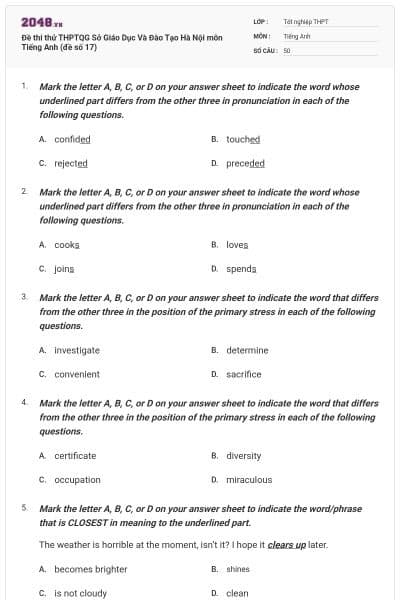
Mark the letter A, B, C, or D on your answer sheet to indicate the word whose underlined part differs from the other three in pronunciation in each of the following questions.
confided
touched
rejected
preceded
Đáp án B
A./id/ B./t/ C./id/ D./id/
Đuôi /ed/ được phát âm là /id/ khi động từ có phát âm kết thúc là /t/ hay /d/
Đuôi /ed/ được phát âm là /t/ khi động từ có phát âm kết thúc là /s/,/f/,/p/,/ʃ/,/tʃ/,/k/
Mark the letter A, B, C, or D on your answer sheet to indicate the word whose underlined part differs from the other three in pronunciation in each of the following questions.
cooks
loves
joins
spends
Đáp án A
A./s/ B./z/ C./z/ D./z/
Khi thêm „s’, /s/ được phát âm là /s/ khi khi động từ có phát âm kết thúc là /k/,/p/,/t/
Các trường hợp còn lại được phát âm là /z/
Mark the letter A, B, C, or D on your answer sheet to indicate the word that differs from the other three in the position of the primary stress in each of the following questions.
investigate
determine
convenient
sacrifice
Đáp án D
Phần D trọng âm rơi vào thứ nhất, còn lại là thứ 2
Investigate: /in’vestigeit/
Determine: /di’tə:min/
Convenient: /kən’vi:njənt/
Sacrifice: /’sækrifais/
Mark the letter A, B, C, or D on your answer sheet to indicate the word that differs from the other three in the position of the primary stress in each of the following questions.
certificate
diversity
occupation
miraculous
Đáp án C
Phần C trọng âm rơi vào âm tiết thứ 3, còn lại là thứ 2
Certificate: /sə’tifikit/
Diversity: /dai’və:siti/
Occupation: /,ɔkju’peiʃn/
Miraculous: /mi’rækjuləs/
Mark the letter A, B, C, or D on your answer sheet to indicate the word/phrase that is CLOSEST in meaning to the underlined part.
The weather is horrible at the moment, isn’t it? I hope it clears up later.
becomes brighter
shines
is not cloudy
clean
Đáp án C
Từ gạch chân: Clear up – (thời tiết) hết mây/mưa
Dịch câu: Thời tiết bây giờ đang rất xấu có phải không? Tôi hi vọng mây mưa sẽ hết
Becomes brighter: trở nên sáng sủa hơn
Shine (v) tỏa nắng
Is not cloudy: không có mây – đồng nghĩa với is not cloudy
Clean: (a) sạch sẽ
Mark the letter A, B, C, or D on your answer sheet to indicate the word/phrase that is CLOSEST in meaning to the underlined part.
There used to be a shop at the end of the street but it went out of business a year ago.
closed up
closed
closed down
closed into
Đáp án C
Từ gạch chân: Go out of business – phá sản, đóng cửa
Dịch câu: Đã từng có một cửa hàng ở cuối phố này nhưng một năm trước đây nó đã bị đóng cửa.
Close up: khít lại
Close: đóng
Close down: đóng cửa
Close into: không có nghĩa
Mark the letter A, B, C, or D on your answer sheet to indicate the word(s) OPPOSITE in meaning to the underlined word(s) in each of the following questions.
Although it’s a long day for us, we feel we are contented with what we do.
interested
dissatisfied
excited
shocked
Đáp án B
“ to be contented with st”: hài lòng, mãn nguyện với cái gì
Từ trái nghĩa là dissatisfied: không hài lòng, không thoả mãn
Dịch câu: Mặc dù đó là một ngày dài đối với chúng tôi, chúng tôi cảm thấy mãn nguyện với những gì chúng tôi làm.
Mark the letter A, B, C, or D on your answer sheet to indicate the word(s) OPPOSITE in meaning to the underlined word(s) in each of the following questions.
I can’t stand people who treat animals cruelly.
gently
cleverly
reasonably
brutally
Đáp án A
“cruelly” (trạng từ): một cách ác độc, một cách tàn nhẫn
Từ trái nghĩa là gently: một cách nhẹ nhàng, một cách dịu dàng
Dịch câu: Tôi không thể chịu được những người đối xử với động vật tàn nhẫn.
Mark the letter A, B, C, or D on your answer sheet to show the underlined part that needs correction.
Students advise to read all the questions carefully and find out the answers to them.
advise
all the questions
out
them
Đáp án A
Dịch câu: Học sinh được khuyên nên đọc tất cả các câu hỏi một cách cẩn thận và tìm ra câu trả lời cho chúng.
Ở đây phải dùng thể bị động chứ không phải chủ động
“advise” => “are advised”
Mark the letter A, B, C, or D on your answer sheet to show the underlined part that needs correction.
My father used to give me a good advice whenever I had a problem.
give
a good advice
whenever
a problem
Đáp án B
Dịch câu: Bố tôi thường cho tôi lời khuyên hữu ích bất cứ khi nào tôi gặp vấn đề.
Advice: lời khuyên – là danh từ không đếm được nên không dùng a
=> a good advice → good advice
Mark the letter A, B, C, or D on your answer sheet to show the underlined part that needs correction.
Not until I was on my way to the airport that I realized I had left my passport at home.
until
on my way
that I realized
at home
Đáp án C
Dịch câu: Mãi cho đến khi tôi đang trên đường ra sân bay thì tôi mới nhận ra tôi đã quên hộ chiếu ở nhà
Cấu trúc đảo ngữ của not until: Not until + S + V, Inversion (đảo ngữ)
=> That I realized → did I realize
Mark the letter A, B, C, or D on your answer sheet to show the underlined part that needs correction.
Our children allowed to have two days off at weekends.
Our
allowed
two days
at weekends
Đáp án B
Dịch câu: Con cái chúng ta được phép có hai ngày nghỉ cuối tuần.
Ở đây phải dùng thể bị động chứ không phải chủ động
“allowed” → “are allowed”
Mark the letter A, B, C, or D on your answer sheet to indicate the correct answer to each of the following questions.
Many applicants find a job interview__________ if they are not well-prepared for it.
impressive
stressful
threatening
time-consuming
Đáp án B
Dịch câu: Nhiều ứng viên cảm thấy phỏng vấn rất áp lực nếu như họ chưa chuẩn bị tốt cho nó
Impressive: ấn tượng
Stressful: áp lực
Threatening: đe doạ
Time-consuming: tốn thời gian
Mark the letter A, B, C, or D on your answer sheet to indicate the correct answer to each of the following questions.
The manager__________ him for a minor mistake.
accused
charged
complained
blamed
Đáp án D
Dịch câu: Người quản lý chê trách anh vì một sai lầm nhỏ
Accuse: buộc tội (đi với giới từ of)
Charge: buộc tội (nếu mang nghĩa là buộc tội ai thì dùng charge sb, không có giới từ)
Complain: phàn nàn
Blame: đổ tội, chê trách (đi với giới từ for)
Mark the letter A, B, C, or D on your answer sheet to indicate the correct answer to each of the following questions.
I __________ hurry. It’s nearly 8.00, and my first class starts at 8.15.
would prefer
can’t help
would rather
had better
Đáp án D
Had better = should: nên
Dịch câu: Tôi nên nhanh chóng thôi. Giờ gần 8h rồi, mà tiết học đầu tiên bắt đầu lúc 8h15
Mark the letter A, B, C, or D on your answer sheet to indicate the correct answer to each of the following questions.
He managed to keep his job__________ the manager had threatened to sack him.
although
despite
unless
therefore
Đáp án A
Although (mặc dù) + một mệnh đề
Despite + danh từ/cụm danh từ
Unless và therefore không phù hợp về nghĩa của câu
Dịch câu: Anh đã giữ được công việc mặc dù quản lý đã doạ sa thải anh.
Mark the letter A, B, C, or D on your answer sheet to indicate the correct answer to each of the following questions.
Don’t touch that wire or you’ll get an electric__________.
shock
fire
charge
current
Đáp án A
Cụm từ “electric shock”: sốc điện, điện giật
Dịch câu: Đừng chạm vào dây đó hoặc bạn sẽ bị điện giật.
Mark the letter A, B, C, or D on your answer sheet to indicate the correct answer to each of the following questions.
The car had a(n) __________ tire, so we had to change the wheel.
bent
flat
cracked
injured
Đáp án B
“flat tire”: xịt lốp xe
Bent: bẻ cong, không thẳng
Cracked: bị vỡ, bị vụn
Injured: bị chấn thương
Dịch câu: Chiếc xe bị xịt lốp, vì vậy chúng tôi đã phải thay đổi bánh xe.
Mark the letter A, B, C, or D on your answer sheet to indicate the correct answer to each of the following questions.
Does television adequately reflect the ethnic and cultural__________ of the country.
costom
diversity
alternations
article
Đáp án B
Dịch câu: truyền hình có phản ánh đầy đủ sự đa dạng sắc tộc và văn hóa của đất nước?
Không có từ costom
Diversity: sự đa dạng
Alternations: sự xen kẽ
Article: đồ, vật phẩm, điều khoản, bài báo…
Mark the letter A, B, C, or D on your answer sheet to indicate the correct answer to each of the following questions.
You should make a(n) __________ to overcome this problem.
trial
impression
effort
apology
Đáp án C
“make an effort to do st”: cố gắng, ráng sức làm gì đó
Dịch câu: Bạn nên nỗ lực để khắc phục vấn đề này
Trial: sự thử thách
Impression: sự ấn tượng
Apology: lời xin lỗi
Mark the letter A, B, C, or D on your answer sheet to indicate the correct answer to each of the following questions.
–“You look beautiful with your new hairstyle!”
– “____________”.
Not at all
It’s kind of you to say so
Very kind of your part
Willingly
Đáp án B
Dịch:
- Bạn trông thật đẹp với kiểu tóc mới đó!
- Bạn thật tốt khi nói như vậy.
Not at all: không có gì
Very kind of your part: Bạn thật là tốt bụng. Dùng đáp lại khi nhận được sự giúp đỡ từ ai đó.
Willingly: Sẵn lòng, vui lòng. Dùng khi nhận được lời đề nghị giúp đỡ từ ai đó.
Mark the letter A, B, C, or D on your answer sheet to indicate the correct answer to each of the following questions.
It was only__________ he told me his surname that I realized that we had been to the same school.
then
until
as soon as
when
Đáp án D
Dịch câu: Chỉ khi anh nói với tôi họ của anh tôi mới nhận ra rằng chúng tôi đã học cùng trường.
Then: sau đó
Until: cho đến tận khi (Ở đây sẽ đúng nếu như sử dụng It was not until….)
As soon as: ngay khi
When: khi (only when: chỉ khi)
Mark the letter A, B, C, or D on your answer sheet to indicate the correct answer to each of the following questions.
The girl __________ design had been chosen stepped to the platform to receive the award.
whose
whom
that
which
Đáp án A
Ở đây chủ ngữ của vị ngữ “had been chosen” là design
Mà chủ ngữ chính trong câu là the girl, do đó chúng ta phải sử dụng mệnh đề quan hệ sở hữu whose để nói về mối quan hệ giữa the girl và design (whose design được hiểu là the girl’s design)
Mark the letter A, B, C, or D on your answer sheet to indicate the correct answer to each of the following questions.
My responsibility is to wash dishes and__________ the garbage.
take care of
take out
take off
take over
Đáp án B
Take out được dùng ở đây với nghĩa tương tự như take away: mang đi
Dịch: trách nhiệm của tôi là phải rửa chén đĩa và mang rác đi.
Read the following passage and mark the letter A, B, C, or D on your answer sheet to indicate the correct word or phrase that best fits each of the numbered blanks.
The latest addiction to trap thousands of people is Internet, which has been (25)________ for broken relationships, job losses, financial ruin and even one suicide. Psychologists now recognize Internet Addiction Syndrome (IAS) as a new illness that could (26)________ serious problems and ruin many lives. Special help groups have been set up to (27)________ sufferers help and support.
IAS is similar to (28)________ problems like gambling, smoking and drinking: addicts have dreams about Internet; they need to use it first thing in the morning; they (29)________ to their partners about how much time they spend online; they (30)_______ they could cut down, but are unable to do so. A recent study found that many users spend up to 40 hours a week on the Internet; (31)______ they felt guilty, they became depressed if they were (32)______ to stop using it.
Almost anyone can be at risk. Some of the addicts are teenagers who are already hooked on computer games and who (33)________ it very difficult to resist the games on the Internet. Surprisingly, however, psychologists (34)________ that most victims are middle-aged housewives who have never used a computer before.
Điền ô số 25
accused
mistaken
blamed
faulted
Đáp án C
Blamed for st: đổ lỗi, chê trách vì cái gì
Dịch: Cơn nghiện mới nhất bẫy hàng ngàn người là Internet, cái mà đã bị đổ lỗi cho việc các mối quan hệ bị phá vỡ, mất việc làm, hủy hoại tài chính và thậm chí tự tử.
Accuse: buộc tội (đi với giới từ of)
Mistaken: nhầm lẫn
Faulted: tìm thấy thiếu sót (ở điểm gì)
Read the following passage and mark the letter A, B, C, or D on your answer sheet to indicate the correct word or phrase that best fits each of the numbered blanks.
The latest addiction to trap thousands of people is Internet, which has been (25)________ for broken relationships, job losses, financial ruin and even one suicide. Psychologists now recognize Internet Addiction Syndrome (IAS) as a new illness that could (26)________ serious problems and ruin many lives. Special help groups have been set up to (27)________ sufferers help and support.
IAS is similar to (28)________ problems like gambling, smoking and drinking: addicts have dreams about Internet; they need to use it first thing in the morning; they (29)________ to their partners about how much time they spend online; they (30)_______ they could cut down, but are unable to do so. A recent study found that many users spend up to 40 hours a week on the Internet; (31)______ they felt guilty, they became depressed if they were (32)______ to stop using it.
Almost anyone can be at risk. Some of the addicts are teenagers who are already hooked on computer games and who (33)________ it very difficult to resist the games on the Internet. Surprisingly, however, psychologists (34)________ that most victims are middle-aged housewives who have never used a computer before.
Điền ô số 26
take
cause
affect
lead
Đáp án B
Cause: gây ra
Dịch: Các nhà tâm lý hiện nay nhận định Internet Addiction Syndrome (IAS) là một căn bệnh mới mà có thể gây ra vấn đề nghiêm trọng và hủy hoại nhiều cuộc đời
Take: lấy đi Affect: ảnh hưởng Lead: dẫn đến
Read the following passage and mark the letter A, B, C, or D on your answer sheet to indicate the correct word or phrase that best fits each of the numbered blanks.
The latest addiction to trap thousands of people is Internet, which has been (25)________ for broken relationships, job losses, financial ruin and even one suicide. Psychologists now recognize Internet Addiction Syndrome (IAS) as a new illness that could (26)________ serious problems and ruin many lives. Special help groups have been set up to (27)________ sufferers help and support.
IAS is similar to (28)________ problems like gambling, smoking and drinking: addicts have dreams about Internet; they need to use it first thing in the morning; they (29)________ to their partners about how much time they spend online; they (30)_______ they could cut down, but are unable to do so. A recent study found that many users spend up to 40 hours a week on the Internet; (31)______ they felt guilty, they became depressed if they were (32)______ to stop using it.
Almost anyone can be at risk. Some of the addicts are teenagers who are already hooked on computer games and who (33)________ it very difficult to resist the games on the Internet. Surprisingly, however, psychologists (34)________ that most victims are middle-aged housewives who have never used a computer before.
Điền ô số 27
recommend
offer
suggest
advise
Đáp án B
Offer: đề nghị, cung cấp, tặng, hiến,…
Dịch: nhóm giúp đỡ đặc biệt đã được thiết lập để cung cấp cho người bệnh sự giúp đỡ và hỗ trợ
Recommend: đề cử, gợi ý
Suggest: gợi ý
Advise: khuyên
Read the following passage and mark the letter A, B, C, or D on your answer sheet to indicate the correct word or phrase that best fits each of the numbered blanks.
The latest addiction to trap thousands of people is Internet, which has been (25)________ for broken relationships, job losses, financial ruin and even one suicide. Psychologists now recognize Internet Addiction Syndrome (IAS) as a new illness that could (26)________ serious problems and ruin many lives. Special help groups have been set up to (27)________ sufferers help and support.
IAS is similar to (28)________ problems like gambling, smoking and drinking: addicts have dreams about Internet; they need to use it first thing in the morning; they (29)________ to their partners about how much time they spend online; they (30)_______ they could cut down, but are unable to do so. A recent study found that many users spend up to 40 hours a week on the Internet; (31)______ they felt guilty, they became depressed if they were (32)______ to stop using it.
Almost anyone can be at risk. Some of the addicts are teenagers who are already hooked on computer games and who (33)________ it very difficult to resist the games on the Internet. Surprisingly, however, psychologists (34)________ that most victims are middle-aged housewives who have never used a computer before.
Điền ô số 28
others
another
the other
other
Đáp án D
Others ( = other + N số nhiều) ở sau others không có danh từ đi kèm nữa
Another + danh từ số ít
The other được sử dụng khi trong câu đã đề cập đến 1 danh từ nào đó rồi, và the other là cái khác, cái còn lại
Other + danh từ số nhiều: những cái khác
Đáp án là D
Read the following passage and mark the letter A, B, C, or D on your answer sheet to indicate the correct word or phrase that best fits each of the numbered blanks.
The latest addiction to trap thousands of people is Internet, which has been (25)________ for broken relationships, job losses, financial ruin and even one suicide. Psychologists now recognize Internet Addiction Syndrome (IAS) as a new illness that could (26)________ serious problems and ruin many lives. Special help groups have been set up to (27)________ sufferers help and support.
IAS is similar to (28)________ problems like gambling, smoking and drinking: addicts have dreams about Internet; they need to use it first thing in the morning; they (29)________ to their partners about how much time they spend online; they (30)_______ they could cut down, but are unable to do so. A recent study found that many users spend up to 40 hours a week on the Internet; (31)______ they felt guilty, they became depressed if they were (32)______ to stop using it.
Almost anyone can be at risk. Some of the addicts are teenagers who are already hooked on computer games and who (33)________ it very difficult to resist the games on the Internet. Surprisingly, however, psychologists (34)________ that most victims are middle-aged housewives who have never used a computer before.
Điền ô số 29
lie
cheat
deceive
betray
Đáp án A
To lie to sb: nói dối ai
Dịch: Họ nói dối bạn bè về khoảng thời gian họ dành ra để online
Cheat: lừa, gian lật (cheat on sb)
Deceive: lừa dối (deceive sb – không có giới từ)
Betray: phản bội (betray sb – không có giới từ)
Read the following passage and mark the letter A, B, C, or D on your answer sheet to indicate the correct word or phrase that best fits each of the numbered blanks.
The latest addiction to trap thousands of people is Internet, which has been (25)________ for broken relationships, job losses, financial ruin and even one suicide. Psychologists now recognize Internet Addiction Syndrome (IAS) as a new illness that could (26)________ serious problems and ruin many lives. Special help groups have been set up to (27)________ sufferers help and support.
IAS is similar to (28)________ problems like gambling, smoking and drinking: addicts have dreams about Internet; they need to use it first thing in the morning; they (29)________ to their partners about how much time they spend online; they (30)_______ they could cut down, but are unable to do so. A recent study found that many users spend up to 40 hours a week on the Internet; (31)______ they felt guilty, they became depressed if they were (32)______ to stop using it.
Almost anyone can be at risk. Some of the addicts are teenagers who are already hooked on computer games and who (33)________ it very difficult to resist the games on the Internet. Surprisingly, however, psychologists (34)________ that most victims are middle-aged housewives who have never used a computer before.
Điền ô số 30
rather
want
prefer
wish
Đáp án D
“wish”: mong rằng, mong ước
Sau wish, động từ khuyết thiếu can được chuyển thành could
Dịch: họ ước có thể cắt giảm (thời gian online), nhưng họ không thể làm được
Read the following passage and mark the letter A, B, C, or D on your answer sheet to indicate the correct word or phrase that best fits each of the numbered blanks.
The latest addiction to trap thousands of people is Internet, which has been (25)________ for broken relationships, job losses, financial ruin and even one suicide. Psychologists now recognize Internet Addiction Syndrome (IAS) as a new illness that could (26)________ serious problems and ruin many lives. Special help groups have been set up to (27)________ sufferers help and support.
IAS is similar to (28)________ problems like gambling, smoking and drinking: addicts have dreams about Internet; they need to use it first thing in the morning; they (29)________ to their partners about how much time they spend online; they (30)_______ they could cut down, but are unable to do so. A recent study found that many users spend up to 40 hours a week on the Internet; (31)______ they felt guilty, they became depressed if they were (32)______ to stop using it.
Almost anyone can be at risk. Some of the addicts are teenagers who are already hooked on computer games and who (33)________ it very difficult to resist the games on the Internet. Surprisingly, however, psychologists (34)________ that most victims are middle-aged housewives who have never used a computer before.
Điền ô số 31
unless
without
although
despite
Đáp án C
Ở đây có sự đối lập về nghĩa giữa 2 vế, do đó cần sử dụng liên từ mang nghĩa đối lập
Although (mặc dù) + một mệnh đề
Dịch: Mặc dù cảm thấy tội lỗi, họ cảm thấy chán nản nếu như phải buộc ngừng sử dụng nó
Read the following passage and mark the letter A, B, C, or D on your answer sheet to indicate the correct word or phrase that best fits each of the numbered blanks.
The latest addiction to trap thousands of people is Internet, which has been (25)________ for broken relationships, job losses, financial ruin and even one suicide. Psychologists now recognize Internet Addiction Syndrome (IAS) as a new illness that could (26)________ serious problems and ruin many lives. Special help groups have been set up to (27)________ sufferers help and support.
IAS is similar to (28)________ problems like gambling, smoking and drinking: addicts have dreams about Internet; they need to use it first thing in the morning; they (29)________ to their partners about how much time they spend online; they (30)_______ they could cut down, but are unable to do so. A recent study found that many users spend up to 40 hours a week on the Internet; (31)______ they felt guilty, they became depressed if they were (32)______ to stop using it.
Almost anyone can be at risk. Some of the addicts are teenagers who are already hooked on computer games and who (33)________ it very difficult to resist the games on the Internet. Surprisingly, however, psychologists (34)________ that most victims are middle-aged housewives who have never used a computer before.
Điền ô số 32
made
allowed
let
had
Đáp án A
To be made to do st: buộc phải làm gì (mang tính bắt buộc)
Dịch: Mặc dù cảm thấy tội lỗi, họ cảm thấy chán nản nếu như phải buộc ngừng sử dụng nó
Allow, let: cho phép
Had trong câu này không đúng về ngữ pháp và về nghĩa
Đáp án là A
Read the following passage and mark the letter A, B, C, or D on your answer sheet to indicate the correct word or phrase that best fits each of the numbered blanks.
The latest addiction to trap thousands of people is Internet, which has been (25)________ for broken relationships, job losses, financial ruin and even one suicide. Psychologists now recognize Internet Addiction Syndrome (IAS) as a new illness that could (26)________ serious problems and ruin many lives. Special help groups have been set up to (27)________ sufferers help and support.
IAS is similar to (28)________ problems like gambling, smoking and drinking: addicts have dreams about Internet; they need to use it first thing in the morning; they (29)________ to their partners about how much time they spend online; they (30)_______ they could cut down, but are unable to do so. A recent study found that many users spend up to 40 hours a week on the Internet; (31)______ they felt guilty, they became depressed if they were (32)______ to stop using it.
Almost anyone can be at risk. Some of the addicts are teenagers who are already hooked on computer games and who (33)________ it very difficult to resist the games on the Internet. Surprisingly, however, psychologists (34)________ that most victims are middle-aged housewives who have never used a computer before.
Điền ô số 33
have
find
feel
say
Đáp án B
Cụm “find it difficult to do st”: cảm thấy khó khăn trong việc làm gì
Dịch:
Một trong số những người nghiện là thanh thiếu niên, những người đã bị cuốn vào trò chơi điện tử và cảm thấy khó để cưỡng lại trò chơi trên Internet
Read the following passage and mark the letter A, B, C, or D on your answer sheet to indicate the correct word or phrase that best fits each of the numbered blanks.
The latest addiction to trap thousands of people is Internet, which has been (25)________ for broken relationships, job losses, financial ruin and even one suicide. Psychologists now recognize Internet Addiction Syndrome (IAS) as a new illness that could (26)________ serious problems and ruin many lives. Special help groups have been set up to (27)________ sufferers help and support.
IAS is similar to (28)________ problems like gambling, smoking and drinking: addicts have dreams about Internet; they need to use it first thing in the morning; they (29)________ to their partners about how much time they spend online; they (30)_______ they could cut down, but are unable to do so. A recent study found that many users spend up to 40 hours a week on the Internet; (31)______ they felt guilty, they became depressed if they were (32)______ to stop using it.
Almost anyone can be at risk. Some of the addicts are teenagers who are already hooked on computer games and who (33)________ it very difficult to resist the games on the Internet. Surprisingly, however, psychologists (34)________ that most victims are middle-aged housewives who have never used a computer before.
Điền ô số 34
say
tell
object
promise
Đáp án A
Say that: nói rằng
Tell: kể (sau đó phải có một tân ngữ, ví dụ tell me, tell us…)
Object: phản đối
Promise: hứa hẹn
Dịch: tuy nhiên, đáng ngạc nhiên là, các nhà tâm lý nói rằng hầu hết các nạn nhân là các bà nội trợ trung niên - người chưa bao giờ sử dụng một máy tính trước đây.
Read the following passage adapted and choose the correct answer (corresponding to A, B, C, or D) to each of the questions that follow.
It’s often said that we learn things at the wrong time. University students frequently do the minimum of work because they’re crazy about a good social life instead. Children often scream before their piano practice because it’s so boring. They have to be given gold stars and medals to be persuaded to swim, or have to be bribed to take exams. But the story is different when you’re older.
Over the years, I’ve done my share of adult learning. At 30, I went to a college and did courses in History and English. It was an amazing experience. For starters, I was paying, so there was no reason to be late – I was the one frowning and drumming my fingers if the tutor was late, not the other way round. Indeed, if I could persuade him to linger for an extra five minutes, it was a bonus, not a nuisance. I wasn’t frightened to ask questions, and homework was a pleasure not a pain. When I passed an exam, I had passed it for me and me alone, not for my parents or my teachers. The satisfaction I got was entirely personal.
Some people fear going back to school because they worry that their brains have got rusty. But the joy is that, although some parts have rusted up, your brain has learnt all kinds of other things since you were young. It has learnt to think independently and flexibly and is much better at relating one thing to another. What you lose in the rust department, you gain in the maturity department.
In some ways, age is a positive plus. For instance, when you’re older, you get less frustrated. Experience has told you that, if you’re calm and simply do something carefully again and again, eventually you’ll get the hang of it. The confidence you have in other areas – from being able to drive a car, perhaps – means that if you can’t, say, build a chair instantly, you don’t, like a child, want to destroy your first pathetic attempts. Maturity tells you that you will, with application, eventually get there.
I hated piano lessons at school, but I was good at music. And coming back to it, with a teacher who could explain why certain exercises were useful and with musical concepts that, at the age of ten, I could never grasp, was magical. Initially, I did feel a bit strange, thumping out a piece that I’d played for my school exams, with just as little comprehension of what the composer intended as I’d had all those years before. But soon, complex emotions that I never knew poured out from my fingers, and suddenly I could understand why practice makes perfect.
It is implied in paragraph 1 that _________.
young learners often lack a good motivation for learning
young learners are usually lazy in their class
teachers should give young learners less homework
parents should encourage young learners to study more
Đáp án A
Đoạn 1 nói rằng: University students frequently do the minimum of work because they’re crazy about a good social life instead. Children often scream before their piano practice because it’s so boring. They have to be given gold stars and medals to be persuaded to swim, or have to be bribed to take exams.
Sinh viên đại học thường xuyên làm mức tối thiểu của công việc bởi vì họ đang điên cuồng về một cuộc sống xã hội tốt. Trẻ em thường hét lên trước khi tập luyện piano, vì nó quá nhàm chán. Họ phải nhận được sao vàng và huy chương để được thuyết phục bơi lội, hoặc phải được hối lộ để tham gia kỳ thi.
=> người trẻ thường thiếu động lực tốt để học (mà thường phải có phần thưởng hay những thứ tương tự mới giúp họ có động lực để học)
Read the following passage adapted and choose the correct answer (corresponding to A, B, C, or D) to each of the questions that follow.
It’s often said that we learn things at the wrong time. University students frequently do the minimum of work because they’re crazy about a good social life instead. Children often scream before their piano practice because it’s so boring. They have to be given gold stars and medals to be persuaded to swim, or have to be bribed to take exams. But the story is different when you’re older.
Over the years, I’ve done my share of adult learning. At 30, I went to a college and did courses in History and English. It was an amazing experience. For starters, I was paying, so there was no reason to be late – I was the one frowning and drumming my fingers if the tutor was late, not the other way round. Indeed, if I could persuade him to linger for an extra five minutes, it was a bonus, not a nuisance. I wasn’t frightened to ask questions, and homework was a pleasure not a pain. When I passed an exam, I had passed it for me and me alone, not for my parents or my teachers. The satisfaction I got was entirely personal.
Some people fear going back to school because they worry that their brains have got rusty. But the joy is that, although some parts have rusted up, your brain has learnt all kinds of other things since you were young. It has learnt to think independently and flexibly and is much better at relating one thing to another. What you lose in the rust department, you gain in the maturity department.
In some ways, age is a positive plus. For instance, when you’re older, you get less frustrated. Experience has told you that, if you’re calm and simply do something carefully again and again, eventually you’ll get the hang of it. The confidence you have in other areas – from being able to drive a car, perhaps – means that if you can’t, say, build a chair instantly, you don’t, like a child, want to destroy your first pathetic attempts. Maturity tells you that you will, with application, eventually get there.
I hated piano lessons at school, but I was good at music. And coming back to it, with a teacher who could explain why certain exercises were useful and with musical concepts that, at the age of ten, I could never grasp, was magical. Initially, I did feel a bit strange, thumping out a piece that I’d played for my school exams, with just as little comprehension of what the composer intended as I’d had all those years before. But soon, complex emotions that I never knew poured out from my fingers, and suddenly I could understand why practice makes perfect.
The writer’s main point in paragraph 2 is to show that as people grow up, _________.
they tend to learn less as they are discouraged
they cannot learn as well as younger learners
they get more impatient with their teachers
they have a more positive attitude towards learning
Đáp án D
Đoạn 2 tác giả chia sẻ:
- At 30, I went to a college and did courses in History and English. It was an amazing experience.
Lúc 30 tuổi, tôi đến một trường đại học và học các khoá học Lịch sử và Tiếng Anh. Nó là một trải nghiệm tuyệt vời
- I wasn’t frightened to ask questions, and homework was a pleasure not a pain. When I passed an exam, I had passed it for me and me alone, not for my parents or my teachers. The satisfaction I got was entirely personal.
Tôi không sợ việc phải đặt câu hỏi, và bài tập về nhà là niềm vui thích chứ không phải đau khổ. Khi tôi vượt qua một kì thi, tôi đã vượt qua nó cho bản thân và chỉ cho bản thân thôi, không phải cho bố mẹ hay giáo viên. Sự hài lòng tôi có được hoàn toàn mang tính cá nhân
=> tác giả cho rằng, khi con người lớn hơn, họ có thái độ tính cực hơn đối với việc học tập (chứ không giống như lúc trẻ - phải có một phần thưởng gì đó mới học)
Read the following passage adapted and choose the correct answer (corresponding to A, B, C, or D) to each of the questions that follow.
It’s often said that we learn things at the wrong time. University students frequently do the minimum of work because they’re crazy about a good social life instead. Children often scream before their piano practice because it’s so boring. They have to be given gold stars and medals to be persuaded to swim, or have to be bribed to take exams. But the story is different when you’re older.
Over the years, I’ve done my share of adult learning. At 30, I went to a college and did courses in History and English. It was an amazing experience. For starters, I was paying, so there was no reason to be late – I was the one frowning and drumming my fingers if the tutor was late, not the other way round. Indeed, if I could persuade him to linger for an extra five minutes, it was a bonus, not a nuisance. I wasn’t frightened to ask questions, and homework was a pleasure not a pain. When I passed an exam, I had passed it for me and me alone, not for my parents or my teachers. The satisfaction I got was entirely personal.
Some people fear going back to school because they worry that their brains have got rusty. But the joy is that, although some parts have rusted up, your brain has learnt all kinds of other things since you were young. It has learnt to think independently and flexibly and is much better at relating one thing to another. What you lose in the rust department, you gain in the maturity department.
In some ways, age is a positive plus. For instance, when you’re older, you get less frustrated. Experience has told you that, if you’re calm and simply do something carefully again and again, eventually you’ll get the hang of it. The confidence you have in other areas – from being able to drive a car, perhaps – means that if you can’t, say, build a chair instantly, you don’t, like a child, want to destroy your first pathetic attempts. Maturity tells you that you will, with application, eventually get there.
I hated piano lessons at school, but I was good at music. And coming back to it, with a teacher who could explain why certain exercises were useful and with musical concepts that, at the age of ten, I could never grasp, was magical. Initially, I did feel a bit strange, thumping out a piece that I’d played for my school exams, with just as little comprehension of what the composer intended as I’d had all those years before. But soon, complex emotions that I never knew poured out from my fingers, and suddenly I could understand why practice makes perfect.
The phrase “For starters” in paragraph 2 could best be replaced by “______”.
For beginners
At the starting point
At the beginning
First and foremost
Đáp án D
“For starters” = “First and foremost”: đầu tiên và hàng đầu
For starters, I was paying, so there was no reason to be late – I was the one frowning and drumming my fingers if the tutor was late, not the other way round.
Đầu tiên, tôi đã trả tiền, vì vậy không có lý do gì để đi trễ - Tôi là người sẽ cau mày và gõ gõ ngón tay nếu gia sư đến muộn, không phải là ngược lại.
Read the following passage adapted and choose the correct answer (corresponding to A, B, C, or D) to each of the questions that follow.
It’s often said that we learn things at the wrong time. University students frequently do the minimum of work because they’re crazy about a good social life instead. Children often scream before their piano practice because it’s so boring. They have to be given gold stars and medals to be persuaded to swim, or have to be bribed to take exams. But the story is different when you’re older.
Over the years, I’ve done my share of adult learning. At 30, I went to a college and did courses in History and English. It was an amazing experience. For starters, I was paying, so there was no reason to be late – I was the one frowning and drumming my fingers if the tutor was late, not the other way round. Indeed, if I could persuade him to linger for an extra five minutes, it was a bonus, not a nuisance. I wasn’t frightened to ask questions, and homework was a pleasure not a pain. When I passed an exam, I had passed it for me and me alone, not for my parents or my teachers. The satisfaction I got was entirely personal.
Some people fear going back to school because they worry that their brains have got rusty. But the joy is that, although some parts have rusted up, your brain has learnt all kinds of other things since you were young. It has learnt to think independently and flexibly and is much better at relating one thing to another. What you lose in the rust department, you gain in the maturity department.
In some ways, age is a positive plus. For instance, when you’re older, you get less frustrated. Experience has told you that, if you’re calm and simply do something carefully again and again, eventually you’ll get the hang of it. The confidence you have in other areas – from being able to drive a car, perhaps – means that if you can’t, say, build a chair instantly, you don’t, like a child, want to destroy your first pathetic attempts. Maturity tells you that you will, with application, eventually get there.
I hated piano lessons at school, but I was good at music. And coming back to it, with a teacher who could explain why certain exercises were useful and with musical concepts that, at the age of ten, I could never grasp, was magical. Initially, I did feel a bit strange, thumping out a piece that I’d played for my school exams, with just as little comprehension of what the composer intended as I’d had all those years before. But soon, complex emotions that I never knew poured out from my fingers, and suddenly I could understand why practice makes perfect.
While doing some adult learning courses at a college, the writer was surprised ______.
to have more time to learn
to be able to learn more quickly
to feel learning more enjoyable
to get on better with the tutor
Đáp án C
Đoạn 2 có những thông tin:
- Indeed, if I could persuade him to linger for an extra five minutes, it was a bonus, not a nuisance.
Thật ra, nếu tôi có thể thuyết phục anh nán lại cho thêm một năm phút, nó là một phần thưởng, không phải là một mối phiền toái.
- The satisfaction I got was entirely personal.
Sự hài lòng tôi có được hoàn toàn mang tính cá nhân
=> trong quá trình học, tác giả đã cảm thấy thích thú việc học
Read the following passage adapted and choose the correct answer (corresponding to A, B, C, or D) to each of the questions that follow.
It’s often said that we learn things at the wrong time. University students frequently do the minimum of work because they’re crazy about a good social life instead. Children often scream before their piano practice because it’s so boring. They have to be given gold stars and medals to be persuaded to swim, or have to be bribed to take exams. But the story is different when you’re older.
Over the years, I’ve done my share of adult learning. At 30, I went to a college and did courses in History and English. It was an amazing experience. For starters, I was paying, so there was no reason to be late – I was the one frowning and drumming my fingers if the tutor was late, not the other way round. Indeed, if I could persuade him to linger for an extra five minutes, it was a bonus, not a nuisance. I wasn’t frightened to ask questions, and homework was a pleasure not a pain. When I passed an exam, I had passed it for me and me alone, not for my parents or my teachers. The satisfaction I got was entirely personal.
Some people fear going back to school because they worry that their brains have got rusty. But the joy is that, although some parts have rusted up, your brain has learnt all kinds of other things since you were young. It has learnt to think independently and flexibly and is much better at relating one thing to another. What you lose in the rust department, you gain in the maturity department.
In some ways, age is a positive plus. For instance, when you’re older, you get less frustrated. Experience has told you that, if you’re calm and simply do something carefully again and again, eventually you’ll get the hang of it. The confidence you have in other areas – from being able to drive a car, perhaps – means that if you can’t, say, build a chair instantly, you don’t, like a child, want to destroy your first pathetic attempts. Maturity tells you that you will, with application, eventually get there.
I hated piano lessons at school, but I was good at music. And coming back to it, with a teacher who could explain why certain exercises were useful and with musical concepts that, at the age of ten, I could never grasp, was magical. Initially, I did feel a bit strange, thumping out a piece that I’d played for my school exams, with just as little comprehension of what the composer intended as I’d had all those years before. But soon, complex emotions that I never knew poured out from my fingers, and suddenly I could understand why practice makes perfect.
In paragraph 3, the word “rusty” means ______.
not as good as it used to be through lack of practice
impatient because of having nothing to do
staying alive and becoming more active
covered with rust and not as good as it used to be
Đáp án A
“rusty” = not as good as it used to be through lack of practice: không được tốt như đã từng bởi vì thiếu sự luyện tập
Some people fear going back to school because they worry that their brains have got rusty.
Một số người sợ đi học trở lại vì họ lo lắng rằng bộ não của họ không còn được như trước.
Read the following passage adapted and choose the correct answer (corresponding to A, B, C, or D) to each of the questions that follow.
It’s often said that we learn things at the wrong time. University students frequently do the minimum of work because they’re crazy about a good social life instead. Children often scream before their piano practice because it’s so boring. They have to be given gold stars and medals to be persuaded to swim, or have to be bribed to take exams. But the story is different when you’re older.
Over the years, I’ve done my share of adult learning. At 30, I went to a college and did courses in History and English. It was an amazing experience. For starters, I was paying, so there was no reason to be late – I was the one frowning and drumming my fingers if the tutor was late, not the other way round. Indeed, if I could persuade him to linger for an extra five minutes, it was a bonus, not a nuisance. I wasn’t frightened to ask questions, and homework was a pleasure not a pain. When I passed an exam, I had passed it for me and me alone, not for my parents or my teachers. The satisfaction I got was entirely personal.
Some people fear going back to school because they worry that their brains have got rusty. But the joy is that, although some parts have rusted up, your brain has learnt all kinds of other things since you were young. It has learnt to think independently and flexibly and is much better at relating one thing to another. What you lose in the rust department, you gain in the maturity department.
In some ways, age is a positive plus. For instance, when you’re older, you get less frustrated. Experience has told you that, if you’re calm and simply do something carefully again and again, eventually you’ll get the hang of it. The confidence you have in other areas – from being able to drive a car, perhaps – means that if you can’t, say, build a chair instantly, you don’t, like a child, want to destroy your first pathetic attempts. Maturity tells you that you will, with application, eventually get there.
I hated piano lessons at school, but I was good at music. And coming back to it, with a teacher who could explain why certain exercises were useful and with musical concepts that, at the age of ten, I could never grasp, was magical. Initially, I did feel a bit strange, thumping out a piece that I’d played for my school exams, with just as little comprehension of what the composer intended as I’d had all those years before. But soon, complex emotions that I never knew poured out from my fingers, and suddenly I could understand why practice makes perfect.
The phrase “get there” in paragraph 4 is closest in meaning to “______”.
receive a school or college degree
arrive at an intended place with difficulty
have the things you have long desired
achieve your aim with hard work
Đáp án D
“get there” ~ achieve your aim with hard work: đạt được mục tiêu bằng cách làm việc chăm chỉ
The confidence you have in other areas – from being able to drive a car, perhaps – means that if you can’t, say, build a chair instantly, you don’t, like a child, want to destroy your first pathetic attempts. Maturity tells you that you will, with application, eventually get there.
Sự tự tin bạn có trong các lĩnh vực khác –có lẽ từ việc có thể lái xe một chiếc xe - có nghĩa là nếu bạn không thể, nói rằng, xây dựng một chiếc ghế ngay lập tức, bạn không, giống như một đứa trẻ, muốn phá huỷ nỗ lực thảm hại đầu tiên của bạn. Maturity nói với bạn rằng bạn sẽ, với các ứng dụng, cuối cùng đạt được điều đó.
Read the following passage adapted and choose the correct answer (corresponding to A, B, C, or D) to each of the questions that follow.
It’s often said that we learn things at the wrong time. University students frequently do the minimum of work because they’re crazy about a good social life instead. Children often scream before their piano practice because it’s so boring. They have to be given gold stars and medals to be persuaded to swim, or have to be bribed to take exams. But the story is different when you’re older.
Over the years, I’ve done my share of adult learning. At 30, I went to a college and did courses in History and English. It was an amazing experience. For starters, I was paying, so there was no reason to be late – I was the one frowning and drumming my fingers if the tutor was late, not the other way round. Indeed, if I could persuade him to linger for an extra five minutes, it was a bonus, not a nuisance. I wasn’t frightened to ask questions, and homework was a pleasure not a pain. When I passed an exam, I had passed it for me and me alone, not for my parents or my teachers. The satisfaction I got was entirely personal.
Some people fear going back to school because they worry that their brains have got rusty. But the joy is that, although some parts have rusted up, your brain has learnt all kinds of other things since you were young. It has learnt to think independently and flexibly and is much better at relating one thing to another. What you lose in the rust department, you gain in the maturity department.
In some ways, age is a positive plus. For instance, when you’re older, you get less frustrated. Experience has told you that, if you’re calm and simply do something carefully again and again, eventually you’ll get the hang of it. The confidence you have in other areas – from being able to drive a car, perhaps – means that if you can’t, say, build a chair instantly, you don’t, like a child, want to destroy your first pathetic attempts. Maturity tells you that you will, with application, eventually get there.
I hated piano lessons at school, but I was good at music. And coming back to it, with a teacher who could explain why certain exercises were useful and with musical concepts that, at the age of ten, I could never grasp, was magical. Initially, I did feel a bit strange, thumping out a piece that I’d played for my school exams, with just as little comprehension of what the composer intended as I’d had all those years before. But soon, complex emotions that I never knew poured out from my fingers, and suddenly I could understand why practice makes perfect.
All of the following are true about adult learning EXCEPT ______.
young people usually feel less patient than adults
experience in doing other things can help one’s learning
adult learners have fewer advantages than young learners
adults think more independently and flexibly than young people
Đáp án C
A,B,D đều được nhắc đến trong bài:
- In some ways, age is a positive plus. For instance, when you’re older, you get less frustrated. Experience has told you that, if you’re calm and simply do something carefully again and again, eventually you’ll get the hang of it.
- your brain has learnt all kinds of other things since you were young. It has learnt to think independently and flexibly and is much better at relating one thing to another. (B & D
Read the following passage adapted and choose the correct answer (corresponding to A, B, C, or D) to each of the questions that follow.
It’s often said that we learn things at the wrong time. University students frequently do the minimum of work because they’re crazy about a good social life instead. Children often scream before their piano practice because it’s so boring. They have to be given gold stars and medals to be persuaded to swim, or have to be bribed to take exams. But the story is different when you’re older.
Over the years, I’ve done my share of adult learning. At 30, I went to a college and did courses in History and English. It was an amazing experience. For starters, I was paying, so there was no reason to be late – I was the one frowning and drumming my fingers if the tutor was late, not the other way round. Indeed, if I could persuade him to linger for an extra five minutes, it was a bonus, not a nuisance. I wasn’t frightened to ask questions, and homework was a pleasure not a pain. When I passed an exam, I had passed it for me and me alone, not for my parents or my teachers. The satisfaction I got was entirely personal.
Some people fear going back to school because they worry that their brains have got rusty. But the joy is that, although some parts have rusted up, your brain has learnt all kinds of other things since you were young. It has learnt to think independently and flexibly and is much better at relating one thing to another. What you lose in the rust department, you gain in the maturity department.
In some ways, age is a positive plus. For instance, when you’re older, you get less frustrated. Experience has told you that, if you’re calm and simply do something carefully again and again, eventually you’ll get the hang of it. The confidence you have in other areas – from being able to drive a car, perhaps – means that if you can’t, say, build a chair instantly, you don’t, like a child, want to destroy your first pathetic attempts. Maturity tells you that you will, with application, eventually get there.
I hated piano lessons at school, but I was good at music. And coming back to it, with a teacher who could explain why certain exercises were useful and with musical concepts that, at the age of ten, I could never grasp, was magical. Initially, I did feel a bit strange, thumping out a piece that I’d played for my school exams, with just as little comprehension of what the composer intended as I’d had all those years before. But soon, complex emotions that I never knew poured out from my fingers, and suddenly I could understand why practice makes perfect.
It can be inferred from paragraph 4 that maturity is a positive plus in the learning process because adult learners ______.
pay more attention to detail than younger learners
are able to organize themselves better than younger learners
are less worried about learning than younger learners
have become more patient than younger learners
Đáp án D
Thông tin ở trong đoạn 4:
In some ways, age is a positive plus. For instance, when you’re older, you get less frustrated. Experience has told you that, if you’re calm and simply do something carefully again and again, eventually you’ll get the hang of it.
Ở một số cách, tuổi tác là một điểm cộng tích cực. Ví dụ, khi bạn lớn tuổi hơn, bạn sẽ thấy ít chán nản hơn. Kinh nghiệm nói với bạn rằng, nếu bạn bình tĩnh và chỉ cần làm điều gì đó một cách cẩn thận lặp đi lặp lại, cuối cùng bạn sẽ học được cách thực hiện nó.
=> khi bạn lớn tuổi hơn, thì bạn sẽ kiên nhẫn hơn là khi còn trẻ (bởi bạn ít bị chán nản bởi thất bại hơn và đủ bình tĩnh để thực hiện lại)
Read the following passage adapted and choose the correct answer (corresponding to A, B, C, or D) to each of the questions that follow.
It’s often said that we learn things at the wrong time. University students frequently do the minimum of work because they’re crazy about a good social life instead. Children often scream before their piano practice because it’s so boring. They have to be given gold stars and medals to be persuaded to swim, or have to be bribed to take exams. But the story is different when you’re older.
Over the years, I’ve done my share of adult learning. At 30, I went to a college and did courses in History and English. It was an amazing experience. For starters, I was paying, so there was no reason to be late – I was the one frowning and drumming my fingers if the tutor was late, not the other way round. Indeed, if I could persuade him to linger for an extra five minutes, it was a bonus, not a nuisance. I wasn’t frightened to ask questions, and homework was a pleasure not a pain. When I passed an exam, I had passed it for me and me alone, not for my parents or my teachers. The satisfaction I got was entirely personal.
Some people fear going back to school because they worry that their brains have got rusty. But the joy is that, although some parts have rusted up, your brain has learnt all kinds of other things since you were young. It has learnt to think independently and flexibly and is much better at relating one thing to another. What you lose in the rust department, you gain in the maturity department.
In some ways, age is a positive plus. For instance, when you’re older, you get less frustrated. Experience has told you that, if you’re calm and simply do something carefully again and again, eventually you’ll get the hang of it. The confidence you have in other areas – from being able to drive a car, perhaps – means that if you can’t, say, build a chair instantly, you don’t, like a child, want to destroy your first pathetic attempts. Maturity tells you that you will, with application, eventually get there.
I hated piano lessons at school, but I was good at music. And coming back to it, with a teacher who could explain why certain exercises were useful and with musical concepts that, at the age of ten, I could never grasp, was magical. Initially, I did feel a bit strange, thumping out a piece that I’d played for my school exams, with just as little comprehension of what the composer intended as I’d had all those years before. But soon, complex emotions that I never knew poured out from my fingers, and suddenly I could understand why practice makes perfect.
It is implied in the last paragraph that when you learn later in life, you ______.
are not able to concentrate as well as when you were younger
find that you can recall a lot of things you learnt when younger
should expect to take longer to learn than when you were younger
can sometimes understand more than when you were younger
Đáp án D
Tác giả đã nhận ra nhiều điều mà trước đây khi còn trẻ đã không nhận ra khi học đàn
Thông tin ở câu cuối: But soon, complex emotions that I never knew poured out from my fingers, and suddenly I could understand why practice makes perfect.
Nhưng ngay sau đó, cảm xúc phức tạp mà tôi không bao giờ biết tuôn ra từ các ngón tay, và đột nhiên tôi có thể hiểu tại sao thực hành tạo nên hoàn hảo.
Read the following passage adapted and choose the correct answer (corresponding to A, B, C, or D) to each of the questions that follow.
It’s often said that we learn things at the wrong time. University students frequently do the minimum of work because they’re crazy about a good social life instead. Children often scream before their piano practice because it’s so boring. They have to be given gold stars and medals to be persuaded to swim, or have to be bribed to take exams. But the story is different when you’re older.
Over the years, I’ve done my share of adult learning. At 30, I went to a college and did courses in History and English. It was an amazing experience. For starters, I was paying, so there was no reason to be late – I was the one frowning and drumming my fingers if the tutor was late, not the other way round. Indeed, if I could persuade him to linger for an extra five minutes, it was a bonus, not a nuisance. I wasn’t frightened to ask questions, and homework was a pleasure not a pain. When I passed an exam, I had passed it for me and me alone, not for my parents or my teachers. The satisfaction I got was entirely personal.
Some people fear going back to school because they worry that their brains have got rusty. But the joy is that, although some parts have rusted up, your brain has learnt all kinds of other things since you were young. It has learnt to think independently and flexibly and is much better at relating one thing to another. What you lose in the rust department, you gain in the maturity department.
In some ways, age is a positive plus. For instance, when you’re older, you get less frustrated. Experience has told you that, if you’re calm and simply do something carefully again and again, eventually you’ll get the hang of it. The confidence you have in other areas – from being able to drive a car, perhaps – means that if you can’t, say, build a chair instantly, you don’t, like a child, want to destroy your first pathetic attempts. Maturity tells you that you will, with application, eventually get there.
I hated piano lessons at school, but I was good at music. And coming back to it, with a teacher who could explain why certain exercises were useful and with musical concepts that, at the age of ten, I could never grasp, was magical. Initially, I did feel a bit strange, thumping out a piece that I’d played for my school exams, with just as little comprehension of what the composer intended as I’d had all those years before. But soon, complex emotions that I never knew poured out from my fingers, and suddenly I could understand why practice makes perfect.
What is the writer’s main purpose in the passage?
To encourage adult learning
To show how fast adult learning is
To explain reasons for learning
To describe adult learning methods
Đáp án A
Mục đích chính của tác giả khi viết bài là: To encourage adult learning: khuyến khích người lớn học tập
Bởi vì thông qua bài viết, tác giả có nói đến nhiều công dụng khi người lớn học tập. Có thể nhắc tới:
- Có thái độ tích cực đối với học tập
- Kiên nhẫn hơn so với lúc trẻ
- Khám phá ra nhiều điều mà khi trẻ không phát hiện ra
- Học một thứ và có thể liên quan, giải quyết nhiều thứ khác
Mark the letter A, B, C, or D on your answer sheet to indicate the sentence that is closest in meaning to each of the following questions.
I have never tasted this kind of food before.
I have tasted this kind of food
I tasted this kind of food long time ago
It is the first time I tasted this kind of food
It is the first time I have ever tasted this kind of food
Đáp án D
Tôi chưa bao giờ nếm thử loại đồ ăn này trước đây
= Đây là lần đầu tiên tôi nếm thử loại đồ ăn này
Khi dùng This is/ It is the first time + thì hoàn thành
Mark the letter A, B, C, or D on your answer sheet to indicate the sentence that is closest in meaning to each of the following questions.
No sooner had she put the telephone down than her boss rang back.
Hardly she had hung up, she rang her boss immediately
As soon as her boss rang back, she put down the telephone
She had hardly put the telephone down without her boss rang back
Scarcely had she put the telephone down when her boss rang back
Đáp án D
No sooner had she put the telephone down than her boss rang back.
Ngay khi cô đặt điện thoại xuống, ông chủ đã gọi lại
Cấu trúc đảo ngữ với Scarely: Scarely + had + S + động từ phân từ II +… + when + mệnh đề quá khứ đơn
Mark the letter A, B, C or D on your answer sheet to indicate the sentence that best combines the pair of sentences given in each of the following questions.
John is studying hard. He doesn't want to fail the next exam
John is studying hard in order that he not fail the next exam
John is studying hard in order not to fail the next exam
John is studying hard in order to not to fail the next exam
John is studying hard so as to fail the next exam
Đáp án B
John is studying hard. He doesn’t want to fail the next exam.
John đang học chăm chỉ. Cậu ấy không muốn trượt kì thi tiếp theo
= John is studying hard in order not to fail the next exam
John đang học chăm chỉ để không bị trượt kì thi tiếp theo
“in order not to do st”: để không làm gì đó
Mark the letter A, B, C or D on your answer sheet to indicate the sentence that best combines the pair of sentences given in each of the following questions.
He was suspected of having stolen credit cards. The police have investigated him for days.
Suspected of having stolen credit cards, he has been investigated for days
Suspecting of having stolen credit cards, he has been investigated for days
He has been investigated for days, suspecting of having stolen credit cards
Having suspected of having stolen credit cards, he has been investigated for days
Đáp án A
He was suspected of having stolen credit cards. The police have investigated him for days. Anh ta bị tình nghi ăn trộm thẻ tín dụng. Cảnh sát đã điều tra anh ấy trong nhiều ngày.
= Suspected of having stolen credit cards, he has been investigated for days
Bị tình nghi ăn trộm thẻ tín dụng, anh ta đã bị điều tra trong nhiều ngày
Ở đây chủ ngữ là he đang được chia ở bị động (was suspected) nên khi viết lại câu, dùng suspected ở đầu câu để giữ nguyên dạng bị động
Mark the letter A, B, C or D on your answer sheet to indicate the sentence that best combines the pair of sentences given in each of the following questions.
I strongly disapproved of your behavior. However, I will help you this time.
Despite of my strong disapproval of your behavior, I will help you this time
Despite my strong disapproval of your behavior, I will help you this time
Because of your behavior, I will help you this time
Although I strongly disapproved of your behavior, but I will help you this time
Đáp án B
Despite + danh từ/cụm danh từ (không có of) nên câu A loại
Sau vế Although không dùng but => câu D loại
Câu C không phù hợp về nghĩa (câu gốc là đối lập, nhưng câu C lại là nhân quả)
Mark the letter A, B, C or D on your answer sheet to indicate the sentence that best combines the pair of sentences given in each of the following questions.
He is very intelligent. He can solve all the problems in no time.
He is so an intelligent that he can solve all the problems in no time
He is so intelligent a boy that he can solve all the problems in no time
He is such intelligent that he can solve all the problems in no time
He is very intelligent that he can solve all the problems in no time
Đáp án B
He is very intelligent. He can solve all the problems in no time.
Anh ấy rất thông minh. Anh ấy có thể giải đáp mọi vấn đề nhanh chóng
Viết lại với cấu trúc nhấn mạnh so…that… (…đến nỗi mà…)
Câu D loại, câu C loại vì thiếu mạo từ an
Câu A thừa mạo từ an (Đúng phải là he is so intelligent that…)
Câu B đúng (so adj + a hoặc an (nếu danh từ đếm được) + danh từ)