Đề thi thử THPTQG năm 2019 chuẩn cấu trúc của bộ giáo dục có đáp án (Đề số 28)
50 câu hỏi
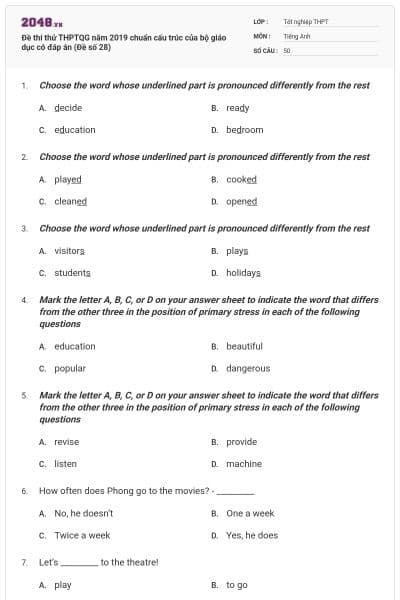
Choose the word whose underlined part is pronounced differently from the rest
decide
ready
education
bedroom
Đáp án C
Phần gạch chân câu C phát âm là /dʒ/, còn lại các đáp án khác phát âm là /d/
A. decide /di'said/ (v): quyết định
B. ready /'redi/(adj): sẵn sàng
C. education /ˌedʒuˈkeɪʃn/ (n): giáo dục
D. bedroom /'bedrum/(n): phòng ngủ
Choose the word whose underlined part is pronounced differently from the rest
played
cooked
cleaned
opened
Đáp án B
Phần gạch chân ‘ed’ câu B phát âm là /t/, các đáp án còn lại được phát âm là /d/
A. played /ˌpleɪd/(v): chơi
B. cooked /kʊkt/(v): nấu ăn
C. cleaned /kliːnd/(v): dọn dẹp
D. opened /ˈəʊpənd/(v): mở
Lưu ý: Phát âm cuối ‘ed’,
- Đuôi “ed” được phát âm là /id/: khi động từ có phát âm kết thúc là /t/ hay /d/.
- Đuôi ed được phát âm là /t/: Khi động từ có phát âm kết thúc là: /ch/, /p/, /f/, /s/, /k/, /th/, /ʃ/, /tʃ/.
- Đuôi ed được phát âm là /d/ trong các trường hợp còn lại
Choose the word whose underlined part is pronounced differently from the rest
visitors
plays
students
holidays
Đáp án C
Phần gạch chân ‘s’ của đáp án C được phát âm là /s/, các đáp án còn lại được phát âm là /z/
A. visitors /ˈvɪzɪtərz/(n): du khách
B. plays/pleɪz/(v): chơi
C. students/ˈstjuːdnts/(n): học sinh, sinh viên
D. holidays/ˈhɒlədeɪz/(n): kì nghỉ
Lưu ý: Cách phát âm đuôi “s/es”
- Phát âm là /s/ khi từ có tận cùng bằng các phụ âm vô thanh: /ð/, /p/, /k/, /f/, /t/.
- Phát âm là /iz/ khi từ có tận cùng là các âm: /s/, /z/, /ʃ/, /tʃ/, /ʒ/, /dʒ/.
- Phát âm là /z/ khi các từ có tận cùng là nguyên âm và các phụ âm hữu thanh còn lại.
Mark the letter A, B, C, or D on your answer sheet to indicate the word that differs from the other three in the position of primary stress in each of the following questions
education
beautiful
popular
dangerous
Đáp án A
Trọng âm rơi vào âm tiết thứ 3, các đáp án còn lại rơi vào âm tiết thứ nhất
A. education /ˌedʒuˈkeɪʃn/ (n): giáo dục
B. beautiful /ˈbjuːtɪfl/(adj): xinh đẹp
C. popular /ˈpɒpjələ(r)/(adj): nổi tiếng, vang danh
D. dangerous /ˈdeɪndʒərəs/(adj): nguy hiểm
Mark the letter A, B, C, or D on your answer sheet to indicate the word that differs from the other three in the position of primary stress in each of the following questions
revise
provide
listen
machine
Đáp án C
Trọng âm rơi vào âm tiết thứ nhất, các đáp án còn lại rơi vào âm tiết thứ 2
A. revise /rɪˈvaɪz/(v): xem lại, ôn tập
B. provide /prəˈvaɪd/(v): cung cấp
C. listen /ˈlɪsn/ (v): lắng nghe
D. machine /məˈʃiːn/ (n): máy móc
How often does Phong go to the movies? - _________
No, he doesn’t
One a week
Twice a week
Yes, he does
Đáp án C
Bao lâu thì Phong tới rạp chiếu phim?
-2 lần 1 tuần
Các đáp án còn lại không phù hợp:
A. Không, anh ta không tới
B. One a week=>sai cấu trúc, phải là ‘once a week’-1 lần 1 tuần
D. Vâng, anh ấy có đi
Let’s _________ to the theatre!
play
to go
go
going
Đáp án C
Cấu trúc câu rủ rê, mời gọi : Let’s +V
What/How about+ doing smt
I suggest + doing smt
Why don’t we + do smt
Dịch: Chúng ta cùng tới rạp chiếu phim nào!
Don’t forget _________ home as soon as you arrive at your destination.
to be called
to call
calling
having called
Đáp án B
‘Forget’ + to V: quên làm gì trong tương lai (trong câu này có mệnh đề chỉ thời gian trong tương lại ‘as soon as you arrive at your destination’ )
+ doing smt: quên đã làm gì
+ having doing smt: đã quên làm gì trong quá khứ
Dịch: Đừng quên gọi điện về nhà ngay khi bạn tới nơi
They are a very _________ family. All of them have very close relationship with one another
typical
strange
friendly
close-knit
Đáp án D
close-knit (adj): thân thiết, khăng khít, gần gũi
Các đáp án còn lại:
A.typical (adj): điển hình
B.strange (adj): lạ lùng
C.friendly (adj): thân thiện, hiếu khách
Dịch: Họ là 1 gia đình thật thật thân thiết, tất cả các thành viên đều gần gũi với nhau
Sometimes Mr. Pike has to work very late ________ night to do some important experiments
in
on
at
for
Đáp án C
at night: vào ban đêm, tối muộn
Dịch: Ông Pike thỉnh thoảng phải làm việc muộn tới tận đêm để tiến hành các thí nghiệm quan trọng
If it _________ tomorrow, we’ll not go swimming.
will rain
is raining
rained
rains
Đáp án D
Câu điều kiện loại I
Chú ý: Các câu điều kiện
+ Câu điều kiện loại 0: If S V(s/es), S V(s/es) ( chỉ 1 sự thật hiển nhiên, chắc chắn xảy ra)
+ Câu điều kiện loại I: If S V(s/es), S will V ( chỉ 1 điều kiện có thể xảy ra ở tương lai)
+ Câu điều kiện loại II: If S V(quá khứ), S would V (chỉ 1 điều kiện không có thật ở hiện tại)
+ Câu điều kiện loại III: If S had PII, S would have PII (chỉ 1 điều kiện khôg có thật ở quá khứ)
+ Câu điều kiện loại Mixed : If had PII, S would have PII (Chỉ điều kiện mà hành động trái với quá khứ và kết quả trái với hiện tại, thường là mối quan hệ nhân quả)
Dịch: Nếu trời mưa, chúng ta sẽ không đi bơi nữa
The child is old enough _________ to school.
to go
goes
can go
go
Đáp án A
Cấu trúc: ‘tobe +adj enough +to V’: đủ để làm gì
Dịch: Đứa trẻ đủ chững chạc để tới trường
_________you _________a new bike last month ?
Are ….going to buy
Did…. bought
Do…buy
Did …buy
Đáp án D
Câu hỏi ở thì quá khứ đơn (DH: last month: tháng trước)-‘Did sbd do smt’
Dịch: Có phải cậu đã mua 1 chiếc xe đạp mới vào tháng trước?
The girl students enjoy _________ English songs.
sing
sang
to sing
singing
Đáp án D
enjoy doing smt: thưởng thức, thích thú cái gì
Dịch: Những nữ sinh đang thưởng thức các bài hát tiếng Anh
He told his brother _______ out that night.
don’t go
didn’t go
not go
not to go
Đáp án D
tell sbd (not) to V: bảo ai làm gì/bảo ai không được làm gì
Dịch: Anh ta bảo em trai mình đừng có ra ngoài vào buổi tối hôm qua
Mr. and Mrs. Brown _______ here for 15 years.
have lived
live
has lived
lived
Đáp án A
Thì hiện tại hoàn thành diễn tả hành động xảy ra ở quá khứ, tiếp diễn đến hiện tại và tương lai: ‘have/has PII’ (DH: for+ thời gian)
Chủ ngữ số nhiều nên động từ chia số nhiều
Dịch: Ông bà Brown đã sống ở đây được 15 năm rồi ( và họ sẽ còn tiếp tục sống ở đây trong tương lai)
Jane’s _______ in the family is helping her younger brother with his study.
activity
task
job
responsibility
Đáp án D
responsibility: trách nhiệm
Các đáp án còn lại:
A. activity(n): hoạt động
B. task(n): nhiệm vụ
C. job(n): công việc
Dịch: Trách nhiệm của Jane trong gia đình là giúp đỡ em trai trong việc học
Body language is a form of _______ communication.
non-verbal
tongue
verbal
oral
Đáp án A
non-verbal communication: giao tiếp không lời
Các đáp án còn lại:
B. tongue (n): lưỡi
C. verbal=oral (adj): có lời, phát ra từ miệng
Dịch: Ngôn ngữ cơ thể là 1 hình thức của giao tiếp không lời
Mark the letter A, B, C, or D on your answer sheet to indicate the word(s) CLOSEST in meaning to the underlined word(s) in each of the following questions
Professor Berg was very interested in the diversity of cultures all over the world.
conservation
changes
number
variety
Đáp án D
diversity = variety(n): tính đa dạng
Các đáp án còn lại:
A. conversation (n):cuộc trò chuyện
B. change (n+v) thay đổi
C. number (n): số lượng, con số
Dịch: Giáo sư Berg rất có hứng thú về sự đa dạng các nền văn hóa trên toàn thế giới
Mark the letter A, B, C, or D on your answer sheet to indicate the word(s) CLOSEST in meaning to the underlined word(s) in each of the following questions
I didn't think his comments were very appropriate at the time.
suitable
correct
exact
right
Đáp án A
appropriate = suitable: phù hợp
Các đáp án còn lại:
B. correct: đúng
C. exact: chính xác
D. righ: đúng, phải lẽ, bên phải
Dịch: Tôi không nghĩ lời bình luận của anh ta phù hợp vào thời điểm này
Mark the letter A, B, C, or D on your answer sheet to indicate the underlined part that needs correction in each of the following questions.
The place which he was born is now a big city.
which
he was born
The place
now
Đáp án A
Sửa ‘which’ => ‘in which/ where’: đại từ quan hệ chỉ địa điểm
Dịch: Nơi mà anh ấy được sinh ra giờ đã là 1 thành phố lớn
Mark the letter A, B, C, or D on your answer sheet to indicate the underlined part that needs correction in each of the following questions.
A new bridge will be build over this river.
build
will
over this river
A
Đáp án A
Sửa ‘build’ => ’built’ ( thể bị động: be Ved- trong này ‘built’ là quá khứ bất quy tắc của ‘build’)
Dịch: Cây cầu mới sẽ được xây dựng bắc qua con sông này
Mark the letter A, B, C, or D on your answer sheet to indicate the underlined part that needs correction in each of the following questions.
It was a nice day, so we decided going for a walk.
so
going
walk
It
Đáp án B
Decide to do smt: quyết định sẽ làm gì
Dịch: Trời đẹp nên chúng tôi quyết định sẽ đi bộ
Read the following passage and mark the letter A, B, C, or D on your answer sheet to indicate the correct answer to each of the questions from 24 to 33
Over the past 600 years, English has grown from a language of few speakers to become the dominant language of international communication. English as we know it today emerged around 1350, after having incorporated many elements of French that were introduced following the Norman invasion of 1066. Until the 1600s, English was, for the most part, spoken only in England and had not extended even as far as Wales, Scotland or Ireland. However, during the course of the next two centuries, English began to spread around the globe as a result of exploration, trade (including slave trade), colonization, and missionary work. Thus, small enclaves of English speakers became established and grew in various parts of the world. As these communities proliferated, English gradually became the primary language of international business, banking and diplomacy.
Currently, about 80 percent of the information stored on computer systems worldwide is in English. Two-thirds of the world’s science writing is in English, and English is the main language of technology, advertising, media, international airports, and air traffic controllers. Today there are more than 700 million English users in the world, and over half of these are non-native speakers, constituting the largest number of non-native users than any other language in the world.
What is the main topic of the passage?
The expansion of English as an international language
The use of English for science and technology
The number of nonnative users of English
The French influence on the English language
Đáp án A
Ý chính trong bài là gì?
A. Sự mở rộng của Tiếng Anh như là thứ 1 ngôn ngữ quốc tế
B. Việc sử dụng Tiếng Anh trong khoa học và công nghệ
C. Số lượng người phi bản địa sử dụng Tiếng Anh
D. Ảnh hưởng của Tiếng Pháp nên Tiếng Anh
Dạng câu hỏi tìm ý chính trong bài luôn luôn nên ưu tiên làm sau cùng sau khi ta đã nắm được kha khá thông tin trong bài thông qua việc làm những câu hỏi trước, ở câu này ta thấy thông tin ở đáp án B,C, D đều có trong bài nhưng chúng không xuyên suốt, bám sát tổng thể toàn bài.
Dịch bài
Trong suốt 600 năm qua, tiếng Anh đã phát triển từ một ngôn ngữ chỉ có số ít người sử dụng để trở thành thứ ngôn ngữ chiếm ưu thế nhất trong giao tiếp quốc tế. Tiếng Anh mà chúng ta biết ngày nay xuất hiện vào khoảng năm 1350, sau khi kết hợp nhiều thành tố của tiếng Pháp do cuộc xâm lăng Norman vào năm 1066. Cho đến những năm 1600, tiếng Anh phần lớn chỉ được nói ở Anh và thậm chí không mở rộng ra xa như xứ Wales, Scotland hay Ireland. Tuy nhiên, trong suốt hai thế kỷ tiếp theo, tiếng Anh bắt đầu lan rộng trên toàn cầu như là kết quả của cuộc thăm dò, thương mại (bao gồm cả buôn bán nô lệ), thuộc địa hóa, và các công cuộc truyền giáo. Do đó, những khu vực nhỏ của những người nói tiếng Anh đã được thiết lập và phát triển ở nhiều nơi trên thế giới. Khi các cộng đồng này phát triển, tiếng Anh dần trở thành ngôn ngữ chính của kinh doanh quốc tế, ngân hàng và ngoại giao.
Hiện tại, khoảng 80 phần trăm thông tin được lưu trữ trên hệ thống máy tính toàn cầu là bằng tiếng Anh. Hai phần ba các bài báo khoa học trên thế giới đều là bằng tiếng Anh, và tiếng Anh là ngôn ngữ chính trong công nghệ, quảng cáo, truyền thông, hàng không quốc tế và các bộ điều khiển không lưu. Ngày nay có hơn 700 triệu người sử dụng tiếng Anh trên thế giới, và hơn một nửa trong số đó là những người phi bản xứ , chiếm số lượng lớn nhất người dùng không phải phải là ngôn ngữ mẹ đẻ so với bất kỳ ngôn ngữ khác trên thế giới
Read the following passage and mark the letter A, B, C, or D on your answer sheet to indicate the correct answer to each of the questions from 24 to 33
Over the past 600 years, English has grown from a language of few speakers to become the dominant language of international communication. English as we know it today emerged around 1350, after having incorporated many elements of French that were introduced following the Norman invasion of 1066. Until the 1600s, English was, for the most part, spoken only in England and had not extended even as far as Wales, Scotland or Ireland. However, during the course of the next two centuries, English began to spread around the globe as a result of exploration, trade (including slave trade), colonization, and missionary work. Thus, small enclaves of English speakers became established and grew in various parts of the world. As these communities proliferated, English gradually became the primary language of international business, banking and diplomacy.
Currently, about 80 percent of the information stored on computer systems worldwide is in English. Two-thirds of the world’s science writing is in English, and English is the main language of technology, advertising, media, international airports, and air traffic controllers. Today there are more than 700 million English users in the world, and over half of these are non-native speakers, constituting the largest number of non-native users than any other language in the world.
The word “emerged” means _______ .
frequented
appeared
engaged
failed
Đáp án B
emerge = appear: xuất hiện, nổi nên
Các đáp án còn lại:
A. frequent(adj): thường xuyên
C. engage (v): thuê, tham gia, cam kết, đính hôn
D. fail (v): thất bại
Read the following passage and mark the letter A, B, C, or D on your answer sheet to indicate the correct answer to each of the questions from 24 to 33
Over the past 600 years, English has grown from a language of few speakers to become the dominant language of international communication. English as we know it today emerged around 1350, after having incorporated many elements of French that were introduced following the Norman invasion of 1066. Until the 1600s, English was, for the most part, spoken only in England and had not extended even as far as Wales, Scotland or Ireland. However, during the course of the next two centuries, English began to spread around the globe as a result of exploration, trade (including slave trade), colonization, and missionary work. Thus, small enclaves of English speakers became established and grew in various parts of the world. As these communities proliferated, English gradually became the primary language of international business, banking and diplomacy.
Currently, about 80 percent of the information stored on computer systems worldwide is in English. Two-thirds of the world’s science writing is in English, and English is the main language of technology, advertising, media, international airports, and air traffic controllers. Today there are more than 700 million English users in the world, and over half of these are non-native speakers, constituting the largest number of non-native users than any other language in the world.
The word “elements” is most similar to _______ .
features
curiosities
declaration
customs
Đáp án A
element = feature: thành phần, đặc điểm
Các đáp án còn lại:
B. curiosity (n): sự tò mò
C. declaration(n): sự tuyên bố, bản tuyên bố
D. customs (n): hải quan
Read the following passage and mark the letter A, B, C, or D on your answer sheet to indicate the correct answer to each of the questions from 24 to 33
Over the past 600 years, English has grown from a language of few speakers to become the dominant language of international communication. English as we know it today emerged around 1350, after having incorporated many elements of French that were introduced following the Norman invasion of 1066. Until the 1600s, English was, for the most part, spoken only in England and had not extended even as far as Wales, Scotland or Ireland. However, during the course of the next two centuries, English began to spread around the globe as a result of exploration, trade (including slave trade), colonization, and missionary work. Thus, small enclaves of English speakers became established and grew in various parts of the world. As these communities proliferated, English gradually became the primary language of international business, banking and diplomacy.
Currently, about 80 percent of the information stored on computer systems worldwide is in English. Two-thirds of the world’s science writing is in English, and English is the main language of technology, advertising, media, international airports, and air traffic controllers. Today there are more than 700 million English users in the world, and over half of these are non-native speakers, constituting the largest number of non-native users than any other language in the world.
Approximately when did English begin to be used beyond England?
After 1600
Around 1350
in 1066
Before 1600
Đáp án A
Khoảng thời gian nào Tiếng Anh bắt đầu được sử dụng ở Anh ?
A. sau 1600
B. trong khoảng 1350
C, vào 1066
D. trước 1600
Dẫn chứng: câu thứ 3 đoạn 1: “ Until the 1600s, English was, for the most part, spoken only in England” ( Cho tới những năm 1600, phần lớn tiếng Anh chỉ được nói ở nước Anh)- như vậy sau 1600 thì Tiếng Anh mới được sử dụng ở Anh
Read the following passage and mark the letter A, B, C, or D on your answer sheet to indicate the correct answer to each of the questions from 24 to 33
Over the past 600 years, English has grown from a language of few speakers to become the dominant language of international communication. English as we know it today emerged around 1350, after having incorporated many elements of French that were introduced following the Norman invasion of 1066. Until the 1600s, English was, for the most part, spoken only in England and had not extended even as far as Wales, Scotland or Ireland. However, during the course of the next two centuries, English began to spread around the globe as a result of exploration, trade (including slave trade), colonization, and missionary work. Thus, small enclaves of English speakers became established and grew in various parts of the world. As these communities proliferated, English gradually became the primary language of international business, banking and diplomacy.
Currently, about 80 percent of the information stored on computer systems worldwide is in English. Two-thirds of the world’s science writing is in English, and English is the main language of technology, advertising, media, international airports, and air traffic controllers. Today there are more than 700 million English users in the world, and over half of these are non-native speakers, constituting the largest number of non-native users than any other language in the world.
According to the passage, all of the following contributed to the spread of English around the world EXCEPT_______
missionaries
the Norman invasion
colonization
the slave trade
Đáp án B
Theo như đoạn văn, đâu KHÔNG PHẢI là yếu tố đóng góp trong việc tiếng Anh được mở rộng ra toàn cầu:
A. việc truyền giáo
B. cuộc xâm lăng Norman
C. việc thuộc địa hóa
D. buôn bán nô lệ
Dẫn chứng câu thứ 4 đoạn 1: “during the course of the next two centuries, English began to spread around the globe as a result of exploration, trade (including slave trade), colonization, and missionary work.” (……tiếng Anh bắt đầu lan rộng ra toàn cầu như là kết quả của sự khai hoang, giao thương( bao gồm cả buôn bán nô lệ), thuộc địa hóa, việc truyền giáo). Từ đó ta loại ra
Read the following passage and mark the letter A, B, C, or D on your answer sheet to indicate the correct answer to each of the questions from 24 to 33
Over the past 600 years, English has grown from a language of few speakers to become the dominant language of international communication. English as we know it today emerged around 1350, after having incorporated many elements of French that were introduced following the Norman invasion of 1066. Until the 1600s, English was, for the most part, spoken only in England and had not extended even as far as Wales, Scotland or Ireland. However, during the course of the next two centuries, English began to spread around the globe as a result of exploration, trade (including slave trade), colonization, and missionary work. Thus, small enclaves of English speakers became established and grew in various parts of the world. As these communities proliferated, English gradually became the primary language of international business, banking and diplomacy.
Currently, about 80 percent of the information stored on computer systems worldwide is in English. Two-thirds of the world’s science writing is in English, and English is the main language of technology, advertising, media, international airports, and air traffic controllers. Today there are more than 700 million English users in the world, and over half of these are non-native speakers, constituting the largest number of non-native users than any other language in the world.
The word “enclaves” is closest in meaning to _______.
organizations
regions
communities
countries
Đáp án B
enclave = region: vùng , miền
Các đáp án còn lại:
A. organiation (n): sự sắp xếp, tổ chức
C. community (n): cộng đồng
D. contry (n): đất nước
Read the following passage and mark the letter A, B, C, or D on your answer sheet to indicate the correct answer to each of the questions from 24 to 33
Over the past 600 years, English has grown from a language of few speakers to become the dominant language of international communication. English as we know it today emerged around 1350, after having incorporated many elements of French that were introduced following the Norman invasion of 1066. Until the 1600s, English was, for the most part, spoken only in England and had not extended even as far as Wales, Scotland or Ireland. However, during the course of the next two centuries, English began to spread around the globe as a result of exploration, trade (including slave trade), colonization, and missionary work. Thus, small enclaves of English speakers became established and grew in various parts of the world. As these communities proliferated, English gradually became the primary language of international business, banking and diplomacy.
Currently, about 80 percent of the information stored on computer systems worldwide is in English. Two-thirds of the world’s science writing is in English, and English is the main language of technology, advertising, media, international airports, and air traffic controllers. Today there are more than 700 million English users in the world, and over half of these are non-native speakers, constituting the largest number of non-native users than any other language in the world.
The word “proliferated” is closest in meaning to_______.
disbanded
prospered
organized
expanded
Đáp án B
proliferate = prosper: sinh trưởng, phát triển mạnh
Các đáp án còn lại:
A. disbanded (v): giải thể
C. organized (v): tổ chức
D. expanded (v): mở rộng
Read the following passage and mark the letter A, B, C, or D on your answer sheet to indicate the correct answer to each of the questions from 24 to 33
Over the past 600 years, English has grown from a language of few speakers to become the dominant language of international communication. English as we know it today emerged around 1350, after having incorporated many elements of French that were introduced following the Norman invasion of 1066. Until the 1600s, English was, for the most part, spoken only in England and had not extended even as far as Wales, Scotland or Ireland. However, during the course of the next two centuries, English began to spread around the globe as a result of exploration, trade (including slave trade), colonization, and missionary work. Thus, small enclaves of English speakers became established and grew in various parts of the world. As these communities proliferated, English gradually became the primary language of international business, banking and diplomacy.
Currently, about 80 percent of the information stored on computer systems worldwide is in English. Two-thirds of the world’s science writing is in English, and English is the main language of technology, advertising, media, international airports, and air traffic controllers. Today there are more than 700 million English users in the world, and over half of these are non-native speakers, constituting the largest number of non-native users than any other language in the world.
Which of the following is not mentioned as the field where English is the main language?
drama
media
advertising
air control
Đáp án A
Cái nào ko được đề cập như là 1 lĩnh vực nơi tiếng Anh là 1 ngôn ngữ chính:
A. kịch
B. truyền thông
C. quảng cáo
D. điều khiển ko lưu
Dẫn chứng câu 2 đoạn 2: “..and English is the main language of technology, advertising, media, international airports, and air traffic controllers.” – (…và tiếng Anh trở thành ngôn ngữ chính trong công nghệ, quảng cáo, tryền thông, hàng không quốc tế và các bộ điều khiển không lưu). Từ đó ta loại ra
Read the following passage and mark the letter A, B, C, or D on your answer sheet to indicate the correct answer to each of the questions from 24 to 33
Over the past 600 years, English has grown from a language of few speakers to become the dominant language of international communication. English as we know it today emerged around 1350, after having incorporated many elements of French that were introduced following the Norman invasion of 1066. Until the 1600s, English was, for the most part, spoken only in England and had not extended even as far as Wales, Scotland or Ireland. However, during the course of the next two centuries, English began to spread around the globe as a result of exploration, trade (including slave trade), colonization, and missionary work. Thus, small enclaves of English speakers became established and grew in various parts of the world. As these communities proliferated, English gradually became the primary language of international business, banking and diplomacy.
Currently, about 80 percent of the information stored on computer systems worldwide is in English. Two-thirds of the world’s science writing is in English, and English is the main language of technology, advertising, media, international airports, and air traffic controllers. Today there are more than 700 million English users in the world, and over half of these are non-native speakers, constituting the largest number of non-native users than any other language in the world.
The word “constituting” is closest in meaning to_______.
doing in
looking over
making up
setting down
Đáp án C
constitute = make up: cấu thành, tạo nên
Các đáp án còn lại:
A. do in = kill: giết
B. look over: kiểm tra, xem xét
Read the following passage and mark the letter A, B, C, or D on your answer sheet to indicate the correct answer to each of the questions from 24 to 33
Over the past 600 years, English has grown from a language of few speakers to become the dominant language of international communication. English as we know it today emerged around 1350, after having incorporated many elements of French that were introduced following the Norman invasion of 1066. Until the 1600s, English was, for the most part, spoken only in England and had not extended even as far as Wales, Scotland or Ireland. However, during the course of the next two centuries, English began to spread around the globe as a result of exploration, trade (including slave trade), colonization, and missionary work. Thus, small enclaves of English speakers became established and grew in various parts of the world. As these communities proliferated, English gradually became the primary language of international business, banking and diplomacy.
Currently, about 80 percent of the information stored on computer systems worldwide is in English. Two-thirds of the world’s science writing is in English, and English is the main language of technology, advertising, media, international airports, and air traffic controllers. Today there are more than 700 million English users in the world, and over half of these are non-native speakers, constituting the largest number of non-native users than any other language in the world.
According to the passage, approximately how many non-native users of English are there in the world today?
350 million
a quarter million
700 million
half a million
Đáp án A
Theo như đoạn văn, khoảng bao nhiêu người phi bản địa sử dụng tiếng Anh trên toàn thế giới ngày nay?
A. 350 triệu
B. 250 ngàn
C. 700 triệu
D. 500 ngàn
Dẫn chứng câu cuối: “Today there are more than 700 million English users in the world, and over half of these are non-native speakers” – (Ngày nay có hơn 700 triệu người nói tiếng Anh trên toàn thế giới và hơn 1 nửa số đó không phải là người bản xứ-tức khoảng 350 triệu người phi bản xứ sử dụng tiếng Anh)
Read the following passage and mark the letter A, B, C, or D on your answer sheet to indicate the correct answer to each of the questions from 34 to 38
As a result of the recent oil crisis, 9.9 million of California’s 15 million motorists were subjected to an odd – even plan of gas rationing. The governor signed a bill forcing motorists with license plates ending in odd numbers to buy gas only on odd – numbered days, and those ending in even numbers on even – numbered days. Those whose plates were all letters or specially printed had to follow the odd – numbered plan.
Exceptions were made only for emergencies and out – of – state – drivers. Those who could not get gas were forced to walk, bike, or skate to work.
This plan was expected to eliminate the long lines at many service stations. Those who tried to purchase more than twenty gallons of gas or tried to fill a more than half filled tank would be fined and possibly imprisoned.
All of the following are true EXCEPT__________.
officials hoped that this plan would alleviate long gas lines
California has 9.9 million drivers
the governor signed the bill concerning gas rationing
a gas limit was imposed
Đáp án B
Tất cả các ý sau là đúng ngoại trừ:
A. Chính quyền hi vọng là chính sách này sẽ làm giảm nhẹ cho các đường dẫn ga
B. Canifornia có 9,9 triệu người lái xe
C. Chính phủ đã kí dự thảo liên quan tới hạn chế phân phối khí đốt
D. Số lượng gas giới hạn bị đánh thuế
Dẫn chứng câu đầu tiên: “…9.9 million of Canifornia’s 15 million motorists…” => có tận 15 triệu người lái xe ở Canifornia chứ không phải chỉ 9.9 triệu người
Dịch bài
Do cuộc khủng hoảng dầu mỏ gần đây, 9,9 triệu trong số 15 triệu lái xe ở Canifornia đã phải chịu một kế hoạch cẳt giảm dầu khí kỳ quặc. Chính phủ đã ký một dự luật buộc người lái xe phải có giấy phép lái xe kết thúc bằng số lẻ để mua xăng chỉ vào những ngày lẻ, và những người kết thúc bằng số chẵn chỉ được mua xăng vào ngày chẵn. Những người có giấy phép đầy đủ các chữa cái thì tuân thủ theo quy luật dành cho số lẻ
Ngoại lệ chỉ đối với các trường hợp khẩn cấp và các lái xe ngoài tiểu bang. Những người không có đủ xăng đã bị buộc phải đi bộ, xe đạp, hoặc trượt ván để đi làm
Kế hoạch này dự kiến sẽ loại bỏ các tuyến đường dài tại nhiều trạm dịch vụ. Những người cố gắng mua hơn hai mươi gallon xăng hoặc cố gắng làm đầy hơn một nửa thùng xăng sẽ bị phạt và có thể bị bỏ tù.
Read the following passage and mark the letter A, B, C, or D on your answer sheet to indicate the correct answer to each of the questions from 34 to 38
As a result of the recent oil crisis, 9.9 million of California’s 15 million motorists were subjected to an odd – even plan of gas rationing. The governor signed a bill forcing motorists with license plates ending in odd numbers to buy gas only on odd – numbered days, and those ending in even numbers on even – numbered days. Those whose plates were all letters or specially printed had to follow the odd – numbered plan.
Exceptions were made only for emergencies and out – of – state – drivers. Those who could not get gas were forced to walk, bike, or skate to work.
This plan was expected to eliminate the long lines at many service stations. Those who tried to purchase more than twenty gallons of gas or tried to fill a more than half filled tank would be fined and possibly imprisoned.
Those who violated the rationing program________.
were forced to walk, bike, or skate to work
were forced to use odd – numbered days
were fined and possibly imprisoned
had to wait in long lines
Đáp án C
Những người vi phạm chương trình cắt giảm sẽ…:
A. bị ép đi bộ, xe đạp, ván trượt để đi làm
B. bị ép sử dụng những con số kì quặc
C. bị phạt hoặc có thể bị bỏ tù
D. phải đợt hàng dài
Dẫn chứng câu cuối: “Those who tried to purchase more than twenty gallons of gas or tried to fill a more than half filled tank would be fined and possibly imprisoned.”- (những người cố mua hơn 20 đô la xăng hoặc cố làm đầy hơn nửa thùng xăng sẽ bị phạt và có thể bị bỏ tù)
Read the following passage and mark the letter A, B, C, or D on your answer sheet to indicate the correct answer to each of the questions from 34 to 38
As a result of the recent oil crisis, 9.9 million of California’s 15 million motorists were subjected to an odd – even plan of gas rationing. The governor signed a bill forcing motorists with license plates ending in odd numbers to buy gas only on odd – numbered days, and those ending in even numbers on even – numbered days. Those whose plates were all letters or specially printed had to follow the odd – numbered plan.
Exceptions were made only for emergencies and out – of – state – drivers. Those who could not get gas were forced to walk, bike, or skate to work.
This plan was expected to eliminate the long lines at many service stations. Those who tried to purchase more than twenty gallons of gas or tried to fill a more than half filled tank would be fined and possibly imprisoned.
The gas rationing plan was not binding on_______.
out – of – state plates
all – lettered plates
even – numbered license plates
odd – numbered license plates
Đáp án A
Kế hoạch cắt giảm khí đốt chiếu cố trong trường hợp…
A. giấy phép ngoài tiểu bang
B. giấy phép có đủ các chữ cái
C. giấp phép lái xe số chẵn
D. giấp phép lái xe số lẻ
Dẫn chứng đoạn 2 “Exceptions were made only for emergencies and out – of – state – drivers.” – (Ngoại lệ dành cho các trường hợp khẩn cấp và lái xe ngoại bang)
Read the following passage and mark the letter A, B, C, or D on your answer sheet to indicate the correct answer to each of the questions from 34 to 38
As a result of the recent oil crisis, 9.9 million of California’s 15 million motorists were subjected to an odd – even plan of gas rationing. The governor signed a bill forcing motorists with license plates ending in odd numbers to buy gas only on odd – numbered days, and those ending in even numbers on even – numbered days. Those whose plates were all letters or specially printed had to follow the odd – numbered plan.
Exceptions were made only for emergencies and out – of – state – drivers. Those who could not get gas were forced to walk, bike, or skate to work.
This plan was expected to eliminate the long lines at many service stations. Those who tried to purchase more than twenty gallons of gas or tried to fill a more than half filled tank would be fined and possibly imprisoned.
California was forced to adopt this plan because _____.
too many drivers were filling their tanks with more than twenty gallons and spilling
a recent oil crisis necessitated it
people were not getting enough exercise and needed to walk, bike, or skate
too many motorists had odd – numbered plates
Đáp án B
Canofornia bị ép phải thích nghi với kế sách này bởi vì…
A. quá nhiều lái xe làm đầy thùng xăng với hơn 20 gallons (đơn vị đo thể tích) và làm tràn ra ngoài
B. khủng hoảng lượng dầu gần đây
C. con người không tập thể dục đầy đủ và cần đi bộ, đạp xe và trượt ván
D. có quá nhiều người lái mô tô có bằng lái số lẻ
Dẫn chứng ngay câu đầu: “As a result of the recent oil crisis, 9.9 million of Canifornia’s 15 million motorists were subjected to an odd – even plan of gas rationing.” – (do cuộc khủng hoảng lượng dầu gần đây….)
Read the following passage and mark the letter A, B, C, or D on your answer sheet to indicate the correct answer to each of the questions from 34 to 38
As a result of the recent oil crisis, 9.9 million of California’s 15 million motorists were subjected to an odd – even plan of gas rationing. The governor signed a bill forcing motorists with license plates ending in odd numbers to buy gas only on odd – numbered days, and those ending in even numbers on even – numbered days. Those whose plates were all letters or specially printed had to follow the odd – numbered plan.
Exceptions were made only for emergencies and out – of – state – drivers. Those who could not get gas were forced to walk, bike, or skate to work.
This plan was expected to eliminate the long lines at many service stations. Those who tried to purchase more than twenty gallons of gas or tried to fill a more than half filled tank would be fined and possibly imprisoned.
The word “eliminate” in the passage share the similar meaning with_____.
move
get out
get off
remove
Đáp án D
eliminate = remove: loại bỏ
Các đáp án còn lại:
A. move: di chuyển
B. get out: trốn, xuất bản…
C. get off: xuống tàu, thoát khỏi…
Read the following passage and mark the letter A, B, C, or D on your answer sheet to indicate the word or phrase that best fits each of the numbered blanks from 39 to 43
Someone once has said that there are three kinds of people who are interested in sport: People who (39)_______ part, people who watch, and people who watch (40)_______ television. It’s very easy to make fun of stay-at-home sports fans but on the other hand, television does enable us to enjoy all kinds of (41)_______ events. We can watch a racing car overtake another, see a cyclist cross the finishing line, or enjoy the goals of our favorite football (42)_______ The first time I watched a tennis match was on television, and I found it unexpectedly interesting. It’s not always easy to travel long distance to football grounds and television is a good solution. Of course, you can (43)_______ used to sitting indoors all the time, and this is dangerous. We should all try to keep fit, and have other interests and pastimes
Điền vào ô số 39
have
make
take
get
Đáp án C
take part (in smt): tham gia
Dịch bài
Có người nói rằng có 3 loại người trong yêu thích thể thao. Đó là những người tham gia trực tiếp,những người tới xem trực tiếp và những người xem trên tivi. Thật dễ để tạo hứng khởi đối với các fan thể thao tại gia nhưng mặc khác, TV cho phép chúng ta thưởng thức đầy đủ các sự kiện thể thao. Chúng ta có thể xem một chiếc xe đua vượt mặt chiếc xe khác, 1 vận động viên đua xe đạp chạm đích hoặc thưởng thức cú sút vào lưới của đội bóng yêu thích. Lần đầu tiên mà tôi xem 1 trận tennis là trên TV và thấy nó thú vị ngoài sức mong đợi. Không phải lúc nào cũng là dễ dàng để vượt 1 quãng đường xa xôi tới sân bóng và xem trực tiếp, khi đó TV chính là 1 sự lựa chọn khôn ngoan. Đương nhiên, bạn có thể quen với việc lúc nào cũng ngồi trong nhà nhưng điều đó thật nguy hiểm. Chúng ta nên cồ gắng giữ thân hình cân đối và có những thú vui khác và các trò tiêu khiển mới.
Read the following passage and mark the letter A, B, C, or D on your answer sheet to indicate the word or phrase that best fits each of the numbered blanks from 39 to 43
Someone once has said that there are three kinds of people who are interested in sport: People who (39)_______ part, people who watch, and people who watch (40)_______ television. It’s very easy to make fun of stay-at-home sports fans but on the other hand, television does enable us to enjoy all kinds of (41)_______ events. We can watch a racing car overtake another, see a cyclist cross the finishing line, or enjoy the goals of our favorite football (42)_______ The first time I watched a tennis match was on television, and I found it unexpectedly interesting. It’s not always easy to travel long distance to football grounds and television is a good solution. Of course, you can (43)_______ used to sitting indoors all the time, and this is dangerous. We should all try to keep fit, and have other interests and pastimes
Điền vào ô số 40
with
on
by
from
Đáp án B
on television: trên TV, vô tuyến
Read the following passage and mark the letter A, B, C, or D on your answer sheet to indicate the word or phrase that best fits each of the numbered blanks from 39 to 43
Someone once has said that there are three kinds of people who are interested in sport: People who (39)_______ part, people who watch, and people who watch (40)_______ television. It’s very easy to make fun of stay-at-home sports fans but on the other hand, television does enable us to enjoy all kinds of (41)_______ events. We can watch a racing car overtake another, see a cyclist cross the finishing line, or enjoy the goals of our favorite football (42)_______ The first time I watched a tennis match was on television, and I found it unexpectedly interesting. It’s not always easy to travel long distance to football grounds and television is a good solution. Of course, you can (43)_______ used to sitting indoors all the time, and this is dangerous. We should all try to keep fit, and have other interests and pastimes
Điền vào ô số 41
future
the
athlete
sports
Đáp án D
sports events: các sự kiện thể thao
Read the following passage and mark the letter A, B, C, or D on your answer sheet to indicate the word or phrase that best fits each of the numbered blanks from 39 to 43
Someone once has said that there are three kinds of people who are interested in sport: People who (39)_______ part, people who watch, and people who watch (40)_______ television. It’s very easy to make fun of stay-at-home sports fans but on the other hand, television does enable us to enjoy all kinds of (41)_______ events. We can watch a racing car overtake another, see a cyclist cross the finishing line, or enjoy the goals of our favorite football (42)_______ The first time I watched a tennis match was on television, and I found it unexpectedly interesting. It’s not always easy to travel long distance to football grounds and television is a good solution. Of course, you can (43)_______ used to sitting indoors all the time, and this is dangerous. We should all try to keep fit, and have other interests and pastimes
Điền vào ô số 42
group
band
class
team
Đáp án D
football team: đội bóng
Read the following passage and mark the letter A, B, C, or D on your answer sheet to indicate the word or phrase that best fits each of the numbered blanks from 39 to 43
Someone once has said that there are three kinds of people who are interested in sport: People who (39)_______ part, people who watch, and people who watch (40)_______ television. It’s very easy to make fun of stay-at-home sports fans but on the other hand, television does enable us to enjoy all kinds of (41)_______ events. We can watch a racing car overtake another, see a cyclist cross the finishing line, or enjoy the goals of our favorite football (42)_______ The first time I watched a tennis match was on television, and I found it unexpectedly interesting. It’s not always easy to travel long distance to football grounds and television is a good solution. Of course, you can (43)_______ used to sitting indoors all the time, and this is dangerous. We should all try to keep fit, and have other interests and pastimes
Điền vào ô số 43
or
is
which
get
Đáp án D
get used to doing smt: tập quen với điều gì ở hiện tại
Simon: "Do you mind if I use your phone?"
Durex: "________________ "
Sorry. I have no idea
Yes, certainly
You can say that again
Not at all. Help yourself
Đáp án D
Simon: “ Cậu có phiền không nếu tớ dùng máy của cậu?”
Durex: “ Không có gì, cứ tự nhiên đi”
Các đáp án còn lại không phù hợp:
A. xin lỗi, tôi không biết
B. vâng, chắc chắn rồi( tức là ‘chắc chắn rồi tôi có phiền đấy’)
C. bạn có thể nói lại không
"Would you like to have coffee, lemonade, or something different?"
Cindy: "________________ ".
I'm afraid not
Yes, please
Anything will do
Never mind
Đáp án C
Wendy: “ Cậu có muốn cà phê, nước chanh hay thứ gì khác không?”
Cindy: “Thứ nào cũng ok nhé”
Các đáp án còn lại không phù hợp:
A. Tôi e là khônng
B. Vâng, cảm ơn
D. Đừng bận tâm
Mark the letter A, B, C, or D on your answer sheet to indicate the sentence that is CLOSEST in meaning to each of the following questions.
They didn’t offer Ann the job.
Ann wasn’t offered them the job
Ann wasn’t offered the job
Ann was offered the job by them
The job wasn’t offered Ann by them
Đáp án B
Ann không được nhận công việc
=Họ không đưa Ann công việc
Chuyển từ câu chủ động thành câu bị động: S V O => S tobe Ved by O
Mark the letter A, B, C, or D on your answer sheet to indicate the sentence that is CLOSEST in meaning to each of the following questions.
The car was so expensive that I didn’t buy it.
The car was too expensive for me to buy
The car was not so cheap that I couldn’t buy it
The car was cheap enough for me to buy
The car was such expensive that I didn’t buy it
Đáp án A
Chiếc xe quá đắt đến nỗi mà tôi không thể mua được (cấu trúc ‘so adj that +clause = such N that + clause: quá đến nỗi mà)
=A. Chiếc xe quá đắt đối với tôi để có thể mua (cấu trúc: ‘too adj for sbd/smt to V’: quá đối với ai đến nỗi không làm được)
Các đáp án còn lại không đúng:
B. Chiếu xe không rẻ đến nỗi tôi không thể mua
C. Chiếc xe rẻ so với tôi để có thể mua
D. sai cấu trúc , sửa ‘such’ => ‘so’
Mark the letter A, B, C, or D on your answer sheet to indicate the sentence that is CLOSEST in meaning to each of the following questions.
She started working as a secretary 5 years ago.
She worked as a secretary for 5 years
She has been working as a secretary for 5 years
She has been starting working as a secretary for years
She is a secretary for 5 years
Đáp án: B
Giải thích:
Kiến thức: Thì hiện tại hoàn thành tiếp diễn
Câu gốc: "She started working as a secretary 5 years ago."
Đây là dấu hiệu của thì hiện tại hoàn thành tiếp diễn (have/has been V-ing) để diễn tả một hành động bắt đầu trong quá khứ và vẫn tiếp tục đến hiện tại.
Cấu trúc:
S + have/has been V-ing + for + khoảng thời gian.
→ "She has been working as a secretary for 5 years."
Xét các đáp án khác:
A. She worked as a secretary for 5 years. → Sai vì thì quá khứ đơn chỉ một hành động đã kết thúc, không diễn tả việc cô ấy vẫn đang làm thư ký.
C. She has been starting working as a secretary for years. → Sai vì "has been starting" không đúng ngữ pháp (start không dùng ở dạng tiếp diễn trong trường hợp này).
D. She is a secretary for 5 years. → Sai vì thì hiện tại đơn không dùng với "for + khoảng thời gian" để diễn tả hành động kéo dài từ quá khứ đến hiện tại.
Chọn B.
Dịch: Cô ấy đã làm thư ký được 5 năm.
Mark the letter A, B, C, or D on your answer sheet to indicate the word(s) OPPOSITE in meaning to the underlined word(s) in each of the following questions.
The passengers had to wait because the plane took off one hour late.
made
landed
turned
cut
Đáp án B
take off: cất cánh >< land: hạ cánh, tiếp đất
Dịch: Hành khách buộc phải đợi bởi chuyến bay cất cánh muộn 1 giờ
Mark the letter A, B, C, or D on your answer sheet to indicate the word(s) OPPOSITE in meaning to the underlined word(s) in each of the following questions.
Johnny used to be one of the best athletes in my country.
easy
successful
worst
lazy
Đáp án C
best: đỉnh nhất > Các đáp án còn lại:
A. easy (adj): dễ dàng
B. successful (adj): thành công
D. lazy (adj): lười biếng
Dịch: Johnny từng là 1 trong những vận động viên điền kinh cừ nhất trên đất nước tôi