Đề thi thử THPTQG năm 2019 chuẩn cấu trúc của bộ giáo dục có đáp án (Đề số 27)
50 câu hỏi
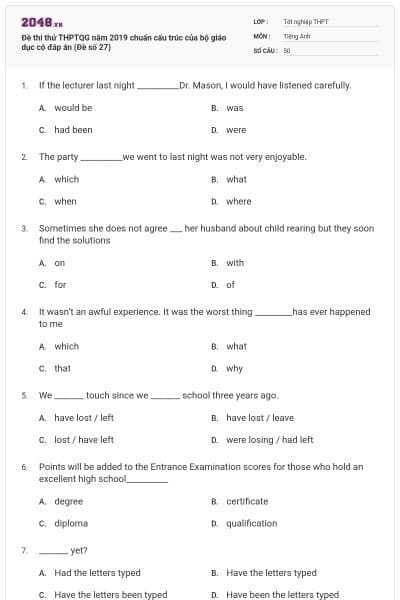
If the lecturer last night __________Dr. Mason, I would have listened carefully.
would be
was
had been
were
Đáp án C
Đây là câu điều kiện loại III
Chú ý: Các câu điều kiện
+ Câu điều kiện loại 0: If S V(s/es), S V(s/es) (chỉ 1 sự thật hiển nhiên chắc chắn)
+ Câu điều kiện loại I: If S V(s/es), S will V (chỉ 1 điều kiện có thể xảy ra ở tương lai)
+ Câu điều kiện loại II: If S V(quá khứ), S would V (chỉ 1 điều kiện không có thật ở hiện tại)
+ Câu điều kiện loại III: If S had PII, S would have PII (chỉ 1 điều kiện không có thật ở quá khứ)
+ Câu điều kiện loại Mixed : If S had PII, S would have PII (Chỉ điều kiện mà hành động trái với quá khứ và kết quả trái với hiện tại, thường là mối quan hệ nhân quả)
Dịch: Nếu người dạy tối qua là giáo sư Mason thì tôi đã nghe giảng cẩn thận hơn
The party __________we went to last night was not very enjoyable.
which
what
when
where
Đáp án A
Đại từ quan hệ ‘which’ đóng chức năng làm tân ngữ thay thế cho ‘the party’
Dịch: Bữa tiệc mà chúng tôi tham dự tối qua không thú vị lắm
Sometimes she does not agree ___ her husband about child rearing but they soon find the solutions
on
with
for
of
Đáp án B
agree with sbd about smt: đồng ý với ai về cái gì.
Dịch: Đôi khi cô ấy không đồng tình với chồng trong việc nuôi dạy bọn trẻ nhưng họ đã sớm tìm ra giải pháp.
It wasn’t an awful experience. It was the worst thing _________has ever happened to me
which
what
that
why
Đáp án C
Trong câu mà đại từ quan hệ thay thế cho chứa so sánh nhất (best/worse/biggest… ) hoặc là số thứ tự (the first/second…) thì đại từ quan hệ đó phải là ‘that’.
Dịch: Đó là 1 trải nghiệm kinh khủng. Đó là điều tồi tệ nhất từng xảy ra với tôi
We _______ touch since we _______ school three years ago.
have lost / left
have lost / leave
lost / have left
were losing / had left
Đáp án A
S + have/has PII since S+ Ved
Dịch: Chúng tôi mất liên lạc kể từ khi ra trường 3 năm về trước
Points will be added to the Entrance Examination scores for those who hold an excellent high school__________
degree
certificate
diploma
qualification
Đáp án C
school diploma: bằng tốt nghiệp.
Dịch: Điểm sẽ được cộng thêm vào kết quả bài thi Tuyển sinh cho những ai có bằng tốt nghiêp trung học loại xuất sắc.
_______ yet?
Had the letters typed
Have the letters typed
Have the letters been typed
Have been the letters typed
Đáp án C
Đây là câu hỏi Yes-No thì Hiện tại hoàn thành tiếp diễn (thể bị động) (DH: yet) – Have/Has S been PII?
Dịch: Bức thư này đã được đánh máy xong chưa?
Before I___________for that job, I_________________my parents for advice.
applied/ had asked
applied/ asked
had applied/ asked
applied/ have asked
Đáp án A
Chú ý: Before + Quá khứ đơn(Ved), Quá khứ hoàn thành (had PII)
After +Quá khứ hoàn thành (had PII), Quá khứ đơn (Ved)
( Hai mệnh đề tương ứng với 2 sự việc xảy ra trong quá khứ và xảy ra trước quá khứ)
Dịch: Trước khi nộp đơn xin việc cho công việc này, tôi đã xin lời khuyên từ bố mẹ
In Vietnam, application forms for the National Entrance Examinations must be __________before the deadline, often in April
submitted
filed
issued
signed
Đáp án: A
Giải thích:
Kiến thức: Từ vựng
A. submit (v): nộp
B. file (v): lưu trữ
C. issue (v): phát hành
D. sign (v): kí
Dựa vào nghĩa câu, chọn A.
Dịch: Ở Việt Nam, đơn đăng kí tham dự kì thi Trung học phổ thông quốc gia phải được nộp trước hạn, thường là vào tháng 4.
John asked me _______ that film the night before.
if had I seen
if I had seen
had I seen
that I saw
Đáp án B
Khi chuyển sang câu gián tiếp cần lùi về 1 thì (ở đây câu trực tiếp là thì quá khứ (DH: ‘the night before’ - đêm qua) nên câu trên động từ cần chia về thì quá khứ hoàn thành (had PII) trong câu gián tiếp, ngoài ra cũng cần đưa câu hỏi về dạng khẳng định
S asked + if/whether + S + V-chia lùi thì
Các câu còn lại sai cấu trúc ngữ pháp
Dịch: John hỏi tôi liệu có phải tôi đã xem bộ phim này tối qua
I _________Tom with me if I had known you and he didn’t get along well with each other
didn’t bring
wouldn’t have brought
hadn’t brought
won’t bring
Đáp án B
Đây là câu điều kiện loại III: If +S + had PII, S + would have PII.
Các câu còn lại sai cấu trúc ngữ pháp câu điều kiện.
Dịch: Tôi đã sẽ không mang Tom đi cùng theo nếu tôi biết cậu và anh ấy không hòa hợp.
Remember to bring with you your school certificate and letters of __________from your teachers or your previous employers when you come to the interview
invitation
advertisement
assignment
recommendation
Đáp án D
letters of recommendation: thư giới thiệu
Các đáp án còn lại:
A. invitation (n): lời mời, sự mời mọc
B. advertisement (n): quảng cáo
C. assignment (n): nhiệm vụ
Dịch: Nhớ mang theo chứng chỉ của trường và thư giới thiệu từ giáo viên hoặc từ nhà tuyển dụng cũ khi bạn đi phỏng vấn
Choose the word with different pronunciation of the underlined part.
question
education
addition
application
Đáp án A
Phần gạch chân ở đáp án A được phát âm là / t∫ən/, các đáp án còn lại là /∫n/
A. question /'kwest∫ən/ (n): câu hỏi
B. education /,edju:'kei∫n/(n) :giáo dục
C. addition /ə'di∫n/ (n):sự thêm vào
D. application /,æpli'kei∫n/ (n):ứng dụng, đơn xin viêc
Choose the word with different pronunciation of the underlined part.
allowed
passed
argued
raised
Đáp án B
’ed’ phát âm là /t/, còn lại là /d/
Lưu ý: Phát âm cuối ‘ed’,
- Đuôi “ed” được phát âm là /id/: khi động từ có phát âm kết thúc là /t/ hay /d/.
- Đuôi ed được phát âm là /t/: Khi động từ có phát âm kết thúc là: /ch/, /p/, /f/, /s/, /k/, /th/, /∫/, /t∫/.
- Đuôi ed được phát âm là /d/ trong các trường hợp còn lại
Choose the word that has the stress differently from that of the other words
enthusiasm
experience
certificate
concentrate
Đáp án D
Trọng âm rơi vào âm tiết thứ nhất, các đáp án còn lại rơi vào âm tiết thứ 2
A. enthusiasm /in'θju:ziæzm/ (n): lòng hăng hái, nhiệt thành
B. experience /iks'piəriəns/(n) : trải nghiệm, kinh nghiệm
C. certificate /sə'tifikit/ (n): chứng chỉ
D. concentrate /'kɔnsntreit/ (v): tập trung
Choose the word that has the stress differently from that of the other words
industry
interview
interviewer
interviewee
Đáp án D
Trọng âm rơi âm tiết cuối, các đáp án còn lại rơi âm tiết đầu
A. industry /'indəstri/ (n) : nền công nghiệp
B. interview /'intəvju:/ (n): cuộc phỏng vấn, (v): phỏng vấn
C. interviewer /'intəvju:ə/ (n): người đi phỏng vấn
D. interviewee/,intəvju:'i:(n) : nhà phỏng vấn
Mark the letter A, B, C, or D on your answer sheet to indicate the word(s) OPPOSITE in meaning to the underlined word(s) in each of the following questions.
The US troops are using much more sophisticated weapons in the Far East.
simple
complicated
difficult
expensive
Đáp án A
sophisticated(adj): tinh vi, phức tạp =c omplicated > Các đáp án còn lại:
C. difficult (adj): khó khăn
D. expensive (adj): đắt đỏ
Dịch: Quân đội Mĩ đang sử dụng những vũ khí tinh vi hơn ở miền Viễn Đông
Mark the letter A, B, C, or D on your answer sheet to indicate the word(s) OPPOSITE in meaning to the underlined word(s) in each of the following questions.
The manager in this company is always courteous to customers.
disappointed
optimistic
gentle
impolite
Đáp án D
courteous=gentle: lịch sự > Các đáp án còn lại:
A. disappointed (adj): thất vọng
B. optimistic (adj): tích cực
Dịch: Quản lí của công ty này luôn luôn lịch sự với khách hàng.
Mary: "I had a really good time. Thank for the lovely party"
Jane: ".........."
Yes, it's really good
Oh that's right
No,it's very kind of you
I'm glad you enjoyed it
Đáp án D
Mary: “Tôi đã có khoảng thời gian thực sự đẹp. Cảm ơn vì bữa tiệc đáng yêu”.
Jane: " ______________."
A.Vâng, thật là tốt
B. Vâng đúng rồi
C. Không đâu, bạn thật là tốt
D. Tôi thật vinh dự khi bạn thích nó
Chỉ có đáp án D là phù hợp
Jim: “ This dictionary is for you. I hope you will find it useful.” Mai : " ______________."
Thanks. I’ll do it
No problem!
Thanks. It’s very kind of you
Yes, please
Đáp án A
Jim :“Cuốn từ điển này dành cho bạn. Tôi hy vọng rằng bạn thấy nó hữu ích”
Mai : " ______________."
A. Cảm ơn, tôi sẽ dùng nó
B. Không vấn đề gì
C. Cảm ơn, bạn thật là tốt
D. Vâng, làm ơn dùm
Chỉ có đáp án A là phù hợp nhất.
Mark the letter A, B, C or D on your answer sheet to indicate the word(s) SIMILAR in meaning to the underlined word(s) in each of the following questions.
There was a long period without rain in the countryside last year so the harvest was poor.
drought
epidemic
flood
famine
Đáp án A
a long period without rain: thời kì dài mà không có mưa = drought: hạn hán
Các đáp án còn lại:
B. epidemic: dịch bệnh
C. flood: lũ lụt
D. famine: nạn đói
Dịch: Đó là 1 thời kì dài không có mưa ở vùng nông thôn nên mùa vụ bị mất mùa.
Mark the letter A, B, C or D on your answer sheet to indicate the word(s) SIMILAR in meaning to the underlined word(s) in each of the following questions.
"He insisted on listening to the entire story".
part
interesting
funny
whole
Đáp án D
entire = whole: toàn bộ
Các đáp án còn lại:
A. part (n,v): 1 phần
B. interesting (adj): thú vị
C. funny (adj): vui tính, hài hước
Dịch: Anh ấy cứ khăng khăng đòi nghe toàn bộ câu chuyện.
Choose the correct answer that complete these given words.
Laser / device / concentrate / light waves / intense beam.
Laser is a device which concentrates light waves into an intense light beam
The laser is a device which concentrates light waves and an intense light beam
Laser is a device concentrates light waves into an intense light beam
The laser is a device to concentrate light waves to an intense light beam
Đáp án A
Các đáp án còn lại sai ngữ pháp và ‘Laser’ chưa xác định nên không dùng ‘the’
Dịch: Laser là 1 thiết bị tập trung sóng ánh sáng thành 1 chùm sáng cường độ cao
Choose the correct answer that complete these given words.
He / suffer / rare tropical disease / which / contracted / while / Africa
He still suffers from a rare tropical disease which contracted while he was in Africa
He still suffers from a rare tropical disease which he contracted while he was in Africa
He suffers from a rare tropical disease which he contracts while in Africa
He suffers from a rare tropical disease which was contracted while he is in Africa
Đáp án B
Các đáp án còn lại sai ngữ pháp hoặc không hợp về thời thì
Dịch: Anh ta vẫn phải chịu đựng từ căn bệnh nhiệt đới hiếm gặp, thứ bệnh mà anh ta mắc phải khi ở Châu Phi (contract = become ill).
Higher education is very importance to national economies, and it is also a source of trained and educated personnel for the whole country
economies
educated
the whole country
importance
Đáp án D
Sửa ‘importance’ => ’important’ do vị trí này cần 1 tính từ
Dịch: Giáo dục đại học rất quan trọng đối với nền kinh tế quốc dân, và đó cũng là nguồn nhân lực được đào tạo chính cho cả nước
The students are going to hearing three short conversations about food.
The students
going
hearing three short
about food
Đáp án C
Sửa ‘hearing ’=> ’to hear’ do đây là dạng của thì hiện tại tiếp diễn (tobe going to V) diễn tả hành động đã có dự định .
Dịch: Những học sinh sắp được nghe 3 cuộc nói chuyện ngắn về chủ đề thức ăn.
I feel both excited and nervously because I have an interview tomorrow.
have
nervously
excited
feel
Đáp án B
Sửa ‘nervously’ => ’nervous’ do vị trí này cần 1 tính từ (feel+adj)
Dịch: Tôi cảm thấy cả phấn khích lẫn lo lắng bởi tôi có 1 cuộc phỏng vấn vào ngày mai
Choose the sentence that is closest in the meaning to the root one.
I didn’t know you were coming, so I didn’t wait for you.
If I had known you were coming, I would wait for you
Had I know you were coming, I would have waited for you
I would have waited for you if I knew you were coming
If I had known you were coming, I would have waited for you
Đáp án D
Tôi đã không biết bạn tới nên tôi đã không đợi bạn
=D. Nếu tôi biết bạn đã đang tới thì tôi đã đợi bạn
Đây là câu điều kiện loại 3: giả định không có thật trong quá khứ (If S had PII, S would have PII)
A, C sai dạng câu điều kiện
D là đảo ngữ của câu điều kiện (Had S done…) nhưng chia sai động từ ‘know’=>’known’
Choose the sentence that is closest in the meaning to the root one.
“ Do you watch television every evening, Jane?”, said Peter.
Peter asked Jane if she watched TV every evening
Peter asks Jane if does she watch TV every evening
Peter asked Jane if she’d watched TV every evening
Peter asked Jane did she watch TV every evening
Đáp án A
“ Cậu có xem TV vào mỗi tối không Jane?”-Peter hỏi
= Peter hỏi Jane liệu cô ấy có xem TV vào mỗi tối không
Câu trực tiếp khi chuyển sang gián tiếp cần lùi về 1 thì : S asked if/whether + S + V - chia lùi thì
Ở đây là “Do you watch television..” thì sang gián tiếp sẽ là “If you watched television…”
Các đáp án còn lại sai ngữ pháp
Choose the sentence that is closest in the meaning to the root one.
I did not answer the door even though I knew it was my friend.
Unless I knew it was my friend, I would not answer the door
I knew it was my friend, but I did not answer the door
Only when I answered the door did I knew it was my friend.
I answered the door since I knew it was my friend
Đáp án B
Tôi không trả lời cửa mặc dù biết đó là bạn mình
= B. Tôi biết đó là bạn mình nhưng tôi vẫn không trả lời cửa
Các đáp án còn lại không đúng nghĩa:
A. Trừ khi tôi biết đó là bạn mình, tôi sẽ không mở cửa
C. Chỉ khi tôi mở của mới biết đó là bạn mình
D. Tôi đã trả lời cửa vì biết đó là bạn mình
Read the following passage and mark the letter A, B, C, or D on your answer sheet to indicate the correct answer to each of the questions.
Millions of people are using cell phones today. In many places, it is actually considered unusual not to use one. In many countries, cell phones are very popular with young people. They find that the phones are more than a means of communication - having a mobile phone shows that they are cool and connected.
The explosion in mobile phone use around the world has made some health professionals worried. Some doctors are concerned that in the future many people may suffer health problems from the use of mobile phones. In England, there has been a serious debate about this issue. Mobile phone companies are worried about the negative publicity of such ideas. They say that there is no proof that mobile phones are bad for your health.
On the other hand, medical studies have shown changes in the brain cells of some people who use mobile phones. Signs of change in the tissues of the brain and head can be detected with modern scanning equipment. In one case, a travelling salesman had to retire at young age because of serious memory loss. He couldn't remember even simple tasks. He would often forget the name of his own son. This man used to talk on his mobile phone for about six hours a day, every day of his working week, for a couple of years. His family doctor blamed his mobile phone use, but his employer's doctor didn't agree.
What is it that makes mobile phones potentially harmful? The answer is radiation. High- tech machines can detect very small amounts of radiation from mobile phones. Mobile phone companies agree that there is some radiation, but they say the amount is too small to worry about.
As the discussion about their safety continues, it appears that it's best to use mobile phones less often. Use your regular phone if you want to talk for a long time. Use your mobile phone only when you really need it. Mobile phones can be very useful and convenient, especially in emergencies. In the future, mobile phones may have a warning label that says they are bad for your health. So for now, it's wise not to use your mobile phone too often
According to the passage, cell phones are especially popular with young people because
they keep the users alert all the time
they are indispensable in everyday communications
they make them look more stylish
they cannot be replaced by regular phones
Đáp án C
Theo như đoạn văn, điện thoại di động đặc biệt phổ biến với giới trẻ bởi vì:
A. Chúng khiến người dùng cảnh giác mọi lúc
B. Chúng không thể thiếu trong giao tiếp hằng ngày
C. Chúng làm họ trông sành điệu hơn
D. Chúng không thể thay thế bởi điện thoại thông thường
Dẫn chứng câu cuối đoại 1 “They find that the phones are more than a means of communication - having a mobile phone shows that they are cool and connected.” – (Họ thấy rằng điện thoại có hơn 1 ý nghĩa là giao tiếp-có 1 chiếc điện thoại cho thấy rằng họ ngầu và có nhiều mối quan hệ)
Dịch bài
Có hàng triệu người đang sử dụng điện thoại di động ngày nay. Ở nhiều nơi, nó thậm chí bị coi là bất thường nếu ta không sử dụng 1 chiếc. Ở nhiều quốc gia, điện thoại di động rất phổ biến đối với giới trẻ. Họ nhận thấy rằng điện thoại không chỉ đơn thuần là 1 phương tiện giao tiếp mà chúng còn chứng minh rằng họ ngầu có mối nhiều quan hệ
Sự bùng nổ trong sử dụng điện thoại di động trên khắp thế giới đã khiến một số chuyên gia y tế lo ngại. Một số bác sĩ sợ rằng trong tương lai nhiều người có thể gặp vấn đề về sức khoẻ do sử dụng điện thoại di động. Tại Anh, đã có một cuộc tranh luận gay gắt về vấn đề này. Các công ty điện thoại đang lo lắng về việc công chúng sẽ biết đến những ảnh hưởng xấu của điện thoại di động. Họ nói rằng không có bằng chứng nào cho thấy điện thoại di động có hại cho sức khoẻ của người dùng.
Mặt khác, các nghiên cứu y học đã cho thấy có sự thay đổi trong tế bào não của một số người đang sử dụng điện thoại di động. Dấu hiệu thay đổi mô trong não có thể được phát hiện bằng thiết bị quét hiện đại. Trong một trường hợp, một nhân viên bán hàng đã phải nghỉ hưu khi còn rất trẻ vì chứng mất trí nhớ nghiêm trọng. Anh ta không thể nhớ ngay cả những nhiệm vụ đơn giản và thường xuyên quên cả tên của con trai mình. Người đàn ông này thường nói chuyện điện thoại di động khoảng sáu giờ mỗi ngày trong tuần làm việc của mình trong một vài năm. Bác sĩ gia đình đổ lỗi cho việc sử dụng điện thoại di động , nhưng bác sĩ công ti thì không đồng tình
Điều gì làm cho điện thoại di động có khả năng gây hại như vậy? Câu trả lời là bức xạ. Các máy móc công nghệ cao có thể phát hiện ra một lượng nhỏ bức xạ từ điện thoại di động. Các công ty điện thoại di động đồng ý rằng có một vài bức xạ, nhưng họ nói rằng số lượng đó rất nhỏ để phải bận tâm
Thảo luận về sự an toàn khi tiếp tục sử dụng, cách tốt nhất là sử dụng ít thường xuyên hơn. Dùng điện thoại thông thường nếu là cuộc nói chuyện dài. Chỉ sử dụng điện thoại di động khi bạn thực sự cần. Điện thoại di động có thể rất hữu ích và thuận tiện, đặc biệt là trong trường hợp khẩn cấp. Trong tương lai, điện thoại di động có thể là 1 cảnh báo rằng chúng không tốt cho sức khoẻ của bạn. Vì vậy, ngay từ bây giờ, hãy khôn ngoan khi không sử dụng chúng quá thường xuyên
Read the following passage and mark the letter A, B, C, or D on your answer sheet to indicate the correct answer to each of the questions.
Millions of people are using cell phones today. In many places, it is actually considered unusual not to use one. In many countries, cell phones are very popular with young people. They find that the phones are more than a means of communication - having a mobile phone shows that they are cool and connected.
The explosion in mobile phone use around the world has made some health professionals worried. Some doctors are concerned that in the future many people may suffer health problems from the use of mobile phones. In England, there has been a serious debate about this issue. Mobile phone companies are worried about the negative publicity of such ideas. They say that there is no proof that mobile phones are bad for your health.
On the other hand, medical studies have shown changes in the brain cells of some people who use mobile phones. Signs of change in the tissues of the brain and head can be detected with modern scanning equipment. In one case, a travelling salesman had to retire at young age because of serious memory loss. He couldn't remember even simple tasks. He would often forget the name of his own son. This man used to talk on his mobile phone for about six hours a day, every day of his working week, for a couple of years. His family doctor blamed his mobile phone use, but his employer's doctor didn't agree.
What is it that makes mobile phones potentially harmful? The answer is radiation. High- tech machines can detect very small amounts of radiation from mobile phones. Mobile phone companies agree that there is some radiation, but they say the amount is too small to worry about.
As the discussion about their safety continues, it appears that it's best to use mobile phones less often. Use your regular phone if you want to talk for a long time. Use your mobile phone only when you really need it. Mobile phones can be very useful and convenient, especially in emergencies. In the future, mobile phones may have a warning label that says they are bad for your health. So for now, it's wise not to use your mobile phone too often
The word "means" in the passage most closely means
transmission
method
meanings
expression
Đáp án B
means = method: phương pháp, phương tiện
Các đáp án còn lại:
A. Transmission: sự truyền tải, bộ truyền
C. Meanings : ý nghĩa
D. Expression: sự bộc lộ
Read the following passage and mark the letter A, B, C, or D on your answer sheet to indicate the correct answer to each of the questions.
Millions of people are using cell phones today. In many places, it is actually considered unusual not to use one. In many countries, cell phones are very popular with young people. They find that the phones are more than a means of communication - having a mobile phone shows that they are cool and connected.
The explosion in mobile phone use around the world has made some health professionals worried. Some doctors are concerned that in the future many people may suffer health problems from the use of mobile phones. In England, there has been a serious debate about this issue. Mobile phone companies are worried about the negative publicity of such ideas. They say that there is no proof that mobile phones are bad for your health.
On the other hand, medical studies have shown changes in the brain cells of some people who use mobile phones. Signs of change in the tissues of the brain and head can be detected with modern scanning equipment. In one case, a travelling salesman had to retire at young age because of serious memory loss. He couldn't remember even simple tasks. He would often forget the name of his own son. This man used to talk on his mobile phone for about six hours a day, every day of his working week, for a couple of years. His family doctor blamed his mobile phone use, but his employer's doctor didn't agree.
What is it that makes mobile phones potentially harmful? The answer is radiation. High- tech machines can detect very small amounts of radiation from mobile phones. Mobile phone companies agree that there is some radiation, but they say the amount is too small to worry about.
As the discussion about their safety continues, it appears that it's best to use mobile phones less often. Use your regular phone if you want to talk for a long time. Use your mobile phone only when you really need it. Mobile phones can be very useful and convenient, especially in emergencies. In the future, mobile phones may have a warning label that says they are bad for your health. So for now, it's wise not to use your mobile phone too often
Doctors have tentatively concluded that cell phones may.
change their users' temperament
damage their users' emotions
change their users' social behaviours
cause some mental malfunction
Đáp án D
Bác sĩ tạm thời kết luận rằng điện thoại di động có lẽ:
A. Thay đổi tính cách người dùng
B. Làm tổn hại tới cảm xúc người dùng
C. Thay đổi hành vi cư xử của người dùng
D. Ảnh hưởng về chức năng thần kinh
Dẫn chứng cuối đoạn 2: “He couldn't remember even simple tasks. He would often forget the name of his own son. This man used to talk on his mobile phone for about six hours a day, every day of his working week, for a couple of years. His family doctor blamed his mobile phone use, but his employer's doctor didn't agree.”-(Anh ta thậm chí không nhớ nổi những nhiệm vụ đơn giản, thường xuyên quên tên của con trai mình. Người đàn ông này nói chuyện qua điện thoại khoảng 6 giờ mỗi ngày trong những ngày làm việc trong tuần trong khoảng vài năm. Bác sĩ gia đình cho rằng đó là do tác dụng của việc sử dụng di động nhưng bác sĩ công ti lại không đồng tình)
Read the following passage and mark the letter A, B, C, or D on your answer sheet to indicate the correct answer to each of the questions.
Millions of people are using cell phones today. In many places, it is actually considered unusual not to use one. In many countries, cell phones are very popular with young people. They find that the phones are more than a means of communication - having a mobile phone shows that they are cool and connected.
The explosion in mobile phone use around the world has made some health professionals worried. Some doctors are concerned that in the future many people may suffer health problems from the use of mobile phones. In England, there has been a serious debate about this issue. Mobile phone companies are worried about the negative publicity of such ideas. They say that there is no proof that mobile phones are bad for your health.
On the other hand, medical studies have shown changes in the brain cells of some people who use mobile phones. Signs of change in the tissues of the brain and head can be detected with modern scanning equipment. In one case, a travelling salesman had to retire at young age because of serious memory loss. He couldn't remember even simple tasks. He would often forget the name of his own son. This man used to talk on his mobile phone for about six hours a day, every day of his working week, for a couple of years. His family doctor blamed his mobile phone use, but his employer's doctor didn't agree.
What is it that makes mobile phones potentially harmful? The answer is radiation. High- tech machines can detect very small amounts of radiation from mobile phones. Mobile phone companies agree that there is some radiation, but they say the amount is too small to worry about.
As the discussion about their safety continues, it appears that it's best to use mobile phones less often. Use your regular phone if you want to talk for a long time. Use your mobile phone only when you really need it. Mobile phones can be very useful and convenient, especially in emergencies. In the future, mobile phones may have a warning label that says they are bad for your health. So for now, it's wise not to use your mobile phone too often
"Negative publicity" in the passage most likely means.
the negative public use of cell phones
poor ideas about the effects of cell phones
information on the lethal effects of cell phones
widespread opinion about bad effects of cell phones
Đáp án D
"Negative publicity" trong đoạn văn nghĩa là gì?
A. Công khai tiêu cực của việc sử dụng di động
B. Ý kiến xấu về những ảnh hưởng của di động
C. Thông tin về sự ảnh hưởng chết người của di động
D. Ý kiến lan rộng về những ảnh hưởng xấu của di động
Dẫn chứng đoạn 2 “In England, there has been a serious debate about this issue. Mobile phone companies are worried about the negative publicity of such ideas.”-(Ở Anh, có những tranh luận gay gắt về vấn đề này. Các công ti điện thoại di động đang lo lắng về “Negative publicity”- có nghĩa là việc làm cho công chúng biết đến những mặt tiêu cực hoặc ảnh hưởng xấu của điều gì đó.)
Read the following passage and mark the letter A, B, C, or D on your answer sheet to indicate the correct answer to each of the questions.
Millions of people are using cell phones today. In many places, it is actually considered unusual not to use one. In many countries, cell phones are very popular with young people. They find that the phones are more than a means of communication - having a mobile phone shows that they are cool and connected.
The explosion in mobile phone use around the world has made some health professionals worried. Some doctors are concerned that in the future many people may suffer health problems from the use of mobile phones. In England, there has been a serious debate about this issue. Mobile phone companies are worried about the negative publicity of such ideas. They say that there is no proof that mobile phones are bad for your health.
On the other hand, medical studies have shown changes in the brain cells of some people who use mobile phones. Signs of change in the tissues of the brain and head can be detected with modern scanning equipment. In one case, a travelling salesman had to retire at young age because of serious memory loss. He couldn't remember even simple tasks. He would often forget the name of his own son. This man used to talk on his mobile phone for about six hours a day, every day of his working week, for a couple of years. His family doctor blamed his mobile phone use, but his employer's doctor didn't agree.
What is it that makes mobile phones potentially harmful? The answer is radiation. High- tech machines can detect very small amounts of radiation from mobile phones. Mobile phone companies agree that there is some radiation, but they say the amount is too small to worry about.
As the discussion about their safety continues, it appears that it's best to use mobile phones less often. Use your regular phone if you want to talk for a long time. Use your mobile phone only when you really need it. Mobile phones can be very useful and convenient, especially in emergencies. In the future, mobile phones may have a warning label that says they are bad for your health. So for now, it's wise not to use your mobile phone too often
The changes possibly caused by the cell phones are mainly concerned with
the mobility of the mind and the body
the arteries of the brain
the smallest units of the brain
the resident memory
Đáp án C
Việc biến đổi có thể bị gây nên do điện thoại di động chủ yếu liên quan tới:
A. Tính linh hoạt của trí óc và thể chất
B. Các động mạch của não
C. Những tế bào nhỏ trong não
D. Bộ nhớ cư trú
Dẫn chứng câu đầu đoạn 3 “On the other hand, medical studies have shown changes in the brain cells of some people who use mobile phones”.-(Mặt khác, những nghiên cứu y khoa chỉ ra rằng có những thay đổi trên những tế bào não của 1 vài người sử dụng di động)
Read the following passage and mark the letter A, B, C, or D on your answer sheet to indicate the correct answer to each of the questions.
Millions of people are using cell phones today. In many places, it is actually considered unusual not to use one. In many countries, cell phones are very popular with young people. They find that the phones are more than a means of communication - having a mobile phone shows that they are cool and connected.
The explosion in mobile phone use around the world has made some health professionals worried. Some doctors are concerned that in the future many people may suffer health problems from the use of mobile phones. In England, there has been a serious debate about this issue. Mobile phone companies are worried about the negative publicity of such ideas. They say that there is no proof that mobile phones are bad for your health.
On the other hand, medical studies have shown changes in the brain cells of some people who use mobile phones. Signs of change in the tissues of the brain and head can be detected with modern scanning equipment. In one case, a travelling salesman had to retire at young age because of serious memory loss. He couldn't remember even simple tasks. He would often forget the name of his own son. This man used to talk on his mobile phone for about six hours a day, every day of his working week, for a couple of years. His family doctor blamed his mobile phone use, but his employer's doctor didn't agree.
What is it that makes mobile phones potentially harmful? The answer is radiation. High- tech machines can detect very small amounts of radiation from mobile phones. Mobile phone companies agree that there is some radiation, but they say the amount is too small to worry about.
As the discussion about their safety continues, it appears that it's best to use mobile phones less often. Use your regular phone if you want to talk for a long time. Use your mobile phone only when you really need it. Mobile phones can be very useful and convenient, especially in emergencies. In the future, mobile phones may have a warning label that says they are bad for your health. So for now, it's wise not to use your mobile phone too often
The man mentioned in the passage, who used his cell phone too often.
suffered serious loss of mental ability
abandoned his family
could no longer think lucidly
had a problem with memory
Đáp án D
Người đàn ông được đề cập trong đoạn văn , người mà sử dụng di động rất thường xuyên:
A. Chịu đựng tổn thương nghiêm trọng về mặt tinh thần
B. Từ bỏ gia đình
C. Không còn khả năng suy nghĩ minh bạch
D. Có vấn đề về trí nhớ
Dẫn chứng cuối đoạn 2: “He couldn't remember even simple tasks. He would often forget the name of his own son. This man used to talk on his mobile phone for about six hours a day, every day of his working week, for a couple of years’-(Anh ta thậm chí không nhớ nổi những nhiệm vụ đơn giản., thường xuyên quên tên của con trai mình. Người đàn ông này nói chuyện qua điện thoại khoảng 6 giờ mỗi ngày trong những ngày làm việc trong tuần và trong khoảng vài năm)
Read the following passage and mark the letter A, B, C, or D on your answer sheet to indicate the correct answer to each of the questions.
Millions of people are using cell phones today. In many places, it is actually considered unusual not to use one. In many countries, cell phones are very popular with young people. They find that the phones are more than a means of communication - having a mobile phone shows that they are cool and connected.
The explosion in mobile phone use around the world has made some health professionals worried. Some doctors are concerned that in the future many people may suffer health problems from the use of mobile phones. In England, there has been a serious debate about this issue. Mobile phone companies are worried about the negative publicity of such ideas. They say that there is no proof that mobile phones are bad for your health.
On the other hand, medical studies have shown changes in the brain cells of some people who use mobile phones. Signs of change in the tissues of the brain and head can be detected with modern scanning equipment. In one case, a travelling salesman had to retire at young age because of serious memory loss. He couldn't remember even simple tasks. He would often forget the name of his own son. This man used to talk on his mobile phone for about six hours a day, every day of his working week, for a couple of years. His family doctor blamed his mobile phone use, but his employer's doctor didn't agree.
What is it that makes mobile phones potentially harmful? The answer is radiation. High- tech machines can detect very small amounts of radiation from mobile phones. Mobile phone companies agree that there is some radiation, but they say the amount is too small to worry about.
As the discussion about their safety continues, it appears that it's best to use mobile phones less often. Use your regular phone if you want to talk for a long time. Use your mobile phone only when you really need it. Mobile phones can be very useful and convenient, especially in emergencies. In the future, mobile phones may have a warning label that says they are bad for your health. So for now, it's wise not to use your mobile phone too often
The most suitable title for the passage could be.
The Reasons Why Mobile Phones Are Popular
Technological Innovations and Their Price
The Way Mobile Phones Work
Mobile Phones: A Must of Our Time
Đáp án B
Đâu là tiêu đề phù hợp nhất cho đoạn văn:
A. Lí do điện thại di động phổ biến
B. Đổi mới công nghệ và cái giá của nó
C. Cách mà điện thoại di đông hoạt động
D. Điện thoại di động: Công cụ phải có trong đời sống chúng ta
Giải thích : Bài đọc đề cập đến 2 mặt của một vấn đề. Tác giả đưa ra sự tiện lợi hữu ích của điện thoại di động nhưng đồng thời cũng nêu lên những tác hại, hệ lụy của nó gây nên cho con người
Read the passage and choose the best answers.
Never say anything negative about past experiences, employers, or courses or professors. Always think of something positive about an experience and talk about that. You should also be __(38) __. If you are genuinely interested __(39) __ the job, let the interviewer know that.
One of the best ways to show you are keen on a job is to demonstrate that you have researched the organization prior to the interview. You can also __(40) __ interest by asking questions about the job, the organization, and its services and products. The best way to impress an employer is to ask questions that build your interview discussion. This shows you are interested and __(41) __ close attention to the interviewer. It is a good idea to prepare a few questions in advance, but an insightful comment based on your conversation can make an even stronger statement. At the __(42) __ of the interview, it is appropriate for you to ask when you may expect to hear from the employer.
Điền vào ô số 38
enthusiast
enthusiastic
enthusiastically
enthusiasm
Đáp án B
B.enthusiastic(adj): nhiệt tình. Do vị trí này cần 1 tính từ (sau tobe)
Các đáp án còn lại:
A. enthusiast (n): người nhiệt tình
C. enthusiastically (adv): mang tính nhiệt tình
D. enthusiasm (n): nhiệt tình, hăng hái
Dịch bài
Không bao giờ nên nói ra bất cứ điều gì tiêu cực về những trải nghiệm trong quá khứ, hoặc về những khóa học và giáo viên. Luôn luôn nghĩ về những trải nghiệm tích cực và nói về chúng. Bản thân bạn cũng nên nhiệt tình. Nếu bạn thật tâm hứng thú với công việc, hãy để nhà tuyển dụng biết điều đó.
Một trong những cách tốt nhất để thể hiện sự hứng thú với công việc đó là chứng minh rằng bạn đã tìm hiểu kĩ về công ti và tổ chức trước khi bước vào phỏng vấn. Một cách khác đó là đặt câu hỏi về công việc, tổ chức, dịch vụ và sản phẩm. Cách khôn ngoan nhất để gây ấn tượng với nhà tuyển dụng đó là biến cuộc phỏng vấn thành 1 cuộc thảo luận. Điều đó chỉ ra rằng bạn đang hứng thú và chú ý tới nhà phỏng vấn. Chuẩn bị trước một vài câu hỏi là 1 điều tốt, nhưng những nhận xét sâu sắc dựa trên nền tảng của cuộc nói chuyện sẽ củng cố mạnh thêm về những điều bạn nói. Đến cuối cuộc phỏng vấn, đó là lúc phù hợp cho bạn đặt câu hỏi khi bạn mong được nghe câu trả lời từ nhà tuyển dụng
Read the passage and choose the best answers.
Never say anything negative about past experiences, employers, or courses or professors. Always think of something positive about an experience and talk about that. You should also be __(38) __. If you are genuinely interested __(39) __ the job, let the interviewer know that.
One of the best ways to show you are keen on a job is to demonstrate that you have researched the organization prior to the interview. You can also __(40) __ interest by asking questions about the job, the organization, and its services and products. The best way to impress an employer is to ask questions that build your interview discussion. This shows you are interested and __(41) __ close attention to the interviewer. It is a good idea to prepare a few questions in advance, but an insightful comment based on your conversation can make an even stronger statement. At the __(42) __ of the interview, it is appropriate for you to ask when you may expect to hear from the employer.
Điền vào ô số 39
on
for
in
with
Đáp án C
tobe interested in smt: có hứng thú vớ
Read the passage and choose the best answers.
Never say anything negative about past experiences, employers, or courses or professors. Always think of something positive about an experience and talk about that. You should also be __(38) __. If you are genuinely interested __(39) __ the job, let the interviewer know that.
One of the best ways to show you are keen on a job is to demonstrate that you have researched the organization prior to the interview. You can also __(40) __ interest by asking questions about the job, the organization, and its services and products. The best way to impress an employer is to ask questions that build your interview discussion. This shows you are interested and __(41) __ close attention to the interviewer. It is a good idea to prepare a few questions in advance, but an insightful comment based on your conversation can make an even stronger statement. At the __(42) __ of the interview, it is appropriate for you to ask when you may expect to hear from the employer.
Điền vào ô số 40
cover
appear
show
conceal
Đáp án C
show interest: thể hiện sự quan tâm ,hứng thú
Read the passage and choose the best answers.
Never say anything negative about past experiences, employers, or courses or professors. Always think of something positive about an experience and talk about that. You should also be __(38) __. If you are genuinely interested __(39) __ the job, let the interviewer know that.
One of the best ways to show you are keen on a job is to demonstrate that you have researched the organization prior to the interview. You can also __(40) __ interest by asking questions about the job, the organization, and its services and products. The best way to impress an employer is to ask questions that build your interview discussion. This shows you are interested and __(41) __ close attention to the interviewer. It is a good idea to prepare a few questions in advance, but an insightful comment based on your conversation can make an even stronger statement. At the __(42) __ of the interview, it is appropriate for you to ask when you may expect to hear from the employer.
Điền vào ô số 41
choose
spend
pay
make
Đáp án C
pay attention to smt: chú ý tới cái gì
Read the passage and choose the best answers.
Never say anything negative about past experiences, employers, or courses or professors. Always think of something positive about an experience and talk about that. You should also be __(38) __. If you are genuinely interested __(39) __ the job, let the interviewer know that.
One of the best ways to show you are keen on a job is to demonstrate that you have researched the organization prior to the interview. You can also __(40) __ interest by asking questions about the job, the organization, and its services and products. The best way to impress an employer is to ask questions that build your interview discussion. This shows you are interested and __(41) __ close attention to the interviewer. It is a good idea to prepare a few questions in advance, but an insightful comment based on your conversation can make an even stronger statement. At the __(42) __ of the interview, it is appropriate for you to ask when you may expect to hear from the employer.
Điền vào ô số 42
finish
final
end
close
Đáp án C
At the end of smt: Cuối cùng, kết thúc của cái gì
Read the following passage and mark the letter A, B, C, or D on your answer sheet to indicate the correct answer to each of the questions.
Most people think that lions only come from Africa. This is understandable because in fact most lions do come from there but this has not always been the case. If we went back ten thousand years, we would find that there were lions roaming vast sections of the globe. However now, unfortunately only a very small section of the lion's former habitat remains.
Asiatic lions are sub-species of African lions. It is almost a hundred thousand years since the Asiatic lions split off and developed as a sub-species. At one time the Asiatic lion was living as far west as Greece and they were found from there, but in a band that spreads east through various countries of the Middle East, all the way to India. In museums now, you can see Greek coins that have clear images of the Asiatic lion on them. Most of them are dated at around 500 B.C. However, Europe saw its last Asiatic lions roaming free two thousand years ago. Over the next nineteen hundred years the numbers of Asiatic lions in the other areas declined steadily, but it was only in the nineteenth century that they disappeared from everywhere but in India.
The Gir Wildlife Sanctuary in India was established especially to protect the Asiatic lion. There are now around three hundred Asiatic lions in India and almost all of them are in this sanctuary. However, despite living in a sanctuary, which makes them safe from hunters, they still face a number of problems that threaten their survival. One of these is the ever-present danger of disease. This is what killed more than a third of Africa’s Serengeti lions in 1994, and people are fearful that something similar could happen in the Gir Sanctuary and kill off many of the Asiatic lions there.
India's lions are particular vulnerable because they have a limited gene pool. The reason for this is interesting is because all of them are descended from a few dozen lions that were saved by a prince who took a particular interest in them. He was very healthy, and he managed to protect them; otherwise they would probably have died out completely.
When you see the Asiatic lion in India, what you sense is enormous vitality. They are very impressive animals and you would never guess that they have this vulnerability when you look at them.
According to the passage, many people believe that lions come from _____.
Africa
Europe
Middle East
India
Đáp án A
Theo như đoạn văn, nhiều người tin rằng sư tử đến từ _____.
A. Châu Mĩ
B. Châu Âu
C. Trung Đông
D. Ấn Độ
Dẫn chứng ngay câu đầu tiên: “Most people think that lions only come from Africa”- ( Hầu hết mọi người tin rằng sư tử đến từ Châu Phi)
Dịch bài
Hầu hết mọi người nghĩ rằng sư tử đến từ Châu Phi. Điều đó là dễ hiểu bởi sự thật rằng đa số sư tử trên thế giới là đến từ Châu Phi nhưng không phải loài sư tử nào cũng vậy. Nếu trở về 10 ngàn năm trước,chúng ta sẽ thấy rằng sư tử lang thang khắp các nơi trên thế giới. Tuy nhiên giờ đây, rất tiếc là chỉ còn một phần nhỏ môi trường sống của chúng còn tồn tại.
Sư tử Châu Á là loài phụ bên cạnh sư tử Châu Phi. Khoảng 10 ngàn năm trước kể từ khi sư tử Châu Á tách ra và phát triển thành 1 loài mới. Có thời, sư tử Châu Á đã sống ở phía tây Hy Lạp và chúng đã được tìm thấy từ đó, nhưng trong một đàn chúng tản ra về phía đông qua các quốc gia khác nhau ở vùng Trung Đông, tất cả con đường đó đều dẫn về Ấn Độ. Ở những bảo tàng ngày nay , bạn có thể thấy các đồng xu Hy Lạp cổ có in hình rất rõ của sư tử Châu Á. Phần lớn những đồng xu cổ đó có niên đại từ năm 500 trước Công nguyên. Mặc dù vậy, người Châu Âu đã thấy lần cuối sư tử Châu Á đi lại tự do là vào khoảng 2000 năm trước. Qua 1900 năm , số lượng sư tử Châu Á ở nhiều khu vực đã giảm mạnh, nhưng chỉ đến thế kỉ 19, chúng biến mất và chỉ còn thấy ở Ấn Độ
Khu bảo tồn động vật hoang dã Gir ở Ấn Độ được thành lập đặc biệt để bảo vệ sư tử Châu Á. Có khoảng ba trăm cá thể sư tử châu Á ở Ấn Độ và hầu hết chúng đều ở trong khu bảo tồn này. Tuy nhiên, mặc dù sống trong một khu bảo tồn làm chúng an toàn từ tay các thợ săn, chúng vẫn phải đối mặt với một số vấn đề đe dọa sự sống còn của mình. Một trong số đó là mối nguy hiểm đến từ bệnh tật. Đây là nguyên nhân đã giết chết hơn một phần ba sư tử Serengeti của Châu Phi vào năm 1994 và mọi người sợ rằng điều gì đó tương tự có thể xảy ra với Khu bảo tồn Gir và giết chết số lượng lớn sư tử Châu Á ở đó.
Sư tử Ấn Độ đặc biệt dễ bị tổn thương vì chúng có giới hạn gen. Lý do cho điều này gây thú vị bởi vì tất cả chúng đều là hậu duệ của một vài tá những con sư tử được cứu bởi một hoàng tử ,ngườu mà quan tâm đặc biệt đến chúng. Ngài rất khỏe mạnh và ngài đã cố gắng xoay sở để bảo vệ được chúng; nếu không chúng sẽ có thể đã tuyệt chủng
Khi bạn nhìn thấy sư tử Châu Á ở Ấn Độ, điều bạn cảm nhận sẽ là sức sống mãnh liệt. Chúng là động vật rất ấn tượng và bạn sẽ không bao giờ đoán rằng chúng có những điểm yếu này khi bạn nhìn vào
Read the following passage and mark the letter A, B, C, or D on your answer sheet to indicate the correct answer to each of the questions.
Most people think that lions only come from Africa. This is understandable because in fact most lions do come from there but this has not always been the case. If we went back ten thousand years, we would find that there were lions roaming vast sections of the globe. However now, unfortunately only a very small section of the lion's former habitat remains.
Asiatic lions are sub-species of African lions. It is almost a hundred thousand years since the Asiatic lions split off and developed as a sub-species. At one time the Asiatic lion was living as far west as Greece and they were found from there, but in a band that spreads east through various countries of the Middle East, all the way to India. In museums now, you can see Greek coins that have clear images of the Asiatic lion on them. Most of them are dated at around 500 B.C. However, Europe saw its last Asiatic lions roaming free two thousand years ago. Over the next nineteen hundred years the numbers of Asiatic lions in the other areas declined steadily, but it was only in the nineteenth century that they disappeared from everywhere but in India.
The Gir Wildlife Sanctuary in India was established especially to protect the Asiatic lion. There are now around three hundred Asiatic lions in India and almost all of them are in this sanctuary. However, despite living in a sanctuary, which makes them safe from hunters, they still face a number of problems that threaten their survival. One of these is the ever-present danger of disease. This is what killed more than a third of Africa’s Serengeti lions in 1994, and people are fearful that something similar could happen in the Gir Sanctuary and kill off many of the Asiatic lions there.
India's lions are particular vulnerable because they have a limited gene pool. The reason for this is interesting is because all of them are descended from a few dozen lions that were saved by a prince who took a particular interest in them. He was very healthy, and he managed to protect them; otherwise they would probably have died out completely.
When you see the Asiatic lion in India, what you sense is enormous vitality. They are very impressive animals and you would never guess that they have this vulnerability when you look at them.
Ten thousand years ago _____.
lions roamed much more than nowadays
lions did not live in small forests
lions came mainly from Africa
there were much more lion habitats than nowadays
Đáp án D
10 ngàn năm trước thì……
A. sư tử đi lang thang nhiều hơn ngày nay
B. sư tử không sống ở những khu rừng nhỏ
C. sư tử chủ yếu đến từ châu phi
D. có nhiều cá thể sư tử hơn bây giờ
Dẫn chứng cuối đoạn 1 “If we went back ten thousand years, we would find that there were lions roaming vast sections of the globe .However now, unfortunately only a very small section of the lion's former habitat remains.”-(Nếu trở về 10 ngàn năm trước, chúng ta sẽ nhận thấy rằng sư tử lang thang khắp nơi trên thế giới. Tuy nhiên bây giờ,rất tiếc là chỉ còn một phần nhỏ môi trường sống của chúng còn tồn tại) - Tức môi trường sống bị thu hẹp đồng nghĩa với việc số lượng cá thể cũng bị giảm theo so với 10 ngàn năm trước và dẫn chứng ở cuối đoạn 2 “but it was only in the nineteenth century that they disappeared from everywhere but in India.”-(nhưng chỉ đến thế kỉ 19, chúng biến mất và chỉ còn thấy ở Ấn Độ)
Read the following passage and mark the letter A, B, C, or D on your answer sheet to indicate the correct answer to each of the questions.
Most people think that lions only come from Africa. This is understandable because in fact most lions do come from there but this has not always been the case. If we went back ten thousand years, we would find that there were lions roaming vast sections of the globe. However now, unfortunately only a very small section of the lion's former habitat remains.
Asiatic lions are sub-species of African lions. It is almost a hundred thousand years since the Asiatic lions split off and developed as a sub-species. At one time the Asiatic lion was living as far west as Greece and they were found from there, but in a band that spreads east through various countries of the Middle East, all the way to India. In museums now, you can see Greek coins that have clear images of the Asiatic lion on them. Most of them are dated at around 500 B.C. However, Europe saw its last Asiatic lions roaming free two thousand years ago. Over the next nineteen hundred years the numbers of Asiatic lions in the other areas declined steadily, but it was only in the nineteenth century that they disappeared from everywhere but in India.
The Gir Wildlife Sanctuary in India was established especially to protect the Asiatic lion. There are now around three hundred Asiatic lions in India and almost all of them are in this sanctuary. However, despite living in a sanctuary, which makes them safe from hunters, they still face a number of problems that threaten their survival. One of these is the ever-present danger of disease. This is what killed more than a third of Africa’s Serengeti lions in 1994, and people are fearful that something similar could happen in the Gir Sanctuary and kill off many of the Asiatic lions there.
India's lions are particular vulnerable because they have a limited gene pool. The reason for this is interesting is because all of them are descended from a few dozen lions that were saved by a prince who took a particular interest in them. He was very healthy, and he managed to protect them; otherwise they would probably have died out completely.
When you see the Asiatic lion in India, what you sense is enormous vitality. They are very impressive animals and you would never guess that they have this vulnerability when you look at them.
The phrase "split off" in paragraph 2 is closest in meaning to _____.
developed into different species
changed the original species
spotted animals
divided
Đáp án D
spit off = devided: tách ra,phân chia
Các đáp án còn lại:
A. phát triển thành nhiều loài khác nhau
B. thay đổi giống loài ban đầu
C. động vật có đốm
Read the following passage and mark the letter A, B, C, or D on your answer sheet to indicate the correct answer to each of the questions.
Most people think that lions only come from Africa. This is understandable because in fact most lions do come from there but this has not always been the case. If we went back ten thousand years, we would find that there were lions roaming vast sections of the globe. However now, unfortunately only a very small section of the lion's former habitat remains.
Asiatic lions are sub-species of African lions. It is almost a hundred thousand years since the Asiatic lions split off and developed as a sub-species. At one time the Asiatic lion was living as far west as Greece and they were found from there, but in a band that spreads east through various countries of the Middle East, all the way to India. In museums now, you can see Greek coins that have clear images of the Asiatic lion on them. Most of them are dated at around 500 B.C. However, Europe saw its last Asiatic lions roaming free two thousand years ago. Over the next nineteen hundred years the numbers of Asiatic lions in the other areas declined steadily, but it was only in the nineteenth century that they disappeared from everywhere but in India.
The Gir Wildlife Sanctuary in India was established especially to protect the Asiatic lion. There are now around three hundred Asiatic lions in India and almost all of them are in this sanctuary. However, despite living in a sanctuary, which makes them safe from hunters, they still face a number of problems that threaten their survival. One of these is the ever-present danger of disease. This is what killed more than a third of Africa’s Serengeti lions in 1994, and people are fearful that something similar could happen in the Gir Sanctuary and kill off many of the Asiatic lions there.
India's lions are particular vulnerable because they have a limited gene pool. The reason for this is interesting is because all of them are descended from a few dozen lions that were saved by a prince who took a particular interest in them. He was very healthy, and he managed to protect them; otherwise they would probably have died out completely.
When you see the Asiatic lion in India, what you sense is enormous vitality. They are very impressive animals and you would never guess that they have this vulnerability when you look at them.
According to the passage, nowadays we can find the Asiatic lion _____.
in Africa and India
only in India
nowhere in the world
only in Greek museums
Đáp án B
Theo như đoạn văn, ngày nay chúng ta có thể tìm thấy sư tử Châu Á ở đâu?
A. ở Châu Phi và Ấn Độ
B. chỉ ở Ấn Độ
C. không nơi nào trên thế giới
D. chỉ ở bảo tàng ở Hy Lạp
Dẫn chứng ở cuối đoạn 2 “but it was only in the nineteenth century that they disappeared from everywhere but in India.”-( nhưng chỉ đến thế kỉ 19, chúng biến mất và chỉ còn thấy ở ẤN Độ)
Read the following passage and mark the letter A, B, C, or D on your answer sheet to indicate the correct answer to each of the questions.
Most people think that lions only come from Africa. This is understandable because in fact most lions do come from there but this has not always been the case. If we went back ten thousand years, we would find that there were lions roaming vast sections of the globe. However now, unfortunately only a very small section of the lion's former habitat remains.
Asiatic lions are sub-species of African lions. It is almost a hundred thousand years since the Asiatic lions split off and developed as a sub-species. At one time the Asiatic lion was living as far west as Greece and they were found from there, but in a band that spreads east through various countries of the Middle East, all the way to India. In museums now, you can see Greek coins that have clear images of the Asiatic lion on them. Most of them are dated at around 500 B.C. However, Europe saw its last Asiatic lions roaming free two thousand years ago. Over the next nineteen hundred years the numbers of Asiatic lions in the other areas declined steadily, but it was only in the nineteenth century that they disappeared from everywhere but in India.
The Gir Wildlife Sanctuary in India was established especially to protect the Asiatic lion. There are now around three hundred Asiatic lions in India and almost all of them are in this sanctuary. However, despite living in a sanctuary, which makes them safe from hunters, they still face a number of problems that threaten their survival. One of these is the ever-present danger of disease. This is what killed more than a third of Africa’s Serengeti lions in 1994, and people are fearful that something similar could happen in the Gir Sanctuary and kill off many of the Asiatic lions there.
India's lions are particular vulnerable because they have a limited gene pool. The reason for this is interesting is because all of them are descended from a few dozen lions that were saved by a prince who took a particular interest in them. He was very healthy, and he managed to protect them; otherwise they would probably have died out completely.
When you see the Asiatic lion in India, what you sense is enormous vitality. They are very impressive animals and you would never guess that they have this vulnerability when you look at them.
The word "vulnerable" in paragraph 4 is closest in meaning to _____.
easily protected
weak
careless
cautious
Đáp án B
vulnerable (adj) =weak: yếu đuối, dễ tổn thương
Các đáp án còn lại:
A. easily protected : dễ bảo vệ
C. careless (adj) : bất cẩn
D. cautious (adj): thận trọng, dè dặt
Read the following passage and mark the letter A, B, C, or D on your answer sheet to indicate the correct answer to each of the questions.
Most people think that lions only come from Africa. This is understandable because in fact most lions do come from there but this has not always been the case. If we went back ten thousand years, we would find that there were lions roaming vast sections of the globe. However now, unfortunately only a very small section of the lion's former habitat remains.
Asiatic lions are sub-species of African lions. It is almost a hundred thousand years since the Asiatic lions split off and developed as a sub-species. At one time the Asiatic lion was living as far west as Greece and they were found from there, but in a band that spreads east through various countries of the Middle East, all the way to India. In museums now, you can see Greek coins that have clear images of the Asiatic lion on them. Most of them are dated at around 500 B.C. However, Europe saw its last Asiatic lions roaming free two thousand years ago. Over the next nineteen hundred years the numbers of Asiatic lions in the other areas declined steadily, but it was only in the nineteenth century that they disappeared from everywhere but in India.
The Gir Wildlife Sanctuary in India was established especially to protect the Asiatic lion. There are now around three hundred Asiatic lions in India and almost all of them are in this sanctuary. However, despite living in a sanctuary, which makes them safe from hunters, they still face a number of problems that threaten their survival. One of these is the ever-present danger of disease. This is what killed more than a third of Africa’s Serengeti lions in 1994, and people are fearful that something similar could happen in the Gir Sanctuary and kill off many of the Asiatic lions there.
India's lions are particular vulnerable because they have a limited gene pool. The reason for this is interesting is because all of them are descended from a few dozen lions that were saved by a prince who took a particular interest in them. He was very healthy, and he managed to protect them; otherwise they would probably have died out completely.
When you see the Asiatic lion in India, what you sense is enormous vitality. They are very impressive animals and you would never guess that they have this vulnerability when you look at them.
The Asiatic lion _____.
was searching for food in a wide range of countries
was searching for food mainly in India and Africa
was looking for food mainly in the Middle East
was looking for food mainly in India
Đáp án A
Sư tủ Châu Á thì……
A. từng kiếm ăn trên phạm vi rộng và trải dài trên nhiều nước
B. từng kiếm ăn chủ yếu ở Ấn Độ và Châu Á
C. từng kiếm ăn chủ yếu ở Trung Đông
D. từng kiếm ăn chủ yếu ở Ấn Độ
Dẫn chứng câu 3 đoạn 2: “At one time the Asiatic lion was living as far west as Greece and they were found from there, but in a band that spreads east through various countries of the Middle East, all the way to India”-( Có thời, sư tử Châu Á đã sống ở phía tây Hy Lạp và chúng đã được tìm thấy từ đó, nhưng trong một đàn chúng tản ra về phía đông qua các quốc gia khác nhau ở Trung Đông, tất cả con đường đều dẫn về Ấn Độ)-tức con đường chúng kiếm ăn và đi qua trải rộng qua nhiều quốc gia
Read the following passage and mark the letter A, B, C, or D on your answer sheet to indicate the correct answer to each of the questions.
Most people think that lions only come from Africa. This is understandable because in fact most lions do come from there but this has not always been the case. If we went back ten thousand years, we would find that there were lions roaming vast sections of the globe. However now, unfortunately only a very small section of the lion's former habitat remains.
Asiatic lions are sub-species of African lions. It is almost a hundred thousand years since the Asiatic lions split off and developed as a sub-species. At one time the Asiatic lion was living as far west as Greece and they were found from there, but in a band that spreads east through various countries of the Middle East, all the way to India. In museums now, you can see Greek coins that have clear images of the Asiatic lion on them. Most of them are dated at around 500 B.C. However, Europe saw its last Asiatic lions roaming free two thousand years ago. Over the next nineteen hundred years the numbers of Asiatic lions in the other areas declined steadily, but it was only in the nineteenth century that they disappeared from everywhere but in India.
The Gir Wildlife Sanctuary in India was established especially to protect the Asiatic lion. There are now around three hundred Asiatic lions in India and almost all of them are in this sanctuary. However, despite living in a sanctuary, which makes them safe from hunters, they still face a number of problems that threaten their survival. One of these is the ever-present danger of disease. This is what killed more than a third of Africa’s Serengeti lions in 1994, and people are fearful that something similar could happen in the Gir Sanctuary and kill off many of the Asiatic lions there.
India's lions are particular vulnerable because they have a limited gene pool. The reason for this is interesting is because all of them are descended from a few dozen lions that were saved by a prince who took a particular interest in them. He was very healthy, and he managed to protect them; otherwise they would probably have died out completely.
When you see the Asiatic lion in India, what you sense is enormous vitality. They are very impressive animals and you would never guess that they have this vulnerability when you look at them.
The following statements are correct EXCEPT that _____.
the Asiatic lion was loved by a wealthy prince
the current Asiatic lions come from a great number of lions
a rich prince sponsored the protection of Asiatic lions
although the Asiatic lion looks strong from appearance they are easily attacked by diseases
Đáp án B
Các câu sau đây là đúng ngoại trừ…..
A. Sư tử Châu Á được ưa chuộng bởi các hoàng tử giàu có
B. Sư tử Châu Á hiện nay đến từ 1 số lượng lớn sư tử
C. Các hoàng tử giàu có tài trợ cho các công cuộc bảo vệ sư tử Châu Á
D. Mặc dù sư tử Châu Á trông có ngoại hình dũng mãnh những dễ bị tấn công bởi các căn bệnh
Giải thích:
Đáp án A đúng. Dẫn chứng ở đoạn 4 “..saved by a prince who took a particular interest in them” (…được cứu sống bởi vị hoàng tử , người mà dành sự yêu quý đặc biệt cho chúng)
Đáp án C đúng. Dẫn chứng ở đoạn 4 “…he managed to protect them..”- ( Ngài cố gắng xoay sở để bảo vệ chúng )
Đáp án D đúng. Dẫn chứng đoạn 3 “One of these is the ever-present danger of disease” – ( 1 trong những mối đe dọa đó là mối nguy hiểm từ bệnh tật )
Từ đó loại ra còn đáp án B sai
Read the following passage and mark the letter A, B, C, or D on your answer sheet to indicate the correct answer to each of the questions.
Most people think that lions only come from Africa. This is understandable because in fact most lions do come from there but this has not always been the case. If we went back ten thousand years, we would find that there were lions roaming vast sections of the globe. However now, unfortunately only a very small section of the lion's former habitat remains.
Asiatic lions are sub-species of African lions. It is almost a hundred thousand years since the Asiatic lions split off and developed as a sub-species. At one time the Asiatic lion was living as far west as Greece and they were found from there, but in a band that spreads east through various countries of the Middle East, all the way to India. In museums now, you can see Greek coins that have clear images of the Asiatic lion on them. Most of them are dated at around 500 B.C. However, Europe saw its last Asiatic lions roaming free two thousand years ago. Over the next nineteen hundred years the numbers of Asiatic lions in the other areas declined steadily, but it was only in the nineteenth century that they disappeared from everywhere but in India.
The Gir Wildlife Sanctuary in India was established especially to protect the Asiatic lion. There are now around three hundred Asiatic lions in India and almost all of them are in this sanctuary. However, despite living in a sanctuary, which makes them safe from hunters, they still face a number of problems that threaten their survival. One of these is the ever-present danger of disease. This is what killed more than a third of Africa’s Serengeti lions in 1994, and people are fearful that something similar could happen in the Gir Sanctuary and kill off many of the Asiatic lions there.
India's lions are particular vulnerable because they have a limited gene pool. The reason for this is interesting is because all of them are descended from a few dozen lions that were saved by a prince who took a particular interest in them. He was very healthy, and he managed to protect them; otherwise they would probably have died out completely.
When you see the Asiatic lion in India, what you sense is enormous vitality. They are very impressive animals and you would never guess that they have this vulnerability when you look at them.
The passage was written to _____.
explain why the Gir Sanctuary is the best habitat for the Asiatic lions
provide an overview of the existence of the Asiatic lions
describe the developmental history of the Gir Sanctuary
persuade readers to protect the Asiatic lions
Đáp án B
Đoạn văn được viết ra để …………..
A. giải thích tại sao khu bảo tồn Gir là môi trường tốt nhất cho sư tử Châu Á
B. cung cấp cái nhìn tổng quan về sự tồn tại của sư tử Châu Á
C. mô tả lịch sử phát triển của Khu bảo tồn Gir
D. thuyết phục người đọc bảo vệ sư tử Châu Á
Giải thích : Từ đầu đoạn văn nêu ra 10 ngàn năm trước sư tử Châu Á đã tồn tại với số lượng lớn trên khắp thế giới rồi đến bây giờ chúng chỉ được tìm thấy ở Ấn Độ và thể trạng hiện tại của chúng đã yếu hơn nhiều so với quá khứ => cái nhìn tổng quan về sự tồn tại của sư tử Châu Á