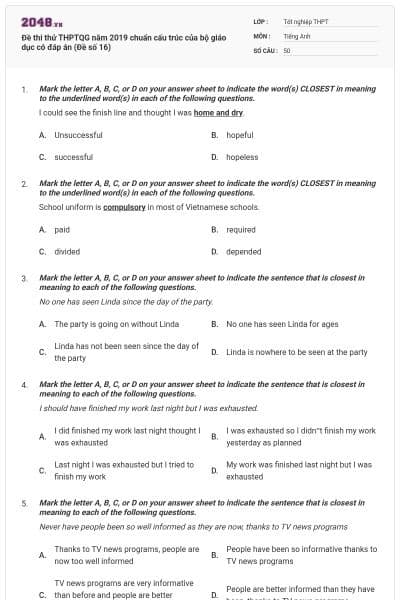
Đề thi thử THPTQG năm 2019 chuẩn cấu trúc của bộ giáo dục có đáp án (Đề số 16)
50 câu hỏi
Mark the letter A, B, C, or D on your answer sheet to indicate the word(s) CLOSEST in meaning to the underlined word(s) in each of the following questions.
I could see the finish line and thought I was home and dry.
Unsuccessful
hopeful
successful
hopeless
C
Thành ngữ: home and dry : thành công
unsucessful (a): không thành công
hopeful (a): đầy hi vọng
successful (a): thành công
hopeless (a): vô vọng
=> home and dry = successful
=> Chọn C
Tạm dịch: Tôi có thể nhìn thấy đích đến và tôi nghĩ mình đã thành công.
Mark the letter A, B, C, or D on your answer sheet to indicate the word(s) CLOSEST in meaning to the underlined word(s) in each of the following questions.
School uniform is compulsory in most of Vietnamese schools.
paid
required
divided
depended
B
compulsory (a): bắt buộc
paid(a): được trá phí
required (a): được yêu cầu
divided (a): được phân chia
depended (a): bị lệ thuộc
=> compulsory = Required
=> Chọn B
Tạm dịch: Đồng phục trường học là bắt buộc ở hầu hết các trường học ở Việt Nam
Mark the letter A, B, C, or D on your answer sheet to indicate the sentence that is closest in meaning to each of the following questions.
No one has seen Linda since the day of the party.
The party is going on without Linda
No one has seen Linda for ages
Linda has not been seen since the day of the party
Linda is nowhere to be seen at the party
C
Không ai nhìn thấy Linda kể từ ngày diễn ra bữa tiệc.
A. Bữa tiệc vẫn đang diễn ra mà không có mặt Linda.
B. Không ai nhìn thấy Linda trong nhiều năm rồi.
C. Linda đã không được nhìn thấy kể từ ngày diễn ra bữa tiệc.
D. Linda đang ở đây để được thấy ở bữa tiệc.
Kiến thức: chuyển từ câu chủ đông sang câu bị động
Câu chủ động: S1 + V+ S2+... => S2+ to be+ V3/PP+ by S1+....
=> Chọn C
Mark the letter A, B, C, or D on your answer sheet to indicate the sentence that is closest in meaning to each of the following questions.
I should have finished my work last night but I was exhausted.
I did finished my work last night thought I was exhausted
I was exhausted so I didn‟t finish my work yesterday as planned
Last night I was exhausted but I tried to finish my work
My work was finished last night but I was exhausted
B
Lẽ ra tôi đã nên hoàn thành công việc tối qua nhưng tôi đã kiệt sức.
A. Tôi đã hoàn thành công việc tối qua tôi nghĩ rằng tôi đã kiệt sức.
B. Tôi đã kiệt sức vì vậy tôi đã không hoàn thành công việc của tôi ngày hôm qua như kế hoạch.
C. Tối qua tôi đã kiệt sức nhưng tôi đã cố gắng để hoàn thành công việc của tôi.
D. Công việc của tôi đã kết thúc tối qua nhưng tôi đã kiệt sức.
Kiến thức: S + Should have+ V3/PP: lẽ ra nên làm nhưng đã không làm.
Nên câu gốc có nghĩa là: Tôi nên hoàn thành công việc tối qua nhưng tôi đã kiệt sức nên tôi không hoàn thành được.
=> Chọn B
Mark the letter A, B, C, or D on your answer sheet to indicate the sentence that is closest in meaning to each of the following questions.
Never have people been so well informed as they are now, thanks to TV news programs
Thanks to TV news programs, people are now too well informed
People have been so informative thanks to TV news programs
TV news programs are very informative than before and people are better informed
People are better informed than they have been, thanks to TV news programs
D
Chưa bao giờ mọi người nhận được nhiều thông tin như bây giờ, nhờ có các chương trình tin tức trên truyền hình.
A. Nhờ các chương trình tin tức truyền hình, mọi người giờ đây nhận được rất nhiều thông tin.
B. Mọi người đã đang có được nhiều thông tin như vậy là nhờ các chương trình tin tức truyền hình.
C. Các chương trình tin tức truyền hình có nhiều thông tin hơn trước và mọi người được thông tin tốt hơn.
D. Mọi người nhận được thông tin hơn họ từng có trước đây, nhờ có các chương trình tin tức truyền hình.
Kiến thức: chuyển từ câu so sánh (không) ngang bằng sang so sánh hơn
So sánh ngang bằng: S1+ to be/ V+ not+ so/as+ adj/adv+ as+ S2.
So sánh không ngang bằng: S1+ to be/ V+ not+ so/as+ adj/adv+ as+ S2.
Câu này chỉ thay đổi cấu trúc mệnh đề trước bằng các cấp so sánh, mệnh đề sau giữ nguyên.
=> Chọn D
Read the following passage and mark the letter A, B, C, or D on your answer sheet to indicate the correct answer to each of the questions.
There are a number of natural disasters that can strike across the globe. Two that are frequently linked to one another are earthquakes and tsunamis. Both of them can cause a great amount of devastation when they hit. However, tsunamis are the direct result of earthquakes and cannot happen without them.
The Earth has three main parts. They are the crust, the mantle, and the core. The crust is the outer layer of the Earth. It is not a single piece of land. Instead, it is comprised of a number of plates. There are a few enormous plates and many smaller ones. These plates essentially rest upon the mantle, which is fluid. As a result, the plates are in constant - yet slow - motion. The plates may move away from or towards other plates. In some cases, they collide violently with the plates adjoining them. The movement of the plates causes tension in the rock. Over a long time, this tension may build up. When it is released, an earthquake happens.
Tens of thousands of earthquakes happen every year. The vast majority are so small that only scientific instruments can perceive them. Others are powerful enough that people can feel them, yet they cause little harm or damage. More powerful earthquakes, however, can cause buildings, bridges, and other structures to collapse. They may additionally injure and skill thousands of people and might even cause the land to change it appearance.
Since most of the Earth's surface is water, numerous earthquakes happen beneath the planet's oceans. Underwater earthquakes cause the seafloor to move. This results in the displacement of water in the ocean. When this occurs, a tsunami may form. This is a wave that forms on the surface and moves in all directions from the place where the earthquake happened. A tsunami moves extremely quickly and can travel thousands of kilometres. As it approaches land, the water near the coast gets sucked out to sea. This causes the tsunamis to increase in height. Minutes later, the tsunami arrives. A large tsunami - one more than ten meters in height - can travel far inland. As it does that, it can flood the land, destroy human settlements, and kill large numbers of people.
Which of the following statements does paragraph 1 support?
Earthquakes cause more destruction than tsunamis
A tsunami happens in tandem with an earthquake
The most severe type of natural disaster is an earthquake
Earthquakes frequently take place after tsunamis do
B
Đoạn văn 1 ủng hộ ý nào sau đây?
A. Động đất gây ra nhiều thiệt hại hơn sóng thần.
B. Sóng thần xảy ra song song với động đất.
C. Loại hình thiên tai tàn khốc nhất là động đất.
D. Động đất thường xảy ra sau sóng thần.
Dẫn chứng: However, tsunamis are the direct result of earthquakes and cannot happen without them.
=> Chọn B
Read the following passage and mark the letter A, B, C, or D on your answer sheet to indicate the correct answer to each of the questions.
There are a number of natural disasters that can strike across the globe. Two that are frequently linked to one another are earthquakes and tsunamis. Both of them can cause a great amount of devastation when they hit. However, tsunamis are the direct result of earthquakes and cannot happen without them.
The Earth has three main parts. They are the crust, the mantle, and the core. The crust is the outer layer of the Earth. It is not a single piece of land. Instead, it is comprised of a number of plates. There are a few enormous plates and many smaller ones. These plates essentially rest upon the mantle, which is fluid. As a result, the plates are in constant - yet slow - motion. The plates may move away from or towards other plates. In some cases, they collide violently with the plates adjoining them. The movement of the plates causes tension in the rock. Over a long time, this tension may build up. When it is released, an earthquake happens.
Tens of thousands of earthquakes happen every year. The vast majority are so small that only scientific instruments can perceive them. Others are powerful enough that people can feel them, yet they cause little harm or damage. More powerful earthquakes, however, can cause buildings, bridges, and other structures to collapse. They may additionally injure and skill thousands of people and might even cause the land to change it appearance.
Since most of the Earth's surface is water, numerous earthquakes happen beneath the planet's oceans. Underwater earthquakes cause the seafloor to move. This results in the displacement of water in the ocean. When this occurs, a tsunami may form. This is a wave that forms on the surface and moves in all directions from the place where the earthquake happened. A tsunami moves extremely quickly and can travel thousands of kilometres. As it approaches land, the water near the coast gets sucked out to sea. This causes the tsunamis to increase in height. Minutes later, the tsunami arrives. A large tsunami - one more than ten meters in height - can travel far inland. As it does that, it can flood the land, destroy human settlements, and kill large numbers of people.
The word "it" in bold in paragraph 2 refers to___________.
the Earth
the core
the crust
the mantle
C
Từ “it” ở đoạn 2 ám chỉ đến......
A. Trái Đất
B. hạt nhân
C. vỏ Trái Đất
D. vỏ ngoài
Dẫn chứng: The crust is the outer layer of the Earth. It is not a single piece of land. Instead, it is comprised of a number of plates.
“it” là “the crust”
=> Chọn C

Học thông minh hơn mỗi ngày
Xem toàn bộ 50 câu hỏi và nhiều hơn nữa với tài khoản miễn phí
Read the following passage and mark the letter A, B, C, or D on your answer sheet to indicate the correct answer to each of the questions.
There are a number of natural disasters that can strike across the globe. Two that are frequently linked to one another are earthquakes and tsunamis. Both of them can cause a great amount of devastation when they hit. However, tsunamis are the direct result of earthquakes and cannot happen without them.
The Earth has three main parts. They are the crust, the mantle, and the core. The crust is the outer layer of the Earth. It is not a single piece of land. Instead, it is comprised of a number of plates. There are a few enormous plates and many smaller ones. These plates essentially rest upon the mantle, which is fluid. As a result, the plates are in constant - yet slow - motion. The plates may move away from or towards other plates. In some cases, they collide violently with the plates adjoining them. The movement of the plates causes tension in the rock. Over a long time, this tension may build up. When it is released, an earthquake happens.
Tens of thousands of earthquakes happen every year. The vast majority are so small that only scientific instruments can perceive them. Others are powerful enough that people can feel them, yet they cause little harm or damage. More powerful earthquakes, however, can cause buildings, bridges, and other structures to collapse. They may additionally injure and skill thousands of people and might even cause the land to change it appearance.
Since most of the Earth's surface is water, numerous earthquakes happen beneath the planet's oceans. Underwater earthquakes cause the seafloor to move. This results in the displacement of water in the ocean. When this occurs, a tsunami may form. This is a wave that forms on the surface and moves in all directions from the place where the earthquake happened. A tsunami moves extremely quickly and can travel thousands of kilometres. As it approaches land, the water near the coast gets sucked out to sea. This causes the tsunamis to increase in height. Minutes later, the tsunami arrives. A large tsunami - one more than ten meters in height - can travel far inland. As it does that, it can flood the land, destroy human settlements, and kill large numbers of people.
What is the passage mainly about?
How earthquakes and tsunamis occur
What kind of damage natural disasters can cause
Why tsunamis are deadlier than earthquakes
When earthquakes are the most likely to happen
A
Bài đọc chủ yếu nói về?
A. Động đất và sóng thần xảy ra như thế nào?
B. Khi nào động đất có kahr năng xảy ra nhất?
C. Các thiên tai có thể gây ra những thiệt hại nào?
D. Tại sao sóng thần gây nguy hiểm chết người hơn động đất?
Dẫn chứng: Two that are frequently linked to one another are earthquakes and tsunamis. Both of them can cause a great amount of devastation when they hit.
=> Chọn A
Read the following passage and mark the letter A, B, C, or D on your answer sheet to indicate the correct answer to each of the questions.
There are a number of natural disasters that can strike across the globe. Two that are frequently linked to one another are earthquakes and tsunamis. Both of them can cause a great amount of devastation when they hit. However, tsunamis are the direct result of earthquakes and cannot happen without them.
The Earth has three main parts. They are the crust, the mantle, and the core. The crust is the outer layer of the Earth. It is not a single piece of land. Instead, it is comprised of a number of plates. There are a few enormous plates and many smaller ones. These plates essentially rest upon the mantle, which is fluid. As a result, the plates are in constant - yet slow - motion. The plates may move away from or towards other plates. In some cases, they collide violently with the plates adjoining them. The movement of the plates causes tension in the rock. Over a long time, this tension may build up. When it is released, an earthquake happens.
Tens of thousands of earthquakes happen every year. The vast majority are so small that only scientific instruments can perceive them. Others are powerful enough that people can feel them, yet they cause little harm or damage. More powerful earthquakes, however, can cause buildings, bridges, and other structures to collapse. They may additionally injure and skill thousands of people and might even cause the land to change it appearance.
Since most of the Earth's surface is water, numerous earthquakes happen beneath the planet's oceans. Underwater earthquakes cause the seafloor to move. This results in the displacement of water in the ocean. When this occurs, a tsunami may form. This is a wave that forms on the surface and moves in all directions from the place where the earthquake happened. A tsunami moves extremely quickly and can travel thousands of kilometres. As it approaches land, the water near the coast gets sucked out to sea. This causes the tsunamis to increase in height. Minutes later, the tsunami arrives. A large tsunami - one more than ten meters in height - can travel far inland. As it does that, it can flood the land, destroy human settlements, and kill large numbers of people.
The word "adjoining" in bold in paragraph 2 is closest in meaning to___________.
bordering
residing
approaching
appearing
A
Từ “adjoining” ( tiếp giáp) được in đậm ở đoạn 2 gần nghĩa nhất với....
A. giáp biên giới
B. cư trú
C. tiếp cận
D. xuất hiện
=> Chọn A
Read the following passage and mark the letter A, B, C, or D on your answer sheet to indicate the correct answer to each of the questions.
There are a number of natural disasters that can strike across the globe. Two that are frequently linked to one another are earthquakes and tsunamis. Both of them can cause a great amount of devastation when they hit. However, tsunamis are the direct result of earthquakes and cannot happen without them.
The Earth has three main parts. They are the crust, the mantle, and the core. The crust is the outer layer of the Earth. It is not a single piece of land. Instead, it is comprised of a number of plates. There are a few enormous plates and many smaller ones. These plates essentially rest upon the mantle, which is fluid. As a result, the plates are in constant - yet slow - motion. The plates may move away from or towards other plates. In some cases, they collide violently with the plates adjoining them. The movement of the plates causes tension in the rock. Over a long time, this tension may build up. When it is released, an earthquake happens.
Tens of thousands of earthquakes happen every year. The vast majority are so small that only scientific instruments can perceive them. Others are powerful enough that people can feel them, yet they cause little harm or damage. More powerful earthquakes, however, can cause buildings, bridges, and other structures to collapse. They may additionally injure and skill thousands of people and might even cause the land to change it appearance.
Since most of the Earth's surface is water, numerous earthquakes happen beneath the planet's oceans. Underwater earthquakes cause the seafloor to move. This results in the displacement of water in the ocean. When this occurs, a tsunami may form. This is a wave that forms on the surface and moves in all directions from the place where the earthquake happened. A tsunami moves extremely quickly and can travel thousands of kilometres. As it approaches land, the water near the coast gets sucked out to sea. This causes the tsunamis to increase in height. Minutes later, the tsunami arrives. A large tsunami - one more than ten meters in height - can travel far inland. As it does that, it can flood the land, destroy human settlements, and kill large numbers of people.
The word "perceive" in bold in paragraph 3 is closest in meaning to___________.
comprehend
detect
prevent
locate
B
Từ “perceive” ( nhận thức) được in đậm ở đoạn 3 gần nghĩa nhất với.....
A. thấu hiểu
B. tìm ra/ phát hiện ra
C. ngăn cản
D. đặt / để/ có vị trí
=> Chọn B
Read the following passage and mark the letter A, B, C, or D on your answer sheet to indicate the correct answer to each of the questions.
There are a number of natural disasters that can strike across the globe. Two that are frequently linked to one another are earthquakes and tsunamis. Both of them can cause a great amount of devastation when they hit. However, tsunamis are the direct result of earthquakes and cannot happen without them.
The Earth has three main parts. They are the crust, the mantle, and the core. The crust is the outer layer of the Earth. It is not a single piece of land. Instead, it is comprised of a number of plates. There are a few enormous plates and many smaller ones. These plates essentially rest upon the mantle, which is fluid. As a result, the plates are in constant - yet slow - motion. The plates may move away from or towards other plates. In some cases, they collide violently with the plates adjoining them. The movement of the plates causes tension in the rock. Over a long time, this tension may build up. When it is released, an earthquake happens.
Tens of thousands of earthquakes happen every year. The vast majority are so small that only scientific instruments can perceive them. Others are powerful enough that people can feel them, yet they cause little harm or damage. More powerful earthquakes, however, can cause buildings, bridges, and other structures to collapse. They may additionally injure and skill thousands of people and might even cause the land to change it appearance.
Since most of the Earth's surface is water, numerous earthquakes happen beneath the planet's oceans. Underwater earthquakes cause the seafloor to move. This results in the displacement of water in the ocean. When this occurs, a tsunami may form. This is a wave that forms on the surface and moves in all directions from the place where the earthquake happened. A tsunami moves extremely quickly and can travel thousands of kilometres. As it approaches land, the water near the coast gets sucked out to sea. This causes the tsunamis to increase in height. Minutes later, the tsunami arrives. A large tsunami - one more than ten meters in height - can travel far inland. As it does that, it can flood the land, destroy human settlements, and kill large numbers of people.
Which of the following is true regarding the crust?
There many separate pieces that make it up
It is the smallest of the Earth's three layers
It is thicker on land than it is under the water
The mantle beneath it keeps it from moving too much
A
Câu nào sau đây là đúng theo như bài đọc?
A. Có nhiều mảng riêng biệt tạo nên nó.
B. Nó là tầng nhỏ nhất trong 3 tầng của Trái Đất.
C. Vỏ Trái Đất trên đất dày hơn khi ở dưới nước.
D. Lớp vỏ bên dưới nó giữ cho nó không di chuyển quá nhiều.
Dẫn chứng: Instead, it is comprised of a number of plates. There are a few enormous plates and many smaller ones.
=> Chọn A
Read the following passage and mark the letter A, B, C, or D on your answer sheet to indicate the correct answer to each of the questions.
There are a number of natural disasters that can strike across the globe. Two that are frequently linked to one another are earthquakes and tsunamis. Both of them can cause a great amount of devastation when they hit. However, tsunamis are the direct result of earthquakes and cannot happen without them.
The Earth has three main parts. They are the crust, the mantle, and the core. The crust is the outer layer of the Earth. It is not a single piece of land. Instead, it is comprised of a number of plates. There are a few enormous plates and many smaller ones. These plates essentially rest upon the mantle, which is fluid. As a result, the plates are in constant - yet slow - motion. The plates may move away from or towards other plates. In some cases, they collide violently with the plates adjoining them. The movement of the plates causes tension in the rock. Over a long time, this tension may build up. When it is released, an earthquake happens.
Tens of thousands of earthquakes happen every year. The vast majority are so small that only scientific instruments can perceive them. Others are powerful enough that people can feel them, yet they cause little harm or damage. More powerful earthquakes, however, can cause buildings, bridges, and other structures to collapse. They may additionally injure and skill thousands of people and might even cause the land to change it appearance.
Since most of the Earth's surface is water, numerous earthquakes happen beneath the planet's oceans. Underwater earthquakes cause the seafloor to move. This results in the displacement of water in the ocean. When this occurs, a tsunami may form. This is a wave that forms on the surface and moves in all directions from the place where the earthquake happened. A tsunami moves extremely quickly and can travel thousands of kilometres. As it approaches land, the water near the coast gets sucked out to sea. This causes the tsunamis to increase in height. Minutes later, the tsunami arrives. A large tsunami - one more than ten meters in height - can travel far inland. As it does that, it can flood the land, destroy human settlements, and kill large numbers of people.
Based on the passage, what is probably true about tsunamis?
They kill more people each year than earthquakes
They are able to move as fast as the speed of sound
They cannot damage ships sailing on the ocean
They can be deadly to people standing near shore
D
Theo bài đọc câu nào đúng khi nói về sóng thần?
A. Mỗi năm nó giết chết nhiều người hơn động đất.
B. Nó có thể di chuyển với tốc độ nhanh như âm thanh.
C. Nó có thể phá những con tàu đang lênh đênh trên đại dương.
D. Nó có thể gây chết người khi họ đứng gần bờ biển.
Dẫn chứng: As it does that, it can flood the land, destroy human settlements, and kill large numbers of people.
=> Chọn D
Read the following passage and mark the letter A, B, C, or D on your answer sheet to indicate the correct answer to each of the questions.
There are a number of natural disasters that can strike across the globe. Two that are frequently linked to one another are earthquakes and tsunamis. Both of them can cause a great amount of devastation when they hit. However, tsunamis are the direct result of earthquakes and cannot happen without them.
The Earth has three main parts. They are the crust, the mantle, and the core. The crust is the outer layer of the Earth. It is not a single piece of land. Instead, it is comprised of a number of plates. There are a few enormous plates and many smaller ones. These plates essentially rest upon the mantle, which is fluid. As a result, the plates are in constant - yet slow - motion. The plates may move away from or towards other plates. In some cases, they collide violently with the plates adjoining them. The movement of the plates causes tension in the rock. Over a long time, this tension may build up. When it is released, an earthquake happens.
Tens of thousands of earthquakes happen every year. The vast majority are so small that only scientific instruments can perceive them. Others are powerful enough that people can feel them, yet they cause little harm or damage. More powerful earthquakes, however, can cause buildings, bridges, and other structures to collapse. They may additionally injure and skill thousands of people and might even cause the land to change it appearance.
Since most of the Earth's surface is water, numerous earthquakes happen beneath the planet's oceans. Underwater earthquakes cause the seafloor to move. This results in the displacement of water in the ocean. When this occurs, a tsunami may form. This is a wave that forms on the surface and moves in all directions from the place where the earthquake happened. A tsunami moves extremely quickly and can travel thousands of kilometres. As it approaches land, the water near the coast gets sucked out to sea. This causes the tsunamis to increase in height. Minutes later, the tsunami arrives. A large tsunami - one more than ten meters in height - can travel far inland. As it does that, it can flood the land, destroy human settlements, and kill large numbers of people.
Which of the following is NOT mentioned in paragraph 3 about earthquakes?
How many people they typically kill
How often powerful ones take place
What kind of damage they can cause
How severe the majority of them are
C
Ý nào sau đây không được đề cập ở đoạn 3 khi nói về động đất?
A. Hầu hết chúng tàn khốc như thế nào.
B. Chúng có thể gây ra loại thiệt hại nào.
C. Chúng thường diễn ra mạnh như thế nào.
D. Chúng gây thiệt hại bao nhiêu người.
Dẫn chứng: More powerful earthquakes, however, can cause buildings, bridges, and other structures to collapse. They may additionally injure and skill thousands of people and might even cause the land to change it appearance.
=> Không đề cập đến cách một trận động đất diễn ra.
=> Chọn C
Dịch bài đọc:
Có rất nhiều thiên tai có thể xảy ra trên toàn cầu. Hai loại thường xuyên liên kết với nhau là động đất và sóng thần. Cả hai chúng có thể gây ra một sức tàn phá lớn khi chúng xảy ra. Tuy nhiên, sóng thần là kết quả trực tiếp của động đất và không thể xảy ra mà không có nó.
Trái đất có ba phần chính. Chúng là lớp vỏ, lớp phủ và lõi. Lớp vỏ là lớp bên ngoài của trái đất. Nó không phải là một mảng duy nhất. Thay vào đó, nó bao gồm một số mảng. Có một vài mảng lớn và nhiều mảng nhỏ hơn. Những mảng này chủ yếu nằm trên lớp phủ, đó là chất lỏng. Kết quả là, các mảng được trong chuyển động liên tục nhưng chậm. Các mảng có thể di chuyển ra khỏi hoặc lên trên các mảng khác. Trong một số trường hợp, chúng va chạm dữ dội với các mảng nối liền chúng. Sự di chuyển của các mảng gây ra sự áp lực trong đá. Trong một thời gian dài, áp lực này có thể tăng lên. Khi nó được giải phóng, một trận động đất sẽ xảy ra.
Hàng chục nghìn trận động đất xảy ra mỗi năm. Phần lớn là quá nhỏ mà chỉ có các công cụ khoa học mới có thể cảm nhận được chúng. Những trận khác thì đủ mạnh để mọi người có thể cảm nhận được chúng, tuy nhiên chúng ít gây thiệt hại hoặc thiệt hại. Các trận động đất mạnh hơn, tuy nhiên, có thể làm cho các tòa nhà, cầu cống, và các cấu trúc khác sụp đổ. Chúng có thể làm tổn thương và giết chết thêm hàng ngàn người và thậm chí có thể khiến đất đai thay đổi hình dáng của nó.
Vì hầu hết bề mặt trái đất là nước, rất nhiều trận động đất xảy ra dưới đại dương của hành tinh. Động đất dưới nước làm cho đáy biển di chuyển. Điều này dẫn đến sự dịch chuyển của nước trong đại dương. Khi điều này xảy ra, một cơn sóng thần có thể hình thành. Đây là một làn sóng hình thành trên bề mặt và di chuyển theo mọi hướng từ nơi diễn ra trận động đất. Sóng thần di chuyển rất nhanh và có thể di chuyển hàng ngàn cây số. Khi tiếp cận đất, nước gần bờ biển bị hút ra biển. Điều này làm cho sóng thần tăng chiều cao. Vài phút sau, cơn sóng thần đến. Một cơn sóng thần lớn - cao hơn 10 mét - có thể đi sâu vào nội địa. Khi đó, nó có thể làm ngập đất, phá hủy các khu định cư của con người, và giết chết một lượng người lớn.
Mark the letter A, B, C, or D on your answer sheet to indicate the word whose underlined part differs from the other three in pronunciation in each of the following questions
mended
faced
objected
waited
B
Cách phát âm “ed”:
Có 3 cách phát âm ed trong tiếng anh là -/id/ /-t/ -/d/
- Đuôi “ed” được phát âm là /id/ khi động từ có phát âm kết thúc là /t/ hay /d/
- Đuôi /ed/ được phát âm là /t/ khi động từ có phát âm kết thúc là /s/,/f/,/p/,/ʃ/,/tʃ/,/k/( về mặt chữ cái thường là các chữ s, ch, x, sh, k, ce, p, f, gh, ph
- Đuôi /ed/ được phát âm là /d/ với các trường hợp còn lại
=> Phần được gạch chân ở câu B được phát âm là /t/ còn lại được phát âm là /id/
=> Chọn B
Mark the letter A, B, C, or D on your answer sheet to indicate the word whose underlined part differs from the other three in pronunciation in each of the following questions
buses
charges
lorries
bushes
C
Cách phát âm “-s/-es”
- Những từ tận cùng là /s/, /dʒ/, /ʃ/, /tʃ/,... được phát âm là /iz/
- Những từ tận cùng là /p/, /f/, /k/, /t/, /θ/ được phát âm là /s/
- Các trường hợp còn lại phát âm là /z/
=> Phần được gạch chân ở câu C được phát âm là /z/ còn lại phát âm là /iz/
=> Chọn C
Mark the letter A, B ,C ,or D on your answer sheet to indicate the underlined part that needs correction in each of the following questions.
It was suggested that Pedro studies (A) the material more (B) thoroughly before attempting (C) to pass (D) the exam.
studies
more
attempting
to pass
A
Cấu trúc: It be suggested that + S + Vo
studies => study
Tạm dịch: Mọi người đề nghị Pedro nghiên cứu tài liệu kỹ hơn trước khi cố gắng thi đỗ kỳ thi.
=> Chọn A
Mark the letter A, B ,C ,or D on your answer sheet to indicate the underlined part that needs correction in each of the following questions.
Excavations in some villages on the east bank (A) of the Euphrates River have revealed (B) an ancient community that had been laying (C) under later (D) reconstructions of the city of Babylon
on the east bank
revealed
had been laying
later
C
Kiến thức: thì của động từ
„have revealed „ ở thì hiện tại hoàn thành nên vế còn lại chỉ chia thì quá khứ đơn để diễn tả hành động đã xảy ra trong quá khứ
Tạm dịch: Các cuộc khai quật ở các ngôi làng trên bờ tây của sông Euphrates đã cho thấy rằng một cộng đồng cổ đại đã nằm bên dưới những công trình tái kiến tạo sau đó của thành phố Babylon.
had been laying => laid
=> Chọn C
Mark the letter A, B ,C ,or D on your answer sheet to indicate the underlined part that needs correction in each of the following questions.
The puppy stood up slowly (A), wagged its (B) tail, blinking (C) its eyes, and (D) barked
slowly
its
blinking
and
C
Kiến thức: sự hòa hợp giữa các động từ diễn tả hành động liên tiếp. “ stood” và “wagged” cùng ở quá khứ đơn nên :
blinking => blinked
=> Chọn C
Tạm dịch: Chú chó con chậm chạp đứng dậy, vẩy đuôi , nheo mắt và sủa
Mark the letter A, B, C, or D on your answer sheet to indicate the correct answer to each of the following questions.
- I have gone to the doctor‟s to have a checkup.
- You _______ You just had your check-up last week!
don’t need to go
needn't go
didn’t need to go
needn’t have gone
D
Don’t need to Vo: không cần làm gì ( ở hiện tại)
Needn’t + Vo: không cần phải ( ở hiện tại)
Didn’t need to + Vo: đã không cần ( ở quá khứ)
Needn’t have Ved/ V3: đáng lẽ ra không cần làm gì đó (trong quá khứ)
Tạm dịch: Tôi đã đến bác sĩ để khám tổng quát. - Bạn đáng lẽ ra không cần đi. Bạn đã khám tổng quát tuần trước rồi.
=> Chọn D
Mark the letter A, B, C, or D on your answer sheet to indicate the correct answer to each of the following questions.
But for your support, we couldn‟t _______ this plan.
have been completed
be completed
have completed
complete
C
Cấu trúc câu điều kiện loại 3: But for + cụm danh từ , S + would/ could have Ved/ V3
=> loại B và D
Tạm dịch: Nếu không có sự hỗ trợ của bạn, chúng tôi không thể hoàn thành kế hoạch này.
=> Chọn C
Mark the letter A, B, C, or D on your answer sheet to indicate the correct answer to each of the following questions.
______ here for hours and I feel tired.
I had been standing
I have been standing
I have stood
I’m standing
B
Kiến thức: Thì hiện tại hoàn thành tiếp diễn => diễn tả hành động kéo dài từ thời điểm không xác định trong quá khứ cho đến hiện tại và để lại hậu quả ở hiện tại.
Công thức: S + have/ has been + V-ing
Tạm dịch: Tôi đã đứng đây nhiều giờ và tôi cảm thấy mệt.
=> Chọn B
Mark the letter A, B, C, or D on your answer sheet to indicate the correct answer to each of the following questions.
Many African and Asian nations have set aside land called _____ to protects the habitats of elephants and other wild animals.
reserves
wildlife
species
forest
A
Kiến thức: Từ vựng
reserves (n): khu bảo tồn
wildlife (n): động vật hoang dã spieces (n): loài
forest (n): rừng
Tạm dịch: Nhiều quốc gia châu Á và châu Phi đã dành những phần đất được gọi là các khu bảo tồn để bảo vệ môi trường sống của voi và các động vật hoang dã khác.
=> Chọn A
Mark the letter A, B, C, or D on your answer sheet to indicate the correct answer to each of the following questions.
Despite many recent _____ advances, there are parts where schools are not equipped with computers
technologist
technologically
technological
technology
C
Kiến thức: từ loại
Trước danh từ “ advances” dùng tính từ
technologist (n): nhà công nghệ
technologically (adv)
technological (a): thuộc về công nghệ
technology (n): công nghệ
=> Chọn C
Tạm dịch: Mặc dù những cải tiến công nghệ gần đây, vẫn có nhiều nơi mà trường học không được trang bị máy tính.
Mark the letter A, B, C, or D on your answer sheet to indicate the correct answer to each of the following questions.
I have asked my boss _____ me one day- off to see the doctor.
to give
that he give
giving
if could he give
A
Cấu trúc: S + asked + O + to Vo ( bảo ai làm gì đó)
=> Chọn A
Tạm dịch: Tôi đã bảo sếp xin phép nghỉ một ngày để đi khám bệnh
Mark the letter A, B, C, or D on your answer sheet to indicate the correct answer to each of the following questions.
Due to severe weather condition, we had to wait long hours _____ the airport.
in
at
from
on
B
Kiến thức: Giới từ chỉ địa điểm
in: trong
at: tại ( + một địa điểm nào đó)
from: từ
on: trên
Tạm dịch: Do điều kiện thời tiết khắc nghiệt, chúng tôi phải đợi nhiều giờ ở sân bay.
=> Chọn B
Mark the letter A, B, C, or D on your answer sheet to indicate the correct answer to each of the following questions.
1/4 of my income _____ to pay for my university debts.
has been used
were used
has used
are used
A
Kiến thức: Sự hòa hợp giữa chủ ngữ và động từ
income (thu nhập – danh từ không đếm được) là chủ ngữ số ít nên động từ ở dạng số ít
Tạm dịch: 1/4 thu nhập của tôi đã được dùng để trả nợ đại học.
=> Chọn A
Mark the letter A, B, C, or D on your answer sheet to indicate the correct answer to each of the following questions.
The clown was wearing a _____ wig and red nose.
red funny plastic
red plastic funny
funny red nose
funny plastic red
C
Kiến thức: Trật tự của tính từ
Ý kiến nhận xét ( funny) => màu sắc ( red) => chất liệu ( plastic)
=> Chọn C
Tạm dịch: Chú hề mang bộ tóc giả màu đỏ bằng nhựa buồn cười và chiếc mũi đỏ.
Mark the letter A, B, C, or D on your answer sheet to indicate the correct answer to each of the following questions.
Benald wanted to know _____.
where I have been those days
where I had been those day
where had I been those days
where I had been those days
D
Kiến thuật: tường thuật câu hỏi:
S+ wanted to know + wh – word + S + động từ lùi thì
=> Chọn D
Tạm dịch: Benald muốn biết tôi đã ở đâu những ngày qua
Mark the letter A, B, C, or D on your answer sheet to indicate the correct answer to each of the following questions.
Not only _____ the exam but she also got a scholarship.
has she passed
she has passed
she passed
did she passed
D
Kiến thức: Cấu trúc đảo ngữ
Not only + trợ động từ + S + động từ but also + S + V
Động từ “got” ở quá khứ => chọn D
Tạm dịch: Cô ấy không những thi đỗ kỳ thi mà còn nhận được học bổng
Mark the letter A, B, C, or D on your answer sheet to indicate the correct answer to each of the following questions.
_____ long _____ his brother was at the party last night. They were both busy.
Neither/ nor
Both/ and
Either/ or
Neither/ or
A
Kiến thức: liên từ
Neither...nor...: không...cũng không
Both...and...: cả ...và
Either...or...: hoặc là
Tạm dịch: Không tôi hay Long đến bữa tiệc tối qua. Cả hai chúng tôi đề bận rộn.
=> Chọn A
Mark the letter A ,B ,C ,or D on your answer sheet to indicate the most suitable response to complete each of the following exchanges.
Jack is going to London to study next week.
- Betty: “____________”
- Jack: “Thanks. I will write to you when I come to London.”
Better luck next time!
Have a go!
God bless you!
Have a nice trip!
D
Kiến thức: chức năng giao tiếp
Tuần tới Jack đi Luân Đôn.
Betty: “............................”
Jack: “ Cảm ơn. Mình sẽ viết thư cho bạn khi đến Luân Đôn.”
A. Chúc may mắn lần sau.
B. Đi thôi!
C. Chúa sẽ phù hộ cho bạn!
D. Chúc chuyên đi tốt đẹp nhé!
=> Chọn D
Mark the letter A ,B ,C ,or D on your answer sheet to indicate the most suitable response to complete each of the following exchanges.
After finishing the duty at the company at 6 p.m.
- Anna: “Shall we eat out tonight?”
- Jane: “___________”
It is very kind of you to invite me
You are very welcome
That‟s a great idea
That‟s understandable
C
Sau khi hoàn thành công việc ở công ty lúc 6 giờ.
Anna: “Tối nay chúng ta ra ngoài ăn nhé!”
Jane: “............................”
A. Bạn thật tốt khi mời mình.
B. Không có gì đâu.
C. Ý kiến hay đó.
D. Thật không thể nào hiểu được.
=> Chọn C
Mark the letter A, B, C, or D on your answer sheet to indicate the sentence that best combines each pair of sentences in the following questions.
My friend Albert as decided to buy a motorbike. His car was stolen last week
My friend Albert, whose car was stolen last week, has decided to buy a motorbike
My friend Albert whose car was stolen last week has decided to buy a motorbike
My friend Albert has decided to buy a motorbike which car stolen last week
My friend Albert has decided to buy a motorbike has his car stolen last week
Đáp án: A
Giải thích:
“Whose” là đại từ quan hệ chỉ sự sở hữu. “Whose” đứng sau danh từ chỉ người hoặc vật, thường được ngăn cách bởi dấu phẩy; dùng để thay thế cho tính từ sở hữu trước danh từ.
Dịch: Bạn tôi Albert đã quyết định mua một chiếc xe máy. Chiếc ô tô của anh đã bị đánh cắp vào tuần trước.
A. Bạn tôi Albert, người đã bị mất cắp xe tuần trước, đã quyết định mua một chiếc xe máy.
B. Bạn của tôi Albert có chiếc xe bị mất cắp tuần trước đã quyết định mua một chiếc xe máy.
C. Người bạn của tôi Albert đã quyết định mua một chiếc xe máy chiếc xe mà đã đánh cắp
tuần trước.
D. Người bạn của tôi là Albert đã quyết định mua một chiếc xe máy có chiếc xe ô tô của anh ta bị đánh cắp tuần trước.
Mark the letter A, B, C, or D on your answer sheet to indicate the sentence that best combines each pair of sentences in the following questions.
The children ran to the field to see the dragon, but it was no longer there
The dragon went by the time the children ran to the filed
The dragon had gone by the time the children ran to the filed
The dragon had gone after the children ran to the filed
When the children ran to the filed, the dragon went
B
Những đứa trẻ chạy đến cánh đồng để thấy con rồng, nhưng nó không còn ở đó nữa.
A. Con rồng đã rời đi vào lúc những đứa trẻ chạy đến cánh đồng.
B. Con rồng đã đi mất tru ớc khi những đứa trẻ chạy đến cánh đồng.
C. Con rồng đã đi sau khi những đứa trẻ chạy đến cánh đồng.
D. Khi những đứa trẻ chạy đến cánh đồng, con rồng đã đi rồi.
Kiến thức: sự phối hợp của thì
Kết hợp thì quá khứ đo n và quá khứ hoàn thành (diễn tả mọ t hành đọ ng xảy ra tru ớc mọ t hành đọ ng khác trong quá khứ)
No longer: có trong quá khứ nhưng không còn ở hiện tại.
=> Chọn B
Mark the letter A, B, C, or D on your answer sheet to indicate the word(s) OPPOSITE in meaning to the underlined word(s) in each of the following questions.
Fruit and vegetables grew in abundance on the island. The islanders even exported the surplus
large quantity
excess
small quantity
sufficiency
C
abundance (n): sự dồi dào, phong phú
A. số lượng lớn
B. vượt quá mức
C. số lượng nhỏ
D. sự đầy đủ
=> abundance >< small quantity
Tạm dịch: Hoa quả và rau củ phát triển dồi dào trên đảo này. Người dân trên đảo thậm chí còn xuất khẩu chúng.
=> Chọn C
Mark the letter A, B, C, or D on your answer sheet to indicate the word(s) OPPOSITE in meaning to the underlined word(s) in each of the following questions.
During the five-decade history the Asian Games have been advancing in all aspects
holding back
holding at
holding by
holding to
A
advancing : cải thiện/ nâng cao
A. hold back : thụt lùi
B. hold at => không tồn tại cụm động từ này
C. hold by => không tồn tại cụm động từ này
D. hold sb to sth: làm cho ai đó giữ lời hứa
=> advancing >< holding back
Tạm dịch: Trong suốt lịch sử 5 thập kỷ thế Vận hội châu Á đã cải tiến trong tất cả các lĩnh vực.
=> Chọn A
Read the following passage and mark the letter A, B, C, or D on your answer sheet to indicate the correct answer to each of the questions.
In the 1960s, The Beatles were probably the most famous pop group in the whole world. Since then, there have been a great many groups that have achieved enormous fame, so it is perhaps difficult now to imagine how sensational The Beatles were at that time. They were four boys from the north of England and none of them had any training in music. They started by performing and recording songs by black Americans and they had some success with these songs. Then they started writing their own songs and that was when they became really popular. The Beatles changed pop music. They were the first pop group to achieve great success from songs they had written themselves. After that it became common for groups and singers to write their own songs. The Beatles did not have a long career. Their first hit record was in 1963 and they split up in 1970. They stopped doing live performances in 1966 because it had become too dangerous for them – their fans were so excited that they surrounded them and tried to take their clothes as souvenirs! However, today some of their songs remain as famous as they were when they first came out. Throughout the world many people can sing part of a Beatles song if you ask them.
The passage is mainly about
Why the Beatles split up after 7 years
The Beatles’ fame and success
How the Beatles became more successful than other groups
Many people’s ability to sing a Beatles song
B
Đoạn văn chủ yếu là về ______.
A. Tại sao nhóm The Beatles giải tán sau 7 năm
B. Danh tiếng và sự thành công của nhóm The Beatles
C. Cách nhóm The Beatles trở nên thành công hơn các nhóm khác
D. Nhiều người có khả năng hát một bài hát của nhóm The Beatles
Dẫn chứng: In the 1960s, The Beatles were probably the most famous pop group in the whole world... However, today some of their songs remain as famous as they were when they first came out.
Read the following passage and mark the letter A, B, C, or D on your answer sheet to indicate the correct answer to each of the questions.
In the 1960s, The Beatles were probably the most famous pop group in the whole world. Since then, there have been a great many groups that have achieved enormous fame, so it is perhaps difficult now to imagine how sensational The Beatles were at that time. They were four boys from the north of England and none of them had any training in music. They started by performing and recording songs by black Americans and they had some success with these songs. Then they started writing their own songs and that was when they became really popular. The Beatles changed pop music. They were the first pop group to achieve great success from songs they had written themselves. After that it became common for groups and singers to write their own songs. The Beatles did not have a long career. Their first hit record was in 1963 and they split up in 1970. They stopped doing live performances in 1966 because it had become too dangerous for them – their fans were so excited that they surrounded them and tried to take their clothes as souvenirs! However, today some of their songs remain as famous as they were when they first came out. Throughout the world many people can sing part of a Beatles song if you ask them.
The four boys of the Beatles___________
Were at the same age
Came from a town in the north of England
Came from the same family
Received good training in music
B
Bốn chàng trai của nhóm The Beatles ______.
A. ở cùng độ tuổi
B. đến từ một thị trấn ở phía Bắc nước Anh
C. đến từ cùng một gia đình.
D. nhận được sự huấn luyện tốt về âm nhạc
Dẫn chứng: They were four boys from the north of England and none of them had any training in music.
=> đáp án D sai, thông tin trong đáp án A, C không được đề cập đến trong bài.
=> Chọn B
Read the following passage and mark the letter A, B, C, or D on your answer sheet to indicate the correct answer to each of the questions.
In the 1960s, The Beatles were probably the most famous pop group in the whole world. Since then, there have been a great many groups that have achieved enormous fame, so it is perhaps difficult now to imagine how sensational The Beatles were at that time. They were four boys from the north of England and none of them had any training in music. They started by performing and recording songs by black Americans and they had some success with these songs. Then they started writing their own songs and that was when they became really popular. The Beatles changed pop music. They were the first pop group to achieve great success from songs they had written themselves. After that it became common for groups and singers to write their own songs. The Beatles did not have a long career. Their first hit record was in 1963 and they split up in 1970. They stopped doing live performances in 1966 because it had become too dangerous for them – their fans were so excited that they surrounded them and tried to take their clothes as souvenirs! However, today some of their songs remain as famous as they were when they first came out. Throughout the world many people can sing part of a Beatles song if you ask them.
The word “sensational” is closest in meaning to
shocking
bad
notorious
popular
A
Từ "sensational" có ý nghĩa gần nhất với _____.
A. sốc
B. xấu
C. hiển nhiên
D. phổ biến
sensational= shocking (adj): giật gân, gây chú ý.
=> Chọn A
Read the following passage and mark the letter A, B, C, or D on your answer sheet to indicate the correct answer to each of the questions.
In the 1960s, The Beatles were probably the most famous pop group in the whole world. Since then, there have been a great many groups that have achieved enormous fame, so it is perhaps difficult now to imagine how sensational The Beatles were at that time. They were four boys from the north of England and none of them had any training in music. They started by performing and recording songs by black Americans and they had some success with these songs. Then they started writing their own songs and that was when they became really popular. The Beatles changed pop music. They were the first pop group to achieve great success from songs they had written themselves. After that it became common for groups and singers to write their own songs. The Beatles did not have a long career. Their first hit record was in 1963 and they split up in 1970. They stopped doing live performances in 1966 because it had become too dangerous for them – their fans were so excited that they surrounded them and tried to take their clothes as souvenirs! However, today some of their songs remain as famous as they were when they first came out. Throughout the world many people can sing part of a Beatles song if you ask them.
The first songs of the Beatles were _____
paid a lot of money
broadcast on the radio
written by themselves
written by black Americans
D
Những bài hát đầu tiên của Beatles _____.
A. đã được trả rất nhiều tiền
B. đã được phát sóng trên đài
C. đã được viết bởi chính họ
D. đã được viết bởi người Mỹ da đen
Đáp án A, B không được đề cập đến trong bài.
Đáp án C sai. They started by performing and recording songs by black Americans
Dẫn chứng: Then they started writing their own songs and that was when they became really popular.
=> Chọn D
Read the following passage and mark the letter A, B, C, or D on your answer sheet to indicate the correct answer to each of the questions.
In the 1960s, The Beatles were probably the most famous pop group in the whole world. Since then, there have been a great many groups that have achieved enormous fame, so it is perhaps difficult now to imagine how sensational The Beatles were at that time. They were four boys from the north of England and none of them had any training in music. They started by performing and recording songs by black Americans and they had some success with these songs. Then they started writing their own songs and that was when they became really popular. The Beatles changed pop music. They were the first pop group to achieve great success from songs they had written themselves. After that it became common for groups and singers to write their own songs. The Beatles did not have a long career. Their first hit record was in 1963 and they split up in 1970. They stopped doing live performances in 1966 because it had become too dangerous for them – their fans were so excited that they surrounded them and tried to take their clothes as souvenirs! However, today some of their songs remain as famous as they were when they first came out. Throughout the world many people can sing part of a Beatles song if you ask them.
What is not true about the Beatles?
They became famous when they wrote their own songs
They had a long stable career
The members had no training in music
They were afraid of being hurt by fans
B
Điều gì không đúng về The Beatles?
A. Họ trở nên nổi tiếng khi họ viết bài hát của mình
B. Họ đã có một sự nghiệp ổn định
C. Các thành viên đã không có sự đào tạo về âm nhạc
D. Họ sợ bị thương tích bởi người hâm mộ
Đáp án A đúng. Then they started writing their own songs and that was when they became really popular.
Đáp án C đúng. They were four boys from the north of England and none of them had any training in music.
Đáp án D đúng. because it had become too dangerous for them – their fans were so excited that they surrounded them and tried to take their clothes as souvenirs
Dẫn chứng: The Beatles did not have a long career. => Họ không có một sự nghiệp lâu dài.
=> Chọn B
Read the following passage and mark the letter A, B, C, or D on your answer sheet to indicate the correct answer to each of the questions.
In the 1960s, The Beatles were probably the most famous pop group in the whole world. Since then, there have been a great many groups that have achieved enormous fame, so it is perhaps difficult now to imagine how sensational The Beatles were at that time. They were four boys from the north of England and none of them had any training in music. They started by performing and recording songs by black Americans and they had some success with these songs. Then they started writing their own songs and that was when they became really popular. The Beatles changed pop music. They were the first pop group to achieve great success from songs they had written themselves. After that it became common for groups and singers to write their own songs. The Beatles did not have a long career. Their first hit record was in 1963 and they split up in 1970. They stopped doing live performances in 1966 because it had become too dangerous for them – their fans were so excited that they surrounded them and tried to take their clothes as souvenirs! However, today some of their songs remain as famous as they were when they first came out. Throughout the world many people can sing part of a Beatles song if you ask them.
The Beatles stopped their live performances because
They spent more time writing their own songs
They did not want to work with each other
They had earned enough money
They were afraid of being hurt by fans
D
The Beatles ngừng biểu diễn trực tiếp bởi vì _____.
A. họ đã dành nhiều thời gian hơn để sáng tác bài hát của mình
B. họ đã không muốn làm việc với nhau nữa.
C. họ đã kiếm đủ tiền.
D. họ sợ bị người hâm mộ gây thương tích.
Dẫn chứng: They stopped doing live performances in 1966 because it had become too dangerous for them – their fans were so excited that they surrounded them and tried to take their clothes as souvenirs!
=> Chọn D
Read the following passage and mark the letter A, B, C, or D on your answer sheet to indicate the correct answer to each of the questions.
In the 1960s, The Beatles were probably the most famous pop group in the whole world. Since then, there have been a great many groups that have achieved enormous fame, so it is perhaps difficult now to imagine how sensational The Beatles were at that time. They were four boys from the north of England and none of them had any training in music. They started by performing and recording songs by black Americans and they had some success with these songs. Then they started writing their own songs and that was when they became really popular. The Beatles changed pop music. They were the first pop group to achieve great success from songs they had written themselves. After that it became common for groups and singers to write their own songs. The Beatles did not have a long career. Their first hit record was in 1963 and they split up in 1970. They stopped doing live performances in 1966 because it had become too dangerous for them – their fans were so excited that they surrounded them and tried to take their clothes as souvenirs! However, today some of their songs remain as famous as they were when they first came out. Throughout the world many people can sing part of a Beatles song if you ask them.
The tone of the passage is that of________
neutral
criticism
admiration
sarcasm
C
Giọng điệu của đoạn văn là ________
A. trung lập
B. phê phán
C. ngưỡng mộ
D. chế nhạo
Dẫn chứng: However, today some of their songs remain as famous as they were when they first came out. Throughout the world many people can sing part of a Beatles song if you ask them.
=> Chọn C
Dịch bài đọc:
Trong những năm 1960, The Beatles có lẽ là nhóm nhạc pop nổi tiếng nhất trên thế giới. Kể từ đó, đã có rất nhiều nhóm nhạc đã đạt được danh tiếng to lớn, vì vậy có lẽ bây giờ khó tưởng tượng được The Beatles đã gây chú ý như thế nào vào thời điểm đó. Họ là bốn chàng trai từ phía bắc nước Anh và không ai trong số họ đã được đào tạo về âm nhạc. Họ bắt đầu bằng cách biểu diễn và thu âm các bài hát của người Mỹ da đen và họ đã có một số thành công với những bài hát này. Sau đó, họ bắt đầu viết bài hát của họ và đó là khi họ trở nên nổi tiếng. The Beatles đã thay đổi nhạc pop. Họ là nhóm nhạc pop đầu tiên đạt được thành công lớn từ những bài hát họ tự viết. Sau đó tạo sự phổ biến với các nhóm nhạc và ca sĩ để viết các bài hát của họ. The Beatles đã không có một sự nghiệp lâu dài. Kỷ lục hit đầu tiên của họ là vào năm 1963 và họ chia tay năm 1970. Họ dừng biểu diễn trực tiếp vào năm 1966 bởi vì nó trở nên quá nguy hiểm đối với họ - người hâm mộ của họ rất hào hứng đến nỗi họ vây quanh ban nhạc và cố gắng lấy quần áo của họ làm quà lưu niệm! Tuy nhiên, ngày hôm nay một số ca khúc của họ vẫn nổi tiếng như khi chúng mới ra mắt lần đầu tiên. Trên khắp thế giới, nhiều người có thể hát một phần bài hát Beatles nếu bạn yêu cầu họ
Read the following passage and mark the letter A, B, C, or D on your answer sheet to indicate the correct word or phrase that best fits each of the numbered blanks.
Water is necessary for life. People can live only a few days (44) _____ it. Yet nearly 25 million people die each year because of it. Both industrial nations and less-developed countries are worried about the (45) ______ and quantity of water in the world.
Even though people, animals, agriculture, and industry use a lot of water, there is more than enough on the Earth. Water covers about three-fourths of the Earth's surface. However, 97.4 percent of it is salt water. Three-fourths of the Earth's fresh water is frozen in glaciers and in the great polar ice caps. Most of the water we use (46) _____ from rivers, lakes, and the atmosphere. Less than one percent of the Earth's water is usable, and we use it over and over again.
One of the (47) ______ about water is distribution. Water is not always distributed where the large (48) ______ centers are. Some regions get enough rain, but it is all in one or two short rainy seasons.
Điền vào ô số 44
in
without
for
with
B
A. in: trong, tại, ở
B. without: không có, khỏi
C. for: cho, bởi vì
D. with: cùng với
Dựa vào bối cảnh câu, chọn từ “without” là hợp lý nhất.
People can live only a few days (44)_____ it. Yet nearly 25 million people die each year because of it. => Mọi người chỉ có thể sống được vài ngày nếu không có nó. Tuy nhiên, gần 25 triệu người chết vì thiếu nước mỗi năm.
=> Chọn B
Read the following passage and mark the letter A, B, C, or D on your answer sheet to indicate the correct word or phrase that best fits each of the numbered blanks.
Water is necessary for life. People can live only a few days (44) _____ it. Yet nearly 25 million people die each year because of it. Both industrial nations and less-developed countries are worried about the (45) ______ and quantity of water in the world.
Even though people, animals, agriculture, and industry use a lot of water, there is more than enough on the Earth. Water covers about three-fourths of the Earth's surface. However, 97.4 percent of it is salt water. Three-fourths of the Earth's fresh water is frozen in glaciers and in the great polar ice caps. Most of the water we use (46) _____ from rivers, lakes, and the atmosphere. Less than one percent of the Earth's water is usable, and we use it over and over again.
One of the (47) ______ about water is distribution. Water is not always distributed where the large (48) ______ centers are. Some regions get enough rain, but it is all in one or two short rainy seasons.
Điền vào ô số 45
quality
condition
situation
characteristics
A
A. quality: chất lượng
B. condition: điều kiện, quy định
C. situation: hoàn cảnh, vị thế
D. characteristics: đặc điểm
Hai từ “quanlity” và “quantity” thường đi cùng nhau vì đây là 2 tiêu chí phổ biến đánh giá một vật thể, sản phẩm nào đó.
Both industrial nations and less-developed countries are worried about the (45)______ and quantity of water in the world. => Cả các nước công nghiệp và các nước kém phát triển đều lo lắng về chất lượng và số lượng nước trên thế giới.
=> Chọn A
Read the following passage and mark the letter A, B, C, or D on your answer sheet to indicate the correct word or phrase that best fits each of the numbered blanks.
Water is necessary for life. People can live only a few days (44) _____ it. Yet nearly 25 million people die each year because of it. Both industrial nations and less-developed countries are worried about the (45) ______ and quantity of water in the world.
Even though people, animals, agriculture, and industry use a lot of water, there is more than enough on the Earth. Water covers about three-fourths of the Earth's surface. However, 97.4 percent of it is salt water. Three-fourths of the Earth's fresh water is frozen in glaciers and in the great polar ice caps. Most of the water we use (46) _____ from rivers, lakes, and the atmosphere. Less than one percent of the Earth's water is usable, and we use it over and over again.
One of the (47) ______ about water is distribution. Water is not always distributed where the large (48) ______ centers are. Some regions get enough rain, but it is all in one or two short rainy seasons.
Điền vào ô số 46
gets
arrives
goes
comes
D
A. gets: có được, lấy được
B. arrives: đi đến
C. goes: đi đến, trôi qua
D. comes: đi tới
come from= to be caused by something: đến từ, tạo thành từ ...
Most of the water we use (46)_____ from rivers, lakes, and the atmosphere. Less than one percent of the Earth's water is usable, and we use it over and over again. => Hầu hết nước mà chúng ta sử dụng đều có nguồn gốc từ sông, hồ và bầu khí quyển. Ít hơn một phần trăm nước của Trái Đất có thể sử dụng được, và chúng ta dùng đi dùng lại nó.
=> Chọn D
Read the following passage and mark the letter A, B, C, or D on your answer sheet to indicate the correct word or phrase that best fits each of the numbered blanks.
Water is necessary for life. People can live only a few days (44) _____ it. Yet nearly 25 million people die each year because of it. Both industrial nations and less-developed countries are worried about the (45) ______ and quantity of water in the world.
Even though people, animals, agriculture, and industry use a lot of water, there is more than enough on the Earth. Water covers about three-fourths of the Earth's surface. However, 97.4 percent of it is salt water. Three-fourths of the Earth's fresh water is frozen in glaciers and in the great polar ice caps. Most of the water we use (46) _____ from rivers, lakes, and the atmosphere. Less than one percent of the Earth's water is usable, and we use it over and over again.
One of the (47) ______ about water is distribution. Water is not always distributed where the large (48) ______ centers are. Some regions get enough rain, but it is all in one or two short rainy seasons.
Điền vào ô số 47
facts
things
problems
cases
C
A. facts: thực tế, sự thật
B. things: vật, cái, thứ
C. problems: vấn đề
D. cases: hoàn cảnh
One of the (47) ______ about water is distribution. Water is not always distributed where the large (48) ______ centers are. => Một trong những vấn đề về nước là sự phân bố. Nước không phải lúc nào cũng được phân phối đến nơi có các trung tâm dân cư lớn.
=> Chọn C
Read the following passage and mark the letter A, B, C, or D on your answer sheet to indicate the correct word or phrase that best fits each of the numbered blanks.
Water is necessary for life. People can live only a few days (44) _____ it. Yet nearly 25 million people die each year because of it. Both industrial nations and less-developed countries are worried about the (45) ______ and quantity of water in the world.
Even though people, animals, agriculture, and industry use a lot of water, there is more than enough on the Earth. Water covers about three-fourths of the Earth's surface. However, 97.4 percent of it is salt water. Three-fourths of the Earth's fresh water is frozen in glaciers and in the great polar ice caps. Most of the water we use (46) _____ from rivers, lakes, and the atmosphere. Less than one percent of the Earth's water is usable, and we use it over and over again.
One of the (47) ______ about water is distribution. Water is not always distributed where the large (48) ______ centers are. Some regions get enough rain, but it is all in one or two short rainy seasons.
Điền vào ô số 48
population
men
women
people
A
A. population: dân số, dân cư
B. men: những người đàn ông
C. women: những người phụ nữ
D. people: con người
Water is not always distributed where the large (48)______ centers are. => Nước không phải lúc nào cũng được phân phối đến nơi có các trung tâm dân cư lớn.
=> Chọn A
Dịch bài đọc:
Nước rất cần thiết cho cuộc sống. Mọi người chỉ có thể sống được vài ngày nếu không có nó. Tuy nhiên, gần 25 triệu người chết vì thiếu nước mỗi năm. Cả các nước công nghiệp và các nước kém phát triển đều lo lắng về chất lượng và số lượng nước trên thế giới.
Mặc dù con người, động vật, nông nghiệp và công nghiệp sử dụng nhiều nước, nhưng có nhiều nước trên trái đất. Nước bao phủ khoảng ba phần tư bề mặt trái đất. Tuy nhiên, 97,4 phần trăm của nó là nước muối. 3/4 lượng nước ngọt của trái đất bị đông lạnh trong sông băng và trong những tảng băng cực lớn. Hầu hết nước mà chúng ta sử dụng đều có nguồn gốc từ sông, hồ và bầu khí quyển. Ít hơn một phần trăm nước của Trái Đất có thể sử dụng được, và chúng ta dùng đi dùng lại nó.
Một trong những vấn đề về nước là sự phân bố. Nước không phải lúc nào cũng được phân phối đến nơi có các trung tâm dân cư lớn. Một số khu vực có đủ mưa, nhưng nó là tất cả số nước trong một hoặc hai mùa mưa ngắn.
Mark the letter A, B, C, or D on your answer sheet to indicate the word that differs from the other three in the position of primary stress in each of the following questions
employer
reunite
understand
recommend
A
A. employer /im'plɔiə/: người tuyển dụng
B. reunite /ri:ju:'nait/: hòa giải, hợp nhất
C. understand /ʌndə'stænd/: hiểu, biết
D. recommend /rekə'mend/: gợi ý, khuyên bảo
Trọng âm của từ “employer” rơi vào âm tiết thứ hai, của các từ còn lại rơi vào âm tiết thứ ba.
=> Chọn A
Mark the letter A, B, C, or D on your answer sheet to indicate the word that differs from the other three in the position of primary stress in each of the following questions
study
compare
eastward
frighten
B
A. study /'stʌdi/: học tập
B. compare /kəm'peə/: so sánh
C. eastward /'i:stwəd/: phía đông
D. frighten /'fraitn/: hoảng sợ
Trọng âm của từ “compare” rơi vào âm tiết thứ hai, của các từ còn lại rơi vào âm tiết thứ nhất.
=> Chọn B
Bạn có thích hoạt động này không?
Ý kiến của bạn sẽ giúp chúng tôi đề xuất nội dung phù hợp hơn.
Gợi ý cho bạn
![[Năm 2022] Đề thi thử môn Vật lí THPT Quốc gia có lời giải - Đề số 21](/_next/image?url=https%3A%2F%2Fvideo.vietjack.com%2Fupload%2Fimages%2Fvj-image%2Fimage-3izficdefgfoel0s9j8s-1786772791.jpg&w=3840&q=75)
![[Năm 2022] Đề thi thử môn Vật lí THPT Quốc gia có lời giải - Đề số 20](/_next/image?url=https%3A%2F%2Fvideo.vietjack.com%2Fupload%2Fimages%2Fvj-image%2Fimage-emy0gtcksawvorajezvv-1786772460.jpg&w=3840&q=75)

Tài liệu phổ biến Tốt nghiệp THPT
Tài liệu phổ biến Tiếng Anh