Đề thi thử THPT quốc gia năm 2019 môn tiếng anh chuẩn cấu trúc (Đề số 9)
50 câu hỏi
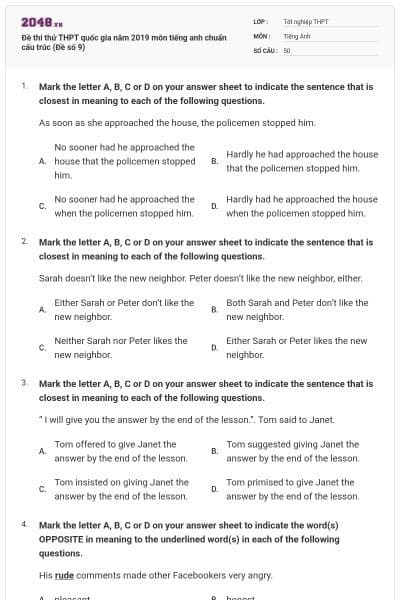
Mark the letter A, B, C or D on your answer sheet to indicate the sentence that is closest in meaning to each of the following questions.
As soon as she approached the house, the policemen stopped him.
No sooner had he approached the house that the policemen stopped him.
Hardly he had approached the house that the policemen stopped him.
No sooner had he approached the when the policemen stopped him.
Hardly had he approached the house when the policemen stopped him.
Đáp án D
Chủ điểm ngữ pháp liên quan tới Đảo ngữ.
Cấu trúc : No sooner + Inversion (đảo ngữ) than + S V O ( Vừa mới…thì…)
= Hardy + Inversion (đảo ngữ) when + S V O
Các đáp án còn lại sai cấu trúc.
Dịch: Ngay khi anh ta vừa về tới nhà thì cảnh sát cho dừng anh ta lại.
Mark the letter A, B, C or D on your answer sheet to indicate the sentence that is closest in meaning to each of the following questions.
Sarah doesn’t like the new neighbor. Peter doesn’t like the new neighbor, either.
Either Sarah or Peter don’t like the new neighbor.
Both Sarah and Peter don’t like the new neighbor.
Neither Sarah nor Peter likes the new neighbor.
Either Sarah or Peter likes the new neighbor.
Đáp án C
Sarah không thích người hàng xóm mới, Peter cũng không thích người hàng xóm mới.
= D. Cả Sarah và Peter đều không thích người hàng xóm mới
Chú ý: Either…or…: 1 trong 2.
Both..and..: Cả 2 đều có .
Neither…nor…: Cả 2 đều không.
Đáp án A sai ngữ pháp do bản thân “Either…or…” đã mang tính phủ định rồi nên không cần “ don’t”, và dù đúng ngữ pháp thì cũng sai nghĩa.
Đáp án B sai ngữ pháp do “Both..and..” không dùng trong câu phủ định.
Đáp án D sai nghĩa: Sarah hoặc Peter không thích người hàng xóm mới.
Mark the letter A, B, C or D on your answer sheet to indicate the sentence that is closest in meaning to each of the following questions.
“ I will give you the answer by the end of the lesson.”. Tom said to Janet.
Tom offered to give Janet the answer by the end of the lesson.
Tom suggested giving Janet the answer by the end of the lesson.
Tom insisted on giving Janet the answer by the end of the lesson.
Tom primised to give Janet the answer by the end of the lesson.
Đáp án D
Chú ý: offer to V: đề nghị làm gì (mang hàm ý giúp đỡ).
suggest V-ing: gợi ý làm gì (mang hàm ý rủ rê).
insist on V-ing: khăng khăng làm gì.
promise to V: hứa sẽ làm gì.
Dịch: “ Tớ sẽ đưa cậu câu trả lời vào cuối buổi học”- Tom nói với Janet.
= Tom đã hứa sẽ đưa Janet câu trả lời vào cuối buổi học.
Các đáp án còn lại không hợp nghĩa:
A. Tom đã đề nghị đưa cho Janet câu trả lời vào cuối buổi học.
B. Tom đã gợi ý đưa cho Janet câu trả lời vào cuối buổi học.
C. Tom đã khăng khăng đưa cho Janet câu trả lời vào cuối buổi học.
Mark the letter A, B, C or D on your answer sheet to indicate the word(s) OPPOSITE in meaning to the underlined word(s) in each of the following questions.
His rude comments made other Facebookers very angry.
pleasant
honest
polite
kind
Đáp án C
rude (adj): thô lỗ >< polite (adj): lịch sự.
Các đáp án còn lại:
A. pleasant (adj): thân mật, dễ chịu.
B. honest (adj): thật thà, trung thực.
D. kind (adj): tốt bụng.
Dịch: Lời bình luận thô lỗ của anh ta khiến những người dùng Facebook khác rất tức giận
Mark the letter A, B, C or D on your answer sheet to indicate the word(s) OPPOSITE in meaning to the underlined word(s) in each of the following questions.
Fruit and vegetables grew in abundance on the island. The islanders even exported the surplus.
small quantity
large quantity
excess
sufficiency
Đáp án A
abundance (n): dồi dào, phong phú >< small quantity: số lượng nhỏ.
Các đáp án còn lại:
B. large quantity: số lượng lớn.
C. excess (n): vô độ, quá giới han.
D. sufficiency (n): sự đầy đủ.
Dịch: Hoa quả và rau củ phát triển dồi dào trên hòn đảo này. Người dân thậm chí phải xuất khẩu bớt số lượng dư thừa đi.
Mark the letter A, B, C or D on your answer sheet to indicate the word(s) CLOSEST in meaning to the underlined word(s) in each of the following questions.
GCSE are not compulsory, but they are the most common qualifications taken by students.
required
applied
fulfilled
specialized
Đáp án A
compulsory (adj): bắt buộc = required: bị yêu cầu.
Các đáp án còn lại:
B. applied: được ứng dụng.
C. fulfilled (adj): thỏa mãn, mãn nguyện.
D. specialized (adj): chuyên dụng.
Dịch: Chương trình GCES là không bắt buộc nhưng nó là tiêu chuẩn chung được nhiều học sinh tham gia.
Mark the letter A, B, C or D on your answer sheet to indicate the word(s) CLOSEST in meaning to the underlined word(s) in each of the following questions.
I received housing benefit when I was unemployed.
out of order
out of fashion
out of work
out of practice
Đáp án C
unemployed (adj): thất nghiệp = out of work.
Các đáp án còn lại:
A. out of order: hỏng hóc (máy móc).
B. out of fashion: lỗ thời.
D. out of practice: không thực tế.
Dịch: Tôi đã nhận được trợ cấp nhà ở khi đang bị thất nghiệp
Read the following passage and mark the letter A, B, C, or D on your answer sheet to indicate the correct answer to each of the questions.
Family life in the United States is changing. Thirty or forty years ago, the wife was called a "housewife". She cleaned, cooked, and cared for the children. The husband earned the money for the family. He was usually out working all day. He came home tired in the evening, so he did not do much housework. And he did not see the children very much, except on weekends.
These days, however, more and more wemen work outside the home. They cannot stay with the children all day. They, too, come home tired in the evening. They do not want to spend the evening cooking dinner and cleaning up. They do not have time to clean the house and do the laundry. So who is going to do the housework now? Who is going to take care of the children?
Many families solve the problem of housework by sharing it. In these families, the husband and wife agree to do different jobs around the house, or they take turns doing each job. For example, the husband always cooks dinner and the wife always does the laundry. Or the wife cooks dinner on some nights and the husband cooks dinner on other nights.
Then there is a question of the children. In the past, many families got help with child care from grandparents. Now families usually do not live near their relatives. The grandparents often are too far away to help in a regular way.
More often, parents have to pay for child care help. The help may be a babysister or a day-care center. The problem with this kind of help is the high cost. It is possible only for couples with jobs that pay well. Parents may get another kind of help from the companies they work for. Many companies now let people with children work part-time. That way, parents can spend more time with their children. Some husbands may even stop working for a while to stay with the children. For these men there is a new word: They are called "househusband". In the United States more ans more men are becoming househusband every year.
These changes in the home mean changes in the family. Fathers can learn to understand their children better, and the children can get to know their fathers better. Husbands and wives may also find changes in their marriage. They, too, may have a better understanding of each other
These changes in the Amercan home may ______________
not happen .
not change the children at all.
help families.
cause problems for a marriage.
Đáp án C
Những thay đổi này ở trong các gia đình Mĩ có thể ____________.
A. không xảy ra.
B. thay đổi tất cả bọn trẻ.
C. giúp được nhiều gia đình.
D. gây ra những vấn đề về hôn nhân.
Dẫn chứng ở đoạn cuối cùng: “These changes in the home mean changes in the family. Fathers can learn to understand their children better, and the children can get to know their fathers better. Husbands and wives may also find changes in their marriage. They, too, may have a better understanding of each other” – (Những thay đổi này làm thay đổi cả bộ mặt tình cảm của gia đình. Những người bố có thể học cách hiểu con mình tốt hơn, và lũ trẻ cũng có thể hiểu bố mình nhiều hơn. Những người vợ người chồng cũng có thể nhận thấy thay đổi trong hôn nhân của họ. Tất cả nhìn chung lại sẽ hiểu và thông cảm cho nhau hơn).
Read the following passage and mark the letter A, B, C, or D on your answer sheet to indicate the correct answer to each of the questions.
Family life in the United States is changing. Thirty or forty years ago, the wife was called a "housewife". She cleaned, cooked, and cared for the children. The husband earned the money for the family. He was usually out working all day. He came home tired in the evening, so he did not do much housework. And he did not see the children very much, except on weekends.
These days, however, more and more wemen work outside the home. They cannot stay with the children all day. They, too, come home tired in the evening. They do not want to spend the evening cooking dinner and cleaning up. They do not have time to clean the house and do the laundry. So who is going to do the housework now? Who is going to take care of the children?
Many families solve the problem of housework by sharing it. In these families, the husband and wife agree to do different jobs around the house, or they take turns doing each job. For example, the husband always cooks dinner and the wife always does the laundry. Or the wife cooks dinner on some nights and the husband cooks dinner on other nights.
Then there is a question of the children. In the past, many families got help with child care from grandparents. Now families usually do not live near their relatives. The grandparents often are too far away to help in a regular way.
More often, parents have to pay for child care help. The help may be a babysister or a day-care center. The problem with this kind of help is the high cost. It is possible only for couples with jobs that pay well. Parents may get another kind of help from the companies they work for. Many companies now let people with children work part-time. That way, parents can spend more time with their children. Some husbands may even stop working for a while to stay with the children. For these men there is a new word: They are called "househusband". In the United States more ans more men are becoming househusband every year.
These changes in the home mean changes in the family. Fathers can learn to understand their children better, and the children can get to know their fathers better. Husbands and wives may also find changes in their marriage. They, too, may have a better understanding of each other
It can be inferred from paragraph 4 that__________.
couples with low-paid jobs can’t afford the cost of a babysitter or a day-care center.
in the past, grandparents did not help the couples with child care.
all couples with jobs can pay for help from a babysitter or a day-care center.
grandparents can help care the children in a regular way.
Đáp án B
Có thể được suy ra từ đoạn 4 rằng:
A. Những cặp vợ chồng có thu nhập thấp không thể chi trả nổi chi phí cho người trông trẻ hoặc trung tâm trông giữ trẻ.
B. Trong quá khứ, ông bà đã không giúp được các cặp vợ chồng chăm sóc bọn trẻ.
C. Tất cả các cặp vợ chồng có việc làm đều có thể chi trả chi phí cho người trông trẻ hoặc các trung tâm trông giữ trẻ.
D. Ông bà có thể giúp trông giữ bọn trẻ thường xuyên.
Dịch đoạn 4: “In the past, many families got help with child care from grandparents. Now families usually do not live near their relatives. The grandparents often are too far away to help in a regular way.”- (Trong quá khứ, nhiều gia đình thường nhờ ông bà chăm sóc lũ trẻ. Bây giờ, họ không còn sống gần với nhau nữa. Nhà ông bà cũng thường là quá xa để có thể giúp trông nom con cháu thường xuyên).
Read the following passage and mark the letter A, B, C, or D on your answer sheet to indicate the correct answer to each of the questions.
Family life in the United States is changing. Thirty or forty years ago, the wife was called a "housewife". She cleaned, cooked, and cared for the children. The husband earned the money for the family. He was usually out working all day. He came home tired in the evening, so he did not do much housework. And he did not see the children very much, except on weekends.
These days, however, more and more wemen work outside the home. They cannot stay with the children all day. They, too, come home tired in the evening. They do not want to spend the evening cooking dinner and cleaning up. They do not have time to clean the house and do the laundry. So who is going to do the housework now? Who is going to take care of the children?
Many families solve the problem of housework by sharing it. In these families, the husband and wife agree to do different jobs around the house, or they take turns doing each job. For example, the husband always cooks dinner and the wife always does the laundry. Or the wife cooks dinner on some nights and the husband cooks dinner on other nights.
Then there is a question of the children. In the past, many families got help with child care from grandparents. Now families usually do not live near their relatives. The grandparents often are too far away to help in a regular way.
More often, parents have to pay for child care help. The help may be a babysister or a day-care center. The problem with this kind of help is the high cost. It is possible only for couples with jobs that pay well. Parents may get another kind of help from the companies they work for. Many companies now let people with children work part-time. That way, parents can spend more time with their children. Some husbands may even stop working for a while to stay with the children. For these men there is a new word: They are called "househusband". In the United States more ans more men are becoming househusband every year.
These changes in the home mean changes in the family. Fathers can learn to understand their children better, and the children can get to know their fathers better. Husbands and wives may also find changes in their marriage. They, too, may have a better understanding of each other
Sixty years ago, most women ____________.
had no children.
were housewives.
went out to work.
did not do much housework.
Đáp án B
60 năm trước, hầu hết phụ nữ ____________.
A. không có con.
B. đều là nội trợ.
C. làm việc bên ngoài.
D. không làm nhiều việc nhà.
Dẫn chứng ở câu thứ 2 đoạn đầu tiên: “Thirty or forty years ago, the wife was called a "housewife".” – ( Khoảng 30-40 năm trước, người vợ đã được gọi là “nội trợ”)
Read the following passage and mark the letter A, B, C, or D on your answer sheet to indicate the correct answer to each of the questions.
Family life in the United States is changing. Thirty or forty years ago, the wife was called a "housewife". She cleaned, cooked, and cared for the children. The husband earned the money for the family. He was usually out working all day. He came home tired in the evening, so he did not do much housework. And he did not see the children very much, except on weekends.
These days, however, more and more wemen work outside the home. They cannot stay with the children all day. They, too, come home tired in the evening. They do not want to spend the evening cooking dinner and cleaning up. They do not have time to clean the house and do the laundry. So who is going to do the housework now? Who is going to take care of the children?
Many families solve the problem of housework by sharing it. In these families, the husband and wife agree to do different jobs around the house, or they take turns doing each job. For example, the husband always cooks dinner and the wife always does the laundry. Or the wife cooks dinner on some nights and the husband cooks dinner on other nights.
Then there is a question of the children. In the past, many families got help with child care from grandparents. Now families usually do not live near their relatives. The grandparents often are too far away to help in a regular way.
More often, parents have to pay for child care help. The help may be a babysister or a day-care center. The problem with this kind of help is the high cost. It is possible only for couples with jobs that pay well. Parents may get another kind of help from the companies they work for. Many companies now let people with children work part-time. That way, parents can spend more time with their children. Some husbands may even stop working for a while to stay with the children. For these men there is a new word: They are called "househusband". In the United States more ans more men are becoming househusband every year.
These changes in the home mean changes in the family. Fathers can learn to understand their children better, and the children can get to know their fathers better. Husbands and wives may also find changes in their marriage. They, too, may have a better understanding of each other
Nowadays there are ____________.
more and more women staying with the children all day
more work outside the home before.
more housewives than before.
more women going out to work than before.
Đáp án D
Ngày nay, có ____________.
A. càng nhiều phụ nữ ở cùng với con cái cả ngày.
B. nhiều công việc bên ngoài hơn trước kia.
C. nhiều người vợ nội trợ hơn trước kia.
D. nhiều phụ nữ đi làm bên ngoài hơn trước kia.
Dẫn chứng ở câu đầu đoạn 2: “These days, however, more and more wemen work outside the home” – ( Ngày nay, có ngày càng nhiều phụ nữ đi làm ở bên ngoài).
Read the following passage and mark the letter A, B, C, or D on your answer sheet to indicate the correct answer to each of the questions.
Family life in the United States is changing. Thirty or forty years ago, the wife was called a "housewife". She cleaned, cooked, and cared for the children. The husband earned the money for the family. He was usually out working all day. He came home tired in the evening, so he did not do much housework. And he did not see the children very much, except on weekends.
These days, however, more and more wemen work outside the home. They cannot stay with the children all day. They, too, come home tired in the evening. They do not want to spend the evening cooking dinner and cleaning up. They do not have time to clean the house and do the laundry. So who is going to do the housework now? Who is going to take care of the children?
Many families solve the problem of housework by sharing it. In these families, the husband and wife agree to do different jobs around the house, or they take turns doing each job. For example, the husband always cooks dinner and the wife always does the laundry. Or the wife cooks dinner on some nights and the husband cooks dinner on other nights.
Then there is a question of the children. In the past, many families got help with child care from grandparents. Now families usually do not live near their relatives. The grandparents often are too far away to help in a regular way.
More often, parents have to pay for child care help. The help may be a babysister or a day-care center. The problem with this kind of help is the high cost. It is possible only for couples with jobs that pay well. Parents may get another kind of help from the companies they work for. Many companies now let people with children work part-time. That way, parents can spend more time with their children. Some husbands may even stop working for a while to stay with the children. For these men there is a new word: They are called "househusband". In the United States more ans more men are becoming househusband every year.
These changes in the home mean changes in the family. Fathers can learn to understand their children better, and the children can get to know their fathers better. Husbands and wives may also find changes in their marriage. They, too, may have a better understanding of each other
This article is about ________.
how more American women are working.
how family life in America is changing.
American men as househusbands.
housewives in America.
Đáp án B
Chủ đề của đoạn văn là về __________.
A. Phụ nữ Mỹ đang làm việc như thế nào
B. Cuộc sống các gia đình ở Mỹ đang thay đổi như thế nào.
C. Những người đàn ông Mỹ trong vai trò nội trợ.
D. Các bà nội trợ ở Mỹ.
Dựa vào đoạn văn đầu tiên giới thiệu chủ đề, ta thấy có câu chủ đề là: “Family life in the United States is changing” – (Cuộc sống ở các gia đình Mỹ đang thay đổi) rồi các đoạn văn tiếp theo đi vào diễn giải cho câu chủ đề đó.
Read the following passage and mark the letter A, B, C, or D on your answer sheet to indicate the correct answer to each of the questions.
Family life in the United States is changing. Thirty or forty years ago, the wife was called a "housewife". She cleaned, cooked, and cared for the children. The husband earned the money for the family. He was usually out working all day. He came home tired in the evening, so he did not do much housework. And he did not see the children very much, except on weekends.
These days, however, more and more wemen work outside the home. They cannot stay with the children all day. They, too, come home tired in the evening. They do not want to spend the evening cooking dinner and cleaning up. They do not have time to clean the house and do the laundry. So who is going to do the housework now? Who is going to take care of the children?
Many families solve the problem of housework by sharing it. In these families, the husband and wife agree to do different jobs around the house, or they take turns doing each job. For example, the husband always cooks dinner and the wife always does the laundry. Or the wife cooks dinner on some nights and the husband cooks dinner on other nights.
Then there is a question of the children. In the past, many families got help with child care from grandparents. Now families usually do not live near their relatives. The grandparents often are too far away to help in a regular way.
More often, parents have to pay for child care help. The help may be a babysister or a day-care center. The problem with this kind of help is the high cost. It is possible only for couples with jobs that pay well. Parents may get another kind of help from the companies they work for. Many companies now let people with children work part-time. That way, parents can spend more time with their children. Some husbands may even stop working for a while to stay with the children. For these men there is a new word: They are called "househusband". In the United States more ans more men are becoming househusband every year.
These changes in the home mean changes in the family. Fathers can learn to understand their children better, and the children can get to know their fathers better. Husbands and wives may also find changes in their marriage. They, too, may have a better understanding of each other
The word “they” in paragraph 5 refers to _______________.
children who spend more time with fathers than mothers.
husbands who stop working to stay with the children.
parents who work part-time.
fathers who spend more time with their children
Đáp án B
Từ “ họ” ở đoạn 5 ám chỉ ____________.
A. những đứa trẻ dành nhiều thời gian bên bố hơn là bên mẹ.
B. những người chồng nghỉ việc để ở bên con cái.
C. những bố mẹ đi làm bán thời gian .
D. những người bố dành nhiều thời gian cho con cái.
Ta thấy “ They” đứng đầu câu nên ta cần đọc lên câu phía trước nó: “Some husbands may even stop working for a while to stay with the children. For these men there is a new word: They are called "househusband”” – ( Một vài người chồng thậm chí là có thể nghỉ việc 1 thời gian để ở bên con cái. Đối với những người đàn ông này, có 1 thuật ngữ mới đó là " đàn ông nội trợ”. Họ được gọi là những “người đàn ông nội trợ”) => “ They” chỉ có thể là ám chỉ những người đàn ông nghỉ việc để ở bên cạnh con cái.
Read the following passage and mark the letter A, B, C, or D on your answer sheet to indicate the correct answer to each of the questions.
Family life in the United States is changing. Thirty or forty years ago, the wife was called a "housewife". She cleaned, cooked, and cared for the children. The husband earned the money for the family. He was usually out working all day. He came home tired in the evening, so he did not do much housework. And he did not see the children very much, except on weekends.
These days, however, more and more wemen work outside the home. They cannot stay with the children all day. They, too, come home tired in the evening. They do not want to spend the evening cooking dinner and cleaning up. They do not have time to clean the house and do the laundry. So who is going to do the housework now? Who is going to take care of the children?
Many families solve the problem of housework by sharing it. In these families, the husband and wife agree to do different jobs around the house, or they take turns doing each job. For example, the husband always cooks dinner and the wife always does the laundry. Or the wife cooks dinner on some nights and the husband cooks dinner on other nights.
Then there is a question of the children. In the past, many families got help with child care from grandparents. Now families usually do not live near their relatives. The grandparents often are too far away to help in a regular way.
More often, parents have to pay for child care help. The help may be a babysister or a day-care center. The problem with this kind of help is the high cost. It is possible only for couples with jobs that pay well. Parents may get another kind of help from the companies they work for. Many companies now let people with children work part-time. That way, parents can spend more time with their children. Some husbands may even stop working for a while to stay with the children. For these men there is a new word: They are called "househusband". In the United States more ans more men are becoming househusband every year.
These changes in the home mean changes in the family. Fathers can learn to understand their children better, and the children can get to know their fathers better. Husbands and wives may also find changes in their marriage. They, too, may have a better understanding of each other
The word “laundry” in paragraph 2 is closest in meaning to ___________.
washing and ironing.
tidying up
cooking and washing up.
shopping.
Đáp án A
laundry = washing and ironing: giặt giũ và là ủi.
Các đáp án còn lại:
B. lau dọn.
C. nấu nướng và dọn rửa.
D. mua sắm.
Mark the letter A, B, C, or D on your answer sheet to indicate the sentence that best combines each pair of sentences in the following questions.
The student next to me kept chewing gum. That bothered me a lot.
The student next to me kept chewing gum, that bothered me a lot.
The student next to me kept chewing gum bothered me a lot.
The student next to me kept chewing gum, which bothered me a lot.
The student next to me kept chewing gum bothering me a lot.
Đáp án C
Mệnh đề quan hệ “which” đứng sau dấu phẩy thay thế cho cả mệnh đề đứng trước dấu phẩy.
Các đáp án còn lại sai ngữ pháp.
Dịch: Đứa học sinh ngồi cạnh tôi nhai kẹo cao su, điều đó làm phiền tôi rất nhiều.
Mark the letter A, B, C, or D on your answer sheet to indicate the sentence that best combines each pair of sentences in the following questions.
My father regrets taking up smoking. He can’t give it up now.
Regretful as my father is, there might be a chance for him to stop smoking.
My father can’t give up smoking now and feels regret about it.
My father regrets having taken up smoking because he’s not able to give it up now.
My father wishes he hadn’t taken up smoking since he can’t cut down it now
Đáp án C
Cấu trúc: regret having PII = regret V-ing: hối hận đã làm gì.
Dịch: Bố tôi hối hận đã tập tành hút thuốc bởi bây giờ ông không thể từ bỏ nó được nữa.
Các đáp án còn lại không đúng nghĩa:
A. Mặc dù hối hận nhưng vẫn có cơ hội cho bố tôi để bỏ hút thuốc.
B. Bố tôi bây giờ không thể bỏ hút thuốc và cảm thấy hối hận về điều đó.
D. Bố tôi ước ông đã không tập tành hút thuốc bởi bây giờ ông không thể cắt giảm việc hút thuốc được nữa.
Mark the letter A, B, C or D on your answer sheet to indicate the word whose underlined part differs from the other three in pronunciation in each of the following questions.
allow
below
slowly
tomorrow
Đáp án A
Phần gạch chân đáp án A được phát âm là /aʊ/, các đáp án còn lại được phát âm là /əʊ/
A. allow /əˈlaʊ/ (v): cho phép.
B. below /bɪˈləʊ/ (pre): ở phía dưới.
C. slowly /ˈsləʊ.li/ (adv): chậm.
D. tomorrow /təˈmɒ.rəʊ/ (n): ngày mai.
Mark the letter A, B, C or D on your answer sheet to indicate the word whose underlined part differs from the other three in pronunciation in each of the following questions.
considerable
represent
atmosphere
customer
Đáp án B
Phần gạch chân đáp án B được phát âm là /z/, các đáp án còn lại được phát âm là /s/.
A. considerable /kənˈsɪd.ər.ə.bəl/ (adj): đáng kể.
B. represent /ˌre.prɪˈzent/ (v): trình bày,…
C. atmosphere /ˈæt.mə.sfɪər/ (n): bầu không khí, khí quyển.
D. customer /ˈkʌs.tə.mər/ (n): khách hàng.
Mark the letter A, B, C or D on your answer sheet to indicate the word that differs from the other three in the position of primary stress in each of the following questions.
interview
intellectual
similarity
engineer
Đáp án A
Trọng âm rơi vào âm tiết thứ nhất, các đáp án còn lại rơi vào âm tiết thứ 3.
A. interview /ˈɪn.tə.vjuː/ (n+v): phỏng vấn.
B. intellectual /ˌɪn.təlˈek.tʃu.əl/ (adj): thuộc về đầu óc, thuộc về trí tuệ.
C. similarity /ˌsɪ.mɪˈlær.ə.ti/ (n): sự giống nhau, tương tự.
D. engineer /ˌen.dʒɪˈnɪər/ (n): kĩ sư.
Mark the letter A, B, C or D on your answer sheet to indicate the word that differs from the other three in the position of primary stress in each of the following questions.
attitide
partnership
romantic
actually
Đáp án C
Trọng âm rơi vào âm tiết thứ 2, các đáp án còn lại rơi vào âm tiết thứ nhất.
A. attitide /ˈæ.tɪ.tʃuːd/ (n): thái độ.
B. partnership /ˈpɑːt.nə.ʃɪp/ (n): sự cộng tác, hiệp hội.
C. romantic /rəʊˈmæn.tɪk/ (adj): lãng mạn.
D. actually /ˈæk.tʃuə.li/ (adv): thực sự
-Mai: “ What are you going to do this weekend, Lan?”
-Lan: “___________”
I don’t feel like going out.
What a great idea!
I haven’t planned yet.
I went to the beach with my dad.
Đáp án C
-Mai: “ Cậu định làm gì vào cuối tuần này, Lan?”
-Lan: “___________”
A. Tớ không thích đi ra ngoài.
B. Thật là 1 ý tưởng hay!
C. Tớ chưa có kế hoạch gì cả.
D. Tớ đã đi ra biển cùng bố.
Chỉ có đáp án C là phù hợp nhất
-Uncle Tom: “ Remember to give my best regards to your parents, Bob.”
-Bob: “___________”
That’s very kind of you to say so.
That was at least I could do.
Sure, I will.
Yes, let’s.
Đáp án A
-Bác Tom: “ Đừng quên gửi lời chúc của bác tới bố mẹ cháu nhé”
-Bob: “___________”
A. Bác thật tốt khi nói vậy.
B. Đó là điều tối thiểu nhất cháu có thể làm.
C. Chắc chắn rồi, cháu sẽ nhớ.
D. Vâng, đi thôi.
Đáp án B là phù hợp nhất.
Mark the letter A, B, C or D in your answer sheet to indicate the underlined part that needs correction in each of the following questions.
Having not been to the sea before, the children couldn’t fall asleep due to their excitement.
Having not been
to
fall asleep
due to
Đáp án A
Sửa “ Having not been” => “ Not having been”.
Dịch: Chưa từng được tới biển trước đó, lũ trẻ thao thức vì quá phấn khích
Mark the letter A, B, C or D in your answer sheet to indicate the underlined part that needs correction in each of the following questions.
The food that my mom is cooking in the kitchen smells deliciously.
that
is cooking
smells
deliciously
Đáp án D
Sửa “ deliciously” => “delicious”.
Do “smell” là động từ nhận thức tri giác nên nó luôn đi cùng với tính từ.
Dịch: Món ăn mà mẹ tôi đang nấu trong bếp ngửi trông có vẻ rất ngon
Mark the letter A, B, C or D in your answer sheet to indicate the underlined part that needs correction in each of the following questions.
If he paid a little more attention to his accounting work in the first place, he wouldn’t be in the red now.
paid
a little
to
wouldn’t be
Đáp án A
Sửa “paid” => “had paid”.
Do thấy “now” nên ta nhận ra đây là câu điều kiện loại Mix ( If S had PII, S would V) để chỉ hành động trái với quá khứ và kết quả trái với hiện tại, thường là chỉ mối quan hệ nhân quả.
Dịch: Nếu anh ấy chú ý hơn tới việc tính toán chi tiêu ngay từ đầu thì bây giờ đã không phải nợ nần ngập đầu.
Read the following passage and mark the letter A, B, C, or D on your answer sheet to indicate the correct answer to each of the questions.
Early peoples had no need of engineering works to supply their water. Hunters and nomads camped near natural sources of fresh water, and populations were so sparse that pollution of the water supply was not a serious problem. After community life developed and agricultural villages became urban centres, the problem of supplying water became important for inhabitants of a city, as well as for irrigation of the farms surrounding the city. Irrigation works were known in prehistoric times, and before 2000 BC the rulers of Babylonia and Egypt constructed systems of dams and canals to impound the flood waters of the Euphrates and Nile rivers, controlling floods and providing irrigation water throughout the dry season. Such irrigation canals also supplied water for domestic purposes. The first people to consider the sanitation of their water supply were the ancient Romans, who constructed a vast system of aqueducts to bring the clean waters of the Apennine Mountains into the city and built basins and filters along these mains to ensure the clarity of the water. The construction of such extensive water-supply systems declined when the Roman Empire disintegrated, and for several centuries local springs and wells formed the main source of domestic and industrial water.
The invention of the force pump in England in the middle of the 16th century greatly extended the possibilities of development of water-supply systems. In London, the first pumping waterworks was completed in 1562; it pumped river water to a reservoir about 37 m above the level of the River Thames and from the reservoir the water was distributed by gravity, through lead pipes, to buildings in the vicinity.
Increased per-capita demand has coincided with water shortages in many countries. Southeast England, for example, receives only 14 per cent of Britain's rainfall, has 30 per cent of its population, and has experienced declining winter rainfall since the 1980s.
In recent years a great deal of interest has been shown in the conversion of seawater to fresh water to provide drinking water for very dry areas, such as the Middle East. Several different processes, including distillation, electrodialysis, reverse osmosis, and direct-freeze evaporation, have been developed for this purpose. Some of these processes have been used in large facilities in the United States. Although these processes are successful, the cost of treating seawater is much higher than that for treating fresh water
Clean water supply was first taken into consideration by ______.
the Egyptians
the US people
the English people
the ancient Romans
Đáp án D
Việc cung cấp nước sạch lần đầu tiên được đưa ra cân nhắc bởi:
A. Người Ai Cập
B. Người Mĩ
C. Người Anh
D. Người La Mã cổ
Dẫn chứng ở câu thứ 6 đoạn 1: “The first people to consider the sanitation of their water supply were the ancient Romans” – ( Người đầu tiên cân nhắc tới việc đảm bảo vệ sinh cho việc cung cấp nước chính là những người La Mã cổ)
Read the following passage and mark the letter A, B, C, or D on your answer sheet to indicate the correct answer to each of the questions.
Early peoples had no need of engineering works to supply their water. Hunters and nomads camped near natural sources of fresh water, and populations were so sparse that pollution of the water supply was not a serious problem. After community life developed and agricultural villages became urban centres, the problem of supplying water became important for inhabitants of a city, as well as for irrigation of the farms surrounding the city. Irrigation works were known in prehistoric times, and before 2000 BC the rulers of Babylonia and Egypt constructed systems of dams and canals to impound the flood waters of the Euphrates and Nile rivers, controlling floods and providing irrigation water throughout the dry season. Such irrigation canals also supplied water for domestic purposes. The first people to consider the sanitation of their water supply were the ancient Romans, who constructed a vast system of aqueducts to bring the clean waters of the Apennine Mountains into the city and built basins and filters along these mains to ensure the clarity of the water. The construction of such extensive water-supply systems declined when the Roman Empire disintegrated, and for several centuries local springs and wells formed the main source of domestic and industrial water.
The invention of the force pump in England in the middle of the 16th century greatly extended the possibilities of development of water-supply systems. In London, the first pumping waterworks was completed in 1562; it pumped river water to a reservoir about 37 m above the level of the River Thames and from the reservoir the water was distributed by gravity, through lead pipes, to buildings in the vicinity.
Increased per-capita demand has coincided with water shortages in many countries. Southeast England, for example, receives only 14 per cent of Britain's rainfall, has 30 per cent of its population, and has experienced declining winter rainfall since the 1980s.
In recent years a great deal of interest has been shown in the conversion of seawater to fresh water to provide drinking water for very dry areas, such as the Middle East. Several different processes, including distillation, electrodialysis, reverse osmosis, and direct-freeze evaporation, have been developed for this purpose. Some of these processes have been used in large facilities in the United States. Although these processes are successful, the cost of treating seawater is much higher than that for treating fresh water
The word “mains” in paragraph 1 could best be replaced by “______”.
rivers
pipes
areas
lands
Đáp án B
mains = pipes: ống dẫn
Các đáp án còn lại”
A. river: sông.
C. area: khu vực.
D. land: đất đai.
Read the following passage and mark the letter A, B, C, or D on your answer sheet to indicate the correct answer to each of the questions.
Early peoples had no need of engineering works to supply their water. Hunters and nomads camped near natural sources of fresh water, and populations were so sparse that pollution of the water supply was not a serious problem. After community life developed and agricultural villages became urban centres, the problem of supplying water became important for inhabitants of a city, as well as for irrigation of the farms surrounding the city. Irrigation works were known in prehistoric times, and before 2000 BC the rulers of Babylonia and Egypt constructed systems of dams and canals to impound the flood waters of the Euphrates and Nile rivers, controlling floods and providing irrigation water throughout the dry season. Such irrigation canals also supplied water for domestic purposes. The first people to consider the sanitation of their water supply were the ancient Romans, who constructed a vast system of aqueducts to bring the clean waters of the Apennine Mountains into the city and built basins and filters along these mains to ensure the clarity of the water. The construction of such extensive water-supply systems declined when the Roman Empire disintegrated, and for several centuries local springs and wells formed the main source of domestic and industrial water.
The invention of the force pump in England in the middle of the 16th century greatly extended the possibilities of development of water-supply systems. In London, the first pumping waterworks was completed in 1562; it pumped river water to a reservoir about 37 m above the level of the River Thames and from the reservoir the water was distributed by gravity, through lead pipes, to buildings in the vicinity.
Increased per-capita demand has coincided with water shortages in many countries. Southeast England, for example, receives only 14 per cent of Britain's rainfall, has 30 per cent of its population, and has experienced declining winter rainfall since the 1980s.
In recent years a great deal of interest has been shown in the conversion of seawater to fresh water to provide drinking water for very dry areas, such as the Middle East. Several different processes, including distillation, electrodialysis, reverse osmosis, and direct-freeze evaporation, have been developed for this purpose. Some of these processes have been used in large facilities in the United States. Although these processes are successful, the cost of treating seawater is much higher than that for treating fresh water
Which of the following is NOT true about London’s water supply in the middle of the 16th century?
Water was pumped from the River Thames.
Water was stored in a reservoir.
Water was conducted through canals.
Water ran from the reservoir to buildings.
Đáp án C
Câu nào dưới đây không đúng về hệ thống cung cấp nước ở London vào giữa thế kỉ 16?
A. Nước được bơm lên từ sông Thames.
B. Nước được dự trữ trong bể chứa nhân tạo.
C. Nước được dẫn qua kênh rạch.
D. Nước chạy từ bể chứa nhân tạo tới các tòa nhà.
Dẫn chứng ở câu thứ 2 đoạn 2: “it pumped river water to a reservoir about 37 m above the level of the River Thames and from the reservoir the water was distributed by gravity, through lead pipes, to buildings in the vicinity” - (nó bơm nước sông Thames vào hồ chứa cao hơn khoảng 37 m so với mực nước sông và từ hồ chứa đó, nước được phân bổ đi bằng cách hút, rồi đi qua các đường ống dẫn đến các tòa nhà trong vùng lân cận).=> các ý A, B, D được nhắc tới, loại trừ ra còn đáp án C
Read the following passage and mark the letter A, B, C, or D on your answer sheet to indicate the correct answer to each of the questions.
Early peoples had no need of engineering works to supply their water. Hunters and nomads camped near natural sources of fresh water, and populations were so sparse that pollution of the water supply was not a serious problem. After community life developed and agricultural villages became urban centres, the problem of supplying water became important for inhabitants of a city, as well as for irrigation of the farms surrounding the city. Irrigation works were known in prehistoric times, and before 2000 BC the rulers of Babylonia and Egypt constructed systems of dams and canals to impound the flood waters of the Euphrates and Nile rivers, controlling floods and providing irrigation water throughout the dry season. Such irrigation canals also supplied water for domestic purposes. The first people to consider the sanitation of their water supply were the ancient Romans, who constructed a vast system of aqueducts to bring the clean waters of the Apennine Mountains into the city and built basins and filters along these mains to ensure the clarity of the water. The construction of such extensive water-supply systems declined when the Roman Empire disintegrated, and for several centuries local springs and wells formed the main source of domestic and industrial water.
The invention of the force pump in England in the middle of the 16th century greatly extended the possibilities of development of water-supply systems. In London, the first pumping waterworks was completed in 1562; it pumped river water to a reservoir about 37 m above the level of the River Thames and from the reservoir the water was distributed by gravity, through lead pipes, to buildings in the vicinity.
Increased per-capita demand has coincided with water shortages in many countries. Southeast England, for example, receives only 14 per cent of Britain's rainfall, has 30 per cent of its population, and has experienced declining winter rainfall since the 1980s.
In recent years a great deal of interest has been shown in the conversion of seawater to fresh water to provide drinking water for very dry areas, such as the Middle East. Several different processes, including distillation, electrodialysis, reverse osmosis, and direct-freeze evaporation, have been developed for this purpose. Some of these processes have been used in large facilities in the United States. Although these processes are successful, the cost of treating seawater is much higher than that for treating fresh water
Early peoples didn’t need water supply engineering works because ______.
they had good ways to irrigate their farms.
their community life had already developed.
there was almost no dry season in prehistoric times.
natural sources of fresh water nearby were always available.
Đáp án D
Loài người thuở sơ khai không cần các công trình cung cấp nước bởi vì ______.
A. Họ đã có cách hay để tưới tiêu cho nông trại của mình.
B. Cộng đồng của họ vốn đã phát triển.
C. Hầu như không có mùa khô ở thời tiền sử.
D. Nguồn nước sạch gần như là luôn có sẵn.
Dẫn chứng ở 2 câu đầu tiên ở đoạn 1: “Early peoples had no need of engineering works to supply their water. Hunters and nomads camped near natural sources of fresh water, and populations were so sparse that pollution of the water supply was not a serious problem” – (Loài người thuở sơ khai không cần đến các công trình với mục đích cung cấp nước. Thợ săn và du mục thường cắm trại ở gần các nguồn nước sạch tự nhiên và dân cư thì quá thưa thớt để việc cung cấp nước trở thành 1 vấn đề cấp thiết).
Read the following passage and mark the letter A, B, C, or D on your answer sheet to indicate the correct answer to each of the questions.
Early peoples had no need of engineering works to supply their water. Hunters and nomads camped near natural sources of fresh water, and populations were so sparse that pollution of the water supply was not a serious problem. After community life developed and agricultural villages became urban centres, the problem of supplying water became important for inhabitants of a city, as well as for irrigation of the farms surrounding the city. Irrigation works were known in prehistoric times, and before 2000 BC the rulers of Babylonia and Egypt constructed systems of dams and canals to impound the flood waters of the Euphrates and Nile rivers, controlling floods and providing irrigation water throughout the dry season. Such irrigation canals also supplied water for domestic purposes. The first people to consider the sanitation of their water supply were the ancient Romans, who constructed a vast system of aqueducts to bring the clean waters of the Apennine Mountains into the city and built basins and filters along these mains to ensure the clarity of the water. The construction of such extensive water-supply systems declined when the Roman Empire disintegrated, and for several centuries local springs and wells formed the main source of domestic and industrial water.
The invention of the force pump in England in the middle of the 16th century greatly extended the possibilities of development of water-supply systems. In London, the first pumping waterworks was completed in 1562; it pumped river water to a reservoir about 37 m above the level of the River Thames and from the reservoir the water was distributed by gravity, through lead pipes, to buildings in the vicinity.
Increased per-capita demand has coincided with water shortages in many countries. Southeast England, for example, receives only 14 per cent of Britain's rainfall, has 30 per cent of its population, and has experienced declining winter rainfall since the 1980s.
In recent years a great deal of interest has been shown in the conversion of seawater to fresh water to provide drinking water for very dry areas, such as the Middle East. Several different processes, including distillation, electrodialysis, reverse osmosis, and direct-freeze evaporation, have been developed for this purpose. Some of these processes have been used in large facilities in the United States. Although these processes are successful, the cost of treating seawater is much higher than that for treating fresh water
One of the causes of water shortages in South-east England is ______.
increased demand.
water pollution
water-supply system decline.
water evaporation.
Đáp án A
Một trong những lí do mà sự thiếu hụt nước sạch ở Tây Nam nước Anh xảy tra là do ______.
A. nhu cầu tăng cao.
B. ô nhiễm nguồn nước.
C. hệ thống cung cấp nước bị hỏng.
D. sự bay hơi của nước.
Dẫn chứng ở câu đầu đoạn 3: “Increased per-capita demand has coincided with water shortages in many countries.” – ( Nhu cầu của số bình quân đầu người tăng cao khiến cho sự thiếu hụt nước xảy ra trên phạm vi nhiều quốc gia)
Read the following passage and mark the letter A, B, C, or D on your answer sheet to indicate the correct answer to each of the questions.
Early peoples had no need of engineering works to supply their water. Hunters and nomads camped near natural sources of fresh water, and populations were so sparse that pollution of the water supply was not a serious problem. After community life developed and agricultural villages became urban centres, the problem of supplying water became important for inhabitants of a city, as well as for irrigation of the farms surrounding the city. Irrigation works were known in prehistoric times, and before 2000 BC the rulers of Babylonia and Egypt constructed systems of dams and canals to impound the flood waters of the Euphrates and Nile rivers, controlling floods and providing irrigation water throughout the dry season. Such irrigation canals also supplied water for domestic purposes. The first people to consider the sanitation of their water supply were the ancient Romans, who constructed a vast system of aqueducts to bring the clean waters of the Apennine Mountains into the city and built basins and filters along these mains to ensure the clarity of the water. The construction of such extensive water-supply systems declined when the Roman Empire disintegrated, and for several centuries local springs and wells formed the main source of domestic and industrial water.
The invention of the force pump in England in the middle of the 16th century greatly extended the possibilities of development of water-supply systems. In London, the first pumping waterworks was completed in 1562; it pumped river water to a reservoir about 37 m above the level of the River Thames and from the reservoir the water was distributed by gravity, through lead pipes, to buildings in the vicinity.
Increased per-capita demand has coincided with water shortages in many countries. Southeast England, for example, receives only 14 per cent of Britain's rainfall, has 30 per cent of its population, and has experienced declining winter rainfall since the 1980s.
In recent years a great deal of interest has been shown in the conversion of seawater to fresh water to provide drinking water for very dry areas, such as the Middle East. Several different processes, including distillation, electrodialysis, reverse osmosis, and direct-freeze evaporation, have been developed for this purpose. Some of these processes have been used in large facilities in the United States. Although these processes are successful, the cost of treating seawater is much higher than that for treating fresh water
For several centuries after the disintegration of the Roman Empire, the main source of water supply was from ______.
water pipes
systems of aqueducts
dams and canals
springs and wells
Đáp án A
Vài thế kỉ sau sự sụp đổ của Đế chế La Mã, nguồn cung cấp nước chủ yếu là từ______.
A. các ống dẫn nước.
B. hệ thống cống rãnh.
C. đập và các kênh rạch.
D. suối và giếng.
Dẫn chứng ở câu cuối đoạn 1: “The construction of such extensive water-supply systems declined when the Roman Empire disintegrated, and for several centuries local springs and wells formed the main source of domestic and industrial water.” – (Việc xây dựng các hệ thống cung cấp nước rộng lớn như vậy đã suy tàn khi mà Đế chế La Mã sụp đổ, và trong nhiều thế kỷ, nguồn nước chủ yếu là được lấy từ các suối và giếng ).
Read the following passage and mark the letter A, B, C, or D on your answer sheet to indicate the correct answer to each of the questions.
Early peoples had no need of engineering works to supply their water. Hunters and nomads camped near natural sources of fresh water, and populations were so sparse that pollution of the water supply was not a serious problem. After community life developed and agricultural villages became urban centres, the problem of supplying water became important for inhabitants of a city, as well as for irrigation of the farms surrounding the city. Irrigation works were known in prehistoric times, and before 2000 BC the rulers of Babylonia and Egypt constructed systems of dams and canals to impound the flood waters of the Euphrates and Nile rivers, controlling floods and providing irrigation water throughout the dry season. Such irrigation canals also supplied water for domestic purposes. The first people to consider the sanitation of their water supply were the ancient Romans, who constructed a vast system of aqueducts to bring the clean waters of the Apennine Mountains into the city and built basins and filters along these mains to ensure the clarity of the water. The construction of such extensive water-supply systems declined when the Roman Empire disintegrated, and for several centuries local springs and wells formed the main source of domestic and industrial water.
The invention of the force pump in England in the middle of the 16th century greatly extended the possibilities of development of water-supply systems. In London, the first pumping waterworks was completed in 1562; it pumped river water to a reservoir about 37 m above the level of the River Thames and from the reservoir the water was distributed by gravity, through lead pipes, to buildings in the vicinity.
Increased per-capita demand has coincided with water shortages in many countries. Southeast England, for example, receives only 14 per cent of Britain's rainfall, has 30 per cent of its population, and has experienced declining winter rainfall since the 1980s.
In recent years a great deal of interest has been shown in the conversion of seawater to fresh water to provide drinking water for very dry areas, such as the Middle East. Several different processes, including distillation, electrodialysis, reverse osmosis, and direct-freeze evaporation, have been developed for this purpose. Some of these processes have been used in large facilities in the United States. Although these processes are successful, the cost of treating seawater is much higher than that for treating fresh water
Which of the following is NOT mentioned as a process of conversing seawater to freshwate
Steaming and cooling.
Water evaporation.
Dissolving chemicals.
Purification method.
Đáp án B
Cái nào dưới đây không được đề cập như là 1 quá trình biến nước biển thành nước sạch?
A. Bốc hơi và làm lạnh.
B. Hòa tan hóa chất.
C. Sự bay hơi nước.
D. Phương pháp lọc.
Dẫn chứng ở câu thứ 2 đoạn cuối cùng: “Several different processes, including distillation, electrodialysis, reverse osmosis, and direct-freeze evaporation, have been developed for this purpose”- (Một vài quá trình bao gồm trưng cất, thẩm tách bằng điện, thẩm thấu ngược, bốc hơi đã được phát triển để phục vụ cho mục đích này)=> A, C, D được nhắc tới, còn lại B là không.
Read the following passage and mark the letter A, B, C, or D on your answer sheet to indicate the correct answer to each of the questions.
Early peoples had no need of engineering works to supply their water. Hunters and nomads camped near natural sources of fresh water, and populations were so sparse that pollution of the water supply was not a serious problem. After community life developed and agricultural villages became urban centres, the problem of supplying water became important for inhabitants of a city, as well as for irrigation of the farms surrounding the city. Irrigation works were known in prehistoric times, and before 2000 BC the rulers of Babylonia and Egypt constructed systems of dams and canals to impound the flood waters of the Euphrates and Nile rivers, controlling floods and providing irrigation water throughout the dry season. Such irrigation canals also supplied water for domestic purposes. The first people to consider the sanitation of their water supply were the ancient Romans, who constructed a vast system of aqueducts to bring the clean waters of the Apennine Mountains into the city and built basins and filters along these mains to ensure the clarity of the water. The construction of such extensive water-supply systems declined when the Roman Empire disintegrated, and for several centuries local springs and wells formed the main source of domestic and industrial water.
The invention of the force pump in England in the middle of the 16th century greatly extended the possibilities of development of water-supply systems. In London, the first pumping waterworks was completed in 1562; it pumped river water to a reservoir about 37 m above the level of the River Thames and from the reservoir the water was distributed by gravity, through lead pipes, to buildings in the vicinity.
Increased per-capita demand has coincided with water shortages in many countries. Southeast England, for example, receives only 14 per cent of Britain's rainfall, has 30 per cent of its population, and has experienced declining winter rainfall since the 1980s.
In recent years a great deal of interest has been shown in the conversion of seawater to fresh water to provide drinking water for very dry areas, such as the Middle East. Several different processes, including distillation, electrodialysis, reverse osmosis, and direct-freeze evaporation, have been developed for this purpose. Some of these processes have been used in large facilities in the United States. Although these processes are successful, the cost of treating seawater is much higher than that for treating fresh water
The word “ vicinity” in paragraph 2 refers to “______”
The neighborhood around a reservoir.
The region where industry developed.
The cities in South- East England.
The areas along the River Thames.
Đáp án A
Từ “ vùng lân cận” ở đoạn 2 ám chỉ ______.
A. Khu vực xung quanh bể chứa nhân tạo.
B. Nơi công nghiệp phát triển.
C. Những thành phố ở phía Tây Nam nước Anh.
D. Những khu vực dọc theo con sông Thames.
Dẫn chứng: “it pumped river water to a reservoir about 37 m above the level of the River Thames and from the reservoir the water was distributed by gravity, through lead pipes, to buildings in the vicinity” - (nó bơm nước sông Thames vào hồ chứa cao hơn khoảng 37 m so với mực nước sông và từ hồ chứa đó, nước được phân bổ đi bằng cách hút, rồi đi qua các đường ống dẫn đến các tòa nhà trong vùng lân cận).=> “vicinity” chính là chỉ khu vực xung quanh bể chứa, nơi mà nước được dẫn từ bể chứa tới
Jane really love the ______ jewelry box that her parents gave her as a birthday present
nice wooden brown.
brown wooden nice.
nice brown wooden.
wooden brown nice
Đáp án C
nice (opinion)- brown (color)- wooden (material)
Cần lưu ý tới thứ tự tính từ trong cụm danh từ
Opinion - tính từ chỉ quan điểm, sự đánh giá. (beautiful, wonderful, terrible…)
Size - tính từ chỉ kích cỡ. (big, small, long, short, tall…
Age - tính từ chỉ độ tuổi. (old, young, old, new…)
Shape - tính từ chỉ hình dạng (circular, square, round, rectangle... )
Color - tính từ chỉ màu sắc. (orange, yellow, light blue…)
Origin – tính từ chỉ nguồn gốc, xuất xứ. (Japanese, American, Vietnamese…)
Material – tính từ chỉ chất liệu (stone, plastic, leather, steel, silk…)
Purpose – tính từ chỉ mục đích, tác dụng
OSASCOMP: Ông Sáu Ăn Súp Cơm Ông Mập Phì
My grandmother takes ______ for keeping house.
possibility
responsibility
probability
ability
Đáp án B
take reasponsibility for smt: chịu trách nhiệm, đảm nhiệm về cái gì.
Các đáp án còn lại:
A. possibility (n): có khả năng.
C. probability (n): có khả năng.
D. ability (n): có năng lực.
Dịch: Bà ngoại tôi đảm nhiệm việc trông coi nhà cửa.
Can anyone give me ______ hand, please? I have just fallen over.
a
the
an
Ø
Đáp án A
give sbd a hand: giúp đỡ ai.
Dịch: Có ai làm ơn có thể giúp tôi không? Tôi vừa bị ngã.
Be sure to ______ a real effort to answer all the questions the interview asks.
take
do
put
make
Đáp án C
put effort to V: nỗ lực, cố gắng làm gì.
Dịch: Hãy đảm bảo rằng bạn thực sự cố gắng trả lời hết mọi câu hỏi của nhà phỏng vấn
Since he ______ , I have heard nothing from him.
had left
was leaving
has left
left
Đáp án D
Since + S+ Ved, S have PII. (Kể từ khi…, …)
Dịch: Kể từ khi anh ấy đi, tôi không nghe được tin tức nào về anh
The noise from the karaoke bar nearby was unbrearable. It kept me wide ______ last night.
wake
awake
awaken
waken
Đáp án B
keep sbd awake: làm ai không ngủ được, làm thức giấc,
Dịch: Tiếng ồn từ quán karaoke gần đây thật không thể chịu đựng được. Nó làm tôi mất ngủ cả đêm.
She sat there quietly, but during all that time she was getting ______. Finally she exploded.
more and more angry
the more angry
the most angry
angrier and angrier
Đáp án A
more and more angry: càng ngày càng tức giận.
Cấu trúc so sánh kép: + Tính từ ngắn: adj-er and adj-er (càng ngày càng).
+ Tính từ dài: more and more adj.
Dịch: Cô ấy ngồi đó trong yên lặng nhưng càng lúc càng trở nên tức giận, cuối cùng thì cô ấy đã bùng nổ.
______ I see Tom and Jerry, I always feel interested because the cartoon is so exciting.
Whatever frequency
No matter what times
However many
No matter how many ti
Đáp án D
No matter how many times, S V O: Mặc dù rất nhiều lần…
Dịch: Mặc dù tôi xem Tom và Jerry rất nhiều lần, tôi vẫn luôn cảm thấy thích thú bởi bộ phim hoạt hình này rất thú vị.
Nothing is destroyed after the serious flood in this area, ______?
isn’t it
is it
aren’t they
are they
Đáp án B
Chủ điểm ngữ pháp liên quan tới Câu hỏi đuôi.
Chủ ngữ là “nothing” thì câu hỏi đuôi sẽ dùng “it”, và “nothing” là mang tính phủ định nên câu hỏi đuôi sẽ ngược lại là mang tính khẳng định.
Dịch: Không có gì bị thiệt hại sau trận lũ nghiêm trọng ở khu vực này, có phải không?
The government is being ______ criticized in the press for failing to limit air pollution.
widely
wide
widened
widen
Đáp án A
Vị trí này ta cần 1 trạng từ để bổ nghĩa cho động từ “criticized”
Dịch: Chính phủ bị chỉ trích nặng nề trên báo chí bởi thất bại trong việc giảm thiểu ô nhiễm môi trường.
It was ______ that he was kept in hospital for nearby a month.
so a serious accident
so serious an accident
such serious an accident
a such serious accident
Đáp án B
Cấu trúc chỉ mức độ: It tobe + so adj + (a/an) N + that S V O. ( …như thế nào…đến nỗi mà…)
= It tobe + such + (a/an) adj N.+ that S V O.
Các đáp án còn lại sai cấu trúc ngữ pháp.
Dịch: Đó là 1 tai nạn nghiêm trọng đến nỗi mà anh ấy phải ở bệnh viện gần 1 tháng.
Your grades are coming down. You should try to ______ the other students in your class.
come up with
keep up with
get along with
get in touch with
Đáp án B
keep up with: bắt kịp.
Các đáp án còn lại:
A. come up with: nảy ra ý tưởng.
C. get along with: hòa hợp với.
D. get in touch with: giữ liên lạc với.
Dịch: Điểm số của em đang đi xuống. Em nên cố gắng để bắt kịp các bạn khác trong lớp.
Read the passage and mark A, B, C, or D to indicate the correct answer to each of the blanks.
The Internet has truly transformed how students do their homework. (46) ____ homework today still means spending time in the library, it’s for a different reason. Rather than using books for research, students today are (47) ______ to the Internet to download enormous amounts of data available online. In the past, students were limited to their school’s (48) _________ of books. In many cases, they got to the school library and found out that someone had already taken the books they needed. Nowadays, such inconvenience can be avoided since the Internet never runs out of information. Students, however, do have to (49)_____ sure that the information they find online is true. Teachers have also benefited from the homework which is done on the Internet. They do not need to carry students’ papers around with them any more. This is because online (50)______ allow students to electronically upload their homework for their teachers to read and mark. Of course, this also means that students can no longer use the excuse that the dog ate their homework!
Điền vào số (46)
For
But
While
Because
Đáp án A
“ while” thể hiện sự tương phản giữa 2 mệnh đề trong câu.
Các đáp án còn lại:
A. For = D. because: bởi vì
B. But: Nhưng.
Dịch: Interner đã thay đổi thực sự cách thức học sinh làm bài tập về nhà. Trong khi việc làm bài tập ngày nay vẫn có nghĩa là dành thời gian ở thư viện.
Read the passage and mark A, B, C, or D to indicate the correct answer to each of the blanks.
The Internet has truly transformed how students do their homework. (46) ____ homework today still means spending time in the library, it’s for a different reason. Rather than using books for research, students today are (47) ______ to the Internet to download enormous amounts of data available online. In the past, students were limited to their school’s (48) _________ of books. In many cases, they got to the school library and found out that someone had already taken the books they needed. Nowadays, such inconvenience can be avoided since the Internet never runs out of information. Students, however, do have to (49)_____ sure that the information they find online is true. Teachers have also benefited from the homework which is done on the Internet. They do not need to carry students’ papers around with them any more. This is because online (50)______ allow students to electronically upload their homework for their teachers to read and mark. Of course, this also means that students can no longer use the excuse that the dog ate their homework!
Điền vào số (47)
connecting
looking
searching
linking
Đáp án A
connect to the Internet: kết nối với mạng Internet.
Các đáp án còn lại:
B. looking: trông, nhìn
C. searching (+for): tìm kiếm.
D. linking (between A and B): kết nối ( A với B).
Dịch: Thay vì dùng sách để tìm kiếm thông tin thì những học sinh ngày nay lại lên mạng để tải về những tài liệu trực tuyến đã có sẵn
Read the passage and mark A, B, C, or D to indicate the correct answer to each of the blanks.
The Internet has truly transformed how students do their homework. (46) ____ homework today still means spending time in the library, it’s for a different reason. Rather than using books for research, students today are (47) ______ to the Internet to download enormous amounts of data available online. In the past, students were limited to their school’s (48) _________ of books. In many cases, they got to the school library and found out that someone had already taken the books they needed. Nowadays, such inconvenience can be avoided since the Internet never runs out of information. Students, however, do have to (49)_____ sure that the information they find online is true. Teachers have also benefited from the homework which is done on the Internet. They do not need to carry students’ papers around with them any more. This is because online (50)______ allow students to electronically upload their homework for their teachers to read and mark. Of course, this also means that students can no longer use the excuse that the dog ate their homework!
Điền vào số (47)
select
selection
selective
selectively
Đáp án B
a selection of books: sự lựa chọn sách.
Sau sở hữu cách ta cần 1 danh từ.
Dịch: Trong quá khứ, học sinh bị giới hạn trong việc lựa chọn sách trên trường.
Read the passage and mark A, B, C, or D to indicate the correct answer to each of the blanks.
The Internet has truly transformed how students do their homework. (46) ____ homework today still means spending time in the library, it’s for a different reason. Rather than using books for research, students today are (47) ______ to the Internet to download enormous amounts of data available online. In the past, students were limited to their school’s (48) _________ of books. In many cases, they got to the school library and found out that someone had already taken the books they needed. Nowadays, such inconvenience can be avoided since the Internet never runs out of information. Students, however, do have to (49)_____ sure that the information they find online is true. Teachers have also benefited from the homework which is done on the Internet. They do not need to carry students’ papers around with them any more. This is because online (50)______ allow students to electronically upload their homework for their teachers to read and mark. Of course, this also means that students can no longer use the excuse that the dog ate their homework!
Điền vào số (49)
do
make
get
come
Đáp án B
make sure: đảm bảo.
Dịch: Mặc dù vậy thì học sinh vẫn phải đảm bảo rằng thông tin họ tìm thấy là đúng sự thật.
Read the passage and mark A, B, C, or D to indicate the correct answer to each of the blanks.
The Internet has truly transformed how students do their homework. (46) ____ homework today still means spending time in the library, it’s for a different reason. Rather than using books for research, students today are (47) ______ to the Internet to download enormous amounts of data available online. In the past, students were limited to their school’s (48) _________ of books. In many cases, they got to the school library and found out that someone had already taken the books they needed. Nowadays, such inconvenience can be avoided since the Internet never runs out of information. Students, however, do have to (49)_____ sure that the information they find online is true. Teachers have also benefited from the homework which is done on the Internet. They do not need to carry students’ papers around with them any more. This is because online (50)______ allow students to electronically upload their homework for their teachers to read and mark. Of course, this also means that students can no longer use the excuse that the dog ate their homework!
Điền vào số (50)
systems
materials
sources
structures
Đáp án A
online system: hệ thống trực tuyến.
Các đáp án còn lại:
B. materials: chất liệu.
C. sources: nguồn.
D. structures: cấu trúc.