Đề thi thử THPT quốc gia năm 2019 môn tiếng anh chuẩn cấu trúc (Đề số 8)
50 câu hỏi
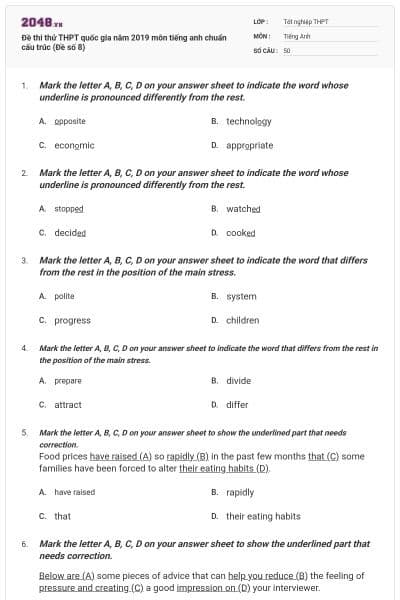
Mark the letter A, B, C, D on your answer sheet to indicate the word whose underline is pronounced differently from the rest.
opposite
technology
economic
appropriate
Đáp án D
Phần gạch chân phát âm là /oʊ/, các đáp án còn lại phần gạch chân phát âm là /ɑː/
A. opposite /ˈɑːpəzɪt/: đối ngược
B. technology /tekˈnɑːlədʒi/: công nghệ
C. economic /iːkəˈnɑːmɪk/: về kinh tế
D. appropriate /əˈproʊpriət/: phù hợ
Mark the letter A, B, C, D on your answer sheet to indicate the word whose underline is pronounced differently from the rest.
stopped
watched
decided
cooked
Đáp án C
Phần gạch chân phát âm là /id/, các đáp án còn lại phần gạch chân phát âm là /t/
Cách phát âm “ed”
- Đuôi “ed” được phát âm là /id/: khi động từ có phát âm kết thúc là /t/ hay /d/.
- Đuôi ed được phát âm là /t/: Khi động từ có phát âm kết thúc là: /ch/, /p/, /f/, /s/, /k/, /th/, /ʃ/, /t ʃ/.
- Đuôi ed được phát âm là /d/ trong các trường hợp còn lại.
Mark the letter A, B, C, D on your answer sheet to indicate the word that differs from the rest in the position of the main stress.
polite
system
progress
children
Đáp án A
Trọng âm rơi vào âm tiết 2, các đáp án còn lại trọng âm rơi vào âm tiết 1
A. polite /pəˈlaɪt/: lịch sự, nhã nhặn
B. system /ˈsɪstəm/: hệ thống
C. progress /ˈprɑːɡres/ : tiến trình, tiến bộ
D. children /ˈtʃɪldrən/: con trẻ
Mark the letter A, B, C, D on your answer sheet to indicate the word that differs from the rest in the position of the main stress.
prepare
divide
attract
differ
Đáp án D
Trọng âm rơi vào âm tiết 1, các đáp án còn lại trọng âm rơi vào âm tiết 2
A. prepare /prɪˈper/: chuẩn bị
B. divide /dɪˈvaɪd/: phân chia
C. attract /əˈtrækt/: thu hút, hấp dẫn
D. differ /ˈdɪfɚ/: khác biệt
Mark the letter A, B, C, D on your answer sheet to show the underlined part that needs correction.
Food prices have raised (A) so rapidly (B) in the past few months that (C) some families have been forced to alter their eating habits (D).
have raised
rapidly
that
their eating habits
Đáp án A
Sửa: have raised => have risen
Phân biệt nội động từ, ngoại động từ.
(to) raise (ngoại động từ): làm thứ gì đó tăng lên
(to) rise (nội động từ): bản thân thứ đó tự tăng lên
Dịch nghĩa: Giá thức ăn tăng lên quá nhanh chóng trong vài tháng vừa qua khiến nhiều gia đình buộc phải thay đổi thói quen ăn uống.
Mark the letter A, B, C, D on your answer sheet to show the underlined part that needs correction.
Below are (A) some pieces of advice that can help you reduce (B) the feeling of pressure and creating (C) a good impression on (D) your interviewer.
Below are
help you reduce
presure and creating
impression on
Đáp án C
Sửa: creating => create
Động từ create trong câu có vai trò tương tự reduce, ta có cấu trúc help someone do something (giúp ai làm gì)
Trong đó động từ chia ở dạng nguyên thể.
Dịch nghĩa: Sau đây là một vài lời khuyên giúp bạn giảm áp lực và tạo được ấn tượng tốt với nhà tuyển dụng.
Mark the letter A, B, C, D on your answer sheet to show the underlined part that needs correction.
A number (A) of large insurance companies has (B) their headquarters (C) in the capital city (D).
A number
has
their headquarters
the capital city
Đáp án B
Sửa: has => have
Phân biệt A number of / The number of
The number of + plural noun + singular verb
A number of + plural noun + plural verb
Dịch nghĩa: Một số công ty bảo hiểm đặt trụ sở tại thủ đô.
Environmental __________ is a big problem in large cities nowadays.
pollution
dust
dirty
research
Đáp án A
Environmental pollution: ô nhiễm môi trường (cụm từ cố định)
Các đáp án còn lại không phù hợp:
B. dust (n): bụi bẩn
C. dirty (adj): bẩn
D. research (n): nghiên cứu
Dịch nghĩa: Ô nhiễm môi trường là một vấn đề nhức nhối tại các thành phố lớn ngày
She was tired and couldn’t keep ________ the group.
on to
up agains
up with
out of
Đáp án C
Câu hỏi giới từ
(to) keep up with: bắt kịp tiến độ
Các đáp án còn lại không tạo thành cụm động từ có nghĩa.
Dịch nghĩa: Cô ấy rất mệt và không thể bắt kịp với cả nhóm.
The more you study, ________ .
the more knowledge you gain
the more knowledge do you gain
you are the more knowledge
you will gain more knowledge
Đáp án A
Cấu trúc The more + S + V, the more S + V (Càng… thì càng)
Chỉ có đáp án A đúng cấu trúc.
Dịch nghĩa: Càng học nhiều, bạn càng tiếp thu được nhiều kiến thức.
We’d better ________ really early. It’s a very long journey.
set down
set off
set up
set on
Đáp án B
(to) set off (v): khởi hành, xuất phát
Các đáp án còn lại:
A. (to) set down (v): đặt xuống; ghi chép lại; gán cho
C. (to) set up (v): chuẩn bị, dàn dựng
D. (to) set on (v): nói khích, xúi giục; tấn công
Dịch nghĩa: Chúng ta nên khởi hành sớm thôi. Chuyến này đi dài đấy
He’d prefer ________ chicken soup rather than _______ milk.
to have – drink
had – drank
having – having
have – drink
Đáp án A
Cấu trúc would prefer + to + V + rather than + V: thích, muốn làm gì hơn là làm gì
Dịch nghĩa: Cậu ấy muốn ăn súp gà hơn là uống sữa.
– “Who wrote the poem?” – “It’s said ________ written by one of the Bronte sisters.”
to have been
to being
to having been
to be
Đáp án A
Bị động với các động từ: say, report, think, believe, understand, know, expect...
Câu chủ động: S + say(report, think, believe, understand, know, expect...)+ that + S + V
C1: ~>It + be + said (reported, thought, believed, understood, known, expected...) + that + S + V
C2: ~>S + be + said (reported, thought, believed, understood, known, expected...) to-inf/to have + Vpp...
Notice: dùng to have + Vpp để nhấn mạnh hành động đã xảy ra trong quá khứ.
Dịch nghĩa: - “Ai sáng tác bài thơ này thế?” – “Nó được cho là được viết bởi chị em nhà Bronte.”
You’re very fat. You should go on a(n) ______.
jogging
exercise
diet
swimming
Đáp án C
(to) go on a diet: ăn kiêng
Các đáp án còn lại không tạo thành cụm động từ có nghĩa.
Dịch nghĩa: Cậu béo quá rồi đấy. Cậu nên ăn kiêng đi.
We have plenty of time for doing the work. We ________ be hurried.
needn’t
shouldn’t
mustn’t
may not
Đáp án A
A. needn’t: không cần
B. shouldn’t: không nên
C. mustn’t: không được
D. may not: có lẽ không
Dựa theo nghĩa câu, ta chọn được đáp án A.
Dịch nghĩa: Chúng ta còn nhiều thời gian để làm việc mà. Không cần vội.
He has got a bulldog quality. He always insists ____ solving each problem completely.
for
at
on
in
Đáp án C
Câu hỏi giới từ
Động từ insist đi với giới từ on.
(to) insist on: khăng khăng
Dịch nghĩa: Anh ta rất cứng đầu. Lúc nào cũng khăng khăng đòi giải quyết từng vấn đề bằng được
The ________ of the radio by Marconi played an important part in the development of communication.
invention
discovery
development
research
Đáp án A
A. invention (n): phát minh (tạo nên thứ chưa từng có trước đó)
B. discovery (n): khám phá (tìm ra một sự vật có sẵn nhưng từng được biết đến)
C. development (n): sự phát triển
D. research (n): nghiên cứu
Theo nghĩa, chỉ có A và B là đáng phân vân. Tuy nhiên, radio không phải một sự vật hay địa điểm vốn có sẵn và được khám phá, nó là một sự vật mới ra đời nhờ phát minh nên ta chọn A
Dịch nghĩa: Phát minh radio của Marconi đóng vai trò quan trọng trong sự phát triển của truyền thông.
Unfortunately, the company closed down because it couldn’t keep _____ with rapidly changing technology
fast
time
speed
pace
Đáp án D
(to) keep pace with: theo kịp, sánh kịp
Các đáp án còn lại không tạo nên cụm động từ có nghĩa.
Dịch nghĩa: Thật không may, công ty đã phải đóng cửa do không thể theo kịp sự thay đổi nhanh chóng của công nghệ
Do you know the beautiful girl ______ is sitting in the car?
who
whom
which
whose
Đáp án A
Kiến thức mệnh đề quan hệ
A. who – thay thế cho danh từ chỉ người, đóng vai trò là chủ ngữ
B. whom – thay thế cho danh từ chỉ người, đóng vai trò là tân ngữ
C. which – thay thế cho danh từ chỉ vật
D. whose – thay thế cho đại từ sở hữu
Ở đây, đại từ quan hệ là thay thế cho the beautiful girl, chỉ người nên ta chọn đáp án A.
Dịch nghĩa: Cậu biết cô gái xinh đẹp ngồi trong xe kia không
– Dylan: “I’m thinking of doing some shopping today. Can you recommend anywhere?”
- Steward: “________________”
That’s OK. In that case, how about going to the Roman ruins down by the lake?
Well, you should try the local museum. That’s quite close to here.
To be honest, I’m not really a big fan of department stores.
Well, you could try Oxford Street. There are lots of big department stores there.
Đáp án D
- Dylan: “Tôi đang định đi mua sắm hôm nay. Cậu biết chỗ nào hay không?
- Steward: “Ừm, cậu có thể thử đến đường Oxford. Ở đấy nhiều hàng bách hoá lắm.
Các đáp án còn lại:
A. Được thôi. Nếu đã vậy, hay là đến chỗ tàn tích thành La Mã cạnh hồ đi?
B. Ừm, cậu nên thử đến bảo tàng địa phương. Chỗ đó khá gần đây.
C. Nói thật thì, tôi không hứng thú lắm với mấy cửa hàng bách hoá.
– John: “You have a good voice! You sang so beautifully!”
- Linda: “____________”
Don’t joke me.
Your compliment isn’t correct.
Your compliment is encouraging.
Better than you are thinking.
Đáp án A
- John: “Giọng cậu tuyệt thật! Cậu hát hay lắm!”
- Linda: “Lời khen của cậu rất khích lệ tớ đấy.”
Các đáp án còn lại:
A. Đừng đùa với tớ.
B. Cậu khen vậy không đúng đâu.
D. Tốt hơn cậu nghĩ đấy.
Mark the letter A, B, C or D on your answer sheet to indicate the word of phrase that is CLOSEST in meaning to the underlined part in each of the following question.
When you see your teacher approaching you, a slight wave to attract his attention is appropriate.
looking up to
catching sight of
pointing at
coming nearer to
Đáp án D
(to) approach (v): tiến đến gần = (to) come nearer to
Các đáp án còn lại:
A. (to) look up to: tôn trọng, ngưỡng mộ
B. (to) catch sight of: trông thấy lướt qua
C. (to) point at: chỉ tay vào
Dịch nghĩa: Nếu thấy giáo viên đang đi tới, vẫy nhẹ tay để thu hút sự chú ý là phù hợp nhất.
Mark the letter A, B, C or D on your answer sheet to indicate the word of phrase that is CLOSEST in meaning to the underlined part in each of the following question.
John, could you look after my handbag while I go out for a minute
take over
take care of
take part in
take place
Đáp án B
(to) look after = (to) take care of: chăm sóc, trông nom
Các đáp án còn lại:
A. (to) take over: tiếp nhận, tiếp quản
C. (to) take part in: tham gia
D. (to) take place: diễn ra
Dịch nghĩa: John, cậu để ý túi xách lúc tớ ra ngoài một lát nhé.
Mark the letter A, B, C or D on your answer sheet to indicate the word of phrase that is OPPOSITE in meaning to the underlined part in each of the following question.
Remember not to show your nervousness during a job interview.
confidence
anxiety
challenge
creativeness
Đáp án A
Nervousness (n) = anxiety (n): sự bồn chồn, lo lắng >< confidence (n): sự tự tin
Các đáp án còn lại:
C. challenge (n): thách thức
D. creativeness (n): óc sáng tạo
Dịch nghĩa: Nhớ rõ không được để lộ sự lo lắng trong quá trình phỏng vấn.
Mark the letter A, B, C or D on your answer sheet to indicate the word of phrase that is OPPOSITE in meaning to the underlined part in each of the following question.
She was unhappy that she lost contact with a lot of her old friends when she went abroad to study.
lost control of
put in charge of
made room for
got in touch with
Đáp án D
(to) lost contact with: mất liên lạc với ai >< (to) get in touch with: giữ liên lạc với ai
Các đáp án còn lại:
A. lost control of: mất kiểm soát
B. put in charge of: nắm quyền kiểm soát
C. made room for: dành chỗ cho
Dịch nghĩa: Cô ấy buồn vì mất liên lạc với bạn cũ khi đi du học
Mark the letter A, B, C or D on your answer sheet to indicate the sentence that is closest in meaning to each of the following questions.
He started studying physics five years ago.
He has not studied physics for five years.
He has studied physics for five years.
It was five years ago did he start studying physics.
It is five years since he has studied physics.
Đáp án B
Cậu ấy bắt đầu học Vật lí từ 5 năm trước = Cậu ấy đã học Vật lí được 5 năm.
Các đáp án còn lại:
A. Cậu ấy đã nghỉ học Vật lí được 5 năm.
C. 5 năm trước cậu ấy bắt đầu học Vật lí.
(nghĩa đúng nhưng ngữ pháp sai. Cấu trúc đúng câu này phải là: It was five years ago that he started studying physics.)
D. Đã 5 năm kể từ khi cậu ấy học Vật lí.
(sai tương tự C. Cấu trúc đúng: It has been five years since he started studying physics.)
Mark the letter A, B, C or D on your answer sheet to indicate the sentence that is closest in meaning to each of the following questions.
The president was reported to have had a heart attack.
The president was reported to suffer a heart attack.
People say that the president had suffered a heart attack.
It was reported that the president had suffered a heart attack.
People reported the president to suffer a heart attack.
Đáp án C
Tổng thống được cho là đã lên cơn đau tim = Người ta nói rằng tổng thống đã lên cơn đau tim.
Bị động với các động từ: say, report, think, believe, understand, know, expect...
Câu chủ động: S + say(report, think, believe, understand, know, expect...)+ that + S + V
C1: ~>It + be + said (reported, thought, believed, understood, known, expected...) + that + S + V
C2: ~>S + be + said (reported, thought, believed, understood, known, expected...) to-inf/to have + Vpp...
Notice: dùng to have + Vpp để nhấn mạnh hành động đã xảy ra trong quá khứ.
Các đáp án còn lại không đúng cấu trúc.
Mark the letter A, B, C or D on your answer sheet to indicate the sentence that is closest in meaning to each of the following questions.
My sister is often sick because she doesn’t do physical exercise.
If my sister isn’t physical exercise, she does sick.
If my sister wasn’t physical exercise, she would do sick.
If my sister does physical exercise, she won’t often be sick.
If my sister did physical exercise, she wouldn’t often be sick.
Đáp án D
Chị tôi hay ốm vì chị không tập thể dục = Nếu chị tôi tập thể dục, chị sẽ không ốm thường xuyên.
Câu điều kiện loại 2 dùng để chỉ một sự việc không có thật ở hiện tại và kết quả giả định của nó.
Cấu trúc: If + S + Ved, S + would/could (not) + V-inf
Ở đây, việc chị tập thể dục không xảy ra và đương nhiên, kết quả rằng chị không ốm thường xuyên cũng là giả định.
Các đáp án còn lại sai về cả nghĩa và ngữ pháp.
Mark the letter A, B, C or D on your answer sheet to indicate the sentence that best combines each pair of sentences in the following questions.
He had just finished eating his breakfast. Then he fell down.
Hardly did he finished eating his breakfast when he fell down.
Hardly he had finished eating his breakfast when he fell down.
Hardly had he finished eating his breakfast when he fell down.
Hardly have he finished eating his breakfast when he fell down.
Đáp án C
Cậu ấy vừa ăn xong bữa sáng. Sau đó cậu ấy ngã.
= Ngay khi vừa ăn xong bữa sáng thì cậu ấy ngã.
Cấu trúc: Hardly + had + S + Vpp + when + S + V-ed (ngay khi… thì…)
Các đáp án còn lại nghĩa tương đương nhưng sai cấu trúc.
Mark the letter A, B, C or D on your answer sheet to indicate the sentence that best combines each pair of sentences in the following questions.
He behaved in a very strange way. That surprised me a lot.
What almost surprised me was the strange way he behaved.
His behavior was a very strange thing, that surprised me the most.
I was almost surprised by his strange behavior.
He behaved very strangely, which surprised me very much.
Đáp án D
Cậu ta cư xử một cách kì quái. Điều đó khiến tôi rất ngạc nhiên.
= Cậu ta cư xử rất lạ, điều đó khiến tôi rất ngạc nhiên.
Các đáp án còn lại:
A. Điều gần như khiến tôi ngạc nhiên là cách cư xử lạ lùng của cậu ta.
(việc sử dụng từ almost hoàn toàn không có nghĩa, nó không nói lên được mức độ surprise a lot và còn làm lệch đi ý nghĩa câu.)
B. Cách cư xử của cậu ấy là một thứ gì đó rất lạ, điều đó khiến tôi ngạc nhiên nhất.
(chú ý: that không thể thay thế được cho cả mệnh đề phía trước, và nó không đứng sau dấu phẩy, dùng như trong câu này là sai)
C. Tôi đã gần như bất ngờ bởi cách cư xử kì lạ của cậu ta. (tương tự A, almost làm lệch nghĩa câu)
Read the following passage and mark the letter A, B, C or D on your answer sheet to indicate the correct word for each of the blanks.
We can communicate not only through words (31) ______ through body language. Body language includes our posture, facial expressions, and gestures. Because body language is so important, you’ll want (32) ______ what yours is saying and how to interpret other people’s, too. Here are some examples of body language and its meaning. If your posture is slumped and your head is down, this could mean that you are sad or you lack (33) ________. If your posture is straight but relaxed, you are expressing confidence and friendliness. A smile is a sign of friendliness and interest. But people sometimes smile just to be polite. Friendliness and interest are expressed when a person’s eyes meet yours and then look away and meet yours again. A person (34) _______ doesn’t look away is expressing a challenge. Hand gestures can mean a person is (35) _____ in the conversation.
Điền vào số (31)
but also
and also
but so
and so
Đáp án A
Cấu trúc Not only… but also… (không những… mà còn…)
Read the following passage and mark the letter A, B, C or D on your answer sheet to indicate the correct word for each of the blanks.
We can communicate not only through words (31) ______ through body language. Body language includes our posture, facial expressions, and gestures. Because body language is so important, you’ll want (32) ______ what yours is saying and how to interpret other people’s, too. Here are some examples of body language and its meaning. If your posture is slumped and your head is down, this could mean that you are sad or you lack (33) ________. If your posture is straight but relaxed, you are expressing confidence and friendliness. A smile is a sign of friendliness and interest. But people sometimes smile just to be polite. Friendliness and interest are expressed when a person’s eyes meet yours and then look away and meet yours again. A person (34) _______ doesn’t look away is expressing a challenge. Hand gestures can mean a person is (35) _____ in the conversation.
Điền vào số (32)
know
knowing
to knowing
to know
Đáp án D
(to) want + to V-inf: muốn làm gì
Read the following passage and mark the letter A, B, C or D on your answer sheet to indicate the correct word for each of the blanks.
We can communicate not only through words (31) ______ through body language. Body language includes our posture, facial expressions, and gestures. Because body language is so important, you’ll want (32) ______ what yours is saying and how to interpret other people’s, too. Here are some examples of body language and its meaning. If your posture is slumped and your head is down, this could mean that you are sad or you lack (33) ________. If your posture is straight but relaxed, you are expressing confidence and friendliness. A smile is a sign of friendliness and interest. But people sometimes smile just to be polite. Friendliness and interest are expressed when a person’s eyes meet yours and then look away and meet yours again. A person (34) _______ doesn’t look away is expressing a challenge. Hand gestures can mean a person is (35) _____ in the conversation.
Điền vào số (33)
confidence
confide
confiding
confident
Đáp án A
Sau động từ lack ta cần một danh từ. Chỉ có confidence thoả mãn.
Read the following passage and mark the letter A, B, C or D on your answer sheet to indicate the correct word for each of the blanks.
We can communicate not only through words (31) ______ through body language. Body language includes our posture, facial expressions, and gestures. Because body language is so important, you’ll want (32) ______ what yours is saying and how to interpret other people’s, too. Here are some examples of body language and its meaning. If your posture is slumped and your head is down, this could mean that you are sad or you lack (33) ________. If your posture is straight but relaxed, you are expressing confidence and friendliness. A smile is a sign of friendliness and interest. But people sometimes smile just to be polite. Friendliness and interest are expressed when a person’s eyes meet yours and then look away and meet yours again. A person (34) _______ doesn’t look away is expressing a challenge. Hand gestures can mean a person is (35) _____ in the conversation.
Điền vào số (34)
whom
who
whose
which
Đáp án B
Kiến thức mệnh đề quan hệ
A. whom – thay thế cho danh từ chỉ người, đóng vai trò là tân ngữ
B. who – thay thế cho danh từ chỉ người, đóng vai trò là chủ ngữ
C. whose – thay thế cho đại từ sở hữu
D. which – thay thế cho danh từ chỉ vật
Ở đây ta cần đại từ quan hệ thay thế cho chủ ngữ A person, chỉ người nên dùng who.
Read the following passage and mark the letter A, B, C or D on your answer sheet to indicate the correct word for each of the blanks.
We can communicate not only through words (31) ______ through body language. Body language includes our posture, facial expressions, and gestures. Because body language is so important, you’ll want (32) ______ what yours is saying and how to interpret other people’s, too. Here are some examples of body language and its meaning. If your posture is slumped and your head is down, this could mean that you are sad or you lack (33) ________. If your posture is straight but relaxed, you are expressing confidence and friendliness. A smile is a sign of friendliness and interest. But people sometimes smile just to be polite. Friendliness and interest are expressed when a person’s eyes meet yours and then look away and meet yours again. A person (34) _______ doesn’t look away is expressing a challenge. Hand gestures can mean a person is (35) _____ in the conversation.
Điền vào số (35)
interest
interested
interestingly
interesting
Đáp án B
(to) be interested in: thích thú với điều gì
Read the following passage and mark the letter A, B, C or D on your answer sheet to indicate the correct answer to each of the questions.
Telecommunicating is a form of computer communication between employees’ homes and offices. For employees whose jobs involve sitting at a terminal or word processor entering data or typing reports, the location of the computer is of no consequence. If the machine can communicate over telephone lines, when the work is completed, employees can dial the office computer from a distant site and transmit the material to their employers. A recent survey in USA Today estimates that there are approximately 8.7 million telecommuters. But although the numbers are rising annually, the trend does not appear to be as significant as predicted when Business Week published "The Portable Executive" as its cover story a few years ago. Why hasn't telecommuting become more popular?
Clearly, change simply takes time. But in addition, there has been active resistance on the part of many managers. These executives claim that supervising the telecommuters in a large work force scattered across the country would be too difficult, or, at least, systems for managing them are not yet developed, thereby complicating the manager's responsibilities.
It is also true that employees who are given the option of telecommuting are often reluctant to accept the opportunity. Most people feel that they need regular interaction with a group, and many are concerned that they will not have the same consideration for advancement if they are not more visible in the office setting. Some people feel that even when a space in their homes is set aside as a work area, they never really get away from the office.
How many American workers are involved in telecommuting?
More than 8 million
More than predicted in Business Week
Fewer than estimated in USA Today
Fewer than last year
Đáp án A
Có bao nhiêu nhân viên Mỹ làm việc từ xa?
A. Hơn 8 triệu
B. Hơn lượng dự đoán của Business Week
C. Ít hơn lượng USA Today tính toán
D. Ít hơn năm ngoái
“A recent survey in USA Today estimates that there are approximately 8.7 million telecommuters.”
Như vậy lượng nhân viên làm từ xa là hơn 8 triệu, cụ thể khoảng 8.7 triệu
Read the following passage and mark the letter A, B, C or D on your answer sheet to indicate the correct answer to each of the questions.
Telecommunicating is a form of computer communication between employees’ homes and offices. For employees whose jobs involve sitting at a terminal or word processor entering data or typing reports, the location of the computer is of no consequence. If the machine can communicate over telephone lines, when the work is completed, employees can dial the office computer from a distant site and transmit the material to their employers. A recent survey in USA Today estimates that there are approximately 8.7 million telecommuters. But although the numbers are rising annually, the trend does not appear to be as significant as predicted when Business Week published "The Portable Executive" as its cover story a few years ago. Why hasn't telecommuting become more popular?
Clearly, change simply takes time. But in addition, there has been active resistance on the part of many managers. These executives claim that supervising the telecommuters in a large work force scattered across the country would be too difficult, or, at least, systems for managing them are not yet developed, thereby complicating the manager's responsibilities.
It is also true that employees who are given the option of telecommuting are often reluctant to accept the opportunity. Most people feel that they need regular interaction with a group, and many are concerned that they will not have the same consideration for advancement if they are not more visible in the office setting. Some people feel that even when a space in their homes is set aside as a work area, they never really get away from the office.
The phrase “of no consequence” means ___________.
of no use
of no good
unimportant
irrelevant
Đáp án C
Cụm “of no consequence” có nghĩa _________
A. vô ích, vô dụng
B. không tốt lành gì
C. không quan trọng
D. không liên quan
Of no consequence: không gây ảnh hưởng, tác động nhiều, không quan trọng = unimportant
Read the following passage and mark the letter A, B, C or D on your answer sheet to indicate the correct answer to each of the questions.
Telecommunicating is a form of computer communication between employees’ homes and offices. For employees whose jobs involve sitting at a terminal or word processor entering data or typing reports, the location of the computer is of no consequence. If the machine can communicate over telephone lines, when the work is completed, employees can dial the office computer from a distant site and transmit the material to their employers. A recent survey in USA Today estimates that there are approximately 8.7 million telecommuters. But although the numbers are rising annually, the trend does not appear to be as significant as predicted when Business Week published "The Portable Executive" as its cover story a few years ago. Why hasn't telecommuting become more popular?
Clearly, change simply takes time. But in addition, there has been active resistance on the part of many managers. These executives claim that supervising the telecommuters in a large work force scattered across the country would be too difficult, or, at least, systems for managing them are not yet developed, thereby complicating the manager's responsibilities.
It is also true that employees who are given the option of telecommuting are often reluctant to accept the opportunity. Most people feel that they need regular interaction with a group, and many are concerned that they will not have the same consideration for advancement if they are not more visible in the office setting. Some people feel that even when a space in their homes is set aside as a work area, they never really get away from the office.
The author mentions all of the following as concerns of telecommuters EXCEPT_____.
the lack of interaction with a group
the different system of supervision
the fact that the work space is in the home
the opportunities for advancement
Đáp án B
Tác giả đề cập đến những điều sau như các mỗi quan ngại về việc làm việc từ xa NGOẠI TRỪ ______.
A. thiếu tương tác với đội nhóm
B. hệ thống quản lý khác
C. sự thật rằng nơi làm việc ở nhà
D. cơ hội thăng tiến
Đoạn cuối tác giả nói về những mối quan ngại của nhân viên khi chọn làm việc từ xa, trong đó có: cần tương tác với nhóm, ít cơ hội thăng tiến và sự thật rằng làm việc ở nhà không khiến họ hoàn toàn tách khỏi cơ quan. Chỉ có đáp án B không được nhắc ở đoạn này.
Read the following passage and mark the letter A, B, C or D on your answer sheet to indicate the correct answer to each of the questions.
Telecommunicating is a form of computer communication between employees’ homes and offices. For employees whose jobs involve sitting at a terminal or word processor entering data or typing reports, the location of the computer is of no consequence. If the machine can communicate over telephone lines, when the work is completed, employees can dial the office computer from a distant site and transmit the material to their employers. A recent survey in USA Today estimates that there are approximately 8.7 million telecommuters. But although the numbers are rising annually, the trend does not appear to be as significant as predicted when Business Week published "The Portable Executive" as its cover story a few years ago. Why hasn't telecommuting become more popular?
Clearly, change simply takes time. But in addition, there has been active resistance on the part of many managers. These executives claim that supervising the telecommuters in a large work force scattered across the country would be too difficult, or, at least, systems for managing them are not yet developed, thereby complicating the manager's responsibilities.
It is also true that employees who are given the option of telecommuting are often reluctant to accept the opportunity. Most people feel that they need regular interaction with a group, and many are concerned that they will not have the same consideration for advancement if they are not more visible in the office setting. Some people feel that even when a space in their homes is set aside as a work area, they never really get away from the office.
The word “them” in line 11 refers to ________.
systems
telecommuters
executives
responsibilities
Đáp án B
Từ “them” ở dòng 11 nhắc đến _______.
A. hệ thống
B. người làm việc từ xa
C. các nhà quản lý
D trách nhiệm
Đọc cả câu, ta thấy các nhà quản lý lo ngại về việc “supervising the telecommuters” và “managing them”.
Như vậy them là thay thế cho telecommuters
Read the following passage and mark the letter A, B, C or D on your answer sheet to indicate the correct answer to each of the questions.
Telecommunicating is a form of computer communication between employees’ homes and offices. For employees whose jobs involve sitting at a terminal or word processor entering data or typing reports, the location of the computer is of no consequence. If the machine can communicate over telephone lines, when the work is completed, employees can dial the office computer from a distant site and transmit the material to their employers. A recent survey in USA Today estimates that there are approximately 8.7 million telecommuters. But although the numbers are rising annually, the trend does not appear to be as significant as predicted when Business Week published "The Portable Executive" as its cover story a few years ago. Why hasn't telecommuting become more popular?
Clearly, change simply takes time. But in addition, there has been active resistance on the part of many managers. These executives claim that supervising the telecommuters in a large work force scattered across the country would be too difficult, or, at least, systems for managing them are not yet developed, thereby complicating the manager's responsibilities.
It is also true that employees who are given the option of telecommuting are often reluctant to accept the opportunity. Most people feel that they need regular interaction with a group, and many are concerned that they will not have the same consideration for advancement if they are not more visible in the office setting. Some people feel that even when a space in their homes is set aside as a work area, they never really get away from the office.
The reason why telecommuting has not become popular is that the employees __________
need regular interaction with their families.
are worried about the promotion if they are not seen at the office
feel that a work area in their home is away from the office.
are ignorant of telecommuting
Đáp án B
Lý do khiến làm việc từ xa chưa trở nên phổ biến là các nhân viên _________
A. cần giao tiếp thường xuyên với gia đình.
B. lo về vấn đề thăng tiến nếu không thường xuất hiện ở cơ quan.
C. cảm thấy làm việc tại nhà quá xa cơ quan.
D. không biết cách làm việc từ xa.
Đoạn cuối có nhắc đến: “many are concerned that they will not have the same consideration for advancement if they are not more visible in the office setting.”
Đây là một trong những lý do khiến họ do dự, các đáp án còn lại đều không đúng.
Read the following passage and mark the letter A, B, C or D on your answer sheet to indicate the correct answer to each of the questions.
Telecommunicating is a form of computer communication between employees’ homes and offices. For employees whose jobs involve sitting at a terminal or word processor entering data or typing reports, the location of the computer is of no consequence. If the machine can communicate over telephone lines, when the work is completed, employees can dial the office computer from a distant site and transmit the material to their employers. A recent survey in USA Today estimates that there are approximately 8.7 million telecommuters. But although the numbers are rising annually, the trend does not appear to be as significant as predicted when Business Week published "The Portable Executive" as its cover story a few years ago. Why hasn't telecommuting become more popular?
Clearly, change simply takes time. But in addition, there has been active resistance on the part of many managers. These executives claim that supervising the telecommuters in a large work force scattered across the country would be too difficult, or, at least, systems for managing them are not yet developed, thereby complicating the manager's responsibilities.
It is also true that employees who are given the option of telecommuting are often reluctant to accept the opportunity. Most people feel that they need regular interaction with a group, and many are concerned that they will not have the same consideration for advancement if they are not more visible in the office setting. Some people feel that even when a space in their homes is set aside as a work area, they never really get away from the office.
It can be inferred from the passage that the author is ________.
a telecommuter
the manager
a statistician
a reporter
Đáp án D
Có thể suy ra từ đoạn văn rằng tác giả là _______.
A. người làm việc từ xa
B. quản lý
C. nhà thống kê
D. người đưa tin
Bài đọc cung cấp thông tin về khái niệm làm việc từ xa, về các thống kê được tính toán và những nhân viên cũng như quản lý có liên quan đến làm việc từ xa. Đó là công việc của một người đưa tin.
Read the following passage and mark the letter A, B, C or D on your answer sheet to indicate the correct answer to each of the questions.
Telecommunicating is a form of computer communication between employees’ homes and offices. For employees whose jobs involve sitting at a terminal or word processor entering data or typing reports, the location of the computer is of no consequence. If the machine can communicate over telephone lines, when the work is completed, employees can dial the office computer from a distant site and transmit the material to their employers. A recent survey in USA Today estimates that there are approximately 8.7 million telecommuters. But although the numbers are rising annually, the trend does not appear to be as significant as predicted when Business Week published "The Portable Executive" as its cover story a few years ago. Why hasn't telecommuting become more popular?
Clearly, change simply takes time. But in addition, there has been active resistance on the part of many managers. These executives claim that supervising the telecommuters in a large work force scattered across the country would be too difficult, or, at least, systems for managing them are not yet developed, thereby complicating the manager's responsibilities.
It is also true that employees who are given the option of telecommuting are often reluctant to accept the opportunity. Most people feel that they need regular interaction with a group, and many are concerned that they will not have the same consideration for advancement if they are not more visible in the office setting. Some people feel that even when a space in their homes is set aside as a work area, they never really get away from the office.
When Business Week published “The Portable Executive”, it implied that
systems for managing telecommuters were not effective.
there was resistance on the part of many managers about telecommuting.
the trend for telecommuting was optimistic.
most telecommuters were satisfied with their work.
Đáp án B
Khi tờ Business Week xuất bản “Quản lý di động”, nó cho thấy
A. hệ thống quản lý người làm việc từ xa không hiệu quả.
B. có làn sóng phản đối giữa các nhà nhà quản lý về việc làm việc từ xa.
C. xu hướng làm việc từ xa rất khả quan.
D. phần lớn người làm việc từ xa đều hài lòng với công việc của họ.
Về xu hướng làm việc từ xa, tác giả có nói: “But although the numbers are rising annually, the trend does not appear to be as significant as predicted when Business Week published "The Portable Executive" as its cover story a few years ago.”
Như vậy chứng tỏ bài báo nói về điều bất lợi khiến xu hướng này không phổ biến, vậy loại C và D.
Ngoài ra, hệ thống quản lý được nhắc đến là “not yet developed” chứ không phải “not effective”.
Và “But in addition, there has been active resistance on the part of many managers.”
Vậy chọn B
Read the following passage and mark the letter A, B, C or D on your answer sheet to indicate the correct answer to each of the questions.
The mineral particles found in soil range in size from microscopic clay particles to large boulders. The most abundant particles - sand, silt, and clay - are the focus of examination in studies of soil texture. Texture is the term used to describe the line composite sizes of particles in a soil sample, typically several representative handfuls. To measure soil texture, the sand, silt, and clay particles are sorted out by size and weight. The weights of each size are then expressed as a percentage of the sample weight.
In the field, soil texture can be estimated by extracting a handful of sod and squeezing the damp soil into three basic shapes; cast, a lump formed by squeezing a sample in a clenched fist; thread, a pencil shape formed by rolling soil between the palms; and ribbon, a flatfish shape formed by squeezing a small sample between the thumb and index finger. The behavioral characteristics of the soil when molded into each of these shapes, if they can be formed at all, provides the basis for a general textural classification. The behavior of the soil in the hand test is determined by the amount of clay in the sample. Clay particles are highly cohesive, and when dampened, behave as a plastic. Therefore the higher the clay content in a sample, the more refined and durable the shapes into which it can be molded.
Another method of determining soil texture involves the use of devices called sediment sieves, screens built with a specified mesh size. When the soil is filtered through a group of sieves, each with a different mesh size, the particles become grouped in corresponding size categories. Each category can be weighed to make a textural determination. Although sieves work well for silt, sand, and larger particles, they are not appropriate for clay particles. Clay is far too small to sieve accurately; therefore, in soils with a high proportion of clay, the fine particles are measured on the basis of their settling velocity when suspended in water. Since clays settle so slowly, they are easily segregated from sand and silt. The water can be drawn off and evaporated, leaving a residue of clay, which can be weighed.
The author mentions “several representative handfuls” in the passage in order to show ______.
how small soil particles are
the requirements for an adequate soil farm
the process by which soil is weighed
the range of soil samples
Đáp án D
Tác giả đề cập “several representative handfuls” trong bài nhằm trình bày _______.
A. phần tử đất nhỏ ra sao
B. yêu cầu đối với một mảnh đất đầy đủ
C. quá trình đo trọng lượng đất
D. các loại mẫu đất
Ta có thể tìm thấy câu trả lời qua câu sau trong bài: “Texture is the term used to describe the line composite sizes of particles in a soil sample, typically several representative handfuls.”
(Kết cấu là thuật ngữ dùng để mô tả các quy mô hỗn hợp theo hàng của các hạt trong một mẫu đất, điển hình là một vài nắm đất đại diện làm mẫu.) Như vậy cụm từ “several representative handfuls” được tác giả đề cập trong bài để chỉ các loại mẫu đất (the range of soil samples)
Lưu ý: range = a variety of things of a particular type (nhóm hay một loạt các vật cùng loại)
Read the following passage and mark the letter A, B, C or D on your answer sheet to indicate the correct answer to each of the questions.
The mineral particles found in soil range in size from microscopic clay particles to large boulders. The most abundant particles - sand, silt, and clay - are the focus of examination in studies of soil texture. Texture is the term used to describe the line composite sizes of particles in a soil sample, typically several representative handfuls. To measure soil texture, the sand, silt, and clay particles are sorted out by size and weight. The weights of each size are then expressed as a percentage of the sample weight.
In the field, soil texture can be estimated by extracting a handful of sod and squeezing the damp soil into three basic shapes; cast, a lump formed by squeezing a sample in a clenched fist; thread, a pencil shape formed by rolling soil between the palms; and ribbon, a flatfish shape formed by squeezing a small sample between the thumb and index finger. The behavioral characteristics of the soil when molded into each of these shapes, if they can be formed at all, provides the basis for a general textural classification. The behavior of the soil in the hand test is determined by the amount of clay in the sample. Clay particles are highly cohesive, and when dampened, behave as a plastic. Therefore the higher the clay content in a sample, the more refined and durable the shapes into which it can be molded.
Another method of determining soil texture involves the use of devices called sediment sieves, screens built with a specified mesh size. When the soil is filtered through a group of sieves, each with a different mesh size, the particles become grouped in corresponding size categories. Each category can be weighed to make a textural determination. Although sieves work well for silt, sand, and larger particles, they are not appropriate for clay particles. Clay is far too small to sieve accurately; therefore, in soils with a high proportion of clay, the fine particles are measured on the basis of their settling velocity when suspended in water. Since clays settle so slowly, they are easily segregated from sand and silt. The water can be drawn off and evaporated, leaving a residue of clay, which can be weighed.
It can be inferred that the names of the three basic shapes mentioned in paragraph 2 reflect ______.
the results of squeezing the soil
the way the soil is extracted
the need to check more than one handful
the difficulty of forming different shapes
Đáp án A
Có thể suy ra rằng tên 3 hình dáng được đề cập đến trong đoạn 2 nói đến _____.
A. kết quả của việc nhào nắn đất
B. cách chiết tách đất
C. sự cần thiết của việc kiểm tra hơn một nắm đất
D. sự khó khăn trong việc nhào nặn dáng khác nhau
“In the field, soil texture can be estimated by extracting a handful of sod and squeezing the damp soil into three basic shapes” (Ở đồng ruộng, kết cấu đất được đánh giá bằng cách chọn lấy một nắm đất ở bề mặt rồi vắt nắm đất ẩm này thành 3 hình dạng cơ bản)
Từ đây ta suy ra được rằng 3 tên gọi được đề cập là kết quả của việc nhào nắn đất nhằm xác định kết cấu của chúng.
Read the following passage and mark the letter A, B, C or D on your answer sheet to indicate the correct answer to each of the questions.
The mineral particles found in soil range in size from microscopic clay particles to large boulders. The most abundant particles - sand, silt, and clay - are the focus of examination in studies of soil texture. Texture is the term used to describe the line composite sizes of particles in a soil sample, typically several representative handfuls. To measure soil texture, the sand, silt, and clay particles are sorted out by size and weight. The weights of each size are then expressed as a percentage of the sample weight.
In the field, soil texture can be estimated by extracting a handful of sod and squeezing the damp soil into three basic shapes; cast, a lump formed by squeezing a sample in a clenched fist; thread, a pencil shape formed by rolling soil between the palms; and ribbon, a flatfish shape formed by squeezing a small sample between the thumb and index finger. The behavioral characteristics of the soil when molded into each of these shapes, if they can be formed at all, provides the basis for a general textural classification. The behavior of the soil in the hand test is determined by the amount of clay in the sample. Clay particles are highly cohesive, and when dampened, behave as a plastic. Therefore the higher the clay content in a sample, the more refined and durable the shapes into which it can be molded.
Another method of determining soil texture involves the use of devices called sediment sieves, screens built with a specified mesh size. When the soil is filtered through a group of sieves, each with a different mesh size, the particles become grouped in corresponding size categories. Each category can be weighed to make a textural determination. Although sieves work well for silt, sand, and larger particles, they are not appropriate for clay particles. Clay is far too small to sieve accurately; therefore, in soils with a high proportion of clay, the fine particles are measured on the basis of their settling velocity when suspended in water. Since clays settle so slowly, they are easily segregated from sand and silt. The water can be drawn off and evaporated, leaving a residue of clay, which can be weighed.
The word “dampened” in the passage is closest in meaning to _____.
examined
stretched
moistened
damaged
Đáp án C
Từ “dampened” trong bài gần nghĩa nhất với _______.
A. kiểm tra
B. giãn cách
C. làm ẩm
D. huỷ hoại
(to) dampen = (to) moisten: làm ẩm, ướt
Read the following passage and mark the letter A, B, C or D on your answer sheet to indicate the correct answer to each of the questions.
The mineral particles found in soil range in size from microscopic clay particles to large boulders. The most abundant particles - sand, silt, and clay - are the focus of examination in studies of soil texture. Texture is the term used to describe the line composite sizes of particles in a soil sample, typically several representative handfuls. To measure soil texture, the sand, silt, and clay particles are sorted out by size and weight. The weights of each size are then expressed as a percentage of the sample weight.
In the field, soil texture can be estimated by extracting a handful of sod and squeezing the damp soil into three basic shapes; cast, a lump formed by squeezing a sample in a clenched fist; thread, a pencil shape formed by rolling soil between the palms; and ribbon, a flatfish shape formed by squeezing a small sample between the thumb and index finger. The behavioral characteristics of the soil when molded into each of these shapes, if they can be formed at all, provides the basis for a general textural classification. The behavior of the soil in the hand test is determined by the amount of clay in the sample. Clay particles are highly cohesive, and when dampened, behave as a plastic. Therefore the higher the clay content in a sample, the more refined and durable the shapes into which it can be molded.
Another method of determining soil texture involves the use of devices called sediment sieves, screens built with a specified mesh size. When the soil is filtered through a group of sieves, each with a different mesh size, the particles become grouped in corresponding size categories. Each category can be weighed to make a textural determination. Although sieves work well for silt, sand, and larger particles, they are not appropriate for clay particles. Clay is far too small to sieve accurately; therefore, in soils with a high proportion of clay, the fine particles are measured on the basis of their settling velocity when suspended in water. Since clays settle so slowly, they are easily segregated from sand and silt. The water can be drawn off and evaporated, leaving a residue of clay, which can be weighed.
It can be inferred from the passage that a soil sample with little or no clay in it ________.
may not hold its shape when molded
does not have a classifiable texture
is not very heavy
does not have a durable shap
Đáp án A
Có thể suy ra từ đoạn văn rằng một mẫu đất có ít hoặc không có chất sét thì ______.
A. không thể giữ nguyên hình dạng khi được nặn
B. không có kết cấu định dạng được
C. không quá nặng
D. không có hình dạng bền nhất định
“The behavior of the soil in the hand test is determined by the amount of clay in the sample. Clay particles are highly cohesive, and when dampened, behave as a plastic. Therefore the higher the clay content in a sample, the more refined and durable the shapes into which it can be molded.”
(Trạng thái của đất qua thử nghiệm bằng tay được xác định qua lượng chất sét có trong mẫu. Các hạt đất sét có tính kết dính rất cao, và khi được làm ẩm thì có đặc tính như chất dẻo. Vì vậy, lượng đất sét có trong mẫu càng cao thì ta có thể nặn nó thành những hình dạng trau chuốt và giữ được lâu hơn.)
Từ đây ta có thể suy ra mẫu đất ít hoặc không có chất sét sẽ không giữ được hình dạng khi được vắt, nặn. Không thể kết luận liệu nó nhẹ hay nặng, hình dạng bền hay không và kết cấu phân loại được hay không.
Read the following passage and mark the letter A, B, C or D on your answer sheet to indicate the correct answer to each of the questions.
The mineral particles found in soil range in size from microscopic clay particles to large boulders. The most abundant particles - sand, silt, and clay - are the focus of examination in studies of soil texture. Texture is the term used to describe the line composite sizes of particles in a soil sample, typically several representative handfuls. To measure soil texture, the sand, silt, and clay particles are sorted out by size and weight. The weights of each size are then expressed as a percentage of the sample weight.
In the field, soil texture can be estimated by extracting a handful of sod and squeezing the damp soil into three basic shapes; cast, a lump formed by squeezing a sample in a clenched fist; thread, a pencil shape formed by rolling soil between the palms; and ribbon, a flatfish shape formed by squeezing a small sample between the thumb and index finger. The behavioral characteristics of the soil when molded into each of these shapes, if they can be formed at all, provides the basis for a general textural classification. The behavior of the soil in the hand test is determined by the amount of clay in the sample. Clay particles are highly cohesive, and when dampened, behave as a plastic. Therefore the higher the clay content in a sample, the more refined and durable the shapes into which it can be molded.
Another method of determining soil texture involves the use of devices called sediment sieves, screens built with a specified mesh size. When the soil is filtered through a group of sieves, each with a different mesh size, the particles become grouped in corresponding size categories. Each category can be weighed to make a textural determination. Although sieves work well for silt, sand, and larger particles, they are not appropriate for clay particles. Clay is far too small to sieve accurately; therefore, in soils with a high proportion of clay, the fine particles are measured on the basis of their settling velocity when suspended in water. Since clays settle so slowly, they are easily segregated from sand and silt. The water can be drawn off and evaporated, leaving a residue of clay, which can be weighed.
The word “they” in the passage refers to _____.
categories
sieves
clay particles
larger particles
Đáp án C
Từ “they” trong đoạn chỉ _____.
A. các hạng mục, phân loại
B. các màng lọc
C. phân tử đất sét
D. các phân tử lớn hơn
“Since clays settle so slowly, they are easily segregated from sand and silt.”
(Do đất sét lắng xuống rất chậm, chúng có thể được tách biệt dễ dàng khỏi cát và bùn.)
Dễ thấy they là thay thế cho clays (clays particles
Read the following passage and mark the letter A, B, C or D on your answer sheet to indicate the correct answer to each of the questions.
The mineral particles found in soil range in size from microscopic clay particles to large boulders. The most abundant particles - sand, silt, and clay - are the focus of examination in studies of soil texture. Texture is the term used to describe the line composite sizes of particles in a soil sample, typically several representative handfuls. To measure soil texture, the sand, silt, and clay particles are sorted out by size and weight. The weights of each size are then expressed as a percentage of the sample weight.
In the field, soil texture can be estimated by extracting a handful of sod and squeezing the damp soil into three basic shapes; cast, a lump formed by squeezing a sample in a clenched fist; thread, a pencil shape formed by rolling soil between the palms; and ribbon, a flatfish shape formed by squeezing a small sample between the thumb and index finger. The behavioral characteristics of the soil when molded into each of these shapes, if they can be formed at all, provides the basis for a general textural classification. The behavior of the soil in the hand test is determined by the amount of clay in the sample. Clay particles are highly cohesive, and when dampened, behave as a plastic. Therefore the higher the clay content in a sample, the more refined and durable the shapes into which it can be molded.
Another method of determining soil texture involves the use of devices called sediment sieves, screens built with a specified mesh size. When the soil is filtered through a group of sieves, each with a different mesh size, the particles become grouped in corresponding size categories. Each category can be weighed to make a textural determination. Although sieves work well for silt, sand, and larger particles, they are not appropriate for clay particles. Clay is far too small to sieve accurately; therefore, in soils with a high proportion of clay, the fine particles are measured on the basis of their settling velocity when suspended in water. Since clays settle so slowly, they are easily segregated from sand and silt. The water can be drawn off and evaporated, leaving a residue of clay, which can be weighed.
The word “fine” in the passage is closest in meaning to _____.
various
tiny
excellent
many
Đáp án B
Từ “fine” trong bài gần nghĩa nhất với _____.
A. phong phú
B. tí hon, cực tiểu
C. xuất sắc
D. rất nhiều
Ta thấy tính từ “fine” được dùng trong bài mang nghĩa là in small grains, pieces, or drops (ở dạng những hạt, viên hay giọt nhỏ bé).
Fine (adj) ≈ tiny (adj): nhỏ xíu
Read the following passage and mark the letter A, B, C or D on your answer sheet to indicate the correct answer to each of the questions.
The mineral particles found in soil range in size from microscopic clay particles to large boulders. The most abundant particles - sand, silt, and clay - are the focus of examination in studies of soil texture. Texture is the term used to describe the line composite sizes of particles in a soil sample, typically several representative handfuls. To measure soil texture, the sand, silt, and clay particles are sorted out by size and weight. The weights of each size are then expressed as a percentage of the sample weight.
In the field, soil texture can be estimated by extracting a handful of sod and squeezing the damp soil into three basic shapes; cast, a lump formed by squeezing a sample in a clenched fist; thread, a pencil shape formed by rolling soil between the palms; and ribbon, a flatfish shape formed by squeezing a small sample between the thumb and index finger. The behavioral characteristics of the soil when molded into each of these shapes, if they can be formed at all, provides the basis for a general textural classification. The behavior of the soil in the hand test is determined by the amount of clay in the sample. Clay particles are highly cohesive, and when dampened, behave as a plastic. Therefore the higher the clay content in a sample, the more refined and durable the shapes into which it can be molded.
Another method of determining soil texture involves the use of devices called sediment sieves, screens built with a specified mesh size. When the soil is filtered through a group of sieves, each with a different mesh size, the particles become grouped in corresponding size categories. Each category can be weighed to make a textural determination. Although sieves work well for silt, sand, and larger particles, they are not appropriate for clay particles. Clay is far too small to sieve accurately; therefore, in soils with a high proportion of clay, the fine particles are measured on the basis of their settling velocity when suspended in water. Since clays settle so slowly, they are easily segregated from sand and silt. The water can be drawn off and evaporated, leaving a residue of clay, which can be weighed.
During the procedure described in paragraph 3, when clay particles are placed into water they ______.
dissolve quickly
separate into different sizes
take some time to sink to the bottom
stick to the sides of the water container
Đáp án C
Trong quá trình được mô tả ở đoạn 3, khi đất sét được cho vào nước, chúng ______.
A. phân huỷ nhanh chóng
B. tách ra thành các kích cỡ khác nhau
C. mất một thời gian để lắng xuống
D. bám vào thành ống nước
Dựa vào câu: “Since clays settle so slowly, they are easily segregated from sand and silt.” (Do đất sét khá lâu lắng xuống, chúng có thể được tách biệt dễ dàng khỏi cát và bùn.) có thể kết luận khi cho đất sét vào nước, chúng mất một thời gian mới lắng xuống đáy.
Read the following passage and mark the letter A, B, C or D on your answer sheet to indicate the correct answer to each of the questions.
The mineral particles found in soil range in size from microscopic clay particles to large boulders. The most abundant particles - sand, silt, and clay - are the focus of examination in studies of soil texture. Texture is the term used to describe the line composite sizes of particles in a soil sample, typically several representative handfuls. To measure soil texture, the sand, silt, and clay particles are sorted out by size and weight. The weights of each size are then expressed as a percentage of the sample weight.
In the field, soil texture can be estimated by extracting a handful of sod and squeezing the damp soil into three basic shapes; cast, a lump formed by squeezing a sample in a clenched fist; thread, a pencil shape formed by rolling soil between the palms; and ribbon, a flatfish shape formed by squeezing a small sample between the thumb and index finger. The behavioral characteristics of the soil when molded into each of these shapes, if they can be formed at all, provides the basis for a general textural classification. The behavior of the soil in the hand test is determined by the amount of clay in the sample. Clay particles are highly cohesive, and when dampened, behave as a plastic. Therefore the higher the clay content in a sample, the more refined and durable the shapes into which it can be molded.
Another method of determining soil texture involves the use of devices called sediment sieves, screens built with a specified mesh size. When the soil is filtered through a group of sieves, each with a different mesh size, the particles become grouped in corresponding size categories. Each category can be weighed to make a textural determination. Although sieves work well for silt, sand, and larger particles, they are not appropriate for clay particles. Clay is far too small to sieve accurately; therefore, in soils with a high proportion of clay, the fine particles are measured on the basis of their settling velocity when suspended in water. Since clays settle so slowly, they are easily segregated from sand and silt. The water can be drawn off and evaporated, leaving a residue of clay, which can be weighed.
It can be inferred from the passage that the sediment sieve has an advantage over the hand test in determining soil texture because _______
less training is required to use the sieve
the sieve allows for a more exact measure
the sieve can measure clay
using the sieve takes less time
Đáp án B
Có thể suy ra từ bài đọc rằng dùng màng lọc có lợi hơn thí nghiệm bằng tay trong việc xác định kết cấu đất là do ______.
A. cần ít tập huấn hơn để sử dụng được màng lọc
B. màng lọc cho ra kết quả chính xác hơn
C. màng lọc có thể đo đất sét
D. dùng màng lọc tốn ít thời gian hơn
Đọc kĩ cả bài ta rút ra kết luận: việc xác định kết cấu đất qua thử nghiệm bằng tay chỉ cho ta sự phân loại kết cấu thông thường, trong khi đó việc sử dụng màng lọc để xác định kết cấu đất có lợi thế hơn ở chỗ nó cho phép những kết quả đo lường chính xác hơn