Đề thi thử THPT quốc gia năm 2019 môn tiếng anh chuẩn cấu trúc (Đề số 7)
50 câu hỏi
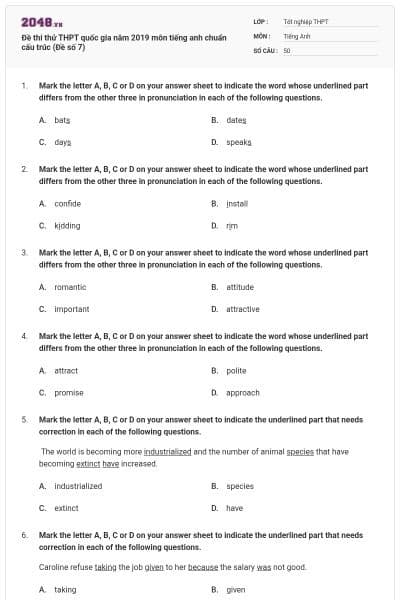
Mark the letter A, B, C or D on your answer sheet to indicate the word whose underlined part differs from the other three in pronunciation in each of the following questions.
bats
dates
days
speaks
Đáp án C
Phần gạch chân đáp án C phát âm là /z/, các đáp án còn lại phát âm là /s/
Cách phát âm đuôi “s/es”
- Phát âm là /s/ khi từ có tận cùng bằng các phụ âm vô thanh: /ð/, /p/, /k/, /f/, /t/.
- Phát âm là /ɪz/ khi từ có tận cùng là các âm: /s/, /z/, /ʃ/, /tʃ/, /ʒ/, /dʒ/.
- Phát âm là /z/ khi các từ có tận cùng là nguyên âm và các phụ âm hữu thanh còn lại.
Mark the letter A, B, C or D on your answer sheet to indicate the word whose underlined part differs from the other three in pronunciation in each of the following questions.
confide
install
kidding
rim
Đáp án A
Phần gạch chân đáp án A phát âm là /aɪ/, các đáp án còn lại phát âm là /ɪ/
A. confide /kənˈfaɪd/: giao phó
B. install /ɪnˈstɔːl/: cài đặt
C. kidding /kɪdɪŋ/: đùa
D. rim /rɪm/: viền xung quanh
Mark the letter A, B, C or D on your answer sheet to indicate the word whose underlined part differs from the other three in pronunciation in each of the following questions.
romantic
attitude
important
attractive
Đáp án B
Đáp án B trọng âm rơi vào âm tiết thứ nhát, các đáp án còn lại trọng âm ở âm tiết thứ 2.
A. romantic /rəʊˈmæntɪk/: lãng mạn
B. attitude /ˈætɪtjuːd/: thái độ
C. important /ɪmˈpɔːtnt/: quan trọng
D. attractive /əˈtræktɪv/: thu hút
Mark the letter A, B, C or D on your answer sheet to indicate the word whose underlined part differs from the other three in pronunciation in each of the following questions.
attract
polite
promise
approach
Đáp án C
Đáp án C trọng âm rơi vào âm tiết thứ nhất, các đáp án còn lại trọng âm ở âm tiết thứ 2.
A. attract /əˈtrækt/ : thu hút
B. polite /pəˈlaɪt/: lịch sự
C. promise /ˈprɒmɪs/: lời hứa
D. approach /əˈprəʊtʃ/: đến gần
Mark the letter A, B, C or D on your answer sheet to indicate the underlined part that needs correction in each of the following questions.
The world is becoming more industrialized and the number of animal species that have becoming extinct have increased.
industrialized
species
extinct
have
Đáp án D
have => has
Cấu trúc: The number of + plural noun + singular verb....
Dịch nghĩa: Thế giới ngày càng trở nên công nghiệp hóa và số lượng các loài động vật bị tuyệt chủng ngày càng tăng lên.
Mark the letter A, B, C or D on your answer sheet to indicate the underlined part that needs correction in each of the following questions.
Caroline refuse taking the job given to her because the salary was not good.
taking
given
because
was
Đáp án A
taking => to take
(to) refuse to do something: từ chối làm gì
Dịch nghĩa: Caroline từ chối nhận công việc được giành cho cô vì mức lương không được cao.
Mark the letter A, B, C or D on your answer sheet to indicate the underlined part that needs correction in each of the following questions.
The General Certificate of Secondary Education (GCSE) is the name of a set of English qualifications, generally taking by secondary students at the age of 15-16 in England.
the name
a set of
taking
at the age
Đáp án C
taking => taken
Khi rút gọn mệnh đề ở dạng bị động, ta sử dụng quá khứ phân từ.
Dịch nghĩa: Chương trình phổ thông Anh quốc (GCSE) là tên của một hệ thống bằng cấp tiếng Anh, thường được lấy bởi học sinh trung học ở tuổi 15-16 ở Anh.
The old woman accused the boy _________ window.
in breaking
on breaking
at breaking
of breaking
Đáp án D
(to) accuse somebody of doing something: buộc tội ai làm gì
Dịch nghĩa: Người phụ nữ lớn tuổi đã buộc tội John về việc phá vỡ cửa sổ.
The more you study during semester, _________ the week before the exam.
you have to study the less
the less you have to study
the least you have to study
the study less you have
Đáp án B
Cấu trúc so sánh kép: The + comparative adjective + to be , + the + comparative adjective + subject + verb + (infinitive of purpose): càng...càng
Dịch nghĩa: Bạn học càng chăm chỉ trong suốt học kỳ, bạn càng ít phải học vào tuần trước kì thi
Neither the students nor their lecturer _________ English in the classroom.
have used
use
are using
uses
Đáp án D
Neither S1 nor S2 + V(phụ thuộc vào S2) + O: ...không...cũng không
Ở đây động từ chia theo chủ ngữ their lecturer nên phải ở dạng số ít.
Dịch nghĩa: Cả học sinh và giảng viên đều không sử dụng tiếng Anh trong lớp.
In order to make the house more beautiful and newer, the Browns had it _________ yesterday.
to be repainted
repaint
repainted
to repaint
Đáp án C
Cấu trúc (to) have something done: có cái gì được làm dùng để diễn đạt cho người khác biết rằng có ai đó làm điều gì cho chúng ta.
Dịch nghĩa: Để làm cho ngôi nhà trở nên đẹp hơn và mới hơn, Browns đã nhờ người sơn lại nó ngày hôm qua.
Last summer he _________ to Ha Long Bay.
went
has been going
has gone
was going
Đáp án A
Thì quá khứ đơn diễn tả những hành động xảy ra và đã kết thúc trong quá khứ.
Trong câu xuất hiện dấu hiệu nhận biết của thì quá khứ đơn last summer.
Dịch nghĩa: Hè năm ngoái, cậu ấy đi đến Vịnh Hạ Long.
Universities send letters of _________ to successful candidates by post.
accept
acceptance
acceptably
acceptabe
Đáp án B
Ở vị trí này ta cần một danh từ => Chọn B. acceptance (n): sự chấp thuận.
accept (v): chấp nhận => acceptable (adj): chấp nhận được => acceptably (adv)
Dịch nghĩa: Các trường đại học gửi thư chấp thuận đến những thí sinh trúng tuyển qua đường bưu điện
Many people lost their homes in the earthquake. The government needs to establish more shelters to care for those _________ have homes.
which doesn’t
who doesn’t
which don’t
who don’t
Đáp án D
Đại từ quan hệ who thay thế cho danh từ chỉ người, đóng vai trò là chủ ngữ.
Đại từ quan hệ which thay thế cho danh từ chỉ vật.
Vì đại từ quan hệ ở đây thay thế cho từ those ở đây để chỉ người nên ta dùng đại từ who và trợ động từ ở đây phải là do.
Dịch nghĩa: Nhiều người đã mất nhà cửa trong trận động đất. Chính phủ cần thiết lập nhiều nơi trú ẩn để chăm sóc cho những người không có nhà ở.
I love _________ films but I seldom find time to go to the .
seeing
see
saw
seen
Đáp án A
(to) love doing something: yêu thích làm gì
Dịch nghĩa: Tôi thích xem phim nhưng tôi rất ít khi có thời gian đi đến rạp chiếu phim
We’re going to freeze out here if you don’t let us _________ the bus.
come up
go into
take off
get
Đáp án D
(to) get on: lên xe
Các đáp án còn lại:
A. (to) come up: xảy ra
B. (to) go into: điểu tra, kiểm tra
C. (to) take off: cởi đồ
I saw him hiding something in a _________ bag.
black small plastic
plastic small black
small plastic black
small black plastic
Đáp án D
Trật tự của tính từ: Opinion – Size – Age – Shape – Color – Origin – Material – Purpose
small => Size
black => Color
plastic => Material
Dịch nghĩa: Tôi thấy hắn ta giấu thứ gì đó trong một cái túi plastic nhỏ màu đen.
George won five medals at the competition. His parents _________ very proud of him.
could have been
can’t have
can’t be
must have been
Đáp án D
must have + V(P.P): chắc hẳn là đã => Chỉ sự suy đoán logic dựa trên những hiện tượng có thật ở quá khứ.
should have + V(P.P): Lẽ ra phải, lẽ ra nên => Chỉ một việc lẽ ra đã phải xảy ra trong quá khứ nhưng vì lý do nào đó lại không xảy ra.
Đáp án B và C sai vì câu đang ở thì quá khứ nên ở đây ta không dùng can.
Dịch nghĩa: George đã giành được năm huy chương tại cuộc thi này. Bố mẹ cậu ấy chắc hẳn là đã rất tự hào về cậu.
She spent _________ her free time watching TV.
a few
most of
a lot
most
Đáp án B
Most of + a/an/the/this/that/these/those/my/his... + N = hầu hết. Most of là đại từ, theo sau là danh từ xác định, đề cập đến những đối tượng cụ thể.
Most + N (danh từ số nhiều không xác định ) cũng nghĩa là hầu hết. Most là tính từ, bổ nghĩa cho danh từ số nhiều không xác định.
A few + danh từ đếm được số nhiều: có một chút, đủ để.
A lot of = lots of dùng để chỉ số lượng nhiều dù là đếm được hay không đếm được.
Dịch nghĩa: Cô ấy dùng hầu hết thời gian rảnh của mình để xem TV.
Carol is wearing a new dress and Helen loves it.
- Helen: “_______”
- Carol: “Thanks. I’m glad you like it. My sister give it to me yesterday.”
What a fashionable dress you are wearing!
Oh! I like your fashionable dress.
I think you have a fashionable dress
Your fashionable must be expensive.
Đáp án A
Carol đang mặc một chiếc váy mới và Helen thích nó.
- Helen: “Chiếc váy bạn đang mặc thật thời trang!”
- Carol: “Cảm ơn. Tôi mừng vì bạn thích nó. Chị tôi vừa tặng nó cho tôi hôm qua.”
Khi khen ngợi, bày tỏ sự yêu thích với một thứ gì đó, người ta thường dùng câu cảm thán.
Đáp án D sai vì sau fashionable thiếu danh từ dress
Các đáp án còn lại:
B. Ôi! Tôi thích chiếc váy thời trang của bạn.
C. Tôi nghĩ bạn có chiếc váy thật thời trang
Harry and Mai are talking about their plan for the weekend.
Harry: “Do you feel like going to the cinema this weekend?”
Mai: “_______”
You’re welcome
That would be great
I don’t agree, I’m afraid
I feel very bored
Đáp án B
Harry và Mai đang nói về kế hoạch của họ cho cuối tuần.
Harry: "Bạn có cảm thấy như đi xem phim vào cuối tuần này?"
Mai: “Điều đó sẽ rất tuyệt đấy”
Khi tán thành một đề nghị nào đó, ta có thể dùng That would be great.
Các đáp án còn lại:
A. Không có gì => Dùng để trả lời một lời cảm ơn.
C. Tôi sợ là tôi không đồng ý => Dùng để bày tỏ sự phản đối với một quan điểm.
D. Tôi thấy rất chán. => Đây là cách trả lời không lịch sự.
Mark the letter A, B, C or D on your answer sheet to indicate the word(s) CLOSEST in meaning to the underlined word(s) in each of the following questions.
That is the instance where big, obvious non-verbal signals are appropriate.
matter
place
attention
situation
Đáp án D
Giải thích: instance (n): ví dụ, trường hợp đặc biệt ≈ situation (n): hoàn cảnh.
Các đáp án còn lại:
A. matter (n): vấn đề
B. place (n): nơi
C. attention (n): sự chú ý
Dịch nghĩa : Đó là trường hợp mà những tín hiệu phi ngôn ngữ mạnh, rõ ràng là thích hợp
Mark the letter A, B, C or D on your answer sheet to indicate the word(s) CLOSEST in meaning to the underlined word(s) in each of the following questions.
My close friend, Lan, helps me when I am in need.
sends money
gives a hand
buys a book
gives care
Đáp án B
Giải thích: (to) help = (to) give a hand: giúp đỡ
Các đáp án còn lại:
A. (to) send money: gửi tiền
C. (to) buy a book: mua một cuốn sách
D. (to) give care: quan tâm
Dịch nghĩa: Bạn thân của tôi, Lan, luôn giúp tôi mỗi khi tôi cần.
Mark the letter A, B, C or D on your answer sheet to indicate the word(s) OPPOSITE in meaning to the underlined word(s) in each of the following questions.
The Vietnamese consider it rude to interrupt a person while he is talking.
bad mannered
polite
uneducated
ignorant
Đáp án B
Giải thích: rude (adj): thô lỗ >< polite (adj): lịch sự
Các đáp án còn lại:
A. bad mannered (adj): hành xử tồi
C. uneducated (adj): không có học thức
D. ignorant (adj): dốt
Dịch nghĩa: Người Việt Nam coi đó là thô lỗ khi làm gián đoạn một người trong khi anh ấy nói chuyện
Mark the letter A, B, C or D on your answer sheet to indicate the word(s) OPPOSITE in meaning to the underlined word(s) in each of the following questions.
Differently from English taught to all Vietnamese students, Chinese and Russian have been made optional languages taught at secondary schools in Vietnam.
compulsory
important
comfortable
necessary
Đáp án A
Giải thích: optional (adj): tự chọn >< compulsory (adj): bắt buộc
Các đáp án còn lại:
B. important (adj): quan trọng’
C. comfortable (adj); thoải mái
D. necessary (adj): cần thiết
Dịch nghĩa: Khác với tiếng Anh được dạy cho tất cả sinh viên Việt Nam, tiếng Trung và tiếng Nga là các ngôn ngữ tự chọn được giảng dạy tại các trường trung học ở Việt Nam.
Mark the letter A,B, C or D on your answer sheet to indicate the sentence that is closest in meaning to each of the following questions.
People say that he was born in London.
That is said he was born in London.
He was said to be born in London.
He is said to have been born in London.
It was said that he was born in London.
Đáp án C
Dịch nghĩa: Người ta nói rằng anh ta được sinh ra ở London.
= C. Anh ta được nói rằng đã được sinh ra ở London.
Cấu trúc bị động kép: It is + believed/ thought/ supposed...+ that + clause
- Nếu động từ trong clause ở thì hiện tại, cấu trúc trên bằng: S + am/is/are + thought/ said/supposed... + to + Vinf
- Nếu động từ trong clause ở thì quá khứ, cấu trúc trên bằng: S + am/is/are + thought/ said/ supposed... + to + have + V(P.P)
Đáp án A sai vì ta dùng It is chứ không thể dùng That is.
Đáp án B sai vì ở đây phải dùng have been born.
Đáp án D sai vì ở đây dùng thì quá khứ It was trong khi câu gốc ở thì hiện tại.
Mark the letter A,B, C or D on your answer sheet to indicate the sentence that is closest in meaning to each of the following questions.
We started working here three years ago.
We have worked here for three years.
We worked here for three years.
We will work here for three years.
We have no longer worked here for three years.
Đáp án A
Dịch nghĩa: Chúng tôi bắt đầu làm việc ở đây ba năm trước.
= A. Chúng tôi đã làm việc ở đây được ba năm rồi.
Thì hiện tại hoàn thành diễn tả những hành động xảy ra trong quá khứ, vẫn còn tiếp diễn ở hiện tại và có thể còn kéo dài đến tương lai.
Cấu trúc: S + started + V-ing + thời gian
= S + have/has + since/for + mốc thời gian/khoảng thời gian
Các đáp án còn lại:
B. Chúng tôi đã làm việc ở đây trong 3 năm.
C. Chúng tôi sẽ làm việc ở đây trong 3 năm.
D. Chúng tôi không còn làm việc ở đây được 3 năm nữa.
Các đáp án B, C sai vì chia sai thì. Đáp án D sai về nghĩa
Mark the letter A,B, C or D on your answer sheet to indicate the sentence that is closest in meaning to each of the following questions.
Kevin put a fence so that people didn’t walk on his garden
Kevin put a fence because he wants to remind people to walk on his garden.
Kevin put a fence to prevent people from walking on his garden.
In order to tell people to walk on his garden, Kevin put a fence.
So as to encourage people to walk on his garden, Kevin put a fence.
Đáp án B
Dịch nghĩa: Kevin đặt hàng rào để mọi người không đi bộ trên khu vườn của mình.
= B. Kevin đặt hàng rào để ngăn chặn mọi người đi bộ trên khu vườn của mình.
(to) prevent somebody from doing something: ngăn chặn ai làm gì.
Các đáp án còn lại:
A. Kevin đặt hàng rào vì anh muốn nhắc nhở mọi người đi bộ trên khu vườn của mình.
C. Để cho mọi người đi bộ trên khu vườn của mình, Kevin đặt hàng rào.
D. Để khuyến khích mọi người đi bộ trên khu vườn của mình, Kevin đặt hàng rào.
Các đáp án trên đều sai về nghĩa.
Mark the letter A, B, C or D on your answer sheet to indicate the sentence that best combines each pair of sentence in the following questions.
The old man is working in this factory. I borrowed his bicycle yesterday.
The old man whom is working in this factory, I borrowed his bicycle yesterday.
The old man whom I borrowed his bicycle yesterday is working in this factory.
The old man whose bicycle I borrowed yesterday is working in this factory
The old man is working in this factory which I borrowed his bicycle yesterday
Đáp án C
Dịch nghĩa: Người đàn ông lớn tuổi đang làm việc trong nhà máy này. Tôi đã mượn chiếc xe đạp của ông ấy hôm qua.
= C. Người đàn ông lớn tuổi mà sở hữu chiếc xe đạp mà tôi mượn hôm qua đang làm việc tại nhà máy này.
Đại từ quan hệ whose chỉ sở hữu cho người và vật.
Đại từ quan hệ whom thay thế cho danh từ chỉ người, đóng vai trò là tân ngữ. Đứng trước whom phải có trạng từ => Đáp án B và C sai.
Đại từ quan hệ which thay thế cho danh từ chỉ vật. => Đáp án D sai vì dùng which để thay thế cho the old man.
Mark the letter A, B, C or D on your answer sheet to indicate the sentence that best combines each pair of sentence in the following questions.
The film was not interesting. However, he tried to watch the whole film.
In spite of the film uninteresting, he tried to watch the whole film.
Uninteresting as the film was, he tried to watch the whole film.
Despite of uninteresting film, he tried to watch the whole film.
Uninteresting as was the film, he tried to watch the whole film.
Đáp án B
Dịch nghĩa: Bộ phim không thú vị. Tuy nhiên, cậu ấy đã cố gắng để xem toàn bộ bộ phim.
= B. Dù bộ phim không thú vị như thế nào đi nữa, cậu ấy cũng đã cố gắng để xem toàn bộ bộ phim.
Cấu trúc Adj + as/though + S + V, clause: dù.... đến thế nào => Đáp án D sai cấu trúc.
Đáp án A sai vì tính từ phải đứng trước danh từ nên interesting phải đứng trước film.
Đáp án C sai vì Despite không đi với of.
Read the following passage and mark the letter A, B, C, or D on your answer sheet to indicate the correct word or phrases that best fits each of the numbered blanks.
Kindergarten is a fun place (31)________ young children learn. In some special kindergartens, children learn outside most of the day!
Some kindergartens are (32)________ the forest. In these "forest kindergartens," children play freely. They're outside in all kinds of weather. At forest kindergartens, children learn by climbing trees and picking fruit. They also learn about and (33)________ animals. For example, they collect chicken eggs and feed baby mice.
Little Flower Kindergarten is in Dong Nai, Vietnam. At this school, children learn about farming. They also learn that it is important (34)________ healthy food. They grow vegetables in gardens - on the roof! They eat the vegetables they grow in their lunches.
At Fuji Kindergarten in Tokyo, Japan, trees grow inside the building! The classroom windows and sliding doors (35)________ open to the outside most of the year. The roof is a big, wooden circle. Children love to play and run on it.
Điền vào số (31)
why
when
where
which
Đáp án C
Where là trạng từ quan hệ chỉ nơi trốn.
Why là trạng từ quan hệ chỉ lí do, đứng sau tiền ngữ the reason.
When là trạng từ quan hệ chỉ thời gian.
Which là đại từ quan hệ thay thế cho danh từ chỉ vật.
Ở đây ta dùng where chứ không dùng which vì trong mệnh đề quan hệ không có giới từ.
Dịch nghĩa: Mẫu giáo là một nơi thú vị mà ở đó trẻ nhỏ học được nhiều điều.
Read the following passage and mark the letter A, B, C, or D on your answer sheet to indicate the correct word or phrases that best fits each of the numbered blanks.
Kindergarten is a fun place (31)________ young children learn. In some special kindergartens, children learn outside most of the day!
Some kindergartens are (32)________ the forest. In these "forest kindergartens," children play freely. They're outside in all kinds of weather. At forest kindergartens, children learn by climbing trees and picking fruit. They also learn about and (33)________ animals. For example, they collect chicken eggs and feed baby mice.
Little Flower Kindergarten is in Dong Nai, Vietnam. At this school, children learn about farming. They also learn that it is important (34)________ healthy food. They grow vegetables in gardens - on the roof! They eat the vegetables they grow in their lunches.
At Fuji Kindergarten in Tokyo, Japan, trees grow inside the building! The classroom windows and sliding doors (35)________ open to the outside most of the year. The roof is a big, wooden circle. Children love to play and run on it.
Điền vào số (32)
at
in
on
by
Đáp án B
Câu hỏi giới từ.
in the forest: trong rừng
Dịch nghĩa: Một số trường mầm non nằm trong rừng
Read the following passage and mark the letter A, B, C, or D on your answer sheet to indicate the correct word or phrases that best fits each of the numbered blanks.
Kindergarten is a fun place (31)________ young children learn. In some special kindergartens, children learn outside most of the day!
Some kindergartens are (32)________ the forest. In these "forest kindergartens," children play freely. They're outside in all kinds of weather. At forest kindergartens, children learn by climbing trees and picking fruit. They also learn about and (33)________ animals. For example, they collect chicken eggs and feed baby mice.
Little Flower Kindergarten is in Dong Nai, Vietnam. At this school, children learn about farming. They also learn that it is important (34)________ healthy food. They grow vegetables in gardens - on the roof! They eat the vegetables they grow in their lunches.
At Fuji Kindergarten in Tokyo, Japan, trees grow inside the building! The classroom windows and sliding doors (35)________ open to the outside most of the year. The roof is a big, wooden circle. Children love to play and run on it.
Điền vào số (33)
take care of
take over
take on
take after
Đáp án A
(to) take care of: chăm sóc
Các đáp án còn lại:
B. (to) take over: chiếm quyền
C. (to) take on: chiến đấu với
D. (to) take after: giống
Dịch nghĩa: Chúng cũng được tìm hiểu và chăm sóc các loại động vật.
Read the following passage and mark the letter A, B, C, or D on your answer sheet to indicate the correct word or phrases that best fits each of the numbered blanks.
Kindergarten is a fun place (31)________ young children learn. In some special kindergartens, children learn outside most of the day!
Some kindergartens are (32)________ the forest. In these "forest kindergartens," children play freely. They're outside in all kinds of weather. At forest kindergartens, children learn by climbing trees and picking fruit. They also learn about and (33)________ animals. For example, they collect chicken eggs and feed baby mice.
Little Flower Kindergarten is in Dong Nai, Vietnam. At this school, children learn about farming. They also learn that it is important (34)________ healthy food. They grow vegetables in gardens - on the roof! They eat the vegetables they grow in their lunches.
At Fuji Kindergarten in Tokyo, Japan, trees grow inside the building! The classroom windows and sliding doors (35)________ open to the outside most of the year. The roof is a big, wooden circle. Children love to play and run on it.
ĐIền vào số (34)
to eat
eating
eat
eaten
Đáp án A
It + be + important + to V: quan trọng để làm gì
Dịch nghĩa: Tại trường học này, trẻ em học về nông nghiệp. Chúng cũng biết rằng ăn thực phẩm lành mạnh là điều quan trọng
Read the following passage and mark the letter A, B, C, or D on your answer sheet to indicate the correct word or phrases that best fits each of the numbered blanks.
Kindergarten is a fun place (31)________ young children learn. In some special kindergartens, children learn outside most of the day!
Some kindergartens are (32)________ the forest. In these "forest kindergartens," children play freely. They're outside in all kinds of weather. At forest kindergartens, children learn by climbing trees and picking fruit. They also learn about and (33)________ animals. For example, they collect chicken eggs and feed baby mice.
Little Flower Kindergarten is in Dong Nai, Vietnam. At this school, children learn about farming. They also learn that it is important (34)________ healthy food. They grow vegetables in gardens - on the roof! They eat the vegetables they grow in their lunches.
At Fuji Kindergarten in Tokyo, Japan, trees grow inside the building! The classroom windows and sliding doors (35)________ open to the outside most of the year. The roof is a big, wooden circle. Children love to play and run on it.
Điền vào số (35)
make
stay
do
be
Đáp án B
Câu hỏi từ vựng.
(to) stay open: luôn mở cửa
Các đáp án còn lại:
A. (to) make: làm cho
C. (to) do: làm
D. (to) be: thì, là, ở => Ở đây không thể dùng be vì ngay sau chủ ngữ ta dùng động từ to be cụ thể như is/are.
Dịch nghĩa: Các cửa sổ lớp học và cửa trượt đều luôn mở ra bên ngoài hầu như cả năm
Read the following passage and mark the letter A, B, C, or D on your answer sheet to indicate the correct answer to each of the questions.
Southern Thailand was hit Thursday by the most severe haze from forest fires in Indonesia, forcing all schools in a province to close and disrupting flights in a popular tourist area, officially said.
The haze that has shrouded parts of Malaysia and Singapore for nearly two months reached hazardous levels in the southern Thai city of Songkhla, with the pollution index hitting a record-high reading of 365. A reading of 101-200 is unhealthy, 201-300 is very unhealthy and above 300 is hazardous.
“This is a crisis,” said Halem Jemarican, head of the Southern Environment Office. He said the pollution index in southern Thailand has never exceeded 300 before.
Halem said his office has worked with other authorities to have all schools in Songkhla province send students home and all outdoor sports stadiums to close temporarily. Warnings have been issued to vulnerable people such as children, the elderly and people with illnesses not to go out of their homes.
“The wind speed is very low this year in the south, causing haze to stay in our skies longer,” Halem said by telephone.
An airport official in Hat Yai, a popular tourist area, said three flights bound for Bangkok were delayed Thursday morning because of the haze. A flight from Bangkok to Hat Yai was diverted to Surat Thani on Wednesday evening. The official declined to be identified because of working rules.
Local media reported that cloud seeding has been discussed as a way to dispel the haze in southern Thailand, which is hundreds of kilometers (miles) from the forest fires in Indonesia's Sumatra island.
Southern Thailand boasts tropical beaches popular among tourists in Surat Thani and Phuket, two of the seven provinces suffering from the haze.
The word "dispel" in the passage is closest in meaning to ______.
solve
eliminate
discourage
lessen
Đáp án B
Từ "dispel" trong đoạn văn gần nghĩa nhất với ______.
A. solve (v):giải quyết
B. eliminate (v): loại bỏ
C. discourage (v): can ngăn
D. lessen (v): giảm bớt
dispel (v) : xua tan ≈ eliminate (v)
Read the following passage and mark the letter A, B, C, or D on your answer sheet to indicate the correct answer to each of the questions.
Southern Thailand was hit Thursday by the most severe haze from forest fires in Indonesia, forcing all schools in a province to close and disrupting flights in a popular tourist area, officially said.
The haze that has shrouded parts of Malaysia and Singapore for nearly two months reached hazardous levels in the southern Thai city of Songkhla, with the pollution index hitting a record-high reading of 365. A reading of 101-200 is unhealthy, 201-300 is very unhealthy and above 300 is hazardous.
“This is a crisis,” said Halem Jemarican, head of the Southern Environment Office. He said the pollution index in southern Thailand has never exceeded 300 before.
Halem said his office has worked with other authorities to have all schools in Songkhla province send students home and all outdoor sports stadiums to close temporarily. Warnings have been issued to vulnerable people such as children, the elderly and people with illnesses not to go out of their homes.
“The wind speed is very low this year in the south, causing haze to stay in our skies longer,” Halem said by telephone.
An airport official in Hat Yai, a popular tourist area, said three flights bound for Bangkok were delayed Thursday morning because of the haze. A flight from Bangkok to Hat Yai was diverted to Surat Thani on Wednesday evening. The official declined to be identified because of working rules.
Local media reported that cloud seeding has been discussed as a way to dispel the haze in southern Thailand, which is hundreds of kilometers (miles) from the forest fires in Indonesia's Sumatra island.
Southern Thailand boasts tropical beaches popular among tourists in Surat Thani and Phuket, two of the seven provinces suffering from the haze.
Which statement is NOT true, according to the passage?
The pollution index in southern Thailand used to exceed 300.
Seven provinces in Thailand suffered from the haze.
The haze reached a hazardous level in the city of Songkhla.
The local authorities warned the citizens against going out.
Đáp án A
Câu nào là KHÔNG đúng, theo đoạn văn?
A. Chỉ số ô nhiễm ở miền Nam Thái Lan đã từng vượt quá 300.
B. Bảy tỉnh của Thái Lan phải chịu cảnh màn khói mù.
C. Màn khói mù đã đạt đến mức nguy hiểm ở thành phố Songkhla.
D. Chính quyền địa phương đã cảnh báo người dân về việc ra ngoài.
Thông tin ở câu : “He said the pollution index in southern Thailand has never exceeded 300 before.” (Ông nói rằng chỉ số ô nhiễm ở miền Nam Thái Lan chưa bao giờ vượt quá 300 trước kia.) => Đáp án A sai
Read the following passage and mark the letter A, B, C, or D on your answer sheet to indicate the correct answer to each of the questions.
Southern Thailand was hit Thursday by the most severe haze from forest fires in Indonesia, forcing all schools in a province to close and disrupting flights in a popular tourist area, officially said.
The haze that has shrouded parts of Malaysia and Singapore for nearly two months reached hazardous levels in the southern Thai city of Songkhla, with the pollution index hitting a record-high reading of 365. A reading of 101-200 is unhealthy, 201-300 is very unhealthy and above 300 is hazardous.
“This is a crisis,” said Halem Jemarican, head of the Southern Environment Office. He said the pollution index in southern Thailand has never exceeded 300 before.
Halem said his office has worked with other authorities to have all schools in Songkhla province send students home and all outdoor sports stadiums to close temporarily. Warnings have been issued to vulnerable people such as children, the elderly and people with illnesses not to go out of their homes.
“The wind speed is very low this year in the south, causing haze to stay in our skies longer,” Halem said by telephone.
An airport official in Hat Yai, a popular tourist area, said three flights bound for Bangkok were delayed Thursday morning because of the haze. A flight from Bangkok to Hat Yai was diverted to Surat Thani on Wednesday evening. The official declined to be identified because of working rules.
Local media reported that cloud seeding has been discussed as a way to dispel the haze in southern Thailand, which is hundreds of kilometers (miles) from the forest fires in Indonesia's Sumatra island.
Southern Thailand boasts tropical beaches popular among tourists in Surat Thani and Phuket, two of the seven provinces suffering from the haze.
The following actions are taken by the authorities in response to the haze EXCEPT ______.
closing sports stadiums
sending students home
issuing warnings
disrupting flights
Đáp án D
Những hành động sau đây được thực hiện bởi các nhà chức trách để đối phó với màn khói mù trừ ______.
A. đóng các sân vận động thể thao
B. gửi sinh viên về nhà
C. phát cảnh báo
D. hủy các chuyến bay
Thông tin ở câu : “Halem said his office has worked with other authorities to have all schools in Songkhla province send students home and all outdoor sports stadiums to close temporarily. Warnings have been issued to vulnerable people such as children, the elderly and people with illnesses not to go out of their homes.” (Halem cho biết văn phòng của ông đã làm việc với các cơ quan chức năng khác để tất cả các trường học ở tỉnh Songkhla đưa sinh viên về nhà và tất cả các sân vận động ngoài trời tạm thời đóng cửa. Cảnh báo đã được ban hành cho những người dễ bị tổn thương như trẻ em, người già và người bị bệnh không được ra khỏi nhà của họ.)
Read the following passage and mark the letter A, B, C, or D on your answer sheet to indicate the correct answer to each of the questions.
Southern Thailand was hit Thursday by the most severe haze from forest fires in Indonesia, forcing all schools in a province to close and disrupting flights in a popular tourist area, officially said.
The haze that has shrouded parts of Malaysia and Singapore for nearly two months reached hazardous levels in the southern Thai city of Songkhla, with the pollution index hitting a record-high reading of 365. A reading of 101-200 is unhealthy, 201-300 is very unhealthy and above 300 is hazardous.
“This is a crisis,” said Halem Jemarican, head of the Southern Environment Office. He said the pollution index in southern Thailand has never exceeded 300 before.
Halem said his office has worked with other authorities to have all schools in Songkhla province send students home and all outdoor sports stadiums to close temporarily. Warnings have been issued to vulnerable people such as children, the elderly and people with illnesses not to go out of their homes.
“The wind speed is very low this year in the south, causing haze to stay in our skies longer,” Halem said by telephone.
An airport official in Hat Yai, a popular tourist area, said three flights bound for Bangkok were delayed Thursday morning because of the haze. A flight from Bangkok to Hat Yai was diverted to Surat Thani on Wednesday evening. The official declined to be identified because of working rules.
Local media reported that cloud seeding has been discussed as a way to dispel the haze in southern Thailand, which is hundreds of kilometers (miles) from the forest fires in Indonesia's Sumatra island.
Southern Thailand boasts tropical beaches popular among tourists in Surat Thani and Phuket, two of the seven provinces suffering from the haze.
The word "their" in the passage refers to ______.
vulnerable people
the elderly
students
stadiums
Đáp án A
Từ "their" trong đoạn văn đề cập đến ______.
A. những người dễ bị tổn thương
B. người già
C. học sinh
D. sân vân động
Thông tin ở đoạn: “Warnings have been issued to vulnerable people such as children, the elderly and people with illnesses not to go out of their homes.” (Cảnh báo đã được ban hành cho những người dễ bị tổn thương như trẻ em, người già và người bị bệnh không được ra khỏi nhà của họ.) => their ở đây là tính từ sở hữu của danh từ chỉ người vulnerable people phía trước.
Read the following passage and mark the letter A, B, C, or D on your answer sheet to indicate the correct answer to each of the questions.
Southern Thailand was hit Thursday by the most severe haze from forest fires in Indonesia, forcing all schools in a province to close and disrupting flights in a popular tourist area, officially said.
The haze that has shrouded parts of Malaysia and Singapore for nearly two months reached hazardous levels in the southern Thai city of Songkhla, with the pollution index hitting a record-high reading of 365. A reading of 101-200 is unhealthy, 201-300 is very unhealthy and above 300 is hazardous.
“This is a crisis,” said Halem Jemarican, head of the Southern Environment Office. He said the pollution index in southern Thailand has never exceeded 300 before.
Halem said his office has worked with other authorities to have all schools in Songkhla province send students home and all outdoor sports stadiums to close temporarily. Warnings have been issued to vulnerable people such as children, the elderly and people with illnesses not to go out of their homes.
“The wind speed is very low this year in the south, causing haze to stay in our skies longer,” Halem said by telephone.
An airport official in Hat Yai, a popular tourist area, said three flights bound for Bangkok were delayed Thursday morning because of the haze. A flight from Bangkok to Hat Yai was diverted to Surat Thani on Wednesday evening. The official declined to be identified because of working rules.
Local media reported that cloud seeding has been discussed as a way to dispel the haze in southern Thailand, which is hundreds of kilometers (miles) from the forest fires in Indonesia's Sumatra island.
Southern Thailand boasts tropical beaches popular among tourists in Surat Thani and Phuket, two of the seven provinces suffering from the haze.
What is the event reported in the news?
Southern Thailand was hit by the haze from Indonesia.
People suffered because of the haze from Indonesia.
The flights were disrupted by the haze on Thursday
The haze from Indonesia was the worst ever last year.
Đáp án A
Sự kiện được báo cáo trong tin tức là gì?
A. Miền Nam Thái Lan bị ảnh hưởng bởi màn khói mù từ Indonesia.
B. Nhiều người bị ảnh hưởng do màn khói mù từ Indonesia.
C. Các chuyến bay đã bị gián đoạn bởi màn khói mù vào thứ Năm.
D. Màn khói mù từ Indonesia là tồi tệ nhất trong năm qua.
Thông tin ở câu: “ Southern Thailand was hit Thursday by the most severe haze from forest fires in Indonesia, forcing all schools in a province to close and disrupting fights in a popular tourist area, officially said.” (Miền Nam Thái Lan bị ảnh hưởng nặng nề nhất do màn khói mù do vụ cháy rừng ở Indonesia gây ra, buộc các trường học trong vùng phải đóng cửa và làm gián đoạn các chuyến bay tại một khu du lịch nổi tiếng, nói một cách chính thức.
Read the following passage and mark the letter A, B, C, or D on your answer sheet to indicate the correct answer to each of the questions.
Southern Thailand was hit Thursday by the most severe haze from forest fires in Indonesia, forcing all schools in a province to close and disrupting flights in a popular tourist area, officially said.
The haze that has shrouded parts of Malaysia and Singapore for nearly two months reached hazardous levels in the southern Thai city of Songkhla, with the pollution index hitting a record-high reading of 365. A reading of 101-200 is unhealthy, 201-300 is very unhealthy and above 300 is hazardous.
“This is a crisis,” said Halem Jemarican, head of the Southern Environment Office. He said the pollution index in southern Thailand has never exceeded 300 before.
Halem said his office has worked with other authorities to have all schools in Songkhla province send students home and all outdoor sports stadiums to close temporarily. Warnings have been issued to vulnerable people such as children, the elderly and people with illnesses not to go out of their homes.
“The wind speed is very low this year in the south, causing haze to stay in our skies longer,” Halem said by telephone.
An airport official in Hat Yai, a popular tourist area, said three flights bound for Bangkok were delayed Thursday morning because of the haze. A flight from Bangkok to Hat Yai was diverted to Surat Thani on Wednesday evening. The official declined to be identified because of working rules.
Local media reported that cloud seeding has been discussed as a way to dispel the haze in southern Thailand, which is hundreds of kilometers (miles) from the forest fires in Indonesia's Sumatra island.
Southern Thailand boasts tropical beaches popular among tourists in Surat Thani and Phuket, two of the seven provinces suffering from the haze.
The haze stayed longer in the southern Thailand because of ___
the fine particles of dust in the air
the tropical weather in the area
the high pollution index
the low speed of the wind
Đáp án D
Màn khói mù vẫn còn ở miền nam Thái Lan vì ______.
A. các hạt bụi mịn trong không khí
B. thời tiết nhiệt đới trong khu vực
C. chỉ số ô nhiễm cao
D. tốc độ thấp của gió
Thông tin ở câu: “Halem nói qua điện thoại:"“The wind speed is very low this year in the south, causing haze to stay in our skies longer,” Halem said by telephone.” (“Tốc độ gió năm nay ở phía nam rất thấp, khiến cho màn sương mù trên bầu trời của chúng ta ở lại lâu hơn.” Halem nói qua điện thoại.)
Read the following passage and mark the letter A, B, C, or D on your answer sheet to indicate the correct answer to each of the questions.
Southern Thailand was hit Thursday by the most severe haze from forest fires in Indonesia, forcing all schools in a province to close and disrupting flights in a popular tourist area, officially said.
The haze that has shrouded parts of Malaysia and Singapore for nearly two months reached hazardous levels in the southern Thai city of Songkhla, with the pollution index hitting a record-high reading of 365. A reading of 101-200 is unhealthy, 201-300 is very unhealthy and above 300 is hazardous.
“This is a crisis,” said Halem Jemarican, head of the Southern Environment Office. He said the pollution index in southern Thailand has never exceeded 300 before.
Halem said his office has worked with other authorities to have all schools in Songkhla province send students home and all outdoor sports stadiums to close temporarily. Warnings have been issued to vulnerable people such as children, the elderly and people with illnesses not to go out of their homes.
“The wind speed is very low this year in the south, causing haze to stay in our skies longer,” Halem said by telephone.
An airport official in Hat Yai, a popular tourist area, said three flights bound for Bangkok were delayed Thursday morning because of the haze. A flight from Bangkok to Hat Yai was diverted to Surat Thani on Wednesday evening. The official declined to be identified because of working rules.
Local media reported that cloud seeding has been discussed as a way to dispel the haze in southern Thailand, which is hundreds of kilometers (miles) from the forest fires in Indonesia's Sumatra island.
Southern Thailand boasts tropical beaches popular among tourists in Surat Thani and Phuket, two of the seven provinces suffering from the haze.
What is the main idea of paragraph 2?
Thailand is the most polluted country in Asia.
Thailand's pollution index reads 201-300.
The haze reached a dangerous level.
People living in Songkhla do a lot of reading.
Đáp án C
Ý chính của đoạn 2 là gì?
A. Thái Lan là nước bị ô nhiễm nhất ở châu Á.
B. Chỉ số ô nhiễm của Thái Lan là 201-300.
C. Màn khói mù đã đạt đến mức nguy hiểm.
D. Những người sống ở Songkhla thường đọc rất nhiều.
Thông tin ở câu chủ đề của đoạn 2: “The haze that has shrouded parts of Malaysia and Singapore for nearly two months reached hazardous levels in the southern Thai city of Songkhla, with the pollution index hitting a record-high reading of 365.” (Màn khói mù bao phủ các khu vực của Malaysia và Singapore trong gần hai tháng đã đạt mức nguy hiểm ở thành phố Songkhla của miền nam Thái Lan, với chỉ số ô nhiễm đạt mức kỷ lục 365.)
Read the following passage and mark the letter A, B, C, or D on your answer sheet to indicate the correct answer to each of the questions.
Marianne Moore (1887-1972) once said that her writing could be called poetry only because there was no other name for it. Indeed her poems appear to be extremely compressed essays that happen to be printed in jagged lines on the page. Her subject were varied: animals, laborers, artists, and the craft of poetry. From her general reading came quotations that she found striking or insightful. She included these in her poems, scrupulously enclosed in quotation marks, and sometimes identified in footnotes. Of this practice, she wrote, " 'Why many quotation marks?' I am asked ... When a thing has been so well that it could not be said better, why paraphrase it? Hence, my writing is, if not a cabinet of fossils, a kind of collection of flies in amber." Close observation and concentration on detail and the methods of her poetry.
Marianne Moore grew up in Kirkwood, Missouri, near St. Lois. After graduation from Bryn Mawr College in 1909, she taught commercial subjects at the Indian School in Carlisle, Pennsylvania. Later she became a librarian in New York City. During the 1920’s she was editor of The Dial, an important literary magazine of the period. She lived quietly all her life, mostly in Brooklyn, New York. She spent a lot of time at the Bronx Zoo, fascinated by animals. Her admiration of the Brooklyn Dodgers-before the teammoved to Los Angeles-was widely known.
Her first book of poems was published in London in 1921 by a group of friends associated with the Imagist movement. From that time on her poetry has been read with interest by succeeding generations of poets and readers. In 1952 she was awarded the Pulitzer Prize for her Collected Poems. She wrote that she did not write poetry "for money or fame. To earn a living is needful, but it can be done in routine ways. One writes because one has a burning desire to objectify what it is indispensable to one's happiness to express
The word "succeeding" in line 19 is closest to ___________.
inheriting
prospering
diverse
later
Đáp án D
Từ "succeeding" ở dòng 19 gần nghĩa nhất với ___________.
A. inheriting: thừa kế
B. prospering: phát đạt
C. diverse (adj): Đáp án dạng
D. later (adj): sau đó, về sau
succeeding (adj): kế tiếp, kế sau ≈ later (adj)
Read the following passage and mark the letter A, B, C, or D on your answer sheet to indicate the correct answer to each of the questions.
Marianne Moore (1887-1972) once said that her writing could be called poetry only because there was no other name for it. Indeed her poems appear to be extremely compressed essays that happen to be printed in jagged lines on the page. Her subject were varied: animals, laborers, artists, and the craft of poetry. From her general reading came quotations that she found striking or insightful. She included these in her poems, scrupulously enclosed in quotation marks, and sometimes identified in footnotes. Of this practice, she wrote, " 'Why many quotation marks?' I am asked ... When a thing has been so well that it could not be said better, why paraphrase it? Hence, my writing is, if not a cabinet of fossils, a kind of collection of flies in amber." Close observation and concentration on detail and the methods of her poetry.
Marianne Moore grew up in Kirkwood, Missouri, near St. Lois. After graduation from Bryn Mawr College in 1909, she taught commercial subjects at the Indian School in Carlisle, Pennsylvania. Later she became a librarian in New York City. During the 1920’s she was editor of The Dial, an important literary magazine of the period. She lived quietly all her life, mostly in Brooklyn, New York. She spent a lot of time at the Bronx Zoo, fascinated by animals. Her admiration of the Brooklyn Dodgers-before the teammoved to Los Angeles-was widely known.
Her first book of poems was published in London in 1921 by a group of friends associated with the Imagist movement. From that time on her poetry has been read with interest by succeeding generations of poets and readers. In 1952 she was awarded the Pulitzer Prize for her Collected Poems. She wrote that she did not write poetry "for money or fame. To earn a living is needful, but it can be done in routine ways. One writes because one has a burning desire to objectify what it is indispensable to one's happiness to express
It can be inferred from the passage that Moore wrote because she ___________.
wanted to win awards
was dissatisfied with what others wrote
felt a need to express herself
wanted to raise money for the Bronx Zoo
Đáp án C
Có thể suy luận từ đoạn văn mà Moore đã sáng tác vì bà ___________.
A. muốn giành giải thưởng
B. không hài lòng với những gì người khác đã viết
C. cảm thấy cần thể hiện bản thân
D. muốn quyên góp tiền cho vườn thú Bronx
Thông tin ở câu: “She wrote that she did not write poetry "for money or fame. To earn a living is needful, but it can be done in routine ways. One writes because one has a burning desire to objectify what it is indispensable to one's happiness to express.” (Bà đã từng viết rằng bà không viết thơ "vì tiền bạc hay danh vọng .. Để kiếm sống là cần thiết, nhưng nó có thể được thực hiện theo những cách thông thường. Một người viết vì người đó có một mong muốn cụ thể hóa những điều không thể thiếu đối với hạnh phúc của mình để thể hiện bản thân.)
Read the following passage and mark the letter A, B, C, or D on your answer sheet to indicate the correct answer to each of the questions.
Marianne Moore (1887-1972) once said that her writing could be called poetry only because there was no other name for it. Indeed her poems appear to be extremely compressed essays that happen to be printed in jagged lines on the page. Her subject were varied: animals, laborers, artists, and the craft of poetry. From her general reading came quotations that she found striking or insightful. She included these in her poems, scrupulously enclosed in quotation marks, and sometimes identified in footnotes. Of this practice, she wrote, " 'Why many quotation marks?' I am asked ... When a thing has been so well that it could not be said better, why paraphrase it? Hence, my writing is, if not a cabinet of fossils, a kind of collection of flies in amber." Close observation and concentration on detail and the methods of her poetry.
Marianne Moore grew up in Kirkwood, Missouri, near St. Lois. After graduation from Bryn Mawr College in 1909, she taught commercial subjects at the Indian School in Carlisle, Pennsylvania. Later she became a librarian in New York City. During the 1920’s she was editor of The Dial, an important literary magazine of the period. She lived quietly all her life, mostly in Brooklyn, New York. She spent a lot of time at the Bronx Zoo, fascinated by animals. Her admiration of the Brooklyn Dodgers-before the teammoved to Los Angeles-was widely known.
Her first book of poems was published in London in 1921 by a group of friends associated with the Imagist movement. From that time on her poetry has been read with interest by succeeding generations of poets and readers. In 1952 she was awarded the Pulitzer Prize for her Collected Poems. She wrote that she did not write poetry "for money or fame. To earn a living is needful, but it can be done in routine ways. One writes because one has a burning desire to objectify what it is indispensable to one's happiness to express
What is the passage mainly about?
Essayists and poets of the 1920's.
The use of quotations in poetry.
Marianne Moore's life and work.
The influence of the imagists on Marianne Moore.
Đáp án C
Ý chính của bài là gì?
A. Các nhà văn tiểu luận và nhà thơ của những năm 1920.
B. Việc sử dụng các trích dẫn trong thơ.
C. Cuộc sống và công việc của Marianne Moore.
D. Ảnh hưởng của các nhà thơ theo trường phái trừu tượng đối với Marianne Moore.
Đoạn văn nêu ra những thông tin như năm sinh, năm mất, sự nghiệp sáng tác của Marianne Moore. => Đáp án D đúng
Read the following passage and mark the letter A, B, C, or D on your answer sheet to indicate the correct answer to each of the questions.
Marianne Moore (1887-1972) once said that her writing could be called poetry only because there was no other name for it. Indeed her poems appear to be extremely compressed essays that happen to be printed in jagged lines on the page. Her subject were varied: animals, laborers, artists, and the craft of poetry. From her general reading came quotations that she found striking or insightful. She included these in her poems, scrupulously enclosed in quotation marks, and sometimes identified in footnotes. Of this practice, she wrote, " 'Why many quotation marks?' I am asked ... When a thing has been so well that it could not be said better, why paraphrase it? Hence, my writing is, if not a cabinet of fossils, a kind of collection of flies in amber." Close observation and concentration on detail and the methods of her poetry.
Marianne Moore grew up in Kirkwood, Missouri, near St. Lois. After graduation from Bryn Mawr College in 1909, she taught commercial subjects at the Indian School in Carlisle, Pennsylvania. Later she became a librarian in New York City. During the 1920’s she was editor of The Dial, an important literary magazine of the period. She lived quietly all her life, mostly in Brooklyn, New York. She spent a lot of time at the Bronx Zoo, fascinated by animals. Her admiration of the Brooklyn Dodgers-before the teammoved to Los Angeles-was widely known.
Her first book of poems was published in London in 1921 by a group of friends associated with the Imagist movement. From that time on her poetry has been read with interest by succeeding generations of poets and readers. In 1952 she was awarded the Pulitzer Prize for her Collected Poems. She wrote that she did not write poetry "for money or fame. To earn a living is needful, but it can be done in routine ways. One writes because one has a burning desire to objectify what it is indispensable to one's happiness to express
Where did Moore grow up?
In Kirkwood
In Brooklyn.
In Carlisle
In Los Angeles.
Đáp án A
Moore lớn lên ở đâu?
A. Ở Kirkwood
B. Ở Brooklyn
C. Ở Carlisle
D. Ở Los Angeles.
Thông tin ở câu: “Marianne Moore grew up in Kirkwood, Missouri, near St. Lois.” (Marianne Moore lớn lên ở Kirkwood, Missouri, gần St Louis.)
Read the following passage and mark the letter A, B, C, or D on your answer sheet to indicate the correct answer to each of the questions.
Marianne Moore (1887-1972) once said that her writing could be called poetry only because there was no other name for it. Indeed her poems appear to be extremely compressed essays that happen to be printed in jagged lines on the page. Her subject were varied: animals, laborers, artists, and the craft of poetry. From her general reading came quotations that she found striking or insightful. She included these in her poems, scrupulously enclosed in quotation marks, and sometimes identified in footnotes. Of this practice, she wrote, " 'Why many quotation marks?' I am asked ... When a thing has been so well that it could not be said better, why paraphrase it? Hence, my writing is, if not a cabinet of fossils, a kind of collection of flies in amber." Close observation and concentration on detail and the methods of her poetry.
Marianne Moore grew up in Kirkwood, Missouri, near St. Lois. After graduation from Bryn Mawr College in 1909, she taught commercial subjects at the Indian School in Carlisle, Pennsylvania. Later she became a librarian in New York City. During the 1920’s she was editor of The Dial, an important literary magazine of the period. She lived quietly all her life, mostly in Brooklyn, New York. She spent a lot of time at the Bronx Zoo, fascinated by animals. Her admiration of the Brooklyn Dodgers-before the teammoved to Los Angeles-was widely known.
Her first book of poems was published in London in 1921 by a group of friends associated with the Imagist movement. From that time on her poetry has been read with interest by succeeding generations of poets and readers. In 1952 she was awarded the Pulitzer Prize for her Collected Poems. She wrote that she did not write poetry "for money or fame. To earn a living is needful, but it can be done in routine ways. One writes because one has a burning desire to objectify what it is indispensable to one's happiness to express
Which of the following can be inferred about Moore's poems?
They do not use traditional verse forms.
They are better known in Europe than the United States.
They were all published in The Dial.
They tend to be abstract.
Đáp án A
Có thể suy luận điều gì về những bài thơ của Moore?
A. Chúng không sử dụng các dạng câu truyền thống.
B. Chúng được biết đến nhiều hơn ở châu Âu so với Hoa Kỳ.
C. Tất cả đều được xuất bản trong The Dial.
D. Chúng mang khuynh hướng trừu tượng.
Thông tin ở câu: “Indeed her poems appear to be extremely compressed essays that happen to be printed in jagged lines on the page.” (Quả thực những bài thơ của bà dường như là những bài tiểu luận bị nén lại dưới dạng những dòng thơ lởm chởm và được in ra trên trang sách.)
Read the following passage and mark the letter A, B, C, or D on your answer sheet to indicate the correct answer to each of the questions.
Marianne Moore (1887-1972) once said that her writing could be called poetry only because there was no other name for it. Indeed her poems appear to be extremely compressed essays that happen to be printed in jagged lines on the page. Her subject were varied: animals, laborers, artists, and the craft of poetry. From her general reading came quotations that she found striking or insightful. She included these in her poems, scrupulously enclosed in quotation marks, and sometimes identified in footnotes. Of this practice, she wrote, " 'Why many quotation marks?' I am asked ... When a thing has been so well that it could not be said better, why paraphrase it? Hence, my writing is, if not a cabinet of fossils, a kind of collection of flies in amber." Close observation and concentration on detail and the methods of her poetry.
Marianne Moore grew up in Kirkwood, Missouri, near St. Lois. After graduation from Bryn Mawr College in 1909, she taught commercial subjects at the Indian School in Carlisle, Pennsylvania. Later she became a librarian in New York City. During the 1920’s she was editor of The Dial, an important literary magazine of the period. She lived quietly all her life, mostly in Brooklyn, New York. She spent a lot of time at the Bronx Zoo, fascinated by animals. Her admiration of the Brooklyn Dodgers-before the teammoved to Los Angeles-was widely known.
Her first book of poems was published in London in 1921 by a group of friends associated with the Imagist movement. From that time on her poetry has been read with interest by succeeding generations of poets and readers. In 1952 she was awarded the Pulitzer Prize for her Collected Poems. She wrote that she did not write poetry "for money or fame. To earn a living is needful, but it can be done in routine ways. One writes because one has a burning desire to objectify what it is indispensable to one's happiness to express
The author mentions all of the following as jobs held by Moore EXCEPT ___________.
teacher
magazine editor
commercial artist
librarian
Đáp án C
Tác giả đề cập đến tất cả những công việc được làm bởi Moore ngoại trừ ___________.
A. giáo viên
B. biên tập viên tạp chí
C. nghệ sĩ thương mại
D. thủ thư
Thông tin ở các câu: “After graduation from Bryn Mawr College in 1909, she taught commercial subjects at the Indian School in Carlisle, Pennsylvania.” (Sau khi tốt nghiệp trường cao đẳng Bryn Mawr vào năm 1909, bà đã dạy các môn học về thương mại tại Trường học Ấn Độ ở Carlisle, Pennsylvania.) => Moore từng là giáo viên.
“Later she became a librarian in New York City. During the 1920’s she was editor of The Dial, an important literary magazine of the period” (Sau đó bà trở thành một thủ thư tại thành phố New York. Vào những năm 1920, bà là biên tập viên của The Dial, một tạp chí văn học quan trọng của thời kỳ này) => Bà cũng từng là thủ thư và biên tập viên tạp chí
Read the following passage and mark the letter A, B, C, or D on your answer sheet to indicate the correct answer to each of the questions.
Marianne Moore (1887-1972) once said that her writing could be called poetry only because there was no other name for it. Indeed her poems appear to be extremely compressed essays that happen to be printed in jagged lines on the page. Her subject were varied: animals, laborers, artists, and the craft of poetry. From her general reading came quotations that she found striking or insightful. She included these in her poems, scrupulously enclosed in quotation marks, and sometimes identified in footnotes. Of this practice, she wrote, " 'Why many quotation marks?' I am asked ... When a thing has been so well that it could not be said better, why paraphrase it? Hence, my writing is, if not a cabinet of fossils, a kind of collection of flies in amber." Close observation and concentration on detail and the methods of her poetry.
Marianne Moore grew up in Kirkwood, Missouri, near St. Lois. After graduation from Bryn Mawr College in 1909, she taught commercial subjects at the Indian School in Carlisle, Pennsylvania. Later she became a librarian in New York City. During the 1920’s she was editor of The Dial, an important literary magazine of the period. She lived quietly all her life, mostly in Brooklyn, New York. She spent a lot of time at the Bronx Zoo, fascinated by animals. Her admiration of the Brooklyn Dodgers-before the teammoved to Los Angeles-was widely known.
Her first book of poems was published in London in 1921 by a group of friends associated with the Imagist movement. From that time on her poetry has been read with interest by succeeding generations of poets and readers. In 1952 she was awarded the Pulitzer Prize for her Collected Poems. She wrote that she did not write poetry "for money or fame. To earn a living is needful, but it can be done in routine ways. One writes because one has a burning desire to objectify what it is indispensable to one's happiness to express
According to the passage Moore wrote about all of the following EXCEPT ___________.
workers
fossils
animals
artists
Đáp án C
Theo đoạn văn Moore đã viết về tất cả các thứ sau ngoại trừ ___________.
A. công nhân
B. động vật
C. hóa thạch
D. nghệ sĩ
Thông tin ở câu: “Her subject were varied: animals, laborers, artists, and the craft of poetry” (Chủ đề của bà rất đa dạng: động vật, người lao động, nghệ sĩ, và các thủ thuật trong thơ.)
Read the following passage and mark the letter A, B, C, or D on your answer sheet to indicate the correct answer to each of the questions.
Marianne Moore (1887-1972) once said that her writing could be called poetry only because there was no other name for it. Indeed her poems appear to be extremely compressed essays that happen to be printed in jagged lines on the page. Her subject were varied: animals, laborers, artists, and the craft of poetry. From her general reading came quotations that she found striking or insightful. She included these in her poems, scrupulously enclosed in quotation marks, and sometimes identified in footnotes. Of this practice, she wrote, " 'Why many quotation marks?' I am asked ... When a thing has been so well that it could not be said better, why paraphrase it? Hence, my writing is, if not a cabinet of fossils, a kind of collection of flies in amber." Close observation and concentration on detail and the methods of her poetry.
Marianne Moore grew up in Kirkwood, Missouri, near St. Lois. After graduation from Bryn Mawr College in 1909, she taught commercial subjects at the Indian School in Carlisle, Pennsylvania. Later she became a librarian in New York City. During the 1920’s she was editor of The Dial, an important literary magazine of the period. She lived quietly all her life, mostly in Brooklyn, New York. She spent a lot of time at the Bronx Zoo, fascinated by animals. Her admiration of the Brooklyn Dodgers-before the teammoved to Los Angeles-was widely known.
Her first book of poems was published in London in 1921 by a group of friends associated with the Imagist movement. From that time on her poetry has been read with interest by succeeding generations of poets and readers. In 1952 she was awarded the Pulitzer Prize for her Collected Poems. She wrote that she did not write poetry "for money or fame. To earn a living is needful, but it can be done in routine ways. One writes because one has a burning desire to objectify what it is indispensable to one's happiness to express
The word "it" in line 22 refers to ___________.
writing poetry
becoming famous
earning a living
attracting readers
Đáp án C
Từ “it” trong câu 22 đề cập đến ___________.
A. sáng tác thơ
B. trở nên nổi tiếng
C. kiếm sống
D. thu hút người đọc
“it” đóng vai trò chủ ngữ nên ta đọc lại vế thứ nhất của câu: “To earn a living is needful, but it can be done in routine ways.” (Để kiếm sống là cần thiết, nhưng nó có thể được thực hiện theo những cách thông thường.) => it thay thế cho earn a living