Đề thi thử THPT quốc gia năm 2019 môn tiếng anh chuẩn cấu trúc (Đề số 4)
50 câu hỏi
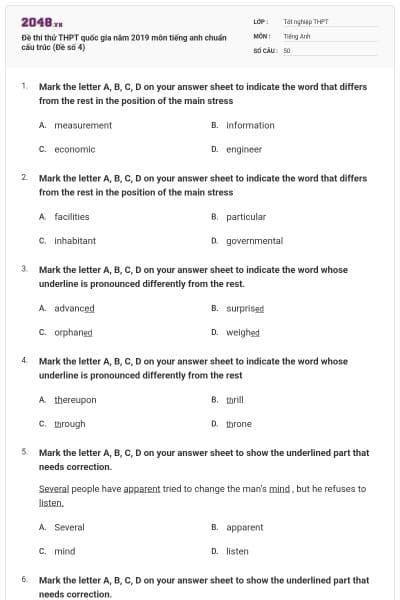
Mark the letter A, B, C, D on your answer sheet to indicate the word that differs from the rest in the position of the main stress
measurement
information
economic
engineer
Đáp án A
Trọng âm rơi vào âm tiết 1, các đáp án còn lại trọng âm rơi vào âm tiết 3
A. measurement /ˈmeʒɚmənt/: sự đo lường
B. information /,infə'meinʃn/: thông tin
C. economic /,i:kə'nɔmik/: thuộc về kinh tế
D. engineer /ˌen.dʒɪˈnɪr/: kĩ sư
Mark the letter A, B, C, D on your answer sheet to indicate the word that differs from the rest in the position of the main stress
facilities
particular
inhabitant
governmental
Đáp án D
Trọng âm rơi vào âm tiết 1, các đáp án còn lại trọng âm rơi vào âm tiết 2
A. facilities /fəˈsɪləti/: thiết bị chuyên dụng
B. particular /pɚˈtɪkjəlɚ/: cụ thể, nhất định, đặc biệt
C. inhabitant /ɪnˈhæbɪtənt/: người ở, người cư trú, dân cư
D. governmental /ˌɡʌvɚnˈmentəl/: thuộc về, liên quan đến chính phủ
Mark the letter A, B, C, D on your answer sheet to indicate the word whose underline is pronounced differently from the rest.
advanced
surprised
orphaned
weighed
Đáp án A
Phần được gạch chân phát âm là /t/, các đáp án còn lại phần gạch chân phát âm là /d/
Cách phát âm “ed”
- Đuôi “ed” được phát âm là /id/: khi động từ có phát âm kết thúc là /t/ hay /d/.
- Đuôi ed được phát âm là /t/: Khi động từ có phát âm kết thúc là: /ch/, /p/, /f/, /s/, /k/, /th/, /ʃ/, /t ʃ/.
- Đuôi ed được phát âm là /d/ trong các trường hợp còn lại
Mark the letter A, B, C, D on your answer sheet to indicate the word whose underline is pronounced differently from the rest
thereupon
thrill
through
throne
Đáp án A
Phần gạch chân phát âm là /ð/, các đáp án còn lại phần gạch chân phát âm là /θ/
A. thereupon /'ðeərə'pɔn/: do vậy, ngay sau đó
B. thrill /θrɪl/: sự rộn ràng (h) sự rùng mình
C. through /θruː/: qua, xuyên qua, suốt
D. throne /θroʊn/: ngai vị
Mark the letter A, B, C, D on your answer sheet to show the underlined part that needs correction.
Several people have apparent tried to change the man’s mind , but he refuses to listen.
Several
apparent
mind
listen
Đáp án B
Sửa: apparent => apparently
Trạng từ apparently bổ nghĩa cho động từ try.
Dịch nghĩa: Vài người tỏ rõ ý muốn anh ta đổi ý. Nhưng anh ta không thèm nghe
Mark the letter A, B, C, D on your answer sheet to show the underlined part that needs correction.
Students suppose to read all the questions carefully and find out the answer to them.
suppose
all the questions
out
them
Đáp án A
Sửa: suppose => are supposed
To be supposed to = to have to, to have a duty or a responsibility to
Dịch nghĩa: Học sinh phải đọc kĩ tất cả câu hỏi và tìm đáp án
Mark the letter A, B, C, D on your answer sheet to show the underlined part that needs correction.
Public health experts say that the money one spends avoiding illness is less than the cost of to treat sickness.
Public health
illness
cost
to treat
Đáp án D
Sửa: to treat => treating
Sau giới từ, động từ chia đuôi -ing: Of + V-ing
Dịch nghĩa: Các chuyên gia sức khoẻ cộng đồng cho biết, số tiền một người dành ra để phòng bệnh ít hơn so với chi phí chữa bệnh.
Lack of sleep over the last few months is finally _________ Jane.
catching up with
getting on with
coming over
putting on
Đáp án A
(to) catch up with somebody: gây rắc rối, làm ảnh hưởng tiêu cực đến ai đó (sự việc xấu)
Dịch nghĩa: Thiếu ngủ suốt nhiều tháng, cuối cùng Jane đã gặp rắc rối.
In China’s largest psychiatric facility, there is a serious lack of resources but the staffs try hard to _________ this in their treatment of the patients.
make up for
go in for
put up with
set in for
Đáp án A
(to) make up for: bù vào, lấp phần thiếu
Dịch nghĩa: Tại trại tâm thần lớn nhất Trung Quốc, nguồn tài nguyên thiếu hụt trầm trọng nhưng các nhân viên đều nỗ lực hết mình trong trị liệu cho bệnh nhận để bù đắp cho sự thiếu thốn này
Of all the factors affecting agricultural yields, the weather is the one ______ the most
that influences farmers
farmers that is influences
why farmers influence it
it influences farmers
Đáp án: A
Giải thích:
Kiến thức: Mệnh đề quan hệ
Dùng mệnh đề quan hệ để bổ nghĩa cho “the one”, có thể dùng đại từ quan hệ “which/that”.
Loại B vì đại từ quan hệ “that” phải đứng ngay sau “the one”, “influences” là động từ chính rồi, không cần “is” nữa.
Loại C vì “why” chỉ thay cho nguyên nhân
Loại D vì “it” không phải đại từ quan hệ.
Đáp án A đúng ngữ pháp.
Dịch: Trong tất cả các yếu tố ảnh hưởng đến năng suất nông nghiệp, thời tiết là yếu tố ảnh hưởng nhiều nhất đến người nông dân.
The passport she carried was ________.
artificial
imitation
untrue
false
Đáp án D
Câu hỏi từ vựng
A. artificial (adj): nhân tạo
B. imitation (n): vật mô phỏng, bắt chước
C. untrue (adj): không đúng, trái với sự thật
D. false (adj): được làm giả nhìn giống thật
Dịch nghĩa: Hộ chiếu cô ấy mang theo là giả
Jane’s eyes burned and her shoulders ached. She ________ at the computer for five straight hours. Finally, she took a break.
has sat
has been sitting
had been sitting
had sat
Đáp án C
Thì quá khứ hoàn thành tiếp diễn, chỉ sự việc đã và đang diễn ra tại một thời điểm trong quá khứ.
Dịch nghĩa: Mắt Jane đỏ lên và vai thì đau nhức. Cô ấy đã ngồi trước máy tính suốt 5 giờ liền.
Cuối cùng, cô ấy nghỉ một lát.
He showed his _________ for the TV program by switching it off.
distaste
discontent
annoyance
boredom
Đáp án A
Câu hỏi từ vựng
A. distaste (n): sự không thích, chán ghét
B. discontent (n): sự bất mãn, bất bình
C. annoyance (n): sự bực mình, thấy phiền phức
D. boredom (n): sự tẻ nhạt, buồn chán
Dịch nghĩa: Cậu ấy thể hiện sự chán ghét đối với chương trình bằng việc tắt nó đi
It is necessary that he _________ of his old parents.
takes care
to take care
take care
took care
Đáp án C
Cấu trúc giả định: It + be + adj + that + S + V-inf
Các tính từ được dùng mang tính khuyên nhủ, yêu cầu, quan trọng: advised, necessary, recommended, urgent, important, obligatory, required, imperative, mandatory, proposed, suggested,…
Dịch nghĩa: Anh ấy cần phải chăm sóc cha mẹ già.
The two countries have reached an agreement through dialogues described as ________.
productive
unproductive
productivity
counterprod
Đáp án A
Ở đây ta cần tính từ bổ nghĩa cho danh từ dialogues, trước hết loại C.
Xét nghĩa các tính từ và chọn được đáp án phù hợp là A
A. productive (adj): hữu ích
B. unproductive (adj): không hữu ích
D. counterproductive (adj): phản tác dụng
Dịch nghĩa: Hai nước đã đi đến thảo thuận nhờ các cuộc đối thoại được xem là rất hữu ích.
People usually can get sufficient _________ of the calcium their bodies need from the food they consume.
variety
source
amount
number
Đáp án C
A. variety (n): sự Đáp án dạng phong phú
B. source (n): nguồn
C. amount (n): lượng (không đếm được)
D. number (n): số lượng (đếm được)
Dựa theo ý nghĩa câu, ta chọn được đáp án C (do calcium là danh từ không đếm được)
Dịch nghĩa: Người ta thường hấp thụ lượng canxi cần thiết cho cơ thể qua thức ăn
The weather is going to change soon; I feel it in my _________.
body
legs
skin
bones
Đáp án D
(to) feel it in your bones: cảm giác vô cùng tin tưởng, chắc chắn (tuy không rõ lý do, bằng chứng xác thực)
Dịch nghĩa: Thời tiết sẽ thay đổi sớm thôi; tôi dám chắc là thế.
Kelly wanted to have a live band __________ at her wedding.
to be played
played
play
been playing
Đáp án C
(to) have someone do something: nhờ, khiến ai làm gì
Dịch nghĩa: Kelly muốn có một bạn nhạc chơi trong đám cưới cô ấy.
It is a top secret. You ________ tell anyone about it.
won’t
needn’t
mustn’t
mightn’t
Đáp án C
A. won’t: sẽ không
B. needn’t: không cần
C. mustn’t: không được
D. mightn’t: có thể sẽ không
Dịch nghĩa: Đây là vấn đề tuyệt mật. Cậu không được nói với ai khác.
– John: “How about giving me a hand?”
- Tom: “_____________”
I promise.
No, not yet.
Sure, I’d be glad to help.
You’re welcome!
Đáp án C
- John: “Giúp tớ chút được không?”
- Tom: “Đương nhiên, rất vui lòng được giúp cậu.”
Các đáp án còn lại:
A. Tớ hứa
B. Không, vẫn chưa.
D. Có gì đâu!
– Liz: “Thanks for the nice gift you brought to us!”
– Jennifer: “___________”
Alright. Do you know how much it costs?
Not at all. Don’t mention it.
Actually speaking, I myself don’t like it.
Welcome! It’s very nice of you.
Đáp án B
- Liz: “Cảm ơn vì món quà cậu tặng bọn tớ!”
- Jennifer: “Có gì đâu. Đừng nói thế mà.” (ý nói việc này là việc nhỏ, không cần bận tâm)
Các đáp án còn lại:
A. Được rồi. Cậu biết nó đắt cỡ nào không?
C. Nói thật thì, cá nhân tớ không thích nó lắm.
D. Hoan nghênh! Cậu thật tốt.
Mark the letter A, B, C or D on your answer sheet to indicate the word of phrase that is CLOSEST in meaning to the underlined part in each of the following question.
Few businesses are flourishing in the present economic climate.
taking off
setting up
growing well
closing down
Đáp án C
(to) flourish = (to) grow well: phát triển tốt, thịnh vượng
Các đáp án còn lại:
A. (to) take off (v): cất cánh (máy bay); bắt chước
B. (to) set up (v): chuẩn bị, dàn dựng
D. (to) close down (v): đóng cửa, ngừng kinh doanh
Dịch nghĩa: Một vài ngành kinh doanh đang rất phát triển trong điều kiện kinh tế hiện nay.
Mark the letter A, B, C or D on your answer sheet to indicate the word of phrase that is CLOSEST in meaning to the underlined part in each of the following question.
The dog saw his reflection in the pool of water.
imagination
bone
leash
image
Đáp án D
Reflection (n): hình ảnh phản chiếu ≈ image
Các đáp án còn lại:
A. imagination (n): tưởng tượng
B. bone (n): khung xương
C. leash (n): dây xích
Dịch nghĩa: Chú chó thấy hình ảnh mình bị phản chiếu từ bể nước
Mark the letter A, B, C or D on your answer sheet to indicate the word of phrase that is OPPOSITE in meaning to the underlined part in each of the following question.
We ought to keep these proposals secret from the chairman for the time being.
revealed
frequented
accessible
lively
Đáp án A
Secret (adj): bí mật >< revealed (adj): được tiết lộ
Các đáp án còn lại:
B. frequent (adj): thường xuyên
C. accessible (adj): có thể tiếp cận
D. lively (adj): sinh động
Dịch nghĩa: Chúng ta tạm thời nên giữ bí mật những kiến nghị này với chủ tịch
Mark the letter A, B, C or D on your answer sheet to indicate the word of phrase that is OPPOSITE in meaning to the underlined part in each of the following question.
They protested about the inhumane treatment of the prisoners.
vicious
warm-hearted
callous
cold-blooded
Đáp án B
Inhumane (adj): độc ác, vô nhân tính >< warm-hearted (adj): nhân ái, tốt bụng
Các đáp án còn lại:
A. vicious (adj): xấu xa, đầy ác ý
C. callous (adj): nhẫn tâm, tàn nhẫn
D. cold-blooded (adj): máu lạnh
Dịch nghĩa: Họ phản đối việc đối đãi tàn nhẫn với tù nhân.
Mark the letter A, B, C or D on your answer sheet to indicate the sentence that is closest in meaning to each of the following questions.
It is English pronunciation that puzzles me most.
Pronouncing English is not complicated.
I was not quick at English pronunciation at school.
Puzzling me most is how to pronounce English
English pronunciation is difficult for me.
Đáp án D
Chính phát âm Tiếng Anh là khó nhằn nhất với tôi.
= Phát âm Tiếng Anh rất khó đối với tôi.
(to) puzzle (v): làm khó, gây phiền, bối rối
(to) be difficult (adj): khó
Các đáp án còn lại:
A. Phát âm Tiếng Anh không phức tạp.
B. Tôi không nhanh nhạy phần phát âm Tiếng Anh ở trường lắm.
C. Khiến tôi khó nhằn nhất là phát âm Tiếng Anh.
Đáp án C có nghĩa tương đương, tuy nhiên ngữ pháp không ổn. Câu này sẽ đúng nếu ta sửa lại: What puzzles me most is English pronunciation
Mark the letter A, B, C or D on your answer sheet to indicate the sentence that is closest in meaning to each of the following questions.
The woman was too weak to lift the suitcase.
The woman wasn’t able to lift the suitcase, so she was very weak.
The woman, though weak, could lift the suitcase.
So weak was the woman that she couldn’t lift the suitcase.
The woman shouldn’t have lifted the suitcase as she was weak.
Đáp án C
Người phụ nữ quá yếu để có thể xách được hành lí.
= Người phụ nữ yếu đến mức không xách nổi hành lí.
Các đáp án còn lại:
A. Người phụ nữ không thể xách hành lí, nên cô ấy rất yếu.
B. Người phụ nữ, tuy yếu, nhưng vẫn xách được hành lí.
D. Người phị nữ đáng ra không nên xách hành lí vì cô ấy rất yếu.
Mark the letter A, B, C or D on your answer sheet to indicate the sentence that is closest in meaning to each of the following questions.
“Would you like some more beer?” he asked.
He asked me if I liked some more beer.
He wanted to invite me for a glass of beer.
He offered me some more beer.
He asked me would I like some more beer.
Đáp án C
“Cậu muốn uống thêm bia không?” cậu ta hỏi.
= Cậu ta mời tôi uống thêm bia.
Ở đây, Would you like là câu mời mọc, khi viết lại câu tường thuật ta dùng động từ offer.
Các đáp án còn lại:
A. Cậu ta hỏi liệu tôi có muốn uống thêm bia.
B. Cậu ta muốn mời tôi uống một cốc bia.
D. Cậu ta hỏi tôi liệu tôi có muốn uống thêm bia không
Mark the letter A, B, C or D on your answer sheet to indicate the sentence that best combines each pair of sentences in the following questions.
My Tam is a pop star. She has many famous songs.
My Tam, who has many famous songs, is a pop star.
My Tam, that has many famous songs, is a pop star.
My Tam, whose has many famous songs, is a pop star.
My Tam, which has many famous songs, is a pop star.
Đáp án A
Mỹ Tâm là một ngôi sao ca nhạc. Chị ấy có rất nhiều bài nổi tiếng.
= Mỹ Tâm, người có nhiều bài hát nổi tiếng, là một ngôi sao ca nhạc.
Phân biệt who, that, which, whose.
Who – thay thế cho người
That – thay thế cho cả người, vật và không dùng trong mệnh đề quan hệ không xác định.
Whose – thay thế cho đại từ sở hữu
Which – thay thế cho vật
Đây là mệnh đề quan hệ không xác định, và chủ thể ở đây là người nên ta dùng who.
Mark the letter A, B, C or D on your answer sheet to indicate the sentence that best combines each pair of sentences in the following questions.
I’m not rich. I can’t help other people.
If I am rich, I can help other people.
If I were rich, I can help other people.
If I am rich, I could help other people.
If I were rich, I could help other people.
Đáp án D
Tôi không giàu. Tôi không thể giúp được người ta.
= Nếu tôi giàu, tôi đã giúp được mọi người.
Dùng câu điều kiện loại 2 nói về sự việc không có thật ở hiện tại và kết quả giả định.
Cấu trúc: If + S + V-ed, S + would/could + V
Read the following passage and mark the letter A, B, C or D on your answer sheet to indicate the correct answer to each of the questions
A pioneering study by Donald Appleyard made the astounding discovery that a sudden increase in the volume of traffic through an area affects people in the way that a sudden increase in crime does. Appleyard observed this by finding three blocks of houses in San Francisco that looked much alike and had the same kind of middle-class and working-class residents, with approximately the same ethnic mix. The difference was that only 2,000 cars a day ran down Octavia Street (LIGHT street, in Appleyard’s terminology) while Gough Street (MEDIUM street) was used by 8,000 cars daily, and Franklin Street (HEAVY street) had around 16,000 cars a day. Franklin Street often had as many cars in an hour as Octavia had in a day.
Heavy traffic brought with it danger, noise, fumes and soot, directly, and trash secondarily. That is, the cars didn’t bring in much trash, but when trash accumulated, residents seldom picked it up. The cars, Appleyard determined, reduced the amount of territory residents felt responsible for. Noise was a constant intrusion into their homes. Many Franklin Street residents covered their doors and windows and spent most of their time in the rear of their houses. Most
families with children had already left.
Conditions on Octavia Street were much different. Residents picked up trash. They sat on their front steps and chatted with neighbors. They had three times as many friends and twice as many acquaintances as the people on Franklin.
On Gough Street, residents said that the old feeling of community was disappearing as traffic increased. People were becoming more and more preoccupied with their own lives. A number of families had recently moved and more were considering. Those who were staying expressed deep regret at the destruction of their community.
The word “astounding” in line 1 is closest in meaning to
startling
disappointing
dubious
alternative
Đáp án A
Từ “astounding” ở dòng 1 gần nghĩa nhất với _________
A. giật mình
B. đáng thất vọng
C. mơ hồ, không rõ ràng
D. luân phiên
Astounding (adj): đáng kinh ngạc ≈ startling (adj): giật mình
Read the following passage and mark the letter A, B, C or D on your answer sheet to indicate the correct answer to each of the questions
A pioneering study by Donald Appleyard made the astounding discovery that a sudden increase in the volume of traffic through an area affects people in the way that a sudden increase in crime does. Appleyard observed this by finding three blocks of houses in San Francisco that looked much alike and had the same kind of middle-class and working-class residents, with approximately the same ethnic mix. The difference was that only 2,000 cars a day ran down Octavia Street (LIGHT street, in Appleyard’s terminology) while Gough Street (MEDIUM street) was used by 8,000 cars daily, and Franklin Street (HEAVY street) had around 16,000 cars a day. Franklin Street often had as many cars in an hour as Octavia had in a day.
Heavy traffic brought with it danger, noise, fumes and soot, directly, and trash secondarily. That is, the cars didn’t bring in much trash, but when trash accumulated, residents seldom picked it up. The cars, Appleyard determined, reduced the amount of territory residents felt responsible for. Noise was a constant intrusion into their homes. Many Franklin Street residents covered their doors and windows and spent most of their time in the rear of their houses. Most
families with children had already left.
Conditions on Octavia Street were much different. Residents picked up trash. They sat on their front steps and chatted with neighbors. They had three times as many friends and twice as many acquaintances as the people on Franklin.
On Gough Street, residents said that the old feeling of community was disappearing as traffic increased. People were becoming more and more preoccupied with their own lives. A number of families had recently moved and more were considering. Those who were staying expressed deep regret at the destruction of their community.
The three streets mentioned in this passage are different in that __________.
they are in different cities.
the residents are of different ethnic backgrounds.
they have varying amounts of traffic.
the income levels of the residents vary considerably.
Đáp án C
Ba con đường được đề cập khác nhau ở điểm ________
A. Chúng ở khác thành phố.
B. Tôn giáo sắc tộc của dân cư khác nhau.
C. Chúng có lưu lượng giao thông khác nhau.
D. Mức thu nhập của cư dân khác nhau.
Đặc điểm 3 ngôi nhà được đề cập: “looked much alike and had the same kind of middle-class and working-class residents, with approximately the same ethnic mix”
(trông giống nhau, lượng dân cư độ tuổi trung niên và lao động ngang nhau và có tỉ lệ tôn giáo sắc tộc)
Và sau đó tác giả đưa ra khác biệt chính là: đường Octovia 2,000 xe, Gough 8,000 xe và Franklin 16,000 xe mỗi ngày.
Read the following passage and mark the letter A, B, C or D on your answer sheet to indicate the correct answer to each of the questions
A pioneering study by Donald Appleyard made the astounding discovery that a sudden increase in the volume of traffic through an area affects people in the way that a sudden increase in crime does. Appleyard observed this by finding three blocks of houses in San Francisco that looked much alike and had the same kind of middle-class and working-class residents, with approximately the same ethnic mix. The difference was that only 2,000 cars a day ran down Octavia Street (LIGHT street, in Appleyard’s terminology) while Gough Street (MEDIUM street) was used by 8,000 cars daily, and Franklin Street (HEAVY street) had around 16,000 cars a day. Franklin Street often had as many cars in an hour as Octavia had in a day.
Heavy traffic brought with it danger, noise, fumes and soot, directly, and trash secondarily. That is, the cars didn’t bring in much trash, but when trash accumulated, residents seldom picked it up. The cars, Appleyard determined, reduced the amount of territory residents felt responsible for. Noise was a constant intrusion into their homes. Many Franklin Street residents covered their doors and windows and spent most of their time in the rear of their houses. Most
families with children had already left.
Conditions on Octavia Street were much different. Residents picked up trash. They sat on their front steps and chatted with neighbors. They had three times as many friends and twice as many acquaintances as the people on Franklin.
On Gough Street, residents said that the old feeling of community was disappearing as traffic increased. People were becoming more and more preoccupied with their own lives. A number of families had recently moved and more were considering. Those who were staying expressed deep regret at the destruction of their community.
Approximately how many cars used Franklin Street daily?
2,000
8,000
16,000
20,000
Đáp án C
Có khoảng bao nhiêu phương tiện dùng đường Franklin mỗi ngày?
A. 2,000
B. 8,000
C. 16,000
D. 20,000
Như đã nhắc ở trên, đường Franklin có 16,000 xe lưu thông mỗi ngày
Read the following passage and mark the letter A, B, C or D on your answer sheet to indicate the correct answer to each of the questions
A pioneering study by Donald Appleyard made the astounding discovery that a sudden increase in the volume of traffic through an area affects people in the way that a sudden increase in crime does. Appleyard observed this by finding three blocks of houses in San Francisco that looked much alike and had the same kind of middle-class and working-class residents, with approximately the same ethnic mix. The difference was that only 2,000 cars a day ran down Octavia Street (LIGHT street, in Appleyard’s terminology) while Gough Street (MEDIUM street) was used by 8,000 cars daily, and Franklin Street (HEAVY street) had around 16,000 cars a day. Franklin Street often had as many cars in an hour as Octavia had in a day.
Heavy traffic brought with it danger, noise, fumes and soot, directly, and trash secondarily. That is, the cars didn’t bring in much trash, but when trash accumulated, residents seldom picked it up. The cars, Appleyard determined, reduced the amount of territory residents felt responsible for. Noise was a constant intrusion into their homes. Many Franklin Street residents covered their doors and windows and spent most of their time in the rear of their houses. Most
families with children had already left.
Conditions on Octavia Street were much different. Residents picked up trash. They sat on their front steps and chatted with neighbors. They had three times as many friends and twice as many acquaintances as the people on Franklin.
On Gough Street, residents said that the old feeling of community was disappearing as traffic increased. People were becoming more and more preoccupied with their own lives. A number of families had recently moved and more were considering. Those who were staying expressed deep regret at the destruction of their community.
All of the following are direct results of heavy traffic EXCEPT
increased amount of trash
greater danger to residents
more pollution
more vibrations
Đáp án D
Tất cả các đáp án sau đều là kết quả của giao thông đông đúc, NGOẠI TRỪ ________
A. lượng rác thải tăng lên
B. mối nguy hại lớn hơn cho cư dân
C. ô nhiễm hơn
D. nhiều rung động hơn
Câu đầu tiên đoạn 2: “Heavy traffic brought with it DANGER, NOISE, FUMES AND SOOT directly, and TRASH secondarily.” (Giao thông đông đúc mang theo mối nguy hại, tiếng ồn, khói bụi và cả rác)
Chỉ có vibrations không được nhắc tới.
Read the following passage and mark the letter A, B, C or D on your answer sheet to indicate the correct answer to each of the questions
A pioneering study by Donald Appleyard made the astounding discovery that a sudden increase in the volume of traffic through an area affects people in the way that a sudden increase in crime does. Appleyard observed this by finding three blocks of houses in San Francisco that looked much alike and had the same kind of middle-class and working-class residents, with approximately the same ethnic mix. The difference was that only 2,000 cars a day ran down Octavia Street (LIGHT street, in Appleyard’s terminology) while Gough Street (MEDIUM street) was used by 8,000 cars daily, and Franklin Street (HEAVY street) had around 16,000 cars a day. Franklin Street often had as many cars in an hour as Octavia had in a day.
Heavy traffic brought with it danger, noise, fumes and soot, directly, and trash secondarily. That is, the cars didn’t bring in much trash, but when trash accumulated, residents seldom picked it up. The cars, Appleyard determined, reduced the amount of territory residents felt responsible for. Noise was a constant intrusion into their homes. Many Franklin Street residents covered their doors and windows and spent most of their time in the rear of their houses. Most
families with children had already left.
Conditions on Octavia Street were much different. Residents picked up trash. They sat on their front steps and chatted with neighbors. They had three times as many friends and twice as many acquaintances as the people on Franklin.
On Gough Street, residents said that the old feeling of community was disappearing as traffic increased. People were becoming more and more preoccupied with their own lives. A number of families had recently moved and more were considering. Those who were staying expressed deep regret at the destruction of their community.
The author’s main purpose in the second paragraph is to __________.
discuss the problem of trash disposal
point out the disadvantage of heavy traffic
propose an alternate system of transportation
suggest ways to cope with traffic problems
Đáp án B
Mục đích chính của tác giả trong đoạn 2 là ______________
A. bàn luận vấn đề xử lí rác thải.
B. chỉ ra điểm bất lợi của giao thông đông đúc.
C. đề xuất hệ thống giao thông thay thế.
D. gợi ý phương hướng giải quyết vấn đề giao thông.
Đoạn 2 chủ yếu nói về mối nguy hại mà giao thông đông đúc đưa lại, những tác động đến người dân và hệ quả sau đó (nhiều gia đình phải chuyển đi).
Read the following passage and mark the letter A, B, C or D on your answer sheet to indicate the correct answer to each of the questions
A pioneering study by Donald Appleyard made the astounding discovery that a sudden increase in the volume of traffic through an area affects people in the way that a sudden increase in crime does. Appleyard observed this by finding three blocks of houses in San Francisco that looked much alike and had the same kind of middle-class and working-class residents, with approximately the same ethnic mix. The difference was that only 2,000 cars a day ran down Octavia Street (LIGHT street, in Appleyard’s terminology) while Gough Street (MEDIUM street) was used by 8,000 cars daily, and Franklin Street (HEAVY street) had around 16,000 cars a day. Franklin Street often had as many cars in an hour as Octavia had in a day.
Heavy traffic brought with it danger, noise, fumes and soot, directly, and trash secondarily. That is, the cars didn’t bring in much trash, but when trash accumulated, residents seldom picked it up. The cars, Appleyard determined, reduced the amount of territory residents felt responsible for. Noise was a constant intrusion into their homes. Many Franklin Street residents covered their doors and windows and spent most of their time in the rear of their houses. Most
families with children had already left.
Conditions on Octavia Street were much different. Residents picked up trash. They sat on their front steps and chatted with neighbors. They had three times as many friends and twice as many acquaintances as the people on Franklin.
On Gough Street, residents said that the old feeling of community was disappearing as traffic increased. People were becoming more and more preoccupied with their own lives. A number of families had recently moved and more were considering. Those who were staying expressed deep regret at the destruction of their community.
Which of the following is NOT a statement you would expect from a resident of Gough Street?
People on this street are unhappy because the neighborhood is deteriorating.
People on this street think mostly of themselves.
People on this street have more and more space for which they feel responsible.
A number of people are preparing to leave this street.
Đáp án C
Đâu không phải là điều mà người dân đường Gough có thể sẽ nói?
A. Người dân đường này không vui vì khu dân cư của họ đang mai một dần.
B. Người dân đường này chỉ nghĩ cho bản thân nhiều hơn.
C. Người dân đường này ngày càng cảm thấy có trách nhiệm.
D. Nhiều người đang có ý định chuyển đi.
Đoạn cuối nói về suy nghĩ của người dân đường Gough: cảm giác cộng đồng dần mất đi, người ta chỉ biết đến cuộc sống bản thân (ít trách nhiệm hơn, ít thông cảm cho nhau hơn). Nhiều gia đình đã chuyển và nhiều gia đình đang cân nhắc chuyển. Người ở lại bày tỏ tiếc nuối (không vui)… Như vậy, ta có thể thấy, đáp án C (cảm thấy có trách nhiệm hơn) là sai.
Read the following passage and mark the letter A, B, C or D on your answer sheet to indicate the correct answer to each of the questions
A pioneering study by Donald Appleyard made the astounding discovery that a sudden increase in the volume of traffic through an area affects people in the way that a sudden increase in crime does. Appleyard observed this by finding three blocks of houses in San Francisco that looked much alike and had the same kind of middle-class and working-class residents, with approximately the same ethnic mix. The difference was that only 2,000 cars a day ran down Octavia Street (LIGHT street, in Appleyard’s terminology) while Gough Street (MEDIUM street) was used by 8,000 cars daily, and Franklin Street (HEAVY street) had around 16,000 cars a day. Franklin Street often had as many cars in an hour as Octavia had in a day.
Heavy traffic brought with it danger, noise, fumes and soot, directly, and trash secondarily. That is, the cars didn’t bring in much trash, but when trash accumulated, residents seldom picked it up. The cars, Appleyard determined, reduced the amount of territory residents felt responsible for. Noise was a constant intrusion into their homes. Many Franklin Street residents covered their doors and windows and spent most of their time in the rear of their houses. Most
families with children had already left.
Conditions on Octavia Street were much different. Residents picked up trash. They sat on their front steps and chatted with neighbors. They had three times as many friends and twice as many acquaintances as the people on Franklin.
On Gough Street, residents said that the old feeling of community was disappearing as traffic increased. People were becoming more and more preoccupied with their own lives. A number of families had recently moved and more were considering. Those who were staying expressed deep regret at the destruction of their community.
In what order does the author present detailed discussions of the three streets?
LIGHT, MEDIUM, HEAVY
HEAVY, MEDIUM, LIGHT
HEAVY, LIGHT, MEDIUM
LIGHT, HEAVY, M
Đáp án C
Tác giả bàn luận chi tiết về 3 loại đường theo thứ tự nào?
A. LIGHT, MEDIUM, HEAVY
B. HEAVY, MEDIUM, LIGHT
C. HEAVY, LIGHT, MEDIUM
D. LIGHT, HEAVY, MEDIUM
Đọc bài ta có thể thấy, HEAVY Street được nhắc ở cuối đoạn 2, sau đó là LIGHT Street ở đoạn 3 và MEDIUM Street đoạn cuối. Như vậy thứ tự là C.
Read the following passage and mark the letter A, B, C or D on your answer sheet to indicate the correct answer to each of the questions
A pioneering study by Donald Appleyard made the astounding discovery that a sudden increase in the volume of traffic through an area affects people in the way that a sudden increase in crime does. Appleyard observed this by finding three blocks of houses in San Francisco that looked much alike and had the same kind of middle-class and working-class residents, with approximately the same ethnic mix. The difference was that only 2,000 cars a day ran down Octavia Street (LIGHT street, in Appleyard’s terminology) while Gough Street (MEDIUM street) was used by 8,000 cars daily, and Franklin Street (HEAVY street) had around 16,000 cars a day. Franklin Street often had as many cars in an hour as Octavia had in a day.
Heavy traffic brought with it danger, noise, fumes and soot, directly, and trash secondarily. That is, the cars didn’t bring in much trash, but when trash accumulated, residents seldom picked it up. The cars, Appleyard determined, reduced the amount of territory residents felt responsible for. Noise was a constant intrusion into their homes. Many Franklin Street residents covered their doors and windows and spent most of their time in the rear of their houses. Most
families with children had already left.
Conditions on Octavia Street were much different. Residents picked up trash. They sat on their front steps and chatted with neighbors. They had three times as many friends and twice as many acquaintances as the people on Franklin.
On Gough Street, residents said that the old feeling of community was disappearing as traffic increased. People were becoming more and more preoccupied with their own lives. A number of families had recently moved and more were considering. Those who were staying expressed deep regret at the destruction of their community.
What is the writer’s attitude toward heavy traffic when he mentions the Appleyard’s study?
neutral
favorable
critical
doubtful
Đáp án C
Thái độ của tác giả đối với giao thông đông đúc ra sao khi ông đề cập nghiên cứu của Appleyard?
A. trung lập
B. ủng hộ
C. chỉ trích
D. nghi ngờ
Nhắc đến heavy traffic, tác giả nói đến mối nguy hại của nó và những hệ luỵ kéo theo. Từ đó có thể thấy được sự phản đối, chỉ trích của tác giả đối với nó.
Read the following passage and mark the letter A, B, C or D on your answer sheet to indicate the correct answer to each of the questions.
Dinosaurs were reptiles that lived during a period of earth’s history called the Mesozoic Era, which is known as the Age of Reptiles. The first dinosaurs appeared more than 200 million years ago. For many millions of years, they dominated the land with their huge size and strength. Then about 65 million years ago, they died out rather suddenly, never to reemerge.
The word dinosaur comes from two Greek words meaning “terrible lizard”. Dinosaurs were not lizards, but their appearance could be truly terrifying. The biggest ones weighed more than ten times as much as a mature elephant and nearly equaled the size of most modern—day whales. The famous kinds of dinosaurs, including the brontosaur and tyrannosaurus, reached 80 to 90 feet in length. Not all dinosaurs were giants, however, some were actually no larger than a chicken.
Scientists still do not know what caused dinosaur to disappear. One theory involves a change in the earth’s climate. It is believed that temperature dropped significantly towards the end of the Cretaceous Period. Too large to hibernate and not having fur or feathers for protection, it is possible that the climate became too chilly for dinosaurs. In contrast, other species having protection, such as the mammals and birds, were able to survive
The word “ones” in the passage refers to __________
dinosaurs
millions
lizards
whales
Đáp án A
Từ “ones” trong đoạn nói đến _________
A. khủng long
B. hàng triệu
C. thằn lằn
D. cá voi
Ta đọc lại 2 câu trước đó, đều là nói về khủng long. Ones ở đây được sử dụng để thay thế khủng long nhằm tránh lặp.
Read the following passage and mark the letter A, B, C or D on your answer sheet to indicate the correct answer to each of the questions.
Dinosaurs were reptiles that lived during a period of earth’s history called the Mesozoic Era, which is known as the Age of Reptiles. The first dinosaurs appeared more than 200 million years ago. For many millions of years, they dominated the land with their huge size and strength. Then about 65 million years ago, they died out rather suddenly, never to reemerge.
The word dinosaur comes from two Greek words meaning “terrible lizard”. Dinosaurs were not lizards, but their appearance could be truly terrifying. The biggest ones weighed more than ten times as much as a mature elephant and nearly equaled the size of most modern—day whales. The famous kinds of dinosaurs, including the brontosaur and tyrannosaurus, reached 80 to 90 feet in length. Not all dinosaurs were giants, however, some were actually no larger than a chicken.
Scientists still do not know what caused dinosaur to disappear. One theory involves a change in the earth’s climate. It is believed that temperature dropped significantly towards the end of the Cretaceous Period. Too large to hibernate and not having fur or feathers for protection, it is possible that the climate became too chilly for dinosaurs. In contrast, other species having protection, such as the mammals and birds, were able to survive
The word “chilly” in the passage refers to _________
very hot
extremely cold
very cold
humid
Đáp án C
Từ “chilly” trong đoạn có nghĩa _______
A. rất nóng
B. cực lạnh
C. rất lạnh
D. ẩm
Chilly (adj): lạnh lẽo, giá lạnh (chỉ ở mức không thoải mái, chưa đến mức lạnh khắc nghiệt) = very cold
Read the following passage and mark the letter A, B, C or D on your answer sheet to indicate the correct answer to each of the questions.
Dinosaurs were reptiles that lived during a period of earth’s history called the Mesozoic Era, which is known as the Age of Reptiles. The first dinosaurs appeared more than 200 million years ago. For many millions of years, they dominated the land with their huge size and strength. Then about 65 million years ago, they died out rather suddenly, never to reemerge.
The word dinosaur comes from two Greek words meaning “terrible lizard”. Dinosaurs were not lizards, but their appearance could be truly terrifying. The biggest ones weighed more than ten times as much as a mature elephant and nearly equaled the size of most modern—day whales. The famous kinds of dinosaurs, including the brontosaur and tyrannosaurus, reached 80 to 90 feet in length. Not all dinosaurs were giants, however, some were actually no larger than a chicken.
Scientists still do not know what caused dinosaur to disappear. One theory involves a change in the earth’s climate. It is believed that temperature dropped significantly towards the end of the Cretaceous Period. Too large to hibernate and not having fur or feathers for protection, it is possible that the climate became too chilly for dinosaurs. In contrast, other species having protection, such as the mammals and birds, were able to survive
What is the best title for this passage?
The Domination of the Land
The Metabolism of Dinosaurs
Earth’s Largest Reptiles
The History of Earth
Đáp án B
Đề mục phù hợp nhất với đoạn văn là?
A. Thống trị vùng đất
B. Sự chuyển hoá của khủng long
C. Loài bò sát lớn nhất Trái Đất
D. Lịch sử Trái Đất
Bài đọc nói về khủng long và việc chúng tuyệt chủng
Read the following passage and mark the letter A, B, C or D on your answer sheet to indicate the correct answer to each of the questions.
Dinosaurs were reptiles that lived during a period of earth’s history called the Mesozoic Era, which is known as the Age of Reptiles. The first dinosaurs appeared more than 200 million years ago. For many millions of years, they dominated the land with their huge size and strength. Then about 65 million years ago, they died out rather suddenly, never to reemerge.
The word dinosaur comes from two Greek words meaning “terrible lizard”. Dinosaurs were not lizards, but their appearance could be truly terrifying. The biggest ones weighed more than ten times as much as a mature elephant and nearly equaled the size of most modern—day whales. The famous kinds of dinosaurs, including the brontosaur and tyrannosaurus, reached 80 to 90 feet in length. Not all dinosaurs were giants, however, some were actually no larger than a chicken.
Scientists still do not know what caused dinosaur to disappear. One theory involves a change in the earth’s climate. It is believed that temperature dropped significantly towards the end of the Cretaceous Period. Too large to hibernate and not having fur or feathers for protection, it is possible that the climate became too chilly for dinosaurs. In contrast, other species having protection, such as the mammals and birds, were able to survive
It can be inferred from the passage that the Age of Reptiles lasted about _______
200 million years
135 million years
80 million years
65 million years
Đáp án B
Có thể suy ra từ đoạn văn Kỉ nguyên của loài bò sát kéo dài _______
A. 200 triệu năm
B. 135 triệu năm
C. 80 triệu năm
D. 65 triệu năm
Từ câu đầu bài đọc, ta biết Kỉ nguyên loài bò sát chính là thời kì tồn tại của khủng long. Như vậy cần tính thời gian chúng tồn tại.
Khủng long xuất hiện vào 200 triệu năm trước, và tuyệt chủng vào 65 triệu năm trước. Từ đó ta tính được chúng tồn tại trong 135 triệu năm, cũng chính là thời gian tồn tại của Kỉ nguyên loài bò sát.
Read the following passage and mark the letter A, B, C or D on your answer sheet to indicate the correct answer to each of the questions.
Dinosaurs were reptiles that lived during a period of earth’s history called the Mesozoic Era, which is known as the Age of Reptiles. The first dinosaurs appeared more than 200 million years ago. For many millions of years, they dominated the land with their huge size and strength. Then about 65 million years ago, they died out rather suddenly, never to reemerge.
The word dinosaur comes from two Greek words meaning “terrible lizard”. Dinosaurs were not lizards, but their appearance could be truly terrifying. The biggest ones weighed more than ten times as much as a mature elephant and nearly equaled the size of most modern—day whales. The famous kinds of dinosaurs, including the brontosaur and tyrannosaurus, reached 80 to 90 feet in length. Not all dinosaurs were giants, however, some were actually no larger than a chicken.
Scientists still do not know what caused dinosaur to disappear. One theory involves a change in the earth’s climate. It is believed that temperature dropped significantly towards the end of the Cretaceous Period. Too large to hibernate and not having fur or feathers for protection, it is possible that the climate became too chilly for dinosaurs. In contrast, other species having protection, such as the mammals and birds, were able to survive
The author uses the phrase “never to reemerge” to indicate the dinosaurs
became extinct
went into hiding
never died out
lost their way
Đáp án A
Tác giả dùng cụm “never to reemerge” để chỉ rằng loài khủng long _______
A. đã tuyệt chủng
B. đi trốn
D. không bao giờ chết mòn
D. lạc đường
Never to reemerge: không bao giờ xuất hiện lại nữa = tuyệt chủng
Read the following passage and mark the letter A, B, C or D on your answer sheet to indicate the correct answer to each of the questions.
Dinosaurs were reptiles that lived during a period of earth’s history called the Mesozoic Era, which is known as the Age of Reptiles. The first dinosaurs appeared more than 200 million years ago. For many millions of years, they dominated the land with their huge size and strength. Then about 65 million years ago, they died out rather suddenly, never to reemerge.
The word dinosaur comes from two Greek words meaning “terrible lizard”. Dinosaurs were not lizards, but their appearance could be truly terrifying. The biggest ones weighed more than ten times as much as a mature elephant and nearly equaled the size of most modern—day whales. The famous kinds of dinosaurs, including the brontosaur and tyrannosaurus, reached 80 to 90 feet in length. Not all dinosaurs were giants, however, some were actually no larger than a chicken.
Scientists still do not know what caused dinosaur to disappear. One theory involves a change in the earth’s climate. It is believed that temperature dropped significantly towards the end of the Cretaceous Period. Too large to hibernate and not having fur or feathers for protection, it is possible that the climate became too chilly for dinosaurs. In contrast, other species having protection, such as the mammals and birds, were able to survive
According to the passage, what is true about the size of dinosaurs?
It made them the largest creatures ever on earth.
It varied quite greatly.
It guaranteed their survival.
It was rather uniform.
Đáp án B
Theo bài đọc, điều nào là đúng về kích cỡ khủng long?
A. Nó giúp khủng long trở thành sinh vật khổng lồ nhất Trái Đất.
B. Nó vô cùng đa dạng.
C. Nó bảo đảm cho sự sống còn của khủng long
D. Nó khá đồng đều.
Tác giả nói về kích cỡ của các loài khủng long trong đoạn 3: “The biggest ones weighed more than ten times as much as a mature elephant and nearly equaled the size of most modern—day whales. The famous kinds of dinosaurs, including the brontosaur and tyrannosaurus, reached 80 to 90 feet in length. Not all dinosaurs were giants, however, some were actually no larger than a chicken.”
Tóm gọn, khủng long có thể nặng gấp 10 con voi trưởng thành, kích cỡ gần cá voi ngày nay và có thể đạt tới 80-90 feet về độ dài. Tuy nhiên, không phải tất cả, có những loài chỉ bé cỡ con gà.
Như vậy, ta thấy, kích cỡ của chúng vô cùng đa dạng.
Read the following passage and mark the letter A, B, C or D on your answer sheet to indicate the correct answer to each of the questions.
Dinosaurs were reptiles that lived during a period of earth’s history called the Mesozoic Era, which is known as the Age of Reptiles. The first dinosaurs appeared more than 200 million years ago. For many millions of years, they dominated the land with their huge size and strength. Then about 65 million years ago, they died out rather suddenly, never to reemerge.
The word dinosaur comes from two Greek words meaning “terrible lizard”. Dinosaurs were not lizards, but their appearance could be truly terrifying. The biggest ones weighed more than ten times as much as a mature elephant and nearly equaled the size of most modern—day whales. The famous kinds of dinosaurs, including the brontosaur and tyrannosaurus, reached 80 to 90 feet in length. Not all dinosaurs were giants, however, some were actually no larger than a chicken.
Scientists still do not know what caused dinosaur to disappear. One theory involves a change in the earth’s climate. It is believed that temperature dropped significantly towards the end of the Cretaceous Period. Too large to hibernate and not having fur or feathers for protection, it is possible that the climate became too chilly for dinosaurs. In contrast, other species having protection, such as the mammals and birds, were able to survive
Which of the following can be inferred about mammals and birds?
Most have either fur or feathers over their bodies.
They preceded the dinosaurs.
They were too large to hibernate.
They could not survive the chilly temperatures
Đáp án A
Điều nào có thể suy ra về động vật có vú và chim?
A. Chúng phần lớn có da và lông trên cơ thể.
B. Chúng tồn tại trước khủng long.
C. Chúng quá lớn để ngủ đông.
D. Chúng không thể sống sót qua thời tiết lạnh.
Nói về sự tuyệt chủng của khủng long, giả thuyết đưa đưa ra: “Too large to hibernate and not having fur or feathers for protection, it is possible that the climate became too chilly for dinosaurs. In contrast, other species having protection, such as the mammals and birds, were able to survive.”
(Khủng long quá khổng lồ để ngủ đông, không có da lông bảo vệ, có khả năng khí hậu quá lạnh đối với chúng. Ngược lại, các loài khác có lớp bảo vệ, như động vật có vú hay chim, thì có thể sống sót)
Từ đó ta thấy ĐV có vú và chim có lớp da lông bảo vệ
Read the following passage and mark the letter A, B, C or D on your answer sheet to indicate the correct word for each of the blanks from 46 to 50.
Vietnamese generally shake hands when greeting and parting. Using both hands shows respect as does a (46) _______ bow of the head. In rural areas, elderly people who do not extend their hand are greeted with a slight bow. Women are more likely to bow the head than to shake hands. Vietnamese names begin with the family name and are (47) _______ by a given name. People address one another by their given names, but add a title that indicates their perceived relationship to the other person. These titles are family related rather than professional. Among colleagues, for example, the younger of the two might combine the given name with the title of “Anh” (Older Brother). A/n (48) _______ greeting combined with the given name and title is “Xin chao” (Hello). Classifiers for gender and familiarity are also combined with the greeting. In formal meetings, business cards are sometimes exchanged on greeting.
Vietnamese have a strong (49) _______ of hospitality and feel embarrassed if they cannot show their guests full respect by preparing for their arrival. Therefore, it is (50) _______ to visit someone without having been invited. Gifts are not required, but are appreciated. Flowers, incense, or tea may be appropriate gifts for the hosts. Hosts also appreciate a small gift for their children or elderly parents
Điền vào số (46)
light
slight
lightly
lighted
Đáp án B
Cần tính từ nên loại B, xét nghĩa các từ còn lại:
A. light (adj): nhẹ (về trọng lượng)
B. slight (adj): nhẹ nhàng (chỉ tần suất, mức độ)
D. lighted (adj): cháy
Chỉ có B hợp nghĩa.
Read the following passage and mark the letter A, B, C or D on your answer sheet to indicate the correct word for each of the blanks from 46 to 50.
Vietnamese generally shake hands when greeting and parting. Using both hands shows respect as does a (46) _______ bow of the head. In rural areas, elderly people who do not extend their hand are greeted with a slight bow. Women are more likely to bow the head than to shake hands. Vietnamese names begin with the family name and are (47) _______ by a given name. People address one another by their given names, but add a title that indicates their perceived relationship to the other person. These titles are family related rather than professional. Among colleagues, for example, the younger of the two might combine the given name with the title of “Anh” (Older Brother). A/n (48) _______ greeting combined with the given name and title is “Xin chao” (Hello). Classifiers for gender and familiarity are also combined with the greeting. In formal meetings, business cards are sometimes exchanged on greeting.
Vietnamese have a strong (49) _______ of hospitality and feel embarrassed if they cannot show their guests full respect by preparing for their arrival. Therefore, it is (50) _______ to visit someone without having been invited. Gifts are not required, but are appreciated. Flowers, incense, or tea may be appropriate gifts for the hosts. Hosts also appreciate a small gift for their children or elderly parents
Điền vào số (47)
continued
chased
followed
forwarded
Đáp án C
(to) be followed by: được theo sau bởi
Các đáp án còn lại không hợp nghĩa:
A. tiếp tục
B. đuổi theo
D. chuyển tiếp
Read the following passage and mark the letter A, B, C or D on your answer sheet to indicate the correct word for each of the blanks from 46 to 50.
Vietnamese generally shake hands when greeting and parting. Using both hands shows respect as does a (46) _______ bow of the head. In rural areas, elderly people who do not extend their hand are greeted with a slight bow. Women are more likely to bow the head than to shake hands. Vietnamese names begin with the family name and are (47) _______ by a given name. People address one another by their given names, but add a title that indicates their perceived relationship to the other person. These titles are family related rather than professional. Among colleagues, for example, the younger of the two might combine the given name with the title of “Anh” (Older Brother). A/n (48) _______ greeting combined with the given name and title is “Xin chao” (Hello). Classifiers for gender and familiarity are also combined with the greeting. In formal meetings, business cards are sometimes exchanged on greeting.
Vietnamese have a strong (49) _______ of hospitality and feel embarrassed if they cannot show their guests full respect by preparing for their arrival. Therefore, it is (50) _______ to visit someone without having been invited. Gifts are not required, but are appreciated. Flowers, incense, or tea may be appropriate gifts for the hosts. Hosts also appreciate a small gift for their children or elderly parents
Điền vào số (48)
easy
basic
fundamental
elementary
Đáp án B
A basic greeting: câu chào cơ bản
Các đáp án còn lại không hợp nghĩa:
A. dễ dàng
C. thiết yếu
D. sơ cấp
Read the following passage and mark the letter A, B, C or D on your answer sheet to indicate the correct word for each of the blanks from 46 to 50.
Vietnamese generally shake hands when greeting and parting. Using both hands shows respect as does a (46) _______ bow of the head. In rural areas, elderly people who do not extend their hand are greeted with a slight bow. Women are more likely to bow the head than to shake hands. Vietnamese names begin with the family name and are (47) _______ by a given name. People address one another by their given names, but add a title that indicates their perceived relationship to the other person. These titles are family related rather than professional. Among colleagues, for example, the younger of the two might combine the given name with the title of “Anh” (Older Brother). A/n (48) _______ greeting combined with the given name and title is “Xin chao” (Hello). Classifiers for gender and familiarity are also combined with the greeting. In formal meetings, business cards are sometimes exchanged on greeting.
Vietnamese have a strong (49) _______ of hospitality and feel embarrassed if they cannot show their guests full respect by preparing for their arrival. Therefore, it is (50) _______ to visit someone without having been invited. Gifts are not required, but are appreciated. Flowers, incense, or tea may be appropriate gifts for the hosts. Hosts also appreciate a small gift for their children or elderly parents
Điền vào số (49)
sense
sensitivity
sensation
sensibility
Đáp án A
(to) have a sense of something: khả năng, cảm giác về điều gì đó
Read the following passage and mark the letter A, B, C or D on your answer sheet to indicate the correct word for each of the blanks from 46 to 50.
Vietnamese generally shake hands when greeting and parting. Using both hands shows respect as does a (46) _______ bow of the head. In rural areas, elderly people who do not extend their hand are greeted with a slight bow. Women are more likely to bow the head than to shake hands. Vietnamese names begin with the family name and are (47) _______ by a given name. People address one another by their given names, but add a title that indicates their perceived relationship to the other person. These titles are family related rather than professional. Among colleagues, for example, the younger of the two might combine the given name with the title of “Anh” (Older Brother). A/n (48) _______ greeting combined with the given name and title is “Xin chao” (Hello). Classifiers for gender and familiarity are also combined with the greeting. In formal meetings, business cards are sometimes exchanged on greeting.
Vietnamese have a strong (49) _______ of hospitality and feel embarrassed if they cannot show their guests full respect by preparing for their arrival. Therefore, it is (50) _______ to visit someone without having been invited. Gifts are not required, but are appreciated. Flowers, incense, or tea may be appropriate gifts for the hosts. Hosts also appreciate a small gift for their children or elderly parents
Điền vào số (50)
inactive
inaccurate
inappropriate
in
Đáp án C
A. bị động
B. không đúng hoàn toàn
C. không phù hợp
D. không chính xác
Dựa trên nghĩa lựa chọn, chỉ có C phù hợp