Đề thi thử THPT quốc gia năm 2019 môn tiếng anh chuẩn cấu trúc (Đề số 2)
50 câu hỏi
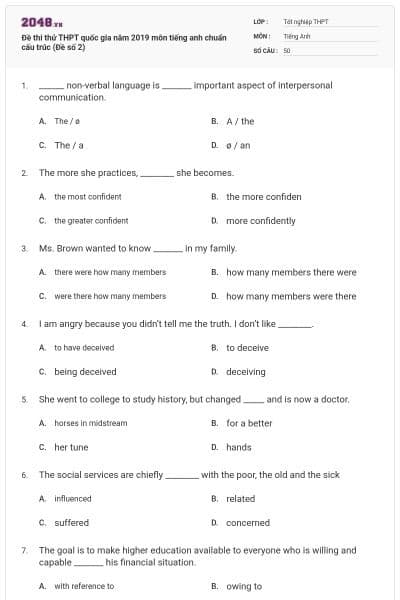
______ non-verbal language is _______ important aspect of interpersonal communication.
The / ø
A / the
The / a
ø / an
Đáp án D
Với non-verbal language không có mạo từ vì đây là một tập hợp rộng lớn, duy nhất, không dùng mạo từ.
Với important aspect dùng mạo từ không xác định vì đây là một danh từ chung bổ nghĩa cho chủ ngữ.
Dịch nghĩa: Ngôn ngữ phi ngôn từ là một lĩnh vực quan trọng trong giao tiếp giữa cá nhân.
The more she practices, ________ she becomes.
the most confident
the more confiden
the greater confident
more confidently
Đáp án B
So sánh kép (càng…càng)
The + comparative + S + V, the + comparative + S + V
Become + adj: trở nên như thế nào
Dịch nghĩa: Càng luyện tập nhiều, cô ấy càng tự tin hơn
Ms. Brown wanted to know _______ in my family.
there were how many members
how many members there were
were there how many members
how many members were there
Đáp án A
Câu gốc có thể là: “How many people are there in your family?” Ms.Brown asked me.
Khi chuyển về câu tường thuật, ta biến đổi nó thành một câu dạng trần thuật thông thường, từ được hỏi được chuyển ra sau và đồng thời lùi thì. Câu gốc dùng thì hiện tại đơn thì câu viết lại dùng quá khứ đơn.
Dịch nghĩa: Ms. Brown muốn biết nhà tôi có bao nhiêu người
I am angry because you didn’t tell me the truth. I don’t like ________.
to have deceived
to deceive
being deceived
deceiving
Đáp án C
(to) deceive (v): lừa dối, không cho ai đó biết sự thật
(to) be deceived: bị lừa dối
Theo nghĩa của câu, ta cần dạng bị động nên chọn C.
Dịch nghĩa: Tôi tức vì cậu không nói sự thật cho tôi biết. Tôi không thích bị lừa dối.
She went to college to study history, but changed _____ and is now a doctor.
horses in midstream
for a better
her tune
hands
Đáp án A
(to) change horse in midstream: thay ngựa giữa dòng (ý nói thay đổi giữa chừng)
Các đáp án còn lại:
B. (to) change for the better: cải thiện
C. (to) change one’s tune: đổi giọng, đổi thái độ
D. (to) change hands: đổi chủ
Dịch nghĩa: Cô ấy học chuyên ngành Lịch sử ở Đại học, nhưng rồi thay đổi giữa chừng và hiện tại đang là bác sĩ.
The social services are chiefly ________ with the poor, the old and the sick
influenced
related
suffered
concerned
Đáp án D
(to) concern with: bận tậm, quan tâm đến điều gì
Các đáp án còn lại không phù hợp:
A. (to) influence on: ảnh hưởng, tác động tới cái gì
B. (to) relate to: liên quan đến cái gì
C. (to) suffer from/with/for: chịu đựng cái gì
Dịch nghĩa: Công ích xã hội ngày nay phần lớn hướng đến người nghèo, già yếu và bệnh tật.
The goal is to make higher education available to everyone who is willing and capable _______ his financial situation.
with reference to
owing to
regardless of
in terms of
Đáp án C
Regardless of: Bất chấp, không kể, không quan tâm tới điều gì đó.
Các đáp án còn lại:
A. with reference to: Về vấn đề, có liên quan tới.
B. owing to = Because of = Due to: Bởi vì.
D. in terms of something; In something terms: Về mặt; dưới dạng.
Dịch nghĩa: Mục tiêu là đưa đến giáo dục bậc cao cho tất cả những ai muốn và có khả năng, bất kể tình hình tài chính của họ.
No sooner had we come back home than we got down _______ household chores.
to doing
to make
to do
to making
Đáp án A
(to) get down to sth/doing sth: bắt đầu bắt tay vào vào việc gì đó
(to) do household chores: làm việc nhà
Dịch nghĩa: Vừa về đến nơi chúng tôi đã làm việc nhà ngay.
Thanks to the _______ weather condition, Vietnam owns plentiful kinds of fruits and vegetables.
favorite
favorable
unfavorable
favored
Đáp án B
favorable (adj): dễ chịu, thuận lợi
Các đáp án còn lại:
A. favorite (adj): yêu thích
C. unfavorable (adj): không thuận lợi
D. favored (adj): được hưởng ân huệ
Dịch nghĩa: Nhờ thời tiết thuận lợi, Vietnam trồng được rất nhiều loại rau quả.
This house ______ some years ago, because it looks quite new.
is believed to build
was believed building
is believed to have been built
was believed to built
Đáp án C
Ngôi nhà được xây => dùng dạng bị động và đồng thời, do việc được xây đã xảy ra (vài năm trước) nên ta dùng have been built.
Dịch nghĩa: Ngôi nhà này được cho là mới được xây vài năm trước, vì nó trông còn khá mới.
After they have been _____ love for two years, they decide to get married.
in
for
with
on
Đáp án A
(to) be in love: yêu
Dịch nghĩa: Sau khi yêu nhau 2 năm, họ quyết định tiến tới hôn nhân
Housework is less tiring and boring thanks to the invention of ______ devices.
environment-friendly
time-consuming
labor-saving
pollution-free
Đáp án C
Labor-saving: tiết kiệm sức lao động
Các đáp án còn lại:
A. environment-friendly: thân thiện với môi trường
B. time-consuming: tốn thời gian
D. pollution-free: không ô nhiễm
Dịch nghĩa: Việc nhà đỡ mệt và chán hơn nhờ sự ra đời của các thiết bị tiết kiệm sức lao động.
Read the following passage and mark the letter A, B, C or D on your answer sheet to indicate the correct answer to each of the questions.
Sunlight is solar energy. Sunlight is needed for growing plants that you eat to get energy. Sunlight is also used to make clean electricity. Burning fossil fuels to make electricity pollutes our atmosphere and rivers. Fossil fuels are expensive and limited sources of energy. Nuclear fission is used to create enormous amount of heat and electricity. However, nuclear fission forms dangerous radioactive waste.
Sunlight offers many ways to get energy. A window can allow warm sunlight into your room. Solar water-heating systems can use sunlight to warm the water for your home, swimming pool and school. Sunlight also warms the Earth and causes wind. Electricity can be made by wind generators.
Photovoltaic, or PV system use a type of material that converts sunlight into electricity. PV systems can power your air conditioner or a satellite like the International Space Station. PV systems are also used to run a calculator, recharge cell phone, or even power lightweight cars.
Sunlight is also changed into electricity by concentrating solar power or CSP systems. CSP systems have mirrors that focus the sunlight. The concentrated sunlight turns water into steam which turns a turbine that is connected to an electric generator. A CSP system usually uses sunlight to make steam. CSP power plants can store large amount of heat. The stored heat is used to make electricity at night. During cloud days, many CSP plants can also burn natural gas to provide the heat that is used to turn water into steam.
Sunlight provides the energy needed to grow plants and make large amount of environmentally friendly heat and electricity. Solar energy can provide power today and for a long time in the future.
This article is mainly about _____
Human using sunlight to stay warm.
The need to develop new technology for solar power system.
How the energy of sunlight is used
How solar energy can provide power for transportation systems.
Đáp án C
Bài viết chủ yếu nói về ________
A. Con người dùng ánh sáng để giữ nhiệt.
B. Sự cần thiết cho việc phát triển công nghệ mới trong hệ thống quang năng.
C. Năng lượng mặt trời đang được dùng ra sao.
D. Năng lượng mặt trời dùng trong hệ thống giao thông vận tải.
Ánh sáng mặt trời và cách nó được dùng là chủ đề chính trong bài. Ta có thể thấy rõ công dụng của quang năng qua mỗi đoạn.
Các đáp án còn lại sai vì:
A. chỉ mới đề cập được một phần nhỏ, không phải ý chính
B. bài viết giới thiệu về các hệ thống chuyển đổi quang năng, nhưng không có ý nói chúng lạc hậu và cần phát triển công nghệ mới.
D. giao thông vận tải không được nhắc đến trong bài.
Read the following passage and mark the letter A, B, C or D on your answer sheet to indicate the correct answer to each of the questions.
Sunlight is solar energy. Sunlight is needed for growing plants that you eat to get energy. Sunlight is also used to make clean electricity. Burning fossil fuels to make electricity pollutes our atmosphere and rivers. Fossil fuels are expensive and limited sources of energy. Nuclear fission is used to create enormous amount of heat and electricity. However, nuclear fission forms dangerous radioactive waste.
Sunlight offers many ways to get energy. A window can allow warm sunlight into your room. Solar water-heating systems can use sunlight to warm the water for your home, swimming pool and school. Sunlight also warms the Earth and causes wind. Electricity can be made by wind generators.
Photovoltaic, or PV system use a type of material that converts sunlight into electricity. PV systems can power your air conditioner or a satellite like the International Space Station. PV systems are also used to run a calculator, recharge cell phone, or even power lightweight cars.
Sunlight is also changed into electricity by concentrating solar power or CSP systems. CSP systems have mirrors that focus the sunlight. The concentrated sunlight turns water into steam which turns a turbine that is connected to an electric generator. A CSP system usually uses sunlight to make steam. CSP power plants can store large amount of heat. The stored heat is used to make electricity at night. During cloud days, many CSP plants can also burn natural gas to provide the heat that is used to turn water into steam.
Sunlight provides the energy needed to grow plants and make large amount of environmentally friendly heat and electricity. Solar energy can provide power today and for a long time in the future.
In the first paragraph, the word “fossil fuels” in line 2 means ________
fuels formed millions of years from the remains of animals and plants
nuclear energy
solar powe
fuel formed from the energy of the wind
Đáp án A
Trong đoạn đầu tiên, từ “fossil fuels” dòng 2 mang nghĩa ______
A. chất đốt được hình thành qua hàng triệu năm từ phần còn lại của động thực vật
B. năng lượng nguyên tử
C. năng lượng mặt trời
D. chất đốt có từ năng lượng gió
Fossil fuels (n): nhiên liệu hoá thạch = fuels formed millions of years from the remains of animals and plants
Read the following passage and mark the letter A, B, C or D on your answer sheet to indicate the correct answer to each of the questions.
Sunlight is solar energy. Sunlight is needed for growing plants that you eat to get energy. Sunlight is also used to make clean electricity. Burning fossil fuels to make electricity pollutes our atmosphere and rivers. Fossil fuels are expensive and limited sources of energy. Nuclear fission is used to create enormous amount of heat and electricity. However, nuclear fission forms dangerous radioactive waste.
Sunlight offers many ways to get energy. A window can allow warm sunlight into your room. Solar water-heating systems can use sunlight to warm the water for your home, swimming pool and school. Sunlight also warms the Earth and causes wind. Electricity can be made by wind generators.
Photovoltaic, or PV system use a type of material that converts sunlight into electricity. PV systems can power your air conditioner or a satellite like the International Space Station. PV systems are also used to run a calculator, recharge cell phone, or even power lightweight cars.
Sunlight is also changed into electricity by concentrating solar power or CSP systems. CSP systems have mirrors that focus the sunlight. The concentrated sunlight turns water into steam which turns a turbine that is connected to an electric generator. A CSP system usually uses sunlight to make steam. CSP power plants can store large amount of heat. The stored heat is used to make electricity at night. During cloud days, many CSP plants can also burn natural gas to provide the heat that is used to turn water into steam.
Sunlight provides the energy needed to grow plants and make large amount of environmentally friendly heat and electricity. Solar energy can provide power today and for a long time in the future.
The drawback of nuclear fission is that ________
it sends out energy in the form of rays that can be harmful.
it is costly.
it releases smoke.
it is time-consuming to be formed.
Đáp án A
Hạn chế của hạt nhân nguyên tử là _______
A. nó truyền ra năng lượng dưới dạng các tia độc hại.
B. nó tốn kém.
C. nó thải ra khói.
D. nó mất nhiều thời gian để hình thành
Câu cuối đoạn 1: “However, nuclear fission forms dangerous radioactive waste.”
(Tuy nhiên, hạt nhân thải ra các tia phóng xạ độc hại.)
Read the following passage and mark the letter A, B, C or D on your answer sheet to indicate the correct answer to each of the questions.
Sunlight is solar energy. Sunlight is needed for growing plants that you eat to get energy. Sunlight is also used to make clean electricity. Burning fossil fuels to make electricity pollutes our atmosphere and rivers. Fossil fuels are expensive and limited sources of energy. Nuclear fission is used to create enormous amount of heat and electricity. However, nuclear fission forms dangerous radioactive waste.
Sunlight offers many ways to get energy. A window can allow warm sunlight into your room. Solar water-heating systems can use sunlight to warm the water for your home, swimming pool and school. Sunlight also warms the Earth and causes wind. Electricity can be made by wind generators.
Photovoltaic, or PV system use a type of material that converts sunlight into electricity. PV systems can power your air conditioner or a satellite like the International Space Station. PV systems are also used to run a calculator, recharge cell phone, or even power lightweight cars.
Sunlight is also changed into electricity by concentrating solar power or CSP systems. CSP systems have mirrors that focus the sunlight. The concentrated sunlight turns water into steam which turns a turbine that is connected to an electric generator. A CSP system usually uses sunlight to make steam. CSP power plants can store large amount of heat. The stored heat is used to make electricity at night. During cloud days, many CSP plants can also burn natural gas to provide the heat that is used to turn water into steam.
Sunlight provides the energy needed to grow plants and make large amount of environmentally friendly heat and electricity. Solar energy can provide power today and for a long time in the future.
To help the readers understand some of the benefits of solar energy, the author ________
provides a list of solar energy projects.
lists in chronological order the invention of various systems that gather the energy of sunlight
describes in detail how a PV system works.
briefly compares and contrasts the differences in using fossil fuels, nuclear fission and solar energy in electric power systems
Đáp án D
Để giúp độc giả hiểu về ích lợi của năng lượng mặt trời, tác giả ______
A. liệt kê một loạt dự án quang năng.
B. liệt kê theo thứ tự ra đời của các hệ thống tập hợp năng lượng mặt trời.
C. mô tả chi tiết quy trình của hệ thống PV.
D. so sánh ngắn gọn và tương phản sự khác biệt trong việc dùng nhiên liệu hoá thạch, hạt nhân nguyên tử và năng lượng mặt trời trong hệ thống điện năng.
Trong đoạn 1, tác giả đưa ra sự so sánh và tương phản ngắn gọn về các dang năng lượng, nêu lên tác dụng và hạn chế của chúng, từ đó làm bật lên lợi ích của năng lượng mặt trờ
Read the following passage and mark the letter A, B, C or D on your answer sheet to indicate the correct answer to each of the questions.
Sunlight is solar energy. Sunlight is needed for growing plants that you eat to get energy. Sunlight is also used to make clean electricity. Burning fossil fuels to make electricity pollutes our atmosphere and rivers. Fossil fuels are expensive and limited sources of energy. Nuclear fission is used to create enormous amount of heat and electricity. However, nuclear fission forms dangerous radioactive waste.
Sunlight offers many ways to get energy. A window can allow warm sunlight into your room. Solar water-heating systems can use sunlight to warm the water for your home, swimming pool and school. Sunlight also warms the Earth and causes wind. Electricity can be made by wind generators.
Photovoltaic, or PV system use a type of material that converts sunlight into electricity. PV systems can power your air conditioner or a satellite like the International Space Station. PV systems are also used to run a calculator, recharge cell phone, or even power lightweight cars.
Sunlight is also changed into electricity by concentrating solar power or CSP systems. CSP systems have mirrors that focus the sunlight. The concentrated sunlight turns water into steam which turns a turbine that is connected to an electric generator. A CSP system usually uses sunlight to make steam. CSP power plants can store large amount of heat. The stored heat is used to make electricity at night. During cloud days, many CSP plants can also burn natural gas to provide the heat that is used to turn water into steam.
Sunlight provides the energy needed to grow plants and make large amount of environmentally friendly heat and electricity. Solar energy can provide power today and for a long time in the future.
Which of the following statements is NOT true?
Fossil fuel supplies are unlimited.
Solar energy is the energy that comes from the sun.
PV systems provide electricity for the International Space Station
A CSP power plant can produce steam even at night.
Đáp án A
Phát biểu nào sau đây không đúng?
A. Nguồn nhiên liệu hoá thạch là vô hạn.
B. Quang năng là năng lượng từ mặt trời.
C. Hệ thống PV cung cấp nguồn điện cho Trạm vũ trụ quốc tế.
D. Cột năng lượng CSP có thể tạo hơi nước vào ban đêm.
Ta có: “Fossil fuels are expensive and limited sources of energy.” (Nhiên liệu hoá thạch đắt và có hạn.)
Read the following passage and mark the letter A, B, C or D on your answer sheet to indicate the correct answer to each of the questions.
Sunlight is solar energy. Sunlight is needed for growing plants that you eat to get energy. Sunlight is also used to make clean electricity. Burning fossil fuels to make electricity pollutes our atmosphere and rivers. Fossil fuels are expensive and limited sources of energy. Nuclear fission is used to create enormous amount of heat and electricity. However, nuclear fission forms dangerous radioactive waste.
Sunlight offers many ways to get energy. A window can allow warm sunlight into your room. Solar water-heating systems can use sunlight to warm the water for your home, swimming pool and school. Sunlight also warms the Earth and causes wind. Electricity can be made by wind generators.
Photovoltaic, or PV system use a type of material that converts sunlight into electricity. PV systems can power your air conditioner or a satellite like the International Space Station. PV systems are also used to run a calculator, recharge cell phone, or even power lightweight cars.
Sunlight is also changed into electricity by concentrating solar power or CSP systems. CSP systems have mirrors that focus the sunlight. The concentrated sunlight turns water into steam which turns a turbine that is connected to an electric generator. A CSP system usually uses sunlight to make steam. CSP power plants can store large amount of heat. The stored heat is used to make electricity at night. During cloud days, many CSP plants can also burn natural gas to provide the heat that is used to turn water into steam.
Sunlight provides the energy needed to grow plants and make large amount of environmentally friendly heat and electricity. Solar energy can provide power today and for a long time in the future.
In the third paragraph, the word “convert” is closest in meaning to _______
change form one religion to another
transform
exchange for something equal in value
converse
Đáp án B
Trong đoạn 3, từ “convert” gần nghĩa nhất với________
A. thay đổi hình thức một tôn giáo
B. thay đổi, cải biến
C. đổi sang thứ gì đó có giá trị tương đương
D. nói chuyện (to) convert = (to) transform: thay đổi, biến đổi
Read the following passage and mark the letter A, B, C or D on your answer sheet to indicate the correct answer to each of the questions.
Sunlight is solar energy. Sunlight is needed for growing plants that you eat to get energy. Sunlight is also used to make clean electricity. Burning fossil fuels to make electricity pollutes our atmosphere and rivers. Fossil fuels are expensive and limited sources of energy. Nuclear fission is used to create enormous amount of heat and electricity. However, nuclear fission forms dangerous radioactive waste.
Sunlight offers many ways to get energy. A window can allow warm sunlight into your room. Solar water-heating systems can use sunlight to warm the water for your home, swimming pool and school. Sunlight also warms the Earth and causes wind. Electricity can be made by wind generators.
Photovoltaic, or PV system use a type of material that converts sunlight into electricity. PV systems can power your air conditioner or a satellite like the International Space Station. PV systems are also used to run a calculator, recharge cell phone, or even power lightweight cars.
Sunlight is also changed into electricity by concentrating solar power or CSP systems. CSP systems have mirrors that focus the sunlight. The concentrated sunlight turns water into steam which turns a turbine that is connected to an electric generator. A CSP system usually uses sunlight to make steam. CSP power plants can store large amount of heat. The stored heat is used to make electricity at night. During cloud days, many CSP plants can also burn natural gas to provide the heat that is used to turn water into steam.
Sunlight provides the energy needed to grow plants and make large amount of environmentally friendly heat and electricity. Solar energy can provide power today and for a long time in the future.
In the fourth paragraph, the word “which” refers to _______
water
steam
sunlight
solar power
Đáp án B
Trong đoạn 4, từ “which” nói đến ________
A. nước
B. hơi nước
C. ánh sáng mặt trời
D. năng lượng mặt trời
“The concentrated sunlight turns water into steam which turns a turbine that is connected to an electric generator.”
(Ánh sáng được tập trung chuyển nước từ dạng lỏng sang dạng hơi – làm xoay tuabin được nối với máy phát điện.)
Thứ làm xoay tuabin chính là hơi nước – steam.
. - Huong: “That millions of people attended General Vo Nguyen Giap’s funeral made a special impression on almost every foreigner.”
- Lan: “___________.”
My pleasure
Me neither
I’m afraid I can’t
I’ll say
Đáp án D
I’ll say là thành ngữ, thể hiện sự đồng ý, đồng quan điểm.
- Hương: “Hàng triệu người dự lễ tang Đại tường Võ Nguyên Giáp đã khiến hầu hết người ngoại quốc rất ấn tượng.”
- Lan: “Tôi cũng nghĩ vậy.”
Các đáp án còn lại:
A. Đó là vinh dự của tôi
B. Tôi cũng không
C. Tôi e là mình không thể
- David: “Your parents must be proud of your result at school.”
- Kathy: “_________.”
Sorry to hear that
I am glad you like it
Thanks. It’s certainly encouraging
Of course
Đáp án C
- David: “Bố mẹ cậu hẳn rất tự hào vì thành tích ở trường của cậu.”
- Kathy: “Cảm ơn. Thật sự rất khích lệ.”
Các đáp án còn lại:
A. Thật tiếc khi được biết
B. Tôi mừng vì cậu thích nó
D. Tất nhiên rồi
Mark the letter A, B, C or D on your answer sheet to indicate the word(s) CLOSEST in meaning to the underlined word(s) in each of the following questions.
I strongly recommend that you should take out an insurance policy in the house for your own peace of mind.
to stop your sleeping
to stop your worrying
to stop your thinking
to stop your believing
Đáp án B
Peace of mind: cảm giác yên tâm, không lo lắng
For one’s own peace of mind = to stop your worrying: khỏi bận tâm, lo lắng Các đáp án còn lại:
A. ngừng ngủ
C. ngừng suy nghĩ
D. ngừng tin tưởng
Dịch nghĩa: Tôi chân thành khuyên cậu nên mua bảo hiểm căn hộ để khỏi thêm lo lắng.
Mark the letter A, B, C or D on your answer sheet to indicate the word(s) CLOSEST in meaning to the underlined word(s) in each of the following questions.
Every year this charity organization takes on volunteers to support the needy and the poor.
dismisses
creates
recruits
interviews
Đáp án C
(to) take on = (to) recruit: chiêu mộ, tuyển thêm người mới
Các đáp án còn lại:
A. (to) dismiss (v): giải tán, đuổi, sa thải
B. (to) create (v): tạo nên
D. (to) interview (v): phỏng vấn
Dịch nghĩa: Mỗi năm tổ chức tình nguyện này lại tuyển thêm tình nguyện viên mới để giúp đỡ người nghèo khó.
Read the following passage and mark the letter A, B, C or D on your answer sheet to indicate the correct answer to each of the questions.
In most discussions of cultural diversity, attention has focused on visible, explicit aspects of culture, such as language, dress, food, religion, music, and social rituals. Although they are important, these visible expressions of culture, which are taught deliberately and learned consciously, are only the tip of the iceberg of culture. Much of culture is taught and learned implicitly, or outside awareness. Thus, neither cultural insiders nor cultural outsiders are aware that certain “invisible” aspects of their culture exist.
Invisible elements of culture are important to us. For example, how long we can be late before being impolite, what topics we should avoid in a conversation, how we show interest or attention through listening behaviour, what we consider beautiful or ugly- these are all aspects of culture that we learn and use without being aware of it. When we meet other people whose invisible cultural assumptions differ from those we have learned implicitly, we usually do not recognize their behaviour as cultural in origin.
Differences in invisible culture can cause problems in cross-cultural relations. Conflicts may arise when we are unable to recognize others’ behavioural differences as cultural rather than personal. We tend to misinterpret other people’s behaviour, blame them, or judge their intentions or competence without realizing that we are experiencing cultural rather than individual differences.
Formal organizations and institutions, such as schools, hospitals, workplaces, governments, and the legal system are collection sites for invisible cultural differences. If the differences were more visible, we might have less misunderstanding. For example, if we met a man in a courthouse who was wearing exotic clothes, speaking a language other than ours, and carrying food that looked strange, we would not assume that we understood his thoughts and feelings or that he understood ours. Yet when such a man is dressed similarly to us, speaks our language, and does not differ from us in other obvious ways, we may fail to recognize the invisible cultural differences between us. As a result, mutual misunderstanding may arise.
What is the main purpose of the passage?
To point out that much of culture is learned consciously.
To describe cultural diversity.
To explain the importance of invisible aspects of culture.
To explain why cross-cultural conflict occurs.
Đáp án C
Mục đích chính của đoạn văn là gì?
A. Chỉ ra rằng phần đa văn hoá được chủ tâm tiếp thu.
B. Mô tả sự đa dạng văn hoá.
C. Giải thích tầm quan trọng của các khía cạnh vô hình trong văn hoá.
D. Giải thích tại sao mâu thuẫn văn hoá xảy ra.
Trong đoạn 1, tác giả giới thiệu về những khía cạnh vô hình trong văn hoá và từ đoạn 2 với câu chủ đề: “Invisible elements of culture are important to us.” tác giả đi sâu vào giải thích tầm quan trọng của chúng, đồng thời đưa ra những ví dụ, dẫn chứng để chứng minh luận điểm của mình
Read the following passage and mark the letter A, B, C or D on your answer sheet to indicate the correct answer to each of the questions.
In most discussions of cultural diversity, attention has focused on visible, explicit aspects of culture, such as language, dress, food, religion, music, and social rituals. Although they are important, these visible expressions of culture, which are taught deliberately and learned consciously, are only the tip of the iceberg of culture. Much of culture is taught and learned implicitly, or outside awareness. Thus, neither cultural insiders nor cultural outsiders are aware that certain “invisible” aspects of their culture exist.
Invisible elements of culture are important to us. For example, how long we can be late before being impolite, what topics we should avoid in a conversation, how we show interest or attention through listening behaviour, what we consider beautiful or ugly- these are all aspects of culture that we learn and use without being aware of it. When we meet other people whose invisible cultural assumptions differ from those we have learned implicitly, we usually do not recognize their behaviour as cultural in origin.
Differences in invisible culture can cause problems in cross-cultural relations. Conflicts may arise when we are unable to recognize others’ behavioural differences as cultural rather than personal. We tend to misinterpret other people’s behaviour, blame them, or judge their intentions or competence without realizing that we are experiencing cultural rather than individual differences.
Formal organizations and institutions, such as schools, hospitals, workplaces, governments, and the legal system are collection sites for invisible cultural differences. If the differences were more visible, we might have less misunderstanding. For example, if we met a man in a courthouse who was wearing exotic clothes, speaking a language other than ours, and carrying food that looked strange, we would not assume that we understood his thoughts and feelings or that he understood ours. Yet when such a man is dressed similarly to us, speaks our language, and does not differ from us in other obvious ways, we may fail to recognize the invisible cultural differences between us. As a result, mutual misunderstanding may arise.
The word “deliberately” in bold in paragraph 1 is closest in meaning to _______.
slowly
accurately
intentionally
randomly
Đáp án C
Từ “deliberately” in đậm trong đoạn 1 gần nghĩa nhất với _________
A. chậm, từ từ
B. chính xác
C. có chủ ý
D. ngẫu nhiên
Deliberately = intentionally (adv): chủ tâm, có chủ ý từ trước
Read the following passage and mark the letter A, B, C or D on your answer sheet to indicate the correct answer to each of the questions.
In most discussions of cultural diversity, attention has focused on visible, explicit aspects of culture, such as language, dress, food, religion, music, and social rituals. Although they are important, these visible expressions of culture, which are taught deliberately and learned consciously, are only the tip of the iceberg of culture. Much of culture is taught and learned implicitly, or outside awareness. Thus, neither cultural insiders nor cultural outsiders are aware that certain “invisible” aspects of their culture exist.
Invisible elements of culture are important to us. For example, how long we can be late before being impolite, what topics we should avoid in a conversation, how we show interest or attention through listening behaviour, what we consider beautiful or ugly- these are all aspects of culture that we learn and use without being aware of it. When we meet other people whose invisible cultural assumptions differ from those we have learned implicitly, we usually do not recognize their behaviour as cultural in origin.
Differences in invisible culture can cause problems in cross-cultural relations. Conflicts may arise when we are unable to recognize others’ behavioural differences as cultural rather than personal. We tend to misinterpret other people’s behaviour, blame them, or judge their intentions or competence without realizing that we are experiencing cultural rather than individual differences.
Formal organizations and institutions, such as schools, hospitals, workplaces, governments, and the legal system are collection sites for invisible cultural differences. If the differences were more visible, we might have less misunderstanding. For example, if we met a man in a courthouse who was wearing exotic clothes, speaking a language other than ours, and carrying food that looked strange, we would not assume that we understood his thoughts and feelings or that he understood ours. Yet when such a man is dressed similarly to us, speaks our language, and does not differ from us in other obvious ways, we may fail to recognize the invisible cultural differences between us. As a result, mutual misunderstanding may arise.
The phrase “the tip of the iceberg” in paragraph 1 means that ___________.
most aspects of culture cannot be seen
we usually focus on the highest forms of culture
other cultures seem cold to us
visible aspects of culture are learned in formal institutions
Đáp án A
Cụm “the tip of the iceberg” trong đoạn 1 có nghĩa ______
A. phần lớn khía cạnh văn hoá không thể nhìn thấy
B. chúng ta thường chỉ chú trọng hình thức tối cao của văn hoá
C. các văn hoá khác có vẻ xa cách, lạnh lung với chúng ta
D. các khía cạnh bề nổi được tiếp thu qua các cơ quan chính quy
The tip of the iceberg: phần nổi tảng băng trôi.
Nguyên lý này nói đến những thứ ta dễ nhận thấy được chỉ là phần nổi của một sự vật, sự việc. Còn phần lớn hơn, quan trọng hơn lại là phần chìm, không nhận thấy được.
Tác giả có ý muốn nói phần lớn khía cạnh văn hoá là phần chìm mà ta không nhận thấy được.
Read the following passage and mark the letter A, B, C or D on your answer sheet to indicate the correct answer to each of the questions.
In most discussions of cultural diversity, attention has focused on visible, explicit aspects of culture, such as language, dress, food, religion, music, and social rituals. Although they are important, these visible expressions of culture, which are taught deliberately and learned consciously, are only the tip of the iceberg of culture. Much of culture is taught and learned implicitly, or outside awareness. Thus, neither cultural insiders nor cultural outsiders are aware that certain “invisible” aspects of their culture exist.
Invisible elements of culture are important to us. For example, how long we can be late before being impolite, what topics we should avoid in a conversation, how we show interest or attention through listening behaviour, what we consider beautiful or ugly- these are all aspects of culture that we learn and use without being aware of it. When we meet other people whose invisible cultural assumptions differ from those we have learned implicitly, we usually do not recognize their behaviour as cultural in origin.
Differences in invisible culture can cause problems in cross-cultural relations. Conflicts may arise when we are unable to recognize others’ behavioural differences as cultural rather than personal. We tend to misinterpret other people’s behaviour, blame them, or judge their intentions or competence without realizing that we are experiencing cultural rather than individual differences.
Formal organizations and institutions, such as schools, hospitals, workplaces, governments, and the legal system are collection sites for invisible cultural differences. If the differences were more visible, we might have less misunderstanding. For example, if we met a man in a courthouse who was wearing exotic clothes, speaking a language other than ours, and carrying food that looked strange, we would not assume that we understood his thoughts and feelings or that he understood ours. Yet when such a man is dressed similarly to us, speaks our language, and does not differ from us in other obvious ways, we may fail to recognize the invisible cultural differences between us. As a result, mutual misunderstanding may arise.
Which of the following was NOT mentioned as an example of invisible culture?
How people express interest in what others are saying
How late is considered impolite
What topics to avoid in conversation
What food to eat in a courthouse
Đáp án D
Điều nào sau đây không được đề cập đến như một ví dụ về văn hoá vô hình?
A. Cách người ta thể hiện sự hứng thú với điều người khác nói.
B. Muộn bao lâu thì bị coi là bất lịch sự.
C. Chủ đề nào nên tránh trong các cuộc trò chuyện.
D. Đồ ăn nào nên ăn trong toà án.
Câu 2 đoạn 2: “For example, how long we can be late before being impolite, what topics we should avoid in a conversation, how we show interest or attention through listening behavior…”
Như vậy dễ thấy cả A, B, C đều được đề cập. Chỉ có D sai
Read the following passage and mark the letter A, B, C or D on your answer sheet to indicate the correct answer to each of the questions.
In most discussions of cultural diversity, attention has focused on visible, explicit aspects of culture, such as language, dress, food, religion, music, and social rituals. Although they are important, these visible expressions of culture, which are taught deliberately and learned consciously, are only the tip of the iceberg of culture. Much of culture is taught and learned implicitly, or outside awareness. Thus, neither cultural insiders nor cultural outsiders are aware that certain “invisible” aspects of their culture exist.
Invisible elements of culture are important to us. For example, how long we can be late before being impolite, what topics we should avoid in a conversation, how we show interest or attention through listening behaviour, what we consider beautiful or ugly- these are all aspects of culture that we learn and use without being aware of it. When we meet other people whose invisible cultural assumptions differ from those we have learned implicitly, we usually do not recognize their behaviour as cultural in origin.
Differences in invisible culture can cause problems in cross-cultural relations. Conflicts may arise when we are unable to recognize others’ behavioural differences as cultural rather than personal. We tend to misinterpret other people’s behaviour, blame them, or judge their intentions or competence without realizing that we are experiencing cultural rather than individual differences.
Formal organizations and institutions, such as schools, hospitals, workplaces, governments, and the legal system are collection sites for invisible cultural differences. If the differences were more visible, we might have less misunderstanding. For example, if we met a man in a courthouse who was wearing exotic clothes, speaking a language other than ours, and carrying food that looked strange, we would not assume that we understood his thoughts and feelings or that he understood ours. Yet when such a man is dressed similarly to us, speaks our language, and does not differ from us in other obvious ways, we may fail to recognize the invisible cultural differences between us. As a result, mutual misunderstanding may arise.
The word “those” in paragraph 2 refers to__________.
invisible cultural assumptions
people from a different culture
topics that should be avoided in conversation
people who speak a different language
Đáp án A
Từ “those” ở đoạn 2 nói đến _________
A. quan niệm văn hoá vô hình
B. những người từ nền văn hoá khác
C. chủ đề nên tránh khi trò chuyện
D. người nói ngôn ngữ khác
“When we meet other people whose invisible cultural assumptions differ from those we have learned implicitly, we usually do not recognize their behaviour as cultural in origin.”
(Khi gặp người có quan niệm văn hoá vô hình khác những gì mình quan niệm, ta thường không xem hành vi của họ là thứ thuộc về văn hoá.)
Như vậy those là thay thế cho cụm invisible cultural assumptions.
Read the following passage and mark the letter A, B, C or D on your answer sheet to indicate the correct answer to each of the questions.
In most discussions of cultural diversity, attention has focused on visible, explicit aspects of culture, such as language, dress, food, religion, music, and social rituals. Although they are important, these visible expressions of culture, which are taught deliberately and learned consciously, are only the tip of the iceberg of culture. Much of culture is taught and learned implicitly, or outside awareness. Thus, neither cultural insiders nor cultural outsiders are aware that certain “invisible” aspects of their culture exist.
Invisible elements of culture are important to us. For example, how long we can be late before being impolite, what topics we should avoid in a conversation, how we show interest or attention through listening behaviour, what we consider beautiful or ugly- these are all aspects of culture that we learn and use without being aware of it. When we meet other people whose invisible cultural assumptions differ from those we have learned implicitly, we usually do not recognize their behaviour as cultural in origin.
Differences in invisible culture can cause problems in cross-cultural relations. Conflicts may arise when we are unable to recognize others’ behavioural differences as cultural rather than personal. We tend to misinterpret other people’s behaviour, blame them, or judge their intentions or competence without realizing that we are experiencing cultural rather than individual differences.
Formal organizations and institutions, such as schools, hospitals, workplaces, governments, and the legal system are collection sites for invisible cultural differences. If the differences were more visible, we might have less misunderstanding. For example, if we met a man in a courthouse who was wearing exotic clothes, speaking a language other than ours, and carrying food that looked strange, we would not assume that we understood his thoughts and feelings or that he understood ours. Yet when such a man is dressed similarly to us, speaks our language, and does not differ from us in other obvious ways, we may fail to recognize the invisible cultural differences between us. As a result, mutual misunderstanding may arise.
It can be inferred from paragraph 3 that conflict results when ___________.
one culture is more invisible than another culture
people compete with those from other cultures
some people recognize more cultural differences than others
people think cultural differences are personal
Đáp án D
Có thể suy ra từ đoạn 3 rằng mâu thuẫn xảy ra khi___________
A. văn hoá này khó nhận biết hơn văn hoá kia
B. người ta ganh đua với người từ nền văn hoá khác
C. vài người nhận biết nhiều khác biệt trong văn hoá hơn người khác
D. người ta đánh đồng khác biệt văn hoá với khác biệt quan điểm cá nhân
Câu 2 đoạn 3: “Conflicts may arise when we are unable to recognize others’ behavioural differences as cultural rather than personal.”
(Mâu thuẫn có thể xảy ra khi chúng ta không xem khác biệt trong cách hành xử của người khác như một đặc tính về văn hoá mà coi nó như vấn đề cá nhân.)
Read the following passage and mark the letter A, B, C or D on your answer sheet to indicate the correct answer to each of the questions.
In most discussions of cultural diversity, attention has focused on visible, explicit aspects of culture, such as language, dress, food, religion, music, and social rituals. Although they are important, these visible expressions of culture, which are taught deliberately and learned consciously, are only the tip of the iceberg of culture. Much of culture is taught and learned implicitly, or outside awareness. Thus, neither cultural insiders nor cultural outsiders are aware that certain “invisible” aspects of their culture exist.
Invisible elements of culture are important to us. For example, how long we can be late before being impolite, what topics we should avoid in a conversation, how we show interest or attention through listening behaviour, what we consider beautiful or ugly- these are all aspects of culture that we learn and use without being aware of it. When we meet other people whose invisible cultural assumptions differ from those we have learned implicitly, we usually do not recognize their behaviour as cultural in origin.
Differences in invisible culture can cause problems in cross-cultural relations. Conflicts may arise when we are unable to recognize others’ behavioural differences as cultural rather than personal. We tend to misinterpret other people’s behaviour, blame them, or judge their intentions or competence without realizing that we are experiencing cultural rather than individual differences.
Formal organizations and institutions, such as schools, hospitals, workplaces, governments, and the legal system are collection sites for invisible cultural differences. If the differences were more visible, we might have less misunderstanding. For example, if we met a man in a courthouse who was wearing exotic clothes, speaking a language other than ours, and carrying food that looked strange, we would not assume that we understood his thoughts and feelings or that he understood ours. Yet when such a man is dressed similarly to us, speaks our language, and does not differ from us in other obvious ways, we may fail to recognize the invisible cultural differences between us. As a result, mutual misunderstanding may arise.
The author implies that institutions such as schools and workplaces ________.
reinforce invisible cultural differences
are aware of cultural differences
share a common culture
teach their employees about cultural differences
Đáp án A
Tác giả nói rằng những nơi như trường học hay cơ quan làm việc ________.
A. củng cố khác biệt vô hình trong văn hoá
B. nhận biết được khác biệt văn hoá
C. cùng có chung một văn hoá
D. dạy cho nhân viên về khác biệt văn hoá
Câu đầu đoạn cuối: “Formal organizations and institutions, such as schools, hospitals, workplaces, governments, and the legal system are collection sites for invisible cultural differences.”
(Các cơ quan tổ chức chính quy như trường học, bệnh viện, cơ quan làm việc, chính phủ và hệ thống pháp lý là nơi quy tụ những khác biệt vô hình trong văn hoá.)
Read the following passage and mark the letter A, B, C or D on your answer sheet to indicate the correct answer to each of the questions.
In most discussions of cultural diversity, attention has focused on visible, explicit aspects of culture, such as language, dress, food, religion, music, and social rituals. Although they are important, these visible expressions of culture, which are taught deliberately and learned consciously, are only the tip of the iceberg of culture. Much of culture is taught and learned implicitly, or outside awareness. Thus, neither cultural insiders nor cultural outsiders are aware that certain “invisible” aspects of their culture exist.
Invisible elements of culture are important to us. For example, how long we can be late before being impolite, what topics we should avoid in a conversation, how we show interest or attention through listening behaviour, what we consider beautiful or ugly- these are all aspects of culture that we learn and use without being aware of it. When we meet other people whose invisible cultural assumptions differ from those we have learned implicitly, we usually do not recognize their behaviour as cultural in origin.
Differences in invisible culture can cause problems in cross-cultural relations. Conflicts may arise when we are unable to recognize others’ behavioural differences as cultural rather than personal. We tend to misinterpret other people’s behaviour, blame them, or judge their intentions or competence without realizing that we are experiencing cultural rather than individual differences.
Formal organizations and institutions, such as schools, hospitals, workplaces, governments, and the legal system are collection sites for invisible cultural differences. If the differences were more visible, we might have less misunderstanding. For example, if we met a man in a courthouse who was wearing exotic clothes, speaking a language other than ours, and carrying food that looked strange, we would not assume that we understood his thoughts and feelings or that he understood ours. Yet when such a man is dressed similarly to us, speaks our language, and does not differ from us in other obvious ways, we may fail to recognize the invisible cultural differences between us. As a result, mutual misunderstanding may arise.
Which of the following would most likely result in misunderstanding?
Strange behaviour from someone speaking a foreign language
Learning about our own culture in school
Strange behaviour from someone speaking our language
Unusual food being cooked by foreign visitors
Đáp án C
Điều nào sau đây dễ có khả năng gây hiểu nhầm nhất?
A. Hành vi kì lạ từ ai đó nói ngôn ngữ khác mình.
B. Học về văn hoá của mình tại trường học.
C. Hành vi kì lạ từ ai đó nói chung ngôn ngữ.
D. Thức ăn lạ miệng được nấu bởi du khách nước ngoài.
Đoạn cuối bài viết: “If the differences were more visible, we might have less misunderstanding. For example, if we met a man in a courthouse who was wearing exotic clothes, speaking a language other than ours, and carrying food that looked strange, we would not assume that we understood his thoughts and feelings or that he understood ours. Yet when such a man is dressed similarly to us, speaks our language, and does not differ from us in other obvious ways, we may fail to recognize the invisible cultural differences between us. As a result, mutual misunderstanding may arise.”
Ý chính: Khi sự khác biệt rõ ràng ngay từ đầu chúng ta ít hiểu nhầm hơn. Ví dụ một người có bề ngoài khác mình, nói ngôn ngữ khác mình thì ta sẽ không cho là mình hiểu được anh ta hay anh ta hiểu được mình. Nhưng nếu một người vẻ ngoài có vẻ không khác, lại nói chung ngôn ngữ thì ta sẽ cho rằng mình hiểu được anh ta. Tuy nhiên, quan niệm mới là cái quyết định hành vi, do đó dù cho vẻ ngoài giống nhưng quan niệm vô hình lại khác biệt thì mâu thuẫn từ đó sẽ dễ dàng xảy ra
Mark the letter A, B, C or D on your answer sheet to indicate the sentence that is OPPOSITE in meaning to each of the following questions.
I must have a watch since punctuality is imperative in my new job.
being on time
being cheerful
being efficient
being late
Đáp án D
Giải nghĩa: punctuality (n) sự đúng giờ >< being late: trễ giờ
Các đáp án còn lại:
A. being courteous: lịch sự, nhã nhặn
B. being cheerful: vui mừng, hoan hỉ
C. being efficient: năng suất
Dịch nghĩa: Tôi nhất định phải mua đồng hồ, vì công việc mới này rất quan trọng việc đúng giờ giấc.
Mark the letter A, B, C or D on your answer sheet to indicate the sentence that is OPPOSITE in meaning to each of the following questions.
It’s discourteous to ask Americans questions about their age, marriage or income.
impolite
polite
unacceptable
rude
Đáp án B
Giải nghĩa: discourteous = impolite = rude (adj): bất nhã, thô lỗ >< polite (adj): lịch sự, nhã nhặn
Các đáp án còn lại:
C. unacceptable (adj): không thể chấp nhận được
Dịch nghĩa: Việc hỏi người Mỹ về tuổi, hôn nhân hay thu nhập là rất bất lịch sự.
Mark the letter A, B, C or D on your answer sheet to indicate the sentence that is CLOSEST in meaning to each of the following questions.
“Why don’t you participate in the volunteer work in summer?” said Sophie.
Sophie suggested my participating in the volunteer work in summer.
Sophie made me participate in the volunteer work in summer.
Sophie asked me why not participate in the volunteer work in summer.
Sophie suggested me to participate in the volunteer work in summer.
Đáp án A
“Sao cậu không tham gia tình nguyện đợt hè này nhỉ?” Sophie nói.
= Sophie gợi ý tôi nên tham gia tình nguyện đợt hè này.
Cấu trúc Why don’t you… là lời gợi ý, đề nghị.
Các đáp án còn lại:
B. Sophie bắt tôi tham gia tình nguyện đợt hè này.
C. Sophie hỏi tôi tại sao không tham gia tình nguyện đợt hè này.
D. Sophie gợi ý tôi nên tham gia tình nguyện đợt hè này.
Câu D tương đương về mặt nghĩa nhưng sai cấu trúc ngữ pháp.
S + suggest + (that) + someone + (should) + V-inf
Mark the letter A, B, C or D on your answer sheet to indicate the sentence that is CLOSEST in meaning to each of the following questions.
If it hadn’t been for his carelessness, we would have finished the work.
He was careless because he hadn’t finished the work.
If he were careful, we would finish the work.
If he had been more careful, we would have completed the work.
Because he wasn’t careless, we didn’t finish the work
Đáp án C
Nếu không phải do cậu ta bất cẩn, chúng tôi đã hoàn thành công việc.
= Nếu cậu ta cẩn thận hơn, chúng tôi đã hoàn thành công việc.
Các đáp án còn lại:
A. Cậu ta bất cẩn vì chưa làm xong công việc.
B. Nếu cậu ta cẩn thận, chúng tôi sẽ làm xong công việc.
(dùng sai loại câu điều kiện làm sai ý nghĩa câu. Câu gốc dùng điều kiện loại 3 nhằm chỉ giả thiết về sự việc không có thực trong quá khứ, câu B dùng điều kiện loại 2 nói đến giả thiết về sự việc không có thực trong hiện tại.)
D. Vì cậu ta không bất cẩn nên chúng tôi không làm xong việc.
Mark the letter A, B, C or D on your answer sheet to indicate the sentence that is CLOSEST in meaning to each of the following questions.
I can’t stand his talking foolishly when everybody talks about something in a serious ways.
Everybody talks seriously when he talks foolishly.
I don’t mind his talking foolishly when everybody talks seriously
I can’t understand what he talks when people talk foolishly.
I hate him talking foolishly when people talk seriously.
Đáp án D
Tôi không chấp nhận nổi việc anh ta nói chuyện ngu ngốc khi mọi người đều đang nghiêm túc.
= Tôi ghét anh ta nói chuyện ngu ngốc khi mọi người đều đang nghiêm túc.
A. Mọi người nói chuyện nghiêm túc khi anh ta nói dại.
B. Tôi không ngại anh ta nói ngu ngốc khi mọi người nói chuyện nghiêm túc.
C. Tôi không thể hiểu được những gì anh ta nói khi mọi người nói dại.
Read the following passage and mark the letter A, B, C or D on your answer sheet to indicate the word or phrase that best fits each of the numbered blanks.
Children (37) _____ this and other Finnish public schools are given not only basic subject instruction in math, language and science, but learning-through-play-based preschools and kindergartens, training in second languages, arts, crafts, music, physical education, ethics, and, amazingly, as many as four outdoor free-play breaks per day, each (38) _______ 15 minutes between classes, no matter how cold or wet the weather is. Educators and parents here believe that these breaks are a powerful engine of learning that improves almost all the “metrics” that (39) _______ most for children in school – executive function, concentration and cognitive focus, behavior, well-being, attendance, physical health, and yes, test scores, too.
The homework load for children in Finland varies by teacher, but is lighter overall than most other developed countries. This insight is supported by research, (40) ______ has found little academic benefit in childhood for any (41) _______ than brief sessions of homework until around high school.
Điền vào số (37)
for
at
on
in
Đáp án B
At school: ở trường
Trên thực tế, dùng in hay at school đều được.
At school được dùng khi chủ thể đang ở ngay tại trường.
In school mang nghĩa rộng hơn, có nghĩa là đang theo học tại trường, không cần có mặt ở đó ngay tại thời điểm nói.
Read the following passage and mark the letter A, B, C or D on your answer sheet to indicate the word or phrase that best fits each of the numbered blanks.
Children (37) _____ this and other Finnish public schools are given not only basic subject instruction in math, language and science, but learning-through-play-based preschools and kindergartens, training in second languages, arts, crafts, music, physical education, ethics, and, amazingly, as many as four outdoor free-play breaks per day, each (38) _______ 15 minutes between classes, no matter how cold or wet the weather is. Educators and parents here believe that these breaks are a powerful engine of learning that improves almost all the “metrics” that (39) _______ most for children in school – executive function, concentration and cognitive focus, behavior, well-being, attendance, physical health, and yes, test scores, too.
The homework load for children in Finland varies by teacher, but is lighter overall than most other developed countries. This insight is supported by research, (40) ______ has found little academic benefit in childhood for any (41) _______ than brief sessions of homework until around high school.
Điền vào số (38)
spending
taking
lasting
continuing
Đáp án C
(to) last (v): kéo dài (khoảng thời gian)
Các đáp án còn lại:
A. (to) spend (v): dành ra (bao nhiêu thời gian)
B. (to) take (v): chiếm, tốn (bao nhiêu thời gian)
D. (to) continue (v): tiếp tục
Giờ nghỉ kéo dài 15 phút.
Read the following passage and mark the letter A, B, C or D on your answer sheet to indicate the word or phrase that best fits each of the numbered blanks.
Children (37) _____ this and other Finnish public schools are given not only basic subject instruction in math, language and science, but learning-through-play-based preschools and kindergartens, training in second languages, arts, crafts, music, physical education, ethics, and, amazingly, as many as four outdoor free-play breaks per day, each (38) _______ 15 minutes between classes, no matter how cold or wet the weather is. Educators and parents here believe that these breaks are a powerful engine of learning that improves almost all the “metrics” that (39) _______ most for children in school – executive function, concentration and cognitive focus, behavior, well-being, attendance, physical health, and yes, test scores, too.
The homework load for children in Finland varies by teacher, but is lighter overall than most other developed countries. This insight is supported by research, (40) ______ has found little academic benefit in childhood for any (41) _______ than brief sessions of homework until around high school.
Điền vào số (39)
mean
relate
matter
happen
Đáp án C
(to) matter (v): tác động đến, có ý nghĩa quan trọng
(to) matter for someone: quan trọng với ai
Các đáp án còn lại:
A. (to) mean: có ý nghĩa (đi với giới từ to)
B. (to) relate: liên quan đến
D. (to) happen: xảy ra
Read the following passage and mark the letter A, B, C or D on your answer sheet to indicate the word or phrase that best fits each of the numbered blanks.
Children (37) _____ this and other Finnish public schools are given not only basic subject instruction in math, language and science, but learning-through-play-based preschools and kindergartens, training in second languages, arts, crafts, music, physical education, ethics, and, amazingly, as many as four outdoor free-play breaks per day, each (38) _______ 15 minutes between classes, no matter how cold or wet the weather is. Educators and parents here believe that these breaks are a powerful engine of learning that improves almost all the “metrics” that (39) _______ most for children in school – executive function, concentration and cognitive focus, behavior, well-being, attendance, physical health, and yes, test scores, too.
The homework load for children in Finland varies by teacher, but is lighter overall than most other developed countries. This insight is supported by research, (40) ______ has found little academic benefit in childhood for any (41) _______ than brief sessions of homework until around high school.
Điền vào số (40)
what
who
that
which
Đáp án D
Which – thay thế cho vật hoặc đại diện cho cả vế câu, ở đây nó thay thế cho research
Các đáp án còn lại:
A. what – cái gì, nói đến sự vật sự việc chưa được nhắc đến trước đó
B. who – đại diện cho chủ ngữ là người
C. that – đại diện cho chủ ngữ chỉ người, vật, đặc biệt trong mệnh đề quan hệ xác định.
Read the following passage and mark the letter A, B, C or D on your answer sheet to indicate the word or phrase that best fits each of the numbered blanks.
Children (37) _____ this and other Finnish public schools are given not only basic subject instruction in math, language and science, but learning-through-play-based preschools and kindergartens, training in second languages, arts, crafts, music, physical education, ethics, and, amazingly, as many as four outdoor free-play breaks per day, each (38) _______ 15 minutes between classes, no matter how cold or wet the weather is. Educators and parents here believe that these breaks are a powerful engine of learning that improves almost all the “metrics” that (39) _______ most for children in school – executive function, concentration and cognitive focus, behavior, well-being, attendance, physical health, and yes, test scores, too.
The homework load for children in Finland varies by teacher, but is lighter overall than most other developed countries. This insight is supported by research, (40) ______ has found little academic benefit in childhood for any (41) _______ than brief sessions of homework until around high school.
Điền vào số (41)
more
sooner
other
rather
Đáp án A
Anymore than: không hơn gì, cũng như
Các đáp án còn lại:
B. sooner than: sớm hơn
C. other than: ngoài
D. rather than: hơn là
Mark the letter A, B, C or D on your answer sheet to indicate the word whose underlined part differs from the other three in pronunciation in each of the following questions.
studied
approved
reminded
returned
Đáp án C
Phần được gạch chân phát âm là /id/, các đáp án còn lại phát âm /d/
Cách phát âm “ed”
- Đuôi “ed” được phát âm là /id/: khi động từ có phát âm kết thúc là /t/ hay /d/.
- Đuôi ed được phát âm là /t/: Khi động từ có phát âm kết thúc là: /ch/, /p/, /f/, /s/, /k/, /th/, /ʃ/, /t ʃ/.
- Đuôi ed được phát âm là /d/ trong các trường hợp còn lại.
Mark the letter A, B, C or D on your answer sheet to indicate the word whose underlined part differs from the other three in pronunciation in each of the following questions.
survive
prohibit
fertilizer
environment
Đáp án B
Phần được gạch chân phát âm là /ɪ/, các đáp án còn lại phát âm /aɪ/
A. survive /sɚˈvaɪv/: sống sót, tồn tại
B. prohibit /prəˈhɪbɪt/: cấm
C. fertilizer /ˈfɝːtəlaɪzɚ/: phân bón
D. environment /ɪnˈvaɪrənmənt/: môi trường, không khí
Mark the letter A, B, C or D on your answer sheet to indicate the word that differs from the other three in the position of primary stress in each of the following questions.
enter
comment
chemist
proceed
Đáp án D
Trọng âm rơi vào âm tiết 2, các đáp án còn lại rơi vào âm tiết 1
A. enter /ˈentɚ/: đi vào
B. comment /ˈkɑː.ment/: bình luận
C. chemist /ˈkemɪst/: nhà hoá học
D. proceed /proʊˈsiːd/: tiếp tục, tiếp diễn
Mark the letter A, B, C or D on your answer sheet to indicate the word that differs from the other three in the position of primary stress in each of the following questions.
communicate
impossible
intervention
activity
Đáp án C
Trọng âm rơi vào âm tiết 3, các đáp án còn lại rơi vào âm tiết 2
A. communicate /kəˈmjuːnəkeɪt/: giao tiếp
B. impossible /ɪmˈpɑːsəbəl/: không thể
C. intervention /ˌɪntərˈvenʃən/: sự can thiệp, xen vào
D. activity /ækˈtɪvəti/: hoạt động
Mark the letter A, B, C or D on your answer sheet to indicate the underlined part that needs correction in each of the following questions.
Establishing in 1984 for students who wanted to study art and music subjects, LaGuardia was the first public school of its kind .
Establishing
for students
was
of its kind
Đáp án A
Sửa: Establishing => Established
Chủ ngữ trong câu là LaGuardia - một trường học.
Ngôi trường này được thành lập; việc thành lập là bị động nên phải dùng quá khứ phân từ đứng đầu câu để thể hiện ý bị động.
Dịch nghĩa: Được thành lập từ năm 1984 cho sinh viên hứng thú với mĩ thuật và nhạc, LaGuardia là trường công lập đầu tiên với mô hình này
Mark the letter A, B, C or D on your answer sheet to indicate the underlined part that needs correction in each of the following questions.
A recent research shows that walking (A) for even (B) twenty minutes a day (C) can have significance (D) health benefits.
walking
even
a day
significance
Đáp án D
Giải thích:
Ở đây có cụm danh từ “health benefits” nên phía trước phải là một tính từ bổ nghĩa.
significance (n): tầm quan trọng
significant (adj): đáng kể
Sửa: significance → significant
Dịch: Một nghiên cứu gần đây cho thấy đi bộ chỉ 20 phút mỗi ngày có thể mang lại lợi ích đáng kể cho sức khỏe.
Mark the letter A, B, C or D on your answer sheet to indicate the underlined part that needs correction in each of the following questions.
U.S President Donald Trump, accompanied by (A) hundreds of (B) bodyguards, have (C) paid a visit (D) to Vietnam for the APEC Summit this year.
accompanied by
of
have
a visit
Đáp án C
Sửa: have => has
Chủ ngữ là US President Donald Trump, trợ động từ đi kèm phải là has.
Mark the letter A, B, C or D on your answer sheet to indicate the sentence that best combines each pair of sentences in the following questions.
He showed himself a good student. He proved himself a good athlete.
Not only he showed himself a good student but he also proved himself a good athlete.
He did not show himself a good student but he proved himself a good athlete.
A good student not only showed him but he also proved himself a good athlete.
Not only did he show himself a good student but he also proved himself a good athlete.
Đáp án D
Cậu ấy tỏ ra là một học sinh giỏi. Cậu ấy cũng thể hiện mình là một vận động viên tài năng.
= Không chỉ tỏ ra là một học sinh giỏi, cậu ấy còn thể hiện được mình là một vận động viên tài năng.
Các đáp án còn lại:
B. Cậu ấy không có vẻ là một học sinh giỏi nhưng thể hiện được mình là một vận động viên tài năng.
C. Một học sinh giỏi không chỉ thể hiện ra mà còn cho thấy mình là một vận động viên tài năng.
Đáp án A và D nghĩa tương đương, tuy nhiên A dùng sai cấu trúc.
Cấu trúc đảo ngữ: Not only + trợ ĐT + S + V but…. also…
Mark the letter A, B, C or D on your answer sheet to indicate the sentence that best combines each pair of sentences in the following questions.
Corazon Aquino was the first woman in the Philippines. She was elected as the president of the country.
Corazon Aquino was the first woman who is elected as the president of the Philippines.
Corazon Aquino was the first woman to be elected as the president of the Philippines.
Corazon Aquino was the first woman elected as the president of the Philippines.
Corazon Aquino was the first woman being elected as the president of the Philippines.
Đáp án B
Corazon Aquino là người phụ nữ đầu tiên tại Phillipines. Bà trúng cử tổng thống.
= Corazon Aquino là người phụ nữ đầu tiên trúng cử tổng thống tại Phillipines.
Các câu nghĩa tương đương tuy nhiên sai cấu trúc.
Mệnh đề quan hệ dạng rút gọn dùng cụm động từ nguyên mẫu (to + V-inf) khi danh từ đứng trước có các từ sau bổ nghĩa: the first/the second/…/the last/ the only, so sánh nhất, mục đích,…
Eg: English is an important language which we have to master.
=> English is an important language to master