Đề thi thử THPT quốc gia năm 2019 môn tiếng anh chuẩn cấu trúc (Đề số 16)
50 câu hỏi
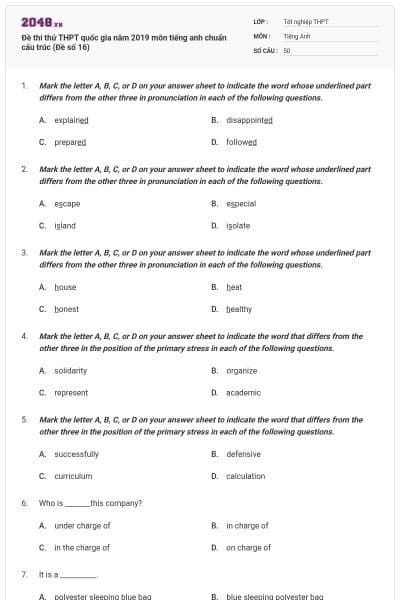
Mark the letter A, B, C, or D on your answer sheet to indicate the word whose underlined part differs from the other three in pronunciation in each of the following questions.
explained
disappointed
prepared
followed
Đáp án B
Phần gạch chân đáp án B được phát âm là /id/, các đáp án còn lại là /d/.
A. expalained /ɪkˈspleɪnd/ (v): giải thích
B. disappointed /ˌdɪs.əˈpɔɪn.tɪd/ (v+ adj): làm thất vọng, bội ước.
C. prepared /prɪˈpeəd/ (v+adj): chuẩn bị, sẵn sàng.
D. followed /ˈfɒ.ləʊd/ (v): theo dõi, theo đuổi.
Mark the letter A, B, C, or D on your answer sheet to indicate the word whose underlined part differs from the other three in pronunciation in each of the following questions.
escape
especial
island
isolate
Đáp án C
Phần gạch chân đáp án C là âm câm, các đáp án còn lại được phát âm là /s/.
A. escape /ɪˈskeɪp/ (v): trốn thoát.
B. especial /ɪˈspe.ʃəl/ (adj): đặc biệt.
C. island /ˈaɪ.lənd/ (n): hòn đảo.
D. isolate /ˈaɪ.sə.leɪt/ (v): cô lập, cách ly.
Mark the letter A, B, C, or D on your answer sheet to indicate the word whose underlined part differs from the other three in pronunciation in each of the following questions.
house
heat
honest
healthy
Đáp án C
Phần gạch chân đáp án C là âm câm, các đáp án còn lại được phát âm là /h/.
A. house /haʊs/ (n): ngôi nhà.
B. heat /hiːt/ (n): nhiệt
C. honest /ˈɒn.ɪst/ (adj): thật thà.
D. healthy /ˈhel.θi/ (adj): khỏe mạnh.
Mark the letter A, B, C, or D on your answer sheet to indicate the word that differs from the other three in the position of the primary stress in each of the following questions.
solidarity
organize
represent
academic
Đáp án B
Trọng âm rơi vào âm tiết thứ nhất, các đáp án còn lại rơi vào âm tiết thứ 3.
A. solidarity /ˌsɒ.lɪˈdæ.rə.ti/ (n): sự thống nhất, tình đoàn kết.
B. organize /ˈɔː.ɡən.aɪz/ (v): tổ chức, sắp xếp.
C. represent /ˌrep.rɪˈzent/ (v): trình bày, thuyết trình…
D. academic /ˌæ.kəˈde.mɪk/ (adj): có tính học thuật
Mark the letter A, B, C, or D on your answer sheet to indicate the word that differs from the other three in the position of the primary stress in each of the following questions.
successfully
defensive
curriculum
calculation
Đáp án D
Trọng âm rơi vào âm tiết thứ 3, các đáp án còn lại rơi vào âm tiết thứ 2.
A. successfully /səkˈses.fəl/ (adv): thành công.
B. defensive /dɪˈfen.sɪv/ (adj): có tính phòng thủ.
C. curriculum kəˈrɪk.jə.ləm/ (n): chương trình giảng dạy.
D. calculation /ˌkæl.kjəˈleɪ.ʃən/ (n): sự tính toán, sự trù liệu
Who is _______this company?
under charge of
in charge of
in the charge of
on charge of
Đáp án B
Tobe in charge of: chịu trách nhiệm.
Dịch: Ai là người chịu trách nhiệm về công ty này?
It is a __________.
polyester sleeping blue bag
blue sleeping polyester bag
blue polyester sleeping bag
sleeping blue polyester bag
Đáp án C
Blue (color) + polyester (material) + sleeping bag (N).
Cần lưu ý tới thứ tự tính từ trong cụm danh từ:
Opinion - tính từ chỉ quan điểm, sự đánh giá. (beautiful, wonderful, terrible…)
Size - tính từ chỉ kích cỡ. (big, small, long, short, tall…)
Age - tính từ chỉ độ tuổi. (old, young, old, new…)
Shape - tính từ chỉ hình dạng (circular, square, round, rectangle... )
Color - tính từ chỉ màu sắc. (orange, yellow, light blue…)
Origin – tính từ chỉ nguồn gốc, xuất xứ. (Japanese, American, Vietnamese…)
Material – tính từ chỉ chất liệu (stone, plastic, leather, steel, silk…)
Purpose – tính từ chỉ mục đích, tác dụng
OSASCOMP: Ông Sáu Ăn Súp Cơm Ông Mập Phì
She is a slow student. She seems to be unable to concentrate on anything in __________.
particular
particularly
particularity
particularize
Đáp án A
Cụm:in particular: đặc biệt.
Các đáp án còn lại:
B. particularly (adv): 1 cách đặc biệt.
C. particularity (n): nét đặc thù.
D. particularize (v): nhận định, nêu rõ.
Dịch: Cô ấy là 1 học sinh yếu. Cô ấy dường như không có khả năng tập trung vào bất cứ thứ gì đặc biệt.
Five ________ sources used most often are hydropower, solar, wind, geothermal, and biomass
renewed
renewing
renew
renewable
Đáp án D
Cụm danh từ: renewable sources: năng lượng có thể tái tạo.
Dịch: 5 nguồn năng lượng có thể tái tạo đang được sử dụng phổ biến nhất đó là năng lượng thủy điện, năng lượng mặt trời, năng lượng gió, năng lượng địa nhiệt và năng lượng sinh khối
Remember that things such as language, food and clothing are simply expressions of our cultural __________.
identity
characteristics
personality
uniqueness
Đáp án A
Cụm danh từ: Cultural identity: bản sắc văn hóa.
Các đáp án còn lại:
B. characteristics (n): nét đặc trưng, đặc điểm.
C. personality (n): tính cách.
D. uniqueness (n): sự độc nhất.
Dịch: Hãy nhớ rằng những thứ như ngôn ngữ, ẩm thực và trang phục là những biểu hiện thuần thúy của bản sắc văn hóa chúng ta.
Jane is going to take extra lessons to ________ what she missed while she was away.
catch up with
cut down on
take up with
put up with
Đáp án A
Câu hỏi từ vựng:
A. catch up with: theo kịp, bắt kịp.
B. cut down on: cắt giảm.
C. take up with sbd/smt: thân thiết với ai, liên quan tới các gì.
D. put up with: chịu đựng.
Dịch: Jane sẽ phải làm những bài kiểm tra bổ sung để theo kịp những thứ cô ấy đã bỏ lỡ khi nghỉ học.
I didn’t get home until 11p.m last night. Otherwise, I________ your call.
returned
had returned
would return
would have returned
Đáp án D
Giả định trong quá khứ (tương tự như câu điều kiện loại 3): would have PII.
Dịch: Tớ đã không về tới nhà cho tới 11h đêm hôm qua. Nếu không, tớ đã gọi lại cậu.
The man and his dogs ________ were buried in the demolished building after the earthquake have just been rescued safely.
which
who
that
whom
Đáp án C
Buộc phải dùng đại từ quan hệ “that” khi thay thế cho cụm danh từ chỉ cả người và vật (The man and his dogs).
Các đáp án còn lại:
A. which- ĐTQH thay thế cho danh từ chỉ vật, đóng chức năng làm chủ ngữ hoặc tân ngữ.
B. who- ĐTQH thay thế cho danh từ chỉ người, đóng chức năng làm chủ ngữ.
D. whom- ĐTQH thay thế cho danh từ chỉ người, đóng chức năng làm tân ngữ.
Dịch: Người đàn ông và những con chó mà bị trôn vùi trong tòa nhà đổ nát sau trận động đất, đã được giải cứu thành công.
It is essential that Mary _______ about her responsibilities in the meeting tomorrow.
must remind
will be reminded
will remind
be reminded
Đáp án D
Câu giả định: It tobe essential that S (should) V-inf.
Dịch: Điều đó là cần thiết rằng Mary nên được nhắc nhở về trách nhiệm của mình trong buổi họp.
She listened so attentively that not a word _______.
she had missed
she missed
she didn’t miss
did she miss
Đáp án D
Đảo ngữ với “Not”: Not + N + aux+ S V.
Dịch: Cô ấy lắng nghe chú tâm tới mức không bỏ lỡ bất kì 1 từ nào.
The more he slept _______ he became.
more irritable
most irritable
the more irritable
the most irritable
Đáp án C
Cấu trúc so sánh kép: The + comparative + S + V, the + comparative + S + V.
Dịch: Anh ấy càng ngủ ngủ nhiều, anh ấy càng dễ trở nên cáu kỉnh.
Each of us must take _______ for our own actions.
probability
ability
possibility
responsibility
Đáp án D
(to) take responsibility: chịu trách nhiệm, đảm nhận.
Các đáp án còn lại:
A. probability (n): khả năng có thể xảy ra = C. possibility (n) .
B. ability (n): khả năng, năng lực.
Dịch: Mỗi người trong chúng ta phải chịu trách nhiệm về hành động của bản thân.
Mark the letter A, B, C, or D on your answer sheet to indicate the underlined part that needs correction in each of the following questions.
The number of wild condors, an endangered species of bird, have been increasing steadily because of the work of scientists and environmentalists.
species of
have been
steadily
because of
Đáp án B
Sửa have been increasing => has been increasing.
A number of + N (số nhiều) + động từ chia dạng số nhiều.
The number of + N (số nhiều) + động từ chia ngôi thứ 3 số ít.
Dịch: Số lượng loài kền kền hoang dã, loài chim có nguy cơ bị tuyệt chủng, đang gia tăng ở mức bình ổn nhờ vào những công trình nghiên cứu của các nhà khoa học và môi trường học.
Mark the letter A, B, C, or D on your answer sheet to indicate the underlined part that needs correction in each of the following questions.
If a person really wants to succeed, they must always work hard.
person
really wants
they
work
Đáp án C
Sửa they => she/he.
Chủ ngữ cần đồng nhất với nhau trong 2 mệnh đề.
Dịch: Nếu 1 ai đó thực sự muốn thành công, anh/cô ấy phải luôn luôn làm việc chăm chỉ.
Mark the letter A, B, C, or D on your answer sheet to indicate the underlined part that needs correction in each of the following questions.
Many meteorite falls go unnoticed because they either happen at night nor they hit the earth in uninhabited areas.
Many
because
at night
nor they
Đáp án D
Sửa nor => or.
Cấu trúc: either…or…: (hoặc)…hoặc.
Dịch: Nhiều thiên thạch rơi xuống không được chú ý tới bởi chúng thường rơi vào ban đêm hoặc rơi vào những khu vực không có người ở.
"Your parents must be proud of your result at school".
- “______”.
Sorry to hear that
I am glad you like it.
Thanks. It's certainly encouraging.
Of course
Đáp án C
-“ Bố mẹ cậu chắc hẳn phải rất tự hào về kết quả học tập của cậu”.
-“______”.
A. Rất tiếc về chuyện đó.
B. Tớ rất vui khi cậu thích nó.
C. Cảm ơn, điều đó rất đáng khích lệ.
D. Đương nhiên.
Chỉ có đáp án C là phù hợp.
Peter: Do you have a minute please?
- Tim: “______”.
Yes. But you should be brief.
That’s just fantastic.Thank.
Sorry, I left my watch at home.
Well, it is not as good as I think.
Đáp án A
-Peter: “Làm ơn cậu có rảnh 1 chút không?”
-Tim:“______”.
A. Có. Nhưng cậu nên nhanh lên.
B. Thật tuyệt vời. Cảm ơn.
C. Xin lỗi, tớ để quên đồng hồ ở nhà.
D. Chà, nó không tốt như tớ nghĩ.
Chỉ có đáo án A là phù hợp
Mark the letter A, B, C, or D on your answer sheet to indicate the word or phrase that is CLOSEST in meaning to the underlined part in each of the following questions.
Talks on climate change resumed in the German city of Bonn on July 16 to combat global warming.
focus on
settle down
fight against
sum up
Đáp án C
Combat (v): chiến đấu chống lại, đọ sức = C. fight against.
Các đáp án còn lại:
A. focus on: tập trung vào.
B. settle down: ổn định, nguôi dần.
D. sum up: tóm tắt, tổng kết.
Dịch: Các cuộc đàm phán về biến đổi khí hậu đã được tiếp tục tại thành phố Bonn của Đức vào ngày 16 tháng 7 để chống lại sự nóng lên toàn cầu.
Mark the letter A, B, C, or D on your answer sheet to indicate the word or phrase that is CLOSEST in meaning to the underlined part in each of the following questions.
You must apply yourself to your work more.
improve
carry out
do quickly
concentrate on
Đáp án D
(to) apply one’s self to smt: đặt bản thân vào cái gì = D. concentrate on smt: tập trung vào cái gì.
Các đáp án còn lại:
A. improve (v): tiến bộ.
B. carry out (v): tiến hành.
C. do quickly (v): làm nhanh chóng.
Dịch: Bạn phải tập trung hơn vào công việc.
Mark the letter A, B, C or D on your answer sheet to indicate the word(s) OPPOSITE in meaning to the underlined word(s) in each of the following questions.
A mediocre student who gets low grades will have trouble getting into an Ivy League College.
excellent
lazy
average
moronic
Đáp án A
Mediocre (adj): xoàng, tầm thường, mức trung bình >< A. excellent (adj): xuất sắc, ưu tú.
Các đáp án còn lại:
B. lazy (adj): lười biếng.
C. average (n+adj): trung bình.
D. moronic (adj): khờ dại.
Dịch: Một sinh viên trung bình có điểm số thấp sẽ gặp rắc rối khi vào Đại học Ivy League.
Mark the letter A, B, C or D on your answer sheet to indicate the word(s) OPPOSITE in meaning to the underlined word(s) in each of the following questions.
The shop assistant has to break off the conversation to serve a customer.
interrupt
hurry
continue
begin
Đáp án C
(to) break off: ngắt lời, dừng lời >< C. continue (v): tiếp tục.
Các đáp án còn lại:
A. interrupt (v): ngắt lời, cản trở.
B. hurry (n+v): vội vàng, thúc giục.
D. begin (v): bắt đầu.
Dịch: Người nhân viên cửa hàng phải dừng cuộc nói chuyện lại để phục vụ khách hàng.
Mark the letter A, B, C, or D on your answer sheet to indicate the sentence that is closest in meaning to each of the following questions.
However old and worn his clothes were, they look clean and of good quality.
His clothes looked clean and of good quality but they were old and worn.
His clothes, though old and worn, looked clean and of good quality.
He was fond of wearing such old and worn clothes because they were of good quality.
No matter what good quality his clothes had, they looked old and worn.
Đáp án B
Mặc dù quần áo anh ấy cũ và sờn nhưng chúng trông rất sạch sẽ và chất lượng tốt.
= B. Quần áo anh ấy, mặc dù cũ và sờn, trông rất sạch sẽ và chất lượng tốt.
Các đáp án còn lại sai nghĩa:
A. Quần áo anh ấy trông sạch sẽ và chất lượng tốt nhưng chúng đã cũ và sờn.
C. Anh ấy thích mặc đồ cũ và sờn bởi chúng có chất lượng tốt.
D. Mặc dù quần áo anh ấy có chất lượng tốt nhưng chúng trông đã cũ và sờn.
Mark the letter A, B, C, or D on your answer sheet to indicate the sentence that is closest in meaning to each of the following questions.
I remember doing this assignment before.
I remembered I had already done this assignment.
I try to remember to do this assignment.
I don’t forget to do this assignment.
I remember that I have done this assignment before.
Đáp án D
Tôi nhớ là đã làm bài tập này trước đây
= D. Tôi nhớ rằng tôi đã làm bài tập này trước đây.
Các đáp án còn lại:
A- sai thời thì.
B- sai nghĩa: Tôi cố nhớ để làm bài tập này.
C- sai nghĩa: Tôi không quên làm bài tập này.
Mark the letter A, B, C, or D on your answer sheet to indicate the sentence that best combines each pair of sentences in the following questions.
Most of the classmates couldn't come. He invited them to the birthday party.
Most of the classmates he invited to the birthday party couldn't come.
Most of the classmates he was invited to the birthday party couldn't come.
Most of the classmates that he invited them to the birthday party couldn't come.
Most of the classmates which he invited to the birthday party couldn't come.
Đáp án A
Phần lớn những bạn cùng lớp đã không thể tới. Anh ấy đã mời họ tới bữa tiệc.
= A. Phần lớn những bạn cùng lớp mà anh ấy mời tới bữa tiệc đã không thể tới.
Các đáp án còn lại:
B- sai nghĩa: Phần lớn những bạn cùng lớp mà anh ấy được mời tới bữa tiệc đã không thể tới.
C- thừa “them”.
D- sai Đại từ quan hệ “which”, “which” là ĐTQH thay thế cho danh từ chỉ vật.
Mark the letter A, B, C, or D on your answer sheet to indicate the sentence that best combines each pair of sentences in the following questions.
Sue lives in a house. The house is opposite my house.
Sue lives in a house where is opposite my house.
Sue lives in a house which is opposite my house.
Sue lives in a house who is opposite my house.
Sue lives in a house and which is opposite my house
Đáp án B
Sue đang sống trong 1 ngôi nhà. Ngôi nhà đó đối diện nhà tôi.
= Sue đang sống trong 1 ngôi nhà đối diện nhà tôi.
Đại từ quan hệ “which” thay thế cho “a house”.
Đáp án A, C dùng sai ĐTQH, D thừa “and”.
A. where- ĐTQH chỉ nơi chốn.
C. who- ĐTQH thay thế cho danh từ chỉ người, đóng vai trò làm chủ ngữ
Read the following passage and mark the letter A, B, C or D on your answer sheet to indicate the correct word or phrase that best fits each of the numbered blanks from 31 to 35.
Few people now realize the reality of global warming and its effects on the world’s climate. Many scientists (31) ______ the blame for recent natural disasters on the increase in the world’s temperatures and are convinced that, more than ever before, the Earth is at (32) ______ from the forces of the wind, rain and sun. According to them, global warming is making extreme weather events, such as hurricanes and droughts, even more severe and causing sea levels all around the world to rise.
Environmental groups are putting pressure on governments to take action to reduce the amount of carbon dioxide which is given (33) ______ by factories and power plants, thus attacking the problems at its source. They are in (34) ______ of more money being spent on research into solar, wind and wave energy devices, which could then replace existing power (35) ______. Some scientists, however, believe that even if we stopped releasing carbon dioxide and other gases into the atmosphere tomorrow, we would have to wait several hundred years to notice the results. Global warming, it seems, is to stay.
Điền vào số (31)
give
put
take
has
Đáp án B
(to) put the blame for sbd/smt on smt: đổ lỗi cho ai/cái gì về cái gì.
Dịch: Nhiều nhà khoa học đã đổ lỗi cho những thiên tai gần đây là do nền nhiệt độ trái đất đang tăng lên
Read the following passage and mark the letter A, B, C or D on your answer sheet to indicate the correct word or phrase that best fits each of the numbered blanks from 31 to 35.
Few people now realize the reality of global warming and its effects on the world’s climate. Many scientists (31) ______ the blame for recent natural disasters on the increase in the world’s temperatures and are convinced that, more than ever before, the Earth is at (32) ______ from the forces of the wind, rain and sun. According to them, global warming is making extreme weather events, such as hurricanes and droughts, even more severe and causing sea levels all around the world to rise.
Environmental groups are putting pressure on governments to take action to reduce the amount of carbon dioxide which is given (33) ______ by factories and power plants, thus attacking the problems at its source. They are in (34) ______ of more money being spent on research into solar, wind and wave energy devices, which could then replace existing power (35) ______. Some scientists, however, believe that even if we stopped releasing carbon dioxide and other gases into the atmosphere tomorrow, we would have to wait several hundred years to notice the results. Global warming, it seems, is to stay.
Điền vào số (32)
danger
harm
risk
threat
Đáp án C
At risk: gặp nguy hiểm, có nguy cơ chịu rủi ro.
Các đáp án còn lại:
A. danger (n): mối nguy hiểm
In danger of = At risk: gặp nguy hiểm.
B. harm (n): mối nguy hại.
D. threat (n): mối đe dọa.
Dịch: trái đất đang có nguy cơ bị ảnh hưởng bởi các tác động của gió, mưa và mặt trời
Read the following passage and mark the letter A, B, C or D on your answer sheet to indicate the correct word or phrase that best fits each of the numbered blanks from 31 to 35.
Few people now realize the reality of global warming and its effects on the world’s climate. Many scientists (31) ______ the blame for recent natural disasters on the increase in the world’s temperatures and are convinced that, more than ever before, the Earth is at (32) ______ from the forces of the wind, rain and sun. According to them, global warming is making extreme weather events, such as hurricanes and droughts, even more severe and causing sea levels all around the world to rise.
Environmental groups are putting pressure on governments to take action to reduce the amount of carbon dioxide which is given (33) ______ by factories and power plants, thus attacking the problems at its source. They are in (34) ______ of more money being spent on research into solar, wind and wave energy devices, which could then replace existing power (35) ______. Some scientists, however, believe that even if we stopped releasing carbon dioxide and other gases into the atmosphere tomorrow, we would have to wait several hundred years to notice the results. Global warming, it seems, is to stay.
Điền vào số (33)
off
up
over
away
Đáp án A
(to) give off: bốc ra, phát ra, tỏa ra, sinh ra (mùi, khói…).
Các đáp án còn lại:
B. give up: từ bỏ.
C. give over: chấm dứt, từ bỏ 1 thói quen.
D. give away: trao đi, làm từ thiện…
Dịch: Các nhóm bảo vệ môi trường đang gây sức ép lên chính phủ nhằm mục tiêu hành động để giảm thiểu lượng khí các-bon phát ra từ các xí nghiệp và nhà máy phát điện.
Read the following passage and mark the letter A, B, C or D on your answer sheet to indicate the correct word or phrase that best fits each of the numbered blanks from 31 to 35.
Few people now realize the reality of global warming and its effects on the world’s climate. Many scientists (31) ______ the blame for recent natural disasters on the increase in the world’s temperatures and are convinced that, more than ever before, the Earth is at (32) ______ from the forces of the wind, rain and sun. According to them, global warming is making extreme weather events, such as hurricanes and droughts, even more severe and causing sea levels all around the world to rise.
Environmental groups are putting pressure on governments to take action to reduce the amount of carbon dioxide which is given (33) ______ by factories and power plants, thus attacking the problems at its source. They are in (34) ______ of more money being spent on research into solar, wind and wave energy devices, which could then replace existing power (35) ______. Some scientists, however, believe that even if we stopped releasing carbon dioxide and other gases into the atmosphere tomorrow, we would have to wait several hundred years to notice the results. Global warming, it seems, is to stay.
Điền vào số (34)
request
suggestion
belief
favor
Đáp án D
Tobe in favor of sbd/smt: ủng hộ ai, cái gì.
Các đáp án còn lại:
A. request (n+v): yêu cầu.
B. suggestion (n): gợi ý.
C. belief (n): niềm tin.
Dịch: Họ ủng hộ việc ngân sách được chi ra mạnh tay hơn để sử dụng cho mục đích nghiên cứu các thiết bị năng lượng mặt trời, gió và năng lượng sóng.
Read the following passage and mark the letter A, B, C or D on your answer sheet to indicate the correct word or phrase that best fits each of the numbered blanks from 31 to 35.
Few people now realize the reality of global warming and its effects on the world’s climate. Many scientists (31) ______ the blame for recent natural disasters on the increase in the world’s temperatures and are convinced that, more than ever before, the Earth is at (32) ______ from the forces of the wind, rain and sun. According to them, global warming is making extreme weather events, such as hurricanes and droughts, even more severe and causing sea levels all around the world to rise.
Environmental groups are putting pressure on governments to take action to reduce the amount of carbon dioxide which is given (33) ______ by factories and power plants, thus attacking the problems at its source. They are in (34) ______ of more money being spent on research into solar, wind and wave energy devices, which could then replace existing power (35) ______. Some scientists, however, believe that even if we stopped releasing carbon dioxide and other gases into the atmosphere tomorrow, we would have to wait several hundred years to notice the results. Global warming, it seems, is to stay.
Điền vào số (35)
houses
dumps
stations
generation
Đáp án C
Power station: nhà máy phát điện, trạm phát điện.
Các đáp án còn lại:
A. houses (n): những ngôi nhà.
B. dumps (n): sự buồn chán, bãi rác.
D. generation (n): sự phát sinh, thế hệ, sự phát điện.
Dịch: cái mà có thể thay thế cho các trạm phát điện hiện tại.
Read the following passage and mark the letter A, B, C or D on your answer sheet to indicate the correct answer to each of the following questions.
Each person has different learning preferences and styles that benefit them. Some may find they have a dominant learning style. Others prefer different learning styles in different circumstances. There is no right or wrong answer to which learning style is best for you - or mix of learning styles. However, by discovering and better understanding your own learning styles, you can employ techniques that will improve the rate and quality of your learning.
If you prefer lessons that employ images to teach, you are a visual learner. Visual learners retain information better when it is presented in pictures, videos, graphs and books. They frequently draw pictures or develop diagrams when trying to comprehend a subject or memorize rote information. If you are a visual learner, use pictures, images, color, diagrams and other visual media in your note taking, test preparation and studying. Whenever possible, use pictures instead of text. Try to develop diagrams to comprehend concepts and storyboards to remember important sequences and relationships.
Aural (auditory) learners retain information better when it’s presented in lecture format, via speeches, audio recordings, and other forms of verb communication. While a visual learner would prefer to read a book or watch a video, auditory learners would prefer to attend a lecture or listen to a book on tap. Aural learners are also big on sound and music. They can typically sing, play an instrument and identify different sounds. If you are an aural learner, integrate auditory media, listening techniques, sound, rhyme, or even music in your learning and studying. You may also consider using background music and sounds to help you with visualization of processes and systems. For example, if you’re practicing fight procedures, you may consider playing a recording of an aircraft in the background as you study. Replacing the lyrics of a favorite song with information you are learning is a very powerful way to memorize large amounts of information for aural learning. Use this technique and you will never forget the information again
What does the passage mainly discuss?
Features and techniques of two learning styles.
Visual and aural learners’ problems and solutions.
Why and how to understand your learning styles.
What and how to use your learning techniques.
Đáp án A
Đoạn văn chủ yếu bàn về?
A. Đặc điểm và kĩ thuật của 2 phong cách học tập.
B. Vấn đề và giải pháp của người học bằng thị giác và người học bằng thính giác.
C. Tại sao và làm thế nào để hiểu được phong cách học tập của bạn.
D. Những gì và làm thế nào để sử dụng tới kĩ thuật học tập của bạn.
Dạng câu hỏi tìm ý chính trong bài luôn luôn nên ưu tiên làm sau cùng sau khi đã lắm được sơ qua nội dung bài đọc.
Dễ thấy đoạn 1 là giới thiệu chủ đề, đoạn 2 bàn về phong cách học tập bằng thị giác, đoạn 3 bàn về phong cách học tập bằng thính giác => Đáp án A là hợp lí và bao quát nhất
Read the following passage and mark the letter A, B, C or D on your answer sheet to indicate the correct answer to each of the following questions.
Each person has different learning preferences and styles that benefit them. Some may find they have a dominant learning style. Others prefer different learning styles in different circumstances. There is no right or wrong answer to which learning style is best for you - or mix of learning styles. However, by discovering and better understanding your own learning styles, you can employ techniques that will improve the rate and quality of your learning.
If you prefer lessons that employ images to teach, you are a visual learner. Visual learners retain information better when it is presented in pictures, videos, graphs and books. They frequently draw pictures or develop diagrams when trying to comprehend a subject or memorize rote information. If you are a visual learner, use pictures, images, color, diagrams and other visual media in your note taking, test preparation and studying. Whenever possible, use pictures instead of text. Try to develop diagrams to comprehend concepts and storyboards to remember important sequences and relationships.
Aural (auditory) learners retain information better when it’s presented in lecture format, via speeches, audio recordings, and other forms of verb communication. While a visual learner would prefer to read a book or watch a video, auditory learners would prefer to attend a lecture or listen to a book on tap. Aural learners are also big on sound and music. They can typically sing, play an instrument and identify different sounds. If you are an aural learner, integrate auditory media, listening techniques, sound, rhyme, or even music in your learning and studying. You may also consider using background music and sounds to help you with visualization of processes and systems. For example, if you’re practicing fight procedures, you may consider playing a recording of an aircraft in the background as you study. Replacing the lyrics of a favorite song with information you are learning is a very powerful way to memorize large amounts of information for aural learning. Use this technique and you will never forget the information again
By discovering and better understanding your own learning styles, you can improve _______.
Your learning quality and quantity.
Your learning rate.
Your learning styles.
Your learning quality and speed.
Đáp án D
Bằng việc khám phá ra và hiểu được phong cách học tập của riêng mình, bạn có thể cải thiện được_______.
A. Khối lượng và chất lượng học tập.
B. Tốc độ học tập.
C. Phong cách học tập.
D. Chất lượng và tốc độ học tập.
Dẫn chứng ở câu cuối đoạn 1: “However, by discovering and better understanding your own learning styles, you can employ techniques that will improve the rate and quality of your learning” – (Mặc dù vậy, bằng việc khám phá và hiểu được phong cách học của riêng mình, bạn có thể vận dụng các kĩ thuật và cải thiện được tốc độ và chất lượng học tập của mình).
Chú ý: rate (n) = speed (n): tốc độ
Read the following passage and mark the letter A, B, C or D on your answer sheet to indicate the correct answer to each of the following questions.
Each person has different learning preferences and styles that benefit them. Some may find they have a dominant learning style. Others prefer different learning styles in different circumstances. There is no right or wrong answer to which learning style is best for you - or mix of learning styles. However, by discovering and better understanding your own learning styles, you can employ techniques that will improve the rate and quality of your learning.
If you prefer lessons that employ images to teach, you are a visual learner. Visual learners retain information better when it is presented in pictures, videos, graphs and books. They frequently draw pictures or develop diagrams when trying to comprehend a subject or memorize rote information. If you are a visual learner, use pictures, images, color, diagrams and other visual media in your note taking, test preparation and studying. Whenever possible, use pictures instead of text. Try to develop diagrams to comprehend concepts and storyboards to remember important sequences and relationships.
Aural (auditory) learners retain information better when it’s presented in lecture format, via speeches, audio recordings, and other forms of verb communication. While a visual learner would prefer to read a book or watch a video, auditory learners would prefer to attend a lecture or listen to a book on tap. Aural learners are also big on sound and music. They can typically sing, play an instrument and identify different sounds. If you are an aural learner, integrate auditory media, listening techniques, sound, rhyme, or even music in your learning and studying. You may also consider using background music and sounds to help you with visualization of processes and systems. For example, if you’re practicing fight procedures, you may consider playing a recording of an aircraft in the background as you study. Replacing the lyrics of a favorite song with information you are learning is a very powerful way to memorize large amounts of information for aural learning. Use this technique and you will never forget the information again
The word “They” in paragraph 2 refers to_______.
visual learners
pictures
videos
graphs
Đáp án A
Từ “they” ở đoạn 2 ám chỉ tới _______.
A. những người học bằng thị giác.
B. những bức tranh.
C. những băng vi-đê-ô.
D. những biểu đồ, đồ thị.
Do “they” đứng đầu làm chủ ngữ, ta đọc lên câu phía trước:
Tạm dịch: “Visual learners retain information better when it is presented in pictures, videos, graphs and books. They frequently draw pictures or develop diagrams when trying to comprehend a subject or memorize rote information” – (Những người học bằng thị giác giữ lại được thông tin tốt hơn khi nó được thể hiện dưới dạng tranh ảnh, video, biểu đồ và sách. Họ thường vẽ tranh hoặc phát triển biểu đồ khi cố gắng tiếp thu bài hoặc ghi nhớ những phần thông tin quan trọng).
=> “They” chỉ có thể là thay thế cho “visual learners”.
Read the following passage and mark the letter A, B, C or D on your answer sheet to indicate the correct answer to each of the following questions.
Each person has different learning preferences and styles that benefit them. Some may find they have a dominant learning style. Others prefer different learning styles in different circumstances. There is no right or wrong answer to which learning style is best for you - or mix of learning styles. However, by discovering and better understanding your own learning styles, you can employ techniques that will improve the rate and quality of your learning.
If you prefer lessons that employ images to teach, you are a visual learner. Visual learners retain information better when it is presented in pictures, videos, graphs and books. They frequently draw pictures or develop diagrams when trying to comprehend a subject or memorize rote information. If you are a visual learner, use pictures, images, color, diagrams and other visual media in your note taking, test preparation and studying. Whenever possible, use pictures instead of text. Try to develop diagrams to comprehend concepts and storyboards to remember important sequences and relationships.
Aural (auditory) learners retain information better when it’s presented in lecture format, via speeches, audio recordings, and other forms of verb communication. While a visual learner would prefer to read a book or watch a video, auditory learners would prefer to attend a lecture or listen to a book on tap. Aural learners are also big on sound and music. They can typically sing, play an instrument and identify different sounds. If you are an aural learner, integrate auditory media, listening techniques, sound, rhyme, or even music in your learning and studying. You may also consider using background music and sounds to help you with visualization of processes and systems. For example, if you’re practicing fight procedures, you may consider playing a recording of an aircraft in the background as you study. Replacing the lyrics of a favorite song with information you are learning is a very powerful way to memorize large amounts of information for aural learning. Use this technique and you will never forget the information again
According to the passage, one benefit of diagrams is _______.
to understand concepts.
to remember sequences.
to understand story boards.
to use pictures not texts.
Đáp án B
Theo như đoạn văn, 1 lợi ích của biểu đồ là _______.
A. hiểu được khái niệm.
B. nhớ được các chuỗi.
C. hiểu được cốt truyện.
D. sử dụng hình ảnh thay vì văn bản.
Dẫn chứng ở câu cuối đoạn 2: “Try to develop diagrams to comprehend concepts and storyboards to remember important sequencesand relationships” – (Cố gắng phát triển các biểu đồ để hiểu được những khái niệm và cốt truyện cho mục tiêu ghi nhớ các chuỗi quan trọng và những mối quan hệ).
Read the following passage and mark the letter A, B, C or D on your answer sheet to indicate the correct answer to each of the following questions.
Each person has different learning preferences and styles that benefit them. Some may find they have a dominant learning style. Others prefer different learning styles in different circumstances. There is no right or wrong answer to which learning style is best for you - or mix of learning styles. However, by discovering and better understanding your own learning styles, you can employ techniques that will improve the rate and quality of your learning.
If you prefer lessons that employ images to teach, you are a visual learner. Visual learners retain information better when it is presented in pictures, videos, graphs and books. They frequently draw pictures or develop diagrams when trying to comprehend a subject or memorize rote information. If you are a visual learner, use pictures, images, color, diagrams and other visual media in your note taking, test preparation and studying. Whenever possible, use pictures instead of text. Try to develop diagrams to comprehend concepts and storyboards to remember important sequences and relationships.
Aural (auditory) learners retain information better when it’s presented in lecture format, via speeches, audio recordings, and other forms of verb communication. While a visual learner would prefer to read a book or watch a video, auditory learners would prefer to attend a lecture or listen to a book on tap. Aural learners are also big on sound and music. They can typically sing, play an instrument and identify different sounds. If you are an aural learner, integrate auditory media, listening techniques, sound, rhyme, or even music in your learning and studying. You may also consider using background music and sounds to help you with visualization of processes and systems. For example, if you’re practicing fight procedures, you may consider playing a recording of an aircraft in the background as you study. Replacing the lyrics of a favorite song with information you are learning is a very powerful way to memorize large amounts of information for aural learning. Use this technique and you will never forget the information again
All of the following statements are TRUE about visual learners EXCEPT _______.
They employ images to teach.
They remember graphs well.
They prefer pictures to texts.
They use story boards for relationships.
Đáp án A
Tất cả các câu sau đây đều đúng về những người học bằng thị giác, ngoại trừ:
A. Họ sử dụng hình ảnh để giảng dạy.
B. Họ nhớ được tốt các biểu đồ.
C. Họ ưu tiên tranh ảnh hơn là văn bản.
D. Họ sử dụng cốt truyện cho các mối quan hệ.
Dẫn chứng ở đoạn 2:
B- “Visual learners retain information better when it is presented in pictures, videos, graphs and books”- (Những người học bằng thị giác giữ lại được thông tin tốt hơn khi nó được thể hiện dưới dạng tranh ảnh, video, biểu đồ và sách).
C- “Whenever possible, use pictures instead of text”- (Bất cứ khi nào có thể, sử dụng biểu đồ thay vì văn bản).
D- “Try to develop diagrams to comprehend concepts and storyboards to remember important sequences and relationships” – (Cố gắng phát triển các biểu đồ để hiểu được những khái niệm và cốt truyện cho mục tiêu ghi nhớ các chuỗi quan trọng và những mối quan hệ).
Đáp án A sai bởi “If you prefer lessons that employ images to teach, you are a visual learner”- (Nếu bạn ưa thích những bài giảng có sử dụng hình ảnh để truyền đạt, bạn đích thực là người học bằng thị giác) chứ không phải “những người học bằng thị giác sử dụng hình ảnh để dạy học”.
Read the following passage and mark the letter A, B, C or D on your answer sheet to indicate the correct answer to each of the following questions.
Each person has different learning preferences and styles that benefit them. Some may find they have a dominant learning style. Others prefer different learning styles in different circumstances. There is no right or wrong answer to which learning style is best for you - or mix of learning styles. However, by discovering and better understanding your own learning styles, you can employ techniques that will improve the rate and quality of your learning.
If you prefer lessons that employ images to teach, you are a visual learner. Visual learners retain information better when it is presented in pictures, videos, graphs and books. They frequently draw pictures or develop diagrams when trying to comprehend a subject or memorize rote information. If you are a visual learner, use pictures, images, color, diagrams and other visual media in your note taking, test preparation and studying. Whenever possible, use pictures instead of text. Try to develop diagrams to comprehend concepts and storyboards to remember important sequences and relationships.
Aural (auditory) learners retain information better when it’s presented in lecture format, via speeches, audio recordings, and other forms of verb communication. While a visual learner would prefer to read a book or watch a video, auditory learners would prefer to attend a lecture or listen to a book on tap. Aural learners are also big on sound and music. They can typically sing, play an instrument and identify different sounds. If you are an aural learner, integrate auditory media, listening techniques, sound, rhyme, or even music in your learning and studying. You may also consider using background music and sounds to help you with visualization of processes and systems. For example, if you’re practicing fight procedures, you may consider playing a recording of an aircraft in the background as you study. Replacing the lyrics of a favorite song with information you are learning is a very powerful way to memorize large amounts of information for aural learning. Use this technique and you will never forget the information again
According to the passage, the benefit of listening to music while learning and studying is that it _______.
is a hobby or an interest
attracts your attention
makes you feel relaxed
helps you visualize processes and systems
Đáp án D
Theo như đoạn văn, lợi ích của việc nghe nhạc trong khi đang học_______.
A. là 1 sở thích hoặc niềm thích thú.
B. thu hút sự chú ý.
C. làm cho thư thái.
D. giúp hình dung ra các quy trình và hệ thống.
Dẫn chứng câu 6- đoạn 3: “…or even music in your learning and studying. You may also consider using background music and sounds to help you with visualization of processes and systems” – (…hoặc thậm chí là nghe nhạc khi đang học. Bạn cũng có thể cân nhắc việc sử dụng nhạc nền và âm thanh để giúp hình dung ra các quy trình và hệ thống).
Read the following passage and mark the letter A, B, C or D on your answer sheet to indicate the correct answer to each of the following questions.
Each person has different learning preferences and styles that benefit them. Some may find they have a dominant learning style. Others prefer different learning styles in different circumstances. There is no right or wrong answer to which learning style is best for you - or mix of learning styles. However, by discovering and better understanding your own learning styles, you can employ techniques that will improve the rate and quality of your learning.
If you prefer lessons that employ images to teach, you are a visual learner. Visual learners retain information better when it is presented in pictures, videos, graphs and books. They frequently draw pictures or develop diagrams when trying to comprehend a subject or memorize rote information. If you are a visual learner, use pictures, images, color, diagrams and other visual media in your note taking, test preparation and studying. Whenever possible, use pictures instead of text. Try to develop diagrams to comprehend concepts and storyboards to remember important sequences and relationships.
Aural (auditory) learners retain information better when it’s presented in lecture format, via speeches, audio recordings, and other forms of verb communication. While a visual learner would prefer to read a book or watch a video, auditory learners would prefer to attend a lecture or listen to a book on tap. Aural learners are also big on sound and music. They can typically sing, play an instrument and identify different sounds. If you are an aural learner, integrate auditory media, listening techniques, sound, rhyme, or even music in your learning and studying. You may also consider using background music and sounds to help you with visualization of processes and systems. For example, if you’re practicing fight procedures, you may consider playing a recording of an aircraft in the background as you study. Replacing the lyrics of a favorite song with information you are learning is a very powerful way to memorize large amounts of information for aural learning. Use this technique and you will never forget the information again
The author suggests that to remember lessons, aural learners can _______.
forget melody
learn by heart lyrics
sing along
write songs with your favorite lyrics and information you’re learning
Đáp án D
Tác giả gợi ý rằng để nhớ được bài, những người học bằng thính giác có thể:
A. quên đi giai điệu.
B. học thuộc lòng lời nhạc.
C. hát theo.
D. viết nhạc với lời thoại ưu thích và thông tin đang được học.
Dẫn chứng câu gần cuối- đoạn 3: “Replacing the lyrics of a favorite song with information you are learning is a very powerful way to memorize large amounts of information for aural learning”- (Thay lời bài thoại của bài hát ưu thích bằng những thông tin bạn đang được học là 1 phương pháp hữu hiệu để ghi nhớ khối lượng thông tin lớn đối với việc học bằng thính giác).
Read the following passage and mark the letter A, B, C or D on your answer sheet to indicate the correct answer to each of the following questions.
Each person has different learning preferences and styles that benefit them. Some may find they have a dominant learning style. Others prefer different learning styles in different circumstances. There is no right or wrong answer to which learning style is best for you - or mix of learning styles. However, by discovering and better understanding your own learning styles, you can employ techniques that will improve the rate and quality of your learning.
If you prefer lessons that employ images to teach, you are a visual learner. Visual learners retain information better when it is presented in pictures, videos, graphs and books. They frequently draw pictures or develop diagrams when trying to comprehend a subject or memorize rote information. If you are a visual learner, use pictures, images, color, diagrams and other visual media in your note taking, test preparation and studying. Whenever possible, use pictures instead of text. Try to develop diagrams to comprehend concepts and storyboards to remember important sequences and relationships.
Aural (auditory) learners retain information better when it’s presented in lecture format, via speeches, audio recordings, and other forms of verb communication. While a visual learner would prefer to read a book or watch a video, auditory learners would prefer to attend a lecture or listen to a book on tap. Aural learners are also big on sound and music. They can typically sing, play an instrument and identify different sounds. If you are an aural learner, integrate auditory media, listening techniques, sound, rhyme, or even music in your learning and studying. You may also consider using background music and sounds to help you with visualization of processes and systems. For example, if you’re practicing fight procedures, you may consider playing a recording of an aircraft in the background as you study. Replacing the lyrics of a favorite song with information you are learning is a very powerful way to memorize large amounts of information for aural learning. Use this technique and you will never forget the information again
It can be inferred from the passage that a person’s learning style _______.
is completely different from others.
can never be best for them.
determines learning quality.
has its effective technique.
Đáp án D
Có thể được suy ra từ đoạn văn rằng phong cách học của 1 người ______.
A. là hoàn toàn khác với những người khác.
B. có thể không bao giờ là tốt nhất cho họ.
C. quyết định tới chất lượng học tập.
D. có những kĩ thuật hiệu quả của nó.
Dẫn chứng:
+ Kĩ thuật hiệu quả của phong cách học bằng thị giác: “…develop diagrams to comprehend concepts and storyboards to remember important sequences and relationships” – (…phát triển các biểu đồ để hiểu được những khái niệm và cốt truyện cho mục tiêu ghi nhớ các chuỗi quan trọng và những mối quan hệ)….
+ Kĩ thuật hiệu quả của phong cách học bằng thính giác: “Replacing the lyrics of a favorite song with information you are learning is a very powerful way to memorize large amounts of information for aural learning”- (Thay lời bài thoại của bài hát ưu thích bằng những thông tin bạn đang được học là 1 phương pháp hữu hiệu để ghi nhớ khối lượng thông tin lớn đối với những người học bằng thính giác)….
Read the following passage and mark the letter A, B, C or D on your answer sheet to indicate the correct answer to each of the following questions.
Ranked as the number one beverage consumed worldwide, tea takes the lead over coffee in both popularity and production with 5 million metric tons of tea produced annually. Although much of this tea is consumed in Asian, European and African countries, the United States drinks its fair share. According to estimates by the Tea Council of the United States, tea is enjoyed by no less than half of the U.S population on any given day. Black tea or green tea – iced, spiced or instant – tea drinking has spurred a billion-dollar with major tea producer in Africa and South America and throughout Asia.
Tea is made from the leaves from an evergreen plant, Camellia saneness, which grows tall and lush in tropical region. On tea plantation, the plant is kept trimmed to approximately four feet high and as new buds called flush appear; they are plucked off by hand. Even in today’s world of modern agricultural machinery, hand harvesting continues to be the preferred method. Ideally, only the top two leaves and a bud should be picked. This new growth produces the highest quality tea.
After being harvested, tea leaves are laid out on long drying racks, called withering racks, for 18 to 20 hours. During this process, the tea softens and become limp. Next, dependent on the type of tea being product, the leaves may be crushed or chopped to release flavor, and then fermented under controlled condition of heat and humidity. For green tea, the whole leaves are often steamed to retain their green color, and the fermentation process is skipped. Producing black teas requires fermentation during which the tea leaves begin darken. After fermentation, black tea is dried in vats to produce its rich brown or black color.
No one knows when or how tea became popular, but legend has it that tea as a beverage was discovered in 2737 B.C. by Emperor Shen Nung of China when leaves from camellia dropped into his drinking water as it was boiling over a fire. As the story goes, Emperor Shen Nung drank the resulting liquid and proclaimed that the drink to be most nourishing and refreshing. Though this account cannot be documented, it is thought that tea drinking probably originated in China and spread to other parts of Asia, then Europe, and ultimately to America colonies around 1650.
With about half the caffeine content of coffee, tea is often chosen by those who want to reduce, but not necessarily eliminate their caffeine intake. Some people find that tea is less acidic than coffee and therefore easier on the stomach. Others have become interested in tea drinking since the National Cancer Institute publishes its finding on the antioxidant properties of tea. But whether tea is enjoyed for it perceived health benefit, its flavor, or as a social drink, teacups continue to be filled daily with the world’ most popular beverage.
According to the passage, what is implied about tea harvesting.
It is totaling done with the assistance of modern agricultural machinery
It is longer done in China.
The method has remained nearly the same for a long time.
The method involves trimming the uppermost branches of the plant
Đáp án C
Theo như đoạn văn, điều gì được ngụ ý về thu hoạch chè?
A. Nó được tiến hành tuyệt đối với sự trợ giúp của máy móc công nghiệp hiện đại.
B. Nó kéo dài hơn ở Trung Quốc.
C. Phương pháp được giữ nguyên gần như là giống với thời gian dài trước kia
D. Phương pháp bao gồm việc cắt tỉa các cành ngọn trên cùng của cây.
Dẫn chứng ở đoạn 2: “Even in today’s world of modern agricultural machinery, hand harvesting continues to be the preferred method” – (Ngày nay mặc dù có rất nhiều máy móc nông nghiệp hiện đại trên thế giới, nhưng việc thu hái chè bằng tay vẫn là phương pháp được ưu chuộng).
Read the following passage and mark the letter A, B, C or D on your answer sheet to indicate the correct answer to each of the following questions.
Ranked as the number one beverage consumed worldwide, tea takes the lead over coffee in both popularity and production with 5 million metric tons of tea produced annually. Although much of this tea is consumed in Asian, European and African countries, the United States drinks its fair share. According to estimates by the Tea Council of the United States, tea is enjoyed by no less than half of the U.S population on any given day. Black tea or green tea – iced, spiced or instant – tea drinking has spurred a billion-dollar with major tea producer in Africa and South America and throughout Asia.
Tea is made from the leaves from an evergreen plant, Camellia saneness, which grows tall and lush in tropical region. On tea plantation, the plant is kept trimmed to approximately four feet high and as new buds called flush appear; they are plucked off by hand. Even in today’s world of modern agricultural machinery, hand harvesting continues to be the preferred method. Ideally, only the top two leaves and a bud should be picked. This new growth produces the highest quality tea.
After being harvested, tea leaves are laid out on long drying racks, called withering racks, for 18 to 20 hours. During this process, the tea softens and become limp. Next, dependent on the type of tea being product, the leaves may be crushed or chopped to release flavor, and then fermented under controlled condition of heat and humidity. For green tea, the whole leaves are often steamed to retain their green color, and the fermentation process is skipped. Producing black teas requires fermentation during which the tea leaves begin darken. After fermentation, black tea is dried in vats to produce its rich brown or black color.
No one knows when or how tea became popular, but legend has it that tea as a beverage was discovered in 2737 B.C. by Emperor Shen Nung of China when leaves from camellia dropped into his drinking water as it was boiling over a fire. As the story goes, Emperor Shen Nung drank the resulting liquid and proclaimed that the drink to be most nourishing and refreshing. Though this account cannot be documented, it is thought that tea drinking probably originated in China and spread to other parts of Asia, then Europe, and ultimately to America colonies around 1650.
With about half the caffeine content of coffee, tea is often chosen by those who want to reduce, but not necessarily eliminate their caffeine intake. Some people find that tea is less acidic than coffee and therefore easier on the stomach. Others have become interested in tea drinking since the National Cancer Institute publishes its finding on the antioxidant properties of tea. But whether tea is enjoyed for it perceived health benefit, its flavor, or as a social drink, teacups continue to be filled daily with the world’ most popular beverage.
What does the word “they” in paragraph 2 refer to?
tea pickers
new buds
evergreen plants
tropical regions
Đáp án B
Từ “they” ở đoạn 2 ám chỉ tới?
A. những người hái chè.
B. những chồi non mới.
C. những cây thường xanh.
D. những vùng nhiệt đới.
Tạm dịch: “On tea plantation, the plant is kept trimmed to approximately four feet high and as new buds called flush appear; they are plucked off by hand”- (Trên những đồi chè, cây được tỉa cao khoảng 4 feet và ngay khi ngọn vừa trồi ra, chúng sẽ được hái bằng tay).
=> “they” chỉ có thể là thay thế cho “new buds”.
Read the following passage and mark the letter A, B, C or D on your answer sheet to indicate the correct answer to each of the following questions.
Ranked as the number one beverage consumed worldwide, tea takes the lead over coffee in both popularity and production with 5 million metric tons of tea produced annually. Although much of this tea is consumed in Asian, European and African countries, the United States drinks its fair share. According to estimates by the Tea Council of the United States, tea is enjoyed by no less than half of the U.S population on any given day. Black tea or green tea – iced, spiced or instant – tea drinking has spurred a billion-dollar with major tea producer in Africa and South America and throughout Asia.
Tea is made from the leaves from an evergreen plant, Camellia saneness, which grows tall and lush in tropical region. On tea plantation, the plant is kept trimmed to approximately four feet high and as new buds called flush appear; they are plucked off by hand. Even in today’s world of modern agricultural machinery, hand harvesting continues to be the preferred method. Ideally, only the top two leaves and a bud should be picked. This new growth produces the highest quality tea.
After being harvested, tea leaves are laid out on long drying racks, called withering racks, for 18 to 20 hours. During this process, the tea softens and become limp. Next, dependent on the type of tea being product, the leaves may be crushed or chopped to release flavor, and then fermented under controlled condition of heat and humidity. For green tea, the whole leaves are often steamed to retain their green color, and the fermentation process is skipped. Producing black teas requires fermentation during which the tea leaves begin darken. After fermentation, black tea is dried in vats to produce its rich brown or black color.
No one knows when or how tea became popular, but legend has it that tea as a beverage was discovered in 2737 B.C. by Emperor Shen Nung of China when leaves from camellia dropped into his drinking water as it was boiling over a fire. As the story goes, Emperor Shen Nung drank the resulting liquid and proclaimed that the drink to be most nourishing and refreshing. Though this account cannot be documented, it is thought that tea drinking probably originated in China and spread to other parts of Asia, then Europe, and ultimately to America colonies around 1650.
With about half the caffeine content of coffee, tea is often chosen by those who want to reduce, but not necessarily eliminate their caffeine intake. Some people find that tea is less acidic than coffee and therefore easier on the stomach. Others have become interested in tea drinking since the National Cancer Institute publishes its finding on the antioxidant properties of tea. But whether tea is enjoyed for it perceived health benefit, its flavor, or as a social drink, teacups continue to be filled daily with the world’ most popular beverage.
Which of the following is NOT true about the tea production process?
Black tea develops its dark color during fermentation and final drying.
Green tea requires a long fermentation process.
Green tea is often steamed to keep its color.
Black tea goes through two phases during production.
Đáp án B
Ý nào sau đây không đúng về quá trình sản xuất chè?
A. Chè đen lên màu tối trong suốt quá trình lên men và sấy khô cuối cùng.
B. Chè xanh đòi hỏi 1 quá trình lên men dài.
C. Chè xanh thường được hấp để giữ màu.
D. Chè đen trải qua 2 giai đoạn trong quá trình sản xuất.
Dẫn chứng câu 4- đoạn 3: “.For green tea, the whole leaves are often steamed to retain their green color, and the fermentation process is skipped”- (Đối với trà xanh, toàn bộ phần lá thường được hấp để giữ lại màu và bỏ qua quá trình lên men)
Read the following passage and mark the letter A, B, C or D on your answer sheet to indicate the correct answer to each of the following questions.
Ranked as the number one beverage consumed worldwide, tea takes the lead over coffee in both popularity and production with 5 million metric tons of tea produced annually. Although much of this tea is consumed in Asian, European and African countries, the United States drinks its fair share. According to estimates by the Tea Council of the United States, tea is enjoyed by no less than half of the U.S population on any given day. Black tea or green tea – iced, spiced or instant – tea drinking has spurred a billion-dollar with major tea producer in Africa and South America and throughout Asia.
Tea is made from the leaves from an evergreen plant, Camellia saneness, which grows tall and lush in tropical region. On tea plantation, the plant is kept trimmed to approximately four feet high and as new buds called flush appear; they are plucked off by hand. Even in today’s world of modern agricultural machinery, hand harvesting continues to be the preferred method. Ideally, only the top two leaves and a bud should be picked. This new growth produces the highest quality tea.
After being harvested, tea leaves are laid out on long drying racks, called withering racks, for 18 to 20 hours. During this process, the tea softens and become limp. Next, dependent on the type of tea being product, the leaves may be crushed or chopped to release flavor, and then fermented under controlled condition of heat and humidity. For green tea, the whole leaves are often steamed to retain their green color, and the fermentation process is skipped. Producing black teas requires fermentation during which the tea leaves begin darken. After fermentation, black tea is dried in vats to produce its rich brown or black color.
No one knows when or how tea became popular, but legend has it that tea as a beverage was discovered in 2737 B.C. by Emperor Shen Nung of China when leaves from camellia dropped into his drinking water as it was boiling over a fire. As the story goes, Emperor Shen Nung drank the resulting liquid and proclaimed that the drink to be most nourishing and refreshing. Though this account cannot be documented, it is thought that tea drinking probably originated in China and spread to other parts of Asia, then Europe, and ultimately to America colonies around 1650.
With about half the caffeine content of coffee, tea is often chosen by those who want to reduce, but not necessarily eliminate their caffeine intake. Some people find that tea is less acidic than coffee and therefore easier on the stomach. Others have become interested in tea drinking since the National Cancer Institute publishes its finding on the antioxidant properties of tea. But whether tea is enjoyed for it perceived health benefit, its flavor, or as a social drink, teacups continue to be filled daily with the world’ most popular beverage.
According to the passage, what is TRUE about origin of tea drinking?
It began during the Shen Nung Dynasty.
It may begin some time around 1950.
It is unknown when tea first became popular.
It was originally produced from Camilla plants in Europe.
Đáp án C
Theo như đoạn văn, điều nào sau đây là đúng về nguồn gốc của việc uống trà?
A. bắt đầu từ triều đại Shen Nung.
B. có thể bắt đầu vào khoảng thời gian quanh năm 1950.
C. không được biết tới khi trà trở nên phổ biến lần đầu tiên.
D. ban đầu được sản xuất từ cây Camilla ở Châu Âu.
Dẫn chứng ở câu đầu đoạn 4: “No one knows when or how tea became popular, but legend […]”- (Không ai biết khi nào và làm thế nào mà trà trở nên phổ biến, nhưng có 1 truyền thuyết kể lại rằng…) => Việc uống trà đã không được biết tới cho đến khi chè trở nên nổi tiếng.
Có thể nhầm sang đáp án A bởi câu chuyện về Hoàng đế Shen Nung chỉ là 1 truyền thuyết không xác thực
Read the following passage and mark the letter A, B, C or D on your answer sheet to indicate the correct answer to each of the following questions.
Ranked as the number one beverage consumed worldwide, tea takes the lead over coffee in both popularity and production with 5 million metric tons of tea produced annually. Although much of this tea is consumed in Asian, European and African countries, the United States drinks its fair share. According to estimates by the Tea Council of the United States, tea is enjoyed by no less than half of the U.S population on any given day. Black tea or green tea – iced, spiced or instant – tea drinking has spurred a billion-dollar with major tea producer in Africa and South America and throughout Asia.
Tea is made from the leaves from an evergreen plant, Camellia saneness, which grows tall and lush in tropical region. On tea plantation, the plant is kept trimmed to approximately four feet high and as new buds called flush appear; they are plucked off by hand. Even in today’s world of modern agricultural machinery, hand harvesting continues to be the preferred method. Ideally, only the top two leaves and a bud should be picked. This new growth produces the highest quality tea.
After being harvested, tea leaves are laid out on long drying racks, called withering racks, for 18 to 20 hours. During this process, the tea softens and become limp. Next, dependent on the type of tea being product, the leaves may be crushed or chopped to release flavor, and then fermented under controlled condition of heat and humidity. For green tea, the whole leaves are often steamed to retain their green color, and the fermentation process is skipped. Producing black teas requires fermentation during which the tea leaves begin darken. After fermentation, black tea is dried in vats to produce its rich brown or black color.
No one knows when or how tea became popular, but legend has it that tea as a beverage was discovered in 2737 B.C. by Emperor Shen Nung of China when leaves from camellia dropped into his drinking water as it was boiling over a fire. As the story goes, Emperor Shen Nung drank the resulting liquid and proclaimed that the drink to be most nourishing and refreshing. Though this account cannot be documented, it is thought that tea drinking probably originated in China and spread to other parts of Asia, then Europe, and ultimately to America colonies around 1650.
With about half the caffeine content of coffee, tea is often chosen by those who want to reduce, but not necessarily eliminate their caffeine intake. Some people find that tea is less acidic than coffee and therefore easier on the stomach. Others have become interested in tea drinking since the National Cancer Institute publishes its finding on the antioxidant properties of tea. But whether tea is enjoyed for it perceived health benefit, its flavor, or as a social drink, teacups continue to be filled daily with the world’ most popular beverage.
The word “eliminate” in paragraph 5 could be best replaced by which of the following words?
decrease
increase
reduce
remove
Đáp án D
Câu hỏi từ vựng:
A. decrease (v): giảm.
B. increase (v): tăng.
C. reduce (v): giảm, hạ.
D. remove (v): bỏ, dời đi.
(to) eliminate: loại bỏ = D. remove (v)
Read the following passage and mark the letter A, B, C or D on your answer sheet to indicate the correct answer to each of the following questions.
Ranked as the number one beverage consumed worldwide, tea takes the lead over coffee in both popularity and production with 5 million metric tons of tea produced annually. Although much of this tea is consumed in Asian, European and African countries, the United States drinks its fair share. According to estimates by the Tea Council of the United States, tea is enjoyed by no less than half of the U.S population on any given day. Black tea or green tea – iced, spiced or instant – tea drinking has spurred a billion-dollar with major tea producer in Africa and South America and throughout Asia.
Tea is made from the leaves from an evergreen plant, Camellia saneness, which grows tall and lush in tropical region. On tea plantation, the plant is kept trimmed to approximately four feet high and as new buds called flush appear; they are plucked off by hand. Even in today’s world of modern agricultural machinery, hand harvesting continues to be the preferred method. Ideally, only the top two leaves and a bud should be picked. This new growth produces the highest quality tea.
After being harvested, tea leaves are laid out on long drying racks, called withering racks, for 18 to 20 hours. During this process, the tea softens and become limp. Next, dependent on the type of tea being product, the leaves may be crushed or chopped to release flavor, and then fermented under controlled condition of heat and humidity. For green tea, the whole leaves are often steamed to retain their green color, and the fermentation process is skipped. Producing black teas requires fermentation during which the tea leaves begin darken. After fermentation, black tea is dried in vats to produce its rich brown or black color.
No one knows when or how tea became popular, but legend has it that tea as a beverage was discovered in 2737 B.C. by Emperor Shen Nung of China when leaves from camellia dropped into his drinking water as it was boiling over a fire. As the story goes, Emperor Shen Nung drank the resulting liquid and proclaimed that the drink to be most nourishing and refreshing. Though this account cannot be documented, it is thought that tea drinking probably originated in China and spread to other parts of Asia, then Europe, and ultimately to America colonies around 1650.
With about half the caffeine content of coffee, tea is often chosen by those who want to reduce, but not necessarily eliminate their caffeine intake. Some people find that tea is less acidic than coffee and therefore easier on the stomach. Others have become interested in tea drinking since the National Cancer Institute publishes its finding on the antioxidant properties of tea. But whether tea is enjoyed for it perceived health benefit, its flavor, or as a social drink, teacups continue to be filled daily with the world’ most popular beverage.
According to the passage, why someone would choose to drink tea instead of coffee?
Because it’s easier to digest than coffee.
Because it has higher nutritional content than coffee.
Because it helps prevent heart attacks.
Because it has more caffeine than coffee does.
Đáp án A
Theo như đoạn văn, tại sao người ta lại chọn uống trà thay vì cà phê?
A. Vì nó dễ tiêu hóa hơn cà phê.
B. Vì nó có hàm lượng dinh dưỡng cao hơn cà phê.
C. Vì nó giúp ngăn ngừa các cơn đau tim.
D. Vì nó có nhiều caffein hơn cà phê.
Dẫn chứng ở câu 2- đoạn cuối: “Some people find that tea is less acidic than coffee and therefore easier on the stomach” – (Một vài người nhận ra rằng trà có hàm lượng a-xít thấp hơn cà phê và do đó nó dễ dàng hơn cho dạ dày)
Read the following passage and mark the letter A, B, C or D on your answer sheet to indicate the correct answer to each of the following questions.
Ranked as the number one beverage consumed worldwide, tea takes the lead over coffee in both popularity and production with 5 million metric tons of tea produced annually. Although much of this tea is consumed in Asian, European and African countries, the United States drinks its fair share. According to estimates by the Tea Council of the United States, tea is enjoyed by no less than half of the U.S population on any given day. Black tea or green tea – iced, spiced or instant – tea drinking has spurred a billion-dollar with major tea producer in Africa and South America and throughout Asia.
Tea is made from the leaves from an evergreen plant, Camellia saneness, which grows tall and lush in tropical region. On tea plantation, the plant is kept trimmed to approximately four feet high and as new buds called flush appear; they are plucked off by hand. Even in today’s world of modern agricultural machinery, hand harvesting continues to be the preferred method. Ideally, only the top two leaves and a bud should be picked. This new growth produces the highest quality tea.
After being harvested, tea leaves are laid out on long drying racks, called withering racks, for 18 to 20 hours. During this process, the tea softens and become limp. Next, dependent on the type of tea being product, the leaves may be crushed or chopped to release flavor, and then fermented under controlled condition of heat and humidity. For green tea, the whole leaves are often steamed to retain their green color, and the fermentation process is skipped. Producing black teas requires fermentation during which the tea leaves begin darken. After fermentation, black tea is dried in vats to produce its rich brown or black color.
No one knows when or how tea became popular, but legend has it that tea as a beverage was discovered in 2737 B.C. by Emperor Shen Nung of China when leaves from camellia dropped into his drinking water as it was boiling over a fire. As the story goes, Emperor Shen Nung drank the resulting liquid and proclaimed that the drink to be most nourishing and refreshing. Though this account cannot be documented, it is thought that tea drinking probably originated in China and spread to other parts of Asia, then Europe, and ultimately to America colonies around 1650.
With about half the caffeine content of coffee, tea is often chosen by those who want to reduce, but not necessarily eliminate their caffeine intake. Some people find that tea is less acidic than coffee and therefore easier on the stomach. Others have become interested in tea drinking since the National Cancer Institute publishes its finding on the antioxidant properties of tea. But whether tea is enjoyed for it perceived health benefit, its flavor, or as a social drink, teacups continue to be filled daily with the world’ most popular beverage.
What best describes the topic of the passage?
Tea consumption and production.
The two most popular types of tea.
The benefits of tea consumption worldwide.
How tea is produced and brewed.
Đáp án A
Đâu là tiêu đề phù hợp nhất cho đoạn văn?
A. Tiêu thụ và sản xuất chè.
B. 2 loại chè phổ biến nhất.
C. Những lợi ích của việc tiêu thụ chè trên toàn thế giới.
D. Cách chè được sản xuất và ủ.
Để tỉm được chủ đề phù hợp ta xem xét đến ý chính của từng đoạn:
+ Đoạn 1: Giới thiệu chủ đề
“Ranked as the number one beverage consumed worldwide, tea takes the lead over coffee in both popularity and production with 5 million metric tons of tea produced annually” – (Được xếp hạng vào loại thức uống được tiêu thụ nhiều nhất trên toàn cầu, chè dẫn đầu cà phê về cả độ nổi tiếng và sản lượng xuất ra với 5 triệu tấn được chè được sản xuất mỗi năm).
+ Đoạn 2: Thu hoạch chè.
“On tea plantation, the plant is kept trimmed to approximately four feet high and as new buds called flush appear; they are plucked off by hand. […].Ideally, only the top two leaves and a bud should be picked” – (Trên những đồi chè, cây được tỉa cao khoảng 4 feet và ngay khi ngọn vừa trồi ra, chúng sẽ được ngắt bằng tay. Lí tưởng nhất là chỉ nên ngắt thu hoạch 2 lá trên cùng với chồi).
+ Đoạn 3: Gia công chè.
“After being harvested, tea leaves are laid out on long drying racks, called withering racks, for 18 to 20 hours” – (Sau khi thu hoạch, lá chè được đặt trên những kệ sấy dài, được gọi là giá treo, trong vòng từ 18 đến 20 giờ).
“Next, dependent on the type of tea being product, the leaves may be crushed or chopped to release flavor, and then fermented under controlled condition of heat and humidity” – (Tiếp theo, phụ thuộc vào loại chè được được sản xuất, lá có thể được nghiền nhỏ hoặc xắt nhỏ để giải phóng hương vị, và sau đó cho lên men dưới điều kiện kiểm soát nhiệt và độ ẩm).
[….]
+ Đoạn 4: Nguồn gốc.
“No one knows when or how tea became popular, but legend has it that tea as a beverage was discovered in 2737 B.C. by Emperor Shen Nung of China when leaves from camellia dropped into his drinking water as it was boiling over a fire” – (Không ai biết khi nào và làm thế nào mà trà trở nên phổ biến, nhưng có 1 truyền thuyết kể lại rằng trà là 1 loại đồ uống đã được phát hiện ra từ năm 2737 trước Công nguyên bởi Hoàng đế Shen Nung của Trung Quốc, khi lá hoa Sơn Trà rơi vào nước uống của ngài khi đang sôi trên lửa).
+ Đoạn 5: Tiêu thụ chè trên thế giới.
“But whether tea is enjoyed for it perceived health benefit, its flavor, or as a social drink, teacups continue to be filled daily with the world’ most popular beverage” – (Nhưng liệu rằng chè được thưởng thức vì nó có lợi cho sức khỏe, vì hương vị hay vì nó được coi như 1 thức uống xã giao, thì những tách trà vẫn tiếp tục được làm đầy mỗi ngày với thứ đồ uống phổ biến nhất thế giới).