Đề thi thử THPT quốc gia năm 2019 môn tiếng anh chuẩn cấu trúc (Đề số 11)
50 câu hỏi
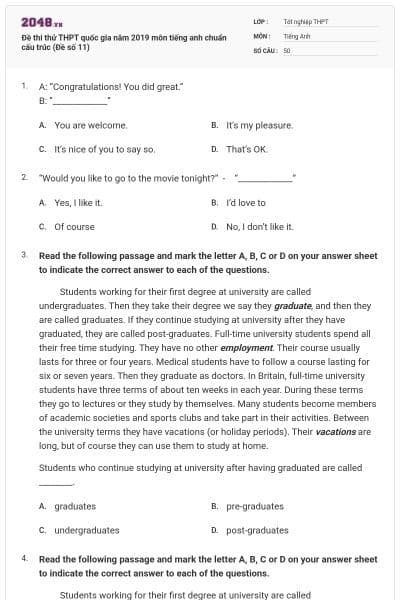
A: “Congratulations! You did great.”
B: “_____________”
You are welcome.
It’s my pleasure.
It’s nice of you to say so.
That’s OK.
Đáp án C
A: “Chúc mừng! Cậu làm tốt lắm.”
B: “Cậu thật tốt khi nói vậy.” (một cách đáp lại lời khen)
Các đáp án còn lại:
A. Có gì đâu (đáp lại lời cảm ơn)
B. Đó là vinh hạnh của tôi (đáp lại lời cảm ơn)
D. Không sao đâu/Vậy là ổn rồi.
“Would you like to go to the movie tonight?” - “_____________”
Yes, I like it.
I’d love to
Of course
No, I don’t like it.
Đáp án B
“Tối nay cậu muốn đi xem phim không?” - “Muốn chứ.” (I’d love to dùng để đáp lại lời mời)
Các đáp án còn lại:
A. Có, tớ thích nó.
C. Đương nhiên rồi.
D. Không, tớ không thích nó.
Read the following passage and mark the letter A, B, C or D on your answer sheet to indicate the correct answer to each of the questions.
Students working for their first degree at university are called undergraduates. Then they take their degree we say they graduate, and then they are called graduates. If they continue studying at university after they have graduated, they are called post-graduates. Full-time university students spend all their free time studying. They have no other employment. Their course usually lasts for three or four years. Medical students have to follow a course lasting for six or seven years. Then they graduate as doctors. In Britain, full-time university students have three terms of about ten weeks in each year. During these terms they go to lectures or they study by themselves. Many students become members of academic societies and sports clubs and take part in their activities. Between the university terms they have vacations (or holiday periods). Their vacations are long, but of course they can use them to study at home.
Students who continue studying at university after having graduated are called ________.
graduates
pre-graduates
undergraduates
post-graduates
Đáp án D
Sinh viên tiếp tục theo học tại đại học sau khi tốt nghiệp được gọi là ________.
A. cử nhân B. pre-graduates (từ này không có nghĩa)
C. sinh viên chưa tốt nghiệp D. nghiên cứu sinh
Câu 3: “If they continue studying at university after they have graduated, they are called post-graduates.”
Read the following passage and mark the letter A, B, C or D on your answer sheet to indicate the correct answer to each of the questions.
Students working for their first degree at university are called undergraduates. Then they take their degree we say they graduate, and then they are called graduates. If they continue studying at university after they have graduated, they are called post-graduates. Full-time university students spend all their free time studying. They have no other employment. Their course usually lasts for three or four years. Medical students have to follow a course lasting for six or seven years. Then they graduate as doctors. In Britain, full-time university students have three terms of about ten weeks in each year. During these terms they go to lectures or they study by themselves. Many students become members of academic societies and sports clubs and take part in their activities. Between the university terms they have vacations (or holiday periods). Their vacations are long, but of course they can use them to study at home.
The word “graduate” in line 2 is closest in meaning to __________.
finish studying
start studying
study
learn
Đáp án A
Từ “graduate” ở dòng 2 gần nghĩa nhất với _______
A. hoàn thành việc học
B. bắt đầu việc học
C, D. học
(to) graduate (v): tốt nghiệp ≈ hoàn thành việc học
Read the following passage and mark the letter A, B, C or D on your answer sheet to indicate the correct answer to each of the questions.
Students working for their first degree at university are called undergraduates. Then they take their degree we say they graduate, and then they are called graduates. If they continue studying at university after they have graduated, they are called post-graduates. Full-time university students spend all their free time studying. They have no other employment. Their course usually lasts for three or four years. Medical students have to follow a course lasting for six or seven years. Then they graduate as doctors. In Britain, full-time university students have three terms of about ten weeks in each year. During these terms they go to lectures or they study by themselves. Many students become members of academic societies and sports clubs and take part in their activities. Between the university terms they have vacations (or holiday periods). Their vacations are long, but of course they can use them to study at home.
According to the passage, the full-time university students have ________ of about 10 weeks in each year.
two terms
four terms
seven terms
three terms
Đáp án D
Theo như đoạn văn, sinh viên chính quy có _______ kéo dài khoảng 10 tuần mỗi năm.
A. 2 học kỳ B. 4 học kỳ C. 7 học kỳ D. 3 học kỳ
Ta có: “In Britain, full-time university students have three terms of about ten weeks in each year.”
Read the following passage and mark the letter A, B, C or D on your answer sheet to indicate the correct answer to each of the questions.
Students working for their first degree at university are called undergraduates. Then they take their degree we say they graduate, and then they are called graduates. If they continue studying at university after they have graduated, they are called post-graduates. Full-time university students spend all their free time studying. They have no other employment. Their course usually lasts for three or four years. Medical students have to follow a course lasting for six or seven years. Then they graduate as doctors. In Britain, full-time university students have three terms of about ten weeks in each year. During these terms they go to lectures or they study by themselves. Many students become members of academic societies and sports clubs and take part in their activities. Between the university terms they have vacations (or holiday periods). Their vacations are long, but of course they can use them to study at home.
The word “employment” in line 4 refers to the ________.
work
music
play
money
Đáp án A
Từ “employment” trong dòng 4 nói đến ________
A. công việc
B. âm nhạc
C. chơi đùa
D. tiền
Employment (n) ≈ work (n): công việc, việc làm
Read the following passage and mark the letter A, B, C or D on your answer sheet to indicate the correct answer to each of the questions.
Students working for their first degree at university are called undergraduates. Then they take their degree we say they graduate, and then they are called graduates. If they continue studying at university after they have graduated, they are called post-graduates. Full-time university students spend all their free time studying. They have no other employment. Their course usually lasts for three or four years. Medical students have to follow a course lasting for six or seven years. Then they graduate as doctors. In Britain, full-time university students have three terms of about ten weeks in each year. During these terms they go to lectures or they study by themselves. Many students become members of academic societies and sports clubs and take part in their activities. Between the university terms they have vacations (or holiday periods). Their vacations are long, but of course they can use them to study at home.
Medical students have to follow a course lasting for _________.
four to five years
only 4 years
six or seven years
about 5 years
Đáp án C
Sinh viên Y phải theo học khoá kéo dài ________.
A. 4 đến 5 năm
B. chỉ 4 năm
C. 6 đến 7 năm
D. khoảng 5 năm
Ta có: “Medical students have to follow a course lasting for six or seven years.”
Read the following passage and mark the letter A, B, C or D on your answer sheet to indicate the correct answer to each of the questions.
Students working for their first degree at university are called undergraduates. Then they take their degree we say they graduate, and then they are called graduates. If they continue studying at university after they have graduated, they are called post-graduates. Full-time university students spend all their free time studying. They have no other employment. Their course usually lasts for three or four years. Medical students have to follow a course lasting for six or seven years. Then they graduate as doctors. In Britain, full-time university students have three terms of about ten weeks in each year. During these terms they go to lectures or they study by themselves. Many students become members of academic societies and sports clubs and take part in their activities. Between the university terms they have vacations (or holiday periods). Their vacations are long, but of course they can use them to study at home.
The word “vacations” in line 9 could be best replaced by __________.
times
holidays
visits
picnics
Đáp án B
Từ “vacations” ở dòng 9 có thể được thay thế bởi _______.
A. lần B. kỳ nghỉ lễ C. chuyến thăm D. buổi dã ngoại
Vacation (n) ≈ Holiday (n): kỳ nghỉ
Read the following passage and mark the letter A, B, C or D on your answer sheet to indicate the correct answer to each of the questions.
Students working for their first degree at university are called undergraduates. Then they take their degree we say they graduate, and then they are called graduates. If they continue studying at university after they have graduated, they are called post-graduates. Full-time university students spend all their free time studying. They have no other employment. Their course usually lasts for three or four years. Medical students have to follow a course lasting for six or seven years. Then they graduate as doctors. In Britain, full-time university students have three terms of about ten weeks in each year. During these terms they go to lectures or they study by themselves. Many students become members of academic societies and sports clubs and take part in their activities. Between the university terms they have vacations (or holiday periods). Their vacations are long, but of course they can use them to study at home.
According to the passage, students working for their first degree at __________ are called undergraduates.
an university
laboratory
university
library
Đáp án C
Theo như đoạn văn, sinh viên học để lấy tấm bằng đầu tiên ở _______ được gị là sinh viên chưa tốt nghiệp.
A. đại học B. phòng thí nghiệm C. đại học D. thư viện
Theo ý câu đầu tiên, từ cần điền ở đây là đại học, nên loại B và D.
Đây là câu hỏi về kiến thức mạo từ a/an. Trong đó, từ university được phát âm /ˌjuː.nəˈvɝːsə.ti/, bắt đầu bằng phụ âm nên ta dùng mạo từ a.
Read the following passage and mark the letter A, B, C or D on your answer sheet to indicate the correct answer to each of the questions.
Students working for their first degree at university are called undergraduates. Then they take their degree we say they graduate, and then they are called graduates. If they continue studying at university after they have graduated, they are called post-graduates. Full-time university students spend all their free time studying. They have no other employment. Their course usually lasts for three or four years. Medical students have to follow a course lasting for six or seven years. Then they graduate as doctors. In Britain, full-time university students have three terms of about ten weeks in each year. During these terms they go to lectures or they study by themselves. Many students become members of academic societies and sports clubs and take part in their activities. Between the university terms they have vacations (or holiday periods). Their vacations are long, but of course they can use them to study at home.
Which of the following is NOT mentioned in the passage as full-time university students?
have other work
go to lectures
study by themselves
become members of sports clubs
Đáp án A
Điều nào sau đây không được nhắc đến khi nói về sinh viên chính quy?
A. có công việc khác bên ngoài B. đến học tại giảng đường
C. tự học D. làm thành viên câu lạc bộ thể thao
Khi nói về sinh viên chính quy tại đại học, tác giả có nhắc: “They have no other employment… they go to lectures or they study by themselves.
Many students become members of academic societies and sports clubs and take part in their activities.” (Họ không có công việc khác ở ngoài… họ đến học tại giảng đường hoặc tư học. Nhiều sinh viên trở thành thành viên các câu lạc bộ học tập hoặc thể thao và tham gia các hoạt động tại đó.)
Read the following passage and mark the letter A, B, C or D on your answer sheet to indicate the correct answer to each of the questions.
It is difficult to write rules that tell exactly when we should apologize, but it is not difficult to learn how. If we have done something to hurt someone’s feeling or if we have been impolite or rude, we should apologize. An apology indicates that we realize we have made a mistake, and we are sorry for it. It is a way of expressing our regret for something. When we apologize, we admit our wrongdoing, usually offer a reason for it, and express regret.
The simplest way to apologize is to say “I’m sorry”, but often that is not enough. Let’s take a common situation. Mario is late for class and enters the classroom, interrupting the teacher in the middle of the class. What does he do? The most polite action is usually to take a seat as quietly as possible and apologize later. But if the teacher stops and waits for him to say something, he could apologize simply “I’m sorry I’m late”, ask permission to take his seat, and sit down. Naturally, more than this, a reason for the tardiness, is needed, but this is not the time or the place for it because he has already caused one interruption and doesn’t need to make it any longer or worse than it already is.
When we apologize, ________
we express our sadness and unluckiness.
we realize our wrongdoing.
we express our happiness.
we admit our wrongdoing, offer a reason for it, and express regret.
Đáp án D
Khi xin lỗi, __________
A. ta bày tỏ nỗi buồn và sự bất hạnh.
B. ta nhận ra điều mình làm sai.
C. ta bày tỏ sự hạnh phúc.
D. ta thừa nhận việc mình làm sai, đưa ra lý do, và bày tỏ sự hối lỗi.
Câu cuối đoạn 1: “When we apologize, we admit our wrongdoing, usually offer a reason for it, and express regret.”
Read the following passage and mark the letter A, B, C or D on your answer sheet to indicate the correct answer to each of the questions.
It is difficult to write rules that tell exactly when we should apologize, but it is not difficult to learn how. If we have done something to hurt someone’s feeling or if we have been impolite or rude, we should apologize. An apology indicates that we realize we have made a mistake, and we are sorry for it. It is a way of expressing our regret for something. When we apologize, we admit our wrongdoing, usually offer a reason for it, and express regret.
The simplest way to apologize is to say “I’m sorry”, but often that is not enough. Let’s take a common situation. Mario is late for class and enters the classroom, interrupting the teacher in the middle of the class. What does he do? The most polite action is usually to take a seat as quietly as possible and apologize later. But if the teacher stops and waits for him to say something, he could apologize simply “I’m sorry I’m late”, ask permission to take his seat, and sit down. Naturally, more than this, a reason for the tardiness, is needed, but this is not the time or the place for it because he has already caused one interruption and doesn’t need to make it any longer or worse than it already is.
We should apologize _____________
when we feel tired and make mistake.
when we have been impolite, rude or done something to hurt someone’s feeling.
when we are angry with somebody about something.
when we are not happy or lose something.
Đáp án B
Ta nên xin lỗi ___________
A. khi mình thấy mệt và gây lỗi.
B. khi mình cư xử khiếm nhã, thô lỗ và làm tổn thương người khác.
C. khi mình tức giận với người khác về điều gì đó.
D. khi mình không vui hay làm mất thứ gì đó.
Câu 2 đoạn 1: “If we have done something to hurt someone’s feeling or if we have been impolite or rude, we should apologize.”
Read the following passage and mark the letter A, B, C or D on your answer sheet to indicate the correct answer to each of the questions.
It is difficult to write rules that tell exactly when we should apologize, but it is not difficult to learn how. If we have done something to hurt someone’s feeling or if we have been impolite or rude, we should apologize. An apology indicates that we realize we have made a mistake, and we are sorry for it. It is a way of expressing our regret for something. When we apologize, we admit our wrongdoing, usually offer a reason for it, and express regret.
The simplest way to apologize is to say “I’m sorry”, but often that is not enough. Let’s take a common situation. Mario is late for class and enters the classroom, interrupting the teacher in the middle of the class. What does he do? The most polite action is usually to take a seat as quietly as possible and apologize later. But if the teacher stops and waits for him to say something, he could apologize simply “I’m sorry I’m late”, ask permission to take his seat, and sit down. Naturally, more than this, a reason for the tardiness, is needed, but this is not the time or the place for it because he has already caused one interruption and doesn’t need to make it any longer or worse than it already is.
Is it difficult to learn how to apologize somebody?
Yes, it is
not difficult
No, it isn’t
No, hasn’t
Đáp án C
Học cách xin lỗi người khác có khó không?
A. Có, nó khó.
B. không khó
C. Không, nó không khó
D. Không, chưa từng
Câu 1 đoạn 1: “It is difficult to write rules that tell exactly when we should apologize, but it is not difficult to learn how.” (Rất khó để viết ra quy tắc quy định chính xác lúc nào nên xin lỗi, nhưng học cách xin lỗi ra sao lại không khó.)
Như vậy ta biết, câu trả lời cho câu hỏi này là không.
Vận dụng kiến thức cơ bản về cách trả lời câu hỏi Yes/No ta chọn được đáp án C.
Read the following passage and mark the letter A, B, C or D on your answer sheet to indicate the correct answer to each of the questions.
It is difficult to write rules that tell exactly when we should apologize, but it is not difficult to learn how. If we have done something to hurt someone’s feeling or if we have been impolite or rude, we should apologize. An apology indicates that we realize we have made a mistake, and we are sorry for it. It is a way of expressing our regret for something. When we apologize, we admit our wrongdoing, usually offer a reason for it, and express regret.
The simplest way to apologize is to say “I’m sorry”, but often that is not enough. Let’s take a common situation. Mario is late for class and enters the classroom, interrupting the teacher in the middle of the class. What does he do? The most polite action is usually to take a seat as quietly as possible and apologize later. But if the teacher stops and waits for him to say something, he could apologize simply “I’m sorry I’m late”, ask permission to take his seat, and sit down. Naturally, more than this, a reason for the tardiness, is needed, but this is not the time or the place for it because he has already caused one interruption and doesn’t need to make it any longer or worse than it already is.
The word “rude” in paragraph 1 could be best replaced by ________.
incorrect behavior
polite
correct behavior
good behavior
Đáp án A
Từ “rude” ở đoạn 1 có thể được thay thế bởi __________
A. cách hành xử sai lệch B. lịch sự
C. cách hành xử đúng D. cách hành xử tốt
Rude (adj): thô lỗ (đây là cách hành xử sai lệch), vậy chọn A.
Read the following passage and mark the letter A, B, C or D on your answer sheet to indicate the correct answer to each of the questions.
It is difficult to write rules that tell exactly when we should apologize, but it is not difficult to learn how. If we have done something to hurt someone’s feeling or if we have been impolite or rude, we should apologize. An apology indicates that we realize we have made a mistake, and we are sorry for it. It is a way of expressing our regret for something. When we apologize, we admit our wrongdoing, usually offer a reason for it, and express regret.
The simplest way to apologize is to say “I’m sorry”, but often that is not enough. Let’s take a common situation. Mario is late for class and enters the classroom, interrupting the teacher in the middle of the class. What does he do? The most polite action is usually to take a seat as quietly as possible and apologize later. But if the teacher stops and waits for him to say something, he could apologize simply “I’m sorry I’m late”, ask permission to take his seat, and sit down. Naturally, more than this, a reason for the tardiness, is needed, but this is not the time or the place for it because he has already caused one interruption and doesn’t need to make it any longer or worse than it already is.
Which of the following is NOT mentioned in the passage as the most polite action in Mario’s case?
keep quiet
apologize later
interrupt the teacher
take a seat
Đáp án C
Đâu không phải là hành động lịch sự nhất trong trường hợp của Mario như bài đọc đề cập?
A. giữ trật tự
B. xin lỗi sau
C. ngắt mạch giáo viên
D. ngồi vào chỗ
Trả lời cho câu hỏi “What does he do?” tác giả nói “The most polite action is usually to take a seat as quietly as possible and apologize later.”
Như vậy, giữ trật tự ngồi vào chỗ và xin lỗi sau là hành động lịch sự đơn giản nhất, còn việc ngắt mạch giáo viên là không phù hợp.
Read the following passage and mark the letter A, B, C or D on your answer sheet to indicate the correct answer to each of the questions.
It is difficult to write rules that tell exactly when we should apologize, but it is not difficult to learn how. If we have done something to hurt someone’s feeling or if we have been impolite or rude, we should apologize. An apology indicates that we realize we have made a mistake, and we are sorry for it. It is a way of expressing our regret for something. When we apologize, we admit our wrongdoing, usually offer a reason for it, and express regret.
The simplest way to apologize is to say “I’m sorry”, but often that is not enough. Let’s take a common situation. Mario is late for class and enters the classroom, interrupting the teacher in the middle of the class. What does he do? The most polite action is usually to take a seat as quietly as possible and apologize later. But if the teacher stops and waits for him to say something, he could apologize simply “I’m sorry I’m late”, ask permission to take his seat, and sit down. Naturally, more than this, a reason for the tardiness, is needed, but this is not the time or the place for it because he has already caused one interruption and doesn’t need to make it any longer or worse than it already is.
What is the simplest way to apologize?
We express our regret.
We said nothing.
We say “I’m sorry”.
We admit our wrongdoing.
Đáp án C
Cách đơn giản nhất để xin lỗi là?
A. Bày tỏ sự hối lỗi. B. Không nói gì hết.
C. Nói “Tôi xin lỗi”. D. Thừa nhận điều mình sai.
Câu 1 đoạn 2: The simplest way to apologize is to say “I’m sorry”.
Read the following passage and mark the letter A, B, C or D on your answer sheet to indicate the correct answer to each of the questions.
It is difficult to write rules that tell exactly when we should apologize, but it is not difficult to learn how. If we have done something to hurt someone’s feeling or if we have been impolite or rude, we should apologize. An apology indicates that we realize we have made a mistake, and we are sorry for it. It is a way of expressing our regret for something. When we apologize, we admit our wrongdoing, usually offer a reason for it, and express regret.
The simplest way to apologize is to say “I’m sorry”, but often that is not enough. Let’s take a common situation. Mario is late for class and enters the classroom, interrupting the teacher in the middle of the class. What does he do? The most polite action is usually to take a seat as quietly as possible and apologize later. But if the teacher stops and waits for him to say something, he could apologize simply “I’m sorry I’m late”, ask permission to take his seat, and sit down. Naturally, more than this, a reason for the tardiness, is needed, but this is not the time or the place for it because he has already caused one interruption and doesn’t need to make it any longer or worse than it already is.
It is ________ to write the rules that tell exactly when we should apologize.
common
simple
easy
difficult
Đáp án D
Rất _______ để viết ra quy tắc quy định chính xác lúc nào thì nên xin lỗi.
A. bình thường B. đơn giản C. dễ dàng D. khó
Câu đầu tiên trong bài đọc: “It is difficult to write rules that tell exactly when we should apologize…”
Mark the letter A, B, C, D on your answer sheet to indicate the word that differs from the rest in the position of the main stress.
support
project
believe
secure
Đáp án B
Trọng âm rơi vào âm tiết 1, các đáp án còn lại trọng âm rơi vào âm tiết 2
A. support /səˈpɔːrt/: ủng hộ, hỗ trợ
B. project /ˈprɑːdʒekt/: dự án (trong trường hợp project làm danh từ, trọng âm của nó rơi vào âm tiết 1, nếu đóng vai trò động từ nó mang nghĩa dự kiến, làm đề án và trọng âm rơi vào âm tiết 2 /prəˈdʒekt/)
C. believe /bɪˈliːv/: tin tưởng
D. secure /səˈkjʊr/: an toàn, bảo mật
Mark the letter A, B, C, D on your answer sheet to indicate the word that differs from the rest in the position of the main stress.
physical
cinema
September
carefully
Đáp án C
Trọng âm rơi vào âm tiết 2, các đáp án còn lại trọng âm rơi vào âm tiết 1
A. physical /ˈfɪzɪkəl/: thuộc về thể chất
B. cinema /ˈsɪnəmə/: rạp chiếu phim
C. September /sepˈtembɚ/: Tháng 9
D. carefully /ˈkerfəli/: một cách cẩn thận
Mark the letter A, B, C or D on your answer sheet to indicate the word of phrase that is CLOSEST in meaning to the underlined part in each of the following question.
Billy attempted to win a place at university.
enjoyed
tried
felt like
wanted
Đáp án B
(to) attempt ≈ (to) try: cố gắng, nỗ lực để đạt được điều gì
Các đáp án còn lại:
A. (to) enjoy (v): tận hưởng
C. (to) feel like doing something: thích làm điều gì
D. (to) want (v): muốn
Dịch nghĩa: Billy cố gắng để đậu đại học.
Mark the letter A, B, C or D on your answer sheet to indicate the word of phrase that is CLOSEST in meaning to the underlined part in each of the following question.
Love is supposed to follow marriage, not precede it.
come late
come before
come later
come after
Đáp án B
(to) precede ≈ (to) come before: đi trước, có trước
Các đáp án còn lại:
A. (to) come late: đến muộn
C. (to) come later: đến sau, muộn hơn
D. (to) come after: đến sau
Dịch nghĩa: Tình yêu nảy sinh sau khi kết hôn, không phải có trước đó
Read the following passage and mark the letter A, B, C or D on your answer sheet to indicate the correct word for each of the blanks.
These days, most people in Britain and the US do not (22) ______ very formal clothes. But sometimes it is important to wear the right thing.
Many British people don't think (23) ______ clothes very much. They just like to be comfortable. When they go out to enjoy themselves, they can wear almost anything. At theatres, cinemas and concerts you can put on (24) ______ you like from elegant suits and dresses to jeans and sweaters. Anything goes, as long as you (25) _____ clean and tidy.
But in Britain, as well as in the US, men in offices usually wear suits and ties, and women wear dresses or skirts (not trousers). Doctors, lawyers and business people wear quite formal clothes. And in (26) ______ hotels and restaurants men have to wear ties and women wear smart dresses.
Điền vào số (22)
sell
buy
wear
know
Đáp án C
(to) wear (clothes): mặc (quần áo)
Read the following passage and mark the letter A, B, C or D on your answer sheet to indicate the correct word for each of the blanks.
These days, most people in Britain and the US do not (22) ______ very formal clothes. But sometimes it is important to wear the right thing.
Many British people don't think (23) ______ clothes very much. They just like to be comfortable. When they go out to enjoy themselves, they can wear almost anything. At theatres, cinemas and concerts you can put on (24) ______ you like from elegant suits and dresses to jeans and sweaters. Anything goes, as long as you (25) _____ clean and tidy.
But in Britain, as well as in the US, men in offices usually wear suits and ties, and women wear dresses or skirts (not trousers). Doctors, lawyers and business people wear quite formal clothes. And in (26) ______ hotels and restaurants men have to wear ties and women wear smart dresses.
Điền vào số (23)
on
at
to
about
Đáp án D
Câu hỏi giới từ
(to) think about: nghĩ về vấn đề gì
Read the following passage and mark the letter A, B, C or D on your answer sheet to indicate the correct word for each of the blanks.
These days, most people in Britain and the US do not (22) ______ very formal clothes. But sometimes it is important to wear the right thing.
Many British people don't think (23) ______ clothes very much. They just like to be comfortable. When they go out to enjoy themselves, they can wear almost anything. At theatres, cinemas and concerts you can put on (24) ______ you like from elegant suits and dresses to jeans and sweaters. Anything goes, as long as you (25) _____ clean and tidy.
But in Britain, as well as in the US, men in offices usually wear suits and ties, and women wear dresses or skirts (not trousers). Doctors, lawyers and business people wear quite formal clothes. And in (26) ______ hotels and restaurants men have to wear ties and women wear smart dresses.
Điền vào số (24)
what
why
who
whom
Đáp án A
What – chỉ sự vật, sự việc
Why – chỉ lý do
Who – chỉ người
Whom – chỉ người, làm tân ngữ
Ở đây, danh từ được nói đến là clothes nói chung – chỉ sự vật, nên ta dùng what.
Read the following passage and mark the letter A, B, C or D on your answer sheet to indicate the correct word for each of the blanks.
These days, most people in Britain and the US do not (22) ______ very formal clothes. But sometimes it is important to wear the right thing.
Many British people don't think (23) ______ clothes very much. They just like to be comfortable. When they go out to enjoy themselves, they can wear almost anything. At theatres, cinemas and concerts you can put on (24) ______ you like from elegant suits and dresses to jeans and sweaters. Anything goes, as long as you (25) _____ clean and tidy.
But in Britain, as well as in the US, men in offices usually wear suits and ties, and women wear dresses or skirts (not trousers). Doctors, lawyers and business people wear quite formal clothes. And in (26) ______ hotels and restaurants men have to wear ties and women wear smart dresses.
Điền vào số (25)
looks
look
is looking
has looked
Đáp án B
Chủ ngữ là you, động từ theo sau không thể chia ở dạng ngôi thứ 3 số ít. Chỉ có look là phù hợp.
Read the following passage and mark the letter A, B, C or D on your answer sheet to indicate the correct word for each of the blanks.
These days, most people in Britain and the US do not (22) ______ very formal clothes. But sometimes it is important to wear the right thing.
Many British people don't think (23) ______ clothes very much. They just like to be comfortable. When they go out to enjoy themselves, they can wear almost anything. At theatres, cinemas and concerts you can put on (24) ______ you like from elegant suits and dresses to jeans and sweaters. Anything goes, as long as you (25) _____ clean and tidy.
But in Britain, as well as in the US, men in offices usually wear suits and ties, and women wear dresses or skirts (not trousers). Doctors, lawyers and business people wear quite formal clothes. And in (26) ______ hotels and restaurants men have to wear ties and women wear smart dresses.
Điền vào số (26)
one
little
a
some
Đáp án D
Danh từ phía sau (hotels, restaurants) chia ở dạng số nhiều nên không thể dùng a, one hay little
Mark the letter A, B, C, D on your answer sheet to indicate the word whose underline is pronounced differently from the rest.
books
roots
tables
roofs
Đáp án C
Phần được gạch chân phát âm là /z/, các đáp án còn lại phần được gạch chân phát âm là /s/
Cách phát âm đuôi “s/es”
- Phát âm là /s/ khi từ có tận cùng bằng các phụ âm vô thanh: /ð/, /p/, /k/, /f/, /t/.
- Phát âm là /iz/ khi từ có tận cùng là các âm: /s/, /z/, /ʃ/, /tʃ/, /ʒ/, /dʒ/.
- Phát âm là /z/ khi các từ có tận cùng là nguyên âm và các phụ âm hữu thanh còn lại.
Mark the letter A, B, C, D on your answer sheet to indicate the word whose underline is pronounced differently from the rest.
stopped
played
packed
parked
Đáp án B
Phần được gạch chân phát âm là /d/, các đáp án còn lại phần được gạch chân phát âm là /t/
Cách phát âm “ed”
- Đuôi “ed” được phát âm là /id/: khi động từ có phát âm kết thúc là /t/ hay /d/.
- Đuôi ed được phát âm là /t/: Khi động từ có phát âm kết thúc là: /ch/, /p/, /f/, /s/, /k/, /th/, /ʃ/, /t ʃ/.
- Đuôi ed được phát âm là /d/ trong các trường hợp còn lại.
Mark the letter A, B, C or D on your answer sheet to indicate the sentence that is closest in meaning to each of the following questions.
“We’ll go camping as long as the weather is good."
If the weather is fine, we will go camping.
The weather is good when we will go camping.
If the weather is better, we will go camping.
We’ll go camping immediately the weather is good.
Đáp án A
“Chúng tôi sẽ đi cắm trại miễn là thời tiết tốt.”
= Nếu thời tiết tốt, chúng tôi sẽ đi cắm trại.
Fine = good (adj): tốt, đẹp
Các đáp án còn lại:
B. Thời tiết tốt khi chúng tôi sẽ đi cắm trại.
C. Nếu thời tiết tốt hơn, chúng tôi sẽ đi cắm trại.
D. Chúng tôi sẽ đi cắm trại ngay khi thời tiết tốt.
Mark the letter A, B, C or D on your answer sheet to indicate the sentence that is closest in meaning to each of the following questions.
They could have taken the car to the garage today.
The car have been taken to the garage today.
The car could have been taken to the garage today.
The car could have been took to the garage today.
The car could be have taken to the garage today.
Đáp án B
Họ hắn đã đem xe đến ga-ra hôm nay rồi.
= Chiếc xe hẳn đã được đem tới ga-ra hôm nay rồi.
Chuyển từ câu chủ động sang câu bị động, câu gốc dùng could have + Vpp thì câu viết lại chuyển thành could have been + Vpp
Các đáp án còn lại dùng sai cấu trúc
Mark the letter A, B, C or D on your answer sheet to indicate the sentence that is closest in meaning to each of the following questions.
“Where were you last night, Mr. Jenkins?” he said.
He wanted to know where Mr. Jenkins was the night before.
He asked Mr. Jenkins where was he last night.
He wanted to know where Mr. Jenkins had been the following night.
He asked Mr. Jenkins where he had been the previous night.
Đáp án D
“Tối qua ông ở đâu vậy, ông Jenkins?” anh ta hỏi.
= Anh ta hỏi ông Jenkins xem ông ấy đã ở đâu vào tối qua.
Khi chuyển sang câu tường thuật, động từ trong câu gốc thường phải lùi thì, cụ thể ở đây là were -> had been.
Các từ như last, next, now, ... -> the previous, the following, then, ...
Các đáp án còn lại sai vì:
A. Chưa lùi thì
B. Chưa lùi thì, chưa chuyển last night -> the night before/the previous night
C. Dùng the following night là sai.
Mark the letter A, B, C or D on your answer sheet to indicate the sentence that best combines each pair of sentences in the following questions.
Jim is my best friend. I borrowed his car yesterday.
Jim, whose car I borrowed yesterday, is my best friend.
Jim, who is my best friend, borrowed my car yesterday.
Jim, whose car I borrowed yesterday is my best friend.
Jim, whose car I lent yesterday, is my best friend.
Đáp án A
Jim là bạn tốt nhất của tôi. Tôi mượn xe cậu ấy hôm qua.
= Jim, chủ chiếc xe tôi mượn hôm qua, là bạn tốt nhất của tôi.
Đây là mệnh đề quan hệ không xác định do không có nó thì câu vẫn có nghĩa. Mệnh đề quan hệ không xác định được tách với mệnh đề chính bằng các dấu phẩy đứng trước và sau nó. Do đó ta chọn A thay vì C.
Các đáp án còn lại:
B. Jim, bạn tốt nhất của tôi, mượn xe tôi hôm qua.
C. Sai cấu trúc.
D. Jim, chủ chiếc xe tôi cho mượn hôm qua, là bạn tốt nhất của tôi.
Mark the letter A, B, C or D on your answer sheet to indicate the sentence that best combines each pair of sentences in the following questions.
The room is cold. They leave the door open.
If they didn’t leave the door open, the room would be cold.
If they closed the door, the room will be hot.
If they close the door, the room will be cold.
If they closed the door, the room wouldn’t be cold.
Đáp án D
Căn phòng lạnh. Họ đã để cửa sổ mở. = Nếu họ đóng cửa sổ, căn phòng sẽ không lạnh.
Dùng câu điều kiện loại 2, chỉ sự việc không có thật ở hiện tại và kết quả giả định của nó.
Các đáp án còn lại:
A. Nếu họ không để cửa số mở, căn phòng sẽ lạnh.
B. Nếu họ đóng cửa sổ, căn phòng sẽ nóng.
C. Nếu họ đóng cửa sổ, căn phòng sẽ lạnh.
I _______ there once a long time ago and ________ back since.
have gone/was
go/am not
was going/had not been
went/have not been
Đáp án D
Vế đầu ta xác định thì quá khứ đơn nhờ từ ago, vế sau ta xác định thì hiện tại hoàn thành nhờ từ since.
Dịch nghĩa: Tôi từng tới đó cách đây khá lâu và đó giờ vẫn chưa quay lại
The students ________ by Mrs. Monty. However, this week they ________ by Mr. Tanzer.
have usually been taught / have been teaching
usually teach / are teaching
were usually teaching / are teaching
are usually taught / are being t
Đáp án D
Vế trước là sự thật hiển nhiên, điều diễn ra thông thường nên dùng hiện tại đơn.
Vế sau là sự việc đang diễn ra trong thời điểm cụ thể là trong tuần này, và không theo như thường lệ nên ta dùng thì hiện tại tiếp diễn.
Dịch nghĩa: Học sinh thường thì được dạy bởi cô Monty. Nhưng tuần này, chúng đang được thầy Tanzer dạy.
Can you tell me who is responsible ________ checking passports?
at
for
about
to
Đáp án B
Câu hỏi giới từ
(to) be responsible for: có trách nhiệm với việc gì
Dịch nghĩa: Anh có thể chỉ tôi người chịu trách nhiệm kiểm tra hộ chiếu được không?
It was ________ of you to leave the medicine where the children could get it.
caring
care
careless
careful
Đáp án C
(to) be careless (adj): bất cẩn
Các đáp án còn lại:
A. chu đáo, quan tâm B. quan tâm D. cẩn thận
Dịch nghĩa: Bạn thật bất cẩn khi để thuốc trong tầm với của bọn trẻ.
Most children would prefer _______ with their parents and siblings.
play
played
playing
to play
Đáp án D
Would prefer + to-V: thích làm gì
Dịch nghĩa: Hầu hết bọn trẻ thích chơi với bố mẹ và anh chị em của chúng.
I will return Bob’s pen to him the next time I ______ him.
see
have seen
will see
will have seen
Đáp án A
Ở đây cụm the next time mang nghĩa tương đương when. Để nói về một thời điểm trong tương lai, ta dùng When + S + V, trong đó verb được chia theo thì hiện tại.
Dịch nghĩa: Tôi sẽ trả bút cho Bob vào lần gặp tới.
Many young people have objected to _________ marriage, which is decided by the parents of the bride and groom.
shared
agreed
sacrificed
contractual
Đáp án D
Contractual marriage (n): hôn ước (thường là cha mẹ đặt đâu con ngồi đấy)
Dịch nghĩa: Nhiều người trẻ phản đối việc kết hôn theo hôn ước, kiểu hôn nhân được ước định bởi cha mẹ của cô dâu và chú rể.
We needed some snow; so we _______ our minds to go abroad.
set in
made up
turned out
brought into
Đáp án B
(to) make up one’s mind: quyết định
Các đáp án còn lại:
A. (to) set in: bắt đầu
C (to) turn out: hoá ra, thành ra
D. (to) bring into: đưa vào, đề cập đến
Dịch nghĩa: Chúng tôi muốn thấy tuyết rơi, nên đã quyết tâm ra nước ngoài
If you heat water to 100˚C, it _______.
boil
boils
will boils
shall boil
Đáp án B
Đây là điều kiện loại 0, chỉ sự thật tổng quan, mang tính khoa học.
Cấu trúc: If + S1 + V(s/es), S2 + V(s/es)
Nước sôi ở 100˚C là sự thật hiển nhiên, nên ta dùng thì hiện tại đơn.
Dịch nghĩa: Nếu bạn đun nước tới 100˚C, nó sôi.
Had they learnt English well, they _______ the scholarship to learn in England.
got
would get
would have got
will get
Đáp án C
Đảo ngữ câu điều kiện loại 3.
Cấu trúc: Had + S + Vpp, S + would/could + have + Vpp
Dịch nghĩa: Nếu học Tiếng Anh tốt, họ đã có thể giành học bổng sang Anh du học.
Ba said that he _______ early the next day.
will set off
set off
had set off
would set off
Đáp án D
Trong câu tường thuật, will -> would
Câu gốc có thể là: “I will set off early tomorrow”, Ba said.
Và ta viết lại thành: Ba said that he would set off early the next day.
Dịch nghĩa: Ba nói cậu ấy sẽ khởi hành sớm vào hôm sau
This is Henry, _________ works for your father.
who
A&D are correct
whom
that
Đáp án A
Who – đại từ quan hệ thay thế cho danh từ chỉ người, làm chủ ngữ trong câu Whom – đại từ quan hệ thay thế cho danh từ chỉ người, làm tân ngữ trong câu
That – đạ từ quan hệ thay thế cho danh từ chỉ người, vật, không dùng trong MĐQH không xác định
Đây là MĐQH không xác định, và đối tượng được thay thế làm chủ ngữ trong câu, nên ta dùng who.
Dịch nghĩa: Đây là Henry, nhân viên của bố cậu.
Mark the letter A, B, C or D on your answer sheet to indicate the word of phrase that is OPPOSITE in meaning to the underlined part in each of the following question.
Schooling is compulsory for all English children from the age of 5 to 16.
optional
required
difficult
cheap
Đáp án A
Compulsory (adj): bắt buộc >< optional (adj): tuỳ ý, tự chọn
Các đáp án còn lại:
B. required (adj): cần thiết
C. difficult (adj): khó
D. cheap (adj): rẻ
Dịch nghĩa: Giáo dục là bắt buộc đối với tất cả trẻ em từ 5-16 tuổi tại Anh.
Mark the letter A, B, C or D on your answer sheet to indicate the word of phrase that is OPPOSITE in meaning to the underlined part in each of the following question.
The people at the party were busy playing some games.
doing something
free
eager
making something
Đáp án B
Busy (adj): bận rộn >< free (adj): rảnh rỗi
Các đáp án còn lại:
A. doing something: làm gì đó
C. eager (adj): háo hức
D. making something: tạo ra thứ gì đó
Dịch nghĩa: Mọi người tại bữa tiệc đều bận vui chơi
Mark the letter A, B, C, D on your answer sheet to show the underlined part that needs correction.
I said when Mary went to live in the capital.
said
went
to
the capital
Đáp án A
Sửa: said -> asked
Có từ để hỏi when, nên động từ được dùng phải là ask.
Dịch nghĩa: Tôi hỏi xem lúc nào thì Mary chuyển tới sống ở thủ đô
Mark the letter A, B, C, D on your answer sheet to show the underlined part that needs correction.
My new student is being interviewing by a foreigner .
new student
being
interviewing
foreigner
Đáp án C
Sửa: interviewing -> interviewed
Câu bị động, động từ phải được đưa về dạng quá khứ phân từ.
Dịch nghĩa: Học sinh mới của tôi đang được một người ngoại quốc phỏng vấn.
Mark the letter A, B, C, D on your answer sheet to show the underlined part that needs correction.
They worked as receptionists in this hotel since they graduated from university in 2009.
worked
as receptionists
graduated
in 2009
Đáp án A
Sửa: worked -> have worked/have been working
Xác định thì hiện tại hoàn thành (tiếp diễn) dựa vào từ since.
Dịch nghĩa: Họ làm lễ tân tại khách sạn này từ thời tốt nghiệp đại học năm 2009