Đề thi thử THPT quốc gia năm 2019 môn tiếng anh chuẩn cấu trúc (Đề số 1)
50 câu hỏi
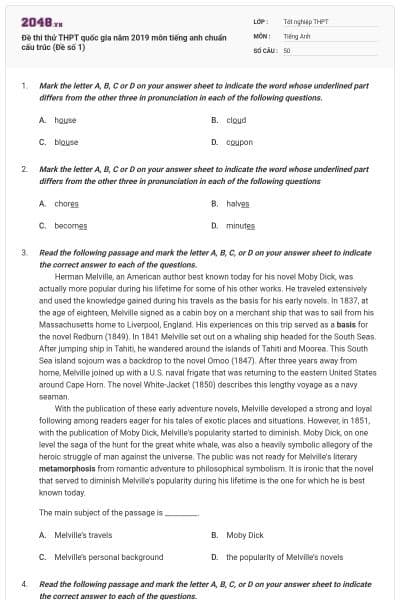
Mark the letter A, B, C or D on your answer sheet to indicate the word whose underlined part differs from the other three in pronunciation in each of the following questions.
house
cloud
blouse
coupon
Đáp án D
House /haʊs/ nhà
Cloud /klaʊd/ mây
Blouse /blaʊs/ áo phông trắng cho nữ
Coupon /ˈkuːpɒn/ phiếu mua hàng
Phương án D có phần gạch chân phát âm là /uː/, các phương án còn lại phát âm là /aʊ
Mark the letter A, B, C or D on your answer sheet to indicate the word whose underlined part differs from the other three in pronunciation in each of the following questions
chores
halves
becomes
minutes
Đáp án D
Chores /tʃɔːrz/ việc nhà
Halves /hɑːvz/ nhiều cái một nửa
Becomes /bɪˈkʌmz/ trở thành
Minutes /ˈmɪnɪts/ nhiều phút
Phương án D có phần gạch chân phát âm là /s/, các phương án còn lại phát âm là /z/.
Read the following passage and mark the letter A, B, C, or D on your answer sheet to indicate the correct answer to each of the questions.
Herman Melville, an American author best known today for his novel Moby Dick, was actually more popular during his lifetime for some of his other works. He traveled extensively and used the knowledge gained during his travels as the basis for his early novels. In 1837, at the age of eighteen, Melville signed as a cabin boy on a merchant ship that was to sail from his Massachusetts home to Liverpool, England. His experiences on this trip served as a basis for the novel Redburn (1849). In 1841 Melville set out on a whaling ship headed for the South Seas. After jumping ship in Tahiti, he wandered around the islands of Tahiti and Moorea. This South Sea island sojourn was a backdrop to the novel Omoo (1847). After three years away from home, Melville joined up with a U.S. naval frigate that was returning to the eastern United States around Cape Horn. The novel White-Jacket (1850) describes this lengthy voyage as a navy seaman.
With the publication of these early adventure novels, Melville developed a strong and loyal following among readers eager for his tales of exotic places and situations. However, in 1851, with the publication of Moby Dick, Melville's popularity started to diminish. Moby Dick, on one level the saga of the hunt for the great white whale, was also a heavily symbolic allegory of the heroic struggle of man against the universe. The public was not ready for Melville's literary metamorphosis from romantic adventure to philosophical symbolism. It is ironic that the novel that served to diminish Melville's popularity during his lifetime is the one for which he is best known today.
The main subject of the passage is _________.
Melville’s travels
Moby Dick
Melville’s personal background
the popularity of Melville’s novels
Đáp án D
Câu đầu tiên của đoạn văn cho ta biết chủ đề của bài: Herman Melville, an American author best known today for his novel Moby Dick, was actually more popular during his lifetime for some of his other works. (Herman Melvile, một tác gia người Mỹ, ngày nay nổi tiếng vì cuốn tiểu thuyết Moby Dick, thực ra lại được biết đến nhiều hơn nhờ những tác phẩm khác trong thời mà ông còn sống).
Và các đoạn sau, bài viết nói về các tác phẩm của ông. Các chuyến đi dù có được nhắc đến nhưng chỉ được nhắc đến như là cơ sở để ông viết văn, chứ không phải đoạn văn miêu tả hay kể về chuyến đi đó.
Nếu lấy nhan đề là Moby Dick, một tác phẩm của ông, thì đây chỉ là một chi tiết nhỏ, không đủ bao quát tác phẩm. Nếu lấy nhan đề là nền tảng cá nhân thì cũng không được vì trong bài không nhắc đến những tính chất này ngoài những chuyến đi.
Read the following passage and mark the letter A, B, C, or D on your answer sheet to indicate the correct answer to each of the questions.
Herman Melville, an American author best known today for his novel Moby Dick, was actually more popular during his lifetime for some of his other works. He traveled extensively and used the knowledge gained during his travels as the basis for his early novels. In 1837, at the age of eighteen, Melville signed as a cabin boy on a merchant ship that was to sail from his Massachusetts home to Liverpool, England. His experiences on this trip served as a basis for the novel Redburn (1849). In 1841 Melville set out on a whaling ship headed for the South Seas. After jumping ship in Tahiti, he wandered around the islands of Tahiti and Moorea. This South Sea island sojourn was a backdrop to the novel Omoo (1847). After three years away from home, Melville joined up with a U.S. naval frigate that was returning to the eastern United States around Cape Horn. The novel White-Jacket (1850) describes this lengthy voyage as a navy seaman.
With the publication of these early adventure novels, Melville developed a strong and loyal following among readers eager for his tales of exotic places and situations. However, in 1851, with the publication of Moby Dick, Melville's popularity started to diminish. Moby Dick, on one level the saga of the hunt for the great white whale, was also a heavily symbolic allegory of the heroic struggle of man against the universe. The public was not ready for Melville's literary metamorphosis from romantic adventure to philosophical symbolism. It is ironic that the novel that served to diminish Melville's popularity during his lifetime is the one for which he is best known today.
The word “basis” in paragraph 1 is closest in meaning to _________.
background
message
bottom
dissertation
Đáp án A
Background: nền tảng
Message: thông điệp
Bottom: đáy
Dissertation: luận án
Ở đoạn 1: His experiences on this trip served as a basis for the novel Redburn (1849). (Những trải nghiệm trên chuyến tàu này chính là nền tảng cho cuốn tiểu thuyết Redburn (1849)).
Như vậy, từ basis có thể thay thế tốt nhất bằng từ background
Read the following passage and mark the letter A, B, C, or D on your answer sheet to indicate the correct answer to each of the questions.
Herman Melville, an American author best known today for his novel Moby Dick, was actually more popular during his lifetime for some of his other works. He traveled extensively and used the knowledge gained during his travels as the basis for his early novels. In 1837, at the age of eighteen, Melville signed as a cabin boy on a merchant ship that was to sail from his Massachusetts home to Liverpool, England. His experiences on this trip served as a basis for the novel Redburn (1849). In 1841 Melville set out on a whaling ship headed for the South Seas. After jumping ship in Tahiti, he wandered around the islands of Tahiti and Moorea. This South Sea island sojourn was a backdrop to the novel Omoo (1847). After three years away from home, Melville joined up with a U.S. naval frigate that was returning to the eastern United States around Cape Horn. The novel White-Jacket (1850) describes this lengthy voyage as a navy seaman.
With the publication of these early adventure novels, Melville developed a strong and loyal following among readers eager for his tales of exotic places and situations. However, in 1851, with the publication of Moby Dick, Melville's popularity started to diminish. Moby Dick, on one level the saga of the hunt for the great white whale, was also a heavily symbolic allegory of the heroic struggle of man against the universe. The public was not ready for Melville's literary metamorphosis from romantic adventure to philosophical symbolism. It is ironic that the novel that served to diminish Melville's popularity during his lifetime is the one for which he is best known today.
According to the passage, Melville’s early novels were __________.
published while he was traveling
completely fictional
all about his work on whaling ship
based on his travel experience
Đáp án D
Dịch: Theo bài viết, những cuốn tiểu thuyết đầu tiên của Melville
A. Được xuất bản khi ông đang trên đường di chuyển
B. Hoàn toàn là viễn tưởng
C. Tất cả đều là về công việc của ông khi còn trên tàu đánh cá voi
D. Dựa vào kinh nghiệm trong những chuyến đi của ông
Thông tin nằm ở đoạn 1: He travelled extensively and used the knowledge gathered during his travels as the basis for his early novels. (Ông đi rất nhiều và sử dụng kiến thức thu lượm được trong những chuyến đi để làm nền tảng cho những cuốn tiểu thuyết đầu tiên)
Read the following passage and mark the letter A, B, C, or D on your answer sheet to indicate the correct answer to each of the questions.
Herman Melville, an American author best known today for his novel Moby Dick, was actually more popular during his lifetime for some of his other works. He traveled extensively and used the knowledge gained during his travels as the basis for his early novels. In 1837, at the age of eighteen, Melville signed as a cabin boy on a merchant ship that was to sail from his Massachusetts home to Liverpool, England. His experiences on this trip served as a basis for the novel Redburn (1849). In 1841 Melville set out on a whaling ship headed for the South Seas. After jumping ship in Tahiti, he wandered around the islands of Tahiti and Moorea. This South Sea island sojourn was a backdrop to the novel Omoo (1847). After three years away from home, Melville joined up with a U.S. naval frigate that was returning to the eastern United States around Cape Horn. The novel White-Jacket (1850) describes this lengthy voyage as a navy seaman.
With the publication of these early adventure novels, Melville developed a strong and loyal following among readers eager for his tales of exotic places and situations. However, in 1851, with the publication of Moby Dick, Melville's popularity started to diminish. Moby Dick, on one level the saga of the hunt for the great white whale, was also a heavily symbolic allegory of the heroic struggle of man against the universe. The public was not ready for Melville's literary metamorphosis from romantic adventure to philosophical symbolism. It is ironic that the novel that served to diminish Melville's popularity during his lifetime is the one for which he is best known today.
The passage implies that Melville stayed in Tahiti because ___________.
he had unofficially left his ship
he was on leave while his ship was in port
he had finished his term of duty
he had received permission to take a vacation in Tahiti
Đáp án A
Dịch: Bài viết ngụ ý rằng Melvile đã ở tại Tahiti vì
A. Ông ấy đã rời con tàu một cách không chính thức
B. Ông ấy đi khi con tàu ở cảng
C. Ông ấy đã hoàn thành trách nhiệm của đội
D. Ông ấy đã nhận được sự cho phép để đi nghỉ ở Tahiti
Thông tin nằm ở đoạn 1: After jumping ship in Tahiti, he wandered around the islands of Tahiti and Moorea. (Sau khi nhảy khỏi tàu ở Tahiti, ông ấy đi loanh quanh khắp các đảo ở Tahiti và Moorea).
Các ý trong B, C, D không hề được đề cập trong bài
Read the following passage and mark the letter A, B, C, or D on your answer sheet to indicate the correct answer to each of the questions.
Herman Melville, an American author best known today for his novel Moby Dick, was actually more popular during his lifetime for some of his other works. He traveled extensively and used the knowledge gained during his travels as the basis for his early novels. In 1837, at the age of eighteen, Melville signed as a cabin boy on a merchant ship that was to sail from his Massachusetts home to Liverpool, England. His experiences on this trip served as a basis for the novel Redburn (1849). In 1841 Melville set out on a whaling ship headed for the South Seas. After jumping ship in Tahiti, he wandered around the islands of Tahiti and Moorea. This South Sea island sojourn was a backdrop to the novel Omoo (1847). After three years away from home, Melville joined up with a U.S. naval frigate that was returning to the eastern United States around Cape Horn. The novel White-Jacket (1850) describes this lengthy voyage as a navy seaman.
With the publication of these early adventure novels, Melville developed a strong and loyal following among readers eager for his tales of exotic places and situations. However, in 1851, with the publication of Moby Dick, Melville's popularity started to diminish. Moby Dick, on one level the saga of the hunt for the great white whale, was also a heavily symbolic allegory of the heroic struggle of man against the universe. The public was not ready for Melville's literary metamorphosis from romantic adventure to philosophical symbolism. It is ironic that the novel that served to diminish Melville's popularity during his lifetime is the one for which he is best known today.
How did the publication of Moby Dick affect Melville’s popularity?
His popularity remained as strong as ever
It caused his popularity to decrease
His popularity increased immediately.
It had no effect on his popularity.
Đáp án B
Dịch: Việc xuất bản tác phẩm Moby Dick đã ảnh hưởng đến sự nổi tiếng của Malvile như thế nào?
A. Sự nổi tiếng đó vẫn y nguyên như trước đây
B. Nó khiến cho sự nổi tiếng tụt giảm
C. Sự nổi tiếng của ông tăng ngay lập tức
D. Nó không có ảnh hưởng gì đến sự nổi tiếng của ông
Thông tin nằm ở đoạn 2: However, in 1851, with the publication of Moby Dick, Melville's popularity started to diminish. (Tuy nhiên, vào năm 1851, với sự xuất bản của Moby Dick thì sự nổi tiếng của Melvile bắt đầu giảm xuống).
Diminish: giảm
Read the following passage and mark the letter A, B, C, or D on your answer sheet to indicate the correct answer to each of the questions.
Herman Melville, an American author best known today for his novel Moby Dick, was actually more popular during his lifetime for some of his other works. He traveled extensively and used the knowledge gained during his travels as the basis for his early novels. In 1837, at the age of eighteen, Melville signed as a cabin boy on a merchant ship that was to sail from his Massachusetts home to Liverpool, England. His experiences on this trip served as a basis for the novel Redburn (1849). In 1841 Melville set out on a whaling ship headed for the South Seas. After jumping ship in Tahiti, he wandered around the islands of Tahiti and Moorea. This South Sea island sojourn was a backdrop to the novel Omoo (1847). After three years away from home, Melville joined up with a U.S. naval frigate that was returning to the eastern United States around Cape Horn. The novel White-Jacket (1850) describes this lengthy voyage as a navy seaman.
With the publication of these early adventure novels, Melville developed a strong and loyal following among readers eager for his tales of exotic places and situations. However, in 1851, with the publication of Moby Dick, Melville's popularity started to diminish. Moby Dick, on one level the saga of the hunt for the great white whale, was also a heavily symbolic allegory of the heroic struggle of man against the universe. The public was not ready for Melville's literary metamorphosis from romantic adventure to philosophical symbolism. It is ironic that the novel that served to diminish Melville's popularity during his lifetime is the one for which he is best known today.
According to the passage, Moby Dick is __________.
symbolic of humanity fighting the universe
a single-faceted work
a short story about a whale
a 47 adventure
Đáp án A
Dịch: Theo bài viết, Moby Dick là
A. Biểu tượng cho việc con người chống lại vũ trụ
B. Một công trình một mặt
C. Một câu chuyện ngắn về loài cá voi
D. Một hành trình lãng mạn
Thông tin nằm ở đoạn 2: Moby Dick, on one level the saga of the hunt for the great white whale, was also a heavily symbolic allegory of the heroic struggle of man against the universe. (Moby Dick, tầm cỡ như câu chuyện dân gian về cuộc săn bắt chú cá voi khổng lồ, cũng là một câu chuyện ngụ ý về cuộc đấu tranh anh hùng của con người chống lại vũ trụ)
Read the following passage and mark the letter A, B, C, or D on your answer sheet to indicate the correct answer to each of the questions.
Herman Melville, an American author best known today for his novel Moby Dick, was actually more popular during his lifetime for some of his other works. He traveled extensively and used the knowledge gained during his travels as the basis for his early novels. In 1837, at the age of eighteen, Melville signed as a cabin boy on a merchant ship that was to sail from his Massachusetts home to Liverpool, England. His experiences on this trip served as a basis for the novel Redburn (1849). In 1841 Melville set out on a whaling ship headed for the South Seas. After jumping ship in Tahiti, he wandered around the islands of Tahiti and Moorea. This South Sea island sojourn was a backdrop to the novel Omoo (1847). After three years away from home, Melville joined up with a U.S. naval frigate that was returning to the eastern United States around Cape Horn. The novel White-Jacket (1850) describes this lengthy voyage as a navy seaman.
With the publication of these early adventure novels, Melville developed a strong and loyal following among readers eager for his tales of exotic places and situations. However, in 1851, with the publication of Moby Dick, Melville's popularity started to diminish. Moby Dick, on one level the saga of the hunt for the great white whale, was also a heavily symbolic allegory of the heroic struggle of man against the universe. The public was not ready for Melville's literary metamorphosis from romantic adventure to philosophical symbolism. It is ironic that the novel that served to diminish Melville's popularity during his lifetime is the one for which he is best known today.
In what year did Melville’s book about his experiences as a cabin boy appear?
1849
1837
1847
1841
Đáp án A
Dịch: Sách của Melvole kể về trải nghiệm của ông khi làm một chàng trai làm việc trong cabin xuất hiện vào năm nào?
A. 1849
B. 1837
C. 1847
D. 1841
Thông tin nằm ở đoạn 1: In 1837, at the age of eighteen, Melville signed as a cabin boy on a merchant ship that was to sail from his Massachusetts home to Liverpool, England. His experiences on this trip served as a basis for the novel Redburn (1849). (Năm 1837, khi 18 tuổi, Melvile làm việc ở cabin trên một con tàu thương gia đi từ quê nhà Massachusetts đến Liverpool, vương quốc Anh. Kinh nghiệm tển chuyến đi này chính là nền tảng cho tác phẩm Redburn (1849)).
Read the following passage and mark the letter A, B, C, or D on your answer sheet to indicate the correct answer to each of the questions.
Herman Melville, an American author best known today for his novel Moby Dick, was actually more popular during his lifetime for some of his other works. He traveled extensively and used the knowledge gained during his travels as the basis for his early novels. In 1837, at the age of eighteen, Melville signed as a cabin boy on a merchant ship that was to sail from his Massachusetts home to Liverpool, England. His experiences on this trip served as a basis for the novel Redburn (1849). In 1841 Melville set out on a whaling ship headed for the South Seas. After jumping ship in Tahiti, he wandered around the islands of Tahiti and Moorea. This South Sea island sojourn was a backdrop to the novel Omoo (1847). After three years away from home, Melville joined up with a U.S. naval frigate that was returning to the eastern United States around Cape Horn. The novel White-Jacket (1850) describes this lengthy voyage as a navy seaman.
With the publication of these early adventure novels, Melville developed a strong and loyal following among readers eager for his tales of exotic places and situations. However, in 1851, with the publication of Moby Dick, Melville's popularity started to diminish. Moby Dick, on one level the saga of the hunt for the great white whale, was also a heavily symbolic allegory of the heroic struggle of man against the universe. The public was not ready for Melville's literary metamorphosis from romantic adventure to philosophical symbolism. It is ironic that the novel that served to diminish Melville's popularity during his lifetime is the one for which he is best known today.
The word “metamorphosis” in paragraph 2 is closest in meaning to _________.
descent
circle
mysticism
change
Đáp án D
Dịch: Từ “metamorphosis” ở đoạn 2 gần nghĩa nhất với
A. Hậu duệ
B. Vòng tròn
C. Thần bí
D. Thay đổi
Metamorphosis: sự biến hình
Mark the letter A, B, C or D on your answer sheet to indicate the word that differs from the other three in the position of primary stress in each of the following questions.
counterpart
communicate
attention
appropriate
Đáp án A
Counterpart /ˈkaʊntərpɑːrt/ đối tác
Communicate /kəˈmjuːnɪkeɪt/ giao tiếp
Attention /əˈtenʃn/ sự chú ý
Appropriate /əˈproʊpriət/ phù hợp
Phương án A có trọng âm rơi vào âm tiết 1, các từ còn lại trọng âm rơi vào âm tiết 2.
Mark the letter A, B, C or D on your answer sheet to indicate the word that differs from the other three in the position of primary stress in each of the following questions.
reply
appear
protect
order
Đáp án D
Reply /rɪˈplaɪ/ trả lời
Appear /əˈpɪr/ xuất hiện
Protect /prəˈtekt/ bảo vệ
Order /ˈɔːrdər/ thứ tự
Phương án D có trọng âm rơi vào âm tiết thứ 1, các từ còn lại trọng âm rơi vào âm tiết 2
Read the following passage and mark the letter A, B, C, or D on your answer sheet to indicate the correct answer to each of the questions.
The handling and delivery of mail has always been a serious business, underpinned by the trust of the public in requiring timeliness, safety, and confidentiality. After early beginnings using horseback and stagecoach, and although cars and trucks later replaced stagecoaches and wagons, the Railway Mail Service still stands as one of America’s most resourceful and exciting postal innovations. This service began in 1832, but grew slowly until the Civil War. Then from 1862, by sorting the mail on board moving trains, the Post Office Department was able to decentralize its operations as railroads began to crisscross the nation on a regular basis, and speed up mail delivery. This service lasted until 1974. During peak decades of service, railway mail clerks handled 93% of all non-local mail and by 1905 the service had over 12,000 employees.
Railway Post Office trains used a system of mail cranes to exchange mail at stations without stopping. As a train approached the crane, a clerk prepared the catcher arm which would then snatch the incoming mailbag in the blink of an eye. The clerk then booted out the outgoing mailbag. Experienced clerks were considered the elite of the Postal Service’s employees, and spoke with pride of making the switch at night with nothing but the curves and feel of the track to warn them of an upcoming catch. They also worked under the greatest pressure and their jobs were considered to be exhausting and dangerous. In addition to regular demands of their jobs they could find themselves the victims of train wrecks and robberies.
As successful as it was, “mail-on-the-fly” still had its share of glitches. If they hoisted the train’s catcher arm too soon, they risked hitting switch targets, telegraph poles or semaphores, which would rip the catcher arm off the train. Too late, and they would miss an exchange.
Which of the following can be inferred from the first paragraph?
There was a high turnover of railway mail clerk
The development of the mail roads during the second half of the 19th century enabled Post Office Department to focus on timeliness
The Post Office Department was more concerned about speeding up mail delivery than the safety of its clerks.
Mail was often lost or damaged as it was exchanged on the mail crane.
Đáp án B
Dịch: Từ đoạn văn thứ nhất, chúng ta có thể suy ra điều gì?
A. Nhân viên thư tín đường sắt có tỉ lệ nghỉ việc cao.
B. Việc phát triển đường thư tín trong suốt nửa sau thế kỉ 19 đã cho phép Sở bưu chính tập trung vào tính tốc độ nhanh chóng.
C. Sở Bưu chính lo lắng nhiều hơn về việc vận chuyển nhanh hơn là sự an toàn của các nhân viên.
D. Thư tín thường bị mất hoặc hư hỏng khi chúng được trao đổi ở các trạm.
Đoạn 1 nói về việc phát triển của hệ thống thư tín đường sắt.
Trong đoạn 1: Then from 1862, by sorting the mail on board moving trains, the Post Office Department was able to decentralize its operations as railroads began to crisscross the nation on a regular basis, and speed up mail delivery. (Sau đó, từ năm 1862, bằng cách phân loại thư trên tàu di chuyển, Sở Bưu điện đã có thể phân hoạt động của nó vì đường sắt bắt đầu mọc lên chằng chịt trên khắp đất nước và có thể tăng tốc độ chuyển thư).
Từ năm 1862 trở đi chính là nửa cuối thế kì 19.
Read the following passage and mark the letter A, B, C, or D on your answer sheet to indicate the correct answer to each of the questions.
The handling and delivery of mail has always been a serious business, underpinned by the trust of the public in requiring timeliness, safety, and confidentiality. After early beginnings using horseback and stagecoach, and although cars and trucks later replaced stagecoaches and wagons, the Railway Mail Service still stands as one of America’s most resourceful and exciting postal innovations. This service began in 1832, but grew slowly until the Civil War. Then from 1862, by sorting the mail on board moving trains, the Post Office Department was able to decentralize its operations as railroads began to crisscross the nation on a regular basis, and speed up mail delivery. This service lasted until 1974. During peak decades of service, railway mail clerks handled 93% of all non-local mail and by 1905 the service had over 12,000 employees.
Railway Post Office trains used a system of mail cranes to exchange mail at stations without stopping. As a train approached the crane, a clerk prepared the catcher arm which would then snatch the incoming mailbag in the blink of an eye. The clerk then booted out the outgoing mailbag. Experienced clerks were considered the elite of the Postal Service’s employees, and spoke with pride of making the switch at night with nothing but the curves and feel of the track to warn them of an upcoming catch. They also worked under the greatest pressure and their jobs were considered to be exhausting and dangerous. In addition to regular demands of their jobs they could find themselves the victims of train wrecks and robberies.
As successful as it was, “mail-on-the-fly” still had its share of glitches. If they hoisted the train’s catcher arm too soon, they risked hitting switch targets, telegraph poles or semaphores, which would rip the catcher arm off the train. Too late, and they would miss an exchange.
The word “elite” in the second paragraph is closest in meaning to ___________.
majority
superior
more capable
leade
Đáp án B
Majority: đa số
Superior: áp đảo, cấp trên
Capable: có khả năng
Leader: lãnh đạo
Elite: ưu tú
Như vậy, elite gần nghĩa nhất với từ superior.
Read the following passage and mark the letter A, B, C, or D on your answer sheet to indicate the correct answer to each of the questions.
The handling and delivery of mail has always been a serious business, underpinned by the trust of the public in requiring timeliness, safety, and confidentiality. After early beginnings using horseback and stagecoach, and although cars and trucks later replaced stagecoaches and wagons, the Railway Mail Service still stands as one of America’s most resourceful and exciting postal innovations. This service began in 1832, but grew slowly until the Civil War. Then from 1862, by sorting the mail on board moving trains, the Post Office Department was able to decentralize its operations as railroads began to crisscross the nation on a regular basis, and speed up mail delivery. This service lasted until 1974. During peak decades of service, railway mail clerks handled 93% of all non-local mail and by 1905 the service had over 12,000 employees.
Railway Post Office trains used a system of mail cranes to exchange mail at stations without stopping. As a train approached the crane, a clerk prepared the catcher arm which would then snatch the incoming mailbag in the blink of an eye. The clerk then booted out the outgoing mailbag. Experienced clerks were considered the elite of the Postal Service’s employees, and spoke with pride of making the switch at night with nothing but the curves and feel of the track to warn them of an upcoming catch. They also worked under the greatest pressure and their jobs were considered to be exhausting and dangerous. In addition to regular demands of their jobs they could find themselves the victims of train wrecks and robberies.
As successful as it was, “mail-on-the-fly” still had its share of glitches. If they hoisted the train’s catcher arm too soon, they risked hitting switch targets, telegraph poles or semaphores, which would rip the catcher arm off the train. Too late, and they would miss an exchange.
What does the passage mainly discuss?
How the mail cranes exchanged the mail
Improvements in mail handling and delivery
How Post Office Trains handled the mail without stopping.
The skills of experienced clerks.
Đáp án B
Dịch: Đoạn văn chủ yếu bàn bạc về chủ đề gì?
A. Cách những trạm thư trao đổi thư.
B. Những cải thiện trong việc xử lí và phân phát thư tín.
C. Cách những tàu bưu chính xử lí thư mà không cần dừng lại.
D. Những kĩ năng của một nhân viên giàu kinh nghiệm.
Đoạn đầu tiên nói về việc phát triển của hệ thống vận chuyển thư tín, đặc biệt là hệ thống thư tín đường sắt. Đoạn thứ hai nói chi tiết về cách hoạt động, cách làm việc của thư tín đường sắt. Và đoạn thứ ba nói về một số khó khăn, trở ngại của quá trình này. Như vậy, nhìn tổng quát thì bài viết nói về những cải tiến của việc xử lí và phân phát thư tín, các ý còn lại có được nhắc đến trong bài, nhưng quá nhỏ nhặt và chi tiết nên không thể coi là nội dung bao quát cả bài được.
Read the following passage and mark the letter A, B, C, or D on your answer sheet to indicate the correct answer to each of the questions.
The handling and delivery of mail has always been a serious business, underpinned by the trust of the public in requiring timeliness, safety, and confidentiality. After early beginnings using horseback and stagecoach, and although cars and trucks later replaced stagecoaches and wagons, the Railway Mail Service still stands as one of America’s most resourceful and exciting postal innovations. This service began in 1832, but grew slowly until the Civil War. Then from 1862, by sorting the mail on board moving trains, the Post Office Department was able to decentralize its operations as railroads began to crisscross the nation on a regular basis, and speed up mail delivery. This service lasted until 1974. During peak decades of service, railway mail clerks handled 93% of all non-local mail and by 1905 the service had over 12,000 employees.
Railway Post Office trains used a system of mail cranes to exchange mail at stations without stopping. As a train approached the crane, a clerk prepared the catcher arm which would then snatch the incoming mailbag in the blink of an eye. The clerk then booted out the outgoing mailbag. Experienced clerks were considered the elite of the Postal Service’s employees, and spoke with pride of making the switch at night with nothing but the curves and feel of the track to warn them of an upcoming catch. They also worked under the greatest pressure and their jobs were considered to be exhausting and dangerous. In addition to regular demands of their jobs they could find themselves the victims of train wrecks and robberies.
As successful as it was, “mail-on-the-fly” still had its share of glitches. If they hoisted the train’s catcher arm too soon, they risked hitting switch targets, telegraph poles or semaphores, which would rip the catcher arm off the train. Too late, and they would miss an exchange.
According to the passage, the Railway Mail Service commenced in _________.
1874
1842
1832
1905
Đáp án C
Dịch: Theo bài viết, Thư tín đường sắt bắt đầu vào năm
A. 1874
B. 1842
C. 1832
D. 1905
Thông tin nằm ở đoạn 1: After early beginnings using horseback and stagecoach, and although cars and trucks later replaced stagecoaches and wagons, the Railway Mail Service still stands as one of America’s most resourceful and exciting postal innovations. This service began in 1832, but grew slowly until the Civil War. (Bắt đầu với ngựa cưỡi và xe ngựa kéo, sau đó xe ô tô và xe tải đã thay thế xe ngựa và xe ngựa kéo, Dịch vụ Thư tín đường sắt vẫn còn là một trong những phát kiến bưu chính có tiềm lực và thú vị nhất nước Mỹ. Dịch vụ này bắt đầu vào năm 1832, nhưng tăng trưởng chậm cho đến khi cuộc Nội chiến nổ ra).
Read the following passage and mark the letter A, B, C, or D on your answer sheet to indicate the correct answer to each of the questions.
The handling and delivery of mail has always been a serious business, underpinned by the trust of the public in requiring timeliness, safety, and confidentiality. After early beginnings using horseback and stagecoach, and although cars and trucks later replaced stagecoaches and wagons, the Railway Mail Service still stands as one of America’s most resourceful and exciting postal innovations. This service began in 1832, but grew slowly until the Civil War. Then from 1862, by sorting the mail on board moving trains, the Post Office Department was able to decentralize its operations as railroads began to crisscross the nation on a regular basis, and speed up mail delivery. This service lasted until 1974. During peak decades of service, railway mail clerks handled 93% of all non-local mail and by 1905 the service had over 12,000 employees.
Railway Post Office trains used a system of mail cranes to exchange mail at stations without stopping. As a train approached the crane, a clerk prepared the catcher arm which would then snatch the incoming mailbag in the blink of an eye. The clerk then booted out the outgoing mailbag. Experienced clerks were considered the elite of the Postal Service’s employees, and spoke with pride of making the switch at night with nothing but the curves and feel of the track to warn them of an upcoming catch. They also worked under the greatest pressure and their jobs were considered to be exhausting and dangerous. In addition to regular demands of their jobs they could find themselves the victims of train wrecks and robberies.
As successful as it was, “mail-on-the-fly” still had its share of glitches. If they hoisted the train’s catcher arm too soon, they risked hitting switch targets, telegraph poles or semaphores, which would rip the catcher arm off the train. Too late, and they would miss an exchange.
The word “glitches” in the third paragraph can be replaced by _______
accidents
blames
advantages
problems
Đáp án D
Accident: tai nạn
Blame: phê bình
Advantage: thuận lợi
Problem: vấn đề
Glitch: vấn đề
Như vậy, từ glitches gần nghĩa nhất với problem
Read the following passage and mark the letter A, B, C, or D on your answer sheet to indicate the correct answer to each of the questions.
The handling and delivery of mail has always been a serious business, underpinned by the trust of the public in requiring timeliness, safety, and confidentiality. After early beginnings using horseback and stagecoach, and although cars and trucks later replaced stagecoaches and wagons, the Railway Mail Service still stands as one of America’s most resourceful and exciting postal innovations. This service began in 1832, but grew slowly until the Civil War. Then from 1862, by sorting the mail on board moving trains, the Post Office Department was able to decentralize its operations as railroads began to crisscross the nation on a regular basis, and speed up mail delivery. This service lasted until 1974. During peak decades of service, railway mail clerks handled 93% of all non-local mail and by 1905 the service had over 12,000 employees.
Railway Post Office trains used a system of mail cranes to exchange mail at stations without stopping. As a train approached the crane, a clerk prepared the catcher arm which would then snatch the incoming mailbag in the blink of an eye. The clerk then booted out the outgoing mailbag. Experienced clerks were considered the elite of the Postal Service’s employees, and spoke with pride of making the switch at night with nothing but the curves and feel of the track to warn them of an upcoming catch. They also worked under the greatest pressure and their jobs were considered to be exhausting and dangerous. In addition to regular demands of their jobs they could find themselves the victims of train wrecks and robberies.
As successful as it was, “mail-on-the-fly” still had its share of glitches. If they hoisted the train’s catcher arm too soon, they risked hitting switch targets, telegraph poles or semaphores, which would rip the catcher arm off the train. Too late, and they would miss an exchange.
Which of the following is TRUE according to the passage?
The clerk booted out the outgoing mailbag before snatching the incoming bag.
Clerks couldn’t often see what they were doing.
The Railway Mail clerk’s job was considered elite because it was safe and exciting.
Despite their success, railway mail clerks only handled a small proportion of all non-local mail.
Đáp án B
Dịch: Đâu là mệnh đề đúng, dựa theo thông tin trong bài?
A. Nhân viên cho túi thư đi vào trước khi lấy túi thư đến ra.
B. Nhân viên không thể thường xuyên nhìn những gì họ đang làm.
C. Công việc của những nhân viên thư tín đường sắt được coi là ưu tú vì nó an toàn và thú vị.
D. Mặc dù thành công nhưng những nhân viên thư tín đường sắt chỉ xử lí một khối lượng nhỏ những thư không thuộc địa phương.
Thông tin nằm ở đoạn 2: Experienced clerks were considered the elite of the Postal Service’s employees, and spoke with pride of making the switch at night with nothing but the curves and feel of the track to warn them of an upcoming catch. (Các nhân viên giàu kinh nghiệm được xem là tầng lớp ưu tú của Dịch vụ Bưu điện, luôn tự hào vì có thể thực hiện những chuyển đổi này vào ban đêm mà không cần gì ngoài đường cong và cảm giác tàu tới để cảnh báo họ rằng sắp có một đợt bắt hàng).
=> Vào ban đêm họ chỉ cần cảm giác để làm việc nên không phải là họ thường xuyên nhìn thấy những gì họ làm.
Ý A sai vì: As a train approached the crane, a clerk prepared the catcher arm which would then snatch the incoming mailbag in the blink of an eye. The clerk then booted out the outgoing mailbag. – Họ lấy thư đến trước rồi mới cho thư đi vào.
Ý C sai vì: They also worked under the greatest pressure and their jobs were considered to be exhausting and dangerous. – Thực tế là nó nguy hiểm chứ không an toàn.
Ý D sai vì: During peak decades of service, railway mail clerks handled 93% of all non-local mail and by 1905 the service had over 12,000 employees. – thực tế thì họ xử lí rất nhiều, tới 93% chứ không phải là ít thư địa phương.
Read the following passage and mark the letter A, B, C, or D on your answer sheet to indicate the correct answer to each of the questions.
The handling and delivery of mail has always been a serious business, underpinned by the trust of the public in requiring timeliness, safety, and confidentiality. After early beginnings using horseback and stagecoach, and although cars and trucks later replaced stagecoaches and wagons, the Railway Mail Service still stands as one of America’s most resourceful and exciting postal innovations. This service began in 1832, but grew slowly until the Civil War. Then from 1862, by sorting the mail on board moving trains, the Post Office Department was able to decentralize its operations as railroads began to crisscross the nation on a regular basis, and speed up mail delivery. This service lasted until 1974. During peak decades of service, railway mail clerks handled 93% of all non-local mail and by 1905 the service had over 12,000 employees.
Railway Post Office trains used a system of mail cranes to exchange mail at stations without stopping. As a train approached the crane, a clerk prepared the catcher arm which would then snatch the incoming mailbag in the blink of an eye. The clerk then booted out the outgoing mailbag. Experienced clerks were considered the elite of the Postal Service’s employees, and spoke with pride of making the switch at night with nothing but the curves and feel of the track to warn them of an upcoming catch. They also worked under the greatest pressure and their jobs were considered to be exhausting and dangerous. In addition to regular demands of their jobs they could find themselves the victims of train wrecks and robberies.
As successful as it was, “mail-on-the-fly” still had its share of glitches. If they hoisted the train’s catcher arm too soon, they risked hitting switch targets, telegraph poles or semaphores, which would rip the catcher arm off the train. Too late, and they would miss an exchange.
The public expects the following three services in handling and delivery of mail except ___________
safety
accuracy
confidentiality
timeliness
Đáp án B
Dịch: Công chúng mong chờ ba yếu tố sau trong việc xử lí và vận chuyển thư tín, ngoại trừ:
A. Sự an toàn
B. Sự chính xác
C. Sự bảo mật
D. Tính nhanh chóng, kịp thời
Thông tin nằm ở đoạn 1: The handling and delivery of mail has always been a serious business, underpinned by the trust of the public in requiring timeliness, safety, and confidentiality. (Việc xử lý và phân phát thư luôn là một việc kinh doanh nghiêm túc, được củng cố bởi sự tin tưởng của công chúng trong việc đảm bảo tính kịp thời, an toàn và bảo mật). – Không hề nhắc tới tính chính xác ở trong đoạn văn.
Mark the letter A, B, C, or D on your answer sheet to indicate the sentence that best combines each pair of sentences in the following questions.
We cut down many forests. The Earth becomes hot.
The more we cut down forests, the Earth becomes hotter
The more we cut down forests, the hotter the Earth becomes.
The more forests we cut down, the hotter the Earth becomes.
The more forests we cut down, the Earth becomes hotter.
Đáp án C
Giải thích:
Cut down: đốn hạ
Cấu trúc so sánh cấp tiến: So sánh hơn với danh từ, tính từ hoặc phó từ + vế câu, so sánh hơn với danh từ, tính từ hoặc phó từ + vế câu: Càng….càng…
Trong phần so sánh hơn, cần lưu ý tân ngữ đi ngay more/less nếu có.
Dịch: Chúng ta càng đốn hạ nhiều cây rừng thì trái đất ngày càng nóng hơn.
Mark the letter A, B, C, or D on your answer sheet to indicate the sentence that best combines each pair of sentences in the following questions.
I listen to Joe patiently until he started insulting me. At this point, I told him a few home truths.
I listened to Joe patiently until he started insulting me, at which point I told him a few home truths.
I told Joe a few home truths, by which time he started insulting me patiently.
I told Joe a few home truths after listening to him insulting me patiently.
I listened to Joe patiently until he started insulting me, in this case I told him a few home truths.
Đáp án A
Giải thích: Trong câu này ta dịch nghĩa để chọn được đáp án đúng. Các phương án B, C, D chuyển bị sai nghĩa so với câu gốc.
Câu gốc: Tôi lắng nghe Joe một cách đầy kiên nhẫn cho đến khi anh ta bắt đầu xúc phạm tôi. Đến lúc này, tôi đã nói cho anh ta biết về những sự thật tiêu cực về anh ta.
A. Tôi đã lắng nghe Joe một cách đầy kiên nhẫn cho đến khi anh ta bắt đầu xúc phạm tôi, cái thời điểm mà tôi đã nói cho anh ta biết về những sự thật tiêu cực về anh ta.
Câu này sử dụng mệnh đề quan hệ để nối hai vế câu.
B. Tôi kể cho Joe những sự thật tiêu cực về anh ta, lúc mà anh ta bắt đầu xúc phạm tôi đầy kiên nhẫn.
C. Tôi kể cho Joe những sự thật tiêu cực về anh ta sau khi lắng nghe anh ta xúc phạm tôi đầy kiên nhẫn.
D. Tôi đã lắng nghe Joe một cách đầy kiên nhẫn cho đến khi anh ta bắt đầu xúc phạm tôi, trong trường hợp này, tôi đã nói cho anh ta biết về những sự thật tiêu cực về anh ta.
Mark the letter A, B, C or D in your answer sheet to indicate the underlined part that needs correction in each of the following questions.
They asked me what did happen last night, but I was unable to tell them.
asked
did happen
but
to tell
Đáp án B
Giải thích: Khi câu hỏi được chuyển về mệnh đề trần thuật, ta không dùng trợ động từ nữa mà chia động từ như thường. Cần sửa “did happen” thành “happened”.
Dịch: Họ hỏi tôi về chuyện gì đã xảy ra đêm qua, nhưng tôi không thể nói cho họ được.
Mark the letter A, B, C or D in your answer sheet to indicate the underlined part that needs correction in each of the following questions.
Last year, my little brother got lost when we had gone shopping.
when
Last year
lost
had gone
Đáp án D
Giải thích: Thì quá khứ hoàn thành (had gone) chỉ dùng khi nó xảy ra trước một mốc nào đó khác trong quá khứ. Việc đi lạc xảy ra trong khi đi mua sắm, chứ không phải việc mua sắm xảy ra trước, sau đó đi lạc sau, nên cần dùng thì quá khứ đơn, sửa thành “went”.
Dịch: Năm ngoái, em trai tôi bị lạc khi chúng tôi đang đi mua sắm.
Mark the letter A, B, C or D in your answer sheet to indicate the underlined part that needs correction in each of the following questions.
There are more than eight four million specimens in the National Museum of Natural History’s collection of biological, geological, anthropology treasures.
collection
specimens
anthropology
treasures
Đáp án C
Giải thích: Cần dùng cấu trúc song song một loạt tính từ ở đây để bổ sung cho danh từ treasures. Đã có hai tính từ biological và geological nên anthropology cần chuyển sang tính từ là anthropological.
Dịch: Có hơn 84 triệu loài trong bộ sưu tập kho sinh học, địa chất học và nhân chủng học ở bảo tàng quốc gia về lịch sử thiên nhiên.
Becoming an adult and setting up ___________ no longer mean the same thing.
housing
housework
household
housemate
Đáp án C
Giải thích:
Housing: nhà cửa
Housework: việc nhà
Household: hộ gia đình
Housemate: bạn cùng nhà
Dựa theo nghĩa để chọn đáp án.
Dịch: Trở thành một người lớn và lập gia đình không còn là một thứ giống nhau nữa.
Tom: Do you know the man talking to our form teacher?
Peter: Well, he is the doctor who ___________ next to my door some years ago. He ___________ abroad and ___________ back.
lived – had gone – had just come
lived – went – has just come
had lived – went – just came
lived – had gone – just came
Đáp án B
Giải thích:
Động từ thứ nhất, trong câu có ago nên ta dùng quá khứ đơn là lived. Sau đó ông ta đi nước ngoài – cũng là trong quá khứ nên dùng quá khứ đơn là went. Và ông ta vừa mới trở lại, có từ just, hành động vừa mới xảy ra gần hiện tại nên dùng hiện tại hoàn thành là has just come.
Dịch:
- Tom: Cậu có biết người đàn ông đang nói chuyện với giáo viên chủ nhiệm của chúng mình không?
- Peter: Ồ, ông ấy là bác sĩ đã sống cạnh nhà mình mấy năm trước. Ông đi nước ngoài và vừa mới trở lại
John contributed fifty dollars, but he wishes he could contribute ___________.
more fifty dollars
one other fifty dollars
the same amount also
another fifty
Đáp án D
Giải thích:
A sai vì thiếu “than”, ước có thể đóng góp nhiều hơn $50 thì có thể hợp lí.
B sai vì không có “one other”.
C sai vì dùng từ also, khi đó ta dịch là anh ta ước có thể đóng góp cũng lượng như thế. Nếu sửa also thành more thì hợp lí hơn.
D đúng, another fifty – thêm 50 (đô la) nữa
They said they had come back ___________
the previous day
the next day
the following day
the day after tomorrow
Đáp án A
Giải thích:
Câu tường thuật, vế chính chia ở thì quá khứ hoàn thành, do đó việc này đã diễn ra trong quá khứ, nên những trạng từ như the next day, the following day, the day after tomorrow, chỉ về tương lai không sử dụng được. Ta dùng the previous day: ngày trước đó.
Dịch: Họ nói họ đã trở lại ngày trước đó.
They asked me ___________ in Los Angeles then.
whether my father had been working
was my father working
if my father was working
whether was my father
Đáp án C
Giải thích:
Trong câu trần thuật nhưng có những động từ để hỏi, dạng câu chuyển từ nghi vấn sang thì ta không sử dụng trợ động từ như câu nghi vấn mà động từ cần chia như bình thường và đặt theo thứ tự như thường.
Với câu hỏi yes/no, ta sử dụng if/whether + vế câu khi chuyển sang câu trần thuật.
Theo quy tắc thì có A và C đúng. Tuy nhiên, do có từ “then” (chuyển từ “now” ở câu trực tiếp sang câu gián tiếp là “then”) nên câu trực tiếp đang chia ở thì tiếp diễn. Khi chuyển sang gián tiếp, ta giữ nguyên bản chất tiếp diễn tobe V-ing nhưng lùi thành thì quá khứ tiếp diễn là was working.
Dịch: Họ hỏi tôi rằng bố tôi có đang làm việc khi ở Los Angeles lúc đó không
Most young people nowadays believe in ___________ marriage – first come love, then comes marriage.
romantic
arranged
unique
contractual
Đáp án A
Giải thích:
Romantic: lãng mạn
Arranged marriage: hôn nhân sắp đặt trước
Unique: đặc biệt
Contractual: thuộc về hợp đồng
Dựa vào nghĩa ta chọn được romantic marriage – yêu trước, cưới sau – hôn nhân lãng mạn.
Dịch: Phần lớn người trẻ ngày nay tin vào hôn nhân lãng mạn – phải có tình yêu trước, kết hôn sau.
It’s my wish that he ___________ here at this room at 5p.m tomorrow.
will be
is
be
is going to be
Đáp án C
Giải thích:
Ta cần dùng giả định - động từ nguyên mẫu cho cấu trúc: It’s my wish that S V (không chia động từ, dù là ngôi thứ 3 số ít).
Các danh từ theo sau là giả định (that S V-không chia động từ) bao gồm: advice, demand, command, recommendation, urge, requirement…
Dịch: Điều ước của tôi là anh ta ở đây tại phòng này vào lúc 5h chiều mai.
Unfortunately, not all candidates can be offered a job, some have to be ___________
required
rejected
remained
resigned
Đáp án B
Giải thích:
Require: yêu cầu
Reject: từ chối
Remain: giữ nguyên
Resign: từ chức
Dịch nghĩa ta chọn được đáp án cho câu.
Dịch: Không may là không phải tất cả các ứng viên đều được trao cho công việc, một vài người bị từ chối.
The proposal will go ahead despite strong ___________ from the public.
objections
refusals
resistances
disagreements
Đáp án A
Giải thích:
Objection: sự phản đối
Refusal: sự từ chối
Resistance: sự kháng cự
Disagreement: sự bất đồng
Có cụm từ hay gặp: strong objection: phản đối kịch liệt
Các từ khác cũng không phù hợp về nghĩa.
Dịch: Hồ sơ sẽ phải tiếp tục dù có sự phản đối kịch liệt từ công chúng.
The rise in energy ___________ has led to a reduction of fossil fuels that the world must use.
redundancy
consumption
efficiency
suitability
Đáp án B
Giải thích:
Redundancy: sự thừa thãi
Consumption: sự tiêu thụ
Efficiency: sự hiệu quả
Suitability: sự phù hợp
Energy consumption: lượng năng lượng tiêu thụ
Dịch: Sự gia tăng về lượng năng lượng tiêu thụ đã dẫn đến việc giảm thiểu nguồn nhiên liệu hóa thạch mà thế giới phải sử dụng
- How much is this car? – 15,000 dollars. My uncle paid for it by ___________.
installments
credit
hire purchase
cash
Đáp án A
Giải thích:
In/By installments: trả góp
Credit: tín dụng
On hire purchase: trả góp
Cash: tiền mặt
Dịch:
- Chiếc ô tô này giá bao nhiêu?
- $15,000. Chú tôi trả góp cho nó.
My neighbor is ________ photographer; let’s ask him for ________ advice about color film
a - Ø
the – the
the - an
a – the
Đáp án A
Giải thích:
Ta dùng mạo từ an (cho danh từ bắt đầu bằng nguyên âm) và a (cho danh từ bắt đầu bằng phụ âm), để chỉ số lượng “một” và không xác định, chung chung. Ta dùng mạo từ the cho danh từ đã xác định, đã được nhắc đến trước đó trong ngữ cảnh mà người nói, người nghe đều hiểu danh từ đó cụ thể nhắm đến đối tượng nào.
Ask for something: xin, yêu cầu cái gì
Trong câu này, hàng xóm là một nhiếp ảnh gia, nói chung, chứ không chỉ cụ thể một loại nhiếp ảnh gia nào, nên ta dùng “a”. Advice là danh từ không đếm được nên không thể dùng a/an. Hơn nữa, xin lời khuyên nói chung, chứ không phải xin lời khuyên cụ thể nào đã được nhắc đến trước đó nên cũng không thể dùng “the”.
Dịch: Hàng xóm của tôi là một nhiếp ảnh gia, hãy xin anh ta lời khuyên về phim màu.
Tom: “I’m sorry. I won’t be able to come.” Jerry: “__________”
Great!
Oh, that’s annoying!
Sounds like fun!
Well, never mind!
Đáp án D
Dịch:
Tom: Xin lỗi, mình sẽ không thể đến được đâu.
Jerry: ___________.
A. Tuyệt vời!
B. Oh, bực mình thế!
C. Nghe hay đó!
D. Ồ, không sao!
Theo nghĩa, ta chọn được D phù hợp nhất.
Lan: “Well, cats are very good at catching mice around the house.”
Mai: “___________”
No, dogs are very good, too.
Yes, I hope so.
You can say that again.
Nothing more to say.
Đáp án C
Dịch:
Lan: Ồ, mèo rất giỏi bắt chuột trong nhà.
Mai: ____________.
A. Không, chó cũng rất giỏi.
B. Ừ, mình hi vọng thế.
C. Mình hoàn toàn đồng ý. (Mặc dù nghĩa đen của câu You can say that again mang nghĩa khác nhưng nó được dùng tương đương với sự đồng ý với quan điểm của người nói trước).
D. Không còn gì để nói.
Mark the letter A, B, C or D on your answer sheet to indicate the word(s) CLOSEST in meaning to the underlined word(s) in each of the following questions.
It is believed that the plane crash was caused by electrical malfunction of its navigation system.
breaking through
breaking in
breaking down
breaking up
Đáp án C
Giải thích:
Malfunction: lỗi sai, hoạt động nhầm lẫn
Break through: đột phá
Break in: đột nhập
Break down: hỏng hóc
Break up: chia tay
Malfunction gần nghĩa với break down nhất.
Dịch: Người ta tin rằng tai nạn máy bay gây ra bởi việc hư hỏng về điện của hệ thống định vị.
Mark the letter A, B, C or D on your answer sheet to indicate the word(s) CLOSEST in meaning to the underlined word(s) in each of the following questions.
Billy, come and give me a hand with cooking.
be busy
attempt
prepare
help
Đáp án D
Giải thích:
Give me a hand: giúp tôi một tay
Busy: bận
Attempt: cố gắng, nỗ lực
Prepare: chuẩn bị
Help: giúp đỡ
Give me a hand gần nghĩa nhất với help.
Dịch: Billy, lại đây giúp mẹ một tay nấu ăn nào.
Mark the letter A, B, C or D on your answer sheet to indicate the word(s) O0PPOSITE in meaning to the underlined word(s) in each of the following questions.
John was so insubordinate that he lost his job in one week.
understanding
fresh
obedient
disobedient
Đáp án C
Giải thích:
Insubordinate: không nghe lời
Understanding: hiểu biết
Fresh: tươi mới
Obedient: nghe lời
Disobedient: không biết nghe lời
Insubordinate trái nghĩa với obedient.
Dịch: John quá là không biết nghe lời đến nỗi mà anh ta mất việc trong vòng một tuần.
Mark the letter A, B, C or D on your answer sheet to indicate the word(s) O0PPOSITE in meaning to the underlined word(s) in each of the following questions.
He had never experienced such discourtesy towards the president as it occurred at the annual meeting in May.
rudeness
measurement
encouragement
politeness
Đáp án D
Giải thích:
Discourtesy: vô lễ
Rudeness: sự vô lễ
Measurement: giải pháp
Encouragement: sự thúc đẩy, khích lệ
Politeness: sự lễ phép
Discourtesy trái nghĩa với politeness.
Dịch: Anh ta chưa bao giờ trải nghiệm việc vô lễ với tổng thống như là khi nó xảy ra vào cuộc họp hàng năm vào tháng Năm
Mark the letter A, B, C or D on your answer sheet to indicate the sentence that is closest in meaning to each of the following questions.
Eight years ago, we started writing to each other.
We have rarely written to each other for eight years.
Eight years is a long time for us to write to each other.
We have been writing to each other for eight years.
We wrote to each other eight year ago.
Đáp án C
Dịch:
Câu gốc: Tám năm trước, chúng tôi bắt đầu viết thư cho nhau.
A. Chúng tôi hiếm khi viết cho nhau trong tám năm rồi.
B. Tám năm là một khoảng thời gian dài cho chúng tôi để viết cho nhau.
C. Chúng tôi đã viết cho nhau trong suốt tám năm.
D. Chúng tôi đã viết cho nhau vào tám năm trước.
Dựa vào nghĩa ta chọn được C.
Mark the letter A, B, C or D on your answer sheet to indicate the sentence that is closest in meaning to each of the following questions.
Keeping calm is the secret of passing the driving test.
Keep calm or you will pass the driving test.
As long as you keep calm, you will pass the driving test.
Unless you keep calm, you will pass the driving test.
Pass the driving test is without keeping calm.
Đáp án B
Dịch:
Câu gốc: Giữ bình tĩnh là chìa khóa của việc vượt qua bài thi lái xe.
A. Giữ bình tĩnh hoặc bạn sẽ vượt qua bài thi lái xe.
B. Miễn là bạn giữ bình tĩnh, bạn sẽ vượt qua bài thi lái xe.
C. Trừ phi bạn giữ bình tĩnh, bạn sẽ vượt qua bài thi lái xe.
D. Vượt qua bài thi lái xe là không cần giữ bình tĩnh.
Dựa vào nghĩa ta chọn được B.
Mark the letter A, B, C or D on your answer sheet to indicate the sentence that is closest in meaning to each of the following questions.
“Why don’t you complain to the company, John?” said Peter.
Peter suggested John to complain to the company.
Peter advised John complaining to the company.
Peter suggested that John should complain to the company.
Peter asked John why he doesn’t complain to the company
Đáp án C
Dịch:
Câu gốc: “Tại sao bạn không phàn nàn với công ty hả John?”, Peter hỏi.
A. Peter đề nghị John than phiền với công ty.
Thực ra câu này sai cấu trúc: suggest V-ing hoặc suggest (that) somebody V (giữ nguyên thể) mới đúng.
B. Peter khuyên John than phiền với công ty.
C. Peter đề nghị rằng John nên than phiền với công ty.
D. Peter hỏi John tại sao anh ta lại không than phiền với công ty.
Cấu trúc Why don’t you V? dùng để khuyên, gợi ý ai đó nên làm gì, nên thực chất là Peter đang khuyên John phàn nàn với công ty của anh ta.
Read the passage and mark A, B, C, or D to indicate the correct answer to each of the blanks.
In European and North American cultures, body language behaviors can be divided into 2 groups: open or closed and forward or backward.
Open/closed postures are the easiest to (46)__________. People are open to messages when they show open hands, face you fully, and have both feet on the ground. This indicates that they are (47)__________ to listen to what you are saying, even if they are disagreeing with you. When people are closed to messages, they have their arms folded or their legs crossed, and they may turn their bodies away. This body language usually means that people are rejecting your message.
Forward or backward behavior reveals an active or a passive (48)__________ to what is being said. If people lean forward with their bodies toward you, they are actively engaged in your message. They may be accepting or rejecting it, but their minds are on (49)__________ you are saying. On the other hand, if people lean back in their chairs or look away from you, or perform activities such as drawing or cleaning their eyeglasses, you know that they are either passively taking in your message or that they are ignoring it. In (50)__________ case, they are not very much engaged in the conversation.
Điền vào số (46)
indicate
do
refer
recognize
Đáp án D
Indicate: ngụ ý
Do: làm
Refer: nhắc đến
Recognize: nhận ra
Dựa vào nghĩa ta chọn được recognize: cử chi đóng/mở là dễ nhận ra nhất
Read the passage and mark A, B, C, or D to indicate the correct answer to each of the blanks.
In European and North American cultures, body language behaviors can be divided into 2 groups: open or closed and forward or backward.
Open/closed postures are the easiest to (46)__________. People are open to messages when they show open hands, face you fully, and have both feet on the ground. This indicates that they are (47)__________ to listen to what you are saying, even if they are disagreeing with you. When people are closed to messages, they have their arms folded or their legs crossed, and they may turn their bodies away. This body language usually means that people are rejecting your message.
Forward or backward behavior reveals an active or a passive (48)__________ to what is being said. If people lean forward with their bodies toward you, they are actively engaged in your message. They may be accepting or rejecting it, but their minds are on (49)__________ you are saying. On the other hand, if people lean back in their chairs or look away from you, or perform activities such as drawing or cleaning their eyeglasses, you know that they are either passively taking in your message or that they are ignoring it. In (50)__________ case, they are not very much engaged in the conversation.
Điền vào số (47)
likely
reluctant
able
willing
Đáp án B
Likely: có khả năng
Reluctant: lưỡng lự
Able: có thể
Willing: sẵn lòng
Dựa vào nghĩa ta chọn được willing: Những điều này cho biết họ sẵn lòng lắng nghe những gì bạn nói, dù họ có không đồng ý với
Read the passage and mark A, B, C, or D to indicate the correct answer to each of the blanks.
In European and North American cultures, body language behaviors can be divided into 2 groups: open or closed and forward or backward.
Open/closed postures are the easiest to (46)__________. People are open to messages when they show open hands, face you fully, and have both feet on the ground. This indicates that they are (47)__________ to listen to what you are saying, even if they are disagreeing with you. When people are closed to messages, they have their arms folded or their legs crossed, and they may turn their bodies away. This body language usually means that people are rejecting your message.
Forward or backward behavior reveals an active or a passive (48)__________ to what is being said. If people lean forward with their bodies toward you, they are actively engaged in your message. They may be accepting or rejecting it, but their minds are on (49)__________ you are saying. On the other hand, if people lean back in their chairs or look away from you, or perform activities such as drawing or cleaning their eyeglasses, you know that they are either passively taking in your message or that they are ignoring it. In (50)__________ case, they are not very much engaged in the conversation.
Điền vào số (48)
reaction
opinion
behavior
knowledge
Đáp án A
Reaction to: phản ứng với điều gì
Opinion about: ý kiến về vấn đề gì
Behavior: hành vi
Knowledge: kiến thức
Dựa vào nghĩa ta chọn được reaction: Việc tiến hay lui cho thấy phản ứng chủ động hay bị động đối với những gì được nói ra.
Read the passage and mark A, B, C, or D to indicate the correct answer to each of the blanks.
In European and North American cultures, body language behaviors can be divided into 2 groups: open or closed and forward or backward.
Open/closed postures are the easiest to (46)__________. People are open to messages when they show open hands, face you fully, and have both feet on the ground. This indicates that they are (47)__________ to listen to what you are saying, even if they are disagreeing with you. When people are closed to messages, they have their arms folded or their legs crossed, and they may turn their bodies away. This body language usually means that people are rejecting your message.
Forward or backward behavior reveals an active or a passive (48)__________ to what is being said. If people lean forward with their bodies toward you, they are actively engaged in your message. They may be accepting or rejecting it, but their minds are on (49)__________ you are saying. On the other hand, if people lean back in their chairs or look away from you, or perform activities such as drawing or cleaning their eyeglasses, you know that they are either passively taking in your message or that they are ignoring it. In (50)__________ case, they are not very much engaged in the conversation.
Điền vào số (49)
who
what
that
things
Đáp án B
What you are saying: những điều bạn đang nói
Đây không phải mệnh đề quan hệ nên không dùng who, that; mà bản chất nó là cụm danh từ với từ để hỏi what.
Read the passage and mark A, B, C, or D to indicate the correct answer to each of the blanks.
In European and North American cultures, body language behaviors can be divided into 2 groups: open or closed and forward or backward.
Open/closed postures are the easiest to (46)__________. People are open to messages when they show open hands, face you fully, and have both feet on the ground. This indicates that they are (47)__________ to listen to what you are saying, even if they are disagreeing with you. When people are closed to messages, they have their arms folded or their legs crossed, and they may turn their bodies away. This body language usually means that people are rejecting your message.
Forward or backward behavior reveals an active or a passive (48)__________ to what is being said. If people lean forward with their bodies toward you, they are actively engaged in your message. They may be accepting or rejecting it, but their minds are on (49)__________ you are saying. On the other hand, if people lean back in their chairs or look away from you, or perform activities such as drawing or cleaning their eyeglasses, you know that they are either passively taking in your message or that they are ignoring it. In (50)__________ case, they are not very much engaged in the conversation.
Điền vào số (50)
other
both
either
another
Đáp án C
Other: khác
Both: cả hai
Either: một trong hai
Another: một cái khác
Ta dựa theo nghĩa của các câu phía trước để chọn đáp án, và lưu ý “case” ở số ít nên không thể dùng “both”, dù nghĩa của từ “both” cũng phù hợp để điền vào. Mặt khác, nếu người ta dựa về phía sau ghế hoặc không nhìn về phía bạn, hoặc thực hiện những hành động như là vẽ hoặc lau kính, bạn biết rằng họ đang bị động nhận lấy những lời nói của bạn hoặc phớt lờ bạn. Trong một trong hai trường hợp đó, họ đều không tham gia lắm vào cuộc hội thoại