ĐỀ THI THỬ THPT QUỐC GIA NĂM 2019 – LẦN 2 Môn thi: TIẾNG ANH (Đề 7)
50 câu hỏi
Read the following passage and mark the letter A, B, C or D on your answer sheet to indicate the correct answer to each of the following questions.
VEGETARIANISM
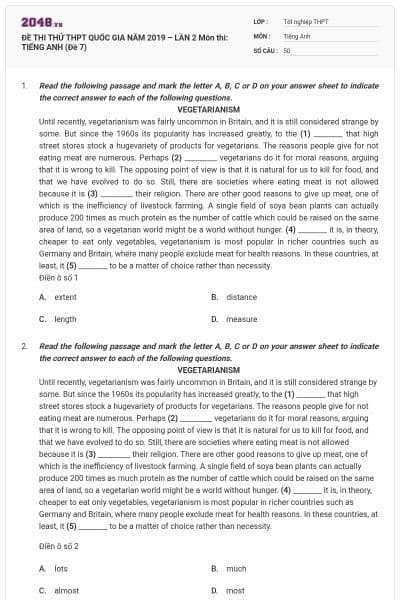
Until recently, vegetarianism was fairly uncommon in Britain, and it is still considered strange by some. But since the 1960s its popularity has increased greatly, to the (1) ________ that high street stores stock a hugevariety of products for vegetarians. The reasons people give for not eating meat are numerous. Perhaps (2) _________ vegetarians do it for moral reasons, arguing that it is wrong to kill. The opposing point of view is that it is natural for us to kill for food, and that we have evolved to do so. Still, there are societies where eating meat is not allowed because it is (3) _________ their religion. There are other good reasons to give up meat, one of which is the inefficiency of livestock farming. A single field of soya bean plants can actually produce 200 times as much protein as the number of cattle which could be raised on the same area of land, so a vegetarian world might be a world without hunger. (4) ________ it is, in theory, cheaper to eat only vegetables, vegetarianism is most popular in richer countries such as Germany and Britain, where many people exclude meat for health reasons. In these countries, at least, it (5) ________ to be a matter of choice rather than necessity.
Điền ô số 1
extent
distance
length
measure
Kiến thức: Cụm từ
Giải thích:
to the extent that: đến mức
But since the 1960s its popularity has increased greatly, to the (1) extent that high street stores stock a huge variety of products for vegetarians.
Tạm dịch: Nhưng kể từ những năm 1960, mức độ phổ biến của nó đã tăng lên rất nhiều, đến mức các cửa hàng trên đường phố cao cấp dự trữ rất nhiều sản phẩm cho người ăn chay.
Chọn A
Read the following passage and mark the letter A, B, C or D on your answer sheet to indicate the correct answer to each of the following questions.
VEGETARIANISM
Until recently, vegetarianism was fairly uncommon in Britain, and it is still considered strange by some. But since the 1960s its popularity has increased greatly, to the (1) ________ that high street stores stock a hugevariety of products for vegetarians. The reasons people give for not eating meat are numerous. Perhaps (2) _________ vegetarians do it for moral reasons, arguing that it is wrong to kill. The opposing point of view is that it is natural for us to kill for food, and that we have evolved to do so. Still, there are societies where eating meat is not allowed because it is (3) _________ their religion. There are other good reasons to give up meat, one of which is the inefficiency of livestock farming. A single field of soya bean plants can actually produce 200 times as much protein as the number of cattle which could be raised on the same area of land, so a vegetarian world might be a world without hunger. (4) ________ it is, in theory, cheaper to eat only vegetables, vegetarianism is most popular in richer countries such as Germany and Britain, where many people exclude meat for health reasons. In these countries, at least, it (5) ________ to be a matter of choice rather than necessity.
Điền ô số 2
lots
much
almost
most
Kiến thức: Lượng từ
Giải thích:
A. lots (đại từ): số lượng lớn B. much (adj): nhiều
C. almost (phó từ): hầu như, gần như D. most (adj): phần lớn, hầu hết
Perhaps (2) most vegetarians do it for moral reasons, arguing that it is wrong to kill.
Tạm dịch: Có lẽ hầu hết những người ăn chay làm điều đó vì lý do đạo đức, cho rằng việc giết chóc là sai.
Chọn D
Read the following passage and mark the letter A, B, C or D on your answer sheet to indicate the correct answer to each of the following questions.
VEGETARIANISM
Until recently, vegetarianism was fairly uncommon in Britain, and it is still considered strange by some. But since the 1960s its popularity has increased greatly, to the (1) ________ that high street stores stock a hugevariety of products for vegetarians. The reasons people give for not eating meat are numerous. Perhaps (2) _________ vegetarians do it for moral reasons, arguing that it is wrong to kill. The opposing point of view is that it is natural for us to kill for food, and that we have evolved to do so. Still, there are societies where eating meat is not allowed because it is (3) _________ their religion. There are other good reasons to give up meat, one of which is the inefficiency of livestock farming. A single field of soya bean plants can actually produce 200 times as much protein as the number of cattle which could be raised on the same area of land, so a vegetarian world might be a world without hunger. (4) ________ it is, in theory, cheaper to eat only vegetables, vegetarianism is most popular in richer countries such as Germany and Britain, where many people exclude meat for health reasons. In these countries, at least, it (5) ________ to be a matter of choice rather than necessity.
Điền ô số 3
opposite
against
beside
across
Kiến thức: Giới từ
Giải thích:
A. opposite: đối diện B. against: chống lại
C. beside: bên cạnh D. across: phía bên kia
Still, there are societies where eating meat is not allowed because it is (3) against their religion.
Tạm dịch: Tuy nhiên, có những xã hội mà việc ăn thịt không được phép vì nó chống lại tôn giáo của họ.
Chọn B
Read the following passage and mark the letter A, B, C or D on your answer sheet to indicate the correct answer to each of the following questions.
VEGETARIANISM
Until recently, vegetarianism was fairly uncommon in Britain, and it is still considered strange by some. But since the 1960s its popularity has increased greatly, to the (1) ________ that high street stores stock a hugevariety of products for vegetarians. The reasons people give for not eating meat are numerous. Perhaps (2) _________ vegetarians do it for moral reasons, arguing that it is wrong to kill. The opposing point of view is that it is natural for us to kill for food, and that we have evolved to do so. Still, there are societies where eating meat is not allowed because it is (3) _________ their religion. There are other good reasons to give up meat, one of which is the inefficiency of livestock farming. A single field of soya bean plants can actually produce 200 times as much protein as the number of cattle which could be raised on the same area of land, so a vegetarian world might be a world without hunger. (4) ________ it is, in theory, cheaper to eat only vegetables, vegetarianism is most popular in richer countries such as Germany and Britain, where many people exclude meat for health reasons. In these countries, at least, it (5) ________ to be a matter of choice rather than necessity .
Điền ô số 4
Although
Since
Despite
Therefore
Kiến thức: Liên từ
Giải thích:
A. Although: mặc dù B. Since: bởi vì
C. Despite + N: mặc cho D. Therefore: vì vậy
(4) Although it is, in theory, cheaper to eat only vegetables, vegetarianism is most popular in richer countries such as Germany and Britain, where many people exclude meat for health reasons.
Tạm dịch: Mặc dù về lý thuyết, chỉ ăn rau thì rẻ hơn, ăn chay phổ biến nhất ở các nước giàu hơn như Đức và Anh, nơi nhiều người loại trừ thịt vì lý do sức khỏe.
Chọn A
Read the following passage and mark the letter A, B, C or D on your answer sheet to indicate the correct answer to each of the following questions.
VEGETARIANISM
Until recently, vegetarianism was fairly uncommon in Britain, and it is still considered strange by some. But since the 1960s its popularity has increased greatly, to the (1) ________ that high street stores stock a hugevariety of products for vegetarians. The reasons people give for not eating meat are numerous. Perhaps (2) _________ vegetarians do it for moral reasons, arguing that it is wrong to kill. The opposing point of view is that it is natural for us to kill for food, and that we have evolved to do so. Still, there are societies where eating meat is not allowed because it is (3) _________ their religion. There are other good reasons to give up meat, one of which is the inefficiency of livestock farming. A single field of soya bean plants can actually produce 200 times as much protein as the number of cattle which could be raised on the same area of land, so a vegetarian world might be a world without hunger. (4) ________ it is, in theory, cheaper to eat only vegetables, vegetarianism is most popular in richer countries such as Germany and Britain, where many people exclude meat for health reasons. In these countries, at least, it (5) ________ to be a matter of choice rather than necessity.
Điền ô số 5
finishes off
goes through
comes
turns out
Kiến thức: Phrasal verb
Giải thích:
A. finishes off: kết thúc
B. goes through: trải qua
C. comes up: nảy lên (ý tưởng)
D. turns out: hóa ra (để chỉ cái gì được biết đến hay phát hiện ra một cách bất ngờ.)
In these countries, at least, it (5) turns out to be a matter of choice rather than necessity.
Tạm dịch: Ở những nước này, ít nhất, nó trở thành vấn đề được lựa chọn hơn là điều cần thiết.
Chọn D
Dịch bài đọc:
THÓI QUEN ĂN CHAY
Cho đến gần đây, việc ăn chay khá phổ biến ở Anh và nó vẫn bị một số người coi là lạ. Nhưng kể từ những năm 1960, mức độ phổ biến của nó đã tăng lên rất nhiều, đến mức các cửa hàng trên đường phố cao cấp dự trữ rất nhiều sản phẩm cho người ăn chay. Những lý do mọi người đưa ra cho việc không ăn thịt là rất nhiều. Có lẽ hầu hết những người ăn chay làm điều đó vì lý do đạo đức, cho rằng việc giết chóc là sai. Quan điểm đối lập là việc chúng ta giết để lấy thức ăn là điều tự nhiên và chúng ta đã tiến hóa để làm như vậy. Tuy nhiên, có những xã hội mà việc ăn thịt không được phép vì nó chống lại tôn giáo của họ. Có những lý do tốt khác để từ bỏ thịt, một trong số đó là sự không hiệu quả của chăn nuôi. Một cánh đồng duy nhất của cây đậu nành thực sự có thể tạo ra lượng protein gấp 200 lần số lượng gia súc có thể được nuôi trên cùng một diện tích đất, vì vậy một thế giới chay có thể là một thế giới không có đói. Mặc dù về lý thuyết, chỉ ăn rau thì rẻ hơn, ăn chay phổ biến nhất ở các nước giàu hơn như Đức và Anh, nơi nhiều người loại trừ thịt vì lý do sức khỏe. Ở những nước này, ít nhất, nó trở thành vấn đề được lựa chọn hơn là điều cần thiết.
Read the following passage and mark the letter A, B, C or D on your answer sheet to indicate the correct answer to each of the following questions.
TEXAS
A Texas middle school is under fire after students say they have been banned from speaking Spanish in class. The students say their principal announced the rule last month over the intercom. Inside the walls of Hemptead Middle School, a language controversy is brewing. “There’s one teacher that said, „If you speak Spanish in my class, I’m gonna write you up,” 8th grader Tiffani Resurez says. Four students say their principal’s announcement – banning them from speaking Spanish in class – has given teachers and fellow students a hall pass to discriminate. “She was like, „No speaking Spanish.’ She told me that. I was like, „That’s my first language.’ She said, „Well, you can get out,” fellow classmate Yedhany Gallegos says. A letter sent home by the superintendent says, “Neither the district nor any campus has any policy prohibiting the speaking of Spanish.” The four students feel that the statement from the superintendent has not been made entirely clear that their school. “People don’t want to speak it anymore and don’t want to get caught speaking it because they’re going to get into trouble,” 6th grader Kiara Lozano says. Parents, like Cynthia Zamora, believe the school is not getting to the root of the problem. She wants to know why the “No Spanish” announcement was ever made in the first place. “I was very surprised that she would even go to such lengths,” Zamora says. Many students at the school grew up speaking Spanish at home, and they say it often comes as second nature when they’re talking to each other at school. “I’m not scared. I’m gonna keep speaking my language. That’s my first language, and I’m gonna keep doing it,” Lozano said. The principal has been placed on paid administrative leave while the district investigates. A spokewoman for Hempstead Independent School District has released a statement saying, in part, “The district is committed to efficiently and effectively resolving this matter with as little disruption to our students and their learning environment as possible.”
In the passage, the word “root” is closest in meaning to _______.
solution
cause
ground
time
Kiến thức: Đọc hiểu
Giải thích:
Từ “root” (gốc rễ) có nghĩa gần nhất với _________ .
A. solution (n): giải pháp B. cause (n): nguyên nhân
C. ground (n): mặt đất D. time (n): thời gian
=> root = cause
Thông tin: Parents, like Cynthia Zamora, believe the school is not getting to the root of the problem.
Tạm dịch: Phụ huynh, như Cynthia Zamora, tin rằng trường học không đi đến gốc rễ của vấn đề.
Chọn B
Read the following passage and mark the letter A, B, C or D on your answer sheet to indicate the correct answer to each of the following questions.
TEXAS
A Texas middle school is under fire after students say they have been banned from speaking Spanish in class. The students say their principal announced the rule last month over the intercom. Inside the walls of Hemptead Middle School, a language controversy is brewing. “There’s one teacher that said, „If you speak Spanish in my class, I’m gonna write you up,” 8th grader Tiffani Resurez says. Four students say their principal’s announcement – banning them from speaking Spanish in class – has given teachers and fellow students a hall pass to discriminate. “She was like, „No speaking Spanish.’ She told me that. I was like, „That’s my first language.’ She said, „Well, you can get out,” fellow classmate Yedhany Gallegos says. A letter sent home by the superintendent says, “Neither the district nor any campus has any policy prohibiting the speaking of Spanish.” The four students feel that the statement from the superintendent has not been made entirely clear that their school. “People don’t want to speak it anymore and don’t want to get caught speaking it because they’re going to get into trouble,” 6th grader Kiara Lozano says. Parents, like Cynthia Zamora, believe the school is not getting to the root of the problem. She wants to know why the “No Spanish” announcement was ever made in the first place. “I was very surprised that she would even go to such lengths,” Zamora says. Many students at the school grew up speaking Spanish at home, and they say it often comes as second nature when they’re talking to each other at school. “I’m not scared. I’m gonna keep speaking my language. That’s my first language, and I’m gonna keep doing it,” Lozano said. The principal has been placed on paid administrative leave while the district investigates. A spokewoman for Hempstead Independent School District has released a statement saying, in part, “The district is committed to efficiently and effectively resolving this matter with as little disruption to our students and their learning environment as possible.”
Why was the policy introduced?
The superintendent wants students to speak only English at school
No one at school is Spanish
The principal hates Spanish
The reason is not mentioned
Kiến thức: Đọc hiểu
Giải thích:
Tại sao chính sách được giới thiệu?
A. Giám thị muốn học sinh chỉ nói tiếng Anh ở trường
B. Không ai ở trường là người Tây Ban Nha
C. Hiệu trưởng ghét tiếng Tây Ban Nha
D. Lý do không được đề cập
Chọn D
Read the following passage and mark the letter A, B, C or D on your answer sheet to indicate the correct answer to each of the following questions.
TEXAS
A Texas middle school is under fire after students say they have been banned from speaking Spanish in class. The students say their principal announced the rule last month over the intercom. Inside the walls of Hemptead Middle School, a language controversy is brewing. “There’s one teacher that said, „If you speak Spanish in my class, I’m gonna write you up,” 8th grader Tiffani Resurez says. Four students say their principal’s announcement – banning them from speaking Spanish in class – has given teachers and fellow students a hall pass to discriminate. “She was like, „No speaking Spanish.’ She told me that. I was like, „That’s my first language.’ She said, „Well, you can get out,” fellow classmate Yedhany Gallegos says. A letter sent home by the superintendent says, “Neither the district nor any campus has any policy prohibiting the speaking of Spanish.” The four students feel that the statement from the superintendent has not been made entirely clear that their school. “People don’t want to speak it anymore and don’t want to get caught speaking it because they’re going to get into trouble,” 6th grader Kiara Lozano says. Parents, like Cynthia Zamora, believe the school is not getting to the root of the problem. She wants to know why the “No Spanish” announcement was ever made in the first place. “I was very surprised that she would even go to such lengths,” Zamora says. Many students at the school grew up speaking Spanish at home, and they say it often comes as second nature when they’re talking to each other at school. “I’m not scared. I’m gonna keep speaking my language. That’s my first language, and I’m gonna keep doing it,” Lozano said. The principal has been placed on paid administrative leave while the district investigates. A spokewoman for Hempstead Independent School District has released a statement saying, in part, “The district is committed to efficiently and effectively resolving this matter with as little disruption to our students and their learning environment as possible.”
What can we infer about the policy on no speaking Spanish?
All the students and school staff were irritated by the policy
Students were against the rule at first but then compromised
The principal who made this announcement hated Spanish
Only people inside of the school knew about the rule when it was announced
Kiến thức: Đọc hiểu
Giải thích:
Chúng ta có thể suy luận gì về chính sách không nói tiếng Tây Ban Nha?
A. Tất cả học sinh và nhân viên nhà trường đều nổi giận bởi chính sách
B. Học sinh ban đầu chống lại quy tắc nhưng sau đó bị thỏa hiệp
C. Hiệu trưởng người đưa ra thông báo này ghét tiếng Tây Ban Nha
D. Chỉ những người trong trường biết về quy tắc khi nó được công bố
Thông tin: “People don’t want to speak it anymore and don’t want to get caught speaking it because they’re going to get into trouble,”
Tạm dịch: “Mọi người không còn muốn nói tiếng Tây Ban Nha nữa và cũng không muốn bị bắt vì họ sẽ gặp rắc rối,”
Chọn B
Read the following passage and mark the letter A, B, C or D on your answer sheet to indicate the correct answer to each of the following questions.
TEXAS
A Texas middle school is under fire after students say they have been banned from speaking Spanish in class. The students say their principal announced the rule last month over the intercom. Inside the walls of Hemptead Middle School, a language controversy is brewing. “There’s one teacher that said, „If you speak Spanish in my class, I’m gonna write you up,” 8th grader Tiffani Resurez says. Four students say their principal’s announcement – banning them from speaking Spanish in class – has given teachers and fellow students a hall pass to discriminate. “She was like, „No speaking Spanish.’ She told me that. I was like, „That’s my first language.’ She said, „Well, you can get out,” fellow classmate Yedhany Gallegos says. A letter sent home by the superintendent says, “Neither the district nor any campus has any policy prohibiting the speaking of Spanish.” The four students feel that the statement from the superintendent has not been made entirely clear that their school. “People don’t want to speak it anymore and don’t want to get caught speaking it because they’re going to get into trouble,” 6th grader Kiara Lozano says. Parents, like Cynthia Zamora, believe the school is not getting to the root of the problem. She wants to know why the “No Spanish” announcement was ever made in the first place. “I was very surprised that she would even go to such lengths,” Zamora says. Many students at the school grew up speaking Spanish at home, and they say it often comes as second nature when they’re talking to each other at school. “I’m not scared. I’m gonna keep speaking my language. That’s my first language, and I’m gonna keep doing it,” Lozano said. The principal has been placed on paid administrative leave while the district investigates. A spokewoman for Hempstead Independent School District has released a statement saying, in part, “The district is committed to efficiently and effectively resolving this matter with as little disruption to our students and their learning environment as possible.”
What will the district do?
Dismiss the principal
Solve the problem
Ask all students to remain silent about the issue
Apologize for their mistake
Kiến thức: Đọc hiểu
Giải thích:
Học khu sẽ làm gì?
A. Sa thải hiệu trưởng B. Giải quyết vấn đề
C. Yêu cầu tất cả học sinh giữ im lặng về vấn đề D. Xin lỗi vì lỗi lầm của họ
Thông tin: The district is committed to efficiently and effectively resolving this matter with as little disruption to our students and their learning environment as possible.
Tạm dịch: Học khu cam kết giải quyết vấn đề này một cách hiệu quả nhất và với ít sự gián đoạn nhất đối với học sinh và môi trường học tập của chúng
Chọn B
Read the following passage and mark the letter A, B, C or D on your answer sheet to indicate the correct answer to each of the following questions.
TEXAS
A Texas middle school is under fire after students say they have been banned from speaking Spanish in class. The students say their principal announced the rule last month over the intercom. Inside the walls of Hemptead Middle School, a language controversy is brewing. “There’s one teacher that said, „If you speak Spanish in my class, I’m gonna write you up,” 8th grader Tiffani Resurez says. Four students say their principal’s announcement – banning them from speaking Spanish in class – has given teachers and fellow students a hall pass to discriminate. “She was like, „No speaking Spanish.’ She told me that. I was like, „That’s my first language.’ She said, „Well, you can get out,” fellow classmate Yedhany Gallegos says. A letter sent home by the superintendent says, “Neither the district nor any campus has any policy prohibiting the speaking of Spanish.” The four students feel that the statement from the superintendent has not been made entirely clear that their school. “People don’t want to speak it anymore and don’t want to get caught speaking it because they’re going to get into trouble,” 6th grader Kiara Lozano says. Parents, like Cynthia Zamora, believe the school is not getting to the root of the problem. She wants to know why the “No Spanish” announcement was ever made in the first place. “I was very surprised that she would even go to such lengths,” Zamora says. Many students at the school grew up speaking Spanish at home, and they say it often comes as second nature when they’re talking to each other at school. “I’m not scared. I’m gonna keep speaking my language. That’s my first language, and I’m gonna keep doing it,” Lozano said. The principal has been placed on paid administrative leave while the district investigates. A spokewoman for Hempstead Independent School District has released a statement saying, in part, “The district is committed to efficiently and effectively resolving this matter with as little disruption to our students and their learning environment as possible.”
In the passage, the word “it” refers to _________.
the local accent
Spanish
English
slang
Kiến thức: Đọc hiểu
Giải thích:
Trong đoạn văn, từ “it” liên quan đến ________ .
A. giọng địa phương B. Tiếng Tây Ban Nha
C. Tiếng Anh D. tiếng lóng
Thông tin: Many students at the school grew up speaking Spanish at home, and they say it often comes as second nature when they’re talking to each other at school.
Tạm dịch: Nhiều học sinh trong trường lớn lên nói tiếng Tây Ban Nha ở nhà, và họ nói rằng nó rất tự nhiên khi họ nói chuyện với nhau ở trường.
Chọn B
Dịch bài đọc:
TEXAS
Một trường trung học ở Texas đang bị lên án sau khi học sinh nói rằng họ đã bị cấm nói tiếng Tây Ban Nha trong lớp. Các sinh viên nói rằng hiệu trưởng của họ đã công bố quy tắc vào tháng trước về hệ thống liên lạc nội bộ. Bên trong những bức tường của trường trung học Heemead, một cuộc tranh cãi về ngôn ngữ đang diễn ra. Một giáo viên dạy tiếng Anh nói: "Nếu em nào nói tiếng Tây Ban Nha trong lớp của tôi, tôi sẽ lập biên bản cho em,” học sinh lớp 8 Tiffani Resurez nói. Bốn học sinh nói rằng thông báo chính của họ - cấm họ nói tiếng Tây Ban Nha trong lớp - đã cho giáo viên và học sinh vượt qua để phân biệt đối xử. Cô ấy giống như, “Không nói tiếng Tây Ban Nha.” Cô ấy nói với tôi điều đó. Tôi giống như, “Đó là ngôn ngữ mẹ đẻ của em”. Cô ấy nói, “Vậy thì, em có thể ra ngoài”, bạn cùng lớp của Yedhany Gallegos nói. Một bức thư của quản lý gửi về nhà viết rằng, “không phải khu học chánh hay khu học xá nào cũng có bất kỳ chính sách nào cấm nói tiếng Tây Ban Nha”. Bốn học sinh cảm thấy rằng tuyên bố của quản lý đã không được làm rõ hoàn toàn rằng trường của họ. “Mọi người không còn muốn nói tiếng Tây Ban Nha nữa và cũng không muốn bị bắt vì họ sẽ gặp rắc rối,” học sinh lớp 6 Kiara Lozano nói. Phụ huynh, như Cynthia Zamora, tin rằng trường học không đi đến gốc rễ của vấn đề. Cô ấy muốn biết lý do tại sao thông báo đầu tiên của “không được nói tiếng Tây Ban Nha” được đưa ra ngay từ đầu. Tôi đã rất ngạc nhiên khi cô ấy thậm chí sẽ đi những quãng đường dài như vậy, Zam Zamora nói. Nhiều học sinh trong trường lớn lên nói tiếng Tây Ban Nha ở nhà, và họ nói rằng nó rất tự nhiên khi họ nói chuyện với nhau ở trường. "Tôi không sợ. Tôi sẽ tiếp tục nói ngôn ngữ của mình. Đó là ngôn ngữ mẹ đẻ, và tôi sẽ tiếp tục thực hiện nó.” Hiệu trưởng đã được nghỉ phép hành chính có lương trong khi quận điều tra. Một nữ phát ngôn viên của Học khu độc lập Hempstead đã đưa ra một tuyên bố rằng, một phần, “Học khu cam kết giải quyết vấn đề này một cách hiệu quả nhất và với ít sự gián đoạn nhất đối với học sinh và môi trường học tập của chúng.”
Read the following passage and mark the letter A, B, C or D on your answer sheet to indicate the correct answer to each of the following questions.
‘A good book for children should simply be a good book in its own right.' These are the words of Mollie Hunter, a well known author of books for youngsters. Born and bred near Edinburgh, Mollie has devoted her talents to writing primarily for young people. She firmly believes that there is always and should always be a wider audience for any good book whatever its main market. In Mollie's opinion it is essential to make full use of language and she enjoys telling a story, which is what every writer should be doing: 'If you aren't telling a story, you're a very dead writer indeed,' she says.
With the chief function of a writer being to entertain, Molly is indeed an entertainer. 'I have this great love of not only the meaning of language but of the music of language,' she says. This love goes back to early childhood. 'I've told stories all my life. I had a school teacher who used to ask us what we would like to be when we grew up and, because my family always had dogs, and I was very good at handling them, I said I wanted to work with dogs, and the teacher always said "Nonsense, Mollie dear, you'll be a writer." So eventually I thought that this woman must have something, since she was a good teacher - and I decided when I was nine that I would be a writer.’
This childhood intention is described in her novel, A Sound of Chariots, which although written in the third person is clearly autobiographical and gives a picture both of Mollie's ambition and her struggle towards its achievement.
Thoughts of her childhood inevitably brought thoughts of the time when her home was still a village with buttercup meadows and strawberry fields - sadly now covered with modern houses. 'I was once taken back to see it and I felt that somebody had lain dirty hands all over my childhood. I'll never go back,' she said. 'Never.' 'When I set one of my books in Scotland,' she said, 'I can recapture my romantic feelings as a child playing in those fields, or watching the village blacksmith at work. And that's important, because children now know so much so early that romance can't exist for them, as it did for us.'
To this day, Mollie has a lively affection for children, which is reflected in the love she has for her writing. 'When we have visitors with children the adults always say, "If you go to visit Mollie, she'll spend more time with the children." They don't realise that children are much more interesting company. I've heard all the adults have to say before. The children have something new.'
In Molie Hunter’s opinion, one sign of a poor writer is ________.
complicated ideas
the weakness of the description
lifeless characters
the absence of a story
Kiến thức: Đọc hiểu
Giải thích:
Theo ý kiến của Molie Hunter, một dấu hiệu của một nhà văn nghèo là ________.
A. ý tưởng phức tạp B. điểm yếu của mô tả
C. nhân vật vô hồn D. sự vắng mặt của một câu chuyện
Thông tin: In Mollie's opinion it is essential to make full use of language and she enjoys telling a story, which is what every writer should be doing: 'If you aren't telling a story, you're a very dead writer indeed,' she says.
Tạm dịch: Theo ý kiến của Mollie, việc sử dụng toàn bộ ngôn ngữ là điều cần thiết và cô ấy thích kể chuyện, đó là điều mà mọi nhà văn nên làm: 'Nếu bạn không kể chuyện, thực sự bạn là một nhà văn đã chết', cô nói .
Chọn D
Read the following passage and mark the letter A, B, C or D on your answer sheet to indicate the correct answer to each of the following questions.
‘A good book for children should simply be a good book in its own right.' These are the words of Mollie Hunter, a well known author of books for youngsters. Born and bred near Edinburgh, Mollie has devoted her talents to writing primarily for young people. She firmly believes that there is always and should always be a wider audience for any good book whatever its main market. In Mollie's opinion it is essential to make full use of language and she enjoys telling a story, which is what every writer should be doing: 'If you aren't telling a story, you're a very dead writer indeed,' she says.
With the chief function of a writer being to entertain, Molly is indeed an entertainer. 'I have this great love of not only the meaning of language but of the music of language,' she says. This love goes back to early childhood. 'I've told stories all my life. I had a school teacher who used to ask us what we would like to be when we grew up and, because my family always had dogs, and I was very good at handling them, I said I wanted to work with dogs, and the teacher always said "Nonsense, Mollie dear, you'll be a writer." So eventually I thought that this woman must have something, since she was a good teacher - and I decided when I was nine that I would be a writer.’
This childhood intention is described in her novel, A Sound of Chariots, which although written in the third person is clearly autobiographical and gives a picture both of Mollie's ambition and her struggle towards its achievement.
Thoughts of her childhood inevitably brought thoughts of the time when her home was still a village with buttercup meadows and strawberry fields - sadly now covered with modern houses. 'I was once taken back to see it and I felt that somebody had lain dirty hands all over my childhood. I'll never go back,' she said. 'Never.' 'When I set one of my books in Scotland,' she said, 'I can recapture my romantic feelings as a child playing in those fields, or watching the village blacksmith at work. And that's important, because children now know so much so early that romance can't exist for them, as it did for us.'
To this day, Mollie has a lively affection for children, which is reflected in the love she has for her writing. 'When we have visitors with children the adults always say, "If you go to visit Mollie, she'll spend more time with the children." They don't realise that children are much more interesting company. I've heard all the adults have to say before. The children have something new.'
What does “its” in paragraph 3 refer to?
ambition
picture
novel
struggle
Kiến thức: Đọc hiểu
Giải thích:
Từ “its” trong đoạn 3 liên quan đến _________.
A. ambition (n): tham vọng B. picture (n): bức tranh
C. novel (n): tiểu thuyết D. struggle (n): cuộc đấu tranh
Thông tin: This childhood intention is described in her novel, A Sound of Chariots, which although written in the third person is clearly autobiographical and gives a picture both of Mollie's ambition and her struggle towards its achievement.
Tạm dịch: Ý định thời thơ ấu này được mô tả trong cuốn tiểu thuyết A Sound of Chariots của cô, mặc dù được viết ở ngôi thứ ba rõ ràng là tự truyện và đưa ra một bức tranh về tham vọng của Mollie và cuộc đấu tranh của cô đối với thành tựu của nó.
Chọn A
Read the following passage and mark the letter A, B, C or D on your answer sheet to indicate the correct answer to each of the following questions.
‘A good book for children should simply be a good book in its own right.' These are the words of Mollie Hunter, a well known author of books for youngsters. Born and bred near Edinburgh, Mollie has devoted her talents to writing primarily for young people. She firmly believes that there is always and should always be a wider audience for any good book whatever its main market. In Mollie's opinion it is essential to make full use of language and she enjoys telling a story, which is what every writer should be doing: 'If you aren't telling a story, you're a very dead writer indeed,' she says.
With the chief function of a writer being to entertain, Molly is indeed an entertainer. 'I have this great love of not only the meaning of language but of the music of language,' she says. This love goes back to early childhood. 'I've told stories all my life. I had a school teacher who used to ask us what we would like to be when we grew up and, because my family always had dogs, and I was very good at handling them, I said I wanted to work with dogs, and the teacher always said "Nonsense, Mollie dear, you'll be a writer." So eventually I thought that this woman must have something, since she was a good teacher - and I decided when I was nine that I would be a writer.’
This childhood intention is described in her novel, A Sound of Chariots, which although written in the third person is clearly autobiographical and gives a picture both of Mollie's ambition and her struggle towards its achievement.
Thoughts of her childhood inevitably brought thoughts of the time when her home was still a village with buttercup meadows and strawberry fields - sadly now covered with modern houses. 'I was once taken back to see it and I felt that somebody had lain dirty hands all over my childhood. I'll never go back,' she said. 'Never.' 'When I set one of my books in Scotland,' she said, 'I can recapture my romantic feelings as a child playing in those fields, or watching the village blacksmith at work. And that's important, because children now know so much so early that romance can't exist for them, as it did for us.'
To this day, Mollie has a lively affection for children, which is reflected in the love she has for her writing. 'When we have visitors with children the adults always say, "If you go to visit Mollie, she'll spend more time with the children." They don't realise that children are much more interesting company. I've heard all the adults have to say before. The children have something new.'
How does Mollie feel about what has happened to her birthplace?
surprised
ashamed
disappointed
confused
Kiến thức: Đọc hiểu
Giải thích:
Mollie cảm thấy thế nào về những gì đã xảy ra với nơi sinh của mình?
A. surprised (adj): ngạc nhiên B. ashamed (adj): xấu hổ
C. disappointed (adj): thất vọng D. confused (adj): bối rối
Thông tin: 'I was once taken back to see it and I felt that somebody had lain dirty hands all over my childhood. I'll never go back,' she said.
Tạm dịch: 'Tôi đã từng được trở lại đó để xem và tôi cảm thấy rằng ai đó đã nhúng những bàn tay bẩn thỉu vào suốt thời thơ ấu của tôi. Tôi sẽ không bao giờ quay trở lại, 'cô nói.
Chọn C
Read the following passage and mark the letter A, B, C or D on your answer sheet to indicate the correct answer to each of the following questions.
‘A good book for children should simply be a good book in its own right.' These are the words of Mollie Hunter, a well known author of books for youngsters. Born and bred near Edinburgh, Mollie has devoted her talents to writing primarily for young people. She firmly believes that there is always and should always be a wider audience for any good book whatever its main market. In Mollie's opinion it is essential to make full use of language and she enjoys telling a story, which is what every writer should be doing: 'If you aren't telling a story, you're a very dead writer indeed,' she says.
With the chief function of a writer being to entertain, Molly is indeed an entertainer. 'I have this great love of not only the meaning of language but of the music of language,' she says. This love goes back to early childhood. 'I've told stories all my life. I had a school teacher who used to ask us what we would like to be when we grew up and, because my family always had dogs, and I was very good at handling them, I said I wanted to work with dogs, and the teacher always said "Nonsense, Mollie dear, you'll be a writer." So eventually I thought that this woman must have something, since she was a good teacher - and I decided when I was nine that I would be a writer.’
This childhood intention is described in her novel, A Sound of Chariots, which although written in the third person is clearly autobiographical and gives a picture both of Mollie's ambition and her struggle towards its achievement.
Thoughts of her childhood inevitably brought thoughts of the time when her home was still a village with buttercup meadows and strawberry fields - sadly now covered with modern houses. 'I was once taken back to see it and I felt that somebody had lain dirty hands all over my childhood. I'll never go back,' she said. 'Never.' 'When I set one of my books in Scotland,' she said, 'I can recapture my romantic feelings as a child playing in those fields, or watching the village blacksmith at work. And that's important, because children now know so much so early that romance can't exist for them, as it did for us.'
To this day, Mollie has a lively affection for children, which is reflected in the love she has for her writing. 'When we have visitors with children the adults always say, "If you go to visit Mollie, she'll spend more time with the children." They don't realise that children are much more interesting company. I've heard all the adults have to say before. The children have something new.'
What do we learn about Mollie Hunter as a very young child?
She didn’t enjoy writing stories
She didn’t have any particular ambitions
She didn’t expect to become a writer
She didn’t respect her teacher’s views
Kiến thức: Đọc hiểu
Giải thích:
Chúng ta biết được gì về Mollie Hunter khi còn rất nhỏ?
A. Cô ấy không thích viết truyện
B. Cô ấy không có bất kỳ tham vọng cụ thể nào
C. Cô ấy đã không mong muốn trở thành một nhà văn
D. Cô ấy đã tôn trọng giáo viên của mình
Thông tin: 'I've told stories all my life. I had a school teacher who used to ask us what we would like to be when we grew up and, because my family always had dogs, and I was very good at handling them, I said I wanted to work with dogs’
Tạm dịch: 'Tôi đã kể chuyện. Tôi có một giáo viên ở trường, người thường hỏi chúng tôi muốn làm gì khi chúng tôi lớn lên và vì gia đình tôi luôn có chó và tôi rất giỏi trong việc xử lý chúng, tôi nói tôi muốn làm việc với chó và giáo viên luôn nói
Chọn C
Read the following passage and mark the letter A, B, C or D on your answer sheet to indicate the correct answer to each of the following questions.
‘A good book for children should simply be a good book in its own right.' These are the words of Mollie Hunter, a well known author of books for youngsters. Born and bred near Edinburgh, Mollie has devoted her talents to writing primarily for young people. She firmly believes that there is always and should always be a wider audience for any good book whatever its main market. In Mollie's opinion it is essential to make full use of language and she enjoys telling a story, which is what every writer should be doing: 'If you aren't telling a story, you're a very dead writer indeed,' she says.
With the chief function of a writer being to entertain, Molly is indeed an entertainer. 'I have this great love of not only the meaning of language but of the music of language,' she says. This love goes back to early childhood. 'I've told stories all my life. I had a school teacher who used to ask us what we would like to be when we grew up and, because my family always had dogs, and I was very good at handling them, I said I wanted to work with dogs, and the teacher always said "Nonsense, Mollie dear, you'll be a writer." So eventually I thought that this woman must have something, since she was a good teacher - and I decided when I was nine that I would be a writer.’
This childhood intention is described in her novel, A Sound of Chariots, which although written in the third person is clearly autobiographical and gives a picture both of Mollie's ambition and her struggle towards its achievement.
Thoughts of her childhood inevitably brought thoughts of the time when her home was still a village with buttercup meadows and strawberry fields - sadly now covered with modern houses. 'I was once taken back to see it and I felt that somebody had lain dirty hands all over my childhood. I'll never go back,' she said. 'Never.' 'When I set one of my books in Scotland,' she said, 'I can recapture my romantic feelings as a child playing in those fields, or watching the village blacksmith at work. And that's important, because children now know so much so early that romance can't exist for them, as it did for us.'
To this day, Mollie has a lively affection for children, which is reflected in the love she has for her writing. 'When we have visitors with children the adults always say, "If you go to visit Mollie, she'll spend more time with the children." They don't realise that children are much more interesting company. I've heard all the adults have to say before. The children have something new.'
In comparison with children of earlier years, Mollie feels that modern children are _____.
better informed
more intelligent
less interested in fiction
less keen to learn
Kiến thức: Đọc hiểu
Giải thích:
So với trẻ em của những năm trước, Mollie cảm thấy rằng trẻ em hiện đại là _____.
A. thông tin tốt hơn B. thông minh hơn
C. ít quan tâm đến tiểu thuyết D. ít ham học
Thông tin: 'I can recapture my romantic feelings as a child playing in those fields, or watching the village blacksmith at work. And that's important, because children now know so much so early that romance can't exist for them, as it did for us.'
Tạm dịch: 'Tôi có thể lấy lại cảm xúc lãng mạn của mình khi còn là một đứa trẻ chơi trên những cánh đồng đó, hoặc xem thợ rèn trong làng làm việc. Và điều đó rất quan trọng, vì trẻ em bây giờ biết rất sớm nên sự lãng mạn không thể tồn tại với chúng, như nó đã làm cho chúng ta.
Chọn A
Read the following passage and mark the letter A, B, C or D on your answer sheet to indicate the correct answer to each of the following questions.
‘A good book for children should simply be a good book in its own right.' These are the words of Mollie Hunter, a well known author of books for youngsters. Born and bred near Edinburgh, Mollie has devoted her talents to writing primarily for young people. She firmly believes that there is always and should always be a wider audience for any good book whatever its main market. In Mollie's opinion it is essential to make full use of language and she enjoys telling a story, which is what every writer should be doing: 'If you aren't telling a story, you're a very dead writer indeed,' she says.
With the chief function of a writer being to entertain, Molly is indeed an entertainer. 'I have this great love of not only the meaning of language but of the music of language,' she says. This love goes back to early childhood. 'I've told stories all my life. I had a school teacher who used to ask us what we would like to be when we grew up and, because my family always had dogs, and I was very good at handling them, I said I wanted to work with dogs, and the teacher always said "Nonsense, Mollie dear, you'll be a writer." So eventually I thought that this woman must have something, since she was a good teacher - and I decided when I was nine that I would be a writer.’
This childhood intention is described in her novel, A Sound of Chariots, which although written in the third person is clearly autobiographical and gives a picture both of Mollie's ambition and her struggle towards its achievement.
Thoughts of her childhood inevitably brought thoughts of the time when her home was still a village with buttercup meadows and strawberry fields - sadly now covered with modern houses. 'I was once taken back to see it and I felt that somebody had lain dirty hands all over my childhood. I'll never go back,' she said. 'Never.' 'When I set one of my books in Scotland,' she said, 'I can recapture my romantic feelings as a child playing in those fields, or watching the village blacksmith at work. And that's important, because children now know so much so early that romance can't exist for them, as it did for us.'
To this day, Mollie has a lively affection for children, which is reflected in the love she has for her writing. 'When we have visitors with children the adults always say, "If you go to visit Mollie, she'll spend more time with the children." They don't realise that children are much more interesting company. I've heard all the adults have to say before. The children have something new.'
What does Mollie Hunter feel about the nature of a good book?
It should be based on original ideas
It should not aim at a narrow audience
It should not include too much information
It should be attractive to young readers
Kiến thức: Đọc hiểu
Giải thích:
Mollie Hunter cảm thấy gì về bản chất của một cuốn sách hay?
A. Nó nên dựa trên những ý tưởng ban đầu
B. Nó không nên nhắm vào một đối tượng hẹp
C. Không nên bao gồm quá nhiều thông tin
D. Nó sẽ hấp dẫn độc giả trẻ
Thông tin: She firmly believes that there is always and should always be a wider audience for any good book whatever its main market.
Tạm dịch: Cô tin chắc rằng luôn luôn có và nên luôn có đối tượng rộng hơn cho bất kỳ cuốn sách hay nào bất kể thị trường chính của nó nhắm vào ai.
Chọn B
Read the following passage and mark the letter A, B, C or D on your answer sheet to indicate the correct answer to each of the following questions.
‘A good book for children should simply be a good book in its own right.' These are the words of Mollie Hunter, a well known author of books for youngsters. Born and bred near Edinburgh, Mollie has devoted her talents to writing primarily for young people. She firmly believes that there is always and should always be a wider audience for any good book whatever its main market. In Mollie's opinion it is essential to make full use of language and she enjoys telling a story, which is what every writer should be doing: 'If you aren't telling a story, you're a very dead writer indeed,' she says.
With the chief function of a writer being to entertain, Molly is indeed an entertainer. 'I have this great love of not only the meaning of language but of the music of language,' she says. This love goes back to early childhood. 'I've told stories all my life. I had a school teacher who used to ask us what we would like to be when we grew up and, because my family always had dogs, and I was very good at handling them, I said I wanted to work with dogs, and the teacher always said "Nonsense, Mollie dear, you'll be a writer." So eventually I thought that this woman must have something, since she was a good teacher - and I decided when I was nine that I would be a writer.’
This childhood intention is described in her novel, A Sound of Chariots, which although written in the third person is clearly autobiographical and gives a picture both of Mollie's ambition and her struggle towards its achievement.
Thoughts of her childhood inevitably brought thoughts of the time when her home was still a village with buttercup meadows and strawberry fields - sadly now covered with modern houses. 'I was once taken back to see it and I felt that somebody had lain dirty hands all over my childhood. I'll never go back,' she said. 'Never.' 'When I set one of my books in Scotland,' she said, 'I can recapture my romantic feelings as a child playing in those fields, or watching the village blacksmith at work. And that's important, because children now know so much so early that romance can't exist for them, as it did for us.'
To this day, Mollie has a lively affection for children, which is reflected in the love she has for her writing. 'When we have visitors with children the adults always say, "If you go to visit Mollie, she'll spend more time with the children." They don't realise that children are much more interesting company. I've heard all the adults have to say before. The children have something new.'
What is the writer’s purpose in this text?
to provide information for Mollie Hunter’s exsisting readers
to introduce Mollie Hunter’s work to a wider audience
to describe Mollie Hunter’s most successful books
to share her enjoyment of Mollie Hunter’s books
Kiến thức: Đọc hiểu
Giải thích:
Mục đích của nhà văn trong văn bản này là gì?
A. để cung cấp thông tin cho các độc giả hiện có của Mollie Hunter
B. để giới thiệu Mollie Hunter tới nhiều độc giả hơn
C. để mô tả những cuốn sách thành công nhất của Mollie Hunter
D. để chia sẻ niềm vui của cô ấy với những cuốn sách của Mollie Hunter
Chọn B
Read the following passage and mark the letter A, B, C or D on your answer sheet to indicate the correct answer to each of the following questions.
‘A good book for children should simply be a good book in its own right.' These are the words of Mollie Hunter, a well known author of books for youngsters. Born and bred near Edinburgh, Mollie has devoted her talents to writing primarily for young people. She firmly believes that there is always and should always be a wider audience for any good book whatever its main market. In Mollie's opinion it is essential to make full use of language and she enjoys telling a story, which is what every writer should be doing: 'If you aren't telling a story, you're a very dead writer indeed,' she says.
With the chief function of a writer being to entertain, Molly is indeed an entertainer. 'I have this great love of not only the meaning of language but of the music of language,' she says. This love goes back to early childhood. 'I've told stories all my life. I had a school teacher who used to ask us what we would like to be when we grew up and, because my family always had dogs, and I was very good at handling them, I said I wanted to work with dogs, and the teacher always said "Nonsense, Mollie dear, you'll be a writer." So eventually I thought that this woman must have something, since she was a good teacher - and I decided when I was nine that I would be a writer.’
This childhood intention is described in her novel, A Sound of Chariots, which although written in the third person is clearly autobiographical and gives a picture both of Mollie's ambition and her struggle towards its achievement.
Thoughts of her childhood inevitably brought thoughts of the time when her home was still a village with buttercup meadows and strawberry fields - sadly now covered with modern houses. 'I was once taken back to see it and I felt that somebody had lain dirty hands all over my childhood. I'll never go back,' she said. 'Never.' 'When I set one of my books in Scotland,' she said, 'I can recapture my romantic feelings as a child playing in those fields, or watching the village blacksmith at work. And that's important, because children now know so much so early that romance can't exist for them, as it did for us.'
To this day, Mollie has a lively affection for children, which is reflected in the love she has for her writing. 'When we have visitors with children the adults always say, "If you go to visit Mollie, she'll spend more time with the children." They don't realise that children are much more interesting company. I've heard all the adults have to say before. The children have something new.'
Mollie’s adult visitors generally discover that _____.
she talks a lot about her work
she is a very generous person
she pays more attention to their children
she is interesting company
Kiến thức: Đọc hiểu
Giải thích:
Những người lớn đọc sách của Mollie thường khám phá ra rằng _____.
A. cô ấy nói rất nhiều về công việc của mình
B. cô ấy là một người rất hào phóng
C. cô ấy quan tâm nhiều hơn đến những đứa trẻ của họ
D. cô ấy là một công ty thú vị
Thông tin: 'When we have visitors with children the adults always say, "If you go to visit Mollie, she'll spend more time with the children."
Tạm dịch: 'Khi chúng tôi có khách có trẻ em, người lớn luôn nói: "Nếu bạn đến thăm Mollie, cô ấy sẽ dành nhiều thời gian hơn cho trẻ em."
Chọn C
Dịch bài đọc:
'Một cuốn sách tốt cho trẻ em chỉ đơn giản là một cuốn sách tốt theo đúng nghĩa của nó.' Đây là những lời của Mollie Hunter, một tác giả nổi tiếng về sách dành cho giới trẻ. Sinh ra và lớn lên gần Edinburgh, Mollie đã dành tài năng của mình để viết chủ yếu cho những người trẻ tuổi. Cô tin chắc rằng luôn luôn có và nên luôn có đối tượng rộng hơn cho bất kỳ cuốn sách hay nào bất kể thị trường chính của nó nhắm vào ai. Theo ý kiến của Mollie, việc sử dụng toàn bộ ngôn ngữ là điều cần thiết và cô ấy thích kể chuyện, đó là điều mà mọi nhà văn nên làm: 'Nếu bạn không kể chuyện, thực sự bạn là một nhà văn rất chết', cô nói .
Với chức năng chính của một nhà văn là giải trí, Molly thực sự là một nghệ sĩ giải trí. "Tôi có tình yêu lớn này không chỉ về ý nghĩa của ngôn ngữ mà cả âm nhạc của ngôn ngữ", cô nói. Tình yêu này trở lại thời thơ ấu. 'Tôi đã kể chuyện. Tôi có một giáo viên ở trường, người thường hỏi chúng tôi muốn làm gì khi chúng tôi lớn lên và vì gia đình tôi luôn có chó và tôi rất giỏi trong việc xử lý chúng, tôi nói tôi muốn làm việc với chó và giáo viên luôn nói "Vô nghĩa, Mollie thân yêu, em sẽ là một nhà văn." Vì vậy, cuối cùng tôi đã nghĩ rằng người phụ nữ này phải có một cái gì đó, vì cô ấy là một giáo viên giỏi - và tôi đã quyết định khi chín tuổi rằng tôi sẽ là một nhà văn.
Ý định thời thơ ấu này được mô tả trong cuốn tiểu thuyết A Sound of Chariots của cô, mặc dù được viết ở ngôi thứ ba rõ ràng là tự truyện và đưa ra một bức tranh về tham vọng của Mollie và cuộc đấu tranh của cô đối với thành tựu của nó.
Những suy nghĩ về thời thơ ấu của cô chắc chắn đã mang đến những suy nghĩ về thời gian khi nhà cô vẫn còn là một ngôi làng với những đồng cỏ bơ và những cánh đồng dâu tây - thật đáng buồn bây giờ được bao phủ bởi những ngôi nhà hiện đại. 'Tôi đã từng được trở lại đó để xem và tôi cảm thấy rằng ai đó đã nhúng những bàn tay bẩn thỉu vào suốt thời thơ ấu của tôi. Tôi sẽ không bao giờ quay trở lại, 'cô nói. 'Không bao giờ.' 'Khi tôi đặt một trong những cuốn sách của mình ở Scotland,' cô nói, 'Tôi có thể lấy lại cảm xúc lãng mạn của mình khi còn là một đứa trẻ chơi trên những cánh đồng đó, hoặc xem thợ rèn trong làng làm việc. Và điều đó rất quan trọng, vì trẻ em bây giờ biết rất sớm nên sự lãng mạn không thể tồn tại với chúng, như nó đã làm cho chúng ta.’
Cho đến ngày nay, Mollie có một tình cảm sống động dành cho trẻ em, điều này được thể hiện qua tình yêu mà cô dành cho bài viết của mình. 'Khi chúng tôi có khách có trẻ em, người lớn luôn nói: "Nếu bạn đến thăm Mollie, cô ấy sẽ dành nhiều thời gian hơn cho trẻ em." Họ không nhận ra rằng trẻ em là công ty thú vị hơn nhiều. Tôi đã nghe tất cả những người lớn phải nói trước đây. Những đứa trẻ có một cái gì đó mới.
Mark the letter A, B, C or D on your answer sheet to indicate the word whose underlined part differs from the other three in pronunciation in the following questions.
pleased
released
ceased
increased
Kiến thức: Cách phát âm “-ed”
Giải thích:
Đuôi /ed/ được phát âm là /t/: Khi động từ có phát âm kết thúc là /s/, /f/, /p/, /ʃ/, /tʃ/, /k/ và những động từ có từ phát âm cuối là “s”. E.g: washed, fixed, touched.
Đuôi /ed/ được phát âm là /id/: Khi động từ có phát âm kết thúc là /t/ hay /d/. E.g: wanted, needed.
Đuôi /ed/ được phát âm là /d/ với những trường hợp còn lại.
A. pleased /pliːzd/ B. released /rɪˈliːst/
C. ceased /siːst/ D. increased /ɪnˈkriːst/
Phần được phát âm của đáp án A được phát âm là /d/, còn lại phát âm là /t/.
Chọn A
Mark the letter A, B, C or D on your answer sheet to indicate the word whose underlined part differs from the other three in pronunciation in the following questions.
profile
stomach
postpone
cyclone
Kiến thức: Cách phát âm “-o”
Giải thích:
A. profile /ˈprəʊfaɪl/ B. stomach /ˈstʌmək/
C. postpone /pəˈspəʊn/ D. cyclone /ˈsaɪkləʊn/
Phần được phát âm của đáp án B được phát âm là /ʌ/, còn lại phát âm là /əʊ/.
Chọn B
Mark the letter A, B, C or D on your answer sheet to indicate the word that differs from the other three in the position of primary stress in the following questions.
compass
comedy
comfort
command
Kiến thức: Trọng âm từ có 2, 3 âm tiết
Giải thích:
A. compass /ˈkʌmpəs/ B. comedy /ˈkɒmədi/
C. comfort /ˈkʌmfət/ D. command /kəˈmɑːnd/
Câu D có trọng âm rơi vào âm tiết thứ 2, còn lại rơi vào âm tiết thứ 1.
Chọn D
Mark the letter A, B, C or D on your answer sheet to indicate the word that differs from the other three in the position of primary stress in the following questions.
atmosphere
Vietnamese
entertain
picturesque
Kiến thức: Trọng âm từ có 3 âm tiết
Giải thích:
A. atmosphere /ˈætməsfɪə(r)/ B. Vietnamese /ˌvjetnəˈmiːz/
C. entertain /ˌentəˈteɪn/ D. picturesque /ˌpɪktʃəˈresk/
Câu A có trọng âm rơi vào âm tiết thứ 1, còn lại rơi vào âm tiết thứ 3.
Chọn A
Mark the letter A, B, C or D on your answer sheet to indicate the underlined part that needs correction in the following questions.
The children are extremely excited about the visit to the town where their grandparents were born in.
about
were
where
the town
Kiến thức: Đại từ quan hệ
Giải thích:
Đại từ quan hệ “which” làm chủ từ hoặc túc từ trong mệnh đề quan hệ, thay thế cho danh từ chỉ vật
Trong mệnh đề đã dùng giới từ “in” ( in which = where) nên không được dùng “where”.
Sửa: where => which
Tạm dịch: Những đứa trẻ vô cùng phấn khích về chuyến thăm thị trấn nơi ông bà của chúng được sinh ra.
Chọn C
Mark the letter A, B, C or D on your answer sheet to indicate the underlined part that needs correction in the following questions.
Some of the jobs described in the job interview were writing essays, correcting papers, and reports typing.
essays
were
reports typing
described
Kiến thức: Cấu trúc song song
Giải thích:
Khi thông tin được đưa ra trong câu dưới dạng liệt kê ( writing essays, correcting papers) thì các thành phần được liệt kê phải tương ứng với nhau về từ loại.
Sửa: reports typing => typing reports
Tạm dịch: Một số công việc được mô tả trong cuộc phỏng vấn xin việc là viết tiểu luận, sửa bài và đánh máy bài báo cáo.
Chọn C
Mark the letter A, B, C or D on your answer sheet to indicate the underlined part that needs correction in the following questions.
She always wishes to be chosen for the national ballet team, just alike her mother.
alike
her mother
for
to be chosen
Kiến thức: Từ vựng
Giải thích:
alike (adj): giống nhau, tương tự
like (giới từ): như là
Sau phó từ “just” ta cần 1 giới từ
Sửa: alike => like
Tạm dịch: Cô luôn mong muốn được chọn vào đội ba lê quốc gia, giống như mẹ mình.
Chọn A
Mark the letter A, B, C or D on your answer sheet to indicate the most suitable response to complete each of the following questions.
- Ben: “You didn’t go to school yesterday, did you?”
- Jasmine: “ _______. I saw you, but you were talking to someone”
No, I didn’t
Yes, I did
Let me see
I went
Kiến thức: Ngôn ngữ nói
Giải thích:
- Ben: “Ngày hôm qua, bạn không đi học phải không?”
- Jasamine: “______ .Tôi đã nhìn thấy bạn, nhưng bạn đang nói chuyện với ai đó.”
A. Không, tôi đã không đi B. Có, tôi đã đi
C. Để xem nào D. Tôi đã đi Câu A, C, D không phù hợp về nghĩa.
Chọn B
Mark the letter A, B, C or D on your answer sheet to indicate the most suitable response to complete each of the following questions.
- Mother: “How come you didn’t tell me that you would quit your job?”
- Lisa: “__________.”
I’d love to tell you now
Because I knew that you would make a fuss about it
I have no idea
Because I’m so bored with
Kiến thức: Ngôn ngữ nói
Giải thích:
-Mẹ: “Sao con có thể không nói với mẹ rằng con bỏ việc?”
-Lisa: “ ______________”
A. Con muốn nói với mẹ bây giờ. B. Bởi vì con biết là mẹ sẽ làm ầm lên.
C. Con không biết. D. Bởi vì con chán chuyện đấy rồi.
Câu A, C, D không phù hợp về nghĩa.
Chọn B
Mark the letter A, B, C or D on your answer sheet to indicate the word(s) CLOSEST in meaning to the underlined word(s) in each of the following questions.
The renovation of the national museum is now nearing completion.
intervention
restoration
maintenance
repairing
Kiến thức: Từ đồng nghĩa
Giải thích:
renovation (n): sự cải tạo
A. intervention (n): sự can thiệp B. restoration (n): sự phục hồi
C. maintenance (n): sự duy trì D. repairing (n): sự sửa chữa
=> renovation = restoration
Tạm dịch: Việc cải tạo bảo tàng quốc gia hiện đã gần hoàn thành.
Chọn B
Mark the letter A, B, C or D on your answer sheet to indicate the word(s) CLOSEST in meaning to the underlined word(s) in each of the following questions.
The problem of salary didn’t come up in the meeting last week.
mention
approach
raise
arise
Kiến thức: Từ đồng nghĩa
Giải thích:
come up: xuất hiện
A. mention (v): đề cập B. approach (v): tiếp cận
C. raise (v): đưa lên D. arise (v): xuất hiện
=> come up = arise
Tạm dịch: Vấn đề tiền lương đã không xuất hiện trong cuộc họp tuần trước.
Chọn D
Mark the letter A, B, C or D on your answer sheet to indicate the word(s) OPPOSITE in meaning to the underlined word(s) in each of the following questions.
Although not essential, some prior knowledge about the company when applying is desirable.
subsequent
preceding
respective
bygone
Kiến thức: Từ trái nghĩa
Giải thích:
prior (adj): trước
A. subsequent (adj): sau B. preceding (adj): trước
C. respective (adj): tương ứng D. bygone (adj): đã qua
=> prior >< subsequent
Tạm dịch: Mặc dù không cần thiết nhưng trang bị một số kiến thức trước về công ty khi đăng kí là được mong đợi.
Chọn A
Mark the letter A, B, C or D on your answer sheet to indicate the word(s) OPPOSITE in meaning to the underlined word(s) in each of the following questions.
Your suggestions are not in harmony with the aims of our project.
incompatible with
indifferent to
disagreeable with
unaccompanied by
Kiến thức: Từ trái nghĩa
Giải thích:
in harmony with: hòa hợp với, đồng nhất với
A. incompatible with: không tương thích với B. indifferent to: thờ ơ với
C. disagreeable with: không đồng tình với D. unaccompanied by: không đi cùng với
=> in harmony with >< incompatible with
Tạm dịch: Đề xuất của bạn không đồng nhất với mục tiêu của dự án của chúng tôi.
Chọn A
Mark the letter A, B, C or D on your answer sheet to indicate the correct answer to each of the following questions.
The biologists have found more than one thousand types of butterflies in the forest, ______ its special characteristics
each one has
which has
each having
having
Kiến thức: Sự hòa hợp giữa chủ ngữ - động từ
Giải thích:
Each one + động từ số ít: mỗi cái, mỗi loại
“which” thay thế cho “types of butterflies” nên động từ số nhiều
Tạm dịch: Các nhà sinh vật học đã tìm ra hơn 1000 loại bướm ở trong rừng, mỗi loại có đặc tính riêng biệt
Chọn A
If you are ______ of hearing, these hearing aids will be invaluable.
poor
weak
hard
short
Kiến thức: Cụm từ
Giải thích: hard of hearing: kém tai, khó nghe
Tạm dịch: Nếu bạn bị kém tai, những trợ giúp nghe này sẽ là vô giá.
Chọn C
_______ Steve to help, I’m sure he would agree. He is so kind a person.
Even if you asked
If you ask
Were you to ask
Should you ask
Kiến thức: Câu điều kiện
Giải thích:
Câu điều kiện loại 2 diễn tả điều giả định ngược lại với hiện tại.
Cấu trúc: If + S + Ved/ V2, S + would/ could..... + Vo
= Were + S + to V, S + would/ could..... + Vo
Câu điều kiện loại 1 diễn tả điều có thể xảy ra ở hiện tại hoặc tương lai.
Cấu trúc: If + S + V(s/es), S + will/ can + Vo
= Should + S + V, S + will/ can + Vo
Even if: Thậm chí nếu... => không phù hợp về nghĩa trong trường hợp này
Tạm dịch: Nếu bạn nhờ Steve giúp, tôi chắc chắn anh ấy sẽ đồng ý. Anh ấy là một người tốt bụng.
Chọn C
Jenny has an _______ command of Japanese cuisine.
intensive
utter
impressive
extreme
Kiến thức: Cụm từ
Giải thích: have an impressive command of sth: giỏi làm việc gì
Tạm dịch: Cô ấy làm món ăn Nhật rất giỏi
Chọn C
The new airport has ______ a lot of changes on this island.
brought about
taken to
counted in
turned up
Kiến thức: Phrasal verbs
Giải thích:
A. bring about: gây ra B. take to: bắt đầu một thói quen
C. count in: hoạt động cùng ai D. turn up: xuất hiện
Tạm dịch: Sân bay mới đã gây ra nhiều thay đổi trên hòn đảo này.
Chọn A
The new secretary is really asking for trouble, ______ the boss’s requests like that.
to ignore
ignore
is ignoring
ignoring
Kiến thức: Mệnh đề rút gọn
Giải thích: Trong 1 câu có 2 mệnh đề đồng chủ ngữ ( the new secretary) thì ta có thể lược bớt 1 chủ ngữ, động từ chuyển sang dạng V-ing khi mệnh đề được rút gọn mang nghĩa chủ động.
Tạm dịch: Thư kí mới thực sự đang gặp rắc rối khi cô ấy phớt lờ lời đề nghị của sếp.
Chọn D
The way in which we work has _______ a complete transformation in the past decade.
undercovered
undertaken
undergone
underdone
Kiến thức: Từ vựng
Giải thích:
A. undercover (v): giấu giếm B. undertake (v): làm; cam đoan
C. undergo (v): trải qua D. underdo (v): làm ít
Cụm từ: undergo a transformation: thay đổi
Tạm dịch: Cách mà chúng tôi làm việc đã thay đổi hoàn toàn trong thập kỷ qua.
Chọn C
He was accused to theft, but then he ______ as the real thief confessed to the police.
appeared in broad daylight
cleared his name
kept it up his sleeve
caught himself red-handed
Kiến thức: Thành ngữ
Giải thích:
in broad daylight: rõ như ban ngày
to clear one’s name: xoá tội cho ai
have/keep something up your sleeve: giữ bí mật đến phút cuối
catch somebody red-handed: bắt quả tang
Tạm dịch: Anh ấy đã bị buộc tội trộm cắp, nhưng sau đó anh ấy đã xoá tội bởi tên trộm thực sự ra đầu thú cảnh sát.
Chọn B
The government has made a big effort to tackle the two most important _______ issues of our country.
society
socialize
sociable
social
Đáp án: D
Giải thích:
Kiến thức: Từ vựng - Từ loại
A. society (n): xã hội
B. socialize (v): xã hội hóa
C. sociable (adj): hòa đồng
D. social (adj): thuộc xã hội
Trước danh từ “issues” cần tính từ để bổ nghĩa.
Có cụm “ social issues”: các vấn đề xã hội
Dịch: Chính phủ đã nỗ lực rất lớn để giải quyết hai vấn đề xã hội quan trọng nhất của nước ta.
They have signed an agreement to protect the forests _______ all over the world.
being cut down
that cut down
which are cut down
are being cut down
Kiến thức: Mệnh đề quan hệ rút gọn
Giải thích:
Câu đầy đủ: They have signed an agreement to protect the forests that/ which are being cut down all over the world.
Khi rút gọn, ta có thể bỏ “which/ that” và động từ “are”.
Câu rút gọn: They have signed an agreement to protect the forests being cut down all over the world.
Tạm dịch: Họ đã kí một thoả thuận bảo vệ những cánh rừng đang bị chặt trên toàn thế giới.
Chọn A
Pat, put all your toys away _______ someone slips and falls on them.
otherwise
in case
provided that
so long as
Kiến thức: Liên từ
Giải thích:
A. otherwise: nếu không thì (trước đó phải có dấu phẩy) B. in case: trong trường hợp, phòng khi
C. provided that: nếu D. so long as: chỉ khi
Tạm dịch: Pat, cất hết đồ chơi đi phòng khi có ai bị trượt và ngã lên chúng.
Chọn B
Vietnam has played _______ high spririts and had an impressive 2-0 victory over Yemen.
at
in
on
with
Kiến thức: Thành ngữ
Giải thích: in high spirits: hạnh phúc và phấn khích
Tạm dịch: Việt Nam đã chơi với tinh thần mạnh mẽ và có chiến thắng 2-0 đầy ấn tượng trước Yemen.
Chọn B
By the time the software _______ on sale next month, the company ______ $2 million on developing it.
went – had spent
will go – has spent
has gone – will spend
goes – will have spent
Kiến thức: Sự kết hợp thì hiện tại đơn - thì tương lai hoàn thành
Giải thích:
Thì tương lai hoàn thành dùng để diễn tả một hành động hay sự việc hoàn thành trước một hành động hay sự việc trong tương lai.
Công thức: By the time + S + V(s/es), S + will + have + VpII
Tạm dịch: Vào thời điểm phần mềm được bán vào tháng tới, công ty sẽ chi 2 triệu đô la để phát triển nó.
Chọn D
The excursion is ______ unique opportunity to discover _______ wild in its natural beauty.
an – Ø
a – the
the – the
an – the
Đáp án: B
Giải thích:
Kiến thức: Mạo từ
“a” và “an” đứng trước danh từ đếm được số ít và chưa xác định, lần đầu được nói tới, tuy nhiên, dùng “an” khi từ phía sau bắt đầu bằng nguyên âm (tính theo phát âm, không tính theo chữ cái); và dùng “a” khi đằng sau bắt đầu bằng các phụ âm.
unique /juˈniːk/ bắt đầu bằng âm /j/ nên dùng mạo từ “a”.
Mạo từ xác định “the” được dùng trước danh từ xác định, nghĩa là cả người nói và người nghe đều biết đối tượng được đề cập tới.
Dịch: Chuyến dã ngoại là cơ hội độc nhất để khám phá sự hoang dã với vẻ đẹp tự nhiên.
Mark the letter A, B, C or D on your answer sheet to indicate the sentence that is closest in meaning to each of the following questions.
The only members of the cat family that can roar are lions, leopards, tigers and jaguars, but lions are by far the loudest.
Lions, leopard, tigers and jaguars are the only four cats that can roar; however, the others can’t roar as loudly as lions.
Like leopard, tigers, and jaguars, lions are among the members of the cat family that can roar.
Lions, leopard, tigers and jaguars can roar, however the roar of a lion is not as frightening as that of the others.
Since lions come from the same cat family as leopards, tigers and jaguars do, they can roar as loud as the others.
Kiến thức: Câu đồng nghĩa
Giải thích:
Các thành viên duy nhất trong họ nhà mèo có thể gầm lên là sư tử, báo, hổ và báo đốm, nhưng sư tử là loài to nhất.
A. Sư tử, báo, hổ, và báo đốm là bốn loài mèo duy nhất có thể gầm lên; tuy nhiên, những con khác có thể gầm rú lớn như sư tử.
B. Giống như báo, hổ và báo đốm, sư tử là một trong những thành viên của gia đình mèo có thể gầm lên.
C. Sư tử, báo, hổ và báo đốm có thể gầm lên, tuy nhiên, tiếng gầm của một con sư tử không đáng sợ như những con khác.
D. Vì sư tử đến từ cùng một họ mèo như báo, hổ và báo đốm, chúng có thể gầm to như những con khác.
Câu B, C, D không phù hợp về nghĩa.
Chọn A
Mark the letter A, B, C or D on your answer sheet to indicate the sentence that is closest in meaning to each of the following questions.
The likelihood of suffering a heart attack rises as one becomes increasingly obese.
Heart attack are happening more and more often, and most of the suffers are obese
The more obese one is, the higher the chances for a heart attack become.
Obesity results in only a slight increase in the probability of having a heart attack
Anyone who is obese is likely to experience a heart attack at any time
Đáp án: B
Giải thích:
Cấu trúc: The + comparative + S + V, the + comparative + S + V
– Dạng so sánh hơn của tính từ/ trạng từ ngắn: short adj/adv + er
– Dạng so sánh hơn của tính từ/ trạng từ dài: more + long adj/adv
Dịch: Khả năng bị đau tim tăng lên khi một người ngày càng béo phì.
A. Đau tim xảy ra ngày càng thường xuyên và hầu hết những người bị đau tim đều béo phì.
B. Người càng béo phì thì khả năng bị đau tim càng cao.
C. Béo phì chỉ làm tăng nhẹ khả năng bị đau tim.
D. Bất kỳ ai bị béo phì đều có khả năng bị đau tim bất cứ lúc nào.
Dựa vào nghĩa, chọn B.
Mark the letter A, B, C or D on your answer sheet to indicate the sentence that is closest in meaning to each of the following questions.
It seems to me that we’ve taken the wrong train.
The trained turned out to be not the one we were supposed to have taken
There is no chance that we’ll catch the train that we’re supposed to
I have a feeling that this train is not the one we should be on
I wish we had been more careful and taken the right train from the station
Kiến thức: Câu đồng nghĩa
Giải thích:
Tôi cảm thấy rằng dường như chúng tôi đã đi sai chuyến tàu.
A. Người được đào tạo hóa ra không phải là người mà chúng tôi phải có.
B. Không có cơ hội nào để chúng tôi bắt được chuyến tàu mà chúng tôi phải đi.
C. Tôi có cảm giác rằng chuyến tàu này không phải là chuyến tàu chúng tôi nên đi.
D. Tôi ước chúng tôi đã cẩn thận hơn và đi đúng chuyến tàu từ nhà ga.
Câu A, B, D không phù hợp về nghĩa.
Chọn B
Mark the letter A, B, C or D on your answer sheet to indicate the sentence that best combines each pair of sentences in the following questions.
My sisters used to get on with each other. Now they hardly speak.
My sisters rarely speak because they have never liked each other
Because they have never got on, my sisters do not speak to each other.
My sisters were once close, but they rarely speak to each other now
My sisters do not speak to each other much, but they are good friends.
Kiến thức: Câu đồng nghĩa
Giải thích:
Các chị của tôi đã từng rất hợp nhau. Bây giờ họ hầu như không nói chuyện với nhau.
A. Các chị của tôi hiếm khi nói vì chưa bao giờ thích nhau.
B. Bởi vì họ chưa bao giờ gặp nhau, các chị của tôi tôi không nói chuyện với nhau.
C. Các chị của tôi đã từng thân thiết, nhưng bây giờ họ hiếm khi nói chuyện với nhau.
D. Các chị của tôi không nói chuyện với nhau nhiều, nhưng họ là những người bạn tốt.
Câu A, B, D không phù hợp về nghĩa.
Chọn C
Mark the letter A, B, C or D on your answer sheet to indicate the sentence that best combines each pair of sentences in the following questions.
We should quickly find a solution to the problem. Otherwise, its impact on those concerned will increase.
If we can solve this problem soon, we will lower the impact on all of our concerns
The sooner we find a solution to the problem, the lower the impact it has on those concerned.
If all those concerned lower their impact, the problem will be better solved.
By the time we solve this problem, the impact on those concerned will have been lower.
Kiến thức: Câu đồng nghĩa
Giải thích:
Chúng ta nên nhanh chóng tìm ra giải pháp cho vấn đề. Nếu không, tác động của nó đối với những người liên quan sẽ tăng lên.
A. Nếu chúng ta có thể giải quyết vấn đề này sớm, chúng ta sẽ giảm tác động đến tất cả các mối quan tâm của chúng ta.
B. Chúng ta càng sớm tìm ra giải pháp cho vấn đề thì tác động của nó đối với những người liên quan càng thấp.
C. Nếu tất cả những người liên quan giảm tác động của họ, vấn đề sẽ được giải quyết tốt hơn.
D. Vào thời điểm chúng ta giải quyết vấn đề này, tác động đối với những người liên quan sẽ thấp hơn.
Câu A, C, D không phù hợp về nghĩa.
Chọn B