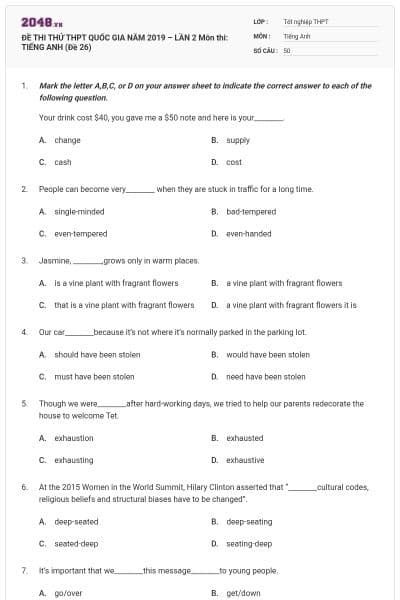
ĐỀ THI THỬ THPT QUỐC GIA NĂM 2019 – LẦN 2 Môn thi: TIẾNG ANH (Đề 26)
50 câu hỏi
Mark the letter A,B,C, or D on your answer sheet to indicate the correct answer to each of the following question.
Your drink cost $40, you gave me a $50 note and here is your________.
change
supply
cash
cost
Đáp án A.
Tạm dịch: Đồ uống của cô hết 40 đô la, cô đưa cho tôi một tờ 50 đô la và đây là tiền thừa trả lại.
A. change (n): tiền thừa
B. supply (n): cung cấp
C. cash (n): tiền mặt
D. cost (n): trị giá
- Here is your change: Đây là tiền trả lại của anh.
Đáp án A là phù hợp nhất.
People can become very________ when they are stuck in traffic for a long time.
single-minded
bad-tempered
even-tempered
even-handed
Đáp án B.
Tạm dịch: Mọi người thường trở nên rất nóng tính khi họ bị tắc đường lâu.
A. sing-minded (adj): chuyên tâm, có một mục đích duy nhất
B. bad-tempered (adj): hay cáu, dễ nổi cáu, xấu tính
C. even-tempered (adj): điềm đạm, bình thản
D. even-handed (adj): công bằng, vô tư
Jasmine, ________,grows only in warm places.
is a vine plant with fragrant flowers
a vine plant with fragrant flowers
that is a vine plant with fragrant flowers
a vine plant with fragrant flowers it is
Đáp án B.
Câu dùng mệnh đề quan hệ không giới hạn dạng rút gọn, chỉ còn cụm danh từ.
Tạm dịch: Hoa nhài, một loài cây thân leo với những bông hoa thơm ngát, mọc chủ yếu ở những vùng khí hậu ấm áp.
Our car________because it’s not where it’s normally parked in the parking lot.
should have been stolen
would have been stolen
must have been stolen
need have been stolen
Đáp án C.
Cấu trúc: must have + PP: ắt hẳn là,chắc là đã (Chỉ một kết luận logic trên những hiện tượng xảy ra ở quá khứ).
Tạm dịch: Xe của chúng tôi ắt hẳn là đã bị đánh cắp bởi vì nó không còn ở chỗ chúng tôi hay đậu trong bãi đỗ xe.
Though we were________after hard-working days, we tried to help our parents redecorate the house to welcome Tet.
exhaustion
exhausted
exhausting
exhaustive
Đáp án B.
A. exhaustion: sự kiệt sức
B. exhausted: cảm thấy kiệt sức
C. exhausting: việc gì làm ai kiệt sức
D. exhaustive: đầy đủ, chi tiết
Tạm dịch: Mặc dù chúng tôi cảm thấy kiệt sức sau những ngày làm việc vất vả, chúng tôi đã cố gắng giúp cha mẹ trang trí lại nhà cửa để đón Tết
At the 2015 Women in the World Summit, Hilary Clinton asserted that “________cultural codes, religious beliefs and structural biases have to be changed”.
deep-seated
deep-seating
seated-deep
seating-deep
Đáp án A.
Tạm dịch: Tại Hội nghị Thượng đỉnh Phụ nữ Thế giới năm 2015, Hilary Clinton đã nhấn mạnh rằng những tập tục văn hoá cổ hủ, niềm tin tôn giáo và định kiến truyền thống phải được thay đổi”.
- assert /ə’sɜ:t/ (v): xác nhận, khẳng định, quả quyết, quyết đoán
- deep-seated (adj): sâu kín, ngấm ngầm, (nghĩa bóng) chắc chắn, vững chắc
It’s important that we________this message________to young people.
go/over
get/down
get/over
go/for
Đáp án C.
Tạm dịch: Chúng ta cần phải làm cho giới trẻ hiểu rõ thông điệp này.
- get sth over (to sb) = make sth clear (to sb): làm cho ai rõ điều gì
Miss Diligent did nine hour’s________ studying a day for het exam.
heavy
solid
powerful
big
Đáp án B.
Tạm dịch: Cô Diligent đã học liên tục 9 tiếng một ngày để chuẩn bị cho kỳ thi.
- solid /’sɒlɪd/ (adj): liên tục, không ngừng (khoảng thời gian)
Ex: - The essay represent a solid week’s work.
- It rained for two hours solid this afternoon.
“At the start of the 19th century, the highest-________newspaper in the United Kingdom was The Morning Post, which sold around 4,000 copies per day.”
distribution
coverage
circulation
sales
Đáp án C.
Tạm dịch: Vào đầu thế kỷ 19, tờ báo có lượng phát hành cao nhất của Vương quốc Anh là Morning Post, bán khoảng 4.000 bản mỗi ngày.
A. distribution /dɪstrɪ’bj:ʃn/ (n): phân phát
B. coverage /’kʌvərɪdʒ/ (n) = news: tin tức
C. circulation: tổng số phát hành (báo, tạp chí,…)
Marketing this new product will be expansive, but________it will be worth the money we spend on it.
at long last
down the years
in the event
in the long run
Đáp án D.
Tạm dịch: Quảng bá sản phẩm mới này sẽ tốn kém nhưng về mặt lâu dài thì nó đáng đồng tiền chúng ta bỏ ra.
A. at long time: sau một thời gian dài = finally
Ex: At long last his prayers had been answered.
B. down the years: trong quá khứ
Ex: I worked a lot down the years
C. in the event = when the situation actually happened: vào lúc xảy ra điều gì
Ex: I got very nervous about the exam, but in the event, I needn’t have worried; it was really easy.
D. in the long run = down the road: trong tương lai xa
Laura start a conversation with Maya-Jane’s sister.
Laura: “You must be Jane’s sister. Glad to meet you.”
Maya: “________”
I am, either
So I am. I’m glad
What do you do?
Me too.
Đáp án D.
Người đầu tiên nói “Rất vui được gặp bạn” – Đáp lại: Me too nghĩa là Tôi cũng vậy (Tôi cũng rất vui được gặp bạn).
Các đáp án khác không phù hợp:
A. I am, either: Sai, “either” đứng cuối câu phủ định.
B. So I am. I’m glad: Sai, vì phải đảo ngữ là “So am I”.
C. What do you do: Câu hỏi về nghề nghiệp dung đáp lại trong trường hợp này là không lịch sự.
The boys ________ that they had broken the window, but I’m sure they did.
refused
denied
objected
reject
Đáp án B.
Tạm dịch: Những cậu bé phủ nhận làm vỡ cửa sổ nhưng tôi chắc là chúng đã.
A. refused + to V: từ chối, khước từ, cự tuyệt làm gì
B. denied + V-ing hoặc denied + that + mệnh đề: phủ nhận không làm gì
C. object + to + V-ing: phản đối, chống, chống đối
D. reject + N: loại ra, bỏ ra; đánh hỏng
Để phù hợp ngữ nghĩa và cấu trúc thì đáp án B là hợp lý nhất
Lien was walking her dogs in the park, she met Lan accidentally.
Lan: “How lovely you pets are!”
Lien: “________”
Thank you, it’s nice of you to say so
Really? They are
Can you say that again
I love them, too
Đáp án A.
Thank you. It’s nice of you to say so: là lời phúc đáp thích hợp nhất cho câu cảm khen ngợi phía trên.
Lưu ý: Một số cấu trúc khen ngợi và đáp án lời khen trong tiếng Anh:
+ Khen ngợi về diện mạo:
Người Anh thường đưa ra lời khen về diện mạo của một ai đó như là màu mắt, kiểu tóc, vóc dáng, hoặc ngoại hình chung. Tuy nhiên, bạn nên tránh đưa ra lời khen về những bộ phận cụ thể trên cơ thể của họ vì điều đó sẽ làm họ cảm thấy khó chịu. Sự thân mật, gần gũi của bạn và người đó càng nhiều thì bạn càng có thể đưa ra những lời khen về những vấn đề riêng tư, cụ thể:
Ex 1:
- Robert: You really have beautiful eyes, Barbara. I’ve never seen such a gorgeous shade of blue: Barbara, đôi mắt của em thực sự rất đẹp. Anh chưa bao giờ thấy đôi mắt màu xanh nào đẹp lộng lẫy như thế cả.
- Barbara: Thank you, Robert. That’s a nice compliment: cám ơn anh, Robert. Đó là một lời khen rất hay.
Ex 2:
- Abdulla: Goodness, you look great, Beverly! Have you lost weight?: Lạy chúa, trông em tuyệt quá, Berverly! Em đã giảm cân phải không?
- Berverly: That’s nice of you to notice. I’ve lost about 10 pounds, but I still need to lose another 5 or 6: Rất vui là anh đã chú ý tới điều đó. Em đã giảm được 10 pounds rồi, nhưng em cần giảm them 5 hoặc 6 pounds nữa.
Ex 3:
- Gene: Your new hairstyle is terrific, Cindy!: Kiểu tóc mới của em thật tuyệt, Cindy!
- Cindy: Thanks, Gene. I think I’ve finally found a style that looks decent and easy to handle: Cám ơn anh, Gene. Em nghĩ là cuối cùng em đã tìm được kiểu tóc phù hợp với mình.
+ Khen ngợi về kỹ năng hoặc sự thông minh:
Dưới đây là một số lời khen về khả nănng hoặc sự thông minh mà người Anh thường dung và cách đáp lại những lời khen đó:
Ex 1:
- Pat: I didn’t know you could play the guitar so well, Jone. Your song was lovely: Tớ không biết là cậu lại có thể chơi ghi ta hay đến thế Jone ạ. Tiết mục của cậu rất tuyệt.
- Jone: Thanks, Pat. I’m glad you enjoy it: Cảm ơn cậu, Pat. Mình vui là cậu thích nó.
Ex 2:
- Yumi: Joe, your backhand (in tennis) us getting stronger every time we play!: Joe này, cú ve trái của em ngày càng mạnh hơn đấy.
- Joe: Do you really think so? I’ve been practicing every day, and I’m pleased you see an improvement: Anh nghĩ vậy thật không? Em đã tập luyện hang ngày, và em rất vui khi anh thấy được sự tiến bộ.
Ex 3:
- Marry: Bud, your photographs are unbelievable! I really wish you’d give me some advice to help my pictures come out better: Những bữc ảnh anh chụp thật không thể tin được Bud ạ! Em rất hy vọng là anh có thể cho em vài lời khuyên làm thế nào em có thể chụp ảnh được đẹp hơn.
- Bud: I’m happy to hear that: Anh rất vui khi nghe em nói thế.
+ Khen ngợi về công việc đã được hoàn thành:
Khi bạn hoàn thành công việc một cách xuất sắc, bạn rất xứng đáng được nhận sự khen ngợi. Trong trường hợp này, chúng ta thường sử dụng từ “congratulation - chúc mừng”. Ngoài ra, còn có một số cách khen ngợi điển hình mà người Anh thường hay dùng.
Ex 1:
- Mike: You did a fine job on the room, Jullie. I don’t think I’ve ever seen it that clean!: Em dọn phòng rất sạch sẽ Jullie ạ. Chưa khi nào anh thấy căn phòng này sạch sẽ đến thế cả!
- Jullie: Oh, it was nothing. I’m glad you could help: Không có gì đâu anh. Em rất vui khi em có thế giúp đỡ được gì đó.
Ex 2:
- Mr.Jones: Congratulation, Barry! That report you wrote was excellent! I’d like to use it as a model at the staff meeting on Friday: Chúc mừng cô, Barry! Bản báo cáo cô viết rất tốt! Tôi muốn dung nó như một bản báo cáo mẫu cho cuộc họp nhân viên vào thứ sáu tới.
- Barry: Thank you, Mr.Jones. I’d be flattered for you to use it: Cám ơn ông Jones. Tôi rấy lấy làm vinh dự.
+ Khen ngợi vật sở hữu của ai đó:
Người Anh thường thích khen đồ vật mà ai đó sở hữu như một món trang sức nhỏ, chiếc áo mới, xe hơi, hay ngôi nhà,… Tuy nhiên, bạn nên thật cẩn thận về cách đưa ra lời khen của mình. Bạn sẽ có thể bị coi là mất lịch sự nếu bạn cố tình tọc mạch vào đời sống cá nhân của họ.
Ví dụ, bạn có thể khen chiếc đồng hồ của Greg rất đẹp - That’s beautiful watch, Greg! Nhưng nếu bạn hỏi thêm một câu nữa về giá của chiếc đồng hồ đó (How much did you pay for it?) thì bạn lại bị coi là mất lịch sự.
Nếu mối quan hệ của bạn và người đó rất thân mật, gần gũi, bạn có thể hỏi người ấy những câu hỏi có tính chất cá nhân, tuy nhiên bạn nên rào trước bằng câu hỏi “Do you mind if I ask…?” (Cậu có phiền không nếu mình hỏi về…?). Bạn phải thật chú ý khi hỏi những câu hỏi mang tính chất riêng tư, trực tiếp, đặc biệt là những câu hỏi liên quan tới những vấn đề tiền bạc, tuổi tác hoặc sex,… Nếu người ấy muốn tiết lộ them điều gì đó (như chiếc đồng hồ giá bao nhiêu, được mua ở đâu,…) thì người ấy sẽ tự nói về chúng mà bạn không cần phải hỏi. Sau đây là một số cách khen ngợi đồ sở hữu của một ai đó mà người Anh hay dùng:
Ex 1:
- Abdal: Your new sweater is very pretty, Sue: Chiếc áo len mới của em trông rất đẹp Sue ạ.
- Sue: Thank you. My sister gave it to me for my birthday. I like yours, too. Is it new?: Cám ơn anh. Chị gái em tặng em nhân ngày sinh nhật đấy. Em cũng rất thích cái của anh. Có phải là áo mới không anh?
Ex 2:
- Mark: Your house is very lovely! I espeacially like what you’ve done to the front yard: Nhà của em rất đẹp! Anh thực sự rất thích cách em trang trí ở sân trước.
- Linda: Really? That’s nice of you to say so: Thật không anh? Anh thật đáng yêu khi nói như vậy!
Ex 3:
- Arthur: You know, I do like your glasses, Bob. I don’t know exactly what it is, but they make you look older: Cậu biết không, tớ rất thích chiếc kính mới của cậu Bob ạ. Tớ không biết chính xác nó là cái gì, nhưng chúng làm cậu trông chững chạc hơn đấy.
- Bob: Thanks.I take that as a compliment, I guess. You think that help me new image as a banker, don’t you? Cám ơn cậu. Tớ sẽ coi đó như là một lời khen. Cậu cho là cặp kính sẽ làm tớ trông giống như giám đốc ngân hang phải không?
If our team________U23Uzbekistan in the final match, we________the champion now.
have defeated/ would be
defeats/ will be
defeated/ would be
had defeated/ would be
Đáp án D.
Tạm dịch: Nếu đội bóng của chúng ta đánh bại U23 Uzbekistan thì giờ chúng ta đã trở thành nhà vô địch rồi.
Đây là dạng câu điều kiện loại hỗn hợp, kết hợp giữa điều kiện loại 3 và 2, diễn tả một việc xảy ra trong quá khứ nhưng kết quả/hậu quả của nó còn kéo dài đến hiện tại.
Ex: If she hadn’t been driving so carelessly, she wouldn’t be in hospital now: Nếu cô ta không lái xe quá ẩu thì bây giờ đã không nằm trong bệnh viện rồi: Việc lái xe đã xảy ra trong quá khứ, dung vế đầu của ĐK loại 3 (Quá khứ hoàn thành). Nhưng hậu quả của việc lái xe ẩu đó vẫn còn tiếp diễn đến hiện tại là cô ta đang nằm trên giường bệnh, sử dụng vế sau của điều kiện loại 2 (Quá khứ đơn).
Mark the letter A,B,C, or D on your answer sheet to indicate the underlined part that needs correction in each of the following questions.
Transplanting organs such hearts and kidneys had proved easier than transplanting muscles.
such
proved
easier
muscles
Đáp án A.
Đổi such thành such as.
Tạm dịch: Cấy ghép nội tạng ví dụ như tim và thận đã tỏ ra đơn giản hơn cấy ghép cơ.
Để đưa ra ví dụ mih hoạ sử dụng such as không phải such
Mark the letter A,B,C, or D on your answer sheet to indicate the underlined part that needs correction in each of the following questions.
On the floor of the Pacific Ocean is hundreds of flat-tipped mountains more than a mile beneath sea level.
On
is hundreds of
more than
beneath sea level
Đáp án: B
Giải thích:
Đảo ngữ với trạng từ chỉ nơi chốn:
Trạng từ chỉ nơi chốn + V + S
Trong đó, động từ chia theo thì và theo chủ ngữ.
“hundreds of flat-tipped mountains” là số nhiều, dùng “are”.
Sửa: is hundreds of → are hundreds of
Dịch: Trên đáy Thái Bình Dương có hàng trăm ngọn núi có đỉnh phẳng, nằm sâu hơn một dặm dưới mực nước biển.
Mark the letter A,B,C, or D on your answer sheet to indicate the underlined part that needs correction in each of the following questions.
Paint must bestirred and sometimes dilution before it is applied.
must
bestirred
dilution
applied
Đáp án C.
Áp dụng luật song hành, đổi danh từ dilution thành động từ dạng bị động diluted.
Tạm dịch: Sơn phải được khoả đều và đôi khi phải được pha loãng trước khi dung.
Read the following passage and mark the letter A,B,C, or D on your answer sheet to indicate the correct answer to each of the following question from 18 to 25.
The principle of use and disuse states that those parts of organisms’ bodies that are used grown larger. Those parts that are not tend to wither away. It is an observed fact that when you exercise particular muscles, they grow. Those that are never used dimish. By examining a man’s body, we can tell which muscles he uses and which he doesn’t. We may even be able to guess his profession or his reaction. Enthusiasts of the “body-building” cult make use of the principle of use and disuse to “build” their bodies, almost like a piece of sculpture, into whatever unnatural shape is demanded by fashion in this peculiar minority culture. Muscles are not the only parts of the body that respond to use in this kind of way. Walk barefoot and you acquire harder skin on your soles. It is easy to tell a famer from a bank teller by looking at their hands alone. The famer’s hands are horny, hardened by long exposure to rough work. The teller’s hands are relatively soft.
The principle of use and disuse enables animals to become better at the job of surviving in their world, progressively better during their lifetime as result of living in that world. Humans, through direct exposure to sunlight, or lack of it, develop a skin color which equips them better to survive in the particular local conditions.
Too much sunlight is dangerous. Enthusiastic sunbathers with very fair skins are susceptible to skin cancer. Too little sunlight, on the other hand, leads to vitamin-D deficiency and rickets. The brown pigment melanin which is synthesized under the influence of sunlight, makes a screen to protect the underlying tissues from the harmful effects of further sunlight. If a suntanned person moves to a less sunny climate, the melanin disappears, and the body is able to benefit from what little sun there is. This can be represented as an instance of the principle of use and disuse: skin goes brown when it is “used”, and fades to white when it is not.
What does the passage mainly discuss?
How the principles of use and disuse change people’s concepts of themselves.
The changes that occur according to the principle of use and disuse
The way in which people change themselves to conform to fashion
The effects of the sun on the principle of use and disuse
Đáp án B
Key word: the passage, mainly discuss.
Phân tích đáp án:
A. How the principle of use and disuse change people’s concepts of themselves: Cách nhưng quy luật về dung và không dung làm thay đổi khái niệm của con người về chính họ.
B. The changes that occur according to the principle of use and disuse: Những thay đổi tuỳ theo quy luật dung và không dung - Nội dung xuyên suốt bài (những thay đổi của người tập thể hình/ của da người tuỳ theo điều kiện nắng…)
C. The way in which people change themselves to conform to fashion: Cách mà người ta thay đổi để chạy theo thời trang - Chỉ là một nội dung nhỏ.
D. The effects of the sun on the principle of use and disuse: những ảnh hưởng của ánh nắng lên quy luật dung và không dùng - Hoàn toàn sai.
Đáp án chính xác là B.
Read the following passage and mark the letter A,B,C, or D on your answer sheet to indicate the correct answer to each of the following question from 18 to 25.
The principle of use and disuse states that those parts of organisms’ bodies that are used grown larger. Those parts that are not tend to wither away. It is an observed fact that when you exercise particular muscles, they grow. Those that are never used dimish. By examining a man’s body, we can tell which muscles he uses and which he doesn’t. We may even be able to guess his profession or his reaction. Enthusiasts of the “body-building” cult make use of the principle of use and disuse to “build” their bodies, almost like a piece of sculpture, into whatever unnatural shape is demanded by fashion in this peculiar minority culture. Muscles are not the only parts of the body that respond to use in this kind of way. Walk barefoot and you acquire harder skin on your soles. It is easy to tell a famer from a bank teller by looking at their hands alone. The famer’s hands are horny, hardened by long exposure to rough work. The teller’s hands are relatively soft.
The principle of use and disuse enables animals to become better at the job of surviving in their world, progressively better during their lifetime as result of living in that world. Humans, through direct exposure to sunlight, or lack of it, develop a skin color which equips them better to survive in the particular local conditions.
Too much sunlight is dangerous. Enthusiastic sunbathers with very fair skins are susceptible to skin cancer. Too little sunlight, on the other hand, leads to vitamin-D deficiency and rickets. The brown pigment melanin which is synthesized under the influence of sunlight, makes a screen to protect the underlying tissues from the harmful effects of further sunlight. If a suntanned person moves to a less sunny climate, the melanin disappears, and the body is able to benefit from what little sun there is. This can be represented as an instance of the principle of use and disuse: skin goes brown when it is “used”, and fades to white when it is not.
The phrase “wither away” in bold is closest in meaning to________.
split
rot
perish
shrink
Đáp án D.
Key word: wither away.
Clue: “those parts of organisms’ bodies that are used grow larger. Those parts that are not tend to wither away”: những phần của cơ thể sinh vật sống đang được sử dụng sẽ phát triển lớn hơn. Những phần không được sử dụng có khuynh hướng________.
Phân tích đáp án:
A. split: phân chia
B. rot: mục rữa
C. perish: chết, tàn lụi
D. shrink: co vào, bé đi
Ta thấy rằng dựa vào clue thì ý của câu 2 phải ngược lại ý của câu 1. Ở câu 1 là “grow larger” thì ở cảu hai sẽ mang nghĩa là bé đi. Đáp an chính xác là D.
Read the following passage and mark the letter A,B,C, or D on your answer sheet to indicate the correct answer to each of the following question from 18 to 25.
The principle of use and disuse states that those parts of organisms’ bodies that are used grown larger. Those parts that are not tend to wither away. It is an observed fact that when you exercise particular muscles, they grow. Those that are never used dimish. By examining a man’s body, we can tell which muscles he uses and which he doesn’t. We may even be able to guess his profession or his reaction. Enthusiasts of the “body-building” cult make use of the principle of use and disuse to “build” their bodies, almost like a piece of sculpture, into whatever unnatural shape is demanded by fashion in this peculiar minority culture. Muscles are not the only parts of the body that respond to use in this kind of way. Walk barefoot and you acquire harder skin on your soles. It is easy to tell a famer from a bank teller by looking at their hands alone. The famer’s hands are horny, hardened by long exposure to rough work. The teller’s hands are relatively soft.
The principle of use and disuse enables animals to become better at the job of surviving in their world, progressively better during their lifetime as result of living in that world. Humans, through direct exposure to sunlight, or lack of it, develop a skin color which equips them better to survive in the particular local conditions.
Too much sunlight is dangerous. Enthusiastic sunbathers with very fair skins are susceptible to skin cancer. Too little sunlight, on the other hand, leads to vitamin-D deficiency and rickets. The brown pigment melanin which is synthesized under the influence of sunlight, makes a screen to protect the underlying tissues from the harmful effects of further sunlight. If a suntanned person moves to a less sunny climate, the melanin disappears, and the body is able to benefit from what little sun there is. This can be represented as an instance of the principle of use and disuse: skin goes brown when it is “used”, and fades to white when it is not.
The word “Those” in bold refers to________.
organisms
bodies
parts
muscles
Đáp án D.
Key word: those.
Clue: “It is an observed fact that when you exercise particular muscles, they grow. Those that are never used dimish”: Theo quan satd thì khi bạn tập luyện những nhóm cơ nhất định, chúng sẽ lớn lên. Những nhóm không bao giờ được sử dụng sẽ rất nhỏ.
Phân tích đáp án:
A. organisms
B. bodies
C. parts
D. muscles
Do câu trước đang nói đến nhóm cơ nên câu sau chắc chắn vẫn sẽ nói về danh từ đó. Đáp án chính xác là D
Read the following passage and mark the letter A,B,C, or D on your answer sheet to indicate the correct answer to each of the following question from 18 to 25.
The principle of use and disuse states that those parts of organisms’ bodies that are used grown larger. Those parts that are not tend to wither away. It is an observed fact that when you exercise particular muscles, they grow. Those that are never used dimish. By examining a man’s body, we can tell which muscles he uses and which he doesn’t. We may even be able to guess his profession or his reaction. Enthusiasts of the “body-building” cult make use of the principle of use and disuse to “build” their bodies, almost like a piece of sculpture, into whatever unnatural shape is demanded by fashion in this peculiar minority culture. Muscles are not the only parts of the body that respond to use in this kind of way. Walk barefoot and you acquire harder skin on your soles. It is easy to tell a famer from a bank teller by looking at their hands alone. The famer’s hands are horny, hardened by long exposure to rough work. The teller’s hands are relatively soft.
The principle of use and disuse enables animals to become better at the job of surviving in their world, progressively better during their lifetime as result of living in that world. Humans, through direct exposure to sunlight, or lack of it, develop a skin color which equips them better to survive in the particular local conditions.
Too much sunlight is dangerous. Enthusiastic sunbathers with very fair skins are susceptible to skin cancer. Too little sunlight, on the other hand, leads to vitamin-D deficiency and rickets. The brown pigment melanin which is synthesized under the influence of sunlight, makes a screen to protect the underlying tissues from the harmful effects of further sunlight. If a suntanned person moves to a less sunny climate, the melanin disappears, and the body is able to benefit from what little sun there is. This can be represented as an instance of the principle of use and disuse: skin goes brown when it is “used”, and fades to white when it is not.
According to the passage, men who body build________
appear like sculptures
change their appearance
belong to strange cults
are very fashionable
Đáp án B.
Key word: men who body build.
Clue: “Enthusiasts of the “body-building” cult make use of the principle of use and disuse to “build” their bodies, almost like a piece of sculpture, into whatever unnatural shape is demanded by fashion in this peculiar minority culture”: Những người ủng hộ trường phái “tập thể hình” sủ dụng nguyên tắc dùng và không dùng để xây dựng cơ thể, gần giống như một tác phẩm điêu khắc, họ biến đổi thành những hình thù không tự nhiên tuỳ theo xu hướng thời trang trong cái xã hội nhỏ khác lạ đó.
Phân tích đáp án:
A. appear like sculpture: trông như một bức tượng điêu khắc
B. change their appearance: thay đổi ngoại hình của họ
C. belong to strange cults: thuộc về những trường phái lạ
D. are very fashionable: rất hợp thời trang
Dựa vào clue ta thấy rằng những người này thuộc về trường phái thể hình (the “body-building” cults) và họ thay đổi cơ thể để hợp mốt thời trang nên do đó đáp án C và D sai. Tác giả dùng tác phẩm điêu khắc để nói về cách những người này thay đổi cơ thể của họ chứ không phải là nhìn họ như những tấm điêu khắc (cứng đơ, bất động). Do đó đáp án chính xác là B.
Read the following passage and mark the letter A,B,C, or D on your answer sheet to indicate the correct answer to each of the following question from 18 to 25.
The principle of use and disuse states that those parts of organisms’ bodies that are used grown larger. Those parts that are not tend to wither away. It is an observed fact that when you exercise particular muscles, they grow. Those that are never used dimish. By examining a man’s body, we can tell which muscles he uses and which he doesn’t. We may even be able to guess his profession or his reaction. Enthusiasts of the “body-building” cult make use of the principle of use and disuse to “build” their bodies, almost like a piece of sculpture, into whatever unnatural shape is demanded by fashion in this peculiar minority culture. Muscles are not the only parts of the body that respond to use in this kind of way. Walk barefoot and you acquire harder skin on your soles. It is easy to tell a famer from a bank teller by looking at their hands alone. The famer’s hands are horny, hardened by long exposure to rough work. The teller’s hands are relatively soft.
The principle of use and disuse enables animals to become better at the job of surviving in their world, progressively better during their lifetime as result of living in that world. Humans, through direct exposure to sunlight, or lack of it, develop a skin color which equips them better to survive in the particular local conditions.
Too much sunlight is dangerous. Enthusiastic sunbathers with very fair skins are susceptible to skin cancer. Too little sunlight, on the other hand, leads to vitamin-D deficiency and rickets. The brown pigment melanin which is synthesized under the influence of sunlight, makes a screen to protect the underlying tissues from the harmful effects of further sunlight. If a suntanned person moves to a less sunny climate, the melanin disappears, and the body is able to benefit from what little sun there is. This can be represented as an instance of the principle of use and disuse: skin goes brown when it is “used”, and fades to white when it is not.
From the passage, it can be inferred that author views body building________.
with enthusiasm
as an artistic from
with scientific interest
of doubtful benefic
Đáp án D.
Key word: author views bodybuilding as.
Clue: Enthusiasts of the “body-building” cult make use of the principle of use and disuse to “build” their bodies, almost like a piece of sculpture, into whatever unnatural shaple is demanded bu fashion in this peculiar minority: Dùng và không dùng để xây dựng cơ thể, gần giống như một tác phẩm điêu khắc, họ biến đổi thành những hình thù không tự nhiên tuỳ theo xu hướng thời trang trong cái xã hội nhỏ khác lạ đó.
Phân tích đáp án:
A. with enthusiasm: với sự hào hứng
B. as an artistic: như một dạng nghệ thuật
C. with scientific interest: với một niềm yêu thích khoa học
D. of doubtful: như một lợi ích đáng nghi ngờ
Đây là câu hỏi không đơn giản, đòi hỏi ta phải hiểu sắc thái từ ngữ mà tác giả sử dụng. Các từ mang ý nghĩa tương đối không hài lòng, không có cảm tình lắm như: unnatural (không tự nhiên), peculiar (dị biệt, lập dị), minority (thiểu số).
Do đó đáp án chính xác là D.
Read the following passage and mark the letter A,B,C, or D on your answer sheet to indicate the correct answer to each of the following question from 18 to 25.
The principle of use and disuse states that those parts of organisms’ bodies that are used grown larger. Those parts that are not tend to wither away. It is an observed fact that when you exercise particular muscles, they grow. Those that are never used dimish. By examining a man’s body, we can tell which muscles he uses and which he doesn’t. We may even be able to guess his profession or his reaction. Enthusiasts of the “body-building” cult make use of the principle of use and disuse to “build” their bodies, almost like a piece of sculpture, into whatever unnatural shape is demanded by fashion in this peculiar minority culture. Muscles are not the only parts of the body that respond to use in this kind of way. Walk barefoot and you acquire harder skin on your soles. It is easy to tell a famer from a bank teller by looking at their hands alone. The famer’s hands are horny, hardened by long exposure to rough work. The teller’s hands are relatively soft.
The principle of use and disuse enables animals to become better at the job of surviving in their world, progressively better during their lifetime as result of living in that world. Humans, through direct exposure to sunlight, or lack of it, develop a skin color which equips them better to survive in the particular local conditions.
Too much sunlight is dangerous. Enthusiastic sunbathers with very fair skins are susceptible to skin cancer. Too little sunlight, on the other hand, leads to vitamin-D deficiency and rickets. The brown pigment melanin which is synthesized under the influence of sunlight, makes a screen to protect the underlying tissues from the harmful effects of further sunlight. If a suntanned person moves to a less sunny climate, the melanin disappears, and the body is able to benefit from what little sun there is. This can be represented as an instance of the principle of use and disuse: skin goes brown when it is “used”, and fades to white when it is not.
It can be inferred from the passage that the principle of use and disuse enables organisms to________.
change their existence
automatically benefit
survive in any condition
improve their lifetime
Đáp án C.
Key word: inferred, principle of use and disuse anables organisms to.
Clue: “The principle of use and disuse anables animals to become better at the job of surviving in their world…which equips them better to survive in the particular local conditions”: Nguyên tắc dùng và không dùng giúp cho động vật có thể thích nghi tốt hơn trong viêc tồn tại ở thế giới của chúng… trang bị cho chúng để tồn tại trong những điều kiện cụ thể.
Phân tích đáp án:
A. change their existence: thay đổi sự tồn tại của chúng
B. automatically: có lợi một cách tự nhiên
C. survive in any condition: tồn tại ở bất kỳ tình trạng nào
D. improve their lifetime: cải thiện tuổi thọ
Dựa vào clue ta thấy đáp án chính xác là C.
Read the following passage and mark the letter A,B,C, or D on your answer sheet to indicate the correct answer to each of the following question from 18 to 25.
The principle of use and disuse states that those parts of organisms’ bodies that are used grown larger. Those parts that are not tend to wither away. It is an observed fact that when you exercise particular muscles, they grow. Those that are never used dimish. By examining a man’s body, we can tell which muscles he uses and which he doesn’t. We may even be able to guess his profession or his reaction. Enthusiasts of the “body-building” cult make use of the principle of use and disuse to “build” their bodies, almost like a piece of sculpture, into whatever unnatural shape is demanded by fashion in this peculiar minority culture. Muscles are not the only parts of the body that respond to use in this kind of way. Walk barefoot and you acquire harder skin on your soles. It is easy to tell a famer from a bank teller by looking at their hands alone. The famer’s hands are horny, hardened by long exposure to rough work. The teller’s hands are relatively soft.
The principle of use and disuse enables animals to become better at the job of surviving in their world, progressively better during their lifetime as result of living in that world. Humans, through direct exposure to sunlight, or lack of it, develop a skin color which equips them better to survive in the particular local conditions.
Too much sunlight is dangerous. Enthusiastic sunbathers with very fair skins are susceptible to skin cancer. Too little sunlight, on the other hand, leads to vitamin-D deficiency and rickets. The brown pigment melanin which is synthesized under the influence of sunlight, makes a screen to protect the underlying tissues from the harmful effects of further sunlight. If a suntanned person moves to a less sunny climate, the melanin disappears, and the body is able to benefit from what little sun there is. This can be represented as an instance of the principle of use and disuse: skin goes brown when it is “used”, and fades to white when it is not.
The author suggests that melanin________.
is necessary for the production of vitamin D
is beneficial in sunless climates
helps protect fair-skinned people
is a synthetic product
Đáp án C.
Key word: melanin.
Clue: “The brown pigment melanin which is synthesized under the influence of sunlight, makes asreen to protect the underlying tissues from the harmful effects of further sunlight”: Melanin có sắc tố nâu được tổng hợp dưới tác động của ánh nắng, tạo nên một lớp bảo vệ những tế bào nằm dưới da khỏi tác động có hại của ánh nắng mặt trời.
Phân tích đáp án:
A. Is necessary for the production of vitamin-D
B. Is beneficial in sunless climates
C. Helps protect fair-skinned people
D. Is a synthetic product
Dựa vào clue ta thấy rằng đáp án chính xác là C.
Read the following passage and mark the letter A,B,C, or D on your answer sheet to indicate the correct answer to each of the following question from 18 to 25.
The principle of use and disuse states that those parts of organisms’ bodies that are used grown larger. Those parts that are not tend to wither away. It is an observed fact that when you exercise particular muscles, they grow. Those that are never used dimish. By examining a man’s body, we can tell which muscles he uses and which he doesn’t. We may even be able to guess his profession or his reaction. Enthusiasts of the “body-building” cult make use of the principle of use and disuse to “build” their bodies, almost like a piece of sculpture, into whatever unnatural shape is demanded by fashion in this peculiar minority culture. Muscles are not the only parts of the body that respond to use in this kind of way. Walk barefoot and you acquire harder skin on your soles. It is easy to tell a famer from a bank teller by looking at their hands alone. The famer’s hands are horny, hardened by long exposure to rough work. The teller’s hands are relatively soft.
The principle of use and disuse enables animals to become better at the job of surviving in their world, progressively better during their lifetime as result of living in that world. Humans, through direct exposure to sunlight, or lack of it, develop a skin color which equips them better to survive in the particular local conditions.
Too much sunlight is dangerous. Enthusiastic sunbathers with very fair skins are susceptible to skin cancer. Too little sunlight, on the other hand, leads to vitamin-D deficiency and rickets. The brown pigment melanin which is synthesized under the influence of sunlight, makes a screen to protect the underlying tissues from the harmful effects of further sunlight. If a suntanned person moves to a less sunny climate, the melanin disappears, and the body is able to benefit from what little sun there is. This can be represented as an instance of the principle of use and disuse: skin goes brown when it is “used”, and fades to white when it is not.
In the second paragraph, the author mentions sun tanning as an example of________.
humans improving their local condition
humans surviving in adverse conditions
humans using the principle of use and disuse
humans running the risk of skin cancer
Đáp án C.
Key word: sun tanning, example of.
Clue: “The principle of use disuse anables animals better at the job of surviving in their world, progressively better during their lifetime as a result of living in that world. Humans, through direct exposure to sunlight, or lack of it, develop a skin color which equips them better to survive in the particular local conditions. Too much sunlight is dangerous”: Nguyên lí của việc dùng hay không dùng cho phép động vật trở nên tốt hơn trong việc tồn tại trong môi trường chúng sống, càng ngày càng tốt lên trong suốt cuộc đời của chúng như một kết quả của việc sống đó. Con người tiếp xúc trực tiếp với ánh nắng mặt trời hay thiếu ánh nắng đều phát triển một màu da để tồn tại tốt hơn trong môi trường địa phương đặc biệt.
Phân tích đáp án:
A. Humans improving their local condition: Con người cải thiện điều kiện ở địa phương của họ.
B. Humans surviving in adverse conditions: Con người sống sót trong điều kiện bất lợi
C. Humans using the principle of use and disuse: Con người sử dụng nguyên tắc sử dụng và không sử dụng.
D. Humans running the risk of skin cancer: Con người có nguy cơ ung thư da.
Trong clue ta thấy câu trước nói về quy luật sử dụng hay không sử dụng “ánh nắng” của con người nên câu sau phải là ví dụ cho việc này. Đáp án chính xác là C.
Mark the letter A,B,C, or D on your answer sheet to indicate the word whose underlined part that differs from the other three in the pronunciation in each of the following.
expand
stagnant
vacancy
applicant
Đáp án C
A. expand /ɪk’spænd/ (v): mở rộng
B. stagnant /’stæɡnənt/ (adj): ứ đọng, trì trệ, uể oải
C. vacancy /’veɪkənsi/ (n): vị trí việc làm còn trống, phòng còn trống (trong khách sạn)
D. applicant /’æplɪkənt/ (n): người xin việc
Đáp án chính xác là C vì phần gạch chân được đọc là âm /əi/ khác với những đáp án còn lại đọc âm /æ/.
Mark the letter A,B,C, or D on your answer sheet to indicate the word whose underlined part that differs from the other three in the pronunciation in each of the following.
attained
resolved
disused
decreased
Đáp án D.
A. attained /a’teind/ (v): đạt được
B. resolved /zɪ’zɒlvd/ (v): giải quyết (khó khan, vấn đề, mối nghi ngờ,,,), (hoá học) phân giải
C. disused /dis’ju:zd/ (v): không sử dụng nữa
D. decreased /dɪ’kri:st/ (v): giảm đi
Ta thấy các đáp án A,B,C đều có từ gạch chân đọc là /d/, còn đáp án D là /t/, nên đáp án chính xác là D.
Mark the letter A,B,C, or D on your answer sheet to indicate the word that differs from the other three in the position of primary stress in each of the following.
flourish
season
product
today
Đáp án D.
D nhấn trọng âm ở âm tiết thứ 2, còn lại nhấn âm thứ 1.
A. flourish /’flʌrɪʃ/ (v): thịnh vượng, phát đạt; thành công; phát triển, mọc sum sê (cây), viết hoa mỹ, nói hoa mỹ, khoa trương, (âm nhạc) dạo nhạc một cách bay bướm; thổi một hồi kèn
B. season /’si:zn/ (n): mùa
C. product /’prɒdʌkt/ (n): sản phẩm
D. today /tədeɪ/ (n): ngày nay, hôm nay
Mark the letter A,B,C, or D on your answer sheet to indicate the word that differs from the other three in the position of primary stress in each of the following.
attitude
infamously
geneticist
socialist
Đáp án C.
C nhấn trọng âm ở âm tiết thứ 2, còn lại nhấn âm thứ 1.
A. attiude /’ætɪtju:d/ (n): thái độ
B. infamously /’ɪnfəməsli/ (adv): một cách ô nhục
C. geneticist /dʒə’netɪsɪst/ (n): nhà nghiên cứu về di truyền học, nhà di truyền học
D. socialist /’səʊʃəlɪst/ (n): người theo chủ nghĩa xã hội
Read the following passage and mark the letter A,B,C, or D on your answer sheet to indicate the correct word or phrase that best fits each of the numbered blanks.
THE HOSTORY OF WRITING
The development of writing (30)________ a huge difference to the world and might see it as the beginning of the media. Pieces of pottery with marks on that are probably numbers have been discovered in China (31)________date from around 4000 BC. Hieroglyphics and other forms of “picture writing” developed in the area around Mesopotamia (modern-day Iraq), where the ancient Sumerian civilization was based, from around 3300 BC onwards. However, the first (32)________ alphabet was used by the Phoenicians around 1050 BC. Their alphabet had 22 letters and it is estimated that it lasted for 1000 years. The first two signs were called “aleph” and “beth”, which in Greek became “alpha” and “beta”, which gave us the modern word “alphabet”.
The modern European alphabet is based on the Greek and spead (33)________other European countries under the Romans. A number of changes took place as time passed. The Romans added the letter G, and the letter J and V were unknown to people in Shakespeare’s time.
If we (34)________the history of punctuation, we also find some interesting facts. The Romans used to write quaesto at the end of a sentence in order to show that it was a Question. They started to write Qo in place of the whole word, and the put the Q above the o. In the end, that became the question mark “?”
Điền vào ô 30
did
had
made
took
Đáp án C.
Tạm dịch: The development of writing________a huge difference to the workd: Sự phát triển của việc viết________một sự khác biệt rất lớn đối với thế giới
Đáp án đúng là C. make a difference: tạo ra một sự khác biệt.
Read the following passage and mark the letter A,B,C, or D on your answer sheet to indicate the correct word or phrase that best fits each of the numbered blanks.
THE HOSTORY OF WRITING
The development of writing (30)________ a huge difference to the world and might see it as the beginning of the media. Pieces of pottery with marks on that are probably numbers have been discovered in China (31)________date from around 4000 BC. Hieroglyphics and other forms of “picture writing” developed in the area around Mesopotamia (modern-day Iraq), where the ancient Sumerian civilization was based, from around 3300 BC onwards. However, the first (32)________ alphabet was used by the Phoenicians around 1050 BC. Their alphabet had 22 letters and it is estimated that it lasted for 1000 years. The first two signs were called “aleph” and “beth”, which in Greek became “alpha” and “beta”, which gave us the modern word “alphabet”.
The modern European alphabet is based on the Greek and spead (33)________other European countries under the Romans. A number of changes took place as time passed. The Romans added the letter G, and the letter J and V were unknown to people in Shakespeare’s time.
If we (34)________the history of punctuation, we also find some interesting facts. The Romans used to write quaesto at the end of a sentence in order to show that it was a Question. They started to write Qo in place of the whole word, and the put the Q above the o. In the end, that became the question mark “?”
Điền vào ô 31
where
that
who
when
Đáp án B.
Tạm dịch: Pieces of pottery with marks on that are probably numbers have been discovered in China________date from around 4000 BC: Các mảnh gốm với các dấu hiệu trên đó, có thể là các con số, được phát hiện ở Trung Quốc, có niên đại từ khoảng năm 4000 trước Công nguyên.
Chỗ trống thiếu đại từ quan hệ làm chủ ngữ, làm rõ nghĩa cho pieces of pottery nên đáp án đúng là B. that.
Read the following passage and mark the letter A,B,C, or D on your answer sheet to indicate the correct word or phrase that best fits each of the numbered blanks.
THE HOSTORY OF WRITING
The development of writing (30)________ a huge difference to the world and might see it as the beginning of the media. Pieces of pottery with marks on that are probably numbers have been discovered in China (31)________date from around 4000 BC. Hieroglyphics and other forms of “picture writing” developed in the area around Mesopotamia (modern-day Iraq), where the ancient Sumerian civilization was based, from around 3300 BC onwards. However, the first (32)________ alphabet was used by the Phoenicians around 1050 BC. Their alphabet had 22 letters and it is estimated that it lasted for 1000 years. The first two signs were called “aleph” and “beth”, which in Greek became “alpha” and “beta”, which gave us the modern word “alphabet”.
The modern European alphabet is based on the Greek and spead (33)________other European countries under the Romans. A number of changes took place as time passed. The Romans added the letter G, and the letter J and V were unknown to people in Shakespeare’s time.
If we (34)________the history of punctuation, we also find some interesting facts. The Romans used to write quaesto at the end of a sentence in order to show that it was a Question. They started to write Qo in place of the whole word, and the put the Q above the o. In the end, that became the question mark “?”
Điền vào ô 32
true
accurate
exact
precise
Đáp án A.
Tạm dịch: However, the first________alphabet was used by the Phoenicians around 1050 BC: Tuy nhiên, bảng chữ cái________đầu tiên được sử dụng bởi những người xứ Phoenici khoảng năm 1050 TCN.
A. true (adj): chân thực, đúng với sự thật (thường dùng với một sự kiện, sự việc)
B. accurate (adj): chính xác, xác đáng (theo kiểu đúng với mọi chi tiết)
C. exact (adj): đúng đắn, chính xác (đưa ra tất cả các chi tiết một cách đúng đắn)
D. precise (adj): rõ ràng, chính xác, tỉ mỉ, nghiêm ngặt (đưa ra các chi tiết một cách rõ ràng, chính xác và thường dùng trong đo lường)
Read the following passage and mark the letter A,B,C, or D on your answer sheet to indicate the correct word or phrase that best fits each of the numbered blanks.
THE HOSTORY OF WRITING
The development of writing (30)________ a huge difference to the world and might see it as the beginning of the media. Pieces of pottery with marks on that are probably numbers have been discovered in China (31)________date from around 4000 BC. Hieroglyphics and other forms of “picture writing” developed in the area around Mesopotamia (modern-day Iraq), where the ancient Sumerian civilization was based, from around 3300 BC onwards. However, the first (32)________ alphabet was used by the Phoenicians around 1050 BC. Their alphabet had 22 letters and it is estimated that it lasted for 1000 years. The first two signs were called “aleph” and “beth”, which in Greek became “alpha” and “beta”, which gave us the modern word “alphabet”.
The modern European alphabet is based on the Greek and spead (33)________other European countries under the Romans. A number of changes took place as time passed. The Romans added the letter G, and the letter J and V were unknown to people in Shakespeare’s time.
If we (34)________the history of punctuation, we also find some interesting facts. The Romans used to write quaesto at the end of a sentence in order to show that it was a Question. They started to write Qo in place of the whole word, and the put the Q above the o. In the end, that became the question mark “?”
Điền vào ô 33
to
in
with
for
Đáp án A.
Tạm dịch: “The modern European alphabet is based on the Greek and spread________other European countries under the Romans”: Bảng chữ cái của người Châu Âu hiện đại có nền tảng là tiếng Hy Lạp và lan truyền sang các nước Châu Âu khác dưới thời La Mã.
- to spread to: truyền ra, rải, truyền bá
Read the following passage and mark the letter A,B,C, or D on your answer sheet to indicate the correct word or phrase that best fits each of the numbered blanks.
THE HOSTORY OF WRITING
The development of writing (30)________ a huge difference to the world and might see it as the beginning of the media. Pieces of pottery with marks on that are probably numbers have been discovered in China (31)________date from around 4000 BC. Hieroglyphics and other forms of “picture writing” developed in the area around Mesopotamia (modern-day Iraq), where the ancient Sumerian civilization was based, from around 3300 BC onwards. However, the first (32)________ alphabet was used by the Phoenicians around 1050 BC. Their alphabet had 22 letters and it is estimated that it lasted for 1000 years. The first two signs were called “aleph” and “beth”, which in Greek became “alpha” and “beta”, which gave us the modern word “alphabet”.
The modern European alphabet is based on the Greek and spead (33)________other European countries under the Romans. A number of changes took place as time passed. The Romans added the letter G, and the letter J and V were unknown to people in Shakespeare’s time.
If we (34)________the history of punctuation, we also find some interesting facts. The Romans used to write quaesto at the end of a sentence in order to show that it was a Question. They started to write Qo in place of the whole word, and the put the Q above the o. In the end, that became the question mark “?”
Điền vào ô 34
look into
bring on
make off
hold up
Đáp án A.
Tạm dịch: “If we________ the history of punctuation, we also find some interesting facts”: Nếu chúng ta________lịch sử của hệ thống chấm câu, chúng ta cũng sẽ tìm thấy một vài thực tế thú vị.
Đáp án đúng là A. look into: điều tra.
Các đáp án khác không phù hợp:
B. bring on sth: gây ra
Ex: He was suffering from stress brought on by overwork.
C. make off: đi nhanh để bỏ trốn
D. hold up: ăn trộm (có dùng súng)
Ex: Masked men help up a security van in South London yesterday
Read the following passage and mark the letter A,B,C, or D on your answer sheet to indicate the correct answer to each of the questions.
ENGLISH SEVENTH MEETING “SAN ANDREAS FAULT”
The San Andreas Fault line is a fracture at the congruence of two major plates of the Earth’s crust, one of which support most of the North American continent, and the other of which underlies the coast of California and part of the ocean floor or the Pacific Ocean. The fault originates about six hundred miles south of the Gulf of California, runs north in an irregular line along the western coast to San Francisco, and continues north for about two hundred more miles before angling off into the ocean. In places, the trace of the fault is marked by a trench, or, in geological terms, a rift, and a small ponds dot the landscape. Its western side always move north in relation to its eastern side. The total net slip along the San Andreas Fault and the length of time it has active are matters of conjecture, but it has been estimated that, during the past fifteen million years, coastal California along the San Andreas Fault has moved about 190 miles in a northwesterly direction with respect to the North American plate. Although the movement along the fault averages only a few inches a year, it is intermittent and variable. Some segments of the fault do not have move at all for long periods of time, building up tremendous pressure that must be released. For this reason, tremors are not unusual along the San Andreas Fault, some of which are classified as major earthquakes. Also for this reason, small tremors are interpreted as safe, since they are understood to be pressure that releases without causing much damage.
It is worth nothing that the San Andreas Fault passes uncomfortable close to several major metropolitan areas, including Los Angeles and San Francisco, in addition, the San Andreas Fault has created smaller fault systems, many of which underlie the smaller towns and cities along the California coast. For this reason, Californians have long anticipated the recurrence of what they refer to as “the Big One”, a chain reaction of destructive earthquakes that would measure near 8 on the Richter scale, similar in intensity to those that occurred in 1857 and 1906. Such a quake world wreak devastating effects on the life and property in the region. Unfortunately, as pressure continues to build along the fault, the likelihood of such an earthquake increases substantially.
What is the author’s main purpose in the passage?
To describe the San Andreas Fault
To give a definition of a fault
To explain the reason for tremors and earthquakes
To classify different kinds of faults
Đáp án A.
Tạm dịch câu hỏi: Mục đích chính của tác giả trong đoạn văn là gì?
Ta thấy toàn bài tập trung nói về các đặc điểm của khe nứt San Andreas. Vậy đáp án đúng là A. to describe the San Andreas Fault: để miêu tả khe nứt San Andreas.
Các đáp án còn lại là sai:
B. to give a definition of a fault: để đưa ra một định nghĩa cho (khái niệm) khe nứt.
C. to explain the reason for tremors and earthquakes: để giải thích lí do cho những đợt rung chuyển và động đất.
D. to classify different kinds of faults: để phân loại những loại khe nứt khác nhau.
Read the following passage and mark the letter A,B,C, or D on your answer sheet to indicate the correct answer to each of the questions.
ENGLISH SEVENTH MEETING “SAN ANDREAS FAULT”
The San Andreas Fault line is a fracture at the congruence of two major plates of the Earth’s crust, one of which support most of the North American continent, and the other of which underlies the coast of California and part of the ocean floor or the Pacific Ocean. The fault originates about six hundred miles south of the Gulf of California, runs north in an irregular line along the western coast to San Francisco, and continues north for about two hundred more miles before angling off into the ocean. In places, the trace of the fault is marked by a trench, or, in geological terms, a rift, and a small ponds dot the landscape. Its western side always move north in relation to its eastern side. The total net slip along the San Andreas Fault and the length of time it has active are matters of conjecture, but it has been estimated that, during the past fifteen million years, coastal California along the San Andreas Fault has moved about 190 miles in a northwesterly direction with respect to the North American plate. Although the movement along the fault averages only a few inches a year, it is intermittent and variable. Some segments of the fault do not have move at all for long periods of time, building up tremendous pressure that must be released. For this reason, tremors are not unusual along the San Andreas Fault, some of which are classified as major earthquakes. Also for this reason, small tremors are interpreted as safe, since they are understood to be pressure that releases without causing much damage.
It is worth nothing that the San Andreas Fault passes uncomfortable close to several major metropolitan areas, including Los Angeles and San Francisco, in addition, the San Andreas Fault has created smaller fault systems, many of which underlie the smaller towns and cities along the California coast. For this reason, Californians have long anticipated the recurrence of what they refer to as “the Big One”, a chain reaction of destructive earthquakes that would measure near 8 on the Richter scale, similar in intensity to those that occurred in 1857 and 1906. Such a quake world wreak devastating effects on the life and property in the region. Unfortunately, as pressure continues to build along the fault, the likelihood of such an earthquake increases substantially.
How does the author define the San Andreas Fault?
A plate that underlies the North American continent
A crack in the Earth’s crust between two plates
Occasional tremors and earthquakes
Intense pressure that builds up
Đáp án B.
Key word: San Andreas Fault, define.
Clue: “The San Andreas Fault line is a fracture at the congruence of two major plates of the Earth’s crust”: Vệt nứt San Andreas là một khe nứt giữa hai mảng của vỏ trái đất.
Ta thấy câu đầu tiên qua bài văn chính là định nghĩa về San Andreas nên đáp án chính xác là B. A crack in the Earth’s crust between two plates: Một vết nức trên vỏ trái đất giữa hai mảng.
Các đáp án còn lại là sai:
A. A plate that underlies the North American continent: một mảng nằm dưới lục địa Bắc Mỹ.
C. Occasional tremors and earthquakes: Những chấn động và động đất theo từng thời kỳ.
D. Intense pressure that builds up: Một áp lực lớn đã tạo ra.
Read the following passage and mark the letter A,B,C, or D on your answer sheet to indicate the correct answer to each of the questions.
ENGLISH SEVENTH MEETING “SAN ANDREAS FAULT”
The San Andreas Fault line is a fracture at the congruence of two major plates of the Earth’s crust, one of which support most of the North American continent, and the other of which underlies the coast of California and part of the ocean floor or the Pacific Ocean. The fault originates about six hundred miles south of the Gulf of California, runs north in an irregular line along the western coast to San Francisco, and continues north for about two hundred more miles before angling off into the ocean. In places, the trace of the fault is marked by a trench, or, in geological terms, a rift, and a small ponds dot the landscape. Its western side always move north in relation to its eastern side. The total net slip along the San Andreas Fault and the length of time it has active are matters of conjecture, but it has been estimated that, during the past fifteen million years, coastal California along the San Andreas Fault has moved about 190 miles in a northwesterly direction with respect to the North American plate. Although the movement along the fault averages only a few inches a year, it is intermittent and variable. Some segments of the fault do not have move at all for long periods of time, building up tremendous pressure that must be released. For this reason, tremors are not unusual along the San Andreas Fault, some of which are classified as major earthquakes. Also for this reason, small tremors are interpreted as safe, since they are understood to be pressure that releases without causing much damage.
It is worth nothing that the San Andreas Fault passes uncomfortable close to several major metropolitan areas, including Los Angeles and San Francisco, in addition, the San Andreas Fault has created smaller fault systems, many of which underlie the smaller towns and cities along the California coast. For this reason, Californians have long anticipated the recurrence of what they refer to as “the Big One”, a chain reaction of destructive earthquakes that would measure near 8 on the Richter scale, similar in intensity to those that occurred in 1857 and 1906. Such a quake world wreak devastating effects on the life and property in the region. Unfortunately, as pressure continues to build along the fault, the likelihood of such an earthquake increases substantially.
The word originates in paragraph 1 could best be replaced by________.
gets wider
changes direction
begins
disappears
Đáp án C.
Key word: orginates, paragraph 1.
Clue: “The fault originates about six hundred miles south of the Gulf of California, runs north in an irregular line slong the western coast to San Francisco, and continues north for about two hundred more miles before angling off into the ocean”: Khe nứt…ở khoảng 600 dặm Nam vịnh California, chạy hướng bắc theo một đường dài không thẳng tắp dọc theo bờ biển phía Tây đến San Francisco, và tiếp tục kéo lên phía bắc khoảng hơn 200 dặm trước khi gấp khúc hướng về phía đại dương.
A. gets wider: trở nên lớn hơn
B. changes direction: thay đổi hướng
C. begins: bắt đầu
D. disappears: biến mất
Dựa vào clue ta thấy đây là câu văn miêu tả hướng đi của khe nứt nên đáp án chính xác và phù hợp nhất là C vì “originates” là động từ xuất hiện đầu tiên và nó xác định địa điểm đầu tiên của khe nứt.
Read the following passage and mark the letter A,B,C, or D on your answer sheet to indicate the correct answer to each of the questions.
ENGLISH SEVENTH MEETING “SAN ANDREAS FAULT”
The San Andreas Fault line is a fracture at the congruence of two major plates of the Earth’s crust, one of which support most of the North American continent, and the other of which underlies the coast of California and part of the ocean floor or the Pacific Ocean. The fault originates about six hundred miles south of the Gulf of California, runs north in an irregular line along the western coast to San Francisco, and continues north for about two hundred more miles before angling off into the ocean. In places, the trace of the fault is marked by a trench, or, in geological terms, a rift, and a small ponds dot the landscape. Its western side always move north in relation to its eastern side. The total net slip along the San Andreas Fault and the length of time it has active are matters of conjecture, but it has been estimated that, during the past fifteen million years, coastal California along the San Andreas Fault has moved about 190 miles in a northwesterly direction with respect to the North American plate. Although the movement along the fault averages only a few inches a year, it is intermittent and variable. Some segments of the fault do not have move at all for long periods of time, building up tremendous pressure that must be released. For this reason, tremors are not unusual along the San Andreas Fault, some of which are classified as major earthquakes. Also for this reason, small tremors are interpreted as safe, since they are understood to be pressure that releases without causing much damage.
It is worth nothing that the San Andreas Fault passes uncomfortable close to several major metropolitan areas, including Los Angeles and San Francisco, in addition, the San Andreas Fault has created smaller fault systems, many of which underlie the smaller towns and cities along the California coast. For this reason, Californians have long anticipated the recurrence of what they refer to as “the Big One”, a chain reaction of destructive earthquakes that would measure near 8 on the Richter scale, similar in intensity to those that occurred in 1857 and 1906. Such a quake world wreak devastating effects on the life and property in the region. Unfortunately, as pressure continues to build along the fault, the likelihood of such an earthquake increases substantially.
In which direction does the western side of the fault move?
West
East
North
South
Đáp án C.
Key word: which direction, western side, fault, move.
Dựa vào clue câu 37, ta có đáp án chính xác là C. north: Vùng phía đông của khe nứt tiếp tục chạy lên phía Bắc.
Read the following passage and mark the letter A,B,C, or D on your answer sheet to indicate the correct answer to each of the questions.
ENGLISH SEVENTH MEETING “SAN ANDREAS FAULT”
The San Andreas Fault line is a fracture at the congruence of two major plates of the Earth’s crust, one of which support most of the North American continent, and the other of which underlies the coast of California and part of the ocean floor or the Pacific Ocean. The fault originates about six hundred miles south of the Gulf of California, runs north in an irregular line along the western coast to San Francisco, and continues north for about two hundred more miles before angling off into the ocean. In places, the trace of the fault is marked by a trench, or, in geological terms, a rift, and a small ponds dot the landscape. Its western side always move north in relation to its eastern side. The total net slip along the San Andreas Fault and the length of time it has active are matters of conjecture, but it has been estimated that, during the past fifteen million years, coastal California along the San Andreas Fault has moved about 190 miles in a northwesterly direction with respect to the North American plate. Although the movement along the fault averages only a few inches a year, it is intermittent and variable. Some segments of the fault do not have move at all for long periods of time, building up tremendous pressure that must be released. For this reason, tremors are not unusual along the San Andreas Fault, some of which are classified as major earthquakes. Also for this reason, small tremors are interpreted as safe, since they are understood to be pressure that releases without causing much damage.
It is worth nothing that the San Andreas Fault passes uncomfortable close to several major metropolitan areas, including Los Angeles and San Francisco, in addition, the San Andreas Fault has created smaller fault systems, many of which underlie the smaller towns and cities along the California coast. For this reason, Californians have long anticipated the recurrence of what they refer to as “the Big One”, a chain reaction of destructive earthquakes that would measure near 8 on the Richter scale, similar in intensity to those that occurred in 1857 and 1906. Such a quake world wreak devastating effects on the life and property in the region. Unfortunately, as pressure continues to build along the fault, the likelihood of such an earthquake increases substantially.
The word its in the paragraph 1 refer to ________.
San Francisco
ocean
coast
fault
Đáp án D.
Key word: its, paragraph 1, refers.
Clue: “In places, the trace of the fault is marked by a trench, or, in geological terms, a rift, and small ponds dot the landscape. Its western side always move north in relation to its eartern side”: Ở một vài nơi, dấu vết của khe nứt được đánh dấu bởi một cái rãnh, hoặc nói theo thuật ngữ địa lý, một kẽ nứt, và những ao nước nhỏ chấm điểm trên vùng đất. Khi phía tây của nó luôn di chuyển theo hướng bắc so với khu phía đông.
Dựa vào clue ta thấy từ Its liên kết với từ “fault” ở câu trên và đáp án chính xác là D. fault.
Read the following passage and mark the letter A,B,C, or D on your answer sheet to indicate the correct answer to each of the questions.
ENGLISH SEVENTH MEETING “SAN ANDREAS FAULT”
The San Andreas Fault line is a fracture at the congruence of two major plates of the Earth’s crust, one of which support most of the North American continent, and the other of which underlies the coast of California and part of the ocean floor or the Pacific Ocean. The fault originates about six hundred miles south of the Gulf of California, runs north in an irregular line along the western coast to San Francisco, and continues north for about two hundred more miles before angling off into the ocean. In places, the trace of the fault is marked by a trench, or, in geological terms, a rift, and a small ponds dot the landscape. Its western side always move north in relation to its eastern side. The total net slip along the San Andreas Fault and the length of time it has active are matters of conjecture, but it has been estimated that, during the past fifteen million years, coastal California along the San Andreas Fault has moved about 190 miles in a northwesterly direction with respect to the North American plate. Although the movement along the fault averages only a few inches a year, it is intermittent and variable. Some segments of the fault do not have move at all for long periods of time, building up tremendous pressure that must be released. For this reason, tremors are not unusual along the San Andreas Fault, some of which are classified as major earthquakes. Also for this reason, small tremors are interpreted as safe, since they are understood to be pressure that releases without causing much damage.
It is worth nothing that the San Andreas Fault passes uncomfortable close to several major metropolitan areas, including Los Angeles and San Francisco, in addition, the San Andreas Fault has created smaller fault systems, many of which underlie the smaller towns and cities along the California coast. For this reason, Californians have long anticipated the recurrence of what they refer to as “the Big One”, a chain reaction of destructive earthquakes that would measure near 8 on the Richter scale, similar in intensity to those that occurred in 1857 and 1906. Such a quake world wreak devastating effects on the life and property in the region. Unfortunately, as pressure continues to build along the fault, the likelihood of such an earthquake increases substantially.
Along the San Andreas Fault, tremors are________.
small and insignificant
rare, but disastrous
frequent events
very unpredictable
Đáp án C
Key word: tremors.
Clue: “For this reason, tremors are not unusual along the San Andreas Fault, some of which are classified as major earthquakes”: Với lý do này, các chấn động thường diễn ra không phài là không thường xuyên dọc theo khe nứt San Andreas, một vài chấn động được phân loại là những trận động đất lớn.
Phân tích đáp án:
A. small and insignificant: nhỏ và không quan trọng
B. rare, but disastrous: hiếm khi xảy ra nhưng rất thảm khốc
C. frequent events: những sự kiện diễn ra thường xuyên
D. very unpredictable: rất khó dự đoán trước
Dựa vào clue ta thấy đáp án đúng là C. frequent = not unusual
Read the following passage and mark the letter A,B,C, or D on your answer sheet to indicate the correct answer to each of the questions.
ENGLISH SEVENTH MEETING “SAN ANDREAS FAULT”
The San Andreas Fault line is a fracture at the congruence of two major plates of the Earth’s crust, one of which support most of the North American continent, and the other of which underlies the coast of California and part of the ocean floor or the Pacific Ocean. The fault originates about six hundred miles south of the Gulf of California, runs north in an irregular line along the western coast to San Francisco, and continues north for about two hundred more miles before angling off into the ocean. In places, the trace of the fault is marked by a trench, or, in geological terms, a rift, and a small ponds dot the landscape. Its western side always move north in relation to its eastern side. The total net slip along the San Andreas Fault and the length of time it has active are matters of conjecture, but it has been estimated that, during the past fifteen million years, coastal California along the San Andreas Fault has moved about 190 miles in a northwesterly direction with respect to the North American plate. Although the movement along the fault averages only a few inches a year, it is intermittent and variable. Some segments of the fault do not have move at all for long periods of time, building up tremendous pressure that must be released. For this reason, tremors are not unusual along the San Andreas Fault, some of which are classified as major earthquakes. Also for this reason, small tremors are interpreted as safe, since they are understood to be pressure that releases without causing much damage.
It is worth nothing that the San Andreas Fault passes uncomfortable close to several major metropolitan areas, including Los Angeles and San Francisco, in addition, the San Andreas Fault has created smaller fault systems, many of which underlie the smaller towns and cities along the California coast. For this reason, Californians have long anticipated the recurrence of what they refer to as “the Big One”, a chain reaction of destructive earthquakes that would measure near 8 on the Richter scale, similar in intensity to those that occurred in 1857 and 1906. Such a quake world wreak devastating effects on the life and property in the region. Unfortunately, as pressure continues to build along the fault, the likelihood of such an earthquake increases substantially.
The phrase “the Big One” refers to which of the following?
A serious earthquake
The San Andreas Fault
The river scale
California
Đáp án A.
Key word: the Big One, refers.
Clue: the recurrence of what they refer to as the “Big One”, a chain reaction of destructive earthquakes: sự trở lại của thứ mà họ xem như “vật khổng lồ”, một chuỗi những trận động đất mang tính chất phá huỷ.
Dựa vào clue ta thấy đáp án chính xác là A. a serious earthquake.
Mark the letter A,B,C, or D on your answer sheet to indicate the word(s) CLOSEST in meaning to the underlined word(s) in each of the following questions.
The Chernobyl disaster occurred on 26 April 1986 when the Chernobyl Nuclear Power Plant near Pripyat, a town in northern Ukraine, went off.
demolished
ran
developed
exploded
Đáp án: D
Giải thích:
Kiến thức: Từ vựng – Từ đồng nghĩa
go off (v) – went off: phát nổ
Xét các đáp án:
A. demolish (v) – demolished: phá hủy
B. run (v) – ran: chạy
C. develop (v) – developed: phát triển
D. explode (v) – exploded: phát nổ, nổ
→ went off = exploded
Dịch: Thảm họa Chernobyl xảy ra vào ngày 26 tháng 4 năm 1986 khi Nhà máy điện hạt nhân Chernobyl gần Pripyat, một thị trấn ở miền bắc Ukraine, phát nổ.
Mark the letter A,B,C, or D on your answer sheet to indicate the word(s) CLOSEST in meaning to the underlined word(s) in each of the following questions.
Prior to its evacuation Chernobyl was inhabited by 16,000 people but is now populated only by Zone administrative personnel and a number of residents who refused to leave their homes or subsequently returned.
after
while
when
before
Đáp án D.
Tạm dịch: Trước khi sơ tán, Chernobyl có khoảng 16.000 người sinh sống, nhưng hiện nay chỉ có các nhân viên hành chính khu vực và một số người dân từ chối rời khỏi nhà của họ hoặc trở lại sau đó.
- prior to = before
Mark the letter A,B,C, or D on your answer sheet to indicate the word(s) OPPOSITE in meaning to the underlined word(s) in each of the following questions.
The Democratic Party now have 59.9% of the votes, so they’re home and dry.
returning home
safe and successful
disappointed
at risk of losing
Đáp án D.
Tạm dịch: Đảng Dân chủ hiện có 59,9% số phiếu bầu, vậy là họ đã thành công.
home and dry = safe and successful >< at risk of losing.
Mark the letter A,B,C, or D on your answer sheet to indicate the word(s) OPPOSITE in meaning to the underlined word(s) in each of the following questions.
Having served in the White House for 34 years and assisted 8 presidents, Eugene Allen experienced crucial moment in American history during his time here.
unimportant
special
diverse
complex
Đáp án A.
Tạm dịch: Phục vụ ở Nhà Trắng 34 năm cho 8 đời Tổng Thống, Eugene Allen đã trải qua những thời khắc quan trọng trong lịch sử nước Mỹ.
- crucial (a) = important ><uimportant
Mark the letter A,B,C, or D on your answer sheet to indicate the sentence that best combines each pair of sentence in the following questions.
Many doctors and nurses on duty during holidays don’t have time to relax. They don’t have time to meet up with their families.
Many doctors and nurses on duty during holidays have time neither to relax nor to meet up with their families
Many doctors and nurses on duty during holidays have time neither to relax or to meet up with their families
Many doctors and nurses on duty during holidays have time either to relax or to meet up with their families.
Many doctors and nurses on duty during holidays have time not only to relax but also to meet up with their families
Đáp án A.
Cụm từ: “Neither…nor…”: cả hai đều không
Tạm dịch: Các bác sỹ và y tá phải trực trong các dịp lễ tết không có thời gian để nghỉ ngơi cũng như cho các cuộc gặp gỡ mà gia đình đã lên kế hoạch.
Mark the letter A,B,C, or D on your answer sheet to indicate the sentence that best combines each pair of sentence in the following questions.
The boy lost several of his fingers because of firecrackers. The doctors are operating on him.
The boy who lost several of his fingers because of firecrackers is being operating on
The boy whom the doctors are operating on him lost several of his fingers because of firecrackers
The boy was whom the doctors are operating on him lost several of his fingers because of firecrackers
The doctors are operating on the boy who lost several of his fingers because of firecrackers
Đáp án D.
A sai ở từ “operating” (Phải đổi thành operated).
B sai, thừa từ “him” vì trong mệnh đề quan hệ đã có từ whom rồi.
C sai, phải bỏ “was” và “him”
Tạm dịch: Các bác sĩ đang phẫu thuật cho cậu bé bị mất mốt số ngón tây vì bắn pháo hoa.
Mark the letter A,B,C, or D on your answer sheet to indicate the sentence that is closets in meaning to each of the following questions.
Father said “Albert, if you break your promise, nobody will respect you.”
Father said that if Albert broke his promise, nobody would respect him
Father warned Albert that if he broke his promise, nobody would respect
Father told that if Albert broke his promise, nobody would respect him
Father said to Albert if he breaks his promise, nobody will respect
Đáp án B.
Câu gốc là câu truyền đạt trực tiếp: “Bố bảo Albert: Nếu con không giữ lời hứa, sẽ không có người nào tôn trọng con đâu” được viết lai dùng “warn sb that” là hợp lý.
Mark the letter A,B,C, or D on your answer sheet to indicate the sentence that is closets in meaning to each of the following questions.
People say that products are sold in this market at suitable prices.
Products are said to be selling in this market at suitable prices.
Products are said to have sold in this market at suitable prices
This market is said to have sold products at suitable prices
This market is said to sell products at suitable prices
Đáp án D.
Câu gốc dùng cấu trúc “People say that…” được viết lại bị động. Chỉ có đáp án D la đúng cấu trúc ngữ pháp: V1 (is said) chia ở HTĐ cùng thì với V1 (say), của câu gốc, V2 (to sell) vì V2 (are sold) của câu gốc cũng được chia ở HTĐ, chủ ngữ mới của câu bị động là This market nên V2 ở dạng chủ động là đúng, không dùng to be sold được.
Tạm dịch: Mọi người bảo là các sản phẩm bầy bán ở chở này giá cả phù hợp.
Mark the letter A,B,C, or D on your answer sheet to indicate the sentence that is closets in meaning to each of the following questions.
We couldn’t have been to go to the final match without the coach’s flexible strategies.
We could have been able to go to the final match with the coach’s flexible strategies
If we could be able to go to the final match, the coach would have flexible strategies.
If we couldn’t have been able to go to the final match, we would have had the coach’s flexible strategies
Had it not been for the coach’s flexible strategies, we couldn’t have been able to go to the final match.
Đáp án D.
Câu đề bài là 1 dạng câu điều kiện loại 3, thay mệnh đề if bằng cum “without + danh từ”. Do vậy, câu viết lại phải tương tự nên ta chọn D (cũng là điều kiện loại 3 nhưng với dạng đảo. Cấu trúc Had it not been for + N…