ĐỀ THI THỬ THPT QUỐC GIA NĂM 2019 – LẦN 2 Môn thi: TIẾNG ANH (Đề 22)
50 câu hỏi
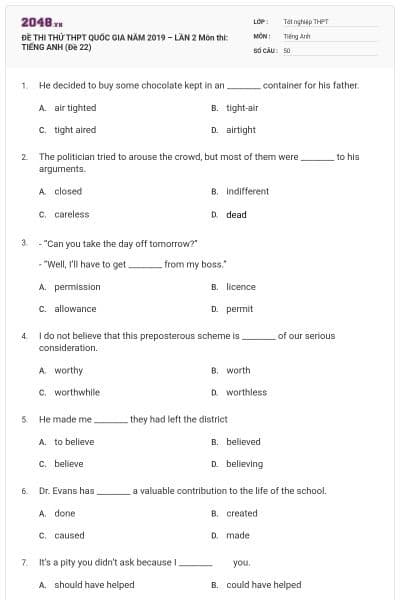
He decided to buy some chocolate kept in an ________ container for his father.
air tighted
tight-air
tight aired
airtight
Đáp án D.
- airtight (adj): không cho phép không khí vào hoặc ra
Tạm dịch: Anh ấy quyết định mua một số ít sôcôla được bảo quản trong một cái hộp kín khí.
The politician tried to arouse the crowd, but most of them were ________ to his arguments.
closed
indifferent
careless
dead
Đáp án B.
- to be indifferent to sth: thờ ờ, lãnh đạm.
Tạm dịch: Nhà chính trị cố gắng khuấy động đám đông nhưng hầu hết bọn họ đều tỏ ra thờ ơ với những luận điểm của ông ấy.
- “Can you take the day off tomorrow?”
- “Well, I’ll have to get ________ from my boss.”
permission
licence
allowance
permit
Đáp án A.
A. permission: sự cho phép
B. licence (n): giấy phép, ví dụ: lái xe,…
C. allowance (n): tiền trợ cấp
D. permit (n): giấy phép lao động
Vậy A là phù hợp nhất.
Tạm dịch: Bạn có thể nghỉ ngày mai không? Vâng, tôi phải xin phép ông chủ đã
I do not believe that this preposterous scheme is ________ of our serious consideration.
worthy
worth
worthwhile
worthless
Đáp án A.
- to be worthy of sth: thích hợp, thích đáng, xứng đáng với
Tạm dịch: Tôi không tin rằng kế hoạch ngớ ngẩn này lại đáng để chúng ta xem xét nghiêm túc.
Lưu ý: Các cấu trúc với từ worth, worthy, worthwhile và worthless:
* worth sth: trị giá bằng cái gì. Ex: The paintings are worth 2 million dollars.
* worth + V-ing sth: đáng làm gì. Ex: It is worth reading a book.
* worthy + of sb/th: xứng đáng với ai/cái gì. Ex: she felt she was not worthy of him.
* worthwhile cũng giống như từ “worth”: worthwhile+V-ing: đáng làm gì đó. Cấu trúc khác của “worthwhile”: worthwhile to do sth = worthwhile for sb to do sth.
worthless là tính từ đồng nghĩa với valueless: không có giá trị và trái nghĩa với valueable/priceless
He made me ________ they had left the district
to believe
believed
believe
believing
Đáp án C.
Cấu trúc: make sb/sth do sth: khiến ai làm gì.
Tạm dịch: Anh ta làm cho tôi tin là họ đã đi khỏi quận đó
Dr. Evans has ________ a valuable contribution to the life of the school.
done
created
caused
made
Đáp án D.
Cụm từ: to make a contribution to something: góp phần
It’s a pity you didn’t ask because I ________ you.
should have helped
could have helped
must have helped
would have helped
Đáp án B.
Cấu trúc: could, may, might + have + PP: có lẽ đã
- Diễn đạt một điều gì đó có thể đã xảy ra hoặc có thể đúng ở quá khứ nhưng người nói không dám chắc:
Ex: I didn’t hear the telephone ring, I might have been sleeping at that time: Tôi đã không nghe thấy chuông điện thoại, lúc đó có lẽ tôi đã ngủ.
- Diễn đạt điều gì đó có thể xảy ra nhưng đã không xảy ra:
Ex: Why did you leave him come home alone? He might/ could have got lost: Sao anh lại để nó đi về nhà một mình? Nó có thể đã bị lạc. àSự thật là nó không bị lạc.
Tạm dịch: Thật đáng tiếc vì bạn đã không báo tôi trước vì tôi có lẽ đã có thể giúp bạn.
It was difficutl to guess what her ________ to the news would be.
feelings
reaction
capital
opinion
Đáp án B.
- reaction to sth: sự phản ứng đối với cái gì.
- opinion about/on sth = feeling about sth: quan điểm về việc gì.
The greater part of London ________ of wood, but after the great fire, wider streets and brick houses ________.
have been/are built
was/were built
was /would be built
had been/ were built
Đáp án D.
Lưu ý: Khi có hai hành động cùng xảy ra trong quá khứ, hành động xảy ra trước để thì QKHT, hành động xảy ra sau để QKĐ.
Tạm dịch: Phần lớn các công trình nhà cửa của London trước đây được làm bằng gỗ, nhưng sau trận đại hỏa hoạn thì những con phố rộng và những căn nhà bằng gạch đã được xây dựng lên.
Harry and Kate are talking in Harry’s office.
Kate: “May I open the window?”
Harry: “________”
What suits you?
You are free.
Accommodate yourself!
Go ahead!
Đáp án D.
Câu cảm thán Go ahead!: Cứ tự nhiên.
Tạm dịch: Tôi có thể mở cửa sổ được không? – Cứ tự nhiên đi.
The show was very funny. They were ________ sport commentators.
sending up
taking up
looking up
bringing up
Đáp án A.
A. sending up: châm biếm, đả kích.
Các đáp án khác không phù hợp:
B. taking up (v): tiếp tục, đảm nhận, làm cho ngắn lại (quần áo), bắt đầu học cách chơi một môn thể thao nào đó.
C. looking up (v): cải thiện, tra cứu.
D. bringing up (v): nuôi dưỡng.
Tạm dịch: Show diễn đó rất hài hước. Mọi người châm biếm các bình luận viên thể thao và làm cho khán giả cười bể bụng
Maria is talking to Ann after work.
Maria: “________?”
Ann: “With pleasure.”
Could you give me a lift
Would you mind if I smoked
What do you plan to do
Would you like a cup of tea
Đáp án A.
- with pleasure: chỉ sự đồng ý một cách lịch sự.
Tạm dịch: Bạn có thể cho tôi đi nhờ được không? – Được thôi!
Các đáp án khác không phù hợp:
B. Bạn có phiền không nếu tôi hút thuốc?
C. Bạn có kế hoạch làm gì?
D. Bạn có muốn dùng một tách trà không
The newcomer has got few friends, ________?
doesn’t she
does she
hasn’t she
has she
Đáp án C.
Cách thành lập câu hỏi đuôi:
- Câu giới thiệu dùng thì HTHT hoặc HTHTTD, phần hỏi đuôi phải mượn trợ động từ have hoặc has.
- Câu giới thiệu khẳng định, phần hỏi đuôi phủ định.
S + V(s/ es/ ed/ 2)……, don’t/ doesn’t/ didn’t + S?
- Câu giới thiệu phủ định, phần hỏi đuôi khẳng định.
S + don’t/ doesn’t/ didn’t + V……,do/ does/ did + S?
Tạm dịch: Người mới đến có rất ít bạn phải không?
________ more help, I could call my neighbour.
Needed
Should I need
I have needed
I should need
Đáp án B.
Cấu trúc đảo của câu điều kiện loại I: Should + S + V, S + can/ could + V.
Tạm dịch: Nếu cần giúp đỡ, tôi có thể gọi hàng xóm
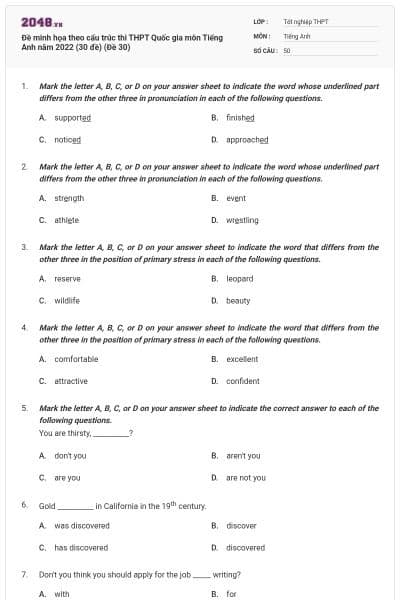
Mark the letter A, B, C or D on your answer sheet to indicate the word(s) OPPOSITE in meaning to the underlined word(s) in each of the following questions.
In 1864 George Pullman designed a sleeping car that eventually saw widespread use.
previously
ultimately
familiarly
simultaneously
Đáp án A.
Tạm dịch: Vào năm 1864, George Pullman đã thiết kế một chiếc xe có giường ngủ__ đã được sử dụng rộng rãi.
- eventually (adv): cuối cùng
A. previously (adv): trước đây
B. ultimately (adv): cuối cùng, sau cùng
C. familiarly (adv): thân mật, không khách khí, suồng sã
D. simultaneously (adv): đồng thời, xảy ra cùng một lúc, làm cùng một lúc
Do đó đáp án chính xác là “previously” (đề bài yêu cầu tìm đáp án trái nghĩa)
Mark the letter A, B, C or D on your answer sheet to indicate the word(s) OPPOSITE in meaning to the underlined word(s) in each of the following questions.
Why are you so arrogant?
snooty
stupid
humble
cunning
Đáp án C.
- arrogant (adj): kiêu căng, kiêu ngạo, ngạo mạn
A. snooty (adj): khinh khỉnh, kiêu kỳ
B. stupid (adj): ngu ngốc, ngu xuẩn
C. humble (adj): khiêm tốn, nhún nhường
D. cunning (adj): xảo quyệt, xảo trá
Đáp án chính xác là “humble” (đề bài yêu cầu tìm đáp án trái nghĩa).
Mark the letter A, B, C or D on your answer sheet to indicate the word(s) CLOSEST in meaning to the underlined word(s) in each of the following questions.
He was asked to account for his presence at the scene of crime.
complain
exchange
explain
arrange
Đáp án C.
Tạm dịch: Anh ta được đề nghị__ sự xuất hiện của mình ở hiện trường vụ án.
- account for (v) giải thích, đưa lí do cho.
Ex: This accounts for his behaviour: điều đó giải thích thái độ đối xử của hắn.
A. complain (v): kêu ca, kêu, phàn nàn, than phiền; oán trách
B. exchange (v): đổi, đổi chác, trao đổi
C. explain (v): giải thích, thanh minh
D. arrange (v): sắp xếp, sắp đặt, sửa soạn
Câu hỏi tìm đáp án gần nghĩa nhất. Ta thấy đáp án chính xác và phù hợp với văn cảnh là “explain”.
Mark the letter A, B, C or D on your answer sheet to indicate the word(s) CLOSEST in meaning to the underlined word(s) in each of the following questions.
Pop music is not my cup of tea; I prefer classical music.
doesn’t suit my taste
is not my favourite drink
is something I enjoy most
is an object I don’t need
Đáp án A.
Tạm dịch: Nhạc Pop____ ; tôi thích nhạc cổ điển hơn.
- is not my cup of tea: không phải là cái mà tôi thích thú, quan tâm đến
Ex: An evening at the opera isn’t everyone’s cup of tea: Một buổi tối ở nhà hát opera không phải là cái mà ai cũng thích.
A. doesn’t suit my taste: không phù hợp với khẩu vị của tôi
B. is not my favourite drink: không phải là đồ uống yêu thích của tôi
C. is something I enjoy most: là cái gì đó mà tôi thích nhất
D. is an object I don’t need: là một vật mà tôi không cần
Dựa vào những giải nghĩa ở trên thì đáp án chính xác là “doesn’t suit my taste”.
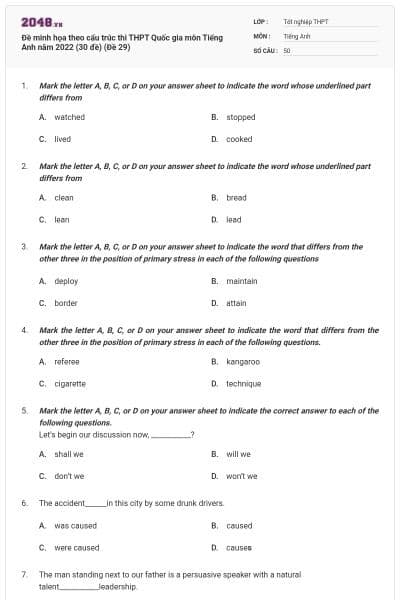
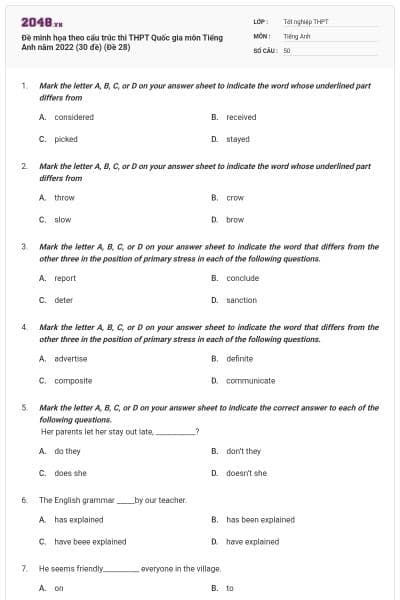
Mark the letter A, B, C or D on your answer sheet to indicate the word whose underlined part differs from the other three in the position of primary stress in each of the following questions.
great
bean
teacher
means
Đáp án A.
A. great / greɪt/ (adj): to lớn, tuyệt vời, vĩ đại
B. bean /bi:n/ (n): hạt đậu, đậu
C. teacher/’ti: tʃə/ (n): giáo viên
D. means /’mi:ns/ (n): phương tiện
Đáp án chính xác là A vì phần gạch chân được đọc là âm/eɪ/ khác với những đáp án còn lại đọc âm/i:/.
Mark the letter A, B, C or D on your answer sheet to indicate the word whose underlined part differs from the other three in the position of primary stress in each of the following questions.
removed
approved
beloved
relieved
Đáp án C.
A. removed /rɪ’ mu:vd/ (v): rời…đi
B. approved /ə’pru:vd/ (v): ủng hộ
C. beloved /bɪ’lʌvɪd/(adj): rất được yêu thích – chỉ sử dụng trước danh từ
D. relieved /rɪ’li:vd/(v): làm dịu đi, làm an tâm
Ta thấy các đáp án A, B, D đều có từ gạch chân đọc là /d/, còn đáp án C là /id/.
Mark the letter A, B, C or D on your answer sheet to indicate the word that differs from the other three in the position of primary stress in each of the following questions.
statistical
solidarity
sociology
managerial
Đáp án A.
Nhấn trọng âm ở âm tiết thứ 2, còn lại nhấn âm thứ 3.
A. statistical /stə’tɪstɪkl/ (adj): dự trên thống kê
B. solidarity /,sɒlɪ’dærəti/ (n): tình đoàn kết, hữu nghị
C. sociology /,səʊsi’ɒləʤi/ (n): xã hội học
D. managerial /,mænə’ʤɪəriəl/ (adj): thuộc về công việc quản lý
Mark the letter A, B, C or D on your answer sheet to indicate the word that differs from the other three in the position of primary stress in each of the following questions.
familiar
redundant
customary
reluctan
Đáp án C.
Nhấn trọng âm ở âm tiết thứ 1, còn lại nhấn âm thứ 2.
A. familiar /fə’mɪliə(r)/ (adj): quen thuộc, thân thuộc
B. redundant /rɪ’dʌndənt/ (adj): dư, thừa
C. customary /’kʌstəməri/ (adj): thông thường, thành thói quen
D. reluctant /rɪ’lʌktənt/ (adj): miễn cưỡng, bất đắc dĩ, không thích
Mark the letter A, B, C or D on your answer sheet to indicate the underlined part that needs correction in each of the following questions.
Gilbert Newton Lewis, a chemist, helped to develop the modern electron theory of valence, a theory what explains the forces holding atoms together in molecules.
a
develop
what
together
Đáp án: C
Giải thích:
Kiến thức: Đại từ quan hệ
“what” không phải một đại từ quan hệ
Để thay cho danh từ chỉ vật đứng làm chủ ngữ, dùng “which/that”
Sửa: what → which/that
Dịch: Gilbert Newton Lewis, một nhà hóa học, đã giúp phát triển lý thuyết electron hóa trị hiện đại, một lý thuyết giải thích các lực giữ các nguyên tử lại với nhau trong phân tử.
Carnegie Hall was the first building in New York designing specially for
orchestral music.
the
designing
specially
orchestral music
Đáp án B.
Đổi designing thành designed hoặc which/ that was designed.
Tạm dịch: Carnegie Hall là tòa nhà đầu tiên ở New York được thiết kế đặc biệt dành cho nhạc giao hưởng.
Mark the letter A, B, C or D on your answer sheet to indicate the underlined part that needs correction in each of the following questions.
Lady Liberty has long been a symbol of free and hope to people all over the world, but have you ever wondered where she came from?
long
a
free
where she came
Đáp án C.
Đổi free thành freedom.
“and” là liên từ nối các sự vật, sự việc có chung đặc điểm hay còn gọi là có cấu trúc song song với nhau.
Hiện tượng liệt kê song song nên các từ (hay cụm từ) phải đồng loại: hope là danh từ đứng sau giới từ “of” nên trước “and” cũng phải là danh từ.
Tạm dịch: Tượng nữ thần tự do từ lâu đã là một biểu tượng của tự do và hy vọng cho mọi người trên toàn thế giới, nhưng bạn đã bao giờ tự hỏi cô ấy đến từ đâu?
Read the following passage and mark the letter A, B, C or D on your answer sheet to indicate the correct answer to each of the questions.
Accustomed though we are to speaking of the films made before 1927 as “silent”, the film has never been, in the full sense of the word,silent. From the very beginning, music was regarded as an indispensable accompaniment; when the Lumiere films were shown at the first public film exhibition in the United States in February 1896, they were accompanied by piano improvisations on popular tunes. At first, the music played bore no special relationship to the films; an accompaniment of any kind was sufficient. Within a very short time, however, the incongruity of playing lively music to a solemn film became apparent, and film pianists began to take some care in matching their pieces to the mood of the film.
As movie theaters grew in number and importance, a violinist, and perhaps a cellist, would be added to the pianist in certain cases, and in the larger movie theaters small orchestras were formed. For a number of years the selection of music for each film program rested entirely in the hands of the conductor or leader of the orchestra, and very often the principal qualification for holding such a position was not skill or taste so much as the ownership of a large personal library of musical pieces. Since the conductor seldom saw the films until the night before they were to be shown (if, indeed, the conductor was lucky enough to see them then), the musical arrangement was normally improvised in the greatest hurry.
To help meet this difficulty, film distributing companies started the practice of publishing suggestions for musical accompaniments. In 1909, for example, the Edison Company began issuing with their films such indications of mood as “pleasant”, “sad”, “lively”. The suggestions became more explicit, and so emerged the musical cue sheet containing indications of mood, the titles of suitable pieces of music, and precise directions to show where one piece led into the next.
Certain films had music especially composed for them. The most famous of these early special scores was that composed and arranged for D.W. Griffith’s film Birth of a Nation, which was released in 1915.
The passage mainly discusses music that was ________.
performed before the showing of a
played during silent films
recorded during film exhibitions
specifically composed for certain movie theaters
Đáp án B.
Keywords: mainly, discuss, music.
Clue: “Accustomed though we are to speaking of the films made before 1927 as “silent”, the film has never been, in the full sense of the word,silent. From the very beginning, music was regarded as an indispensable accompaniment…”: Mặc dù chúng ta đã quen thuộc khi nhắc tới những bộ phim được sản xuất trước năm 1927 là “phim câm” thì những phim này chưa bao giờ thực sự là phim câm cả. Ngay từ khi mới bắt đầu, âm nhạc đã được xem là thứ đồng hành không thể thiếu…à Đáp án đúng là B. played during silent films: được chơi trong suốt các bộ phim câm.
Các đáp án còn lại không phù hợp: A. performed before the showing of a film: được chơi trước khi trình chiếu một bộ phim.
C. recorded during film exhibitions: được thu lại trong khi triển lãm phim.
D. specifically composed for certain movie: được soạn đặc biệt cho một bộ phim nhất định
Read the following passage and mark the letter A, B, C or D on your answer sheet to indicate the correct answer to each of the questions.
Accustomed though we are to speaking of the films made before 1927 as “silent”, the film has never been, in the full sense of the word,silent. From the very beginning, music was regarded as an indispensable accompaniment; when the Lumiere films were shown at the first public film exhibition in the United States in February 1896, they were accompanied by piano improvisations on popular tunes. At first, the music played bore no special relationship to the films; an accompaniment of any kind was sufficient. Within a very short time, however, the incongruity of playing lively music to a solemn film became apparent, and film pianists began to take some care in matching their pieces to the mood of the film.
As movie theaters grew in number and importance, a violinist, and perhaps a cellist, would be added to the pianist in certain cases, and in the larger movie theaters small orchestras were formed. For a number of years the selection of music for each film program rested entirely in the hands of the conductor or leader of the orchestra, and very often the principal qualification for holding such a position was not skill or taste so much as the ownership of a large personal library of musical pieces. Since the conductor seldom saw the films until the night before they were to be shown (if, indeed, the conductor was lucky enough to see them then), the musical arrangement was normally improvised in the greatest hurry.
To help meet this difficulty, film distributing companies started the practice of publishing suggestions for musical accompaniments. In 1909, for example, the Edison Company began issuing with their films such indications of mood as “pleasant”, “sad”, “lively”. The suggestions became more explicit, and so emerged the musical cue sheet containing indications of mood, the titles of suitable pieces of music, and precise directions to show where one piece led into the next.
Certain films had music especially composed for them. The most famous of these early special scores was that composed and arranged for D.W. Griffith’s film Birth of a Nation, which was released in 1915.
What can be inferred that the passage about the majority of films made after 1927?
They were truly “silent”.
They were accompanied by symphonic orchestras
They incorporated the sound of the actors’ voices
They corresponded to specific musical compositions
Đáp án C.
Keywords: inferred (suy luận), the majority of films, after 1927.
Clue: “Accustomed though we are to speaking of the films made before 1927 as “silent”, the film has never been, in the full sense of the word,silent. From the very beginning, music was regarded as an indispensable accompaniment…”: Mặc dù chúng ta đã quen thuộc khi nhắc tới những bộ phim được sản xuất trước năm 1927 là “phim câm” thì những phim này chưa bao giờ thực sự là phim câm cả. Ngay từ khi mới bắt đầu, âm nhạc đã được xem là thứ đồng hành không thể thiếu…
Phân tích:
A. They were truly “silent”: Chúng thực sự im lặng.
B. They were accompanied by symphonic orchestras: Chúng được chơi cùng dàn nhạc giao hưởng.
C. They incorporated the sound of the actors’ voices: Chúng được kết hợp chặt chẽ với âm thanh từ giọng của diễn viên.
D. They corresponded to specific musical compositions: Chúng tương ứng với một tác phẩm âm nhạc cụ thể.
Những bộ phim câm trước năm 1927 trên thực tế không hoàn toàn im lặng bởi luôn có âm nhạc đồng hành. Dù cho diễn viên không nói nhưng âm nhạc lại được kết hợp với phần diễn của diễn viên để miêu tả được phần diễn đó. Do đó, sau năm 1927 chắc chắn là film đã được lồng tiếng nên đáp án đúng là C
Read the following passage and mark the letter A, B, C or D on your answer sheet to indicate the correct answer to each of the questions.
Accustomed though we are to speaking of the films made before 1927 as “silent”, the film has never been, in the full sense of the word,silent. From the very beginning, music was regarded as an indispensable accompaniment; when the Lumiere films were shown at the first public film exhibition in the United States in February 1896, they were accompanied by piano improvisations on popular tunes. At first, the music played bore no special relationship to the films; an accompaniment of any kind was sufficient. Within a very short time, however, the incongruity of playing lively music to a solemn film became apparent, and film pianists began to take some care in matching their pieces to the mood of the film.
As movie theaters grew in number and importance, a violinist, and perhaps a cellist, would be added to the pianist in certain cases, and in the larger movie theaters small orchestras were formed. For a number of years the selection of music for each film program rested entirely in the hands of the conductor or leader of the orchestra, and very often the principal qualification for holding such a position was not skill or taste so much as the ownership of a large personal library of musical pieces. Since the conductor seldom saw the films until the night before they were to be shown (if, indeed, the conductor was lucky enough to see them then), the musical arrangement was normally improvised in the greatest hurry.
To help meet this difficulty, film distributing companies started the practice of publishing suggestions for musical accompaniments. In 1909, for example, the Edison Company began issuing with their films such indications of mood as “pleasant”, “sad”, “lively”. The suggestions became more explicit, and so emerged the musical cue sheet containing indications of mood, the titles of suitable pieces of music, and precise directions to show where one piece led into the next.
Certain films had music especially composed for them. The most famous of these early special scores was that composed and arranged for D.W. Griffith’s film Birth of a Nation, which was released in 1915.
It can be inferred that orchestras conductors who worked in movie theaters needed to ________.
be able to play many instruments
have pleasant voices
be familiar with a wide variety of music
be able to compose original music
Đáp án C.
Keywords: inferred, orchestra conductor, needed to.
Clue: “For a number of years the selection of music for each film program rested entirely in the hands of the conductor or leader of the orchestra, and very often the principal qualification for holding such a position was not skill or taste so much as the ownership of a large personal library of musical pieces.”: Trong một vài năm việc lựa chọn âm nhạc cho từng chương trình phim hoàn toàn nằm trong quyết định của người chỉ huy hoặc người chỉ đạo dàn nhạc, và rất thường xuyên thì tiêu chuẩn chính để được nắm giữ vị trí này không phải nằm ở kỹ năng hay thẩm âm mà là ở việc sở hữu một kho tang các bản nhạc đồ sộ riêng.
Phân tích:
Ta ngầm hiểu “the ownership of a large personal library of musical pieces” trong bối cảnh này nghĩa là người chỉ huy dàn nhạc phải biết tới nhiều loại nhạc đa dạng phong phú khác nhau. Do đó, chọn đáp án C. be familiar with a wide variety of music: quen thuộc với các loại nhạc đa dạng khác nhau.
Các đáp án khác không phải là những suy luận đúng:
A. be able to play many instruments: có khả năng chơi nhiều nhạc cụ
B. have pleasant voices: có giọng hay.
D. be able to compose original music: có khả năng soạn nhạc nguyên bản.
Read the following passage and mark the letter A, B, C or D on your answer sheet to indicate the correct answer to each of the questions.
Accustomed though we are to speaking of the films made before 1927 as “silent”, the film has never been, in the full sense of the word,silent. From the very beginning, music was regarded as an indispensable accompaniment; when the Lumiere films were shown at the first public film exhibition in the United States in February 1896, they were accompanied by piano improvisations on popular tunes. At first, the music played bore no special relationship to the films; an accompaniment of any kind was sufficient. Within a very short time, however, the incongruity of playing lively music to a solemn film became apparent, and film pianists began to take some care in matching their pieces to the mood of the film.
As movie theaters grew in number and importance, a violinist, and perhaps a cellist, would be added to the pianist in certain cases, and in the larger movie theaters small orchestras were formed. For a number of years the selection of music for each film program rested entirely in the hands of the conductor or leader of the orchestra, and very often the principal qualification for holding such a position was not skill or taste so much as the ownership of a large personal library of musical pieces. Since the conductor seldom saw the films until the night before they were to be shown (if, indeed, the conductor was lucky enough to see them then), the musical arrangement was normally improvised in the greatest hurry.
To help meet this difficulty, film distributing companies started the practice of publishing suggestions for musical accompaniments. In 1909, for example, the Edison Company began issuing with their films such indications of mood as “pleasant”, “sad”, “lively”. The suggestions became more explicit, and so emerged the musical cue sheet containing indications of mood, the titles of suitable pieces of music, and precise directions to show where one piece led into the next.
Certain films had music especially composed for them. The most famous of these early special scores was that composed and arranged for D.W. Griffith’s film Birth of a Nation, which was released in 1915.
The word “them” in paragraph 2 refers to ________
years
hands
pieces
films
Đáp án D.
Keywords: them, paragraph 2.
Clue: Since the conductor seldom saw the films until the night before they were to be shown (if, indeed, the conductor was lucky enough to see them then), the musical arrangement was normally improvised in the greatest hurry: Bởi người chỉ đạo dàn nhạc hiếm khi được xem những bộ phim và phải tới đêm trước khi những bộ phim được trình chiếu (đó là trong trường hợp người chỉ đạo dàn nhạc may mắn mới được xem bộ phim vào thời điểm đó), việc sắp xếp âm nhạc thông thường được ứng biến trong khoảng thời gian rất ngắn.
Phân tích:
Ta chiếu lên phía trước xem “them” ở đây thay thế cho danh từ nào. Vì “see them” do đó danh từ này phải xem được. Vậy ta chọn đáp án D. films.
Các đáp án khác không phù hợp:
A. years: các năm
B. hands: những bàn tay
C. pieces: những bản nhạc
Read the following passage and mark the letter A, B, C or D on your answer sheet to indicate the correct answer to each of the questions.
Accustomed though we are to speaking of the films made before 1927 as “silent”, the film has never been, in the full sense of the word,silent. From the very beginning, music was regarded as an indispensable accompaniment; when the Lumiere films were shown at the first public film exhibition in the United States in February 1896, they were accompanied by piano improvisations on popular tunes. At first, the music played bore no special relationship to the films; an accompaniment of any kind was sufficient. Within a very short time, however, the incongruity of playing lively music to a solemn film became apparent, and film pianists began to take some care in matching their pieces to the mood of the film.
As movie theaters grew in number and importance, a violinist, and perhaps a cellist, would be added to the pianist in certain cases, and in the larger movie theaters small orchestras were formed. For a number of years the selection of music for each film program rested entirely in the hands of the conductor or leader of the orchestra, and very often the principal qualification for holding such a position was not skill or taste so much as the ownership of a large personal library of musical pieces. Since the conductor seldom saw the films until the night before they were to be shown (if, indeed, the conductor was lucky enough to see them then), the musical arrangement was normally improvised in the greatest hurry.
To help meet this difficulty, film distributing companies started the practice of publishing suggestions for musical accompaniments. In 1909, for example, the Edison Company began issuing with their films such indications of mood as “pleasant”, “sad”, “lively”. The suggestions became more explicit, and so emerged the musical cue sheet containing indications of mood, the titles of suitable pieces of music, and precise directions to show where one piece led into the next.
Certain films had music especially composed for them. The most famous of these early special scores was that composed and arranged for D.W. Griffith’s film Birth of a Nation, which was released in 1915.
According to the passage, what kind of business was the Edison Company?
It produced electricity
It distributed films
It published musical arrangements
It made musical instruments
Đáp án B.
Keywords: kind of business, the Edison Company.
Clue: “In 1909, for example, the Edison ComTapany began issuing with their films…”: Vào năm 1909, ví dụ, công ty Edison bắt đầu phát hành những bộ phim của họ…
Phân tích: Ta có từ “issue” là phát hành. Trong bối cảnh này tương đương với từ “distribute”: phân phối. Do đó, chọn đáp án B. It distributed films: Công ty này phân phối những bộ phim.
Các đáp án khác không phù hợp:
A. It produced electricity: Công ty này sản xuất điện.
C. It published musical arrangements: Công ty này xuất bản các bản nhạc.
D. It made musical instruments: Công ty này chế tạo các nhạc cụ.
Read the following passage and mark the letter A, B, C or D on your answer sheet to indicate the correct answer to each of the questions.
Accustomed though we are to speaking of the films made before 1927 as “silent”, the film has never been, in the full sense of the word,silent. From the very beginning, music was regarded as an indispensable accompaniment; when the Lumiere films were shown at the first public film exhibition in the United States in February 1896, they were accompanied by piano improvisations on popular tunes. At first, the music played bore no special relationship to the films; an accompaniment of any kind was sufficient. Within a very short time, however, the incongruity of playing lively music to a solemn film became apparent, and film pianists began to take some care in matching their pieces to the mood of the film.
As movie theaters grew in number and importance, a violinist, and perhaps a cellist, would be added to the pianist in certain cases, and in the larger movie theaters small orchestras were formed. For a number of years the selection of music for each film program rested entirely in the hands of the conductor or leader of the orchestra, and very often the principal qualification for holding such a position was not skill or taste so much as the ownership of a large personal library of musical pieces. Since the conductor seldom saw the films until the night before they were to be shown (if, indeed, the conductor was lucky enough to see them then), the musical arrangement was normally improvised in the greatest hurry.
To help meet this difficulty, film distributing companies started the practice of publishing suggestions for musical accompaniments. In 1909, for example, the Edison Company began issuing with their films such indications of mood as “pleasant”, “sad”, “lively”. The suggestions became more explicit, and so emerged the musical cue sheet containing indications of mood, the titles of suitable pieces of music, and precise directions to show where one piece led into the next.
Certain films had music especially composed for them. The most famous of these early special scores was that composed and arranged for D.W. Griffith’s film Birth of a Nation, which was released in 1915.
It may be inferred from the passage that the first musical cue sheets appeared around ________.
1896
1909
1915
1927
Đáp án B.
Keywords: inferred, the first musical cue sheets.
Clue: “In 1909, for example, the Edison Company began issuing with their films such indications of mood as “pleasant”, “sad”, “lively”. The suggestions became more explicit, and so emerged the musical cue sheet containing indications of mood…”: Ví dụ vào năm 1909, Công ty Edison đã bắt đầu phát hành những bộ phim của họ với những biểu thị tâm trạng ẩn trong đó như “vui”, “buồn”, “sống động”. Những gợi ý này dần trở nên rõ ràng hơn và vì thế đã xuất hiện những bản sắp xếp trình tự xuất hiện của bản nhạc bao gồm cả những biểu thị tâm trạng…
Phân tích: Con số được đưa ra trong manh mối này là 1909. Do đó ta chọn đáp án B. 1909.
Read the following passage and mark the letter A, B, C or D on your answer sheet to indicate the correct answer to each of the questions.
Accustomed though we are to speaking of the films made before 1927 as “silent”, the film has never been, in the full sense of the word,silent. From the very beginning, music was regarded as an indispensable accompaniment; when the Lumiere films were shown at the first public film exhibition in the United States in February 1896, they were accompanied by piano improvisations on popular tunes. At first, the music played bore no special relationship to the films; an accompaniment of any kind was sufficient. Within a very short time, however, the incongruity of playing lively music to a solemn film became apparent, and film pianists began to take some care in matching their pieces to the mood of the film.
As movie theaters grew in number and importance, a violinist, and perhaps a cellist, would be added to the pianist in certain cases, and in the larger movie theaters small orchestras were formed. For a number of years the selection of music for each film program rested entirely in the hands of the conductor or leader of the orchestra, and very often the principal qualification for holding such a position was not skill or taste so much as the ownership of a large personal library of musical pieces. Since the conductor seldom saw the films until the night before they were to be shown (if, indeed, the conductor was lucky enough to see them then), the musical arrangement was normally improvised in the greatest hurry.
To help meet this difficulty, film distributing companies started the practice of publishing suggestions for musical accompaniments. In 1909, for example, the Edison Company began issuing with their films such indications of mood as “pleasant”, “sad”, “lively”. The suggestions became more explicit, and so emerged the musical cue sheet containing indications of mood, the titles of suitable pieces of music, and precise directions to show where one piece led into the next.
Certain films had music especially composed for them. The most famous of these early special scores was that composed and arranged for D.W. Griffith’s film Birth of a Nation, which was released in 1915.
Which of the following notations is most likely to have been included on a musical cue sheet of the early 1900’s?
“Calm, peaceful”
“Piano, violin”
“Key of C major”
“Directed by D.W. Griffith’s”
Đáp án A.
Keywords: notations, included on a musical cue sheet.
Clue: “so emerged the musical cue sheet containing indications of mood, the titles of suitable pieces of music, and precise directions to show where one piece led into the next”:… vì thế đã xuất hiện những bản sắp xếp trình tự xuất hiện của bản nhạc bao gồm cả những biểu thị tâm trạng, tiêu đề của loại nhạc phù hợp, và các chỉ dẫn chính xác để thể hiện lúc nào sẽ chơi một bản nhạc khác.
Phân tích: Ta xét các đáp án:
A. “Calm, peaceful”: “Bình tĩnh, yên ả”: Đây là biểu thị tâm trạng: Có được thể hiện trên “musical cue sheet”.
B. “Piano, violin”: Đây là nhạc cụ: Không được thể hiện trên musical cue sheet.
C. “Key of C major”: “khóa Đô trưởng”: Đây là khóa nhạc: Không được thể hiện trên “musical cue sheet”.
D. “Directed by D.W. Griffith’s”: “Đạo diễn bởi D.W. Griffith’s”: Đây là tên đạo diễn: Không được thể hiện trên “musical cue sheet”.
Vậy đáp án đúng phải là A. “Calm, peaceful”.
Read the following passage and mark the letter A, B, C or D on your answer sheet to indicate the correct answer to each of the questions.
Accustomed though we are to speaking of the films made before 1927 as “silent”, the film has never been, in the full sense of the word,silent. From the very beginning, music was regarded as an indispensable accompaniment; when the Lumiere films were shown at the first public film exhibition in the United States in February 1896, they were accompanied by piano improvisations on popular tunes. At first, the music played bore no special relationship to the films; an accompaniment of any kind was sufficient. Within a very short time, however, the incongruity of playing lively music to a solemn film became apparent, and film pianists began to take some care in matching their pieces to the mood of the film.
As movie theaters grew in number and importance, a violinist, and perhaps a cellist, would be added to the pianist in certain cases, and in the larger movie theaters small orchestras were formed. For a number of years the selection of music for each film program rested entirely in the hands of the conductor or leader of the orchestra, and very often the principal qualification for holding such a position was not skill or taste so much as the ownership of a large personal library of musical pieces. Since the conductor seldom saw the films until the night before they were to be shown (if, indeed, the conductor was lucky enough to see them then), the musical arrangement was normally improvised in the greatest hurry.
To help meet this difficulty, film distributing companies started the practice of publishing suggestions for musical accompaniments. In 1909, for example, the Edison Company began issuing with their films such indications of mood as “pleasant”, “sad”, “lively”. The suggestions became more explicit, and so emerged the musical cue sheet containing indications of mood, the titles of suitable pieces of music, and precise directions to show where one piece led into the next.
Certain films had music especially composed for them. The most famous of these early special scores was that composed and arranged for D.W. Griffith’s film Birth of a Nation, which was released in 1915.
The word “scores” in paragraph 4 most likely means ________.
totals
successes
groups of musicians
musical compositions
Đáp án D.
Keywords: “scores”, paragraph 4.
Clue: “Certain films had music especially composed for them. The most famous of these early special scores was that composed and arranged for D.W. Griffith’s film Birth of a Nation, which was released in 1915”: Những bộ phim nhất định có âm nhạc được đặc biệt sáng tác cho chúng. Nổi tiếng nhất trong những… đặc biệt này là cái được soạn và sắp xếp cho bộ phim Birth of a Nation của D.W. Griffith’s, bộ phim ra mắt năm 1915.
Phân tích: Ta xét nghĩa của các đáp án:
A. totals: tổng cộng
B. successes: chuỗi thành công
C. groups of musicians : nhóm các nhà soạn nhạc
D. musical compositions: tác phẩm âm nhạc
Trong các đáp án trên thì đáp án D là thể hiện rõ nhất nghĩa của từ “scores” trong bối cảnh này.
Read the following passage and mark the letter A, B, C or D on your answer sheet to indicate the correct word or phrase that best fits each of the numbered blanks.
NEIGHBOURS INFLUENCE BUYING DECISIONS
However objective we believe ourselves to be, most of us do not judge a product solely on its merits, considering quality, value and style before making a decision. (34) ________, we are easily influenced by the people around us.
There is nothing wrong with this. It is probably a smarter way to make decisions than (35) ________ on only our own opinions. But it does make life hard for companies. They have long understood that groups of friends and relatives tend to buy the same products, but understanding the reasons has been tricky. It is because they are so similar with (36)________ to how much money they make and what television ads they watch that they independently arrive at the same decision? Or do they copy one another, perhaps (37) ________ envy or perhaps because they have shared information about the products?
Research in Finland recently found overwhelming evidence that neighbours have a big influence on buying decisions. When one of a person’s ten nearest neighbours bought a car, the chances (38) ________ that person would buy a car of the same brand during the next week and a half rose by 86 per cent. The researchers argued that it was not just a matter of envy. Used cars seemed to attract neighbours even more than new cars. This suggested that people were not trying to keep up with their neighbours, they were keen to learn from them. Since used cars are less reliable, a recommendation of one can strongly influence a buying decision.
Điền vào ô 34
What’s more
Instead
Unlike
In place
Đáp án B.
Tạm dịch: …However objective we believe ourselves to be, most of us do not judge a product solely on its merits, considering quality, value and style before making a decision. (1) _______, we are easily influenced by the people around us: Cho dù bạn nghĩ mình khách quan đến mức nào thì hầu hết chúng ta đều không đánh giá một sản phẩm đơn thuần dựa trên phẩm chất, chất lượng thực tế, giá trị và mẫu mã của sản phẩm đó trước khi đưa ra quyết định. _______, chúng ta dễ dàng bị ảnh hưởng bởi những người xung quanh.
A. What’s more: Hơn thế là
B. Instead: Thay vào đó
C. Unlike: Không giống như
D. In place: Thay
Ta chọn đáp án có thể đứng làm trạng ngữ. Vì hai vế của câu trái ngược nhau nên từ này cũng phải thể hiện được sự trái ngược đó. Đáp án A không hợp nghĩa. Đáp án C không thể đứng làm trạng ngữ nếu không có danh từ đi kèm. Đáp án D thiếu giới từ “of”, “in place of sth” (thay cho cái gì) và cũng không đứng làm trạng ngữ được. Vậy đáp án đúng phải là B.
Read the following passage and mark the letter A, B, C or D on your answer sheet to indicate the correct word or phrase that best fits each of the numbered blanks.
NEIGHBOURS INFLUENCE BUYING DECISIONS
However objective we believe ourselves to be, most of us do not judge a product solely on its merits, considering quality, value and style before making a decision. (34) ________, we are easily influenced by the people around us.
There is nothing wrong with this. It is probably a smarter way to make decisions than (35) ________ on only our own opinions. But it does make life hard for companies. They have long understood that groups of friends and relatives tend to buy the same products, but understanding the reasons has been tricky. It is because they are so similar with (36)________ to how much money they make and what television ads they watch that they independently arrive at the same decision? Or do they copy one another, perhaps (37) ________ envy or perhaps because they have shared information about the products?
Research in Finland recently found overwhelming evidence that neighbours have a big influence on buying decisions. When one of a person’s ten nearest neighbours bought a car, the chances (38) ________ that person would buy a car of the same brand during the next week and a half rose by 86 per cent. The researchers argued that it was not just a matter of envy. Used cars seemed to attract neighbours even more than new cars. This suggested that people were not trying to keep up with their neighbours, they were keen to learn from them. Since used cars are less reliable, a recommendation of one can strongly influence a buying decision.
Điền vào ô 35
basing
trusting
supposing
relying
Đáp án D.
Tạm dịch: It is probably a smarter way to make decisions than (3)________ on only our own opinions: Mà đây có lẽ là cách thức khôn ngoan để đưa ra quyết định hơn là chỉ ________ vào ý kiến cá nhân.
A. basing: dựa trên nền tảng, phát triển từ
B. trusting: tin tưởng
C. supposing: tin rằng
D. relying: phụ phuộc
Cấu trúc: to rely on sth: dựa vào, phụ thuộc vào. Các đáp án khác không phù hợp về nghĩa và không thích hợp với văn cảnh.
Read the following passage and mark the letter A, B, C or D on your answer sheet to indicate the correct word or phrase that best fits each of the numbered blanks.
NEIGHBOURS INFLUENCE BUYING DECISIONS
However objective we believe ourselves to be, most of us do not judge a product solely on its merits, considering quality, value and style before making a decision. (34) ________, we are easily influenced by the people around us.
There is nothing wrong with this. It is probably a smarter way to make decisions than (35) ________ on only our own opinions. But it does make life hard for companies. They have long understood that groups of friends and relatives tend to buy the same products, but understanding the reasons has been tricky. It is because they are so similar with (36)________ to how much money they make and what television ads they watch that they independently arrive at the same decision? Or do they copy one another, perhaps (37) ________ envy or perhaps because they have shared information about the products?
Research in Finland recently found overwhelming evidence that neighbours have a big influence on buying decisions. When one of a person’s ten nearest neighbours bought a car, the chances (38) ________ that person would buy a car of the same brand during the next week and a half rose by 86 per cent. The researchers argued that it was not just a matter of envy. Used cars seemed to attract neighbours even more than new cars. This suggested that people were not trying to keep up with their neighbours, they were keen to learn from them. Since used cars are less reliable, a recommendation of one can strongly influence a buying decision.
Điền vào ô 36
connection
regard
relation
concern
Đáp án B.
Cấu trúc: with regard to: liên quan tới, đề cập tới
Read the following passage and mark the letter A, B, C or D on your answer sheet to indicate the correct word or phrase that best fits each of the numbered blanks.
NEIGHBOURS INFLUENCE BUYING DECISIONS
However objective we believe ourselves to be, most of us do not judge a product solely on its merits, considering quality, value and style before making a decision. (34) ________, we are easily influenced by the people around us.
There is nothing wrong with this. It is probably a smarter way to make decisions than (35) ________ on only our own opinions. But it does make life hard for companies. They have long understood that groups of friends and relatives tend to buy the same products, but understanding the reasons has been tricky. It is because they are so similar with (36)________ to how much money they make and what television ads they watch that they independently arrive at the same decision? Or do they copy one another, perhaps (37) ________ envy or perhaps because they have shared information about the products?
Research in Finland recently found overwhelming evidence that neighbours have a big influence on buying decisions. When one of a person’s ten nearest neighbours bought a car, the chances (38) ________ that person would buy a car of the same brand during the next week and a half rose by 86 per cent. The researchers argued that it was not just a matter of envy. Used cars seemed to attract neighbours even more than new cars. This suggested that people were not trying to keep up with their neighbours, they were keen to learn from them. Since used cars are less reliable, a recommendation of one can strongly influence a buying decision.
Điền vào ô 37
for
as to
out of
about
Đáp án C.
Tạm dịch: Or do they copy one another, perhaps (6)______ envy or perhaps because they have shared information about the products?: Hay bởi họ bắt chước lẫn nhau, có lẽ ______ ghen tị hoặc có lẽ do họ cùng chia sẻ thông tin về sản phẩm?
Cấu trúc: out of envy = because of envy: bởi sự ghen tị, do ghen tị
Read the following passage and mark the letter A, B, C or D on your answer sheet to indicate the correct word or phrase that best fits each of the numbered blanks.
NEIGHBOURS INFLUENCE BUYING DECISIONS
However objective we believe ourselves to be, most of us do not judge a product solely on its merits, considering quality, value and style before making a decision. (34) ________, we are easily influenced by the people around us.
There is nothing wrong with this. It is probably a smarter way to make decisions than (35) ________ on only our own opinions. But it does make life hard for companies. They have long understood that groups of friends and relatives tend to buy the same products, but understanding the reasons has been tricky. It is because they are so similar with (36)________ to how much money they make and what television ads they watch that they independently arrive at the same decision? Or do they copy one another, perhaps (37) ________ envy or perhaps because they have shared information about the products?
Research in Finland recently found overwhelming evidence that neighbours have a big influence on buying decisions. When one of a person’s ten nearest neighbours bought a car, the chances (38) ________ that person would buy a car of the same brand during the next week and a half rose by 86 per cent. The researchers argued that it was not just a matter of envy. Used cars seemed to attract neighbours even more than new cars. This suggested that people were not trying to keep up with their neighbours, they were keen to learn from them. Since used cars are less reliable, a recommendation of one can strongly influence a buying decision.
Điền vào ô 38
who
whose
that
when
Đáp án C.
Tạm dịch: When one of a person’s ten nearest neighbours bought a car, the chances (38)__________ that person would buy a car of the same brand during the next week and a half rose by 86 per cent: Khi một trong số mười người hàng xóm thân cận với một cá nhân mua một chiếc xe hơi thì cơ hội________cá nhân đó cũng mua một chiếc xe nhãn hiệu tương tự trong một tuần rưỡi sau đó tăng tới 86%.
Câu trên đã có đủ các thành phần của câu, do đó chỉ có đáp án C là đúng.
The chances that that person…: cơ hội để/ là/ rằng người đó…
Read the following passage and mark the letter A, B, C or D on your answer sheet to indicate the correct answer to each of the questions.
Glass is a remarkable substance made from the simplest raw materials. It can be colored or colorless, monochrome or polychrome, transparent, translucent, or opaque. It is lightweight impermeable to liquids, readily cleaned and reused, durable yet fragile, and often very beautiful. Glass can be decorated in multiple ways and its optical properties are exceptional. In all its myriad forms - as table ware, containers, in architecture and design - glass represents a major achievement in the history of technological developments.
Since the Bronze Age about 3,000 B.C., glass has been used for making various kinds of objects. It was first made from a mixture of silica, line and an alkali such as soda or potash, and these remained the basic ingredients of glass until the development of lead glass in the seventeenth century. When heated, the mixture becomes soft and malleable and can be formed by various techniques into a vast array of shapes and sizes. The homogeneous mass thus formed by melting then cools to create glass, but in contrast to most materials formed in this way (metals, for instance), glass lacks the crystalline structure normally associated with solids, and instead retains the random molecular structure of a liquid. In effect, as molten glass cools, it progressively stiffens until rigid, but does so without setting up a network of interlocking crystals customarily associated with that process. This is why glass shatters so easily when dealt a blow. Why glass deteriorates over time, especially when exposed to moisture, and why glassware must be slowly reheated and uniformly cooled after manufacture to release internal stresses induced by uneven cooling.
Another unusual feature of glass is the manner in which its viscosity changes as it turns from a cold substance into a hot, ductile liquid. Unlike metals that flow or "freeze" at specific temperatures glass progressively softens as the temperature rises, going through varying stages of malleability until it flows like a thick syrup. Each stage of malleability allows the glass to be manipulated into various forms, by different techniques, and if suddenly cooled the object retains the shape achieved at that point. Glass is thus amenable to a greater number of heat-forming techniques than most other materials.
Why does the author list the characteristics of glass in paragraph 1?
To demonstrate how glass evolved
To show the versatility of glass
To explain glassmaking technology
To explain the purpose of each component of glass
Đáp án B.
Keywords: characteristics of glass, paragraph 1.
Clue: “Glass can be decorated in multiple ways and its optical properties are exceptional. In all its myriad forms…”: Thủy tinh có thể được trang trí theo nhiều cách và những tính chất quang học của nó rất đặc biệt. Trong tất cả các hình dáng vô cùng đa dạng…
Phân tích:
Theo như manh mối thì tác giả liệt kê các đặc tính của thủy tinh nhằm thể hiện tính linh hoạt của nó. Vậy chọn đáp án B. To show the versatility of glass.
Các đáp án khác không phù hợp:
A. To demonstrate how glass evolved: Để diễn tả sự phát triển của thủy tinh.
C. To explain glassmaking technology: Để giải thích công nghệ chế tạo thủy tinh.
D. To explain the purpose of each component of glass: Để giải thích chức năng của mỗi thành phần trong thủy tinh.
Read the following passage and mark the letter A, B, C or D on your answer sheet to indicate the correct answer to each of the questions.
Glass is a remarkable substance made from the simplest raw materials. It can be colored or colorless, monochrome or polychrome, transparent, translucent, or opaque. It is lightweight impermeable to liquids, readily cleaned and reused, durable yet fragile, and often very beautiful. Glass can be decorated in multiple ways and its optical properties are exceptional. In all its myriad forms - as table ware, containers, in architecture and design - glass represents a major achievement in the history of technological developments.
Since the Bronze Age about 3,000 B.C., glass has been used for making various kinds of objects. It was first made from a mixture of silica, line and an alkali such as soda or potash, and these remained the basic ingredients of glass until the development of lead glass in the seventeenth century. When heated, the mixture becomes soft and malleable and can be formed by various techniques into a vast array of shapes and sizes. The homogeneous mass thus formed by melting then cools to create glass, but in contrast to most materials formed in this way (metals, for instance), glass lacks the crystalline structure normally associated with solids, and instead retains the random molecular structure of a liquid. In effect, as molten glass cools, it progressively stiffens until rigid, but does so without setting up a network of interlocking crystals customarily associated with that process. This is why glass shatters so easily when dealt a blow. Why glass deteriorates over time, especially when exposed to moisture, and why glassware must be slowly reheated and uniformly cooled after manufacture to release internal stresses induced by uneven cooling.
Another unusual feature of glass is the manner in which its viscosity changes as it turns from a cold substance into a hot, ductile liquid. Unlike metals that flow or "freeze" at specific temperatures glass progressively softens as the temperature rises, going through varying stages of malleability until it flows like a thick syrup. Each stage of malleability allows the glass to be manipulated into various forms, by different techniques, and if suddenly cooled the object retains the shape achieved at that point. Glass is thus amenable to a greater number of heat-forming techniques than most other materials.
What does the author imply about the raw materials used to make glass?
They were the same for centuries
They are liquid.
They are transparent
They are very heavy
Đáp án A.
Key words: raw materials, make glass.
Clue: “It was first made from a mixture of silica, line and an alkali such as soda or potash, and these remained the basic ingredients of glass until the development of lead glass in the seventeenth century.” Thủy tinh được làm từ hỗ hợp silic, thép, chất kiềm ví dụ như Natri cacbonat hoặc Kali cacbonat, và đây vẫn là các nguyên liệu cơ bản của thủy tinh cho đến khi có sự phát triển của thủy tinh chì vào thế kỷ 17.
Phân tích: Đến thế kỷ 17, các nguyên liệu cơ bản để tạo ra thủy tinh vẫn không thay đổi. Do đó, chọn đáp án A. They were the same for centuries: Các nguyên liệu thô vẫn như vậy trong nhiều thế kỷ.
Các đáp án khác không phù hợp:
B. They are liquid: Các nguyên thô là chất lỏng.
C. They are transparent: Các nguyên liệu thô trong suốt.
D. They are very heavy: Các nguyên thô rất nặng.
Read the following passage and mark the letter A, B, C or D on your answer sheet to indicate the correct answer to each of the questions.
Glass is a remarkable substance made from the simplest raw materials. It can be colored or colorless, monochrome or polychrome, transparent, translucent, or opaque. It is lightweight impermeable to liquids, readily cleaned and reused, durable yet fragile, and often very beautiful. Glass can be decorated in multiple ways and its optical properties are exceptional. In all its myriad forms - as table ware, containers, in architecture and design - glass represents a major achievement in the history of technological developments.
Since the Bronze Age about 3,000 B.C., glass has been used for making various kinds of objects. It was first made from a mixture of silica, line and an alkali such as soda or potash, and these remained the basic ingredients of glass until the development of lead glass in the seventeenth century. When heated, the mixture becomes soft and malleable and can be formed by various techniques into a vast array of shapes and sizes. The homogeneous mass thus formed by melting then cools to create glass, but in contrast to most materials formed in this way (metals, for instance), glass lacks the crystalline structure normally associated with solids, and instead retains the random molecular structure of a liquid. In effect, as molten glass cools, it progressively stiffens until rigid, but does so without setting up a network of interlocking crystals customarily associated with that process. This is why glass shatters so easily when dealt a blow. Why glass deteriorates over time, especially when exposed to moisture, and why glassware must be slowly reheated and uniformly cooled after manufacture to release internal stresses induced by uneven cooling.
Another unusual feature of glass is the manner in which its viscosity changes as it turns from a cold substance into a hot, ductile liquid. Unlike metals that flow or "freeze" at specific temperatures glass progressively softens as the temperature rises, going through varying stages of malleability until it flows like a thick syrup. Each stage of malleability allows the glass to be manipulated into various forms, by different techniques, and if suddenly cooled the object retains the shape achieved at that point. Glass is thus amenable to a greater number of heat-forming techniques than most other materials.
According to the passage, how is glass that has cooled and become rigid different from most other rigid substances?
It has an interlocking crystal network
It has an unusually low melting temperature.
It has varying physical properties
It has a random molecular structure.
Đáp án D.
Key words: cooled and become rigid, other rigid substance.
Clue: “…in contrast to most materials formed in this way (metals, for instance), glass lacks the crystalline structure normally associated with solids, and instead retains the random molecular structure of a liquid. In effect, as molten glass cools, it progressively stiffens until rigid…”: đối lập với hầu hết những nguyên liệu được hình thành theo cách này (ví như kim loại), thủy tinh thiếu cấu trúc pha lê thường liên quan đến chất rắn, và thay vào đó giữ lại cấu trúc phân tử ngẫu nhiên của chất lỏng. Trên thực tế, khi thủy tinh nóng chảy nguội, nó sẽ dần dần đặc lại cho đến khi cứng lại.
Đáp án đúng là D. It has a random molecular structure: Nó có cấu trúc phân tử ngẫu nhiên – có từ khóa xuất hiện trong manh mối.
Các đáp án khác không phù hợp:
A. It has an interlocking crystal network: Nó có mạng lưới tinh thể liên kết với nhau.
B. It has an unusually low melting temperature: Nó có nhiệt độ tan chảy thấp khác thường.
C. It has varying physical properties: Nó có tính chất vật lý hay thay đổi.
Read the following passage and mark the letter A, B, C or D on your answer sheet to indicate the correct answer to each of the questions.
Glass is a remarkable substance made from the simplest raw materials. It can be colored or colorless, monochrome or polychrome, transparent, translucent, or opaque. It is lightweight impermeable to liquids, readily cleaned and reused, durable yet fragile, and often very beautiful. Glass can be decorated in multiple ways and its optical properties are exceptional. In all its myriad forms - as table ware, containers, in architecture and design - glass represents a major achievement in the history of technological developments.
Since the Bronze Age about 3,000 B.C., glass has been used for making various kinds of objects. It was first made from a mixture of silica, line and an alkali such as soda or potash, and these remained the basic ingredients of glass until the development of lead glass in the seventeenth century. When heated, the mixture becomes soft and malleable and can be formed by various techniques into a vast array of shapes and sizes. The homogeneous mass thus formed by melting then cools to create glass, but in contrast to most materials formed in this way (metals, for instance), glass lacks the crystalline structure normally associated with solids, and instead retains the random molecular structure of a liquid. In effect, as molten glass cools, it progressively stiffens until rigid, but does so without setting up a network of interlocking crystals customarily associated with that process. This is why glass shatters so easily when dealt a blow. Why glass deteriorates over time, especially when exposed to moisture, and why glassware must be slowly reheated and uniformly cooled after manufacture to release internal stresses induced by uneven cooling.
Another unusual feature of glass is the manner in which its viscosity changes as it turns from a cold substance into a hot, ductile liquid. Unlike metals that flow or "freeze" at specific temperatures glass progressively softens as the temperature rises, going through varying stages of malleability until it flows like a thick syrup. Each stage of malleability allows the glass to be manipulated into various forms, by different techniques, and if suddenly cooled the object retains the shape achieved at that point. Glass is thus amenable to a greater number of heat-forming techniques than most other materials.
The words "exposed to" in paragraph 2 most likely mean ________.
hardened by
chilled with
subjected to
deprived of
Đáp án C.
Key words: exposed to, paragraph 2.
Clue: “…Why glass deteriorates over time, especially when exposed to moisture, and why glassware must be slowly reheated and uniformly cooled after manufacture to release internal stresses induced by uneven cooling..”: Lí do thủy tinh hỏng theo thời gian, đặc biệt khi tiếp xúc với hơi ẩm, và lí do đồ thủy tinh phải được đun lại từ từ và được làm nguội đồng bộ sau khi sản xuất để giải thoát áp lực bên trong gây ra bởi làm nguội không đồng đều.
Phân tích: Ta có “to be exposed to” là tiếp xúc với, thường là những thứ khó chịu, độc hại. Trong bối cảnh này tương đương với từ “subjected to”. Do đó, chọn đáp án C. subjected to: chịu đựng cái gì có hại, phụ thuộc vào.
Các đáp án khác không phù hợp:
A. hardened by: bị làm cứng lại, làm rắn lại.
B. chilled with: làm cho ớn lạnh, làm giảm nhiệt.
D. deprived of: bị tước đi, bị lấy đi, cướp đi.
Read the following passage and mark the letter A, B, C or D on your answer sheet to indicate the correct answer to each of the questions.
Glass is a remarkable substance made from the simplest raw materials. It can be colored or colorless, monochrome or polychrome, transparent, translucent, or opaque. It is lightweight impermeable to liquids, readily cleaned and reused, durable yet fragile, and often very beautiful. Glass can be decorated in multiple ways and its optical properties are exceptional. In all its myriad forms - as table ware, containers, in architecture and design - glass represents a major achievement in the history of technological developments.
Since the Bronze Age about 3,000 B.C., glass has been used for making various kinds of objects. It was first made from a mixture of silica, line and an alkali such as soda or potash, and these remained the basic ingredients of glass until the development of lead glass in the seventeenth century. When heated, the mixture becomes soft and malleable and can be formed by various techniques into a vast array of shapes and sizes. The homogeneous mass thus formed by melting then cools to create glass, but in contrast to most materials formed in this way (metals, for instance), glass lacks the crystalline structure normally associated with solids, and instead retains the random molecular structure of a liquid. In effect, as molten glass cools, it progressively stiffens until rigid, but does so without setting up a network of interlocking crystals customarily associated with that process. This is why glass shatters so easily when dealt a blow. Why glass deteriorates over time, especially when exposed to moisture, and why glassware must be slowly reheated and uniformly cooled after manufacture to release internal stresses induced by uneven cooling.
Another unusual feature of glass is the manner in which its viscosity changes as it turns from a cold substance into a hot, ductile liquid. Unlike metals that flow or "freeze" at specific temperatures glass progressively softens as the temperature rises, going through varying stages of malleability until it flows like a thick syrup. Each stage of malleability allows the glass to be manipulated into various forms, by different techniques, and if suddenly cooled the object retains the shape achieved at that point. Glass is thus amenable to a greater number of heat-forming techniques than most other materials.
What must be done to release the internal stresses that build up in glass products during manufacture?
The glass must be reheated and evenly cooled
The glass must be cooled quickly.
The glass must be kept moist until cooled
The glass must be shaped to its desired form immediately
Đáp án A.
Key words: release internal stresses.
Clue: “ …glassware must be slowly reheated and uniformly cooled after manufacture to release internal stresses induced by uneven cooling…”:… đồ thủy tinh phải được đun lại từ từ và được làm nguội đồng bộ sau khi sản xuất để giải thoát áp lực bên trong gây ra bởi làm nguội không đồng đều.
Phân tích: Quá trình được mô tả trong manh mối trùng với quá trình trong đáp án A. The glass must be reheated and evenly cooled: thủy tinh phải được làm nóng lại và làm lạnh đồng đều.
Các đáp án khác không phù hợp:
B. The glass must be cooled quickly: Thủy tinh phải được làm lạnh nhanh chóng.
C. The glass must be kept moist until cooled: Thủy tinh phải được giữ ẩm cho đến khi nguội.
D. The glass must be shaped to its desired form immediately: Thủy tinh phải được tạo hình theo thiết kế của nó ngay lập tức.
Read the following passage and mark the letter A, B, C or D on your answer sheet to indicate the correct answer to each of the questions.
Glass is a remarkable substance made from the simplest raw materials. It can be colored or colorless, monochrome or polychrome, transparent, translucent, or opaque. It is lightweight impermeable to liquids, readily cleaned and reused, durable yet fragile, and often very beautiful. Glass can be decorated in multiple ways and its optical properties are exceptional. In all its myriad forms - as table ware, containers, in architecture and design - glass represents a major achievement in the history of technological developments.
Since the Bronze Age about 3,000 B.C., glass has been used for making various kinds of objects. It was first made from a mixture of silica, line and an alkali such as soda or potash, and these remained the basic ingredients of glass until the development of lead glass in the seventeenth century. When heated, the mixture becomes soft and malleable and can be formed by various techniques into a vast array of shapes and sizes. The homogeneous mass thus formed by melting then cools to create glass, but in contrast to most materials formed in this way (metals, for instance), glass lacks the crystalline structure normally associated with solids, and instead retains the random molecular structure of a liquid. In effect, as molten glass cools, it progressively stiffens until rigid, but does so without setting up a network of interlocking crystals customarily associated with that process. This is why glass shatters so easily when dealt a blow. Why glass deteriorates over time, especially when exposed to moisture, and why glassware must be slowly reheated and uniformly cooled after manufacture to release internal stresses induced by uneven cooling.
Another unusual feature of glass is the manner in which its viscosity changes as it turns from a cold substance into a hot, ductile liquid. Unlike metals that flow or "freeze" at specific temperatures glass progressively softens as the temperature rises, going through varying stages of malleability until it flows like a thick syrup. Each stage of malleability allows the glass to be manipulated into various forms, by different techniques, and if suddenly cooled the object retains the shape achieved at that point. Glass is thus amenable to a greater number of heat-forming techniques than most other materials.
The word "it" in paragraph 3 refers to ________.
feature
glass
manner
viscosity
Đáp án B.
Key words: it, paragraph 3.
Clue: “Another unusual feature of glass is the manner in which its viscosity changes as it turns from a cold substance into a hot…”: Một đặc tính lạ nữa của thủy tinh là cách mà độ dẻo của nó thay đổi khi nó chuyển từ một chất lạnh sang một chất nóng…
Phân tích: Ta chiếu lên các từ phía trước. Chọn đáp án B. glass: thủy tinh.
Các đáp án khác không phù hợp:
A. feature: đặc tính
C. manner: kiểu, cách
D. viscosity: độ dẻo
Read the following passage and mark the letter A, B, C or D on your answer sheet to indicate the correct answer to each of the questions.
Glass is a remarkable substance made from the simplest raw materials. It can be colored or colorless, monochrome or polychrome, transparent, translucent, or opaque. It is lightweight impermeable to liquids, readily cleaned and reused, durable yet fragile, and often very beautiful. Glass can be decorated in multiple ways and its optical properties are exceptional. In all its myriad forms - as table ware, containers, in architecture and design - glass represents a major achievement in the history of technological developments.
Since the Bronze Age about 3,000 B.C., glass has been used for making various kinds of objects. It was first made from a mixture of silica, line and an alkali such as soda or potash, and these remained the basic ingredients of glass until the development of lead glass in the seventeenth century. When heated, the mixture becomes soft and malleable and can be formed by various techniques into a vast array of shapes and sizes. The homogeneous mass thus formed by melting then cools to create glass, but in contrast to most materials formed in this way (metals, for instance), glass lacks the crystalline structure normally associated with solids, and instead retains the random molecular structure of a liquid. In effect, as molten glass cools, it progressively stiffens until rigid, but does so without setting up a network of interlocking crystals customarily associated with that process. This is why glass shatters so easily when dealt a blow. Why glass deteriorates over time, especially when exposed to moisture, and why glassware must be slowly reheated and uniformly cooled after manufacture to release internal stresses induced by uneven cooling.
Another unusual feature of glass is the manner in which its viscosity changes as it turns from a cold substance into a hot, ductile liquid. Unlike metals that flow or "freeze" at specific temperatures glass progressively softens as the temperature rises, going through varying stages of malleability until it flows like a thick syrup. Each stage of malleability allows the glass to be manipulated into various forms, by different techniques, and if suddenly cooled the object retains the shape achieved at that point. Glass is thus amenable to a greater number of heat-forming techniques than most other materials.
According to the passage, why can glass be more easily shaped into specific forms than can metals
It resists breaking when heated
It has better optical properties
It retains heat while its viscosity changes
It gradually becomes softer as its temperature rises
Đáp án D.
Key words: glass, easily shaped, than metals
Clue: “Unlike metals that flow or "freeze" at specific temperatures glass progressively softens as the temperature rises…”: Không giống như kim loại chảy hoặc đông lại tại những nhiệt độ cụ thể, thủy tinh dần dần mềm mại khi nhiệt độ tăng lên…
Theo manh mối trên thì đáp án chính là D. It gradually becomes softer as its temperature rises: Nó dần trở nên mềm hơn khi nhiệt độ của nó tăng lên.
Các đáp án khác không phù hợp:
A. It resists breaking when heated: Nó không bị vỡ khi được đun nóng.
B. It has better optical properties: Nó có đặc tính quang học tốt hơn.
C. It retains heat while its viscosity changes: Nó chịu được nhiệt trong khi độ dẻo của nó thay đổi.
Mark the letter A, B, C, or D on your answer sheet to indicate the sentence that is closest in meaning to each of the following questions.
“Never borrow money from friends”, my father said
My father advised me to borrow money from friends
My father told me not to borrow money from friends
My father suggested me that I should borrow money from friends
My father advised me not to lend my friends money
Đáp án: B
Giải thích:
Dịch: “Không bao giờ mượn tiền từ bạn bè.”, bố tôi nói.
A. Bố tôi khuyên tôi mượn tiền từ bạn bè.
B. Bố tôi bảo tôi không mượn tiền từ bạn bè.
C. Bố tôi gợi ý rằng tôi nên mượn tiền từ bạn bè.
D. Bố tôi khuyên tôi không cho bạn bè mượn tiền.
Dựa vào nghĩa, chọn đáp án B.
Cấu trúc: tell/advise/ask somebody (not) to do something: bảo/khuyên ai (không) được làm gì.
Mark the letter A, B, C, or D on your answer sheet to indicate the sentence that is closest in meaning to each of the following questions.
They were exposed to biased information, so they didn’t know the true story.
If they got unbiased information, they could know the true story
If they had unbiased the information, they could have known the true story
If they had been exposed to unbiased information, they would have known the true story
If they have exposed to the unbiased information, they could have seen the true story
Đáp án C.
Nghĩa câu gốc: Họ bị cung cấp thông tin sai lệch nên họ không biết được sự thật.
Câu gốc dùng thì quá khứ nên khi chuyển sang câu điều kiện ta dùng câu điều kiện loại III: If + S + V (QK), S + would/ could/ should + have + PP.
Lưu ý: unbiased: không thiên vị.
Mark the letter A, B, C, or D on your answer sheet to indicate the sentence that is closest in meaning to each of the following questions.
People believe that 13 is an unlucky number.
13 is believed to have been an unlucky number
13 is believed to be an unlucky
It was believed that 13 was an unlucky number
It is believed that 13 has been an unlucky
Đáp án B.
Nghĩa câu gốc: Mọi người tin rằng 13 là một số không may mắn.
Câu gốc dùng cấu trúc “People say that…” với V1 (believe) và V2 (is) đều dùng thì HTĐ nên ta chọn đáp án B là phù hợp.
Lưu ý: Cấu trúc câu bị động đặc biệt với động từ nêu lên ý kiến (V1): say , think, believe, report, know, consider,…
- Dạng 1: It is/was + PPII + that + S2 + V2
Ex: They consider that she is studying abroad.
à She is considered to be studying abroad
à It is thought that he works for a bank.
Mark the letter A, B, C, or D on you answer sheet to indicate the sentence that best combines each pair of sentences in the following questions.
He is very intelligent. He can solve all the problems in no time.
So intelligent is he that he can solve all the problems in no time
He is very intelligent that he can solve all the problems in no time
An intelligent student is he that he can solve all the problems in no time
So intelligent a student is he that he can solve all the problems in no time
Đáp án A.
Tạm dịch: Anh ấy rất thông minh. Anh ấy có thể giải quyết nhanh tất cả các vấn đề.
Khi viết lại sử dụng cấu trúc đảo ngữ: So + adj + to be + chủ ngữ + that + mệnh đề để nhấn mạnh.
Mark the letter A, B, C, or D on you answer sheet to indicate the sentence that best combines each pair of sentences in the following questions.
We had had very salty food. We were all dying of thirst
Having very salty food, we were all dying of thirst
Having had very salty food, we were all dying of thirst
Dying of thirst, we had very salty food
Having died of thirst, we had very salty food
Đáp án B.
Tạm dịch: Ăn đồ ăn rất mặn nên giờ tất cả chúng tôi đều đang chết khát.
Dùng cách rút gọn mệnh đề để nối câu.
Lưu ý: Cách rút gọn 2 mệnh đề có cùng chủ ngữ:
- V-ing đứng đầu nếu chủ thể có thể tự thực hiện được hành động.
Ex: Coming back to Vietnam, she was very excited.
- V-ed đứng đầu nếu chủ thể không tự thực hiện được hành động.
Ex: Known as the founder of that company, she is also helpful to others.