ĐỀ THI THỬ THPT QUỐC GIA NĂM 2019 – LẦN 2 Môn thi: TIẾNG ANH (Đề 18)
50 câu hỏi
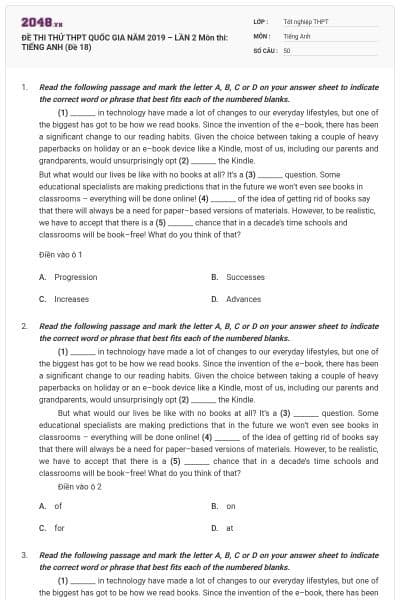
Read the following passage and mark the letter A, B, C or D on your answer sheet to indicate the correct word or phrase that best fits each of the numbered blanks.
(1) _______ in technology have made a lot of changes to our everyday lifestyles, but one of the biggest has got to be how we read books. Since the invention of the e–book, there has been a significant change to our reading habits. Given the choice between taking a couple of heavy paperbacks on holiday or an e–book device like a Kindle, most of us, including our parents and grandparents, would unsurprisingly opt (2) _______ the Kindle.
But what would our lives be like with no books at all? It’s a (3) _______ question. Some educational specialists are making predictions that in the future we won’t even see books in classrooms – everything will be done online! (4) _______ of the idea of getting rid of books say that there will always be a need for paper–based versions of materials. However, to be realistic, we have to accept that there is a (5) _______ chance that in a decade’s time schools and classrooms will be book–free! What do you think of that?
Điền vào ô 1
Progression
Successes
Increases
Advances
Kiến thức: Từ vựng
Giải thích:
Động từ “have” được chia ở ngôi số nhiều nên cần một danh từ ở dạng số nhiều.
Progression (n): sự tiến bộ Success (n): thành công
Increase (n): sự tăng thêm Advance (n): sự tiến bộ
(1) Advance in technology have made a lot of changes to our everyday lifestyles
Tạm dịch: Những tiến bộ trong công nghệ đã tạo ra rất nhiều thay đổi trong lối sống hàng ngày của chúng ta
Chọn D
Read the following passage and mark the letter A, B, C or D on your answer sheet to indicate the correct word or phrase that best fits each of the numbered blanks.
(1) _______ in technology have made a lot of changes to our everyday lifestyles, but one of the biggest has got to be how we read books. Since the invention of the e–book, there has been a significant change to our reading habits. Given the choice between taking a couple of heavy paperbacks on holiday or an e–book device like a Kindle, most of us, including our parents and grandparents, would unsurprisingly opt (2) _______ the Kindle.
But what would our lives be like with no books at all? It’s a (3) _______ question. Some educational specialists are making predictions that in the future we won’t even see books in classrooms – everything will be done online! (4) _______ of the idea of getting rid of books say that there will always be a need for paper–based versions of materials. However, to be realistic, we have to accept that there is a (5) _______ chance that in a decade’s time schools and classrooms will be book–free! What do you think of that?
Điền vào ô 2
of
on
for
at
Kiến thức: Từ vựng
Giải thích:
opt for/against something: lựa chọn cái gì
most of us, including our parents and grandparents, would unsurprisingly opt (2) for the Kindle.
Tạm dịch: hầu hết chúng ta, bao gồm cả cha mẹ và ông bà của chúng ta, sẽ không ngạc nhiên khi chọn Kindle.
Chọn C
Read the following passage and mark the letter A, B, C or D on your answer sheet to indicate the correct word or phrase that best fits each of the numbered blanks.
(1) _______ in technology have made a lot of changes to our everyday lifestyles, but one of the biggest has got to be how we read books. Since the invention of the e–book, there has been a significant change to our reading habits. Given the choice between taking a couple of heavy paperbacks on holiday or an e–book device like a Kindle, most of us, including our parents and grandparents, would unsurprisingly opt (2) _______ the Kindle.
But what would our lives be like with no books at all? It’s a (3) _______ question. Some educational specialists are making predictions that in the future we won’t even see books in classrooms – everything will be done online! (4) _______ of the idea of getting rid of books say that there will always be a need for paper–based versions of materials. However, to be realistic, we have to accept that there is a (5) _______ chance that in a decade’s time schools and classrooms will be book–free! What do you think of that?
Điền vào ô 3
special
naughty
funny
tricky
Kiến thức: Từ vựng
Giải thích:
special (adj): đặc biệt naughty (adj): nghịch ngợm
funny (adj): hài hước tricky (adj): khó/ khôn lanh (con người)
It’s a (3) tricky question.
Tạm dịch: Đó là một câu hỏi khó.
Chọn D
Read the following passage and mark the letter A, B, C or D on your answer sheet to indicate the correct word or phrase that best fits each of the numbered blanks.
(1) _______ in technology have made a lot of changes to our everyday lifestyles, but one of the biggest has got to be how we read books. Since the invention of the e–book, there has been a significant change to our reading habits. Given the choice between taking a couple of heavy paperbacks on holiday or an e–book device like a Kindle, most of us, including our parents and grandparents, would unsurprisingly opt (2) _______ the Kindle.
But what would our lives be like with no books at all? It’s a (3) _______ question. Some educational specialists are making predictions that in the future we won’t even see books in classrooms – everything will be done online! (4) _______ of the idea of getting rid of books say that there will always be a need for paper–based versions of materials. However, to be realistic, we have to accept that there is a (5) _______ chance that in a decade’s time schools and classrooms will be book–free! What do you think of that?
Điền vào ô 4
Alternatives
Contestants
Opponents
Enemies
Kiến thức: Từ vựng
Giải thích:
Alternative (n): lựa chọn Contestant (n): thí sinh
Opponent (n): đối thủ, người phản đối Enemy (n): kẻ thù
(4) Opponent of the idea of getting rid of books say that there will always be a need for paper–based versions of materials.
Tạm dịch: Những người phản đối ý tưởng loại bỏ sách nói rằng chúng ta sẽ luôn cần có các phiên bản tài liệu giấy.
Chọn C
Read the following passage and mark the letter A, B, C or D on your answer sheet to indicate the correct word or phrase that best fits each of the numbered blanks.
(1) _______ in technology have made a lot of changes to our everyday lifestyles, but one of the biggest has got to be how we read books. Since the invention of the e–book, there has been a significant change to our reading habits. Given the choice between taking a couple of heavy paperbacks on holiday or an e–book device like a Kindle, most of us, including our parents and grandparents, would unsurprisingly opt (2) _______ the Kindle.
But what would our lives be like with no books at all? It’s a (3) _______ question. Some educational specialists are making predictions that in the future we won’t even see books in classrooms – everything will be done online! (4) _______ of the idea of getting rid of books say that there will always be a need for paper–based versions of materials. However, to be realistic, we have to accept that there is a (5) _______ chance that in a decade’s time schools and classrooms will be book–free! What do you think of that?
Điền vào ô 5
remote
far
long
distant
Kiến thức: Từ vựng
Giải thích:
remote (adj): xa xôi/ không quá lớn, một chút far (adj): (khoảng cách) xa
long (adj): dài distant (adj): xa (về khoảng cách hoặc thời gian)
However, to be realistic, we have to accept that there is a (5) remote chance that in a decade’s time schools and classrooms will be book–free!
Tạm dịch: Tuy nhiên, để thực tế, chúng ta phải chấp nhận rằng có một cơ hội nhỏ rằng trong một thập kỷ, các trường học và lớp học thời gian sẽ không có sách!
Chọn A
Dịch bài đọc:
Những tiến bộ trong công nghệ đã tạo ra rất nhiều thay đổi trong lối sống hàng ngày của chúng ta, nhưng một trong những điều lớn nhất phải kể đến là cách chúng ta đọc sách. Kể từ khi phát minh ra sách điện tử, đã có một sự thay đổi đáng kể trong thói quen đọc sách của chúng ta. Được cho lựa chọn giữa việc mang một vài cuốn sách bìa dày cộp hoặc một thiết bị sách điện tử như Kindle vào kỳ nghỉ, hầu hết chúng ta, bao gồm cả cha mẹ và ông bà của chúng ta, sẽ không ngạc nhiên khi đều lựa chọn Kindle.
Nhưng cuộc sống của chúng ta sẽ ra sao nếu không có sách? Đó là một câu hỏi khó. Một số chuyên gia giáo dục đang đưa ra dự đoán rằng trong tương lai chúng ta sẽ thậm chí không còn nhìn thấy những cuốn sách trong lớp học – mọi thứ sẽ được thực hiện trực tuyến! Những người phản đối ý tưởng loại bỏ sách nói rằng chúng ta sẽ luôn cần có các phiên bản tài liệu giấy. Tuy nhiên, thực lòng, chúng ta phải thừa nhận rằng có một khả năng dù không lớn, các trường học và lớp học trong một thập kỷ tới sẽ không còn sách nữa! Bạn nghĩ gì về điều đó?
Mark the letter A, B, C or D on your answer sheet to indicate the most suitable response to complete each of the following exchanges.
Peter and Mike are in the middle of their conversation.
Peter: “If only I hadn’t said that to her.”
Mike: “_______”
No, you’ve don’t a good job!
No worry, that’s nothing
Ah, well, that’s life.
Yes, you mustn’t have done that.
Kiến thức: Hội thoại giao tiếp
Giải thích:
Peter và Mike đang nói chuyện với nhau.
Peter: “Giá như mình đã không nói điều đó với cô ấy.”
Mike: “_______”
A. Không, bạn đã làm rất tốt! B. Đừng lo lắng, điều đó không là gì.
C. Ah, ừ, cuộc sống mà. D. Ừ, chắc hẳn bạn đã không làm điều đó.
musn’t have V.p.p: (phỏng đoán trong quá khứ) chắc hẳn đã không làm gì
Chọn B
Mark the letter A, B, C or D on your answer sheet to indicate the most suitable response to complete each of the following exchanges.
Son: “Why don’t we buy a new car, Dad? This one is too old to go out with my friends.”
Dad: “_______ We don’t have much money.”
You’re right
I have to think it up
It’s out of the question now
That’s a great idea
Kiến thức: Hội thoại giao tiếp
Giải thích:
Con trai: “Tại sao chúng ta không mua chiếc ô tô mới hả bố? Chiếc xe này quá cũ để con đi ra ngoài chơi với bạn bè.”
Bố: “_______ Chúng ta đâu có nhiều tiền.”
A. Con nói đúng. B. Bố sẽ suy nghĩ.
C. Bây giờ điều đó là không thể. D. Đó là một ý tưởng hay đấy.
out of the question: không thể
Chọn C
Mark the letter A, B, C or D on your answer sheet to indicate the word(s) whose underlined part differs from the other three in pronunciation in each of the following questions.
possession
dissolve
dessert
pessimistic
Kiến thức: Phát âm “ss”
Giải thích:
possession /pəˈzeʃn/ dissolve /dɪˈzɒlv/
dessert /dɪˈzɜːt/ pessimistic /ˌpesɪˈmɪstɪk/
Phần được gạch chân ở câu D phát âm là /s/, còn lại phát âm là /z/.
Chọn D
Mark the letter A, B, C or D on your answer sheet to indicate the word(s) whose underlined part differs from the other three in pronunciation in each of the following questions.
penalty
expedition
incredible
determine
Kiến thức: Phát âm “e”
Giải thích:
penalty /ˈpenəlti/ expedition /ˌekspəˈdɪʃn/
incredible /ɪnˈkredəbl/ determine /dɪˈtɜːmɪn/
Phần được gạch chân ở câu D phát âm là /ɜː/, còn lại phát âm là /e/.
Chọn D
Read the following passage and mark the letter A, B, C or D on your answer sheet to indicate the correct answer to each of the following questions.
WHY DON’T YOU GET A PROPER JOB?
She wants to be a singer; you think she should go for a long–term career with job security and eventually retire with a good pension. But a new report suggests that in fact she’s the practical one. Why do parents make terrible careers advisers?
Today’s 14 and 15–year–olds are ambitious. They are optimistic about their prospects, but their career ideas are rather vague. Although 80% of them have no intention of following in their parents’ footsteps, 69% still turn to their parents for advice. They look at their working future in a different way to their parents.
A job for life is not in their vocabulary; neither is a dead–end but secure job that is boring but pays the bills. Almost half the boys surveyed expected that their hobbies would lead them into the right sort of job, while most girls seemed determined to avoid traditionally female careers such as nursing.
In the past, this might have counted as bad news. Certainly when I was 15, my guidance counsellors were horrified at my plans to become a writer. I’m glad I didn’t change my plans to suit them. Even so, their faith in rigid career paths was well–founded. In those days, that was the way to get ahead.
But the world has changed. The global economy is not kind to yesterday’s diligent and dependable worker. The future belongs to quick–thinking people who are resourceful, ambitious and can take the initiative. This means that a 14–year–old who sees her working future as a kind of adventure, to be made up as she goes along is not necessarily being unrealistic.
However, she has to have the training and guidance to help her develop the right skills for today’s market; not the rigid preparation for a workplace that disappeared twenty years ago. Many young people are very aware of the pitfalls of the flexible workplace; they understand that redundancy, downsizing and freelancing are all part of modern working life, but no one is telling them how they might be able to turn the new rules of the employment game to their advantage. This is what they need to know if they are to make a life for themselves.
So what is to be done? A good first step would be to change the way in which schools prepare young people for adult life. The education system is becoming less flexible and more obsessed with traditional skills at just the time that the employment market is going in the opposite direction.
Accurate, up–to–date information on new jobs and qualifications can help guidance counsellors to help their students. Young people need solid information on the sort of training they need to pursue the career of their dreams. Also, a little bit of encouragement can go a long way. If nothing else, a bit of optimism from an adult can serve as an antidote to the constant criticism of teenagers in the press.
What, then, can we as parents do to help them? The best thing is to forget all the advice that your parents gave you, and step into your teenager’s shoes. Once you’ve done that, it’s easier to see how important it is that they learn how to be independent, resourceful and resilient. Give them the courage to follow their dreams –however odd they might sound right now. In a world that offers economic security to almost no one, imagination is a terrible thing to waste.
What is the writer’s attitude to the changing job market?
It is a challenge that must be faced
It had made too many people unemployed.
It is something that young people are afraid of
It has had a negative effect on education
Kiến thức: Đọc hiểu
Giải thích:
Thái độ của tác giả đối với việc thị trường việc làm đang thay đổi là gì?
A. Đó là một thách thức phải đối mặt. B. Nó đã làm cho quá nhiều người thất nghiệp.
C. Đó là điều mà các bạn trẻ sợ. D. Nó đã có tác động tiêu cực đến giáo dục.
Thông tin: But the world has changed. The global economy is not kind to yesterday’s diligent and dependable worker. The future belongs to quick–thinking people who are resourceful, ambitious and can take the initiative. …
Many young people are very aware of the pitfalls of the flexible workplace; they understand that redundancy, downsizing and freelancing are all part of modern working life, but no one is telling them how they might be able to turn the new rules of the employment game to their advantage.
Tạm dịch: Nhưng thế giới đã thay đổi. Nền kinh tế toàn cầu không tử tế với người lao động siêng năng và đáng tin cậy của ngày hôm qua. Tương lai thuộc về những người tư duy nhanh, tháo vát, tham vọng và chủ động…
Nhiều bạn trẻ rất ý thức về những cạm bẫy của nơi làm việc linh hoạt; họ hiểu rằng sự dư thừa, cắt giảm nhân sự và làm việc tự do đều là một phần của cuộc sống làm việc hiện đại, nhưng không ai nói cho họ biết làm thế nào họ có thể biến các quy tắc mới của trò chơi tìm việc làm thành lợi thế của họ.
Chọn A
Read the following passage and mark the letter A, B, C or D on your answer sheet to indicate the correct answer to each of the following questions.
WHY DON’T YOU GET A PROPER JOB?
She wants to be a singer; you think she should go for a long–term career with job security and eventually retire with a good pension. But a new report suggests that in fact she’s the practical one. Why do parents make terrible careers advisers?
Today’s 14 and 15–year–olds are ambitious. They are optimistic about their prospects, but their career ideas are rather vague. Although 80% of them have no intention of following in their parents’ footsteps, 69% still turn to their parents for advice. They look at their working future in a different way to their parents.
A job for life is not in their vocabulary; neither is a dead–end but secure job that is boring but pays the bills. Almost half the boys surveyed expected that their hobbies would lead them into the right sort of job, while most girls seemed determined to avoid traditionally female careers such as nursing.
In the past, this might have counted as bad news. Certainly when I was 15, my guidance counsellors were horrified at my plans to become a writer. I’m glad I didn’t change my plans to suit them. Even so, their faith in rigid career paths was well–founded. In those days, that was the way to get ahead.
But the world has changed. The global economy is not kind to yesterday’s diligent and dependable worker. The future belongs to quick–thinking people who are resourceful, ambitious and can take the initiative. This means that a 14–year–old who sees her working future as a kind of adventure, to be made up as she goes along is not necessarily being unrealistic.
However, she has to have the training and guidance to help her develop the right skills for today’s market; not the rigid preparation for a workplace that disappeared twenty years ago. Many young people are very aware of the pitfalls of the flexible workplace; they understand that redundancy, downsizing and freelancing are all part of modern working life, but no one is telling them how they might be able to turn the new rules of the employment game to their advantage. This is what they need to know if they are to make a life for themselves.
So what is to be done? A good first step would be to change the way in which schools prepare young people for adult life. The education system is becoming less flexible and more obsessed with traditional skills at just the time that the employment market is going in the opposite direction.
Accurate, up–to–date information on new jobs and qualifications can help guidance counsellors to help their students. Young people need solid information on the sort of training they need to pursue the career of their dreams. Also, a little bit of encouragement can go a long way. If nothing else, a bit of optimism from an adult can serve as an antidote to the constant criticism of teenagers in the press.
What, then, can we as parents do to help them? The best thing is to forget all the advice that your parents gave you, and step into your teenager’s shoes. Once you’ve done that, it’s easier to see how important it is that they learn how to be independent, resourceful and resilient. Give them the courage to follow their dreams –however odd they might sound right now. In a world that offers economic security to almost no one, imagination is a terrible thing to waste.
How does the writer think the global economy has affected the employment market?
Workers have to be willing to change jobs
Workers are unlikely to receive a pension
It has made workers less dependable
It has made work more adventurous
Kiến thức: Đọc hiểu
Giải thích:
Tác giả nghĩ rằng nền kinh tế toàn cầu đã ảnh hưởng đến thị trường việc làm như thế nào?
A. Người lao động phải sẵn sàng thay đổi công việc.
B. Người lao động không có khả năng nhận lương hưu.
C. Nó đã làm cho người lao động ít tin cậy hơn.
D. Nó đã làm cho công việc mạo hiểm hơn.
Thông tin: Many young people are very aware of the pitfalls of the flexible workplace; they understand that redundancy, downsizing and freelancing are all part of modern working life, but no one is telling them how they might be able to turn the new rules of the employment game to their advantage.
Tạm dịch: Nhiều bạn trẻ rất ý thức về những cạm bẫy của nơi làm việc linh hoạt; họ hiểu rằng sự dư thừa, cắt giảm nhân sự và làm việc tự do đều là một phần của cuộc sống làm việc hiện đại, nhưng không ai nói cho họ biết làm thế nào họ có thể biến các quy tắc mới của trò chơi tìm việc làm thành lợi thế của họ.
Chọn D
Read the following passage and mark the letter A, B, C or D on your answer sheet to indicate the correct answer to each of the following questions.
WHY DON’T YOU GET A PROPER JOB?
She wants to be a singer; you think she should go for a long–term career with job security and eventually retire with a good pension. But a new report suggests that in fact she’s the practical one. Why do parents make terrible careers advisers?
Today’s 14 and 15–year–olds are ambitious. They are optimistic about their prospects, but their career ideas are rather vague. Although 80% of them have no intention of following in their parents’ footsteps, 69% still turn to their parents for advice. They look at their working future in a different way to their parents.
A job for life is not in their vocabulary; neither is a dead–end but secure job that is boring but pays the bills. Almost half the boys surveyed expected that their hobbies would lead them into the right sort of job, while most girls seemed determined to avoid traditionally female careers such as nursing.
In the past, this might have counted as bad news. Certainly when I was 15, my guidance counsellors were horrified at my plans to become a writer. I’m glad I didn’t change my plans to suit them. Even so, their faith in rigid career paths was well–founded. In those days, that was the way to get ahead.
But the world has changed. The global economy is not kind to yesterday’s diligent and dependable worker. The future belongs to quick–thinking people who are resourceful, ambitious and can take the initiative. This means that a 14–year–old who sees her working future as a kind of adventure, to be made up as she goes along is not necessarily being unrealistic.
However, she has to have the training and guidance to help her develop the right skills for today’s market; not the rigid preparation for a workplace that disappeared twenty years ago. Many young people are very aware of the pitfalls of the flexible workplace; they understand that redundancy, downsizing and freelancing are all part of modern working life, but no one is telling them how they might be able to turn the new rules of the employment game to their advantage. This is what they need to know if they are to make a life for themselves.
So what is to be done? A good first step would be to change the way in which schools prepare young people for adult life. The education system is becoming less flexible and more obsessed with traditional skills at just the time that the employment market is going in the opposite direction.
Accurate, up–to–date information on new jobs and qualifications can help guidance counsellors to help their students. Young people need solid information on the sort of training they need to pursue the career of their dreams. Also, a little bit of encouragement can go a long way. If nothing else, a bit of optimism from an adult can serve as an antidote to the constant criticism of teenagers in the press.
What, then, can we as parents do to help them? The best thing is to forget all the advice that your parents gave you, and step into your teenager’s shoes. Once you’ve done that, it’s easier to see how important it is that they learn how to be independent, resourceful and resilient. Give them the courage to follow their dreams –however odd they might sound right now. In a world that offers economic security to almost no one, imagination is a terrible thing to waste.
The writer uses the phrase “aware of the pitfalls” to show that young people _______.
feel that modern jobs are too flexible
know about the problems of modern jobs
don’t think they get enough training
accept that they will be made redundant
Kiến thức: Đọc hiểu
Giải thích:
Tác giả sử dụng cụm từ “Nhận thức về những cạm bẫy”, để chỉ ra rằng những người trẻ tuổi ___.
A. cảm thấy rằng các công việc hiện đại quá linh hoạt
B. hiểu về các vấn đề của công việc hiện đại
C. không nghĩ rằng họ được đào tạo đầy đủ
D. chấp nhận rằng họ sẽ bị dư thừa
Thông tin: Many young people are very aware of the pitfalls of the flexible workplace; they understand that redundancy, downsizing and freelancing are all part of modern working life, but no one is telling them how they might be able to turn the new rules of the employment game to their advantage.
Tạm dịch: Nhiều bạn trẻ rất ý thức về những cạm bẫy của nơi làm việc linh hoạt; họ hiểu rằng sự dư thừa, cắt giảm nhân sự và làm việc tự do đều là một phần của cuộc sống làm việc hiện đại, nhưng không ai nói cho họ biết làm thế nào họ có thể biến các quy tắc mới của trò chơi tìm việc làm thành lợi thế của họ.
Chọn B
Read the following passage and mark the letter A, B, C or D on your answer sheet to indicate the correct answer to each of the following questions.
WHY DON’T YOU GET A PROPER JOB?
She wants to be a singer; you think she should go for a long–term career with job security and eventually retire with a good pension. But a new report suggests that in fact she’s the practical one. Why do parents make terrible careers advisers?
Today’s 14 and 15–year–olds are ambitious. They are optimistic about their prospects, but their career ideas are rather vague. Although 80% of them have no intention of following in their parents’ footsteps, 69% still turn to their parents for advice. They look at their working future in a different way to their parents.
A job for life is not in their vocabulary; neither is a dead–end but secure job that is boring but pays the bills. Almost half the boys surveyed expected that their hobbies would lead them into the right sort of job, while most girls seemed determined to avoid traditionally female careers such as nursing.
In the past, this might have counted as bad news. Certainly when I was 15, my guidance counsellors were horrified at my plans to become a writer. I’m glad I didn’t change my plans to suit them. Even so, their faith in rigid career paths was well–founded. In those days, that was the way to get ahead.
But the world has changed. The global economy is not kind to yesterday’s diligent and dependable worker. The future belongs to quick–thinking people who are resourceful, ambitious and can take the initiative. This means that a 14–year–old who sees her working future as a kind of adventure, to be made up as she goes along is not necessarily being unrealistic.
However, she has to have the training and guidance to help her develop the right skills for today’s market; not the rigid preparation for a workplace that disappeared twenty years ago. Many young people are very aware of the pitfalls of the flexible workplace; they understand that redundancy, downsizing and freelancing are all part of modern working life, but no one is telling them how they might be able to turn the new rules of the employment game to their advantage. This is what they need to know if they are to make a life for themselves.
So what is to be done? A good first step would be to change the way in which schools prepare young people for adult life. The education system is becoming less flexible and more obsessed with traditional skills at just the time that the employment market is going in the opposite direction.
Accurate, up–to–date information on new jobs and qualifications can help guidance counsellors to help their students. Young people need solid information on the sort of training they need to pursue the career of their dreams. Also, a little bit of encouragement can go a long way. If nothing else, a bit of optimism from an adult can serve as an antidote to the constant criticism of teenagers in the press.
What, then, can we as parents do to help them? The best thing is to forget all the advice that your parents gave you, and step into your teenager’s shoes. Once you’ve done that, it’s easier to see how important it is that they learn how to be independent, resourceful and resilient. Give them the courage to follow their dreams –however odd they might sound right now. In a world that offers economic security to almost no one, imagination is a terrible thing to waste.
What kind of employment would teenagers like to have?
A job similar to their parents
A job that gives them fulfillment
A job that can also be a hobby
A job with economic security
Kiến thức: Đọc hiểu
Giải thích:
Thanh thiếu niên muốn làm những loại công việc nào?
A. Một công việc tương tự như cha mẹ của họ.
B. Một công việc mang lại cho họ sự hài lòng và vui vẻ.
C. Một công việc đồng thời có thể là một sở thích.
D. Một công việc có sự ổn định kinh tế.
Thông tin: A job for life is not in their vocabulary; neither is a dead–end but secure job that is boring but pays the bills. Almost half the boys surveyed expected that their hobbies would lead them into the right sort of job, while most girls seemed determined to avoid traditionally female careers such as nursing.
Tạm dịch: Một công việc cho cuộc sống không nằm trong vốn từ vựng của họ; đó không phải là một công việc cuối cùng nhưng ổn định và nhàm chán nhưng đủ để trả các hóa đơn. Gần một nửa các cậu bé được khảo sát mong rằng sở thích của họ sẽ giúp họ chọn được loại công việc phù hợp, trong khi hầu hết các cô gái dường như quyết tâm tránh các nghề nghiệp truyền thống của phụ nữ như điều dưỡng.
Chọn B
Read the following passage and mark the letter A, B, C or D on your answer sheet to indicate the correct answer to each of the following questions.
WHY DON’T YOU GET A PROPER JOB?
She wants to be a singer; you think she should go for a long–term career with job security and eventually retire with a good pension. But a new report suggests that in fact she’s the practical one. Why do parents make terrible careers advisers?
Today’s 14 and 15–year–olds are ambitious. They are optimistic about their prospects, but their career ideas are rather vague. Although 80% of them have no intention of following in their parents’ footsteps, 69% still turn to their parents for advice. They look at their working future in a different way to their parents.
A job for life is not in their vocabulary; neither is a dead–end but secure job that is boring but pays the bills. Almost half the boys surveyed expected that their hobbies would lead them into the right sort of job, while most girls seemed determined to avoid traditionally female careers such as nursing.
In the past, this might have counted as bad news. Certainly when I was 15, my guidance counsellors were horrified at my plans to become a writer. I’m glad I didn’t change my plans to suit them. Even so, their faith in rigid career paths was well–founded. In those days, that was the way to get ahead.
But the world has changed. The global economy is not kind to yesterday’s diligent and dependable worker. The future belongs to quick–thinking people who are resourceful, ambitious and can take the initiative. This means that a 14–year–old who sees her working future as a kind of adventure, to be made up as she goes along is not necessarily being unrealistic.
However, she has to have the training and guidance to help her develop the right skills for today’s market; not the rigid preparation for a workplace that disappeared twenty years ago. Many young people are very aware of the pitfalls of the flexible workplace; they understand that redundancy, downsizing and freelancing are all part of modern working life, but no one is telling them how they might be able to turn the new rules of the employment game to their advantage. This is what they need to know if they are to make a life for themselves.
So what is to be done? A good first step would be to change the way in which schools prepare young people for adult life. The education system is becoming less flexible and more obsessed with traditional skills at just the time that the employment market is going in the opposite direction.
Accurate, up–to–date information on new jobs and qualifications can help guidance counsellors to help their students. Young people need solid information on the sort of training they need to pursue the career of their dreams. Also, a little bit of encouragement can go a long way. If nothing else, a bit of optimism from an adult can serve as an antidote to the constant criticism of teenagers in the press.
What, then, can we as parents do to help them? The best thing is to forget all the advice that your parents gave you, and step into your teenager’s shoes. Once you’ve done that, it’s easier to see how important it is that they learn how to be independent, resourceful and resilient. Give them the courage to follow their dreams –however odd they might sound right now. In a world that offers economic security to almost no one, imagination is a terrible thing to waste.
The writer feels that most parents _______.
give their children good career advice
do not tend to be particularly ambitious
have very traditional views about work
have realistic goals for their children
Kiến thức: Đọc hiểu
Giải thích:
Người viết cảm thấy rằng hầu hết các bậc cha mẹ _______.
A. cho con cái họ lời khuyên tốt về nghề nghiệp B. không có xu hướng đặc biệt tham vọng
C. có quan điểm rất truyền thống về công việc D. có mục tiêu thực tế cho con cái của họ
Thông tin: Today’s 14 and 15–year–olds are ambitious. … They look at their working future in a different way to their parents.
Tạm dịch: Ngày nay, những cô bé cậu bé 14 và 15 tuổi đầy tham vọng. ... Họ nhìn vào sự nghiệp tương lai theo một cách khác với bố mẹ của mình.
Chọn B
Read the following passage and mark the letter A, B, C or D on your answer sheet to indicate the correct answer to each of the following questions.
WHY DON’T YOU GET A PROPER JOB?
She wants to be a singer; you think she should go for a long–term career with job security and eventually retire with a good pension. But a new report suggests that in fact she’s the practical one. Why do parents make terrible careers advisers?
Today’s 14 and 15–year–olds are ambitious. They are optimistic about their prospects, but their career ideas are rather vague. Although 80% of them have no intention of following in their parents’ footsteps, 69% still turn to their parents for advice. They look at their working future in a different way to their parents.
A job for life is not in their vocabulary; neither is a dead–end but secure job that is boring but pays the bills. Almost half the boys surveyed expected that their hobbies would lead them into the right sort of job, while most girls seemed determined to avoid traditionally female careers such as nursing.
In the past, this might have counted as bad news. Certainly when I was 15, my guidance counsellors were horrified at my plans to become a writer. I’m glad I didn’t change my plans to suit them. Even so, their faith in rigid career paths was well–founded. In those days, that was the way to get ahead.
But the world has changed. The global economy is not kind to yesterday’s diligent and dependable worker. The future belongs to quick–thinking people who are resourceful, ambitious and can take the initiative. This means that a 14–year–old who sees her working future as a kind of adventure, to be made up as she goes along is not necessarily being unrealistic.
However, she has to have the training and guidance to help her develop the right skills for today’s market; not the rigid preparation for a workplace that disappeared twenty years ago. Many young people are very aware of the pitfalls of the flexible workplace; they understand that redundancy, downsizing and freelancing are all part of modern working life, but no one is telling them how they might be able to turn the new rules of the employment game to their advantage. This is what they need to know if they are to make a life for themselves.
So what is to be done? A good first step would be to change the way in which schools prepare young people for adult life. The education system is becoming less flexible and more obsessed with traditional skills at just the time that the employment market is going in the opposite direction.
Accurate, up–to–date information on new jobs and qualifications can help guidance counsellors to help their students. Young people need solid information on the sort of training they need to pursue the career of their dreams. Also, a little bit of encouragement can go a long way. If nothing else, a bit of optimism from an adult can serve as an antidote to the constant criticism of teenagers in the press.
What, then, can we as parents do to help them? The best thing is to forget all the advice that your parents gave you, and step into your teenager’s shoes. Once you’ve done that, it’s easier to see how important it is that they learn how to be independent, resourceful and resilient. Give them the courage to follow their dreams –however odd they might sound right now. In a world that offers economic security to almost no one, imagination is a terrible thing to waste.
How can parents help their children?
By trying to think the way they do
By learning to be courageous
By ignoring advice given by others
By becoming more independent
Kiến thức: Đọc hiểu
Giải thích:
Các bậc cha mẹ có thể giúp con cái của họ như thế nào?
A. Bằng cách cố gắng suy nghĩ theo cách của chúng.
B. Bằng cách học để trở nên can đảm hơn.
C. Bằng cách lơ đi lời khuyên được đưa ra bởi người khác.
D. Bằng cách trở nên độc lập hơn.
Thông tin: What, then, can we as parents do to help them? The best thing is to forget all the advice that your parents gave you, and step into your teenager’s shoes.
Tạm dịch: Vậy thì, những người cha mẹ như chúng ta có thể làm gì để giúp đỡ họ? Điều tốt nhất là quên đi tất cả những lời khuyên mà cha mẹ của bạn đã dành cho bạn, và đứng vào vị trí của con bạn.
Chọn A
Read the following passage and mark the letter A, B, C or D on your answer sheet to indicate the correct answer to each of the following questions.
WHY DON’T YOU GET A PROPER JOB?
She wants to be a singer; you think she should go for a long–term career with job security and eventually retire with a good pension. But a new report suggests that in fact she’s the practical one. Why do parents make terrible careers advisers?
Today’s 14 and 15–year–olds are ambitious. They are optimistic about their prospects, but their career ideas are rather vague. Although 80% of them have no intention of following in their parents’ footsteps, 69% still turn to their parents for advice. They look at their working future in a different way to their parents.
A job for life is not in their vocabulary; neither is a dead–end but secure job that is boring but pays the bills. Almost half the boys surveyed expected that their hobbies would lead them into the right sort of job, while most girls seemed determined to avoid traditionally female careers such as nursing.
In the past, this might have counted as bad news. Certainly when I was 15, my guidance counsellors were horrified at my plans to become a writer. I’m glad I didn’t change my plans to suit them. Even so, their faith in rigid career paths was well–founded. In those days, that was the way to get ahead.
But the world has changed. The global economy is not kind to yesterday’s diligent and dependable worker. The future belongs to quick–thinking people who are resourceful, ambitious and can take the initiative. This means that a 14–year–old who sees her working future as a kind of adventure, to be made up as she goes along is not necessarily being unrealistic.
However, she has to have the training and guidance to help her develop the right skills for today’s market; not the rigid preparation for a workplace that disappeared twenty years ago. Many young people are very aware of the pitfalls of the flexible workplace; they understand that redundancy, downsizing and freelancing are all part of modern working life, but no one is telling them how they might be able to turn the new rules of the employment game to their advantage. This is what they need to know if they are to make a life for themselves.
So what is to be done? A good first step would be to change the way in which schools prepare young people for adult life. The education system is becoming less flexible and more obsessed with traditional skills at just the time that the employment market is going in the opposite direction.
Accurate, up–to–date information on new jobs and qualifications can help guidance counsellors to help their students. Young people need solid information on the sort of training they need to pursue the career of their dreams. Also, a little bit of encouragement can go a long way. If nothing else, a bit of optimism from an adult can serve as an antidote to the constant criticism of teenagers in the press.
What, then, can we as parents do to help them? The best thing is to forget all the advice that your parents gave you, and step into your teenager’s shoes. Once you’ve done that, it’s easier to see how important it is that they learn how to be independent, resourceful and resilient. Give them the courage to follow their dreams –however odd they might sound right now. In a world that offers economic security to almost no one, imagination is a terrible thing to waste.
What does the writer believe about her guidance counsellors?
That they should have treated her better
That the advice they gave was wrong
That they were in some ways right
That they had tried to ruin her career
Kiến thức: Đọc hiểu
Giải thích:
Nhà văn tin điều gì về các cố vấn hướng dẫn của cô ấy?
A. Rằng họ nên đối xử với cô ấy tốt hơn. B. Rằng lời khuyên họ đưa ra là sai.
C. Rằng họ cũng đúng theo cách nào đó. D. Rằng họ đã cố hủy hoại sự nghiệp của cô.
Thông tin: Certainly when I was 15, my guidance counsellors were horrified at my plans to become a writer. I’m glad I didn’t change my plans to suit them. Even so, their faith in rigid career paths was well–founded. In those days, that was the way to get ahead.
Tạm dịch: Chắc chắn khi tôi 15 tuổi, các cố vấn hướng dẫn của tôi đã kinh hoàng trước kế hoạch trở thành nhà văn của tôi. Tôi rất vui vì tôi đã không thay đổi kế hoạch để phù hợp với họ. Mặc dù vậy, niềm tin của họ vào con đường sự nghiệp cứng nhắc là hoàn toàn có cơ sở. Trước đây, đó là cách để tiến bộ.
Chọn C
Read the following passage and mark the letter A, B, C or D on your answer sheet to indicate the correct answer to each of the following questions.
WHY DON’T YOU GET A PROPER JOB?
She wants to be a singer; you think she should go for a long–term career with job security and eventually retire with a good pension. But a new report suggests that in fact she’s the practical one. Why do parents make terrible careers advisers?
Today’s 14 and 15–year–olds are ambitious. They are optimistic about their prospects, but their career ideas are rather vague. Although 80% of them have no intention of following in their parents’ footsteps, 69% still turn to their parents for advice. They look at their working future in a different way to their parents.
A job for life is not in their vocabulary; neither is a dead–end but secure job that is boring but pays the bills. Almost half the boys surveyed expected that their hobbies would lead them into the right sort of job, while most girls seemed determined to avoid traditionally female careers such as nursing.
In the past, this might have counted as bad news. Certainly when I was 15, my guidance counsellors were horrified at my plans to become a writer. I’m glad I didn’t change my plans to suit them. Even so, their faith in rigid career paths was well–founded. In those days, that was the way to get ahead.
But the world has changed. The global economy is not kind to yesterday’s diligent and dependable worker. The future belongs to quick–thinking people who are resourceful, ambitious and can take the initiative. This means that a 14–year–old who sees her working future as a kind of adventure, to be made up as she goes along is not necessarily being unrealistic.
However, she has to have the training and guidance to help her develop the right skills for today’s market; not the rigid preparation for a workplace that disappeared twenty years ago. Many young people are very aware of the pitfalls of the flexible workplace; they understand that redundancy, downsizing and freelancing are all part of modern working life, but no one is telling them how they might be able to turn the new rules of the employment game to their advantage. This is what they need to know if they are to make a life for themselves.
So what is to be done? A good first step would be to change the way in which schools prepare young people for adult life. The education system is becoming less flexible and more obsessed with traditional skills at just the time that the employment market is going in the opposite direction.
Accurate, up–to–date information on new jobs and qualifications can help guidance counsellors to help their students. Young people need solid information on the sort of training they need to pursue the career of their dreams. Also, a little bit of encouragement can go a long way. If nothing else, a bit of optimism from an adult can serve as an antidote to the constant criticism of teenagers in the press.
What, then, can we as parents do to help them? The best thing is to forget all the advice that your parents gave you, and step into your teenager’s shoes. Once you’ve done that, it’s easier to see how important it is that they learn how to be independent, resourceful and resilient. Give them the courage to follow their dreams –however odd they might sound right now. In a world that offers economic security to almost no one, imagination is a terrible thing to waste.
What does the writer feel will happen if the education system does not change?
Young people will be discouraged from working
Young people will receive mover criticism in the press
Young people will be unable to fulfill their potential
Young people will not be optimistic about their future
Kiến thức: Đọc hiểu
Giải thích:
Tác giả cảm thấy điều gì sẽ xảy ra nếu hệ thống giáo dục không thay đổi?
A. Giới trẻ sẽ cảm thấy không hứng thú khi làm việc.
B. Giới trẻ sẽ nhận được những lời chỉ trích trên báo chí.
C. Giới trẻ sẽ không thể phát huy hết tiềm năng của họ.
D. Giới trẻ sẽ không lạc quan về tương lai của họ.
Thông tin: but no one is telling them how they might be able to turn the new rules of the employment game to their advantage…So what is to be done? A good first step would be to change the way in which schools prepare young people for adult life…
Accurate, up–to–date information on new jobs and qualifications can help guidance counsellors to help their students. Young people need solid information on the sort of training they need to pursue the career of their dreams.
Tạm dịch: nhưng không ai nói cho họ biết làm thế nào họ có thể biến các quy tắc mới của trò chơi tìm việc làm thành lợi thế của họ…Vậy phải làm gì? Bước đầu tiên tốt là thay đổi cách các trường học chuẩn bị cho những người trẻ tuổi bước vào cuộc sống trưởng thành…
Thông tin chính xác, cập nhật về công việc và bằng cấp mới có thể giúp các cố vấn hướng dẫn giúp đỡ học sinh của mình. Những người trẻ tuổi cần thông tin vững chắc về loại đào tạo họ cần để theo đuổi nghề nghiệp họ mơ ước.
Chọn C
Dịch bài đọc:
TẠI SAO BẠN KHÔNG LỰA CHỌN MỘT CÔNG VIỆC PHÙ HỢP?
Cô ấy muốn trở thành một ca sĩ; bạn nghĩ rằng cô ấy nên lựa chọn một sự nghiệp lâu dài với sự ổn định trong công việc và cuối cùng về hưu với mức lương hưu tốt. Nhưng một báo cáo mới đây cho thấy rằng trên thực tế, cô ấy là người thực tế. Tại sao bố mẹ trở thành những vị cố vấn sự nghiệp tồi tệ?
Ngày nay, những cô bé cậu bé 14 và 15 tuổi đầy tham vọng. Họ lạc quan về triển vọng của mình, nhưng ý tưởng về nghề nghiệp của họ khá mơ hồ. Mặc dù 80% trong số họ không có ý định đi theo sự nghiệp của bố mẹ, nhưng 69% vẫn tìm đến bố mẹ để xin lời khuyên. Họ nhìn vào sự nghiệp tương lai theo một cách khác với bố mẹ của mình.
Một công việc cho cuộc sống không nằm trong vốn từ vựng của họ; đó không phải là một công việc cuối cùng nhưng ổn định và nhàm chán nhưng đủ để trả các hóa đơn. Gần một nửa các cậu bé được khảo sát mong rằng sở thích của họ sẽ giúp họ chọn được loại công việc phù hợp, trong khi hầu hết các cô gái dường như quyết tâm tránh các nghề nghiệp truyền thống của phụ nữ như điều dưỡng.
Trong quá khứ, điều này có thể được coi là tin xấu. Chắc chắn khi tôi 15 tuổi, các cố vấn hướng dẫn của tôi đã kinh hoàng trước kế hoạch trở thành nhà văn của tôi. Tôi rất vui vì tôi đã không thay đổi kế hoạch để phù hợp với họ. Mặc dù vậy, niềm tin của họ vào con đường sự nghiệp cứng nhắc là hoàn toàn có cơ sở. Trước đây, đó là cách để tiến bộ.
Nhưng thế giới đã thay đổi. Nền kinh tế toàn cầu không tử tế với người lao động siêng năng và đáng tin cậy của ngày hôm qua. Tương lai thuộc về những người tư duy nhanh, tháo vát, tham vọng và chủ động. Điều này có nghĩa là một cô bé 14 tuổi coi sự nghiệp tương lai của mình là một loại phiêu lưu, được hình thành nên khi em phát triển cùng hẳn là không thực tế.
Tuy nhiên, cô ấy phải được đào tạo và hướng dẫn để giúp phát triển các kỹ năng phù hợp cho thị trường ngày nay; không phải là sự chuẩn bị cứng nhắc cho một nơi làm việc mà đã biến mất hai mươi năm trước. Nhiều bạn trẻ rất ý thức về những cạm bẫy của nơi làm việc linh hoạt; họ hiểu rằng sự dư thừa, cắt giảm nhân sự và làm việc tự do đều là một phần của cuộc sống làm việc hiện đại, nhưng không ai nói cho họ biết làm thế nào họ có thể biến các quy tắc mới của trò chơi tìm việc làm thành lợi thế của họ. Đây là những gì họ cần biết nếu họ muốn tạo ra một cuộc sống cho chính họ.
Vậy phải làm gì? Bước đầu tiên tốt là thay đổi cách các trường học chuẩn bị cho những người trẻ tuổi bước vào cuộc sống trưởng thành. Hệ thống giáo dục đang trở nên kém linh hoạt và bị ám ảnh bởi các kỹ năng truyền thống trong thời điểm thị trường việc làm đang đi theo hướng ngược lại.
Thông tin chính xác, cập nhật về công việc và bằng cấp mới có thể giúp các cố vấn hướng dẫn giúp đỡ học sinh của mình. Những người trẻ tuổi cần thông tin vững chắc về loại đào tạo họ cần để theo đuổi nghề nghiệp họ mơ ước. Ngoài ra, một chút khích lệ có thể duy trì. Nếu không có gì khác, một chút lạc quan từ một người trưởng thành có thể đóng vai trò là liều thuốc trấn an cho những lời chỉ trích liên tục của thanh thiếu niên trên báo chí.
Vậy thì, những người cha mẹ như chúng ta có thể làm gì để giúp đỡ họ? Điều tốt nhất là quên đi tất cả những lời khuyên mà cha mẹ của bạn đã dành cho bạn, và đứng vào vị trí của con bạn. Một khi bạn đã làm điều đó, bạn sẽ dễ dàng nhận ra tầm quan trọng của việc họ học cách độc lập, tự lập và kiên cường. Hãy cho họ lòng can đảm để thực hiện ước mơ của mình – dù ngay bây giờ chúng nghe có vẻ kỳ lạ thế nào chăng nữa. Trong một thế giới không đảm bảo an ninh kinh tế cho bất kỳ ai, trí tưởng tượng là một điều tệ hại để lãng phí.
Mark the letter A, B, C or D on your answer sheet to indicate the word(s) CLOSEST in meaning to the underlined word(s) in each of the following questions.
Flats which are both comfortable and reasonably priced are few and far between in the current context of economic crisis.
uncommon
unusual
non–standard
non–existent
Kiến thức: Từ đồng nghĩa
Giải thích:
few and far between = not happening often: không thường xuyên xảy ra
uncommon (adj): không phổ biến unusual (adj): bất thường
non–standard (adj): không chuẩn non–existent (adj): không tồn tại
=> few and far between = uncommon
Tạm dịch: Căn hộ vừa thoải mái vừa có giá hợp lý không phổ biến trong bối cảnh khủng hoảng kinh tế hiện nay.
Chọn A
Mark the letter A, B, C or D on your answer sheet to indicate the word(s) CLOSEST in meaning to the underlined word(s) in each of the following questions.
Gerry didn’t go on the expedition – he made up that part of the story.
Gerry didn’t go on the expedition – he made up that part of the story.
narrated
unfolded
recounted
Kiến thức: Từ đồng nghĩa
Giải thích:
make up: bịa ra một câu chuyện,…
invent (v): sáng chế/ bịa đặt narrate (v): kể chuyện
unfold (v): lộ ra recount (v): thuật lại
=> made up = invented
Tạm dịch: Gerry đã không đi thám hiểm – anh ấy đã bịa ra một phần của câu chuyện.
Chọn A
Read the following passage and mark the letter A, B, C or D on your answer sheet to indicate the correct answer to each of the following questions.
It is not surprising that the birthplace of cola was the hot and humid American South. This region had long specialized in creating delicious soft drinks. A druggist in Atlanta, Georgia named John Pemberton created the most well–known drink brand in the world in the 1880s. However, it seems clear that he had no idea how big it would become.
Like many American pharmacists of the day, Pemberton was opposed to the drinking of alcohol and wanted to produce a stimulating soft drink. First, he made "the French Wine of Coca," made from the coca leaf. Then he began to experiment with the cola nut. Eventually, he managed to make a combination of the two that he thought was sweet, but not too sweet. Deciding that "the two C's would look well in advertising," he named it Coca–Cola.
Pemberton's invention caught on fairly quickly. By 1905, "Coke" was being advertised all over the country as "The Great Natural Temperance Drink." The drink enjoyed additional success since there was a large and popular temperance movement in the US at that time. In the 1920s, alcohol was outlawed, and sales of Coke rose significantly. However, they continued to rise even after the law was repeated.
Another reason for Coke's popularity was good business sense. A year after he invented it, Pemberton had sold Coca–Cola to Asa Griggs Candler for only $283.26! Candler was a marketing genius, and by the time he sold the Coca–Cola Company in1919, it was worth $25 million.
Which of the following would be the best title for the reading?
The Invention and History of Coca–Cola
Cola is the World’s Most Popular Soft Drink
The Temperance Movement and Coke’s success
John Pemberton created Coca–Cola
Kiến thức: Đọc hiểu
Giải thích:
Điều nào sau đây sẽ là tiêu đề tốt nhất cho bài đọc?
A. Phát minh và lịch sử của Coca–Cola
B. Cola là nước giải khát phổ biến nhất thế giới
C. Phong trào phản đối đồ uống có cồn và thành công của Coke
D. John Pemberton đã tạo ra Coca–Cola.
Thông tin: It is not surprising that the birthplace of cola was the hot and humid American South. This region had long specialized in creating delicious soft drinks. A druggist in Atlanta, Georgia named John Pemberton created the most well–known drink brand in the world in the 1880s…
Candler was a marketing genius, and by the time he sold the Coca–Cola Company in1919, it was worth $25 million…
Tạm dịch: Không có gì đáng ngạc nhiên khi quê hương của cola là miền Nam nước Mỹ nóng và ẩm. Khu vực này từ lâu đã chuyên tạo ra những lon nước giải khát thơm ngon. Một người buôn bán ở Atlanta, Georgia tên là John Pemberton đã tạo ra thương hiệu đồ uống nổi tiếng nhất thế giới vào những năm 1880…
Candler là một thiên tài tiếp thị, và vào thời điểm ông bán Công ty Coca–Cola vào năm 1919, nó trị giá 25 triệu đô la.
Chọn A
Read the following passage and mark the letter A, B, C or D on your answer sheet to indicate the correct answer to each of the following questions.
It is not surprising that the birthplace of cola was the hot and humid American South. This region had long specialized in creating delicious soft drinks. A druggist in Atlanta, Georgia named John Pemberton created the most well–known drink brand in the world in the 1880s. However, it seems clear that he had no idea how big it would become.
Like many American pharmacists of the day, Pemberton was opposed to the drinking of alcohol and wanted to produce a stimulating soft drink. First, he made "the French Wine of Coca," made from the coca leaf. Then he began to experiment with the cola nut. Eventually, he managed to make a combination of the two that he thought was sweet, but not too sweet. Deciding that "the two C's would look well in advertising," he named it Coca–Cola.
Pemberton's invention caught on fairly quickly. By 1905, "Coke" was being advertised all over the country as "The Great Natural Temperance Drink." The drink enjoyed additional success since there was a large and popular temperance movement in the US at that time. In the 1920s, alcohol was outlawed, and sales of Coke rose significantly. However, they continued to rise even after the law was repeated.
Another reason for Coke's popularity was good business sense. A year after he invented it, Pemberton had sold Coca–Cola to Asa Griggs Candler for only $283.26! Candler was a marketing genius, and by the time he sold the Coca–Cola Company in1919, it was worth $25 million.
In paragraph 3, the word “outlawed” is closest in meaning to _______.
made legal
taken to court
made illegal
allowed
Kiến thức: Đọc hiểu
Giải thích:
outlaw something = to make something illegal: khiến cái gì trở nên bất hợp pháp, cấm
made legal: làm cho hợp pháp
taken to court: bị đưa ra tòa
allowed: cho phép
Thông tin: In the 1920s, alcohol was outlawed, and sales of Coke rose significantly.
Tạm dịch: Trong những năm 1920, rượu đã bị cấm và doanh số của Coke tăng đáng kể.
Chọn C
Read the following passage and mark the letter A, B, C or D on your answer sheet to indicate the correct answer to each of the following questions.
It is not surprising that the birthplace of cola was the hot and humid American South. This region had long specialized in creating delicious soft drinks. A druggist in Atlanta, Georgia named John Pemberton created the most well–known drink brand in the world in the 1880s. However, it seems clear that he had no idea how big it would become.
Like many American pharmacists of the day, Pemberton was opposed to the drinking of alcohol and wanted to produce a stimulating soft drink. First, he made "the French Wine of Coca," made from the coca leaf. Then he began to experiment with the cola nut. Eventually, he managed to make a combination of the two that he thought was sweet, but not too sweet. Deciding that "the two C's would look well in advertising," he named it Coca–Cola.
Pemberton's invention caught on fairly quickly. By 1905, "Coke" was being advertised all over the country as "The Great Natural Temperance Drink." The drink enjoyed additional success since there was a large and popular temperance movement in the US at that time. In the 1920s, alcohol was outlawed, and sales of Coke rose significantly. However, they continued to rise even after the law was repeated.
Another reason for Coke's popularity was good business sense. A year after he invented it, Pemberton had sold Coca–Cola to Asa Griggs Candler for only $283.26! Candler was a marketing genius, and by the time he sold the Coca–Cola Company in1919, it was worth $25 million.
All of the followings are true of Pemberton EXCEPT that _______.
he made “French wine of Coca” from the coca leaf
he combined the coca leaf and cola nut to make “French wine”
he produced stimulating alcohol from coca leaves and cola nuts
he made “French wine of Coca” from the cola nut
Kiến thức: Đọc hiểu
Giải thích:
Tất cả những điều sau đây đều đúng về Pemberton NGOẠI TRỪ ___.
A. ông đã làm “Coca phiên bản Rượu vang Pháp” từ lá coca
B. ông đã kết hợp lá coca và hạt cola để tạo ra “rượu vang Pháp”
C. ông đã sản xuất đồ uống có cồn kích thích từ lá coca và hạt cola
D. ông đã làm “Coca phiên bản Rượu vang Pháp” từ hạt cola
Thông tin: First, he made "the French Wine of Coca," made from the coca leaf. Then he began to experiment with the cola nut. Eventually, he managed to make a combination of the two that he thought was sweet, but not too sweet.
Tạm dịch: Đầu tiên, ông ấy làm " Coca phiên bản Rượu vang Pháp", được làm từ lá coca. Sau đó, ông ấy bắt đầu thử nghiệm với hạt cola. Cuối cùng, ông ấy đã thành công tạo ra sự kết hợp của cả hai mà ông ấy đã thấy ngọt, nhưng không quá ngọt.
Chọn C
Read the following passage and mark the letter A, B, C or D on your answer sheet to indicate the correct answer to each of the following questions.
It is not surprising that the birthplace of cola was the hot and humid American South. This region had long specialized in creating delicious soft drinks. A druggist in Atlanta, Georgia named John Pemberton created the most well–known drink brand in the world in the 1880s. However, it seems clear that he had no idea how big it would become.
Like many American pharmacists of the day, Pemberton was opposed to the drinking of alcohol and wanted to produce a stimulating soft drink. First, he made "the French Wine of Coca," made from the coca leaf. Then he began to experiment with the cola nut. Eventually, he managed to make a combination of the two that he thought was sweet, but not too sweet. Deciding that "the two C's would look well in advertising," he named it Coca–Cola.
Pemberton's invention caught on fairly quickly. By 1905, "Coke" was being advertised all over the country as "The Great Natural Temperance Drink." The drink enjoyed additional success since there was a large and popular temperance movement in the US at that time. In the 1920s, alcohol was outlawed, and sales of Coke rose significantly. However, they continued to rise even after the law was repeated.
Another reason for Coke's popularity was good business sense. A year after he invented it, Pemberton had sold Coca–Cola to Asa Griggs Candler for only $283.26! Candler was a marketing genius, and by the time he sold the Coca–Cola Company in1919, it was worth $25 million.
In paragraph 3, the word “caught on” is closest in meaning to _______.
became popular
became successful
became important
became legal
Kiến thức: Đọc hiểu
Giải thích:
catch on = to become popular or fashionable: trở nên phổ biến và hợp thời trang
became successful: trở nên thành công
became important: trở nên quan trọng
became legal: trở nên hợp pháp
Thông tin: Pemberton's invention caught on fairly quickly.
Tạm dịch: Phát minh của Pemberton nhanh chóng trở nên phổ biến.
Chọn A
Read the following passage and mark the letter A, B, C or D on your answer sheet to indicate the correct answer to each of the following questions.
It is not surprising that the birthplace of cola was the hot and humid American South. This region had long specialized in creating delicious soft drinks. A druggist in Atlanta, Georgia named John Pemberton created the most well–known drink brand in the world in the 1880s. However, it seems clear that he had no idea how big it would become.
Like many American pharmacists of the day, Pemberton was opposed to the drinking of alcohol and wanted to produce a stimulating soft drink. First, he made "the French Wine of Coca," made from the coca leaf. Then he began to experiment with the cola nut. Eventually, he managed to make a combination of the two that he thought was sweet, but not too sweet. Deciding that "the two C's would look well in advertising," he named it Coca–Cola.
Pemberton's invention caught on fairly quickly. By 1905, "Coke" was being advertised all over the country as "The Great Natural Temperance Drink." The drink enjoyed additional success since there was a large and popular temperance movement in the US at that time. In the 1920s, alcohol was outlawed, and sales of Coke rose significantly. However, they continued to rise even after the law was repeated.
Another reason for Coke's popularity was good business sense. A year after he invented it, Pemberton had sold Coca–Cola to Asa Griggs Candler for only $283.26! Candler was a marketing genius, and by the time he sold the Coca–Cola Company in1919, it was worth $25 million.
Which of the following is responsible for Coke’s additional success?
The temperance movement
Its attracting name
Pemberton’s good business sense
Coca–Cola’s great taste
Kiến thức: Đọc hiểu
Giải thích:
Điều nào sau đây là lý do cho thành công hơn nữa của Coke?
A. Phong trào phản đối đồ uống có cồn B. Cái tên đầy thu hút của nó
C. Tầm nhìn kinh doanh tốt của Pemberton D. Hương vị tuyệt vời của Coca–Cola
Thông tin: The drink enjoyed additional success since there was a large and popular temperance movement in the US at that time.
Tạm dịch: Đồ uống càng thành công hơn nhờ có một phong trào phản đối đồ uống có cồn lớn và phổ biến ở Mỹ vào thời điểm đó.
Chọn A
Dịch bài đọc:
Không có gì đáng ngạc nhiên khi quê hương của cola là miền Nam nước Mỹ nóng và ẩm. Khu vực này từ lâu đã chuyên tạo ra những lon nước giải khát thơm ngon. Một người buôn bán ở Atlanta, Georgia tên là John Pemberton đã tạo ra thương hiệu đồ uống nổi tiếng nhất thế giới vào những năm 1880. Tuy nhiên, có vẻ như rõ ràng rằng anh ta không biết nó sẽ trở nên khổng lồ như thế nào.
Giống như nhiều dược sĩ người Mỹ thời đó, Pemberton đã phản đối việc uống rượu và muốn sản xuất một loại nước ngọt kích thích. Đầu tiên, ông ấy làm " Coca phiên bản Rượu vang Pháp", được làm từ lá coca. Sau đó, ông ấy bắt đầu thử nghiệm với hạt cola. Cuối cùng, ông ấy đã thành công tạo ra sự kết hợp của cả hai mà ông ấy đã thấy ngọt, nhưng không quá ngọt. Quyết định rằng "hai chữ C sẽ có vẻ hợp khi quảng cáo", ông đặt tên cho nó là Coca–Cola.
Phát minh của Pemberton nhanh chóng trở nên phổ biến. Đến năm 1905, "Coke" đã được quảng cáo trên toàn quốc như là "Thức uống không cồn tuyệt vời đến từ thiên nhiên". Đồ uống càng thành công hơn nhờ có một phong trào phản đối đồ uống có cồn lớn và phổ biến ở Mỹ vào thời điểm đó. Trong những năm 1920, rượu đã bị cấm và doanh số của Coke tăng đáng kể. Tuy nhiên, chúng vẫn tiếp tục tăng ngay cả sau khi luật được thiết lập lại.
Một lý do khác cho sự nổi tiếng của Coke là tầm nhìn kinh doanh tốt. Một năm sau khi ông phát minh ra nó, Pemberton đã bán Coca–Cola cho Asa Griggs Candler chỉ với $283,26! Candler là một thiên tài tiếp thị, và vào thời điểm ông bán Công ty Coca–Cola vào năm 1919, nó trị giá 25 triệu đô la.
Mark the letter A, B, C or D on your answer sheet to indicate the underlined part that needs correction in each of the following questions.
Physics and mental exercise has been found to be beneficial to our brains, but scientists have now found it could also improve the learning ability of our children.
learning ability
has been
it
Physics
Kiến thức: Từ vựng, từ loại
Giải thích:
Ở đây trước danh từ “exercise” cần một tính từ.
Physics (n): môn vật lý
Physical (adj): thuộc về vật chất/ cơ thể
Sửa: Physics => Physical
Tạm dịch: Tập thể dục thể chất và tinh thần đã được nhận thấy là có lợi cho bộ não của chúng ta, nhưng các nhà khoa học còn thấy rằng nó cũng có thể cải thiện khả năng học tập của con cái của chúng ta.
Chọn D
Mark the letter A, B, C or D on your answer sheet to indicate the underlined part that needs correction in each of the following questions.
Peacocks are among the most exotic birds in nature; its long tail feathers fan out to reveal a profusion of vivid colors.
fan out
its
most exotic
among
Kiến thức: Tính từ sở hữu
Giải thích:
Ở đây cần tính từ sở hữu cho danh từ “Peacocks” (danh từ ở dạng số nhiều) => dùng “their”.
Sửa: its => their
Tạm dịch: Con công là một trong những loài chim kỳ lạ nhất trong tự nhiên; lông đuôi dài của chúng quạt ra để lộ những màu sắc sống động.
Chọn B
Mark the letter A, B, C or D on your answer sheet to indicate the underlined part that needs correction in each of the following questions.
It is the job interview that you should be prepared to mention a salary range.
salary range
to mention
should be
the job interview
Kiến thức: Mạo từ
Giải thích:
Ở đây danh từ “job interview” lần đầu tiên được nhắc đến => chưa xác định => dùng mạo từ “a”.
Sửa: the => a
Tạm dịch: Bạn nên chuẩn bị cuộc phỏng vấn xin việc để đề cập đến một mức lương.
Chọn D
Mark the letter A, B, C or D on your answer sheet to indicate the sentences that combines each pair of sentences in the following questions.
He was overconfident. Therefore, he ruined our plan completely.
It was because his overconfidence that ruined our plan completely
He was overconfident, which ruined our plan completely
That he was overconfidence ruined our plan completely
It was his overconfidence ruined our plan completely.
Kiến thức: Mệnh đề quan hệ
Giải thích:
Đại từ quan hệ “which” có thể thay thế cho cả mệnh đề đứng trước nó, làm chủ ngữ trong mệnh đề quan hệ:
S + V, which + V + …
overconfident (adj): quá tự tin
overconfidence (n): sự quá tự tin
A. because + S + V = because of + N/Ving: bởi vì => Câu A sai.
C. Câu C sai do dùng danh từ “confidence”.
D. Cấu trúc câu chẻ: It + is + N + that + V + … => Câu D sai.
Tạm dịch: Anh ta quá tự tin, điều đó đã phá hỏng hoàn toàn kế hoạch của chúng tôi.
Chọn B
Mark the letter A, B, C or D on your answer sheet to indicate the sentences that combines each pair of sentences in the following questions.
It was a kind of accident. Nobody was really to blame for it.
It was a kind of accident, which nobody was really to blame for
It was a kind of accident for whom was really to blame it
It was a kind of accident for which nobody was really to blame it
It was a kind of accident for which nobody was really to blame
Kiến thức: Mệnh đề quan hệ
Giải thích:
Ở đây cần một đại từ quan hệ thay thế cho “accident”, đóng vai trò tân ngữ trong mệnh đề quan hệ => dùng “which”.
A. Dùng “which” để thay thế cho cả mệnh đề đứng trước nó => Câu A sai.
B. “whom” thay thế cho danh từ chỉ người => Câu B sai.
C. Dùng “which” thay thế cho “accident”, đóng vai trò tân ngữ trong mệnh đề quan hệ, nhưng vẫn dùng tân ngữ “it” => Câu C sai.
Tạm dịch: Đó chỉ là một loại tai nạn mà thực sự không nên đổ lỗi cho ai.
Chọn D
Mark the letter A, B, C or D on your answer sheet to indicate the sentences that combines each pair of sentences in the following questions.
The 2022 FIFA World Cup is an important competition in international football. Almost everyone around the world is looking forward to it.
The 2022 FIFA World Cup is so important a competition in international football that almost everyone around the world is looking forward to it
The 2022 FIFA World Cup is too important a competition in international football that almost everyone around the world to look forward to it
So important is the 2022 FIFA World Cup competition in international football that almost everyone around the world is looking forward
The 2022 FIFA World Cup is such important competition in international football that almost everyone around the world is looking forward to it.
Kiến thức: Cấu trúc “too, so, such”
Giải thích:
Cấu trúc với “so”: S + be + so + adj + that + S + V + …: quá … đến nỗi
Đảo ngữ với “so”: So + adj + be + N + clause
B. Cấu trúc với “too”: S + be + too + adj (for somebody) + to V => Câu A sai.
C. Câu C sai do thiếu tân ngữ “it” ở mệnh đề “that”.
D. Cấu trúc với “such”: S + V + such + (a/an) + adj + noun + that + S + V => Câu D sai do thiếu mạo từ “an”.
Tạm dịch: FIFA World Cup 2022 là một cuộc thi đấu quan trọng trong bóng đá quốc tế đến nỗi hầu như tất cả mọi người trên thế giới đều mong chờ nó.
Chọn A
Mark the letter A, B, C or D on your answer sheet to indicate the sentence that is closest in meaning to each of the following questions.
You should have persuaded him to change his mind.
You didn’t persuade him to change because of his mind
It was essential to persuade him to change his mind but you didn’t.
You persuaded him to change his mind but he didn’t listen
You should persuade him to change his mind.
Kiến thức: Từ vựng
Giải thích:
should + have + V.p.p: nên làm gì nhưng đã không làm
Cấu trúc với tính từ: It + be + adj + to + V
essential (v): cần thiết
Tạm dịch: Bạn đã nên thuyết phục anh ấy thay đổi suy nghĩ của mình.
A. Bạn đã không thuyết phục anh ấy thay đổi vì tâm trí của anh ấy.
B. Điều cần thiết là phải thuyết phục anh ấy thay đổi ý định nhưng bạn đã không làm.
C. Bạn đã thuyết phục anh ấy thay đổi ý định nhưng anh ấy đã không lắng nghe.
D. Bạn nên thuyết phục anh ấy thay đổi ý định.
Câu A, C, D sai về nghĩa.
Chọn B
Mark the letter A, B, C or D on your answer sheet to indicate the sentence that is closest in meaning to each of the following questions.
The likelihood of suffering a heart attack rises as one becomes increasingly obese.
Heart attacks are happening more and more often, and most of the sufferers are obese
Obesity results in only a slight increase in the probability of having a heart attack.
The more obese one is, the higher the chances for a heart attack become
Anyone who is obese is likely to experience a heart attack at any time
Đáp án: C
Giải thích:
Cấu trúc: The + comparative + S + V, the + comparative + S + V
– Dạng so sánh hơn của tính từ/ trạng từ ngắn: short adj/adv + er
– Dạng so sánh hơn của tính từ/ trạng từ dài: more + long adj/adv
Dịch: Khả năng bị đau tim tăng lên khi một người ngày càng béo phì.
A. Đau tim xảy ra ngày càng thường xuyên và hầu hết những người mắc bệnh đều béo phì.
B. Béo phì chỉ làm tăng nhẹ khả năng bị đau tim.
C. Người càng béo phì thì khả năng bị đau tim càng cao.
D. Bất kỳ ai bị béo phì đều có khả năng bị đau tim bất cứ lúc nào.
Dựa vào nghĩa, chọn C.
Mark the letter A, B, C or D on your answer sheet to indicate the word that differs from the other three in the position of primary stress in each of the following questions.
wilderness
commitment
compliment
optimism
Kiến thức: Trọng âm từ có 3,4 âm tiết
Giải thích:
wilderness /ˈwɪldənəs/ commitment /kəˈmɪtmənt/
compliment /ˈkɒmplɪmənt/ optimism /ˈɒptɪmɪzəm/
Trọng âm của câu B rơi vào âm thứ hai, còn lại rơi vào âm thứ nhất.
Chọn B
Mark the letter A, B, C or D on your answer sheet to indicate the word that differs from the other three in the position of primary stress in each of the following questions.
require
confide
swallow
eject
Kiến thức: Trọng âm từ có hai âm tiết
Giải thích:
require /rɪˈkwaɪə(r)/ confide /kənˈfaɪd/
swallow /ˈswɒləʊ/ eject /iˈdʒekt/
Trọng âm của câu C rơi vào âm thứ nhất, còn lại rơi vào âm thứ hai.
Chọn C
Mark the letter A, B, C or D on your answer sheet to indicate the correct answer to each of the following questions.
The eyewitness said that she had seen _______ the scene of the crime.
leaving a tall man
a tall man to leave
a tall man leaving
leave a tall man
Kiến thức: Động từ giác quan
Giải thích:
see somebody/something doing something: thấy ai đó làm gì (thấy một phần của hành động)
see somebody/something do something: thấy ai đó làm gì (thấy toàn bộ hành động)
Tạm dịch: Nhân chứng nói rằng cô ấy đã nhìn thấy một người đàn ông cao lớn rời khỏi hiện trường vụ án.
Chọn C
_______ of the tennis players served well in the singles final.
Either
Any
Neither
None
Kiến thức: Từ vựng
Giải thích:
either: một trong hai, cái nào cũng được
any: bất kỳ ai/ cái nào
neither: cả hai đều không
none: không một ai/ cái nào trong một nhóm
Một trận đấu quần vợt gồm hai vận động viên thi đấu => dùng “neither”.
Tạm dịch: Cả hai tay vợt đều chơi không tốt trong trận chung kết.
Chọn C
It was an amazing victory as it was only the second time _______ in a marathon.
she had competed
for her to compete
she competes
of competing
Kiến thức: Thì quá khứ hoàn thành
Giải thích:
Thì quá khứ hoàn thành diễn tả hành động đã xảy ra và đã hoàn tất trước một thời điểm trong quá khứ, hoặc trước một hành động khác cũng đã kết thúc trong quá khứ.
Dấu hiệu:
– It was an amazing victory
– it was only the second time
Cấu trúc: S + had + V.p.p
Tạm dịch: Đó là một chiến thắng tuyệt vời vì đây chỉ mới là lần thứ hai cô ấy tham gia một cuộc thi marathon.
Chọn A
Our firm is so successful because it is at the cutting _______ of computer technology.
fringe
limit
verge
edge
Kiến thức: Từ vựng
Giải thích:
fringe (n): đường viền
limit (n): giới hạn
verge (n): bờ vực
the cutting edge (of something): giai đoạn mới nhất, tiên tiến nhất trong sự phát triển của một cái gì đó
Tạm dịch: Công ty của tôi đang rất thành công bởi đây là giai đoạn tiên tiến nhất của công nghệ máy tính.
Chọn D
“I think I can find the information on my own.” – “______ any help, just call me.”
Should you need
Had you needed
Were you to need
In case of you need
Kiến thức: Câu điều kiện loại 1
Giải thích:
Cấu trúc: If + S + V(s,es), S + will + V
Đảo ngữ: Should + S + Vo, S + will + V
Ở mệnh đề chính có thể sử dụng câu mệnh lệnh: Do/ Don’t do something …
Tạm dịch: “Tôi nghĩ tôi có thể tự mình tìm thông tin.” – “Nếu bạn cần sự giúp đỡ, hãy gọi cho tôi.”
Chọn A
What will happen when the world _______ oil?
makes off with
runs out of
loses out on
goes through with
Kiến thức: Từ vựng
Giải thích:
make off with: ăn cắp
run out of: hết
lose out on: không lấy được thứ mà bạn muốn
go through with: làm những việc cần thiết để hoàn thành một quá trình
Tạm dịch: Điều gì sẽ xảy ra khi thế giới hết sạch dầu mỏ?
Chọn B
I would suggest _______ to your doctor before you diet.
you to speak
that you speaking
you speak
to speak
Kiến thức: Thức giả định
Giải thích: Cấu trúc: S + suggest (that) + S + Vo + … : đề nghị ai đó làm gì
Tạm dịch: Tôi sẽ đề nghị bạn nói chuyện với bác sĩ trước khi bạn ăn kiêng.
Chọn C
Mum was angry because I went out when I _______.
should have been studying
needn’t have studied
must study
didn’t need to study
Kiến thức: Động từ khuyết thiếu
Giải thích:
should + have + V.p.p: nên làm gì nhưng đã không làm
should + have + been + V.ing: nên đang gì nhưng đã không làm (nhấn mạnh tính tiếp diễn)
needn’t + have + V.p.p: đã không cần phải làm gì
must + Vo: phải làm gì
need + to V: cần làm gì
Tạm dịch: Mẹ tôi đã rất tức giận vì tôi ra ngoài khi đáng lẽ ra tôi nên đang học bài.
Chọn A
We had a(n) ________ opportunity to train with the best coach.
unique
once
only
lone
Kiến thức: Từ vựng
unique (adj): duy nhất/ đặc biệt once (adv): một lần
only (adj): duy nhất lone (adj): cô đơn
Tạm dịch: Chúng tôi đã có một cơ hội đặc biệt để tập luyện với huấn luyện viên tốt nhất.
Chọn A
If you are interested in applying for the vacancy, send in your _______.
mortgage
paperback
notice
résumé
Kiến thức: Từ vựng
Giải thích:
mortgage (n): văn tự thế chấp paperback (n): sách bìa mềm
notice (n): thông báo résumé (n): hồ sơ cá nhân
Tạm dịch: Nếu bạn muốn ứng tuyển cho vị trí tuyển dụng, hãy gửi hồ sơ cho chúng tôi.
Chọn D
The plane left on time so we _______ long.
didn’t need to wait
needn’t have waited
mustn’t have waited
shouldn’t have waited
Kiến thức: Động từ khuyết thiếu
Giải thích:
need + to V: cần làm gì
needn’t + have + V.p.p: đã không cần phải làm gì
musn’t + have + V.p.p: chắc hẳn đã không làm gì
shouldn’t + have + V.p.p: không nên làm gì nhưng đã làm
Tạm dịch: Máy bay khởi hành đúng giờ nên chúng tôi không cần phải chờ lâu.
Chọn A
Susan will graduate in June _______ she submits her dissertation on time.
otherwise
unless
supposing
provided
Kiến thức: Liên từ
Giải thích:
otherwise: nếu không unless: trừ phi
supposing: giả sử provided = if: nếu
Tạm dịch: Susan sẽ tốt nghiệp vào tháng 6 nếu cô ấy nộp luận án đúng hạn.
Chọn D
Jane is a sympathetic listener. She lent me a(n) _______ when I lost my job
eye
ear
mouth
mind
Kiến thức: Thành ngữ
Giải thích:
eye (n): mắt ear (n): tai
mouth (n): miệng mind (n): tâm trí
lend an ear (to somebody/something): lắng nghe một cách kiên nhẫn và thông cảm với ai đó
Tạm dịch: Jane là một người biết lắng nghe và thông cảm. Cô ấy luôn kiên nhẫn lắng nghe khi tôi mất công việc của mình.
Chọn B
_______ school fees may discourage many students from attending university.
Raising
Improving
Gaining
Receiving
Kiến thức: Từ vựng
Giải thích:
raise (v): nâng, tang improve (v): cải thiện
gain (v): đạt được, kiếm được receive (n): nhận được
Tạm dịch: Tăng học phí có thể khiến nhiều sinh viên không được học đại học.
Chọn A
Mark the letter A, B, C or D on your answer sheet to indicate the word(s) OPPOSITE in meaning to the underlined word(s) in each of the following questions.
They haven’t reached agreement on the official songs of the 27th Sea Games.
formal
uncertified
informal
approved
Kiến thức: Từ trái nghĩa
Giải thích:
official (adj): chính thức, đã được công bố
formal (adj): chính thức/ trang trọng uncertified: không được xác nhận
informal (adj): thoải mái, thân thiện approved: được tán thành
=> official >< uncertified
Tạm dịch: Họ đã thống nhất về các bài hát chính thức của Thế vận hội lần thứ 27.
Chọn B
Mark the letter A, B, C or D on your answer sheet to indicate the word(s) OPPOSITE in meaning to the underlined word(s) in each of the following questions.
Sorry, I can’t come to your party. I am snowed under with work at the moment.
busy with
fond of
free from
relaxed about
Kiến thức: Từ trái nghĩa
Giải thích:
be snowed under (with something): có nhiều hơn số công việc mà bạn có thể làm, bận bịu
busy with: bận fond of: thích
free from: rảnh rỗi relaxed about: thư giãn
=> snowed under with >< free from
Tạm dịch: Xin lỗi, tôi không thể đến bữa tiệc của bạn được. Tôi đang bận lắm.
Chọn C