ĐỀ THI THỬ THPT QUỐC GIA NĂM 2019 – LẦN 2 Môn thi: TIẾNG ANH (Đề 12)
50 câu hỏi
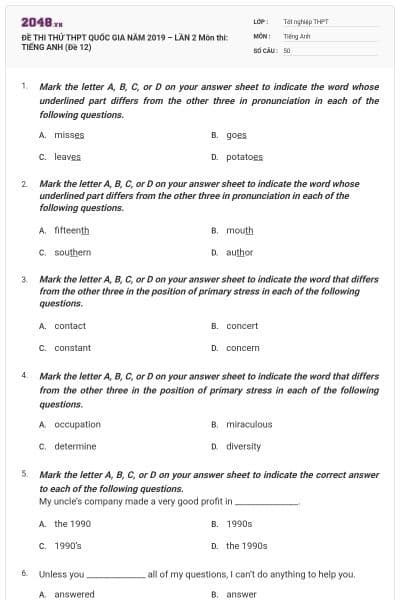
Mark the letter A, B, C, or D on your answer sheet to indicate the word whose underlined part differs from the other three in pronunciation in each of the following questions.
misses
goes
leaves
potatoes
Kiến thức: Phát âm “es”
Giải thích:
Cách phát âm “-s/es”:
Phát âm là /s/ khi tận cùng từ bằng -p, -k, -t, -f.
Phát âm là /iz/ khi tận cùng từ bằng -s,-ss,-ch,-sh,-x,-z,-o,-ge,-ce.
Phát âm là /z/ đối với những từ còn lại.
A. misses /mɪsiz/ B. goes /ɡəʊz/
C. leaves /liːvz/ D. potatoes /pəˈteɪtəʊz/
Phần gạch chân đáp án A phát âm là /iz/, còn lại là /z/.
Chọn A
Mark the letter A, B, C, or D on your answer sheet to indicate the word whose underlined part differs from the other three in pronunciation in each of the following questions.
fifteenth
mouth
southern
author
Kiến thức: Phát âm “th”
Giải thích:
A. fifteenth /ˌfɪfˈtiːnθ/ B. mouth /maʊθ/
C. southern /ˈsʌðən/ D. author /ˈɔːθə(r)/
Phần gạch chân đáp án C phát âm là /ð/, còn lại là /θ/.
Chọn C
Mark the letter A, B, C, or D on your answer sheet to indicate the word that differs from the other three in the position of primary stress in each of the following questions.
contact
concert
constant
concern
Kiến thức: Trọng âm từ có 2 âm tiết
Giải thích:
A. contact /ˈkɒntækt/ B. concert /ˈkɒnsət/
C. constant /ˈkɒnstənt/ D. concern /kənˈsɜːn/
Quy tắc: Danh từ, tính từ có 2 âm tiết trọng âm rơi vào âm tiết thứ nhất; động từ có 2 âm tiết trọng âm rơi vào âm tiết thứ hai.
Trọng âm đáp án D vào âm tiết thứ hai, còn lại vào âm tiết thứ nhất.
Chọn D
Mark the letter A, B, C, or D on your answer sheet to indicate the word that differs from the other three in the position of primary stress in each of the following questions.
occupation
miraculous
determine
diversity
Question 4. A
Kiến thức: Trọng âm từ có 3, 4 âm tiết
Giải thích:
A. occupation /ˌɒkjuˈpeɪʃn/ B. miraculous /mɪˈrækjələs/
C. determine /dɪˈtɜːmɪn/ D. diversity /daɪˈvɜːsəti/
Quy tắc: Từ có tận cùng là –tion, -ity trọng tâm rơi ngay âm trước nó.
Đáp án A trọng âm vào âm tiết thứ ba, còn lại vào âm tiết thứ hai.
Chọn A
Mark the letter A, B, C, or D on your answer sheet to indicate the correct answer to each of the following questions.
My uncle’s company made a very good profit in _______________.
the 1990
1990s
1990’s
the 1990s
Kiến thức: Từ vựng
Giải thích: in the 1990s: trong những năm 1990
Tạm dịch: Công ty của bác tôi đã đạt được lợi nhuận lớn vào những năm 1990.
Chọn D
Unless you ______________ all of my questions, I can’t do anything to help you.
answered
answer
don’t answer
are answering
Kiến thức: Câu điều kiện loại 1
Giải thích:
Câu điều kiện loại 1 diễn tả sự việc có thể xảy ra ở hiện tại hoặc tương lai.
Cấu trúc: If + S + V(hiện tại), S + will/ can (not) + V
Unless = If + S + do/ does not + V
Tạm dịch: Nếu bạn không thể trả lời tất cả câu hỏi của tôi, tôi không thể làm gì giúp bạn.
Chọn B
He _____________ a terrible accident while he _______________ along Ben Luc Bridge
see / am walking
saw / was walking
was seeing / walked
have seen / were walking
Đáp án: B
Giải thích:
Kiến thức: Sự kết hợp thì
Hành động đang diễn ra trong quá khứ (chia quá khứ tiếp diễn) thì có hành động khác cắt ngang (chia quá khứ đơn).
Hành động “see” cắt ngang hành động “walk”, vậy mệnh đề đầu chia quá khứ đơn, mệnh đề sau chia quá khứ tiếp diễn. Chọn B.
Dịch: Ông đã chứng kiến một vụ tai nạn kinh hoàng khi đang đi bộ dọc theo cầu Bến Lức.
We all felt cold, wet and hungry; _________________ , we were lost.
moreover
although
however
so that
Kiến thức: Liên từ
Giải thích:
A. moreover: hơn nữa B. although: mặc dù
C. however: tuy nhiên D. so that: vậy nên
Tạm dịch: Tất cả chúng ta đều thấy lạnh, ẩm ướt và đói; hơn nữa, chúng ta đã bị lạc.
Chọn A
The public are concerned _______________ the increasing crime rates in the city
with
at
about
for
Kiến thức: Giới từ
Giải thích: be concerned about: quan ngại về
Tạm dịch: Cộng đồng quan ngại về tỉ lệ gia tăng tội phạm ở trong thành phố.
Chọn C
Standing on top of the hill, ____________________.
people have seen a castle far away
lies a castle in the middle of the island
a castle can be seen from the distance
we can see a castle in the distance
Kiến thức: Câu rút gọn
Giải thích:
Câu đầy đủ: When we stand on top…
Đối với câu có 2 mệnh đề đồng chủ ngữ (we) , ta có thể lược bỏ bớt một mệnh đề. Trong câu trên, khi rút gọn, ta bỏ “when”, bỏ chủ ngữ “we”, động từ chuyển sang dạng Ving khi mệnh đề mang nghĩa chủ động.
Tạm dịch: Đứng ở trên đỉnh đồi, chúng ta có thể nhìn thấy lâu đài ở xa.
Chọn D
____________ one of the most beautiful forms of performance art, ballet is a combination of dance and mime performed to music
Being considering
Considering
Considered
To consider
Kiến thức: Câu rút gọn
Giải thích:
Câu đầy đủ: Ballet is considered one of the most beautiful forms of performance art...
Đối với câu có 2 mệnh đề đồng chủ ngữ, ta có thể lược bỏ bớt một mệnh đề. Trong câu trên, khi rút gọn, ta bỏ chủ ngữ “ballet” và động từ to be “is” giữ lại Ved/ V3 khi câu mang nghĩa bị động.
Tạm dịch: Được coi là một trong những dạng biểu diễn nghệ thuật đẹp nhất, múa bale là một sự kết hợp của nhảy và diễn kịch điệu bộ theo âm nhạc.
Chọn C
I was enjoying my book, but I stopped ______________________ a programme on TV.
reading to watch
to read to watch
to read for watching
reading for to watch
Kiến thức: Dạng của động từ
Giải thích:
stop + to V: dừng để làm một việc khác
stop + V-ing: dừng hẳn việc đang làm
to + V: để mà (chỉ mục đích)
=> stop reading: dừng đọc; to watch: để xem
Tạm dịch: Tôi đang thưởng thức cuốn sách, nhưng tôi đã dừng đọc để xem một chương trình trên TV.
Chọn A
The _______________ dressed woman in the advertisement has a posed smile on her face.
stylish
stylishly
stylistic
stylistically
Kiến thức: Từ loại
Giải thích:
A. stylish (adj): diện B. stylishly (adv): một cách ăn diện
C. stylistic (adj): thuộc văn phong D. stylistically (adv): theo văn phong
Trước tính từ “dressed” ta cần một trạng từ để bổ nghĩa.
=> stylishly- dressed (adj): ăn mặc có phong cách/ thời thượng
Tạm dịch: Người phụ nữ ăn mặc có phong cách trong quảng cáo nở một nụ cười.
Chọn B
Students can _________ a lot of information just by attending class and taking good notes of the lectures.
absorb
provide
transmit
read
Kiến thức: Từ vựng
Giải thích:
A. absorb (v): hấp thụ, tiếp thu B. provide (v): cung cấp
C. transmit (v): truyền D. read (v): đọc
Tạm dịch: Các học sinh có thể tiếp thu rất nhiều thông tin chỉ qua việc lên lớp và ghi chép bài giảng tốt.
Chọn A
Make sure you __________________ us a visit when you are in town again.
give
do
pay
have
Kiến thức: Cụm từ
Giải thích: pay sb a visit: ghé thăm ai
Tạm dịch: Hãy chắc chắn rằng bạn sẽ ghé thăm chúng tôi khi bạn trở về thị trấn lần nữa.
Chọn C
The play lasted two hours with a/an ________ of 15 minutes between part one and part two.
interval
pause
stop
interruption
Kiến thức: Từ vựng
Giải thích:
A. interval (n): lúc nghỉ B. pause (n): sự tạm ngừng
C. stop (n): sự dừng lại D. interruption (n): sự ngắt quãng
Tạm dịch: Trò chơi diễn ra 2 tiếng với 15 phút nghỉ giữa phần 1 và phần 2.
Chọn A
When he went to Egypt, he knew ______________ no Arabic, but within 6 months he had become extremely fluent.
entirely
barely
scarcely
virtually
Kiến thức: Từ vựng
Giải thích:
A. entirely (adv): toàn bộ B. barely (adv): hiếm khi
C. scarcely (adv): hiếm khi D. virtually (adv): hầu như, gần như
Tạm dịch: Khi anh ấy tới Ai Cập, anh ấy gần như không biết chút tiếng Ả Rập nào, nhưng chỉ trong vòng 6 tháng, anh ấy đã trở nên cực kì thành thạo.
Chọn D
___________________ are that stock price will go up in the coming months.
Conditions
Opportunities
Possibilities
Chances
Kiến thức: Từ vựng
Giải thích:
A. conditions (n): điều kiện B. opportunities (n): cơ hội
C. possibilities (n): khả năng D. chances (n): cơ hội
Tạm dịch: Giá cổ phiếu có khả năng tăng trong những tháng tới.
Chọn C
Mark the letter A, B, C, or D on your answer sheet to indicate the word(s) CLOSEST in meaning to the underlined word(s) in each of the following questions.
To absorb a younger workforce, many companies offered retirement plans as incentives for older workers to retire and make way for the young ones who earned lower salary.
rewards
opportunities
motives
encouragements
Kiến thức: Từ đồng nghĩa
Giải thích:
incentives (n): sự khích lệ, sự khuyến khích
A. rewards (n): phần thưởng B. opportunities (n): các cơ hội
C. motives (n): cớ, lí do D. encouragements (n): sự khích lệ, sự khuyến khích
=> incentives = encouragements
Tạm dịch: Để có lực lượng lao động trẻ hơn, nhiều công ty đã đưa ra kế hoạch nghỉ hưu như là những động lực cho người lao động lớn tuổi nghỉ hưu và nhường chỗ cho những người trẻ tuổi có mức lương thấp hơn.
Chọn D
Mark the letter A, B, C, or D on your answer sheet to indicate the word(s) CLOSEST in meaning to the underlined word(s) in each of the following questions.
How on earth could they do away with a lovely old building like that and put a car park there instead?
keep
destroy
decrease
upgrade
Kiến thức: Từ đồng nghĩa
Giải thích:
do away with: phá huỷ
A. keep (v): giữ B. destroy (v): phá huỷ
C. decrease (v): giảm D. upgrade (v): nâng cấp
=> do away with = destroy
Tạm dịch: Làm sao họ có thể phá huỷ một toà nhà cũ đáng yêu như thế để thay bằng một bãi đỗ xe?
Chọn B
Mark the letter A, B, C, or D on your answer sheet to indicate the word(s) OPPOSITE in meaning to the underlined word(s) in each of the following questions.
Most universities have trained counselors who can reassure and console students who have academic or personal problems.
satisfy
sympathize
please
discourage
Kiến thức: Từ trái nghĩa
Giải thích:
console (v): an ủi, giải khuây
A. satisfy (v): làm hài lòng B. sympathize (v): đồng cảm
C. please (v): làm hài lòng D. discourage (v): làm nản lòng
=> console >< discourage
Tạm dịch: Hầu hết các trường đại học đều có các cố vấn được đào tạo, những người có thể trấn an và an ủi những sinh viên gặp vấn đề về học tập hoặc cá nhân.
Chọn D
Mark the letter A, B, C, or D on your answer sheet to indicate the word(s) OPPOSITE in meaning to the underlined word(s) in each of the following questions.
I don’t know what they are going to ask in the job interview. I’ll just play it by ear.
plan well in advance
be careful about it
listen to others saying
do not plan beforehand
Kiến thức: Từ trái nghĩa
Giải thích:
play it by ear: làm việc gì đó mà không có kế hoạch rõ ràng, để mọi việc xảy ra theo lẽ tự nhiên
A. plan well in advance: lên kế hoạch rõ ràng trước
B. be careful about it: cẩn thận với nó
C. listen to others saying: nghe người khác nói
D. do not plan beforehand: không lên kế hoạch trước
=> play it by ear >< plan well in advance
Tạm dịch: Tôi không biết họ sẽ hỏi gì trong cuộc phỏng vấn. Tôi sẽ để mọi việc xảy ra theo lẽ tự nhiên.
Chọn A
Mark the letter A, B, C, or D on your answer sheet to indicate the most suitable response to complete each of the following exchanges.
Tom is apologizing to Peter for being late.
- Tom: “Sorry, I’m late, Peter. My car has broken down on the way here.”
- Peter: “___________________”
No, I wouldn’t mind at all.
Not on my account
That’s all right.
Well, it’s worth a try.
Kiến thức: Ngôn ngữ giao tiếp
Giải thích:
Tom đang xin lỗi Peter vì tới muộn
- Tom: “Xin lỗi tôi tới muộn, Peter. Xe của tôi bị hỏng trên đường tới đây”
- Peter: “ _____”
A. Không, tôi không bận tâm tí nào B. Không phải vấn đề của tôi
C. Không sao đâu D. Ừ, nó đáng thử
Chọn C
Mark the letter A, B, C, or D on your answer sheet to indicate the most suitable response to complete each of the following exchanges.
Two friends, Peter and Linda, are talking about pets.
- Peter: “Well, cats are very good at catching mice around the house”
- Linda: “___________________”
Nothing more to say
You can say that again
Yes, I hope so
No, dogs are good, too.
Kiến thức: Ngôn ngữ giao tiếp
Giải thích:
Hai người bạn, Peter và Linda, đang nói về thú nuôi.
- Peter: “Lũ mèo rất giỏi bắt chuột quanh nhà”
- Linda: “_____”
A. Không còn gì để nói B. Tôi hoàn toàn đồng ý
C. Ừ, tôi mong là vậy D. Không, những con chó cũng tốt
Chọn B
Read the following passage and mark the letter A, B, C, or D on your answer sheet to indicate the correct word or phrase that best fits each of the numbered blanks.
The invention of the mobile phone has undoubtedly revolutionized the way people communicate and influenced every aspect of our lives. The issue is whether this technological innovation has (25) ______ more harm than good. In order to answer the question, we must first turn to the types of consumers. Presumably, most parents (26) ______ are always worrying about their children’s safety buy mobile phones for them to track their whereabouts. We can also assume that most teenagers want mobile phones to avoid missing out on social contact. In this context, the advantages are clear. (27) ________, we cannot deny the fact that text messages have been used by bullies to intimidate fellow students. There is also (28) ________ evidence that texting has affected literacy skills.
The widespread use of mobile phone has, out of question, affected adult consumers too. What employee, on the way home from work, would be reluctant to answer a call from their boss? Apparently, only 18% of us, according to a survey, are willing to switch off our mobile phones once we've left the office.
Admittedly, mobile phones can be intrusive but there are obvious benefits to possessing one. Personally speaking, they are invaluable when it comes to making social or business arrangements at short (29) _______. They also provide their owners with a sense of security in emergency situations.
Điền ô số 25
done
played
made
brought
Kiến thức: Cụm từ
Giải thích:
do harm: gây hại
The issue is whether this technological innovation has (25) done more harm than good.
Tạm dịch: Vấn đề là liệu sự đổi mới công nghệ này gây hại nhiều hơn hay là tốt hơn.
Chọn A
Read the following passage and mark the letter A, B, C, or D on your answer sheet to indicate the correct word or phrase that best fits each of the numbered blanks.
The invention of the mobile phone has undoubtedly revolutionized the way people communicate and influenced every aspect of our lives. The issue is whether this technological innovation has (25) ______ more harm than good. In order to answer the question, we must first turn to the types of consumers. Presumably, most parents (26) ______ are always worrying about their children’s safety buy mobile phones for them to track their whereabouts. We can also assume that most teenagers want mobile phones to avoid missing out on social contact. In this context, the advantages are clear. (27) ________, we cannot deny the fact that text messages have been used by bullies to intimidate fellow students. There is also (28) ________ evidence that texting has affected literacy skills.
The widespread use of mobile phone has, out of question, affected adult consumers too. What employee, on the way home from work, would be reluctant to answer a call from their boss? Apparently, only 18% of us, according to a survey, are willing to switch off our mobile phones once we've left the office.
Admittedly, mobile phones can be intrusive but there are obvious benefits to possessing one. Personally speaking, they are invaluable when it comes to making social or business arrangements at short (29) _______. They also provide their owners with a sense of security in emergency situations.
Điền ô số 26
which
whom
who
what
Kiến thức: Mệnh đề quan hệ
Giải thích:
Trong mệnh đề quan hệ, khi muốn thay danh từ chỉ người ở vị trí chủ ngữ (parents), ta sử dụng “who”.
Presumably, most parents (26) who are always worrying about their children’s safety buy mobile phones for them to track their whereabouts.
Tạm dịch: Có lẽ, hầu hết các bậc cha mẹ mà luôn lo lắng về sự an toàn của con cái thì mua điện thoại di động để theo dõi nơi ở của chúng.
Chọn C
Read the following passage and mark the letter A, B, C, or D on your answer sheet to indicate the correct word or phrase that best fits each of the numbered blanks.
The invention of the mobile phone has undoubtedly revolutionized the way people communicate and influenced every aspect of our lives. The issue is whether this technological innovation has (25) ______ more harm than good. In order to answer the question, we must first turn to the types of consumers. Presumably, most parents (26) ______ are always worrying about their children’s safety buy mobile phones for them to track their whereabouts. We can also assume that most teenagers want mobile phones to avoid missing out on social contact. In this context, the advantages are clear. (27) ________, we cannot deny the fact that text messages have been used by bullies to intimidate fellow students. There is also (28) ________ evidence that texting has affected literacy skills.
The widespread use of mobile phone has, out of question, affected adult consumers too. What employee, on the way home from work, would be reluctant to answer a call from their boss? Apparently, only 18% of us, according to a survey, are willing to switch off our mobile phones once we've left the office.
Admittedly, mobile phones can be intrusive but there are obvious benefits to possessing one. Personally speaking, they are invaluable when it comes to making social or business arrangements at short (29) _______. They also provide their owners with a sense of security in emergency situations.
Điền ô số 27
Moreover
However
Therefore
So that
Kiến thức: Liên từ
Giải thích:
A. Moreover: hơn nữa B. However: tuy nhiên
C. Therefore: vậy nên D. So that: vậy nên
(27) However, we cannot deny the fact that text messages have been used by bullies to intimidate fellow students.
Tạm dịch: Tuy nhiên, chúng ta không thể phủ nhận thực tế là tin nhắn văn bản đã bị những kẻ bắt nạt sử dụng để đe dọa các học sinh.
Chọn B
Read the following passage and mark the letter A, B, C, or D on your answer sheet to indicate the correct word or phrase that best fits each of the numbered blanks.
The invention of the mobile phone has undoubtedly revolutionized the way people communicate and influenced every aspect of our lives. The issue is whether this technological innovation has (25) ______ more harm than good. In order to answer the question, we must first turn to the types of consumers. Presumably, most parents (26) ______ are always worrying about their children’s safety buy mobile phones for them to track their whereabouts. We can also assume that most teenagers want mobile phones to avoid missing out on social contact. In this context, the advantages are clear. (27) ________, we cannot deny the fact that text messages have been used by bullies to intimidate fellow students. There is also (28) ________ evidence that texting has affected literacy skills.
The widespread use of mobile phone has, out of question, affected adult consumers too. What employee, on the way home from work, would be reluctant to answer a call from their boss? Apparently, only 18% of us, according to a survey, are willing to switch off our mobile phones once we've left the office.
Admittedly, mobile phones can be intrusive but there are obvious benefits to possessing one. Personally speaking, they are invaluable when it comes to making social or business arrangements at short (29) _______. They also provide their owners with a sense of security in emergency situations.
Điền ô số 28
indisputable
arguable
doubtless
unhesitating
Kiến thức: Từ vựng
Giải thích:
A. indisputable (adj): không thể chối cãi B. arguable (adj): gây tranh cãi
C. doubtless (adj): không nghi ngờ D. unhesitating (adj): không ngần ngại
There is also (28) indisputable evidence that texting has affected literacy skills.
Tạm dịch: Ngoài ra còn có bằng chứng không thể chối cãi rằng nhắn tin đã ảnh hưởng đến kỹ năng đọc viết.
Chọn A
Read the following passage and mark the letter A, B, C, or D on your answer sheet to indicate the correct word or phrase that best fits each of the numbered blanks.
The invention of the mobile phone has undoubtedly revolutionized the way people communicate and influenced every aspect of our lives. The issue is whether this technological innovation has (25) ______ more harm than good. In order to answer the question, we must first turn to the types of consumers. Presumably, most parents (26) ______ are always worrying about their children’s safety buy mobile phones for them to track their whereabouts. We can also assume that most teenagers want mobile phones to avoid missing out on social contact. In this context, the advantages are clear. (27) ________, we cannot deny the fact that text messages have been used by bullies to intimidate fellow students. There is also (28) ________ evidence that texting has affected literacy skills.
The widespread use of mobile phone has, out of question, affected adult consumers too. What employee, on the way home from work, would be reluctant to answer a call from their boss? Apparently, only 18% of us, according to a survey, are willing to switch off our mobile phones once we've left the office.
Admittedly, mobile phones can be intrusive but there are obvious benefits to possessing one. Personally speaking, they are invaluable when it comes to making social or business arrangements at short (29) _______. They also provide their owners with a sense of security in emergency situations.
Điền ô số 29
time
warning
term
notice
Kiến thức: Cụm từ
Giải thích:
at short notice: trong một thời gian ngắn
Personally speaking, they are invaluable when it comes to making social or business arrangements at short (29) notice.
Tạm dịch: Nói một cách cá nhân, họ là vô giá khi nói đến việc sắp xếp xã hội hoặc kinh doanh trong thời gian ngắn.
Chọn D
Dịch bài đọc:
Phát minh của điện thoại di động chắc chắn đã cách mạng hóa cách mọi người giao tiếp và ảnh hưởng đến mọi khía cạnh của cuộc sống của chúng ta. Vấn đề là liệu sự đổi mới công nghệ này đã làm hại nhiều hơn hay là tốt hơn. Để trả lời câu hỏi, trước tiên chúng ta phải chuyển sang các kiểu người tiêu dùng. Có lẽ, hầu hết các bậc cha mẹ luôn lo lắng về sự an toàn của con cái họ mua điện thoại di động để theo dõi nơi ở của chúng. Chúng ta cũng có thể cho rằng hầu hết thanh thiếu niên muốn điện thoại di động để tránh bỏ lỡ liên lạc xã hội. Trong bối cảnh này, những lợi thế là rõ ràng. Tuy nhiên, chúng ta không thể phủ nhận thực tế là tin nhắn văn bản đã bị những kẻ bắt nạt sử dụng để đe dọa các học sinh. Ngoài ra còn có bằng chứng không thể chối cãi rằng nhắn tin đã ảnh hưởng đến kỹ năng đọc viết.
Việc sử dụng rộng rãi điện thoại di động, không còn nghi ngờ gì nữa, cũng ảnh hưởng đến người tiêu dùng trưởng thành. Nhân viên nào, trên đường đi làm về, sẽ miễn cưỡng trả lời cuộc gọi từ sếp của họ? Rõ ràng, chỉ có 18% chúng ta, theo một cuộc khảo sát, sẵn sàng tắt điện thoại di động của chúng ta sau khi chúng ta rời văn phòng.
Phải thừa nhận rằng, điện thoại di động có thể xâm nhập nhưng có những lợi ích rõ ràng khi sở hữu nó. Nói một cách cá nhân, họ là vô giá khi nói đến việc sắp xếp xã hội hoặc kinh doanh trong thời gian ngắn. Chúng cũng cung cấp cho chủ sở hữu của một cảm giác an toàn trong các tình huống khẩn cấp.
Read the following passage and mark the letter A, B, C, or D on your answer sheet to indicate the correct answer to each of the questions.
In Africa, people celebrate with joy the birth of a new baby. The Pygmies would sing a birth-song to the child. In Kenya, the mother takes the baby strapped to her back into the thorn enclosure where the cattle are kept. There, her husband and the village elders wait to give the child his or her name.
In West Africa, after the baby is eight days old, the mother takes the baby for its first walk in the big, wide world, and friends and family are invited to meet the new baby. In various African nations, they hold initiation ceremonies for groups of children instead of birthdays. When children reach a certain designated age, they learn the laws, beliefs, customs, songs and dances of their tribes. Some African tribes consider that children from nine to twelve are ready to be initiated into the grown up world. They may have to carry out several tests.
Maasai boys around thirteen years old to seventeen undergo a two-stage initiation. The first stage lasts about three months. The boys leave their parents' homes, paint their bodies white, and are taught how to become young warriors. At the end of this stage, they have their heads shaved and they are also circumcised. At the second stage, the young warriors grow their hair long and live in a camp called a “manyatta” where they practice hunting the wild animals that might attack the Maasai herds. This stage may last a few years. When they are ready, they will marry and become owners of large cattle herds like their fathers. The girls are initiated when they are fourteen or fifteen. They are taught by the older women about the duties of marriage and how to care for babies. Soon after that they are married and lead a life similar to that of their mothers.
What does the passage mainly discuss?
Celebrations in Africa
Birthday ceremonies for children in Africa
Traditions of Maasai people when having a new baby
Activities in a birth celebration
Kiến thức: Đọc hiểu
Giải thích:
Đoạn văn chủ yếu thảo luận về vấn đề gì?
A. Lễ kỷ niệm ở Châu Phi.
B. Nghi lễ sinh nhật cho trẻ em ở Châu Phi.
C. Truyền thống của người Maasai khi có con mới.
D. Các hoạt động trong một lễ kỷ niệm sinh nhật.
Chọn B
Read the following passage and mark the letter A, B, C, or D on your answer sheet to indicate the correct answer to each of the questions.
In Africa, people celebrate with joy the birth of a new baby. The Pygmies would sing a birth-song to the child. In Kenya, the mother takes the baby strapped to her back into the thorn enclosure where the cattle are kept. There, her husband and the village elders wait to give the child his or her name.
In West Africa, after the baby is eight days old, the mother takes the baby for its first walk in the big, wide world, and friends and family are invited to meet the new baby. In various African nations, they hold initiation ceremonies for groups of children instead of birthdays. When children reach a certain designated age, they learn the laws, beliefs, customs, songs and dances of their tribes. Some African tribes consider that children from nine to twelve are ready to be initiated into the grown up world. They may have to carry out several tests.
Maasai boys around thirteen years old to seventeen undergo a two-stage initiation. The first stage lasts about three months. The boys leave their parents' homes, paint their bodies white, and are taught how to become young warriors. At the end of this stage, they have their heads shaved and they are also circumcised. At the second stage, the young warriors grow their hair long and live in a camp called a “manyatta” where they practice hunting the wild animals that might attack the Maasai herds. This stage may last a few years. When they are ready, they will marry and become owners of large cattle herds like their fathers. The girls are initiated when they are fourteen or fifteen. They are taught by the older women about the duties of marriage and how to care for babies. Soon after that they are married and lead a life similar to that of their mothers.
Where do people in Kenya give the name to the child?
at the village church
on the cattle farm
at their house
near the thorn fence
Kiến thức: Đọc hiểu
Giải thích:
Người dân ở Kenya đặt tên cho đứa trẻ ở đâu?
A. tại nhà thờ làng B. trên trang trại gia súc
C. ở nhà họ D. gần hàng rào gai
Thông tin: In Kenya, the mother takes the baby strapped to her back into the thorn enclosure where the cattle are kept. There, her husband and the village elders wait to give the child his or her name.
Tạm dịch: Ở Kenya, người mẹ đưa em bé bị trói vào lưng vào chuồng gai nơi nuôi gia súc. Ở đó, chồng cô và những người lớn tuổi trong làng chờ đợi để đặt cho đứa trẻ tên của mình.
Chọn B
Read the following passage and mark the letter A, B, C, or D on your answer sheet to indicate the correct answer to each of the questions.
In Africa, people celebrate with joy the birth of a new baby. The Pygmies would sing a birth-song to the child. In Kenya, the mother takes the baby strapped to her back into the thorn enclosure where the cattle are kept. There, her husband and the village elders wait to give the child his or her name.
In West Africa, after the baby is eight days old, the mother takes the baby for its first walk in the big, wide world, and friends and family are invited to meet the new baby. In various African nations, they hold initiation ceremonies for groups of children instead of birthdays. When children reach a certain designated age, they learn the laws, beliefs, customs, songs and dances of their tribes. Some African tribes consider that children from nine to twelve are ready to be initiated into the grown up world. They may have to carry out several tests.
Maasai boys around thirteen years old to seventeen undergo a two-stage initiation. The first stage lasts about three months. The boys leave their parents' homes, paint their bodies white, and are taught how to become young warriors. At the end of this stage, they have their heads shaved and they are also circumcised. At the second stage, the young warriors grow their hair long and live in a camp called a “manyatta” where they practice hunting the wild animals that might attack the Maasai herds. This stage may last a few years. When they are ready, they will marry and become owners of large cattle herds like their fathers. The girls are initiated when they are fourteen or fifteen. They are taught by the older women about the duties of marriage and how to care for babies. Soon after that they are married and lead a life similar to that of their mothers.
Which of the following is NOT mentioned in paragraph 2?
An eight-day-old child will be taken for the first walk by his or her mother
Children have to learn their tribes' cultures and traditions when they are old enough.
Children are initiated for a mature life in the presence of their friends and family
Children have to overcome a few trials to enter the grown-up world.
Kiến thức: Đọc hiểu
Giải thích:
Điều nào sau đây KHÔNG được đề cập trong đoạn 2?
A. Một đứa trẻ tám ngày tuổi sẽ được mẹ đưa đi dạo đầu tiên.
B. Trẻ em phải học văn hóa và truyền thống của bộ tộc khi đủ tuổi.
C. Trẻ em được bắt đầu cho một cuộc sống trưởng thành với sự có mặt của bạn bè và gia đình của họ.
D. Trẻ em phải vượt qua một vài thử thách để bước vào thế giới trưởng thành.
Chọn C
Read the following passage and mark the letter A, B, C, or D on your answer sheet to indicate the correct answer to each of the questions.
In Africa, people celebrate with joy the birth of a new baby. The Pygmies would sing a birth-song to the child. In Kenya, the mother takes the baby strapped to her back into the thorn enclosure where the cattle are kept. There, her husband and the village elders wait to give the child his or her name.
In West Africa, after the baby is eight days old, the mother takes the baby for its first walk in the big, wide world, and friends and family are invited to meet the new baby. In various African nations, they hold initiation ceremonies for groups of children instead of birthdays. When children reach a certain designated age, they learn the laws, beliefs, customs, songs and dances of their tribes. Some African tribes consider that children from nine to twelve are ready to be initiated into the grown up world. They may have to carry out several tests.
Maasai boys around thirteen years old to seventeen undergo a two-stage initiation. The first stage lasts about three months. The boys leave their parents' homes, paint their bodies white, and are taught how to become young warriors. At the end of this stage, they have their heads shaved and they are also circumcised. At the second stage, the young warriors grow their hair long and live in a camp called a “manyatta” where they practice hunting the wild animals that might attack the Maasai herds. This stage may last a few years. When they are ready, they will marry and become owners of large cattle herds like their fathers. The girls are initiated when they are fourteen or fifteen. They are taught by the older women about the duties of marriage and how to care for babies. Soon after that they are married and lead a life similar to that of their mothers.
The word "undergo" in paragraph 3 is closest in meaning to ______________.
commence
experience
participate in
explore
Kiến thức: Đọc hiểu
Giải thích:
Từ “undergo” ở đoạn 3 gần nghĩa nhất với?
A. bắt đầu B. kinh nghiệm C. tham gia D. khám phá
Thông tin: Maasai boys around thirteen years old to seventeen undergo a two-stage initiation.
Tạm dịch: Các cậu bé Maasai khoảng mười ba tuổi đến mười bảy tuổi trải qua một sự khởi đầu với hai giai đoạn.
Chọn B
Read the following passage and mark the letter A, B, C, or D on your answer sheet to indicate the correct answer to each of the questions.
In Africa, people celebrate with joy the birth of a new baby. The Pygmies would sing a birth-song to the child. In Kenya, the mother takes the baby strapped to her back into the thorn enclosure where the cattle are kept. There, her husband and the village elders wait to give the child his or her name.
In West Africa, after the baby is eight days old, the mother takes the baby for its first walk in the big, wide world, and friends and family are invited to meet the new baby. In various African nations, they hold initiation ceremonies for groups of children instead of birthdays. When children reach a certain designated age, they learn the laws, beliefs, customs, songs and dances of their tribes. Some African tribes consider that children from nine to twelve are ready to be initiated into the grown up world. They may have to carry out several tests.
Maasai boys around thirteen years old to seventeen undergo a two-stage initiation. The first stage lasts about three months. The boys leave their parents' homes, paint their bodies white, and are taught how to become young warriors. At the end of this stage, they have their heads shaved and they are also circumcised. At the second stage, the young warriors grow their hair long and live in a camp called a “manyatta” where they practice hunting the wild animals that might attack the Maasai herds. This stage may last a few years. When they are ready, they will marry and become owners of large cattle herds like their fathers. The girls are initiated when they are fourteen or fifteen. They are taught by the older women about the duties of marriage and how to care for babies. Soon after that they are married and lead a life similar to that of their mothers.
What does the word "they" in paragraph 3 refer to?
the Maasai herds
the wild animals
the young warriors
the cattle owners
Kiến thức: Đọc hiểu
Giải thích:
Từ “they” ở đoạn 3 nói tới ai?
A. đàn Maasai B. động vật hoang dã C. chiến binh trẻ D. chủ gia súc
Thông tin: When they are ready, they will marry and become owners of large cattle herds like their fathers.
Tạm dịch: Khi họ sẵn sàng, họ sẽ kết hôn và trở thành chủ sở hữu của những đàn gia súc lớn như cha của họ.
Chọn C
Dịch bài đọc:
Ở châu Phi, mọi người ăn mừng với sự vui mừng khi sinh em bé mới. Người Pygmies sẽ hát một bài hát sinh nhật cho đứa trẻ. Ở Kenya, người mẹ đưa em bé bị buộc trên lưng vào chuồng gai nơi nuôi gia súc. Ở đó, chồng cô và những người lớn tuổi trong làng chờ đợi để đặt cho đứa trẻ tên của mình.
Ở Tây Phi, sau khi em bé được tám ngày tuổi, người mẹ đưa em bé đi dạo đầu tiên trong thế giới rộng lớn, và bạn bè và gia đình được mời đến gặp em bé mới. Ở nhiều quốc gia châu Phi khác nhau, họ tổ chức các buổi lễ khởi đầu cho các nhóm trẻ em thay vì sinh nhật. Khi trẻ em đến một độ tuổi nhất định, chúng học luật, tín ngưỡng, phong tục, bài hát và điệu nhảy của bộ lạc. Một số bộ lạc châu Phi cho rằng trẻ em từ chín đến mười hai tuổi đã sẵn sàng để được bắt đầu vào thế giới trưởng thành. Họ có thể phải thực hiện một số thử nghiệm.
Các cậu bé Maasai khoảng mười ba tuổi đến mười bảy tuổi trải qua một sự bắt đầu gồm hai giai đoạn. Giai đoạn đầu tiên kéo dài khoảng ba tháng. Các cậu bé rời khỏi nhà của cha mẹ, sơn trắng cơ thể và được dạy cách trở thành những chiến binh trẻ. Vào cuối giai đoạn này, họ đã cạo đầu và họ cũng được cắt bao quy đầu. Ở giai đoạn thứ hai, các chiến binh trẻ mọc tóc dài và sống trong một trại có tên là rất nhiều người, nơi họ thực hành săn bắn những động vật hoang dã có thể tấn công đàn Maasai. Giai đoạn này có thể kéo dài một vài năm. Khi họ sẵn sàng, họ sẽ kết hôn và trở thành chủ sở hữu của những đàn gia súc lớn như cha của họ. Các cô gái được bắt đầu khi họ mười bốn hoặc mười lăm. Chúng được dạy bởi những người phụ nữ lớn tuổi về nhiệm vụ của hôn nhân và cách chăm sóc em bé. Không lâu sau đó, họ kết hôn và có một cuộc sống tương tự như mẹ của họ.
Read the following passage and mark the letter A, B, C, or D on your answer sheet to indicate the correct answer to each of the questions.
What picture do you have of the future? Will life in the future be better, worse or the same as now? What do you hope about the future?
Futurologists predict that life will probably be very different in 2050 in all the fields, from entertainment to technology. First of all, it seems that TV channels will have disappeared. Instead, people will choose a program from a 'menu' and a computer will send the program directly to the television. Today, we can use the World Wide Web to read newspaper stories and see pictures on a computer thousands of kilometers away. By 2050, music, films, programs, newspapers and books will come to us by computer.
In what concerns the environment, water will have become one of our most serious problems. In many places, agriculture is changing and farmers are growing fruit and vegetables to export. This uses a lot of water. Demand for water will increase ten times between now and 2050 and there could be serious shortages. Some futurologists predict that water could be the cause of war if we don't act now.
In transport, cars running on new, clean fuels will have computers to control the speed and there won't be any accidents. Today, many cars have computers that tell drivers exactly where they are. By 2050, the computer will control the car and drive it to your destination. On the other hand, space planes will take people halfway around the world in two hours. Nowadays, the United States Shuttle can go into space and land on Earth again. By 2050, space planes will fly all over the world and people will fly from Los Angeles to Tokyo in just two hours.
In the domain of technology, robots will have replaced people in factories. Many factories already use robots. Big companies prefer robots - they do not ask for pay rises or go on strike, and they work 24 hours a day. By 2050, we will see robots everywhere - in factories, schools, offices, hospitals, shops and homes.
Last but not least, medicine technology will have conquered many diseases. Today, there are electronic devices that connect directly to the brain to help people hear. By 2050, we will be able to help blind and deaf people see and hear again. Scientists have discovered how to control genes. They have already produced clones of animals. By 2050, scientists will be able to produce clones of people and decide how they look, how they behave and how much intelligence they have.
The passage mainly discusses ________________.
the effect of the futurologists' prediction on our lives
the effect of telecommunication on our future life
the changes in our future life compared with our life today
the importance of cloning in the future
Kiến thức: Đọc hiểu
Giải thích:
Đoạn văn chủ yếu thảo luận về ______________.
A. Ảnh hưởng của dự đoán của các nhà tương lai học đến cuộc sống của chúng ta.
B. Ảnh hưởng của viễn thông đến cuộc sống tương lai của chúng ta.
C. Những thay đổi trong cuộc sống tương lai của chúng ta so với cuộc sống của chúng ta ngày nay.
D. Tầm quan trọng của nhân bản trong tương lai.
Chọn C
Read the following passage and mark the letter A, B, C, or D on your answer sheet to indicate the correct answer to each of the questions.
What picture do you have of the future? Will life in the future be better, worse or the same as now? What do you hope about the future?
Futurologists predict that life will probably be very different in 2050 in all the fields, from entertainment to technology. First of all, it seems that TV channels will have disappeared. Instead, people will choose a program from a 'menu' and a computer will send the program directly to the television. Today, we can use the World Wide Web to read newspaper stories and see pictures on a computer thousands of kilometers away. By 2050, music, films, programs, newspapers and books will come to us by computer.
In what concerns the environment, water will have become one of our most serious problems. In many places, agriculture is changing and farmers are growing fruit and vegetables to export. This uses a lot of water. Demand for water will increase ten times between now and 2050 and there could be serious shortages. Some futurologists predict that water could be the cause of war if we don't act now.
In transport, cars running on new, clean fuels will have computers to control the speed and there won't be any accidents. Today, many cars have computers that tell drivers exactly where they are. By 2050, the computer will control the car and drive it to your destination. On the other hand, space planes will take people halfway around the world in two hours. Nowadays, the United States Shuttle can go into space and land on Earth again. By 2050, space planes will fly all over the world and people will fly from Los Angeles to Tokyo in just two hours.
In the domain of technology, robots will have replaced people in factories. Many factories already use robots. Big companies prefer robots - they do not ask for pay rises or go on strike, and they work 24 hours a day. By 2050, we will see robots everywhere - in factories, schools, offices, hospitals, shops and homes.
Last but not least, medicine technology will have conquered many diseases. Today, there are electronic devices that connect directly to the brain to help people hear. By 2050, we will be able to help blind and deaf people see and hear again. Scientists have discovered how to control genes. They have already produced clones of animals. By 2050, scientists will be able to produce clones of people and decide how they look, how they behave and how much intelligence they have.
What can be inferred about the life in 2050 according to the passage?
Life in 2050 will be much better than that of today
TV will be an indispensable means of communication and business.
People will not suffer from the shortage of water due to the polar melting.
The deaf will not have to depend any longer on the electronic hearing devices
Kiến thức: Đọc hiểu
Giải thích:
Điều gì có thể được suy luận về cuộc sống vào năm 2050 theo đoạn văn?
A. Cuộc sống vào năm 2050 sẽ tốt hơn nhiều so với ngày nay.
B. TV sẽ là một phương tiện truyền thông và kinh doanh không thể thiếu.
C. Mọi người sẽ không bị thiếu nước bởi vì sự tan chảy băng.
D. Người điếc sẽ không phải phụ thuộc lâu hơn vào các thiết bị trợ thính điện tử.
Thông tin: By 2050, we will be able to help blind and deaf people see and hear again.
Tạm dịch: Đến năm 2050, chúng ta sẽ có thể giúp những người mù và điếc nhìn và nghe lại.
Chọn D
Read the following passage and mark the letter A, B, C, or D on your answer sheet to indicate the correct answer to each of the questions.
What picture do you have of the future? Will life in the future be better, worse or the same as now? What do you hope about the future?
Futurologists predict that life will probably be very different in 2050 in all the fields, from entertainment to technology. First of all, it seems that TV channels will have disappeared. Instead, people will choose a program from a 'menu' and a computer will send the program directly to the television. Today, we can use the World Wide Web to read newspaper stories and see pictures on a computer thousands of kilometers away. By 2050, music, films, programs, newspapers and books will come to us by computer.
In what concerns the environment, water will have become one of our most serious problems. In many places, agriculture is changing and farmers are growing fruit and vegetables to export. This uses a lot of water. Demand for water will increase ten times between now and 2050 and there could be serious shortages. Some futurologists predict that water could be the cause of war if we don't act now.
In transport, cars running on new, clean fuels will have computers to control the speed and there won't be any accidents. Today, many cars have computers that tell drivers exactly where they are. By 2050, the computer will control the car and drive it to your destination. On the other hand, space planes will take people halfway around the world in two hours. Nowadays, the United States Shuttle can go into space and land on Earth again. By 2050, space planes will fly all over the world and people will fly from Los Angeles to Tokyo in just two hours.
In the domain of technology, robots will have replaced people in factories. Many factories already use robots. Big companies prefer robots - they do not ask for pay rises or go on strike, and they work 24 hours a day. By 2050, we will see robots everywhere - in factories, schools, offices, hospitals, shops and homes.
Last but not least, medicine technology will have conquered many diseases. Today, there are electronic devices that connect directly to the brain to help people hear. By 2050, we will be able to help blind and deaf people see and hear again. Scientists have discovered how to control genes. They have already produced clones of animals. By 2050, scientists will be able to produce clones of people and decide how they look, how they behave and how much intelligence they have.
We can conclude from the passage that in 2050 ________________.
people will be able to travel around the world in two hours
fewer cars will be used to keep the environment green and clean
no one will be injured or die because of accidents
space planes will take the place of cars as a means of transport
Kiến thức: Đọc hiểu
Giải thích:
Chúng ta có thể kết luận từ đoạn văn đó vào năm 2050 ______________.
A. Mọi người sẽ có thể đi du lịch vòng quanh thế giới trong hai giờ.
B. Ít xe sẽ được sử dụng để giữ cho môi trường xanh và sạch.
C. Không ai sẽ bị thương hoặc chết vì tai nạn.
D. Máy bay không gian sẽ lấy ô tô làm phương tiện vận chuyển.
Thông tin: In transport, cars running on new, clean fuels will have computers to control the speed and there won't be any accidents.
Tạm dịch: Trong vận chuyển, ô tô chạy bằng nhiên liệu mới, sạch sẽ có máy tính để kiểm soát tốc độ và sẽ không có tai nạn.
Chọn C
Read the following passage and mark the letter A, B, C, or D on your answer sheet to indicate the correct answer to each of the questions.
What picture do you have of the future? Will life in the future be better, worse or the same as now? What do you hope about the future?
Futurologists predict that life will probably be very different in 2050 in all the fields, from entertainment to technology. First of all, it seems that TV channels will have disappeared. Instead, people will choose a program from a 'menu' and a computer will send the program directly to the television. Today, we can use the World Wide Web to read newspaper stories and see pictures on a computer thousands of kilometers away. By 2050, music, films, programs, newspapers and books will come to us by computer.
In what concerns the environment, water will have become one of our most serious problems. In many places, agriculture is changing and farmers are growing fruit and vegetables to export. This uses a lot of water. Demand for water will increase ten times between now and 2050 and there could be serious shortages. Some futurologists predict that water could be the cause of war if we don't act now.
In transport, cars running on new, clean fuels will have computers to control the speed and there won't be any accidents. Today, many cars have computers that tell drivers exactly where they are. By 2050, the computer will control the car and drive it to your destination. On the other hand, space planes will take people halfway around the world in two hours. Nowadays, the United States Shuttle can go into space and land on Earth again. By 2050, space planes will fly all over the world and people will fly from Los Angeles to Tokyo in just two hours.
In the domain of technology, robots will have replaced people in factories. Many factories already use robots. Big companies prefer robots - they do not ask for pay rises or go on strike, and they work 24 hours a day. By 2050, we will see robots everywhere - in factories, schools, offices, hospitals, shops and homes.
Last but not least, medicine technology will have conquered many diseases. Today, there are electronic devices that connect directly to the brain to help people hear. By 2050, we will be able to help blind and deaf people see and hear again. Scientists have discovered how to control genes. They have already produced clones of animals. By 2050, scientists will be able to produce clones of people and decide how they look, how they behave and how much intelligence they have.
The word "This" in paragraph 3 refers to __________________.
the possible war
the cash crop planting
the serious shortage
the demand for water
Kiến thức: Đọc hiểu
Giải thích:
Từ “this” ở đoạn 3 nói tới?
A. chiến tranh có thể xảy ra B. trồng hoa màu
C. sự thiếu hụt nghiêm trọng D. nhu cầu về nước
Chọn B
Read the following passage and mark the letter A, B, C, or D on your answer sheet to indicate the correct answer to each of the questions.
What picture do you have of the future? Will life in the future be better, worse or the same as now? What do you hope about the future?
Futurologists predict that life will probably be very different in 2050 in all the fields, from entertainment to technology. First of all, it seems that TV channels will have disappeared. Instead, people will choose a program from a 'menu' and a computer will send the program directly to the television. Today, we can use the World Wide Web to read newspaper stories and see pictures on a computer thousands of kilometers away. By 2050, music, films, programs, newspapers and books will come to us by computer.
In what concerns the environment, water will have become one of our most serious problems. In many places, agriculture is changing and farmers are growing fruit and vegetables to export. This uses a lot of water. Demand for water will increase ten times between now and 2050 and there could be serious shortages. Some futurologists predict that water could be the cause of war if we don't act now.
In transport, cars running on new, clean fuels will have computers to control the speed and there won't be any accidents. Today, many cars have computers that tell drivers exactly where they are. By 2050, the computer will control the car and drive it to your destination. On the other hand, space planes will take people halfway around the world in two hours. Nowadays, the United States Shuttle can go into space and land on Earth again. By 2050, space planes will fly all over the world and people will fly from Los Angeles to Tokyo in just two hours.
In the domain of technology, robots will have replaced people in factories. Many factories already use robots. Big companies prefer robots - they do not ask for pay rises or go on strike, and they work 24 hours a day. By 2050, we will see robots everywhere - in factories, schools, offices, hospitals, shops and homes.
Last but not least, medicine technology will have conquered many diseases. Today, there are electronic devices that connect directly to the brain to help people hear. By 2050, we will be able to help blind and deaf people see and hear again. Scientists have discovered how to control genes. They have already produced clones of animals. By 2050, scientists will be able to produce clones of people and decide how they look, how they behave and how much intelligence they have.
What is the author's attitude in paragraph 3?
concerned
explanatory
outraged
emotional
Kiến thức: Đọc hiểu
Giải thích:
Thái độ của tác giả trong đoạn 3 là gì?
A. quan tâm B. giải thích C. xúc phạm D. tình cảm
Chọn A
Read the following passage and mark the letter A, B, C, or D on your answer sheet to indicate the correct answer to each of the questions.
What picture do you have of the future? Will life in the future be better, worse or the same as now? What do you hope about the future?
Futurologists predict that life will probably be very different in 2050 in all the fields, from entertainment to technology. First of all, it seems that TV channels will have disappeared. Instead, people will choose a program from a 'menu' and a computer will send the program directly to the television. Today, we can use the World Wide Web to read newspaper stories and see pictures on a computer thousands of kilometers away. By 2050, music, films, programs, newspapers and books will come to us by computer.
In what concerns the environment, water will have become one of our most serious problems. In many places, agriculture is changing and farmers are growing fruit and vegetables to export. This uses a lot of water. Demand for water will increase ten times between now and 2050 and there could be serious shortages. Some futurologists predict that water could be the cause of war if we don't act now.
In transport, cars running on new, clean fuels will have computers to control the speed and there won't be any accidents. Today, many cars have computers that tell drivers exactly where they are. By 2050, the computer will control the car and drive it to your destination. On the other hand, space planes will take people halfway around the world in two hours. Nowadays, the United States Shuttle can go into space and land on Earth again. By 2050, space planes will fly all over the world and people will fly from Los Angeles to Tokyo in just two hours.
In the domain of technology, robots will have replaced people in factories. Many factories already use robots. Big companies prefer robots - they do not ask for pay rises or go on strike, and they work 24 hours a day. By 2050, we will see robots everywhere - in factories, schools, offices, hospitals, shops and homes.
Last but not least, medicine technology will have conquered many diseases. Today, there are electronic devices that connect directly to the brain to help people hear. By 2050, we will be able to help blind and deaf people see and hear again. Scientists have discovered how to control genes. They have already produced clones of animals. By 2050, scientists will be able to produce clones of people and decide how they look, how they behave and how much intelligence they have.
Why does the author use "prefer robots" in paragraph 5?
To show the importance of robots in production
To encourage the workers to resign from work
To compare the robots with the workers
To emphasize the scientist's role in inventing robots
Kiến thức: Đọc hiểu
Giải thích:
Tại sao tác giả sử dụng "thích robot" trong đoạn 5?
A. Để cho thấy tầm quan trọng của robot trong sản xuất.
B. Để khuyến khích người lao động nghỉ việc.
C. Để so sánh các robot với công nhân.
D. Để nhấn mạnh vai trò của nhà khoa học trong việc phát minh ra robot.
Chọn C
Read the following passage and mark the letter A, B, C, or D on your answer sheet to indicate the correct answer to each of the questions.
What picture do you have of the future? Will life in the future be better, worse or the same as now? What do you hope about the future?
Futurologists predict that life will probably be very different in 2050 in all the fields, from entertainment to technology. First of all, it seems that TV channels will have disappeared. Instead, people will choose a program from a 'menu' and a computer will send the program directly to the television. Today, we can use the World Wide Web to read newspaper stories and see pictures on a computer thousands of kilometers away. By 2050, music, films, programs, newspapers and books will come to us by computer.
In what concerns the environment, water will have become one of our most serious problems. In many places, agriculture is changing and farmers are growing fruit and vegetables to export. This uses a lot of water. Demand for water will increase ten times between now and 2050 and there could be serious shortages. Some futurologists predict that water could be the cause of war if we don't act now.
In transport, cars running on new, clean fuels will have computers to control the speed and there won't be any accidents. Today, many cars have computers that tell drivers exactly where they are. By 2050, the computer will control the car and drive it to your destination. On the other hand, space planes will take people halfway around the world in two hours. Nowadays, the United States Shuttle can go into space and land on Earth again. By 2050, space planes will fly all over the world and people will fly from Los Angeles to Tokyo in just two hours.
In the domain of technology, robots will have replaced people in factories. Many factories already use robots. Big companies prefer robots - they do not ask for pay rises or go on strike, and they work 24 hours a day. By 2050, we will see robots everywhere - in factories, schools, offices, hospitals, shops and homes.
Last but not least, medicine technology will have conquered many diseases. Today, there are electronic devices that connect directly to the brain to help people hear. By 2050, we will be able to help blind and deaf people see and hear again. Scientists have discovered how to control genes. They have already produced clones of animals. By 2050, scientists will be able to produce clones of people and decide how they look, how they behave and how much intelligence they have.
The word "conquered" in the last paragraph is closest in meaning to ______________.
controlled
diagnosed
transmitted
caused
Kiến thức: Đọc hiểu
Giải thích:
Từ “conquered” ở đoạn cuối gần nghĩa nhất với?
A. kiểm soát B. chẩn đoán C. truyền D. gây ra
Chọn A
Read the following passage and mark the letter A, B, C, or D on your answer sheet to indicate the correct answer to each of the questions.
What picture do you have of the future? Will life in the future be better, worse or the same as now? What do you hope about the future?
Futurologists predict that life will probably be very different in 2050 in all the fields, from entertainment to technology. First of all, it seems that TV channels will have disappeared. Instead, people will choose a program from a 'menu' and a computer will send the program directly to the television. Today, we can use the World Wide Web to read newspaper stories and see pictures on a computer thousands of kilometers away. By 2050, music, films, programs, newspapers and books will come to us by computer.
In what concerns the environment, water will have become one of our most serious problems. In many places, agriculture is changing and farmers are growing fruit and vegetables to export. This uses a lot of water. Demand for water will increase ten times between now and 2050 and there could be serious shortages. Some futurologists predict that water could be the cause of war if we don't act now.
In transport, cars running on new, clean fuels will have computers to control the speed and there won't be any accidents. Today, many cars have computers that tell drivers exactly where they are. By 2050, the computer will control the car and drive it to your destination. On the other hand, space planes will take people halfway around the world in two hours. Nowadays, the United States Shuttle can go into space and land on Earth again. By 2050, space planes will fly all over the world and people will fly from Los Angeles to Tokyo in just two hours.
In the domain of technology, robots will have replaced people in factories. Many factories already use robots. Big companies prefer robots - they do not ask for pay rises or go on strike, and they work 24 hours a day. By 2050, we will see robots everywhere - in factories, schools, offices, hospitals, shops and homes.
Last but not least, medicine technology will have conquered many diseases. Today, there are electronic devices that connect directly to the brain to help people hear. By 2050, we will be able to help blind and deaf people see and hear again. Scientists have discovered how to control genes. They have already produced clones of animals. By 2050, scientists will be able to produce clones of people and decide how they look, how they behave and how much intelligence they have.
What may NOT be true about life in 2050?
Many forms of entertainment will come to us thanks to computer
Blind and deaf people will be helped by scientists to see and hear again
Scientists will be able to produce clones of people and decide how intelligent they are
Our sources of water for agriculture will increase ten times
Kiến thức: Đọc hiểu
Giải thích:
Điều gì có thể KHÔNG đúng với cuộc sống vào năm 2050?
A. Nhiều hình thức giải trí sẽ đến với chúng ta nhờ vào máy tính.
B. Người mù và điếc sẽ được các nhà khoa học giúp đỡ để nghe và nghe lại.
C. Các nhà khoa học sẽ có thể tạo ra bản sao của con người và quyết định mức độ thông minh của họ.
D. Nguồn nước cho nông nghiệp của chúng ta sẽ tăng gấp mười lần.
Thông tin: Demand for water will increase ten times between now and 2050 and there could be serious shortages.
Tạm dịch: Nhu cầu về nước sẽ tăng gấp mười lần từ nay đến năm 2050 và có thể thiếu hụt nghiêm trọng.
Chọn D
Dịch bài đọc:
Bạn có bức tranh nào về tương lai? Cuộc sống trong tương lai sẽ tốt hơn, tồi tệ hơn hay giống như bây giờ? Bạn hy vọng gì về tương lai?
Các nhà tương lai học dự đoán rằng cuộc sống có thể sẽ rất khác vào năm 2050 trong tất cả các lĩnh vực, từ giải trí đến công nghệ. Trước hết, dường như các kênh truyền hình sẽ biến mất. Thay vào đó, mọi người sẽ chọn một chương trình từ 'menu' và máy tính sẽ gửi chương trình trực tiếp tới tivi. Ngày nay, chúng ta có thể sử dụng World Wide Web để đọc các câu chuyện trên báo và xem hình ảnh trên máy tính cách xa hàng ngàn km. Đến năm 2050, âm nhạc, phim ảnh, chương trình, báo và sách sẽ đến với chúng ta bằng máy tính.
Trong những gì liên quan đến môi trường, nước sẽ trở thành một trong những vấn đề nghiêm trọng nhất của chúng ta. Ở nhiều nơi, nông nghiệp đang thay đổi và nông dân đang trồng rau quả để xuất khẩu. Điều này sử dụng rất nhiều nước. Nhu cầu về nước sẽ tăng gấp mười lần từ nay đến năm 2050 và có thể thiếu hụt nghiêm trọng. Một số nhà tương lai dự đoán rằng nước có thể là nguyên nhân của chiến tranh nếu chúng ta không hành động ngay bây giờ.
Trong vận chuyển, ô tô chạy bằng nhiên liệu mới, sạch sẽ có máy tính để kiểm soát tốc độ và sẽ không có tai nạn. Ngày nay, nhiều chiếc xe có máy tính báo cho tài xế biết chính xác họ đang ở đâu. Đến năm 2050, máy tính sẽ điều khiển xe và lái nó đến đích của bạn. Mặt khác, các máy bay không gian sẽ đưa mọi người đi nửa vòng trái đất trong hai giờ. Ngày nay, Tàu con thoi Hoa Kỳ có thể đi vào vũ trụ và hạ cánh trên Trái đất một lần nữa. Đến năm 2050, các máy bay không gian sẽ bay khắp thế giới và mọi người sẽ bay từ Los Angeles đến Tokyo chỉ trong hai giờ.
Trong lĩnh vực công nghệ, robot sẽ thay thế con người trong các nhà máy. Nhiều nhà máy đã sử dụng robot. Các công ty lớn thích robot - họ không yêu cầu tăng lương hoặc đình công và họ làm việc 24 giờ một ngày. Đến năm 2050, chúng ta sẽ thấy robot ở khắp mọi nơi - trong các nhà máy, trường học, văn phòng, bệnh viện, cửa hàng và nhà ở.
Cuối cùng nhưng không kém phần quan trọng, công nghệ y học sẽ chinh phục được nhiều căn bệnh. Ngày nay, có những thiết bị điện tử kết nối trực tiếp với não để giúp mọi người nghe. Đến năm 2050, chúng ta sẽ có thể giúp những người mù và điếc nhìn và nghe lại. Các nhà khoa học đã khám phá ra cách kiểm soát gen. Họ đã tạo ra các bản sao của động vật. Đến năm 2050, các nhà khoa học sẽ có thể tạo ra bản sao của con người và quyết định cách họ nhìn, cách họ hành xử và mức độ thông minh của họ.
Mark the letter A, B, C, or D on your answer sheet to indicate the underlined part that needs correction in each of the following questions.
My brother is enough young to get a scholarship from the government.
is
enough young
from
the government
Kiến thức: Cấu trúc “enough”
Giải thích:
Cấu trúc: be + adj + enough + to do sth: đủ… để làm gì
Sửa: B. enough young => young enough
Tạm dịch: Em trai tôi đủ trẻ để nhận học bổng của chính phủ.
Chọn B
Mark the letter A, B, C, or D on your answer sheet to indicate the underlined part that needs correction in each of the following questions.
Laura expected to give her mother a hand in housework at the weekend, but she did nothing.
expected
a hand
but
nothing
Kiến thức: Câu bị động
Giải thích:
Cấu trúc chung của bị động: be + P2, câu mang hàm ý bị động và động từ ở mệnh đề sau mang thì quá khứ đơn (did) nên ta dùng cấu trúc bị động thì quá khứ đơn: S + was/ were + Ved/ V3.
Sửa: A. expected => was expected
Tạm dịch: Laura được kì vọng sẽ giúp mẹ làm việc nhà vào cuối tuần, nhưng cô ấy đã không làm gì cả.
Chọn A
Mark the letter A, B, C, or D on your answer sheet to indicate the underlined part that needs correction in each of the following questions.
It’s less expensive to buy a computer part by part; you can save a few hundred dollars all together.
less
part by part
a few hundred
all
Kiến thức: Từ vựng
Giải thích:
Sửa: D. all together (tất cả cùng nhau) => altogether (tổng cộng)
Tạm dịch: Sẽ rẻ hơn nếu bạn mua máy tính từng phần một, bạn có thể tiết kiệm tổng cộng vài trăm đô la.
Chọn D
Mark the letter A, B, C, or D on your answer sheet to indicate the sentence that is closest in meaning to each of the following questions.
The living room isn’t as big as the kitchen
The living room is bigger than the kitchen
The kitchen is smaller than the living room
The kitchen is bigger than the living room
The kitchen is not bigger than the living room
Kiến thức: Câu so sánh
Giải thích: A isn’t as big as B = B is bigger than A
Tạm dịch: Phòng khách không to bằng phòng bếp.
= C. Phòng bếp to hơn phòng khách.
A. Phòng khách to hơn phòng bếp. => sai
B. Phòng bếp nhỏ hơn phòng khách. => sai
D. Phòng bếp không lớn hơn phòng khách. => sai
Chọn C
Mark the letter A, B, C, or D on your answer sheet to indicate the sentence that is closest in meaning to each of the following questions.
“Why don’t you complain to the company, John?” said Peter.
Peter asked John why he doesn’t complain to the company
Peter advised John complaining to the company
Peter suggested John to complain to the company
Peter suggested that John should complain to the company
Đáp án: D
Giải thích:
Kiến thức: Câu gián tiếp
Trực tiếp: “Why don’t you…”: dùng để đưa ra gợi ý
=> Gián tiếp: S + suggest + that + S + should V….
Dịch: Peter nói: “Tại sao bạn không phàn nàn với công ty hả John?”
= D. Peter gợi ý rằng John nên phàn nàn với công ty.
A. sai ngữ pháp vì “doesn’t” chưa lùi thì
B. sai ngữ pháp: advise somebody + to V (khuyên ai nên làm gì)
C. sai ngữ pháp: S1 + suggest + S2 + (should) + V (nguyên thể)
Mark the letter A, B, C, or D on your answer sheet to indicate the sentence that is closest in meaning to each of the following questions.
I’m sure it wasn’t Mr. Park you saw at the conference because he is in Seoul now.
It can’t have been Mr. Park you saw at the conference because he is in Seoul now
It couldn’t be Mr. Park you saw at the conference because he is in Seoul now
It mustn’t have been Mr. Park you saw at the conference because he is in Seoul now
It mightn’t be Mr. Park you saw at the conference because he is in Seoul now.
Kiến thức: Động từ khuyết thiếu
Giải thích:
can’t have been: diễn tả độ chắc chắn lên tới 99%
couldn’t be: không thể là
mustn’t have been: chắn hẳn là không
mightn’t be: có thể không
Tạm dịch: Tôi chắc chắn đó không phải là ông Park người mà bạn nhìn thấy ở hội nghị bởi vì hiện tại ông ấy đang ở Seoul.
= A. Bạn không thể nào nhìn thấy ông Park ở hội thảo được vì ông ấy hiện đang ở Seoul.
Chọn A
Mark the letter A, B, C, or D on your answer sheet to indicate the sentence that best combines each pair of sentences in the following questions.
Susan didn’t apply for the summer job in the café. She now regrets it
Susan wishes that she applied for the summer job in the café.
Susan feels regret because she didn’t apply for the summer job in the café.
If only Susan didn’t apply for the summer job in the café.
Susan wishes that she had applied for the summer job in the café
Kiến thức: Câu ao ước
Giải thích:
Cấu trúc với “wish” ở quá khứ: S + wish + S + had Ved/ V3.
A. …wishes that she applied… => sai vì nếu sử dụng “wish” phải lùi 1 thì
B. … feels regret… => sai (feel regretful)
C. If only Susan didn’t apply…. => sai vì phải lùi về thì quá khứ hoàn thành
Tạm dịch: Susan đã không nộp hồ sơ xin việc làm vào mùa hè ở quán cà phê. Bây giờ cô ấy hối tiếc về việc đó.
= D. Susan ước cô ấy đã đăng kí công việc mùa hè ở quán cà phê.
Chọn D
Mark the letter A, B, C, or D on your answer sheet to indicate the sentence that best combines each pair of sentences in the following questions.
The Prime Minister failed to explain the cause of the economic crisis, he did not offer any solutions.
Although the Prime Minister explained the cause of the economic crisis, he failed to offer any solutions.
Not only did the Prime Minister explain the cause of the economic crisis, but he also offered solutions.
The Prime Minister offered some solutions based on the explanation of the cause of the economic crisis.
The Prime Minister didn’t explain the cause of the economic crisis, nor did he offer any solutions.
Kiến thức: Câu phủ định
Giải thích:
Thủ tướng không giải thích được nguyên nhân của cuộc khủng hoảng kinh tế, ông không đưa ra bất kỳ giải pháp nào.
A. Mặc dù Thủ tướng giải thích nguyên nhân của cuộc khủng hoảng kinh tế, ông đã không đưa ra bất kỳ giải pháp nào. => sai
B. Thủ tướng không chỉ giải thích nguyên nhân của cuộc khủng hoảng kinh tế, mà ông còn đưa ra giải pháp. => sai
C. Thủ tướng đưa ra một số giải pháp dựa trên giải thích nguyên nhân của cuộc khủng hoảng kinh tế. => sai
D. Thủ tướng đã không giải thích về nguyên nhân của cuộc khủng hoảng kinh tế, ông cũng không đưa ra bất kỳ giải pháp nào. => đúng
Chọn D