Đề thi thử THPT Quốc gia môn Tiếng anh năm 2022 có đáp án ( Đề số 28)
50 câu hỏi
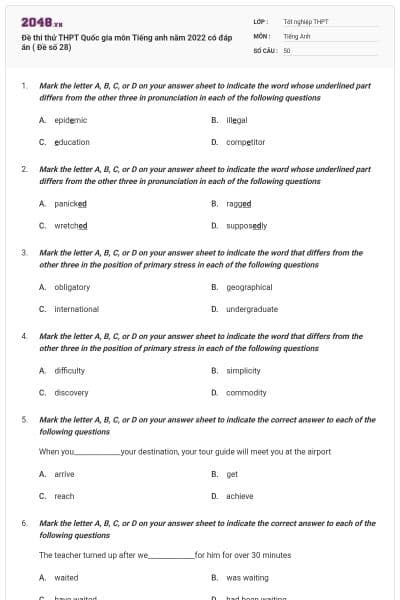
Mark the letter A, B, C, or D on your answer sheet to indicate the word whose underlined part differs from the other three in pronunciation in each of the following questions
epidemic
illegal
education
competitor
Đáp án B
- Epidemic /ˌepɪˈdemɪk/ (n): dịch bệnh
- Education /ˌedʒuˈkeɪʃn/ (n): giáo dục
- Illegal /ɪˈliːɡl/ (adj): bất hợp pháp
- Competitor /kəmˈpetɪtə(r)/ (n): người cạnh tranh
Mark the letter A, B, C, or D on your answer sheet to indicate the word whose underlined part differs from the other three in pronunciation in each of the following questions
panicked
ragged
wretched
supposedly
Đáp án A
- Panicked /ˈpænɪkt/ (v-past): hoảng sợ, sợ hãi
- wretched /ˈretʃɪd/ (adj): không vui (người); tồi tệ
- Ragged /ˈræɡɪd/ (adj): rách tả tơi
- Supposedly /səˈpəʊzɪdli/ (adv): cho là, giả sử là
Mark the letter A, B, C, or D on your answer sheet to indicate the word that differs from the other three in the position of primary stress in each of the following questions
obligatory
geographical
international
undergraduate
Đáp án A
- Obligatory /əˈblɪɡətri/ (adj): bắt buộc
- International /ˌɪntəˈnæʃnəl/ (adj): quốc tế
- Geographical /ˌdʒiːəˈɡræfɪkl/ (adj): (thuộc) địa lý
- Undergraduate /ˌʌndəˈɡrædʒuət/ (n): sinh viên chưa tốt nghiệp
Mark the letter A, B, C, or D on your answer sheet to indicate the word that differs from the other three in the position of primary stress in each of the following questions
difficulty
simplicity
discovery
commodity
Đáp án A
- Difficulty /ˈdɪfɪkəlti/ (n): sự khó khăn
- Simplicity /sɪmˈplɪsəti/ (n): tính đơn giản
- Discovery /dɪˈskʌvəri/ (n): sự khám phá
- Commodity /kəˈmɒdəti/ (n): hàng hóa
Mark the letter A, B, C, or D on your answer sheet to indicate the correct answer to each of the following questions
When you_____________your destination, your tour guide will meet you at the airport
arrive
get
reach
achieve
Đáp án C
- arrive at ~ reach one's destination: đến đích
- get + to + nơi chốn
- achieve: đạt được
"Khi bạn đến đích, hướng dẫn viên du lịch sẽ gặp bạn tại sân bay."
Mark the letter A, B, C, or D on your answer sheet to indicate the correct answer to each of the following questions
The teacher turned up after we_____________for him for over 30 minutes
waited
was waiting
have waited
had been waiting
Đáp án D
Cấu trúc: had been + Ving (thì quá khứ hoàn thành tiếp diễn)
"Thầy giáo đã đến sau khi chúng tôi chờ thầy hơn 30 phút."
Mark the letter A, B, C, or D on your answer sheet to indicate the correct answer to each of the following questions
Mary is bound to notice that broken vase. She has eyes like a_____________!
goose
hawk
dog
fox
Đáp án B
- have eyes like a hawk: mắt sắc như mắt diều hâu, rất tinh ý
"Mary chắc chắn sẽ nhận ra cái bình bị vỡ đó. Cô ấy rất tinh
Mark the letter A, B, C, or D on your answer sheet to indicate the correct answer to each of the following questions
It's_____________house
an ancient black stone-built
a black ancient stone-built
an ancient stone-built grey
a stone-built black ancient
Đáp án A
"Đó là một ngôi nhà cổ màu đen được xây bằng đá."
- Trật tự của tính từ trước danh từ: OpSACOMP (Opinion - Size - Age - Shape - Color - Origin - Material - Purpose)
Trong câu này, ta thấy trật tự đúng là: ancient (age) - black (color) - stone-built (material)
Mark the letter A, B, C, or D on your answer sheet to indicate the correct answer to each of the following questions
Let’s put_____________as many suggestions as possible
forward
out
towards
up
Đáp án A
- put forward: đề xuất, đưa ra (ý kiến, gợi ý,...)
"Chúng ta hãy đưa ra nhiều gợi ý nhất có thể."
Mark the letter A, B, C, or D on your answer sheet to indicate the correct answer to each of the following questions
It came as no surprise to me that Mai sail_____________the final exam.
to
through
with
in
Đáp án B
- sail through: vượt qua điều gì đó rất nhanh và dễ dàng
"Tôi không ngạc nhiên khi Mai vượt qua kì thi cuối kỳ dễ dàng
Mark the letter A, B, C, or D on your answer sheet to indicate the correct answer to each of the following questions
She_____________live with her grandparents in a small house when she was a child
must
would
use to
should
Đáp án B
- would + V (bare-inf).: đã từng làm gì
"Cô ấy đã từng sống với ông bà trong một ngôi nhà nhỏ khi còn bé
Mark the letter A, B, C, or D on your answer sheet to indicate the correct answer to each of the following questions
The boy and the animals_____________she drew were very beautiful
which
who
whom
that
Đáp án D
- that: dùng để thay thế cho cả danh từ chỉ người và vật
"Cậu bé và các con vật mà cô ấy vẽ rất đẹp
Mark the letter A, B, C, or D on your answer sheet to indicate the correct answer to each of the following questions
English and Math interests me almost_____________.
equally
the same
similarly
alike
Đáp án A
- equally chỉ sự ngang bằng về tinh chất, mức độ, còn các đáp án B C D đều nói về tương tự nhau
- the same (N): giống nhau
- similarly (adv): tương tự
- alike (adj, adv): giống nhau
"Toán và Tiếng Anh đều khiến tôi hứng thú gần như nhau."
Mark the letter A, B, C, or D on your answer sheet to indicate the correct answer to each of the following questions
These personal problems seem to be_____________her from her work,
disrupting
disturbing
distracting
dispersing
Đáp án C
Cấu trúc: distract sb from sth: làm ai đó sao lãng việc gì
"Những vấn đề cá nhân này dường như làm cô ấy sao lãng công việc."
Mark the letter A, B, C, or D on your answer sheet to indicate the correct answer to each of the following questions
He ceiling fans were on, but unfortunately they only_____________the hot, humid air
stirred up
poured through
turned into
cut back
Đáp án A
- stir up: gây ra
- pour through: chảy qua
- turn into: biến thành
- cut back: giảm
"Những cái quạt trần đang chạy, nhưng không may chúng chỉ tạo ra không khí nóng ẩm."
Mark the letter A, B, C, or D on your answer sheet to indicate the correct answer to each of the following questions
There is no_____________in persuading him to go out
value
point
worth
profit
Đáp án B
- There's no point in + V-ing : vô ích khi làm gì
"Vô ích khi thuyết phục anh ấy đi chơi
Mark the letter A, B, C, or D on your answer sheet to indicate the correct answer to each of the following questions
My team lost the final five years in_____________.
success
continuation
succession
repetition
Đáp án C
- in succession: liên tiếp
"Đội của tôi thua chung kết 5 năm liên tiếp."
Mark the letter A, B, C, or D on your answer sheet to indicate the correct answer to each of the following questions
I know that she has tried hard _____________that as it may, her work is just not good enough
come
must
should
be
Đáp án D
- be that as it may ~ despite that, nevertheless: tuy nhiên, mặc dù vậy
"Tôi biết cô ấy đã rất cố gắng; tuy nhiên kết quả công việc của cô ấy không đủ tốt."
Mark the letter A, B, C, or D on your answer sheet to indicate the correct answer to each of the following questions
No matter what happens Susan never shows her emotions. She always keeps a stiff upper_____________.
mouth
eye
head
lip
Đáp án D
- keep a stiff upper lip: tỏ ra cứng rắn, kiên cường
"Dù có chuyện gì xảy ra đi chăng nữa thì Susan không bao giờ thể hiện cảm xúc của mình. Cô ấy luôn cứng rắn."
Mark the letter A, B, C, or D on your answer sheet to indicate the word(s) CLOSEST in meaning to the underlined word(s) in each of the following questions
The whole city was wiped out in the bombing raids
changed completely
cleaned well
destroyed completely
removed quickly
Đáp án C
- wiped out ~ destroyed completely: bị phá hủy hoàn toàn
"Toàn bộ thành phố đã bị phá hủy hoàn toàn trong các cuộc tấn công bằng bom
Mark the letter A, B, C, or D on your answer sheet to indicate the word(s) CLOSEST in meaning to the underlined word(s) in each of the following questions
Few companies are flourishing during difficult times
taking off
setting up
growing well
closing down
Đáp án C
- flourish (v) ~ grow well: phát triển tốt
- take off: tháo ra, cởi ra
- set up: thành lập
- close down: đóng cửa
"Rất ít công ty phát triển tốt trong những thời kì khó khăn."
Mark the letter A, B, C, or D on your answer sheet to indicate the word(s) OPPOSITE in meaning to the underlined word(s) in each of the following questions
It seems that the contract was made behind closed doors as no one had any information about it
secretly
daily
transparently
privately
Đáp án C
- behind closed doors: một cách bí mật # transparently (adv): một cách minh bạch, rõ ràng
secretly (adv): bí mật
- daily (adv): hàng ngày
- privately (adv): riêng tư, bí mật
"Dường như hợp đồng đã được kí bí mật vì không ai biết về điều đó."
Mark the letter A, B, C, or D on your answer sheet to indicate the word(s) OPPOSITE in meaning to the underlined word(s) in each of the following questions
He performed all his duties conscientiously. He gave enough care to his work,
insensitively
irresponsibly
liberally
responsibly
Đáp án B
conscientiously: tận tâm, chu đáo # irresponsibly: thiếu trách nhiệm
"Anh ấy đã thực hiện mọi nhiệm vụ chu đáo. Anh ấy để tâm đến công việc mình làm."
Mark the letter A, B, C, or D on your answer sheet to Indicate the option that best completes each of the following exchanges
Nam: “I have an idea. Let's go for a swim on Saturday afternoon".
Hung: -"_____________”
OK, what time?
You're kidding
I know
I'm sure
Đáp án A
Nam: Tớ có ý này. Chúng ta hãy đi bơi vào chiều thứ 7 đi. - Hùng: Được đấy, mấy giờ nhỉ?
B. Cậu đang đùa đấy à.
C. Tớ biết.
D. Tớ chắc đây.
Mark the letter A, B, C, or D on your answer sheet to Indicate the option that best completes each of the following exchanges
Peter: "Why did Tom leave the party so early?" - Daisy:" _____________
You don't say
Why not?
Beats me
You left with him very early
Đáp án C
Peter: Tại sao Tom rời bữa tiệc sớm như vậy? - Daisy: Tớ chịu/ Tớ không biết
Read the following passage and mark the letter A, B, C, or D on your answer sheet to indicate the correct word or phrase that best fits each of the numbered blanks from 26 to 30.
Becoming independent is an essential part of a child's journey to adulthood. To make this journey successful, children need freedom to try new things. But they still need your guidance and support too.
Your love and support are essential for your child's self-esteem. Young people who feel good about themselves often have more (26) _____________to discover who they are and what they want to do with their lives.
Try to (27) _____________ in to your child's feelings. It might help to remember that your child could be confused and upset by the physical, social and emotional changes of adolescence. Your child needs your emotional guidance and stability during this time.
Clear family rules about behaviour, communication and socialising will help your child understand where the limits are and what you expect. Rules will also help you be consistent (28) _____________how you treat your child. Once the rules are in place, apply them consistently.
Your family rules are likely to change as your child develops. As children get more mature, they can make a bigger contribution to the rules and the consequences for breaking them. Involving your child in developing rules helps him to understand the principles behind them. Every family has different rules. You can talk with your child about this and explain that his friends might have different rules, or a different number of rules.
(29) _____________you set the limits too strictly, your child might not have enough room to
grow and try new experiences. This period is a learning curve for both of you. Be prepared for some trial and error.
Younger teenagers might think they're ready to make their own decisions, but they often haven't developed the (30) _____________skills they need to handle significant responsibilities without your help. It can be a good idea to explain to your younger child why younger and older children are given different responsibilities.
time
confidence
efforts
money
Đáp án B
- time (n): thời gian - confidence (n): sự tự tin
- efforts (n): nỗ lực - money (n): tiền
"Your love and support are essential for your child's self-esteem. Young people who feel good about themselves often have more confidence to discover who they are and what they want to do with their lives." (Tình yêu và sự ủng hộ của bạn là điều cần thiết cho lòng tự trọng của con bạn. Những người trẻ tuổi cảm thấy hài lòng về bản thân thường có nhiều tự tin hơn để khám phá mình là ai và mình muốn làm gì với cuộc sống của mình.)
Read the following passage and mark the letter A, B, C, or D on your answer sheet to indicate the correct word or phrase that best fits each of the numbered blanks from 26 to 30.
Becoming independent is an essential part of a child's journey to adulthood. To make this journey successful, children need freedom to try new things. But they still need your guidance and support too.
Your love and support are essential for your child's self-esteem. Young people who feel good about themselves often have more (26) _____________to discover who they are and what they want to do with their lives.
Try to (27) _____________ in to your child's feelings. It might help to remember that your child could be confused and upset by the physical, social and emotional changes of adolescence. Your child needs your emotional guidance and stability during this time.
Clear family rules about behaviour, communication and socialising will help your child understand where the limits are and what you expect. Rules will also help you be consistent (28) _____________how you treat your child. Once the rules are in place, apply them consistently.
Your family rules are likely to change as your child develops. As children get more mature, they can make a bigger contribution to the rules and the consequences for breaking them. Involving your child in developing rules helps him to understand the principles behind them. Every family has different rules. You can talk with your child about this and explain that his friends might have different rules, or a different number of rules.
(29) _____________you set the limits too strictly, your child might not have enough room to
grow and try new experiences. This period is a learning curve for both of you. Be prepared for some trial and error.
Younger teenagers might think they're ready to make their own decisions, but they often haven't developed the (30) _____________skills they need to handle significant responsibilities without your help. It can be a good idea to explain to your younger child why younger and older children are given different responsibilities
tune
understand
consider
make
Đáp án A
- tune in to... (ph.v): hiểu được cảm giác, suy nghĩ của ai
"Try to tune in to your child's feelings. It might help to remember that your child could be confused and upset by the physical, social and emotional changes of adolescence. Your child needs your emotional guidance and stability during this time." (Cố gắng hiểu cảm xúc của con bạn. Điều đó có thể giúp bạn nhớ rằng con bạn có thể bối rối và lo ngại trước những thay đổi về cơ thể, xã hội và cảm xúc của tuổi vị thành niên. Con bạn cần sự hướng dẫn và sự kiên định của bạn trong thời gian này.)
Read the following passage and mark the letter A, B, C, or D on your answer sheet to indicate the correct word or phrase that best fits each of the numbered blanks from 26 to 30.
Becoming independent is an essential part of a child's journey to adulthood. To make this journey successful, children need freedom to try new things. But they still need your guidance and support too.
Your love and support are essential for your child's self-esteem. Young people who feel good about themselves often have more (26) _____________to discover who they are and what they want to do with their lives.
Try to (27) _____________ in to your child's feelings. It might help to remember that your child could be confused and upset by the physical, social and emotional changes of adolescence. Your child needs your emotional guidance and stability during this time.
Clear family rules about behaviour, communication and socialising will help your child understand where the limits are and what you expect. Rules will also help you be consistent (28) _____________how you treat your child. Once the rules are in place, apply them consistently.
Your family rules are likely to change as your child develops. As children get more mature, they can make a bigger contribution to the rules and the consequences for breaking them. Involving your child in developing rules helps him to understand the principles behind them. Every family has different rules. You can talk with your child about this and explain that his friends might have different rules, or a different number of rules.
(29) _____________you set the limits too strictly, your child might not have enough room to
grow and try new experiences. This period is a learning curve for both of you. Be prepared for some trial and error.
Younger teenagers might think they're ready to make their own decisions, but they often haven't developed the (30) _____________skills they need to handle significant responsibilities without your help. It can be a good idea to explain to your younger child why younger and older children are given different responsibilities.
on
of
in
for
Đáp án C
- consistent in sth: kiên định, nhất quán
"Rules will also help you be consistent in how you treat your child." (Các quy tắc cũng sẽ giúp bạn nhất quán trong cách đối xử với con mình.)
Read the following passage and mark the letter A, B, C, or D on your answer sheet to indicate the correct word or phrase that best fits each of the numbered blanks from 26 to 30.
Becoming independent is an essential part of a child's journey to adulthood. To make this journey successful, children need freedom to try new things. But they still need your guidance and support too.
Your love and support are essential for your child's self-esteem. Young people who feel good about themselves often have more (26) _____________to discover who they are and what they want to do with their lives.
Try to (27) _____________ in to your child's feelings. It might help to remember that your child could be confused and upset by the physical, social and emotional changes of adolescence. Your child needs your emotional guidance and stability during this time.
Clear family rules about behaviour, communication and socialising will help your child understand where the limits are and what you expect. Rules will also help you be consistent (28) _____________how you treat your child. Once the rules are in place, apply them consistently.
Your family rules are likely to change as your child develops. As children get more mature, they can make a bigger contribution to the rules and the consequences for breaking them. Involving your child in developing rules helps him to understand the principles behind them. Every family has different rules. You can talk with your child about this and explain that his friends might have different rules, or a different number of rules.
(29) _____________you set the limits too strictly, your child might not have enough room to
grow and try new experiences. This period is a learning curve for both of you. Be prepared for some trial and error.
Younger teenagers might think they're ready to make their own decisions, but they often haven't developed the (30) _____________skills they need to handle significant responsibilities without your help. It can be a good idea to explain to your younger child why younger and older children are given different responsibilities.
Unless
Although
Because
If
Đáp án D
- Unless: nếu... không, trừ phi
- Because: bởi vì
- Although: mặc dù
- If: nếu
"If you set the limits too strictly, your child might not have enough room to grow and try new experiences." (Nếu bạn đặt ra giới hạn quá nghiêm khắc, con bạn có thể không có đủ cơ hội để phát triển và thử trải nghiệm mới.)
Read the following passage and mark the letter A, B, C, or D on your answer sheet to indicate the correct word or phrase that best fits each of the numbered blanks from 26 to 30.
Becoming independent is an essential part of a child's journey to adulthood. To make this journey successful, children need freedom to try new things. But they still need your guidance and support too.
Your love and support are essential for your child's self-esteem. Young people who feel good about themselves often have more (26) _____________to discover who they are and what they want to do with their lives.
Try to (27) _____________ in to your child's feelings. It might help to remember that your child could be confused and upset by the physical, social and emotional changes of adolescence. Your child needs your emotional guidance and stability during this time.
Clear family rules about behaviour, communication and socialising will help your child understand where the limits are and what you expect. Rules will also help you be consistent (28) _____________how you treat your child. Once the rules are in place, apply them consistently.
Your family rules are likely to change as your child develops. As children get more mature, they can make a bigger contribution to the rules and the consequences for breaking them. Involving your child in developing rules helps him to understand the principles behind them. Every family has different rules. You can talk with your child about this and explain that his friends might have different rules, or a different number of rules.
(29) _____________you set the limits too strictly, your child might not have enough room to
grow and try new experiences. This period is a learning curve for both of you. Be prepared for some trial and error.
Younger teenagers might think they're ready to make their own decisions, but they often haven't developed the (30) _____________skills they need to handle significant responsibilities without your help. It can be a good idea to explain to your younger child why younger and older children are given different responsibilities.
making-decision
decision-making
decisions-making
making-decisions
Đáp án B
Cấu trúc: N (singular) - V-ing + N _ cụm danh từ
"Younger teenagers might think they're ready to make their own decisions, but they often haven't developed the decision-making skills they need to handle significant responsibilities without your help." (Các bạn thanh thiếu niên nhỏ tuổi hơn có thể nghĩ rằng chúng đã sẵn sàng để đưa ra quyết định của riêng mình, nhưng chúng thường chưa phát triển được các kỹ năng ra quyết định mà chúng cần đế giải quyết các trách nhiệm quan trọng mà không có sự giúp đỡ của bạn.)
Read the following passage and mark the letter A, B, C, or D on your answer sheet to indicate the correct answer to each of the questions from 31 to 35.
Thousands of books have been written on the conflict between parents and teenagers. Psychologists and sociologists have spent years trying to understand the reasons for the tension and endless arguments between these two groups.
A close look at these arguments often reveals that the reasons are so trivial that we may wonder what the tears and shouts have all been about. Most arguments are not about major issues like the nuclear bomb or the ecological problems of the universe. The fights are usually about simple matters such as food, clothes, the weekly allowance or the telephone.
Let's take an ordinary day and examine what happens. Problems start around 7 a.m. It is then that parents expect their children to get up, get dressed, eat and go to school. Parents and alarm clocks seem like the enemies of mankind at that early hour. Some parents even expect the "poor" youngsters to tidy up their room and put everything in its place before leaving for school - a ridiculous demand - in the eyes of the "victims". In the afternoon, parents want them to do homework and study hard. They resent their children's endless conversations on the phone. In the evening, they complain about the clothes and jewelry the teenagers wear and preach for hours about the dangers on the road and the need to be home by midnight at the latest, like Cinderella.
Youngsters expect parents to be more flexible; not to preach and lecture but to advise and explain. They would like them to be tolerant of different views, listen to their problems and respect their privacy. However, even if they don't admit it, youngsters need the guidance and support of their parents, their approval or disapproval and even their firm opposition on crucial subjects such as drugs or alcohol. They need limits. They need loving but firm authority. In short, youngsters should be more patient and sensitive to their parents' feelings and parents must understand that they cannot prevent their children from making mistakes. Trial and error is, after all, a very important part of the process of growing up.
Most arguments between parents and teenagers are about_____________.
complicated matters
dating relationships
money
simple matters
Đáp án D
Thông tin trong bài: 'The fights are usually about simple matters such as food, clothes, the weekly allowance or the telephone." (Các cuộc chiến thường xoay quanh những vấn đề đơn giản như thức ăn, quần áo, tiền trợ cấp hàng tuần hoặc dùng điện thoại.)
Read the following passage and mark the letter A, B, C, or D on your answer sheet to indicate the correct answer to each of the questions from 31 to 35.
Thousands of books have been written on the conflict between parents and teenagers. Psychologists and sociologists have spent years trying to understand the reasons for the tension and endless arguments between these two groups.
A close look at these arguments often reveals that the reasons are so trivial that we may wonder what the tears and shouts have all been about. Most arguments are not about major issues like the nuclear bomb or the ecological problems of the universe. The fights are usually about simple matters such as food, clothes, the weekly allowance or the telephone.
Let's take an ordinary day and examine what happens. Problems start around 7 a.m. It is then that parents expect their children to get up, get dressed, eat and go to school. Parents and alarm clocks seem like the enemies of mankind at that early hour. Some parents even expect the "poor" youngsters to tidy up their room and put everything in its place before leaving for school - a ridiculous demand - in the eyes of the "victims". In the afternoon, parents want them to do homework and study hard. They resent their children's endless conversations on the phone. In the evening, they complain about the clothes and jewelry the teenagers wear and preach for hours about the dangers on the road and the need to be home by midnight at the latest, like Cinderella.
Youngsters expect parents to be more flexible; not to preach and lecture but to advise and explain. They would like them to be tolerant of different views, listen to their problems and respect their privacy. However, even if they don't admit it, youngsters need the guidance and support of their parents, their approval or disapproval and even their firm opposition on crucial subjects such as drugs or alcohol. They need limits. They need loving but firm authority. In short, youngsters should be more patient and sensitive to their parents' feelings and parents must understand that they cannot prevent their children from making mistakes. Trial and error is, after all, a very important part of the process of growing up
The word "trivial" is closest in meaning to_____________.
unimportant
serious
necessary
complex
Đáp án A
Thông tin trong bài: "A close look at these arguments often reveals that the reasons are so trivial that we may wonder what the tears and shouts have all been about." (Xem xét kỹ những tranh luận này thường cho thấy rằng những lý do rất nhỏ nhặt đến mức chúng ta có thể tự hỏi những giọt nước mắt và tiếng la hét đó là về cái gì.)
Do đó "trivial" ~ unimportant: không đáng kể, nhỏ nhặt
Read the following passage and mark the letter A, B, C, or D on your answer sheet to indicate the correct answer to each of the questions from 31 to 35.
Thousands of books have been written on the conflict between parents and teenagers. Psychologists and sociologists have spent years trying to understand the reasons for the tension and endless arguments between these two groups.
A close look at these arguments often reveals that the reasons are so trivial that we may wonder what the tears and shouts have all been about. Most arguments are not about major issues like the nuclear bomb or the ecological problems of the universe. The fights are usually about simple matters such as food, clothes, the weekly allowance or the telephone.
Let's take an ordinary day and examine what happens. Problems start around 7 a.m. It is then that parents expect their children to get up, get dressed, eat and go to school. Parents and alarm clocks seem like the enemies of mankind at that early hour. Some parents even expect the "poor" youngsters to tidy up their room and put everything in its place before leaving for school - a ridiculous demand - in the eyes of the "victims". In the afternoon, parents want them to do homework and study hard. They resent their children's endless conversations on the phone. In the evening, they complain about the clothes and jewelry the teenagers wear and preach for hours about the dangers on the road and the need to be home by midnight at the latest, like Cinderella.
Youngsters expect parents to be more flexible; not to preach and lecture but to advise and explain. They would like them to be tolerant of different views, listen to their problems and respect their privacy. However, even if they don't admit it, youngsters need the guidance and support of their parents, their approval or disapproval and even their firm opposition on crucial subjects such as drugs or alcohol. They need limits. They need loving but firm authority. In short, youngsters should be more patient and sensitive to their parents' feelings and parents must understand that they cannot prevent their children from making mistakes. Trial and error is, after all, a very important part of the process of growing up.
Parents don’t want youngsters_____________.
get up early
hang out with their friends
wear jewelry
talk a lot on the phone
Đáp án D
Thông tin trong bài: 'They resent their children's endless conversations on the phone." (Họ bực bội với những cuộc nói chuyện điện thoại bất tận.)
Read the following passage and mark the letter A, B, C, or D on your answer sheet to indicate the correct answer to each of the questions from 31 to 35.
Thousands of books have been written on the conflict between parents and teenagers. Psychologists and sociologists have spent years trying to understand the reasons for the tension and endless arguments between these two groups.
A close look at these arguments often reveals that the reasons are so trivial that we may wonder what the tears and shouts have all been about. Most arguments are not about major issues like the nuclear bomb or the ecological problems of the universe. The fights are usually about simple matters such as food, clothes, the weekly allowance or the telephone.
Let's take an ordinary day and examine what happens. Problems start around 7 a.m. It is then that parents expect their children to get up, get dressed, eat and go to school. Parents and alarm clocks seem like the enemies of mankind at that early hour. Some parents even expect the "poor" youngsters to tidy up their room and put everything in its place before leaving for school - a ridiculous demand - in the eyes of the "victims". In the afternoon, parents want them to do homework and study hard. They resent their children's endless conversations on the phone. In the evening, they complain about the clothes and jewelry the teenagers wear and preach for hours about the dangers on the road and the need to be home by midnight at the latest, like Cinderella.
Youngsters expect parents to be more flexible; not to preach and lecture but to advise and explain. They would like them to be tolerant of different views, listen to their problems and respect their privacy. However, even if they don't admit it, youngsters need the guidance and support of their parents, their approval or disapproval and even their firm opposition on crucial subjects such as drugs or alcohol. They need limits. They need loving but firm authority. In short, youngsters should be more patient and sensitive to their parents' feelings and parents must understand that they cannot prevent their children from making mistakes. Trial and error is, after all, a very important part of the process of growing up.
The word "victims" in paragraph 3 refers to_____________
all the parents
all the youngsters
youngsters suffering from severe abuse
youngsters required to clean up their room
Đáp án D
Thông tin trong bài: "Parents and alarm clocks seem like the enemies of mankind at that early hour. Some parents even expect the "poor" youngsters to tidy up their room and put everything in its place before leaving for school - a ridiculous demand - in the eyes of the "victims"." (Bố mẹ và đồng hồ báo thức dường như là kẻ thù của nhân loại vào giờ sáng sớm đó. Một số phụ huynh thậm chí còn mong muốn những đứa trẻ "tội nghiệp" dọn dẹp phòng của mình và sắp xếp mọi thứ ngăn nắp trước khi đến trường - một yêu cầu vô lý - trong mắt của các "nạn nhân".)
_ victims đề cập đến "những bạn trẻ bị bố mẹ bắt dọn dẹp phòng
Read the following passage and mark the letter A, B, C, or D on your answer sheet to indicate the correct answer to each of the questions from 31 to 35.
Thousands of books have been written on the conflict between parents and teenagers. Psychologists and sociologists have spent years trying to understand the reasons for the tension and endless arguments between these two groups.
A close look at these arguments often reveals that the reasons are so trivial that we may wonder what the tears and shouts have all been about. Most arguments are not about major issues like the nuclear bomb or the ecological problems of the universe. The fights are usually about simple matters such as food, clothes, the weekly allowance or the telephone.
Let's take an ordinary day and examine what happens. Problems start around 7 a.m. It is then that parents expect their children to get up, get dressed, eat and go to school. Parents and alarm clocks seem like the enemies of mankind at that early hour. Some parents even expect the "poor" youngsters to tidy up their room and put everything in its place before leaving for school - a ridiculous demand - in the eyes of the "victims". In the afternoon, parents want them to do homework and study hard. They resent their children's endless conversations on the phone. In the evening, they complain about the clothes and jewelry the teenagers wear and preach for hours about the dangers on the road and the need to be home by midnight at the latest, like Cinderella.
Youngsters expect parents to be more flexible; not to preach and lecture but to advise and explain. They would like them to be tolerant of different views, listen to their problems and respect their privacy. However, even if they don't admit it, youngsters need the guidance and support of their parents, their approval or disapproval and even their firm opposition on crucial subjects such as drugs or alcohol. They need limits. They need loving but firm authority. In short, youngsters should be more patient and sensitive to their parents' feelings and parents must understand that they cannot prevent their children from making mistakes. Trial and error is, after all, a very important part of the process of growing up.
Which of the following is TRUE according to paragraph 4?
Teenagers don’t want to talk or explain anything to their parents
Parents need to stop their children from making mistakes
Making mistakes plays an important role in helping teenagers to be mature
Parents should let their children have freedom to do anything that they like
Đáp án C
Thông tin trong bài: 'Trial and error is, after all, a very important part of the process of growing up." (Xét cho cùng, việc thử và sai lầm vẫn là một phần rất quan trọng trong quá trình trưởng thành.)
Read the following passage and mark the letter A, B, C, or D on your answer sheet to indicate the correct answer to each of the questions from 36 to 42.
By the turn of the century, the middle-class home in North American had been transformed. "The flow of industry has passed and left idle the loom in the attic, the soap kettle in the shed". Ellen Richards wrote in 1908. The urban middle class was now able to buy a wide array of food products and clothing - baked goods, canned goods, suits, shirts, shoes, and dresses. Not only had household production waned, but technological improvements were rapidly changing the rest of domestic work. Middle-class homes had indoor running water and furnaces, run on oil, coal, or gas, that produced hot water. Stoves were fueled by gas, and delivery services provided ice for refrigerators. Electric power was available for lamps, sewing machines, irons, and even vacuum cleaners. No domestic task was unaffected. Commercial laundries, for instance, had been doing the wash for urban families for decades; by the early 1900's the first electric washing machines were on the market.
One impact of the new household technology was to draw sharp dividing lines between women of different classes and regions. Technological advances always affected the homes of the wealthy first, filtering downward into the urban middle class. But women who lived on farms were not yet affected by household improvements. Throughout the nineteenth century and well into the twentieth, rural homes lacked running water and electric power. Farm women had to haul large quantities of water into the house from wells or pumps for every purpose. Doing the family laundry, in large vats heated over stoves, continued to be a full day’s work, just as canning and preserving continued to be seasonal necessities. Heat was provided by wood or coal stoves. In addition, rural women continued to produce most of their families' clothing. The urban poor, similarly, reaped few benefits from household improvements. Urban slums such as Chicago's nineteenth ward often had no sewers, garbage collection, or gas or electric lines; and tenements lacked both running water and central heating. At the turn of the century, variations in the nature of women's domestic work were probably more marked than at anytime before
What is the main topic of the passage?
The creation of the urban middle class
Domestic work at the turn of the century
The spread of electrical power in the United States
Overcrowding in American cities
Đáp án B
Chủ đề chính của bài đọc là gì?
A. Sự hình thành tầng lớp trung lưu thành thị
B. Công việc nội trợ vào đầu thế kỷ
C. Sự lan rộng của năng lượng điện ở Mỹ
D. Tình trạng quá đông đúc ở các thành phố của Mỹ
Thông tin trong bài: "By the turn of the century, the middle-class home in North American had been transformed... Not only had household production waned, but technological improvements were rapidly changing the rest of domestic work... At the turn of the century, variations in the nature of women's domestic work were probably more marked than at any time before." (Vào đầu thế kỷ, ngôi nhà của tầng lớp trung lưu ở Bắc Mỹ đã bị thay đổi... Không chỉ việc sản xuất của hộ gia đình suy giảm, mà những cải tiến công nghệ đang thay đổi nhanh chóng phần còn lại của công việc nội trợ... Vào thời điểm đầu thế kỷ, những thay đổi trong công việc nội trợ của phụ nữ có lẽ rõ ràng hơn so với bất kỳ thời điểm nào trước đây.)
Read the following passage and mark the letter A, B, C, or D on your answer sheet to indicate the correct answer to each of the questions from 36 to 42.
By the turn of the century, the middle-class home in North American had been transformed. "The flow of industry has passed and left idle the loom in the attic, the soap kettle in the shed". Ellen Richards wrote in 1908. The urban middle class was now able to buy a wide array of food products and clothing - baked goods, canned goods, suits, shirts, shoes, and dresses. Not only had household production waned, but technological improvements were rapidly changing the rest of domestic work. Middle-class homes had indoor running water and furnaces, run on oil, coal, or gas, that produced hot water. Stoves were fueled by gas, and delivery services provided ice for refrigerators. Electric power was available for lamps, sewing machines, irons, and even vacuum cleaners. No domestic task was unaffected. Commercial laundries, for instance, had been doing the wash for urban families for decades; by the early 1900's the first electric washing machines were on the market.
One impact of the new household technology was to draw sharp dividing lines between women of different classes and regions. Technological advances always affected the homes of the wealthy first, filtering downward into the urban middle class. But women who lived on farms were not yet affected by household improvements. Throughout the nineteenth century and well into the twentieth, rural homes lacked running water and electric power. Farm women had to haul large quantities of water into the house from wells or pumps for every purpose. Doing the family laundry, in large vats heated over stoves, continued to be a full day’s work, just as canning and preserving continued to be seasonal necessities. Heat was provided by wood or coal stoves. In addition, rural women continued to produce most of their families' clothing. The urban poor, similarly, reaped few benefits from household improvements. Urban slums such as Chicago's nineteenth ward often had no sewers, garbage collection, or gas or electric lines; and tenements lacked both running water and central heating. At the turn of the century, variations in the nature of women's domestic work were probably more marked than at anytime before
According to the passage, what kind of fuel was used in a stove in a typical middle-class household?
oil
coal
gas
wood
Đáp án C
Thông tin trong bài: "Middle-class homes had indoor running water and furnaces, run on oil, coal, or gas, that produced hot water. Stoves were fueled by gas, and delivery services provided ice for refrigerators." (Các ngôi nhà trung lưu có nước sinh hoạt và lò sưởi trong nhà, chạy bằng dầu, than hoặc khí đốt, tạo ra nước nóng. Bếp được cung cấp nhiên liệu bằng gas và các dịch vụ giao hàng cung cấp đá cho tủ lạnh.)
Read the following passage and mark the letter A, B, C, or D on your answer sheet to indicate the correct answer to each of the questions from 36 to 42.
By the turn of the century, the middle-class home in North American had been transformed. "The flow of industry has passed and left idle the loom in the attic, the soap kettle in the shed". Ellen Richards wrote in 1908. The urban middle class was now able to buy a wide array of food products and clothing - baked goods, canned goods, suits, shirts, shoes, and dresses. Not only had household production waned, but technological improvements were rapidly changing the rest of domestic work. Middle-class homes had indoor running water and furnaces, run on oil, coal, or gas, that produced hot water. Stoves were fueled by gas, and delivery services provided ice for refrigerators. Electric power was available for lamps, sewing machines, irons, and even vacuum cleaners. No domestic task was unaffected. Commercial laundries, for instance, had been doing the wash for urban families for decades; by the early 1900's the first electric washing machines were on the market.
One impact of the new household technology was to draw sharp dividing lines between women of different classes and regions. Technological advances always affected the homes of the wealthy first, filtering downward into the urban middle class. But women who lived on farms were not yet affected by household improvements. Throughout the nineteenth century and well into the twentieth, rural homes lacked running water and electric power. Farm women had to haul large quantities of water into the house from wells or pumps for every purpose. Doing the family laundry, in large vats heated over stoves, continued to be a full day’s work, just as canning and preserving continued to be seasonal necessities. Heat was provided by wood or coal stoves. In addition, rural women continued to produce most of their families' clothing. The urban poor, similarly, reaped few benefits from household improvements. Urban slums such as Chicago's nineteenth ward often had no sewers, garbage collection, or gas or electric lines; and tenements lacked both running water and central heating. At the turn of the century, variations in the nature of women's domestic work were probably more marked than at anytime before
Which of the following is NOT mentioned as a household convenience in the passage?
The electric fan
The refrigerator
The electric light
The washing machine
Đáp án A
Thông tin trong bài: "Stoves were fueled by gas, and delivery services provided ice for refrigerators. Electric power was available for lamps, sewing machines, irons, and even vacuum cleaners... Commercial laundries, for instance, had been doing the wash for urban families for decades; by the early 1900’s the first electric washing machines were on the market." (Bếp được cung cấp nhiên liệu bằng gas và các dịch vụ giao hàng cung cấp đá cho tủ lạnh. Năng lượng điện đã có sẵn cho đèn, máy khâu, bàn là, và thậm chí cả máy hút bụi... Chẳng hạn như các tiệm giặt là thương mại đã làm công việc giặt giũ cho các gia đình thành thị trong nhiều thập kỷ; vào đầu những năm 1900, những chiếc máy giặt chạy bằng điện đầu tiên đã có mặt trên thị trường.)
"the electric fan" (quạt điện) không được đề cập là thứ tiện nghi trong gia đình
Read the following passage and mark the letter A, B, C, or D on your answer sheet to indicate the correct answer to each of the questions from 36 to 42.
By the turn of the century, the middle-class home in North American had been transformed. "The flow of industry has passed and left idle the loom in the attic, the soap kettle in the shed". Ellen Richards wrote in 1908. The urban middle class was now able to buy a wide array of food products and clothing - baked goods, canned goods, suits, shirts, shoes, and dresses. Not only had household production waned, but technological improvements were rapidly changing the rest of domestic work. Middle-class homes had indoor running water and furnaces, run on oil, coal, or gas, that produced hot water. Stoves were fueled by gas, and delivery services provided ice for refrigerators. Electric power was available for lamps, sewing machines, irons, and even vacuum cleaners. No domestic task was unaffected. Commercial laundries, for instance, had been doing the wash for urban families for decades; by the early 1900's the first electric washing machines were on the market.
One impact of the new household technology was to draw sharp dividing lines between women of different classes and regions. Technological advances always affected the homes of the wealthy first, filtering downward into the urban middle class. But women who lived on farms were not yet affected by household improvements. Throughout the nineteenth century and well into the twentieth, rural homes lacked running water and electric power. Farm women had to haul large quantities of water into the house from wells or pumps for every purpose. Doing the family laundry, in large vats heated over stoves, continued to be a full day’s work, just as canning and preserving continued to be seasonal necessities. Heat was provided by wood or coal stoves. In addition, rural women continued to produce most of their families' clothing. The urban poor, similarly, reaped few benefits from household improvements. Urban slums such as Chicago's nineteenth ward often had no sewers, garbage collection, or gas or electric lines; and tenements lacked both running water and central heating. At the turn of the century, variations in the nature of women's domestic work were probably more marked than at anytime before
According to the passage, who were the first beneficiaries of technological advances?
Farm women
The urban poor
The urban middle class
The wealthy
Đáp án D
Thông tin trong bài: "Technological advances always affected the homes of the wealthy first, filtering downward into the urban middle class." (Những tiến bộ công nghệ luôn ảnh hưởng đến ngôi nhà của những người giàu có trước tiên, rồi đến tầng lớp trung lưu thành thị.)
Read the following passage and mark the letter A, B, C, or D on your answer sheet to indicate the correct answer to each of the questions from 36 to 42.
By the turn of the century, the middle-class home in North American had been transformed. "The flow of industry has passed and left idle the loom in the attic, the soap kettle in the shed". Ellen Richards wrote in 1908. The urban middle class was now able to buy a wide array of food products and clothing - baked goods, canned goods, suits, shirts, shoes, and dresses. Not only had household production waned, but technological improvements were rapidly changing the rest of domestic work. Middle-class homes had indoor running water and furnaces, run on oil, coal, or gas, that produced hot water. Stoves were fueled by gas, and delivery services provided ice for refrigerators. Electric power was available for lamps, sewing machines, irons, and even vacuum cleaners. No domestic task was unaffected. Commercial laundries, for instance, had been doing the wash for urban families for decades; by the early 1900's the first electric washing machines were on the market.
One impact of the new household technology was to draw sharp dividing lines between women of different classes and regions. Technological advances always affected the homes of the wealthy first, filtering downward into the urban middle class. But women who lived on farms were not yet affected by household improvements. Throughout the nineteenth century and well into the twentieth, rural homes lacked running water and electric power. Farm women had to haul large quantities of water into the house from wells or pumps for every purpose. Doing the family laundry, in large vats heated over stoves, continued to be a full day’s work, just as canning and preserving continued to be seasonal necessities. Heat was provided by wood or coal stoves. In addition, rural women continued to produce most of their families' clothing. The urban poor, similarly, reaped few benefits from household improvements. Urban slums such as Chicago's nineteenth ward often had no sewers, garbage collection, or gas or electric lines; and tenements lacked both running water and central heating. At the turn of the century, variations in the nature of women's domestic work were probably more marked than at anytime before
The word "reaped" in the passage is closest in meaning to_____________.
gained
affected
wanted
accepted
Đáp án A
- gain (v): đạt được, thu được ~ reap (v) - affect (v): ảnh hưởng
- want (v): muốn - accept (v): chấp nhận
Thông tin trong bài: "Heat was provided by wood or coal stoves. In addition, rural women continued to produce most of their families' clothing. The urban poor, similarly, reaped few benefits from household improvements." (Nhiệt được cung cấp từ củi hoặc bếp than. Thêm vào đó, phụ nữ nông thôn tiếp tục làm ra hầu hết quần áo của gia đình mình. Tương tự vậy, người nghèo thành thị hưởng được chút lợi ích từ những sự cải tiến.)
Read the following passage and mark the letter A, B, C, or D on your answer sheet to indicate the correct answer to each of the questions from 36 to 42.
By the turn of the century, the middle-class home in North American had been transformed. "The flow of industry has passed and left idle the loom in the attic, the soap kettle in the shed". Ellen Richards wrote in 1908. The urban middle class was now able to buy a wide array of food products and clothing - baked goods, canned goods, suits, shirts, shoes, and dresses. Not only had household production waned, but technological improvements were rapidly changing the rest of domestic work. Middle-class homes had indoor running water and furnaces, run on oil, coal, or gas, that produced hot water. Stoves were fueled by gas, and delivery services provided ice for refrigerators. Electric power was available for lamps, sewing machines, irons, and even vacuum cleaners. No domestic task was unaffected. Commercial laundries, for instance, had been doing the wash for urban families for decades; by the early 1900's the first electric washing machines were on the market.
One impact of the new household technology was to draw sharp dividing lines between women of different classes and regions. Technological advances always affected the homes of the wealthy first, filtering downward into the urban middle class. But women who lived on farms were not yet affected by household improvements. Throughout the nineteenth century and well into the twentieth, rural homes lacked running water and electric power. Farm women had to haul large quantities of water into the house from wells or pumps for every purpose. Doing the family laundry, in large vats heated over stoves, continued to be a full day’s work, just as canning and preserving continued to be seasonal necessities. Heat was provided by wood or coal stoves. In addition, rural women continued to produce most of their families' clothing. The urban poor, similarly, reaped few benefits from household improvements. Urban slums such as Chicago's nineteenth ward often had no sewers, garbage collection, or gas or electric lines; and tenements lacked both running water and central heating. At the turn of the century, variations in the nature of women's domestic work were probably more marked than at anytime before
Which of the following best characterizes the passage's organization_____________.
analysis of a quotation
chronological narrative
extended definition
comparison
Đáp án D
Điều nào sau đây mô tả tốt nhất cách tổ chức của bài đọc?
A.Phân tích đoạn trích dẫn
B. Tường thuật theo trình tự thời gian
C. Định nghĩa mở rộng
D. So sánh
Read the following passage and mark the letter A, B, C, or D on your answer sheet to indicate the correct answer to each of the questions from 36 to 42.
By the turn of the century, the middle-class home in North American had been transformed. "The flow of industry has passed and left idle the loom in the attic, the soap kettle in the shed". Ellen Richards wrote in 1908. The urban middle class was now able to buy a wide array of food products and clothing - baked goods, canned goods, suits, shirts, shoes, and dresses. Not only had household production waned, but technological improvements were rapidly changing the rest of domestic work. Middle-class homes had indoor running water and furnaces, run on oil, coal, or gas, that produced hot water. Stoves were fueled by gas, and delivery services provided ice for refrigerators. Electric power was available for lamps, sewing machines, irons, and even vacuum cleaners. No domestic task was unaffected. Commercial laundries, for instance, had been doing the wash for urban families for decades; by the early 1900's the first electric washing machines were on the market.
One impact of the new household technology was to draw sharp dividing lines between women of different classes and regions. Technological advances always affected the homes of the wealthy first, filtering downward into the urban middle class. But women who lived on farms were not yet affected by household improvements. Throughout the nineteenth century and well into the twentieth, rural homes lacked running water and electric power. Farm women had to haul large quantities of water into the house from wells or pumps for every purpose. Doing the family laundry, in large vats heated over stoves, continued to be a full day’s work, just as canning and preserving continued to be seasonal necessities. Heat was provided by wood or coal stoves. In addition, rural women continued to produce most of their families' clothing. The urban poor, similarly, reaped few benefits from household improvements. Urban slums such as Chicago's nineteenth ward often had no sewers, garbage collection, or gas or electric lines; and tenements lacked both running water and central heating. At the turn of the century, variations in the nature of women's domestic work were probably more marked than at anytime before
Where in the passage does the author discuss conditions in poor urban neighborhoods?
The urban middle ... dresses
Middle-class homes ... water
Electric power... unaffected
The urban poor... heating
Đáp án D
Đoạn nào trong bài đọc tác giả thảo luận về những điều kiện ở vùng thành thị nghèo?
Thông tin trong bài: 'The urban poor, similarly, reaped few benefits from household improvements. Urban slums such as Chicago's nineteenth ward often had no sewers, garbage collection, or gas or electric lines; and tenements lacked both running water and central heating." (Tương tự vậy, người nghèo thành thị hưởng được chút lợi ích từ những sự cải tiến. Các khu ổ chuột ở đô thị như phường thứ 19 của Chicago thường không có cống rãnh, nơi thu gom rác thải, đường dây điện hoặc đường dẫn khí; và các khu nhà thiếu cả nước sinh hoạt và hệ thống sưởi trung tâm.)
Mark the letter A, B, C, or D on your answer sheet to indicate the underlined part that needs correction in each of the following questions
(A) There are few areas (B) of human experience that (C) have not been (D) writing about
There are
of human
have not been
writing
Đáp án D
(writing _ written)
Động từ "write" trong câu này phải được chia ở dạng bị động mới phù hợp về mặt ý nghĩa.
Mark the letter A, B, C, or D on your answer sheet to indicate the underlined part that needs correction in each of the following questions
David (A) was a (B) bravery man to go (C) on this adventure by (D) himself
was
bravery
on
himself
Đáp án B
(bravery _ brave)
- brave (adj): dũng cảm
Cấu trúc: a + adj + N
Mark the letter A, B, C, or D on your answer sheet to indicate the underlined part that needs correction in each of the following questions
(A) Found in 1209, the University of Cambridge (B) ranks (C) among the world’s (D) oldest universities
Found
ranks
among
oldest universities
Đáp án A
(Found _ Founded)
- found (v): thành lập _ founded (v-pp): được thành lập
"Được thành lập vào năm 1209, trường Đại học Cambridge xếp hạng trong số những trường đại học lâu đời nhất trên thế giới
Mark the letter A, B, C, or D on your answer sheet tn indicate the sentence that is closest in meaning to each of the following questions
David broke his leg and couldn't play in the final
David couldn't play in the final due to his broken leg
If David hadn't broken his leg, he could play in the final now
If David didn't break his leg, he could play in the final
But for his broken leg, David couldn't have played in the final
Đáp án A
"David đã gãy chân và không thể chơi trong trận chung kết." _ David đã không thể chơi trong trận chung kết vì bị gãy chân.
B, C. dùng sai câu điều kiện _ phải dùng câu điều kiện loại 3
D.sai nghĩa (Nếu không phải vì gãy chân thì David đã không thể chơi trong trận chung kết.)
Mark the letter A, B, C, or D on your answer sheet tn indicate the sentence that is closest in meaning to each of the following questions
It doesn't make any difference if it rain because they will still go to the cinema.
So long as it doesn't rain, they will go to the cinema
But for the rain, they would have gone to the cinema
There is a difference between going to the cinema and staying at home
Whether it rains or not, they will still go to the cinema
Đáp án D
"Không khác biệt gì nếu trời mưa vì họ sẽ vẫn đi xem phim." _ Dù trời mưa hay không, họ sẽ vẫn đi xem phim.
- whether... or: dù... hay
A, B, C không hợp nghĩa
A. Miễn là trời không mưa, họ sẽ đi xem phim.
B. Nếu không phải vì trời mưa, họ đã đi xem phim.
C. Có một sự khác biệt giữa việc đi xem phim và ở nhà.
Mark the letter A, B, C, or D on your answer sheet tn indicate the sentence that is closest in meaning to each of the following questions
I had only just put the phone down when the boss rang back
I put the phone down when the boss rang back
Hardly had I put the phone down when the boss rang back
No sooner had I put the phone down when the boss rang back
Scarcely had I put the phone down than the boss rang back
Đáp án B
"Tôi chỉ mới đặt điện thoại xuống thì sếp gọi lại." _ Ngay khi tôi đặt điện thoại xuống thì sếp gọi.
Cấu trúc: Hardly/ Scarcely + had + S + pp ... + when + a clause ~ No sooner + had + S + pp ... + than + a clause (ngay khi... thì)
Mark the letter A, B, C, or D on your answer sheet to indicate the sentence that best combines each pair of sentences in the following questions
The test we did yesterday was very long. It was difficult, too
Not only was the test we did yesterday very long but also very difficult
Not only was very long the test we did yesterday but it was also very difficult
The test we did yesterday was not only very long, it was also very difficult
Not only the test we did yesterday was very long but also very difficult
Đáp án A
"Bài kiểm tra chúng tôi đã làm hôm qua rất dài. Nó cũng khó."
_ Bài kiểm tra chúng tôi đã làm hôm qua không chỉ dài mà còn khó.
Cấu trúc đảo ngữ với "not only": Not only + aux + S + V... but also... (không những ...mà còn)
- B, C, D sai cấu trúc
Mark the letter A, B, C, or D on your answer sheet to indicate the sentence that best combines each pair of sentences in the following questions
He was suspected to have stolen two cars. The police have investigated him for days
He has been investigated for days, suspected to have stolen two cars
Suspecting to have stolen two cars, he has been investigated for days
Having suspected to have stolen two cars, he has been investigated for days
Suspected to have stolen two cars, he has been investigated for days
Đáp án D
"Anh ấy bị nghi ngờ ăn trộm hai chiếc ô tô. Cảnh sát đã điều tra anh ấy nhiều ngày."
- Rút gọn mệnh đề trạng ngữ có cùng chủ ngữ và mệnh đề đó ở dạng bị động: dùng PP
- A, B, C đều sai cấu trúc