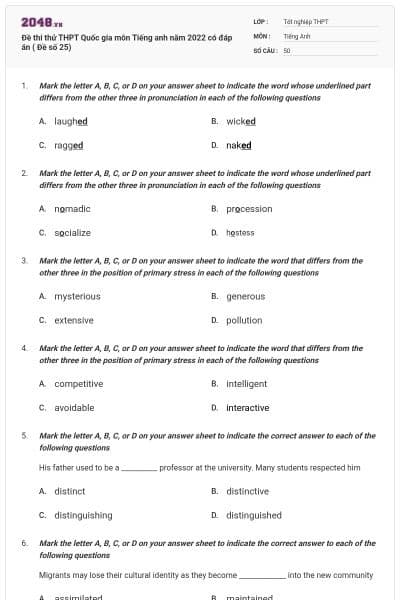
Đề thi thử THPT Quốc gia môn Tiếng anh năm 2022 có đáp án ( Đề số 25)
50 câu hỏi
Mark the letter A, B, C, or D on your answer sheet to indicate the word whose underlined part differs from the other three in pronunciation in each of the following questions
laughed
wicked
ragged
naked
Đáp án A
Laughed /lɑːft/ (v-ed): cười
Wicked /ˈwɪkɪd/ (adj): xấu xa, độc ác
Ragged /ˈræɡɪd/ (adj): rách tả tơi
Naked /ˈneɪkɪd/ (adj): trần truồng
Mark the letter A, B, C, or D on your answer sheet to indicate the word whose underlined part differs from the other three in pronunciation in each of the following questions
nomadic
procession
socialize
hostess
Đáp án B
Nomadic /nəʊˈmædɪk/ (adj): thuộc về du mục
Procession /prəˈseʃn/ (n): đám rước
Socialize /ˈsəʊʃəlaɪz/ (v): giao lưu
Hostess /ˈhəʊstəs/ (n): chủ nhà (nữ)
Mark the letter A, B, C, or D on your answer sheet to indicate the word that differs from the other three in the position of primary stress in each of the following questions
mysterious
generous
extensive
pollution
Đáp án B
Mysterious /mɪˈstɪəriəs/ (adj): thần bí, huyền bí
Generous /ˈdʒenərəs/ (adj): hào phóng, rộng lượng
Extensive /ɪkˈstensɪv/ (adj): rộng, bao quát
Pollution /pəˈluːʃn/ (n): sự ô nhiễm
Mark the letter A, B, C, or D on your answer sheet to indicate the word that differs from the other three in the position of primary stress in each of the following questions
competitive
intelligent
avoidable
interactive
Đáp án D
Competitive /kəmˈpetətɪv/ (adj): mang tính cạnh tranh
Intelligent /ɪnˈtelɪdʒənt/ (adj): thông minh
Avoidable /əˈvɔɪdəbl/ (adj): có thể tránh được
Interactive /ˌɪntərˈæktɪv/ (adj): mang tính tương tác
Mark the letter A, B, C, or D on your answer sheet to indicate the correct answer to each of the following questions
His father used to be a __________ professor at the university. Many students respected him
distinct
distinctive
distinguishing
distinguished
Đáp án D
- distinct (adj): riêng, khác biệt
- distinctive (adj): khác biệt, đặc biệt
- distinguishing (adj): phân biệt
- distinguished (adj): đáng chú ý, ưu tú, lỗi lạc
“Bố anh ta đã từng là giáo sư ưu tú tại trường đại học. Nhiều sinh viên kính trọng ông.”
Mark the letter A, B, C, or D on your answer sheet to indicate the correct answer to each of the following questions
Migrants may lose their cultural identity as they become _____________ into the new community
assimilated
maintained
understood
worshiped
Đáp án A
- assimilated (adj): hòa nhập, đồng hóa
- maintained (adj): được duy trì
- understand (v): hiểu
- worship (v): thờ cúng
“Dân di cư sẽ có thể mất đi bản sắc văn hóa của riêng họ khi họ hòa nhập vào cộng đồng mới.”
Mark the letter A, B, C, or D on your answer sheet to indicate the correct answer to each of the following questions
The government said that they didn’t have enough funds to deal with _______ medical care
low-cost
high-cost
cost-high
cost-effective
Đáp án: B
Giải thích:
Kiến thức: Từ vựng
low-cost (adj): giá thấp, rẻ
high-cost (adj): giá cao, đắt
Không có cost-high
cost-effective (adj): tiết kiệm chi phí
Dựa vào nghĩa, chọn B.
Dịch: Chính phủ nói rằng họ không có đủ nguồn quỹ để giải quyết vấn đề chăm sóc y tế chi phí cao.
Mark the letter A, B, C, or D on your answer sheet to indicate the correct answer to each of the following questions
We should ________ waste paper ________ cut down any trees
either - or
either - nor
neither - nor
neither - or
Đáp án C
- Cụm “neither… nor” (cả hai cái/ việc đều không).
- Cụm “either… or” (hoặc việc này/ cái này hoặc việc kia/ cái kia)
“Chúng ta không nên lãng phí giấy cũng như chặt cây.”
Mark the letter A, B, C, or D on your answer sheet to indicate the correct answer to each of the following questions
A cell phone may take risk going __________ due to unexpected incidents
of
on
off
for
Đáp án C
- go on: tiếp tục
- go off: nổ
- go for: tấn công
“Điện thoại có thể có nguy cơ phát nổ vì những sự cố bất ngờ.”
Mark the letter A, B, C, or D on your answer sheet to indicate the correct answer to each of the following questions
If you don’t ___________ this opportunity, you might not get another one
grab
grasp
maintain
capture
Đáp án B
A. ngoạm, giữ chặt
B. nắm bắt/ chộp lấy cơ hội
C. giữ
D. bắt
“Nếu bạn không nắm bắt cơ hội này, bạn có thể không có cơ hội khác.”
Mark the letter A, B, C, or D on your answer sheet to indicate the correct answer to each of the following questions
How long ______________ in your old house before you moved in this flat?
did you live
do you lives
have you lived
had you lived
Đáp án D
- Chúng ta dùng thì quá khứ hoàn thành để diễn đạt những sự việc, hành động xảy ra trước sự việc, hành động khác trong quá khứ.
- Cấu trúc thể nghi vấn: (Wh-word) + had + S + V-PP?
"Bạn đã ở ngôi nhà cũ bao lâu trước khi bạn chuyển đến căn hộ này?”
Mark the letter A, B, C, or D on your answer sheet to indicate the correct answer to each of the following questions
The hotel prides itself on __________ high standards
protecting
reducing
containing
maintaining
Đáp án D
A. bảo vệ B. giảm
B. chứa đựng D. duy trì
“Khách sạn tự hào về việc duy trì các tiêu chuẩn cao.”
Mark the letter A, B, C, or D on your answer sheet to indicate the correct answer to each of the following questions
Many young people travel all over the world and do all kinds of jobs before they ________.
lie down
put down
touch down
settle down
Đáp án D
- lie down (ph.v): nằm xuống
- put down (ph.v): đặt xuống
- touch down (ph.v): hạ cánh
- settle down (ph.v): ổn định, bắt đầu cuộc sống ổn định
“Nhiều người trẻ đi du lịch vòng quanh thế giới và làm tất cả các loại công việc trước khi họ ổn định cuộc sống.”
Mark the letter A, B, C, or D on your answer sheet to indicate the correct answer to each of the following questions
He has the ________ face and skin of an old traveller
thought-provoking
year-round
overloaded
weather-beaten
Đáp án D
- thought-provoking (adj): đáng để suy nghĩ
- year-round (adj): quanh năm
- overloaded (adj): quá tải
- weather-beaten (adj): dãi dầu sương gió
“Ông ấy có khuôn mặt dãi dầu sương gió và làn da của một người du khách già
Mark the letter A, B, C, or D on your answer sheet to indicate the correct answer to each of the following questions
________ number of boys were swimming in the lake, but I didn’t know ________ exact number of them
A - the
The - an
The - the
A - an
Đáp án A
- the number of + danh từ số nhiều: số lượng của…
- a number of + danh từ số nhiều = many, a lot of, lots of: nhiều
“Nhiều đứa trẻ đang bơi ngoài hồ, nhưng tôi không biết số lượng cụ thể.”
Mark the letter A, B, C, or D on your answer sheet to indicate the correct answer to each of the following questions
It is imperative that this letter __________ immediately.
is sent
sends
was sent
be sent
Đáp án D
- Cấu trúc giả định: It + be + adj + that + S + V-inf
“Lá thư này được yêu cầu gửi ngay lập tức.”
Mark the letter A, B, C, or D on your answer sheet to indicate the correct answer to each of the following questions
Only after food has been dried or canned ___________.
that it should be stored for future use
it should be stored for future use
should it be stored for future use
should it store for future
Đáp án C
- Cấu trúc đảo ngữ: Only after + clause + aux + S + V: chỉ sau khi… thì…
“Chỉ sau khi thức ăn đã được sấy khô hoặc đóng hộp thì nó mới được lưu trữ cho việc sử dụng sau này.”
Mark the letter A, B, C, or D on your answer sheet to indicate the correct answer to each of the following questions
Using renewable resources is the best option for preventing the _________ of fossil-based resources
disposal
poisoning
depletion
production
Đáp án C
A. sự vứt bỏ, sự thải ra B. sự đầu độc
C. sự cạn kiệt D. sự sản xuất
“Sử dụng tài nguyên tái tạo là lựa chọn tốt nhất để ngăn chặn sự cạn kiệt tài nguyên có nguồn gốc hóa thạch.”
Mark the letter A, B, C, or D on your answer sheet to indicate the correct answer to each of the following questions
We use compact florescent light bulbs, __________ last 10 times longer than incandescent bulbs
what
that
which
they
Đáp án C
- Đại từ quan hệ “which” thay thế cho danh từ chỉ vật ở phía trước.
“Chúng tôi sử dụng đèn huỳnh quang nhỏ gọn, thứ mà có tuổi thọ gấp 10 lần bóng đèn sợi đốt.”
Mark the letter A, B, C, or D on your answer sheet to indicate the word(s) CLOSEST in meaning to the underlined word(s) in each of the following questions
A.I. algorithms can also help to detect faces and other features in photos sent to social networking sites
categorize
connect
recognize
remind
Đáp án C
- detect (v): phát hiện ra, nhận ra
- categorize (n): phân loại
- recognize (v): nhận ra, công nhận
- remind (v): nhắc nhở
- connect (v): kết nối
“Thuật toán A.I cũng có thể giúp nhận diện khuôn mặt và những đặc điểm khác trong các bức ảnh trên các trang mạng xã hội.”
Mark the letter A, B, C, or D on your answer sheet to indicate the word(s) CLOSEST in meaning to the underlined word(s) in each of the following questions
Although the first printed books had appeared long before in China, the term ‘mass media’ we use today was coined with the creation of print media, which started in Europe in the Middle Ages
invented
used
borrowed
developed
Đáp án: A
Giải thích:
Kiến thức: Từ vựng – Từ đồng nghĩa
coin (v): tạo ra
Xét các đáp án:
A. invent (v): phát minh ra
B. use (v): sử dụng
C. borrow (v): mượn
D. develop (v): phát triển
→ coined = invented
Dịch: Mặc dù những cuốn sách in đầu tiên đã xuất hiện từ rất lâu trước đó ở Trung Quốc, thuật ngữ 'phương tiện truyền thông đại chúng' mà chúng ta sử dụng ngày nay được hình thành cùng với sự ra đời của phương tiện truyền thông in ấn, bắt đầu ở châu Âu vào thời Trung cổ.
Mark the letter A, B, C, or D on your answer sheet to indicate the word(s) OPPOSITE in meaning to the underlined word(s) in each of the following questions
The development of new technologies helped to diversify mass media and make them an inseparable parts of our lives
develop
increase
narrow down
decrease
Đáp án C.
- diversify (v): đa dạng hóa # narrow down: thu hẹp lại
- develop (v): phát triển
- increase (v): tăng
- decrease (v): giảm
“Sự phát triển của các công nghệ mới đã giúp đa dạng hóa các phương tiện truyền thông đại chúng và biến chúng thành một phần không thể tách rời trong cuộc sống của chúng ta.”
Mark the letter A, B, C, or D on your answer sheet to indicate the word(s) OPPOSITE in meaning to the underlined word(s) in each of the following questions
Millions of teenagers around the world are addicted to computer and video game.
very interested in
very fond of
aware of
neglectful
Đáp án D
- addicted (adj): nghiện # neglectful: sao lãng
- very interested in: rất quan tâm, thích thú
- very fond of: thích
- aware of: nhận thức
“Hàng triệu thanh thiếu niên trên khắp thế giới nghiện máy tính và trò chơi điện tử.”
Mark the letter A, B, C, or D on your answer sheet to indicate the option that best completes each of the following exchanges
Hoa: “I apologize to you for being late for class.”
Ms. Huong. “ __________”
That’s out of question
Your apology is accepted
I am grateful to that
It was very kind of you to help me
Đáp án B
- Hoa: "Em xin lỗi cô vì đi học trễ.” – Cô Hương: “Cô tha lỗi cho em/ Cô chấp nhận lời xin lỗi của em.”
A. Điều đó không thể được.
B. Tôi biết ơn điều đó.
D. Bạn thật tử tế khi giúp tôi.
Mark the letter A, B, C, or D on your answer sheet to indicate the option that best completes each of the following exchanges
Waiter: “How do you like your beef done?”
Customer: “________”
Well done, please
I don’t like it much
I like it
Not very well
Đáp án A
Bồi bàn: “Ông muốn ăn thịt bò nấu như thế nào?” - Khách hàng: “____________”
A. Chín kỹ nhé. B. Tôi không thích nó lắm.
C. Tôi thích nó. D. Không tốt lắm
Read the following passage and mark the letter A, B, C, or D on your answer sheet to indicate the correct word or phrase that best fits each of the numbered blanks from 26 to 30.
In spring 2008, the polar bear was placed on the endangered species list. According to the USA’s Endangered Species Act, an endangered species is an animal, plant or any other kind of wildlife that is likely to face extinction in its natural (26) _____________. Polar bears had already been categorized (27) _____________ a “threatened” species which the ESA defines as one that is likely to become “endangered” in the foreseeable future.
The polar bear’s habitat is more (28) _____________ to global warming than many other species. Polar bears live mainly on the sea ice in the Arctic. This is where they hunt for fish and build up fat reserves. When the ice melts many polar bears move to land and live off their stored fat. In the Arctic, global warming is causing the ice to melt slightly earlier and form slightly later. This (29) _____________ a shorter feeding season for the polar bear. Some risk their lives to find ice. If they have to swim too far they will drown from exhaustion and hunger. The World Wildlife Fund (30) _____________ that over 25% of Arctic sea ice has disappeared in the past 30 years
habitat
forest
home
life
Đáp án A
- habitat (n): môi trường sống (của thực vật và động vật)
+ natural habitat: môi trường sống tự nhiên
- forest (n): khu rừng
- home (n): nhà, nơi ở
- life (n): đời sống
Read the following passage and mark the letter A, B, C, or D on your answer sheet to indicate the correct word or phrase that best fits each of the numbered blanks from 26 to 30.
In spring 2008, the polar bear was placed on the endangered species list. According to the USA’s Endangered Species Act, an endangered species is an animal, plant or any other kind of wildlife that is likely to face extinction in its natural (26) _____________. Polar bears had already been categorized (27) _____________ a “threatened” species which the ESA defines as one that is likely to become “endangered” in the foreseeable future.
The polar bear’s habitat is more (28) _____________ to global warming than many other species. Polar bears live mainly on the sea ice in the Arctic. This is where they hunt for fish and build up fat reserves. When the ice melts many polar bears move to land and live off their stored fat. In the Arctic, global warming is causing the ice to melt slightly earlier and form slightly later. This (29) _____________ a shorter feeding season for the polar bear. Some risk their lives to find ice. If they have to swim too far they will drown from exhaustion and hunger. The World Wildlife Fund (30) _____________ that over 25% of Arctic sea ice has disappeared in the past 30 years
like
with
as
by
Đáp án C
- categorize (v): phân loại
+ categorize sth as: phân loại... như
“Polar bears had already been categorized as a “threatened” species” (Gấu Bắc Cực đã được phân loại như một loài đang bị đe dọa.)
Read the following passage and mark the letter A, B, C, or D on your answer sheet to indicate the correct word or phrase that best fits each of the numbered blanks from 26 to 30.
In spring 2008, the polar bear was placed on the endangered species list. According to the USA’s Endangered Species Act, an endangered species is an animal, plant or any other kind of wildlife that is likely to face extinction in its natural (26) _____________. Polar bears had already been categorized (27) _____________ a “threatened” species which the ESA defines as one that is likely to become “endangered” in the foreseeable future.
The polar bear’s habitat is more (28) _____________ to global warming than many other species. Polar bears live mainly on the sea ice in the Arctic. This is where they hunt for fish and build up fat reserves. When the ice melts many polar bears move to land and live off their stored fat. In the Arctic, global warming is causing the ice to melt slightly earlier and form slightly later. This (29) _____________ a shorter feeding season for the polar bear. Some risk their lives to find ice. If they have to swim too far they will drown from exhaustion and hunger. The World Wildlife Fund (30) _____________ that over 25% of Arctic sea ice has disappeared in the past 30 years
adaptable
vulnerable
dangerous
convenient
Đáp án B
- adaptable (adj): có thể thích nghi, có thể thích ứng
- vulnerable (adj): dễ bị tổn thương, dễ bị tấn công, dễ bị ảnh hưởng
- dangerous (adj): nguy hiểm
- convenient (adj): thuận tiện, thuận lợi
Read the following passage and mark the letter A, B, C, or D on your answer sheet to indicate the correct word or phrase that best fits each of the numbered blanks from 26 to 30.
In spring 2008, the polar bear was placed on the endangered species list. According to the USA’s Endangered Species Act, an endangered species is an animal, plant or any other kind of wildlife that is likely to face extinction in its natural (26) _____________. Polar bears had already been categorized (27) _____________ a “threatened” species which the ESA defines as one that is likely to become “endangered” in the foreseeable future.
The polar bear’s habitat is more (28) _____________ to global warming than many other species. Polar bears live mainly on the sea ice in the Arctic. This is where they hunt for fish and build up fat reserves. When the ice melts many polar bears move to land and live off their stored fat. In the Arctic, global warming is causing the ice to melt slightly earlier and form slightly later. This (29) _____________ a shorter feeding season for the polar bear. Some risk their lives to find ice. If they have to swim too far they will drown from exhaustion and hunger. The World Wildlife Fund (30) _____________ that over 25% of Arctic sea ice has disappeared in the past 30 year
results from
leads in
come from
results in
Đáp án D
- result from (ph.v): do bởi
- lead to ~ result in: dẫn đến, gây ra
- come from: bắt nguồn từ, đến từ
Read the following passage and mark the letter A, B, C, or D on your answer sheet to indicate the correct word or phrase that best fits each of the numbered blanks from 26 to 30.
In spring 2008, the polar bear was placed on the endangered species list. According to the USA’s Endangered Species Act, an endangered species is an animal, plant or any other kind of wildlife that is likely to face extinction in its natural (26) _____________. Polar bears had already been categorized (27) _____________ a “threatened” species which the ESA defines as one that is likely to become “endangered” in the foreseeable future.
The polar bear’s habitat is more (28) _____________ to global warming than many other species. Polar bears live mainly on the sea ice in the Arctic. This is where they hunt for fish and build up fat reserves. When the ice melts many polar bears move to land and live off their stored fat. In the Arctic, global warming is causing the ice to melt slightly earlier and form slightly later. This (29) _____________ a shorter feeding season for the polar bear. Some risk their lives to find ice. If they have to swim too far they will drown from exhaustion and hunger. The World Wildlife Fund (30) _____________ that over 25% of Arctic sea ice has disappeared in the past 30 years
establishes
estimates
ensures
encourages
Đáp án B
- establish (v): thành lập, thiết lập
- estimate (v): ước lượng, ước tính
- ensure (v): đảm bảo
- encourage (v): khuyến khích, động viên
Read the following passage and mark the letter A, B, C, or D on your answer sheet to indicate the correct answer to each of the questions from 31 to 35.
American cities are similar to other cities around the world. In every country, cities reflect the values of the culture. Cities contain the very best aspects of a society: opportunity for education, employment and entertainment. They also contain the very worst parts of a society: Violent crime, racial conflict and poverty. American cities are changing, just as American society is changing.
After World War II city resident have become wealthier and more prosperous. They have more children. They need more space. They move out of their apartments in the city to buy their own homes. They buy houses in the suburbs, areas near a city where people can live in a peaceful atmosphere and where there are areas without many offices or factories. During the 1950’s, the American “dream” was to have a house in the suburbs. Now things are changing. The children of the people who left the cities in 1950’s are now adults. Unlike their parents, they want to live in the cities. Many young professionals, doctors, lawyers and executives are moving back into the city. Many are single, others are married, but often without children. They prefer the city to the suburb because their jobs are there; they are afraid of the fuel shortage or they just enjoy the excitement and opportunities which the city offers. A new class is moving into the city - a wealthier and more mobile class. Only a few years ago, people thought the older American cities were dying. Some city residents now see a bright, new future. Others see only problems and conflicts. One thing is sure: many dying cities are alive again
The paragraph from “American cities are similar to…” to “just as American society is changing” ____________.
explains why American cities are changing
is a description of cities
shows that American cities have many problems
says American cities contain the very best aspect of a society
Đáp án B
Thông tin trong bài: “In every country, cities reflect the values of the culture. Cities contain the very best aspects of a society: Opportunity for education, employment and entertainment. They also contain the very worst parts of a society: Violent crime, racial conflict and poverty.” (Ở mỗi quốc gia, các thành phố phản ánh các giá trị của văn hóa. Các thành phố chứa đựng những khía cạnh tốt nhất của một xã hội: Cơ hội cho giáo dục, việc làm và giải trí. Chúng cũng chứa đựng những phần tồi tệ nhất của một xã hội: Tội phạm bạo lực, xung đột chủng tộc và nghèo đói.)
Read the following passage and mark the letter A, B, C, or D on your answer sheet to indicate the correct answer to each of the questions from 31 to 35.
American cities are similar to other cities around the world. In every country, cities reflect the values of the culture. Cities contain the very best aspects of a society: opportunity for education, employment and entertainment. They also contain the very worst parts of a society: Violent crime, racial conflict and poverty. American cities are changing, just as American society is changing.
After World War II city resident have become wealthier and more prosperous. They have more children. They need more space. They move out of their apartments in the city to buy their own homes. They buy houses in the suburbs, areas near a city where people can live in a peaceful atmosphere and where there are areas without many offices or factories. During the 1950’s, the American “dream” was to have a house in the suburbs. Now things are changing. The children of the people who left the cities in 1950’s are now adults. Unlike their parents, they want to live in the cities. Many young professionals, doctors, lawyers and executives are moving back into the city. Many are single, others are married, but often without children. They prefer the city to the suburb because their jobs are there; they are afraid of the fuel shortage or they just enjoy the excitement and opportunities which the city offers. A new class is moving into the city - a wealthier and more mobile class. Only a few years ago, people thought the older American cities were dying. Some city residents now see a bright, new future. Others see only problems and conflicts. One thing is sure: many dying cities are alive again
In the 1950’s, the American “dream” was ____________.
to have a colour T.V set
to have a big car
to buy an apartment in the city
to buy a new house in the suburb
Đáp án D
Thông tin trong bài: “During the 1950’s, the American “dream” was to have a house in the suburbs.” (Trong những năm 1950, “giấc mơ” của người Mỹ là có một ngôi nhà ở vùng ngoại ô.)
Read the following passage and mark the letter A, B, C, or D on your answer sheet to indicate the correct answer to each of the questions from 31 to 35.
American cities are similar to other cities around the world. In every country, cities reflect the values of the culture. Cities contain the very best aspects of a society: opportunity for education, employment and entertainment. They also contain the very worst parts of a society: Violent crime, racial conflict and poverty. American cities are changing, just as American society is changing.
After World War II city resident have become wealthier and more prosperous. They have more children. They need more space. They move out of their apartments in the city to buy their own homes. They buy houses in the suburbs, areas near a city where people can live in a peaceful atmosphere and where there are areas without many offices or factories. During the 1950’s, the American “dream” was to have a house in the suburbs. Now things are changing. The children of the people who left the cities in 1950’s are now adults. Unlike their parents, they want to live in the cities. Many young professionals, doctors, lawyers and executives are moving back into the city. Many are single, others are married, but often without children. They prefer the city to the suburb because their jobs are there; they are afraid of the fuel shortage or they just enjoy the excitement and opportunities which the city offers. A new class is moving into the city - a wealthier and more mobile class. Only a few years ago, people thought the older American cities were dying. Some city residents now see a bright, new future. Others see only problems and conflicts. One thing is sure: many dying cities are alive again
In “Now things ... mobile class”, the author mentions ____________ reasons why people want to live in cities
two
three
four
five
Đáp án B
Thông tin trong bài: “They prefer the city to the suburb because their jobs are there; they are afraid of the fuel shortage or they just enjoy the excitement and opportunities which the city offers.” (Họ thích thành phố hơn vùng ngoại ô vì công việc của họ ở đó; họ sợ thiếu nhiên liệu hoặc họ chỉ tận hưởng sự phấn khích và cơ hội mà thành phố mang lại.) 3 lý do
Read the following passage and mark the letter A, B, C, or D on your answer sheet to indicate the correct answer to each of the questions from 31 to 35.
American cities are similar to other cities around the world. In every country, cities reflect the values of the culture. Cities contain the very best aspects of a society: opportunity for education, employment and entertainment. They also contain the very worst parts of a society: Violent crime, racial conflict and poverty. American cities are changing, just as American society is changing.
After World War II city resident have become wealthier and more prosperous. They have more children. They need more space. They move out of their apartments in the city to buy their own homes. They buy houses in the suburbs, areas near a city where people can live in a peaceful atmosphere and where there are areas without many offices or factories. During the 1950’s, the American “dream” was to have a house in the suburbs. Now things are changing. The children of the people who left the cities in 1950’s are now adults. Unlike their parents, they want to live in the cities. Many young professionals, doctors, lawyers and executives are moving back into the city. Many are single, others are married, but often without children. They prefer the city to the suburb because their jobs are there; they are afraid of the fuel shortage or they just enjoy the excitement and opportunities which the city offers. A new class is moving into the city - a wealthier and more mobile class. Only a few years ago, people thought the older American cities were dying. Some city residents now see a bright, new future. Others see only problems and conflicts. One thing is sure: many dying cities are alive again
According to the passage, cities are ____________.
sick
alive again
living
dying
Đáp án B
Thông tin trong bài: “Many dying cities are alive again.” (Nhiều thành phố đang chết dần chết mòn đang sống lại.)
Read the following passage and mark the letter A, B, C, or D on your answer sheet to indicate the correct answer to each of the questions from 31 to 35.
American cities are similar to other cities around the world. In every country, cities reflect the values of the culture. Cities contain the very best aspects of a society: opportunity for education, employment and entertainment. They also contain the very worst parts of a society: Violent crime, racial conflict and poverty. American cities are changing, just as American society is changing.
After World War II city resident have become wealthier and more prosperous. They have more children. They need more space. They move out of their apartments in the city to buy their own homes. They buy houses in the suburbs, areas near a city where people can live in a peaceful atmosphere and where there are areas without many offices or factories. During the 1950’s, the American “dream” was to have a house in the suburbs. Now things are changing. The children of the people who left the cities in 1950’s are now adults. Unlike their parents, they want to live in the cities. Many young professionals, doctors, lawyers and executives are moving back into the city. Many are single, others are married, but often without children. They prefer the city to the suburb because their jobs are there; they are afraid of the fuel shortage or they just enjoy the excitement and opportunities which the city offers. A new class is moving into the city - a wealthier and more mobile class. Only a few years ago, people thought the older American cities were dying. Some city residents now see a bright, new future. Others see only problems and conflicts. One thing is sure: many dying cities are alive again
The movement of people to and from the city can explain ____________
social changes
violent
racial conflict
the best aspects of a society
. Đáp án A
Thông tin trong bài: “A new class is moving into the city - a wealthier and more mobile class. Only a few years ago, people thought the older American cities were dying. Some city residents now see a bright, new future. Others see only problems and conflicts.” (Một tầng lớp mới đang di chuyển vào thành phố - một tầng lớp giàu có và di động hơn. Chỉ một vài năm trước, mọi người nghĩ rằng các thành phố cũ của Mỹ đang chết dần. Một số cư dân thành phố bây giờ nhìn thấy một tương lai tươi sáng. Những người khác chỉ thấy vấn đề và xung đột.)
Read the following passage and mark the letter A, B, C, or D on your answer sheet to indicate the correct answer to each of the questions from 36 to 42.
The main difference between urban growth in Europe and in the American colonies was the slow evolution of cities in the former and their rapid growth in the latter. In Europe they grew over a period of centuries from town economies to their present urban structure. In North America, they started as wilderness communities and developed to mature urbanism’s in little more than a century.
In the early colonial day in North America, small cities sprang up along the Atlantic Coastline, mostly in what are now New America, small cities sprang up along the Atlantic United States and in the lower Saint Lawrence valley in Canada. This was natural because these areas were nearest England and France, particularly England, from which most capital goods (assets such as equipment) and many consumer goods were imported Merchandising establishments were, accordingly, advantageously located in port cities from which goods could be readily distributed to interior settlements. Here, too, were the favored locations for processing raw materials prior to export. Boston, Philadelphia, New York, Montreal, and other cities flourished, and, as the colonies grew, these cities increased in importance.
This was less true in the colonial South, where life centered around large farms, known as plantations, rather than around towns, as was the case in the areas further north along the Atlantic coastline. The local isolation and the economic self-sufficiency of the plantations were antagonistic to the development of the towns. The plantations maintained their independence because they were located on navigable streams and each had a wharf accessible to the small shipping of that day. In fact, one of the strongest factors in the selection of plantation land was the desire to have it front on a water highway.
When the United States became an independent nation in 1776, it did not have a single city as large as 50,000 inhabitants, but by 1820 it had a city of more than 10,000 people, and by 1880 it had recorded a city of over one million. It was not until after 1823, after the mechanization of the spinning and weaving industries, that cities started drawing young people away from farms. Such migration was particularly rapid following the Civil War (1861- 1865).
What does the passage mainly discuss
Factors that slowed the growth of cities in Europe
The evolution of cities in America
Trade between North American and European cities
The effects of the United Sates’ independence on urban growth in New England.
Đáp án B
Bài đọc chủ yếu thảo luận về điều gì?
- Các yếu tố làm chậm sự phát triển của các thành phố ở Châu Âu
- Sự phát triển của các thành phố ở Mỹ
- Thương mại giữa các thành phố Châu Âu và Bắc Mỹ
- Những ảnh hưởng của nền độc lập nước Mỹ vào sự phát triển đô thị ở New England
Thông tin trong bài:
- "The main difference between urban growth in Europe and in the American colonies was the
slow evolution of cities in the former and their rapid growth in the latter."
- "In the early colonial day in North America, small cities sprang up along the Atlantic Coastline, mostly in what are now New America, small cities sprang up along the Atlantic United States and in the lower Saint Lawrence valley in Canada."
- "This was less true in the colonial South, where life centered around large farms, known as plantations, rather than around towns, as was the case in the areas further north along the Atlantic coastline."
Bài đọc nói về sự phát triển của các thành phố ở nước Mỹ sau khi giành được độc lập.
Read the following passage and mark the letter A, B, C, or D on your answer sheet to indicate the correct answer to each of the questions from 36 to 42.
The main difference between urban growth in Europe and in the American colonies was the slow evolution of cities in the former and their rapid growth in the latter. In Europe they grew over a period of centuries from town economies to their present urban structure. In North America, they started as wilderness communities and developed to mature urbanism’s in little more than a century.
In the early colonial day in North America, small cities sprang up along the Atlantic Coastline, mostly in what are now New America, small cities sprang up along the Atlantic United States and in the lower Saint Lawrence valley in Canada. This was natural because these areas were nearest England and France, particularly England, from which most capital goods (assets such as equipment) and many consumer goods were imported Merchandising establishments were, accordingly, advantageously located in port cities from which goods could be readily distributed to interior settlements. Here, too, were the favored locations for processing raw materials prior to export. Boston, Philadelphia, New York, Montreal, and other cities flourished, and, as the colonies grew, these cities increased in importance.
This was less true in the colonial South, where life centered around large farms, known as plantations, rather than around towns, as was the case in the areas further north along the Atlantic coastline. The local isolation and the economic self-sufficiency of the plantations were antagonistic to the development of the towns. The plantations maintained their independence because they were located on navigable streams and each had a wharf accessible to the small shipping of that day. In fact, one of the strongest factors in the selection of plantation land was the desire to have it front on a water highway.
When the United States became an independent nation in 1776, it did not have a single city as large as 50,000 inhabitants, but by 1820 it had a city of more than 10,000 people, and by 1880 it had recorded a city of over one million. It was not until after 1823, after the mechanization of the spinning and weaving industries, that cities started drawing young people away from farms. Such migration was particularly rapid following the Civil War (1861- 1865)
The word “they” in paragraph 1 refers to ____________.
North American colonies
cities
centuries
town economies
Đáp án B
Thông tin trong bài: “The main difference between urban growth in Europe and in the American colonies was the slow evolution of cities in the former and their rapid growth in the latter. In Europe they grew over a period of centuries from town economies to their present urban structure. In North America, they started as wilderness communities and developed to mature urbanism’s in little more than a century.” (Sự khác biệt chính giữa sự phát triển đô thị ở Châu Âu và ở các thuộc địa Mỹ là sự phát triển chậm của các thành phố trước và sự phát triển nhanh của các thành phố sau đó. Ở Châu Âu, chúng đã phát triển qua hàng thế kỉ từ các kinh tế đô thị đến cấu trúc đô thị hiện tại. Ở Bắc Mỹ, chúng (các thành phố) ngay từ ban đầu như các vùng hoang dã và đã phát triển thành các đô thị lớn mạnh chỉ hơn 1 thế kỉ.)
Do đó: they = cities
Read the following passage and mark the letter A, B, C, or D on your answer sheet to indicate the correct answer to each of the questions from 36 to 42.
The main difference between urban growth in Europe and in the American colonies was the slow evolution of cities in the former and their rapid growth in the latter. In Europe they grew over a period of centuries from town economies to their present urban structure. In North America, they started as wilderness communities and developed to mature urbanism’s in little more than a century.
In the early colonial day in North America, small cities sprang up along the Atlantic Coastline, mostly in what are now New America, small cities sprang up along the Atlantic United States and in the lower Saint Lawrence valley in Canada. This was natural because these areas were nearest England and France, particularly England, from which most capital goods (assets such as equipment) and many consumer goods were imported Merchandising establishments were, accordingly, advantageously located in port cities from which goods could be readily distributed to interior settlements. Here, too, were the favored locations for processing raw materials prior to export. Boston, Philadelphia, New York, Montreal, and other cities flourished, and, as the colonies grew, these cities increased in importance.
This was less true in the colonial South, where life centered around large farms, known as plantations, rather than around towns, as was the case in the areas further north along the Atlantic coastline. The local isolation and the economic self-sufficiency of the plantations were antagonistic to the development of the towns. The plantations maintained their independence because they were located on navigable streams and each had a wharf accessible to the small shipping of that day. In fact, one of the strongest factors in the selection of plantation land was the desire to have it front on a water highway.
When the United States became an independent nation in 1776, it did not have a single city as large as 50,000 inhabitants, but by 1820 it had a city of more than 10,000 people, and by 1880 it had recorded a city of over one million. It was not until after 1823, after the mechanization of the spinning and weaving industries, that cities started drawing young people away from farms. Such migration was particularly rapid following the Civil War (1861- 1865).
According to the passage, early colonial cities were established along the Atlantic coastline of North America due to _____________.
an abundance of natural resources
financial support from colonial governments
proximity to parts of Europe
a favorable climate
Đáp án C
Theo bài đọc, những thành phố thuộc địa ban đầu được thành lập dọc theo bờ biển Đại Tây Dương của Bắc Mỹ vì ___________.
A. sự phong phú của tài nguyên thiên nhiên
B. hỗ trợ tài chính từ chính quyền thuộc địa
C. gần với các vùng của châu Âu
D. khí hậu thuận lợi
Thông tin trong bài: "In the early colonial day in North America, small cities sprang up along the Atlantic Coastline… This was natural because these areas were nearest England and France, particularly England…” (Trong thời kỳ đầu thuộc địa ở Bắc Mỹ, các thành phố nhỏ mọc lên dọc theo bờ biển Đại Tây Dương… Điều này là tự nhiên vì những khu vực này gần Anh và Pháp nhất, đặc biệt là Anh…)
Read the following passage and mark the letter A, B, C, or D on your answer sheet to indicate the correct answer to each of the questions from 36 to 42.
The main difference between urban growth in Europe and in the American colonies was the slow evolution of cities in the former and their rapid growth in the latter. In Europe they grew over a period of centuries from town economies to their present urban structure. In North America, they started as wilderness communities and developed to mature urbanism’s in little more than a century.
In the early colonial day in North America, small cities sprang up along the Atlantic Coastline, mostly in what are now New America, small cities sprang up along the Atlantic United States and in the lower Saint Lawrence valley in Canada. This was natural because these areas were nearest England and France, particularly England, from which most capital goods (assets such as equipment) and many consumer goods were imported Merchandising establishments were, accordingly, advantageously located in port cities from which goods could be readily distributed to interior settlements. Here, too, were the favored locations for processing raw materials prior to export. Boston, Philadelphia, New York, Montreal, and other cities flourished, and, as the colonies grew, these cities increased in importance.
This was less true in the colonial South, where life centered around large farms, known as plantations, rather than around towns, as was the case in the areas further north along the Atlantic coastline. The local isolation and the economic self-sufficiency of the plantations were antagonistic to the development of the towns. The plantations maintained their independence because they were located on navigable streams and each had a wharf accessible to the small shipping of that day. In fact, one of the strongest factors in the selection of plantation land was the desire to have it front on a water highway.
When the United States became an independent nation in 1776, it did not have a single city as large as 50,000 inhabitants, but by 1820 it had a city of more than 10,000 people, and by 1880 it had recorded a city of over one million. It was not until after 1823, after the mechanization of the spinning and weaving industries, that cities started drawing young people away from farms. Such migration was particularly rapid following the Civil War (1861- 1865)
Which of the following did the Atlantic coastline cities prepare for shipment to Europe during colonial times?
Manufacturing equipment
Capital goods
Consumer goods
Raw materials
Đáp án D
Các thành phố dọc bờ biển Đại Tây Dương chuẩn bị mặt hàng nào để nhập sang châu Âu suốt thời kì thuộc địa?
Thông tin trong bài: "Here, too, were the favored locations for processing raw materials prior to export. Boston, Philadelphia, New York, Montreal, and other cities flourished, and, as the colonies grew, these cities increased in importance." (Đây cũng là các địa điểm thuận lợi cho việc chế biến nguyên liệu thô trước khi xuất khẩu. Boston, Philadelphia, New York, Montreal, và các thành phố khác đều phát triển thịnh vượng; và khi các thuộc địa phát triển thì tầm quan trọng của những thành phố cũng tăng lên.)
Read the following passage and mark the letter A, B, C, or D on your answer sheet to indicate the correct answer to each of the questions from 36 to 42.
The main difference between urban growth in Europe and in the American colonies was the slow evolution of cities in the former and their rapid growth in the latter. In Europe they grew over a period of centuries from town economies to their present urban structure. In North America, they started as wilderness communities and developed to mature urbanism’s in little more than a century.
In the early colonial day in North America, small cities sprang up along the Atlantic Coastline, mostly in what are now New America, small cities sprang up along the Atlantic United States and in the lower Saint Lawrence valley in Canada. This was natural because these areas were nearest England and France, particularly England, from which most capital goods (assets such as equipment) and many consumer goods were imported Merchandising establishments were, accordingly, advantageously located in port cities from which goods could be readily distributed to interior settlements. Here, too, were the favored locations for processing raw materials prior to export. Boston, Philadelphia, New York, Montreal, and other cities flourished, and, as the colonies grew, these cities increased in importance.
This was less true in the colonial South, where life centered around large farms, known as plantations, rather than around towns, as was the case in the areas further north along the Atlantic coastline. The local isolation and the economic self-sufficiency of the plantations were antagonistic to the development of the towns. The plantations maintained their independence because they were located on navigable streams and each had a wharf accessible to the small shipping of that day. In fact, one of the strongest factors in the selection of plantation land was the desire to have it front on a water highway.
When the United States became an independent nation in 1776, it did not have a single city as large as 50,000 inhabitants, but by 1820 it had a city of more than 10,000 people, and by 1880 it had recorded a city of over one million. It was not until after 1823, after the mechanization of the spinning and weaving industries, that cities started drawing young people away from farms. Such migration was particularly rapid following the Civil War (1861- 1865)
According to the passage, all of the following aspects of the plantation system influenced the growth of southern cities EXCEPT the _____________
location of the plantations
access of plantation owners to shipping
relationships between plantation residents and city residents
economic self-sufficiency of the plantation
Đáp án C
Theo bài đọc, tất cả những khía cạnh sau của hệ thống đồn điền ảnh hưởng đến sự phát triển của các thành phố phía Nam NGOẠI TRỪ ________.
Thông tin trong bài: "The local isolation and the economic self-sufficiency of the plantations were antagonistic to the development of the towns. The plantations maintained their independence because they were located on navigable streams and each had a wharf accessible to the small shipping of that day."
Read the following passage and mark the letter A, B, C, or D on your answer sheet to indicate the correct answer to each of the questions from 36 to 42.
The main difference between urban growth in Europe and in the American colonies was the slow evolution of cities in the former and their rapid growth in the latter. In Europe they grew over a period of centuries from town economies to their present urban structure. In North America, they started as wilderness communities and developed to mature urbanism’s in little more than a century.
In the early colonial day in North America, small cities sprang up along the Atlantic Coastline, mostly in what are now New America, small cities sprang up along the Atlantic United States and in the lower Saint Lawrence valley in Canada. This was natural because these areas were nearest England and France, particularly England, from which most capital goods (assets such as equipment) and many consumer goods were imported Merchandising establishments were, accordingly, advantageously located in port cities from which goods could be readily distributed to interior settlements. Here, too, were the favored locations for processing raw materials prior to export. Boston, Philadelphia, New York, Montreal, and other cities flourished, and, as the colonies grew, these cities increased in importance.
This was less true in the colonial South, where life centered around large farms, known as plantations, rather than around towns, as was the case in the areas further north along the Atlantic coastline. The local isolation and the economic self-sufficiency of the plantations were antagonistic to the development of the towns. The plantations maintained their independence because they were located on navigable streams and each had a wharf accessible to the small shipping of that day. In fact, one of the strongest factors in the selection of plantation land was the desire to have it front on a water highway.
When the United States became an independent nation in 1776, it did not have a single city as large as 50,000 inhabitants, but by 1820 it had a city of more than 10,000 people, and by 1880 it had recorded a city of over one million. It was not until after 1823, after the mechanization of the spinning and weaving industries, that cities started drawing young people away from farms. Such migration was particularly rapid following the Civil War (1861- 1865
It can be inferred from the passage that, in comparison with northern, cities, most southern cities were __________.
more prosperous
smaller
less self-sufficient
stronger
Đáp án B
Chúng ta có thể suy ra từ bài đọc rằng so với các thành phố phía Bắc thì đa số các thành phố phía Nam ____________.
Thông tin trong bài:
- "Boston, Philadelphia, New York, Montreal, and other cities flourished, and, as the colonies grew, these cities increased in importance." (Boston, Philadelphia, New York, Montreal, và các thành phố khác đều phát triển thịnh vượng; và khi các thuộc địa phát triển thì tầm quan trọng của những thành phố cũng tăng lên.)
- "This was less true in the colonial South, where life centered around large farms, known as plantations, rather than around towns, as was the case in the areas further north along the Atlantic coastline." (Điều này ít đúng hơn với các vùng thuộc địa phía Nam, nơi mà cuộc sống tập trung quanh các trang trại lớn, được biết đến là các đồn điền, thay vì tập trung ở các thành phố như ở các vùng phía Bắc dọc bờ biển Đại Tây Dương.)
Read the following passage and mark the letter A, B, C, or D on your answer sheet to indicate the correct answer to each of the questions from 36 to 42.
The main difference between urban growth in Europe and in the American colonies was the slow evolution of cities in the former and their rapid growth in the latter. In Europe they grew over a period of centuries from town economies to their present urban structure. In North America, they started as wilderness communities and developed to mature urbanism’s in little more than a century.
In the early colonial day in North America, small cities sprang up along the Atlantic Coastline, mostly in what are now New America, small cities sprang up along the Atlantic United States and in the lower Saint Lawrence valley in Canada. This was natural because these areas were nearest England and France, particularly England, from which most capital goods (assets such as equipment) and many consumer goods were imported Merchandising establishments were, accordingly, advantageously located in port cities from which goods could be readily distributed to interior settlements. Here, too, were the favored locations for processing raw materials prior to export. Boston, Philadelphia, New York, Montreal, and other cities flourished, and, as the colonies grew, these cities increased in importance.
This was less true in the colonial South, where life centered around large farms, known as plantations, rather than around towns, as was the case in the areas further north along the Atlantic coastline. The local isolation and the economic self-sufficiency of the plantations were antagonistic to the development of the towns. The plantations maintained their independence because they were located on navigable streams and each had a wharf accessible to the small shipping of that day. In fact, one of the strongest factors in the selection of plantation land was the desire to have it front on a water highway.
When the United States became an independent nation in 1776, it did not have a single city as large as 50,000 inhabitants, but by 1820 it had a city of more than 10,000 people, and by 1880 it had recorded a city of over one million. It was not until after 1823, after the mechanization of the spinning and weaving industries, that cities started drawing young people away from farms. Such migration was particularly rapid following the Civil War (1861- 1865)
The word “drawing” in the last paragraph is closest in meaning to ___________.
attracting
employing
instructing
representing
Đáp án A
Thông tin trong bài: “It was not until after 1823, after the mechanization of the spinning and weaving industries, that cities started drawing young people away from farms. Such migration was particularly rapid following the Civil War (1861-1865).” (Mãi cho đến sau năm 1823, sau khi cơ giới hóa các ngành công nghiệp kéo sợi và dệt vải, các thành phố bắt đầu thu hút những người trẻ rời khỏi trang trại. Sự di cư như vậy đặc biệt nhanh chóng sau Nội Chiến (1861 - 1865).)
Do đó: drawing ~ attracting
Mark the letter A, B, C, or D on your answer sheet to indicate the underlined part that needs correction in each of the following questions
She (A) was walking to (B) the library to borrow (C) some books when she (D) was seeing a robbery
(A) was walking
(B) the
(C) some
(D) was seeing
Đáp án D (was seeing ð saw)
Hành động “walk” đang tiếp diễn ở quá khứ, còn hành động “see” xen vào nên chia động từ “see” ở thì quá khứ đơn
“Cô ấy đang đi bộ đến thư viện để mượn sách thì cô ấy nhìn thấy một vụ cướp.”
Mark the letter A, B, C, or D on your answer sheet to indicate the underlined part that needs correction in each of the following questions
I (A) feel a (B) certain apprehension (C) with my interview (D) tomorrow
(A) feel
(B) certain
(C) with
(D) tomorrow
Đáp án C (with ð about)
- feel a apprehension about sth: cảm thấy e sợ về điều gì
"Tôi cảm thấy lo lắng về cuộc phỏng vấn của mình vào ngày mai."
Mark the letter A, B, C, or D on your answer sheet to indicate the underlined part that needs correction in each of the following questions
It (A) is time the government (B) helped (C) the unemployment to find (D) some jobs
(A) is
(B) helped
(C) the unemployment
(D) some jobs
Đáp án C (the unemployment ð the unemployed)
- unemployment (n): tình trạng thất nghiệp
- the unemployed: những người thất nghiệp
"Đã đến lúc chính phủ giúp những người thất nghiệp tìm được việc làm.
Mark the letter A, B, C, or D on your answer sheet to indicate the sentence that is closest in meaning to each of the following questions.
“Don’t forget to submit your assignments by Friday,” said the teacher to the students.
The teacher reminded the students to submit their assignments by Friday
The teacher allowed the students to submit their assignments by Friday
The teacher ordered the students to submit their assignments by Friday
The teacher encouraged the students to submit their assignments by Friday
Đáp án A
“Đừng quên nộp bài tập của các em trước thứ 6 nhé, ”giáo viên nói với các học sinh.
Cấu trúc: - remind sb to do sth: nhắc nhở ai làm gì đó
- allow sb to do sth: cho phép ai làm gì đó
- order sb to do sth: ra lệnh ai làm gì đó
- encourage sb to do sth: khuyến khích/ động viên ai làm gì đó
Ta dùng: “Don’t forget + to V - Đừng quên làm gì đó” để đưa ra lời nhắc nhở đối với ai đó
Mark the letter A, B, C, or D on your answer sheet to indicate the sentence that is closest in meaning to each of the following questions
There were so many people on the bus that Sally couldn’t get a seat
The bus was too crowded for Sally not to get a seat
The bus was so crowded that there was nowhere for Sally to sit
So crowded the bus was that Sally couldn’t get a seat
The crowded bus did not prevent Sally from getting a seat
Đáp án B
"Có quá nhiều người trên xe buýt đến nỗi mà Sally không thể có chỗ ngồi."
A. sai ngữ pháp (sửa thành: The bus was too crowded for Sally to get a seat.) ð cấu trúc too: S + be + too + adj + (for O) + to V…
B. Xe buýt quá đông đến nỗi mà không có chỗ nào cho Sally ngồi. ð cấu trúc: S + be + so + adj + that + a clause (quá… đến nỗi mà…)
C. sai ngữ pháp (sửa thành: So crowded was the bus that Sally couldn’t get a seat) ð đảo ngữ với so: so + adj + be + S + that +…
D. sai nghĩa (Xe buýt đông đúc đã không ngăn cản được Sally có chỗ ngồi.) ð cấu trúc: prevent sb from doing sth: ngăn cản ai làm gì
Mark the letter A, B, C, or D on your answer sheet to indicate the sentence that is closest in meaning to each of the following questions
You should take regular exercises instead of sitting in front of the computer screen all day
Taking regular exercises is better than sitting in front of the computer screen all day
Sitting in front of the computer screen all day helps you take regular exercises
Sitting in front of the computer screen all day and taking exercises are advisable
Don’t take regular exercises, and sit in front of the computer screen all day
Đáp án A
"Bạn nên tập thể dục thường xuyên thay vì ngồi trước màn hình máy tính cả ngày."
A. Tập thể dục thường xuyên tốt hơn việc ngồi trước màn hình máy tính cả ngày.
B. Ngồi trước màn hình máy tính cả ngày giúp bạn tập thể dục thường xuyên.
C. Ngồi trước màn hình máy tính cả ngày và tập thể dục là hợp lý.
D. Đừng tập thể dục thường xuyên và hãy ngồi trước màn hình máy tính cả ngày
Mark the letter A, B, C, or D on your answer sheet to indicate the sentence that best combines each pair of sentences in the following questions
She’s just so flexible. She’ll adapt to any situation
Flexible as she is, she cannot adapt to any situation
She’s too flexible that she will adapt to any situation
She’s enough flexible to adapt to any situation
She’s so flexible that she’ll adapt to any situation
Đáp án D
"Cô ấy thật linh hoạt. Cô ấy sẽ thích nghi được với mọi tình huống."
A sai nghĩa. Mặc dù linh hoạt nhưng cô ấy không thể thích nghi với mọi tình huống.
B, C sai ngữ pháp
“Cô ấy linh hoạt đến mức cô ấy sẽ thích nghi được với mọi tình huống.”
Cấu trúc: - S + be + so + adj + that + S + V
- S + be + too + adj + (for somebody) + to + V
- S + be + adj + enough + (for somebody) + to + V
Mark the letter A, B, C, or D on your answer sheet to indicate the sentence that best combines each pair of sentences in the following questions
I didn’t understand his explanation. I asked him to repeat what he had said.
I didn’t understand his explanation because I asked him to repeat what he had said
I didn’t understand his explanation, and I asked him to repeat what he had said.
I didn’t understand his explanation, for I asked him to repeat what he had said
I didn’t understand his explanation, so I asked him to repeat what he had said
Đáp án D
"Tôi không hiểu lời giải thích của anh ấy. Tôi yêu cầu anh ta nhắc lại những gì anh ta đã nói."
- because: bởi vì
- for: vì
- and: và
- so: vì vậy, cho nên
“Tôi không hiểu lời giải thích của anh ấy nên tôi đã yêu cầu anh ấy nhắc lại những gì anh ấy đã nói.”