Đề thi thử THPT Quốc Gia môn Tiếng anh năm 2020 (Đề số 9)
64 câu hỏi
Choose the best answer:
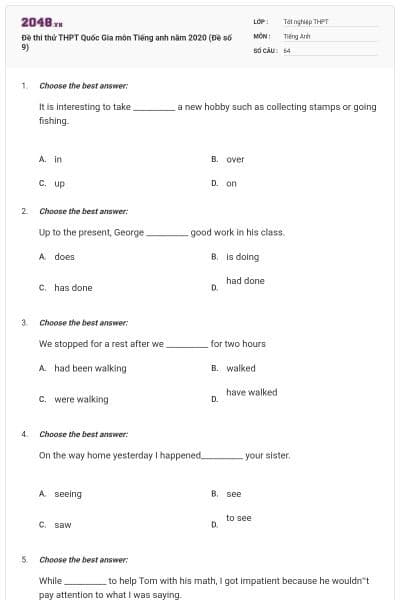
It is interesting to take __________ a new hobby such as collecting stamps or going fishing.
in
over
up
on
Đáp án là C.
Take in= bao gồm, take on= nhiễm thói, take over= chịu trách nhiệm, take up= bắt đầu.
Choose the best answer:
Up to the present, George __________ good work in his class.
does
is doing
has done
had done
Đáp án là C
Dấu hiệu “up to present” cho tới hiện tại, -> thì hiện tại hoàn thành.
Choose the best answer:
We stopped for a rest after we __________ for two hours
had been walking
walked
were walking
have walked
Đáp án là A
Cấu trúc: QKĐ+ after+ QKHT: việc xảy ra sau sự việc khác trong quá khứ.
Choose the best answer:
On the way home yesterday I happened__________ your sister.
seeing
see
saw
to see
Đáp án là D
Happen to + V= trong trường hợp…
Choose the best answer:
While __________ to help Tom with his math, I got impatient because he wouldn‟t pay attention to what I was saying.
I am trying
trying
I try
having tried
Đáp án là B
Rút gọn mệnh đề dạng chủ động: S+ V= Ving.
Choose the best answer:
They congratulated me __________ the exams with high marks.
having passed
on passing
passed
to pass
Đáp án là B
Congratulate + O+ on+ V_ing: chúc mừng ai về việc gì.
Choose the best answer:
Lots of houses __________ by the earthquake.
are destroying
destroyed
were destroying
were destroyed
Đáp án: D
Giải thích:
Câu bị động thì quá khứ đơn.
Cấu trúc: S + was/were + VpII
Dịch: Nhiều ngôi nhà bị tàn phá bởi động đất.
Choose the best answer:
Since their appearance, books are a precious __________ of knowledge and pleasure.
source
pile
amount
sum
Đáp án là A
Source= nguồn, pile= xếp chồng, amount= số lượng, sum= tổng. “a precious source of knowledge and pleasure” một nguồn kiến thức và giải trí quý báu.
Choose the best answer:
All traffic laws _______________.
is observed
must be observed
must have observed
had better observe
Đáp án là B
Must + tobe+ PP: phải được làm gì. Dịch: tất cả các luật giao thông cần phải được tuân thủ.
Choose the best answer:
If I had noticed him, I ___________ hello.
would have said
would say
had said
would said
Đáp án là A
Câu điều kiện loại 3: if+ S+ had+ PP, S+ would+ have+ PP. 11. Đáp án: C
By the way = tiện thể, nhân tiện.
Choose the best answer:
_________ the way, what did you think about the movie you saw yesterday?
From
On
By
In
Đáp án là C
By the way = tiện thể, nhân tiện.
Choose the best answer:
_____________ so many people been out of work as today.
More than ever before
Never before have
In the past, there have never
Formerly, there never were
Đáp án là B
Đảo ngữ: Never before+ trợ động từ+ S+ V…
Choose the best answer:
Going to the pub too often can easily become a bad __________
practice
tradition
custom
habit
Đáp án là D
Dịch: đi tới hộp đêm thường xuyên có thể dễ dàng trở thành một… xấu-> habit= thói quen.
Choose the best answer:
Because the first pair of pants did not fit properly, he asked for _____
another pants
the other ones
others pants
another pair
Đáp án là D
Another+ N( số ít): một cái khác, other+ Ns/es: những cái khác.
Choose the best answer:
My younger sister is very __________ and so she loves going out but I am much quieter and prefer to stay at home.
enjoyable
lively
pleasing
funny
Đáp án là B
Lively= năng nổ-> em gái tôi rất năng nổ và nó thích ra ngoài nhưng tôi lặng lẽ hơn và thích ở nhà hơn.
Choose the best answer:
_____ in UNESCO‟s World Heritage Sites in 2003, Phong Nha Ke Bang is noted for its cave and grotto systems.
Listing
To have listed
Having been listed
Having listed
Đáp án là C
Having + been+ PP: là dạng rút gọn mệnh đề dạng bị động.
Choose the best answer:
My neighbor is driving me mad! It seems that _____ it is at night, _____ he plays his music!
the less / the more loud
the less / less
the more late / the more loudlier
the later / the louder
Đáp án là D
So sánh kép càng càng với tính từ ngắn: the+ adj_er+ S+ V, the+ adj_er+ S+ V.
Choose the best answer:
I couldn't use the pay phone __________I didn't have any coins with me.
so
so that
because
although
Đáp án: C
Giải thích:
A. so: nên
B. so that: để
C. because: bởi vì
D. although: mặc dù
Dựa vào nghĩa, chọn C.
Dịch: Tôi không thể sử dụng điện thoại công cộng vì tôi không mang theo tiền xu.
Choose the best answer:
Tom: ''You must have had a very good time on holiday." Peter: "__________, it was a disaster. Everything went wrong."
By tradition
In short
On the condition
On the contrary
Đáp án là D
Tom: “ bạn hẳn phải có một kỳ nghỉ rất tuyệt.” – Peter: “…, nó là một thảm họa. Mọi thứ trở lên tồi tệ.” -> on the contrary= trái lại.
Mark the letter A, B, C or D on your answer sheet to indicate the word that differ from the rest in the position of the main stress in each of the following questions
victim
resource
passport
happen
Đáp án là B
Trọng âm của từ này rơi vào âm thứ hai , các từ còn lại trọng âm rơi vào âm thứ nhất.
Mark the letter A, B, C or D on your answer sheet to indicate the word that differ from the rest in the position of the main stress in each of the following questions
competitor
terrorism
available
compulsory
Đáp án là B
Trọng âm của từ này rơi vào âm thứ nhất , các từ còn lại trọng âm rơi vào âm thứ hai.
Mark the letter A, B, C or D on your answer sheet to indicate the word that differ from the rest in the position of the main stress in each of the following questions
environment
situation
development
responsible
Đáp án là B
Trọng âm của từ này rơi vào âm thứ ba , các từ còn lại trọng âm rơi vào âm thứ hai.
Mark the letter A, B, C or D on your answer sheet to indicate the word whose underlined part differs from the other three in pronunciation in each of the following questions
improved
invented
advantaged
suffered
Đáp án là B
“ed” trong từ “invented” đọc là /id/, trong các từ còn lại đọc là /d/.
Mark the letter A, B, C or D on your answer sheet to indicate the word whose underlined part differs from the other three in pronunciation in each of the following questions
books
keeps
laughs
plays
Đáp án là D
“s” trong từ “plays” đọc là /z/, trong các từ còn lại đọc là /s/.
Mark the letter A, B, C or D on your answer sheet to indicate the word or phrase that is OPPOSITE in meaning to the underlined part in each of the following questions.
The International Organizations are going to be in a temporary way in the country.
permanent
guess
complicated
soak
Đáp án là A
Temporary = tạm thời, permanent = lâu dài, guess= phỏng đoán, complicate= làm phức tạp, soak= thấm nước.
Mark the letter A, B, C or D on your answer sheet to indicate the word or phrase that is OPPOSITE in meaning to the underlined part in each of the following questions.
Mr. Smith‟s new neighbors appear to be very friendly.
amicable
inapplicable
hostile
futile
Đáp án: C
Giải thích:
friendly = amicable = thân thiện
inapplicable = không thể áp dụng
hostile = thù địch >< friendly
futile = vô ích
Dịch: Những người hàng xóm mới của ông Smith trông có vẻ rất thân thiện.
Mark the letter A, B, C or D on your answer sheet to indicate the word or phrase that is OPPOSITE in meaning to the underlined part in each of the following questions.
Humans depend on species diversity to provide food, clean air and water, and fertile soil for agriculture.
raise
produce
supply
reserve
Đáp án: C
Giải thích:
Kiến thức: Từ vựng – Từ đồng nghĩa
provide (v): cung cấp
Xét các đáp án:
A. raise (v): tăng, gây nên
B. produce (v): sản xuất
C. supply (v): cung cấp
D. reserve (v): dự trữ
=> provide = supply
Dịch: Con người phụ thuộc vào sự đa dạng loài để cung cấp thực phẩm, không khí và nước sạch, cũng như đất đai màu mỡ cho nông nghiệp.
Mark the letter A, B, C or D on your answer sheet to indicate the word or phrase that is OPPOSITE in meaning to the underlined part in each of the following questions.
The goalkeeper can also be ejected for twenty seconds if a major foul is committed
advanced
sprinted
played
excluded
Đáp án: D
Giải thích:
Kiến thức: Từ vựng – Từ đồng nghĩa
eject (v): đẩy ra, đuổi ra, trục xuất
advance (v): tiến bộ
sprint (v): chạy nước rút
play (v): chơi
exclude (v): loại trừ
Đáp án D phù hợp về nghĩa.
Dịch: Thủ môn cũng có thể bị rời sân trong 20 giây nếu phạm lỗi nghiêm trọng.
Mark the letter A, B, C or D on your answer sheet to indicate the word or phrase that is OPPOSITE in meaning to the underlined part in each of the following questions.
The organization was established in 1950 in the USA.
come around
set up
made out
put on
Đáp án: B
Kiến thức: Từ vựng – Cụm từ đồng nghĩa
establish (v): thành lập
Xét các đáp án:
A. come around: tỉnh lại
B. set up: thành lập, sắp xếp
C. make out: xoay sở được
D. put on: mặc
=> established = set up
Dịch: Tổ chức này được thành lập năm 1950 tại Hoa Kì.
Mark the letter A, B, C, or D on your answer sheet to show the underlined part that needs correction (from 30 to 34)
The Southeast Asian Games, also knowing (A) as the SEA Games, is a biennial (B) multisport event involving (C) participants from the current eleven countries of Southeast Asia. (D)
knowing
biennial
involving
of Southeast Asia
Đáp án là A
“knowing” -> “known” được biết, hiểu vì chủ ngữ là sự kiện không phải người-> động từ dạng bị động.
Mark the letter A, B, C, or D on your answer sheet to show the underlined part that needs correction (from 30 to 34)
Catherine is studying (A) law (B) at the university, (C) and so does (D) John.
studying
law
at the university
does
Đáp án là D
Mệnh đề 1 dùng thì hiện tại tiếp diễn-> mệnh đề sau “does”-> “is”.
Mark the letter A, B, C, or D on your answer sheet to show the underlined part that needs correction (from 30 to 34)
The tree that was struck by (A) lightning had been (B) the tallest of (C) the two trees we had (D) in the yard
struck by
had been
the tallest of
had
Đáp án là C
Khi so sánh 2 người, vật thì không thể dùng so sánh hơn nhất mà dùng so sánh hơn-> “the taller of”.
Mark the letter A, B, C, or D on your answer sheet to show the underlined part that needs correction (from 30 to 34)
He has made (A) a lot of mistakes (B) in (C) his writing because (D) his carelessness
made
mistakes
in
because
Đáp án là D
Because + Clause= because of+ N/V_ing. -> “because of”.
Mark the letter A, B, C, or D on your answer sheet to show the underlined part that needs correction (from 30 to 34)
Air pollution, together with (A) littering, are (B) causing many (C) problems in our large, (D) industrial cities today
with
are
many
in our large
Đáp án là B
A together with B + V(A): chia động từ theo chủ ngữ thứ nhất. “are”->”is”.
Read the following passage and mark the letter A, B, C, or D on your answer sheet to indicate the correct word for each of the blanks from 35 to 44.
WHY I DISLIKE COMPUTERS
Almost everyone says that computers are wonderful and that they are (35) ______ our lives for the better by making everything faster and more reliable, but I am not so sure that this is the (36) ________
The other day I was standing in a large department store waiting to pay for a couple of films for my camera (37) _______ the assistant announced that the computer which controlled the till (38) _______ working. I did not think this was a big problem and I (39)________ to find another counter, but of course, all the machines are part of the same system. So there we were: a shop full of customers, money at the ready, waiting to (40) _______ our purchases, but it was quite clear that none of the assistants knew what to do. They were not allowed to take our money and give to customers a written (41) ______,because the sales wouldn‟t then have been recorded on the computer system. In the end, (42) _______many other people, I left my shopping on the counter and walked out .Don't you think so that's ridiculous? It (43) ________ never have happened before computers, and that, for me, is the problem: we are beginning to depend on these machines so completely that we (44) _______ cannot manage without them anymore.
Điền vào ô 35
exchanging
altering
transforming
changing
Đáp án là D
Change= thay đổi, exchange= trao đổi, alter= thay thế, transform+ into= biến đổi. Dịch: và nó thay đổi cuộc sống của chúng ta cho thứ tốt hơn.
Read the following passage and mark the letter A, B, C, or D on your answer sheet to indicate the correct word for each of the blanks from 35 to 44.
WHY I DISLIKE COMPUTERS
Almost everyone says that computers are wonderful and that they are (35) ______ our lives for the better by making everything faster and more reliable, but I am not so sure that this is the (36) ________
The other day I was standing in a large department store waiting to pay for a couple of films for my camera (37) _______ the assistant announced that the computer which controlled the till (38) _______ working. I did not think this was a big problem and I (39)________ to find another counter, but of course, all the machines are part of the same system. So there we were: a shop full of customers, money at the ready, waiting to (40) _______ our purchases, but it was quite clear that none of the assistants knew what to do. They were not allowed to take our money and give to customers a written (41) ______,because the sales wouldn‟t then have been recorded on the computer system. In the end, (42) _______many other people, I left my shopping on the counter and walked out .Don't you think so that's ridiculous? It (43) ________ never have happened before computers, and that, for me, is the problem: we are beginning to depend on these machines so completely that we (44) _______ cannot manage without them anymore.
Điền vào ô 36
truth
case
reality
practice
Đáp án là B
Case= lý do, truth= reality= sự thật, practice= thói quen. Dịch: nhưng tôi không chắc về đây là lý do hợp lý.
Read the following passage and mark the letter A, B, C, or D on your answer sheet to indicate the correct word for each of the blanks from 35 to 44.
WHY I DISLIKE COMPUTERS
Almost everyone says that computers are wonderful and that they are (35) ______ our lives for the better by making everything faster and more reliable, but I am not so sure that this is the (36) ________
The other day I was standing in a large department store waiting to pay for a couple of films for my camera (37) _______ the assistant announced that the computer which controlled the till (38) _______ working. I did not think this was a big problem and I (39)________ to find another counter, but of course, all the machines are part of the same system. So there we were: a shop full of customers, money at the ready, waiting to (40) _______ our purchases, but it was quite clear that none of the assistants knew what to do. They were not allowed to take our money and give to customers a written (41) ______,because the sales wouldn‟t then have been recorded on the computer system. In the end, (42) _______many other people, I left my shopping on the counter and walked out .Don't you think so that's ridiculous? It (43) ________ never have happened before computers, and that, for me, is the problem: we are beginning to depend on these machines so completely that we (44) _______ cannot manage without them anymore.
Điền vào ô 37
but
so
when
then
Đáp án là C
Câu này kể lại các sự việc diễn ra kế tiếp nhau -> “when”. Dịch: khi tôi đang đứng xếp hàng đợi thanh toán thì người trợ lý thông báo…
Read the following passage and mark the letter A, B, C, or D on your answer sheet to indicate the correct word for each of the blanks from 35 to 44.
WHY I DISLIKE COMPUTERS
Almost everyone says that computers are wonderful and that they are (35) ______ our lives for the better by making everything faster and more reliable, but I am not so sure that this is the (36) ________
The other day I was standing in a large department store waiting to pay for a couple of films for my camera (37) _______ the assistant announced that the computer which controlled the till (38) _______ working. I did not think this was a big problem and I (39)________ to find another counter, but of course, all the machines are part of the same system. So there we were: a shop full of customers, money at the ready, waiting to (40) _______ our purchases, but it was quite clear that none of the assistants knew what to do. They were not allowed to take our money and give to customers a written (41) ______,because the sales wouldn‟t then have been recorded on the computer system. In the end, (42) _______many other people, I left my shopping on the counter and walked out .Don't you think so that's ridiculous? It (43) ________ never have happened before computers, and that, for me, is the problem: we are beginning to depend on these machines so completely that we (44) _______ cannot manage without them anymore.
Điền vào ô 38
had stopped
has stopped
stopped
would stop
Đáp án là A
Sự việc xảy ra trước một sự việc khác trong quá khứ -> QKHT: S+ had+ PP.
Read the following passage and mark the letter A, B, C, or D on your answer sheet to indicate the correct word for each of the blanks from 35 to 44.
WHY I DISLIKE COMPUTERS
Almost everyone says that computers are wonderful and that they are (35) ______ our lives for the better by making everything faster and more reliable, but I am not so sure that this is the (36) ________
The other day I was standing in a large department store waiting to pay for a couple of films for my camera (37) _______ the assistant announced that the computer which controlled the till (38) _______ working. I did not think this was a big problem and I (39)________ to find another counter, but of course, all the machines are part of the same system. So there we were: a shop full of customers, money at the ready, waiting to (40) _______ our purchases, but it was quite clear that none of the assistants knew what to do. They were not allowed to take our money and give to customers a written (41) ______,because the sales wouldn‟t then have been recorded on the computer system. In the end, (42) _______many other people, I left my shopping on the counter and walked out .Don't you think so that's ridiculous? It (43) ________ never have happened before computers, and that, for me, is the problem: we are beginning to depend on these machines so completely that we (44) _______ cannot manage without them anymore.
Điền vào ô 39
went out
set out
went off
set off
Đáp án là D
Set off= bắt đầu, set out= lên đường, go off= rời đi, go out= ra ngoài. Dịch: tôi không nghĩ đó là vấn đề lớn và tôi bắt đầu tìm quầy hàng khác.
Read the following passage and mark the letter A, B, C, or D on your answer sheet to indicate the correct word for each of the blanks from 35 to 44.
WHY I DISLIKE COMPUTERS
Almost everyone says that computers are wonderful and that they are (35) ______ our lives for the better by making everything faster and more reliable, but I am not so sure that this is the (36) ________
The other day I was standing in a large department store waiting to pay for a couple of films for my camera (37) _______ the assistant announced that the computer which controlled the till (38) _______ working. I did not think this was a big problem and I (39)________ to find another counter, but of course, all the machines are part of the same system. So there we were: a shop full of customers, money at the ready, waiting to (40) _______ our purchases, but it was quite clear that none of the assistants knew what to do. They were not allowed to take our money and give to customers a written (41) ______,because the sales wouldn‟t then have been recorded on the computer system. In the end, (42) _______many other people, I left my shopping on the counter and walked out .Don't you think so that's ridiculous? It (43) ________ never have happened before computers, and that, for me, is the problem: we are beginning to depend on these machines so completely that we (44) _______ cannot manage without them anymore.
Điền vào ô 40
do
make
pay
carry out
Đáp án là B
Make a purchase= thanh toán hóa đơn mua hàng.
Read the following passage and mark the letter A, B, C, or D on your answer sheet to indicate the correct word for each of the blanks from 35 to 44.
WHY I DISLIKE COMPUTERS
Almost everyone says that computers are wonderful and that they are (35) ______ our lives for the better by making everything faster and more reliable, but I am not so sure that this is the (36) ________
The other day I was standing in a large department store waiting to pay for a couple of films for my camera (37) _______ the assistant announced that the computer which controlled the till (38) _______ working. I did not think this was a big problem and I (39)________ to find another counter, but of course, all the machines are part of the same system. So there we were: a shop full of customers, money at the ready, waiting to (40) _______ our purchases, but it was quite clear that none of the assistants knew what to do. They were not allowed to take our money and give to customers a written (41) ______,because the sales wouldn‟t then have been recorded on the computer system. In the end, (42) _______many other people, I left my shopping on the counter and walked out .Don't you think so that's ridiculous? It (43) ________ never have happened before computers, and that, for me, is the problem: we are beginning to depend on these machines so completely that we (44) _______ cannot manage without them anymore.
Điền vào ô 41
ticket
bill
receipt
label
Đáp án là C
Receipt= biên lai. Dịch: họ không được phép lấy tiền và gửi lại khác hàng biên lại thanh toán.
Read the following passage and mark the letter A, B, C, or D on your answer sheet to indicate the correct word for each of the blanks from 35 to 44.
WHY I DISLIKE COMPUTERS
Almost everyone says that computers are wonderful and that they are (35) ______ our lives for the better by making everything faster and more reliable, but I am not so sure that this is the (36) ________
The other day I was standing in a large department store waiting to pay for a couple of films for my camera (37) _______ the assistant announced that the computer which controlled the till (38) _______ working. I did not think this was a big problem and I (39)________ to find another counter, but of course, all the machines are part of the same system. So there we were: a shop full of customers, money at the ready, waiting to (40) _______ our purchases, but it was quite clear that none of the assistants knew what to do. They were not allowed to take our money and give to customers a written (41) ______,because the sales wouldn‟t then have been recorded on the computer system. In the end, (42) _______many other people, I left my shopping on the counter and walked out .Don't you think so that's ridiculous? It (43) ________ never have happened before computers, and that, for me, is the problem: we are beginning to depend on these machines so completely that we (44) _______ cannot manage without them anymore.
Điền vào ô 42
like
as
the same as
such as
Đáp án là A
Like + N, As+ Clause: giống như.
Read the following passage and mark the letter A, B, C, or D on your answer sheet to indicate the correct word for each of the blanks from 35 to 44.
WHY I DISLIKE COMPUTERS
Almost everyone says that computers are wonderful and that they are (35) ______ our lives for the better by making everything faster and more reliable, but I am not so sure that this is the (36) ________
The other day I was standing in a large department store waiting to pay for a couple of films for my camera (37) _______ the assistant announced that the computer which controlled the till (38) _______ working. I did not think this was a big problem and I (39)________ to find another counter, but of course, all the machines are part of the same system. So there we were: a shop full of customers, money at the ready, waiting to (40) _______ our purchases, but it was quite clear that none of the assistants knew what to do. They were not allowed to take our money and give to customers a written (41) ______,because the sales wouldn‟t then have been recorded on the computer system. In the end, (42) _______many other people, I left my shopping on the counter and walked out .Don't you think so that's ridiculous? It (43) ________ never have happened before computers, and that, for me, is the problem: we are beginning to depend on these machines so completely that we (44) _______ cannot manage without them anymore.
Điền vào ô 43
should
would
ought to
might
Đáp án là B
Would have+ PP: nói về việc mình giả thiết xảy ra trong quá khứ.
Read the following passage and mark the letter A, B, C, or D on your answer sheet to indicate the correct word for each of the blanks from 35 to 44.
WHY I DISLIKE COMPUTERS
Almost everyone says that computers are wonderful and that they are (35) ______ our lives for the better by making everything faster and more reliable, but I am not so sure that this is the (36) ________
The other day I was standing in a large department store waiting to pay for a couple of films for my camera (37) _______ the assistant announced that the computer which controlled the till (38) _______ working. I did not think this was a big problem and I (39)________ to find another counter, but of course, all the machines are part of the same system. So there we were: a shop full of customers, money at the ready, waiting to (40) _______ our purchases, but it was quite clear that none of the assistants knew what to do. They were not allowed to take our money and give to customers a written (41) ______,because the sales wouldn‟t then have been recorded on the computer system. In the end, (42) _______many other people, I left my shopping on the counter and walked out .Don't you think so that's ridiculous? It (43) ________ never have happened before computers, and that, for me, is the problem: we are beginning to depend on these machines so completely that we (44) _______ cannot manage without them anymore.
Điền vào ô 44
justly
merely
only
simply
Đáp án là D
Simply= một cách tuyệt đối, merely= only= just= chỉ. Dịch: chúng ta hoàn toàn không thể quản lý được khi thiếu chúng.
Read the following passage and mark the letter A,B,C or D on your answer sheet to indicate the correct answer to each of the questions from 45 to 54
In comparison with most other places in the world, family identity is rather weak in Britain, especially in England. Of course, the family unit is still the basic living arrangement for most people. But in Britain this definitely means the nuclear family. There is little sense of extended family identity, except among some racial minorities. This is reflected in the size and composition of households.
It is unusual for adults of different generations within the family to live together. The average number of people living in each household in Britain is lower than in most other European countries. The proportion of elderly people living alone is similarly high.
Significant family events such as weddings, births and funerals are not automatically accompanied by large gatherings of people. It is still common to appoint people to certain roles on such
occasions, such as „best man‟ at a wedding, or godmother and godfather when a child is born. But for most people these appointments are of sentimental significance only. They do not imply lifelong responsibility. In fact, family gatherings of any kind beyond the household unit are rare. For most people, they are confined to the Christmas period.
Even the stereotyped nuclear family of father, mother and children is becoming less common. Britain has a higher rate of divorce than anywhere else in Europe except Denmark and the proportion of children born outside marriage has risen dramatically and is also one of the highest (about a third of all births). However, these trends do not necessarily mean that the nuclear family is disappearing. Divorces have increased, but the majority of marriages in Britain (about 55%) do not break down. In addition, it is notable that about three-quarters of all births outside marriage are officially registered by both parents and more than half of the children concerned are born to parents who are living together at the time.
Today, in Britain, many couples, mostly in their twenties or thirties, live together without getting married. Only about 60% of those couples will eventually get married. 40% of children in Britain are born to these cohabiting parents. In 2000, around a quarter of unmarried people between the ages of 16 and 59 were cohabiting in Great Britain. Unmarried couples are also starting families without first being married. Before 1960, this was very unusual, but in 2001, around 23% of births in the UK were to cohabiting couples.
In Britain, the term family should usually be understood as __________
extended
nuclear
single-parent
cohabiting
Đáp án là B
Dòng 3 đoạn 1 “this definitely means the nuclear family” điều này chắc chắn nghĩa là gia đình hạt nhân.
Read the following passage and mark the letter A,B,C or D on your answer sheet to indicate the correct answer to each of the questions from 45 to 54
In comparison with most other places in the world, family identity is rather weak in Britain, especially in England. Of course, the family unit is still the basic living arrangement for most people. But in Britain this definitely means the nuclear family. There is little sense of extended family identity, except among some racial minorities. This is reflected in the size and composition of households.
It is unusual for adults of different generations within the family to live together. The average number of people living in each household in Britain is lower than in most other European countries. The proportion of elderly people living alone is similarly high.
Significant family events such as weddings, births and funerals are not automatically accompanied by large gatherings of people. It is still common to appoint people to certain roles on such
occasions, such as „best man‟ at a wedding, or godmother and godfather when a child is born. But for most people these appointments are of sentimental significance only. They do not imply lifelong responsibility. In fact, family gatherings of any kind beyond the household unit are rare. For most people, they are confined to the Christmas period.
Even the stereotyped nuclear family of father, mother and children is becoming less common. Britain has a higher rate of divorce than anywhere else in Europe except Denmark and the proportion of children born outside marriage has risen dramatically and is also one of the highest (about a third of all births). However, these trends do not necessarily mean that the nuclear family is disappearing. Divorces have increased, but the majority of marriages in Britain (about 55%) do not break down. In addition, it is notable that about three-quarters of all births outside marriage are officially registered by both parents and more than half of the children concerned are born to parents who are living together at the time.
Today, in Britain, many couples, mostly in their twenties or thirties, live together without getting married. Only about 60% of those couples will eventually get married. 40% of children in Britain are born to these cohabiting parents. In 2000, around a quarter of unmarried people between the ages of 16 and 59 were cohabiting in Great Britain. Unmarried couples are also starting families without first being married. Before 1960, this was very unusual, but in 2001, around 23% of births in the UK were to cohabiting couples.
Roles such as best man, godfather are only of _________ values
emotional
responsible
important
rare
Đáp án là A
Dòng 4 đoạn 3 “most people these appointments are of sentimental significance only” với hầu hết mọi người thì những sự kiện này chỉ mang ý nghĩa về mặt tình cảm.
Read the following passage and mark the letter A,B,C or D on your answer sheet to indicate the correct answer to each of the questions from 45 to 54
In comparison with most other places in the world, family identity is rather weak in Britain, especially in England. Of course, the family unit is still the basic living arrangement for most people. But in Britain this definitely means the nuclear family. There is little sense of extended family identity, except among some racial minorities. This is reflected in the size and composition of households.
It is unusual for adults of different generations within the family to live together. The average number of people living in each household in Britain is lower than in most other European countries. The proportion of elderly people living alone is similarly high.
Significant family events such as weddings, births and funerals are not automatically accompanied by large gatherings of people. It is still common to appoint people to certain roles on such
occasions, such as „best man‟ at a wedding, or godmother and godfather when a child is born. But for most people these appointments are of sentimental significance only. They do not imply lifelong responsibility. In fact, family gatherings of any kind beyond the household unit are rare. For most people, they are confined to the Christmas period.
Even the stereotyped nuclear family of father, mother and children is becoming less common. Britain has a higher rate of divorce than anywhere else in Europe except Denmark and the proportion of children born outside marriage has risen dramatically and is also one of the highest (about a third of all births). However, these trends do not necessarily mean that the nuclear family is disappearing. Divorces have increased, but the majority of marriages in Britain (about 55%) do not break down. In addition, it is notable that about three-quarters of all births outside marriage are officially registered by both parents and more than half of the children concerned are born to parents who are living together at the time.
Today, in Britain, many couples, mostly in their twenties or thirties, live together without getting married. Only about 60% of those couples will eventually get married. 40% of children in Britain are born to these cohabiting parents. In 2000, around a quarter of unmarried people between the ages of 16 and 59 were cohabiting in Great Britain. Unmarried couples are also starting families without first being married. Before 1960, this was very unusual, but in 2001, around 23% of births in the UK were to cohabiting couples.
The most popular period for family gatherings yearly is ___________
weddings
funerals
Christmas
births
Đáp án là C
Dòng cuối đoạn 3 “they are confined to the Christmas period.” Hầu hết mợi người chỉ h tập trung lại vào kỳ lễ Giáng sinh
Read the following passage and mark the letter A,B,C or D on your answer sheet to indicate the correct answer to each of the questions from 45 to 54
In comparison with most other places in the world, family identity is rather weak in Britain, especially in England. Of course, the family unit is still the basic living arrangement for most people. But in Britain this definitely means the nuclear family. There is little sense of extended family identity, except among some racial minorities. This is reflected in the size and composition of households.
It is unusual for adults of different generations within the family to live together. The average number of people living in each household in Britain is lower than in most other European countries. The proportion of elderly people living alone is similarly high.
Significant family events such as weddings, births and funerals are not automatically accompanied by large gatherings of people. It is still common to appoint people to certain roles on such
occasions, such as „best man‟ at a wedding, or godmother and godfather when a child is born. But for most people these appointments are of sentimental significance only. They do not imply lifelong responsibility. In fact, family gatherings of any kind beyond the household unit are rare. For most people, they are confined to the Christmas period.
Even the stereotyped nuclear family of father, mother and children is becoming less common. Britain has a higher rate of divorce than anywhere else in Europe except Denmark and the proportion of children born outside marriage has risen dramatically and is also one of the highest (about a third of all births). However, these trends do not necessarily mean that the nuclear family is disappearing. Divorces have increased, but the majority of marriages in Britain (about 55%) do not break down. In addition, it is notable that about three-quarters of all births outside marriage are officially registered by both parents and more than half of the children concerned are born to parents who are living together at the time.
Today, in Britain, many couples, mostly in their twenties or thirties, live together without getting married. Only about 60% of those couples will eventually get married. 40% of children in Britain are born to these cohabiting parents. In 2000, around a quarter of unmarried people between the ages of 16 and 59 were cohabiting in Great Britain. Unmarried couples are also starting families without first being married. Before 1960, this was very unusual, but in 2001, around 23% of births in the UK were to cohabiting couples.
The divorce rate in Britain is the ______ in Europe.
highest
second highest
third highest
lowest
Đáp án là B
Dòng 2 đoạn 4 “Britain has a higher rate of divorce than anywhere else in Europe except Denmark.” Anh có tỉ lệ ly hôn cao hơn bất cứ nơi nào trên châu Âu trừ Đan Mạch-> cao thứ 2.
Read the following passage and mark the letter A,B,C or D on your answer sheet to indicate the correct answer to each of the questions from 45 to 54
In comparison with most other places in the world, family identity is rather weak in Britain, especially in England. Of course, the family unit is still the basic living arrangement for most people. But in Britain this definitely means the nuclear family. There is little sense of extended family identity, except among some racial minorities. This is reflected in the size and composition of households.
It is unusual for adults of different generations within the family to live together. The average number of people living in each household in Britain is lower than in most other European countries. The proportion of elderly people living alone is similarly high.
Significant family events such as weddings, births and funerals are not automatically accompanied by large gatherings of people. It is still common to appoint people to certain roles on such
occasions, such as „best man‟ at a wedding, or godmother and godfather when a child is born. But for most people these appointments are of sentimental significance only. They do not imply lifelong responsibility. In fact, family gatherings of any kind beyond the household unit are rare. For most people, they are confined to the Christmas period.
Even the stereotyped nuclear family of father, mother and children is becoming less common. Britain has a higher rate of divorce than anywhere else in Europe except Denmark and the proportion of children born outside marriage has risen dramatically and is also one of the highest (about a third of all births). However, these trends do not necessarily mean that the nuclear family is disappearing. Divorces have increased, but the majority of marriages in Britain (about 55%) do not break down. In addition, it is notable that about three-quarters of all births outside marriage are officially registered by both parents and more than half of the children concerned are born to parents who are living together at the time.
Today, in Britain, many couples, mostly in their twenties or thirties, live together without getting married. Only about 60% of those couples will eventually get married. 40% of children in Britain are born to these cohabiting parents. In 2000, around a quarter of unmarried people between the ages of 16 and 59 were cohabiting in Great Britain. Unmarried couples are also starting families without first being married. Before 1960, this was very unusual, but in 2001, around 23% of births in the UK were to cohabiting couples.
About 75% of the births outside marriage are _________
born to parents living together
born to single parents
registered by both parents
concerned by cohabiting parents
Đáp án là C
Dòng 6 đoạn 4 “about three-quarters of all births outside marriage are officially registered by both parents” khoảng ¾ ca sinh ngoài giá thú được đăng ký hợp pháp bởi cả cha và mẹ.
Read the following passage and mark the letter A,B,C or D on your answer sheet to indicate the correct answer to each of the questions from 45 to 54
In comparison with most other places in the world, family identity is rather weak in Britain, especially in England. Of course, the family unit is still the basic living arrangement for most people. But in Britain this definitely means the nuclear family. There is little sense of extended family identity, except among some racial minorities. This is reflected in the size and composition of households.
It is unusual for adults of different generations within the family to live together. The average number of people living in each household in Britain is lower than in most other European countries. The proportion of elderly people living alone is similarly high.
Significant family events such as weddings, births and funerals are not automatically accompanied by large gatherings of people. It is still common to appoint people to certain roles on such
occasions, such as „best man‟ at a wedding, or godmother and godfather when a child is born. But for most people these appointments are of sentimental significance only. They do not imply lifelong responsibility. In fact, family gatherings of any kind beyond the household unit are rare. For most people, they are confined to the Christmas period.
Even the stereotyped nuclear family of father, mother and children is becoming less common. Britain has a higher rate of divorce than anywhere else in Europe except Denmark and the proportion of children born outside marriage has risen dramatically and is also one of the highest (about a third of all births). However, these trends do not necessarily mean that the nuclear family is disappearing. Divorces have increased, but the majority of marriages in Britain (about 55%) do not break down. In addition, it is notable that about three-quarters of all births outside marriage are officially registered by both parents and more than half of the children concerned are born to parents who are living together at the time.
Today, in Britain, many couples, mostly in their twenties or thirties, live together without getting married. Only about 60% of those couples will eventually get married. 40% of children in Britain are born to these cohabiting parents. In 2000, around a quarter of unmarried people between the ages of 16 and 59 were cohabiting in Great Britain. Unmarried couples are also starting families without first being married. Before 1960, this was very unusual, but in 2001, around 23% of births in the UK were to cohabiting couples.
The leading factor contributing to the increase in the number of single-parent family is __
women working
the choice to be lone parents
high divorce rate
old age marriage
Đáp án là B
Loại trừ đáp án: A- không đề cập đến, C- tỉ lệ ly hôn cao. Nhưng phần lớn các cuộc hôn nhân không bị phá vỡ (dòng 5 đoạn 4) và D- kết hôn muộn -> sai vì kết hôn muộn là do các cặp cha mẹ muốn sống chung mà không đăng ký -> còn lại đáp án B.
Read the following passage and mark the letter A,B,C or D on your answer sheet to indicate the correct answer to each of the questions from 45 to 54
In comparison with most other places in the world, family identity is rather weak in Britain, especially in England. Of course, the family unit is still the basic living arrangement for most people. But in Britain this definitely means the nuclear family. There is little sense of extended family identity, except among some racial minorities. This is reflected in the size and composition of households.
It is unusual for adults of different generations within the family to live together. The average number of people living in each household in Britain is lower than in most other European countries. The proportion of elderly people living alone is similarly high.
Significant family events such as weddings, births and funerals are not automatically accompanied by large gatherings of people. It is still common to appoint people to certain roles on such
occasions, such as „best man‟ at a wedding, or godmother and godfather when a child is born. But for most people these appointments are of sentimental significance only. They do not imply lifelong responsibility. In fact, family gatherings of any kind beyond the household unit are rare. For most people, they are confined to the Christmas period.
Even the stereotyped nuclear family of father, mother and children is becoming less common. Britain has a higher rate of divorce than anywhere else in Europe except Denmark and the proportion of children born outside marriage has risen dramatically and is also one of the highest (about a third of all births). However, these trends do not necessarily mean that the nuclear family is disappearing. Divorces have increased, but the majority of marriages in Britain (about 55%) do not break down. In addition, it is notable that about three-quarters of all births outside marriage are officially registered by both parents and more than half of the children concerned are born to parents who are living together at the time.
Today, in Britain, many couples, mostly in their twenties or thirties, live together without getting married. Only about 60% of those couples will eventually get married. 40% of children in Britain are born to these cohabiting parents. In 2000, around a quarter of unmarried people between the ages of 16 and 59 were cohabiting in Great Britain. Unmarried couples are also starting families without first being married. Before 1960, this was very unusual, but in 2001, around 23% of births in the UK were to cohabiting couples.
The word reflected in paragraph 1 is closest in meaning to _______
shown
changed
discussed
repeated
Đáp án là A
Reflect= phản ánh, show= cho thấy.
Read the following passage and mark the letter A,B,C or D on your answer sheet to indicate the correct answer to each of the questions from 45 to 54
In comparison with most other places in the world, family identity is rather weak in Britain, especially in England. Of course, the family unit is still the basic living arrangement for most people. But in Britain this definitely means the nuclear family. There is little sense of extended family identity, except among some racial minorities. This is reflected in the size and composition of households.
It is unusual for adults of different generations within the family to live together. The average number of people living in each household in Britain is lower than in most other European countries. The proportion of elderly people living alone is similarly high.
Significant family events such as weddings, births and funerals are not automatically accompanied by large gatherings of people. It is still common to appoint people to certain roles on such
occasions, such as „best man‟ at a wedding, or godmother and godfather when a child is born. But for most people these appointments are of sentimental significance only. They do not imply lifelong responsibility. In fact, family gatherings of any kind beyond the household unit are rare. For most people, they are confined to the Christmas period.
Even the stereotyped nuclear family of father, mother and children is becoming less common. Britain has a higher rate of divorce than anywhere else in Europe except Denmark and the proportion of children born outside marriage has risen dramatically and is also one of the highest (about a third of all births). However, these trends do not necessarily mean that the nuclear family is disappearing. Divorces have increased, but the majority of marriages in Britain (about 55%) do not break down. In addition, it is notable that about three-quarters of all births outside marriage are officially registered by both parents and more than half of the children concerned are born to parents who are living together at the time.
Today, in Britain, many couples, mostly in their twenties or thirties, live together without getting married. Only about 60% of those couples will eventually get married. 40% of children in Britain are born to these cohabiting parents. In 2000, around a quarter of unmarried people between the ages of 16 and 59 were cohabiting in Great Britain. Unmarried couples are also starting families without first being married. Before 1960, this was very unusual, but in 2001, around 23% of births in the UK were to cohabiting couples.
The word cohabiting in paragraph 5 is closest in meaning to __________
married
living together
having children
unusual
Đáp án là B
Cohabiting= sống chung. “co”- cùng, “habitat”- nơi ở.
Read the following passage and mark the letter A,B,C or D on your answer sheet to indicate the correct answer to each of the questions from 45 to 54
In comparison with most other places in the world, family identity is rather weak in Britain, especially in England. Of course, the family unit is still the basic living arrangement for most people. But in Britain this definitely means the nuclear family. There is little sense of extended family identity, except among some racial minorities. This is reflected in the size and composition of households.
It is unusual for adults of different generations within the family to live together. The average number of people living in each household in Britain is lower than in most other European countries. The proportion of elderly people living alone is similarly high.
Significant family events such as weddings, births and funerals are not automatically accompanied by large gatherings of people. It is still common to appoint people to certain roles on such
occasions, such as „best man‟ at a wedding, or godmother and godfather when a child is born. But for most people these appointments are of sentimental significance only. They do not imply lifelong responsibility. In fact, family gatherings of any kind beyond the household unit are rare. For most people, they are confined to the Christmas period.
Even the stereotyped nuclear family of father, mother and children is becoming less common. Britain has a higher rate of divorce than anywhere else in Europe except Denmark and the proportion of children born outside marriage has risen dramatically and is also one of the highest (about a third of all births). However, these trends do not necessarily mean that the nuclear family is disappearing. Divorces have increased, but the majority of marriages in Britain (about 55%) do not break down. In addition, it is notable that about three-quarters of all births outside marriage are officially registered by both parents and more than half of the children concerned are born to parents who are living together at the time.
Today, in Britain, many couples, mostly in their twenties or thirties, live together without getting married. Only about 60% of those couples will eventually get married. 40% of children in Britain are born to these cohabiting parents. In 2000, around a quarter of unmarried people between the ages of 16 and 59 were cohabiting in Great Britain. Unmarried couples are also starting families without first being married. Before 1960, this was very unusual, but in 2001, around 23% of births in the UK were to cohabiting couples.
What is the most suitable heading for paragraph 4?
Cohabiting couples
Children outside marriage
Unmarried children
Changing view on marriage
Đáp án là D
Nội dung đoạn 4 là: tỷ lệ ly hôn cao, số trẻ sinh ngoài giá thú nhưng được khai sinh bởi cả cha mẹ lớn,…-> sự thay đổi cách nhìn về hôn nhân.
Read the following passage and mark the letter A,B,C or D on your answer sheet to indicate the correct answer to each of the questions from 45 to 54
In comparison with most other places in the world, family identity is rather weak in Britain, especially in England. Of course, the family unit is still the basic living arrangement for most people. But in Britain this definitely means the nuclear family. There is little sense of extended family identity, except among some racial minorities. This is reflected in the size and composition of households.
It is unusual for adults of different generations within the family to live together. The average number of people living in each household in Britain is lower than in most other European countries. The proportion of elderly people living alone is similarly high.
Significant family events such as weddings, births and funerals are not automatically accompanied by large gatherings of people. It is still common to appoint people to certain roles on such
occasions, such as „best man‟ at a wedding, or godmother and godfather when a child is born. But for most people these appointments are of sentimental significance only. They do not imply lifelong responsibility. In fact, family gatherings of any kind beyond the household unit are rare. For most people, they are confined to the Christmas period.
Even the stereotyped nuclear family of father, mother and children is becoming less common. Britain has a higher rate of divorce than anywhere else in Europe except Denmark and the proportion of children born outside marriage has risen dramatically and is also one of the highest (about a third of all births). However, these trends do not necessarily mean that the nuclear family is disappearing. Divorces have increased, but the majority of marriages in Britain (about 55%) do not break down. In addition, it is notable that about three-quarters of all births outside marriage are officially registered by both parents and more than half of the children concerned are born to parents who are living together at the time.
Today, in Britain, many couples, mostly in their twenties or thirties, live together without getting married. Only about 60% of those couples will eventually get married. 40% of children in Britain are born to these cohabiting parents. In 2000, around a quarter of unmarried people between the ages of 16 and 59 were cohabiting in Great Britain. Unmarried couples are also starting families without first being married. Before 1960, this was very unusual, but in 2001, around 23% of births in the UK were to cohabiting couples.
What is the most suitable title for the whole passage?
British family types
British family changes
British family identity
British family relation
Đáp án là B
Tương tự như câu trên, cả bài nói về sự thay đổi về gia đình ở Anh.
Read the following passage and mark the letter A,B,C or D on your answer sheet to indicate the correct answer to each of the questions from 55 to 64
An air pollutant is defined as a compound added directly or indirectly by humans to the atmosphere in such quantities as to affect humans, animals, vegetation, or materials adversely. Air pollution requires a very flexible definition that permits continuous change. When the first air pollution laws were established in England in the fourteenth century, air pollutants were limited to compounds that could be seen or smelled - a far cry from the extensive list of harmful substances known today. As technology has developed and knowledge of the health aspects of various chemicals has increased, the list of air pollutants has lengthened. In the future, even water vapor might be considered an air pollutant under certain conditions.
Many of the more important air pollutants, such as sulfur oxides, carbon monoxide, and nitrogen oxides, are found in nature. As the Earth developed, the concentration of these pollutants was altered by various chemical reactions; they became components in biogeochemical cycles. These serve as an air purification scheme by allowing the compounds to move from the air to the water or soil. On a global basis, nature's output of these compounds dwarfs that resulting from human activities.
However, human production usually occurs in a localized area, such as a city. In such a region, human output may be dominant and may temporarily overload the natural purification scheme of the cycles. The result is an increased concentration of noxious chemicals in the air. The concentrations at which the adverse effects appear will be greater than the concentrations that the pollutants would have in the absence of human activities. The actual concentration need not be large for a substance to be a pollutant; in fact, the numerical value tells us little until we know how much of an increase this represents over the concentration that would occur naturally in the area. For example, sulfur dioxide has detectable health effects at 0.08 parts per million (ppm), which is about 400 times its natural level. Carbon monoxide, however, has a natural level of 0.1 ppm and is not usually a pollutant until its level reaches about 15 ppm
What does the passage mainly discuss?
The economic impact of air pollution.
The effects of compounds added to the atmosphere
What constitutes an air pollutant
How much harm air pollutants can cause.
Đáp án là C
Nội dung đáp án B là: cấu tạo của chất gây ô nhiễm môi trường. Dựa vào: “A useful definition of an air pollutant”, “Many of the more important air pollutants”, “The actual concentration need not be large for a substance to be a pollutant”.
Read the following passage and mark the letter A,B,C or D on your answer sheet to indicate the correct answer to each of the questions from 55 to 64
An air pollutant is defined as a compound added directly or indirectly by humans to the atmosphere in such quantities as to affect humans, animals, vegetation, or materials adversely. Air pollution requires a very flexible definition that permits continuous change. When the first air pollution laws were established in England in the fourteenth century, air pollutants were limited to compounds that could be seen or smelled - a far cry from the extensive list of harmful substances known today. As technology has developed and knowledge of the health aspects of various chemicals has increased, the list of air pollutants has lengthened. In the future, even water vapor might be considered an air pollutant under certain conditions.
Many of the more important air pollutants, such as sulfur oxides, carbon monoxide, and nitrogen oxides, are found in nature. As the Earth developed, the concentration of these pollutants was altered by various chemical reactions; they became components in biogeochemical cycles. These serve as an air purification scheme by allowing the compounds to move from the air to the water or soil. On a global basis, nature's output of these compounds dwarfs that resulting from human activities.
However, human production usually occurs in a localized area, such as a city. In such a region, human output may be dominant and may temporarily overload the natural purification scheme of the cycles. The result is an increased concentration of noxious chemicals in the air. The concentrations at which the adverse effects appear will be greater than the concentrations that the pollutants would have in the absence of human activities. The actual concentration need not be large for a substance to be a pollutant; in fact, the numerical value tells us little until we know how much of an increase this represents over the concentration that would occur naturally in the area. For example, sulfur dioxide has detectable health effects at 0.08 parts per million (ppm), which is about 400 times its natural level. Carbon monoxide, however, has a natural level of 0.1 ppm and is not usually a pollutant until its level reaches about 15 ppm
The word "adversely" in the first paragraph is closest in meaning to _______.
negatively
quickly
considerably
admittedly
Đáp án là A
adversely = negatively = bất lợi, admittedly= có thể chấp nhận, quickly= nhanh, considerable= đáng xem xét.
Read the following passage and mark the letter A,B,C or D on your answer sheet to indicate the correct answer to each of the questions from 55 to 64
An air pollutant is defined as a compound added directly or indirectly by humans to the atmosphere in such quantities as to affect humans, animals, vegetation, or materials adversely. Air pollution requires a very flexible definition that permits continuous change. When the first air pollution laws were established in England in the fourteenth century, air pollutants were limited to compounds that could be seen or smelled - a far cry from the extensive list of harmful substances known today. As technology has developed and knowledge of the health aspects of various chemicals has increased, the list of air pollutants has lengthened. In the future, even water vapor might be considered an air pollutant under certain conditions.
Many of the more important air pollutants, such as sulfur oxides, carbon monoxide, and nitrogen oxides, are found in nature. As the Earth developed, the concentration of these pollutants was altered by various chemical reactions; they became components in biogeochemical cycles. These serve as an air purification scheme by allowing the compounds to move from the air to the water or soil. On a global basis, nature's output of these compounds dwarfs that resulting from human activities.
However, human production usually occurs in a localized area, such as a city. In such a region, human output may be dominant and may temporarily overload the natural purification scheme of the cycles. The result is an increased concentration of noxious chemicals in the air. The concentrations at which the adverse effects appear will be greater than the concentrations that the pollutants would have in the absence of human activities. The actual concentration need not be large for a substance to be a pollutant; in fact, the numerical value tells us little until we know how much of an increase this represents over the concentration that would occur naturally in the area. For example, sulfur dioxide has detectable health effects at 0.08 parts per million (ppm), which is about 400 times its natural level. Carbon monoxide, however, has a natural level of 0.1 ppm and is not usually a pollutant until its level reaches about 15 ppm
It can be inferred from the first paragraph that _______.
most air pollutants today can be seen or smelled
water vapor is an air pollutant in localized areas
a substance becomes an air pollutant only in cities
the definition of air pollution will continue to change
Đáp án là D
Câu 2 đoạn 1: “Air pollution requires a very flexible definition that permits continuous change” ô nhiễm không khí yêu cầu 1 định nghĩa phức tạp cho pháp sự thay đổi.
Read the following passage and mark the letter A,B,C or D on your answer sheet to indicate the correct answer to each of the questions from 55 to 64
An air pollutant is defined as a compound added directly or indirectly by humans to the atmosphere in such quantities as to affect humans, animals, vegetation, or materials adversely. Air pollution requires a very flexible definition that permits continuous change. When the first air pollution laws were established in England in the fourteenth century, air pollutants were limited to compounds that could be seen or smelled - a far cry from the extensive list of harmful substances known today. As technology has developed and knowledge of the health aspects of various chemicals has increased, the list of air pollutants has lengthened. In the future, even water vapor might be considered an air pollutant under certain conditions.
Many of the more important air pollutants, such as sulfur oxides, carbon monoxide, and nitrogen oxides, are found in nature. As the Earth developed, the concentration of these pollutants was altered by various chemical reactions; they became components in biogeochemical cycles. These serve as an air purification scheme by allowing the compounds to move from the air to the water or soil. On a global basis, nature's output of these compounds dwarfs that resulting from human activities.
However, human production usually occurs in a localized area, such as a city. In such a region, human output may be dominant and may temporarily overload the natural purification scheme of the cycles. The result is an increased concentration of noxious chemicals in the air. The concentrations at which the adverse effects appear will be greater than the concentrations that the pollutants would have in the absence of human activities. The actual concentration need not be large for a substance to be a pollutant; in fact, the numerical value tells us little until we know how much of an increase this represents over the concentration that would occur naturally in the area. For example, sulfur dioxide has detectable health effects at 0.08 parts per million (ppm), which is about 400 times its natural level. Carbon monoxide, however, has a natural level of 0.1 ppm and is not usually a pollutant until its level reaches about 15 ppm
The word "These" in the second paragraph is closest in meaning to________.
the components in biogeochemical cycles
the pollutants from the developing Earth
the various chemical reactions
the compounds moved to the water
Đáp án là A
Dịch câu 2 và 3 đoạn 2: Khi trái đất phát triển, nồng độ của các chất ô nhiễm được thay đổi bằng phản ứng hóa học khác nhau; chúng trở thành các thành phần trong chu trình sinh địa hóa. Những chất này hoạt động như là một chương trình làm sạch bằng cách cho phép các hợp chất di chuyển từ không khí tới nước hay đất.
Read the following passage and mark the letter A,B,C or D on your answer sheet to indicate the correct answer to each of the questions from 55 to 64
An air pollutant is defined as a compound added directly or indirectly by humans to the atmosphere in such quantities as to affect humans, animals, vegetation, or materials adversely. Air pollution requires a very flexible definition that permits continuous change. When the first air pollution laws were established in England in the fourteenth century, air pollutants were limited to compounds that could be seen or smelled - a far cry from the extensive list of harmful substances known today. As technology has developed and knowledge of the health aspects of various chemicals has increased, the list of air pollutants has lengthened. In the future, even water vapor might be considered an air pollutant under certain conditions.
Many of the more important air pollutants, such as sulfur oxides, carbon monoxide, and nitrogen oxides, are found in nature. As the Earth developed, the concentration of these pollutants was altered by various chemical reactions; they became components in biogeochemical cycles. These serve as an air purification scheme by allowing the compounds to move from the air to the water or soil. On a global basis, nature's output of these compounds dwarfs that resulting from human activities.
However, human production usually occurs in a localized area, such as a city. In such a region, human output may be dominant and may temporarily overload the natural purification scheme of the cycles. The result is an increased concentration of noxious chemicals in the air. The concentrations at which the adverse effects appear will be greater than the concentrations that the pollutants would have in the absence of human activities. The actual concentration need not be large for a substance to be a pollutant; in fact, the numerical value tells us little until we know how much of an increase this represents over the concentration that would occur naturally in the area. For example, sulfur dioxide has detectable health effects at 0.08 parts per million (ppm), which is about 400 times its natural level. Carbon monoxide, however, has a natural level of 0.1 ppm and is not usually a pollutant until its level reaches about 15 ppm
For which of the following reasons can natural pollutants play an important role in controlling air pollution?
They are less harmful to living beings than other pollutants.
They have existed since the Earth developed
They occur in greater quantities than other pollutants.
They function as part of a purification process.
Đáp án là D
Từ câu trên cho thấy các chất thải tự nhiên hoạt động như một phần của của chu trình làm sạch.
Read the following passage and mark the letter A,B,C or D on your answer sheet to indicate the correct answer to each of the questions from 55 to 64
An air pollutant is defined as a compound added directly or indirectly by humans to the atmosphere in such quantities as to affect humans, animals, vegetation, or materials adversely. Air pollution requires a very flexible definition that permits continuous change. When the first air pollution laws were established in England in the fourteenth century, air pollutants were limited to compounds that could be seen or smelled - a far cry from the extensive list of harmful substances known today. As technology has developed and knowledge of the health aspects of various chemicals has increased, the list of air pollutants has lengthened. In the future, even water vapor might be considered an air pollutant under certain conditions.
Many of the more important air pollutants, such as sulfur oxides, carbon monoxide, and nitrogen oxides, are found in nature. As the Earth developed, the concentration of these pollutants was altered by various chemical reactions; they became components in biogeochemical cycles. These serve as an air purification scheme by allowing the compounds to move from the air to the water or soil. On a global basis, nature's output of these compounds dwarfs that resulting from human activities.
However, human production usually occurs in a localized area, such as a city. In such a region, human output may be dominant and may temporarily overload the natural purification scheme of the cycles. The result is an increased concentration of noxious chemicals in the air. The concentrations at which the adverse effects appear will be greater than the concentrations that the pollutants would have in the absence of human activities. The actual concentration need not be large for a substance to be a pollutant; in fact, the numerical value tells us little until we know how much of an increase this represents over the concentration that would occur naturally in the area. For example, sulfur dioxide has detectable health effects at 0.08 parts per million (ppm), which is about 400 times its natural level. Carbon monoxide, however, has a natural level of 0.1 ppm and is not usually a pollutant until its level reaches about 15 ppm
According to the passage, human-generated air pollution in localized regions _______
will damage areas outside of the localized regions
can be dwarfed by nature's output of pollutants
will react harmfully with natural pollutants
can overwhelm the natural system that removes pollutants
Đáp án là D
Dựa vào câu 1 đoạn 4 “human output may be dominant and may temporarily overload the natural purification scheme of the cycle” rác thải của con người có thể quá tải với cơ chế làm sạch tự nhiên. -> nó lấn át hệ sinh thái tự nhiên cái mà làm sạch chất ô nhiếm.
Read the following passage and mark the letter A,B,C or D on your answer sheet to indicate the correct answer to each of the questions from 55 to 64
An air pollutant is defined as a compound added directly or indirectly by humans to the atmosphere in such quantities as to affect humans, animals, vegetation, or materials adversely. Air pollution requires a very flexible definition that permits continuous change. When the first air pollution laws were established in England in the fourteenth century, air pollutants were limited to compounds that could be seen or smelled - a far cry from the extensive list of harmful substances known today. As technology has developed and knowledge of the health aspects of various chemicals has increased, the list of air pollutants has lengthened. In the future, even water vapor might be considered an air pollutant under certain conditions.
Many of the more important air pollutants, such as sulfur oxides, carbon monoxide, and nitrogen oxides, are found in nature. As the Earth developed, the concentration of these pollutants was altered by various chemical reactions; they became components in biogeochemical cycles. These serve as an air purification scheme by allowing the compounds to move from the air to the water or soil. On a global basis, nature's output of these compounds dwarfs that resulting from human activities.
However, human production usually occurs in a localized area, such as a city. In such a region, human output may be dominant and may temporarily overload the natural purification scheme of the cycles. The result is an increased concentration of noxious chemicals in the air. The concentrations at which the adverse effects appear will be greater than the concentrations that the pollutants would have in the absence of human activities. The actual concentration need not be large for a substance to be a pollutant; in fact, the numerical value tells us little until we know how much of an increase this represents over the concentration that would occur naturally in the area. For example, sulfur dioxide has detectable health effects at 0.08 parts per million (ppm), which is about 400 times its natural level. Carbon monoxide, however, has a natural level of 0.1 ppm and is not usually a pollutant until its level reaches about 15 ppm
The word "localized" in the third paragraph is closest in meaning to _______.
encircled
circled
specified
surrounded
Đáp án là C
Localized= định vị hóa, specified= được chỉ rõ, circled= khoanh tròn lại, encircled= bao quanh.
Read the following passage and mark the letter A,B,C or D on your answer sheet to indicate the correct answer to each of the questions from 55 to 64
An air pollutant is defined as a compound added directly or indirectly by humans to the atmosphere in such quantities as to affect humans, animals, vegetation, or materials adversely. Air pollution requires a very flexible definition that permits continuous change. When the first air pollution laws were established in England in the fourteenth century, air pollutants were limited to compounds that could be seen or smelled - a far cry from the extensive list of harmful substances known today. As technology has developed and knowledge of the health aspects of various chemicals has increased, the list of air pollutants has lengthened. In the future, even water vapor might be considered an air pollutant under certain conditions.
Many of the more important air pollutants, such as sulfur oxides, carbon monoxide, and nitrogen oxides, are found in nature. As the Earth developed, the concentration of these pollutants was altered by various chemical reactions; they became components in biogeochemical cycles. These serve as an air purification scheme by allowing the compounds to move from the air to the water or soil. On a global basis, nature's output of these compounds dwarfs that resulting from human activities.
However, human production usually occurs in a localized area, such as a city. In such a region, human output may be dominant and may temporarily overload the natural purification scheme of the cycles. The result is an increased concentration of noxious chemicals in the air. The concentrations at which the adverse effects appear will be greater than the concentrations that the pollutants would have in the absence of human activities. The actual concentration need not be large for a substance to be a pollutant; in fact, the numerical value tells us little until we know how much of an increase this represents over the concentration that would occur naturally in the area. For example, sulfur dioxide has detectable health effects at 0.08 parts per million (ppm), which is about 400 times its natural level. Carbon monoxide, however, has a natural level of 0.1 ppm and is not usually a pollutant until its level reaches about 15 ppm
According to the passage, the numerical value of the concentration level of a substance is only useful if _______.
it is in a localized area
it can be calculated quickly
the natural level is also known
the other substances in the area are known
Đáp án là C
Dựa vào câu 4 đoạn 4 “in fact the numerical value tells us little until we know how much of an increase this represents over the concentration that would occur naturally in the area” trên thực tế, chỉ số chỉ có ý nghĩa cho tới khi chúng ta nhận ra sự gia tăng tiêu biểu quá nồng độ tự nhiên.
Read the following passage and mark the letter A,B,C or D on your answer sheet to indicate the correct answer to each of the questions from 55 to 64
An air pollutant is defined as a compound added directly or indirectly by humans to the atmosphere in such quantities as to affect humans, animals, vegetation, or materials adversely. Air pollution requires a very flexible definition that permits continuous change. When the first air pollution laws were established in England in the fourteenth century, air pollutants were limited to compounds that could be seen or smelled - a far cry from the extensive list of harmful substances known today. As technology has developed and knowledge of the health aspects of various chemicals has increased, the list of air pollutants has lengthened. In the future, even water vapor might be considered an air pollutant under certain conditions.
Many of the more important air pollutants, such as sulfur oxides, carbon monoxide, and nitrogen oxides, are found in nature. As the Earth developed, the concentration of these pollutants was altered by various chemical reactions; they became components in biogeochemical cycles. These serve as an air purification scheme by allowing the compounds to move from the air to the water or soil. On a global basis, nature's output of these compounds dwarfs that resulting from human activities.
However, human production usually occurs in a localized area, such as a city. In such a region, human output may be dominant and may temporarily overload the natural purification scheme of the cycles. The result is an increased concentration of noxious chemicals in the air. The concentrations at which the adverse effects appear will be greater than the concentrations that the pollutants would have in the absence of human activities. The actual concentration need not be large for a substance to be a pollutant; in fact, the numerical value tells us little until we know how much of an increase this represents over the concentration that would occur naturally in the area. For example, sulfur dioxide has detectable health effects at 0.08 parts per million (ppm), which is about 400 times its natural level. Carbon monoxide, however, has a natural level of 0.1 ppm and is not usually a pollutant until its level reaches about 15 ppm
The word "detectable" in the third paragraph is closest in meaning to_________
beneficial
separable
measurable
special
Đáp án là C
Detectable= có thể nhận ra= measurable, beneficial= có lợi, special= đặc biết, separable= có thể tách rời.
Read the following passage and mark the letter A,B,C or D on your answer sheet to indicate the correct answer to each of the questions from 55 to 64
An air pollutant is defined as a compound added directly or indirectly by humans to the atmosphere in such quantities as to affect humans, animals, vegetation, or materials adversely. Air pollution requires a very flexible definition that permits continuous change. When the first air pollution laws were established in England in the fourteenth century, air pollutants were limited to compounds that could be seen or smelled - a far cry from the extensive list of harmful substances known today. As technology has developed and knowledge of the health aspects of various chemicals has increased, the list of air pollutants has lengthened. In the future, even water vapor might be considered an air pollutant under certain conditions.
Many of the more important air pollutants, such as sulfur oxides, carbon monoxide, and nitrogen oxides, are found in nature. As the Earth developed, the concentration of these pollutants was altered by various chemical reactions; they became components in biogeochemical cycles. These serve as an air purification scheme by allowing the compounds to move from the air to the water or soil. On a global basis, nature's output of these compounds dwarfs that resulting from human activities.
However, human production usually occurs in a localized area, such as a city. In such a region, human output may be dominant and may temporarily overload the natural purification scheme of the cycles. The result is an increased concentration of noxious chemicals in the air. The concentrations at which the adverse effects appear will be greater than the concentrations that the pollutants would have in the absence of human activities. The actual concentration need not be large for a substance to be a pollutant; in fact, the numerical value tells us little until we know how much of an increase this represents over the concentration that would occur naturally in the area. For example, sulfur dioxide has detectable health effects at 0.08 parts per million (ppm), which is about 400 times its natural level. Carbon monoxide, however, has a natural level of 0.1 ppm and is not usually a pollutant until its level reaches about 15 ppm
Which of the following is best supported by the passage?
Scientists should be consulted in order to establish uniform limits for all air pollutants.
One of the most important steps in preserving natural lands is to better enforce air pollution laws.
Human activities have been effective in reducing air pollution.
To effectively control pollution, local government should regularly review their air pollution laws.
Đáp án là C
Câu 1 đoạn 1 “compound added directly or indirectly by humans to the atmosphere” phức hợp của việc tác động trực tiếp hay gián tiếp đến không khí. -> hành động của con người ảnh hưởng đến việc giảm ô nhiễm không khí.