Đề thi thử THPT Quốc Gia môn Tiếng anh năm 2020 (Đề số 7)
63 câu hỏi
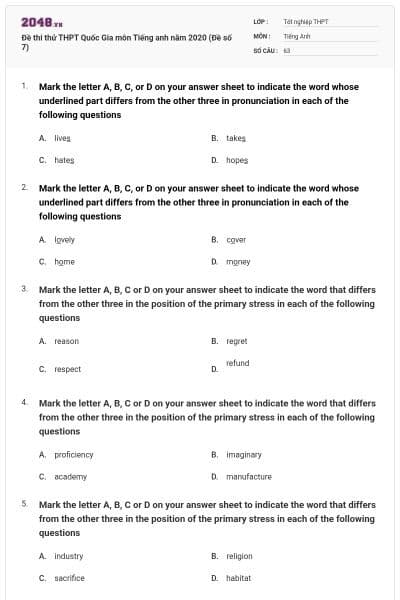
Mark the letter A, B, C, or D on your answer sheet to indicate the word whose underlined part differs from the other three in pronunciation in each of the following questions
lives
takes
hates
hopes
Đáp án A.
A./z/ B./s/ C./s/ D./s/ Các từ có phát âm /k,p,t/ khi thêm s được phát âm là /s/ Còn lại là /z/
Mark the letter A, B, C, or D on your answer sheet to indicate the word whose underlined part differs from the other three in pronunciation in each of the following questions
lovely
cover
home
money
Đáp án C.
A./ʌ/ B. /ʌ/ C./əʊ/ D. /ʌ/
Mark the letter A, B, C or D on your answer sheet to indicate the word that differs from the other three in the position of the primary stress in each of the following questions
reason
regret
respect
refund
Không có đáp án phù hợp Tất cả các từ đều có trọng âm rơi vào âm tiết thứ 2
Mark the letter A, B, C or D on your answer sheet to indicate the word that differs from the other three in the position of the primary stress in each of the following questions
proficiency
imaginary
academy
manufacture
Đáp án D.
Phần D trọng âm rơi vào âm tiết thứ 3, còn lại là thứ 2
Mark the letter A, B, C or D on your answer sheet to indicate the word that differs from the other three in the position of the primary stress in each of the following questions
industry
religion
sacrifice
habitat
Đáp án B.
Phần B trọng âm rơi vào âm tiết thứ 2, còn lại là thứ nhất
Read the following passage and mark the letter A, B, C, or D on your answer sheet to indicate the correct answer to each of the following questions from 6 to 15
The English universities
The University of Paris became the model for French universities north of the Loire and for those of central Europe and England; Oxford would appear to have been the earliest. Certain schools, opened early in the 12th century within the precincts of the dissolved nunnery of St. Frideswide and of Oseney Abbey, are supposed to have been the nucleus around which it grew. But the beginning may have been a migration of English students from Paris about 1167 or 1168. Immediately after 1168, allusions to Oxford as a studium and a studium generale begin to multiply. In the 13th century, mention first occurs of university “chests,” which were benefactions designed for the assistance of poor students. Halls, or places of licensed residence for students, also began to be established. Against periodic vicissitudes, such as student dispersions and plagues, the foundation of colleges proved the most effective remedy. The earliest colleges were University College, founded in 1249; Balliol College, founded about 1263; and Merton College, founded in 1264.
The University of Cambridge, although it came into existence somewhat later than Oxford, may reasonably be held to have had its origin in the same century. In 1112, the canons of St. Giles crossed the River Cam and took up their residence in the new priory in Barnwell, and their work of instruction acquired additional importance. In 1209, a body of students migrated there from Oxford. Then, about 1224, the Franciscans established themselves in the town and, somewhat less than half a century later, were followed by the Dominicans. At both the English universities, as at Paris, the mendicants and other religious orders were admitted to degrees—a privilege that, until the year 1337, was extended to them at no other university. Their interest in and influence at these three centres were consequently proportionately great.
In 1231 and 1233, royal and papal letters afford satisfactory proof that the University of Cambridge was already an organized body, with a chancellor at its head.
Universities elsewhere in Europe
From the 13th to the 15th century, studia generalia or universities proliferated in central and northern Europe and were usually modeled on the University of Paris. Although the earliest was Prague, which existed as a studium in the 13th century and was chartered by Pope Clement VI in 1348, perhaps no medieval university achieved a more rapid and permanent success than Heidelberg. The University of Heidelberg, the oldest in the German realm, received its charter in 1386 from Pope Urban VI as a studium generale and contained all the recognized faculties— theology, canon law, medicine, and the arts, as well as civil law. In the subsequent 100 years, universities were founded at Cologne, Erfurt, Leipzig, Rostock, Freiburg, Tübingen, Ofen (Budapest), Basel, Uppsala, and Copenhagen.
Spain was also an important scene of developments in higher education. Valladolid received its charter in 1346 and attained great celebrity after it obtained the rank of studium generale and a universitas theologiae by a decree of Pope Martin V in 1418. Salamanca was founded in 1243 by Ferdinand III of Castile with faculties of arts, medicine, and jurisprudence, to which theology was added through the efforts of Martin V. The College of St. Bartholomew, the earliest founded at Salamanca, was noted for its ancient library and valuable collection of manuscripts. Other important early Spanish and Portuguese schools were Sevilla, Alcalá, and Lisbon.
According to paragraph 1, which of the following universities or colleges is thought to be the oldest?
University of Paris
Balliol College
University of Oxford
University College
Đáp án C.
Thông tin ở câu đầu tiên đoạn 1: Oxford would appear to have been the earliest. (Oxford xuất hiện sớm nhất -> Oxford có độ tuổi lớn nhất = the oldest)
Read the following passage and mark the letter A, B, C, or D on your answer sheet to indicate the correct answer to each of the following questions from 6 to 15
The English universities
The University of Paris became the model for French universities north of the Loire and for those of central Europe and England; Oxford would appear to have been the earliest. Certain schools, opened early in the 12th century within the precincts of the dissolved nunnery of St. Frideswide and of Oseney Abbey, are supposed to have been the nucleus around which it grew. But the beginning may have been a migration of English students from Paris about 1167 or 1168. Immediately after 1168, allusions to Oxford as a studium and a studium generale begin to multiply. In the 13th century, mention first occurs of university “chests,” which were benefactions designed for the assistance of poor students. Halls, or places of licensed residence for students, also began to be established. Against periodic vicissitudes, such as student dispersions and plagues, the foundation of colleges proved the most effective remedy. The earliest colleges were University College, founded in 1249; Balliol College, founded about 1263; and Merton College, founded in 1264.
The University of Cambridge, although it came into existence somewhat later than Oxford, may reasonably be held to have had its origin in the same century. In 1112, the canons of St. Giles crossed the River Cam and took up their residence in the new priory in Barnwell, and their work of instruction acquired additional importance. In 1209, a body of students migrated there from Oxford. Then, about 1224, the Franciscans established themselves in the town and, somewhat less than half a century later, were followed by the Dominicans. At both the English universities, as at Paris, the mendicants and other religious orders were admitted to degrees—a privilege that, until the year 1337, was extended to them at no other university. Their interest in and influence at these three centres were consequently proportionately great.
In 1231 and 1233, royal and papal letters afford satisfactory proof that the University of Cambridge was already an organized body, with a chancellor at its head.
Universities elsewhere in Europe
From the 13th to the 15th century, studia generalia or universities proliferated in central and northern Europe and were usually modeled on the University of Paris. Although the earliest was Prague, which existed as a studium in the 13th century and was chartered by Pope Clement VI in 1348, perhaps no medieval university achieved a more rapid and permanent success than Heidelberg. The University of Heidelberg, the oldest in the German realm, received its charter in 1386 from Pope Urban VI as a studium generale and contained all the recognized faculties— theology, canon law, medicine, and the arts, as well as civil law. In the subsequent 100 years, universities were founded at Cologne, Erfurt, Leipzig, Rostock, Freiburg, Tübingen, Ofen (Budapest), Basel, Uppsala, and Copenhagen.
Spain was also an important scene of developments in higher education. Valladolid received its charter in 1346 and attained great celebrity after it obtained the rank of studium generale and a universitas theologiae by a decree of Pope Martin V in 1418. Salamanca was founded in 1243 by Ferdinand III of Castile with faculties of arts, medicine, and jurisprudence, to which theology was added through the efforts of Martin V. The College of St. Bartholomew, the earliest founded at Salamanca, was noted for its ancient library and valuable collection of manuscripts. Other important early Spanish and Portuguese schools were Sevilla, Alcalá, and Lisbon.
The word “it” in line 3 of paragraph 1 refers to _______.
St. Frideswide
Oseney Abbey
Oxford
University of Paris
Đáp án C.
“it” trong câu được hiểu là Oxford.
Ở câu trước có đề cập Oxford xuất hiện sớm nhất, ở câu này, tác giả có đề cập: Certain schools, opened early in the 12th century within the precincts of the dissolved nunnery of St. Frideswide and of Oseney Abbey, are supposed to have been the nucleus around which it grew. (Một số trường học, mở ra vào đầu thế kỷ thứ 12 trong khuôn viên của tu viện bị giải thể của St. Frideswide và Oseney Abbey, được cho là hạt nhân giúp nó phát triển), một số trường học được mở ra ở khuôn viên bị giải thể -> không phát triển được bằng Oxford -> “it” chính là Oxford.
Read the following passage and mark the letter A, B, C, or D on your answer sheet to indicate the correct answer to each of the following questions from 6 to 15
The English universities
The University of Paris became the model for French universities north of the Loire and for those of central Europe and England; Oxford would appear to have been the earliest. Certain schools, opened early in the 12th century within the precincts of the dissolved nunnery of St. Frideswide and of Oseney Abbey, are supposed to have been the nucleus around which it grew. But the beginning may have been a migration of English students from Paris about 1167 or 1168. Immediately after 1168, allusions to Oxford as a studium and a studium generale begin to multiply. In the 13th century, mention first occurs of university “chests,” which were benefactions designed for the assistance of poor students. Halls, or places of licensed residence for students, also began to be established. Against periodic vicissitudes, such as student dispersions and plagues, the foundation of colleges proved the most effective remedy. The earliest colleges were University College, founded in 1249; Balliol College, founded about 1263; and Merton College, founded in 1264.
The University of Cambridge, although it came into existence somewhat later than Oxford, may reasonably be held to have had its origin in the same century. In 1112, the canons of St. Giles crossed the River Cam and took up their residence in the new priory in Barnwell, and their work of instruction acquired additional importance. In 1209, a body of students migrated there from Oxford. Then, about 1224, the Franciscans established themselves in the town and, somewhat less than half a century later, were followed by the Dominicans. At both the English universities, as at Paris, the mendicants and other religious orders were admitted to degrees—a privilege that, until the year 1337, was extended to them at no other university. Their interest in and influence at these three centres were consequently proportionately great.
In 1231 and 1233, royal and papal letters afford satisfactory proof that the University of Cambridge was already an organized body, with a chancellor at its head.
Universities elsewhere in Europe
From the 13th to the 15th century, studia generalia or universities proliferated in central and northern Europe and were usually modeled on the University of Paris. Although the earliest was Prague, which existed as a studium in the 13th century and was chartered by Pope Clement VI in 1348, perhaps no medieval university achieved a more rapid and permanent success than Heidelberg. The University of Heidelberg, the oldest in the German realm, received its charter in 1386 from Pope Urban VI as a studium generale and contained all the recognized faculties— theology, canon law, medicine, and the arts, as well as civil law. In the subsequent 100 years, universities were founded at Cologne, Erfurt, Leipzig, Rostock, Freiburg, Tübingen, Ofen (Budapest), Basel, Uppsala, and Copenhagen.
Spain was also an important scene of developments in higher education. Valladolid received its charter in 1346 and attained great celebrity after it obtained the rank of studium generale and a universitas theologiae by a decree of Pope Martin V in 1418. Salamanca was founded in 1243 by Ferdinand III of Castile with faculties of arts, medicine, and jurisprudence, to which theology was added through the efforts of Martin V. The College of St. Bartholomew, the earliest founded at Salamanca, was noted for its ancient library and valuable collection of manuscripts. Other important early Spanish and Portuguese schools were Sevilla, Alcalá, and Lisbon.
Which event(s) was likely to give Oxford a start in its recognition?
periodic vicissitudes
the assistance of poor students
a studium generale
a migration of English students from Paris
Đáp án D.
Thông tin ở đoạn 1: But the beginning may have been a migration of English students from Paris about 1167 or 1168.
Câu trước có đề cập đến sự phát triển của Oxford (Certain schools, .., are supposed to have been
the nucleus around which it grew.) thì câu sau đã nói: But the beginning may have been a migration of English students from Paris about 1167 or 1168. (Nhưng sự khởi đầu – cho sự phát triển – có thể là do sự di trú của học sinh Anh từ Pháp)
Do đó, đáp án là a migration of English students from Paris
Read the following passage and mark the letter A, B, C, or D on your answer sheet to indicate the correct answer to each of the following questions from 6 to 15
The English universities
The University of Paris became the model for French universities north of the Loire and for those of central Europe and England; Oxford would appear to have been the earliest. Certain schools, opened early in the 12th century within the precincts of the dissolved nunnery of St. Frideswide and of Oseney Abbey, are supposed to have been the nucleus around which it grew. But the beginning may have been a migration of English students from Paris about 1167 or 1168. Immediately after 1168, allusions to Oxford as a studium and a studium generale begin to multiply. In the 13th century, mention first occurs of university “chests,” which were benefactions designed for the assistance of poor students. Halls, or places of licensed residence for students, also began to be established. Against periodic vicissitudes, such as student dispersions and plagues, the foundation of colleges proved the most effective remedy. The earliest colleges were University College, founded in 1249; Balliol College, founded about 1263; and Merton College, founded in 1264.
The University of Cambridge, although it came into existence somewhat later than Oxford, may reasonably be held to have had its origin in the same century. In 1112, the canons of St. Giles crossed the River Cam and took up their residence in the new priory in Barnwell, and their work of instruction acquired additional importance. In 1209, a body of students migrated there from Oxford. Then, about 1224, the Franciscans established themselves in the town and, somewhat less than half a century later, were followed by the Dominicans. At both the English universities, as at Paris, the mendicants and other religious orders were admitted to degrees—a privilege that, until the year 1337, was extended to them at no other university. Their interest in and influence at these three centres were consequently proportionately great.
In 1231 and 1233, royal and papal letters afford satisfactory proof that the University of Cambridge was already an organized body, with a chancellor at its head.
Universities elsewhere in Europe
From the 13th to the 15th century, studia generalia or universities proliferated in central and northern Europe and were usually modeled on the University of Paris. Although the earliest was Prague, which existed as a studium in the 13th century and was chartered by Pope Clement VI in 1348, perhaps no medieval university achieved a more rapid and permanent success than Heidelberg. The University of Heidelberg, the oldest in the German realm, received its charter in 1386 from Pope Urban VI as a studium generale and contained all the recognized faculties— theology, canon law, medicine, and the arts, as well as civil law. In the subsequent 100 years, universities were founded at Cologne, Erfurt, Leipzig, Rostock, Freiburg, Tübingen, Ofen (Budapest), Basel, Uppsala, and Copenhagen.
Spain was also an important scene of developments in higher education. Valladolid received its charter in 1346 and attained great celebrity after it obtained the rank of studium generale and a universitas theologiae by a decree of Pope Martin V in 1418. Salamanca was founded in 1243 by Ferdinand III of Castile with faculties of arts, medicine, and jurisprudence, to which theology was added through the efforts of Martin V. The College of St. Bartholomew, the earliest founded at Salamanca, was noted for its ancient library and valuable collection of manuscripts. Other important early Spanish and Portuguese schools were Sevilla, Alcalá, and Lisbon.
The phrase “the canons” in paragraph 2 can be best replaced with _______.
the governments
the priests of a church
the university students
the strong big guns
Đáp án B.
“the canons” = the priests of a church: giáo sĩ đặc nhiệm ở một nhà thờ
Read the following passage and mark the letter A, B, C, or D on your answer sheet to indicate the correct answer to each of the following questions from 6 to 15
The English universities
The University of Paris became the model for French universities north of the Loire and for those of central Europe and England; Oxford would appear to have been the earliest. Certain schools, opened early in the 12th century within the precincts of the dissolved nunnery of St. Frideswide and of Oseney Abbey, are supposed to have been the nucleus around which it grew. But the beginning may have been a migration of English students from Paris about 1167 or 1168. Immediately after 1168, allusions to Oxford as a studium and a studium generale begin to multiply. In the 13th century, mention first occurs of university “chests,” which were benefactions designed for the assistance of poor students. Halls, or places of licensed residence for students, also began to be established. Against periodic vicissitudes, such as student dispersions and plagues, the foundation of colleges proved the most effective remedy. The earliest colleges were University College, founded in 1249; Balliol College, founded about 1263; and Merton College, founded in 1264.
The University of Cambridge, although it came into existence somewhat later than Oxford, may reasonably be held to have had its origin in the same century. In 1112, the canons of St. Giles crossed the River Cam and took up their residence in the new priory in Barnwell, and their work of instruction acquired additional importance. In 1209, a body of students migrated there from Oxford. Then, about 1224, the Franciscans established themselves in the town and, somewhat less than half a century later, were followed by the Dominicans. At both the English universities, as at Paris, the mendicants and other religious orders were admitted to degrees—a privilege that, until the year 1337, was extended to them at no other university. Their interest in and influence at these three centres were consequently proportionately great.
In 1231 and 1233, royal and papal letters afford satisfactory proof that the University of Cambridge was already an organized body, with a chancellor at its head.
Universities elsewhere in Europe
From the 13th to the 15th century, studia generalia or universities proliferated in central and northern Europe and were usually modeled on the University of Paris. Although the earliest was Prague, which existed as a studium in the 13th century and was chartered by Pope Clement VI in 1348, perhaps no medieval university achieved a more rapid and permanent success than Heidelberg. The University of Heidelberg, the oldest in the German realm, received its charter in 1386 from Pope Urban VI as a studium generale and contained all the recognized faculties— theology, canon law, medicine, and the arts, as well as civil law. In the subsequent 100 years, universities were founded at Cologne, Erfurt, Leipzig, Rostock, Freiburg, Tübingen, Ofen (Budapest), Basel, Uppsala, and Copenhagen.
Spain was also an important scene of developments in higher education. Valladolid received its charter in 1346 and attained great celebrity after it obtained the rank of studium generale and a universitas theologiae by a decree of Pope Martin V in 1418. Salamanca was founded in 1243 by Ferdinand III of Castile with faculties of arts, medicine, and jurisprudence, to which theology was added through the efforts of Martin V. The College of St. Bartholomew, the earliest founded at Salamanca, was noted for its ancient library and valuable collection of manuscripts. Other important early Spanish and Portuguese schools were Sevilla, Alcalá, and Lisbon.
It can be infered from the passage that “the mendicants” in line 6 of paragraph 2 means _______.
the residence
the persons of religion
the persons who migrate
the persons of medicine
Đáp án B.
Ở đoạn 2 có đề cập: At both the English universities, as at Paris, the mendicants and other
religious orders were admitted to degrees
“the mendicants” = someone in a religious group
Đáp án chính xác là the persons of religion
Read the following passage and mark the letter A, B, C, or D on your answer sheet to indicate the correct answer to each of the following questions from 6 to 15
The English universities
The University of Paris became the model for French universities north of the Loire and for those of central Europe and England; Oxford would appear to have been the earliest. Certain schools, opened early in the 12th century within the precincts of the dissolved nunnery of St. Frideswide and of Oseney Abbey, are supposed to have been the nucleus around which it grew. But the beginning may have been a migration of English students from Paris about 1167 or 1168. Immediately after 1168, allusions to Oxford as a studium and a studium generale begin to multiply. In the 13th century, mention first occurs of university “chests,” which were benefactions designed for the assistance of poor students. Halls, or places of licensed residence for students, also began to be established. Against periodic vicissitudes, such as student dispersions and plagues, the foundation of colleges proved the most effective remedy. The earliest colleges were University College, founded in 1249; Balliol College, founded about 1263; and Merton College, founded in 1264.
The University of Cambridge, although it came into existence somewhat later than Oxford, may reasonably be held to have had its origin in the same century. In 1112, the canons of St. Giles crossed the River Cam and took up their residence in the new priory in Barnwell, and their work of instruction acquired additional importance. In 1209, a body of students migrated there from Oxford. Then, about 1224, the Franciscans established themselves in the town and, somewhat less than half a century later, were followed by the Dominicans. At both the English universities, as at Paris, the mendicants and other religious orders were admitted to degrees—a privilege that, until the year 1337, was extended to them at no other university. Their interest in and influence at these three centres were consequently proportionately great.
In 1231 and 1233, royal and papal letters afford satisfactory proof that the University of Cambridge was already an organized body, with a chancellor at its head.
Universities elsewhere in Europe
From the 13th to the 15th century, studia generalia or universities proliferated in central and northern Europe and were usually modeled on the University of Paris. Although the earliest was Prague, which existed as a studium in the 13th century and was chartered by Pope Clement VI in 1348, perhaps no medieval university achieved a more rapid and permanent success than Heidelberg. The University of Heidelberg, the oldest in the German realm, received its charter in 1386 from Pope Urban VI as a studium generale and contained all the recognized faculties— theology, canon law, medicine, and the arts, as well as civil law. In the subsequent 100 years, universities were founded at Cologne, Erfurt, Leipzig, Rostock, Freiburg, Tübingen, Ofen (Budapest), Basel, Uppsala, and Copenhagen.
Spain was also an important scene of developments in higher education. Valladolid received its charter in 1346 and attained great celebrity after it obtained the rank of studium generale and a universitas theologiae by a decree of Pope Martin V in 1418. Salamanca was founded in 1243 by Ferdinand III of Castile with faculties of arts, medicine, and jurisprudence, to which theology was added through the efforts of Martin V. The College of St. Bartholomew, the earliest founded at Salamanca, was noted for its ancient library and valuable collection of manuscripts. Other important early Spanish and Portuguese schools were Sevilla, Alcalá, and Lisbon.
Which of the following is TRUE, according to the passage?
Starting from 1276, those who liked the recognition as a scholar had to pass a 15-day exam.
The first English universities, in their origin, partly copyed the Parisian model.
Until 1231 and 1233 Cambridge University was disorganized.
The mendicants’ influence at the 3 universities was small.
Đáp án B.
Thông tin ở đoạn đầu: The University of Paris became the model for French universities north of the Loire and for those of central Europe and England; Oxford would appear to have been the earliest. (Đại học Paris là khuôn mẫu cho phía bắc Loire, trung tâm châu Âu và Anh, do đó có thể hiểu, các trường đại học ở Anh có 1 phần nào đó giống với đại học Paris - The first English universities, in their origin, partly copyed the Parisian model.)
Read the following passage and mark the letter A, B, C, or D on your answer sheet to indicate the correct answer to each of the following questions from 6 to 15
The English universities
The University of Paris became the model for French universities north of the Loire and for those of central Europe and England; Oxford would appear to have been the earliest. Certain schools, opened early in the 12th century within the precincts of the dissolved nunnery of St. Frideswide and of Oseney Abbey, are supposed to have been the nucleus around which it grew. But the beginning may have been a migration of English students from Paris about 1167 or 1168. Immediately after 1168, allusions to Oxford as a studium and a studium generale begin to multiply. In the 13th century, mention first occurs of university “chests,” which were benefactions designed for the assistance of poor students. Halls, or places of licensed residence for students, also began to be established. Against periodic vicissitudes, such as student dispersions and plagues, the foundation of colleges proved the most effective remedy. The earliest colleges were University College, founded in 1249; Balliol College, founded about 1263; and Merton College, founded in 1264.
The University of Cambridge, although it came into existence somewhat later than Oxford, may reasonably be held to have had its origin in the same century. In 1112, the canons of St. Giles crossed the River Cam and took up their residence in the new priory in Barnwell, and their work of instruction acquired additional importance. In 1209, a body of students migrated there from Oxford. Then, about 1224, the Franciscans established themselves in the town and, somewhat less than half a century later, were followed by the Dominicans. At both the English universities, as at Paris, the mendicants and other religious orders were admitted to degrees—a privilege that, until the year 1337, was extended to them at no other university. Their interest in and influence at these three centres were consequently proportionately great.
In 1231 and 1233, royal and papal letters afford satisfactory proof that the University of Cambridge was already an organized body, with a chancellor at its head.
Universities elsewhere in Europe
From the 13th to the 15th century, studia generalia or universities proliferated in central and northern Europe and were usually modeled on the University of Paris. Although the earliest was Prague, which existed as a studium in the 13th century and was chartered by Pope Clement VI in 1348, perhaps no medieval university achieved a more rapid and permanent success than Heidelberg. The University of Heidelberg, the oldest in the German realm, received its charter in 1386 from Pope Urban VI as a studium generale and contained all the recognized faculties— theology, canon law, medicine, and the arts, as well as civil law. In the subsequent 100 years, universities were founded at Cologne, Erfurt, Leipzig, Rostock, Freiburg, Tübingen, Ofen (Budapest), Basel, Uppsala, and Copenhagen.
Spain was also an important scene of developments in higher education. Valladolid received its charter in 1346 and attained great celebrity after it obtained the rank of studium generale and a universitas theologiae by a decree of Pope Martin V in 1418. Salamanca was founded in 1243 by Ferdinand III of Castile with faculties of arts, medicine, and jurisprudence, to which theology was added through the efforts of Martin V. The College of St. Bartholomew, the earliest founded at Salamanca, was noted for its ancient library and valuable collection of manuscripts. Other important early Spanish and Portuguese schools were Sevilla, Alcalá, and Lisbon.
The word “charter” in paragraph 5 probably means ______.
document
chapter
diagram
character
Đáp án A.
“charter” = document: văn bản, văn bản đặc quyền
Read the following passage and mark the letter A, B, C, or D on your answer sheet to indicate the correct answer to each of the following questions from 6 to 15
The English universities
The University of Paris became the model for French universities north of the Loire and for those of central Europe and England; Oxford would appear to have been the earliest. Certain schools, opened early in the 12th century within the precincts of the dissolved nunnery of St. Frideswide and of Oseney Abbey, are supposed to have been the nucleus around which it grew. But the beginning may have been a migration of English students from Paris about 1167 or 1168. Immediately after 1168, allusions to Oxford as a studium and a studium generale begin to multiply. In the 13th century, mention first occurs of university “chests,” which were benefactions designed for the assistance of poor students. Halls, or places of licensed residence for students, also began to be established. Against periodic vicissitudes, such as student dispersions and plagues, the foundation of colleges proved the most effective remedy. The earliest colleges were University College, founded in 1249; Balliol College, founded about 1263; and Merton College, founded in 1264.
The University of Cambridge, although it came into existence somewhat later than Oxford, may reasonably be held to have had its origin in the same century. In 1112, the canons of St. Giles crossed the River Cam and took up their residence in the new priory in Barnwell, and their work of instruction acquired additional importance. In 1209, a body of students migrated there from Oxford. Then, about 1224, the Franciscans established themselves in the town and, somewhat less than half a century later, were followed by the Dominicans. At both the English universities, as at Paris, the mendicants and other religious orders were admitted to degrees—a privilege that, until the year 1337, was extended to them at no other university. Their interest in and influence at these three centres were consequently proportionately great.
In 1231 and 1233, royal and papal letters afford satisfactory proof that the University of Cambridge was already an organized body, with a chancellor at its head.
Universities elsewhere in Europe
From the 13th to the 15th century, studia generalia or universities proliferated in central and northern Europe and were usually modeled on the University of Paris. Although the earliest was Prague, which existed as a studium in the 13th century and was chartered by Pope Clement VI in 1348, perhaps no medieval university achieved a more rapid and permanent success than Heidelberg. The University of Heidelberg, the oldest in the German realm, received its charter in 1386 from Pope Urban VI as a studium generale and contained all the recognized faculties— theology, canon law, medicine, and the arts, as well as civil law. In the subsequent 100 years, universities were founded at Cologne, Erfurt, Leipzig, Rostock, Freiburg, Tübingen, Ofen (Budapest), Basel, Uppsala, and Copenhagen.
Spain was also an important scene of developments in higher education. Valladolid received its charter in 1346 and attained great celebrity after it obtained the rank of studium generale and a universitas theologiae by a decree of Pope Martin V in 1418. Salamanca was founded in 1243 by Ferdinand III of Castile with faculties of arts, medicine, and jurisprudence, to which theology was added through the efforts of Martin V. The College of St. Bartholomew, the earliest founded at Salamanca, was noted for its ancient library and valuable collection of manuscripts. Other important early Spanish and Portuguese schools were Sevilla, Alcalá, and Lisbon.
Which of the following is NOT TRUE, according to the passage?
The University of Prague was chartered the earliest in central and northern Europe.
“studia generalia” are universities.
The University of Heidelberg was the oldest one in Europe.
The University of Heidelberg taught all the recognized faculties then.
Đáp án C.
Thông tin ở đoạn số 4: The University of Heidelberg, the oldest in the German realm (trường đại học Heidelberg có tuổi đời lâu nhất ở Đức, chứ không phải châu Âu)
Ngoài ra, đầu đoạn 4 có nói: Although the earliest was Prague… (trường đại học Prague ra đời sớm nhất)
Read the following passage and mark the letter A, B, C, or D on your answer sheet to indicate the correct answer to each of the following questions from 6 to 15
The English universities
The University of Paris became the model for French universities north of the Loire and for those of central Europe and England; Oxford would appear to have been the earliest. Certain schools, opened early in the 12th century within the precincts of the dissolved nunnery of St. Frideswide and of Oseney Abbey, are supposed to have been the nucleus around which it grew. But the beginning may have been a migration of English students from Paris about 1167 or 1168. Immediately after 1168, allusions to Oxford as a studium and a studium generale begin to multiply. In the 13th century, mention first occurs of university “chests,” which were benefactions designed for the assistance of poor students. Halls, or places of licensed residence for students, also began to be established. Against periodic vicissitudes, such as student dispersions and plagues, the foundation of colleges proved the most effective remedy. The earliest colleges were University College, founded in 1249; Balliol College, founded about 1263; and Merton College, founded in 1264.
The University of Cambridge, although it came into existence somewhat later than Oxford, may reasonably be held to have had its origin in the same century. In 1112, the canons of St. Giles crossed the River Cam and took up their residence in the new priory in Barnwell, and their work of instruction acquired additional importance. In 1209, a body of students migrated there from Oxford. Then, about 1224, the Franciscans established themselves in the town and, somewhat less than half a century later, were followed by the Dominicans. At both the English universities, as at Paris, the mendicants and other religious orders were admitted to degrees—a privilege that, until the year 1337, was extended to them at no other university. Their interest in and influence at these three centres were consequently proportionately great.
In 1231 and 1233, royal and papal letters afford satisfactory proof that the University of Cambridge was already an organized body, with a chancellor at its head.
Universities elsewhere in Europe
From the 13th to the 15th century, studia generalia or universities proliferated in central and northern Europe and were usually modeled on the University of Paris. Although the earliest was Prague, which existed as a studium in the 13th century and was chartered by Pope Clement VI in 1348, perhaps no medieval university achieved a more rapid and permanent success than Heidelberg. The University of Heidelberg, the oldest in the German realm, received its charter in 1386 from Pope Urban VI as a studium generale and contained all the recognized faculties— theology, canon law, medicine, and the arts, as well as civil law. In the subsequent 100 years, universities were founded at Cologne, Erfurt, Leipzig, Rostock, Freiburg, Tübingen, Ofen (Budapest), Basel, Uppsala, and Copenhagen.
Spain was also an important scene of developments in higher education. Valladolid received its charter in 1346 and attained great celebrity after it obtained the rank of studium generale and a universitas theologiae by a decree of Pope Martin V in 1418. Salamanca was founded in 1243 by Ferdinand III of Castile with faculties of arts, medicine, and jurisprudence, to which theology was added through the efforts of Martin V. The College of St. Bartholomew, the earliest founded at Salamanca, was noted for its ancient library and valuable collection of manuscripts. Other important early Spanish and Portuguese schools were Sevilla, Alcalá, and Lisbon.
Which of the following was not a faculty in Spanish universities?
geology
medicine
arts
theology
Đáp án A.
Các đáp án B, C, D đều được đề cập: The University of Heidelberg, the oldest in the German realm, received its charter in 1386 from Pope Urban VI as a studium generale and contained all the recognized faculties—theology, canon law, medicine, and the arts, as well as civil law. Chỉ có đáp án A là không được nói đến
Read the following passage and mark the letter A, B, C, or D on your answer sheet to indicate the correct answer to each of the following questions from 6 to 15
The English universities
The University of Paris became the model for French universities north of the Loire and for those of central Europe and England; Oxford would appear to have been the earliest. Certain schools, opened early in the 12th century within the precincts of the dissolved nunnery of St. Frideswide and of Oseney Abbey, are supposed to have been the nucleus around which it grew. But the beginning may have been a migration of English students from Paris about 1167 or 1168. Immediately after 1168, allusions to Oxford as a studium and a studium generale begin to multiply. In the 13th century, mention first occurs of university “chests,” which were benefactions designed for the assistance of poor students. Halls, or places of licensed residence for students, also began to be established. Against periodic vicissitudes, such as student dispersions and plagues, the foundation of colleges proved the most effective remedy. The earliest colleges were University College, founded in 1249; Balliol College, founded about 1263; and Merton College, founded in 1264.
The University of Cambridge, although it came into existence somewhat later than Oxford, may reasonably be held to have had its origin in the same century. In 1112, the canons of St. Giles crossed the River Cam and took up their residence in the new priory in Barnwell, and their work of instruction acquired additional importance. In 1209, a body of students migrated there from Oxford. Then, about 1224, the Franciscans established themselves in the town and, somewhat less than half a century later, were followed by the Dominicans. At both the English universities, as at Paris, the mendicants and other religious orders were admitted to degrees—a privilege that, until the year 1337, was extended to them at no other university. Their interest in and influence at these three centres were consequently proportionately great.
In 1231 and 1233, royal and papal letters afford satisfactory proof that the University of Cambridge was already an organized body, with a chancellor at its head.
Universities elsewhere in Europe
From the 13th to the 15th century, studia generalia or universities proliferated in central and northern Europe and were usually modeled on the University of Paris. Although the earliest was Prague, which existed as a studium in the 13th century and was chartered by Pope Clement VI in 1348, perhaps no medieval university achieved a more rapid and permanent success than Heidelberg. The University of Heidelberg, the oldest in the German realm, received its charter in 1386 from Pope Urban VI as a studium generale and contained all the recognized faculties— theology, canon law, medicine, and the arts, as well as civil law. In the subsequent 100 years, universities were founded at Cologne, Erfurt, Leipzig, Rostock, Freiburg, Tübingen, Ofen (Budapest), Basel, Uppsala, and Copenhagen.
Spain was also an important scene of developments in higher education. Valladolid received its charter in 1346 and attained great celebrity after it obtained the rank of studium generale and a universitas theologiae by a decree of Pope Martin V in 1418. Salamanca was founded in 1243 by Ferdinand III of Castile with faculties of arts, medicine, and jurisprudence, to which theology was added through the efforts of Martin V. The College of St. Bartholomew, the earliest founded at Salamanca, was noted for its ancient library and valuable collection of manuscripts. Other important early Spanish and Portuguese schools were Sevilla, Alcalá, and Lisbon.
Which of the following could be the best title for the passage?
University of Paris, the earliest
Universities in Europe.
University of Oxford, the most successful
Early times of Universities in Europe.
Đáp án D.
Tiêu đề phù hợp cho bài văn là Early times of Universities in Europe. (thời kì đầu của các trường đại học châu Âu)
Bài văn nói về sự hình thành và khoảng thời gian đầu tiên của những trường đại học ở Anh cũng như nhiều trường khác ở châu Âu
Mark the letter A, B, C, or D on your answer sheet to indicate the word(s) CLOSEST in meaning to the underlined word(s) in each of the following questions
“I could have eaten a horse” Bob said.
hated horses very much
ran much faster than a horse
could win a horse races game
was very hungry
Đáp án D.
“could have eaten a horse” = was very hungry: cụm chỉ cảm giác vô cùng đói
Mark the letter A, B, C, or D on your answer sheet to indicate the word(s) CLOSEST in meaning to the underlined word(s) in each of the following questions
Most bear species are omnivorous, but individual diets can range from almost exclusively herbivorous to almost exclusively carnivorous, depending on what food sources are available locally and seasonally.
concerning easily attacking passers-by
relating to eating meat and plants
having to do with hunting food near and all year
involving sleeping in winters
Đáp án B.
“omnivorous”: động vật ăn tạp (cả động và thực vật) = relating to eating meat and plants
Mark the letter A, B, C, or D on your answer sheet to indicate the word(s) CLOSEST in meaning to the underlined word(s) in each of the following questions
She is a couch potatoe while he is a fitness freak.
a person who avoids eating potatoes
a person who fits all-size clothes
a person who likes keeping fit
a person who is frightened of fitness.
Đáp án C.
“fitness freak” : người say mê hoạt động giúp giữ vóc dáng, khoẻ mạnh = a person who likes keeping fit
Read the following passage and mark the letter A, B, C, or D on your answer sheet to indicate the correct word or phrase that best fits each of the numbered blanks from 19 to 28
The term civilization basically means the ___19___ of development at which people live together peacefully in communities. Ancient civilization refers specifically to the first ___20___ and stable communities that became the basis for later states, nations, and empires.
The study of ancient civilization is concerned with the earliest ___21___ of the much broader subject called ancient history. The ___22___ of ancient history began with the invention of writing in about 3100 BC and lasted for more than 35 centuries. Mankind existed long before the written word, but writing made the keeping of a historical record ___23___.
The first ancient societies ___24___ in Mesopotamia and Egypt in the Middle East, in the Indus Valley region of ___25___ are now Pakistan and India, in the Huang He (Yellow River) valley of China, on the island of Crete in the Aegean Sea, and in Central America. All of these civilizations had certain ___26___ in common. They built cities, invented forms of writing, learned to make pottery and use metals, domesticated animals, and created fairly complex social structures with class systems.
___27___ written records and carved inscriptions, the knowledge about ancient peoples is derived from the work of archaeologists. Most of the significant archaeological ___28___ have been made in the past 200 years. The Sumerian culture of Mesopotamia was discovered in the 1890s, and some of the most important archaeological digs in China were made after the late 1970s.
Điền vào ô 19
rank
level
line
step
Đáp án B.
“civilization”: nền văn minh
“civilization” chỉ mức độ phát triển (level of development)
Read the following passage and mark the letter A, B, C, or D on your answer sheet to indicate the correct word or phrase that best fits each of the numbered blanks from 19 to 28
The term civilization basically means the ___19___ of development at which people live together peacefully in communities. Ancient civilization refers specifically to the first ___20___ and stable communities that became the basis for later states, nations, and empires.
The study of ancient civilization is concerned with the earliest ___21___ of the much broader subject called ancient history. The ___22___ of ancient history began with the invention of writing in about 3100 BC and lasted for more than 35 centuries. Mankind existed long before the written word, but writing made the keeping of a historical record ___23___.
The first ancient societies ___24___ in Mesopotamia and Egypt in the Middle East, in the Indus Valley region of ___25___ are now Pakistan and India, in the Huang He (Yellow River) valley of China, on the island of Crete in the Aegean Sea, and in Central America. All of these civilizations had certain ___26___ in common. They built cities, invented forms of writing, learned to make pottery and use metals, domesticated animals, and created fairly complex social structures with class systems.
___27___ written records and carved inscriptions, the knowledge about ancient peoples is derived from the work of archaeologists. Most of the significant archaeological ___28___ have been made in the past 200 years. The Sumerian culture of Mesopotamia was discovered in the 1890s, and some of the most important archaeological digs in China were made after the late 1970s.
Điền vào ô 20
occupied
sectioned
settled
governed
Đáp án C.
“settled” ~ stable: ổn định, bền vững
Read the following passage and mark the letter A, B, C, or D on your answer sheet to indicate the correct word or phrase that best fits each of the numbered blanks from 19 to 28
The term civilization basically means the ___19___ of development at which people live together peacefully in communities. Ancient civilization refers specifically to the first ___20___ and stable communities that became the basis for later states, nations, and empires.
The study of ancient civilization is concerned with the earliest ___21___ of the much broader subject called ancient history. The ___22___ of ancient history began with the invention of writing in about 3100 BC and lasted for more than 35 centuries. Mankind existed long before the written word, but writing made the keeping of a historical record ___23___.
The first ancient societies ___24___ in Mesopotamia and Egypt in the Middle East, in the Indus Valley region of ___25___ are now Pakistan and India, in the Huang He (Yellow River) valley of China, on the island of Crete in the Aegean Sea, and in Central America. All of these civilizations had certain ___26___ in common. They built cities, invented forms of writing, learned to make pottery and use metals, domesticated animals, and created fairly complex social structures with class systems.
___27___ written records and carved inscriptions, the knowledge about ancient peoples is derived from the work of archaeologists. Most of the significant archaeological ___28___ have been made in the past 200 years. The Sumerian culture of Mesopotamia was discovered in the 1890s, and some of the most important archaeological digs in China were made after the late 1970s.
Điền vào ô 21
spots
patches
villages
segments
Đáp án D.
“segment”: đoạn, khúc (trong câu này được hiểu “ancient history” là đoạn đầu tiên (sớm nhất) của chủ thể rộng lớn)
Muốn hiểu được nền văn minh cổ đại, thì cần hiểu được lịch sử cổ đại – phân khúc đầu tiên
Read the following passage and mark the letter A, B, C, or D on your answer sheet to indicate the correct word or phrase that best fits each of the numbered blanks from 19 to 28
The term civilization basically means the ___19___ of development at which people live together peacefully in communities. Ancient civilization refers specifically to the first ___20___ and stable communities that became the basis for later states, nations, and empires.
The study of ancient civilization is concerned with the earliest ___21___ of the much broader subject called ancient history. The ___22___ of ancient history began with the invention of writing in about 3100 BC and lasted for more than 35 centuries. Mankind existed long before the written word, but writing made the keeping of a historical record ___23___.
The first ancient societies ___24___ in Mesopotamia and Egypt in the Middle East, in the Indus Valley region of ___25___ are now Pakistan and India, in the Huang He (Yellow River) valley of China, on the island of Crete in the Aegean Sea, and in Central America. All of these civilizations had certain ___26___ in common. They built cities, invented forms of writing, learned to make pottery and use metals, domesticated animals, and created fairly complex social structures with class systems.
___27___ written records and carved inscriptions, the knowledge about ancient peoples is derived from the work of archaeologists. Most of the significant archaeological ___28___ have been made in the past 200 years. The Sumerian culture of Mesopotamia was discovered in the 1890s, and some of the most important archaeological digs in China were made after the late 1970s.
Điền vào ô 22
expanse
extent
width
span
Đáp án D.
“span”: khoảng thời gian Khoảng thời gian của lịch sử cổ đại bắt đầu từ sự phát minh của chữ viết vào khoảng năm 3100 TCN và kéo dài hơn 35 thế kỉ
Read the following passage and mark the letter A, B, C, or D on your answer sheet to indicate the correct word or phrase that best fits each of the numbered blanks from 19 to 28
The term civilization basically means the ___19___ of development at which people live together peacefully in communities. Ancient civilization refers specifically to the first ___20___ and stable communities that became the basis for later states, nations, and empires.
The study of ancient civilization is concerned with the earliest ___21___ of the much broader subject called ancient history. The ___22___ of ancient history began with the invention of writing in about 3100 BC and lasted for more than 35 centuries. Mankind existed long before the written word, but writing made the keeping of a historical record ___23___.
The first ancient societies ___24___ in Mesopotamia and Egypt in the Middle East, in the Indus Valley region of ___25___ are now Pakistan and India, in the Huang He (Yellow River) valley of China, on the island of Crete in the Aegean Sea, and in Central America. All of these civilizations had certain ___26___ in common. They built cities, invented forms of writing, learned to make pottery and use metals, domesticated animals, and created fairly complex social structures with class systems.
___27___ written records and carved inscriptions, the knowledge about ancient peoples is derived from the work of archaeologists. Most of the significant archaeological ___28___ have been made in the past 200 years. The Sumerian culture of Mesopotamia was discovered in the 1890s, and some of the most important archaeological digs in China were made after the late 1970s.
Điền vào ô 23
able
possible
potential
capable
Đáp án B.
“possible”: có khả năng, có thể thực hiện
“writing made the keeping of a historical record possible”: chữ viết giúp sự lưu trữ dấu ấn lịch sử có khả năng thực hiện được
Read the following passage and mark the letter A, B, C, or D on your answer sheet to indicate the correct word or phrase that best fits each of the numbered blanks from 19 to 28
The term civilization basically means the ___19___ of development at which people live together peacefully in communities. Ancient civilization refers specifically to the first ___20___ and stable communities that became the basis for later states, nations, and empires.
The study of ancient civilization is concerned with the earliest ___21___ of the much broader subject called ancient history. The ___22___ of ancient history began with the invention of writing in about 3100 BC and lasted for more than 35 centuries. Mankind existed long before the written word, but writing made the keeping of a historical record ___23___.
The first ancient societies ___24___ in Mesopotamia and Egypt in the Middle East, in the Indus Valley region of ___25___ are now Pakistan and India, in the Huang He (Yellow River) valley of China, on the island of Crete in the Aegean Sea, and in Central America. All of these civilizations had certain ___26___ in common. They built cities, invented forms of writing, learned to make pottery and use metals, domesticated animals, and created fairly complex social structures with class systems.
___27___ written records and carved inscriptions, the knowledge about ancient peoples is derived from the work of archaeologists. Most of the significant archaeological ___28___ have been made in the past 200 years. The Sumerian culture of Mesopotamia was discovered in the 1890s, and some of the most important archaeological digs in China were made after the late 1970s.
Điền vào ô 24
raised
aroused
rose
arose
Đáp án D.
“arise”: xuất hiện, nảy sinh Cộng đồng cổ đại đầu tiên xuất hiện ở Mesopotamia và Egypt
Read the following passage and mark the letter A, B, C, or D on your answer sheet to indicate the correct word or phrase that best fits each of the numbered blanks from 19 to 28
The term civilization basically means the ___19___ of development at which people live together peacefully in communities. Ancient civilization refers specifically to the first ___20___ and stable communities that became the basis for later states, nations, and empires.
The study of ancient civilization is concerned with the earliest ___21___ of the much broader subject called ancient history. The ___22___ of ancient history began with the invention of writing in about 3100 BC and lasted for more than 35 centuries. Mankind existed long before the written word, but writing made the keeping of a historical record ___23___.
The first ancient societies ___24___ in Mesopotamia and Egypt in the Middle East, in the Indus Valley region of ___25___ are now Pakistan and India, in the Huang He (Yellow River) valley of China, on the island of Crete in the Aegean Sea, and in Central America. All of these civilizations had certain ___26___ in common. They built cities, invented forms of writing, learned to make pottery and use metals, domesticated animals, and created fairly complex social structures with class systems.
___27___ written records and carved inscriptions, the knowledge about ancient peoples is derived from the work of archaeologists. Most of the significant archaeological ___28___ have been made in the past 200 years. The Sumerian culture of Mesopotamia was discovered in the 1890s, and some of the most important archaeological digs in China were made after the late 1970s.
Điền vào ô 25
where
which
that
what
Đáp án A.
“where” ở đây được hiểu chính là Pakistan and India
Read the following passage and mark the letter A, B, C, or D on your answer sheet to indicate the correct word or phrase that best fits each of the numbered blanks from 19 to 28
The term civilization basically means the ___19___ of development at which people live together peacefully in communities. Ancient civilization refers specifically to the first ___20___ and stable communities that became the basis for later states, nations, and empires.
The study of ancient civilization is concerned with the earliest ___21___ of the much broader subject called ancient history. The ___22___ of ancient history began with the invention of writing in about 3100 BC and lasted for more than 35 centuries. Mankind existed long before the written word, but writing made the keeping of a historical record ___23___.
The first ancient societies ___24___ in Mesopotamia and Egypt in the Middle East, in the Indus Valley region of ___25___ are now Pakistan and India, in the Huang He (Yellow River) valley of China, on the island of Crete in the Aegean Sea, and in Central America. All of these civilizations had certain ___26___ in common. They built cities, invented forms of writing, learned to make pottery and use metals, domesticated animals, and created fairly complex social structures with class systems.
___27___ written records and carved inscriptions, the knowledge about ancient peoples is derived from the work of archaeologists. Most of the significant archaeological ___28___ have been made in the past 200 years. The Sumerian culture of Mesopotamia was discovered in the 1890s, and some of the most important archaeological digs in China were made after the late 1970s.
Điền vào ô 26
styles
features
qualities
types
Đáp án B.
“feature”: nét, nét đặc trưng All of these civilizations had certain features in common: tất cả các nền văn minh đều có những nét giống nhau nhất định
Read the following passage and mark the letter A, B, C, or D on your answer sheet to indicate the correct word or phrase that best fits each of the numbered blanks from 19 to 28
The term civilization basically means the ___19___ of development at which people live together peacefully in communities. Ancient civilization refers specifically to the first ___20___ and stable communities that became the basis for later states, nations, and empires.
The study of ancient civilization is concerned with the earliest ___21___ of the much broader subject called ancient history. The ___22___ of ancient history began with the invention of writing in about 3100 BC and lasted for more than 35 centuries. Mankind existed long before the written word, but writing made the keeping of a historical record ___23___.
The first ancient societies ___24___ in Mesopotamia and Egypt in the Middle East, in the Indus Valley region of ___25___ are now Pakistan and India, in the Huang He (Yellow River) valley of China, on the island of Crete in the Aegean Sea, and in Central America. All of these civilizations had certain ___26___ in common. They built cities, invented forms of writing, learned to make pottery and use metals, domesticated animals, and created fairly complex social structures with class systems.
___27___ written records and carved inscriptions, the knowledge about ancient peoples is derived from the work of archaeologists. Most of the significant archaeological ___28___ have been made in the past 200 years. The Sumerian culture of Mesopotamia was discovered in the 1890s, and some of the most important archaeological digs in China were made after the late 1970s.
Điền vào ô 27
In regard to
Apart from
Instead of
In view of
Đáp án B.
“apart from”: trừ…ra, ngoài ra Apart from written records and carved inscriptions, the knowledge about ancient peoples is derived from the work of archaeologists: Ngoài các bản ghi chép và khắc tạc, những hiểu biết về người cổ xưa bắt nguồn từ công việc của các nhà khảo cổ.
Read the following passage and mark the letter A, B, C, or D on your answer sheet to indicate the correct word or phrase that best fits each of the numbered blanks from 19 to 28
The term civilization basically means the ___19___ of development at which people live together peacefully in communities. Ancient civilization refers specifically to the first ___20___ and stable communities that became the basis for later states, nations, and empires.
The study of ancient civilization is concerned with the earliest ___21___ of the much broader subject called ancient history. The ___22___ of ancient history began with the invention of writing in about 3100 BC and lasted for more than 35 centuries. Mankind existed long before the written word, but writing made the keeping of a historical record ___23___.
The first ancient societies ___24___ in Mesopotamia and Egypt in the Middle East, in the Indus Valley region of ___25___ are now Pakistan and India, in the Huang He (Yellow River) valley of China, on the island of Crete in the Aegean Sea, and in Central America. All of these civilizations had certain ___26___ in common. They built cities, invented forms of writing, learned to make pottery and use metals, domesticated animals, and created fairly complex social structures with class systems.
___27___ written records and carved inscriptions, the knowledge about ancient peoples is derived from the work of archaeologists. Most of the significant archaeological ___28___ have been made in the past 200 years. The Sumerian culture of Mesopotamia was discovered in the 1890s, and some of the most important archaeological digs in China were made after the late 1970s.
Điền vào ô 28
inventions
researches
findings
discoverings
Đáp án C.
“findings”: điều khám phá ra Most of the significant archaeological findings have been made in the past 200 years: Hầu hết các phát hiện khảo cổ quan trọng đã được thực hiện trong vòng 200 năm qua.
Mark the letter A, B,C or D on your answer sheet to indicate the underlined part that needs correction in each of the following questions
According to scientists (A) who study birds,(B) upon hatching,(C) ducklings have already known to swim.(D)
scientists
birds
upon hatching
to swim
Đáp án D.
“to swim” -> “how to swim”: upon hatching, ducklings have already known how to swim (trước khi nở, vịt con đã biết được bơi như thế nào
Mark the letter A, B,C or D on your answer sheet to indicate the underlined part that needs correction in each of the following questions
All of the (A) principles that are collected (B) here serve to make up a system of (C) checking and evaluating security issues. (D)
All of the
are collected
of
security issues
Đáp án A.
“All of the” -> “All the” all the +N: tất cả .........(gồm nhiều đối tượng) all of the+N: tất cả các bộ phận của.......(chỉ một đối tượng)
Ở đây là chỉ nhiều nguyên tắc, chứ không phải bộ phận của 1 nguyên tắc
Mark the letter A, B,C or D on your answer sheet to indicate the underlined part that needs correction in each of the following questions
Our ideal world would be (A) a peaceful one where there are no peace (B) or conflicts between nations, and where (C) people won’t have to live under the threat of (D) terrorism but all live together in harmony.
would be
peace
and where
under the threat of
Đáp án B.
“peace” -> “wars”
Ở đây ta cần một danh từ gần nghĩa với conflicts Ngoài ra vế trước có nói: Thế giới lý tưởng của chúng tôi là một thế giới hoà bình, do đó nếu viết where there are no peace thì không phù hợp
Mark the letter A, B,C or D on your answer sheet to indicate the underlined part that needs correction in each of the following questions
The life span (A) of a domestic cat at home is said to be (B) far shorter (C) than a wild tiger (D) in the jungle
life span
to be
far shorter
a wild tiger
Đáp án D.
“a wild tiger” -> a wild tiger’s
Ở đây là so sánh vòng đời của mèo và hổ chứ không phải so sánh giữa mèo và hổ, do đó a wild tiger cần sở hữu cách (a wild tiger’s = a wild tiger’s life span)
Mark the letter A, B,C or D on your answer sheet to indicate the underlined part that needs correction in each of the following questions
Below (A) are some advices (B) that can help interviewees (C) reduce the feeling of pressure and create (D) a good impression on your interviewer
Below
advices
interviewees
create
Đáp án B.
“advices” -> “advice” hoặc “pieces of advice”
“advice” là danh từ không đếm được, không có dạng số nhiều
Mark the letter A, B, C, or D on your answer sheet to indicate the word(s) OPPOSITE in meaning to the underlined word(s) in each of the following questions
Americans like to be simple in how they wear, so American students choose to wear casual clothes when they go to school
informal clothes
uniforms
protective wears
comfortable clothes
Đáp án B.
“casual clothes”: quần áo thường ngày, xuềnh xoàng, không trang trọng
Trái nghĩa là uniform: đồng phục, có tính trang trọng
Mark the letter A, B, C, or D on your answer sheet to indicate the word(s) OPPOSITE in meaning to the underlined word(s) in each of the following questions
The victims on the flight MH370 were thought to be in desperate hours before the airplane might have disappeared into nowhere
resilient
useless
anxious
distressed
Đáp án A.
“desperate”: tuyệt vọng, lo lắng, rất nghiêm trọng
“resilient”: khả năng hồi phục nhanh, không nghiêm trọng Thực tế, cả 4 đáp án đều không sát là từ trái nghĩa của desperate. Nhưng resilient là phù hợp nhất trong 4 từ
Read the following passage and mark the letter A, B, C, or D on your answer sheet to indicate the correct answer to each of the following questions
The dream of a canal across the Isthmus of Suez had existed since the time 4,000 years ago when the pharaohs built Egypt's first canal. (It linked the Nile River with the Great Bitter Lake, which then opened onto the Gulf of Suez.) This canal, however, was filled in, and for centuries trade with the Far East was carried overland across Asia. Eventually ships began to sail around the southern tip of Africa to reach the Mediterranean Sea from the Red Sea.
Then in 1858 a French engineer, Ferdinand de Lesseps, acquired the rights from his friend, Said Pasha, viceroy of Egypt, to organize a company and build a canal. On November 17, 1869, the Suez Canal was opened with great ceremony at the northern terminus, Port Said, which was named for Said Pasha. The 12,400-mile (19,950-kilometer) voyage from London around South Africa to Bombay, India, was shortened to 7,250 miles (11,670 kilometers).
The Suez Canal is 101 miles (163 kilometers) long, or about twice the length of the Panama Canal. The Suez was easier to construct because it crosses flat, sea-level terrain and requires no locks. About 24 miles (39 kilometers) of the canal are channels dredged through lakes. Most of the banks of the other 77 miles (123 kilometers) are reinforced with stone, cement, or steel to help prevent erosion.
The main channels of the canal are dredged to a depth of about 66 feet (20 meters), and the navigational width between buoys is set at 596 feet (180 meters). Double channels, where ships traveling in opposite directions can pass without stopping, have been constructed at four locations and cover a little more than 41 miles (67 kilometers). The largest ships allowed to pass through the canal may have a beam of up to 210 feet (64 meters) wide and a draught (belowwater depth) of up to 53 feet (16 meters).
Ships move through the canal under their own power, but large ships must be accompanied by a tugboat. The trip takes roughly 12 to 18 hours. To prevent accidents, vessels must travel in convoys at fixed speeds, fixed intervals and fixed distances between passing ships. Convoys going in opposite directions are usually timed so they will pass each other in the Great Bitter Lake where there is a long double channel.
Each day two convoys from south to north and one convoy from north to south sail through the canal, with a maximum total of 80 vessels a day. Yearly traffic numbers about 20,000 ships carrying between 300 million and 400 million net tons. Tankers and cargo ships account for nearly all canal traffic, but occasionally passenger liners and warships use the waterway. Northbound cargo is chiefly oil from the Persian Gulf headed for Western Europe. Southbound cargo consists mainly of manufactured goods and grain from Europe and North America destined for the Far East and southern Asia.
People dreamt of a canal like Suez Canal now ________.
in the time of the first pharaoh
in the year 4000 BC
4000 years before
when the pharaohs built the Gulf of Suez
Đáp án C.
Thông tin ở câu đầu tiên: The dream of a canal across the Isthmus of Suez had existed since the time 4,000 years ago
Read the following passage and mark the letter A, B, C, or D on your answer sheet to indicate the correct answer to each of the following questions
The dream of a canal across the Isthmus of Suez had existed since the time 4,000 years ago when the pharaohs built Egypt's first canal. (It linked the Nile River with the Great Bitter Lake, which then opened onto the Gulf of Suez.) This canal, however, was filled in, and for centuries trade with the Far East was carried overland across Asia. Eventually ships began to sail around the southern tip of Africa to reach the Mediterranean Sea from the Red Sea.
Then in 1858 a French engineer, Ferdinand de Lesseps, acquired the rights from his friend, Said Pasha, viceroy of Egypt, to organize a company and build a canal. On November 17, 1869, the Suez Canal was opened with great ceremony at the northern terminus, Port Said, which was named for Said Pasha. The 12,400-mile (19,950-kilometer) voyage from London around South Africa to Bombay, India, was shortened to 7,250 miles (11,670 kilometers).
The Suez Canal is 101 miles (163 kilometers) long, or about twice the length of the Panama Canal. The Suez was easier to construct because it crosses flat, sea-level terrain and requires no locks. About 24 miles (39 kilometers) of the canal are channels dredged through lakes. Most of the banks of the other 77 miles (123 kilometers) are reinforced with stone, cement, or steel to help prevent erosion.
The main channels of the canal are dredged to a depth of about 66 feet (20 meters), and the navigational width between buoys is set at 596 feet (180 meters). Double channels, where ships traveling in opposite directions can pass without stopping, have been constructed at four locations and cover a little more than 41 miles (67 kilometers). The largest ships allowed to pass through the canal may have a beam of up to 210 feet (64 meters) wide and a draught (belowwater depth) of up to 53 feet (16 meters).
Ships move through the canal under their own power, but large ships must be accompanied by a tugboat. The trip takes roughly 12 to 18 hours. To prevent accidents, vessels must travel in convoys at fixed speeds, fixed intervals and fixed distances between passing ships. Convoys going in opposite directions are usually timed so they will pass each other in the Great Bitter Lake where there is a long double channel.
Each day two convoys from south to north and one convoy from north to south sail through the canal, with a maximum total of 80 vessels a day. Yearly traffic numbers about 20,000 ships carrying between 300 million and 400 million net tons. Tankers and cargo ships account for nearly all canal traffic, but occasionally passenger liners and warships use the waterway. Northbound cargo is chiefly oil from the Persian Gulf headed for Western Europe. Southbound cargo consists mainly of manufactured goods and grain from Europe and North America destined for the Far East and southern Asia.
According to paragraph 1, Egypt’s first canal ________.
has helped trade with the Far East by sea ever since then.
acted as a way for ships to sail around the southern tip of Africa.
was an important waterway to connect the Mediterranean Sea for many centuries
was no longer deep nor empty, but was solid again.
Đáp án B.
Thông tin ở câu cuối đoạn 1: Eventually ships began to sail around the southern tip of Africa
Nên tránh nhầm lẫn chọn câu A, trong bài: for centuries trade with the Far East (nhiều thế kỉ thực hiện thương mại) chứ không phải là ever since then (từ đó trở đi)
Read the following passage and mark the letter A, B, C, or D on your answer sheet to indicate the correct answer to each of the following questions
The dream of a canal across the Isthmus of Suez had existed since the time 4,000 years ago when the pharaohs built Egypt's first canal. (It linked the Nile River with the Great Bitter Lake, which then opened onto the Gulf of Suez.) This canal, however, was filled in, and for centuries trade with the Far East was carried overland across Asia. Eventually ships began to sail around the southern tip of Africa to reach the Mediterranean Sea from the Red Sea.
Then in 1858 a French engineer, Ferdinand de Lesseps, acquired the rights from his friend, Said Pasha, viceroy of Egypt, to organize a company and build a canal. On November 17, 1869, the Suez Canal was opened with great ceremony at the northern terminus, Port Said, which was named for Said Pasha. The 12,400-mile (19,950-kilometer) voyage from London around South Africa to Bombay, India, was shortened to 7,250 miles (11,670 kilometers).
The Suez Canal is 101 miles (163 kilometers) long, or about twice the length of the Panama Canal. The Suez was easier to construct because it crosses flat, sea-level terrain and requires no locks. About 24 miles (39 kilometers) of the canal are channels dredged through lakes. Most of the banks of the other 77 miles (123 kilometers) are reinforced with stone, cement, or steel to help prevent erosion.
The main channels of the canal are dredged to a depth of about 66 feet (20 meters), and the navigational width between buoys is set at 596 feet (180 meters). Double channels, where ships traveling in opposite directions can pass without stopping, have been constructed at four locations and cover a little more than 41 miles (67 kilometers). The largest ships allowed to pass through the canal may have a beam of up to 210 feet (64 meters) wide and a draught (belowwater depth) of up to 53 feet (16 meters).
Ships move through the canal under their own power, but large ships must be accompanied by a tugboat. The trip takes roughly 12 to 18 hours. To prevent accidents, vessels must travel in convoys at fixed speeds, fixed intervals and fixed distances between passing ships. Convoys going in opposite directions are usually timed so they will pass each other in the Great Bitter Lake where there is a long double channel.
Each day two convoys from south to north and one convoy from north to south sail through the canal, with a maximum total of 80 vessels a day. Yearly traffic numbers about 20,000 ships carrying between 300 million and 400 million net tons. Tankers and cargo ships account for nearly all canal traffic, but occasionally passenger liners and warships use the waterway. Northbound cargo is chiefly oil from the Persian Gulf headed for Western Europe. Southbound cargo consists mainly of manufactured goods and grain from Europe and North America destined for the Far East and southern Asia.
Which of the following is not surely true of Ferdinand de Lesseps?
He named Port Said after his friend’s name.
He worked in engineering
He came from France
He and his company built the Canal.
Đáp án D.
Ferdinand de Lesseps và bạn của anh đã lập ra một công ty và xây nên kênh đào (a French engineer, Ferdinand de Lesseps, acquired the rights from his friend, Said Pasha, viceroy of Egypt, to organize a company and build a canal.) không chắc chắn là anh ta và công ty anh ta xây
Read the following passage and mark the letter A, B, C, or D on your answer sheet to indicate the correct answer to each of the following questions
The dream of a canal across the Isthmus of Suez had existed since the time 4,000 years ago when the pharaohs built Egypt's first canal. (It linked the Nile River with the Great Bitter Lake, which then opened onto the Gulf of Suez.) This canal, however, was filled in, and for centuries trade with the Far East was carried overland across Asia. Eventually ships began to sail around the southern tip of Africa to reach the Mediterranean Sea from the Red Sea.
Then in 1858 a French engineer, Ferdinand de Lesseps, acquired the rights from his friend, Said Pasha, viceroy of Egypt, to organize a company and build a canal. On November 17, 1869, the Suez Canal was opened with great ceremony at the northern terminus, Port Said, which was named for Said Pasha. The 12,400-mile (19,950-kilometer) voyage from London around South Africa to Bombay, India, was shortened to 7,250 miles (11,670 kilometers).
The Suez Canal is 101 miles (163 kilometers) long, or about twice the length of the Panama Canal. The Suez was easier to construct because it crosses flat, sea-level terrain and requires no locks. About 24 miles (39 kilometers) of the canal are channels dredged through lakes. Most of the banks of the other 77 miles (123 kilometers) are reinforced with stone, cement, or steel to help prevent erosion.
The main channels of the canal are dredged to a depth of about 66 feet (20 meters), and the navigational width between buoys is set at 596 feet (180 meters). Double channels, where ships traveling in opposite directions can pass without stopping, have been constructed at four locations and cover a little more than 41 miles (67 kilometers). The largest ships allowed to pass through the canal may have a beam of up to 210 feet (64 meters) wide and a draught (belowwater depth) of up to 53 feet (16 meters).
Ships move through the canal under their own power, but large ships must be accompanied by a tugboat. The trip takes roughly 12 to 18 hours. To prevent accidents, vessels must travel in convoys at fixed speeds, fixed intervals and fixed distances between passing ships. Convoys going in opposite directions are usually timed so they will pass each other in the Great Bitter Lake where there is a long double channel.
Each day two convoys from south to north and one convoy from north to south sail through the canal, with a maximum total of 80 vessels a day. Yearly traffic numbers about 20,000 ships carrying between 300 million and 400 million net tons. Tankers and cargo ships account for nearly all canal traffic, but occasionally passenger liners and warships use the waterway. Northbound cargo is chiefly oil from the Persian Gulf headed for Western Europe. Southbound cargo consists mainly of manufactured goods and grain from Europe and North America destined for the Far East and southern Asia.
After the digging of the Suez Canal, the whole voyage from London to India was _______.
reduced by 11,670 kilometers
12,400 miles
7,250 miles
19,950 kilometers
Đáp án C.
Thông tin ở câu cuối đoạn 2: The 12,400-mile (19,950-kilometer) voyage from London around South Africa to Bombay, India, was shortened to 7,250 miles (11,670 kilometers). Chuyến đi từ London đến Ấn từ 12,400 dặm giảm xuống chỉ còn 7,250 dặm
Read the following passage and mark the letter A, B, C, or D on your answer sheet to indicate the correct answer to each of the following questions
The dream of a canal across the Isthmus of Suez had existed since the time 4,000 years ago when the pharaohs built Egypt's first canal. (It linked the Nile River with the Great Bitter Lake, which then opened onto the Gulf of Suez.) This canal, however, was filled in, and for centuries trade with the Far East was carried overland across Asia. Eventually ships began to sail around the southern tip of Africa to reach the Mediterranean Sea from the Red Sea.
Then in 1858 a French engineer, Ferdinand de Lesseps, acquired the rights from his friend, Said Pasha, viceroy of Egypt, to organize a company and build a canal. On November 17, 1869, the Suez Canal was opened with great ceremony at the northern terminus, Port Said, which was named for Said Pasha. The 12,400-mile (19,950-kilometer) voyage from London around South Africa to Bombay, India, was shortened to 7,250 miles (11,670 kilometers).
The Suez Canal is 101 miles (163 kilometers) long, or about twice the length of the Panama Canal. The Suez was easier to construct because it crosses flat, sea-level terrain and requires no locks. About 24 miles (39 kilometers) of the canal are channels dredged through lakes. Most of the banks of the other 77 miles (123 kilometers) are reinforced with stone, cement, or steel to help prevent erosion.
The main channels of the canal are dredged to a depth of about 66 feet (20 meters), and the navigational width between buoys is set at 596 feet (180 meters). Double channels, where ships traveling in opposite directions can pass without stopping, have been constructed at four locations and cover a little more than 41 miles (67 kilometers). The largest ships allowed to pass through the canal may have a beam of up to 210 feet (64 meters) wide and a draught (belowwater depth) of up to 53 feet (16 meters).
Ships move through the canal under their own power, but large ships must be accompanied by a tugboat. The trip takes roughly 12 to 18 hours. To prevent accidents, vessels must travel in convoys at fixed speeds, fixed intervals and fixed distances between passing ships. Convoys going in opposite directions are usually timed so they will pass each other in the Great Bitter Lake where there is a long double channel.
Each day two convoys from south to north and one convoy from north to south sail through the canal, with a maximum total of 80 vessels a day. Yearly traffic numbers about 20,000 ships carrying between 300 million and 400 million net tons. Tankers and cargo ships account for nearly all canal traffic, but occasionally passenger liners and warships use the waterway. Northbound cargo is chiefly oil from the Persian Gulf headed for Western Europe. Southbound cargo consists mainly of manufactured goods and grain from Europe and North America destined for the Far East and southern Asia.
It can be infered from the passage that ______.
the Suez Canal is half the length of the Panama Canal.
The Panama Canal requires no locks.
The Panama Canal went up a steep hill or mountain or something like that.
the Suez Canal was more difficult to dig than the Panama Canal.
Đáp án C.
Thông tin ở đầu đoạn 3: The Suez Canal is 101 miles (163 kilometers) long, or about twice the length of the Panama Canal. The Suez was easier to construct because it crosses flat, sea-level terrain Kênh Suez dài gấp 2 lần kênh Panama, kênh Suez dễ dàng thi công hơn vì nó băng qua địa hình phẳng, bằng mực nước biển. Từ đó suy ra kênh Panama khó xây dựng hơn vì địa hình cao (có thể
băng qua đồi, núi hoặc những địa hình tương tự)
Read the following passage and mark the letter A, B, C, or D on your answer sheet to indicate the correct answer to each of the following questions
The dream of a canal across the Isthmus of Suez had existed since the time 4,000 years ago when the pharaohs built Egypt's first canal. (It linked the Nile River with the Great Bitter Lake, which then opened onto the Gulf of Suez.) This canal, however, was filled in, and for centuries trade with the Far East was carried overland across Asia. Eventually ships began to sail around the southern tip of Africa to reach the Mediterranean Sea from the Red Sea.
Then in 1858 a French engineer, Ferdinand de Lesseps, acquired the rights from his friend, Said Pasha, viceroy of Egypt, to organize a company and build a canal. On November 17, 1869, the Suez Canal was opened with great ceremony at the northern terminus, Port Said, which was named for Said Pasha. The 12,400-mile (19,950-kilometer) voyage from London around South Africa to Bombay, India, was shortened to 7,250 miles (11,670 kilometers).
The Suez Canal is 101 miles (163 kilometers) long, or about twice the length of the Panama Canal. The Suez was easier to construct because it crosses flat, sea-level terrain and requires no locks. About 24 miles (39 kilometers) of the canal are channels dredged through lakes. Most of the banks of the other 77 miles (123 kilometers) are reinforced with stone, cement, or steel to help prevent erosion.
The main channels of the canal are dredged to a depth of about 66 feet (20 meters), and the navigational width between buoys is set at 596 feet (180 meters). Double channels, where ships traveling in opposite directions can pass without stopping, have been constructed at four locations and cover a little more than 41 miles (67 kilometers). The largest ships allowed to pass through the canal may have a beam of up to 210 feet (64 meters) wide and a draught (belowwater depth) of up to 53 feet (16 meters).
Ships move through the canal under their own power, but large ships must be accompanied by a tugboat. The trip takes roughly 12 to 18 hours. To prevent accidents, vessels must travel in convoys at fixed speeds, fixed intervals and fixed distances between passing ships. Convoys going in opposite directions are usually timed so they will pass each other in the Great Bitter Lake where there is a long double channel.
Each day two convoys from south to north and one convoy from north to south sail through the canal, with a maximum total of 80 vessels a day. Yearly traffic numbers about 20,000 ships carrying between 300 million and 400 million net tons. Tankers and cargo ships account for nearly all canal traffic, but occasionally passenger liners and warships use the waterway. Northbound cargo is chiefly oil from the Persian Gulf headed for Western Europe. Southbound cargo consists mainly of manufactured goods and grain from Europe and North America destined for the Far East and southern Asia.
According to the passage, ships that pass the Suez Canal _________.
can’t have a beam of more – than – 210 – feet width
are big and cover an area of 41 miles
do not need any help
can always travel in opposite directions all the way along the Canal
Đáp án A.
Thông tin ở đoạn 4: The largest ships allowed to pass through the canal may have a beam of up to 210 feet wide: Các tàu lớn nhất được phép đi qua các kênh có thể có một đà ngang rộng lên
đến 210 feet (210 feet là mức lớn nhất, đà ngang không thể rộng hơn 210 được)
Read the following passage and mark the letter A, B, C, or D on your answer sheet to indicate the correct answer to each of the following questions
The dream of a canal across the Isthmus of Suez had existed since the time 4,000 years ago when the pharaohs built Egypt's first canal. (It linked the Nile River with the Great Bitter Lake, which then opened onto the Gulf of Suez.) This canal, however, was filled in, and for centuries trade with the Far East was carried overland across Asia. Eventually ships began to sail around the southern tip of Africa to reach the Mediterranean Sea from the Red Sea.
Then in 1858 a French engineer, Ferdinand de Lesseps, acquired the rights from his friend, Said Pasha, viceroy of Egypt, to organize a company and build a canal. On November 17, 1869, the Suez Canal was opened with great ceremony at the northern terminus, Port Said, which was named for Said Pasha. The 12,400-mile (19,950-kilometer) voyage from London around South Africa to Bombay, India, was shortened to 7,250 miles (11,670 kilometers).
The Suez Canal is 101 miles (163 kilometers) long, or about twice the length of the Panama Canal. The Suez was easier to construct because it crosses flat, sea-level terrain and requires no locks. About 24 miles (39 kilometers) of the canal are channels dredged through lakes. Most of the banks of the other 77 miles (123 kilometers) are reinforced with stone, cement, or steel to help prevent erosion.
The main channels of the canal are dredged to a depth of about 66 feet (20 meters), and the navigational width between buoys is set at 596 feet (180 meters). Double channels, where ships traveling in opposite directions can pass without stopping, have been constructed at four locations and cover a little more than 41 miles (67 kilometers). The largest ships allowed to pass through the canal may have a beam of up to 210 feet (64 meters) wide and a draught (belowwater depth) of up to 53 feet (16 meters).
Ships move through the canal under their own power, but large ships must be accompanied by a tugboat. The trip takes roughly 12 to 18 hours. To prevent accidents, vessels must travel in convoys at fixed speeds, fixed intervals and fixed distances between passing ships. Convoys going in opposite directions are usually timed so they will pass each other in the Great Bitter Lake where there is a long double channel.
Each day two convoys from south to north and one convoy from north to south sail through the canal, with a maximum total of 80 vessels a day. Yearly traffic numbers about 20,000 ships carrying between 300 million and 400 million net tons. Tankers and cargo ships account for nearly all canal traffic, but occasionally passenger liners and warships use the waterway. Northbound cargo is chiefly oil from the Persian Gulf headed for Western Europe. Southbound cargo consists mainly of manufactured goods and grain from Europe and North America destined for the Far East and southern Asia.
The word “tugboat” in line 1 of paragraph 4 most probably means _____.
a traveler boat
a life boat
a pulling boat
a fishing boat
Đáp án C.
“tugboat” = a pulling boat: tàu kéo (các tàu khác)
Read the following passage and mark the letter A, B, C, or D on your answer sheet to indicate the correct answer to each of the following questions
The dream of a canal across the Isthmus of Suez had existed since the time 4,000 years ago when the pharaohs built Egypt's first canal. (It linked the Nile River with the Great Bitter Lake, which then opened onto the Gulf of Suez.) This canal, however, was filled in, and for centuries trade with the Far East was carried overland across Asia. Eventually ships began to sail around the southern tip of Africa to reach the Mediterranean Sea from the Red Sea.
Then in 1858 a French engineer, Ferdinand de Lesseps, acquired the rights from his friend, Said Pasha, viceroy of Egypt, to organize a company and build a canal. On November 17, 1869, the Suez Canal was opened with great ceremony at the northern terminus, Port Said, which was named for Said Pasha. The 12,400-mile (19,950-kilometer) voyage from London around South Africa to Bombay, India, was shortened to 7,250 miles (11,670 kilometers).
The Suez Canal is 101 miles (163 kilometers) long, or about twice the length of the Panama Canal. The Suez was easier to construct because it crosses flat, sea-level terrain and requires no locks. About 24 miles (39 kilometers) of the canal are channels dredged through lakes. Most of the banks of the other 77 miles (123 kilometers) are reinforced with stone, cement, or steel to help prevent erosion.
The main channels of the canal are dredged to a depth of about 66 feet (20 meters), and the navigational width between buoys is set at 596 feet (180 meters). Double channels, where ships traveling in opposite directions can pass without stopping, have been constructed at four locations and cover a little more than 41 miles (67 kilometers). The largest ships allowed to pass through the canal may have a beam of up to 210 feet (64 meters) wide and a draught (belowwater depth) of up to 53 feet (16 meters).
Ships move through the canal under their own power, but large ships must be accompanied by a tugboat. The trip takes roughly 12 to 18 hours. To prevent accidents, vessels must travel in convoys at fixed speeds, fixed intervals and fixed distances between passing ships. Convoys going in opposite directions are usually timed so they will pass each other in the Great Bitter Lake where there is a long double channel.
Each day two convoys from south to north and one convoy from north to south sail through the canal, with a maximum total of 80 vessels a day. Yearly traffic numbers about 20,000 ships carrying between 300 million and 400 million net tons. Tankers and cargo ships account for nearly all canal traffic, but occasionally passenger liners and warships use the waterway. Northbound cargo is chiefly oil from the Persian Gulf headed for Western Europe. Southbound cargo consists mainly of manufactured goods and grain from Europe and North America destined for the Far East and southern Asia.
Which of the following is TRUE of the passage?
“Convoys” means groups of ships or boats going together.
the Great Bitter Lake is a narrow part of the Canal where accidents happen easily.
Fixed numbers in speeds, intervals, distances can cause accidents in the Canal.
The trip through the Canal takes ships less than half a day.
Đáp án A.
“Convoys” means groups of ships or boats going together.
“convoy”: đoàn (tàu, xe), đi thành đoàn
Read the following passage and mark the letter A, B, C, or D on your answer sheet to indicate the correct answer to each of the following questions
The dream of a canal across the Isthmus of Suez had existed since the time 4,000 years ago when the pharaohs built Egypt's first canal. (It linked the Nile River with the Great Bitter Lake, which then opened onto the Gulf of Suez.) This canal, however, was filled in, and for centuries trade with the Far East was carried overland across Asia. Eventually ships began to sail around the southern tip of Africa to reach the Mediterranean Sea from the Red Sea.
Then in 1858 a French engineer, Ferdinand de Lesseps, acquired the rights from his friend, Said Pasha, viceroy of Egypt, to organize a company and build a canal. On November 17, 1869, the Suez Canal was opened with great ceremony at the northern terminus, Port Said, which was named for Said Pasha. The 12,400-mile (19,950-kilometer) voyage from London around South Africa to Bombay, India, was shortened to 7,250 miles (11,670 kilometers).
The Suez Canal is 101 miles (163 kilometers) long, or about twice the length of the Panama Canal. The Suez was easier to construct because it crosses flat, sea-level terrain and requires no locks. About 24 miles (39 kilometers) of the canal are channels dredged through lakes. Most of the banks of the other 77 miles (123 kilometers) are reinforced with stone, cement, or steel to help prevent erosion.
The main channels of the canal are dredged to a depth of about 66 feet (20 meters), and the navigational width between buoys is set at 596 feet (180 meters). Double channels, where ships traveling in opposite directions can pass without stopping, have been constructed at four locations and cover a little more than 41 miles (67 kilometers). The largest ships allowed to pass through the canal may have a beam of up to 210 feet (64 meters) wide and a draught (belowwater depth) of up to 53 feet (16 meters).
Ships move through the canal under their own power, but large ships must be accompanied by a tugboat. The trip takes roughly 12 to 18 hours. To prevent accidents, vessels must travel in convoys at fixed speeds, fixed intervals and fixed distances between passing ships. Convoys going in opposite directions are usually timed so they will pass each other in the Great Bitter Lake where there is a long double channel.
Each day two convoys from south to north and one convoy from north to south sail through the canal, with a maximum total of 80 vessels a day. Yearly traffic numbers about 20,000 ships carrying between 300 million and 400 million net tons. Tankers and cargo ships account for nearly all canal traffic, but occasionally passenger liners and warships use the waterway. Northbound cargo is chiefly oil from the Persian Gulf headed for Western Europe. Southbound cargo consists mainly of manufactured goods and grain from Europe and North America destined for the Far East and southern Asia.
Which of the following kinds of ships is not mentioned to pass the Canal in the passage?
Passenger liners
Aircraft carriers
Cargo ships
Tankers
Đáp án B.
A,C,D đều được nhắc đến trong bài:
Tankers and cargo ships account for nearly all canal traffic, but occasionally passenger liners and warships use the waterway. Chỉ có B là không được nhắc đến
Read the following passage and mark the letter A, B, C, or D on your answer sheet to indicate the correct answer to each of the following questions
The dream of a canal across the Isthmus of Suez had existed since the time 4,000 years ago when the pharaohs built Egypt's first canal. (It linked the Nile River with the Great Bitter Lake, which then opened onto the Gulf of Suez.) This canal, however, was filled in, and for centuries trade with the Far East was carried overland across Asia. Eventually ships began to sail around the southern tip of Africa to reach the Mediterranean Sea from the Red Sea.
Then in 1858 a French engineer, Ferdinand de Lesseps, acquired the rights from his friend, Said Pasha, viceroy of Egypt, to organize a company and build a canal. On November 17, 1869, the Suez Canal was opened with great ceremony at the northern terminus, Port Said, which was named for Said Pasha. The 12,400-mile (19,950-kilometer) voyage from London around South Africa to Bombay, India, was shortened to 7,250 miles (11,670 kilometers).
The Suez Canal is 101 miles (163 kilometers) long, or about twice the length of the Panama Canal. The Suez was easier to construct because it crosses flat, sea-level terrain and requires no locks. About 24 miles (39 kilometers) of the canal are channels dredged through lakes. Most of the banks of the other 77 miles (123 kilometers) are reinforced with stone, cement, or steel to help prevent erosion.
The main channels of the canal are dredged to a depth of about 66 feet (20 meters), and the navigational width between buoys is set at 596 feet (180 meters). Double channels, where ships traveling in opposite directions can pass without stopping, have been constructed at four locations and cover a little more than 41 miles (67 kilometers). The largest ships allowed to pass through the canal may have a beam of up to 210 feet (64 meters) wide and a draught (belowwater depth) of up to 53 feet (16 meters).
Ships move through the canal under their own power, but large ships must be accompanied by a tugboat. The trip takes roughly 12 to 18 hours. To prevent accidents, vessels must travel in convoys at fixed speeds, fixed intervals and fixed distances between passing ships. Convoys going in opposite directions are usually timed so they will pass each other in the Great Bitter Lake where there is a long double channel.
Each day two convoys from south to north and one convoy from north to south sail through the canal, with a maximum total of 80 vessels a day. Yearly traffic numbers about 20,000 ships carrying between 300 million and 400 million net tons. Tankers and cargo ships account for nearly all canal traffic, but occasionally passenger liners and warships use the waterway. Northbound cargo is chiefly oil from the Persian Gulf headed for Western Europe. Southbound cargo consists mainly of manufactured goods and grain from Europe and North America destined for the Far East and southern Asia.
What does the passage mainly discuss?
The Suez Canal the greatest building ever made by mankind.
The Suez Canal the fast and convenient way from Western Europe to Asia.
The Suez Canal and Ferdinand Lesseps’ life
The Suez Canal or Panama Canal, which is the more wonderful?
Đáp án B.
Bài đọc chủ yếu nói về kênh Suez (The Suez Canal the fast and convenient way from Western
Europe to Asia.) giúp con đường đi từ Châu Âu sang Châu Á nhanh và thuận tiện hơn (VD: Chuyến đi từ London đến Ấn từ 12,400 dặm giảm xuống chỉ còn 7,250 dặm )
Mark the letter A, B, Cor D on your answer sheet to indicate the correct answer to each of the following questions
On the top of the letter, it reads, “To ______ it may concern.”
who
however
whose
whom
Đáp án D.
Đầu thư nếu không có “Dear…” thì ta thường thấy “To whom it may concern” (Gửi đến ai có liên quan..)
Mark the letter A, B, Cor D on your answer sheet to indicate the correct answer to each of the following questions
Some experienced firefighters and rangers say that in late Autumn, forests may easily _____ fire.
become
catch
turn
get
Đáp án B.
Cụm “catch fire”: bắt lửa
Mark the letter A, B, Cor D on your answer sheet to indicate the correct answer to each of the following questions
I must go to ______ post office to buy some stamps to send this important letter on time.
the
a
an
ᴓ
Đáp án A.
Mạo từ xác định (definite article) THE được dùng khi người nói và người nghe/người đọc đều biết họ đang nói cụ thể về một ai hay vật gì.
Post office đã xác định rồi, nên mạo từ thích hợp là the
Mark the letter A, B, Cor D on your answer sheet to indicate the correct answer to each of the following questions
Tom: “Your hairstyle is terrific!” Sue: “_________.”
I did it quite well!
Why not so terrific?
Thanks. I’m glad you like it.
You are doing well.
Đáp án: C
Giải thích:
Dịch: Tom: “Kiểu tóc của bạn tuyệt quá!”
Sue: “__________”
A. Tôi làm khá tốt!
B. Tại sao lại không tuyệt đến thế?
C. Cảm ơn. Tôi vui vì bạn thích nó.
D. Bạn làm tốt lắm.
Dựa vào nghĩa, chọn C.
Mark the letter A, B, Cor D on your answer sheet to indicate the correct answer to each of the following questions
Her eyes were bright and ______. They always looked active and energetic.
lively
liveliness
live
alive
Đáp án A.
Ở đây ta cần một tính từ để bổ sung ý nghĩa, nội dung cho chủ ngữ
“lively” (adj): sống động
Mark the letter A, B, Cor D on your answer sheet to indicate the correct answer to each of the following questions
The billionaire says that a thousand dollars for a meal _____ not too expensive.
are
is
were
has
Đáp án B.
Nếu chủ ngữ là một đại lượng (tiền tệ, cân nặng, phần trăm…) thì chủ ngữ đó được tính là danh từ số ít Vì thế, to be phù hợp ở đây là is
Mark the letter A, B, Cor D on your answer sheet to indicate the correct answer to each of the following questions
_______ inventions and discoveries have been made by accident.
A large number of
Lots
A great deal of
Plenty
Đáp án A.
Giải thích:
A. A large number of + danh từ đếm được số nhiều
B. Lots of + danh từ không đếm được/ danh từ đếm được số nhiều
C. A great deal of + danh từ không đếm được
D. Plenty of + danh từ đếm được số nhiều
“inventions and discoveries” là cụm danh từ đếm được số nhiều nên chọn A.
Dịch: Rất nhiều phát minh và khám phá đã được tạo ra một cách tình cờ.
Mark the letter A, B, Cor D on your answer sheet to indicate the correct answer to each of the following questions
You should wave as ______ as you can to attract someone’s attention.
hard
well
fast
far
Đáp án A.
You should wave as hard as you can to attract someone’s attention: Bạn nên vẫy tay mạnh nhất có thể để thu hút sự chú ý của một ai đó.
Mark the letter A, B, Cor D on your answer sheet to indicate the correct answer to each of the following questions
In the 17th century, Galileo Galilei proved that the Earth ______ around the Sun.
goes
had gone
went
will go
Đáp án: A
Giải thích:
Mặc dù có mốc thời gian trong quá khứ, tuy nhiên câu diễn tả một chân lí, sự thật hiển nhiên, do đó ta vẫn dùng thì hiện tại đơn.
Dịch: Vào thế kỷ 17, Galileo Galilei đã chứng minh rằng Trái Đất quay quanh Mặt Trời.
Mark the letter A, B, Cor D on your answer sheet to indicate the correct answer to each of the following questions
The English people have a saying about the weather that it rains _______.
cats and dogs
apples and pears
water and ice
winds and storms
Đáp án A.
Cụm “it rains cats and dogs” = rains heavily: mưa nặng hạt
Mark the letter A, B, Cor D on your answer sheet to indicate the correct answer to each of the following questions
He tried his best and finally he _______ to persuade all club members.
defeated
succeeded
won
managed
Đáp án D.
Cấu trúc “manage to do st”: thành công trong việc làm gì đó
Mark the letter A, B, Cor D on your answer sheet to indicate the correct answer to each of the following questions
He was feeling bad. He went to work, _____ , and tried to concentrate.
however
although
therefore
but
Đáp án A.
“however”: tuy nhiên He was feeling bad. He went to work, however , and tried to concentrate: Anh ta cảm thấy tệ.
Tuy nhiên, Anh ta đã đi làm việc và cố gắng tập trung.
Mark the letter A, B, Cor D on your answer sheet to indicate the correct answer to each of the following questions
Many people are dying _______ various types of cancer.
by
of
for
in
Đáp án B.
Cấu trúc “die of st”: chết vì cái gì đó
Mark the letter A, B, Cor D on your answer sheet to indicate the correct answer to each of the following questions
When they opened the door of the fridge, what they saw was _______ ice.
almost
most
mostly
most of
Đáp án C.
“mostly”: hầu hết When they opened the door of the fridge, what they saw was mostly ice: Khi họ mở tủ lạnh ra, thứ họ thấy hầu hết là đá
Mark the letter A, B, Cor D on your answer sheet to indicate the correct answer to each of the following questions
Mike and Laura are at home. They are talking about the TV programme.
Laura: “So, darling, _______.”
Mike: “Oh, there is a football match at 8!”
What’s in the channel?
What will we have?
What’s on TV tonight?
What will they show tonight?
Đáp án C.
Laura: “So, darling, What’s on TV tonight?”
Mike: “Oh, there is a football match at 8!”
(- Anh yêu, TV tối nay có gì thế? - Ồ, có một trận bóng đá lúc 8h)
Mark the letter A, B, Cor D on your answer sheet to indicate the correct answer to each of the following questions
Her husband was always there and she just took him ________.
for granted
off side
as usual
in regard
Đáp án A.
“take sb/st for granted”: không biết quý trọng, xem thường cho điều gì là đúng, cho điều gì là hiển nhiên cho rằng mặc định gì đó phải vậy, là sẵn có
Mark the letter A, B, Cor D on your answer sheet to indicate the correct answer to each of the following questions
According to some optimistists, by the end of the 21st century, our astronauts ______ on Mars.
will be landing
have landed
will land
will have landed
Đáp án D.
Khi có cụm “by + mốc thời gian trong tương lai” thì thường chúng ta chia thì ở thì tương lai hoàn thành 63 D Although + mệnh đề -> loại Despite/in spite of + danh từ/cụm danh từ -> loại
Yet+adj để nhấn mạnh vào tính từ đó
Mark the letter A, B, Cor D on your answer sheet to indicate the correct answer to each of the following questions
______ anyone call, please tell them I’m busy.
Will
Shall
Should
Might
Đáp án C.
Should anyone call = If anyone calls