Đề thi thử THPT Quốc Gia môn Tiếng anh năm 2020 (Đề số 6)
80 câu hỏi
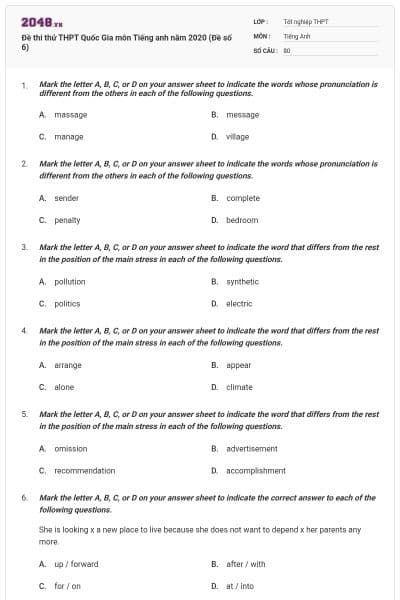
Mark the letter A, B, C, or D on your answer sheet to indicate the words whose pronunciation is different from the others in each of the following questions.
massage
message
manage
village
Mark the letter A, B, C, or D on your answer sheet to indicate the words whose pronunciation is different from the others in each of the following questions.
sender
complete
penalty
bedroom
Đáp án là B.
Từ complete có phần gạch chân được phát âm là /i/, các từ còn lại có phần gạch chân được phát âm là /e/
Mark the letter A, B, C, or D on your answer sheet to indicate the word that differs from the rest in the position of the main stress in each of the following questions.
pollution
synthetic
politics
electric
Đáp án là C.
politics nhấn trọng âm vào âm tiết thứ nhất, các từ còn lại nhấn âm tiết thứ hai.
Mark the letter A, B, C, or D on your answer sheet to indicate the word that differs from the rest in the position of the main stress in each of the following questions.
arrange
appear
alone
climate
Đáp án là D.
Từ climate nhấn trọng âm vào âm tiết thứ nhất, các từ còn lại nhấn âm tiết thứ hai.
Mark the letter A, B, C, or D on your answer sheet to indicate the word that differs from the rest in the position of the main stress in each of the following questions.
omission
advertisement
recommendation
accomplishment
Đáp án là C.
Từ recommendation nhấn trọng âm vào âm tiết thứ tư, các từ còn lại nhấn âm tiết thứ hai.
Mark the letter A, B, C, or D on your answer sheet to indicate the correct answer to each of the following questions.
She is looking x a new place to live because she does not want to depend x her parents any more.
up / forward
after / with
for / on
at / into
Đáp án là C.
look for: tìm kiếm; depend on: phụ thuộc vào ...
Mark the letter A, B, C, or D on your answer sheet to indicate the correct answer to each of the following questions.
Near the White House is another famous landmark x the Washington Monument.
which called
called
which calls
calling
Đáp án là B.
Câu này hỏi về cách rút gọn đại từ quan hệ. Câu đầy đủ phải là : … another famous
landmark which is called the Washington Monument.” Với câu mệnh đề quan hệ dạng chủ động, đại từ quan hệ đóng vai trò làm chủ ngữ ta có thể lược bỏ, và chỉ giữ lại phân từ “called - được gọi là ...”
Mark the letter A, B, C, or D on your answer sheet to indicate the correct answer to each of the following questions.
“You stepped on my toes” - “ x ”
I’m sorry but I meant it.
I’m terribly sorry. I didn’t mean it.
Really? I’m glad.
Are you sure? Did you take any steps?
Đáp án là B.
Câu này hỏi về kỹ năng giao tiếp. Cụm từ “step on one’s toes” nghĩa là nói hoặc làm điều gì đó khiến ai thấy khó chịu. You stepped on my toes - Bạn nói thế làm tớ cảm thấy khó chịu.
B. I’m terribly sorry. I didn’t mean it. - Thực sự xin lỗi. Tớ không có ý đó.
Mark the letter A, B, C, or D on your answer sheet to indicate the correct answer to each of the following questions.
The policeman x my details.
took in
took down
put up with
made up
Đáp án là B.
take down: ghi chép
Nghĩa các từ còn lại: take in: tiếp đón; put up with: kiên nhẫn; make up: trang điểm
Mark the letter A, B, C, or D on your answer sheet to indicate the correct answer to each of the following questions.
My daughter is learning to play x violin at x school.
a/ the
the / a
the / 0
0 / the
Đáp án: C
Giải thích:
Dùng “the” trước danh từ chỉ nhạc cụ, không dùng “the” trước danh từ được dùng với nghĩa chung của nó (“at school”: ở trường).
Dịch: Con gái tôi đang học chơi vi-ô-lông ở trường.
Mark the letter A, B, C, or D on your answer sheet to indicate the correct answer to each of the following questions.
x he missed the first bus, he came ten minutes late.
However
Although
Since
Therefore
Đáp án là C.
since = because: bởi vì. Nghĩa câu: Vì anh ta lỡ chuyến xe bus đầu tiên, nên anh ta đến muộn 10 phút.
However: tuy nhiên ( thường đứng đầu câu trước dấu phẩy); although: mặc dù; Therefore: vì vậy ( thường đứng đầu câu trước dấu phẩy)
Mark the letter A, B, C, or D on your answer sheet to indicate the correct answer to each of the following questions.
One's fingerprints are x other person.
different from those of any
differ from any
different from
different from any
Đáp án là A.
C, D loại vì hai đối tượng so sánh không giống nhau. “One's fingerprints - dấu vân tay của một người” là chỉ vật và “other person - bất cứ người nào khác” - là chỉ người
B loại vì đã có tobe “are” nên không thể dùng động từ “differ” sau được.
A. those = those fingerprints.
Mark the letter A, B, C, or D on your answer sheet to indicate the correct answer to each of the following questions.
I have three brother, x are professional athletes.
two of them
two of that
two of who
two of whom
Đáp án là D.
Câu này hỏi về cách sử dụng đại từ quan hệ sau giới từ “of’. D. whom thay thế cho danh từ chỉ người “ three brothers” và giữ vai trò làm tân ngữ sau giới từ “of”
Mark the letter A, B, C, or D on your answer sheet to indicate the correct answer to each of the following questions.
I put my keys on the table, but now it’s gone. Someone have taken it.
had to
should
would rather
may
Đáp án là D.
may have done : có lẽ đã - diễn tả một khả năng có thể ở quá khứ, song người nói không dám chắc. “ Tôi đã để chìa khóa trên bàn, nhưng giờ không thấy nữa. Có lẽ ai đó đã lấy đi.
Mark the letter A, B, C, or D on your answer sheet to indicate the correct answer to each of the following questions.
If I x in her position, I could turn down the job.
am
had been
will be
were
Đáp án là D.
Đây là câu điều kiện loại II. Với câu điều kiện loại II, dùng “were” cho tất cả các ngôi.
Mark the letter A, B, C, or D on your answer sheet to indicate the correct answer to each of the following questions.
I don’t like x when I am not there.
criticizing
being criticized
to criticize
to be criticized
Đáp án là B.
Câu này mang nghĩa bị đông “ tôi không thích bị phê bình khi không có mặt ở đó.” => A, C loại Sự khác nhau giữa like + to V và + V-ing:
Like + V-ing: diễn tả 1 sở thích lâu dài hay sở thích từ trước tới nay thành 1 thói quen Like + to V: diễn tả 1 sở thích ngẫu hứng ở 1 thời điểm mà không phải là lâu dài.
Mark the letter A, B, C, or D on your answer sheet to indicate the correct answer to each of the following questions.
Elevators in tall buildings make the top floors accessible x everybody.
at
with
to
about
Đáp án là C.
accessible to : dễ bị ảnh hưởng tới ...
Mark the letter A, B, C, or D on your answer sheet to indicate the correct answer to each of the following questions.
The government should take x to reduce the current high unemployment rate.
solutions
changes
steps
measures
Đáp án: D
Giải thích:
solution (n): cách giải quyết
change (n): sự thay đổi
step (n): bước đi
measure (n): biện pháp
Ta có cụm: take measures to do something: đưa ra biện pháp để làm gì
Dịch: Chính phủ nên có biện pháp để giảm tỷ lệ thất nghiệp cao hiện nay.
Mark the letter A, B, C, or D on your answer sheet to indicate the correct answer to each of the following questions.
I was brought x in the countryside by my aunt after my parents had pass x .
for / on
on / over
on / off
up / away
Đáp án là D.
bring up: nuôi dưỡng; pass away: qua đời
Mark the letter A, B, C, or D on your answer sheet to indicate the correct answer to each of the following questions.
Let me know immediately if you hear any x news.
further
farther
furthest
farthest
Đáp án là A.
Tính từ Far, chuyển sang so sánh hơn và hơn nhất có hai dang: farther/ farthest nếu chỉ khoảng cách, và further/ furthest nếu chỉ tầm xa của kiến thức, tin tức
=> Trong trường hợp này, B và D loại, vì danh từ news (tin tức)
A. Câu này sử dụng so sánh hơn chứ không phải so sánh hơn nhất: Nếu bạn nghe được bất kỳ tin tức nào, thì hãy nói tôi biết ngay nhé.
Mark the letter A, B, C, or D on your answer sheet to indicate the correct answer to each of the following questions.
It was x a difficult question that they couldn't explain.
such
so
very
too
Đáp án là A.
Cấu trúc: It + be+ such + N + that + S+ V…: quá… đến nỗi ....
Mark the letter A, B, C, or D on your answer sheet to indicate the correct answer to each of the following questions.
My friend often shows her _____ whenever I have troubles.
sympathetic
sympathize
sympathetically
sympathy
Đáp án D
Sau tính từ sở hữu “her” là một danh từ, sympathy (n) sự đồng cảm.
Các từ còn lại:
A. sympathetic (adj) đồng cảm
B. sympathize (v) đồng cảm
C. sympathetically (adv) một cách đồng cảm
Dịch nghĩa: Bạn tôi thường tỏ ra thông cảm mỗi khi tôi gặp khó khăn.
Mark the letter A, B, C, or D on your answer sheet to indicate the correct answer to each of the following questions.
She expected x to the principal.
being introduced
to introduce
being introduced
to be introduced
Đáp án là D.
Expect + to V: trông đợi.. => A và C loại.
Trường hợp này câu chia ở thể bị động “ cô ấy mong được giới thiệu tới giám đốc.”
Mark the letter A, B, C, or D on your answer sheet to indicate the correct answer to each of the following questions.
I x a small fortune when my uncle died but I managed to squander most of it. I’m ashamed to say.
came up with
came into
came out
came in for
Đáp án là B.
come into a small fortune : nắm quyền, sở hữu,.. ( một cơ đồ nhỏ )
Nghĩa các cụm còn lại: come up with: tìm ra, nảy ra...; come out: đình công; come in for: được phần thưởng
Mark the letter A, B, C, or D on your answer sheet to indicate the correct answer to each of the following questions.
x appears considerably larger at the horizon than it does overhead is merely an optical illusion.
When the Moon
That the Moon
The Moon
The Moon which
Đáp án là B.
Câu này có hai động từ “ appears” và “ is” => không thể chọn A, và C
Đáp án D, sử dụng đại từ quan hệ. Nghĩa câu sẽ là: Mặt trăng cái mà ở phía chân trời xuất hiện lớn hơn đáng kể khi nó ở trên cao chỉ là một ảo ảnh quang học. => Câu này không hợp lý.
Đáp án B. “ That + clause ” đóng vai trò nhữ một chủ ngữ, và theo sau là động từ chia ở dạng số ít. Thay thế câu này sẽ có nghĩa: Hiện tượng Mặt trăng ở phía chân trời xuất hiện lớn hơn đáng kể khi nó ở trên cao chỉ là một ảo ảnh quang học.
Mark the letter A, B, C, or D on your answer sheet to indicate the correct answer to each of the following questions.
“ Do you know where Paul is? ” - “ x ”
Well, I don’t know
It’s no use
Why not?
I’ m afraid he doesn’t
Đáp án là A.
Câu này hỏi về kỹ năng giao tiếp.
Do you know where Paul is? - Bạn biết Paul ở đâu không?
A. Well. I don’t know. - Ồ. Tớ không biết.
Mark the letter A, B, C, or D on your answer sheet to indicate the correct answer to each of the following questions.
We bought some x.
German lovely old glasses
old lovely German glasses
German old lovely glasses
lovely old German glasses
Đáp án là D.
Thứ tự các tính từ lần lượt là: opinion - age - origin ( ý kiến cá nhân - tuổi - nguồn gốc ).
Mark the letter A, B, C, or D on your answer sheet to indicate the correct answer to each of the following questions.
A good teacher should treat all her students on the same x
views
positions
attitudes
terms
Đáp án là D.
terms: khóa, học kỳ
Nghĩa các từ còn lại: view: tầm nhìn; position: vị trí; attitude: thái độ
Mark the letter A, B, C, or D on your answer sheet to indicate the correct answer to each of the following questions.
The Norman is said x England in 1066.
to have invaded
to have been invaded
to invade
to be invaded
Đáp án là A.
Cấu trúc bị động: S + be + PII + to V/ to have done. Dùng “to have done” khi muốn nhấn mạnh hành động đó đã xảy ra.
Invade + N: xâm lược .. => Động từ này sẽ chia dạng chủ động.
A. Vì “in1066” là mốc thời gian trong quá khứ => hành động “xâm lược” đã xảy ra.
Mark the letter A, B, C, or D on your answer sheet to indicate the correct answer to each of the following questions.
I thought you said she was going away the next Sunday, x ?
wasn't it
didn't you
wasn't she
didn't I
Đáp án là B.
Đây là câu hỏi láy đuôi. B. , vì câu này hỏi đối tượng là “you” chứ không phải là “she”. Câu này nghĩa là: Tôi nghĩ, bạn đã nói rằng cô ấy đã ra đi vào Chủ nhật trước phải không?!
Mark the letter A, B, C, or D on your answer sheet to indicate the correct answer to each of the following questions.
“ x ” - “I’m glad you like it”.
Thank you for a great evening. The food was so good.
I like your handbag. It’s fantastic.
Could you drop by tomorrow?
It’s going to rain. I have to leave now.
Đáp án là A.
Câu này hỏi về kỹ năng giao tiếp. I’m glad you like it - Rất vui vì em thích nó.
A. Thank you for a great evening. The food was so good. - Cảm ơn anh về bữa tối tuyệt vời. Món ăn rất là ngon.
Mark the letter A, B, C, or D on your answer sheet to indicate the correct answer to each of the following questions.
Not only x in the field of psychology but animal behavior is examined as well.
is studied human behavior
is human behavior studied
did human behavior study
human behavior studied
Đáp án là B.
Cấu trúc đảo ngữ: Not only + auxiliary + S + V but.... also....
Với cấu trúc này, A và D loại
Đáp án C cũng loại vì, “human behavior - thái độ của con người” => câu này phải chia ở dạng bị động.
Mark the letter A, B, C, or D on your answer sheet to indicate the correct answer to each of the following questions.
Had we not watched the football match last night, we x our work
could have finished
will finish
could finish
could be finished
Đáp án là A.
Đây là câu điều kiện loại III,trường hợp bỏ if: Had + S+ PII, S + would/could + have PII.
Mark the letter A, B, C, or D on your answer sheet to indicate the correct answer to each of the following questions.
Tom painted his room black. It looks dark and dread. He x another color.
must choose
should choose
should have chosen
must have chosen
Đáp án: C
Giải thích:
Kiến thức: Động từ khuyết thiếu
A. must V: phải làm gì (hiện tại)
B. should V: nên làm gì (hiện tại)
C. should have VpII: lẽ ra nên làm gì trong quá khứ
D. must have VpII: chắc hẳn đã làm gì trong quá khứ
Dựa vào nghĩa, chọn C.
Dịch: Tom đã sơn phòng của mình màu đen. Nó trông tối và đáng sợ. Cậu ấy đáng lẽ nên chọn một màu khác.
Mark the letter A, B, C, or D on your answer sheet to indicate the correct answer to each of the following questions.
“ I hear the Golden Bridge is a good film” - “x”
Yes, it’s boring
Yes, it’s very exciting.
No, I hear it, too
No, I don’t hear that
Đáp án là B.
Câu này hỏi về kỹ năng giao tiếp.
I hear the Golden Bridge is a good film - Tớ nghe rằng Golden Bridge là bộ phim hay.
B. Yes, it’s very exciting. - Đúng rồi nó rất hay.
Mark the letter A, B, C, or D on your answer sheet to indicate the correct answer to each of the following questions.
x my father sat down for lunch than there was a knock at the door.
Hardly had
No sooner had
At no time had
Never before had
Đáp án là B.
Cấu trúc đảo ngữ “ No sooner had + S+ PII + than +S+ V-ed. Vừa mới ... thì đã...
Mark the letter A, B, C, or D on your answer sheet to indicate the correct answer to each of the following questions.
India is the country x he spent the early year of his life.
at which
where
that
on which
Đáp án: B
Giải thích:
Kiến thức: Mệnh đề quan hệ
Mệnh đề quan hệ đã có đủ chủ ngữ và động từ, cần dùng trạng từ quan hệ “where” để thay cho nơi chốn.
Ở đây nếu dùng: giới từ + which, ta cần dùng giới từ phù hợp với “the country” → in the country → in which
Vậy chọn B.
Dịch: Ấn Độ là đất nước nơi ông đã sống những năm đầu đời.
Mark the letter A, B, C, or D on your answer sheet to indicate the correct answer to each of the following questions.
The judge x the murderer to a lifetime imprisonment
sentenced
C.accused
prosecuted
convicted
Đáp án là A.
to sentence someone to …. imprisonment: kết án , tuyên án ...
Mark the letter A, B, C, or D on your answer sheet to indicate the correct answer to each of the following questions.
The harder you work, x you’ll pass the exam.
the best
the worst
the better
the worse
Đáp án là C.
Cấu trúc “càng. càng.” : The + comparison + S+ V, the + comparison + S+ V.
Mark the letter A, B, C, or D on your answer sheet to indicate the correct answer to each of the following questions.
While southern California is densely populated x live in the northern part of the state.
a number of people
few people
a few of people
many people
Đáp án: B
Giải thích:
Câu trên bắt đầu bằng “While” (trong khi mà), do vậy nó diễn đạt 2 vế mang nghĩa trái ngược nhau.
Chúng ta thấy mệnh đề “While southern California is densely populated…(Trong khi ở phía Nam California dân số đông đúc…) mang nghĩa khẳng định
→ Mệnh đề còn lại phải mang nghĩa phủ định.
Xét các đáp án:
A. a number of + danh từ đếm được số nhiều: nhiều, một số
Loại vì thiếu “of” và không phù hợp về nghĩa
B. few + danh từ đếm được số nhiều: hầu như không, rất ít
Đúng vì mang nét nghĩa phủ định
C. a few + danh từ đếm được số nhiều: một vài
Loại vì không mang nét nghĩa phủ định
D. many + danh từ đếm được số nhiều: nhiều
Loại vì không mang nét nghĩa phủ định
Dịch: Trong khi miền Nam California có mật độ dân số đông đúc thì phía bắc của tiểu bang lại có rất ít người sống.
Mark the letter A, B, C, or D on your answer sheet to indicate the correct answer to each of the following questions.
Mary is x independent woman with wise and x enthusiasm.
an / Ø / Ø
a / the / the
the / a / an
Ø / a / the
Đáp án là A.
woman là danh từ số ít, đếm được, tính từ trước nó “independent” lại bắt đầu bằng nguyên âm “i” => trước đó phải dùng mạo từ “an” => chỉ chọn được đáp án A. Hơn nữa, wise và enthusiasm là các danh từ không đếm được => thường không dùng mạo từ.
Mark the letter A, B, C, or D on your answer sheet to indicate the correct answer to each of the following questions.
The book which x by a famous author has become the best seller.
is writing
has written
was written
wrote
Đáp án là C.
Mệnh đề quan hệ phải ở dạng bị động, vì thấy có “by a famous author”.
Mark the letter A, B, C or D on your answer sheet to indicate the word(s) CLOSEST in meaning to the underlined word(s) in each of the following questions.
When being interviewed, you should concentrate on what the interviewer is saying or asking you
be related to
express in
be interested in
pay all attention to
Đáp án là D.
concentrate on = pay all attention to: chú ý, tập trung
Nghĩa các cụm từ còn lại: be related to: được liên quan đến; be interested in: thích thú với.; express interest in: thể hiện sự thích thú với.
Mark the letter A, B, C or D on your answer sheet to indicate the word(s) CLOSEST in meaning to the underlined word(s) in each of the following questions.
He drives me to the edge because he never stops talking.
steers me
frightens me
irritates me
moves me
Đáp án là C.
Drive someone to the edge: khiến ai điên lên, C. irritate someone: làm ai phát cáu, điên lên
Nghĩa các từ còn lại: steer: lái ( tàu thủy, ô tô ); move: di chuyển; frighten: làm hoảng sợ
Mark the letter A, B, C, or D on your answer sheet to indicate the word OPPOSITE in meaning to the underlined word(s) in each of the following questions.
Certain courses are compulsory; others are optional
pressure
free
voluntary
mandatory
Đáp án là D.
Optional : tự chọn >< Mandatory : bắt buộc
Nghĩa các từ còn lại: voluntary : tình nguyện; free: miễn phí; pressure: áp lực
Read the following passage and choose the best answer for each blank.
Many of the things we do (46) x on receiving information from other people. Catching a train, making a phone call and going to the cinema all involve information (47) x stored, processed and communicated. In the past this information had to be kept on paper (48) x , for example, books, newspapers and timetables. Now more and more information is put (49) x computers.
Computers play a role in our everyday lives, sometimes without us even realizing it. (50) x the use of computers in both shops and offices. Big shops have to deal with very large (51) x of information. They have to make sure that there are enough goods on the shelves for customers to buy, they need to be able to reorder before (52) x run out. A lot of office work in the past involved information on paper. Once it had been dealt with by people, the paper was (53) x for future reference. This way x of working was never (54) x easy or fast. A computer system is much more (55) x
Điền vào ô 46
depending
to depend
depend
depended
Đáp án là C.
Câu này thiếu động từ chính cho chủ ngữ “Many of the things” => A, B loại Câu này chỉ thực tế ở hiện tại
Read the following passage and choose the best answer for each blank.
Many of the things we do (46) x on receiving information from other people. Catching a train, making a phone call and going to the cinema all involve information (47) x stored, processed and communicated. In the past this information had to be kept on paper (48) x , for example, books, newspapers and timetables. Now more and more information is put (49) x computers.
Computers play a role in our everyday lives, sometimes without us even realizing it. (50) x the use of computers in both shops and offices. Big shops have to deal with very large (51) x of information. They have to make sure that there are enough goods on the shelves for customers to buy, they need to be able to reorder before (52) x run out. A lot of office work in the past involved information on paper. Once it had been dealt with by people, the paper was (53) x for future reference. This way x of working was never (54) x easy or fast. A computer system is much more (55) x
Điền vào ô 47
that has
has
is
that is
Đáp án là D.
Vì câu đã có động từ chính là ‘involve” => B và C loại.
Sau từ cần điền là các phân từ => không thể chọn A có động từ “ have” được.
Read the following passage and choose the best answer for each blank.
Many of the things we do (46) x on receiving information from other people. Catching a train, making a phone call and going to the cinema all involve information (47) x stored, processed and communicated. In the past this information had to be kept on paper (48) x , for example, books, newspapers and timetables. Now more and more information is put (49) x computers.
Computers play a role in our everyday lives, sometimes without us even realizing it. (50) x the use of computers in both shops and offices. Big shops have to deal with very large (51) x of information. They have to make sure that there are enough goods on the shelves for customers to buy, they need to be able to reorder before (52) x run out. A lot of office work in the past involved information on paper. Once it had been dealt with by people, the paper was (53) x for future reference. This way x of working was never (54) x easy or fast. A computer system is much more (55) x
Điền vào ô 48
in the case of
in preparation for
in the form of
in search of
Đáp án là C.
In the form of . : trong hình thức của .. Nghĩa câu: trong quá khứ, thông tin này phải được giữ ở trên giấy trong hình thức là sách, báo, thời gian biểu .
Read the following passage and choose the best answer for each blank.
Many of the things we do (46) x on receiving information from other people. Catching a train, making a phone call and going to the cinema all involve information (47) x stored, processed and communicated. In the past this information had to be kept on paper (48) x , for example, books, newspapers and timetables. Now more and more information is put (49) x computers.
Computers play a role in our everyday lives, sometimes without us even realizing it. (50) x the use of computers in both shops and offices. Big shops have to deal with very large (51) x of information. They have to make sure that there are enough goods on the shelves for customers to buy, they need to be able to reorder before (52) x run out. A lot of office work in the past involved information on paper. Once it had been dealt with by people, the paper was (53) x for future reference. This way x of working was never (54) x easy or fast. A computer system is much more (55) x
Điền vào ô 49
by
in
with
on
Đáp án là D.
on computers: trên máy tính
Read the following passage and choose the best answer for each blank.
Many of the things we do (46) x on receiving information from other people. Catching a train, making a phone call and going to the cinema all involve information (47) x stored, processed and communicated. In the past this information had to be kept on paper (48) x , for example, books, newspapers and timetables. Now more and more information is put (49) x computers.
Computers play a role in our everyday lives, sometimes without us even realizing it. (50) x the use of computers in both shops and offices. Big shops have to deal with very large (51) x of information. They have to make sure that there are enough goods on the shelves for customers to buy, they need to be able to reorder before (52) x run out. A lot of office work in the past involved information on paper. Once it had been dealt with by people, the paper was (53) x for future reference. This way x of working was never (54) x easy or fast. A computer system is much more (55) x
Điền vào ô 50
Be considered
To consider
To be considered
Consider
Đáp án là D.
Câu không có chủ ngữ, nên ta có thể sử dụng động từ nguyên thể đầu câu, chỉ mệnh lệnh, yêu cầu
Read the following passage and choose the best answer for each blank.
Many of the things we do (46) x on receiving information from other people. Catching a train, making a phone call and going to the cinema all involve information (47) x stored, processed and communicated. In the past this information had to be kept on paper (48) x , for example, books, newspapers and timetables. Now more and more information is put (49) x computers.
Computers play a role in our everyday lives, sometimes without us even realizing it. (50) x the use of computers in both shops and offices. Big shops have to deal with very large (51) x of information. They have to make sure that there are enough goods on the shelves for customers to buy, they need to be able to reorder before (52) x run out. A lot of office work in the past involved information on paper. Once it had been dealt with by people, the paper was (53) x for future reference. This way x of working was never (54) x easy or fast. A computer system is much more (55) x
Điền vào ô 51
numbers
number
amount
amounts
Đáp án là C.
(very large ) + amount +N( không đếm được): nhiều… Không có trường hợp amounts (số nhiều )
Với number, ta có cấu trúc: the/a number of + Ns: nhiều.
Read the following passage and choose the best answer for each blank.
Many of the things we do (46) x on receiving information from other people. Catching a train, making a phone call and going to the cinema all involve information (47) x stored, processed and communicated. In the past this information had to be kept on paper (48) x , for example, books, newspapers and timetables. Now more and more information is put (49) x computers.
Computers play a role in our everyday lives, sometimes without us even realizing it. (50) x the use of computers in both shops and offices. Big shops have to deal with very large (51) x of information. They have to make sure that there are enough goods on the shelves for customers to buy, they need to be able to reorder before (52) x run out. A lot of office work in the past involved information on paper. Once it had been dealt with by people, the paper was (53) x for future reference. This way x of working was never (54) x easy or fast. A computer system is much more (55) x
Điền vào ô 52
stocks
items
purchases
cargoes
Đáp án là D.
cargoes: hàng hóa vận chuyển.
Nghĩa các từ còn lại: stock: cổ phiếu; item: tin tức,món; purchase: sự mua, tậu
Nghĩa câu: Họ phải chắc chắn rằng có đủ hàng hóa trên kệ cho khách hàng để mua, họ cần để có thể sắp xếp lại trước khi hàng được bán ra ngoài.
Read the following passage and choose the best answer for each blank.
Many of the things we do (46) x on receiving information from other people. Catching a train, making a phone call and going to the cinema all involve information (47) x stored, processed and communicated. In the past this information had to be kept on paper (48) x , for example, books, newspapers and timetables. Now more and more information is put (49) x computers.
Computers play a role in our everyday lives, sometimes without us even realizing it. (50) x the use of computers in both shops and offices. Big shops have to deal with very large (51) x of information. They have to make sure that there are enough goods on the shelves for customers to buy, they need to be able to reorder before (52) x run out. A lot of office work in the past involved information on paper. Once it had been dealt with by people, the paper was (53) x for future reference. This way x of working was never (54) x easy or fast. A computer system is much more (55) x
Điền vào ô 53
thrown away
torn off
put aside
recycled
Đáp án là C.
put aside: đặt qua một bên
Nghĩa câu: Một khi nó đã được xử lý bởi người dân, giấy tờ này được đặt sang một bên để tham khảo trong tương lai.
Nghĩa các từ còn lại: thrown away: bị ném đi; torn off: bị giật phăng ra; recycled: được tái chế
Read the following passage and choose the best answer for each blank.
Many of the things we do (46) x on receiving information from other people. Catching a train, making a phone call and going to the cinema all involve information (47) x stored, processed and communicated. In the past this information had to be kept on paper (48) x , for example, books, newspapers and timetables. Now more and more information is put (49) x computers.
Computers play a role in our everyday lives, sometimes without us even realizing it. (50) x the use of computers in both shops and offices. Big shops have to deal with very large (51) x of information. They have to make sure that there are enough goods on the shelves for customers to buy, they need to be able to reorder before (52) x run out. A lot of office work in the past involved information on paper. Once it had been dealt with by people, the paper was (53) x for future reference. This way x of working was never (54) x easy or fast. A computer system is much more (55) x
Điền vào ô 54
particularized
particular
particularly
particularity
Đáp án là C.
Câu này cần một trạng ngữ chỉ mức độ, đứng trước hai tính từ “easy” và “fast”
Các từ còn lại: particularized (PII); particular (adj); particularity (n)
Read the following passage and choose the best answer for each blank.
Many of the things we do (46) x on receiving information from other people. Catching a train, making a phone call and going to the cinema all involve information (47) x stored, processed and communicated. In the past this information had to be kept on paper (48) x , for example, books, newspapers and timetables. Now more and more information is put (49) x computers.
Computers play a role in our everyday lives, sometimes without us even realizing it. (50) x the use of computers in both shops and offices. Big shops have to deal with very large (51) x of information. They have to make sure that there are enough goods on the shelves for customers to buy, they need to be able to reorder before (52) x run out. A lot of office work in the past involved information on paper. Once it had been dealt with by people, the paper was (53) x for future reference. This way x of working was never (54) x easy or fast. A computer system is much more (55) x
Điền vào ô 55
capable
effective
formal
skillful
Đáp án là B.
effective: hiệu quả.
Nghĩa câu: Một hệ thống máy tính hiệu quả hơn nhiều.
Các từ còn lại: capable: khả năng có thể; formal: bình thường; skillful: khéo léo
Read the following passage and mark the letter A, B, C, or D on your answer sheet to indicate the correct answer for each of the questions.
We find that bright children are rarely held back by mixed-ability teaching. On the contrary, both their knowledge and experience are enriched. We feel that there are many disadvantages in streaming pupils. It does not take into account the fact that children develop at different rates. It can have a bad effect on both the bright and the not-so-bright child. After all, it can be quite discouraging to be at the bottom of the top grade!
Besides, it is rather unreal to grade people just according to their intellectual ability. This is only one aspect of their total personality. We are concerned to develop the abilities of all our pupils to the full, not just their academic ability. We also value personal qualities and social skills, and we find that mixed- ability teaching contributes to all these aspects of learning.
In our classrooms, we work in various ways. The pupils often work in groups: this gives them the opportunity to learn to co-operate, to share, and to develop leadership skills. They also learn how to cope with personal problems as well as learning how to think, to make decisions, to analyze and evaluate, and to communicate effectively. The pupils learn from each other as well as from the teachers.
Sometimes the pupils work in pairs; sometimes they work on individual tasks and assignments, and they can do this at their own speed. They also have some formal class teaching when this is appropriate. We encourage our pupils to use the library, and we teach them the skills they need in order to do this effectively. An advanced pupil can do advanced work; it does not matter what age the child is. We expect our pupils to do their best, not their least, and we give them every encouragement to attain this goal.
Which of the following is NOT mentioned in the passage?
Group work gives pupils the opportunity to learn to work together with others.
Pupils also learn to develop their reasoning ability.
Pupils also learn how to participate in teaching activities.
Group work provides the pupils with the opportunity to learn to be capable organizers.
Đáp án là C.
A được đề cập: The pupils often work in groups: this gives them the opportunity to learn to co-operate B được đề cập: trong đoạn 2
D được đề cập: The pupils often ... and to develop leadership skills.
Read the following passage and mark the letter A, B, C, or D on your answer sheet to indicate the correct answer for each of the questions.
We find that bright children are rarely held back by mixed-ability teaching. On the contrary, both their knowledge and experience are enriched. We feel that there are many disadvantages in streaming pupils. It does not take into account the fact that children develop at different rates. It can have a bad effect on both the bright and the not-so-bright child. After all, it can be quite discouraging to be at the bottom of the top grade!
Besides, it is rather unreal to grade people just according to their intellectual ability. This is only one aspect of their total personality. We are concerned to develop the abilities of all our pupils to the full, not just their academic ability. We also value personal qualities and social skills, and we find that mixed- ability teaching contributes to all these aspects of learning.
In our classrooms, we work in various ways. The pupils often work in groups: this gives them the opportunity to learn to co-operate, to share, and to develop leadership skills. They also learn how to cope with personal problems as well as learning how to think, to make decisions, to analyze and evaluate, and to communicate effectively. The pupils learn from each other as well as from the teachers.
Sometimes the pupils work in pairs; sometimes they work on individual tasks and assignments, and they can do this at their own speed. They also have some formal class teaching when this is appropriate. We encourage our pupils to use the library, and we teach them the skills they need in order to do this effectively. An advanced pupil can do advanced work; it does not matter what age the child is. We expect our pupils to do their best, not their least, and we give them every encouragement to attain this goal.
According to the passage, which of the following is an advantage of mixed-ability teaching?
Formal class teaching is the important way to give the pupils essential skills such as those to be used in the library.
Pupils can be hindered from an all-round development.
Pupils as individuals always have the opportunities to work on their own.
A pupil can be at the bottom of a class.
Đáp án là C.
Dựa vào ý: sometimes they work on individual tasks and assignments, and they can do this at their own speed.
Read the following passage and mark the letter A, B, C, or D on your answer sheet to indicate the correct answer for each of the questions.
We find that bright children are rarely held back by mixed-ability teaching. On the contrary, both their knowledge and experience are enriched. We feel that there are many disadvantages in streaming pupils. It does not take into account the fact that children develop at different rates. It can have a bad effect on both the bright and the not-so-bright child. After all, it can be quite discouraging to be at the bottom of the top grade!
Besides, it is rather unreal to grade people just according to their intellectual ability. This is only one aspect of their total personality. We are concerned to develop the abilities of all our pupils to the full, not just their academic ability. We also value personal qualities and social skills, and we find that mixed- ability teaching contributes to all these aspects of learning.
In our classrooms, we work in various ways. The pupils often work in groups: this gives them the opportunity to learn to co-operate, to share, and to develop leadership skills. They also learn how to cope with personal problems as well as learning how to think, to make decisions, to analyze and evaluate, and to communicate effectively. The pupils learn from each other as well as from the teachers.
Sometimes the pupils work in pairs; sometimes they work on individual tasks and assignments, and they can do this at their own speed. They also have some formal class teaching when this is appropriate. We encourage our pupils to use the library, and we teach them the skills they need in order to do this effectively. An advanced pupil can do advanced work; it does not matter what age the child is. We expect our pupils to do their best, not their least, and we give them every encouragement to attain this goal.
The author argues that a teacher’s chief concern should be the development of the pupils’ x .
total personality
intellectual abilities
personal and social skills
learning ability and communicative skills
Đáp án là A.
Dựa vào ý: Besides, it is rather unreal to grade people just according to their intellectual ability. This is only one aspect of their total personality
Read the following passage and mark the letter A, B, C, or D on your answer sheet to indicate the correct answer for each of the questions.
We find that bright children are rarely held back by mixed-ability teaching. On the contrary, both their knowledge and experience are enriched. We feel that there are many disadvantages in streaming pupils. It does not take into account the fact that children develop at different rates. It can have a bad effect on both the bright and the not-so-bright child. After all, it can be quite discouraging to be at the bottom of the top grade!
Besides, it is rather unreal to grade people just according to their intellectual ability. This is only one aspect of their total personality. We are concerned to develop the abilities of all our pupils to the full, not just their academic ability. We also value personal qualities and social skills, and we find that mixed- ability teaching contributes to all these aspects of learning.
In our classrooms, we work in various ways. The pupils often work in groups: this gives them the opportunity to learn to co-operate, to share, and to develop leadership skills. They also learn how to cope with personal problems as well as learning how to think, to make decisions, to analyze and evaluate, and to communicate effectively. The pupils learn from each other as well as from the teachers.
Sometimes the pupils work in pairs; sometimes they work on individual tasks and assignments, and they can do this at their own speed. They also have some formal class teaching when this is appropriate. We encourage our pupils to use the library, and we teach them the skills they need in order to do this effectively. An advanced pupil can do advanced work; it does not matter what age the child is. We expect our pupils to do their best, not their least, and we give them every encouragement to attain this goal.
The author’s purpose of writing this passage is to x.
recommend pair work and group work classroom activities
emphasize the importance of appropriate formal classroom teaching
offer advice on the proper use of the school library
argue for teaching bright and not-so-bright pupils in the same class
Đáp án là D.
Dựa vào ý: It can have a bad effect on both the bright and the not-so-bright child.
Read the following passage and mark the letter A, B, C, or D on your answer sheet to indicate the correct answer for each of the questions.
We find that bright children are rarely held back by mixed-ability teaching. On the contrary, both their knowledge and experience are enriched. We feel that there are many disadvantages in streaming pupils. It does not take into account the fact that children develop at different rates. It can have a bad effect on both the bright and the not-so-bright child. After all, it can be quite discouraging to be at the bottom of the top grade!
Besides, it is rather unreal to grade people just according to their intellectual ability. This is only one aspect of their total personality. We are concerned to develop the abilities of all our pupils to the full, not just their academic ability. We also value personal qualities and social skills, and we find that mixed- ability teaching contributes to all these aspects of learning.
In our classrooms, we work in various ways. The pupils often work in groups: this gives them the opportunity to learn to co-operate, to share, and to develop leadership skills. They also learn how to cope with personal problems as well as learning how to think, to make decisions, to analyze and evaluate, and to communicate effectively. The pupils learn from each other as well as from the teachers.
Sometimes the pupils work in pairs; sometimes they work on individual tasks and assignments, and they can do this at their own speed. They also have some formal class teaching when this is appropriate. We encourage our pupils to use the library, and we teach them the skills they need in order to do this effectively. An advanced pupil can do advanced work; it does not matter what age the child is. We expect our pupils to do their best, not their least, and we give them every encouragement to attain this goal.
According to the author, mixed-ability teaching is more preferable because x.
formal class teaching is appropriate
it aims at developing the children’s total personality
children can learn to work with each other to solve personal problems
it doesn’t have disadvantages as in streaming pupils
Đáp án là B.
Có thể dựa vào câu đáp án câu 3 để làm câu này.
Read the following passage and mark the letter A, B, C, or D on your answer sheet to indicate the correct answer for each of the questions.
We find that bright children are rarely held back by mixed-ability teaching. On the contrary, both their knowledge and experience are enriched. We feel that there are many disadvantages in streaming pupils. It does not take into account the fact that children develop at different rates. It can have a bad effect on both the bright and the not-so-bright child. After all, it can be quite discouraging to be at the bottom of the top grade!
Besides, it is rather unreal to grade people just according to their intellectual ability. This is only one aspect of their total personality. We are concerned to develop the abilities of all our pupils to the full, not just their academic ability. We also value personal qualities and social skills, and we find that mixed- ability teaching contributes to all these aspects of learning.
In our classrooms, we work in various ways. The pupils often work in groups: this gives them the opportunity to learn to co-operate, to share, and to develop leadership skills. They also learn how to cope with personal problems as well as learning how to think, to make decisions, to analyze and evaluate, and to communicate effectively. The pupils learn from each other as well as from the teachers.
Sometimes the pupils work in pairs; sometimes they work on individual tasks and assignments, and they can do this at their own speed. They also have some formal class teaching when this is appropriate. We encourage our pupils to use the library, and we teach them the skills they need in order to do this effectively. An advanced pupil can do advanced work; it does not matter what age the child is. We expect our pupils to do their best, not their least, and we give them every encouragement to attain this goal.
Which of the following statements can best summaries the main idea of the passage?
Various ways of teaching should be encouraged in class.
Children, in general, develop at different rates.
Bright children do benefit from mixed-class teaching.
Đáp án là D.
Dựa vào ý đầu tiên trong bài: We find that bright children are rarely held back by mixed- ability teaching. On the contrary, both their knowledge and experience are enriched.
Read the following passage and mark the letter A, B, C, or D on your answer sheet to indicate the correct answer for each of the questions.
We find that bright children are rarely held back by mixed-ability teaching. On the contrary, both their knowledge and experience are enriched. We feel that there are many disadvantages in streaming pupils. It does not take into account the fact that children develop at different rates. It can have a bad effect on both the bright and the not-so-bright child. After all, it can be quite discouraging to be at the bottom of the top grade!
Besides, it is rather unreal to grade people just according to their intellectual ability. This is only one aspect of their total personality. We are concerned to develop the abilities of all our pupils to the full, not just their academic ability. We also value personal qualities and social skills, and we find that mixed- ability teaching contributes to all these aspects of learning.
In our classrooms, we work in various ways. The pupils often work in groups: this gives them the opportunity to learn to co-operate, to share, and to develop leadership skills. They also learn how to cope with personal problems as well as learning how to think, to make decisions, to analyze and evaluate, and to communicate effectively. The pupils learn from each other as well as from the teachers.
Sometimes the pupils work in pairs; sometimes they work on individual tasks and assignments, and they can do this at their own speed. They also have some formal class teaching when this is appropriate. We encourage our pupils to use the library, and we teach them the skills they need in order to do this effectively. An advanced pupil can do advanced work; it does not matter what age the child is. We expect our pupils to do their best, not their least, and we give them every encouragement to attain this goal.
The words “held back” in 1st paragraph means “ x ”.
forced to study in lower classes
prevented from advancing
made to lag behind in study
made to remain in the same classes
Đáp án là B.
held back = prevented from advancing: ngăn lại, chặn lại ...
Read the following passage and mark the letter A, B, C, or D on your answer sheet to indicate the correct answer for each of the questions.
We find that bright children are rarely held back by mixed-ability teaching. On the contrary, both their knowledge and experience are enriched. We feel that there are many disadvantages in streaming pupils. It does not take into account the fact that children develop at different rates. It can have a bad effect on both the bright and the not-so-bright child. After all, it can be quite discouraging to be at the bottom of the top grade!
Besides, it is rather unreal to grade people just according to their intellectual ability. This is only one aspect of their total personality. We are concerned to develop the abilities of all our pupils to the full, not just their academic ability. We also value personal qualities and social skills, and we find that mixed- ability teaching contributes to all these aspects of learning.
In our classrooms, we work in various ways. The pupils often work in groups: this gives them the opportunity to learn to co-operate, to share, and to develop leadership skills. They also learn how to cope with personal problems as well as learning how to think, to make decisions, to analyze and evaluate, and to communicate effectively. The pupils learn from each other as well as from the teachers.
Sometimes the pupils work in pairs; sometimes they work on individual tasks and assignments, and they can do this at their own speed. They also have some formal class teaching when this is appropriate. We encourage our pupils to use the library, and we teach them the skills they need in order to do this effectively. An advanced pupil can do advanced work; it does not matter what age the child is. We expect our pupils to do their best, not their least, and we give them every encouragement to attain this goal.
According to the passage, which of the following is NOT TRUE?
It’s not good for a bright child to find out that he performs worst in a mixed-ability class.
Development of pupils as individuals is not the aim of group work.
Pupils cannot develop in the best way if they are streamed into classes of different intellectual abilities.
There is no fixed method in teaching pupils to develop themselves to the full.
Đáp án là B.
Câu này không đúng vì trong làm việc nhóm, sự phát triển của mỗi cá nhân là cần thiết.
Ý diễn tả: They also learn how to cope with personal problems as well as learning how to think, to make decisions, to analyze and evaluate, and to communicate effectively.
Read the following passage and mark the letter A, B, C, or D on your answer sheet to indicate the correct answer for each of the questions.
We find that bright children are rarely held back by mixed-ability teaching. On the contrary, both their knowledge and experience are enriched. We feel that there are many disadvantages in streaming pupils. It does not take into account the fact that children develop at different rates. It can have a bad effect on both the bright and the not-so-bright child. After all, it can be quite discouraging to be at the bottom of the top grade!
Besides, it is rather unreal to grade people just according to their intellectual ability. This is only one aspect of their total personality. We are concerned to develop the abilities of all our pupils to the full, not just their academic ability. We also value personal qualities and social skills, and we find that mixed- ability teaching contributes to all these aspects of learning.
In our classrooms, we work in various ways. The pupils often work in groups: this gives them the opportunity to learn to co-operate, to share, and to develop leadership skills. They also learn how to cope with personal problems as well as learning how to think, to make decisions, to analyze and evaluate, and to communicate effectively. The pupils learn from each other as well as from the teachers.
Sometimes the pupils work in pairs; sometimes they work on individual tasks and assignments, and they can do this at their own speed. They also have some formal class teaching when this is appropriate. We encourage our pupils to use the library, and we teach them the skills they need in order to do this effectively. An advanced pupil can do advanced work; it does not matter what age the child is. We expect our pupils to do their best, not their least, and we give them every encouragement to attain this goal.
According to the passage, “streaming pupils” x
is the act of putting pupils into classes according to their academic abilities
aims at enriching both their knowledge and experience
is quite discouraging
will help the pupils learn best
Đáp án là A.
Streaming pupils : Học sinh được sắp xếp theo năng lực.
A. là hành động của việc đưa học sinh vào các lớp học theo khả năng học tập của chúng.
Read the following passage and mark the letter A, B, C, or D on your answer sheet to indicate the correct answer for each of the questions.
We find that bright children are rarely held back by mixed-ability teaching. On the contrary, both their knowledge and experience are enriched. We feel that there are many disadvantages in streaming pupils. It does not take into account the fact that children develop at different rates. It can have a bad effect on both the bright and the not-so-bright child. After all, it can be quite discouraging to be at the bottom of the top grade!
Besides, it is rather unreal to grade people just according to their intellectual ability. This is only one aspect of their total personality. We are concerned to develop the abilities of all our pupils to the full, not just their academic ability. We also value personal qualities and social skills, and we find that mixed- ability teaching contributes to all these aspects of learning.
In our classrooms, we work in various ways. The pupils often work in groups: this gives them the opportunity to learn to co-operate, to share, and to develop leadership skills. They also learn how to cope with personal problems as well as learning how to think, to make decisions, to analyze and evaluate, and to communicate effectively. The pupils learn from each other as well as from the teachers.
Sometimes the pupils work in pairs; sometimes they work on individual tasks and assignments, and they can do this at their own speed. They also have some formal class teaching when this is appropriate. We encourage our pupils to use the library, and we teach them the skills they need in order to do this effectively. An advanced pupil can do advanced work; it does not matter what age the child is. We expect our pupils to do their best, not their least, and we give them every encouragement to attain this goal.
In the passage, the author’s attitude towards “mixed-ability teaching” is x
questioning
approving
critical
objective
Đáp án là B.
approving: tán thành. Dựa vào main idea của bài có thể chọn được đáp án này: We find that bright children are rarely held back by mixed-ability teaching. On the contrary, both their knowledge and experience are enriched. We feel that there are many disadvantages in streaming pupils.
Read the passage and mark the letter A, B, C or D to indicate the correct answer to each of the questions.
The forest from which Man takes his timber is the tallest and most impressive plant community on Earth. In terms of Man’s brief life, it appears permanent and unchanging, save for the season growth and fall of the leaves, but to the forester, it represents the climax of a long succession of events.
No wooded landscape we see today has been forest for all time. Plants have minimum requirements of temperature and moisture and, in ages past, virtually every part of Earth’s surface has, at some time, been either too dry or too cool for plants to survive.
However, as soon as climatic conditions change in favor of plant life, a fascinating sequence of changes, called a primary succession, occurs first to colonize the barren land and the lichen surviving on bare rock. Slowly, the acids produced by these organisms crack the rock’s surface, plants debris accumulate and mosses establish shallow root-holes. Ferns may allow and, with short grasses and shrubs, gradually form a covering of plant life. Roots broke even deeper into the developing soil and eventually large shrubs give way to the first trees. These grow rapidly, cutting off sunlight from the smaller plants, and soon establish complete domination - closing their ranks and forming a climax community which may endure for thousands of years. Yet even this community is not everlasting. Fire may destroy it outright and settlers may cut it down to gain land for pasture or cultivations. If the land is then abandoned, a secondary succession will take over, developing much faster on the more hospitable soil. Shrubs and trees are among the early invaders, their seeds carried by the wind, by birds and lodged in the coat of mammals.
For as long as it stands and strives, the forest is a vast machine storing energy and the many elements essential for life.
Why is a “secondary succession” quicker?
The ground is more suitable.
There’s more space for fewer plants.
It is supported by the forest
Birds and animals bring new seeds.
Đáp án là A.
secondary succession = The ground is more suitable: đất phù hợp hơn
Read the passage and mark the letter A, B, C or D to indicate the correct answer to each of the questions.
The forest from which Man takes his timber is the tallest and most impressive plant community on Earth. In terms of Man’s brief life, it appears permanent and unchanging, save for the season growth and fall of the leaves, but to the forester, it represents the climax of a long succession of events.
No wooded landscape we see today has been forest for all time. Plants have minimum requirements of temperature and moisture and, in ages past, virtually every part of Earth’s surface has, at some time, been either too dry or too cool for plants to survive.
However, as soon as climatic conditions change in favor of plant life, a fascinating sequence of changes, called a primary succession, occurs first to colonize the barren land and the lichen surviving on bare rock. Slowly, the acids produced by these organisms crack the rock’s surface, plants debris accumulate and mosses establish shallow root-holes. Ferns may allow and, with short grasses and shrubs, gradually form a covering of plant life. Roots broke even deeper into the developing soil and eventually large shrubs give way to the first trees. These grow rapidly, cutting off sunlight from the smaller plants, and soon establish complete domination - closing their ranks and forming a climax community which may endure for thousands of years. Yet even this community is not everlasting. Fire may destroy it outright and settlers may cut it down to gain land for pasture or cultivations. If the land is then abandoned, a secondary succession will take over, developing much faster on the more hospitable soil. Shrubs and trees are among the early invaders, their seeds carried by the wind, by birds and lodged in the coat of mammals.
For as long as it stands and strives, the forest is a vast machine storing energy and the many elements essential for life.
Why do we tend to think the forest as permanent?
Because it is renewed each season.
Because it is an essential part of our life.
Because our lives are comparatively short.
Because the trees are so tall.
Đáp án là C.
permanent : vĩnh cửu. C. Because our lives are comparatively short. (Bởi vì cuộc sống của chúng tôi là tương đối ngắn.)
Read the passage and mark the letter A, B, C or D to indicate the correct answer to each of the questions.
The forest from which Man takes his timber is the tallest and most impressive plant community on Earth. In terms of Man’s brief life, it appears permanent and unchanging, save for the season growth and fall of the leaves, but to the forester, it represents the climax of a long succession of events.
No wooded landscape we see today has been forest for all time. Plants have minimum requirements of temperature and moisture and, in ages past, virtually every part of Earth’s surface has, at some time, been either too dry or too cool for plants to survive.
However, as soon as climatic conditions change in favor of plant life, a fascinating sequence of changes, called a primary succession, occurs first to colonize the barren land and the lichen surviving on bare rock. Slowly, the acids produced by these organisms crack the rock’s surface, plants debris accumulate and mosses establish shallow root-holes. Ferns may allow and, with short grasses and shrubs, gradually form a covering of plant life. Roots broke even deeper into the developing soil and eventually large shrubs give way to the first trees. These grow rapidly, cutting off sunlight from the smaller plants, and soon establish complete domination - closing their ranks and forming a climax community which may endure for thousands of years. Yet even this community is not everlasting. Fire may destroy it outright and settlers may cut it down to gain land for pasture or cultivations. If the land is then abandoned, a secondary succession will take over, developing much faster on the more hospitable soil. Shrubs and trees are among the early invaders, their seeds carried by the wind, by birds and lodged in the coat of mammals.
For as long as it stands and strives, the forest is a vast machine storing energy and the many elements essential for life.
What conditions are needed for shrubs to become established?
More soil must accumulate.
The ground must be covered with grass.
Smaller plants must die now.
Ferns must take root.
Đáp án là A.
Dựa vào ý: Roots broke even deeper into the developing soil. These grow rapidly, cutting off sunlight from the smaller plants, and soon establish complete domination - closing their ranks and forming a climax community which may endure for thousands of years
Read the passage and mark the letter A, B, C or D to indicate the correct answer to each of the questions.
The forest from which Man takes his timber is the tallest and most impressive plant community on Earth. In terms of Man’s brief life, it appears permanent and unchanging, save for the season growth and fall of the leaves, but to the forester, it represents the climax of a long succession of events.
No wooded landscape we see today has been forest for all time. Plants have minimum requirements of temperature and moisture and, in ages past, virtually every part of Earth’s surface has, at some time, been either too dry or too cool for plants to survive.
However, as soon as climatic conditions change in favor of plant life, a fascinating sequence of changes, called a primary succession, occurs first to colonize the barren land and the lichen surviving on bare rock. Slowly, the acids produced by these organisms crack the rock’s surface, plants debris accumulate and mosses establish shallow root-holes. Ferns may allow and, with short grasses and shrubs, gradually form a covering of plant life. Roots broke even deeper into the developing soil and eventually large shrubs give way to the first trees. These grow rapidly, cutting off sunlight from the smaller plants, and soon establish complete domination - closing their ranks and forming a climax community which may endure for thousands of years. Yet even this community is not everlasting. Fire may destroy it outright and settlers may cut it down to gain land for pasture or cultivations. If the land is then abandoned, a secondary succession will take over, developing much faster on the more hospitable soil. Shrubs and trees are among the early invaders, their seeds carried by the wind, by birds and lodged in the coat of mammals.
For as long as it stands and strives, the forest is a vast machine storing energy and the many elements essential for life.
What has sometimes caused plants to die out in the past?
Variations in climate.
The introduction of new types of plants.
The absence of wooded land.
Interference from the foresters.
Đáp án là A.
Dựa vào ý: Plants have minimum requirements of temperature and moisture and, in ages past, virtually every part of Earth’s surface has, at some time, been either too dry or too cool for plants to survive.
Read the passage and mark the letter A, B, C or D to indicate the correct answer to each of the questions.
The forest from which Man takes his timber is the tallest and most impressive plant community on Earth. In terms of Man’s brief life, it appears permanent and unchanging, save for the season growth and fall of the leaves, but to the forester, it represents the climax of a long succession of events.
No wooded landscape we see today has been forest for all time. Plants have minimum requirements of temperature and moisture and, in ages past, virtually every part of Earth’s surface has, at some time, been either too dry or too cool for plants to survive.
However, as soon as climatic conditions change in favor of plant life, a fascinating sequence of changes, called a primary succession, occurs first to colonize the barren land and the lichen surviving on bare rock. Slowly, the acids produced by these organisms crack the rock’s surface, plants debris accumulate and mosses establish shallow root-holes. Ferns may allow and, with short grasses and shrubs, gradually form a covering of plant life. Roots broke even deeper into the developing soil and eventually large shrubs give way to the first trees. These grow rapidly, cutting off sunlight from the smaller plants, and soon establish complete domination - closing their ranks and forming a climax community which may endure for thousands of years. Yet even this community is not everlasting. Fire may destroy it outright and settlers may cut it down to gain land for pasture or cultivations. If the land is then abandoned, a secondary succession will take over, developing much faster on the more hospitable soil. Shrubs and trees are among the early invaders, their seeds carried by the wind, by birds and lodged in the coat of mammals.
For as long as it stands and strives, the forest is a vast machine storing energy and the many elements essential for life.
In a “primary succession”, what makes it possible for mosses to take root?
The effect of lichens.
The amount of sunlight.
The amount of moisture.
The type of rock.
Đáp án là A.
Dựa vào ý:…, called a primary succession, occurs first to colonize the barren land and the lichen surviving on bare rock.
Mark the letter A, B, C or D on your answer sheet to indicate the underlined part that needs correction in each of the following questions.
The peasant’s wife , who have been married for four times, has just had her third baby.
who
have been
times
third baby
Đáp án là B.
have been=> has been. Vì The peasant’s wife ( vợ của người nông dân ) là danh từ số ít.
Mark the letter A, B, C or D on your answer sheet to indicate the underlined part that needs correction in each of the following questions.
It was suggested that Tom studied the document more thoroughly before attempting to pass
was
studied
thoroughly
attempting to
Đáp án là B.
studied => had studied, vì QKHT + before + QKĐG/ V-ing
Mark the letter A, B, C or D on your answer sheet to indicate the underlined part that needs correction in each of the following questions.
After driving a car for ten miles, John suddenly realized that he has been driving in the wrong direction.
driving
suddenly realized
has been
direction
Đáp án: C
Giải thích:
Việc lái xe đã bắt đầu xảy ra từ trước khi John nhận ra → chia ở quá khứ hoàn thành tiếp diễn
Sửa: has been → had been
Dịch: Sau khi lái xe được mười dặm, John đột nhiên nhận ra rằng anh ấy đã lái xe đi sai hướng.
Mark the letter A, B, C or D on your answer sheet to indicate the underlined part that needs correction in each of the following questions.
I often look into new words in the dictionary whenever I don’t know their meanings.
look into
in
whenever
their
Đáp án là A.
look into => look up ( tra cứu )
Mark the letter A, B, C or D on your answer sheet to indicate the underlined part that needs correction in each of the following questions.
When I came to the theatre, I saw a handsome American young man standing on the stage
came
a
American young man
standing
Đáp án là C.
American young man => young American man, vì tính từ chỉ tuổi đứng trước tính từ chỉ nguồn gốc, xuất xứ
Mark the letter A, B, C, or D on your answer sheet to choose the sentence which is closest in meaning to the given one.
Apollo English centre attracted many students from schools and universities when it was established in 1994
Established in 1994, Apollo English centre attracted many students from schools and universities
Many students from schools and universities were attracted after Apollo English centre was established in 1994
Established in 1994, Apollo English centre was attractive to many students from schools and universities in Hanoi
When Apollo English center was established, many students felt happy
Đáp án là A.
Với hai vế có cùng chủ ngữ, ta có thể lược bỏ trạng từ + chủ ngữ , giữ lại động từ, nếu ở chủ động dùng dạng V-ing, nếu ở bị động thì dùng dạng V-ed.
Mark the letter A, B, C, or D on your answer sheet to choose the sentence which is closest in meaning to the given one.
It was hard not to start laughing when she started to sing.
It was easy to keep a straight face when she started to sing
It was hard to keep a straight face when she started to sing
Start laughing was not hard when she started to sing
It was not difficult to start laughing when she started to sing
Đáp án: B
Giải thích:
Câu gốc: "It was hard not to start laughing when she started to sing."
→ Câu này mang nghĩa: rất khó để không bật cười khi cô ấy bắt đầu hát, tức là rất khó để giữ vẻ mặt nghiêm túc.
Trong các đáp án:
A sai vì "It was easy to keep a straight face" mang ý nghĩa trái ngược.
B đúng vì "It was hard to keep a straight face" có cùng nghĩa với "It was hard not to start laughing".
C sai về ngữ pháp và trật tự từ.
D sai vì "It was not difficult to start laughing" mang nghĩa khác — diễn tả việc bắt đầu cười là dễ, không phải là cố gắng không cười.
Chọn B.
Dịch: Rất khó để giữ vẻ mặt nghiêm túc khi cô ấy bắt đầu hát.
Mark the letter A, B, C, or D on your answer sheet to choose the sentence which is closest in meaning to the given one.
Although Mike was exhausted, he kept on climbing
Despite of being exhausted, he kept on climbing
In spite of the fact that Mike was exhausted, he kept on climbing
Mike didn’t keep on climbing because he was exhausted
In spite of Mike was exhausted, he kept on climbing
Đáp án là B.
A loại vì Despite + N; không có giới từ of; C loại, vì ngược nghĩa với câu gốc.; D loại vì In spite of + N.
B. Although + Clause = In spite of + the fact that + Clause
Mark the letter A, B, C, or D on your answer sheet to choose the sentence which is closest in meaning to the given one.
“I always talk to my father about my personal problems” David said
David said that he always talked to my father about his personal problems
David told that he always talked to his father about my personal problems
David said that he always made a talk with his father about his personal problems
David said that he always had a talk with his father about his personal problems
Đáp án là D.
Đây là câu biến đổi trực tiếp sang gián tiếp.
A và B loại vì chưa biến đổi hết các thành phần, A : my father => his father; B: my personal problems => his personal problems.
C loại vì ta chỉ dùng cụm “have a talk with someone - nói chuyện với ai”
Mark the letter A, B, C, or D on your answer sheet to choose the sentence which is closest in meaning to the given one.
I’ m sure that Kelly will do well in the talent contest
Kelly is bound to do well in the talent contest
Kelly’s sure that she will do well in the talent contest
Kelly will do well in the talent contest, I think so
Kelly is going to do well in the talent contest
Đáp án là A.
Cấu trúc: be bound to do something: thể hiện tính chắc chắn sẽ làm ...