Đề thi thử THPT Quốc Gia môn Tiếng anh năm 2020 (Đề số 31)
50 câu hỏi
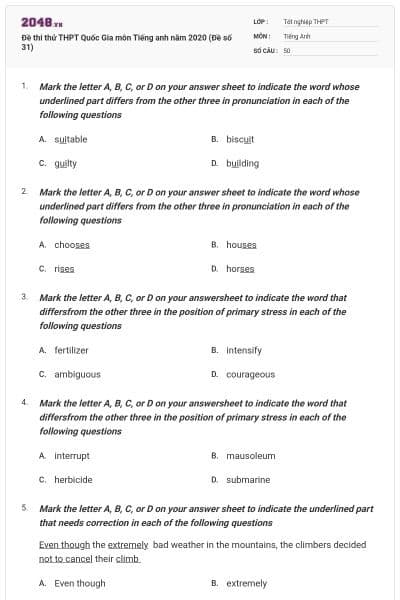
Mark the letter A, B, C, or D on your answer sheet to indicate the word whose underlined part differs from the other three in pronunciation in each of the following questions
suitable
biscuit
guilty
building
Đáp án A
suitable /ˈsuːtəbl/ hoặc /ˈsjuːtəbl/
guilty /ˈɡɪlti/
biscuit /ˈbɪskɪt/
building /ˈbɪldɪŋ/
Câu A phát âm là /u/ hoặc /ju/ còn lại phát âm là /ɪ/
Mark the letter A, B, C, or D on your answer sheet to indicate the word whose underlined part differs from the other three in pronunciation in each of the following questions
chooses
houses
rises
horses
Đáp án D
chooses /tʃuːziz/
rises /raɪziz/
houses /haʊziz/
horses /hɔːsiz/
Câu D phát âm là /siz/ còn lại phát âm là /ziz/
Mark the letter A, B, C, or D on your answersheet to indicate the word that differsfrom the other three in the position of primary stress in each of the following questions
fertilizer
intensify
ambiguous
courageous
Đáp án A
fertilizer /ˈfɜːrtəlaɪzər/
ambiguous /æmˈbɪɡjuəs/
intensify /ɪnˈtensɪfaɪ/
courageous /kəˈreɪdʒəs/
Câu A trọng âm 1 còn lại trọng âm 2
Mark the letter A, B, C, or D on your answersheet to indicate the word that differsfrom the other three in the position of primary stress in each of the following questions
interrupt
mausoleum
herbicide
submarine
Đáp án C
interrupt /ˌɪntəˈrʌpt/
herbicide /ˈhɜːbɪsaɪd/
mausoleum /ˌmɔːsəˈliːəm/
submarine /ˌsʌbməˈriːn/
Câu C trọng âm 1 còn lại trọng âm 3
Mark the letter A, B, C, or D on your answer sheet to indicate the underlined part that needs correction in each of the following questions
Even though the extremely bad weather in the mountains, the climbers decided not to cancel their climb
Even though
extremely
not to cancel
climb
Đáp án A
Kiến thức: Although/ though/ even though + S + V: mặc dù
= In spite of / Despite + noun phrase/ Ving
Even though => In spite of/ Despite
Câu này dịch như sau: Mặc dù thời tết cực kỳ xấu, nhưng những người leo núi vẫn quyết định không hủy chuyến leo núi của họ
Mark the letter A, B, C, or D on your answer sheet to indicate the underlined part that needs correction in each of the following questions
Bill was about average in performance in comparison with other students in his class
about average
in
with other students
his
Đáp án C
Kiến thức: other & the other
Other + danh từ số nhiều [ khác]: khi danh từ tập hợp chưa xác định
The other + danh từ số nhiều [ còn lại]: khi danh từ tập hợp xác định
With other students => with the other students
Câu này dịch như sau: Bill học lực khoảng trung bình so với những học sinh khác trong lớp của bạn ấy
Mark the letter A, B, C, or D on your answer sheet to indicate the underlined part that needs correction in each of the following questions
When I got home, Irene was lying in bed thinking about what a wonderful time she’s had
got
was lying
thinking
she’s had
Đáp án D
Kiến thức: Thì quá khứ đơn và quá khứ hoàn thành
Hành động về nhà, nằm trên giường đều xảy ra trong quá khứ => khoảng thời gian cô ấy đã có xảy ra trước => dùng thì quá khứ hoàn thành
She’s had => she had had
Câu này dịch như sau: Khi tôi trở về nhà, Irene đang nằm trên giường nghĩ về khoảng thời gian tuyệt vời cô ấy đã từng có
Mark the letter A, B, C, or D on your answer sheet to indicate the correct answer to each of the following questions
He’d hardly finished doing his homework when you arrived, ____________?
didn’t he
had he
would he
hadn’t he
Đáp án B
Kiến thức: S+ had hardly + Ved/ V3 when S + Ved/ V2
Câu hỏi đuôi vế trước mang nghĩa phủ định ( vì có hardly) nên vế sau mang nghĩa khẳng định.
Câu này dịch như sau: Anh ấy vừa làm xong bài tập thì bạn đến có phải không?
Mark the letter A, B, C, or D on your answer sheet to indicate the correct answer to each of the following questions
The time has now come when it will be necessary to ____________ making a plan
see through
see over
see about
see into
Đáp án C
See sth through: nhìn thấu đáo/ hoàn thành việc gì đó
See over ( the house): xem qua
See about: chuẩn bị làm điều gì đó
See into: điều tra/ nhận ra, biết được bản chất
Câu này dịch như sau: Bây giờ thời khắc đã đến cần thiết để chúng ta lên kế hoạch
Mark the letter A, B, C, or D on your answer sheet to indicate the correct answer to each of the following questions
A: “Why don’t we go to the cinema?” B: ―It’s too late. The film ______ by now.
will be started
will be starting
will have started
has started
Đáp án C
Kiến tức: Thì của động từ
By + trạng từ thời gian => dùng thì TLHT hoặc QKHT
Câu này dịch như sau: A: “Tại sao chúng ta không đi xem phim nhỉ?”
B: “Đã quá trễ bây giờ bộ phim đã bắt đầu rồi.”
Mark the letter A, B, C, or D on your answer sheet to indicate the correct answer to each of the following questions
Don’t put David in charge of arranging the theater trip; he’s too _____________.
organized
disorganized
organizing
well organized
Đáp án B
organized (adj): có óc tổ chức
disorganized (adj): không có óc tổ chức
organizing: Ving
well – organized (adj): được tổ chức tốt ( dành cho sự việc/ sự kiện)
Câu này dịch như sau: Đừng để David chịu trách nhiệm về việc sắp xếp đi đến nhà hát; anh ấy rất là không có óc tổ chức
Mark the letter A, B, C, or D on your answer sheet to indicate the correct answer to each of the following questions
The play was not ____________ what we had expected
just
absolutely
at all
very
Đáp án C
Cụm từ: not at all [ hoàn toàn không/ không chút nào cả]
Just: chỉ/ vừa mới
Absolutely: hoàn toàn là/ rất ;
sau nó phải là tính từ
Very: rất
Câu này dịch như sau: Vở kịch hoàn toàn không phải là cái mà chúng tôi mong đợi
Mark the letter A, B, C, or D on your answer sheet to indicate the correct answer to each of the following questions
She listened so attentively that not a word ____________.
she had missed
she missed
she didn’t miss
did she miss
Đáp án D
Cấu trúc đảo ngữ: Not a word + trợ động từ + S + động từ chính
Câu này dịch như sau: Cô ấy lắng nghe rất chăm chú đến nỗi mà cô ấy không bỏ sót 1 từ nào
Mark the letter A, B, C, or D on your answer sheet to indicate the correct answer to each of the following questions
A: ―Did you have to do a lot of preparation for the meeting?
B: ―________________ with the board, I reviewed all the proposals again
Until I was meeting
Prior to meeting
By the time I met
Subsequently meeting
Đáp án B
until: cho đến khi
by the time: ngay khi mà
prior to = before : trước khi
subsequently= later / afterward: sau đó
Câu này dịch như sau:
A: “Bạn đã chuẩn bị nhiều cho cuộc họp đúng không?”
B: “Trước khi gặp ban chủ cuộc họp, tôi đã xem lại tất cả các bản kiến nghị một lần nữa.”
Mark the letter A, B, C, or D on your answer sheet to indicate the correct answer to each of the following questions
The matter was so delicate that none of the ministers knew how to __________ it
manipulate
deal
affect
handle
Đáp án D
manipulate: vận dụng
affect : làm ảnh hưởng
deal with ( = cope with): giải quyết
handle: giải quyết
Câu này dịch như sau: Vấn đề này quá là khó xử đến nỗi mà không ai trong số các bộ trưởng biết cách giải
Mark the letter A, B, C, or D on your answer sheet to indicate the correct answer to each of the following questions
_____________ that Emily Dickinson wrote, two were given titles and seven were published during her lifetime
Of the 1800 poems
There were 1800 poems
Because the 1800 poems
The 1800 poems
Đáp án A
A.Trong số 1800 bài thơ
B. Có 1800 bài thơ => câu không hợp nghĩa
C. sai ngữ pháp vì Because + cụm danh từ
D. sai ngữ pháp , sai nghĩa. Nếu sửa thành the 1800th poem hoặc the poem 1800 [ bài thơ thứ 1800]
Câu này dịch như sau: Trong số 1800 bài thơ mà Emily Dickinson đã viết, 2 bài được trao tặng danh hiệu và 7 bài được xuất bản trong suốt cuộc đời của bà
Mark the letter A, B, C, or D on your answer sheet to indicate the correct answer to each of the following questions
Would you be ____________ my letters while I am away?
too good as to forward
so good as to forward
as good as to forward
so good as forwarding
Đáp án B
Cấu trúc: be so + adj+ to Vo [ đủ...để làm gì...]
Câu này dịch như sau: Bạn có đủ tốt bụng để chuyển tiếp thư của tôi khi tôi đi vắng được không?
Mark the letter A, B, C, or D on your answer sheet to indicate the correct answer to each of the following questions
I must have a word ____________ Jack about timekeeping; this is the third time this week he’s been late
with
for
from
toward
Đáp án A
Cụm từ: have a word with sb [ nói chuyện/ trao đổi riêng với ai đó]
Câu này dịch như sau: Tôi phải nói chuyện riêng với Jack về việc đến đúng giờ, đây là lần thứ ba trong tuần anh ấy đến muộn
Mark the letter A, B, C, or D on your answer sheet to indicate the correct answer to each of the following questions
Don’t worry! Our new product will keep your bathroom clean and ______
odourless
odour
odourful
odourlessly
Đáp án A
Cấu trúc: Keep + adj; clean (adj) => cần tính từ
odourless(adj): không mùi
odourful (n): mùi nồng nặc
odour(n): mùi
odourlessly (adv)
Câu này dịch như sau: Đừng lo! Sản phẩm mới của chúng tôi sẽ giữ cho phòng tắm của bạn luôn sạch sẽ và không mùi
Mark the letter A, B, C, or D on your answer sheet to indicate the most suitable response to complete each of the following exchanges
“More peas?”
“______ ________”
Help yourself to them
My honor
No, that’ll do. Thank you
No more available
Đáp án C
A: “Ăn thêm đậu Hà Lan nhé?”
A. Cứ tự nhiên như ở nhà.
C. Không, đủ rồi. Cảm ơn.
B. Đó là niềm vinh dự của tôi.
D. Hết rồi./ Không còn nữa đâu
Mark the letter A, B, C, or D on your answer sheet to indicate the most suitable response to complete each of the following exchanges
“Thank you for driving me home tonight.”
“__________________”
Forget about it. I didn’t mean so
I highly appreciate what you did
It doesn’t matter anyway
It’s nothing
Đáp án D
A: “Cảm ơn vì đã chở mình về nhà tối nay nhé!”
A. Quên nó đi. Mình không có ý đó
C. Không thành vấn đề chút nào.
B. Mình đánh giá cao việc bạn đã làm.
D. Không có gì đâu. ( = Don’t mention it!)
Mark the letter A, B, C, or D on your answersheet to indicate the word(s)CLOSEST in meaning to the under lined word(s) in each of the following questions.
He is an honest man. You can rely on him to do a good job
count on
take in
base on
put up with
Đáp án: B
Giải thích:
Kiến thức: Cụm động từ đồng nghĩa
rely on: tin tưởng, dựa vào ai đó
Xét các đáp án:
A. take in: lừa gạt, hấp thụ
B. count on: tin tưởng
C. base on: dựa trên cơ sở nào đó
D. put up with: chịu đựng
→ rely on = count on
Dịch: Anh ấy là một người trung thực. Bạn có thể tin tưởng anh ấy để làm tốt công việc.
Mark the letter A, B, C, or D on your answersheet to indicate the word(s)CLOSEST in meaning to the under lined word(s) in each of the following questions.
The school orchestra played so many wrong notes that I had trouble keeping a straight face
try not to show that you are unhappy
protect yourself from being embarrassed
do your best not to smile or laugh
show dislike or disgust
Đáp án C
Keep a straight face: giữ khuôn mặt nghiêm túc
A. cố gắng không để lộ là bạn đang không vui. ( = put on a brave face)
B. bảo vệ bản thân bạn khỏi bị lúng túng. ( = to save face)
C. cố hết sức để không cười.
D. thể hiện không thích hoặc chán ghét. ( = to pull a face)
Câu này dịch như sau: Dàn nhạc giao hưởng này chơi quá nhiều nốt sai đến nỗi mà tôi không thể nào giữ nét mặt nghiêm túc được
Mark the letter A,B,C, or D on your answer sheet to indicate the word(s) OPPOSITE in meaning to the underlined word(s) in each of the followingquestions
Moving all the heavy cinder blocks by hand from the driveway to the backyard seemed like an onerous task
easy
tedious
interesting
demanding
Đáp án A
onerous(adj): nặng nhọc/ khó khăn
interesting: thú vị
easy: dễ dàng
demanding: yêu cầu cao
Câu này dịch như sau: Việc di chuyển những khối xỉ nặng này bằng tay từ đường xe chạy đến sân sau có vẻ như là một công việc rất nặng nhọc.
=>onerous >< easy
Mark the letter A,B,C, or D on your answer sheet to indicate the word(s) OPPOSITE in meaning to the underlined word(s) in each of the followingquestions
I can’t understand why she did that. It really doesn’t add up.
makes the wrong addition
doesn’t make sense
seem reasonable
is not mathematics
Đáp án C
Doesn’t add up: khó hiểu/ không hợp lý
A. làm phép cộng sai
C. có vẻ hợp lý
B. không thể hiểu được
D. không phải là tooán học
Câu này dịch như sau: Tôi không thể hiểu tại sao cô ấy lại làm như vậy. Nó thật sự khó hiểu/ vô lý
Mark the letter A, B, C, or D on your answer sheet to indicate the sentence that is closest in meaning to each of the following questions
In order to stay open, the charity shop needs at least four helpers
Four helpers are needed because the charity shop stays open
No fewer than four helpers can enable the charity shop to stay open
Staying open means that the charity shop has the maximum of four helpers
The charity shop needs more than four helpers to stay open
Đáp án B
Để có thể duy trì hoạt động, cửa hàng từ thiện cần ít nhất 4 người giúp đỡ.
A. Bốn người giúp đỡ cần thiết cho cửa hàng từ thiện duy trì hoạt động.
B. Không ít hơn 4 người giúp đỡ có thể giúp cho cửa hàng từ thiện vẫn hoạt động.
C. Vẫn hoạt động có nghĩa là cửa hàng từ thiện có tối đa 4 người giúp đỡ.
D. Cứa hàng từ thiện cần cần nhiều hơn 4 người để duy trì hoạt độn
Mark the letter A, B, C, or D on your answer sheet to indicate the sentence that is closest in meaning to each of the following questions
There is no doubt that the tickets will be more expensive next month
Next month the tickets will undoubtedly be not as cheap as they are now
It is doubtful about the tickets’ price next month
The tickets are not bound to be more expensive next month
Next month maybe they will increase the price of the tickets
Đáp án A
Không nghi ngờ gì nữa tháng tới vé sẽ đắt hơn.
A.Tháng tới vé sẽ không nghi ngờ gì cả không rẻ như bây giờ.
B. Rất đáng ngờ về giá vé tháng tới.
C. Vé không dự định đắt hơn vào tháng tới.
D. Tháng tới có lẽ sẽ có sự tăng giá vé
Mark the letter A, B, C, or D on your answer sheet to indicate the sentence that is closest in meaning to each of the following questions
James could have been a classical musician if he’d continued his cello lessons
It was only because James stopped taking lessons on the cello that he was unable to become a classical musician
Originally, James had wanted to become a classical musician, and so he took cello lessons for a time
It was the cello lessons that he took for a long time that enabled James to become a classical musician
James never became a classical musician, but he did continue taking cello lessons nonetheless
Đáp án A
James đáng lẽ ra có thể trở thành nhạc sĩ nhạc cổ điển nếu anh ấy tiếp tục những bài học đàn hồ cầm của mình.
=>Câu điều kiện loại 3 => ngữ cảnh trong quá khứ
A. Chỉ bởi vi Jame ngừng tham gia những bài học về hồ cầm mà anh ấy không thể trở thành nhạc sĩ nhạc cổ điển.
B. Lúc đầu, James muốn trở thành nhạc sĩ nhạc cổ điển, và vì vậy anh ấy đã tham gia lớp học hồ cầm khoảng một thời gian.
C. Chính là những bài học về hồ cầm mà anh ấy đã học một khoảng thời gian đã giúp James trở thành nhạc sĩ chơi nhạc cổ điển.
D. James chưa bao giờ trở thành nhạc sĩ nhạc cổ điển, nhưng anh ấy đã tiếp tục tham gia lớp học hồ cầm
Mark the letter A, B, C, or D on your answer sheet to indicate the sentence that best combines each pair of sentences in the following questions
He felt very tired. However, he was determined to continue to climb up the mountain
He felt so tired that he was determined to continue to climb up the mountain
Feeling very tired, he was determined to continue to climb up the mountain
As a result of his tiredness, he was determined to continue to climb up the mountain
Tired as he might feel, he was determined to continue to climb up the mountain
Đáp án D
Anh ấy cảm thấy rất mệt. Tuy nhiên, anh ấy quyết tâm tiếp tục leo lên núi.
A. Anh ấy cảm thấy quá mệt đến nỗi mà anh ấy quyết tâm tiếp tục leo lên núi.
B. Cảm thấy rất mệt, anh ấy quyết tâm tiếp tục leo lên núi.
C. Vì mệt mỏi, anh ấy quyết tâm tiếp tục leo lên núi.
D. Mặc dù anh ấy cảm thấy mệt, anh ấy quyết tâm tiếp tục leo lên núi.
Cấu trúc: Adj + as + S + be = Although S + be + adj [ mặc dù]
Mark the letter A, B, C, or D on your answer sheet to indicate the sentence that best combines each pair of sentences in the following questions
Access to the library computer facilities is open to all students
Computers in the library are not used for students
Students can freely assess the library computer service
Students are not allowed to use library computers
The library computer facilities are accessible to students
Đáp án D
Quyền sử dụng trang thiết bị máy tính của thư viện sẵn sàng cho tất cả học sinh./ Tất cả học đều có quyền sử dụng trang thiết bị máy tính của thư viện.
A. Các máy tính trong thính viện khoogn được sử dụng cho học sinh.
B. Học sinh có thể tự do định giá dịch vụ máy tính của thư viện.
C. Học sinh không được phép dùng máy tính của thư viện.
D. Trang thiết bị máy tính của thư viện có thể được sử dụng cho học sinh
Read the following passage and mark the letter A, B, C, or D on your answer sheet to indicate the correctword or phrase that bestfits each of the numbered blanks from 31 to35.
It isn’t difficult to imagine how increases in international commerce and in the movement of people—two defining features of globalization—might influence health. More goods go more places today than at any (31)___________ in history. More people travel farther, more frequently, and come in contact with more people and goods, than at any point in history.
This increased movement of both goods and people increases opportunities for the spread of disease around the world. And it’s not just goods and services that can travel across oceans and state borders—so can diseases like AIDS, malaria, or tuberculosis. The (32)___________ of BSE, or ―mad cow disease,‖ in several European countries is only one example of (33)___________trade can promote the spread of dangerous diseases. Mosquitoes that carry malaria have been found aboard planes thousands of miles from their primary habitats, and (34)___________ seafood carrying cholera bacteria have been shipped from Latin America to the United States and Europe.
But just as globalization increases the frequency and ease (35)___________ which diseases can move around the world, it also can improve access to the medicines, medical information, and training that can help treat or cure these diseases.
Điền vào ô số 31
spot
end
point
position
Đáp án C
Cụm từ: at any point
[ tại bất cứ thời điểm nào]
It isn’t difficult to imagine how increases in international commerce and in the movement of people—two defining features of globalization—might influence health. More goods go more places today than at any (31)___________ in history. More people travel farther, more frequently, and come in contact with more people and goods, than at any point in history. [Không khó để tưởng sự tăng trưởng thương mại quốc tế và sự biến động của con người – hai đặc trưng xác định của toàn cầu hóa – có thể ảnh hưởng đến sức khỏe. Ngày nay ngày càng nhiều hàng hóa đến nhiều nơi hơn bất cứ thời điểm nào trong lịch sử.]
Read the following passage and mark the letter A, B, C, or D on your answer sheet to indicate the correctword or phrase that bestfits each of the numbered blanks from 31 to35.
It isn’t difficult to imagine how increases in international commerce and in the movement of people—two defining features of globalization—might influence health. More goods go more places today than at any (31)___________ in history. More people travel farther, more frequently, and come in contact with more people and goods, than at any point in history.
This increased movement of both goods and people increases opportunities for the spread of disease around the world. And it’s not just goods and services that can travel across oceans and state borders—so can diseases like AIDS, malaria, or tuberculosis. The (32)___________ of BSE, or ―mad cow disease,‖ in several European countries is only one example of (33)___________trade can promote the spread of dangerous diseases. Mosquitoes that carry malaria have been found aboard planes thousands of miles from their primary habitats, and (34)___________ seafood carrying cholera bacteria have been shipped from Latin America to the United States and Europe.
But just as globalization increases the frequency and ease (35)___________ which diseases can move around the world, it also can improve access to the medicines, medical information, and training that can help treat or cure these diseases.
Điền vào ô số 32
outbreak
disruption
corruption
suspension
Đáp án A
outbreak: sự bùng nổ
corruption: sự tham nhũng
disruption: sự gián đoạn
suspension: sự đình chỉ
This increased movement of both goods and people increases opportunities for the spread of disease around the world. And it’s not just goods and services that can travel across oceans and state borders—so can diseases like AIDS, malaria, or tuberculosis. The (32)___________ of BSE, or ―mad cow disease,‖ [Sự biến đổi ngày càng tăng này về cả hàng hóa và con người làm tăng cơ hội cho sự lây lan của các căn bệnh trên khắp thế giới. Và nó không chỉ là các hàng hóa và dịch vụ cái mà có thể đi từ đại dương và liên bang – vì vậy các căn bệnh như AIDS, bệnh sốt rét hay bệnh lao. Sự bùng phát của bệnh BSE hay “bệnh bò điên”
Read the following passage and mark the letter A, B, C, or D on your answer sheet to indicate the correctword or phrase that bestfits each of the numbered blanks from 31 to35.
It isn’t difficult to imagine how increases in international commerce and in the movement of people—two defining features of globalization—might influence health. More goods go more places today than at any (31)___________ in history. More people travel farther, more frequently, and come in contact with more people and goods, than at any point in history.
This increased movement of both goods and people increases opportunities for the spread of disease around the world. And it’s not just goods and services that can travel across oceans and state borders—so can diseases like AIDS, malaria, or tuberculosis. The (32)___________ of BSE, or ―mad cow disease,‖ in several European countries is only one example of (33)___________trade can promote the spread of dangerous diseases. Mosquitoes that carry malaria have been found aboard planes thousands of miles from their primary habitats, and (34)___________ seafood carrying cholera bacteria have been shipped from Latin America to the United States and Europe.
But just as globalization increases the frequency and ease (35)___________ which diseases can move around the world, it also can improve access to the medicines, medical information, and training that can help treat or cure these diseases.
Điền vào ô số 33
what
how
which
when
Đáp án B
what: cái gì
which: cái mà
how: như thế nào
when: khi mà
in several European countries is only one example of (33)___________trade can promote the spread of dangerous diseases
[ Ở một số nước châu Âu chỉ là một ví dụ của thương mại có thể thúc đẩy sự tràn lan của các căn bệnh nguy hiểm như thế nào.]
Read the following passage and mark the letter A, B, C, or D on your answer sheet to indicate the correctword or phrase that bestfits each of the numbered blanks from 31 to35.
It isn’t difficult to imagine how increases in international commerce and in the movement of people—two defining features of globalization—might influence health. More goods go more places today than at any (31)___________ in history. More people travel farther, more frequently, and come in contact with more people and goods, than at any point in history.
This increased movement of both goods and people increases opportunities for the spread of disease around the world. And it’s not just goods and services that can travel across oceans and state borders—so can diseases like AIDS, malaria, or tuberculosis. The (32)___________ of BSE, or ―mad cow disease,‖ in several European countries is only one example of (33)___________trade can promote the spread of dangerous diseases. Mosquitoes that carry malaria have been found aboard planes thousands of miles from their primary habitats, and (34)___________ seafood carrying cholera bacteria have been shipped from Latin America to the United States and Europe.
But just as globalization increases the frequency and ease (35)___________ which diseases can move around the world, it also can improve access to the medicines, medical information, and training that can help treat or cure these diseases.
Điền vào ô số 34
diseased
treated
infectious
infected
Đáp án D
diseased: bị mắc bệnh
infectious: có khả năng lây lan.
treated: đã được xử lý
infected: đã bị nhiễm bệnh
Mosquitoes that carry malaria have been found aboard planes thousands of miles from their primary habitats, and (34)___________ seafood carrying cholera bacteria have been shipped from Latin America to the United States and Europe.
[Muỗi cái mà mang bệnh sốt rét đã được tìm thấy trên những chiếc máy bay nước ngoài cách môi trường sống chính của chúng, và hải sản đã nhiễm bệnh cái mà mang vi khuẩn dịch tả được vận chuyển từ Mỹ La tinh đến Mỹ và châu Âu.]
Read the following passage and mark the letter A, B, C, or D on your answer sheet to indicate the correctword or phrase that bestfits each of the numbered blanks from 31 to35.
It isn’t difficult to imagine how increases in international commerce and in the movement of people—two defining features of globalization—might influence health. More goods go more places today than at any (31)___________ in history. More people travel farther, more frequently, and come in contact with more people and goods, than at any point in history.
This increased movement of both goods and people increases opportunities for the spread of disease around the world. And it’s not just goods and services that can travel across oceans and state borders—so can diseases like AIDS, malaria, or tuberculosis. The (32)___________ of BSE, or ―mad cow disease,‖ in several European countries is only one example of (33)___________trade can promote the spread of dangerous diseases. Mosquitoes that carry malaria have been found aboard planes thousands of miles from their primary habitats, and (34)___________ seafood carrying cholera bacteria have been shipped from Latin America to the United States and Europe.
But just as globalization increases the frequency and ease (35)___________ which diseases can move around the world, it also can improve access to the medicines, medical information, and training that can help treat or cure these diseases.
Điền vào ô số 34
with
for
from
by
Đáp án A
Cụm từ: with ease = easily [ một cách dễ dàng]
But just as globalization increases the frequency and ease (35)___________ which diseases can move around the world, it also can improve access to the medicines, medical information, and training that can help treat or cure these diseases.
[ Khi mà sự toàn cầu hóa làm tăng tần suất và những căn bệnh có thể đi khắp thế giới một cách dễ dàng, nó cũng có thể cải thiện khả năng tiếp cận với thuốc, thông tin y dược, và tập huấn cái mà có thể giúp chữa trị những căn bệnh này.]
Read the following passage and mark the letter A, B, C, or D on your answer sheet to indicate the correct answer to each of the questions from 36 to 42
Leisure activity isn’t just for fun, says a University of Florida psychologist who has developed a scale that classifies hobbies and avocations based on needs they satisfy in people. The scale can help people find more personal fulfillment by giving them insight into what they really like and by helping them to find substitutes when they can’t pursue their favorite activities.
“The surprising thing is that activities you might think are very different have similar effects on people” said Howard E.A. Tinsley, a UF psychology professor who developed the measurement. ―Probably no one would consider acting to have the same characteristics as roller-skating or playing baseball, but men and women who act as a hobby report feeling an intense sense of belonging to a group, much the same way others do in playing sports.
And activities providing the strongest sense of competition are not sports, but card, arcade and computer games, he found.
Tinsley, whose research on leisure has been published in several journals, is scheduled this spring to present some of the findings in Milwaukee at a conference of the Society for Vocational Psychology.
Based on surveys with more than 3,000 people about the satisfactions they get from various hobbies, Tinsley obtained numerical scores for values such as “challenge” and “hedonism”, and grouped some 82 leisure activities into 11 categories. For example, dining out and watching movies fall into the “sensual enjoyment” category, playing soccer and attending sports clubs meetings satisfy participants’ desires for a sense of “belongingness” and coin collecting and baking fulfill their need for “creativity”.
“With so many people in jobs they don’t care for, leisure is a prized aspect of people’s lives,” Tinsley said. “Yet it’s not something psychologists really study. Economists tell us how much money people spend skiing, but nobody explains what it is about skiing that is really appealing to people or how one activity relates to another, perhaps in unexpected ways.”
“Fishing, generally considered more of an outdoor or recreational activity, for example, is a form of self-expression like quilting or stamp collecting, because it gives people the opportunity to express themselves by doing something completely different from their daily routine,”he said.
The word "substitutes" in paragraph 1 is closest in meaning to ________________.
delight
revenge
replacement
attraction
Đáp án C
Từ “substitutes” (sự thay thế) ở đoạn 1 gần nghĩa nhất với
A. sự hài lòng
C. sự thay thế
B. sự trả thù
D. sự thu hút
Read the following passage and mark the letter A, B, C, or D on your answer sheet to indicate the correct answer to each of the questions from 36 to 42
Leisure activity isn’t just for fun, says a University of Florida psychologist who has developed a scale that classifies hobbies and avocations based on needs they satisfy in people. The scale can help people find more personal fulfillment by giving them insight into what they really like and by helping them to find substitutes when they can’t pursue their favorite activities.
“The surprising thing is that activities you might think are very different have similar effects on people” said Howard E.A. Tinsley, a UF psychology professor who developed the measurement. ―Probably no one would consider acting to have the same characteristics as roller-skating or playing baseball, but men and women who act as a hobby report feeling an intense sense of belonging to a group, much the same way others do in playing sports.
And activities providing the strongest sense of competition are not sports, but card, arcade and computer games, he found.
Tinsley, whose research on leisure has been published in several journals, is scheduled this spring to present some of the findings in Milwaukee at a conference of the Society for Vocational Psychology.
Based on surveys with more than 3,000 people about the satisfactions they get from various hobbies, Tinsley obtained numerical scores for values such as “challenge” and “hedonism”, and grouped some 82 leisure activities into 11 categories. For example, dining out and watching movies fall into the “sensual enjoyment” category, playing soccer and attending sports clubs meetings satisfy participants’ desires for a sense of “belongingness” and coin collecting and baking fulfill their need for “creativity”.
“With so many people in jobs they don’t care for, leisure is a prized aspect of people’s lives,” Tinsley said. “Yet it’s not something psychologists really study. Economists tell us how much money people spend skiing, but nobody explains what it is about skiing that is really appealing to people or how one activity relates to another, perhaps in unexpected ways.”
“Fishing, generally considered more of an outdoor or recreational activity, for example, is a form of self-expression like quilting or stamp collecting, because it gives people the opportunity to express themselves by doing something completely different from their daily routine,”he said.
Which of the following is NOT true?
Both acting and roller-skating give people a feeling of being a part of a team
Collecting things satisfied people’s desire for making things
Fishing allows you to show the type of person you are
Researchers already know why a hobby attracts a person
Đáp án D
Câu nào sau đây không đúng?
A. Cả diễn xuất và trượt ba – tanh đều cho con người cảm giác là thành viên của một nhóm B. Sưu tầm các vật dụng làm con người thõa mãn khát vọng làm ra các vật dụng
C. Câu cá cho phép bản thể hiện bản chất con người bạn.
D. Các nhà nghiên cứu đã biết tại 1 sở thích lại thu hút một người.
Dẫn chứng: “but nobody explains what it is about skiing that is really appealing to people or how one activity relates to another, perhaps in unexpected ways.”
Read the following passage and mark the letter A, B, C, or D on your answer sheet to indicate the correct answer to each of the questions from 36 to 42
Leisure activity isn’t just for fun, says a University of Florida psychologist who has developed a scale that classifies hobbies and avocations based on needs they satisfy in people. The scale can help people find more personal fulfillment by giving them insight into what they really like and by helping them to find substitutes when they can’t pursue their favorite activities.
“The surprising thing is that activities you might think are very different have similar effects on people” said Howard E.A. Tinsley, a UF psychology professor who developed the measurement. ―Probably no one would consider acting to have the same characteristics as roller-skating or playing baseball, but men and women who act as a hobby report feeling an intense sense of belonging to a group, much the same way others do in playing sports.
And activities providing the strongest sense of competition are not sports, but card, arcade and computer games, he found.
Tinsley, whose research on leisure has been published in several journals, is scheduled this spring to present some of the findings in Milwaukee at a conference of the Society for Vocational Psychology.
Based on surveys with more than 3,000 people about the satisfactions they get from various hobbies, Tinsley obtained numerical scores for values such as “challenge” and “hedonism”, and grouped some 82 leisure activities into 11 categories. For example, dining out and watching movies fall into the “sensual enjoyment” category, playing soccer and attending sports clubs meetings satisfy participants’ desires for a sense of “belongingness” and coin collecting and baking fulfill their need for “creativity”.
“With so many people in jobs they don’t care for, leisure is a prized aspect of people’s lives,” Tinsley said. “Yet it’s not something psychologists really study. Economists tell us how much money people spend skiing, but nobody explains what it is about skiing that is really appealing to people or how one activity relates to another, perhaps in unexpected ways.”
“Fishing, generally considered more of an outdoor or recreational activity, for example, is a form of self-expression like quilting or stamp collecting, because it gives people the opportunity to express themselves by doing something completely different from their daily routine,”he said.
Which of the following is not mentioned as a category in Tinsley’s scale?
hedonism
belongingness
initiative
sensual enjoyment
Đáp án C
Cái nào sau đây không được đề cập như là một loại thuộc thang đánh giá Tinsley’s?
A. chủ nghĩa khoái lạc
C. sự chủ động/ sáng kiến
B. cảm giác thuộc về
D. sự thích thú về mặt giác quan
Dẫn chứng: Based on surveys with more than 3,000 people about the satisfactions they get from various hobbies, Tinsley obtained numerical scores for values such as “challenge” and “hedonism”, and grouped some 82 leisure activities into 11 categories. For example, dining out and watching movies fall into the “sensual enjoyment” category, playing soccer and attending sports clubs meetings satisfy participants’ desires for a sense of “belongingness” and coin collecting and baking fulfill their need for “creativity.”
Read the following passage and mark the letter A, B, C, or D on your answer sheet to indicate the correct answer to each of the questions from 36 to 42
Leisure activity isn’t just for fun, says a University of Florida psychologist who has developed a scale that classifies hobbies and avocations based on needs they satisfy in people. The scale can help people find more personal fulfillment by giving them insight into what they really like and by helping them to find substitutes when they can’t pursue their favorite activities.
“The surprising thing is that activities you might think are very different have similar effects on people” said Howard E.A. Tinsley, a UF psychology professor who developed the measurement. ―Probably no one would consider acting to have the same characteristics as roller-skating or playing baseball, but men and women who act as a hobby report feeling an intense sense of belonging to a group, much the same way others do in playing sports.
And activities providing the strongest sense of competition are not sports, but card, arcade and computer games, he found.
Tinsley, whose research on leisure has been published in several journals, is scheduled this spring to present some of the findings in Milwaukee at a conference of the Society for Vocational Psychology.
Based on surveys with more than 3,000 people about the satisfactions they get from various hobbies, Tinsley obtained numerical scores for values such as “challenge” and “hedonism”, and grouped some 82 leisure activities into 11 categories. For example, dining out and watching movies fall into the “sensual enjoyment” category, playing soccer and attending sports clubs meetings satisfy participants’ desires for a sense of “belongingness” and coin collecting and baking fulfill their need for “creativity”.
“With so many people in jobs they don’t care for, leisure is a prized aspect of people’s lives,” Tinsley said. “Yet it’s not something psychologists really study. Economists tell us how much money people spend skiing, but nobody explains what it is about skiing that is really appealing to people or how one activity relates to another, perhaps in unexpected ways.”
“Fishing, generally considered more of an outdoor or recreational activity, for example, is a form of self-expression like quilting or stamp collecting, because it gives people the opportunity to express themselves by doing something completely different from their daily routine,”he said.
Taking part in sports gives you _________________.
the strongest desire to win
a need for creativity
the chance to express your feelings
a sense of being part of a team
Đáp án D
Tham gia vào các môn thể thao cho bạn
A. khao khát mạnh mẽ để chiến thắng
C. cơ hội thể hiện cảm xúc
B. sự cần sáng tạo
D. cảm giác là một phần của một đội
Dẫn chứng: playing soccer and attending sports clubs meetings satisfy participants’ desires for a sense of “belongingness
Read the following passage and mark the letter A, B, C, or D on your answer sheet to indicate the correct answer to each of the questions from 36 to 42
Leisure activity isn’t just for fun, says a University of Florida psychologist who has developed a scale that classifies hobbies and avocations based on needs they satisfy in people. The scale can help people find more personal fulfillment by giving them insight into what they really like and by helping them to find substitutes when they can’t pursue their favorite activities.
“The surprising thing is that activities you might think are very different have similar effects on people” said Howard E.A. Tinsley, a UF psychology professor who developed the measurement. ―Probably no one would consider acting to have the same characteristics as roller-skating or playing baseball, but men and women who act as a hobby report feeling an intense sense of belonging to a group, much the same way others do in playing sports.
And activities providing the strongest sense of competition are not sports, but card, arcade and computer games, he found.
Tinsley, whose research on leisure has been published in several journals, is scheduled this spring to present some of the findings in Milwaukee at a conference of the Society for Vocational Psychology.
Based on surveys with more than 3,000 people about the satisfactions they get from various hobbies, Tinsley obtained numerical scores for values such as “challenge” and “hedonism”, and grouped some 82 leisure activities into 11 categories. For example, dining out and watching movies fall into the “sensual enjoyment” category, playing soccer and attending sports clubs meetings satisfy participants’ desires for a sense of “belongingness” and coin collecting and baking fulfill their need for “creativity”.
“With so many people in jobs they don’t care for, leisure is a prized aspect of people’s lives,” Tinsley said. “Yet it’s not something psychologists really study. Economists tell us how much money people spend skiing, but nobody explains what it is about skiing that is really appealing to people or how one activity relates to another, perhaps in unexpected ways.”
“Fishing, generally considered more of an outdoor or recreational activity, for example, is a form of self-expression like quilting or stamp collecting, because it gives people the opportunity to express themselves by doing something completely different from their daily routine,”he said.
The word "it" in the last paragraph refers to ________________.
fishing
activity
self-expression
stamp collecting
Đáp án A
Từ “it” ở đoạn cuối ám chỉ đến
A. việc câu cá
C.tự trình bày cảm xúc
B. hoạt động
D. sưu tầm tem
Dẫn chứng: “Fishing, generally considered more of an outdoor or recreational activity, for example, is a form of self-expression like quilting or stamp collecting, because it gives people the opportunity to express themselves by doing something completely different from their daily routine,” he said.
Read the following passage and mark the letter A, B, C, or D on your answer sheet to indicate the correct answer to each of the questions from 36 to 42
Leisure activity isn’t just for fun, says a University of Florida psychologist who has developed a scale that classifies hobbies and avocations based on needs they satisfy in people. The scale can help people find more personal fulfillment by giving them insight into what they really like and by helping them to find substitutes when they can’t pursue their favorite activities.
“The surprising thing is that activities you might think are very different have similar effects on people” said Howard E.A. Tinsley, a UF psychology professor who developed the measurement. ―Probably no one would consider acting to have the same characteristics as roller-skating or playing baseball, but men and women who act as a hobby report feeling an intense sense of belonging to a group, much the same way others do in playing sports.
And activities providing the strongest sense of competition are not sports, but card, arcade and computer games, he found.
Tinsley, whose research on leisure has been published in several journals, is scheduled this spring to present some of the findings in Milwaukee at a conference of the Society for Vocational Psychology.
Based on surveys with more than 3,000 people about the satisfactions they get from various hobbies, Tinsley obtained numerical scores for values such as “challenge” and “hedonism”, and grouped some 82 leisure activities into 11 categories. For example, dining out and watching movies fall into the “sensual enjoyment” category, playing soccer and attending sports clubs meetings satisfy participants’ desires for a sense of “belongingness” and coin collecting and baking fulfill their need for “creativity”.
“With so many people in jobs they don’t care for, leisure is a prized aspect of people’s lives,” Tinsley said. “Yet it’s not something psychologists really study. Economists tell us how much money people spend skiing, but nobody explains what it is about skiing that is really appealing to people or how one activity relates to another, perhaps in unexpected ways.”
“Fishing, generally considered more of an outdoor or recreational activity, for example, is a form of self-expression like quilting or stamp collecting, because it gives people the opportunity to express themselves by doing something completely different from their daily routine,”he said.
Which sentence best summarizes the passage?
Leisure activity and sport are totally different
A person’s personality is expressed via his hobbies
Leisure activities satisfy people’s particular desires
Sports affect a person’s personality
Đáp án C
Câu nào tóm tắt bài đọc này hay nhất?
A. Hoạt động thư giãn và thể thao hoàn toàn khác nhau.
B. Tính cách của một người được bộc lộ thông qua sở thích của người đó.
C. Các hoạt động thư giãn thỏa mãn những khát khao cụ thể của con người.
D. Các môn thể thao ảnh hưởng đến tính cách của con người
Read the following passage and mark the letter A, B, C, or D on your answer sheet to indicate the correct answer to each of the questions from 36 to 42
Leisure activity isn’t just for fun, says a University of Florida psychologist who has developed a scale that classifies hobbies and avocations based on needs they satisfy in people. The scale can help people find more personal fulfillment by giving them insight into what they really like and by helping them to find substitutes when they can’t pursue their favorite activities.
“The surprising thing is that activities you might think are very different have similar effects on people” said Howard E.A. Tinsley, a UF psychology professor who developed the measurement. ―Probably no one would consider acting to have the same characteristics as roller-skating or playing baseball, but men and women who act as a hobby report feeling an intense sense of belonging to a group, much the same way others do in playing sports.
And activities providing the strongest sense of competition are not sports, but card, arcade and computer games, he found.
Tinsley, whose research on leisure has been published in several journals, is scheduled this spring to present some of the findings in Milwaukee at a conference of the Society for Vocational Psychology.
Based on surveys with more than 3,000 people about the satisfactions they get from various hobbies, Tinsley obtained numerical scores for values such as “challenge” and “hedonism”, and grouped some 82 leisure activities into 11 categories. For example, dining out and watching movies fall into the “sensual enjoyment” category, playing soccer and attending sports clubs meetings satisfy participants’ desires for a sense of “belongingness” and coin collecting and baking fulfill their need for “creativity”.
“With so many people in jobs they don’t care for, leisure is a prized aspect of people’s lives,” Tinsley said. “Yet it’s not something psychologists really study. Economists tell us how much money people spend skiing, but nobody explains what it is about skiing that is really appealing to people or how one activity relates to another, perhaps in unexpected ways.”
“Fishing, generally considered more of an outdoor or recreational activity, for example, is a form of self-expression like quilting or stamp collecting, because it gives people the opportunity to express themselves by doing something completely different from their daily routine,”he said.
The findings in the passage by Howard E.A.Tinsley are somewhat __________
funny
surprising
predictable
useless
Đáp án B
Những phát hiện trong bài đọc của Howard E Tinsley thì khá là
A.buồn cười/ hài hước
C. có thể đoán trước được
B. bất ngờ / không ngờ đến
D. vô dụng
Dẫn chứng: but nobody explains what it is about skiing that is really appealing to people or how one activity relates to another, perhaps in unexpected ways.”
Read the following passage and mark the letter A, B, C, or D on your answer sheet to indicate the correct answer to each of the questions from 43 to 50
Archaeological records - paintings, drawings and carvings of humans engaged in activities involving the use of hands - indicate that humans have been predominantly right-handed for more than 5,000 years. In ancient Egyptian artwork, for example, the right hand is depicted as the dominant one in about 90 percent of the examples. Fracture or wear patterns on tools also indicate that a majority of ancient people were right-handed. Cro-Magnon cave paintings some 27,000 years old commonly show outlines of human hands made by placing one hand against the cave wall and applying paint with the other. Children today make similar outlines of their hands with crayons on paper. With few exceptions, left hands of CroMagnons are displayed on cave walls, indicating that the paintings were usually done by right-handers.
Anthropological evidence pushes the record of handedness in early human ancestors back to at least 1.4 million years ago. One important line of evidence comes from flaking patterns of stone cores used in tool making: implements flaked with a clockwise motion (indicating a right-handed toolmaker) can be distinguished from those flaked with a counter-clockwise rotation (indicating a left-handed toolmaker).
Even scratches found on fossil human teeth offer clues. Ancient humans are thought to have cut meat into strips by holding it between their teeth and slicing it with stone knives, as do the present-day Inuit. Occasionally the knives slip and leave scratches on the users' teeth. Scratches made with a left-to-right stroke direction (by right-handers) are more common than scratches in the opposite direction (made by lefthanders).
Still other evidence comes from cranial morphology: scientists think that physical differences between the right and left sides of the interior of the skull indicate subtle physical differences between the two sides of the brain. The variation between the hemispheres corresponds to which side of the body is used to perform specific activities. Such studies, as well as studies of tool use, indicate that right- or leftsided dominance is not exclusive to modern Homo sapiens. Population of Neanderthals, such as Homo erectus and Homo Habilis, seem to have been predominantly right-handed, as we are.
What is the main idea of the passage?
Human ancestors became predominantly right-handed when they began to use tools
It is difficult to interpret the significance of anthropological evidence concerning tool use
Humans and their ancestors have been predominantly right-handed for over a million years
Human ancestors were more skilled at using both hands than modern humans
Đáp án C
Nội dung chính của bài đọc là?
A.Tổ tiên của con người trở nên thống trị về số lượng thuận tay phải khi họ bắt đầu sử dụng công cụ.
B. Khó để phiên dịch tầm quan trọng của các chứng cứ nhân chủng học liên quan đến việc sử dụng công cụ.
C. Con người và tổ tiên của họ vượt trội về số người thuận tay phải hơn 1 triệu năm qua.
D. Tổ tiên của con người khéo léo hơn về sử dụng công cụ bằng hai tay so với con người hiện đại.
Dẫn chứng: Anthropological evidence pushes the record of handedness in early human ancestors back to at least 1.4 million years ago
Read the following passage and mark the letter A, B, C, or D on your answer sheet to indicate the correct answer to each of the questions from 43 to 50
Archaeological records - paintings, drawings and carvings of humans engaged in activities involving the use of hands - indicate that humans have been predominantly right-handed for more than 5,000 years. In ancient Egyptian artwork, for example, the right hand is depicted as the dominant one in about 90 percent of the examples. Fracture or wear patterns on tools also indicate that a majority of ancient people were right-handed. Cro-Magnon cave paintings some 27,000 years old commonly show outlines of human hands made by placing one hand against the cave wall and applying paint with the other. Children today make similar outlines of their hands with crayons on paper. With few exceptions, left hands of CroMagnons are displayed on cave walls, indicating that the paintings were usually done by right-handers.
Anthropological evidence pushes the record of handedness in early human ancestors back to at least 1.4 million years ago. One important line of evidence comes from flaking patterns of stone cores used in tool making: implements flaked with a clockwise motion (indicating a right-handed toolmaker) can be distinguished from those flaked with a counter-clockwise rotation (indicating a left-handed toolmaker).
Even scratches found on fossil human teeth offer clues. Ancient humans are thought to have cut meat into strips by holding it between their teeth and slicing it with stone knives, as do the present-day Inuit. Occasionally the knives slip and leave scratches on the users' teeth. Scratches made with a left-to-right stroke direction (by right-handers) are more common than scratches in the opposite direction (made by lefthanders).
Still other evidence comes from cranial morphology: scientists think that physical differences between the right and left sides of the interior of the skull indicate subtle physical differences between the two sides of the brain. The variation between the hemispheres corresponds to which side of the body is used to perform specific activities. Such studies, as well as studies of tool use, indicate that right- or leftsided dominance is not exclusive to modern Homo sapiens. Population of Neanderthals, such as Homo erectus and Homo Habilis, seem to have been predominantly right-handed, as we are.
The word "other" in the first paragraph refers to ______________.
outline
hand
wall
paint
Đáp án B
Từ “other” ở đoạn 1 ám chỉ đến
A. dàn ý/ bố cục
C. bức tường
B. tay
D. sơn
Dẫn chứng: Cro-Magnon cave paintings some 27,000 years old commonly show outlines of human hands made by placing one hand against the cave wall and applying paint with the other
Read the following passage and mark the letter A, B, C, or D on your answer sheet to indicate the correct answer to each of the questions from 43 to 50
Archaeological records - paintings, drawings and carvings of humans engaged in activities involving the use of hands - indicate that humans have been predominantly right-handed for more than 5,000 years. In ancient Egyptian artwork, for example, the right hand is depicted as the dominant one in about 90 percent of the examples. Fracture or wear patterns on tools also indicate that a majority of ancient people were right-handed. Cro-Magnon cave paintings some 27,000 years old commonly show outlines of human hands made by placing one hand against the cave wall and applying paint with the other. Children today make similar outlines of their hands with crayons on paper. With few exceptions, left hands of CroMagnons are displayed on cave walls, indicating that the paintings were usually done by right-handers.
Anthropological evidence pushes the record of handedness in early human ancestors back to at least 1.4 million years ago. One important line of evidence comes from flaking patterns of stone cores used in tool making: implements flaked with a clockwise motion (indicating a right-handed toolmaker) can be distinguished from those flaked with a counter-clockwise rotation (indicating a left-handed toolmaker).
Even scratches found on fossil human teeth offer clues. Ancient humans are thought to have cut meat into strips by holding it between their teeth and slicing it with stone knives, as do the present-day Inuit. Occasionally the knives slip and leave scratches on the users' teeth. Scratches made with a left-to-right stroke direction (by right-handers) are more common than scratches in the opposite direction (made by lefthanders).
Still other evidence comes from cranial morphology: scientists think that physical differences between the right and left sides of the interior of the skull indicate subtle physical differences between the two sides of the brain. The variation between the hemispheres corresponds to which side of the body is used to perform specific activities. Such studies, as well as studies of tool use, indicate that right- or leftsided dominance is not exclusive to modern Homo sapiens. Population of Neanderthals, such as Homo erectus and Homo Habilis, seem to have been predominantly right-handed, as we are.
What does the author say about Cro-Magnon paintings of hands?
Some are not very old
It is unusual to see such paintings
Many were made by children
The artists were mostly right-handed
Đáp án D
Tác giả nói gì về những bức tranh vẽ bằng tay của Cro Mangon?
A. Một số không cũ lắm.
B. Thật bất thường khi nhìn thấy những bức tranh như vậy.
C. Nhiều bức tranh do trẻ con vẽ.
D. Các nghệ sĩ hầu hết thuận tay phải.
Dẫn chứng: With few exceptions, left hands of Cro-Magnons are displayed on cave walls, indicating that the paintings were usually done by right-handers
Read the following passage and mark the letter A, B, C, or D on your answer sheet to indicate the correct answer to each of the questions from 43 to 50
Archaeological records - paintings, drawings and carvings of humans engaged in activities involving the use of hands - indicate that humans have been predominantly right-handed for more than 5,000 years. In ancient Egyptian artwork, for example, the right hand is depicted as the dominant one in about 90 percent of the examples. Fracture or wear patterns on tools also indicate that a majority of ancient people were right-handed. Cro-Magnon cave paintings some 27,000 years old commonly show outlines of human hands made by placing one hand against the cave wall and applying paint with the other. Children today make similar outlines of their hands with crayons on paper. With few exceptions, left hands of CroMagnons are displayed on cave walls, indicating that the paintings were usually done by right-handers.
Anthropological evidence pushes the record of handedness in early human ancestors back to at least 1.4 million years ago. One important line of evidence comes from flaking patterns of stone cores used in tool making: implements flaked with a clockwise motion (indicating a right-handed toolmaker) can be distinguished from those flaked with a counter-clockwise rotation (indicating a left-handed toolmaker).
Even scratches found on fossil human teeth offer clues. Ancient humans are thought to have cut meat into strips by holding it between their teeth and slicing it with stone knives, as do the present-day Inuit. Occasionally the knives slip and leave scratches on the users' teeth. Scratches made with a left-to-right stroke direction (by right-handers) are more common than scratches in the opposite direction (made by lefthanders).
Still other evidence comes from cranial morphology: scientists think that physical differences between the right and left sides of the interior of the skull indicate subtle physical differences between the two sides of the brain. The variation between the hemispheres corresponds to which side of the body is used to perform specific activities. Such studies, as well as studies of tool use, indicate that right- or leftsided dominance is not exclusive to modern Homo sapiens. Population of Neanderthals, such as Homo erectus and Homo Habilis, seem to have been predominantly right-handed, as we are.
When compared with implements "flaked with a counter-clockwise rotation”, it can be inferred that "implements flaked with a clock-wise motion" are ______________.
more common
larger
more sophisticated
older
Đáp án A
Khi được so sánh với những dụng cụ được gọt đẽo theo chiều ngược kim đồng hồ”, có thể suy ra rằng “các vật dụng được gọt đẽo theo chiều kim đồng hồ” thì
A. phổ biến hơn
C. phức tạp hơn
B. lớn hơn
D. cũ hơn
Dẫn chứng: implements flaked with a clockwise motion (indicating a right-handed toolmaker) can be distinguished from those flaked with a counter-clockwise rotation (indicating a left-handed toolmaker).
Read the following passage and mark the letter A, B, C, or D on your answer sheet to indicate the correct answer to each of the questions from 43 to 50
Archaeological records - paintings, drawings and carvings of humans engaged in activities involving the use of hands - indicate that humans have been predominantly right-handed for more than 5,000 years. In ancient Egyptian artwork, for example, the right hand is depicted as the dominant one in about 90 percent of the examples. Fracture or wear patterns on tools also indicate that a majority of ancient people were right-handed. Cro-Magnon cave paintings some 27,000 years old commonly show outlines of human hands made by placing one hand against the cave wall and applying paint with the other. Children today make similar outlines of their hands with crayons on paper. With few exceptions, left hands of CroMagnons are displayed on cave walls, indicating that the paintings were usually done by right-handers.
Anthropological evidence pushes the record of handedness in early human ancestors back to at least 1.4 million years ago. One important line of evidence comes from flaking patterns of stone cores used in tool making: implements flaked with a clockwise motion (indicating a right-handed toolmaker) can be distinguished from those flaked with a counter-clockwise rotation (indicating a left-handed toolmaker).
Even scratches found on fossil human teeth offer clues. Ancient humans are thought to have cut meat into strips by holding it between their teeth and slicing it with stone knives, as do the present-day Inuit. Occasionally the knives slip and leave scratches on the users' teeth. Scratches made with a left-to-right stroke direction (by right-handers) are more common than scratches in the opposite direction (made by lefthanders).
Still other evidence comes from cranial morphology: scientists think that physical differences between the right and left sides of the interior of the skull indicate subtle physical differences between the two sides of the brain. The variation between the hemispheres corresponds to which side of the body is used to perform specific activities. Such studies, as well as studies of tool use, indicate that right- or leftsided dominance is not exclusive to modern Homo sapiens. Population of Neanderthals, such as Homo erectus and Homo Habilis, seem to have been predominantly right-handed, as we are.
The fact that the Inuit cut meat by holding it between their teeth is significant because _____________.
the relationship between handedness and scratches on fossil human teeth can be verified
it emphasizes the differences between contemporary humans and their ancestors
the scratch patterns produced by stone knives vary significantly from patterns produced by modern knives
it demonstrates that ancient humans were not skilled at using tools
Đáp án A
Chi tiết rằng người Inuit cắt thịt bằng cách giữ nó giữa răng rất có ý nghĩa bởi vì
A.mối quan hệ giữa việc thuận tay phải và những vết xướt trên răng của người hóa thạch có thể được xác nhận.
B. nó nhấn mạnh sự khác nhau giữa con người hiện đại và tổ tiên của họ.
C. những vết xướt được gây ra do dao được làm bằng đá khác đáng kể so với những vết do dao hiện đại gây ra.
D. nó minh họa rằng người cổ đại không giỏi sử dụng công cụ.
Dẫn chứng: Even scratches found on fossil human teeth offer clues. Ancient humans are thought to have cut meat into strips by holding it between their teeth and slicing it with stone knives, as do the present-day Inuit. Occasionally the knives slip and leave scratches on the users' teeth. Scratches made with a left-to-right stroke direction (by right-handers) are more common than scratches in the opposite direction (made by lefthanders).
Read the following passage and mark the letter A, B, C, or D on your answer sheet to indicate the correct answer to each of the questions from 43 to 50
Archaeological records - paintings, drawings and carvings of humans engaged in activities involving the use of hands - indicate that humans have been predominantly right-handed for more than 5,000 years. In ancient Egyptian artwork, for example, the right hand is depicted as the dominant one in about 90 percent of the examples. Fracture or wear patterns on tools also indicate that a majority of ancient people were right-handed. Cro-Magnon cave paintings some 27,000 years old commonly show outlines of human hands made by placing one hand against the cave wall and applying paint with the other. Children today make similar outlines of their hands with crayons on paper. With few exceptions, left hands of CroMagnons are displayed on cave walls, indicating that the paintings were usually done by right-handers.
Anthropological evidence pushes the record of handedness in early human ancestors back to at least 1.4 million years ago. One important line of evidence comes from flaking patterns of stone cores used in tool making: implements flaked with a clockwise motion (indicating a right-handed toolmaker) can be distinguished from those flaked with a counter-clockwise rotation (indicating a left-handed toolmaker).
Even scratches found on fossil human teeth offer clues. Ancient humans are thought to have cut meat into strips by holding it between their teeth and slicing it with stone knives, as do the present-day Inuit. Occasionally the knives slip and leave scratches on the users' teeth. Scratches made with a left-to-right stroke direction (by right-handers) are more common than scratches in the opposite direction (made by lefthanders).
Still other evidence comes from cranial morphology: scientists think that physical differences between the right and left sides of the interior of the skull indicate subtle physical differences between the two sides of the brain. The variation between the hemispheres corresponds to which side of the body is used to perform specific activities. Such studies, as well as studies of tool use, indicate that right- or leftsided dominance is not exclusive to modern Homo sapiens. Population of Neanderthals, such as Homo erectus and Homo Habilis, seem to have been predominantly right-handed, as we are.
Why does the author mention Homo erectus and Home Habilis in the last paragraph?
To contrast them with modern humans
To explain when human ancestors began to make tools
To show that early humans were also predominantly right handed
To prove that the population of Neanderthals was very large
Đáp án C
Tại sao tác giả đề cập đến người nguyên thủy đi bằng 2 chân và người nguyên thủy biết sử dụng công cụ ở đoạn cuối?
A. để chỉ ra sự tương phản giữa họ với con người hiện đại.
B. để giải thích tại sao tổ tiên của con người bắt đầu tạo ra công cụ
C. để cho thấy rằng con người từ đầu cũng đã phần lớn thuận tay phải.
D. để chứng minh rắng dân số của Neaderthala rất lớn
Read the following passage and mark the letter A, B, C, or D on your answer sheet to indicate the correct answer to each of the questions from 43 to 50
Archaeological records - paintings, drawings and carvings of humans engaged in activities involving the use of hands - indicate that humans have been predominantly right-handed for more than 5,000 years. In ancient Egyptian artwork, for example, the right hand is depicted as the dominant one in about 90 percent of the examples. Fracture or wear patterns on tools also indicate that a majority of ancient people were right-handed. Cro-Magnon cave paintings some 27,000 years old commonly show outlines of human hands made by placing one hand against the cave wall and applying paint with the other. Children today make similar outlines of their hands with crayons on paper. With few exceptions, left hands of CroMagnons are displayed on cave walls, indicating that the paintings were usually done by right-handers.
Anthropological evidence pushes the record of handedness in early human ancestors back to at least 1.4 million years ago. One important line of evidence comes from flaking patterns of stone cores used in tool making: implements flaked with a clockwise motion (indicating a right-handed toolmaker) can be distinguished from those flaked with a counter-clockwise rotation (indicating a left-handed toolmaker).
Even scratches found on fossil human teeth offer clues. Ancient humans are thought to have cut meat into strips by holding it between their teeth and slicing it with stone knives, as do the present-day Inuit. Occasionally the knives slip and leave scratches on the users' teeth. Scratches made with a left-to-right stroke direction (by right-handers) are more common than scratches in the opposite direction (made by lefthanders).
Still other evidence comes from cranial morphology: scientists think that physical differences between the right and left sides of the interior of the skull indicate subtle physical differences between the two sides of the brain. The variation between the hemispheres corresponds to which side of the body is used to perform specific activities. Such studies, as well as studies of tool use, indicate that right- or leftsided dominance is not exclusive to modern Homo sapiens. Population of Neanderthals, such as Homo erectus and Homo Habilis, seem to have been predominantly right-handed, as we are.
All of the follows are mentioned as types of evidence concerning handedness EXCEPT ____________.
ancient artwork
asymmetrical skulls
studies of tool use
fossilized hand bones
Đáp án D
Tất cả những ý nào sau đây được đề cập như là bằng chứng liên quan đến việc thuận tay phải ngoại trừ?
A. tác phẩm cổ xưa
C. nghiên cứu vầ sử dụng dụng cụ
B. hộp sọ không cân xứng
D. xương tay bị hóa thạch
Dẫn chứng: Still other evidence comes from cranial morphology: scientists think that physical differences between the right and left sides of the interior of the skull
Read the following passage and mark the letter A, B, C, or D on your answer sheet to indicate the correct answer to each of the questions from 43 to 50
Archaeological records - paintings, drawings and carvings of humans engaged in activities involving the use of hands - indicate that humans have been predominantly right-handed for more than 5,000 years. In ancient Egyptian artwork, for example, the right hand is depicted as the dominant one in about 90 percent of the examples. Fracture or wear patterns on tools also indicate that a majority of ancient people were right-handed. Cro-Magnon cave paintings some 27,000 years old commonly show outlines of human hands made by placing one hand against the cave wall and applying paint with the other. Children today make similar outlines of their hands with crayons on paper. With few exceptions, left hands of CroMagnons are displayed on cave walls, indicating that the paintings were usually done by right-handers.
Anthropological evidence pushes the record of handedness in early human ancestors back to at least 1.4 million years ago. One important line of evidence comes from flaking patterns of stone cores used in tool making: implements flaked with a clockwise motion (indicating a right-handed toolmaker) can be distinguished from those flaked with a counter-clockwise rotation (indicating a left-handed toolmaker).
Even scratches found on fossil human teeth offer clues. Ancient humans are thought to have cut meat into strips by holding it between their teeth and slicing it with stone knives, as do the present-day Inuit. Occasionally the knives slip and leave scratches on the users' teeth. Scratches made with a left-to-right stroke direction (by right-handers) are more common than scratches in the opposite direction (made by lefthanders).
Still other evidence comes from cranial morphology: scientists think that physical differences between the right and left sides of the interior of the skull indicate subtle physical differences between the two sides of the brain. The variation between the hemispheres corresponds to which side of the body is used to perform specific activities. Such studies, as well as studies of tool use, indicate that right- or leftsided dominance is not exclusive to modern Homo sapiens. Population of Neanderthals, such as Homo erectus and Homo Habilis, seem to have been predominantly right-handed, as we are.
Which of the following conclusions is suggested by the evidence from cranial morphology?
Differences in the hemispheres of the brain probably came about relatively recently
There may be a link between handedness and differences in the brain's hemispheres
Left-handedness was somewhat more common among Neanderthals
Variation between the brain hemispheres was not evident in the skulls of Home Erectus and Home Habilis
Đáp án B
Kết luận nào sau đây được đề xuất bởi các bằng chứng từ hình thái sọ?
A. Sự khác nhau giữa bán cầu não có lẽ xảy ra khá là gần đây.
B. Có một sự liên kết giữa việc thuận tay phải và sự khác nhauở bán cầu não.
C. Thuận tay trái khá là phổ biến hơn ở Neanderthals.
D. Sự khác nhau giữa các bán cầu não thì không rõ ràng trong hộp sọ của người nguyên thủy đi bằng hai chân và người nguyên thủy biết sử dụng công cụ.
Dẫn chứng: The variation between the hemispheres corresponds to which side of the body is used to perform specific activities