Đề thi thử THPT Quốc Gia môn Tiếng anh năm 2020 (Đề số 3)
79 câu hỏi
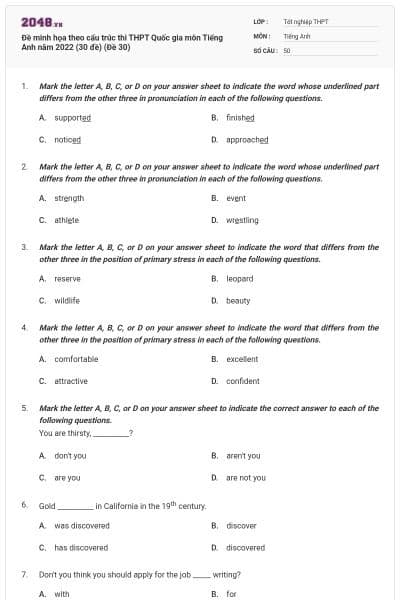
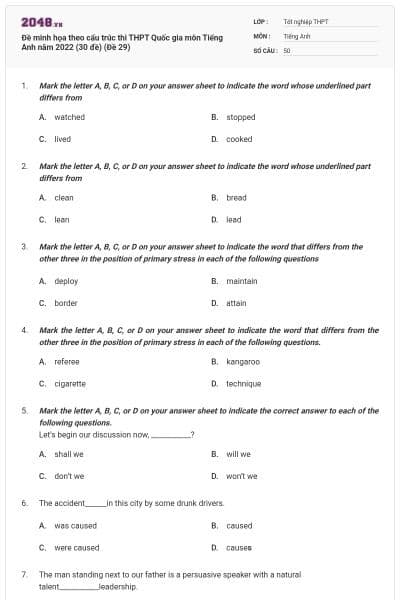
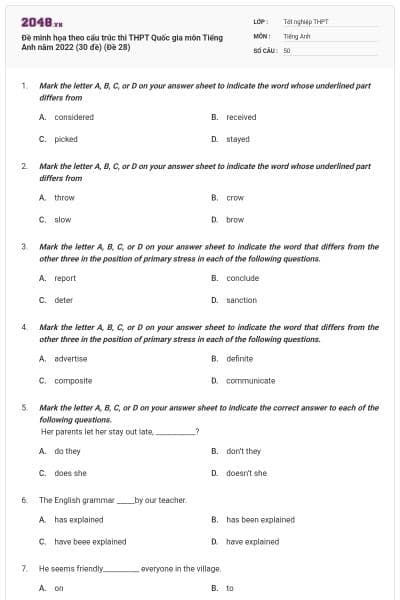
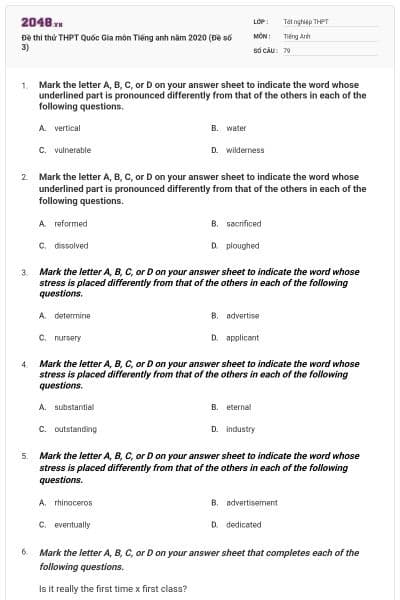
Mark the letter A, B, C, or D on your answer sheet to indicate the word whose underlined part is pronounced differently from that of the others in each of the following questions.
vertical
water
vulnerable
wilderness
Đáp án là A.
vertical có phần gạch chân được đọc là /ɜ:/, các từ còn lại có phần gạch chân được phát âm là /ə/
Mark the letter A, B, C, or D on your answer sheet to indicate the word whose underlined part is pronounced differently from that of the others in each of the following questions.
reformed
sacrificed
dissolved
ploughed
Đáp án là B.
Theo quy tắc đọc đuôi -ed, từ sacrificed có phần gạch chân được phát âm là /t/, các từ còn lại có phần gạch chân được phát âm là /d/.
Mark the letter A, B, C, or D on your answer sheet to indicate the word whose stress is placed differently from that of the others in each of the following questions.
determine
advertise
nursery
applicant
Đáp án là A.
Từ determine nhấn âm thứ hai, các từ còn lại nhấn âm thứ nhất.
Mark the letter A, B, C, or D on your answer sheet to indicate the word whose stress is placed differently from that of the others in each of the following questions.
substantial
eternal
outstanding
industry
Đáp án là D.
Từ industry nhấn âm thứ nhất, các từ còn lại nhấn âm thứ hai.
Mark the letter A, B, C, or D on your answer sheet to indicate the word whose stress is placed differently from that of the others in each of the following questions.
rhinoceros
advertisement
eventually
dedicated
Đáp án là D.
dedicated nhấn âm thứ nhất, các từ còn lại nhấn thứ hai.
Mark the letter A, B, C, or D on your answer sheet that completes each of the following questions.
Is it really the first time x first class?
you ever fly
you’ve ever flown
you’re ever flying
you’ve ever been flying
Đáp án là B.
Cấu trúc: It’s the first/ second/ ... last time + S + have (+ ever) + PII.: Lần đầu tiên/ thứ hai .... lần cuối ....
Mark the letter A, B, C, or D on your answer sheet that completes each of the following questions.
A: Look at this beautiful butterfly!
B: x
Why can’t you?
Where? I don’t see it.
No, it’s your turn.
I'll take it, don’t worry.
Đáp án là B.
Câu này hỏi về kỹ năng giao tiếp
Look at this beautiful butterfly! - Hãy nhìn con bướm đẹp này!
B. Where? I don’t see it. - Đâu?! Tớ không nhìn thấy nó.
Mark the letter A, B, C, or D on your answer sheet that completes each of the following questions.
By the time we x out on a Sunday, the bathroom was full of water.
have a plumber come
got a plumber to come
got a plumber coming
had a plumber to come
Đáp án là B.
Hai vế phải cùng thì quá khứ => A loại.
Các cấu trúc — nhờ ai đó làm gì” : Get someone to do something và Have someone do something
Mark the letter A, B, C, or D on your answer sheet that completes each of the following questions.
There x a number of reasons for the fall of the Roman Empire
are said to have been
said to be
are said being
was said being
Đáp án: A
Giải thích:
Cấu trúc bị động kép:
S + be + said/told/announced/… + to V/ to have VpII
Trong đó:
- to V nếu không có sự chênh lệch về thì hoặc hành động ở hiện tại/ tương lai
- to have VpII nếu có sự chênh lệch về thì hoặc hành động đã xảy ra trong quá khứ
Dựa vào nghĩa, chọn A.
Dịch: Đã có một số lý do dẫn đến sự sụp đổ của Đế chế La Mã.
Mark the letter A, B, C, or D on your answer sheet that completes each of the following questions.
Let’s go to the beach - it’s x a day to sit indoors
nice enough
too nice
so nice
such nine
Đáp án là B.
Cấu trúc — quá .. đến nỗi ...” : S + be + too + adj (+ a/an) + N(s) + to V.
Mark the letter A, B, C, or D on your answer sheet that completes each of the following questions.
A: Shall we go out tomorrow night?
B: x
I’m sorry I can’t, I’m busy.
Of course you can come
Yes, I am going out now.
No, thanks to you.
Đáp án là A.
Câu này hỏi về kỹ năng giao tiếp.
Shall we go out tomorrow night? - Tối mai chúng ta ra ngoài nhé. - Đây là câu đề nghị gợi ý.
A. I’m sorry I can’t, I’m busy. - Xin lỗi, em không thể. Em bận rồi.
Mark the letter A, B, C, or D on your answer sheet that completes each of the following questions.
When we landed, x on the plane for 18 hours
we are
we’ve been
we were
we’d been
Đáp án là D.
When QKHT, QKĐG : chỉ hành động đã xảy, vừa hết thúc ( chia ở thì quá khứ hoàn thành ), thì có một hành động khác tiếp đến ( chia ở thì quá khứ đơn giản)
Mark the letter A, B, C, or D on your answer sheet that completes each of the following questions.
I wish I x there to see Gabriel’s face when you told him!
can be
would have been
would be
could have been
Đáp án là D.
could have done: diễn tả hành động đáng lẽ ra có thể xảy ra nhưng đã không xảy ra trong quá khứ.
Mark the letter A, B, C, or D on your answer sheet that completes each of the following questions.
x of the students did well in the test.
Only a few
Much
Little
Only a little
Đáp án là A.
Only a few of + the/ these/ those/ my, her. + Ns: Rất ít, hầu như không có.
Mark the letter A, B, C, or D on your answer sheet that completes each of the following questions.
My younger sister’s in x .
the year 7 at school
a year 7 at the school
year 7 at school
the year 7 at the school
Đáp án là C.
Câu này trả lời cho câu hỏi —what year is my younger sister in school ?”.Vì vậy, câu trả lời nên là “year 7”. Không cần dùng bất kỳ mạo từ nào trước “year”
Mark the letter A, B, C, or D on your answer sheet that completes each of the following questions.
Even x I work all night, I won’t finish.
although
if
so
when
Đáp án là B.
even if: thậm chí nếu. . Nghĩa câu: Thậm chí tôi có làm việc cả tối, tôi cũng sẽ không xong.
Các từ khác: although: mặc dù (nối mệnh đề chỉ sự tương phản ); so: vì vậy (nối mệnh đề chỉ kết quả); when: khi ( nối mệnh đề chỉ thời gian )
Mark the letter A, B, C, or D on your answer sheet that completes each of the following questions.
Had the electrician not come in time, we would x last night’s party by candlelight.
have to have
have to be having
have had to have had
have had to have been having
Đáp án: C
Giải thích:
Cấu trúc đảo ngữ câu điều kiện loại 3: Had + S + Vp2, S + would/could + have + Vp2: diễn tả sự việc, tình huống, hành động không có thật trong quá khứ.
→ A và B loại
Còn C và D. Loại D vì last night’s party - bữa tiệc tối qua → không thể chia thể hoàn thành tiếp diễn “have been having” → C. ta dùng “have done” sau “to” để nhấn mạnh hành động đã xảy ra.
Dịch: Nếu thợ điện không đến kịp, chúng tôi đã phải tổ chức bữa tiệc tối qua dưới ánh nến.
Mark the letter A, B, C, or D on your answer sheet that completes each of the following questions.
My only ambition, really, is to settle down and x a family.
grow
raise
bring
make
Đáp án là B.
raise a family: nuôi một gia đình.
Các từ khác không chọn được, vì: grow: lớn lên, trồng ; bring (+ up) : nuôi dưỡng; make + N : làm
Mark the letter A, B, C, or D on your answer sheet that completes each of the following questions.
This is one x that I’m interested in
criteria of yours
of your criterias
criterion of yours
criteron of yours
Đáp án là C.
criterion ( số ít ): tiêu chuẩn => criteria ( số nhiều) => B loại vì “criterias” sai; A loại vì ta không thể dùng danh từ số nhiều sau từ “one”; D loại vì “criterion” không có nghĩa.
C. one criterion of yours : một tiêu chuẩn trong những tiêu chuẩn của bạn.
Mark the letter A, B, C, or D on your answer sheet that completes each of the following questions.
Swimming is a beneficial exercise, x aerobic activity and uses a number of muscle groups.
not only because it provides
because it both provides
for provision
as result of providing
Đáp án: B
Giải thích:
Xét các đáp án:
A. không chỉ vì nó cung cấp
B. bởi vì nó vừa cung cấp
C. để cung cấp
D. là kết quả của việc cung cấp
Cấu trúc:
both .... and ....: vừa… vừa (thường nối hai từ có chức năng như nhau. Trong câu này là hai động từ “provides” và “uses”).
Chọn đáp án B.
Dịch: Bơi lội là một bài tập có lợi vì nó vừa cung cấp hoạt động aerobic vừa sử dụng một số nhóm cơ.
Mark the letter A, B, C, or D on your answer sheet that completes each of the following questions.
A fire in the x building could be a problem for firefighters.
ninety-storey-tall
ninety-tall-storey
ninety-storeys-tall
ninety storeyed
Đáp án: A
Giải thích:
Kiến thức: Cấu trúc tính từ ghép
Cụm từ miêu tả tòa nhà cao 90 tầng cần được viết theo đúng cấu trúc tính từ ghép: số + danh từ số ít + tính từ, nên ninety-storey-tall là đúng.
ninety-storey-tall = cao 90 tầng
storey giữ nguyên ở dạng số ít khi đi với số
Chọn A. ninety-storey-tall.
Dịch: Một đám cháy trong tòa nhà cao 90 tầng có thể là một vấn đề đối với lính cứu hỏa.
Mark the letter A, B, C, or D on your answer sheet that completes each of the following questions.
In the past six months, the company has already received twice x in gross revenues as it earned in the entire preceding year.
as much
more
as many
as more
Đáp án là A.
Cấu trúc so sánh gấp bội: twice/ three times/ four times. + as much/ many.. + as ....
gross revenues : tổng doanh thu của tài sán góp vốn => là danh từ không đếm được => dùng “much”
Mark the letter A, B, C, or D on your answer sheet that completes each of the following questions.
When we were in Athens, I bought a x statuette
white, beautiful, marble, little
marble, beautiful, little, white
beautiful, little, marble, white
beautiful, little, white, marble
Đáp án là D.
Thứ tự các tính từ: opinion - size - color - material : beautiful, little, white, marble
Mark the letter A, B, C, or D on your answer sheet that completes each of the following questions.
A: That’s really kind of you.
B: x .
You did too.
Very well thanks
You’re welcome
My pleasures.
Đáp án là C.
Câu này hỏi về kỹ năng giao tiếp.
That’s really kind of you. - Bạn thật tốt bụng. => Cám ơn ai đó đã giúp đỡ
C. You’re welcome. - Dùng để đáp lại lời cám ơn.
Mark the letter A, B, C, or D on your answer sheet that completes each of the following questions.
Nobody knows why x postponed until next week.
the meeting
was the meeting
did the meeting
the meeting was
Đáp án là D
Postpone: trì hoãn => câu này phải chia ở thể bị động => A và C loại
B cũng loại, vì đây là câu trần thuật, ta không được đảo “was” lên trước chủ ngữ
Mark the letter A, B, C, or D on your answer sheet that completes each of the following questions.
A: I’m sorry for shouting at you.
B: x
It’s OK.
So do I.
I still can’t hear you.
I am too.
Đáp án là A
Câu này hỏi về kỹ năng giao tiếp.
I’m sorry for shouting at you. - Xin lỗi vì đã quát bạn.
A. It’s OK. => Không sao đâu.
Mark the letter A, B, C, or D on your answer sheet that completes each of the following questions.
These days, I only see Morgan onced in a x moon.
green
blue
grey
white
Đáp án là B.
blue moon (Trăng xanh): một hiện tượng trăng tròn không vào một thời gian nhất định nào
Mark the letter A, B, C, or D on your answer sheet that completes each of the following questions.
A: John’s going to London.
B: x
Often?
Yesterday?
By train?
Already?
Đáp án là C
Câu này hỏi về kỹ năng giao tiếp. John’s going to London. - John dự định đi Luân Đôn. =.> Hành động chưa xảy ra, nên không thể chọn B và D.
C là phù hợp nhất. By train? - Đi bằng tàu ư? - Hỏi phương tiện
Mark the letter A, B, C, or D on your answer sheet that completes each of the following questions.
If the driver’s own car x damaged, the favorite probably would have won the race.
had not been
was not
had
has not been
Đáp án là A.
Đây là câu điều kiện loại III: If + S + had +PII, S + would + have + PII.
Mark the letter A, B, C, or D on your answer sheet that completes each of the following questions.
In spite x seen as a comfortable and open speaker, Larry dislikes public speaking and will do almost anything to avoid it.
have been
of being
being
having been
Đáp án là B.
In spite of + V-ins: mặc dù…
Mark the letter A , B, C or D on your answer sheet to indicate the word(s) OPPOSITE in meaning to the underlined word(s) in each of the following questions.
My mother is a caring woman and always thoughtful of others
rude
inconsiderate
inconsiderable
critical
Đáp án là B.
thoughtful : suy nghĩ chin chắn >< inconsiderate: thiếu thận trọng, thiếu suy nghĩ Nghĩa các từ còn lại: rude: thô lỗ; inconsiderable: nhỏ bé, không đáng kể; critical: phê bình, chê bai
Mark the letter A , B, C or D on your answer sheet to indicate the word(s) OPPOSITE in meaning to the underlined word(s) in each of the following questions.
There is no excuse for your discourtesy. Think twice before you are going to say anything
bravery
impoliteness
politeness
boldness
Đáp án là C.
discourtesy: sự bất lịch sự >< politeness: lịch sự
Nghĩa các từ còn lại: bravery: tính gan dạ; impoliteness: tính bất lịch sự; boldness: tính dũng cảm, gan dạ
Mark the letter A, B, C, or D to indicate the word(s) CLOSEST in meaning to the underlined word(s) in each of the following questions.
In spite of her embarrassment before Rodya’s urgent and challenging look, she could not deny herself that satisfaction
demanding
hard
difficult
curious
Đáp án là D.
challenging = curious look: cái nhìn tò mò, hiếu kì Nghĩa các từ còn lại: demanding: đòi hỏi khắt khe; hard = difficult: khó
Mark the letter A, B, C, or D to indicate the word(s) CLOSEST in meaning to the underlined word(s) in each of the following questions.
Advanced students need to be aware of the importance of collocation
of high level
of great improvement
of high position
of great progress
Đáp án là A.
advanced = of high level: cấp cao, mức độ cao
Read the following passage and mark the letter A, B, C, or D on your answer sheet to indicate the correct answer to each of the questions from 36 to 45.
PHOBIAS CONTROL THE EYES
People with an overpowering fear of something may not be able to consciously control the direction of their gaze when faced with a picture that provokes that fear. Those with a fear of spiders, or arachnophobia, may not be able to avoid looking toward a spider in the grass, while those without the fear can. To reach this finding, 26 college students - half of whom had arachnophobia - were outfitted with a device that tracks eye movements. The participants were then shown a four-by-four grid of flowers on a computer screen, where a picture of a grey-brown spider and a grey-brown mushroom each occupied one space on the grid.
In one trial, the students were asked to press the spacebar when they spotted a mushroom, but to ignore any spiders. In a second, the students were asked to press the key when they saw the spider, but to avoid looking at mushrooms. When instructed to ignore the spider and spot the mushroom, the students with arachnophobia could not avoid looking at the spider - causing them to notice the mushroom three-tenths of a second more slowly than the control group. Additionally, when the students were asked to search for the spider, the arachnophobic students found the spider and pressed the space bar about three-tenths of a second more quickly than the non-phobic students.
These findings show that the attention processes of people with a powerful fear of spiders may be beyond their conscious control. This suggests that treatments that focus on conscious thought processes may not work for such phobias. Instead, therapists could focus on treatments such as systematic desensitization.
What can we infer that the word phobia means?
a new type of spider
a fear of something
a scientific experiment
the name of a flower
Đáp án là B.
Dựa vào ý đầu tiên trong bài: People with an overpowering fear of something may not be able to consciously control the direction of their gaze when faced with a picture that provokes that fear.
Read the following passage and mark the letter A, B, C, or D on your answer sheet to indicate the correct answer to each of the questions from 36 to 45.
PHOBIAS CONTROL THE EYES
People with an overpowering fear of something may not be able to consciously control the direction of their gaze when faced with a picture that provokes that fear. Those with a fear of spiders, or arachnophobia, may not be able to avoid looking toward a spider in the grass, while those without the fear can. To reach this finding, 26 college students - half of whom had arachnophobia - were outfitted with a device that tracks eye movements. The participants were then shown a four-by-four grid of flowers on a computer screen, where a picture of a grey-brown spider and a grey-brown mushroom each occupied one space on the grid.
In one trial, the students were asked to press the spacebar when they spotted a mushroom, but to ignore any spiders. In a second, the students were asked to press the key when they saw the spider, but to avoid looking at mushrooms. When instructed to ignore the spider and spot the mushroom, the students with arachnophobia could not avoid looking at the spider - causing them to notice the mushroom three-tenths of a second more slowly than the control group. Additionally, when the students were asked to search for the spider, the arachnophobic students found the spider and pressed the space bar about three-tenths of a second more quickly than the non-phobic students.
These findings show that the attention processes of people with a powerful fear of spiders may be beyond their conscious control. This suggests that treatments that focus on conscious thought processes may not work for such phobias. Instead, therapists could focus on treatments such as systematic desensitization.
What is the main idea of the passage?
People who are afraid of spiders don't look at them.
People with phobias can’t help looking at things they are afraid of.
People with arachnophobia always look at spiders first.
Phobias affect eyesight.
Đáp án là B.
Dựa vào ví dụ: Those with a fear of spiders, or arachnophobia, may not be able to avoid looking toward a spider in the grass, while those without the fear can.
Read the following passage and mark the letter A, B, C, or D on your answer sheet to indicate the correct answer to each of the questions from 36 to 45.
PHOBIAS CONTROL THE EYES
People with an overpowering fear of something may not be able to consciously control the direction of their gaze when faced with a picture that provokes that fear. Those with a fear of spiders, or arachnophobia, may not be able to avoid looking toward a spider in the grass, while those without the fear can. To reach this finding, 26 college students - half of whom had arachnophobia - were outfitted with a device that tracks eye movements. The participants were then shown a four-by-four grid of flowers on a computer screen, where a picture of a grey-brown spider and a grey-brown mushroom each occupied one space on the grid.
In one trial, the students were asked to press the spacebar when they spotted a mushroom, but to ignore any spiders. In a second, the students were asked to press the key when they saw the spider, but to avoid looking at mushrooms. When instructed to ignore the spider and spot the mushroom, the students with arachnophobia could not avoid looking at the spider - causing them to notice the mushroom three-tenths of a second more slowly than the control group. Additionally, when the students were asked to search for the spider, the arachnophobic students found the spider and pressed the space bar about three-tenths of a second more quickly than the non-phobic students.
These findings show that the attention processes of people with a powerful fear of spiders may be beyond their conscious control. This suggests that treatments that focus on conscious thought processes may not work for such phobias. Instead, therapists could focus on treatments such as systematic desensitization.
Why was the device to track eye movement needed?
to make sure the students were looking at the computer screen
to move the spider’s location around
to verify where the students were looking
to make the students look only in one place
Đáp án là C.
Để xác minh nơi các sinh viên đang nhìn. Dựa vào ý: In one trial, the students were asked to press the spacebar when they spotted a mushroom, but to ignore any spiders. In a second, the students were asked to press the key when they saw the spider, but to avoid looking at mushrooms.
Read the following passage and mark the letter A, B, C, or D on your answer sheet to indicate the correct answer to each of the questions from 36 to 45.
PHOBIAS CONTROL THE EYES
People with an overpowering fear of something may not be able to consciously control the direction of their gaze when faced with a picture that provokes that fear. Those with a fear of spiders, or arachnophobia, may not be able to avoid looking toward a spider in the grass, while those without the fear can. To reach this finding, 26 college students - half of whom had arachnophobia - were outfitted with a device that tracks eye movements. The participants were then shown a four-by-four grid of flowers on a computer screen, where a picture of a grey-brown spider and a grey-brown mushroom each occupied one space on the grid.
In one trial, the students were asked to press the spacebar when they spotted a mushroom, but to ignore any spiders. In a second, the students were asked to press the key when they saw the spider, but to avoid looking at mushrooms. When instructed to ignore the spider and spot the mushroom, the students with arachnophobia could not avoid looking at the spider - causing them to notice the mushroom three-tenths of a second more slowly than the control group. Additionally, when the students were asked to search for the spider, the arachnophobic students found the spider and pressed the space bar about three-tenths of a second more quickly than the non-phobic students.
These findings show that the attention processes of people with a powerful fear of spiders may be beyond their conscious control. This suggests that treatments that focus on conscious thought processes may not work for such phobias. Instead, therapists could focus on treatments such as systematic desensitization.
What was the function of the spacebar?
to give the students something to do
to give the students place to rest their thumbs
to allow the students to put spaces between words
to determine the amount of time needed to find an item in the picture
Đáp án là D.
to determine the amount of time needed to find an item in the picture ( để xác định số lượng thời gian cần thiết để tìm một điểm trong hình )
Ý trong bài đề cập: the arachnophobic students found the spider and pressed the space bar about three- tenths of a second more quickly than the non-phobic students.
Read the following passage and mark the letter A, B, C, or D on your answer sheet to indicate the correct answer to each of the questions from 36 to 45.
PHOBIAS CONTROL THE EYES
People with an overpowering fear of something may not be able to consciously control the direction of their gaze when faced with a picture that provokes that fear. Those with a fear of spiders, or arachnophobia, may not be able to avoid looking toward a spider in the grass, while those without the fear can. To reach this finding, 26 college students - half of whom had arachnophobia - were outfitted with a device that tracks eye movements. The participants were then shown a four-by-four grid of flowers on a computer screen, where a picture of a grey-brown spider and a grey-brown mushroom each occupied one space on the grid.
In one trial, the students were asked to press the spacebar when they spotted a mushroom, but to ignore any spiders. In a second, the students were asked to press the key when they saw the spider, but to avoid looking at mushrooms. When instructed to ignore the spider and spot the mushroom, the students with arachnophobia could not avoid looking at the spider - causing them to notice the mushroom three-tenths of a second more slowly than the control group. Additionally, when the students were asked to search for the spider, the arachnophobic students found the spider and pressed the space bar about three-tenths of a second more quickly than the non-phobic students.
These findings show that the attention processes of people with a powerful fear of spiders may be beyond their conscious control. This suggests that treatments that focus on conscious thought processes may not work for such phobias. Instead, therapists could focus on treatments such as systematic desensitization.
Why were some of the students slow to press the space bar when instructed to look at the mushroom?
They continued to look at the spider.
They couldn’t find the spacebar
They were looking for the on/off switch.
They had trouble following instructions.
Đáp án là A.
Ý trong bài: When instructed to ignore the spider and spot the mushroom, the students with arachnophobia could not avoid looking at the spider - causing them to notice the mushroom three- tenths of a second more slowly than the control group.
Read the following passage and mark the letter A, B, C, or D on your answer sheet to indicate the correct answer to each of the questions from 36 to 45.
PHOBIAS CONTROL THE EYES
People with an overpowering fear of something may not be able to consciously control the direction of their gaze when faced with a picture that provokes that fear. Those with a fear of spiders, or arachnophobia, may not be able to avoid looking toward a spider in the grass, while those without the fear can. To reach this finding, 26 college students - half of whom had arachnophobia - were outfitted with a device that tracks eye movements. The participants were then shown a four-by-four grid of flowers on a computer screen, where a picture of a grey-brown spider and a grey-brown mushroom each occupied one space on the grid.
In one trial, the students were asked to press the spacebar when they spotted a mushroom, but to ignore any spiders. In a second, the students were asked to press the key when they saw the spider, but to avoid looking at mushrooms. When instructed to ignore the spider and spot the mushroom, the students with arachnophobia could not avoid looking at the spider - causing them to notice the mushroom three-tenths of a second more slowly than the control group. Additionally, when the students were asked to search for the spider, the arachnophobic students found the spider and pressed the space bar about three-tenths of a second more quickly than the non-phobic students.
These findings show that the attention processes of people with a powerful fear of spiders may be beyond their conscious control. This suggests that treatments that focus on conscious thought processes may not work for such phobias. Instead, therapists could focus on treatments such as systematic desensitization.
What do the results of the experiment tell us about people with phobias?
They should always avoid the object of their fear
They don’t have to try to change their thoughts.
They can’t consciously choose how to react to the feared object.
All of the above
Đáp án là C.
Dựa vào đoạn cuối trong bài: These findings show that the attention processes of people with a powerful fear of spiders may be beyond their conscious control. This suggests that treatments that focus on conscious thought processes may not work for such phobias
Read the following passage and mark the letter A, B, C, or D on your answer sheet to indicate the correct answer to each of the questions from 36 to 45.
PHOBIAS CONTROL THE EYES
People with an overpowering fear of something may not be able to consciously control the direction of their gaze when faced with a picture that provokes that fear. Those with a fear of spiders, or arachnophobia, may not be able to avoid looking toward a spider in the grass, while those without the fear can. To reach this finding, 26 college students - half of whom had arachnophobia - were outfitted with a device that tracks eye movements. The participants were then shown a four-by-four grid of flowers on a computer screen, where a picture of a grey-brown spider and a grey-brown mushroom each occupied one space on the grid.
In one trial, the students were asked to press the spacebar when they spotted a mushroom, but to ignore any spiders. In a second, the students were asked to press the key when they saw the spider, but to avoid looking at mushrooms. When instructed to ignore the spider and spot the mushroom, the students with arachnophobia could not avoid looking at the spider - causing them to notice the mushroom three-tenths of a second more slowly than the control group. Additionally, when the students were asked to search for the spider, the arachnophobic students found the spider and pressed the space bar about three-tenths of a second more quickly than the non-phobic students.
These findings show that the attention processes of people with a powerful fear of spiders may be beyond their conscious control. This suggests that treatments that focus on conscious thought processes may not work for such phobias. Instead, therapists could focus on treatments such as systematic desensitization.
It can be inferred that provokes in paragraph I is closest in meaning to x .
eases
treats
reminds
causes
Đáp án là D.
provoke = cause: dẫn đến...
Nghĩa các từ còn lại: ease: làm xoa dịu; treat: đối xử; remind: nhắc nhở
Read the following passage and mark the letter A, B, C, or D on your answer sheet to indicate the correct answer to each of the questions from 36 to 45.
PHOBIAS CONTROL THE EYES
People with an overpowering fear of something may not be able to consciously control the direction of their gaze when faced with a picture that provokes that fear. Those with a fear of spiders, or arachnophobia, may not be able to avoid looking toward a spider in the grass, while those without the fear can. To reach this finding, 26 college students - half of whom had arachnophobia - were outfitted with a device that tracks eye movements. The participants were then shown a four-by-four grid of flowers on a computer screen, where a picture of a grey-brown spider and a grey-brown mushroom each occupied one space on the grid.
In one trial, the students were asked to press the spacebar when they spotted a mushroom, but to ignore any spiders. In a second, the students were asked to press the key when they saw the spider, but to avoid looking at mushrooms. When instructed to ignore the spider and spot the mushroom, the students with arachnophobia could not avoid looking at the spider - causing them to notice the mushroom three-tenths of a second more slowly than the control group. Additionally, when the students were asked to search for the spider, the arachnophobic students found the spider and pressed the space bar about three-tenths of a second more quickly than the non-phobic students.
These findings show that the attention processes of people with a powerful fear of spiders may be beyond their conscious control. This suggests that treatments that focus on conscious thought processes may not work for such phobias. Instead, therapists could focus on treatments such as systematic desensitization.
It can be inferred that spotted in paragraph 2 is closest in meaning to x .
ignored
feared
saw
instructed
Đáp án là C.
spot = see: nhìn, quan sát
Nghĩa các từ còn lại: ignore: bỏ qua; fear: sợ hãi; instruct: huấn luyện
Read the following passage and mark the letter A, B, C, or D on your answer sheet to indicate the correct answer to each of the questions from 36 to 45.
PHOBIAS CONTROL THE EYES
People with an overpowering fear of something may not be able to consciously control the direction of their gaze when faced with a picture that provokes that fear. Those with a fear of spiders, or arachnophobia, may not be able to avoid looking toward a spider in the grass, while those without the fear can. To reach this finding, 26 college students - half of whom had arachnophobia - were outfitted with a device that tracks eye movements. The participants were then shown a four-by-four grid of flowers on a computer screen, where a picture of a grey-brown spider and a grey-brown mushroom each occupied one space on the grid.
In one trial, the students were asked to press the spacebar when they spotted a mushroom, but to ignore any spiders. In a second, the students were asked to press the key when they saw the spider, but to avoid looking at mushrooms. When instructed to ignore the spider and spot the mushroom, the students with arachnophobia could not avoid looking at the spider - causing them to notice the mushroom three-tenths of a second more slowly than the control group. Additionally, when the students were asked to search for the spider, the arachnophobic students found the spider and pressed the space bar about three-tenths of a second more quickly than the non-phobic students.
These findings show that the attention processes of people with a powerful fear of spiders may be beyond their conscious control. This suggests that treatments that focus on conscious thought processes may not work for such phobias. Instead, therapists could focus on treatments such as systematic desensitization.
The word their in paragraph 3 refers to x .
findings
processes
spiders
none of the above
Đáp án là D.
Vì their = people with a powerful fear of spiders
Read the following passage and mark the letter A, B, C, or D on your answer sheet to indicate the correct answer to each of the questions from 36 to 45.
PHOBIAS CONTROL THE EYES
People with an overpowering fear of something may not be able to consciously control the direction of their gaze when faced with a picture that provokes that fear. Those with a fear of spiders, or arachnophobia, may not be able to avoid looking toward a spider in the grass, while those without the fear can. To reach this finding, 26 college students - half of whom had arachnophobia - were outfitted with a device that tracks eye movements. The participants were then shown a four-by-four grid of flowers on a computer screen, where a picture of a grey-brown spider and a grey-brown mushroom each occupied one space on the grid.
In one trial, the students were asked to press the spacebar when they spotted a mushroom, but to ignore any spiders. In a second, the students were asked to press the key when they saw the spider, but to avoid looking at mushrooms. When instructed to ignore the spider and spot the mushroom, the students with arachnophobia could not avoid looking at the spider - causing them to notice the mushroom three-tenths of a second more slowly than the control group. Additionally, when the students were asked to search for the spider, the arachnophobic students found the spider and pressed the space bar about three-tenths of a second more quickly than the non-phobic students.
These findings show that the attention processes of people with a powerful fear of spiders may be beyond their conscious control. This suggests that treatments that focus on conscious thought processes may not work for such phobias. Instead, therapists could focus on treatments such as systematic desensitization.
What is the purpose of the passage?
to prove that phobias are a myth
to help people with phobias
to relate research findings about phobias affecting eye control
to relate research findings about phobias controlling eyesight
Đáp án là C.
Dựa vào đoạn cuối trong bài: ... Instead, therapists could focus on treatments such as systematic desensitization.
Read the following passage and mark the letter A, B, C, or D on your answer sheet to indicate the correct word for each of the blanks from 46 to 50.
Our Homes: Now and Then
Everyone needs a home where they feel sheltered and safe. Today we live in modern flats and houses, (46) x have air-conditioning to keep us cool, and heating to keep us warm. There is electricity for lighting and supplies of gas or oil for the heating. Hot and cold water (47) x from the taps and dirty water disappears (48) x the drains. Many of our homes have balconies or gardens. In the past, people made their homes from materials that they found nearby. When we look at different houses we can tell how old they are from the materials used and the way they were built.
It was different long (49) x people did not have water in their homes and there were no electric lights. T keep warm they sometimes made (50) x inside their homes. With a fire started they could cook their food and heat water.
Điền vào ô 46
who
which
where
whose
Đáp án là B
Đại từ quan hệ thay thế cho danh từ chỉ vật “flats and houses”, đóng vai trò làm chủ ngữ trước động từ “have”
Read the following passage and mark the letter A, B, C, or D on your answer sheet to indicate the correct word for each of the blanks from 46 to 50.
Our Homes: Now and Then
Everyone needs a home where they feel sheltered and safe. Today we live in modern flats and houses, (46) x have air-conditioning to keep us cool, and heating to keep us warm. There is electricity for lighting and supplies of gas or oil for the heating. Hot and cold water (47) x from the taps and dirty water disappears (48) x the drains. Many of our homes have balconies or gardens. In the past, people made their homes from materials that they found nearby. When we look at different houses we can tell how old they are from the materials used and the way they were built.
It was different long (49) x people did not have water in their homes and there were no electric lights. T keep warm they sometimes made (50) x inside their homes. With a fire started they could cook their food and heat water.
Điền vào ô 47
flows
finds
flies
floats
Đáp án là A.
flow from: bắt nguồn từ ...
Read the following passage and mark the letter A, B, C, or D on your answer sheet to indicate the correct word for each of the blanks from 46 to 50.
Our Homes: Now and Then
Everyone needs a home where they feel sheltered and safe. Today we live in modern flats and houses, (46) x have air-conditioning to keep us cool, and heating to keep us warm. There is electricity for lighting and supplies of gas or oil for the heating. Hot and cold water (47) x from the taps and dirty water disappears (48) x the drains. Many of our homes have balconies or gardens. In the past, people made their homes from materials that they found nearby. When we look at different houses we can tell how old they are from the materials used and the way they were built.
It was different long (49) x people did not have water in their homes and there were no electric lights. T keep warm they sometimes made (50) x inside their homes. With a fire started they could cook their food and heat water.
Điền vào ô 48
up
towards
on
down
Đáp án là D.
down: xuống. Nghĩa cả câu: water disappears down the drains. (nước biến mất xuống cống.)
Read the following passage and mark the letter A, B, C, or D on your answer sheet to indicate the correct word for each of the blanks from 46 to 50.
Our Homes: Now and Then
Everyone needs a home where they feel sheltered and safe. Today we live in modern flats and houses, (46) x have air-conditioning to keep us cool, and heating to keep us warm. There is electricity for lighting and supplies of gas or oil for the heating. Hot and cold water (47) x from the taps and dirty water disappears (48) x the drains. Many of our homes have balconies or gardens. In the past, people made their homes from materials that they found nearby. When we look at different houses we can tell how old they are from the materials used and the way they were built.
It was different long (49) x people did not have water in their homes and there were no electric lights. T keep warm they sometimes made (50) x inside their homes. With a fire started they could cook their food and heat water.
Điền vào ô 49
back
then
ago
time
Đáp án là C.
long ago = a long time ago: thời gian dài trước đó.
Read the following passage and mark the letter A, B, C, or D on your answer sheet to indicate the correct word for each of the blanks from 46 to 50.
Our Homes: Now and Then
Everyone needs a home where they feel sheltered and safe. Today we live in modern flats and houses, (46) x have air-conditioning to keep us cool, and heating to keep us warm. There is electricity for lighting and supplies of gas or oil for the heating. Hot and cold water (47) x from the taps and dirty water disappears (48) x the drains. Many of our homes have balconies or gardens. In the past, people made their homes from materials that they found nearby. When we look at different houses we can tell how old they are from the materials used and the way they were built.
It was different long (49) x people did not have water in their homes and there were no electric lights. T keep warm they sometimes made (50) x inside their homes. With a fire started they could cook their food and heat water.
Điền vào ô 50
flames
food
fires
furnaces
Đáp án là C.
make fire: nhóm lửa
Nghĩa các từ còn lại: flame: ngọn lửa; food: thức ăn; furnace: lò sưởi
Mark the letter A, B, C, or D on your answer sheet to show the underlined part that needs correction.
During the 1700s, Philadelphia developed into the most wealthy city in the American colonies.
During the 1700s
into
most wealthy
the American
Đáp án là C
Đáp án là most wealthy => wealthiest. Với tình từ có hai âm tiết, kết thúc băng “y” trước là phụ âm, thì ta biến đổi như theo quy tắc tính từ có một âm tiết
Mark the letter A, B, C, or D on your answer sheet to show the underlined part that needs correction.
Octopuses have not only large brains and also a well-developed nervous system.
Octopuses
large brains
and
well-developed
Đáp án là C.
and => but. Cấu trúc : not only…but also ...: không những ... mà còn…
Mark the letter A, B, C, or D on your answer sheet to show the underlined part that needs correction.
Insufficient protein in the diet may cause a lack of energy, stunted growth and lowering resistance to disease.
Insufficient protein
the diet
stunted growth
lowering resistance to disease
Đáp án là D.
lowering resistance => lowered resistance
Mark the letter A, B, C, or D on your answer sheet to show the underlined part that needs correction.
The keyboard with alphabet keys is enough easy to use to give program instructions to the computer.
alphabet
enough easy
to use
program
Đáp án là B.
enough easy => easy enough
Mark the letter A, B, C, or D on your answer sheet to show the underlined part that needs correction.
About 200 million years before all the continents were part of one vast land mass called Pangea.
million
before
part
one vast land mass
Đáp án là B.
before => ago
Mark the letter A, B, C, or D on your answer sheet to indicate the best way to have a complete sentence with the words provided.
provide/your handwriting/ legible/ test scorer/accept/your answer/.
Providing your handwriting is legible, the test scorer does not accept your answer.
Provided for your legible handwriting, the test scorer has to accept your answer.
Provided that your handwriting is legible, your answer will be accepted by any test scorer.
Providing with your legible handwriting, every test scorer must accept your answer.
Đáp án là C.
Provided that ... If: Nếu … Và đây là câu điều kiện loại I : Provided that + S + V(HTĐG) , S + will+ V.
Mark the letter A, B, C, or D on your answer sheet to indicate the best way to have a complete sentence with the words provided.
teacher/suggest/students/ write/ composition/pets/.
The teacher suggested that her students write a composition about pets.
The teacher suggested that her students to write a composition about pets.
The teacher suggested that her students wrote some compositions about pets.
The teacher suggested that her students had written a composition about pets.
Đáp án là A.
Cấu trúc với gợi ý, khuyên răn với động từ “suggest”: S + suggest + that + S + V(bare).
Mark the letter A, B, C, or D on your answer sheet to indicate the best way to have a complete sentence with the words provided.
it/be/until/she/arrived/home/she/remember/appointment/doctor/.
It was not until she had arrived home when she remembered her appointment with the doctor.
It was not until she had arrived home that she remembered her appointment with the doctor.
It was not until had she arrived home and remembered her appointment with the doctor.
It was not until she had arrived home did she remember her appointment with the doctor.
Đáp án: A
Giải thích:
Cấu trúc:
It was not until + mệnh đề hoặc cụm thời gian + that + mệnh đề: Mãi cho đến … thì ….
Dịch: Phải đến khi về đến nhà, cô mới nhớ ra cuộc hẹn với bác sĩ.
Mark the letter A, B, C, or D on your answer sheet to indicate the best way to have a complete sentence with the words provided.
go abroad/present/ medical report/.
In order to go abroad, a medical report must be presented.
In order to go abroad, one must present a medical report.
Going abroad, a medical report must be presented.
Because of going abroad, a medical report must be presented.
Đáp án là B
Dùng phương pháp loại trừ:
C loại, vì không đồng chủ thể thực hiện hành động, không thể nói “a medical report goes aboard” đươc.
D loại, vì hai vế không phải nguyên nhân - kết quả.
A cũng loại, vì “go aboard” cũng không thể được thực hiện bởi “a medical report” được.
B. Để đi ra nước ngoài, người ta phải trình bày một báo cáo y tế. Có thể viết xuôi lại: one must present a medical report in order to go abroad. ( one = one person/ someone )
Mark the letter A, B, C, or D on your answer sheet to indicate the best way to have a complete sentence with the words provided.
There/ be/two/ boys/class/ tall/work/ monitor/.
There are two boys in my class the tallest of whom works as the monitor.
There are two boys in my class, the taller of whom works as the monitor.
There are two boys in my class, the tallest of them works as the monitor.
There are two boys in my class, the taller of them works as the monitor.
Đáp án là B
Câu này phải dùng đại từ quan hệ chỉ người “whom” đóng vai trò làm tân ngữ sau giới từ “of’ => C và D loại.
A cũng loại, vì câu này sử dụng mệnh đề quan hệ không xác định, vì câu “There are two boys in my class” đứng độc lập vẫn đủ nghĩa.
Read the following passage and mark the letter A, B, C, or D on your answer sheet to indicate the correct answer to each of the questions from 61 to 65.
The Origin of Jeans
In 1853, the California gold rush was in full swing and everyday items were in short supply. Levi Srrauss, a 24-year-old German immigrant, left New York for San Francisco with a small supply of dry goods with the intention of opening a branch of his brother’s New York dry goods business. Shortly after his arrival, a prospector wanted to know what Mr. Strauss was selling. When Strauss told him he had rough canvas cloth to use for tents and wagon covers, the prospector said, “You should have brought trousers!”, because he couldn’t find a pair of trousers strong enough to last.
Levi Strauss had the canvas made into work trousers. Miners liked the trousers, but complained that the fabric was not very comfortable and tended to chafe. Levi Strauss substituted the canvas with a twilled cotton cloth from France called “serge de Nimes.” The fabric later became known as denim and the trousers were nicknamed blue jeans. Then Levi Strauss and Nevada tailor David Jacobs co-patented the process of putting small metal rivets in places such as the sides of the pockets that needed extra strength. On May 20, 1873, they received U.S. Patent No. 139.121 This date is now considered the official birthday of“blue jeans”
But why were they called blue jeans? Denim is unique in its singular connection with one color. It is made from thread that is traditionally dyed with the blue pigment obtained from indigo dye. Indigo was linked with practical fabrics and work clothing. The durability of indigo as a color and its darkness of tone made it a good choice when frequent washing was not possible.
What is the purpose to this text?
to sell a product
to solve a problem
to argue a point
to inform
Đáp án là D.
Dựa vào tiêu đề in đậm, ta cũng có thể biết được mục đích của bài viết là để thông báo về nguồn gốc của quần Jeans .
Read the following passage and mark the letter A, B, C, or D on your answer sheet to indicate the correct answer to each of the questions from 61 to 65.
The Origin of Jeans
In 1853, the California gold rush was in full swing and everyday items were in short supply. Levi Srrauss, a 24-year-old German immigrant, left New York for San Francisco with a small supply of dry goods with the intention of opening a branch of his brother’s New York dry goods business. Shortly after his arrival, a prospector wanted to know what Mr. Strauss was selling. When Strauss told him he had rough canvas cloth to use for tents and wagon covers, the prospector said, “You should have brought trousers!”, because he couldn’t find a pair of trousers strong enough to last.
Levi Strauss had the canvas made into work trousers. Miners liked the trousers, but complained that the fabric was not very comfortable and tended to chafe. Levi Strauss substituted the canvas with a twilled cotton cloth from France called “serge de Nimes.” The fabric later became known as denim and the trousers were nicknamed blue jeans. Then Levi Strauss and Nevada tailor David Jacobs co-patented the process of putting small metal rivets in places such as the sides of the pockets that needed extra strength. On May 20, 1873, they received U.S. Patent No. 139.121 This date is now considered the official birthday of“blue jeans”
But why were they called blue jeans? Denim is unique in its singular connection with one color. It is made from thread that is traditionally dyed with the blue pigment obtained from indigo dye. Indigo was linked with practical fabrics and work clothing. The durability of indigo as a color and its darkness of tone made it a good choice when frequent washing was not possible.
What was Levi Strauss ’job?
He was a clothes designer.
He was a prospector.
He was selling textiles and clothing.
He was selling tools for gold mining.
Đáp án là C.
Có thể dựa vào những câu đầu đoạn 1, miêu tả công việc Levi Strauss: Levi Strauss, a 24-year-old German immigrant, left New York for San Francisco with a small supply of dry goods with the intention of opening a branch of his brother’s New York dry goods business.
Read the following passage and mark the letter A, B, C, or D on your answer sheet to indicate the correct answer to each of the questions from 61 to 65.
The Origin of Jeans
In 1853, the California gold rush was in full swing and everyday items were in short supply. Levi Srrauss, a 24-year-old German immigrant, left New York for San Francisco with a small supply of dry goods with the intention of opening a branch of his brother’s New York dry goods business. Shortly after his arrival, a prospector wanted to know what Mr. Strauss was selling. When Strauss told him he had rough canvas cloth to use for tents and wagon covers, the prospector said, “You should have brought trousers!”, because he couldn’t find a pair of trousers strong enough to last.
Levi Strauss had the canvas made into work trousers. Miners liked the trousers, but complained that the fabric was not very comfortable and tended to chafe. Levi Strauss substituted the canvas with a twilled cotton cloth from France called “serge de Nimes.” The fabric later became known as denim and the trousers were nicknamed blue jeans. Then Levi Strauss and Nevada tailor David Jacobs co-patented the process of putting small metal rivets in places such as the sides of the pockets that needed extra strength. On May 20, 1873, they received U.S. Patent No. 139.121 This date is now considered the official birthday of“blue jeans”
But why were they called blue jeans? Denim is unique in its singular connection with one color. It is made from thread that is traditionally dyed with the blue pigment obtained from indigo dye. Indigo was linked with practical fabrics and work clothing. The durability of indigo as a color and its darkness of tone made it a good choice when frequent washing was not possible.
What problem did the prospectors have?
There were no trousers in California.
They did not like Levi’s product
Their clothes were not stylish.
Their clothes wore out quickly.
Đáp án là D.
Quần áo của họ đã bị mòn. Dựa vào ý: Shortly after his arrival, a prospector wanted to know what Mr. Strauss was selling. When Strauss told him he had rough canvas cloth to use for tents and wagon covers, the prospector said, “You should have brought trousers!”, because he couldn’t find a pair of trousers strong enough to last. => Từ đoạn này có thể hiểu là quần áo đã cũ rồi.
Read the following passage and mark the letter A, B, C, or D on your answer sheet to indicate the correct answer to each of the questions from 61 to 65.
The Origin of Jeans
In 1853, the California gold rush was in full swing and everyday items were in short supply. Levi Srrauss, a 24-year-old German immigrant, left New York for San Francisco with a small supply of dry goods with the intention of opening a branch of his brother’s New York dry goods business. Shortly after his arrival, a prospector wanted to know what Mr. Strauss was selling. When Strauss told him he had rough canvas cloth to use for tents and wagon covers, the prospector said, “You should have brought trousers!”, because he couldn’t find a pair of trousers strong enough to last.
Levi Strauss had the canvas made into work trousers. Miners liked the trousers, but complained that the fabric was not very comfortable and tended to chafe. Levi Strauss substituted the canvas with a twilled cotton cloth from France called “serge de Nimes.” The fabric later became known as denim and the trousers were nicknamed blue jeans. Then Levi Strauss and Nevada tailor David Jacobs co-patented the process of putting small metal rivets in places such as the sides of the pockets that needed extra strength. On May 20, 1873, they received U.S. Patent No. 139.121 This date is now considered the official birthday of“blue jeans”
But why were they called blue jeans? Denim is unique in its singular connection with one color. It is made from thread that is traditionally dyed with the blue pigment obtained from indigo dye. Indigo was linked with practical fabrics and work clothing. The durability of indigo as a color and its darkness of tone made it a good choice when frequent washing was not possible.
Where did the word “denim” come from?
the name of a French fabric.
the indigo color
David Jacobs, the tailor, thought of it
Levi Strauss invented it
Đáp án là A.
Tên của một loại vải của Pháp. Dựa vào ý: It is made from thread that is traditionally dyed with the blue pigment obtained from indigo dye.
Read the following passage and mark the letter A, B, C, or D on your answer sheet to indicate the correct answer to each of the questions from 61 to 65.
The Origin of Jeans
In 1853, the California gold rush was in full swing and everyday items were in short supply. Levi Srrauss, a 24-year-old German immigrant, left New York for San Francisco with a small supply of dry goods with the intention of opening a branch of his brother’s New York dry goods business. Shortly after his arrival, a prospector wanted to know what Mr. Strauss was selling. When Strauss told him he had rough canvas cloth to use for tents and wagon covers, the prospector said, “You should have brought trousers!”, because he couldn’t find a pair of trousers strong enough to last.
Levi Strauss had the canvas made into work trousers. Miners liked the trousers, but complained that the fabric was not very comfortable and tended to chafe. Levi Strauss substituted the canvas with a twilled cotton cloth from France called “serge de Nimes.” The fabric later became known as denim and the trousers were nicknamed blue jeans. Then Levi Strauss and Nevada tailor David Jacobs co-patented the process of putting small metal rivets in places such as the sides of the pockets that needed extra strength. On May 20, 1873, they received U.S. Patent No. 139.121 This date is now considered the official birthday of“blue jeans”
But why were they called blue jeans? Denim is unique in its singular connection with one color. It is made from thread that is traditionally dyed with the blue pigment obtained from indigo dye. Indigo was linked with practical fabrics and work clothing. The durability of indigo as a color and its darkness of tone made it a good choice when frequent washing was not possible.
Which best describes indigo dye?
A long lasting, practical color that did not show dirt.
A color used on all kinds of fabric to make the fabric stronger.
A very rare and desirable color that was difficult to create.
An affordable dark color that was only used by poor people.
Đáp án là A.
The durability( độ bền) of indigo as a color and its darkness of tone made it a good choice when frequent washing was not possible
Read the following passage and mark the letter A, B, C, or D on your answer sheet to indicate the correct word for each of the blanks from 66 to 75.
Sudoku
Are you a fan of the popular logical puzzle that (66) x by the name Sudoku? Even if you’re not, the chances are you know somebody who is. Once (67) x known outside Japan, this addictive brain teaser has become a common feature of newspaper puzzle pages all over the world.
Sudoku’s great success (68) x much to its simplicity. The game (69) x for neither mathematical ability nor (70) x knowledge and there are just a few sentences of straightforward instructions to read before you can play. The only skill required is the ability to recognize the difference between nine different symbols, and these don’t even have to be numbers.
Some clever marketing has helped the game. Western newspapers worked hard at promoting the game. Without this, it is unlikely that it would have (71) x off and become quite such a runaway success. The same also (72) x from its Japanese name that made people in many parts of the world (73) x . It as a superior kind of puzzle compared to those you usually find in newspapers and magazines.
But the popularity of Sudoku reached a peak in 2006, if the number of (74) x on one leading website is anything to go by. Newspapers responded by (75) x up with new kinds of logical puzzles, all with simple rules and Japanese names. But for true Sudoku fans, only the real thing will do.
Điền vào ô 66
goes
calls
passes
titles
Đáp án là A.
go by: xét theo, lây theo ...
Read the following passage and mark the letter A, B, C, or D on your answer sheet to indicate the correct word for each of the blanks from 66 to 75.
Sudoku
Are you a fan of the popular logical puzzle that (66) x by the name Sudoku? Even if you’re not, the chances are you know somebody who is. Once (67) x known outside Japan, this addictive brain teaser has become a common feature of newspaper puzzle pages all over the world.
Sudoku’s great success (68) x much to its simplicity. The game (69) x for neither mathematical ability nor (70) x knowledge and there are just a few sentences of straightforward instructions to read before you can play. The only skill required is the ability to recognize the difference between nine different symbols, and these don’t even have to be numbers.
Some clever marketing has helped the game. Western newspapers worked hard at promoting the game. Without this, it is unlikely that it would have (71) x off and become quite such a runaway success. The same also (72) x from its Japanese name that made people in many parts of the world (73) x . It as a superior kind of puzzle compared to those you usually find in newspapers and magazines.
But the popularity of Sudoku reached a peak in 2006, if the number of (74) x on one leading website is anything to go by. Newspapers responded by (75) x up with new kinds of logical puzzles, all with simple rules and Japanese names. But for true Sudoku fans, only the real thing will do.
Điền vào ô 67
thinly
rarely
hardly
briefly
Đáp án là C.
Once hardly known outside Japan: Một khi hầu như không được biết đến bên ngoài Nhật Bản
Các từ còn lại: thinly: mỏng manh; rarely: hiếm khi ( chỉ tần xuât ); briefly: tóm gọn
Read the following passage and mark the letter A, B, C, or D on your answer sheet to indicate the correct word for each of the blanks from 66 to 75.
Sudoku
Are you a fan of the popular logical puzzle that (66) x by the name Sudoku? Even if you’re not, the chances are you know somebody who is. Once (67) x known outside Japan, this addictive brain teaser has become a common feature of newspaper puzzle pages all over the world.
Sudoku’s great success (68) x much to its simplicity. The game (69) x for neither mathematical ability nor (70) x knowledge and there are just a few sentences of straightforward instructions to read before you can play. The only skill required is the ability to recognize the difference between nine different symbols, and these don’t even have to be numbers.
Some clever marketing has helped the game. Western newspapers worked hard at promoting the game. Without this, it is unlikely that it would have (71) x off and become quite such a runaway success. The same also (72) x from its Japanese name that made people in many parts of the world (73) x . It as a superior kind of puzzle compared to those you usually find in newspapers and magazines.
But the popularity of Sudoku reached a peak in 2006, if the number of (74) x on one leading website is anything to go by. Newspapers responded by (75) x up with new kinds of logical puzzles, all with simple rules and Japanese names. But for true Sudoku fans, only the real thing will do.
Điền vào ô 68
results
thanks
owes
lends
Đáp án là C.
owe to …: cái gì có được nhờ ở ....
Nghĩa câu: Sudoku’s great success owes much to its simplicity (Thành công lớn của Sudoku là nhờ vào sự đơn giản của nó)
Read the following passage and mark the letter A, B, C, or D on your answer sheet to indicate the correct word for each of the blanks from 66 to 75.
Sudoku
Are you a fan of the popular logical puzzle that (66) x by the name Sudoku? Even if you’re not, the chances are you know somebody who is. Once (67) x known outside Japan, this addictive brain teaser has become a common feature of newspaper puzzle pages all over the world.
Sudoku’s great success (68) x much to its simplicity. The game (69) x for neither mathematical ability nor (70) x knowledge and there are just a few sentences of straightforward instructions to read before you can play. The only skill required is the ability to recognize the difference between nine different symbols, and these don’t even have to be numbers.
Some clever marketing has helped the game. Western newspapers worked hard at promoting the game. Without this, it is unlikely that it would have (71) x off and become quite such a runaway success. The same also (72) x from its Japanese name that made people in many parts of the world (73) x . It as a superior kind of puzzle compared to those you usually find in newspapers and magazines.
But the popularity of Sudoku reached a peak in 2006, if the number of (74) x on one leading website is anything to go by. Newspapers responded by (75) x up with new kinds of logical puzzles, all with simple rules and Japanese names. But for true Sudoku fans, only the real thing will do.
Điền vào ô 69
expects
demands
requests
calls
Đáp án là D.
call for: (nghĩa bóng) đòi, bắt buộc phải, cần phải
Nghĩa câu: The game calls for neither mathematical ability..: Game này đòi hỏi khả năng toán học.
Read the following passage and mark the letter A, B, C, or D on your answer sheet to indicate the correct word for each of the blanks from 66 to 75.
Sudoku
Are you a fan of the popular logical puzzle that (66) x by the name Sudoku? Even if you’re not, the chances are you know somebody who is. Once (67) x known outside Japan, this addictive brain teaser has become a common feature of newspaper puzzle pages all over the world.
Sudoku’s great success (68) x much to its simplicity. The game (69) x for neither mathematical ability nor (70) x knowledge and there are just a few sentences of straightforward instructions to read before you can play. The only skill required is the ability to recognize the difference between nine different symbols, and these don’t even have to be numbers.
Some clever marketing has helped the game. Western newspapers worked hard at promoting the game. Without this, it is unlikely that it would have (71) x off and become quite such a runaway success. The same also (72) x from its Japanese name that made people in many parts of the world (73) x . It as a superior kind of puzzle compared to those you usually find in newspapers and magazines.
But the popularity of Sudoku reached a peak in 2006, if the number of (74) x on one leading website is anything to go by. Newspapers responded by (75) x up with new kinds of logical puzzles, all with simple rules and Japanese names. But for true Sudoku fans, only the real thing will do.
Điền vào ô 70
general
normal
usual
ordinary
Đáp án là A.
general knowledge: kiến thức tổng hợp
Read the following passage and mark the letter A, B, C, or D on your answer sheet to indicate the correct word for each of the blanks from 66 to 75.
Sudoku
Are you a fan of the popular logical puzzle that (66) x by the name Sudoku? Even if you’re not, the chances are you know somebody who is. Once (67) x known outside Japan, this addictive brain teaser has become a common feature of newspaper puzzle pages all over the world.
Sudoku’s great success (68) x much to its simplicity. The game (69) x for neither mathematical ability nor (70) x knowledge and there are just a few sentences of straightforward instructions to read before you can play. The only skill required is the ability to recognize the difference between nine different symbols, and these don’t even have to be numbers.
Some clever marketing has helped the game. Western newspapers worked hard at promoting the game. Without this, it is unlikely that it would have (71) x off and become quite such a runaway success. The same also (72) x from its Japanese name that made people in many parts of the world (73) x . It as a superior kind of puzzle compared to those you usually find in newspapers and magazines.
But the popularity of Sudoku reached a peak in 2006, if the number of (74) x on one leading website is anything to go by. Newspapers responded by (75) x up with new kinds of logical puzzles, all with simple rules and Japanese names. But for true Sudoku fans, only the real thing will do.
Điền vào ô 71
got
taken
given
passed
Đáp án là B.
Trong câu này nghĩa từ take off: khởi sắc, thành công rực rỡ
Read the following passage and mark the letter A, B, C, or D on your answer sheet to indicate the correct word for each of the blanks from 66 to 75.
Sudoku
Are you a fan of the popular logical puzzle that (66) x by the name Sudoku? Even if you’re not, the chances are you know somebody who is. Once (67) x known outside Japan, this addictive brain teaser has become a common feature of newspaper puzzle pages all over the world.
Sudoku’s great success (68) x much to its simplicity. The game (69) x for neither mathematical ability nor (70) x knowledge and there are just a few sentences of straightforward instructions to read before you can play. The only skill required is the ability to recognize the difference between nine different symbols, and these don’t even have to be numbers.
Some clever marketing has helped the game. Western newspapers worked hard at promoting the game. Without this, it is unlikely that it would have (71) x off and become quite such a runaway success. The same also (72) x from its Japanese name that made people in many parts of the world (73) x . It as a superior kind of puzzle compared to those you usually find in newspapers and magazines.
But the popularity of Sudoku reached a peak in 2006, if the number of (74) x on one leading website is anything to go by. Newspapers responded by (75) x up with new kinds of logical puzzles, all with simple rules and Japanese names. But for true Sudoku fans, only the real thing will do.
Điền vào ô 72
promoted
improved
benefited
increased
Đáp án là C.
Benefit from: lợi nhuận từ
Read the following passage and mark the letter A, B, C, or D on your answer sheet to indicate the correct word for each of the blanks from 66 to 75.
Sudoku
Are you a fan of the popular logical puzzle that (66) x by the name Sudoku? Even if you’re not, the chances are you know somebody who is. Once (67) x known outside Japan, this addictive brain teaser has become a common feature of newspaper puzzle pages all over the world.
Sudoku’s great success (68) x much to its simplicity. The game (69) x for neither mathematical ability nor (70) x knowledge and there are just a few sentences of straightforward instructions to read before you can play. The only skill required is the ability to recognize the difference between nine different symbols, and these don’t even have to be numbers.
Some clever marketing has helped the game. Western newspapers worked hard at promoting the game. Without this, it is unlikely that it would have (71) x off and become quite such a runaway success. The same also (72) x from its Japanese name that made people in many parts of the world (73) x . It as a superior kind of puzzle compared to those you usually find in newspapers and magazines.
But the popularity of Sudoku reached a peak in 2006, if the number of (74) x on one leading website is anything to go by. Newspapers responded by (75) x up with new kinds of logical puzzles, all with simple rules and Japanese names. But for true Sudoku fans, only the real thing will do.
Điền vào ô 73
believe
regard
think
consider
Đáp án là B.
many parts of the world regard: nhiều bộ phận (nước) liên quan trên thế giới
Read the following passage and mark the letter A, B, C, or D on your answer sheet to indicate the correct word for each of the blanks from 66 to 75.
Sudoku
Are you a fan of the popular logical puzzle that (66) x by the name Sudoku? Even if you’re not, the chances are you know somebody who is. Once (67) x known outside Japan, this addictive brain teaser has become a common feature of newspaper puzzle pages all over the world.
Sudoku’s great success (68) x much to its simplicity. The game (69) x for neither mathematical ability nor (70) x knowledge and there are just a few sentences of straightforward instructions to read before you can play. The only skill required is the ability to recognize the difference between nine different symbols, and these don’t even have to be numbers.
Some clever marketing has helped the game. Western newspapers worked hard at promoting the game. Without this, it is unlikely that it would have (71) x off and become quite such a runaway success. The same also (72) x from its Japanese name that made people in many parts of the world (73) x . It as a superior kind of puzzle compared to those you usually find in newspapers and magazines.
But the popularity of Sudoku reached a peak in 2006, if the number of (74) x on one leading website is anything to go by. Newspapers responded by (75) x up with new kinds of logical puzzles, all with simple rules and Japanese names. But for true Sudoku fans, only the real thing will do.
Điền vào ô 74
hits
clicks
strikes
shots
Đáp án là A.
the number of hits on one leading website: số lượng truy cập vào một trang web hàng đầu
Read the following passage and mark the letter A, B, C, or D on your answer sheet to indicate the correct word for each of the blanks from 66 to 75.
Sudoku
Are you a fan of the popular logical puzzle that (66) x by the name Sudoku? Even if you’re not, the chances are you know somebody who is. Once (67) x known outside Japan, this addictive brain teaser has become a common feature of newspaper puzzle pages all over the world.
Sudoku’s great success (68) x much to its simplicity. The game (69) x for neither mathematical ability nor (70) x knowledge and there are just a few sentences of straightforward instructions to read before you can play. The only skill required is the ability to recognize the difference between nine different symbols, and these don’t even have to be numbers.
Some clever marketing has helped the game. Western newspapers worked hard at promoting the game. Without this, it is unlikely that it would have (71) x off and become quite such a runaway success. The same also (72) x from its Japanese name that made people in many parts of the world (73) x . It as a superior kind of puzzle compared to those you usually find in newspapers and magazines.
But the popularity of Sudoku reached a peak in 2006, if the number of (74) x on one leading website is anything to go by. Newspapers responded by (75) x up with new kinds of logical puzzles, all with simple rules and Japanese names. But for true Sudoku fans, only the real thing will do.
Điền vào ô 75
setting
putting
making
coming
Đáp án là D.
come up with: tìm ra, nảy ra ( ý tưởng ... )
Mark the letter A, B, C, or D on your answer sheet to indicate the sentence that is closest in meaning to the sentence(s) in italics.
This material is suitable for students of eighteen years and up.
Students of eighteen years and over can use this material.
The material is suitable for students who are over eighteen.
The material may be suitable for students of over eighteen years of age.
Only 18-year-old students will find this material suitable.
Đáp án là A
Nghĩa câu gốc: This material is suitable for students of eighteen years and up. (Đây là tài liệu thích hợp cho học sinh mười tám tuổi trở lên.)
A. Học sinh từ mười tám tuổi trở lên có thể sử dụng tài liệu này.
Mark the letter A, B, C, or D on your answer sheet to indicate the sentence that is closest in meaning to the sentence(s) in italics.
If there hadn’t been such a strong wind, it would not have been so difficult to put out the fire.
It was the strong wind which made it difficult for us to put out the fire.
When a strong wind began to blow, it was even more difficult to control the fire.
If the wind hadn’t been so strong, it would have been much easier to put out the fire.
As the wind was really very strong, it took them a long time to put out the fire.
Đáp án là C
Câu gốc: If there hadn’t been such a strong wind, it would not have been so difficult to put out the fire. (Nếu không có một cơn gió mạnh như vậy, sẽ không quá khó khăn để dập đám cháy. )
C. If the wind hadn’t been so strong, it would have been much easier to put out the fire. (Nếu gió đã không quá mạnh, nó sẽ dễ dàng hơn nhiều để dập lửa. ). Câu này sử dụng tính từ trái nghĩa: difficult >< not easy.
Mark the letter A, B, C, or D on your answer sheet to indicate the sentence that is closest in meaning to the sentence(s) in italics.
No sooner had Mary begun her new job than she knew she had made a mistake.
As soon as Mary started working, she realized that her decision had not been a good one.
Had Mary not just begun a new job, she would have gone looking for a better one.
Just before Mary took up her new post, she realized that she was not suited for it.
Since Mary did not like her new job, she began looking for one more suitable to her.
Đáp án là A
Cách dùng no sooner : No sooner + had + S + PII + than + S +V(simple past) : vừa mới .... thì đã
Nghĩa câu gốc: No sooner had Mary begun her new job than she knew she had made a mistake. (Không lâu sau khi Mary bắt đầu công việc mới của cô hơn cô biết rằng mình đã phạm sai lầm.)
A. Cách dùng của as soon as : As soon as + S + PII , S +V(simple past): Là liên từ để nối 2 mệnh đề với nghĩa là ngay khi chỉ một hành động xãy ra liền ngay sau một hành động khác.
As soon as Mary started working, she realized that her decision had not been a good one. ( Ngay sau khi Mary bắt đầu làm việc, cô nhận ra rằng quyết định của cô đã không được tốt.)
Mark the letter A, B, C, or D on your answer sheet to indicate the sentence that is closest in meaning to the sentence(s) in italics.
He needn’t have hurried as the meeting didn’t start until quite a while after the time for which it had been planned.
The meeting started rather later than scheduled, so it wasn't necessary for him to hurry
There was no need for him to hurry because he had plenty of time before the scheduled time of the meeting.
He didn’t need to hurry as he already knew that the meeting wouldn’t start as scheduled.
He wouldn't have arrived at the meeting on time if he hadn't hurried.
Đáp án là A
Nghĩa câu gốc: Anh không cần phải vội vã vì cuộc họp đã không bắt đầu cho đến khi một thời gian khá lâu sau khi mà nó đã được lên kế hoạch.
Câu sát nghĩa nhất với câu gốc là đáp án A. Cuộc họp bắt đầu khá muộn hơn dự kiến, do đó, anh không cần thiết phải vội.
Mark the letter A, B, C, or D on your answer sheet to indicate the sentence that is closest in meaning to the sentence(s) in italics.
“You should have finished the report by now,” Jason told his secretary
Jason reproached his secretary for not having finished the report.
Jason said that his secretary had not finished the report.
Jason reminded his secretary of finishing the report on time.
Jason scolded his secretary for not having finished the report.
Đáp án là A
Câu gốc: "Đáng lẽ ra đến bây giờ cô phải làm xong báo cáo của doanh nghiệp rồi chứ ," Jason nói với thư ký của mình.
A . Cấu trúc reproach someone for (not) doing something: khiển trách ai vì đã ( không ) làm gì