Đề thi thử THPT Quốc Gia môn Tiếng anh năm 2020 (Đề số 25)
50 câu hỏi
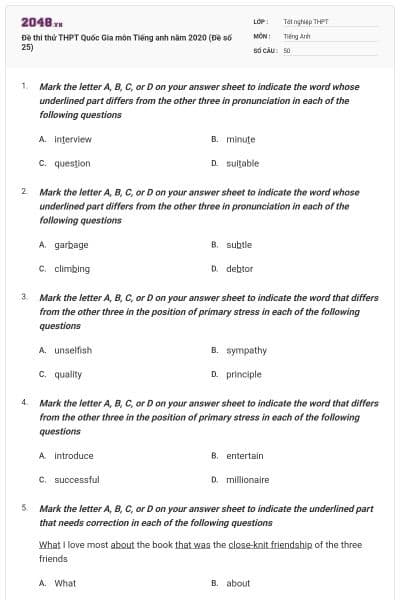
Mark the letter A, B, C, or D on your answer sheet to indicate the word whose underlined part differs from the other three in pronunciation in each of the following questions
interview
minute
question
suitable
Đáp án C
interview/ˈɪntəvjuː/
minute /ˈmɪnɪt/
question /ˈkwestʃən/
suitable /ˈsuːtəbl/
Câu C phát âm là /tʃ/ còn lại phát âm là /t/
Mark the letter A, B, C, or D on your answer sheet to indicate the word whose underlined part differs from the other three in pronunciation in each of the following questions
garbage
subtle
climbing
debtor
Đáp án A
garbage/ˈɡɑːbɪdʒ/
subtle /ˈsʌtl/
climbing /ˈklaɪmɪŋ/
debtor /ˈdetər/
Câu A phát âm là /b/ còn lại là âm câm
Mark the letter A, B, C, or D on your answer sheet to indicate the word that differs from the other three in the position of primary stress in each of the following questions
unselfish
sympathy
quality
principle
Đáp án A
unselfish /ʌnˈselfɪʃ/
sympathy /ˈsɪmpəθi/
quality /ˈkwɒləti/
principle /ˈprɪnsəpl/
Câu A trọng âm 2 còn lại trọng âm 1
Mark the letter A, B, C, or D on your answer sheet to indicate the word that differs from the other three in the position of primary stress in each of the following questions
introduce
entertain
successful
millionaire
Đáp án C
introduce /ˌɪntrəˈdjuːs/
entertain /ˌentəˈteɪn/
successful /səkˈsesfl/
millionaire /ˌmɪljəˈner/
Câu C trọng âm 2 còn lại trọng âm 3
Mark the letter A, B, C, or D on your answer sheet to indicate the underlined part that needs correction in each of the following questions
What I love most about the book that was the close-knit friendship of the three friends
What
about
that was
close-knit friendship
Đáp án C
Mệnh đề danh từ đóng vai trò chủ ngữ: wh- word + S + V [ what I love most about the book] => đóng vai trò chủ ngữ, was là động từ chính => thừa “that”
That was => was
Câu này dịch như sau: Điều tôi thích nhất về quyển sách này là tình bạn khăng khít của ba người bạn đó
Mark the letter A, B, C, or D on your answer sheet to indicate the underlined part that needs correction in each of the following questions
However well my sister made at school, she never seems to be satisfied with the results
However
made
to be satisfied
the results
Đáp án B
made => did
Cụm từ: do well at school [ học rất giỏi]
Câu này dịch như sau: Cho dù chị tôi học giỏi thế nào đi nữa, chị ấy chưa bao giờ có vẻ hài lòng với kết quả
Mark the letter A, B, C, or D on your answer sheet to indicate the underlined part that needs correction in each of the following questions
Some studies show that young babies prefer the smell of milk to those of other liquids
young babies
smell
those
other liquids
Đáp án C
those => that
Prefer + noun...to + noun..., do đó hai danh từ phải cùng dạng the smell là danh từ không đếm được nên để thay thế cho the smell phải dùng “that”. Those thay thế cho danh từ số nhiều. Câu này dịch như sau: Một số nghiên cứu cho thấy rằng trẻ nhỏ thích mùi sữa hơn mùi của những chất lỏng khác
Mark the letter A, B, C, or D on your answer sheet to indicate the correct answer to each of the following questions
Tom was accused ____________ some top secret document
to steal
of having stolen
for stealing
to have stolen
Đáp án: B
Giải thích:
accuse somebody of doing something: buộc tội ai làm gì
Chọn B.
Dịch: Tom bị buộc tội đánh cắp một số tài liệu tuyệt mật.
Mark the letter A, B, C, or D on your answer sheet to indicate the correct answer to each of the following questions
Sometimes ___________ wears people out and is worse than the lack of sleep it self
to sleep the desire
the desire to sleep
to desire to sleep is
The desire to sleep wh
Đáp án B
Câu có 2 động từ chính “ wears out” và “is” là động từ chính => Câu thiếu chủ ngữ => chọn cụm danh từ để đóng vai trò chủ ngữ [ the desire to sleep]
Câu này dịch như sau: Thỉnh thoảng thèm ngủ làm con người mệt mỏi và còn tệ hơn nữa khi thiếu ngủ
Mark the letter A, B, C, or D on your answer sheet to indicate the correct answer to each of the following questions
We were late because we had some car problems. By the time we ___________ to the station, Susan ____________ for us for more than two hours.
are getting/had waited
got/waited
had got/had waited
got/ had been waiting
Đáp án D
Tình huống ngữ cảnh ở quá khứ. => loại A
Susan đã đợi từ trước khi chúng tôi đến nhà ga + có trạng từ chỉ thời gian để nhấn mạnh tính chất kéo dài của hành động => quá khứ hoàn thành tiếp diễn ; hành động đến nhà ga xảy ra sau => quá khứ đơn
Câu này dịch như sau: Chúng tôi đến muộn vì xe có vấn đề. Khi chúng tôi đến nhà ga, cô ấy đã đợi chúng tôi hơn 2 giờ đồng hồ
Mark the letter A, B, C, or D on your answer sheet to indicate the correct answer to each of the following questions
Preparing for a job interview can be very _______________.
stress
stressful
stressed
stressing
Đáp án B
Preparing for a job interview => đóng vai trò chủ ngữ
S + be + very + tính từ => loại A, D
Stressful (adj): căng thẳng [ dùng đề miêu tả tính chất sự vật/ sự việc ]
Stressed (adj): bị làm cho căng thẳng [ dùng để miêu tả cảm xúc của con người]
Câu này dịch như sau: Việc chuẩn bị cho buổi phỏng vấn việc làm có thể rất căng thẳng
Mark the letter A, B, C, or D on your answer sheet to indicate the correct answer to each of the following questions
______________ but for his help yesterday?
What did you do
How would you do
What would you have done
How had you done
Đáp án C
But for = without + cụm danh từ, S + would have Ved => câu điều kiện loại 3
Câu này dịch như sau: Bạn sẽ làm gì nếu không có sự giúp đỡ của anh ấy hôm qua
Mark the letter A, B, C, or D on your answer sheet to indicate the correct answer to each of the following questions
Don’t worry, we will have to wait a little longer because I’m sure he will ___________ soon
turn up
turn in
turn into
turn down
Đáp án: A
Giải thích:
A. turn up = arrive: đến nơi/ xuất hiện
B. turn in = go to bed: đi ngủ
C. turn into: hóa ra là
D. turn down = refuse: từ chối
Dịch: Đừng lo, chúng ta sẽ phải chờ lâu thêm một chút nữa bởi vì tôi chắc chắn anh ấy sẽ đến sớm thôi.
Mark the letter A, B, C, or D on your answer sheet to indicate the correct answer to each of the following questions
I tried every key in turn but not __________ fitted
none
each
any
one
Đáp án D
Câu đã có “not” => loại none
One thay thế cho danh từ “key”
Câu này dịch như sau: Tôi đã thử mọi chìa khóa nhưng không chiếc nào vừa
Mark the letter A, B, C, or D on your answer sheet to indicate the correct answer to each of the following questions
She complains noisily about everything she doesn’t like. She is the type of person who is always _____________.
making a fuss
doing a fuss
creating a fuss
giving a fuss
Đáp án A
Cụm từ: make a fuss [ làm ầm ĩ/ ồn ào mọi chuyện lên]
Câu này dịch như sau: Cô ấy phàn nàn ồn ào về mọi thứ cô ấy không thích. Cô ấy là loại người luôn làm ầm ĩ mọi thứ.
Mark the letter A, B, C, or D on your answer sheet to indicate the correct answer to each of the following questions
That cannot be a true story. He ____________ it up
can have made
must have made
would have made
should have made
Đáp án B
Make it up: bịa chuyện
Would have Ved: sẽ
Can have Ved: đáng lẽ ra có thể Should have Ved: đáng lẽ ra nên
Must have Ved: chắc có lẽ đã
Câu này dịch như sau: Đó không thể là câu chuyện có thật. Anh ấy chắc hẳn đã bịa ra nó
Mark the letter A, B, C, or D on your answer sheet to indicate the correct answer to each of the following questions
They asked me ______ in London then
is my brother working
was my brother working
if my brother was working
if my brother is working
Đáp án: C
Giải thích:
Kiến thức: Câu tường thuật
Động từ tường thuật “asked” chia ở thì quá khứ đơn, nên các động từ trong câu tường thuật cũng chia ở quá khứ. Loại A, D
Công thức tường thuật câu hỏi nghi vấn:
Asked/questioned/wondered/… + O + if/whether + S + V (lùi 1 thì)
Dịch: Họ đã hỏi tôi liệu anh trai tôi có đang làm việc ở Luân Đôn không.
Mark the letter A, B, C, or D on your answer sheet to indicate the correct answer to each of the following questions
She blamed ___________ me ___________ not explaining the lesson __________ her carefully
on – for – to
for – on – for
ø – about – for
ø – for – to
Đáp án D
Cấu trúc: blame sb for sth [ đổ lỗi cho ai về việc gì ]
Explain sth to sb: giải thích cái gì với ai
Câu này dịch như sau: Cô ấy đổ lỗi cho tôi về việc không giải thích bài học cho cô ấy cẩn thận
Mark the letter A, B, C, or D on your answer sheet to indicate the correct answer to each of the following questions
It _____________me more than an hour to download your photos you uploaded to your Facebook sites
took
gave
sent
forwarded
Đáp án A
Cụm từ: It + takes + sb + time + to Vo [ Ai đó mất bao nhiêu thời gian để làm gì ]
Câu này dịch như sau: Nó làm tôi mất hơn 1 tiếng đồng hồ để tải những bức ảnh bạn đã đăng lên facebook xuống
Mark the letter A, B, C, or D on your answer sheet to indicate the most suitable response to complete each of the following exchanges
“________________________.”
“ I have a terrible headache.”
What’s the problem to you?
What’s the matter with you?
What happens with you?
What causes you?
Đáp án B
“ Tôi đau đầu kinh khủng.”
What’s wrong with you? = What’s the problem with you? = What’s the matter with you?: Bạn bị sao vậy?
Mark the letter A, B, C, or D on your answer sheet to indicate the most suitable response to complete each of the following exchanges
Teacher: “ John, you’ve written a much better essay this time.”
John: “_______________________.”
Writing? Why?
You’re welcome
Thank you. It’s really encouraging
What did you say? I’m so shy
Đáp án C
Giáo viên: “ Giáo viên, lần này em viết bài luận hay hơn nhiều rồi đó.”
A. Viết? Tại sao?
C. Cảm ơn thầy/ cô. Thật khích lệ em quá.
B. Không có chi. [ dùng khi ai đó nói cảm ơn]
D. Thầy đã nói gì ạ? Em ngại quá.
Mark the letter A, B, C, or D on your answer sheet to indicate the word(s) CLOSEST in meaning to the underlined word(s) in each of the following questions
It is common practice to look at the person you are talking to
exercise
policy
skill
habit
Đáp án D
practice:thói quen
skill: kỹ năng
exercise : bài tập
habit: thói quen
policy: chính sách
=>practice = habit
Câu này dịch như sau: Thói quen phổ biến là nhìn vào mắt người mà bạn nói chuyện.
Mark the letter A, B, C, or D on your answer sheet to indicate the word(s) CLOSEST in meaning to the underlined word(s) in each of the following questions
Our new teacher has a good sense of humor
ability to amuse people
ability to frighten people
responsibility
commitment
Đáp án A
sense of humor: óc hài hước
A. khả năng làm người cười
B. khả năng làm người khác sợ
C. trách nhiệm
D. cam kết
=>sense of humor = ability to amuse people
Câu này dịch như sau: Giáo viên mới của chúng tôi rất hài hước.
Mark the letter A, B, C, or D on your answer sheet to indicate the word(s) OPPOSITE in meaning to the underlined word(s) in each of the following questions.
Strongly advocating health foods, Jane doesn’t eat any chocolate
supporting
impugning
advising
denying
Đáp án B
Advocating: ủng hộ Supporting: ủng hộ
Impugning: công kích/ phản đối Advising: khuyên bảo Denying: từ chối
Câu này dịch như sau: Ủng hộ mạnh mẽ những sản phẩm tốt cho sức khỏe, cô ấy không ăn miếng sô-cô-la nào.
=>Advocating >< Impugning
Mark the letter A, B, C, or D on your answer sheet to indicate the word(s) OPPOSITE in meaning to the underlined word(s) in each of the following questions.
I’m sorry I can’t come out this weekend – I’m up to my ears in work
very busy
very bored
very scared
very idle
Đáp án D
up to my ears : bận rộn ngập đầu
very busy: rất bận rộn
very bored : rất chán
very scared: rất sợ
very idle: rất rảnh rỗi
Câu này dịch như sau: Tôi xin lỗi cuối tuần này tôi không thể ra ngoài được – Tôi bận công việc ngập đầu luôn.
=> up to my ears >< very idle
Mark the letter A, B, C, or D on your answer sheet to indicate the sentence that is closest in meaning to each of the following questions
Scarcely had he got out of the house when it started raining
He got out of the house after it started raining
He had no sooner got out of the house when it started raining
He was getting out of the house when it started raining
It started raining right after he got out of the house
Đáp án D
Ngay khi anh ấy ra khỏi nhà thì trời bắt đầu mưa.
Cấu trúc: Scarcely / Hardly had + S + Ved when S + Ved = S + had no sooner Ved than S+ Ved: ngay khi...thì
Câu A sai ngữ pháp: S + Ved after S+ had Ved
Câu B sai ngữ pháp: no sooner...than
Câu C. Anh ấy đang đi ra ngoài thì trời bắt đầu mưa. => sai nghĩa
Câu D. Trời bắt đầu mưa ngay sau khi anh ấy ra khỏi nhà
Mark the letter A, B, C, or D on your answer sheet to indicate the sentence that is closest in meaning to each of the following questions
Most students are aware of the importance of English
Not every student is aware of the importance of English
Not a single student is unaware of the importance of English
All students are aware of the importance of English
Almost all students are aware of the importance of English
Đáp án A
Hầu hết học sinh ý thức về tầm quan trọng của tiếng Anh.
A. Không phải tất cả học sinh đều ý thức về tầm quan trọng của tiếng Anh.
B. Không có lấy 1 học sinh không ý thức về tầm quan trọng của tiếng Anh.
C. Tất cả những học sinh đều ý thức về tầm quan trọng của tiếng Anh.
D. Hầu như tất cả học sinh ý thức về tầm quan trọng của tiếng Anh
Mark the letter A, B, C, or D on your answer sheet to indicate the sentence that is closest in meaning to each of the following questions
The airport taxes are included in the ticket price.
You need to pay for ticket and airport taxes
The ticket is included in the airport taxes
The ticket price covers the airport taxes
The airport taxes and ticket price should be paid separately
Đáp án C
Thuế sân bay được bao gồm trong giá vé.
Include = cover: bao gồm
A. Bạn cần trả tiền vé và thuế sân bay.
B. Vé được bao gồm trong thuế sân bay.
C. Giá vé bao gồm thuế sân bay.
D. Thuế sân bay và giá vé nên được trả riêng biệt
Mark the letter A, B, C, or D on your answer sheet to indicate the sentence that best combines each pair of sentences in the following questions
We didn’t want to spend a lot of money. We stayed in a cheap hotel
In spite of spending a lot of money, we stayed in a cheap hotel
Rather than spending a lot of money, we stayed in a cheap hotel
We stayed in a cheap hotel, but we had to spend a lot of money
We didn’t stay in a cheap hotel as we had a lot of money to spend
Đáp án B
Chúng tôi không muốn tiêu nhiều tiền. Chúng tôi ở khách sạn rẻ tiền.
A. Mặc dù tiêu nhiều tiền, nhưng chúng tôi ở khách sạn rẻ tiền.
B. Thay vì tiêu nhiều tiền, chúng tôi ở khách sạn rẻ tiền.
Rather than = Instead of + Ving/ noun phrase [ thay vì]
C. Chúng tôi ở khách sạn rẻ tiền, nhưng chúng tôi phải tiêu nhiều tiền.
D. Chúng tôi đã không ở khách sạn rẻ tiền bởi vì chúng tôi có nhiều tiền để tiêu
Mark the letter A, B, C, or D on your answer sheet to indicate the sentence that best combines each pair of sentences in the following questions
Everyone expected Clement‟s party to be a disaster. It was exactly the opposite
Clement didn’t expect his party to go badly, but everybody else did
Completely contrary to everyone’s expectations, Clement’s party was really good
The expectation was that Clement‟s party wouldn’t be successful, and it wasn’t
Just as everyone had predicted, Clement’s party was not a disaster
Đáp án B
Mọi người nghĩ rằng bữa tiệc của Clement là thảm họa. Nó hoàn toàn ngược lại.
A. Clement đã không hi vọng bữa tiệc của anh ấy là thảm họa, nhưng mọi người cũng hi vọng vậy.
B. Hoàn toàn ngược lại với mong đợi của mọi người, bữa tiệc của Clement thật sự rất tốt đẹp.
Contrary to + danh từ: ngược lại
C. Sự mong đợi rằng bữa tiệc của Clement sẽ không thành công, và nó đã không.
D. Như mọi người dự đoán, bữa tiệc của Clement không phải là thảm họa
Read the following passage and mark the letter A, B, C, or D on your answer sheet to indicate the correct word or phrase that best fits each of the numbered blanks from 31 to 35.
Public awareness of the value of recycling materials such (31)___________ plastic, paper, and glass is increasing daily in all corners of the globe. In some countries these efforts are being (32)___________ by the local governments and in others, by individuals. Participation in these programs is at an all-time high. In the small town of Truro in eastern Massachusetts, for example, space in the local landfill has run out; therefore, residents have had to think of new ways to (33)___________ of their trash. With no room for items such as newspaper, bottles, and old lumber at the land fill, local residents have come up with many (34)___________ programs to recycle and/ or reuse what was once thought of as only trash. For instance, yard waste such as leaves and grass which used to be thrown in the landfill is now broken down and made into compost used by local people as fertilizer in their gardens. In addition, (35)___________ plastics, newspapers, bottles and cans are sold to a recycling company, thereby bringing in revenue for the town.
Điền vào ô số 31
like
with
alike
as
Đáp án D
Such as: chằng hạn như
Public awareness of the value of recycling materials such (31)___________ plastic, paper, and glass is increasing daily in all corners of the globe.
[ Ý thức cộng đồng về gi trị của việc tái chế nguyên liệu chẳng hạn như nhựa, giấy và thủy tinh đang tăng lên hằng ngày ở mọi ngõ ngách trên địa cầu]
Read the following passage and mark the letter A, B, C, or D on your answer sheet to indicate the correct word or phrase that best fits each of the numbered blanks from 31 to 35.
Public awareness of the value of recycling materials such (31)___________ plastic, paper, and glass is increasing daily in all corners of the globe. In some countries these efforts are being (32)___________ by the local governments and in others, by individuals. Participation in these programs is at an all-time high. In the small town of Truro in eastern Massachusetts, for example, space in the local landfill has run out; therefore, residents have had to think of new ways to (33)___________ of their trash. With no room for items such as newspaper, bottles, and old lumber at the land fill, local residents have come up with many (34)___________ programs to recycle and/ or reuse what was once thought of as only trash. For instance, yard waste such as leaves and grass which used to be thrown in the landfill is now broken down and made into compost used by local people as fertilizer in their gardens. In addition, (35)___________ plastics, newspapers, bottles and cans are sold to a recycling company, thereby bringing in revenue for the town.
Điền vào ô số 32
initiated
introduced
participated
brought
Đáp án A
Initiated: khởi xướng Introduced: giới thiệu
Participated in: tham gia vào
Brought: mang lại
In some countries these efforts are being (32)___________ by the local governments and in others, by individuals.
[ Ở một số nước những nỗ lực này đang được khởi xướng bởi chính quyền địa phương và các cá nhân.]
Read the following passage and mark the letter A, B, C, or D on your answer sheet to indicate the correct word or phrase that best fits each of the numbered blanks from 31 to 35.
Public awareness of the value of recycling materials such (31)___________ plastic, paper, and glass is increasing daily in all corners of the globe. In some countries these efforts are being (32)___________ by the local governments and in others, by individuals. Participation in these programs is at an all-time high. In the small town of Truro in eastern Massachusetts, for example, space in the local landfill has run out; therefore, residents have had to think of new ways to (33)___________ of their trash. With no room for items such as newspaper, bottles, and old lumber at the land fill, local residents have come up with many (34)___________ programs to recycle and/ or reuse what was once thought of as only trash. For instance, yard waste such as leaves and grass which used to be thrown in the landfill is now broken down and made into compost used by local people as fertilizer in their gardens. In addition, (35)___________ plastics, newspapers, bottles and cans are sold to a recycling company, thereby bringing in revenue for the town.
Điền vào ô số 33
disapprove
dispose
discard
throw
Đáp án B
Improved: được cải tiến
Reforming: cải cách
Disapprove of: không đồng ý
Dispose of: vứt bỏ
Discard: vứt bỏ
Throw out / away: vứt bỏ
Participation in these programs is at an all-time high. In the small town of Truro in eastern Massachusetts, for example, space in the local landfill has run out; therefore, residents have had to think of new ways to (33)___________ of their trash.
[ Việc tham gia vào những chương trình này đang ở mức độ cao nhất từ trước đến nay. Ở những thị trấn nhỏ của Turo ở phía đông của Massachusetts, chẳng hạn, không gian cho những bãi rác đã hết sạch; vì vậy, người dân ở đây phải nghĩ cách mới để xử lý rác.]
Read the following passage and mark the letter A, B, C, or D on your answer sheet to indicate the correct word or phrase that best fits each of the numbered blanks from 31 to 35.
Public awareness of the value of recycling materials such (31)___________ plastic, paper, and glass is increasing daily in all corners of the globe. In some countries these efforts are being (32)___________ by the local governments and in others, by individuals. Participation in these programs is at an all-time high. In the small town of Truro in eastern Massachusetts, for example, space in the local landfill has run out; therefore, residents have had to think of new ways to (33)___________ of their trash. With no room for items such as newspaper, bottles, and old lumber at the land fill, local residents have come up with many (34)___________ programs to recycle and/ or reuse what was once thought of as only trash. For instance, yard waste such as leaves and grass which used to be thrown in the landfill is now broken down and made into compost used by local people as fertilizer in their gardens. In addition, (35)___________ plastics, newspapers, bottles and cans are sold to a recycling company, thereby bringing in revenue for the town.
Điền vào ô số 34
improved
reforming
innovative
progressive
Đáp án C
Improved: được cải tiến
Reforming: cải cách
Innovative(adj) : sáng tạo
Progressive(adj) : tiến triển
With no room for items such as newspaper, bottles, and old lumber at the land fill, local residents have come up with many (34)___________ programs to recycle and/ or reuse what was once thought of as only trash.
[ Không có không gian cho những thứ như giấy báo, chai lọ, và đồ đạc cũ ở bãi rác, người dân địa phương nghĩ ra nhiều chương trình sáng tạo để tái chế hoặc tái sử dụng những thứ mà lúc đầu được cho rằng chỉ là rác. ]
Read the following passage and mark the letter A, B, C, or D on your answer sheet to indicate the correct word or phrase that best fits each of the numbered blanks from 31 to 35.
Public awareness of the value of recycling materials such (31)___________ plastic, paper, and glass is increasing daily in all corners of the globe. In some countries these efforts are being (32)___________ by the local governments and in others, by individuals. Participation in these programs is at an all-time high. In the small town of Truro in eastern Massachusetts, for example, space in the local landfill has run out; therefore, residents have had to think of new ways to (33)___________ of their trash. With no room for items such as newspaper, bottles, and old lumber at the land fill, local residents have come up with many (34)___________ programs to recycle and/ or reuse what was once thought of as only trash. For instance, yard waste such as leaves and grass which used to be thrown in the landfill is now broken down and made into compost used by local people as fertilizer in their gardens. In addition, (35)___________ plastics, newspapers, bottles and cans are sold to a recycling company, thereby bringing in revenue for the town.
Điền vào ô số 35
reproductive
circulating
recyclable
wasted
Đáp án C
Reproductive: thuộc về sinh sản Circulating: có tính tuần hoàn/ lưu thông
Recyclable:có thể tái chế được Wasted: lãng phí
For instance, yard waste such as leaves and grass which used to be thrown in the landfill is now broken down and made into compost used by local people as fertilizer in their gardens. In addition, (35)___________ plastics, newspapers, bottles and cans are sold to a recycling company, thereby bringing in revenue for the town.
[Ví dụ như, rác thải trong sân nhà nư lá và cỏ được dùng để vứt vào bãi rác bây giờ phân hủy và chuyển thành phân trộn được người dân địa phương dùng như phân bón trong vườn. Thêm vào đó, nhựa, giấy báo, chai lọ và lon có thể tái chế được bán cho các công ty tái chế, do đó đã mang lại doanh thu cho thị trấn.]
Read the following passage and mark the letter A, B, C, or D on your answer sheet to indicate the correct answer to each of the questions from 36 to 42.
Homing pigeons are placed in a training program from about the time they are twenty-eight days of age. They are taught to enter the loft through a trap and to exercise above and around the loft, and gradually they are taken away for short distances in wicker baskets and released. They are then expected to find their way home in the shortest possible time.
In their training flights or in actual races, the birds are taken to prearranged distant points and released to find their way back to their own lofts. Once the birds are liberated, their owners, who are standing by at the home lofts, anxiously watch the sky for the return of their entries. Since time is of the essence, the speed with which the birds can be induced to enter the loft trap may make the difference between gaining a win or a second place.
The head of a homing pigeon is comparatively small, but its brain is one quarter larger than that of the ordinary pigeon. The homing pigeon is very intelligent and will persevere to the point of stubbornness; some have been known to fly a hundred miles off course to avoid a storm.
Some homing pigeon experts claim that this bird is gifted with a form of built-in radar that helps it find its own loft after hours of flight, for hidden under the head feathers are two very sensitive ears, while the sharp, prominent eyes can see great distances in daytime.
Why do homing pigeons fly home? They are not unique in this inherent skill: it is found in most migratory birds, in bees, ants, toads, and even turtles, which have been known to travel hundreds of miles to return to their homes. But in the animal world, the homing pigeon alone can be trusted with its freedom and trained to carry out the missions that people demand
What is the purpose of the passage?
To convince the reader to buy a homing pigeon
To inform the reader about homing pigeons and their training
To protect homing pigeons against the threat of extinction
To encourage the owners of homing pigeons to set the birds free
Đáp án B
Mục đích của bài đọc là gì?
A. để thuyết phục người đọc mua một con chim bồ câu đưa thư.
B. để cung cấp thông tin cho người đọc về chim bồ câu đưa thư và việc tập luyện chúng.
C. để bảo vệ chim bồ câu đưa thư khỏi nguy cơ tuyệt chủng.
D. để khuyễn khích những người chủ chủ của chim bồ câu đưa thư thả tự do cho chúng.
Read the following passage and mark the letter A, B, C, or D on your answer sheet to indicate the correct answer to each of the questions from 36 to 42.
Homing pigeons are placed in a training program from about the time they are twenty-eight days of age. They are taught to enter the loft through a trap and to exercise above and around the loft, and gradually they are taken away for short distances in wicker baskets and released. They are then expected to find their way home in the shortest possible time.
In their training flights or in actual races, the birds are taken to prearranged distant points and released to find their way back to their own lofts. Once the birds are liberated, their owners, who are standing by at the home lofts, anxiously watch the sky for the return of their entries. Since time is of the essence, the speed with which the birds can be induced to enter the loft trap may make the difference between gaining a win or a second place.
The head of a homing pigeon is comparatively small, but its brain is one quarter larger than that of the ordinary pigeon. The homing pigeon is very intelligent and will persevere to the point of stubbornness; some have been known to fly a hundred miles off course to avoid a storm.
Some homing pigeon experts claim that this bird is gifted with a form of built-in radar that helps it find its own loft after hours of flight, for hidden under the head feathers are two very sensitive ears, while the sharp, prominent eyes can see great distances in daytime.
Why do homing pigeons fly home? They are not unique in this inherent skill: it is found in most migratory birds, in bees, ants, toads, and even turtles, which have been known to travel hundreds of miles to return to their homes. But in the animal world, the homing pigeon alone can be trusted with its freedom and trained to carry out the missions that people demand
According to the passage, what happens to homing pigeons when they are about a month old?
They are kept in a trap
They enter their first race
They begin a training program
They get their wings clipped and marked
Đáp án C
Theo bài đọc, điều gì xảy ra với chim bồ câu đưa thư khi chúng được một tháng tuổi?
A. chúng được giữ trong bẫy.
B. chúng bước vào cuộc đua đầu tiên.
C. Chúng bắt đầu chương trình huận luyện.
D. Cánh của chúng được cắt và đánh dấu.
Dẫn chứng: Homing pigeons are placed in a training program from about the time they are twenty-eight days of age
Read the following passage and mark the letter A, B, C, or D on your answer sheet to indicate the correct answer to each of the questions from 36 to 42.
Homing pigeons are placed in a training program from about the time they are twenty-eight days of age. They are taught to enter the loft through a trap and to exercise above and around the loft, and gradually they are taken away for short distances in wicker baskets and released. They are then expected to find their way home in the shortest possible time.
In their training flights or in actual races, the birds are taken to prearranged distant points and released to find their way back to their own lofts. Once the birds are liberated, their owners, who are standing by at the home lofts, anxiously watch the sky for the return of their entries. Since time is of the essence, the speed with which the birds can be induced to enter the loft trap may make the difference between gaining a win or a second place.
The head of a homing pigeon is comparatively small, but its brain is one quarter larger than that of the ordinary pigeon. The homing pigeon is very intelligent and will persevere to the point of stubbornness; some have been known to fly a hundred miles off course to avoid a storm.
Some homing pigeon experts claim that this bird is gifted with a form of built-in radar that helps it find its own loft after hours of flight, for hidden under the head feathers are two very sensitive ears, while the sharp, prominent eyes can see great distances in daytime.
Why do homing pigeons fly home? They are not unique in this inherent skill: it is found in most migratory birds, in bees, ants, toads, and even turtles, which have been known to travel hundreds of miles to return to their homes. But in the animal world, the homing pigeon alone can be trusted with its freedom and trained to carry out the missions that people demand
In paragraph 2, when the author states that the owners "anxiously watch the sky" there is the implication that the owners _______________________.
want their pigeon to win the race
are sending radar signals to their pigeons
do not know whether the race began on time
do not trust the rules set down by the judges
Đáp án A
Ở đoạn 2, khi tác giải trình bày rằng những người chủ “ nhìn bầu trời một cách đầy lo lắng” thì có ngụ ý rằng những người chủ
A. Muốn chim bồ câu của họ chiến thắng cuộc đua.
B. Đang gửi những tín hiệu rada cho chim bồ câu của họ.
C. Không biết rằng liệu cuộc đua có bắt đầu đúng giờ hay không
D. Không tin tưởng những quy định do ban giám khảo đặt ra
Dẫn chứng: Once the birds are liberated, their owners, who are standing by at the home lofts, anxiously watch the sky for the return of their entries
Read the following passage and mark the letter A, B, C, or D on your answer sheet to indicate the correct answer to each of the questions from 36 to 42.
Homing pigeons are placed in a training program from about the time they are twenty-eight days of age. They are taught to enter the loft through a trap and to exercise above and around the loft, and gradually they are taken away for short distances in wicker baskets and released. They are then expected to find their way home in the shortest possible time.
In their training flights or in actual races, the birds are taken to prearranged distant points and released to find their way back to their own lofts. Once the birds are liberated, their owners, who are standing by at the home lofts, anxiously watch the sky for the return of their entries. Since time is of the essence, the speed with which the birds can be induced to enter the loft trap may make the difference between gaining a win or a second place.
The head of a homing pigeon is comparatively small, but its brain is one quarter larger than that of the ordinary pigeon. The homing pigeon is very intelligent and will persevere to the point of stubbornness; some have been known to fly a hundred miles off course to avoid a storm.
Some homing pigeon experts claim that this bird is gifted with a form of built-in radar that helps it find its own loft after hours of flight, for hidden under the head feathers are two very sensitive ears, while the sharp, prominent eyes can see great distances in daytime.
Why do homing pigeons fly home? They are not unique in this inherent skill: it is found in most migratory birds, in bees, ants, toads, and even turtles, which have been known to travel hundreds of miles to return to their homes. But in the animal world, the homing pigeon alone can be trusted with its freedom and trained to carry out the missions that people demand
According to the passage, what is the difference between a homing pigeon and an ordinary one?
The span of the wings
The shape of the eyes
The texture of the feathers
The size of the brain
Đáp án D
Theo bài đọc, sự khác biệt giữa chim bồ câu đưa thư và chim bồ câu bình thường là gì?
A. sự sải cánh
B. hình dạng của mắt
C. kết cấu bề mặt lông vũ
D. kích cỡ của bộ não.
Dẫn chứng: The head of a homing pigeon is comparatively small, but its brain is one quarter larger than that of the ordinary pigeon
Read the following passage and mark the letter A, B, C, or D on your answer sheet to indicate the correct answer to each of the questions from 36 to 42.
Homing pigeons are placed in a training program from about the time they are twenty-eight days of age. They are taught to enter the loft through a trap and to exercise above and around the loft, and gradually they are taken away for short distances in wicker baskets and released. They are then expected to find their way home in the shortest possible time.
In their training flights or in actual races, the birds are taken to prearranged distant points and released to find their way back to their own lofts. Once the birds are liberated, their owners, who are standing by at the home lofts, anxiously watch the sky for the return of their entries. Since time is of the essence, the speed with which the birds can be induced to enter the loft trap may make the difference between gaining a win or a second place.
The head of a homing pigeon is comparatively small, but its brain is one quarter larger than that of the ordinary pigeon. The homing pigeon is very intelligent and will persevere to the point of stubbornness; some have been known to fly a hundred miles off course to avoid a storm.
Some homing pigeon experts claim that this bird is gifted with a form of built-in radar that helps it find its own loft after hours of flight, for hidden under the head feathers are two very sensitive ears, while the sharp, prominent eyes can see great distances in daytime.
Why do homing pigeons fly home? They are not unique in this inherent skill: it is found in most migratory birds, in bees, ants, toads, and even turtles, which have been known to travel hundreds of miles to return to their homes. But in the animal world, the homing pigeon alone can be trusted with its freedom and trained to carry out the missions that people demand
The author mentions all of the following at tributes that enable a homing pigeon to return home EXCEPT ____________________.
instinct
air sacs
sensitive ears
good eyes
Đáp án B
Tác giả đề cập những thuộc tính sau đây giúp chim bồ câu đưa thư quay trở về nhà NGOẠI TRỪ
Instinct: bản năng
Air sacs: túi khí
Sensitive ears: tai nhạy cảm
Good eyes: mắt tốt
Dẫn chứng: Some homing pigeon experts claim that this bird is gifted with a form of built-in radar that helps it find its own loft after hours of flight, for hidden under the head feathers are two very sensitive ears, while the sharp, prominent eyes can see great distances in daytime
Read the following passage and mark the letter A, B, C, or D on your answer sheet to indicate the correct answer to each of the questions from 36 to 42.
Homing pigeons are placed in a training program from about the time they are twenty-eight days of age. They are taught to enter the loft through a trap and to exercise above and around the loft, and gradually they are taken away for short distances in wicker baskets and released. They are then expected to find their way home in the shortest possible time.
In their training flights or in actual races, the birds are taken to prearranged distant points and released to find their way back to their own lofts. Once the birds are liberated, their owners, who are standing by at the home lofts, anxiously watch the sky for the return of their entries. Since time is of the essence, the speed with which the birds can be induced to enter the loft trap may make the difference between gaining a win or a second place.
The head of a homing pigeon is comparatively small, but its brain is one quarter larger than that of the ordinary pigeon. The homing pigeon is very intelligent and will persevere to the point of stubbornness; some have been known to fly a hundred miles off course to avoid a storm.
Some homing pigeon experts claim that this bird is gifted with a form of built-in radar that helps it find its own loft after hours of flight, for hidden under the head feathers are two very sensitive ears, while the sharp, prominent eyes can see great distances in daytime.
Why do homing pigeons fly home? They are not unique in this inherent skill: it is found in most migratory birds, in bees, ants, toads, and even turtles, which have been known to travel hundreds of miles to return to their homes. But in the animal world, the homing pigeon alone can be trusted with its freedom and trained to carry out the missions that people demand
In the fourth paragraph, the pronoun "it" refers to which of the following?
Radar
Bird
Loft
Form
Đáp án B
Trong đoạn 4, đại từ “it” ám chỉ đến cái nào sau đây?
Radar
Bird: chim bồ câu
Loft: lông chim
Form: hình dạng
Dẫn chứng: Some homing pigeon experts claim that this bird is gifted with a form of built-in radar that helps it find its own loft after hours of flight, for hidden under the head feathers are two very sensitive ears, while the sharp, prominent eyes can see great distances in daytim
Read the following passage and mark the letter A, B, C, or D on your answer sheet to indicate the correct answer to each of the questions from 36 to 42.
Homing pigeons are placed in a training program from about the time they are twenty-eight days of age. They are taught to enter the loft through a trap and to exercise above and around the loft, and gradually they are taken away for short distances in wicker baskets and released. They are then expected to find their way home in the shortest possible time.
In their training flights or in actual races, the birds are taken to prearranged distant points and released to find their way back to their own lofts. Once the birds are liberated, their owners, who are standing by at the home lofts, anxiously watch the sky for the return of their entries. Since time is of the essence, the speed with which the birds can be induced to enter the loft trap may make the difference between gaining a win or a second place.
The head of a homing pigeon is comparatively small, but its brain is one quarter larger than that of the ordinary pigeon. The homing pigeon is very intelligent and will persevere to the point of stubbornness; some have been known to fly a hundred miles off course to avoid a storm.
Some homing pigeon experts claim that this bird is gifted with a form of built-in radar that helps it find its own loft after hours of flight, for hidden under the head feathers are two very sensitive ears, while the sharp, prominent eyes can see great distances in daytime.
Why do homing pigeons fly home? They are not unique in this inherent skill: it is found in most migratory birds, in bees, ants, toads, and even turtles, which have been known to travel hundreds of miles to return to their homes. But in the animal world, the homing pigeon alone can be trusted with its freedom and trained to carry out the missions that people demand
Why does the author mention bees, ants, toads, and turtles in the last paragraph?
To describe some unusual kinds of pets
To measure distances traveled by various animals
To compare their home-finding abilities with those of homing pigeons
To interest the reader in learning about other animals
Đáp án C
Tại sao tác giả đề cập đến con ong, con kiến, con ếch và con rùa ở đoạn văn cuối?
A. Để mô tả một số loại thứ cưng khác thường.
B. Để đo đạc khoảng cách đi được bởi các loài động vật khác nhau.
C. Để so sánh khả năng tìm đường về nhà của chúng với khả năng của chim bồ câu đưa thư.
D. Để thu hút người đọc nghiên cứu về những loại động vật khác
Read the following passage and mark the letter A, B, C, or D on your answer sheet to indicate the correct answer to each of the questions from 43 to 50.
ACADEMICS AREN’T THE PROBLEM
Studies about how students use their time might shed light on whether they face increased academic and financial pressures compared with earlier eras.
The data show that full-time students in all types of colleges study much less now than they did a generation ago - a full 10 hours a week less. Students are also receiving significantly higher grades. So it appears that academic pressures are, in fact, considerably lower than they used to be. The time-use data don‟t suggest that students feel greater financial pressures, either. When the time savings and lower opportunity costs are factored in, college appears less expensive for most students than it was in the 1960s. And though there are now more full-time students working for pay while in college, they study less even when paid work choices are held constant.
In other words, full-time students do not appear to be studying less in order to work more. They appear to be studying less and spending the extra time on leisure activities or fun. It seems hard to imagine that students feeling increased financial pressures would respond by taking more leisure.
Based on how students are spending their time then, it doesn‟t look as though academic or financial pressures are greater now than a generation ago. The time-use data don‟t speak directly to social pressures, and it may well be that these have become more intense lately.
In one recent set of data, students reported spending more than 23 hours per week either socializing with friends or playing on the computer for fun. Social activities, in person or on computer, would seem to have become the major focus of campus life. It is hard to tell what kinds of pressures would be associated with this change.
Research studies have shown that pressures put on students nowadays are __________.
much greater than the past
not greater than the past
getting ever greater
more diversified
Đáp án B
Những nghiên cứu cho thấy rằng những áp lực đặt lên sinh viên ngày nay thì
A. nhiều hơn trong quá khứ
B. không lớn hơn trong quá khứ
C. trở nên lớn hơn
D. đa dạng hơn
Dẫn chứng: So it appears that academic pressures are, in fact, considerably lower than they used to be
Read the following passage and mark the letter A, B, C, or D on your answer sheet to indicate the correct answer to each of the questions from 43 to 50.
ACADEMICS AREN’T THE PROBLEM
Studies about how students use their time might shed light on whether they face increased academic and financial pressures compared with earlier eras.
The data show that full-time students in all types of colleges study much less now than they did a generation ago - a full 10 hours a week less. Students are also receiving significantly higher grades. So it appears that academic pressures are, in fact, considerably lower than they used to be. The time-use data don‟t suggest that students feel greater financial pressures, either. When the time savings and lower opportunity costs are factored in, college appears less expensive for most students than it was in the 1960s. And though there are now more full-time students working for pay while in college, they study less even when paid work choices are held constant.
In other words, full-time students do not appear to be studying less in order to work more. They appear to be studying less and spending the extra time on leisure activities or fun. It seems hard to imagine that students feeling increased financial pressures would respond by taking more leisure.
Based on how students are spending their time then, it doesn‟t look as though academic or financial pressures are greater now than a generation ago. The time-use data don‟t speak directly to social pressures, and it may well be that these have become more intense lately.
In one recent set of data, students reported spending more than 23 hours per week either socializing with friends or playing on the computer for fun. Social activities, in person or on computer, would seem to have become the major focus of campus life. It is hard to tell what kinds of pressures would be associated with this change.
Which of the following is used by the author as the proof of academic pressures being lower than before?
More students work while in college
Students get higher grades
Students study less
Both B & C
Đáp án D
Ý nào sau đây được tác giả sử dụng như là bằng chứng của áp lực học vấn ít hơn so với trước đây?
A. Nhiếu sinh viên đi làm hơn trong khi đang đi học
B. Sinh viên đạt điểm số cao hơn
C. Sinh viên học ít hơn
D. Cả B và C
Dẫn chứng: The data show that full-time students in all types of colleges study much less now than they did a generation ago - a full 10 hours a week less. Students are also receiving significantly higher grades
Read the following passage and mark the letter A, B, C, or D on your answer sheet to indicate the correct answer to each of the questions from 43 to 50.
ACADEMICS AREN’T THE PROBLEM
Studies about how students use their time might shed light on whether they face increased academic and financial pressures compared with earlier eras.
The data show that full-time students in all types of colleges study much less now than they did a generation ago - a full 10 hours a week less. Students are also receiving significantly higher grades. So it appears that academic pressures are, in fact, considerably lower than they used to be. The time-use data don‟t suggest that students feel greater financial pressures, either. When the time savings and lower opportunity costs are factored in, college appears less expensive for most students than it was in the 1960s. And though there are now more full-time students working for pay while in college, they study less even when paid work choices are held constant.
In other words, full-time students do not appear to be studying less in order to work more. They appear to be studying less and spending the extra time on leisure activities or fun. It seems hard to imagine that students feeling increased financial pressures would respond by taking more leisure.
Based on how students are spending their time then, it doesn‟t look as though academic or financial pressures are greater now than a generation ago. The time-use data don‟t speak directly to social pressures, and it may well be that these have become more intense lately.
In one recent set of data, students reported spending more than 23 hours per week either socializing with friends or playing on the computer for fun. Social activities, in person or on computer, would seem to have become the major focus of campus life. It is hard to tell what kinds of pressures would be associated with this change.
All factors considered, college now seems___________
even more expensive
more costly
less expensive
much more expensive
Đáp án C
Tất cả yếu tố được cân nhắc, bây giờ đại học có vẻ như
A. thậm chí đắt đỏ hơn
B. tốn kém nhiều hơn
C. ít tốn kém hơn
D. đắt hơn rất nhiều
Dẫn chứng: When the time savings and lower opportunity costs are factored in, college appears less expensive for most students than it was in the 1960s
Read the following passage and mark the letter A, B, C, or D on your answer sheet to indicate the correct answer to each of the questions from 43 to 50.
ACADEMICS AREN’T THE PROBLEM
Studies about how students use their time might shed light on whether they face increased academic and financial pressures compared with earlier eras.
The data show that full-time students in all types of colleges study much less now than they did a generation ago - a full 10 hours a week less. Students are also receiving significantly higher grades. So it appears that academic pressures are, in fact, considerably lower than they used to be. The time-use data don‟t suggest that students feel greater financial pressures, either. When the time savings and lower opportunity costs are factored in, college appears less expensive for most students than it was in the 1960s. And though there are now more full-time students working for pay while in college, they study less even when paid work choices are held constant.
In other words, full-time students do not appear to be studying less in order to work more. They appear to be studying less and spending the extra time on leisure activities or fun. It seems hard to imagine that students feeling increased financial pressures would respond by taking more leisure.
Based on how students are spending their time then, it doesn‟t look as though academic or financial pressures are greater now than a generation ago. The time-use data don‟t speak directly to social pressures, and it may well be that these have become more intense lately.
In one recent set of data, students reported spending more than 23 hours per week either socializing with friends or playing on the computer for fun. Social activities, in person or on computer, would seem to have become the major focus of campus life. It is hard to tell what kinds of pressures would be associated with this change.
According to the author, the fact that more full-time students are working for pay________.
is not an indication of pressures
shows that students are financially pressured
does not change students‟ campus life
indicates that students are academically pressured
Đáp án A
Theo tác giả, sự thật nhiều sinh viên làm việc toàn thời gian hơn để trang trải chi phí
A. không phải là dấu hiệu của áp lực
B. cho thấy rằng các sinh viên bị áp lực tài chính
C. không thay đổi đời sông của sinh viên trong khuôn viên nhà trường
D. cho thấy rằng sinh viên đang bị áp lực về học hành
Dẫn chứng:And though there are now more full-time students working for pay while in college, they study less even when paid work choices are held constant.In other words, full-time students do not appear to be studying less in order to work more. They appear to be studying less and spending the extra time on leisure activities or fun
Read the following passage and mark the letter A, B, C, or D on your answer sheet to indicate the correct answer to each of the questions from 43 to 50.
ACADEMICS AREN’T THE PROBLEM
Studies about how students use their time might shed light on whether they face increased academic and financial pressures compared with earlier eras.
The data show that full-time students in all types of colleges study much less now than they did a generation ago - a full 10 hours a week less. Students are also receiving significantly higher grades. So it appears that academic pressures are, in fact, considerably lower than they used to be. The time-use data don‟t suggest that students feel greater financial pressures, either. When the time savings and lower opportunity costs are factored in, college appears less expensive for most students than it was in the 1960s. And though there are now more full-time students working for pay while in college, they study less even when paid work choices are held constant.
In other words, full-time students do not appear to be studying less in order to work more. They appear to be studying less and spending the extra time on leisure activities or fun. It seems hard to imagine that students feeling increased financial pressures would respond by taking more leisure.
Based on how students are spending their time then, it doesn‟t look as though academic or financial pressures are greater now than a generation ago. The time-use data don‟t speak directly to social pressures, and it may well be that these have become more intense lately.
In one recent set of data, students reported spending more than 23 hours per week either socializing with friends or playing on the computer for fun. Social activities, in person or on computer, would seem to have become the major focus of campus life. It is hard to tell what kinds of pressures would be associated with this change.
The author finds it hard to point out___________.
the cause to students‟ financial pressure
what is associated with the change in students‟ campus life
how students‟ campus life becomes subject to academic pressure
how the background of students‟ campus life is built
Đáp án B
Tác giả cảm thấy khó để chỉ ra
A. nguyên nhân gây ra áp lực về tài chính cho sinh viên
B. điều gì liên quan đến sự thay đổi trong đời sống học đường của sinh viên
C. đời sống học đường của sinh viên trở thành chr đề của áp lực học đường
D. nền tảng đời sống học đường của sinh viên được hình thành như thế nào.
Dẫn chứng: It is hard to tell what kinds of pressures would be associated with this change
Read the following passage and mark the letter A, B, C, or D on your answer sheet to indicate the correct answer to each of the questions from 43 to 50.
ACADEMICS AREN’T THE PROBLEM
Studies about how students use their time might shed light on whether they face increased academic and financial pressures compared with earlier eras.
The data show that full-time students in all types of colleges study much less now than they did a generation ago - a full 10 hours a week less. Students are also receiving significantly higher grades. So it appears that academic pressures are, in fact, considerably lower than they used to be. The time-use data don‟t suggest that students feel greater financial pressures, either. When the time savings and lower opportunity costs are factored in, college appears less expensive for most students than it was in the 1960s. And though there are now more full-time students working for pay while in college, they study less even when paid work choices are held constant.
In other words, full-time students do not appear to be studying less in order to work more. They appear to be studying less and spending the extra time on leisure activities or fun. It seems hard to imagine that students feeling increased financial pressures would respond by taking more leisure.
Based on how students are spending their time then, it doesn‟t look as though academic or financial pressures are greater now than a generation ago. The time-use data don‟t speak directly to social pressures, and it may well be that these have become more intense lately.
In one recent set of data, students reported spending more than 23 hours per week either socializing with friends or playing on the computer for fun. Social activities, in person or on computer, would seem to have become the major focus of campus life. It is hard to tell what kinds of pressures would be associated with this change.
The word “focus” in the last paragraph can be replaced with__________.
headline
biggest importance
primary theme
central activity
Đáp án D
Từ “focus” ở đoạn cuối có thể được thế bằng
A. tiêu đề
B. tầm quan trọng lớn nhất
C. chủ đề cơ bản
D. hoạt động trung tâm
Dẫn chứng: Social activities, in person or on computer, would seem to have become the major focus of campus life.
Read the following passage and mark the letter A, B, C, or D on your answer sheet to indicate the correct answer to each of the questions from 43 to 50.
ACADEMICS AREN’T THE PROBLEM
Studies about how students use their time might shed light on whether they face increased academic and financial pressures compared with earlier eras.
The data show that full-time students in all types of colleges study much less now than they did a generation ago - a full 10 hours a week less. Students are also receiving significantly higher grades. So it appears that academic pressures are, in fact, considerably lower than they used to be. The time-use data don‟t suggest that students feel greater financial pressures, either. When the time savings and lower opportunity costs are factored in, college appears less expensive for most students than it was in the 1960s. And though there are now more full-time students working for pay while in college, they study less even when paid work choices are held constant.
In other words, full-time students do not appear to be studying less in order to work more. They appear to be studying less and spending the extra time on leisure activities or fun. It seems hard to imagine that students feeling increased financial pressures would respond by taking more leisure.
Based on how students are spending their time then, it doesn‟t look as though academic or financial pressures are greater now than a generation ago. The time-use data don‟t speak directly to social pressures, and it may well be that these have become more intense lately.
In one recent set of data, students reported spending more than 23 hours per week either socializing with friends or playing on the computer for fun. Social activities, in person or on computer, would seem to have become the major focus of campus life. It is hard to tell what kinds of pressures would be associated with this change.
According to the author, the fact that students have more time for leisure is a proof that ______.
financial pressure on students is not a problem
they are active with extra-curricular activities
academic work disinterests them
they cannot find extra jobs
Đáp án A
Theo tác giả, thực tế rằng sinh viên có nhiều thời gian rảnh rỗi hơn là bằng chứng của
A. áp lực tài chính đối với học sinh không phải là vấn đề
B. chúng năng động khi tham gia các hoạt động ngoại khóa
C. việc học hành không làm họ hứng thú
D. họ không thể tìm công việc làm thêm
Dẫn chứng: They appear to be studying less and spending the extra time on leisure activities or fun. It seems hard to imagine that students feeling increased financial pressures would respond by taking more leisure
Read the following passage and mark the letter A, B, C, or D on your answer sheet to indicate the correct answer to each of the questions from 43 to 50.
ACADEMICS AREN’T THE PROBLEM
Studies about how students use their time might shed light on whether they face increased academic and financial pressures compared with earlier eras.
The data show that full-time students in all types of colleges study much less now than they did a generation ago - a full 10 hours a week less. Students are also receiving significantly higher grades. So it appears that academic pressures are, in fact, considerably lower than they used to be. The time-use data don‟t suggest that students feel greater financial pressures, either. When the time savings and lower opportunity costs are factored in, college appears less expensive for most students than it was in the 1960s. And though there are now more full-time students working for pay while in college, they study less even when paid work choices are held constant.
In other words, full-time students do not appear to be studying less in order to work more. They appear to be studying less and spending the extra time on leisure activities or fun. It seems hard to imagine that students feeling increased financial pressures would respond by taking more leisure.
Based on how students are spending their time then, it doesn‟t look as though academic or financial pressures are greater now than a generation ago. The time-use data don‟t speak directly to social pressures, and it may well be that these have become more intense lately.
In one recent set of data, students reported spending more than 23 hours per week either socializing with friends or playing on the computer for fun. Social activities, in person or on computer, would seem to have become the major focus of campus life. It is hard to tell what kinds of pressures would be associated with this change.
The word “Academics” in the title mostly means___________
college students and tutors
professors and research students
students‟ workload in college
graduate students‟ workload
Đáp án C
Từ “academics” ở tiêu đề gần như có nghĩa là
A. sinh viên đại học và các giảng giảng viên
B. các giáo sư và nghiên cứu sinh
C. khối lượng công việc của sinh viên ở đại học
D. khối lượng công việc của cử nhân