Đề thi thử THPT Quốc Gia môn Tiếng anh năm 2020 (Đề số 23)
50 câu hỏi
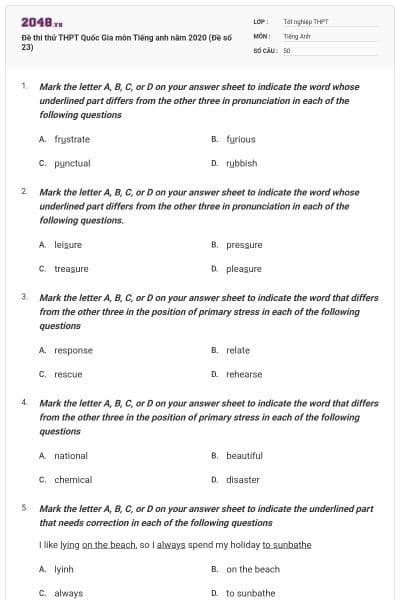
Mark the letter A, B, C, or D on your answer sheet to indicate the word whose underlined part differs from the other three in pronunciation in each of the following questions
frustrate
furious
punctual
rubbish
Đáp án B
frustrate /frʌˈstreɪt/
furious /ˈfjʊəriəs/
punctual /ˈpʌŋktʃuəl/
rubbish /ˈrʌbɪʃ/
=>Câu B “u” phát âm là /jʊ/ còn lại phát âm là /ʌ/
Mark the letter A, B, C, or D on your answer sheet to indicate the word whose underlined part differs from the other three in pronunciation in each of the following questions.
leisure
pressure
treasure
pleasure
Đáp án B
leisure /ˈleʒə(r)/
pressure /ˈpreʃə(r)/
treasure /ˈtreʒə(r)/
pleasure /ˈpleʒə(r)/
=>Câu B “s” phát âm là /ʃ/ còn lại phát âm là /ʒ/
Mark the letter A, B, C, or D on your answer sheet to indicate the word that differs from the other three in the position of primary stress in each of the following questions
response
relate
rescue
rehearse
Đáp án C
response /rɪˈspɒns/
relate /rɪˈleɪt/
rescue /ˈreskjuː/
rehearse /rɪˈhːs/
=>Câu C trọng âm 1 còn lại trọng âm 2
Mark the letter A, B, C, or D on your answer sheet to indicate the word that differs from the other three in the position of primary stress in each of the following questions
national
beautiful
chemical
disaster
Đáp án D
national /ˈnæʃnəl/
beautiful /ˈbjuːtɪfl/
chemical /ˈkemɪkl/
disaster /dɪˈzɑːstə(r)/
=>Câu D trọng âm 2 còn lại trọng âm 1
Mark the letter A, B, C, or D on your answer sheet to indicate the underlined part that needs correction in each of the following questions
I like lying on the beach, so I always spend my holiday to sunbathe
lyinh
on the beach
always
to sunbathe
Đáp án D
To sunbathe => sunbathing Like + Ving: thích làm việc gì
Spend + Ving: dành [ thời gian] làm việc gì
Câu này dịch như sau: Tôi thích nằm trên bãi biển, vì vậy tôi luôn dành cả kỳ nghỉ tắm nắng
Mark the letter A, B, C, or D on your answer sheet to indicate the underlined part that needs correction in each of the following questions
We do not know of how the general employment situation is likely to develop in the future
do not
of how
employment situation
likely to develop
Đáp án B
Of how => how S+ know how + to Vo hoặc how + S + V Know of sth: biết về cái gì
Câu này dịch như sau: Chúng tôi không biết tình hình tuyển dụng chung có khả năng phát triển trong tương lai
Mark the letter A, B, C, or D on your answer sheet to indicate the underlined part that needs correction in each of the following questions
A lot of discoveries have made in the fields of chemistry and physics
a lot of
have made
in
fields of
Đáp án B
Have made in => have been made in
Câu này dịch như sau: Nhiều khám phá đã được phát hiện/ tìm thấy trong lĩnh vực hóa học và vật lý. Câu mang nghĩa bị động nên phải dùng have been + Ved
Mark the letter A, B, C, or D on your answer sheet to indicate the correct answer to each of the following questions
The building work is still on schedule a problem in digging the foundation
due to
despite
so as
only if
Đáp án B
B Due to(prep) = because of = owing to: bởi vì
Despite = in spite of + cụm danh từ / Ving: mặc dù
So as to Vo: để mà
Only if + S + V : chỉ khi mà/ giá mà
Câu này dịch như sau: Công tác thi công vẫn đùng tiến độ mặc dù có vấn đề trong việc đào móng
Mark the letter A, B, C, or D on your answer sheet to indicate the correct answer to each of the following questions
It is very difficult to________the exact meaning of an idiom in a foreign language
convert
convey
exchange
transfer
Đáp án B
Convert (v) = transform: biến từ dạng này sang dạng khác
Convey (v): truyền tải [ ý nghĩa/ thông điệp]
Exchange (v): trao đổi
Transfer (v): chuyển đổi [ từ vị trí này sang vị trí khác]
Câu này dịch như sau: Rất khó để truyền tải nghĩa chính xác của một thành ngữ bằng ngôn ngữ nước ngoài.
Mark the letter A, B, C, or D on your answer sheet to indicate the correct answer to each of the following questions
By the time I return to my country, I________away from home for more than three years
will have been
will be
have been
was
Đáp án A
Cấu trúc: by the time/ before S+ hiện tại đơn, S+ will have Ved [ tương lai hoàn thành] + for + khoảng thời gian.
By the time / before S + quá khứ đơn, S+ had Ved [ quá khứ hoàn thành]
Câu này dịch như sau: Khi tôi trở về quê nhà, tôi sẽ đã xa nhà hơn 3 năm
Mark the letter A, B, C, or D on your answer sheet to indicate the correct answer to each of the following questions
The water is________. You can’t drink it
pollution
pollutant
polluted
polluting
Đáp án C
Pollution (n): sự ô nhiễm
Pollutant (n): yếu tố gây ô nhiễm/ chất gây ô nhiễm
Polluted (adj): bị ô nhiễm/ bị bẩn
Polluting (adj) : làm cho ô nhiễm
Câu này dịch như sau: Nước bị ô nhiễm. Bạn không thể uống nó
Mark the letter A, B, C, or D on your answer sheet to indicate the correct answer to each of the following questions
My boss is going on vacation next month, ________ she’ll be away from the office for about four weeks
in other words
for instance
on the other hand
such as
Đáp án A
In other words: nói cách khác
For instance = for example: ví dụ On the other hand: ngược lại
Such as: chẳng hạn như
Câu này dịch như sau: Sếp của tôi đự định đi nghỉ mát vào tháng tới, nói cách khác bà ấy sẽ đi xa khỏi văn phòng khoảng 4 tuần
Mark the letter A, B, C, or D on your answer sheet to indicate the correct answer to each of the following questions
Have you got a light? My cigarette’s gone________
by
away
off
out
Đáp án D
Go by = pass: trôi qua
Go away:đi vắng/ đi xa
Go off = explode [ nổ] / = ring [ đổ chuông]
Go out: tắt Câu này dịch như sau: Bạn có diêm không? Điếu thu của tôi tắt rồi
Mark the letter A, B, C, or D on your answer sheet to indicate the correct answer to each of the following questions
When he returned home, I found the door________
unlocking
unlocked
to be unlocked
have unlocked
Đáp án B
S+ find + tân ngữ + tính từ : thấy cái gì/ ai như thế nào đấy
Câu này dịch như sau: Khi anh ấy về nhà, anh ấy phát hiện ra rằng cửa đã bị khóa.
Mark the letter A, B, C, or D on your answer sheet to indicate the correct answer to each of the following questions
I had no sooner lit the barbecue________
than it started to rain
as it started to rained
while it started raining
that it started raining
Đáp án A
Cấu trúc: S + had no sooner Ved [ quá khứ hoàn thành] than S + Ved/ V2 [ quá khứ đơn]
Câu này dịch như sau: Tôi vừa bắt bếp lên thì trời đổ mưa
Mark the letter A, B, C, or D on your answer sheet to indicate the correct answer to each of the following questions
Several of my friends are ________ reporters
newspaper’s
newspapers’
newspapers
newspaper
Đáp án B
Newspaper [ danh từ số ít] phía trước phải có mạo từ / đại từ xác định. =>phải dùng sở hữu cách của danh từ số nhiều newspapers’
Câu này dịch như sau: Một vài người bạn của tôi là phóng viên của các tờ báo
Mark the letter A, B, C, or D on your answer sheet to indicate the correct answer to each of the following questions
Are you satisfied________your record?
at
from
with
for
Đáp án C
Be satisfied with: hài lòng với
Câu này dịch như sau: Bạn có hài lòng với kỷ lục/ đĩa hát của bạn không?
Mark the letter A, B, C, or D on your answer sheet to indicate the correct answer to each of the following questions
Do you know________?
what wrong was it with
what’s wrong with it
what wrong is it with
what wrong was with it
Đáp án D
Câu hỏi gián tiếp: Trợ động từ + S+ động từ chính + S + V?
Câu này dịch như sau: Bạn có biết nó bị gì không?
Mark the letter A, B, C, or D on your answer sheet to indicate the correct answer to each of the following questions
Zika________poses an international emergency, according to the World Health Organization
not any longer
any more
no longer
not any more
Đáp án C
S+ NO LONGER + V = S + trợ động từ NOT + động từ chình + ANY LONGER: không còn...nữa.
Câu này dịch như sau: Theo Tổ chức Y tế thế giới, Zika không còn gây ra một tình huống khẩn cấp trên toàn cầu nữ
Mark the letter A, B, C, or D on your answer sheet to indicate the most suitable response to complete each of the following exchanges
“You’re late again, Michael.”
“________________.”
Never mind. I stayed up too late last night
I’m sorry. The traffic was terrible
It’s OK. Thanks for telling me
That’s alright. It’s my fault anyway
Đáp án B
“ Michael, hôm nay em lại đi học muộn rồi.”
A. Đừng bận tâm. Tối qua em thức quá khuya.
B. Em xin lỗi. Giao thông ùn tắc quá.
C. Được rồi. Cảm ơn vì đã bảo tôi.
D. Không sao đâu. Là lỗi của em
Mark the letter A, B, C, or D on your answer sheet to indicate the most suitable response to complete each of the following exchanges
“Do you want to join us for a cup of coffee after work?”
“________________.”
Sounds good, but I can do it myself
Sorry, but I have to finish my presentation for tomorrow
No problem. What’s wrong with the coffee?
Thanks. You can make it
Đáp án B
“ Bạn có muốn uống tách cà phê với chúng tôi sau khi tan làm không?”
A. Nghe có vẻ hay đấy, nhưng tôi có thể tự làm.
B. Xin lỗi, nhưng tôi phải hoàn thành bài thuyết trình vào ngày mai.
C. Không thành vấn đề. Cà phê có vấn đề gì à?
D. Cảm ơn. Bạn có thể làm việc đó
Mark the letter A, B, C, or D on your answer sheet to indicate the word(s) CLOSEST in meaning to the underlined word(s) in each of the following questions.
The ostrich egg is the largest egg of any non-extinct bird, while the smallest egg is the egg of the hummingbird
living
dead
flying
vanished
Đáp án A
Non- extinct (adj): không tuyệt chủng
Living (adj): còn sống
Dead (adj): chết
Flying (adj): biết bay
Vanished (adj): biến mất
Câu này dịch như sau: Trứng chim đà điểu là trứng lớn nhất trong số các loại chim chưa tuyệt chủng, trong khi đó trứng nhỏ nhất là trứng của chim ruồi. =>Non- extinct = Living
Mark the letter A, B, C, or D on your answer sheet to indicate the word(s) CLOSEST in meaning to the underlined word(s) in each of the following questions.
The shop assistant was totally bewildered by the customer's behavior
disgusted
upset
angry
puzzled
Đáp án D
Bewildered (adj): hoang mang
Disgusted:
Upset: buồn
Angry: tức giận
Puzzled: bối rối
Câu này dịch như sau: Phụ tá cửa hàng hoàn toàn bối rối bởi cách cư xử của khách hàng. =>Bewildered = Puzzled
Mark the letter A, B, C, or D on your answer sheet to indicate the word(s) OPPOSITE in meaning to the underlined word(s) in each of the following questions.
I clearly remember talking to him in a chance meeting last summer
deliberate
unplanned
accidental
unintentional
Đáp án A
Chance (adj): tình cờ/ không sắp đặt trước
Deliberate:cố tình
Unplanned: không sắp đặt trước
Accidential: tình cố
Unintentional: cố tình/ có sắp xếp trước
Câu này dịch như sau: Tôi nhớ rõ ràng đã trò chuyện với anh ấy trong một cuộc họp mặt tình cờ vào mùa hè năm ngooái.
=>Chance >< Deliberate
Mark the letter A, B, C, or D on your answer sheet to indicate the word(s) OPPOSITE in meaning to the underlined word(s) in each of the following questions.
We offer a speedy and secure service of transfering money in less than 24 hours
uninterested
unsure
slow
open
Đáp án B
Secure: chắc chắn/ an toàn/ đảm bảo
Unintersted: không quan tâm
Unsure: không đảm bảo/ không chắc chắn
Slow: chậm Open: cởi mở
Câu này dịch như sau: Chúng tôi cung cấp dịch vụ chuyển tiền nhanh chóng và an toàn trong vòng chưa đến 24 giờ. =>Secure >< Unsure
Mark the letter A, B, C, or D on your answer sheet to indicate the sentence that is closest in meaning to each of the following questions
Large cars use more gas than smaller ones
If you own a small car, it uses more gas
The smaller the car, the more gas it uses
The larger the car, the more gas it uses
Large cars don’t use as much gas as smaller ones
Đáp án C
Câu này dịch như sau: Ô tô lớn tốn nhiều nhiên liệu hơn ô tô nhỏ hơn.
A. Nếu bạn sở hữu một chiếc ô tô nhỏ, nó tốn nhiều nhiên liệu hơn.
B. Ô tô càng nhỏ dùng càng nhiều nhiên liệu.
C. Ô tô càng lớn dùng càng nhiều nhiên liệu.
D. Ô tô lớn không tốn nhiều nhiên liệu bằng ô tô nhỏ
Mark the letter A, B, C, or D on your answer sheet to indicate the sentence that is closest in meaning to each of the following questions
Mary is crazy about her new puppy
Mary’s new puppy drives her crazy
Marry really likes her new puppy
Mary’s new puppy is crazy
Mary has a crazy dog
Đáp án B
Crazy about = excited about: thích phát điên lên
Câu này dịch như sau: Mary cực kỳ yêu thích chú chó con mới.
A. Chú chó con mới của Mary làm cô ấy phát điên lên.
B. Mary thật sự thích chú chó con mới.
C. Chú chó con mới của Mary bị điên.
D. Mary có một chú chó điên
Mark the letter A, B, C, or D on your answer sheet to indicate the sentence that is closest in meaning to each of the following questions
Did you happen to run into George last week?
Was it a week ago that you last saw George?
Where do you think George was all last week?
Have you got any idea what happened to George last week?
Did you, by any chance, see George last week?
Đáp án D
Happen to Vo: tình cờ
Run into = meet sb by chance
Câu này dịch như sau: Bạn đã tình cờ gặp George tuần trước phải không?
A. Có phải cách đây một tuần bạn gặp George lần cuối không?
B. Bạn nghĩ George đã ở đâu cả cuối tuần trước?
C. Bạn có ý kiến gì về việc xảy ra với George tuần trước không?
D. Bạn đã tình cờ gặp George tuần trước phải không?
Mark the letter A, B, C, or D on your answer sheet to indicate the sentence that best combines each pair of sentences in the following questions
Nam defeated the former champion in three sets. He finally won the inter-school table tennis championship
Having defeated the former champion in the inter-school table tennis, Nam did not hold the title of champion
Although Nam defeated the former champion in three sets, he did not win the title of inter-school table tennis champion
Having defeated the former champion in three sets, Nam won the inter-school table tennis championship
Being defeated by the former champion, Nam lost the chance to play the final game of inter-school table tennis champion
Đáp án C
Câu này dịch như sau: Nam đã đánh bại đương kim vô địch trong 3 trận đấu. Anh ấy cuối cùng đã giảng danh hiệu vô địch môn bóng bàn liên trường.
A. Đã đánh bại đương kim vô địch trong trận bóng bàn liên trường, Nam đã không giữ được danh hiệu vô địch.
B. Mặc dù Nam đã đánh bại đương kim vô địch trong 3 trận đấu, anh ấy đã không giành được danh hiệu vô địch bóng bàn liên trường.
C. Đã đánh bại đương kim vô địch trong 3 trận đấu, Nam đã giành chức vô địch môn bóng bàn liên trường.
D. Bị đánh bại bởi đương kim vô địch, Nam đã mất cơ hội chơi trận chung kết tranh chức vô địch bòng bàn liên trường
Mark the letter A, B, C, or D on your answer sheet to indicate the sentence that best combines each pair of sentences in the following questions
She wrote the text. She selected the illustration as well
She not only wrote the text but also selected the illustration
The text she wrote was not as good as the illustration she selected
In order to select the illustration, she had to write the text
If she had written the text, she would have selected the illustration
Đáp án A
As well = not only...but also: không những ... mà còn
Câu này dịch như sau: Cô ấy đã viết bài văn. Cô ấy cũng đã chọn hỉnh ảnh minh họa cho nó. A. Cô ấy không những viết bài văn mà còn chọn hình ảnh minh họa cho nó.
B. Bải văn cô ấy viết không tốt như hình ảnh minh họa cô ấy đã chọn.
C. Để chọn hình ảnh minh họa, cô ấy phải viết bài văn.
D. Nếu cô ấy viết bài văn, cô ấy sẽ chọn hình ảnh minh họa cho nó
Read the following passage and mark the letter A, B, C, or D on your answer sheet to indicate the correct word or phrase that best fits each of the numbered blanks from 31 to 35
Nowadays people are more aware that wildlife all over the world is in (31) ________. Many species of animals are threatened, and could easily become (32) ________ if we do not make an effort to protect them. There are many reasons for this. In some cases animals are hunted for their fur or for other valuable parts of their bodies. Some birds, such as parrots, are caught (33) ________, and sold as pets. For many animals and birds, the problem is that their habitatsthe place where they live-is disappearing. More land is used for farm, for houses and industry, and there are fewer open spaces than there once were. Farmers use powerful chemicals to help them grow better crops, but these chemicals pollute the environment and (34) ________ wildlife. The most successful animals on Earth, human beings, will soon be the only ones (35) ________ unless we can solve this problem.
Điền vào ô số 31
threat
problem
danger
vanishing
Đáp án C
Threat: mối đe dọa
Problem: vấn đề
Danger: sự nguy hiểm
Vanishing: sự biến mất
Cụm từ: be in danger: nguy hiểm/ bị đe dọa
Nowadays people are more aware that wildlife all over the world is in (31)________.
[ Ngày nay mọi người đều ý thức được rằng động vật hoang dã có nguy cơ tuyệt chủng/ đang bị đe dọa.]
Read the following passage and mark the letter A, B, C, or D on your answer sheet to indicate the correct word or phrase that best fits each of the numbered blanks from 31 to 35
Nowadays people are more aware that wildlife all over the world is in (31) ________. Many species of animals are threatened, and could easily become (32) ________ if we do not make an effort to protect them. There are many reasons for this. In some cases animals are hunted for their fur or for other valuable parts of their bodies. Some birds, such as parrots, are caught (33) ________, and sold as pets. For many animals and birds, the problem is that their habitatsthe place where they live-is disappearing. More land is used for farm, for houses and industry, and there are fewer open spaces than there once were. Farmers use powerful chemicals to help them grow better crops, but these chemicals pollute the environment and (34) ________ wildlife. The most successful animals on Earth, human beings, will soon be the only ones (35) ________ unless we can solve this problem.
Điền vào ô số 32
disappeared
vanished
extinct
empty
Đáp án C
Disappear: biến mất = vanished
Extinct : tuyệt chủng
Empty: làm trống rỗng
Many species of animals are threatened, and could easily become (32) ________ if we do not make an effort to protect them. There are many reasons for this. In some cases animals are hunted for their fur or for other valuable parts of their bodies.
[Nhiều loại động vật bị đe dọa, và có thể dễ dàng bị tuyệt chủng nếu chúng ta không nỗ lực bảo vệ chúng. Có nhiều lý do để làm việc này. Trong một số trường hợp động vật bị săn bắt để lấy lông hoặc những bộ phận có giá trị.
Read the following passage and mark the letter A, B, C, or D on your answer sheet to indicate the correct word or phrase that best fits each of the numbered blanks from 31 to 35
Nowadays people are more aware that wildlife all over the world is in (31) ________. Many species of animals are threatened, and could easily become (32) ________ if we do not make an effort to protect them. There are many reasons for this. In some cases animals are hunted for their fur or for other valuable parts of their bodies. Some birds, such as parrots, are caught (33) ________, and sold as pets. For many animals and birds, the problem is that their habitatsthe place where they live-is disappearing. More land is used for farm, for houses and industry, and there are fewer open spaces than there once were. Farmers use powerful chemicals to help them grow better crops, but these chemicals pollute the environment and (34) ________ wildlife. The most successful animals on Earth, human beings, will soon be the only ones (35) ________ unless we can solve this problem.
Điền vào ô số 33
for life
alive
lively
for living
Đáp án B
For life : vì cuộc sống
Alive: còn sống
Lively: sống động / linh hoạt
For living: để sinh sống
Some birds, such as parrots, are caught (33) ________, and sold as pets. For many animals and birds, the problem is that their habitats-the place where they live-is disappearing. More land is used for farm, for houses and industry, and there are fewer open spaces than there once were.
[ Một số loài chim, chẳng hạn như vẹt, bị bắt sống và bán như thú cưng. Với nhiều loài động vật và chim, vấn đề là môi trường sống của chúng đang dần biến mất. Ngày càng nhiều đất được sử dụng canh tác, xây nhà ở và công nghiệp, và có ít không gian trống hơn trước đây.]
Read the following passage and mark the letter A, B, C, or D on your answer sheet to indicate the correct word or phrase that best fits each of the numbered blanks from 31 to 35
Nowadays people are more aware that wildlife all over the world is in (31) ________. Many species of animals are threatened, and could easily become (32) ________ if we do not make an effort to protect them. There are many reasons for this. In some cases animals are hunted for their fur or for other valuable parts of their bodies. Some birds, such as parrots, are caught (33) ________, and sold as pets. For many animals and birds, the problem is that their habitatsthe place where they live-is disappearing. More land is used for farm, for houses and industry, and there are fewer open spaces than there once were. Farmers use powerful chemicals to help them grow better crops, but these chemicals pollute the environment and (34) ________ wildlife. The most successful animals on Earth, human beings, will soon be the only ones (35) ________ unless we can solve this problem.
Điền vào ô số 34
spoil
wound
wrong
harm
Đáp án D
Spoil = change sth good into bad: biến đổi thứ tốt thành xấu
Wound: làm bị thương
Wrong (v) = treat sb badly or unfairly: cư xử tệ hoặc bắt công
Harm (v): gây hại
Farmers use powerful chemicals to help them grow better crops, but these chemicals pollute the environment and (34) ________ wildlife.
[Nông dân sử dụng những hóa chất mạnh để giúp họ trồng vụ mùa tốt hơn, nhưng những hóa chất này gây ô nhiễm môi trường và gây hại đến động vật hoang dã.]
Read the following passage and mark the letter A, B, C, or D on your answer sheet to indicate the correct word or phrase that best fits each of the numbered blanks from 31 to 35
Nowadays people are more aware that wildlife all over the world is in (31) ________. Many species of animals are threatened, and could easily become (32) ________ if we do not make an effort to protect them. There are many reasons for this. In some cases animals are hunted for their fur or for other valuable parts of their bodies. Some birds, such as parrots, are caught (33) ________, and sold as pets. For many animals and birds, the problem is that their habitatsthe place where they live-is disappearing. More land is used for farm, for houses and industry, and there are fewer open spaces than there once were. Farmers use powerful chemicals to help them grow better crops, but these chemicals pollute the environment and (34) ________ wildlife. The most successful animals on Earth, human beings, will soon be the only ones (35) ________ unless we can solve this problem.
Điền vào ô số 35
left
over
staying
survived
Đáp án A
Leave: còn lại
Over: hết
Stay: ở lại
Survive: sống sót
The most successful animals on Earth, human beings, will soon be the only ones (35) ________ unless we can solve this problem.
[ Những động vật thành công nhất trên Trái Đất, nhân loại, sẽ sớm là loài duy nhất còn lại nếu chúng ta không giải quyết vấn đề này.]
Read the following passage and mark the letter A, B, C, or D on your answer sheet to indicate the correct answer to each of the questions from 36 to 42.
Although speech is the most advanced form of communication, there are many ways of communicating without using speech. Signals, signs, symbols, and gestures may be found in every known culture. The basic function of signal is to impinge upon the environment in such a way that it attracts attention, as, for example, the dots and dashes of a telegraph circuit. Coded to refer to speech, the potential for communication is very great. Less adaptable to the codification of words, signs also contain meaning in and of themselves. A stop sign or a barber pole conveys meaning quickly and conveniently.
Symbols are more difficult to describe than either signals or signs because of their intricate relationship with the receiver’s cultural perceptions. In some cultures, applauding in a theater provides performers with an auditory symbol of approval. Gestures such as waving and handshaking also communicate certain cultural messages.
Although signals, signs, symbols, and gestures are very useful, they do have a major disadvantage in communication. They usually do not allow ideas to be shared without the sender being directly adjacent to the receiver. Without an exchange of ideas, interaction comes to a halt. As a result, means of communication intended to be used for long distances and extended periods must be based upon speech. To radio, television, and the telephone, one must add fax, paging systems, electronic mail, and the Internet, and no one doubts but that there are more means of communication on the horizon.
Which of the following would be the best title for the passage?
Gestures
Signs and signals
Speech
Communication
Đáp án D
Tiêu đề phù hợp nhất cho bài đọc là gì?
A. Cử chỉ điệu bộ
B. lời nói
C. Ký hiệu và tín hiệu
D. sự giao tiếp
Read the following passage and mark the letter A, B, C, or D on your answer sheet to indicate the correct answer to each of the questions from 36 to 42.
Although speech is the most advanced form of communication, there are many ways of communicating without using speech. Signals, signs, symbols, and gestures may be found in every known culture. The basic function of signal is to impinge upon the environment in such a way that it attracts attention, as, for example, the dots and dashes of a telegraph circuit. Coded to refer to speech, the potential for communication is very great. Less adaptable to the codification of words, signs also contain meaning in and of themselves. A stop sign or a barber pole conveys meaning quickly and conveniently.
Symbols are more difficult to describe than either signals or signs because of their intricate relationship with the receiver’s cultural perceptions. In some cultures, applauding in a theater provides performers with an auditory symbol of approval. Gestures such as waving and handshaking also communicate certain cultural messages.
Although signals, signs, symbols, and gestures are very useful, they do have a major disadvantage in communication. They usually do not allow ideas to be shared without the sender being directly adjacent to the receiver. Without an exchange of ideas, interaction comes to a halt. As a result, means of communication intended to be used for long distances and extended periods must be based upon speech. To radio, television, and the telephone, one must add fax, paging systems, electronic mail, and the Internet, and no one doubts but that there are more means of communication on the horizon.
According to this passage, what is a signal?
A form of communication that interrupts the environment
The most difficult form of communication to describe
A form of communication which may be used across long distances
The form of communication most related to cultural perception
Đáp án A
Theo bài đọc cái nào là tín hiệu?
A. Một hình thức giao tiếp làm gián đoạn môi trường.
B. Hình thức giao tiếp khó mô tả nhất.
C. một hình thức giao tiếp có thể được sử dụng ở những khoảng cách xa.
D. Hình thức giao tiếp liên quan nhất đến nhận thức văn hóa.
Dẫn chứng: The basic function of signal is to impinge upon the environment in such a way that it attracts attention, as, for example, the dots and dashes of a telegraph circuit
Read the following passage and mark the letter A, B, C, or D on your answer sheet to indicate the correct answer to each of the questions from 36 to 42.
Although speech is the most advanced form of communication, there are many ways of communicating without using speech. Signals, signs, symbols, and gestures may be found in every known culture. The basic function of signal is to impinge upon the environment in such a way that it attracts attention, as, for example, the dots and dashes of a telegraph circuit. Coded to refer to speech, the potential for communication is very great. Less adaptable to the codification of words, signs also contain meaning in and of themselves. A stop sign or a barber pole conveys meaning quickly and conveniently.
Symbols are more difficult to describe than either signals or signs because of their intricate relationship with the receiver’s cultural perceptions. In some cultures, applauding in a theater provides performers with an auditory symbol of approval. Gestures such as waving and handshaking also communicate certain cultural messages.
Although signals, signs, symbols, and gestures are very useful, they do have a major disadvantage in communication. They usually do not allow ideas to be shared without the sender being directly adjacent to the receiver. Without an exchange of ideas, interaction comes to a halt. As a result, means of communication intended to be used for long distances and extended periods must be based upon speech. To radio, television, and the telephone, one must add fax, paging systems, electronic mail, and the Internet, and no one doubts but that there are more means of communication on the horizon.
The word “it” in paragraph 1 refers to________
way
environment
function
signal
Đáp án D
Từ “it” ở đoạn 1 ám chỉ đến....
Way: cách thức
Environment: môi trường
Function: chức năng
Signal: tín hiệu
Read the following passage and mark the letter A, B, C, or D on your answer sheet to indicate the correct answer to each of the questions from 36 to 42.
Although speech is the most advanced form of communication, there are many ways of communicating without using speech. Signals, signs, symbols, and gestures may be found in every known culture. The basic function of signal is to impinge upon the environment in such a way that it attracts attention, as, for example, the dots and dashes of a telegraph circuit. Coded to refer to speech, the potential for communication is very great. Less adaptable to the codification of words, signs also contain meaning in and of themselves. A stop sign or a barber pole conveys meaning quickly and conveniently.
Symbols are more difficult to describe than either signals or signs because of their intricate relationship with the receiver’s cultural perceptions. In some cultures, applauding in a theater provides performers with an auditory symbol of approval. Gestures such as waving and handshaking also communicate certain cultural messages.
Although signals, signs, symbols, and gestures are very useful, they do have a major disadvantage in communication. They usually do not allow ideas to be shared without the sender being directly adjacent to the receiver. Without an exchange of ideas, interaction comes to a halt. As a result, means of communication intended to be used for long distances and extended periods must be based upon speech. To radio, television, and the telephone, one must add fax, paging systems, electronic mail, and the Internet, and no one doubts but that there are more means of communication on the horizon.
The word “intricate” in paragraph 2 could best be replaced by ________
inefficient
complicated
historical
uncertain
Đáp án B
Từ “ intricate” ở đoạn 2 có thể được thay thế tốt nhất bởi...
Intricate: lộn xộn Inefficient: không hiệu quả
Complicated: phức tạp
Historical: thuộc về lịch sử
Uncertain: không chắc chắn =>Intricate = Complicated
Read the following passage and mark the letter A, B, C, or D on your answer sheet to indicate the correct answer to each of the questions from 36 to 42.
Although speech is the most advanced form of communication, there are many ways of communicating without using speech. Signals, signs, symbols, and gestures may be found in every known culture. The basic function of signal is to impinge upon the environment in such a way that it attracts attention, as, for example, the dots and dashes of a telegraph circuit. Coded to refer to speech, the potential for communication is very great. Less adaptable to the codification of words, signs also contain meaning in and of themselves. A stop sign or a barber pole conveys meaning quickly and conveniently.
Symbols are more difficult to describe than either signals or signs because of their intricate relationship with the receiver’s cultural perceptions. In some cultures, applauding in a theater provides performers with an auditory symbol of approval. Gestures such as waving and handshaking also communicate certain cultural messages.
Although signals, signs, symbols, and gestures are very useful, they do have a major disadvantage in communication. They usually do not allow ideas to be shared without the sender being directly adjacent to the receiver. Without an exchange of ideas, interaction comes to a halt. As a result, means of communication intended to be used for long distances and extended periods must be based upon speech. To radio, television, and the telephone, one must add fax, paging systems, electronic mail, and the Internet, and no one doubts but that there are more means of communication on the horizon.
Applauding was cited as an example of________
a signal
a sign
a gesture
a symbol
Đáp án D
Vỗ tay được trích dẫn như là một ví dụ của...
a signal: một tín hiệu
a sign: một dấu hiệu
a gesture: một cử chỉ
a symbol: một biểu tượng
Dẫn chứng: In some cultures, applauding in a theater provides performers with an auditory symbol of approval
Read the following passage and mark the letter A, B, C, or D on your answer sheet to indicate the correct answer to each of the questions from 36 to 42.
Although speech is the most advanced form of communication, there are many ways of communicating without using speech. Signals, signs, symbols, and gestures may be found in every known culture. The basic function of signal is to impinge upon the environment in such a way that it attracts attention, as, for example, the dots and dashes of a telegraph circuit. Coded to refer to speech, the potential for communication is very great. Less adaptable to the codification of words, signs also contain meaning in and of themselves. A stop sign or a barber pole conveys meaning quickly and conveniently.
Symbols are more difficult to describe than either signals or signs because of their intricate relationship with the receiver’s cultural perceptions. In some cultures, applauding in a theater provides performers with an auditory symbol of approval. Gestures such as waving and handshaking also communicate certain cultural messages.
Although signals, signs, symbols, and gestures are very useful, they do have a major disadvantage in communication. They usually do not allow ideas to be shared without the sender being directly adjacent to the receiver. Without an exchange of ideas, interaction comes to a halt. As a result, means of communication intended to be used for long distances and extended periods must be based upon speech. To radio, television, and the telephone, one must add fax, paging systems, electronic mail, and the Internet, and no one doubts but that there are more means of communication on the horizon.
Why were the telephone, radio, and television invented?
Because people were unable to understand signs, signals, and symbols
Because people believed that signs, signals, and symbols were obsolete
Because people wanted to communicate across long distances
Because people wanted new forms of communication
Đáp án C
Tại sao điện thoại, radio và truền hình được phát hình?
A. Vì con người không thể hiểu những dấu hiệu, tín hiệu và biểu tượng.
B. Vì con người tin rằng những dấu hiệu, tín hiệu và biểu tượng là lỗi thời.
C. Vì con người muốn giao tiếp ở những khoảng cách xa.
D. Vì con người muốn những hình thức giao tiếp mới.
Dẫn chứng: To radio, television, and the telephone, one must add fax, paging systems, electronic mail, and the Internet, and no one doubts but that there are more means of communication on the horizon
Read the following passage and mark the letter A, B, C, or D on your answer sheet to indicate the correct answer to each of the questions from 36 to 42.
Although speech is the most advanced form of communication, there are many ways of communicating without using speech. Signals, signs, symbols, and gestures may be found in every known culture. The basic function of signal is to impinge upon the environment in such a way that it attracts attention, as, for example, the dots and dashes of a telegraph circuit. Coded to refer to speech, the potential for communication is very great. Less adaptable to the codification of words, signs also contain meaning in and of themselves. A stop sign or a barber pole conveys meaning quickly and conveniently.
Symbols are more difficult to describe than either signals or signs because of their intricate relationship with the receiver’s cultural perceptions. In some cultures, applauding in a theater provides performers with an auditory symbol of approval. Gestures such as waving and handshaking also communicate certain cultural messages.
Although signals, signs, symbols, and gestures are very useful, they do have a major disadvantage in communication. They usually do not allow ideas to be shared without the sender being directly adjacent to the receiver. Without an exchange of ideas, interaction comes to a halt. As a result, means of communication intended to be used for long distances and extended periods must be based upon speech. To radio, television, and the telephone, one must add fax, paging systems, electronic mail, and the Internet, and no one doubts but that there are more means of communication on the horizon.
It may be concluded from this passage that.
Only some cultures have signs, signals, and symbols
Signs, signals, symbols, and gestures are forms of communication
Symbols are very easy to define and interrupt
Waving and handshaking are not related to culture
Đáp án B
Có thể kết luận từ bài đọc rằng...
A. Chỉ một số nền văn hóa có ký hiệu, tín hiệu và biểu tượng.
B. Ký hiệu, tín hiệu , biểu tượng và cử chỉ điệu bộ là những hình thức giao tiếp.
C. Biểu tượng rất dễ định nghĩa và làm gián đoạn.
D. Vẫy tay và bắt tay không liên quan đến văn hóa. Dẫn chứng: Signals, signs, symbols, and gestures may be found in every known culture.
=> loại A Symbols are more difficult to describe than either signals or signs because of their intricate relationship with the receiver’s cultural perceptions.
=> loại C In some cultures, applauding in a theater provides performers with an auditory symbol of approval. Gestures such as waving and handshaking also communicate certain cultural messages.
=> loại D
Read the following passage and mark the letter A, B, C, or D on your answer sheet to indicate the correct answer to each of the questions from 43 to 50.
Smallpox was the first widespread disease to be eliminated by human intervention. Known as a highly contagious viral disease, it broke out in Europe, causing the deaths of millions of people until the vaccination was invented by Edward Jenner around 1800. In many nations, it was a terror, a fatal disease until very recently. Its victims suffer high fever, vomiting and painful, itchy, pustules that left scars. In villages and cities all over the world, people were worried about suffering smallpox.
In May, 1966, the World Health Organization (WHO), an agency of the United Nations was authorized to initiate a global campaign to eradicate smallpox. The goal was to eliminate the disease in one decade. At the time, the disease posed a serious threat to people in more than thirty nations. Because similar projects for malaria and yellow fever had failed, few believed that smallpox could actually be eradicated but eleven years after the initial organization of the campaign, no cases were reported in the field.
The strategy was not only to provide mass vaccinations but also to isolate patients with active smallpox in order to contain the spread of the disease and to break the chain of human transmission. Rewards for reporting smallpox assisted in motivating the public to aid health workers. One by one, each small-pox victim was sought out, removed from contact with others and treated. At the same time, the entire village where the victim had lived was vaccinated.
By April of 1978 WHO officials announced that they had isolated the last known case of the disease but health workers continued to search for new cases for additional years to be completely sure. In May, 1980, a formal statement was made to the global community. Today smallpox is no longer a threat to humanity. Routine vaccinations have been stopped worldwide
Which of the following is the best title for the passage?
The eradication of smallpox
The World Health Organization
Infectious disease
Smallpox vaccinations
Đáp án A
Tiêu đề phù hợp nhất cho bài đọc là gì?
A. Quá trình loại bỏ bệnh đậu mùa
B. Căn bệnh truyền nhiễm
C. Tổ chức Y tế thế giới
D. Sự tiêm ngừa bệnh đậu mùa
Read the following passage and mark the letter A, B, C, or D on your answer sheet to indicate the correct answer to each of the questions from 43 to 50.
Smallpox was the first widespread disease to be eliminated by human intervention. Known as a highly contagious viral disease, it broke out in Europe, causing the deaths of millions of people until the vaccination was invented by Edward Jenner around 1800. In many nations, it was a terror, a fatal disease until very recently. Its victims suffer high fever, vomiting and painful, itchy, pustules that left scars. In villages and cities all over the world, people were worried about suffering smallpox.
In May, 1966, the World Health Organization (WHO), an agency of the United Nations was authorized to initiate a global campaign to eradicate smallpox. The goal was to eliminate the disease in one decade. At the time, the disease posed a serious threat to people in more than thirty nations. Because similar projects for malaria and yellow fever had failed, few believed that smallpox could actually be eradicated but eleven years after the initial organization of the campaign, no cases were reported in the field.
The strategy was not only to provide mass vaccinations but also to isolate patients with active smallpox in order to contain the spread of the disease and to break the chain of human transmission. Rewards for reporting smallpox assisted in motivating the public to aid health workers. One by one, each small-pox victim was sought out, removed from contact with others and treated. At the same time, the entire village where the victim had lived was vaccinated.
By April of 1978 WHO officials announced that they had isolated the last known case of the disease but health workers continued to search for new cases for additional years to be completely sure. In May, 1980, a formal statement was made to the global community. Today smallpox is no longer a threat to humanity. Routine vaccinations have been stopped worldwide
The word “contagious” is closest in meaning to________.
courteous
arresting
numerous
catching
Đáp án D
Từ “ dễ lây nhiễm” gần nghĩa nhất với... Courteous: lịch sự Arresting: khiến người ta chú ý Numerous: nhiều Catching: dễ bắt lấy =>contagious = catching
Read the following passage and mark the letter A, B, C, or D on your answer sheet to indicate the correct answer to each of the questions from 43 to 50.
Smallpox was the first widespread disease to be eliminated by human intervention. Known as a highly contagious viral disease, it broke out in Europe, causing the deaths of millions of people until the vaccination was invented by Edward Jenner around 1800. In many nations, it was a terror, a fatal disease until very recently. Its victims suffer high fever, vomiting and painful, itchy, pustules that left scars. In villages and cities all over the world, people were worried about suffering smallpox.
In May, 1966, the World Health Organization (WHO), an agency of the United Nations was authorized to initiate a global campaign to eradicate smallpox. The goal was to eliminate the disease in one decade. At the time, the disease posed a serious threat to people in more than thirty nations. Because similar projects for malaria and yellow fever had failed, few believed that smallpox could actually be eradicated but eleven years after the initial organization of the campaign, no cases were reported in the field.
The strategy was not only to provide mass vaccinations but also to isolate patients with active smallpox in order to contain the spread of the disease and to break the chain of human transmission. Rewards for reporting smallpox assisted in motivating the public to aid health workers. One by one, each small-pox victim was sought out, removed from contact with others and treated. At the same time, the entire village where the victim had lived was vaccinated.
By April of 1978 WHO officials announced that they had isolated the last known case of the disease but health workers continued to search for new cases for additional years to be completely sure. In May, 1980, a formal statement was made to the global community. Today smallpox is no longer a threat to humanity. Routine vaccinations have been stopped worldwide
The global community considered the smallpox________
a minor illness
a deadly illness
a mental illness
a rare illness
Đáp án B
Cộng đồng toàn cầu xem bệnh đậu mùa như là..............
A. một căn bệnh nhỏ
B. một căn bệnh tâm lý.
C. một căn bệnh chết người
D. một căn bệnh hiếm gặp
Dẫn chứng: In many nations, it was a terror, a fatal disease until very recently
Read the following passage and mark the letter A, B, C, or D on your answer sheet to indicate the correct answer to each of the questions from 43 to 50.
Smallpox was the first widespread disease to be eliminated by human intervention. Known as a highly contagious viral disease, it broke out in Europe, causing the deaths of millions of people until the vaccination was invented by Edward Jenner around 1800. In many nations, it was a terror, a fatal disease until very recently. Its victims suffer high fever, vomiting and painful, itchy, pustules that left scars. In villages and cities all over the world, people were worried about suffering smallpox.
In May, 1966, the World Health Organization (WHO), an agency of the United Nations was authorized to initiate a global campaign to eradicate smallpox. The goal was to eliminate the disease in one decade. At the time, the disease posed a serious threat to people in more than thirty nations. Because similar projects for malaria and yellow fever had failed, few believed that smallpox could actually be eradicated but eleven years after the initial organization of the campaign, no cases were reported in the field.
The strategy was not only to provide mass vaccinations but also to isolate patients with active smallpox in order to contain the spread of the disease and to break the chain of human transmission. Rewards for reporting smallpox assisted in motivating the public to aid health workers. One by one, each small-pox victim was sought out, removed from contact with others and treated. At the same time, the entire village where the victim had lived was vaccinated.
By April of 1978 WHO officials announced that they had isolated the last known case of the disease but health workers continued to search for new cases for additional years to be completely sure. In May, 1980, a formal statement was made to the global community. Today smallpox is no longer a threat to humanity. Routine vaccinations have been stopped worldwide
The word “threat” in paragraph 2 could best be replaced by________
risk
debate
announce
bother
Đáp án A
Từ” mối đe dọa” ở đoạn 2 có thể được thay thế tốt nhất bởi...
Risk: mối nguy hiểm/ đe dọa
Debate: cuộc tranh cãi
Announce: thông báo
Bother: sự làm phiền =>threat = risk
Read the following passage and mark the letter A, B, C, or D on your answer sheet to indicate the correct answer to each of the questions from 43 to 50.
Smallpox was the first widespread disease to be eliminated by human intervention. Known as a highly contagious viral disease, it broke out in Europe, causing the deaths of millions of people until the vaccination was invented by Edward Jenner around 1800. In many nations, it was a terror, a fatal disease until very recently. Its victims suffer high fever, vomiting and painful, itchy, pustules that left scars. In villages and cities all over the world, people were worried about suffering smallpox.
In May, 1966, the World Health Organization (WHO), an agency of the United Nations was authorized to initiate a global campaign to eradicate smallpox. The goal was to eliminate the disease in one decade. At the time, the disease posed a serious threat to people in more than thirty nations. Because similar projects for malaria and yellow fever had failed, few believed that smallpox could actually be eradicated but eleven years after the initial organization of the campaign, no cases were reported in the field.
The strategy was not only to provide mass vaccinations but also to isolate patients with active smallpox in order to contain the spread of the disease and to break the chain of human transmission. Rewards for reporting smallpox assisted in motivating the public to aid health workers. One by one, each small-pox victim was sought out, removed from contact with others and treated. At the same time, the entire village where the victim had lived was vaccinated.
By April of 1978 WHO officials announced that they had isolated the last known case of the disease but health workers continued to search for new cases for additional years to be completely sure. In May, 1980, a formal statement was made to the global community. Today smallpox is no longer a threat to humanity. Routine vaccinations have been stopped worldwide
According to the passage, what way was used to eliminate the spread of smallpox?
Vaccination of entire villages
Treatment of individual victims
Isolation of victims and mass vaccinations
Extensive reporting of outbreaks
Đáp án C
Theo bài đọc, phương pháp nào được sử dụng để ngăn chặn sự lây lan của bệnh đậu mùa?
A. Tiêm ngừa vắc-xin cho cả làng.
B. Chữa trị cho từng cá nhân.
C. Cách li những nạn nhân và tiêm ngừa trên diện rộng.
D. Thông báo sự bùng phát dịch bệnh một cách rộng rãi.
Dẫn chứng: The strategy was not only to provide mass vaccinations but also to isolate patients with active smallpox in order to contain the spread of the disease and to break the chain of human transmission
Read the following passage and mark the letter A, B, C, or D on your answer sheet to indicate the correct answer to each of the questions from 43 to 50.
Smallpox was the first widespread disease to be eliminated by human intervention. Known as a highly contagious viral disease, it broke out in Europe, causing the deaths of millions of people until the vaccination was invented by Edward Jenner around 1800. In many nations, it was a terror, a fatal disease until very recently. Its victims suffer high fever, vomiting and painful, itchy, pustules that left scars. In villages and cities all over the world, people were worried about suffering smallpox.
In May, 1966, the World Health Organization (WHO), an agency of the United Nations was authorized to initiate a global campaign to eradicate smallpox. The goal was to eliminate the disease in one decade. At the time, the disease posed a serious threat to people in more than thirty nations. Because similar projects for malaria and yellow fever had failed, few believed that smallpox could actually be eradicated but eleven years after the initial organization of the campaign, no cases were reported in the field.
The strategy was not only to provide mass vaccinations but also to isolate patients with active smallpox in order to contain the spread of the disease and to break the chain of human transmission. Rewards for reporting smallpox assisted in motivating the public to aid health workers. One by one, each small-pox victim was sought out, removed from contact with others and treated. At the same time, the entire village where the victim had lived was vaccinated.
By April of 1978 WHO officials announced that they had isolated the last known case of the disease but health workers continued to search for new cases for additional years to be completely sure. In May, 1980, a formal statement was made to the global community. Today smallpox is no longer a threat to humanity. Routine vaccinations have been stopped worldwide
How was the public motivated to help the health workers?
By educating them
By rewarding them for reporting smallpox cases
By isolating them from others
By giving them vaccinations
Đáp án B
Cộng đồng được thúc giục để giúp đỡ những nhân viên y tế như thế nào?
A. bằng cách giáo dục họ.
B. bằng cách ban thưởng cho họ khi báo cáo những trường hợp bệnh đậu mùa.
C. bằng cách cách li họ với những người khác.
D. bằng cách tiêm ngừa vắc-xin cho họ.
Dẫn chứng: Rewards for reporting smallpox assisted in motivating the public to aid health workers
Read the following passage and mark the letter A, B, C, or D on your answer sheet to indicate the correct answer to each of the questions from 43 to 50.
Smallpox was the first widespread disease to be eliminated by human intervention. Known as a highly contagious viral disease, it broke out in Europe, causing the deaths of millions of people until the vaccination was invented by Edward Jenner around 1800. In many nations, it was a terror, a fatal disease until very recently. Its victims suffer high fever, vomiting and painful, itchy, pustules that left scars. In villages and cities all over the world, people were worried about suffering smallpox.
In May, 1966, the World Health Organization (WHO), an agency of the United Nations was authorized to initiate a global campaign to eradicate smallpox. The goal was to eliminate the disease in one decade. At the time, the disease posed a serious threat to people in more than thirty nations. Because similar projects for malaria and yellow fever had failed, few believed that smallpox could actually be eradicated but eleven years after the initial organization of the campaign, no cases were reported in the field.
The strategy was not only to provide mass vaccinations but also to isolate patients with active smallpox in order to contain the spread of the disease and to break the chain of human transmission. Rewards for reporting smallpox assisted in motivating the public to aid health workers. One by one, each small-pox victim was sought out, removed from contact with others and treated. At the same time, the entire village where the victim had lived was vaccinated.
By April of 1978 WHO officials announced that they had isolated the last known case of the disease but health workers continued to search for new cases for additional years to be completely sure. In May, 1980, a formal statement was made to the global community. Today smallpox is no longer a threat to humanity. Routine vaccinations have been stopped worldwide
Which one of the statements doesn’t refer to smallpox?
Previous project had failed
People are no longer vaccinated for it
The WHO set up a worldwide campaign to eradicate the disease
It was a fatal threat
Đáp án A
Câu nào sau đây không ám chỉ đến bệnh đậu mùa?
A. Dự án trước đây đã thất bại.
B. Mọi người không còn tiêm ngừa vắc-xin bệnh đậu mùa nữa.
C. Tổ chức Y tế thế giới đã thành lập một chiến dịch toàn cầu để loại trừ căn bệnh này.
D. Nó là một mối đe dọa chết người.
Dẫn chứng: Routine vaccinations have been stopped worldwide.=> loại B In May, 1966, the World Health Organization (WHO), an agency of the United Nations was authorized to initiate a global campaign to eradicate smallpox. => loại C In many nations, it was a terror, a fatal disease until very recently. => loại D
Read the following passage and mark the letter A, B, C, or D on your answer sheet to indicate the correct answer to each of the questions from 43 to 50.
Smallpox was the first widespread disease to be eliminated by human intervention. Known as a highly contagious viral disease, it broke out in Europe, causing the deaths of millions of people until the vaccination was invented by Edward Jenner around 1800. In many nations, it was a terror, a fatal disease until very recently. Its victims suffer high fever, vomiting and painful, itchy, pustules that left scars. In villages and cities all over the world, people were worried about suffering smallpox.
In May, 1966, the World Health Organization (WHO), an agency of the United Nations was authorized to initiate a global campaign to eradicate smallpox. The goal was to eliminate the disease in one decade. At the time, the disease posed a serious threat to people in more than thirty nations. Because similar projects for malaria and yellow fever had failed, few believed that smallpox could actually be eradicated but eleven years after the initial organization of the campaign, no cases were reported in the field.
The strategy was not only to provide mass vaccinations but also to isolate patients with active smallpox in order to contain the spread of the disease and to break the chain of human transmission. Rewards for reporting smallpox assisted in motivating the public to aid health workers. One by one, each small-pox victim was sought out, removed from contact with others and treated. At the same time, the entire village where the victim had lived was vaccinated.
By April of 1978 WHO officials announced that they had isolated the last known case of the disease but health workers continued to search for new cases for additional years to be completely sure. In May, 1980, a formal statement was made to the global community. Today smallpox is no longer a threat to humanity. Routine vaccinations have been stopped worldwide
It can be inferred from the passage that________
yellow fever have been reported this year
no new cases of smallpox have been reported this year
smallpox victims no longer die when they contact the disease
smallpox is not transmitted from one person to another
Đáp án B
Có thể suy ra từ bài đọc rằng................
A. Bệnh sốt rét đã được báo cáo từ năm ngoái.
B. Không có trường hợp mắc bệnh đậu mùa mới được báo cáo trong năm nay.
C. Những bệnh nhân đậu mùa không còn chết khi tiếp xúc với căn bệnh này nữa.
D. Bệnh đậu mùa không lây từ người này sang người khác.
Dẫn chứng: Câu A không được đề cập đến thời điểm [ this year] Câu C không được đề cập đến trong bài. Câu D sai nghĩa hoàn toàn vì bệnh đậu mùa là bệnh truyền nhiễm.