Đề thi thử THPT Quốc Gia môn Tiếng anh năm 2020 (Đề số 19)
50 câu hỏi
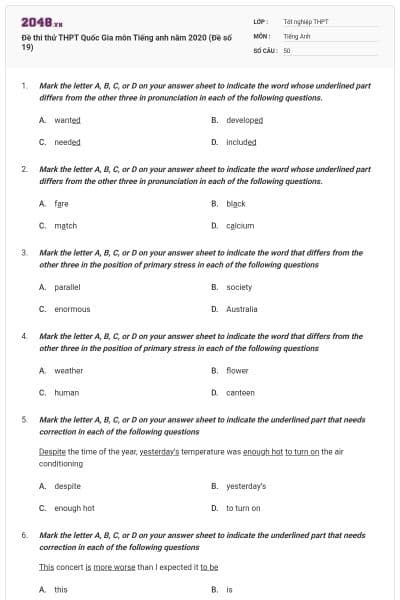
Mark the letter A, B, C, or D on your answer sheet to indicate the word whose underlined part differs from the other three in pronunciation in each of the following questions.
wanted
developed
needed
included
Đáp án B
Cách phát âm đuôi “-ed”
/id/: động từ tận cùng bằng [t] hoặc [d]. Ví dụ: wanted, decided, divided,…
/t/: động từ tận cùng bằng [k, p, f, ph, gh, s, x, ce, sh, ch]. Ví dụ: cooked, liked, stopped, hoped, coughed, laughed, missed, mixed, fixed, voiced, washed, watched,…
/d/: trường hợp còn lại. Ví dụ: moved, closed, boiled, listened,…
Câu B phát âm là /t/ còn lại phát âm là /id/
Mark the letter A, B, C, or D on your answer sheet to indicate the word whose underlined part differs from the other three in pronunciation in each of the following questions.
fare
black
match
calcium
Đáp án A
fare /feə(r)/
black /blæk/
match /mætʃ/
calcium /ˈkælsiəm/
Câu A phát âm là /e/ còn lại phát âm là /æ/ Chữ cái [a] thường được phát âm là:
1. /æ/: map, national, natural
2. /eɪ/: take, nature
3. /ɔː/: all, altogether
4. /ɒ/: want, quality
5. /e/: many, any
6. /ɪ/: message, dosage
7. /ə/: afraid, familiar
8. /ɑː/: car, after
Mark the letter A, B, C, or D on your answer sheet to indicate the word that differs from the other three in the position of primary stress in each of the following questions
parallel
society
enormous
Australia
Đáp án A
parallel /ˈpærəlel/
society /səˈsaɪəti/
enormous /ɪˈnɔːməs/
Australia /ɒsˈtreɪliə/
Câu A trọng âm 1 các câu còn lại trọng â m 2
Mark the letter A, B, C, or D on your answer sheet to indicate the word that differs from the other three in the position of primary stress in each of the following questions
weather
flower
human
canteen
Đáp án D
weather /ˈweðə(r)/
flower /ˈflaʊə(r)/
human /ˈhjuːmən/
canteen /kænˈtiːn/
Câu D trọng âm 2 các câu còn lại trọng âm 1
Mark the letter A, B, C, or D on your answer sheet to indicate the underlined part that needs correction in each of the following questions
Despite the time of the year, yesterday’s temperature was enough hot to turn on the air conditioning
despite
yesterday’s
enough hot
to turn on
Đáp án C
Enough hot => hot enough
tính từ + enuogh: đủ…
enough + danh từ ( đủ cái gì)
Mark the letter A, B, C, or D on your answer sheet to indicate the underlined part that needs correction in each of the following questions
This concert is more worse than I expected it to be
this
is
more worse
to be
Đáp án C
More worse => worse
vì worse là so sánh hơn của bad nên không dùng more nữa
Mark the letter A, B, C, or D on your answer sheet to indicate the underlined part that needs correction in each of the following questions
As I was driving south I could see that the old road was rebuilding
driving
see
that
was rebuilding
Đáp án D
Was rebuilding => was being rebuilt
vì câu mang nghĩa bị động nên dùng cấu trúc bị động của thì quá khứ tiếp diễn: S+ was / were being Ved/ V3
Câu này dịch như sau: Khi tôi đang lái xe về phía Nam, tôi có thể thấy rằng con đường cũ đang được sửa lại
Mark the letter A, B, C, or D on your answer sheet to indicate the correct answer to each of the following questions.
When she returned home from work, she________a bath
takes
took
has taken
was taking
Đáp án B
Khi cô ấy đi làm về, cô ấy đi tắm.
Dùng thì quá khứ đơn để diễn tả chuỗi hành động xảy ra trong quá khứ
Mark the letter A, B, C, or D on your answer sheet to indicate the correct answer to each of the following questions.
It is important to have someone you can________in
talk
speak
know
confide
Đáp án D
Rất cần có một ai đó mà bạn có thể tin tưởng để chia sẻ bí mật.
confide in (v) = tell somebody secrets and personal information because you feel you can trust them: kế cho ai đó nghe bí mật vì bạn cảm thấy có thể tin tưởng họ
Mark the letter A, B, C, or D on your answer sheet to indicate the correct answer to each of the following questions.
He was lucky to escape from the accident with only________injuries
minor
serious
important
major
Đáp án A
Anh ấy rất may mắn khi thoát khỏi vụ tại nạn với chỉ một vài vết thương nhỏ.
Minor( nhỏ)
Serious( nghiêm trọng)
Important( quan trọng)
Major( lớn)
Mark the letter A, B, C, or D on your answer sheet to indicate the correct answer to each of the following questions.
You________clean the windows. The window-cleaner is coming tomorrow
don’t have
must
mustn’t
needn’t
Đáp án D
don’t have to + Vo: không cần
must + Vo: phải
mustn’t: không được phép, cấm
needn’t: không cần
Bạn không cần lau chùi của sổ. Nhân viên vệ sinh sẽ đến vào ngày mai.
Need( động từ): need to do sth/ noun
Ví dụ: You need to water this planet twice a week. You don’t need to hurry.
Need( trợ động từ): need do sth
Ví dụ: You need fill in this form. You needn’t wash it.
Mark the letter A, B, C, or D on your answer sheet to indicate the correct answer to each of the following questions.
Would you rather live in________town or in________country?
a – a
a – the
the – a
the – the
Đáp án D
Bạn muốn sống ở thị trấn hay nông thôn? Bắt buộc phải dùng “the”:
cụm từ chỉ môi trường vật chất/ thế giới xung quanh ta, khí hậu…
- the environment
- the town
- the country(side)
- the sea(side)
- the beach
- the ground
- the jungle
- the mountains
- the desert
- the universe
- the world
- the rain
- the wind
- the fog
- the weather
- the sunshine
Mark the letter A, B, C, or D on your answer sheet to indicate the correct answer to each of the following questions.
Our teacher would like________
that we practicing our pronunciation
we to practice our pronunciation
us to practice our pronunciation
us practicing our pronunciation
Đáp án C
Giáo viên của chúng tôi muốn chúng tôi thực hành phát âm.
would like sb + to do sth = want sb + to do sth: muốn ( ai đó) làm ( cái gì)
Mark the letter A, B, C, or D on your answer sheet to indicate the correct answer to each of the following questions.
Jane often remembered________to her mother before she died
to talk
talk
talked
talking
Đáp án D
Jane thường nhớ lại việc đã nói chuyện với mẹ của cô ấy trước khi bà mất.
Remember + to Vo: nhớ việc cần làm nhưng chưa làm
Remember + to Vo: nhớ việc đã xảy ra
Mark the letter A, B, C, or D on your answer sheet to indicate the correct answer to each of the following questions.
They will be able to walk across the river________
if the ice will be thick enough
unless the ice is thick enough
if the ice is thick enough
when the ice will be thick enough
Đáp án C
Họ sẽ có thể băng qua được dòng sông nếu lớp băng đủ dày.
Câu điều kiện loại 1: If S+ hiện tại đơn, S+ will Vo
Mark the letter A, B, C, or D on your answer sheet to indicate the correct answer to each of the following questions.
I don’t care________money. Money can’t buy happiness
about
with
in
at
Đáp án A
Tôi không bận tâm đến tiền. TIền không thể mua được hành phúc.
care about sb/sth: quan tâm đến ai/ điều gì
Mark the letter A, B, C, or D on your answer sheet to indicate the correct answer to each of the following questions.
The Giant Panda has been on thev________of extinction for many years
border
verge
margin
rim
Đáp án B
Gấu trúc khổng lồ đang cơ nguy cơ tuyệt chủng nhiều năm nay.
on the verge of extinction: ở trên bờ vực tuyệt chủng
bring/drive sth to the verge of extinction: đẩy đến bờ vực tuyệt chủng
border (đường biên giới)
verge (ven đường, ven rừng)
margin (lề trang giấy, rìa bờ hồ)
rim (miệng cốc, cạp nong nia)
Mark the letter A, B, C, or D on your answer sheet to indicate the correct answer to each of the following questions.
What I like best of him is his________
dependence
dependable
independence
dependency
Đáp án C
Cái điều tôi thích nhất ở anh ấy là tính tự lập.
- tính từ sở hữu [his/her/my/our/their…] + danh từ
- dependable (adj) = reliable (adj): đáng tin cậy # reliant (adj) = dependent: lệ thuộc
- dependence (n): sự lệ thuộc
- independence (n): sự độc lập
- dependency (n): sự ỷ lại
Mark the letter A, B, C, or D on your answer sheet to indicate the most suitable response to complete each of the following exchanges.
He leaves work early to________his daughter up from school
pick
put
take
collect
Đáp án A
Anh ấy đi làm về sớm để đón con gái đi học về.
- pick up (v): to go somewhere in your car and collect somebody who is / waiting for you: đi đến nơi nào đó bằng ô tô để đón/ rước người đang chờ bạn
Mark the letter A, B, C, or D on your answer sheet to indicate the correct answer to each of the following questions.
“Hello, I’d like to speak to Mr. Green, please.”
“________________________________.”
I’m afraid I don’t know
I’m sorry. I’ll call again later
Sorry. Can you take a message?
Sure, I’ll put you through
Đáp án D
“ Xin chào, tôi muốn nói chuyện với ông Green, làm ơn”
A. Tôi e rằng tôi không biết
B. Tôi xin lỗi. Tôi sẽ gọi lại sau.
C. Xin lỗi. Bạn có thể ghi lại lời nhắn giúp tôi được không?
D. Chắc chắn rồi, tôi sẽ nối máy ngay
Mark the letter A, B, C, or D on your answer sheet to indicate the most suitable response to complete each of the following exchanges.
“It’s going to rain.”
“________________.”
I’m afraid I don’t know
I’m sorry. I’ll call again later
Sorry. Can you take a message?
Sure, I’ll put you through
Đáp án D
“ Trời sắp mưa rồi”
“ Tôi hi vọng rằng không mưa”
“ Tôi không hi vọng vậy” Các cách để diễn tả sự đống ý và không đồng ý:
I think so I expect so I hope so
I’m afraid so I guess so
I suppose so
I don’t think so
I don’t expect so. I hope not
I’m afraid not
I guess not.
I don’t suppose so/ I suppose not.
Mark the letter A, B, C, or D on your answer sheet to indicate the word(s) CLOSEST in meaning to the underlined word(s) in each of the following questions
The use of lasers in surgery has become relatively commonplace in recent years
absolutely
relevantly
comparatively
almost
Đáp án C
Việc sử dụng tia laze trong phẫu thuật đã trở nên khá là/ tương đối phổ biến trong những năm gần đây.
A. absolutely (hoàn toàn)
B. relevantly (có liên quan đến)
C. comparatively (tương đối)
D. almost (gần như)
Mark the letter A, B, C, or D on your answer sheet to indicate the word(s) CLOSEST in meaning to the underlined word(s) in each of the following questions.
The US Congress office is adjacent to the Capitol building
far from
behind
next to
within
Đáp án A
Văn phòng quốc hội Mỹ ngay bên cạnh tòa nhà Capitol.
adjacent = next to/ near: gần/ bên cạnh
behind: phía sau
far from: xa
within: trong vòng
Mark the letter A, B, C, or D on your answer sheet to indicate the word(s) OPPOSITE in meaning to the underlined word(s) in each of the following questions.
“I’m sorry, madam. This is the fixed price and there is no discount."
negotiable
discounted
unchanged
discussed
Đáp án A
Xin lỗi bà. Đây là giá cố định và không có giảm giá.”
A. negotiable (có thể thương lượng)
B. discounted (được giảm giá)
C. unchanged (không thay đổi)
D. discussed (được thảo luận)
Fixed: cố định ≠ negotiable :có thể thương lượng
Mark the letter A, B, C, or D on your answer sheet to indicate the word(s) CLOSEST in meaning to the underlined word(s) in each of the following questions.
In common with many mothers, she feels torn between her family and her work
In association with
In imitation of
Ignoring
Unlike
Đáp án D
in association with = together with: cùng với
in imitation of: phỏng theo, bắt chước theo
in common with = Like: cũng giống như
unlike : Không giống như
Giống như nhiều bà mẹ, cô ấy cảm thấy khó xử giữa gia đình và công việc
Mark the letter A, B, C, or D on your answer sheet to indicate the sentence that is closest in meaning to each of the following questions
He knew little about the world nature
He had a little knowledge about the world nature
He had little knowledge of the world nature
He knew little knowledge according to the world nature
He rarely knew of the little world nature
Đáp án B
Anh ấy biết rất ít về thiên nhiên thế giới. = Anh ấy có rất ít kiến thức về thiên nhiên thế giới
Mark the letter A, B, C, or D on your answer sheet to indicate the sentence that is closest in meaning to each of the following questions
I can’t agree with you more
I absolutely agree with you
I absolutely can’t agree with you
I partly agree with you
We have completely different ideas
Đáp án A
Tôi không thể tán thành với bạn hơn nữa.
A. Tôi hoàn toàn đồng ý với bạn.
B. Tôi hoàn toàn không thể đống ý với bạn.
C. Tôi đồng ý với bạn một phần.
D. Chúng tôi có ý kiến hoàn toàn khác nhau
Mark the letter A, B, C, or D on your answer sheet to indicate the sentence that is closest in meaning to each of the following questions
We prefer going by train because we can enjoy the sight
We would like to go by train, or we will enjoy the sight
We enjoy the sight although we go by train
We prefer going by train to enjoying the sight
We would like to go by train so that we can enjoy the sight
Đáp án D
Chúng tôi thích đi bằng tàu hỏa hơn vì chúng tôi có thể thưởng thức phong cảnh.
A. Chúng tôi muốn đi bằng tàu hỏa, hoặc là chúng tôi sẽ ngắm cảnh.
B. Chúng tôi thích ngắm cảnh mặc dù chúng tôi đi tàu hỏa. Câu C sai ngữ pháp vì to + Vo
C. Chúng tôi muốn đi bằng tàu hỏa để mà chúng tôi có thể ngắm cảnh
Mark the letter A, B, C, or D on your answer sheet to indicate the sentence that best combines each pair of sentences in the following questions
We cut down many forests. The Earth becomes hot
The more forests we cut down, the hotter the Earth becomes
The more we cut down forests, the hotter the Earth becomes
The more forests we cut down, the Earth becomes hotter
The more we cut down forests, the Earth becomes hotter
Đáp án A
Chúng tai chặt nhiều rừng. Trái Đất trở nên nóng.
Chúng ta càng chặt nhiều rừng, Trái Đất càng nóng lên.
Cấu trúc so sánh kép (càng… càng…): The + so sánh hơn + S + V
Mark the letter A, B, C, or D on your answer sheet to indicate the sentence that best combines each pair of sentences in the following questions
A thermometer is an instrument. We use it to measure the temperature
We use it to measure the temperature which is a thermometer
A thermometer is an instrument which is used to measure the temperature
We use thermometer which measure the temperature
A thermometer is an instrument which we use it to measure the temperature
Đáp án: B
Giải thích:
Câu gốc: A thermometer is an instrument. We use it to measure the temperature.
→ Nghĩa: Nhiệt kế là một dụng cụ. Chúng ta dùng nó để đo nhiệt độ.
Phân tích đáp án:
A. We use it to measure the temperature which is a thermometer. → Sai ngữ pháp: "which is a thermometer" không phù hợp vì "which" đang thay thế cho "temperature", dẫn đến câu vô nghĩa.
B. A thermometer is an instrument which is used to measure the temperature. → Đúng: Dùng mệnh đề quan hệ "which is used to measure the temperature" để bổ nghĩa cho "an instrument".
C. We use thermometer which measure the temperature. → Sai ngữ pháp: "thermometer" là danh từ số ít nhưng "measure" không chia đúng dạng số ít (measures).
D. A thermometer is an instrument which we use it to measure the temperature. → Sai ngữ pháp: "which" đã thay thế cho "it", nên không cần thêm "it" nữa.
Chọn B.
Dịch: Nhiệt kế là một dụng cụ được dùng để đo nhiệt độ.
Read the following passage and mark the letter A, B, C, or D on your answer sheet to indicate the correct word or phrase that best fits each of the numbered blanks from 31 to 35.
British parents are always complaining that their children spend too much time glued to the TV and do not have enough time on other activities (31) ________sports and reading. A survey recently (32) ________on people’s viewing habits does not approve this. It shows that young people in Britain spend on average 23 hours a week in front of the television, (33) ________works out at over three hours a day.
(34) ________is surprising, however, is the fact that the average adult watches even more: an incredible 28 hours a week. We (35) ________to have become a nation of addicts. Just about every household in the country has a television set and over half have two or more. According to the survey, people nowadays don’t just watch television sitting in their living-rooms, they watch it in the kitchen and in bed as well
Điền vào ô số 31
such
like
as
alike
Đáp án B
British parents are always complaining that their children spend too much time glued to the TV and do not have enough time on other activities (31)________sports and reading. => Những bố mẹ người Anh luôn phàn nàn rằng con họ dành quá nhiều thời gian dán mắt vào tivi và không có đủ thời gian cho các hoạt động khác như thể thao và đọc sách.
uch as: chắng hạn như
Like( giới từ): chẳng hạn như/ như là
As: vì, khi
Alike: giống nhau
Read the following passage and mark the letter A, B, C, or D on your answer sheet to indicate the correct word or phrase that best fits each of the numbered blanks from 31 to 35.
British parents are always complaining that their children spend too much time glued to the TV and do not have enough time on other activities (31) ________sports and reading. A survey recently (32) ________on people’s viewing habits does not approve this. It shows that young people in Britain spend on average 23 hours a week in front of the television, (33) ________works out at over three hours a day.
(34) ________is surprising, however, is the fact that the average adult watches even more: an incredible 28 hours a week. We (35) ________to have become a nation of addicts. Just about every household in the country has a television set and over half have two or more. According to the survey, people nowadays don’t just watch television sitting in their living-rooms, they watch it in the kitchen and in bed as well
Điền vào ô số 32
investigated
researched
carried out
carried
Đáp án C
Investigate: điều tra Research: nghiên cứu
Carry out: tiến hành Carry: mang vác
A survey recently (32________on people’s viewing habits does not approve this.
Một cuộc khảo sát cái mà được tiến hành gần đây về thói quen xem tivi của con người không đồng ý với điều này
Read the following passage and mark the letter A, B, C, or D on your answer sheet to indicate the correct word or phrase that best fits each of the numbered blanks from 31 to 35.
British parents are always complaining that their children spend too much time glued to the TV and do not have enough time on other activities (31) ________sports and reading. A survey recently (32) ________on people’s viewing habits does not approve this. It shows that young people in Britain spend on average 23 hours a week in front of the television, (33) ________works out at over three hours a day.
(34) ________is surprising, however, is the fact that the average adult watches even more: an incredible 28 hours a week. We (35) ________to have become a nation of addicts. Just about every household in the country has a television set and over half have two or more. According to the survey, people nowadays don’t just watch television sitting in their living-rooms, they watch it in the kitchen and in bed as well
Điền vào ô số 33
that
which
this
it
Đáp án B
Trước đó là dấu phẩy => loại that, dùng đại từ quan hệ which thay thế cho cả mệnh đề phía trước.
It shows that young people in Britain spend on average 23 hours a week in front of the television, (33) ________works out at over three hours a day. => Nó cho thấy rằng thanh niên ở Anh dành trung bình 23 giờ một tuần trước tivi, việc này tiêu tốn hơn 3 giờ một ngày
Read the following passage and mark the letter A, B, C, or D on your answer sheet to indicate the correct word or phrase that best fits each of the numbered blanks from 31 to 35.
British parents are always complaining that their children spend too much time glued to the TV and do not have enough time on other activities (31) ________sports and reading. A survey recently (32) ________on people’s viewing habits does not approve this. It shows that young people in Britain spend on average 23 hours a week in front of the television, (33) ________works out at over three hours a day.
(34) ________is surprising, however, is the fact that the average adult watches even more: an incredible 28 hours a week. We (35) ________to have become a nation of addicts. Just about every household in the country has a television set and over half have two or more. According to the survey, people nowadays don’t just watch television sitting in their living-rooms, they watch it in the kitchen and in bed as well
Điền vào ô số 34
What
It
The thing
This
Đáp án A
Câu đã có động từ chính là “is the fact that…” nên cả cụm phía trước đóng vai trò chủ ngữ phải dùng cụm từ what.
(34)________is surprising, however, is the fact that the average adult watches even more: an incredible 28 hours a week. => Tuy nhiên điều ngạc nhiên là sự thật trung bình người lớn xem thậm chí nhiều hơn : 28 giờ một tuần một con số thật khó tin
Read the following passage and mark the letter A, B, C, or D on your answer sheet to indicate the correct word or phrase that best fits each of the numbered blanks from 31 to 35.
British parents are always complaining that their children spend too much time glued to the TV and do not have enough time on other activities (31) ________sports and reading. A survey recently (32) ________on people’s viewing habits does not approve this. It shows that young people in Britain spend on average 23 hours a week in front of the television, (33) ________works out at over three hours a day.
(34) ________is surprising, however, is the fact that the average adult watches even more: an incredible 28 hours a week. We (35) ________to have become a nation of addicts. Just about every household in the country has a television set and over half have two or more. According to the survey, people nowadays don’t just watch television sitting in their living-rooms, they watch it in the kitchen and in bed as well
Điền vào ô số 35
seem
ought
used
would
Đáp án A
Seem to Vo: có vẻ như
Ought to Vo: nên
Used to Vo: đã từng
Would like to Vo: muốn
We (35)________to have become a nation of addicts. Just about every household in the country has a television set and over half have two or more. According to the survey, people nowadays don’t just watch television sitting in their living-rooms, they watch it in the kitchen and in bed as well.
Chúng ta dường như đã trở thành đất nước của những người nghiện tivi. Chỉ khoảng mỗi hộ gia đình trên đất nước đều có 1 tivi và hơn phân nửa trong số đó có hai tivi hoặc nhiều hơn. Theo cuộc khảo sát, ngày nay ,ọi người không chỉ xem tivi trogn phòng khách. Họ xem trong nhà bếp cũng như trên giường
Read the following passage and mark the letter A, B, C, or D on your answer sheet to indicate the correct answer to each of the questions from 36 to 42.
Most people go to a doctor in their own town or suburbs. But people in the Australian outback can’t get to a doctor quickly. The nearest doctor is sometimes hundreds of kilometers away so they have to call him on a two-way radio. This special doctor is called the “flying doctor”. He visits sick people by plane.
When someone is sick, the doctor has to fly to the person’s home. His plane lands on a flat piece of ground near the person’s house. Sometimes the doctor has to take the patient to hospital. Flying doctors take about 8,600 people to hospital each year.
However, most of the time the person isn’t very sick, and the doctor doesn’t have to visit. He can give advice on the radio from the office at the flying doctor center. He can tell the patient to use some medicine from a special medicine chest. There is one of these chests in every home in the outback. Each bottle, tube and packet in the chest has a number. The doctor often says something like this, “Take two tablets from bottle number 5 every four hours.”
A man called John Flynn started the Royal Flying Doctor service in 1927. He had only one plane. Today there are 14 flying-doctor centers, 29 planes, 14 full-time doctors and several part- time doctors, nurses and dentists.
The flying doctors mentioned in this article treat their patients
in clinics
by old methods
over great distances
by telepathy
Đáp án C
Những bác sĩ đi bằng máy bay được đề cập trong bài chữa trị cho bệnh nhân:
A. Tại phòng khám
B. Bằng phuowmg pháp cũ kỹ
C. ở rất xa
D. bằng thần giao cách cảm
Dẫn chứng: Most people go to a doctor in their own town or suburbs. But people in the Australian outback can’t get to a doctor quickly. The nearest doctor is sometimes hundreds of kilometers away so they have to call him on a two-way radio. This special doctor is called the “flying doctor”. He visits sick people by plane
Read the following passage and mark the letter A, B, C, or D on your answer sheet to indicate the correct answer to each of the questions from 36 to 42.
Most people go to a doctor in their own town or suburbs. But people in the Australian outback can’t get to a doctor quickly. The nearest doctor is sometimes hundreds of kilometers away so they have to call him on a two-way radio. This special doctor is called the “flying doctor”. He visits sick people by plane.
When someone is sick, the doctor has to fly to the person’s home. His plane lands on a flat piece of ground near the person’s house. Sometimes the doctor has to take the patient to hospital. Flying doctors take about 8,600 people to hospital each year.
However, most of the time the person isn’t very sick, and the doctor doesn’t have to visit. He can give advice on the radio from the office at the flying doctor center. He can tell the patient to use some medicine from a special medicine chest. There is one of these chests in every home in the outback. Each bottle, tube and packet in the chest has a number. The doctor often says something like this, “Take two tablets from bottle number 5 every four hours.”
A man called John Flynn started the Royal Flying Doctor service in 1927. He had only one plane. Today there are 14 flying-doctor centers, 29 planes, 14 full-time doctors and several part- time doctors, nurses and dentists.
Which happens first?
The doctor flies to the sick person’s home
The sick person or his family calls the doctor on a two-way radio
The plane lands near the patient’s house
The doctor treats the sick person on a two-way radio
Đáp án B
Cái nào xảy ra trước?
A. Bác sĩ bay đến nhà bệnh nhân.
B. Người bệnh hoặc thân nhân người bệnh gọi bác sĩ bằng radio 2 chiều.
C. Máy bay hạ cánh gần nhà của bệnh nhân.
D. Bác sĩ chữa trị cho người bệnh qua radio hai chiều.
Dẫn chứng: The nearest doctor is sometimes hundreds of kilometers away so they have to call him on a two-way radio. This special doctor is called the “flying doctor”. He visits sick people by plane
Read the following passage and mark the letter A, B, C, or D on your answer sheet to indicate the correct answer to each of the questions from 36 to 42.
Most people go to a doctor in their own town or suburbs. But people in the Australian outback can’t get to a doctor quickly. The nearest doctor is sometimes hundreds of kilometers away so they have to call him on a two-way radio. This special doctor is called the “flying doctor”. He visits sick people by plane.
When someone is sick, the doctor has to fly to the person’s home. His plane lands on a flat piece of ground near the person’s house. Sometimes the doctor has to take the patient to hospital. Flying doctors take about 8,600 people to hospital each year.
However, most of the time the person isn’t very sick, and the doctor doesn’t have to visit. He can give advice on the radio from the office at the flying doctor center. He can tell the patient to use some medicine from a special medicine chest. There is one of these chests in every home in the outback. Each bottle, tube and packet in the chest has a number. The doctor often says something like this, “Take two tablets from bottle number 5 every four hours.”
A man called John Flynn started the Royal Flying Doctor service in 1927. He had only one plane. Today there are 14 flying-doctor centers, 29 planes, 14 full-time doctors and several part- time doctors, nurses and dentists.
The word “outback” mostly means________
a large field of the Aborigines
an isolated island
a vast and remote area
a far-off forest
Đáp án C
Từ “outback” hầu như có nghĩa là:
A. a large field of the Aborigines [1 cánh đồng lớn của những người thổ dân Úc]
B. an isolated island [1 hòn đảo biệt lập]
C. a vast and remote area [khu vực rộng lớn và xa xôi hẻo lánh]
D. a far-off forest [1 khu rừng ở vùng xa xôi hẻo lánh]
Read the following passage and mark the letter A, B, C, or D on your answer sheet to indicate the correct answer to each of the questions from 36 to 42.
Most people go to a doctor in their own town or suburbs. But people in the Australian outback can’t get to a doctor quickly. The nearest doctor is sometimes hundreds of kilometers away so they have to call him on a two-way radio. This special doctor is called the “flying doctor”. He visits sick people by plane.
When someone is sick, the doctor has to fly to the person’s home. His plane lands on a flat piece of ground near the person’s house. Sometimes the doctor has to take the patient to hospital. Flying doctors take about 8,600 people to hospital each year.
However, most of the time the person isn’t very sick, and the doctor doesn’t have to visit. He can give advice on the radio from the office at the flying doctor center. He can tell the patient to use some medicine from a special medicine chest. There is one of these chests in every home in the outback. Each bottle, tube and packet in the chest has a number. The doctor often says something like this, “Take two tablets from bottle number 5 every four hours.”
A man called John Flynn started the Royal Flying Doctor service in 1927. He had only one plane. Today there are 14 flying-doctor centers, 29 planes, 14 full-time doctors and several part- time doctors, nurses and dentists.
The word “chest” in this context probably means________
a body part
a machine
a remote control
a small box
Đáp án D
Từ “ chest” trong ngữ cảnh này có thể có nghĩa là:
A. a body part [1 bộ phận cơ thể]
B. a machine [1 cỗ máy]
C. a remote control [1 thiết bị điều khiển từ xa]
D. a small box [1 cái hộp nhỏ]
Read the following passage and mark the letter A, B, C, or D on your answer sheet to indicate the correct answer to each of the questions from 36 to 42.
Most people go to a doctor in their own town or suburbs. But people in the Australian outback can’t get to a doctor quickly. The nearest doctor is sometimes hundreds of kilometers away so they have to call him on a two-way radio. This special doctor is called the “flying doctor”. He visits sick people by plane.
When someone is sick, the doctor has to fly to the person’s home. His plane lands on a flat piece of ground near the person’s house. Sometimes the doctor has to take the patient to hospital. Flying doctors take about 8,600 people to hospital each year.
However, most of the time the person isn’t very sick, and the doctor doesn’t have to visit. He can give advice on the radio from the office at the flying doctor center. He can tell the patient to use some medicine from a special medicine chest. There is one of these chests in every home in the outback. Each bottle, tube and packet in the chest has a number. The doctor often says something like this, “Take two tablets from bottle number 5 every four hours.”
A man called John Flynn started the Royal Flying Doctor service in 1927. He had only one plane. Today there are 14 flying-doctor centers, 29 planes, 14 full-time doctors and several part- time doctors, nurses and dentists.
When a patient needs a special examination, the doctor has to________
take him/her to a special holy place
fly him/her to a military clinic
give him/her all kinds of medicine
fly to the patient’s place
Đáp án D
Khi một bệnh nhân cần kiểm tra đặc biệt, bác sĩ phải…………….
A. Mang bệnh nhân đến một nơi thiêng liêng.
B. Đưa người đó đi máy bay đến phòng khám quân y.
C. Cho bệnh nhân đó tất cả các loại thuốc.
D. Bay đến nơi của bệnh nhân.
Dẫn chứng: When someone is sick, the doctor has to fly to the person’s home. His plane lands on a flat piece of ground near the person’s house. Sometimes the doctor has to take the patient to hospital. Flying doctors take about 8,600 people to hospital each year
Read the following passage and mark the letter A, B, C, or D on your answer sheet to indicate the correct answer to each of the questions from 36 to 42.
Most people go to a doctor in their own town or suburbs. But people in the Australian outback can’t get to a doctor quickly. The nearest doctor is sometimes hundreds of kilometers away so they have to call him on a two-way radio. This special doctor is called the “flying doctor”. He visits sick people by plane.
When someone is sick, the doctor has to fly to the person’s home. His plane lands on a flat piece of ground near the person’s house. Sometimes the doctor has to take the patient to hospital. Flying doctors take about 8,600 people to hospital each year.
However, most of the time the person isn’t very sick, and the doctor doesn’t have to visit. He can give advice on the radio from the office at the flying doctor center. He can tell the patient to use some medicine from a special medicine chest. There is one of these chests in every home in the outback. Each bottle, tube and packet in the chest has a number. The doctor often says something like this, “Take two tablets from bottle number 5 every four hours.”
A man called John Flynn started the Royal Flying Doctor service in 1927. He had only one plane. Today there are 14 flying-doctor centers, 29 planes, 14 full-time doctors and several part- time doctors, nurses and dentists.
All of the following statements are true EXCEPT________
None of the doctor at the center work full-time
Every home in the outback has a chest
Sometimes the doctor has to take the patient to hospital
The doctor gives prescription using specific numbers for each kind of medicine
Đáp án A
Tất cả những câu sau đây đều đúng NGOẠI TRỪ…………….
A. Không bác sĩ nào ở trung tâm làm việc toàn thời gian.
B. Mỗi hộ gia đình ở vùng sâu vùng xa đều có 1 tủ thuốc nhỏ.
C. Thỉnh thoảng bác sĩ phải mang bệnh nhận đến bệnh viện.
D. Bác sĩ cho đơn thuốc sử dụng những con số đặc biệt cho mỗi loại thuốc. Dẫn chứng:
There is one of these chests in every home in the outback. Each bottle, tube and packet in the chest has a number.
Loại câu B và D
Sometimes the doctor has to take the patient to hospital. => loại câu C
Read the following passage and mark the letter A, B, C, or D on your answer sheet to indicate the correct answer to each of the questions from 36 to 42.
Most people go to a doctor in their own town or suburbs. But people in the Australian outback can’t get to a doctor quickly. The nearest doctor is sometimes hundreds of kilometers away so they have to call him on a two-way radio. This special doctor is called the “flying doctor”. He visits sick people by plane.
When someone is sick, the doctor has to fly to the person’s home. His plane lands on a flat piece of ground near the person’s house. Sometimes the doctor has to take the patient to hospital. Flying doctors take about 8,600 people to hospital each year.
However, most of the time the person isn’t very sick, and the doctor doesn’t have to visit. He can give advice on the radio from the office at the flying doctor center. He can tell the patient to use some medicine from a special medicine chest. There is one of these chests in every home in the outback. Each bottle, tube and packet in the chest has a number. The doctor often says something like this, “Take two tablets from bottle number 5 every four hours.”
A man called John Flynn started the Royal Flying Doctor service in 1927. He had only one plane. Today there are 14 flying-doctor centers, 29 planes, 14 full-time doctors and several part- time doctors, nurses and dentists.
The writer of this passage shows a/an________attitude to the flying- doctor service
critical
supportive
curious
indifferent
Đáp án B
Tác giả của bài đọc thể hiện thái độ…………..đối với dịch vụ bác sĩ đi bằng máy bay
A. critical [phê bình]
B. supportive [ủng hộ]
C. curious [tò mò]
D. indifferent [thờ ơ]
Read the following passage and mark the letter A, B, C, or D on your answer sheet to indicate the correct answer to each of the questions from 43 to 50.
The food we eat seems to have profound effects on our health. Although science has made enormous steps in making food more fit to eat, it has, at the same time, made many foods unfit to eat. Some research has shown that perhaps 80% of all human illnesses are related to diet and 40% of cancer is related to the diet as well, especially cancer of the colon. People of different cultures are more prone to contract certain illnesses because of the characteristic foods they consume.
That food is related to illness is not a new discovery. In 1945, government researchers realized that nitrates and nitrites (commonly used to preserve color in meats) as well as other food additives caused cancer. Yet, these carcinogenic additives remain on our food, and it becomes more difficult all the time to know which ingredients on the packaging labels of processed food are healthful or harmful.
The additives that we eat are not all so direct. Farmers often give penicillin to cattle and poultry, and because of this, penicillin has been found in the milk of treated cows. Sometimes similar drugs are administered to animals not for medicinal purposes, but for financial reasons. The farmers are simply trying to fatten the animals in order to obtain a higher price on the market. Although the Food and Drug Administration (FDA) has tried repeatedly to control these producers, the practices continue.
A healthy diet is directly related to good health. Often we are unaware of detrimental substances we ingest. Sometimes well-meaning farmers or others who do not realize the consequences add these substances to food without their knowledge
How has science done a disservice to people?
Because of science, disease caused by contaminated food has been virtually eradicated
It has caused a lack of information concerning the value of food
As a result of scientific intervention, some potentially harmful substances have been added to our food
The scientists have preserved the color of meats, but not of vegetables
Đáp án C
Khoa học đã gây hại đến con người như thế nào?
A. Nhờ khoa học, căn bệnh được gây ra bởi thực phẩm bị ô nhiễm đã được loại trừ đáng kể.
B. Nó đã gây ra sự thiếu thông tin liên quan đến giá trị của thực phẩm.
C. Nhờ vào sự can thiệp của khoa học, một số chất có nguy cơ gây hại đã được thêm vào thức ăn của chúng ta.
D. Các nhà khoa học đã giữ màu của thịt nhưng không giữ được màu của rau củ.
Dẫn chứng: The food we eat seems to have profound effects on our health. Although science has made enormous steps in making food more fit to eat, it has, at the same time, made many foods unfit to eat. Some research has shown that perhaps 80% of all human illnesses are related to diet and 40% of cancer is related to the diet as well, especially cancer of the colon. People of different cultures are more prone to contract certain illnesses because of the characteristic foods they consume.
That food is related to illness is not a new discovery. In 1945, government researchers realized that nitrates and nitrites (commonly used to preserve color in meats) as well as other food additives caused cancer. Yet, these carcinogenic additives remain on our food, and it becomes more difficult all the time to know which ingredients on the packaging labels of processed food are healthful or harmful
Read the following passage and mark the letter A, B, C, or D on your answer sheet to indicate the correct answer to each of the questions from 43 to 50.
The food we eat seems to have profound effects on our health. Although science has made enormous steps in making food more fit to eat, it has, at the same time, made many foods unfit to eat. Some research has shown that perhaps 80% of all human illnesses are related to diet and 40% of cancer is related to the diet as well, especially cancer of the colon. People of different cultures are more prone to contract certain illnesses because of the characteristic foods they consume.
That food is related to illness is not a new discovery. In 1945, government researchers realized that nitrates and nitrites (commonly used to preserve color in meats) as well as other food additives caused cancer. Yet, these carcinogenic additives remain on our food, and it becomes more difficult all the time to know which ingredients on the packaging labels of processed food are healthful or harmful.
The additives that we eat are not all so direct. Farmers often give penicillin to cattle and poultry, and because of this, penicillin has been found in the milk of treated cows. Sometimes similar drugs are administered to animals not for medicinal purposes, but for financial reasons. The farmers are simply trying to fatten the animals in order to obtain a higher price on the market. Although the Food and Drug Administration (FDA) has tried repeatedly to control these producers, the practices continue.
A healthy diet is directly related to good health. Often we are unaware of detrimental substances we ingest. Sometimes well-meaning farmers or others who do not realize the consequences add these substances to food without their knowledge
According to the passage, what are nitrates used for?
They preserve flavor in package foods
They are the objects of research
They preserve the color of meats
They cause the animals to become fatter
Đáp án C
Theo bài đọc, nitrat được sử dụng để làm gì?
A. Chúng giữ màu cho thực phẩm được đóng gói.
B. Chúng là những đối tượng nghiên cứu.
C. Chúng bảo quản màu của thịt.
D. Chúng làm cho động vật béo hơn.
Dẫn chứng: That food is related to illness is not a new discovery. In 1945, government researchers realized that nitrates and nitrites (commonly used to preserve color in meats) as well as other food additives caused cancer. Yet, these carcinogenic additives remain on our food, and it becomes more difficult all the time to know which ingredients on the packaging labels of processed food are healthful or harmful
Read the following passage and mark the letter A, B, C, or D on your answer sheet to indicate the correct answer to each of the questions from 43 to 50.
The food we eat seems to have profound effects on our health. Although science has made enormous steps in making food more fit to eat, it has, at the same time, made many foods unfit to eat. Some research has shown that perhaps 80% of all human illnesses are related to diet and 40% of cancer is related to the diet as well, especially cancer of the colon. People of different cultures are more prone to contract certain illnesses because of the characteristic foods they consume.
That food is related to illness is not a new discovery. In 1945, government researchers realized that nitrates and nitrites (commonly used to preserve color in meats) as well as other food additives caused cancer. Yet, these carcinogenic additives remain on our food, and it becomes more difficult all the time to know which ingredients on the packaging labels of processed food are healthful or harmful.
The additives that we eat are not all so direct. Farmers often give penicillin to cattle and poultry, and because of this, penicillin has been found in the milk of treated cows. Sometimes similar drugs are administered to animals not for medicinal purposes, but for financial reasons. The farmers are simply trying to fatten the animals in order to obtain a higher price on the market. Although the Food and Drug Administration (FDA) has tried repeatedly to control these producers, the practices continue.
A healthy diet is directly related to good health. Often we are unaware of detrimental substances we ingest. Sometimes well-meaning farmers or others who do not realize the consequences add these substances to food without their knowledge
The word “fit” is closest in meaning to
athletic
suitable
tasty
adaptable
Đáp án B
Từ “fit” gần nghĩa nhất với….
A. athletic [khỏe mạnh, lực lưỡng]
B. suitable [phù hợp]
C. tasty [ngon]
D. adaptable [có thể thích nghi]
fit = suitable
Read the following passage and mark the letter A, B, C, or D on your answer sheet to indicate the correct answer to each of the questions from 43 to 50.
The food we eat seems to have profound effects on our health. Although science has made enormous steps in making food more fit to eat, it has, at the same time, made many foods unfit to eat. Some research has shown that perhaps 80% of all human illnesses are related to diet and 40% of cancer is related to the diet as well, especially cancer of the colon. People of different cultures are more prone to contract certain illnesses because of the characteristic foods they consume.
That food is related to illness is not a new discovery. In 1945, government researchers realized that nitrates and nitrites (commonly used to preserve color in meats) as well as other food additives caused cancer. Yet, these carcinogenic additives remain on our food, and it becomes more difficult all the time to know which ingredients on the packaging labels of processed food are healthful or harmful.
The additives that we eat are not all so direct. Farmers often give penicillin to cattle and poultry, and because of this, penicillin has been found in the milk of treated cows. Sometimes similar drugs are administered to animals not for medicinal purposes, but for financial reasons. The farmers are simply trying to fatten the animals in order to obtain a higher price on the market. Although the Food and Drug Administration (FDA) has tried repeatedly to control these producers, the practices continue.
A healthy diet is directly related to good health. Often we are unaware of detrimental substances we ingest. Sometimes well-meaning farmers or others who do not realize the consequences add these substances to food without their knowledge
The word “these” in paragraph 2 refers to
meats
colors
researchers
nitrates and nitrites
Đáp án D
Từ “ these” ở đoạn văn số 2 ám chỉ đến…=> Nitrat và nitric
Read the following passage and mark the letter A, B, C, or D on your answer sheet to indicate the correct answer to each of the questions from 43 to 50.
The food we eat seems to have profound effects on our health. Although science has made enormous steps in making food more fit to eat, it has, at the same time, made many foods unfit to eat. Some research has shown that perhaps 80% of all human illnesses are related to diet and 40% of cancer is related to the diet as well, especially cancer of the colon. People of different cultures are more prone to contract certain illnesses because of the characteristic foods they consume.
That food is related to illness is not a new discovery. In 1945, government researchers realized that nitrates and nitrites (commonly used to preserve color in meats) as well as other food additives caused cancer. Yet, these carcinogenic additives remain on our food, and it becomes more difficult all the time to know which ingredients on the packaging labels of processed food are healthful or harmful.
The additives that we eat are not all so direct. Farmers often give penicillin to cattle and poultry, and because of this, penicillin has been found in the milk of treated cows. Sometimes similar drugs are administered to animals not for medicinal purposes, but for financial reasons. The farmers are simply trying to fatten the animals in order to obtain a higher price on the market. Although the Food and Drug Administration (FDA) has tried repeatedly to control these producers, the practices continue.
A healthy diet is directly related to good health. Often we are unaware of detrimental substances we ingest. Sometimes well-meaning farmers or others who do not realize the consequences add these substances to food without their knowledge
The word “carcinogenic” is closest in meaning to
trouble-making
color-retaining
money-making
cancer-causing
Đáp án D
Từ “carcinogenic” gần nghĩa nhất với….
A. Gây lo lắng
B. Giữ màu
C. Làm ra tiền
D. Gây ung thư
Carcinogenic = cancer – causing: gây ung thư
Read the following passage and mark the letter A, B, C, or D on your answer sheet to indicate the correct answer to each of the questions from 43 to 50.
The food we eat seems to have profound effects on our health. Although science has made enormous steps in making food more fit to eat, it has, at the same time, made many foods unfit to eat. Some research has shown that perhaps 80% of all human illnesses are related to diet and 40% of cancer is related to the diet as well, especially cancer of the colon. People of different cultures are more prone to contract certain illnesses because of the characteristic foods they consume.
That food is related to illness is not a new discovery. In 1945, government researchers realized that nitrates and nitrites (commonly used to preserve color in meats) as well as other food additives caused cancer. Yet, these carcinogenic additives remain on our food, and it becomes more difficult all the time to know which ingredients on the packaging labels of processed food are healthful or harmful.
The additives that we eat are not all so direct. Farmers often give penicillin to cattle and poultry, and because of this, penicillin has been found in the milk of treated cows. Sometimes similar drugs are administered to animals not for medicinal purposes, but for financial reasons. The farmers are simply trying to fatten the animals in order to obtain a higher price on the market. Although the Food and Drug Administration (FDA) has tried repeatedly to control these producers, the practices continue.
A healthy diet is directly related to good health. Often we are unaware of detrimental substances we ingest. Sometimes well-meaning farmers or others who do not realize the consequences add these substances to food without their knowledge
All the following statements are true EXCEPT
Drugs are always given to animals for medical reasons
Some of the additives in our food are added to the food itself and some are given to the living animals
Researchers have known about the potential hazards of food additives for more than 45 years
Food may cause 40% of the cancer in the world
Đáp án A
Câu nào sau đây đúng NGOẠI TRỪ…
A. Thuốc lúc nào cũng được cấp cho động vật vì lý do y học
B. Một số chất phụ gia trong thức ăn của chúng ta được thêm vào thức ăn và một số được cho động vật sống.
C. Các nhà nghiên cứu đã biết về nguy cơ tiềm năng của chất phụ gia hơn 45 năm nay.
D. Thức ăn có thể gây 40% ung thư trên thế giới.
Dẫn chứng: Sometimes similar drugs are administered to animals not for medical purposes, but for financial reasons. The farmers are simply trying to fatten the animals in order to obtain a higher price on the market. Although the Food and Drug Administration (FDA) has tried repeatedly to control these producers, the practices continue
Read the following passage and mark the letter A, B, C, or D on your answer sheet to indicate the correct answer to each of the questions from 43 to 50.
The food we eat seems to have profound effects on our health. Although science has made enormous steps in making food more fit to eat, it has, at the same time, made many foods unfit to eat. Some research has shown that perhaps 80% of all human illnesses are related to diet and 40% of cancer is related to the diet as well, especially cancer of the colon. People of different cultures are more prone to contract certain illnesses because of the characteristic foods they consume.
That food is related to illness is not a new discovery. In 1945, government researchers realized that nitrates and nitrites (commonly used to preserve color in meats) as well as other food additives caused cancer. Yet, these carcinogenic additives remain on our food, and it becomes more difficult all the time to know which ingredients on the packaging labels of processed food are healthful or harmful.
The additives that we eat are not all so direct. Farmers often give penicillin to cattle and poultry, and because of this, penicillin has been found in the milk of treated cows. Sometimes similar drugs are administered to animals not for medicinal purposes, but for financial reasons. The farmers are simply trying to fatten the animals in order to obtain a higher price on the market. Although the Food and Drug Administration (FDA) has tried repeatedly to control these producers, the practices continue.
A healthy diet is directly related to good health. Often we are unaware of detrimental substances we ingest. Sometimes well-meaning farmers or others who do not realize the consequences add these substances to food without their knowledge
The word “additives” in paragraph 3 is closest in meaning to
added substances
dangerous substances
natural substances
toxic substances
Đáp án A
Từ “ additives” ở đoạn văn 3 gần nghĩa nhất với…..
A. Chất phụ gia/ chất thêm vào
B. Chất nguy hiểm
C. Chất tự nhiên
D. Chất độc
Additives = added substances: chất phụ gia
Read the following passage and mark the letter A, B, C, or D on your answer sheet to indicate the correct answer to each of the questions from 43 to 50.
The food we eat seems to have profound effects on our health. Although science has made enormous steps in making food more fit to eat, it has, at the same time, made many foods unfit to eat. Some research has shown that perhaps 80% of all human illnesses are related to diet and 40% of cancer is related to the diet as well, especially cancer of the colon. People of different cultures are more prone to contract certain illnesses because of the characteristic foods they consume.
That food is related to illness is not a new discovery. In 1945, government researchers realized that nitrates and nitrites (commonly used to preserve color in meats) as well as other food additives caused cancer. Yet, these carcinogenic additives remain on our food, and it becomes more difficult all the time to know which ingredients on the packaging labels of processed food are healthful or harmful.
The additives that we eat are not all so direct. Farmers often give penicillin to cattle and poultry, and because of this, penicillin has been found in the milk of treated cows. Sometimes similar drugs are administered to animals not for medicinal purposes, but for financial reasons. The farmers are simply trying to fatten the animals in order to obtain a higher price on the market. Although the Food and Drug Administration (FDA) has tried repeatedly to control these producers, the practices continue.
A healthy diet is directly related to good health. Often we are unaware of detrimental substances we ingest. Sometimes well-meaning farmers or others who do not realize the consequences add these substances to food without their knowledge
What is the best title for this passage?
Harmful and harmless substances in food
The food you eat can affect your health
Improving health through a natural diet
Avoiding injurious substances in food
Đáp án C
Tiêu đề phù hợp nhất cho bài đọc này là?
A. Những chất có hại và vô hại có trong thức ăn.
B. Cải thiện sức khỏe thông quá chế độ ăn tự nhiên.
C. Thức ăn mà bạn ăn có thể ảnh hưởng đến sức khỏe của bạn.
D. Tránh những chất có hại trong thức ăn