Đề thi thử THPT Quốc Gia môn Tiếng anh năm 2020 (Đề số 13)
64 câu hỏi
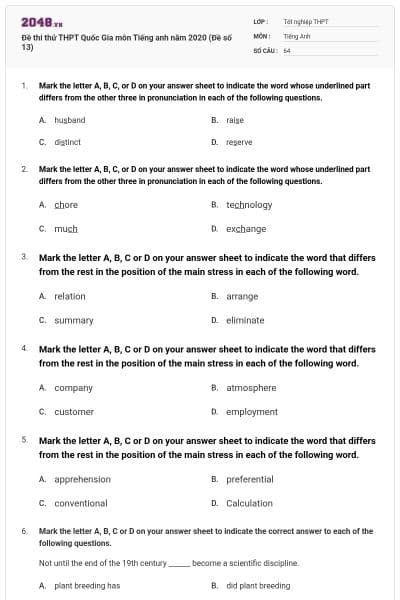
Mark the letter A, B, C, or D on your answer sheet to indicate the word whose underlined part differs from the other three in pronunciation in each of the following questions.
husband
raise
distinct
reserve
Đáp án là C.
S ở đây được phát âm là /s/, trong các từ còn lại là /z/
Mark the letter A, B, C, or D on your answer sheet to indicate the word whose underlined part differs from the other three in pronunciation in each of the following questions.
chore
technology
much
exchange
Đáp án là B.
Ch được phát âm là /k/, trong các từ còn lại là /ʧ/
Mark the letter A, B, C or D on your answer sheet to indicate the word that differs from the rest in the position of the main stress in each of the following word.
relation
arrange
summary
eliminate
Đáp án là C.
Trọng âm rơi vào âm thứ 1, các từ còn lại rơi vào âm thứ 2
Mark the letter A, B, C or D on your answer sheet to indicate the word that differs from the rest in the position of the main stress in each of the following word.
company
atmosphere
customer
employment
Đáp án là D.
Trọng âm rơi vào âm thứ 2, các từ còn lại rơi vào âm thứ 1
Mark the letter A, B, C or D on your answer sheet to indicate the word that differs from the rest in the position of the main stress in each of the following word.
apprehension
preferential
conventional
Calculation
Đáp án là C.
Trọng âm rơi vào âm thứ 2, các từ còn lại rơi vào âm thứ 3
Mark the letter A, B, C or D on your answer sheet to indicate the correct answer to each of the following questions.
Not until the end of the 19th century ______ become a scientific discipline.
plant breeding has
did plant breeding
plant breeding had
has plant breeding
Đáp án: B
Giải thích:
Kiến thức: Đảo ngữ
Not until + thời gian trong quá khứ + did + S + V [mãi cho đến khi...thì...]
Dịch: Mãi cho đến cuối thế kỷ 19 thì trông cây đã trở thành một quy tắc khoa học.
Mark the letter A, B, C or D on your answer sheet to indicate the correct answer to each of the following questions.
When friends insist on ______ expensive gifts, it makes most people uncomfortable
them to accept
they accepting
their accepting
they accept
Đáp án là C
Sử dụng cấu trúc: to insist on + V-ing/ N
-> their accepting: sự chấp nhận của họ
Mark the letter A, B, C or D on your answer sheet to indicate the correct answer to each of the following questions.
I walked away as calmly as I could. __________, they would have thought I was a thief.
In case
If so
Or else
Owing to
Đáp án là C.
Dựa vào nghĩa ta chọn đáp án đúng: Or else: không thì
If so: nếu vậy thì; In case: trong trường hợp; owing to: theo như
Mark the letter A, B, C or D on your answer sheet to indicate the correct answer to each of the following questions.
By the time Brown’s daughter graduates, __________ retired.
he
he has
he’ll being
he’ll have
Đáp án: D
Giải thích:
Kiến thức: Thì của động từ
By the time + hiện tại đơn, tương lai hoàn thành.
Chọn D.
Dịch: Khi con gái của Brown tốt nghiệp thì ông đã nghỉ hưu rồi.
Mark the letter A, B, C or D on your answer sheet to indicate the correct answer to each of the following questions.
__________the storm, the ship couldn't reach its destination on time.
Because of
In case of
In spite of
But for
Đáp án: A
Giải thích:
because of + N/V-ing: vì
in case of + N: trong trường hợp
in spite of + N/V-ing: mặc dù, mặc cho
but for + N: nếu không có
Dựa vào nghĩa câu, chọn A.
Dịch: Vì cơn bão nên con tàu không thể đến đích đúng giờ.
Mark the letter A, B, C or D on your answer sheet to indicate the correct answer to each of the following questions.
Everyone can join our club, ______ age and sex
not mention
in case of
in place of
regardless of
Đáp án là D.
Regardless of st: bất kể -> Ai cũng có thể tham gia vào câu lạc bộ, bất kể tuổi tác hay giới tính
Mark the letter A, B, C or D on your answer sheet to indicate the correct answer to each of the following questions.
The strike was caused by the_________ of two workers.
dismiss
dismissing
dismissed
dismissal
Đáp án là D.
Sau “the” ta cần dùng một danh từ The dismissal of : sự sa thải
Mark the letter A, B, C or D on your answer sheet to indicate the correct answer to each of the following questions.
Look! The yard is wet. It______ last night.
must rain
couldn't have rained
must have rained
should have rained
Đáp án là C.
ở đây ta diễn tả một sự chắc chắn về sự việc tối qua: Nhìn kìa. Sân ướt hết rồi. Hẳn là tối qua đã mưa. Must have done: chắc hẳn đã làm gì
Should have done: đáng nhẽ nên làm gì
Could have done: có thể làm gì
Mark the letter A, B, C or D on your answer sheet to indicate the correct answer to each of the following questions.
James Cook,______ , also discovered the Hawaiian Islands.
by exploring the South Sea he reached Australia.
explored the South Sea and reaching Australia.
who explored the South Sea and reached Australia
explored the South Sea then reached Australia.
Đáp án: C
Giải thích:
Kiến thức: Mệnh đề quan hệ
Dịch: James Cook, ______, cũng đã khám phá ra quần đảo Hawaii.
A. bằng cách khám phá Biển Nam, ông đã đến Úc (sai nghĩa)
B. hai động từ song hành cần chia giống nhau, ở đây “explored” đuôi –ed và “reaching” đuôi –ing, loại.
C. người đã khám phá Biển Nam và đến Úc: đại từ quan hệ “who” thay cho danh từ chỉ người đứng trước, đúng cấu trúc mệnh đề quan hệ.
D. nếu bỏ chủ ngữ của mệnh đề phụ quan hệ, ta rút gọn bằng cách dùng V-ing cho dạng chủ động và VpII cho dạng bị động. Ở đây là dạng chủ động, nên đưa về VpII sai.
Mark the letter A, B, C or D on your answer sheet to indicate the correct answer to each of the following questions.
“I understand you don’t like opera. _____ I go at least once a month.”
On contrast
In contrast
In the contrast
On the contrast
Đáp án là B.
In contrast = On the contrary: mặt khác, đối lập
Mark the letter A, B, C or D on your answer sheet to indicate the correct answer to each of the following questions.
He has always looked _______ his elder brother.
up to
back on
into
up and down
Đáp án là A.
To look up to sb: ngưỡng mộ ai
Look back on: coi thường; look into: nhìn vào; look up and down: nhìn lên nhìn xuống
Mark the letter A, B, C or D on your answer sheet to indicate the correct answer to each of the following questions.
A: Do you mind if we schedule the meeting for 11 o’clock?
B: Well, actually, I ____ earlier
will prefer it
would prefer it to be
am preferring
should prefer it will be
Đáp án là B.
To prefer st to V: thích gì
Mark the letter A, B, C or D on your answer sheet to indicate the correct answer to each of the following questions.
Both of the lifts were out of order.
Either of the lifts was not in right order.
The order of the two lifts was wrong
Neither of the lifts was working.
Neither of the lifts was in order.
Đáp án là C.
Ở đây ta cần chọn câu có nghĩa tương tự.
To be out of order: hỏng, không hoạt động
Both: cả hai >< neither: không cái nào
Mark the letter A, B, C or D on your answer sheet to indicate the correct answer to each of the following questions.
We bought some _______.
German lovely old glasses
German old lovely glasses
lovely old German glasses
old lovely German glasses
Đáp án là C.
Đối với câu có nhiều tính từ đi cùng nhau, ta sắp xếp tính từ theo thứ tự:
OpSACOM (opinion, size, age, color, origin, material)
Theo đó: lovely (opinion) old (age) German (Origin)
Mark the letter A, B, C or D on your answer sheet to indicate the correct answer to each of the following questions.
I should very much like to have gone to that party of theirs, but _______.
I'm not invited
I will not be invited
I have not been invited
I was not invited
Đáp án: D
Giải thích:
Kiến thức: Thì của động từ
“have gone” → bữa tiệc đã xảy ra trong quá khứ, dùng thì quá khứ đơn
Dịch: Tôi rất muốn đến bữa tiệc của họ, nhưng tôi không được mời.
Mark the letter A, B, C or D on your answer sheet to indicate the correct answer to each of the following questions.
I assure you that _______.
I had no intention of offending you.
there was no intention of offending you.
I have no idea of offending you.
there was no point to offend you.
Đáp án là A.
To have intention of + Ving: có ý định làm gì; assure: đảm bảo, chắc chắn
-> Tôi đảm bảo không hề có ý định xúc phạm bạn
Mark the letter A, B, C or D on your answer sheet to indicate the correct answer to each of the following questions.
“You damaged my bicycle, John.” said Margaret.
Margaret forbade John to damage her bicycle.
Margaret persuaded John to damage her bicycle.
John regretted damaging Margaret’s bicycle.
Margaret accused John of damaging her bicycle.
Đáp án là D.
Trong câu trực tiếp, Margaret đổ tội cho John vì làm hỏng xe đạp của cô ấy
To accuse sb of: buộc tội ai đã làm gì
Persuade: thuyết phục; regret: hối hận làm gì
Mark the letter A, B, C or D on your answer sheet to indicate the correct answer to each of the following questions or the correct question to each of the following answers .
Ellen: "_________________?" - Tom : "He's tall and thin with blue eyes."
What does John look like
Who does John look like
How is John doing
What does John like
Đáp án là B.
Ta thấy câu trả lời Tom miêu tả ngoại hình của John -> câu hỏi What does sb look like? (Trông người ấy thế nào)
Mark the letter A, B, C or D on your answer sheet to indicate the correct answer to each of the following questions or the correct question to each of the following answers .
Customer: Can I have a look at that pullover, please? Salesgirl: “__________.”
It's much cheaper
Which one? This one?
Sorry, it is out of stock.
Can I help you?
Đáp án là B.
Dựa vào nghĩa ta chọn đáp án trả lời lại câu hỏi muốn xem đồ -> cái nào nhỉ? Cái này phải không?
Indicate the word or phrase that is closest in meaning to the underlined part in each of the following questions.
In most countries, compulsory military service does not apply to women
superior
mandatory
beneficial
constructive
Đáp án là B.
Compulsory = mandatory: bắt buộc
Superior: mạnh hơn, giỏi hơn; beneficial: có lợi; constructive: có tính xây dựng
Indicate the word or phrase that is closest in meaning to the underlined part in each of the following questions.
The medical community continues to make progress in the fight against cancer.
speed
expect more
do better
treat better
Đáp án: C
Giải thích:
make progress: tiến bộ
speed: tăng tốc
expect more: hy vọng, mong muốn nhiều hơn
do better: làm tốt hơn
treat better: chữa trị tốt hơn
=> make progress = do better (Không chọn D vì ở đây “make progress” mang nghĩa là tiến bộ khái quát, không nói cụ thể là việc chữa trị)
Dịch: Cộng đồng y học tiếp tục đạt được tiến bộ trong cuộc chiến chống lại bệnh ung thư.
Indicate the word or phrase that is closest in meaning to the underlined part in each of the following questions.
This college emphasizes the primacy of teaching over research
give it primary stress
make it most important
make it important at first
make it most importance
Đáp án là B.
To emphasize the primacy: nhấn mạnh vào ưu tiên hang đầu = make it most important: cho đó là quan trọng nhất
Indicate the word or phrase that is OPPOSITE in meaning to the underlined part in each of the following questions.
Ignoring the danger to himself, Freddie dived into the river to save the puppy
Neglecting
Overlooking
Watching
Noticing
Đáp án là D.
Ignore: phớt lờ >< notice: chú ý
Neglect: xao nhãng; overlook: nhìn qua; watch: xem
Indicate the word or phrase that is OPPOSITE in meaning to the underlined part in each of the following questions.
"Don't be such a pessimist. I'm sure you'll soon get over it. Cheer up"
activist
feminist
optimist
Hobbyist
Đáp án là C.
Pessimist: người bi quan >< optimist: người lạc quan
Mark the letter A, B, C or D on your answer sheet to show the underlined part that needs correction.
Foreign students who are doing a decision about which school to attend may not know exactly where the choices are located
are doing
about which
to attend
the choices
Đáp án là A.
are making To make a decision: đưa ra quyết định
Mark the letter A, B, C or D on your answer sheet to show the underlined part that needs correction.
Stuart stopped to write his letter because he had to leave for the hospital
to write
because
leave
for the hospital.
Đáp án là A.
writing
To stop + Ving: dừng lại, không làm gì nữa
To stop + to V: dừng lại để làm gì
Mark the letter A, B, C or D on your answer sheet to show the underlined part that needs correction.
A fully grown male mountain lion may be eight long feet
fully grown
male mountain lion
be
long feet
Đáp án là D.
feet long
Nói về độ cao chiều dài như này ta để tính từ cuối câu
Mark the letter A, B, C or D on your answer sheet to show the underlined part that needs correction.
When I got home, Irene was lying in bed thinking about the wonderful time she has ha
got
was lying
thinking
she has had
Đáp án là D.
had
Ta thấy toàn bộ sự việc đã xảy ra trong quá khứ vì vậy cần chia động từ Quá khứ
Mark the letter A, B, C or D on your answer sheet to show the underlined part that needs correction.
A large amount of popular expressions in our language have interesting backgrounds
A large amount
expressions
have
backgrounds
Đáp án là A.
large number
Ta thấy danh từ đằng sau là expression đếm được -> a number of st: một số lượng
Amount: lượng
Read the following passage and mark the letter A,B,C,D on your answer sheet to indicate the correct word for each of the blanks.
Around 200 million people are employed in tourism worldwide, making it the largest industry in the modern global economy. It is estimated that three-quarters of a billion people (35)___________ on holiday each year, and industry planners expect this figure to double by 2020. Some of the biggest beneficiaries are less developed countries, (36)___________it is often their main source of income. (37)_________________, along with the economic benefits, this mass movement of people has resulted in threats (38)_____________ the environment. People often forget the damage caused by carbon dioxide emissions from aircraft, which (39) ______________ directly to global warming. Deforestation has cleared land in order to build hotels, airport and roads, and this has destroyed wildlife. In some areas, water shortages are now common (40)_____________of the need to fill swimming pools and water golf courses for tourists. By pushing up prices for goods and services, tourism can also be (41)______________ to the people who live in tourist destinations.
In response to these concerns, some travel operators now offer environmental friendly holidays. Many of these aim to reduce the negative (42)____________ of tourism by promoting only hotels that have invested equipment to recycle waste and use energy and water efficiently. Increasingly, tourists are also being reminded to show respect (43)______________ the customs of the people (44) ______________countries they are going to visit, and to support local businesses, such as restaurants and shops, which depend on tourism for their main income.
Điền vào ô số 35
go
travel
move
leave
Đáp án là B.
Dựa vào nghĩa ta chọn đáp án đúng: to travel on holiday: đi du lịch trong kì nghỉ
Read the following passage and mark the letter A,B,C,D on your answer sheet to indicate the correct word for each of the blanks.
Around 200 million people are employed in tourism worldwide, making it the largest industry in the modern global economy. It is estimated that three-quarters of a billion people (35)___________ on holiday each year, and industry planners expect this figure to double by 2020. Some of the biggest beneficiaries are less developed countries, (36)___________it is often their main source of income. (37)_________________, along with the economic benefits, this mass movement of people has resulted in threats (38)_____________ the environment. People often forget the damage caused by carbon dioxide emissions from aircraft, which (39) ______________ directly to global warming. Deforestation has cleared land in order to build hotels, airport and roads, and this has destroyed wildlife. In some areas, water shortages are now common (40)_____________of the need to fill swimming pools and water golf courses for tourists. By pushing up prices for goods and services, tourism can also be (41)______________ to the people who live in tourist destinations.
In response to these concerns, some travel operators now offer environmental friendly holidays. Many of these aim to reduce the negative (42)____________ of tourism by promoting only hotels that have invested equipment to recycle waste and use energy and water efficiently. Increasingly, tourists are also being reminded to show respect (43)______________ the customs of the people (44) ______________countries they are going to visit, and to support local businesses, such as restaurants and shops, which depend on tourism for their main income.
Điền vào ô số 36
where
whom
which
when
Đáp án là A.
Ta chọn where thay thế cho địa điểm là: countries (các nước)
Read the following passage and mark the letter A,B,C,D on your answer sheet to indicate the correct word for each of the blanks.
Around 200 million people are employed in tourism worldwide, making it the largest industry in the modern global economy. It is estimated that three-quarters of a billion people (35)___________ on holiday each year, and industry planners expect this figure to double by 2020. Some of the biggest beneficiaries are less developed countries, (36)___________it is often their main source of income. (37)_________________, along with the economic benefits, this mass movement of people has resulted in threats (38)_____________ the environment. People often forget the damage caused by carbon dioxide emissions from aircraft, which (39) ______________ directly to global warming. Deforestation has cleared land in order to build hotels, airport and roads, and this has destroyed wildlife. In some areas, water shortages are now common (40)_____________of the need to fill swimming pools and water golf courses for tourists. By pushing up prices for goods and services, tourism can also be (41)______________ to the people who live in tourist destinations.
In response to these concerns, some travel operators now offer environmental friendly holidays. Many of these aim to reduce the negative (42)____________ of tourism by promoting only hotels that have invested equipment to recycle waste and use energy and water efficiently. Increasingly, tourists are also being reminded to show respect (43)______________ the customs of the people (44) ______________countries they are going to visit, and to support local businesses, such as restaurants and shops, which depend on tourism for their main income.
Điền vào ô số 37
Therefore
Although
However
Furthermore
Đáp án là C.
Dựa vào nghĩa ta chọn đáp án đúng.
Ở đây chọn However (tuy nhiên) để chỉ sự ngược lại, đưa ra những nguy hiểm cho việc đi du lịch
Read the following passage and mark the letter A,B,C,D on your answer sheet to indicate the correct word for each of the blanks.
Around 200 million people are employed in tourism worldwide, making it the largest industry in the modern global economy. It is estimated that three-quarters of a billion people (35)___________ on holiday each year, and industry planners expect this figure to double by 2020. Some of the biggest beneficiaries are less developed countries, (36)___________it is often their main source of income. (37)_________________, along with the economic benefits, this mass movement of people has resulted in threats (38)_____________ the environment. People often forget the damage caused by carbon dioxide emissions from aircraft, which (39) ______________ directly to global warming. Deforestation has cleared land in order to build hotels, airport and roads, and this has destroyed wildlife. In some areas, water shortages are now common (40)_____________of the need to fill swimming pools and water golf courses for tourists. By pushing up prices for goods and services, tourism can also be (41)______________ to the people who live in tourist destinations.
In response to these concerns, some travel operators now offer environmental friendly holidays. Many of these aim to reduce the negative (42)____________ of tourism by promoting only hotels that have invested equipment to recycle waste and use energy and water efficiently. Increasingly, tourists are also being reminded to show respect (43)______________ the customs of the people (44) ______________countries they are going to visit, and to support local businesses, such as restaurants and shops, which depend on tourism for their main income.
Điền vào ô số 38
at
on
for
to
Đáp án là D.
Threat to the environment: nguy hiểm cho môi trường
Read the following passage and mark the letter A,B,C,D on your answer sheet to indicate the correct word for each of the blanks.
Around 200 million people are employed in tourism worldwide, making it the largest industry in the modern global economy. It is estimated that three-quarters of a billion people (35)___________ on holiday each year, and industry planners expect this figure to double by 2020. Some of the biggest beneficiaries are less developed countries, (36)___________it is often their main source of income. (37)_________________, along with the economic benefits, this mass movement of people has resulted in threats (38)_____________ the environment. People often forget the damage caused by carbon dioxide emissions from aircraft, which (39) ______________ directly to global warming. Deforestation has cleared land in order to build hotels, airport and roads, and this has destroyed wildlife. In some areas, water shortages are now common (40)_____________of the need to fill swimming pools and water golf courses for tourists. By pushing up prices for goods and services, tourism can also be (41)______________ to the people who live in tourist destinations.
In response to these concerns, some travel operators now offer environmental friendly holidays. Many of these aim to reduce the negative (42)____________ of tourism by promoting only hotels that have invested equipment to recycle waste and use energy and water efficiently. Increasingly, tourists are also being reminded to show respect (43)______________ the customs of the people (44) ______________countries they are going to visit, and to support local businesses, such as restaurants and shops, which depend on tourism for their main income.
Điền vào ô số 39
contribute
result
cause
act
Đáp án là A.
To contribute to: đóng góp vào
Read the following passage and mark the letter A,B,C,D on your answer sheet to indicate the correct word for each of the blanks.
Around 200 million people are employed in tourism worldwide, making it the largest industry in the modern global economy. It is estimated that three-quarters of a billion people (35)___________ on holiday each year, and industry planners expect this figure to double by 2020. Some of the biggest beneficiaries are less developed countries, (36)___________it is often their main source of income. (37)_________________, along with the economic benefits, this mass movement of people has resulted in threats (38)_____________ the environment. People often forget the damage caused by carbon dioxide emissions from aircraft, which (39) ______________ directly to global warming. Deforestation has cleared land in order to build hotels, airport and roads, and this has destroyed wildlife. In some areas, water shortages are now common (40)_____________of the need to fill swimming pools and water golf courses for tourists. By pushing up prices for goods and services, tourism can also be (41)______________ to the people who live in tourist destinations.
In response to these concerns, some travel operators now offer environmental friendly holidays. Many of these aim to reduce the negative (42)____________ of tourism by promoting only hotels that have invested equipment to recycle waste and use energy and water efficiently. Increasingly, tourists are also being reminded to show respect (43)______________ the customs of the people (44) ______________countries they are going to visit, and to support local businesses, such as restaurants and shops, which depend on tourism for their main income.
Điền vào ô số 40
thanks
because
due
since
Đáp án là B.
Because of: bởi vì ( +N/ Noun phrase) Thank to: cám ơn, nhờ có; due to: bởi vì
Read the following passage and mark the letter A,B,C,D on your answer sheet to indicate the correct word for each of the blanks.
Around 200 million people are employed in tourism worldwide, making it the largest industry in the modern global economy. It is estimated that three-quarters of a billion people (35)___________ on holiday each year, and industry planners expect this figure to double by 2020. Some of the biggest beneficiaries are less developed countries, (36)___________it is often their main source of income. (37)_________________, along with the economic benefits, this mass movement of people has resulted in threats (38)_____________ the environment. People often forget the damage caused by carbon dioxide emissions from aircraft, which (39) ______________ directly to global warming. Deforestation has cleared land in order to build hotels, airport and roads, and this has destroyed wildlife. In some areas, water shortages are now common (40)_____________of the need to fill swimming pools and water golf courses for tourists. By pushing up prices for goods and services, tourism can also be (41)______________ to the people who live in tourist destinations.
In response to these concerns, some travel operators now offer environmental friendly holidays. Many of these aim to reduce the negative (42)____________ of tourism by promoting only hotels that have invested equipment to recycle waste and use energy and water efficiently. Increasingly, tourists are also being reminded to show respect (43)______________ the customs of the people (44) ______________countries they are going to visit, and to support local businesses, such as restaurants and shops, which depend on tourism for their main income.
Điền vào ô số 41
harmful
destructive
offensive
dangerous
Đáp án là A.
Be harmful to: có hại với Dangerous: nguy hiểm; offensive: làm phiền; destructive: phá hoại
Read the following passage and mark the letter A,B,C,D on your answer sheet to indicate the correct word for each of the blanks.
Around 200 million people are employed in tourism worldwide, making it the largest industry in the modern global economy. It is estimated that three-quarters of a billion people (35)___________ on holiday each year, and industry planners expect this figure to double by 2020. Some of the biggest beneficiaries are less developed countries, (36)___________it is often their main source of income. (37)_________________, along with the economic benefits, this mass movement of people has resulted in threats (38)_____________ the environment. People often forget the damage caused by carbon dioxide emissions from aircraft, which (39) ______________ directly to global warming. Deforestation has cleared land in order to build hotels, airport and roads, and this has destroyed wildlife. In some areas, water shortages are now common (40)_____________of the need to fill swimming pools and water golf courses for tourists. By pushing up prices for goods and services, tourism can also be (41)______________ to the people who live in tourist destinations.
In response to these concerns, some travel operators now offer environmental friendly holidays. Many of these aim to reduce the negative (42)____________ of tourism by promoting only hotels that have invested equipment to recycle waste and use energy and water efficiently. Increasingly, tourists are also being reminded to show respect (43)______________ the customs of the people (44) ______________countries they are going to visit, and to support local businesses, such as restaurants and shops, which depend on tourism for their main income.
Điền vào ô số 42
reasons
effects
objectives
achievements
Đáp án là B.
Negative effects: tác dụng xấu; hậu quả
Read the following passage and mark the letter A,B,C,D on your answer sheet to indicate the correct word for each of the blanks.
Around 200 million people are employed in tourism worldwide, making it the largest industry in the modern global economy. It is estimated that three-quarters of a billion people (35)___________ on holiday each year, and industry planners expect this figure to double by 2020. Some of the biggest beneficiaries are less developed countries, (36)___________it is often their main source of income. (37)_________________, along with the economic benefits, this mass movement of people has resulted in threats (38)_____________ the environment. People often forget the damage caused by carbon dioxide emissions from aircraft, which (39) ______________ directly to global warming. Deforestation has cleared land in order to build hotels, airport and roads, and this has destroyed wildlife. In some areas, water shortages are now common (40)_____________of the need to fill swimming pools and water golf courses for tourists. By pushing up prices for goods and services, tourism can also be (41)______________ to the people who live in tourist destinations.
In response to these concerns, some travel operators now offer environmental friendly holidays. Many of these aim to reduce the negative (42)____________ of tourism by promoting only hotels that have invested equipment to recycle waste and use energy and water efficiently. Increasingly, tourists are also being reminded to show respect (43)______________ the customs of the people (44) ______________countries they are going to visit, and to support local businesses, such as restaurants and shops, which depend on tourism for their main income.
Điền vào ô số 43
with
to
for
at
Đáp án là C.
To show respect for sb: thể hiện sự tôn trọng đối với ai
Read the following passage and mark the letter A,B,C,D on your answer sheet to indicate the correct word for each of the blanks.
Around 200 million people are employed in tourism worldwide, making it the largest industry in the modern global economy. It is estimated that three-quarters of a billion people (35)___________ on holiday each year, and industry planners expect this figure to double by 2020. Some of the biggest beneficiaries are less developed countries, (36)___________it is often their main source of income. (37)_________________, along with the economic benefits, this mass movement of people has resulted in threats (38)_____________ the environment. People often forget the damage caused by carbon dioxide emissions from aircraft, which (39) ______________ directly to global warming. Deforestation has cleared land in order to build hotels, airport and roads, and this has destroyed wildlife. In some areas, water shortages are now common (40)_____________of the need to fill swimming pools and water golf courses for tourists. By pushing up prices for goods and services, tourism can also be (41)______________ to the people who live in tourist destinations.
In response to these concerns, some travel operators now offer environmental friendly holidays. Many of these aim to reduce the negative (42)____________ of tourism by promoting only hotels that have invested equipment to recycle waste and use energy and water efficiently. Increasingly, tourists are also being reminded to show respect (43)______________ the customs of the people (44) ______________countries they are going to visit, and to support local businesses, such as restaurants and shops, which depend on tourism for their main income.
Điền vào ô số 44
whose
their
that
whom
Đáp án là A.
Ta thấy sau từ cần điền là một danh từ -> chọn mệnh đề quan hệ Whose (của)
Read the following passage and mark the letter A, B, C, or D on your answer sheet to indicate the correct answer to each of the questions.
Basic to any understanding of Canada in the 20 years after the Second World War is the country's impressive population growth. For every three Canadians in 1945, there were over five in 1966. In September 1966, Canada's population passed the 20 million mark. Most of this surging growth came from natural increase. The depression of the 1930s and the war had held back marriages, and the catching-up process began after 1945. The baby boom continued through the decade of the1950s, producing a population increase of nearly fifteen percent in the five years from 1951 to 1956. This rate of increase had been exceeded only once before in Canada's history, in the decade before 1911 when the prairies were being settled. Undoubtedly, the good economic conditions of the 1950s supported a growth in the population, but the expansion also derived from a trend toward earlier marriages and an increase in the average size of families. In 1957 the Canadian birth rate stood at 28 per thousand, one of the highest in the world.
After the peak year of 1957, the birth rate in Canada began to decline. It continued falling until in 1966 it stood at the lowest level in 25 years. Partly this decline reflected the low level of births during the depression and the war, but it was also caused by changes in Canadian society. Young people were staying at school longer; more women were working; young married couples were buying automobiles or houses before starting families; rising living standards were cutting down the size of families.
It appeared that Canada was once more falling in step with the trend toward smaller families that had occurred all through the Western world since the time of the Industrial Revolution. Although the growth in Canada's population had slowed down by 1966 (the increase in the first half of the 1960's was only nine percent), another large population wave was coming over the horizon. It would be composed of the children who were born during the period of the high birth rate prior to 1957.
The phrase "prior to" in the last paragraph is closest in meaning to __________________.
during
behind
before
since
Đáp án là C.
Prior to = before: trước khi
During: trong khi; behind: phía sau; since: từ khi
Read the following passage and mark the letter A, B, C, or D on your answer sheet to indicate the correct answer to each of the questions.
Basic to any understanding of Canada in the 20 years after the Second World War is the country's impressive population growth. For every three Canadians in 1945, there were over five in 1966. In September 1966, Canada's population passed the 20 million mark. Most of this surging growth came from natural increase. The depression of the 1930s and the war had held back marriages, and the catching-up process began after 1945. The baby boom continued through the decade of the1950s, producing a population increase of nearly fifteen percent in the five years from 1951 to 1956. This rate of increase had been exceeded only once before in Canada's history, in the decade before 1911 when the prairies were being settled. Undoubtedly, the good economic conditions of the 1950s supported a growth in the population, but the expansion also derived from a trend toward earlier marriages and an increase in the average size of families. In 1957 the Canadian birth rate stood at 28 per thousand, one of the highest in the world.
After the peak year of 1957, the birth rate in Canada began to decline. It continued falling until in 1966 it stood at the lowest level in 25 years. Partly this decline reflected the low level of births during the depression and the war, but it was also caused by changes in Canadian society. Young people were staying at school longer; more women were working; young married couples were buying automobiles or houses before starting families; rising living standards were cutting down the size of families.
It appeared that Canada was once more falling in step with the trend toward smaller families that had occurred all through the Western world since the time of the Industrial Revolution. Although the growth in Canada's population had slowed down by 1966 (the increase in the first half of the 1960's was only nine percent), another large population wave was coming over the horizon. It would be composed of the children who were born during the period of the high birth rate prior to 1957.
When was the birth rate in Canada at its lowest postwar level?
1957
1966
1951
1956
Đáp án là B.
Câu hỏi đề cập đến birth rate (tỉ lệ sinh đẻ) ở Canada, như vậy ta cần tìm đến đoạn văn có nhắc tới đó. Theo đó, 2 câu đầu đoạn 2 cho ta thấy đáp án khi nhắc tới tỉ lệ sinh đẻ đạt mức thấp nhất vào năm 1966 : It continued falling until in 1966 it stood at the lowest level in 25 years.
Read the following passage and mark the letter A, B, C, or D on your answer sheet to indicate the correct answer to each of the questions.
Basic to any understanding of Canada in the 20 years after the Second World War is the country's impressive population growth. For every three Canadians in 1945, there were over five in 1966. In September 1966, Canada's population passed the 20 million mark. Most of this surging growth came from natural increase. The depression of the 1930s and the war had held back marriages, and the catching-up process began after 1945. The baby boom continued through the decade of the1950s, producing a population increase of nearly fifteen percent in the five years from 1951 to 1956. This rate of increase had been exceeded only once before in Canada's history, in the decade before 1911 when the prairies were being settled. Undoubtedly, the good economic conditions of the 1950s supported a growth in the population, but the expansion also derived from a trend toward earlier marriages and an increase in the average size of families. In 1957 the Canadian birth rate stood at 28 per thousand, one of the highest in the world.
After the peak year of 1957, the birth rate in Canada began to decline. It continued falling until in 1966 it stood at the lowest level in 25 years. Partly this decline reflected the low level of births during the depression and the war, but it was also caused by changes in Canadian society. Young people were staying at school longer; more women were working; young married couples were buying automobiles or houses before starting families; rising living standards were cutting down the size of families.
It appeared that Canada was once more falling in step with the trend toward smaller families that had occurred all through the Western world since the time of the Industrial Revolution. Although the growth in Canada's population had slowed down by 1966 (the increase in the first half of the 1960's was only nine percent), another large population wave was coming over the horizon. It would be composed of the children who were born during the period of the high birth rate prior to 1957.
It can be inferred from the passage that before the Industrial Revolution __________________.
population statistics were
the population grew steadily
families were larger
economic conditions were bad
Đáp án là C.
Before the industrial revolution: trước cuộc cách mạng công nghiệp hóa
Ta có thể thấy đáp án nằm ở câu đầu đoạn cuối: It appeared that Canada was once more falling in step with the trend toward smaller families that had occurred all through the Western world since the time of the Industrial Revolution : Nó cho thấy rằng Canada một lần nữa bước vào xu hướng có gia đình nhỏ sau lần xảy ra trên toàn phía tây thế giới từ khi diễn ra cuộc cách mạng công nghiệp hóa -> như vậy trước khi có cuộc cách mạng này, ở Canada có các gia đình lớn hơn
Read the following passage and mark the letter A, B, C, or D on your answer sheet to indicate the correct answer to each of the questions.
Basic to any understanding of Canada in the 20 years after the Second World War is the country's impressive population growth. For every three Canadians in 1945, there were over five in 1966. In September 1966, Canada's population passed the 20 million mark. Most of this surging growth came from natural increase. The depression of the 1930s and the war had held back marriages, and the catching-up process began after 1945. The baby boom continued through the decade of the1950s, producing a population increase of nearly fifteen percent in the five years from 1951 to 1956. This rate of increase had been exceeded only once before in Canada's history, in the decade before 1911 when the prairies were being settled. Undoubtedly, the good economic conditions of the 1950s supported a growth in the population, but the expansion also derived from a trend toward earlier marriages and an increase in the average size of families. In 1957 the Canadian birth rate stood at 28 per thousand, one of the highest in the world.
After the peak year of 1957, the birth rate in Canada began to decline. It continued falling until in 1966 it stood at the lowest level in 25 years. Partly this decline reflected the low level of births during the depression and the war, but it was also caused by changes in Canadian society. Young people were staying at school longer; more women were working; young married couples were buying automobiles or houses before starting families; rising living standards were cutting down the size of families.
It appeared that Canada was once more falling in step with the trend toward smaller families that had occurred all through the Western world since the time of the Industrial Revolution. Although the growth in Canada's population had slowed down by 1966 (the increase in the first half of the 1960's was only nine percent), another large population wave was coming over the horizon. It would be composed of the children who were born during the period of the high birth rate prior to 1957.
According to the passage, when did Canada's baby boom begin?
During the depression of the 1930s
After 1945
In 1966
In the decade after 1911
Đáp án là B.
Ta thấy đáp án xuất hiện ở dòng số 5 của bài, đoạn 1. Khi bắt đầu năm 1945 thì baby boom xảy ra: the catching-up process began after 1945. The baby boom continued through the decade of the1950s
Read the following passage and mark the letter A, B, C, or D on your answer sheet to indicate the correct answer to each of the questions.
Basic to any understanding of Canada in the 20 years after the Second World War is the country's impressive population growth. For every three Canadians in 1945, there were over five in 1966. In September 1966, Canada's population passed the 20 million mark. Most of this surging growth came from natural increase. The depression of the 1930s and the war had held back marriages, and the catching-up process began after 1945. The baby boom continued through the decade of the1950s, producing a population increase of nearly fifteen percent in the five years from 1951 to 1956. This rate of increase had been exceeded only once before in Canada's history, in the decade before 1911 when the prairies were being settled. Undoubtedly, the good economic conditions of the 1950s supported a growth in the population, but the expansion also derived from a trend toward earlier marriages and an increase in the average size of families. In 1957 the Canadian birth rate stood at 28 per thousand, one of the highest in the world.
After the peak year of 1957, the birth rate in Canada began to decline. It continued falling until in 1966 it stood at the lowest level in 25 years. Partly this decline reflected the low level of births during the depression and the war, but it was also caused by changes in Canadian society. Young people were staying at school longer; more women were working; young married couples were buying automobiles or houses before starting families; rising living standards were cutting down the size of families.
It appeared that Canada was once more falling in step with the trend toward smaller families that had occurred all through the Western world since the time of the Industrial Revolution. Although the growth in Canada's population had slowed down by 1966 (the increase in the first half of the 1960's was only nine percent), another large population wave was coming over the horizon. It would be composed of the children who were born during the period of the high birth rate prior to 1957.
What does the passage mainly discuss?
Educational changes in Canadian society
Canada during the Second World War
Population trends in postwar Canada
Standards of living in Canada
Đáp án là C.
Ta có thể dễ dàng nhận ra toàn bộ bài văn nói về dân số ở Canada chứ không phải A: educational change: sự thay đổi giáo dục; B: Canada trong suốt thế chiến 2; D: mức sống ở Canada
Read the following passage and mark the letter A, B, C, or D on your answer sheet to indicate the correct answer to each of the questions.
Basic to any understanding of Canada in the 20 years after the Second World War is the country's impressive population growth. For every three Canadians in 1945, there were over five in 1966. In September 1966, Canada's population passed the 20 million mark. Most of this surging growth came from natural increase. The depression of the 1930s and the war had held back marriages, and the catching-up process began after 1945. The baby boom continued through the decade of the1950s, producing a population increase of nearly fifteen percent in the five years from 1951 to 1956. This rate of increase had been exceeded only once before in Canada's history, in the decade before 1911 when the prairies were being settled. Undoubtedly, the good economic conditions of the 1950s supported a growth in the population, but the expansion also derived from a trend toward earlier marriages and an increase in the average size of families. In 1957 the Canadian birth rate stood at 28 per thousand, one of the highest in the world.
After the peak year of 1957, the birth rate in Canada began to decline. It continued falling until in 1966 it stood at the lowest level in 25 years. Partly this decline reflected the low level of births during the depression and the war, but it was also caused by changes in Canadian society. Young people were staying at school longer; more women were working; young married couples were buying automobiles or houses before starting families; rising living standards were cutting down the size of families.
It appeared that Canada was once more falling in step with the trend toward smaller families that had occurred all through the Western world since the time of the Industrial Revolution. Although the growth in Canada's population had slowed down by 1966 (the increase in the first half of the 1960's was only nine percent), another large population wave was coming over the horizon. It would be composed of the children who were born during the period of the high birth rate prior to 1957.
The author suggests that in Canada during the1950s __________________.
the urban population decreased rapidly
economic conditions were poor
fewer people married
the birth rate was very high
Đáp án là D.
Ta có thể thấy đáp án ở dòng số 8, đoạn 1 của bài khi tác giả nói đến những năm 1950s: . Undoubtedly, the good economic conditions of the 1950s supported a growth in the population: không nghi ngờ gì nữa, điều kiện kinh tế khá khẩm những năm 50 đã ủng hộ một sự tăng lên trong dân số -> như vậy tỉ lệ sinh đẻ là cao trong những năm này
Read the following passage and mark the letter A, B, C, or D on your answer sheet to indicate the correct answer to each of the questions.
Basic to any understanding of Canada in the 20 years after the Second World War is the country's impressive population growth. For every three Canadians in 1945, there were over five in 1966. In September 1966, Canada's population passed the 20 million mark. Most of this surging growth came from natural increase. The depression of the 1930s and the war had held back marriages, and the catching-up process began after 1945. The baby boom continued through the decade of the1950s, producing a population increase of nearly fifteen percent in the five years from 1951 to 1956. This rate of increase had been exceeded only once before in Canada's history, in the decade before 1911 when the prairies were being settled. Undoubtedly, the good economic conditions of the 1950s supported a growth in the population, but the expansion also derived from a trend toward earlier marriages and an increase in the average size of families. In 1957 the Canadian birth rate stood at 28 per thousand, one of the highest in the world.
After the peak year of 1957, the birth rate in Canada began to decline. It continued falling until in 1966 it stood at the lowest level in 25 years. Partly this decline reflected the low level of births during the depression and the war, but it was also caused by changes in Canadian society. Young people were staying at school longer; more women were working; young married couples were buying automobiles or houses before starting families; rising living standards were cutting down the size of families.
It appeared that Canada was once more falling in step with the trend toward smaller families that had occurred all through the Western world since the time of the Industrial Revolution. Although the growth in Canada's population had slowed down by 1966 (the increase in the first half of the 1960's was only nine percent), another large population wave was coming over the horizon. It would be composed of the children who were born during the period of the high birth rate prior to 1957.
The word "surging" is closest in meaning to __________________.
surprising
new
accelerating
extra
Đáp án là C.
Surging = accelerating: dâng tràn, tăng nhanh
Read the following passage and mark the letter A, B, C, or D on your answer sheet to indicate the correct answer to each of the questions.
Basic to any understanding of Canada in the 20 years after the Second World War is the country's impressive population growth. For every three Canadians in 1945, there were over five in 1966. In September 1966, Canada's population passed the 20 million mark. Most of this surging growth came from natural increase. The depression of the 1930s and the war had held back marriages, and the catching-up process began after 1945. The baby boom continued through the decade of the1950s, producing a population increase of nearly fifteen percent in the five years from 1951 to 1956. This rate of increase had been exceeded only once before in Canada's history, in the decade before 1911 when the prairies were being settled. Undoubtedly, the good economic conditions of the 1950s supported a growth in the population, but the expansion also derived from a trend toward earlier marriages and an increase in the average size of families. In 1957 the Canadian birth rate stood at 28 per thousand, one of the highest in the world.
After the peak year of 1957, the birth rate in Canada began to decline. It continued falling until in 1966 it stood at the lowest level in 25 years. Partly this decline reflected the low level of births during the depression and the war, but it was also caused by changes in Canadian society. Young people were staying at school longer; more women were working; young married couples were buying automobiles or houses before starting families; rising living standards were cutting down the size of families.
It appeared that Canada was once more falling in step with the trend toward smaller families that had occurred all through the Western world since the time of the Industrial Revolution. Although the growth in Canada's population had slowed down by 1966 (the increase in the first half of the 1960's was only nine percent), another large population wave was coming over the horizon. It would be composed of the children who were born during the period of the high birth rate prior to 1957.
The word "five" in the first paragraph refers to__________________.
decades
marriages
years
Canadians
Đáp án là D.
Đối với dạng bài thay thế này, ta tìm danh từ hoặc chủ để được nhắc tới trong vế trước của câu. Và có thể thấy Canadian (người Canada) chính là đáp án
Read the following passage and mark the letter A, B, C, or D on your answer sheet to indicate the correct answer to each of the questions.
Basic to any understanding of Canada in the 20 years after the Second World War is the country's impressive population growth. For every three Canadians in 1945, there were over five in 1966. In September 1966, Canada's population passed the 20 million mark. Most of this surging growth came from natural increase. The depression of the 1930s and the war had held back marriages, and the catching-up process began after 1945. The baby boom continued through the decade of the1950s, producing a population increase of nearly fifteen percent in the five years from 1951 to 1956. This rate of increase had been exceeded only once before in Canada's history, in the decade before 1911 when the prairies were being settled. Undoubtedly, the good economic conditions of the 1950s supported a growth in the population, but the expansion also derived from a trend toward earlier marriages and an increase in the average size of families. In 1957 the Canadian birth rate stood at 28 per thousand, one of the highest in the world.
After the peak year of 1957, the birth rate in Canada began to decline. It continued falling until in 1966 it stood at the lowest level in 25 years. Partly this decline reflected the low level of births during the depression and the war, but it was also caused by changes in Canadian society. Young people were staying at school longer; more women were working; young married couples were buying automobiles or houses before starting families; rising living standards were cutting down the size of families.
It appeared that Canada was once more falling in step with the trend toward smaller families that had occurred all through the Western world since the time of the Industrial Revolution. Although the growth in Canada's population had slowed down by 1966 (the increase in the first half of the 1960's was only nine percent), another large population wave was coming over the horizon. It would be composed of the children who were born during the period of the high birth rate prior to 1957.
The word "trend" in the first paragraph is closest in meaning to __________________.
aim
growth
tendency
directive
Đáp án là C.
Trend = tendency: xu hướng Aim: mục đích; growth: sự tăng lên; directive: chỉ huy, hướng dẫn
Read the following passage and mark the letter A, B, C, or D on your answer sheet to indicate the correct answer to each of the questions.
Basic to any understanding of Canada in the 20 years after the Second World War is the country's impressive population growth. For every three Canadians in 1945, there were over five in 1966. In September 1966, Canada's population passed the 20 million mark. Most of this surging growth came from natural increase. The depression of the 1930s and the war had held back marriages, and the catching-up process began after 1945. The baby boom continued through the decade of the1950s, producing a population increase of nearly fifteen percent in the five years from 1951 to 1956. This rate of increase had been exceeded only once before in Canada's history, in the decade before 1911 when the prairies were being settled. Undoubtedly, the good economic conditions of the 1950s supported a growth in the population, but the expansion also derived from a trend toward earlier marriages and an increase in the average size of families. In 1957 the Canadian birth rate stood at 28 per thousand, one of the highest in the world.
After the peak year of 1957, the birth rate in Canada began to decline. It continued falling until in 1966 it stood at the lowest level in 25 years. Partly this decline reflected the low level of births during the depression and the war, but it was also caused by changes in Canadian society. Young people were staying at school longer; more women were working; young married couples were buying automobiles or houses before starting families; rising living standards were cutting down the size of families.
It appeared that Canada was once more falling in step with the trend toward smaller families that had occurred all through the Western world since the time of the Industrial Revolution. Although the growth in Canada's population had slowed down by 1966 (the increase in the first half of the 1960's was only nine percent), another large population wave was coming over the horizon. It would be composed of the children who were born during the period of the high birth rate prior to 1957.
The author mentions all of the following as causes of declines in population growth after 1957 EXCEPT ___.
couples buying houses
people being better educated
people getting married earlier
better standards of living
Đáp án là C.
Đối với dạng bài tìm đáp án loại trừ này, ta tìm 3 trong 4 đáp án xuất hiện trong bài, đáp án còn lại chính là lựa chọn đúng. Theo đó, nguyên nhân dẫn đến sự giảm trong dân số sau năm 1957: A (các cặp đôi mua nhà), B (người dân được giáo dục tốt hơn); D (mức sống cải thiện) đều được nhắc tới trong 3 dòng cuối đoạn 2 của bài
Read the following passage and mark the letter A, B, C, or D on your answer sheet to indicate the correct answer to each of the questions from 55 to 64.
May 7, 1840, was the birthday of one of the most famous Russian composers of the nineteenth century Peter Illich Tchaikovsky. The son of a mining inspector, Tchaikovsky studied music as a child and later studied composition at the St. Petersburg Conservatory. His greatest period of productivity occurred between 1876 and 1890, during which time he enjoyed the patronage of Madame von Meck, a woman he never met, who gave him a living stipend of about $1,000.00 a year. Madame von Meck later terminated her friendship with Tchaikovsky, as well as his living allowance, when she, herself, was facing financial difficulties. It was during the time of Madame von Meck's patronage, however, that Tchaikovsky created the music for which he is most famous, including the music for the ballets of Swan Lake and The Sleeping Beauty.
Tchaikovsky's music, well known for its rich melodic and sometimes melancholy passages, was one of the first that brought serious dramatic music to dance. Before this, little attention had been given to the music behind the dance. Tchaikovsky died on November 6, 1893, ostensibly of cholera, though there are now some scholars who argue that he committed suicide.
With what topic is the passage primarily concerned?
the life and music of Tchaikovsky
development of Tchaikovsky's music for ballets
Tchaikovsky's relationship with Madame Von Meck
the cause of Tchaikovsky's death
Đáp án là A.
Ta tìm ý chính trong mỗi đoạn của bài. Theo đó, trong câu 1 đoạn 1 nhắc tới tiểu sử, lịch sử cuộc đời Tchaikovsky và câu 1 đoạn 2 nhắc tới sự nghiệp âm nhạc của ông -> A: cuộc đời và âm nhạc của Tchaikovsky.
Read the following passage and mark the letter A, B, C, or D on your answer sheet to indicate the correct answer to each of the questions from 55 to 64.
May 7, 1840, was the birthday of one of the most famous Russian composers of the nineteenth century Peter Illich Tchaikovsky. The son of a mining inspector, Tchaikovsky studied music as a child and later studied composition at the St. Petersburg Conservatory. His greatest period of productivity occurred between 1876 and 1890, during which time he enjoyed the patronage of Madame von Meck, a woman he never met, who gave him a living stipend of about $1,000.00 a year. Madame von Meck later terminated her friendship with Tchaikovsky, as well as his living allowance, when she, herself, was facing financial difficulties. It was during the time of Madame von Meck's patronage, however, that Tchaikovsky created the music for which he is most famous, including the music for the ballets of Swan Lake and The Sleeping Beauty.
Tchaikovsky's music, well known for its rich melodic and sometimes melancholy passages, was one of the first that brought serious dramatic music to dance. Before this, little attention had been given to the music behind the dance. Tchaikovsky died on November 6, 1893, ostensibly of cholera, though there are now some scholars who argue that he committed suicide.
Which of the following is closest in meaning to the word "productivity"?
fertility
affinity
creativity
maturity
Đáp án là C.
Productivity = creativity: sự tạo ra
Fertility: khả năng sinh sản; affinity: sự đồng cảm, sự hấp dẫn; maturity: tính trưởng thành
Read the following passage and mark the letter A, B, C, or D on your answer sheet to indicate the correct answer to each of the questions from 55 to 64.
May 7, 1840, was the birthday of one of the most famous Russian composers of the nineteenth century Peter Illich Tchaikovsky. The son of a mining inspector, Tchaikovsky studied music as a child and later studied composition at the St. Petersburg Conservatory. His greatest period of productivity occurred between 1876 and 1890, during which time he enjoyed the patronage of Madame von Meck, a woman he never met, who gave him a living stipend of about $1,000.00 a year. Madame von Meck later terminated her friendship with Tchaikovsky, as well as his living allowance, when she, herself, was facing financial difficulties. It was during the time of Madame von Meck's patronage, however, that Tchaikovsky created the music for which he is most famous, including the music for the ballets of Swan Lake and The Sleeping Beauty.
Tchaikovsky's music, well known for its rich melodic and sometimes melancholy passages, was one of the first that brought serious dramatic music to dance. Before this, little attention had been given to the music behind the dance. Tchaikovsky died on November 6, 1893, ostensibly of cholera, though there are now some scholars who argue that he committed suicide.
The phrase "enjoyed the patronage of" probably means _________
liked the company of
was mentally attached to
solicited the advice of
was financially dependent upon
Đáp án là D.
The patronage: sự bảo trợ -> D: phụ thuộc tài chính
Read the following passage and mark the letter A, B, C, or D on your answer sheet to indicate the correct answer to each of the questions from 55 to 64.
May 7, 1840, was the birthday of one of the most famous Russian composers of the nineteenth century Peter Illich Tchaikovsky. The son of a mining inspector, Tchaikovsky studied music as a child and later studied composition at the St. Petersburg Conservatory. His greatest period of productivity occurred between 1876 and 1890, during which time he enjoyed the patronage of Madame von Meck, a woman he never met, who gave him a living stipend of about $1,000.00 a year. Madame von Meck later terminated her friendship with Tchaikovsky, as well as his living allowance, when she, herself, was facing financial difficulties. It was during the time of Madame von Meck's patronage, however, that Tchaikovsky created the music for which he is most famous, including the music for the ballets of Swan Lake and The Sleeping Beauty.
Tchaikovsky's music, well known for its rich melodic and sometimes melancholy passages, was one of the first that brought serious dramatic music to dance. Before this, little attention had been given to the music behind the dance. Tchaikovsky died on November 6, 1893, ostensibly of cholera, though there are now some scholars who argue that he committed suicide.
Which of the following could best replace the word "terminated"?
discontinued
resolved
exploited
hated
Đáp án là A.
Terminate = discontinue: chấm dứt, ngừng lại
Read the following passage and mark the letter A, B, C, or D on your answer sheet to indicate the correct answer to each of the questions from 55 to 64.
May 7, 1840, was the birthday of one of the most famous Russian composers of the nineteenth century Peter Illich Tchaikovsky. The son of a mining inspector, Tchaikovsky studied music as a child and later studied composition at the St. Petersburg Conservatory. His greatest period of productivity occurred between 1876 and 1890, during which time he enjoyed the patronage of Madame von Meck, a woman he never met, who gave him a living stipend of about $1,000.00 a year. Madame von Meck later terminated her friendship with Tchaikovsky, as well as his living allowance, when she, herself, was facing financial difficulties. It was during the time of Madame von Meck's patronage, however, that Tchaikovsky created the music for which he is most famous, including the music for the ballets of Swan Lake and The Sleeping Beauty.
Tchaikovsky's music, well known for its rich melodic and sometimes melancholy passages, was one of the first that brought serious dramatic music to dance. Before this, little attention had been given to the music behind the dance. Tchaikovsky died on November 6, 1893, ostensibly of cholera, though there are now some scholars who argue that he committed suicide.
According to the passage, all of the following describe Madame von Meck EXCEPT _________
She had economic troubles.
She was generous.
She enjoyed Tchaikovsky's music
She was never introduced to Tchaikovsky.
Đáp án là C.
Đối với dạng bài tìm đáp án loại trừ này, ta tìm 3 trong 4 đáp án xuất hiện trong bài, đáp án còn lại chính là lựa chọn đúng; Theo đó, nói về Madame von Meck: A (bà có vấn đề về kinh tế) xuất hiện cuối dòng 6 đầu dòng 7 B (bà hào phóng) xuất hiện trong dòng 5 D (bà chưa bao giờ được giới thiệu cho Tchaikovsky) xuất hiện đầu dòng 5
Read the following passage and mark the letter A, B, C, or D on your answer sheet to indicate the correct answer to each of the questions from 55 to 64.
May 7, 1840, was the birthday of one of the most famous Russian composers of the nineteenth century Peter Illich Tchaikovsky. The son of a mining inspector, Tchaikovsky studied music as a child and later studied composition at the St. Petersburg Conservatory. His greatest period of productivity occurred between 1876 and 1890, during which time he enjoyed the patronage of Madame von Meck, a woman he never met, who gave him a living stipend of about $1,000.00 a year. Madame von Meck later terminated her friendship with Tchaikovsky, as well as his living allowance, when she, herself, was facing financial difficulties. It was during the time of Madame von Meck's patronage, however, that Tchaikovsky created the music for which he is most famous, including the music for the ballets of Swan Lake and The Sleeping Beauty.
Tchaikovsky's music, well known for its rich melodic and sometimes melancholy passages, was one of the first that brought serious dramatic music to dance. Before this, little attention had been given to the music behind the dance. Tchaikovsky died on November 6, 1893, ostensibly of cholera, though there are now some scholars who argue that he committed suicide.
It is known that before Tchaikovsky, _______ .
the music behind the dance had been taken seriously
serous dramatic music had been already brought to dance
the music behind the dance had been given very little attention.
music had been famous for its rich melodic passages
Đáp án là C.
Ta có thể thấy đáp án nằm ở đoạn 2 trong câu: Before this, little attention had been given to the music behind the dance: trước đó (âm nhạc của Tchaikovsky), rất ít người chú ý tới âm nhạc phía sau bài nhảy
Read the following passage and mark the letter A, B, C, or D on your answer sheet to indicate the correct answer to each of the questions from 55 to 64.
May 7, 1840, was the birthday of one of the most famous Russian composers of the nineteenth century Peter Illich Tchaikovsky. The son of a mining inspector, Tchaikovsky studied music as a child and later studied composition at the St. Petersburg Conservatory. His greatest period of productivity occurred between 1876 and 1890, during which time he enjoyed the patronage of Madame von Meck, a woman he never met, who gave him a living stipend of about $1,000.00 a year. Madame von Meck later terminated her friendship with Tchaikovsky, as well as his living allowance, when she, herself, was facing financial difficulties. It was during the time of Madame von Meck's patronage, however, that Tchaikovsky created the music for which he is most famous, including the music for the ballets of Swan Lake and The Sleeping Beauty.
Tchaikovsky's music, well known for its rich melodic and sometimes melancholy passages, was one of the first that brought serious dramatic music to dance. Before this, little attention had been given to the music behind the dance. Tchaikovsky died on November 6, 1893, ostensibly of cholera, though there are now some scholars who argue that he committed suicide.
According to the passage, for what is Tchaikovsky's music most well known?
its repetitive and monotonous tones
the ballet-like quality of the music
its lively, capricious melodies
the richness and melodic drama of the music
Đáp án là D.
Ta có thể thấy đáp án nằm ở đầu đoạn 2 của bài: Âm nhạc của Tchaikovsky nổi tiếng bởi giàu giai điệu 62. C Ta thấy, cuối đoạn 1 có nhắc tới việc Tchaikovsky dựng nhạc cho điệu bale của 2 vở Swan Lake (hồ thiên nga) và Sleeping Beauty (công chúa ngủ trong rừng) -> opera: nhạc kịch
Read the following passage and mark the letter A, B, C, or D on your answer sheet to indicate the correct answer to each of the questions from 55 to 64.
May 7, 1840, was the birthday of one of the most famous Russian composers of the nineteenth century Peter Illich Tchaikovsky. The son of a mining inspector, Tchaikovsky studied music as a child and later studied composition at the St. Petersburg Conservatory. His greatest period of productivity occurred between 1876 and 1890, during which time he enjoyed the patronage of Madame von Meck, a woman he never met, who gave him a living stipend of about $1,000.00 a year. Madame von Meck later terminated her friendship with Tchaikovsky, as well as his living allowance, when she, herself, was facing financial difficulties. It was during the time of Madame von Meck's patronage, however, that Tchaikovsky created the music for which he is most famous, including the music for the ballets of Swan Lake and The Sleeping Beauty.
Tchaikovsky's music, well known for its rich melodic and sometimes melancholy passages, was one of the first that brought serious dramatic music to dance. Before this, little attention had been given to the music behind the dance. Tchaikovsky died on November 6, 1893, ostensibly of cholera, though there are now some scholars who argue that he committed suicide.
According to the passage, "Swan Lake" and "The Sleeping Beauty" are _________
dances
songs
operas
plays
Đáp án là D.
Ta có thể thấy đáp án nằm ở đầu đoạn 2 của bài: Âm nhạc của Tchaikovsky nổi tiếng bởi giàu giai điệu 62. C Ta thấy, cuối đoạn 1 có nhắc tới việc Tchaikovsky dựng nhạc cho điệu bale của 2 vở Swan Lake (hồ thiên nga) và Sleeping Beauty (công chúa ngủ trong rừng) -> opera: nhạc kịch
Read the following passage and mark the letter A, B, C, or D on your answer sheet to indicate the correct answer to each of the questions from 55 to 64.
May 7, 1840, was the birthday of one of the most famous Russian composers of the nineteenth century Peter Illich Tchaikovsky. The son of a mining inspector, Tchaikovsky studied music as a child and later studied composition at the St. Petersburg Conservatory. His greatest period of productivity occurred between 1876 and 1890, during which time he enjoyed the patronage of Madame von Meck, a woman he never met, who gave him a living stipend of about $1,000.00 a year. Madame von Meck later terminated her friendship with Tchaikovsky, as well as his living allowance, when she, herself, was facing financial difficulties. It was during the time of Madame von Meck's patronage, however, that Tchaikovsky created the music for which he is most famous, including the music for the ballets of Swan Lake and The Sleeping Beauty.
Tchaikovsky's music, well known for its rich melodic and sometimes melancholy passages, was one of the first that brought serious dramatic music to dance. Before this, little attention had been given to the music behind the dance. Tchaikovsky died on November 6, 1893, ostensibly of cholera, though there are now some scholars who argue that he committed suicide.
Which of the following is closest in meaning to the word "behind"?
supporting
in back of
going beyond
concealing
Đáp án là A.
Behind: ngay phía sau ~ support: cổ vũ
Read the following passage and mark the letter A, B, C, or D on your answer sheet to indicate the correct answer to each of the questions from 55 to 64.
May 7, 1840, was the birthday of one of the most famous Russian composers of the nineteenth century Peter Illich Tchaikovsky. The son of a mining inspector, Tchaikovsky studied music as a child and later studied composition at the St. Petersburg Conservatory. His greatest period of productivity occurred between 1876 and 1890, during which time he enjoyed the patronage of Madame von Meck, a woman he never met, who gave him a living stipend of about $1,000.00 a year. Madame von Meck later terminated her friendship with Tchaikovsky, as well as his living allowance, when she, herself, was facing financial difficulties. It was during the time of Madame von Meck's patronage, however, that Tchaikovsky created the music for which he is most famous, including the music for the ballets of Swan Lake and The Sleeping Beauty.
Tchaikovsky's music, well known for its rich melodic and sometimes melancholy passages, was one of the first that brought serious dramatic music to dance. Before this, little attention had been given to the music behind the dance. Tchaikovsky died on November 6, 1893, ostensibly of cholera, though there are now some scholars who argue that he committed suicide.
Which of the following is NOT mentioned in the passage?
Tchaikovsky's influence on ballet music
Tchaikovsky's unhappiness leading to suicide
the patronage of Madame von Meck
Tchaikovsky's productivity in composing
Đáp án là B.
Đối với dạng bài tìm đáp án loại trừ này, ta tìm 3 trong 4 đáp án xuất hiện trong bài, đáp án còn lại là lựa chọn đúng. Theo đó, A (Tchaikovsky có ảnh hưởng đên snhạc balê) xuất hiện trong câu cuối đoạn 1 C (sự bảo trợ của Madame) được nhắc tới rõ ràng trong dòng 4 đoạn 1 D (hiệu quả trong việc biên soạn của Tchaikovsky) xuất hiện trong câu cuối đoạn 1 khi ông dựng nhạc cho hai vở nhạc kịch