Đề thi thử THPT Quốc Gia môn Tiếng anh năm 2020 (Đề số 12)
64 câu hỏi
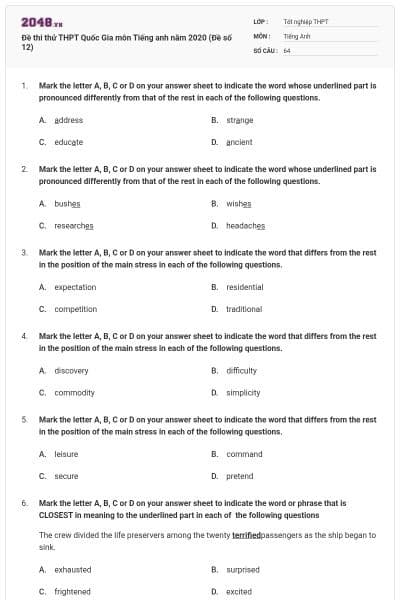
Mark the letter A, B, C or D on your answer sheet to indicate the word whose underlined part is pronounced differently from that of the rest in each of the following questions.
address
strange
educate
ancient
Đáp án là A
“a” trong từ “address” đọc là /ə/, trong các từ còn lại là /ei/.
Mark the letter A, B, C or D on your answer sheet to indicate the word whose underlined part is pronounced differently from that of the rest in each of the following questions.
bushes
wishes
researches
headaches
Đáp án là D
“es” trong từ “headaches” đọc là /t/ do “ch” đọc là /k/, trong các từ còn lại đọc là /iz/ do “ch” đọc là /tʃ/.
Mark the letter A, B, C or D on your answer sheet to indicate the word that differs from the rest in the position of the main stress in each of the following questions.
expectation
residential
competition
traditional
Đáp án là D
Trọng âm của từ này rơi vào âm tiết thứ 2, các từ còn lại rơi vào âm tiết thứ 3.
Mark the letter A, B, C or D on your answer sheet to indicate the word that differs from the rest in the position of the main stress in each of the following questions.
discovery
difficulty
commodity
simplicity
Đáp án là B
Trọng âm của từ này rơi vào âm tiết thứ 1, các từ còn lại rơi vào âm tiết thứ 2.
Mark the letter A, B, C or D on your answer sheet to indicate the word that differs from the rest in the position of the main stress in each of the following questions.
leisure
command
secure
pretend
Đáp án là A
Trọng âm của từ này rơi vào âm tiết thứ 1, các từ còn lại rơi vào âm tiết thứ 2.
Mark the letter A, B, C or D on your answer sheet to indicate the word or phrase that is CLOSEST in meaning to the underlined part in each of the following questions
The crew divided the life preservers among the twenty terrifiedpassengers as the ship began to sink.
exhausted
surprised
frightened
excited
Đáp án là C
Terrified= frightened= sợ hãi, exhausted= kiệt sức, surprised= bất ngờ, excited= hào hứng.
Mark the letter A, B, C or D on your answer sheet to indicate the word or phrase that is CLOSEST in meaning to the underlined part in each of the following questions
Books are primary means for dissemination of knowledge and information.
invention
attempt
variety
distribution
Đáp án là D
Dissemination = sự truyền bá, distribution= phân phát, invention= phát minh, attempt= thử, variety= đa dạng
Mark the letter A, B, C or D on your answer sheet to indicate the word or phrase that is CLOSEST in meaning to the underlined part in each of the following questions
Thanks to the invention of microscope, biologist can now gain insights into the nature of human cell.
deep understanding
far-sighted views
spectacular sightings
in-depth studies
Đáp án: A
Giải thích:
Kiến thức: Từ vựng – Cụm từ đồng nghĩa
insight (n): sự hiểu biết/ sự hiếu thấu
Xét các đáp án:
A. deep understanding: hiểu sâu sắc
B. far-sighted views: tầm nhìn xa rộng
C. spectacular sightings: cảnh tượng ngoạn mục
D. in-depth studies: nghiên cứu chuyên sâu
→ insights = deep understanding
Dịch: Nhờ phát minh ra kính hiển vi, các nhà sinh vật học hiện nay có thể hiểu sâu hơn về bản chất tế bào của con người.
Mark the letter A, B, C or D on your answer sheet to indicate the correct answer to each of the following questions.
It gets _____ to understand what the professor has explained.
the more difficult
difficult more and more
more difficult than
more and more difficult
Đáp án là D
Cấu trúc so sánh hơn với tính từ dài: more and more + long-adj: ngày càng… Các đáp án còn lại không phù hợp, sai cấu trúc.
Mark the letter A, B, C or D on your answer sheet to indicate the correct answer to each of the following questions.
My student practices _____ English with her friends every day
speaking
to speak
spoke
speak
Đáp án là A
Practice+ Ving: thực hành cái gì.
Mark the letter A, B, C or D on your answer sheet to indicate the correct answer to each of the following questions.
_____, we try our best to complete it.
Thanks to the difficult homework
Despite the homework was difficult
Difficult as the homework was
As though the homework was difficult
Đáp án: C
Giải thích:
A. Thanks to: Nhờ có → Loại vì không phù hợp về nghĩa
B. Despite + N/V-ing: Mặc cho → Loại vì phía sau là mệnh đề
C. Adj + as + S + V: Mặc dù → Đúng nghĩa và cấu trúc
D. As though + mệnh đề: Như thể → Loại vì không phù hợp về nghĩa
Chọn C.
Dịch: Mặc dù bài tập về nhà rất khó, chúng tôi vẫn cố gắng hết sức để hoàn thành.
Mark the letter A, B, C or D on your answer sheet to indicate the correct answer to each of the following questions.
It is a top secret. You _____ tell anyone about it
won’t
needn’t
mustn’t
mightn’t
Đáp án là C
Dịch: nó là một bí mật lớn. Bạn … nói với bất kỳ ai về nó-> mustn’t= không được.
Mark the letter A, B, C or D on your answer sheet to indicate the correct answer to each of the following questions.
Only when you become a parent _____ what true responsibility is.
you will understand
don’t you understand
will you understand
would you understand
Đáp án là C
Dịch: chỉ khi bạn làm cha mẹ, bạn sẽ hiểu được trách nhiệm thật sự là gì. -> chọn đáp án C, đáp án A dùng khi đứng đầu câu hỏi, đáp án B, D không phù hợp.
Mark the letter A, B, C or D on your answer sheet to indicate the correct answer to each of the following questions.
Larry drove all night to get here for his sister’s wedding. He _____ exhausted by the time he arrived.
ought to be
must have been
could be
will have been
Đáp án là B
Cấu trúc: must have+ PP: phỏng đoán điều có thể xảy ra trong quá khứ.
Mark the letter A, B, C or D on your answer sheet to indicate the correct answer to each of the following questions.
Peter _____ for thirty minutes before Mary arrived.
had been waiting
would be waiting
was waiting
has been waiting
Đáp án là A
Cấu trúc: QKHT/QKHTTD + before+ QKĐ: diễn tả một hành động đã xảy ra trước một hành động khác trong quá khứ.
Mark the letter A, B, C or D on your answer sheet to indicate the correct answer to each of the following questions.
_____ on the stairs than the phone rang.
No sooner had I stepped
Had no sooner I stepped
No sooner I had stepped
Had I no sooner stepped
Đáp án là A
Đảo ngữ: No sooner+ had+ S+ PP than + S+V_ed: ngay khi… thì…
Mark the letter A, B, C or D on your answer sheet to indicate the correct answer to each of the following questions.
The doctor advised Robert _____ to lose the weight.
to take more exercise so that he could
to take more exercise if he wanted
that he takes more exercise
that he should take more exercise in order that
Đáp án là A
Advise+ Sbd+ to V: khuyên ai nên làm gì. -> loại đáp án C, D. Đáp án B không đúng cấu trúc câu điều kiện, đáp án C: so that+ clause= nhằm để…
Mark the letter A, B, C or D on your answer sheet to indicate the correct answer to each of the following questions.
Everyone can join our club, _____ age and sex.
in place of
regardless of
in case of
on behalf of
Đáp án là B
regardless of= không qua tâm đến, in place of= thay vì, in case of= phòng khi, on behalf of= thay mặt cho.
Mark the letter A, B, C or D on your answer sheet to indicate the correct answer to each of the following questions.
_____ he is old, he wants to travel around the world.
will have complete
will completed
are completing
completes
Đáp án là A
“By this time next summer” tầm này mùa hè sau-> thời điểm xác định trong tương lai-> tương lai hoàn thành: S+ will+ have+ PP.
Mark the letter A, B, C or D on your answer sheet to indicate the correct answer to each of the following questions.
_____ he is old, he wants to travel around the world.
In spite of
Although
Despite
Because
Đáp án là B
Although + clause= In spite of / Despite + N: mặc dù…>< because + clause= bởi vì.
Mark the letter A, B, C or D on your answer sheet to indicate the correct answer to each of the following questions.
Nam wanted to know what the time _____.
the movie began
the movie begins
does the movie begin
did the movie begin
Đáp án A
Cấu trúc câu hỏi gián tiếp dạng S + asked / wanted to know + “wh” question + S + V lùi 1 thì.
Dịch nghĩa: Nam muốn biết rằng mấy giờ thì bộ phim bắt đầu.
Mark the letter A, B, C or D on your answer sheet to indicate the correct answer to each of the following questions.
The last person _____ the room must turn off the lights.
to leave
who leave
that leave
All are correct
Đáp án là A
Rút gọn mệnh đề quan hệ dạng chủ động với từ chỉ số thứ tự: The+ stt+ N+ to V+…. Đáp án B phải là “who leaves”.
Mark the letter A, B, C or D on your answer sheet to indicate the correct answer to each of the following questions.
At first sight I met her, I was impressed with her _____.
big beautiful round black eyes
beautiful black big round eyes
beautiful big round black eyes
beautiful round black big eyes
Đáp án là C
Trật tự tính từ “OpSASCOMP”: opinion- size- age- shape- color-origin- material- purpose.
Mark the letter A, B, C or D on your answer sheet to indicate the correct answer to each of the following questions.
–“Would you mind lending me your bike?” – “_____.”
Yes, Here it is.
Not at all.
Great
Yes, let’s
Đáp án là B
- “bạn có phiền cho tôi mượn xe đạp của bạn không?” Với câu hỏi “do/would you mind.” thì câu trả lời “yes” là không đồng ý, còn “no” là đồng ý. -> không phiền “not at all”.
Mark the letter A, B, C or D on your answer sheet to indicate the correct answer to each of the following questions.
It is hard to get him _____; he is such an aggressive man
by
over to
on with
into
Đáp án là D
Get by= chấp nhận, get into sbd= tác động đến ai, get on with sbd= thân thiện với ai, get sth over to sbd= làm rõ điều gì với ai. -> Dịch: thật khó để tác động đến anh ấy, anh ấy là người rất năng nổ.
Mark the letter A, B, C or D on your answer sheet to indicate the correct answer to each of the following questions.
–“Today’s my 20th birthday.” – “_____.”
I don’t understand.
Take care!
Have a good time!
Many happy returns.
Đáp án là D
Hôm nay là sinh nhật 20 tuổi của tôi-> tặng lời chúc mừng -> đáp án D: chúc bạn gặp nhiều may mắn. Các đáp án còn lại: A- tôi không hiểu, B- bảo trọng ( khi người nhận đi xa), C- có thời gian vui vẻ nhé ( khi người nhận có chuyến đi chơi).
Mark the letter A, B, C or D on your answer sheet to indicate the correct answer to each of the following questions.
You need more exercise – you should _____ jogging.
hold up
take up
try on
carry out
Đáp án: B
Giải thích:
Kiến thức: Cụm động từ
A. hold up something: trộm cái gì (từ ngân hàng, cửa hàng) bằng việc dùng súng
B. take up something: bắt đầu chơi cái gì
C. try on something: thử quần áo
D. carry on something: tiếp tục việc gì
Dựa vào nghĩa, chọn B.
Dịch: Bạn cần tập thể dục nhiều hơn – bạn nên bắt đầu chạy bộ.
Mark the letter A, B, C or D on your answer sheet to show the underlined part that needs correction.
Mrs. Stevens, along with her cousins from New Mexico, are planning to attend the festivities.
along with
her cousins
are
to attend
Đáp án là C
Cấu trúc A+ along with+ B+ V(A): động từ chia theo chủ ngữ A. “are”-> “is”.
Mark the letter A, B, C or D on your answer sheet to show the underlined part that needs correction.
George hasn’t completed the assignment yet, and Mary hasn’t too.
hasn’t
the assignment yet
and
hasn’t too
Đáp án: D
Giải thích:
“too” = cũng vậy, đứng cuối câu khẳng định để nhắc lại một điều giống câu trước, “either” = cũng không, đứng cuối câu phủ định để nhắc lại một điều giống câu trước.
Sửa: hasn’t too → hasn’t either
Dịch: George vẫn chưa hoàn thành bài tập và Mary cũng vậy.
Mark the letter A, B, C or D on your answer sheet to show the underlined part that needs correction.
The foreign student advisor recommended that she studied more English before enrolling at the university.
foreign
studied
enrolling
the
Đáp án là B
Cấu trúc: QKHT+ before+ QKĐ/V_ing: một việc diễn ra trước một việc khác.
Mark the letter A, B, C or D on your answer sheet to show the underlined part that needs correction.
Ceramic can be harder, light, and more resistant to heat than metals.
light
resistant
heat
metals
Đáp án là A
Trước và sau “and” các từ có cùng dạng: “light”-> “lighter”.
Mark the letter A, B, C or D on your answer sheet to show the underlined part that needs correction.
Sydney Laniar achieved fame both as a poet or a symphony musician.
achieved
as a
or
musician
Đáp án là C
Cấu trúc so sánh bằng: tobe+ as+ adj+ as. “or”-> “as”.
Read the following passage and mark the letter A, B, C, or D on your answer sheet to indicate the correct word for each of the blanks from 33 to 42.
Everyone wants to reduce pollution. But the pollution problem is (33)______ complicated as it is serious. It is complicated (34)______ much pollution is caused by things that benefit people. (35)______, exhaust from automobiles causes a large percentage of air pollution. But the automobile (36)______ transportation for millions of people. Factories discharge much (37)______ the material that pollutes the air and water, but factories give employment to a large number of people.
Thus, to end (38)_______ greatly reduce pollution immediately, people would have to (39)______ using many things that benefit them. Most of the people do not want to do that, of course. But pollution can be (40)______ reduced in several ways. Scientists and engineers can work to find ways to lessen the (41)______ of pollution that such things as automobiles and factories cause. Governments can pass and enforce laws that (42)______ businesses and traffic to stop, or to cut down on certain polluting activities.
Điền vào ô số 33
as
more
less
like
Đáp án là A
Cấu trúc so sánh bằng: tobe+ as+ adj+ as. Ô nhiễm là 1 vấn đề phức tạp cũng nha nghiêm trọng.
Read the following passage and mark the letter A, B, C, or D on your answer sheet to indicate the correct word for each of the blanks from 33 to 42.
Everyone wants to reduce pollution. But the pollution problem is (33)______ complicated as it is serious. It is complicated (34)______ much pollution is caused by things that benefit people. (35)______, exhaust from automobiles causes a large percentage of air pollution. But the automobile (36)______ transportation for millions of people. Factories discharge much (37)______ the material that pollutes the air and water, but factories give employment to a large number of people.
Thus, to end (38)_______ greatly reduce pollution immediately, people would have to (39)______ using many things that benefit them. Most of the people do not want to do that, of course. But pollution can be (40)______ reduced in several ways. Scientists and engineers can work to find ways to lessen the (41)______ of pollution that such things as automobiles and factories cause. Governments can pass and enforce laws that (42)______ businesses and traffic to stop, or to cut down on certain polluting activities.
Điền vào ô số 34
so
while
though
because
Đáp án là D
Dịch: nó phức tạp vì rất nhiều ô nhiễm gay ra bởi những thứ có lợi cho con người -> bởi vì.
Read the following passage and mark the letter A, B, C, or D on your answer sheet to indicate the correct word for each of the blanks from 33 to 42.
Everyone wants to reduce pollution. But the pollution problem is (33)______ complicated as it is serious. It is complicated (34)______ much pollution is caused by things that benefit people. (35)______, exhaust from automobiles causes a large percentage of air pollution. But the automobile (36)______ transportation for millions of people. Factories discharge much (37)______ the material that pollutes the air and water, but factories give employment to a large number of people.
Thus, to end (38)_______ greatly reduce pollution immediately, people would have to (39)______ using many things that benefit them. Most of the people do not want to do that, of course. But pollution can be (40)______ reduced in several ways. Scientists and engineers can work to find ways to lessen the (41)______ of pollution that such things as automobiles and factories cause. Governments can pass and enforce laws that (42)______ businesses and traffic to stop, or to cut down on certain polluting activities.
Điền vào ô số 35
Specific
For example
Such as
Like
Đáp án là B
For example= cho ví dụ. Dịch: ví dụ, tổn hại từ ô tô gây ra phần lớn ô nhiễm không khí.
Read the following passage and mark the letter A, B, C, or D on your answer sheet to indicate the correct word for each of the blanks from 33 to 42.
Everyone wants to reduce pollution. But the pollution problem is (33)______ complicated as it is serious. It is complicated (34)______ much pollution is caused by things that benefit people. (35)______, exhaust from automobiles causes a large percentage of air pollution. But the automobile (36)______ transportation for millions of people. Factories discharge much (37)______ the material that pollutes the air and water, but factories give employment to a large number of people.
Thus, to end (38)_______ greatly reduce pollution immediately, people would have to (39)______ using many things that benefit them. Most of the people do not want to do that, of course. But pollution can be (40)______ reduced in several ways. Scientists and engineers can work to find ways to lessen the (41)______ of pollution that such things as automobiles and factories cause. Governments can pass and enforce laws that (42)______ businesses and traffic to stop, or to cut down on certain polluting activities.
Điền vào ô số 36
takes
affords
carries
provides
Đáp án là D
Take= làm, afford = cấp cho, carry= mang vác, provide= cung cấp. Dịch: nhưng ô tô cung cấp phương tiện đi lại cho hàng triệu người
Read the following passage and mark the letter A, B, C, or D on your answer sheet to indicate the correct word for each of the blanks from 33 to 42.
Everyone wants to reduce pollution. But the pollution problem is (33)______ complicated as it is serious. It is complicated (34)______ much pollution is caused by things that benefit people. (35)______, exhaust from automobiles causes a large percentage of air pollution. But the automobile (36)______ transportation for millions of people. Factories discharge much (37)______ the material that pollutes the air and water, but factories give employment to a large number of people.
Thus, to end (38)_______ greatly reduce pollution immediately, people would have to (39)______ using many things that benefit them. Most of the people do not want to do that, of course. But pollution can be (40)______ reduced in several ways. Scientists and engineers can work to find ways to lessen the (41)______ of pollution that such things as automobiles and factories cause. Governments can pass and enforce laws that (42)______ businesses and traffic to stop, or to cut down on certain polluting activities.
Điền vào ô số 37
about
for
of
with
Đáp án là C
Much/many of sth= phần lớn… Many đi với danh từ đếm được và much đi với danh từ không đếm được
Read the following passage and mark the letter A, B, C, or D on your answer sheet to indicate the correct word for each of the blanks from 33 to 42.
Everyone wants to reduce pollution. But the pollution problem is (33)______ complicated as it is serious. It is complicated (34)______ much pollution is caused by things that benefit people. (35)______, exhaust from automobiles causes a large percentage of air pollution. But the automobile (36)______ transportation for millions of people. Factories discharge much (37)______ the material that pollutes the air and water, but factories give employment to a large number of people.
Thus, to end (38)_______ greatly reduce pollution immediately, people would have to (39)______ using many things that benefit them. Most of the people do not want to do that, of course. But pollution can be (40)______ reduced in several ways. Scientists and engineers can work to find ways to lessen the (41)______ of pollution that such things as automobiles and factories cause. Governments can pass and enforce laws that (42)______ businesses and traffic to stop, or to cut down on certain polluting activities.
Điền vào ô số 38
or
and
as well
then
Đáp án là A
“to end _______ greatly reduce pollution immediately” để kết thúc … giảm thiểu ô nhiễm ngay lập tức -> “or” mang ý lựa chọn giữa 2 hành động.
Read the following passage and mark the letter A, B, C, or D on your answer sheet to indicate the correct word for each of the blanks from 33 to 42.
Everyone wants to reduce pollution. But the pollution problem is (33)______ complicated as it is serious. It is complicated (34)______ much pollution is caused by things that benefit people. (35)______, exhaust from automobiles causes a large percentage of air pollution. But the automobile (36)______ transportation for millions of people. Factories discharge much (37)______ the material that pollutes the air and water, but factories give employment to a large number of people.
Thus, to end (38)_______ greatly reduce pollution immediately, people would have to (39)______ using many things that benefit them. Most of the people do not want to do that, of course. But pollution can be (40)______ reduced in several ways. Scientists and engineers can work to find ways to lessen the (41)______ of pollution that such things as automobiles and factories cause. Governments can pass and enforce laws that (42)______ businesses and traffic to stop, or to cut down on certain polluting activities.
Điền vào ô số 39
start
continue
stop
go on
Đáp án là C
“people would have to______ using many things” mọi người phải … sử dụng rất nhiều thứ, kết hợp với câu trước là giảm thiểu ô nhiễm -> stop
Read the following passage and mark the letter A, B, C, or D on your answer sheet to indicate the correct word for each of the blanks from 33 to 42.
Everyone wants to reduce pollution. But the pollution problem is (33)______ complicated as it is serious. It is complicated (34)______ much pollution is caused by things that benefit people. (35)______, exhaust from automobiles causes a large percentage of air pollution. But the automobile (36)______ transportation for millions of people. Factories discharge much (37)______ the material that pollutes the air and water, but factories give employment to a large number of people.
Thus, to end (38)_______ greatly reduce pollution immediately, people would have to (39)______ using many things that benefit them. Most of the people do not want to do that, of course. But pollution can be (40)______ reduced in several ways. Scientists and engineers can work to find ways to lessen the (41)______ of pollution that such things as automobiles and factories cause. Governments can pass and enforce laws that (42)______ businesses and traffic to stop, or to cut down on certain polluting activities.
Điền vào ô số 40
carefully
unexpectedly
gradually
little
Đáp án là C
Ý chính đầu đoạn 2: ô nhiễm có thể giảm ngay lập tức bằng việc bỏ những việc gậy ô nhiễm mà mọi người vẫn đang làm. Nhưng không ai muốn làm điều đó. Nhưng ô nhiễm có thể giảm… theo nhiều cách. -> nếu như giảm ô nhiễm ngay lập tức không được thì chuyển sang giảm dần dần = gradually
Read the following passage and mark the letter A, B, C, or D on your answer sheet to indicate the correct word for each of the blanks from 33 to 42.
Everyone wants to reduce pollution. But the pollution problem is (33)______ complicated as it is serious. It is complicated (34)______ much pollution is caused by things that benefit people. (35)______, exhaust from automobiles causes a large percentage of air pollution. But the automobile (36)______ transportation for millions of people. Factories discharge much (37)______ the material that pollutes the air and water, but factories give employment to a large number of people.
Thus, to end (38)_______ greatly reduce pollution immediately, people would have to (39)______ using many things that benefit them. Most of the people do not want to do that, of course. But pollution can be (40)______ reduced in several ways. Scientists and engineers can work to find ways to lessen the (41)______ of pollution that such things as automobiles and factories cause. Governments can pass and enforce laws that (42)______ businesses and traffic to stop, or to cut down on certain polluting activities.
Điền vào ô số 41
way
figure
number
amount
Đáp án là D
A large amount of/ a great deal of+N¬(không đếm được), A large number of N (đếm được).
Read the following passage and mark the letter A, B, C, or D on your answer sheet to indicate the correct word for each of the blanks from 33 to 42.
Everyone wants to reduce pollution. But the pollution problem is (33)______ complicated as it is serious. It is complicated (34)______ much pollution is caused by things that benefit people. (35)______, exhaust from automobiles causes a large percentage of air pollution. But the automobile (36)______ transportation for millions of people. Factories discharge much (37)______ the material that pollutes the air and water, but factories give employment to a large number of people.
Thus, to end (38)_______ greatly reduce pollution immediately, people would have to (39)______ using many things that benefit them. Most of the people do not want to do that, of course. But pollution can be (40)______ reduced in several ways. Scientists and engineers can work to find ways to lessen the (41)______ of pollution that such things as automobiles and factories cause. Governments can pass and enforce laws that (42)______ businesses and traffic to stop, or to cut down on certain polluting activities.
Điền vào ô số 42
forbid
prevent
request
require
Đáp án là D
Require sbd to do sth: đòi hỏi, yêu cầu ai làm gì
Mark the letter A, B, C or D on your answer sheet to indicate the word or phrase that is OPPOSITE in meaning to the underlined part in each of the following questions.
She was unhappy that she lost contact with a lot of her old friends when she went abroad to study.
made room for
put in charge of
kept in touch with
lost control of
Đáp án là C
Lose contact with= mất liên lạc với, keep in touch with= giữ liên lạc với, make room for= nhường chỗ cho, lose control of= mất kiểm soát.
Mark the letter A, B, C or D on your answer sheet to indicate the word or phrase that is OPPOSITE in meaning to the underlined part in each of the following questions.
Fruit and vegetable grew in abundanceon the island. The islanders even exported the surplus.
excess
large quantity
small quantity
sufficiency
Đáp án: C
Giải thích:
Kiến thức: Từ vựng – Cụm từ trái nghĩa
abundance (n): sự phong phú, sự dồi dào, rất nhiều
Xét các đáp án:
A. excess (n): sự vượt quá
B. large quantity (n.phr): số lượng lớn
C. small quantity (n.phr): số lượng nhỏ
D. sufficiency (n): sự đủ đầy
→ abundance >< small quantity
Dịch: Trái cây và rau quả mọc rất phong phú trên đảo. Người dân đảo thậm chí còn xuất khẩu phần thặng dư.
Read the following passage and mark the letter A, B, C, or D on your answer sheet to indicate the correct answer to each of the questions from 45 to 54.
Researchers in the field of psychology have found that one of the best ways to make an important decision, such as choosing a university to attend or a business to invest in, involves he utilization of a decision worksheet. Psychologists who study optimization compare the actual decisions made by people to theoretical ideal decisions to see how similar they are. Proponents of the worksheet procedure believe that it will yield optimal, that is, the best decisions. Although there are several variations on the exact format that worksheets can take, they are all similar in their essential aspects. Worksheets require defining the problem in a clear and concise way and then listing all possible solutions to the problem. Next, the pertinent considerations that will be affected by each decision are listed, and the relative importance of each consideration or consequence is determined. Each consideration is assigned a numerical value to reflect its relative importance. A decision is mathematically calculated by adding these values together. The alternative with the highest number of points emerges as the best decision.
Since most important problems are multifaceted, there are several alternatives to choose from, each with unique advantages and disadvantages. One of the benefits of a pencil and paper decision-making procedure is that it permits people to deal with more variables than their minds can generally comprehend and remember. On the average, people can keep about seven ideas in their minds at once. A worksheet can be especially useful when the decision involves a large number of variables with complex relationships. A realistic example for many college students is the question "What will I do after graduation?" A graduate might seek a position that offers specialized training, pursue an advanced degree, or travel abroad for a year.
A decision-making worksheet begins with a succinct statement of the problem that will also help to narrow it. It is important to be clear about the distinction between long-range and immediate goals because long-range goals often involve a different decision from short-range ones. Focusing on long-range goals, a graduating student might revise the question above to "What will I do after graduation that will lead to a successful career?"
What does the passage mainly discuss?
A tool to assist in making complex decisions.
A comparison of actual decisions and ideal decisions
Research on how people make decisions
Differences between long-range and short-range decision making
Đáp án là A
Dòng 1 đoạn 1 “Researchers in the field of psychology have found that one of the best way to make an important decision”: những nghiên cứu trên lĩnh vực tâm lý học đã tìm ra một trong những cách tốt nhất để ra một quyết định.-> công cụ để giúp đưa ra quyết định phức tạp.
Read the following passage and mark the letter A, B, C, or D on your answer sheet to indicate the correct answer to each of the questions from 45 to 54.
Researchers in the field of psychology have found that one of the best ways to make an important decision, such as choosing a university to attend or a business to invest in, involves he utilization of a decision worksheet. Psychologists who study optimization compare the actual decisions made by people to theoretical ideal decisions to see how similar they are. Proponents of the worksheet procedure believe that it will yield optimal, that is, the best decisions. Although there are several variations on the exact format that worksheets can take, they are all similar in their essential aspects. Worksheets require defining the problem in a clear and concise way and then listing all possible solutions to the problem. Next, the pertinent considerations that will be affected by each decision are listed, and the relative importance of each consideration or consequence is determined. Each consideration is assigned a numerical value to reflect its relative importance. A decision is mathematically calculated by adding these values together. The alternative with the highest number of points emerges as the best decision.
Since most important problems are multifaceted, there are several alternatives to choose from, each with unique advantages and disadvantages. One of the benefits of a pencil and paper decision-making procedure is that it permits people to deal with more variables than their minds can generally comprehend and remember. On the average, people can keep about seven ideas in their minds at once. A worksheet can be especially useful when the decision involves a large number of variables with complex relationships. A realistic example for many college students is the question "What will I do after graduation?" A graduate might seek a position that offers specialized training, pursue an advanced degree, or travel abroad for a year.
A decision-making worksheet begins with a succinct statement of the problem that will also help to narrow it. It is important to be clear about the distinction between long-range and immediate goals because long-range goals often involve a different decision from short-range ones. Focusing on long-range goals, a graduating student might revise the question above to "What will I do after graduation that will lead to a successful career?"
The word "essential" in paragraph 1 is closest in meaning to
introductory
changeable
beneficial
fundamental
Đáp án là D
Essential= thiết yếu, fundamental=cơ bản, introductory= mở đầu, changeable= có thể thay đổi, beneficial = có lợi.
Read the following passage and mark the letter A, B, C, or D on your answer sheet to indicate the correct answer to each of the questions from 45 to 54.
Researchers in the field of psychology have found that one of the best ways to make an important decision, such as choosing a university to attend or a business to invest in, involves he utilization of a decision worksheet. Psychologists who study optimization compare the actual decisions made by people to theoretical ideal decisions to see how similar they are. Proponents of the worksheet procedure believe that it will yield optimal, that is, the best decisions. Although there are several variations on the exact format that worksheets can take, they are all similar in their essential aspects. Worksheets require defining the problem in a clear and concise way and then listing all possible solutions to the problem. Next, the pertinent considerations that will be affected by each decision are listed, and the relative importance of each consideration or consequence is determined. Each consideration is assigned a numerical value to reflect its relative importance. A decision is mathematically calculated by adding these values together. The alternative with the highest number of points emerges as the best decision.
Since most important problems are multifaceted, there are several alternatives to choose from, each with unique advantages and disadvantages. One of the benefits of a pencil and paper decision-making procedure is that it permits people to deal with more variables than their minds can generally comprehend and remember. On the average, people can keep about seven ideas in their minds at once. A worksheet can be especially useful when the decision involves a large number of variables with complex relationships. A realistic example for many college students is the question "What will I do after graduation?" A graduate might seek a position that offers specialized training, pursue an advanced degree, or travel abroad for a year.
A decision-making worksheet begins with a succinct statement of the problem that will also help to narrow it. It is important to be clear about the distinction between long-range and immediate goals because long-range goals often involve a different decision from short-range ones. Focusing on long-range goals, a graduating student might revise the question above to "What will I do after graduation that will lead to a successful career?"
The word "pertinent" in paragraph 1 is closest in meaning to
relevant
preceding
insightful
responsive
Đáp án là A
Pertinent = thích hợp, relevant= có liên quan, preceding= có trước, insightful= sâu sắc, responsive= phản ứng nhạy.
Read the following passage and mark the letter A, B, C, or D on your answer sheet to indicate the correct answer to each of the questions from 45 to 54.
Researchers in the field of psychology have found that one of the best ways to make an important decision, such as choosing a university to attend or a business to invest in, involves he utilization of a decision worksheet. Psychologists who study optimization compare the actual decisions made by people to theoretical ideal decisions to see how similar they are. Proponents of the worksheet procedure believe that it will yield optimal, that is, the best decisions. Although there are several variations on the exact format that worksheets can take, they are all similar in their essential aspects. Worksheets require defining the problem in a clear and concise way and then listing all possible solutions to the problem. Next, the pertinent considerations that will be affected by each decision are listed, and the relative importance of each consideration or consequence is determined. Each consideration is assigned a numerical value to reflect its relative importance. A decision is mathematically calculated by adding these values together. The alternative with the highest number of points emerges as the best decision.
Since most important problems are multifaceted, there are several alternatives to choose from, each with unique advantages and disadvantages. One of the benefits of a pencil and paper decision-making procedure is that it permits people to deal with more variables than their minds can generally comprehend and remember. On the average, people can keep about seven ideas in their minds at once. A worksheet can be especially useful when the decision involves a large number of variables with complex relationships. A realistic example for many college students is the question "What will I do after graduation?" A graduate might seek a position that offers specialized training, pursue an advanced degree, or travel abroad for a year.
A decision-making worksheet begins with a succinct statement of the problem that will also help to narrow it. It is important to be clear about the distinction between long-range and immediate goals because long-range goals often involve a different decision from short-range ones. Focusing on long-range goals, a graduating student might revise the question above to "What will I do after graduation that will lead to a successful career?"
Of the following steps, which occurs before the others in making a decision worksheet?
Listing the consequences of each solution
Calculating a numerical summary of each solution
eciding which consequences are most important
Writing down all possible solutions
Đáp án là D
Cuối câu 1 đoạn 2 “listing all possible solutions to the problem”: lên danh sách các giải pháp cho vấn đề.
Read the following passage and mark the letter A, B, C, or D on your answer sheet to indicate the correct answer to each of the questions from 45 to 54.
Researchers in the field of psychology have found that one of the best ways to make an important decision, such as choosing a university to attend or a business to invest in, involves he utilization of a decision worksheet. Psychologists who study optimization compare the actual decisions made by people to theoretical ideal decisions to see how similar they are. Proponents of the worksheet procedure believe that it will yield optimal, that is, the best decisions. Although there are several variations on the exact format that worksheets can take, they are all similar in their essential aspects. Worksheets require defining the problem in a clear and concise way and then listing all possible solutions to the problem. Next, the pertinent considerations that will be affected by each decision are listed, and the relative importance of each consideration or consequence is determined. Each consideration is assigned a numerical value to reflect its relative importance. A decision is mathematically calculated by adding these values together. The alternative with the highest number of points emerges as the best decision.
Since most important problems are multifaceted, there are several alternatives to choose from, each with unique advantages and disadvantages. One of the benefits of a pencil and paper decision-making procedure is that it permits people to deal with more variables than their minds can generally comprehend and remember. On the average, people can keep about seven ideas in their minds at once. A worksheet can be especially useful when the decision involves a large number of variables with complex relationships. A realistic example for many college students is the question "What will I do after graduation?" A graduate might seek a position that offers specialized training, pursue an advanced degree, or travel abroad for a year.
A decision-making worksheet begins with a succinct statement of the problem that will also help to narrow it. It is important to be clear about the distinction between long-range and immediate goals because long-range goals often involve a different decision from short-range ones. Focusing on long-range goals, a graduating student might revise the question above to "What will I do after graduation that will lead to a successful career?"
According to decision-worksheet theory, an optimal decision is defined as one that
has the fewest variables to consider
uses the most decision worksheets
has the most points assigned to it
is agreed to by the greatest number of people
Đáp án là C
Câu cuối đoạn 2 “The alternative with the highest number of points emerges as the best decision.” Sự lựa chọn có số điểm cao nhất hiện ra như giải pháp tốt nhất.
Read the following passage and mark the letter A, B, C, or D on your answer sheet to indicate the correct answer to each of the questions from 45 to 54.
Researchers in the field of psychology have found that one of the best ways to make an important decision, such as choosing a university to attend or a business to invest in, involves he utilization of a decision worksheet. Psychologists who study optimization compare the actual decisions made by people to theoretical ideal decisions to see how similar they are. Proponents of the worksheet procedure believe that it will yield optimal, that is, the best decisions. Although there are several variations on the exact format that worksheets can take, they are all similar in their essential aspects. Worksheets require defining the problem in a clear and concise way and then listing all possible solutions to the problem. Next, the pertinent considerations that will be affected by each decision are listed, and the relative importance of each consideration or consequence is determined. Each consideration is assigned a numerical value to reflect its relative importance. A decision is mathematically calculated by adding these values together. The alternative with the highest number of points emerges as the best decision.
Since most important problems are multifaceted, there are several alternatives to choose from, each with unique advantages and disadvantages. One of the benefits of a pencil and paper decision-making procedure is that it permits people to deal with more variables than their minds can generally comprehend and remember. On the average, people can keep about seven ideas in their minds at once. A worksheet can be especially useful when the decision involves a large number of variables with complex relationships. A realistic example for many college students is the question "What will I do after graduation?" A graduate might seek a position that offers specialized training, pursue an advanced degree, or travel abroad for a year.
A decision-making worksheet begins with a succinct statement of the problem that will also help to narrow it. It is important to be clear about the distinction between long-range and immediate goals because long-range goals often involve a different decision from short-range ones. Focusing on long-range goals, a graduating student might revise the question above to "What will I do after graduation that will lead to a successful career?"
The author organizes paragraph 2 by
describing a process
classifying types of worksheets
providing historical background
explaining a theory
Đáp án là A
Đoạn 2 mô tả quá trình đưa ra 1 quyết định với bảng hỏi với từ nối như “next”. Đầu tiên là xác định vấn đề 1 cách rõ ràng, lên danh sách giải pháp, lý do cho sự khả thi của giải pháp và kết quả có hể xảy ra, mỗi lý do sẽ được cho điểm, tính tổng số điểm cho mỗi giải pháp, lựa chọn giải pháp có điểm cao nhất.
Read the following passage and mark the letter A, B, C, or D on your answer sheet to indicate the correct answer to each of the questions from 45 to 54.
Researchers in the field of psychology have found that one of the best ways to make an important decision, such as choosing a university to attend or a business to invest in, involves he utilization of a decision worksheet. Psychologists who study optimization compare the actual decisions made by people to theoretical ideal decisions to see how similar they are. Proponents of the worksheet procedure believe that it will yield optimal, that is, the best decisions. Although there are several variations on the exact format that worksheets can take, they are all similar in their essential aspects. Worksheets require defining the problem in a clear and concise way and then listing all possible solutions to the problem. Next, the pertinent considerations that will be affected by each decision are listed, and the relative importance of each consideration or consequence is determined. Each consideration is assigned a numerical value to reflect its relative importance. A decision is mathematically calculated by adding these values together. The alternative with the highest number of points emerges as the best decision.
Since most important problems are multifaceted, there are several alternatives to choose from, each with unique advantages and disadvantages. One of the benefits of a pencil and paper decision-making procedure is that it permits people to deal with more variables than their minds can generally comprehend and remember. On the average, people can keep about seven ideas in their minds at once. A worksheet can be especially useful when the decision involves a large number of variables with complex relationships. A realistic example for many college students is the question "What will I do after graduation?" A graduate might seek a position that offers specialized training, pursue an advanced degree, or travel abroad for a year.
A decision-making worksheet begins with a succinct statement of the problem that will also help to narrow it. It is important to be clear about the distinction between long-range and immediate goals because long-range goals often involve a different decision from short-range ones. Focusing on long-range goals, a graduating student might revise the question above to "What will I do after graduation that will lead to a successful career?"
The author states that "On the average, people can keep about seven ideas in their minds at once" (paragraph 3) to explain that
most decisions involve seven steps
human mental capacity has limitations
some people have difficulty making minor as well as major decisions
people can learn to keep more than seven ideas in their minds with practice
Đáp án là B
Câu này nghĩa là: trung bình, mỗi người giữ được 7 suy nghĩ cùng 1 lúc.-> khả năng thần kinh của con người rất hạn chế, không chứa được nhiều thông tin bằng worksheet
Read the following passage and mark the letter A, B, C, or D on your answer sheet to indicate the correct answer to each of the questions from 45 to 54.
Researchers in the field of psychology have found that one of the best ways to make an important decision, such as choosing a university to attend or a business to invest in, involves he utilization of a decision worksheet. Psychologists who study optimization compare the actual decisions made by people to theoretical ideal decisions to see how similar they are. Proponents of the worksheet procedure believe that it will yield optimal, that is, the best decisions. Although there are several variations on the exact format that worksheets can take, they are all similar in their essential aspects. Worksheets require defining the problem in a clear and concise way and then listing all possible solutions to the problem. Next, the pertinent considerations that will be affected by each decision are listed, and the relative importance of each consideration or consequence is determined. Each consideration is assigned a numerical value to reflect its relative importance. A decision is mathematically calculated by adding these values together. The alternative with the highest number of points emerges as the best decision.
Since most important problems are multifaceted, there are several alternatives to choose from, each with unique advantages and disadvantages. One of the benefits of a pencil and paper decision-making procedure is that it permits people to deal with more variables than their minds can generally comprehend and remember. On the average, people can keep about seven ideas in their minds at once. A worksheet can be especially useful when the decision involves a large number of variables with complex relationships. A realistic example for many college students is the question "What will I do after graduation?" A graduate might seek a position that offers specialized training, pursue an advanced degree, or travel abroad for a year.
A decision-making worksheet begins with a succinct statement of the problem that will also help to narrow it. It is important to be clear about the distinction between long-range and immediate goals because long-range goals often involve a different decision from short-range ones. Focusing on long-range goals, a graduating student might revise the question above to "What will I do after graduation that will lead to a successful career?"
The word "succinct" in paragraph 4 is closest in meaning to
creative
satisfactory
personal
concise
Đáp án là D
Succinct= concise= ngắn gọn, creative = sáng tạo, satisfactory= hài lòng, personal= cá nhân.
Read the following passage and mark the letter A, B, C, or D on your answer sheet to indicate the correct answer to each of the questions from 45 to 54.
Researchers in the field of psychology have found that one of the best ways to make an important decision, such as choosing a university to attend or a business to invest in, involves he utilization of a decision worksheet. Psychologists who study optimization compare the actual decisions made by people to theoretical ideal decisions to see how similar they are. Proponents of the worksheet procedure believe that it will yield optimal, that is, the best decisions. Although there are several variations on the exact format that worksheets can take, they are all similar in their essential aspects. Worksheets require defining the problem in a clear and concise way and then listing all possible solutions to the problem. Next, the pertinent considerations that will be affected by each decision are listed, and the relative importance of each consideration or consequence is determined. Each consideration is assigned a numerical value to reflect its relative importance. A decision is mathematically calculated by adding these values together. The alternative with the highest number of points emerges as the best decision.
Since most important problems are multifaceted, there are several alternatives to choose from, each with unique advantages and disadvantages. One of the benefits of a pencil and paper decision-making procedure is that it permits people to deal with more variables than their minds can generally comprehend and remember. On the average, people can keep about seven ideas in their minds at once. A worksheet can be especially useful when the decision involves a large number of variables with complex relationships. A realistic example for many college students is the question "What will I do after graduation?" A graduate might seek a position that offers specialized training, pursue an advanced degree, or travel abroad for a year.
A decision-making worksheet begins with a succinct statement of the problem that will also help to narrow it. It is important to be clear about the distinction between long-range and immediate goals because long-range goals often involve a different decision from short-range ones. Focusing on long-range goals, a graduating student might revise the question above to "What will I do after graduation that will lead to a successful career?"
The word "it" in paragraph 4 refers to
worksheet
problem
distinction
decision
Đáp án là B
Câu 1 đoạn 4 “A decision-making worksheet begins with a succinct statement of the problem that will also help to narrow it” một mẫu hỏi ra quyết định bắt đầu với 1 tiêu đề ngắn gọn của vấn đề sẽ giúp thu hẹp nó-> “it” là vấn đề.
Read the following passage and mark the letter A, B, C, or D on your answer sheet to indicate the correct answer to each of the questions from 45 to 54.
Researchers in the field of psychology have found that one of the best ways to make an important decision, such as choosing a university to attend or a business to invest in, involves he utilization of a decision worksheet. Psychologists who study optimization compare the actual decisions made by people to theoretical ideal decisions to see how similar they are. Proponents of the worksheet procedure believe that it will yield optimal, that is, the best decisions. Although there are several variations on the exact format that worksheets can take, they are all similar in their essential aspects. Worksheets require defining the problem in a clear and concise way and then listing all possible solutions to the problem. Next, the pertinent considerations that will be affected by each decision are listed, and the relative importance of each consideration or consequence is determined. Each consideration is assigned a numerical value to reflect its relative importance. A decision is mathematically calculated by adding these values together. The alternative with the highest number of points emerges as the best decision.
Since most important problems are multifaceted, there are several alternatives to choose from, each with unique advantages and disadvantages. One of the benefits of a pencil and paper decision-making procedure is that it permits people to deal with more variables than their minds can generally comprehend and remember. On the average, people can keep about seven ideas in their minds at once. A worksheet can be especially useful when the decision involves a large number of variables with complex relationships. A realistic example for many college students is the question "What will I do after graduation?" A graduate might seek a position that offers specialized training, pursue an advanced degree, or travel abroad for a year.
A decision-making worksheet begins with a succinct statement of the problem that will also help to narrow it. It is important to be clear about the distinction between long-range and immediate goals because long-range goals often involve a different decision from short-range ones. Focusing on long-range goals, a graduating student might revise the question above to "What will I do after graduation that will lead to a successful career?"
The word "revise" in paragraph 4 is closest in meaning to
ask
explain
change
predict
Đáp án là C
Revise= xem xét lại, change= thay đổi, ask= hỏi, explain = giải thích, predict= đoán trước.
Read the following passage and mark the letter A, B, C, or D on your answer sheet to indicate the correct answer to each of the questions from 55 to 64.
The livelihood of each species in the vast and intricate assemblage of living things depends on the existences of other organisms. This interdependence is sometimes subtle, sometimes obvious. Perhaps the most straight forward dependence of one species on another occurs with parasites, organisms that live on or in other living things and derive nutrients directly from them. The parasitic way of life is widespread. A multitude of microorganisms (including viruses and bacteria) and an army of invertebrates - or creatures lacking a spinal column (including crustaceans, insects, and many different types of worms) - make their livings directly at the expense of other creatures. In the face of this onslaught, living things have evolved a variety of defense mechanisms for protecting their bodies from invasion by other organisms.
Certain fungi and even some kinds of bacteria secrete substances known as antibiotics into their external environment. These substances are capable of killing or inhibiting the growth of various kinds of bacteria that also occupy the area, thereby eliminating or reducing the competition for nutrients. The same principle is used in defense against invaders in other groups of organisms. For example, when attacked by disease - causing fungi or bacteria, many kinds of plants produce chemicals that help to ward off the invaders. Members of the animal kingdom have developed a variety of defense mechanisms for dealing with parasites.
Although these mechanisms vary considerably, all major groups of animals are capable of detecting and reacting to the presence of "foreign" cells. In fact, throughout the animal kingdom, from sponges to certain types of worms, shellfish, and all vertebrates (creatures possessing a spinal column), there is evidence that transplants of cells or fragments of tissues into an animal are accepted only if they come from genetically compatible or closely related individuals. The ability to distinguish between "self" and "nonself", while present in all animals, is most efficient among vertebrates, which have developed an immune system as their defense mechanism. The immune system recognizes and takes action against foreign invaders and transplanted tissues that are treated as foreign cells.
What does the passage mainly discuss?
how antibiotics work to cure disease
how organisms react to invaders
how the immune systems of vertebrates developed
how parasites reproduce
Đáp án là B
Dịch đáp án:
A- cách sinh sản ở ký sinh trùng,
B- cách sinh vật phản ứng với kẻ thủ,
C- cách kháng sinh hoạt động để chữa bệnh,
D-cách phát triển hệ thống miễn dịch của động vật có xương sống.
Đoạn 1 nói về mối quan hệ giữa các loài, đoạn là sự tự vệ của nấm và vi khuẩn, đoạn 3 là hệ thông bảo vệ của động vật, đoạn cuối là giới thiệu về hệ thống miễn dịch của sống vật có xương sống -> đáp án B là nội dung chính của bài.
Read the following passage and mark the letter A, B, C, or D on your answer sheet to indicate the correct answer to each of the questions from 55 to 64.
The livelihood of each species in the vast and intricate assemblage of living things depends on the existences of other organisms. This interdependence is sometimes subtle, sometimes obvious. Perhaps the most straight forward dependence of one species on another occurs with parasites, organisms that live on or in other living things and derive nutrients directly from them. The parasitic way of life is widespread. A multitude of microorganisms (including viruses and bacteria) and an army of invertebrates - or creatures lacking a spinal column (including crustaceans, insects, and many different types of worms) - make their livings directly at the expense of other creatures. In the face of this onslaught, living things have evolved a variety of defense mechanisms for protecting their bodies from invasion by other organisms.
Certain fungi and even some kinds of bacteria secrete substances known as antibiotics into their external environment. These substances are capable of killing or inhibiting the growth of various kinds of bacteria that also occupy the area, thereby eliminating or reducing the competition for nutrients. The same principle is used in defense against invaders in other groups of organisms. For example, when attacked by disease - causing fungi or bacteria, many kinds of plants produce chemicals that help to ward off the invaders. Members of the animal kingdom have developed a variety of defense mechanisms for dealing with parasites.
Although these mechanisms vary considerably, all major groups of animals are capable of detecting and reacting to the presence of "foreign" cells. In fact, throughout the animal kingdom, from sponges to certain types of worms, shellfish, and all vertebrates (creatures possessing a spinal column), there is evidence that transplants of cells or fragments of tissues into an animal are accepted only if they come from genetically compatible or closely related individuals. The ability to distinguish between "self" and "nonself", while present in all animals, is most efficient among vertebrates, which have developed an immune system as their defense mechanism. The immune system recognizes and takes action against foreign invaders and transplanted tissues that are treated as foreign cells.
The word "intricate" in line 1 is closest in meaning to ________.
widespread
difficult
complex
critical
Đáp án là C
Intricate= complex= phức tạp, widespread= phổ biến, difficult= khó khăn, critical= chỉ trích.
Read the following passage and mark the letter A, B, C, or D on your answer sheet to indicate the correct answer to each of the questions from 55 to 64.
The livelihood of each species in the vast and intricate assemblage of living things depends on the existences of other organisms. This interdependence is sometimes subtle, sometimes obvious. Perhaps the most straight forward dependence of one species on another occurs with parasites, organisms that live on or in other living things and derive nutrients directly from them. The parasitic way of life is widespread. A multitude of microorganisms (including viruses and bacteria) and an army of invertebrates - or creatures lacking a spinal column (including crustaceans, insects, and many different types of worms) - make their livings directly at the expense of other creatures. In the face of this onslaught, living things have evolved a variety of defense mechanisms for protecting their bodies from invasion by other organisms.
Certain fungi and even some kinds of bacteria secrete substances known as antibiotics into their external environment. These substances are capable of killing or inhibiting the growth of various kinds of bacteria that also occupy the area, thereby eliminating or reducing the competition for nutrients. The same principle is used in defense against invaders in other groups of organisms. For example, when attacked by disease - causing fungi or bacteria, many kinds of plants produce chemicals that help to ward off the invaders. Members of the animal kingdom have developed a variety of defense mechanisms for dealing with parasites.
Although these mechanisms vary considerably, all major groups of animals are capable of detecting and reacting to the presence of "foreign" cells. In fact, throughout the animal kingdom, from sponges to certain types of worms, shellfish, and all vertebrates (creatures possessing a spinal column), there is evidence that transplants of cells or fragments of tissues into an animal are accepted only if they come from genetically compatible or closely related individuals. The ability to distinguish between "self" and "nonself", while present in all animals, is most efficient among vertebrates, which have developed an immune system as their defense mechanism. The immune system recognizes and takes action against foreign invaders and transplanted tissues that are treated as foreign cells.
The expression "an army" in line 5 most likely means ________.
an illness
an attack
a large number
a distinct type
Đáp án là C
An army= một đội quân, a large of number= số lượng lớn, an illness= ốm bệnh, an attack= sự tấn công, a distinct type= một loại khác biệt
Read the following passage and mark the letter A, B, C, or D on your answer sheet to indicate the correct answer to each of the questions from 55 to 64.
The livelihood of each species in the vast and intricate assemblage of living things depends on the existences of other organisms. This interdependence is sometimes subtle, sometimes obvious. Perhaps the most straight forward dependence of one species on another occurs with parasites, organisms that live on or in other living things and derive nutrients directly from them. The parasitic way of life is widespread. A multitude of microorganisms (including viruses and bacteria) and an army of invertebrates - or creatures lacking a spinal column (including crustaceans, insects, and many different types of worms) - make their livings directly at the expense of other creatures. In the face of this onslaught, living things have evolved a variety of defense mechanisms for protecting their bodies from invasion by other organisms.
Certain fungi and even some kinds of bacteria secrete substances known as antibiotics into their external environment. These substances are capable of killing or inhibiting the growth of various kinds of bacteria that also occupy the area, thereby eliminating or reducing the competition for nutrients. The same principle is used in defense against invaders in other groups of organisms. For example, when attacked by disease - causing fungi or bacteria, many kinds of plants produce chemicals that help to ward off the invaders. Members of the animal kingdom have developed a variety of defense mechanisms for dealing with parasites.
Although these mechanisms vary considerably, all major groups of animals are capable of detecting and reacting to the presence of "foreign" cells. In fact, throughout the animal kingdom, from sponges to certain types of worms, shellfish, and all vertebrates (creatures possessing a spinal column), there is evidence that transplants of cells or fragments of tissues into an animal are accepted only if they come from genetically compatible or closely related individuals. The ability to distinguish between "self" and "nonself", while present in all animals, is most efficient among vertebrates, which have developed an immune system as their defense mechanism. The immune system recognizes and takes action against foreign invaders and transplanted tissues that are treated as foreign cells.
According to the passage, some organisms produce antibiotics in order to ________.
prevent disease in humans
aid digestion
fight off other organisms
create new types of nutrients
Đáp án là C
Đoạn 2 “Certain fungi and even some kinds of bacteria secrete substances known as antibiotics… The same principle is used in defense against invaders in other groups of organisms” một số loại nấm và vi khuẩn tiết ra chất được gọi là kháng sinh… nguyên tắc tương tự với việc dùng để chống lại những kẻ xâm lăng từ các nhóm khác. -> chông lại nhóm sinh vật khác.
Read the following passage and mark the letter A, B, C, or D on your answer sheet to indicate the correct answer to each of the questions from 55 to 64.
The livelihood of each species in the vast and intricate assemblage of living things depends on the existences of other organisms. This interdependence is sometimes subtle, sometimes obvious. Perhaps the most straight forward dependence of one species on another occurs with parasites, organisms that live on or in other living things and derive nutrients directly from them. The parasitic way of life is widespread. A multitude of microorganisms (including viruses and bacteria) and an army of invertebrates - or creatures lacking a spinal column (including crustaceans, insects, and many different types of worms) - make their livings directly at the expense of other creatures. In the face of this onslaught, living things have evolved a variety of defense mechanisms for protecting their bodies from invasion by other organisms.
Certain fungi and even some kinds of bacteria secrete substances known as antibiotics into their external environment. These substances are capable of killing or inhibiting the growth of various kinds of bacteria that also occupy the area, thereby eliminating or reducing the competition for nutrients. The same principle is used in defense against invaders in other groups of organisms. For example, when attacked by disease - causing fungi or bacteria, many kinds of plants produce chemicals that help to ward off the invaders. Members of the animal kingdom have developed a variety of defense mechanisms for dealing with parasites.
Although these mechanisms vary considerably, all major groups of animals are capable of detecting and reacting to the presence of "foreign" cells. In fact, throughout the animal kingdom, from sponges to certain types of worms, shellfish, and all vertebrates (creatures possessing a spinal column), there is evidence that transplants of cells or fragments of tissues into an animal are accepted only if they come from genetically compatible or closely related individuals. The ability to distinguish between "self" and "nonself", while present in all animals, is most efficient among vertebrates, which have developed an immune system as their defense mechanism. The immune system recognizes and takes action against foreign invaders and transplanted tissues that are treated as foreign cells.
The word "vary" in line 14 could best be replaced by “________”.
endure
differ
balance
contribute
Đáp án là B
Vary= thay đổi, differ= khác, endure= chịu đựng, balance= cân bằng, contribute=góp phần.
Read the following passage and mark the letter A, B, C, or D on your answer sheet to indicate the correct answer to each of the questions from 55 to 64.
The livelihood of each species in the vast and intricate assemblage of living things depends on the existences of other organisms. This interdependence is sometimes subtle, sometimes obvious. Perhaps the most straight forward dependence of one species on another occurs with parasites, organisms that live on or in other living things and derive nutrients directly from them. The parasitic way of life is widespread. A multitude of microorganisms (including viruses and bacteria) and an army of invertebrates - or creatures lacking a spinal column (including crustaceans, insects, and many different types of worms) - make their livings directly at the expense of other creatures. In the face of this onslaught, living things have evolved a variety of defense mechanisms for protecting their bodies from invasion by other organisms.
Certain fungi and even some kinds of bacteria secrete substances known as antibiotics into their external environment. These substances are capable of killing or inhibiting the growth of various kinds of bacteria that also occupy the area, thereby eliminating or reducing the competition for nutrients. The same principle is used in defense against invaders in other groups of organisms. For example, when attacked by disease - causing fungi or bacteria, many kinds of plants produce chemicals that help to ward off the invaders. Members of the animal kingdom have developed a variety of defense mechanisms for dealing with parasites.
Although these mechanisms vary considerably, all major groups of animals are capable of detecting and reacting to the presence of "foreign" cells. In fact, throughout the animal kingdom, from sponges to certain types of worms, shellfish, and all vertebrates (creatures possessing a spinal column), there is evidence that transplants of cells or fragments of tissues into an animal are accepted only if they come from genetically compatible or closely related individuals. The ability to distinguish between "self" and "nonself", while present in all animals, is most efficient among vertebrates, which have developed an immune system as their defense mechanism. The immune system recognizes and takes action against foreign invaders and transplanted tissues that are treated as foreign cells.
The word "they" in line 17 refers to ________.
individuals
vertebrates
transplants
sponges, worms and shellfish
Đáp án là C
Individual= cá thể, vertebrate= động vật có xương sống, transplant = cấy ghép, sponges, worms and shellfish= bọt biển, sâu và một số hải sản có vỏ. Dòng 6 đoạn 3 “transplants of cells or fragments of tissues into an animal are accepted only if they come from genetically compatible” việc cấy ghép tế bào hoặc các mô vào động vật chỉ được chấp nhận khi nó tương thích về di truyền-> việc cấy ghép.
Read the following passage and mark the letter A, B, C, or D on your answer sheet to indicate the correct answer to each of the questions from 55 to 64.
The livelihood of each species in the vast and intricate assemblage of living things depends on the existences of other organisms. This interdependence is sometimes subtle, sometimes obvious. Perhaps the most straight forward dependence of one species on another occurs with parasites, organisms that live on or in other living things and derive nutrients directly from them. The parasitic way of life is widespread. A multitude of microorganisms (including viruses and bacteria) and an army of invertebrates - or creatures lacking a spinal column (including crustaceans, insects, and many different types of worms) - make their livings directly at the expense of other creatures. In the face of this onslaught, living things have evolved a variety of defense mechanisms for protecting their bodies from invasion by other organisms.
Certain fungi and even some kinds of bacteria secrete substances known as antibiotics into their external environment. These substances are capable of killing or inhibiting the growth of various kinds of bacteria that also occupy the area, thereby eliminating or reducing the competition for nutrients. The same principle is used in defense against invaders in other groups of organisms. For example, when attacked by disease - causing fungi or bacteria, many kinds of plants produce chemicals that help to ward off the invaders. Members of the animal kingdom have developed a variety of defense mechanisms for dealing with parasites.
Although these mechanisms vary considerably, all major groups of animals are capable of detecting and reacting to the presence of "foreign" cells. In fact, throughout the animal kingdom, from sponges to certain types of worms, shellfish, and all vertebrates (creatures possessing a spinal column), there is evidence that transplants of cells or fragments of tissues into an animal are accepted only if they come from genetically compatible or closely related individuals. The ability to distinguish between "self" and "nonself", while present in all animals, is most efficient among vertebrates, which have developed an immune system as their defense mechanism. The immune system recognizes and takes action against foreign invaders and transplanted tissues that are treated as foreign cells.
According to the passage, a transplant of tissue between genetically incompatible organisms will result in the transplanted tissue ________.
becoming a parasite
being treated as an invader
developing a new immune system
altering its genetic makeup
Đáp án là B
Dựa vào ý của Câu 2 đoạn 3 “all major groups of animals are capable of detecting and reacting to the presence of "foreign" cells”-> việc cấy ghép mô không tương thích sẽ gay ra sự bài trừ “kẻ xâm lăng”
Read the following passage and mark the letter A, B, C, or D on your answer sheet to indicate the correct answer to each of the questions from 55 to 64.
The livelihood of each species in the vast and intricate assemblage of living things depends on the existences of other organisms. This interdependence is sometimes subtle, sometimes obvious. Perhaps the most straight forward dependence of one species on another occurs with parasites, organisms that live on or in other living things and derive nutrients directly from them. The parasitic way of life is widespread. A multitude of microorganisms (including viruses and bacteria) and an army of invertebrates - or creatures lacking a spinal column (including crustaceans, insects, and many different types of worms) - make their livings directly at the expense of other creatures. In the face of this onslaught, living things have evolved a variety of defense mechanisms for protecting their bodies from invasion by other organisms.
Certain fungi and even some kinds of bacteria secrete substances known as antibiotics into their external environment. These substances are capable of killing or inhibiting the growth of various kinds of bacteria that also occupy the area, thereby eliminating or reducing the competition for nutrients. The same principle is used in defense against invaders in other groups of organisms. For example, when attacked by disease - causing fungi or bacteria, many kinds of plants produce chemicals that help to ward off the invaders. Members of the animal kingdom have developed a variety of defense mechanisms for dealing with parasites.
Although these mechanisms vary considerably, all major groups of animals are capable of detecting and reacting to the presence of "foreign" cells. In fact, throughout the animal kingdom, from sponges to certain types of worms, shellfish, and all vertebrates (creatures possessing a spinal column), there is evidence that transplants of cells or fragments of tissues into an animal are accepted only if they come from genetically compatible or closely related individuals. The ability to distinguish between "self" and "nonself", while present in all animals, is most efficient among vertebrates, which have developed an immune system as their defense mechanism. The immune system recognizes and takes action against foreign invaders and transplanted tissues that are treated as foreign cells.
According to the passage, the ability to distinguish between "self" and "nonself" enables vertebrates to ________.
detect and react to invasion
get rid of antibiotics
accept transplanted cells
weaken their immune system
Đáp án là A
Câu 2 đoạn 3 “all major groups of animals are capable of detecting and reacting to the presence of "foreign" cells” phần lớp các nhóm động vật có khả năng phát hiện vaf phản ứng lại sự xuất hiện của tế bào ngoại lai.
Read the following passage and mark the letter A, B, C, or D on your answer sheet to indicate the correct answer to each of the questions from 55 to 64.
The livelihood of each species in the vast and intricate assemblage of living things depends on the existences of other organisms. This interdependence is sometimes subtle, sometimes obvious. Perhaps the most straight forward dependence of one species on another occurs with parasites, organisms that live on or in other living things and derive nutrients directly from them. The parasitic way of life is widespread. A multitude of microorganisms (including viruses and bacteria) and an army of invertebrates - or creatures lacking a spinal column (including crustaceans, insects, and many different types of worms) - make their livings directly at the expense of other creatures. In the face of this onslaught, living things have evolved a variety of defense mechanisms for protecting their bodies from invasion by other organisms.
Certain fungi and even some kinds of bacteria secrete substances known as antibiotics into their external environment. These substances are capable of killing or inhibiting the growth of various kinds of bacteria that also occupy the area, thereby eliminating or reducing the competition for nutrients. The same principle is used in defense against invaders in other groups of organisms. For example, when attacked by disease - causing fungi or bacteria, many kinds of plants produce chemicals that help to ward off the invaders. Members of the animal kingdom have developed a variety of defense mechanisms for dealing with parasites.
Although these mechanisms vary considerably, all major groups of animals are capable of detecting and reacting to the presence of "foreign" cells. In fact, throughout the animal kingdom, from sponges to certain types of worms, shellfish, and all vertebrates (creatures possessing a spinal column), there is evidence that transplants of cells or fragments of tissues into an animal are accepted only if they come from genetically compatible or closely related individuals. The ability to distinguish between "self" and "nonself", while present in all animals, is most efficient among vertebrates, which have developed an immune system as their defense mechanism. The immune system recognizes and takes action against foreign invaders and transplanted tissues that are treated as foreign cells.
All of the following are defined in the passage EXCEPT ________.
parasites (paragraph 1)
invertebrates (paragraph 1)
nutrients (paragraph 2)
vertebrates (paragraph 3)
Đáp án là C
“parasites, organisms that live on or in other living things and derive nutrients directly from them”- sinh vật sống trên hoặc trong các sinh vật khác và lấy được các chất dinh dưỡng trực tiếp từ chúng. “invertebrates - or creatures lacking a spinal column (including crustaceans, insects, and many different types of worms)” –động vật không xương sống- sinh vật thiếu cột sống ( bao gồm động vật giáp xác, côn trùng, và nhiều loại khác nhau của sâu”, vertebrates (creatures possessing a spinal column) – động vật có xương sống ( các sinh vật sở hữu 1 cột sống)-> loại trừ đáp án A, B, D.
Read the following passage and mark the letter A, B, C, or D on your answer sheet to indicate the correct answer to each of the questions from 55 to 64.
The livelihood of each species in the vast and intricate assemblage of living things depends on the existences of other organisms. This interdependence is sometimes subtle, sometimes obvious. Perhaps the most straight forward dependence of one species on another occurs with parasites, organisms that live on or in other living things and derive nutrients directly from them. The parasitic way of life is widespread. A multitude of microorganisms (including viruses and bacteria) and an army of invertebrates - or creatures lacking a spinal column (including crustaceans, insects, and many different types of worms) - make their livings directly at the expense of other creatures. In the face of this onslaught, living things have evolved a variety of defense mechanisms for protecting their bodies from invasion by other organisms.
Certain fungi and even some kinds of bacteria secrete substances known as antibiotics into their external environment. These substances are capable of killing or inhibiting the growth of various kinds of bacteria that also occupy the area, thereby eliminating or reducing the competition for nutrients. The same principle is used in defense against invaders in other groups of organisms. For example, when attacked by disease - causing fungi or bacteria, many kinds of plants produce chemicals that help to ward off the invaders. Members of the animal kingdom have developed a variety of defense mechanisms for dealing with parasites.
Although these mechanisms vary considerably, all major groups of animals are capable of detecting and reacting to the presence of "foreign" cells. In fact, throughout the animal kingdom, from sponges to certain types of worms, shellfish, and all vertebrates (creatures possessing a spinal column), there is evidence that transplants of cells or fragments of tissues into an animal are accepted only if they come from genetically compatible or closely related individuals. The ability to distinguish between "self" and "nonself", while present in all animals, is most efficient among vertebrates, which have developed an immune system as their defense mechanism. The immune system recognizes and takes action against foreign invaders and transplanted tissues that are treated as foreign cells.
The paragraph following the passage most probably discusses ________.
how the immune system in vertebrates fights off foreign cells
different types of bacteria and lung
how vertebrates and invertebrates differ
examples of different groups of organisms
Đáp án là A
Đoạn cuối nói giới thiệu về hệ thống miễn dịch của sống vật có xương sống-> đoạn sau sẽ nói về cách mà hệ thông này hoạt động chống lại các tế bào ngoại lai.