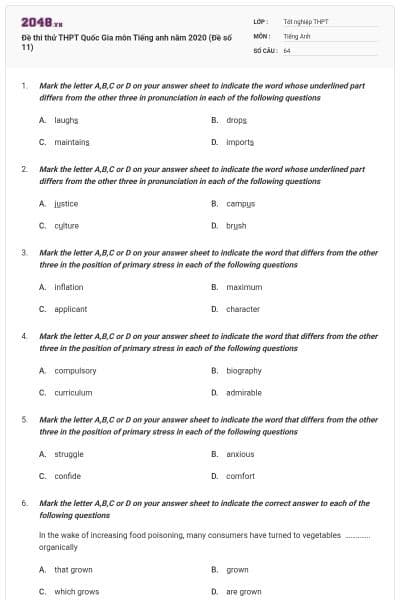
Đề thi thử THPT Quốc Gia môn Tiếng anh năm 2020 (Đề số 11)
64 câu hỏi
Mark the letter A,B,C or D on your answer sheet to indicate the word whose underlined part differs from the other three in pronunciation in each of the following questions
laughs
drops
maintains
imports
Đáp án là C.
A./s/ B./s/ C./z/ D./s/
Các từ có phát âm cuối là /k, p, t, f/ khi thêm s được đọc là /s/, các trường hợp còn lại đọc là /z/
Mark the letter A,B,C or D on your answer sheet to indicate the word whose underlined part differs from the other three in pronunciation in each of the following questions
justice
campus
culture
brush
Đáp án là B.
A./ʌ/ B./ə/ C. /ʌ/ D. /ʌ/
Mark the letter A,B,C or D on your answer sheet to indicate the word that differs from the other three in the position of primary stress in each of the following questions
inflation
maximum
applicant
character
Đáp án là A.
Phần A trọng âm rơi vào âm tiết thứ 2, còn lại là thứ nhất
Mark the letter A,B,C or D on your answer sheet to indicate the word that differs from the other three in the position of primary stress in each of the following questions
compulsory
biography
curriculum
admirable
Đáp án là D.
Phần D trọng âm rơi vào âm tiết thứ nhất, còn lại là thứ 2
Mark the letter A,B,C or D on your answer sheet to indicate the word that differs from the other three in the position of primary stress in each of the following questions
struggle
anxious
confide
comfort
Đáp án là C.
Phần C trọng âm rơi vào âm tiết thứ 2, còn lại là thứ nhất
Mark the letter A,B,C or D on your answer sheet to indicate the correct answer to each of the following questions
In the wake of increasing food poisoning, many consumers have turned to vegetables ………….. organically
that grown
grown
which grows
are grown
Đáp án là B.
“grown” ở đây được hiểu là thay thế cho mệnh đề quan hệ “which are grown”
Mark the letter A,B,C or D on your answer sheet to indicate the correct answer to each of the following questions
It is raining heavily with rolls of thunder. We ……………….such a terrible thunderstorm.
would never see
had never seen
have never seen
never see
Đáp án là C.
Câu phía trước đang dùng thì hiện tại, vì thế, thì tương lai và quá khứ hoàn thành loại. “have never seen”: trước nay chưa bao giờ thấy, thì phù hợp ở đây là hiện tại hoàn thành
Mark the letter A,B,C or D on your answer sheet to indicate the correct answer to each of the following questions
Most teenagers enjoy …………… the Internet for information and entertainment
surfing
surf
surfed
to surf
Đáp án là A.
Cấu trúc enjoy + Ving: yêu thích, thích thú làm gì
Mark the letter A,B,C or D on your answer sheet to indicate the correct answer to each of the following questions
…………….they are delicious, hamburgers and French fries are too high in fat
However
Although
Because
Despite
Đáp án là B.
Về nghĩa đây là câu đối lập về nghĩa của 2 vế, do đó ta phải lựa chọn Although (tuy nhiên)
Despite cũng là tuy nhiên, nhưng despite + danh từ/cụm danh từ
Mark the letter A,B,C or D on your answer sheet to indicate the correct answer to each of the following questions
Canned food is not as healthy as fresh food,………..?
isn’t it
doesn’t it
is it
does it
Đáp án là C.
Câu hỏi đuôi, nếu như trong câu là khẳng định thì câu hỏi đuôi là phủ định và ngược lại
Mark the letter A,B,C or D on your answer sheet to indicate the correct answer to each of the following questions
Without your help, I……………..the technical problem with my computer the other day
wouldn’t solve
couldn’t have solved
could solve
can’s solve
Đáp án là B.
Ở đây cũng giống như câu điều kiện loại 3: thể hiện một hành động không xảy ra trong quá khứ.
Phần vế nhận định: S + would/could…+ have + V phân từ II +…
Mark the letter A,B,C or D on your answer sheet to indicate the correct answer to each of the following questions
This part of the country is famous ………………..its beautiful landscapes and fine cuisine
about
with
of
for
Đáp án là D.
“famous for….”: nổi tiếng vì cái gì
In a modern family, the husband is expected to join hands with his wife to ……………… the household chores
do
run
take
make
Đáp án là A.
Cụm “do the household chores”: làm việc nhà
Mark the letter A,B,C or D on your answer sheet to indicate the correct answer to each of the following questions
Most psychologists agree that the basic structure of an individual’s personality is…………………
by the age of five it is quite well established
quite well established by the age of five
well established quite by the age of five
by the age of five and quite well established
Đáp án là B.
Vị trí: trạng từ chỉ mức độ (quite, very, so…) đứng trước các trạng từ bổ sung ý nghĩa cho động từ (well, badly…)
Mark the letter A,B,C or D on your answer sheet to indicate the correct answer to each of the following questions
A waiter in a restaurant is talking to a customer who has just finished his meal there. Select the most suitable response to complete the exchange
- Waiter: “Here’s your bill, sir”
- Customer: “………………………”
Don’t mention it
Can I pay by credit card?
What do you have?
You’re welcome
Đáp án là B.
“Đây là hoá đơn của ngài.”
“Tôi có thể trả bằng thẻ không?”
Mark the letter A,B,C or D on your answer sheet to indicate the correct answer to each of the following questions
The Government has brought ………………a new law in an effort to prevent further environmental deterioration
in
about
up
on
Đáp án: A
Giải thích:
Kiến thức: Cụm động từ
A. bring in (phr.v): giới thiệu, ban hành (luật, quy định)
B. bring about (phr.v): gây ra, dẫn đến (thường là kết quả, sự thay đổi)
C. bring up (phr.v): nuôi dưỡng
D. bring on (phr.v): gây ra (thường là điều không mong muốn như bệnh)
Dựa vào nghĩa, chọn A.
Dịch: Chính phủ đã ban hành một đạo luật mới nhằm ngăn chặn sự suy thoái môi trường thêm nữa.
Mark the letter A,B,C or D on your answer sheet to indicate the correct answer to each of the following questions
She took a course in fine arts ………………starting her own business in interior design
with a view to
in terms of
in order to
with preference to
Đáp án A
“with a view to doing st”: với mục đích làm gì
“in order to do st”: để làm gì
“in terms of…”: dưới dạng, được xem như…
“with reference to..”: có liên quan đến, về việc…
Dịch nghĩa: Cô ấy đã tham gia một khóa học về mỹ thuật với mục đích bắt đầu kinh doanh riêng trong lĩnh vực thiết kế nội thất.
Mark the letter A,B,C or D on your answer sheet to indicate the correct answer to each of the following questions
All the …………..in the stadium applauded the winner of the marathon when he crossed the finishing line
watchers
audience
viewers
spectators
Đáp án là D.
“spectators”: khán giả (của một trận bóng đá, thể thao ngoài trời…)
“viewers”: khán giả trên truyền hình
“watchers”: người quan sát (người, cái gì) một cách thường xuyên
“audience”: khán giả trong nhà hát, rạp,…
Mark the letter A,B,C or D on your answer sheet to indicate the correct answer to each of the following questions
The table in the living room should be moved to …………..the new TV set
get rid of
pave the way for
make room for
take hold of
Đáp án là C.
“make room for”: dành chỗ cho…
“get rid of”: bỏ, từ bỏ…
“pave the way for..”: mở đường cho…
“take hold of…”: nắm trong tay..
Mark the letter A,B,C or D on your answer sheet to indicate the correct answer to each of the following questions
The US president Barack Obama …………….an official visit to Vietnam in May 2016, which is of great significance to the comprehensive bilateral partnership
delivered
paid
offered
gave
Đáp án: B
Giải thích:
deliver (v): phân phát, giao hàng
pay (v): chi trả
offer (v): đề nghị, đưa ra đề nghị
give (v): đưa, tặng
Ta có cụm: pay a visit: ghé thăm
Dịch: Tổng thống Hoa Kỳ Barack Obama thăm chính thức Việt Nam vào tháng 5/2016, chuyến thăm này có ý nghĩa to lớn đối với quan hệ đối tác toàn diện giữa hai nước.
Mark the letter A,B,C or D on your answer sheet to indicate the correct answer to each of the following questions
Two close friends Tom and Kyle are talking about Kyle’s upcoming birthday. Select the most suitable response to complete the exchange
- Tom: “Can I bring a friend to your birthday party?”
- Kyle: “………………..”
It’s my honour
Let’s do it then
The more the merrier
That’s right
Đáp án là C.
“Tôi có thể dẫn thêm 1 bạn đến tiệc sinh nhật của cậu không?”
“Càng đông càng vui mà.”
Mark the letter A,B,C or D on your answer sheet to indicate the correct answer to each of the following questions
Candidates are requested to ………….the form to the admissions officer by July 25th
fill out
show up
pass over
hand in
Đáp án là D.
“hand in”: nộp (giấy tờ, bài tập…)
Mark the letter A,B,C or D on your answer sheet to indicate the correct answer to each of the following questions
The firefighters’ single-minded devotion to the rescue of the victims of the fire was …………..
respecting
respective
respectful
respectable
Đáp án: D
Giải thích:
Kiến thức: Cấu tạo từ
Vị trí cần điền đứng sau động từ “to be” nên cần một tính từ
Xét các đáp án:
A. respecting: động từ dạng V-ing của động từ “respect” (v): tôn trọng, ngưỡng mộ
B. respective (adj): tương ứng
C. respectful (adj): tỏ ra, thể hiện sự tôn kính, ngưỡng mộ
D. respectable (adj): đáng ngưỡng mộ, đáng tôn trọng
Dựa vào nghĩa câu, chọn D.
Dịch: Sự tận tâm tận tâm của lực lượng cứu hỏa trong việc giải cứu các nạn nhân của vụ cháy thật đáng ngưỡng mộ.
Mark the letter A,B,C or D on your answer sheet to indicate the correct answer to each of the following questions
The university administrations are introducing new measures to………………….that the enrolment process runs smoothly
maintain
improve
facilitate
ensure
Đáp án: D
Giải thích:
Kiến thức: Từ vựng
Maintain (v): giữ vững, ổn định
improve (v): nâng cao, cải thiện
facilitate (v): làm cho dễ dàng, tạo điều kiện dễ dàng.
ensure (v): đảm bảo, chắc chắn (rằng)…
Dựa vào nghĩa câu, chọn D.
Dịch: Ban quản lý trường đại học đang đưa ra các biện pháp mới để đảm bảo quá trình tuyển sinh diễn ra suôn sẻ.
Mark the letter A,B,C or D on your answer sheet to indicate the word(s) CLOSEST in meaning to the underlined word(s) in each of the following questions
Not until all their demands had been turned down did the workers decide to go on strike for more welfare
rejected
sacked
reviewed
deleted
Đáp án là A.
“turn down” = “reject”: từ chối
Mark the letter A,B,C or D on your answer sheet to indicate the word(s) CLOSEST in meaning to the underlined word(s) in each of the following questions
Environmentalists appeal to the government to enact laws to stop factories from discharging toxic chemicals into the sea
releasing
producing
obtaining
dismissing
Đáp án là A.
“discharge” = “release”: thải ra
Mark the letter A,B,C or D on your answer sheet to indicate the word(s) CLOSEST in meaning to the underlined word(s) in each of the following questions
The overall aim of the book is to help bridge the gap between theory and practice, particularly in language teaching
increase the understanding
reduce the difference
minimize the limitations
construct a bridge
Đáp án là B.
“bridge the gap” = “reduce the differences”: giảm thiểu sự khác biệt
Mark the letter A,B,C,D on your answer sheet to indicate the underlined part that needs correction in each of the following questions
The longer the children waited in the long queue, the more impatiently they becam
The longer
waited
the long queue
impatiently
Đáp án là D.
“impatiently” -> “impatient” Sau become dùng tính từ bổ sung ý nghĩa, chứ không dùng trạng từ như nhiều động từ khác
Mark the letter A,B,C,D on your answer sheet to indicate the underlined part that needs correction in each of the following questions
Because of bad weather conditions, it took the explorers three days reaching their destination
Because
weather conditions
the explorers
reaching
Đáp án là D.
“reaching” -> “to reach” Cấu trúc “take sb time to do st”: mất ai đó bao nhiêu thời gian để làm cái gì
Mark the letter A,B,C,D on your answer sheet to indicate the underlined part that needs correction in each of the following questions
According to most doctors, massage relieves pain and anxiety, eases depression and speeding up recovery from illnesses
most doctors
relieves
speeding up
illnesses
Đáp án là C.
“speeding up” -> “speeds up”
Phía trước các động từ được chia ở thì hiện tại (relieves, eases) nên ở đây cũng phải chia là speeds
Mark the letter A,B,C,D on your answer sheet to indicate the underlined part that needs correction in each of the following questions
New sources of energy have been looking for as the number of fossil fuels continues to decrease
sources of energy
been looking
number
continues
Đáp án là B.
“have been looking” -> “have been looked” Chủ ngữ là vật (New sources of energy) nên câu được chia ở dạng bị động ở thì hiện tại hoàn thành
Mark the letter A,B,C,D on your answer sheet to indicate the underlined part that needs correction in each of the following questions
The science of medicine, which progress has been very rapid lately, is perhaps the most important of all sciences
The science
which
very rapid
all sciences
Đáp án là B.
“which” -> “whose”
“whose” là mệnh đề quan hệ mang tính sở hữu, ở đây “whose progress” = The science of medicine’s progress
Read the following passage and mark the letter A,B,C or D on your answer sheet to indicate the correct answer to each of the questions from 33 to 42
Though called by sweet-sounding names like Firinga or Katrina, tropical cyclones are huge rotating storms 200 to 2,000 kilometers wide with winds that blow at speeds of more than 100 kilometers per hour (kph). Weather professionals know them as tropical cyclones, but they are called hurricanes in the Caribbean Sea, typhoons in the Pacific Ocean, and cyclones in the Indian Ocean. They occur in both the northern and southern hemispheres. Large ones have destroyed cities and killed hundreds of thousands of people.
Tropical cyclones begin over water that is warmer than 27 degrees Celsius (80 degrees Fahrenheit) slightly north or south of the earth’s equator. Warm, humid air full of water vapor moves upward. The earth’s rotation causes the growing storm to start to rotate around its center (called the eye). At the certain height, the water vapor condenses, changing to liquid and releasing heat. The heat draws more air and water vapor upward,
creating a cycle as air and water vapor rise and liquid water falls. If the cycle speeds up until winds reach 118 kilometers per hour, the storm qualifies as a tropical cyclone.
Most deaths in tropical cyclones are caused by storm surge. This is a rise in sea level, sometimes seven meters or more, caused by the storm pushing against the ocean’s surface. Storm surge was to blame for the flooding of New Orleans in 2005. The storm surge of Cyclone Nargis in 2008 in Myanmar pushed seawater nearly four meters deep some40 kilometers inland, resulting in many deaths.
It has never been easy to forecast a tropical cyclone accurately. The goal is to know when and where the next tropical cyclone will form. “And we can’t really do that yet”, says David Nolan, a weather researcher from the University of Miami. The direction and strength of tropical cyclones are also difficult to predict, even with computer assistance. In fact, long-term forecasts are poor; small differences in the combination of weather factors lead to very different storms. More accurate forecasting could help people decide to evacuate when a storm is on the way.
As stated in paragraph 1, tropical cyclones are storms with winds blowing at speeds of________.
more than 100 kph
at least 200 kph
less than 100 kph
no less than 200 kph
Đáp án là A.
Thông tin ở ngay câu đầu tiên của đoạn 1: Though called by sweet-sounding names like Firinga or Katrina, tropical cyclones are huge rotating storms 200 to 2,000 kilometers wide with winds that blow at speeds of more than 100 kilometers per hour (kph).
Read the following passage and mark the letter A,B,C or D on your answer sheet to indicate the correct answer to each of the questions from 33 to 42
Though called by sweet-sounding names like Firinga or Katrina, tropical cyclones are huge rotating storms 200 to 2,000 kilometers wide with winds that blow at speeds of more than 100 kilometers per hour (kph). Weather professionals know them as tropical cyclones, but they are called hurricanes in the Caribbean Sea, typhoons in the Pacific Ocean, and cyclones in the Indian Ocean. They occur in both the northern and southern hemispheres. Large ones have destroyed cities and killed hundreds of thousands of people.
Tropical cyclones begin over water that is warmer than 27 degrees Celsius (80 degrees Fahrenheit) slightly north or south of the earth’s equator. Warm, humid air full of water vapor moves upward. The earth’s rotation causes the growing storm to start to rotate around its center (called the eye). At the certain height, the water vapor condenses, changing to liquid and releasing heat. The heat draws more air and water vapor upward,
creating a cycle as air and water vapor rise and liquid water falls. If the cycle speeds up until winds reach 118 kilometers per hour, the storm qualifies as a tropical cyclone.
Most deaths in tropical cyclones are caused by storm surge. This is a rise in sea level, sometimes seven meters or more, caused by the storm pushing against the ocean’s surface. Storm surge was to blame for the flooding of New Orleans in 2005. The storm surge of Cyclone Nargis in 2008 in Myanmar pushed seawater nearly four meters deep some40 kilometers inland, resulting in many deaths.
It has never been easy to forecast a tropical cyclone accurately. The goal is to know when and where the next tropical cyclone will form. “And we can’t really do that yet”, says David Nolan, a weather researcher from the University of Miami. The direction and strength of tropical cyclones are also difficult to predict, even with computer assistance. In fact, long-term forecasts are poor; small differences in the combination of weather factors lead to very different storms. More accurate forecasting could help people decide to evacuate when a storm is on the way.
The word “they” in paragraph 1 refers to _________.
sweet-sounding names
wind speeds
tropical cyclones
weather professionals
Đáp án là C.
“they” được thay thế cho tropical cyclones trong vế trước: Weather professionals know them as tropical cyclones, but they are called hurricanes in the Caribbean Sea, typhoons in the Pacific Ocean, and cyclones in the Indian Ocean: các chuyên gia thời tiết nhận biết chúng như bão nhiệt đới, nhưng chúng được gọi là cơn bão ở vùng biển Caribê, bão ở Thái Bình Dương, và lốc xoáy ở Ấn Độ Dương
Read the following passage and mark the letter A,B,C or D on your answer sheet to indicate the correct answer to each of the questions from 33 to 42
Though called by sweet-sounding names like Firinga or Katrina, tropical cyclones are huge rotating storms 200 to 2,000 kilometers wide with winds that blow at speeds of more than 100 kilometers per hour (kph). Weather professionals know them as tropical cyclones, but they are called hurricanes in the Caribbean Sea, typhoons in the Pacific Ocean, and cyclones in the Indian Ocean. They occur in both the northern and southern hemispheres. Large ones have destroyed cities and killed hundreds of thousands of people.
Tropical cyclones begin over water that is warmer than 27 degrees Celsius (80 degrees Fahrenheit) slightly north or south of the earth’s equator. Warm, humid air full of water vapor moves upward. The earth’s rotation causes the growing storm to start to rotate around its center (called the eye). At the certain height, the water vapor condenses, changing to liquid and releasing heat. The heat draws more air and water vapor upward,
creating a cycle as air and water vapor rise and liquid water falls. If the cycle speeds up until winds reach 118 kilometers per hour, the storm qualifies as a tropical cyclone.
Most deaths in tropical cyclones are caused by storm surge. This is a rise in sea level, sometimes seven meters or more, caused by the storm pushing against the ocean’s surface. Storm surge was to blame for the flooding of New Orleans in 2005. The storm surge of Cyclone Nargis in 2008 in Myanmar pushed seawater nearly four meters deep some40 kilometers inland, resulting in many deaths.
It has never been easy to forecast a tropical cyclone accurately. The goal is to know when and where the next tropical cyclone will form. “And we can’t really do that yet”, says David Nolan, a weather researcher from the University of Miami. The direction and strength of tropical cyclones are also difficult to predict, even with computer assistance. In fact, long-term forecasts are poor; small differences in the combination of weather factors lead to very different storms. More accurate forecasting could help people decide to evacuate when a storm is on the way.
According to the passage, tropical cyclones are called typhoons in ________.
the Indian Ocean
the Arctic Ocean
the Atlantic Ocean
the Pacific Ocean
Đáp án là D.
Thông tin ở câu thứ 2 đoạn đầu tiên: but they are called hurricanes in the Caribbean Sea, typhoons in the Pacific Ocean
Read the following passage and mark the letter A,B,C or D on your answer sheet to indicate the correct answer to each of the questions from 33 to 42
Though called by sweet-sounding names like Firinga or Katrina, tropical cyclones are huge rotating storms 200 to 2,000 kilometers wide with winds that blow at speeds of more than 100 kilometers per hour (kph). Weather professionals know them as tropical cyclones, but they are called hurricanes in the Caribbean Sea, typhoons in the Pacific Ocean, and cyclones in the Indian Ocean. They occur in both the northern and southern hemispheres. Large ones have destroyed cities and killed hundreds of thousands of people.
Tropical cyclones begin over water that is warmer than 27 degrees Celsius (80 degrees Fahrenheit) slightly north or south of the earth’s equator. Warm, humid air full of water vapor moves upward. The earth’s rotation causes the growing storm to start to rotate around its center (called the eye). At the certain height, the water vapor condenses, changing to liquid and releasing heat. The heat draws more air and water vapor upward,
creating a cycle as air and water vapor rise and liquid water falls. If the cycle speeds up until winds reach 118 kilometers per hour, the storm qualifies as a tropical cyclone.
Most deaths in tropical cyclones are caused by storm surge. This is a rise in sea level, sometimes seven meters or more, caused by the storm pushing against the ocean’s surface. Storm surge was to blame for the flooding of New Orleans in 2005. The storm surge of Cyclone Nargis in 2008 in Myanmar pushed seawater nearly four meters deep some40 kilometers inland, resulting in many deaths.
It has never been easy to forecast a tropical cyclone accurately. The goal is to know when and where the next tropical cyclone will form. “And we can’t really do that yet”, says David Nolan, a weather researcher from the University of Miami. The direction and strength of tropical cyclones are also difficult to predict, even with computer assistance. In fact, long-term forecasts are poor; small differences in the combination of weather factors lead to very different storms. More accurate forecasting could help people decide to evacuate when a storm is on the way.
The word “humid” in paragraph 2 is closest in meaning to _______.
moist
dry
thin
thick
Đáp án là A.
“humid” = “moist”: ẩm, ẩm ướt
Read the following passage and mark the letter A,B,C or D on your answer sheet to indicate the correct answer to each of the questions from 33 to 42
Though called by sweet-sounding names like Firinga or Katrina, tropical cyclones are huge rotating storms 200 to 2,000 kilometers wide with winds that blow at speeds of more than 100 kilometers per hour (kph). Weather professionals know them as tropical cyclones, but they are called hurricanes in the Caribbean Sea, typhoons in the Pacific Ocean, and cyclones in the Indian Ocean. They occur in both the northern and southern hemispheres. Large ones have destroyed cities and killed hundreds of thousands of people.
Tropical cyclones begin over water that is warmer than 27 degrees Celsius (80 degrees Fahrenheit) slightly north or south of the earth’s equator. Warm, humid air full of water vapor moves upward. The earth’s rotation causes the growing storm to start to rotate around its center (called the eye). At the certain height, the water vapor condenses, changing to liquid and releasing heat. The heat draws more air and water vapor upward,
creating a cycle as air and water vapor rise and liquid water falls. If the cycle speeds up until winds reach 118 kilometers per hour, the storm qualifies as a tropical cyclone.
Most deaths in tropical cyclones are caused by storm surge. This is a rise in sea level, sometimes seven meters or more, caused by the storm pushing against the ocean’s surface. Storm surge was to blame for the flooding of New Orleans in 2005. The storm surge of Cyclone Nargis in 2008 in Myanmar pushed seawater nearly four meters deep some40 kilometers inland, resulting in many deaths.
It has never been easy to forecast a tropical cyclone accurately. The goal is to know when and where the next tropical cyclone will form. “And we can’t really do that yet”, says David Nolan, a weather researcher from the University of Miami. The direction and strength of tropical cyclones are also difficult to predict, even with computer assistance. In fact, long-term forecasts are poor; small differences in the combination of weather factors lead to very different storms. More accurate forecasting could help people decide to evacuate when a storm is on the way.
Which the following comes first in the process of storm formation?
Liquid water falls.
Warm, humid air moves upward
Water vapor condenses
Wind speed reaches 118 kph
Đáp án là B.
Thông tin ở 2 câu đầu đoạn 2: Tropical cyclones begin over water that is warmer than 27 degrees Celsius (80 degrees Fahrenheit) slightly north or south of the earth’s equator. Warm, humid air full of water vapor moves upward: lốc xoáy nhiệt đới bắt đầu trong nước ấm hơn 27 độ C (80 độ F) một chút về phía bắc hay phía nam của đường xích đạo của trái đất. không khí nóng, ẩm đầy hơi nước di chuyển lên trên.
Read the following passage and mark the letter A,B,C or D on your answer sheet to indicate the correct answer to each of the questions from 33 to 42
Though called by sweet-sounding names like Firinga or Katrina, tropical cyclones are huge rotating storms 200 to 2,000 kilometers wide with winds that blow at speeds of more than 100 kilometers per hour (kph). Weather professionals know them as tropical cyclones, but they are called hurricanes in the Caribbean Sea, typhoons in the Pacific Ocean, and cyclones in the Indian Ocean. They occur in both the northern and southern hemispheres. Large ones have destroyed cities and killed hundreds of thousands of people.
Tropical cyclones begin over water that is warmer than 27 degrees Celsius (80 degrees Fahrenheit) slightly north or south of the earth’s equator. Warm, humid air full of water vapor moves upward. The earth’s rotation causes the growing storm to start to rotate around its center (called the eye). At the certain height, the water vapor condenses, changing to liquid and releasing heat. The heat draws more air and water vapor upward,
creating a cycle as air and water vapor rise and liquid water falls. If the cycle speeds up until winds reach 118 kilometers per hour, the storm qualifies as a tropical cyclone.
Most deaths in tropical cyclones are caused by storm surge. This is a rise in sea level, sometimes seven meters or more, caused by the storm pushing against the ocean’s surface. Storm surge was to blame for the flooding of New Orleans in 2005. The storm surge of Cyclone Nargis in 2008 in Myanmar pushed seawater nearly four meters deep some40 kilometers inland, resulting in many deaths.
It has never been easy to forecast a tropical cyclone accurately. The goal is to know when and where the next tropical cyclone will form. “And we can’t really do that yet”, says David Nolan, a weather researcher from the University of Miami. The direction and strength of tropical cyclones are also difficult to predict, even with computer assistance. In fact, long-term forecasts are poor; small differences in the combination of weather factors lead to very different storms. More accurate forecasting could help people decide to evacuate when a storm is on the way.
According to the passage, a storm surge is ___________.
a rise in sea level
pushing seawater
a tropical cyclone
inland flooding
Đáp án là A.
Thông tin ở câu 1 và 2 đoạn 3: Most deaths in tropical cyclones are caused by storm surge. This is a rise in sea level
Read the following passage and mark the letter A,B,C or D on your answer sheet to indicate the correct answer to each of the questions from 33 to 42
Though called by sweet-sounding names like Firinga or Katrina, tropical cyclones are huge rotating storms 200 to 2,000 kilometers wide with winds that blow at speeds of more than 100 kilometers per hour (kph). Weather professionals know them as tropical cyclones, but they are called hurricanes in the Caribbean Sea, typhoons in the Pacific Ocean, and cyclones in the Indian Ocean. They occur in both the northern and southern hemispheres. Large ones have destroyed cities and killed hundreds of thousands of people.
Tropical cyclones begin over water that is warmer than 27 degrees Celsius (80 degrees Fahrenheit) slightly north or south of the earth’s equator. Warm, humid air full of water vapor moves upward. The earth’s rotation causes the growing storm to start to rotate around its center (called the eye). At the certain height, the water vapor condenses, changing to liquid and releasing heat. The heat draws more air and water vapor upward,
creating a cycle as air and water vapor rise and liquid water falls. If the cycle speeds up until winds reach 118 kilometers per hour, the storm qualifies as a tropical cyclone.
Most deaths in tropical cyclones are caused by storm surge. This is a rise in sea level, sometimes seven meters or more, caused by the storm pushing against the ocean’s surface. Storm surge was to blame for the flooding of New Orleans in 2005. The storm surge of Cyclone Nargis in 2008 in Myanmar pushed seawater nearly four meters deep some40 kilometers inland, resulting in many deaths.
It has never been easy to forecast a tropical cyclone accurately. The goal is to know when and where the next tropical cyclone will form. “And we can’t really do that yet”, says David Nolan, a weather researcher from the University of Miami. The direction and strength of tropical cyclones are also difficult to predict, even with computer assistance. In fact, long-term forecasts are poor; small differences in the combination of weather factors lead to very different storms. More accurate forecasting could help people decide to evacuate when a storm is on the way.
What is true about the storm surge of Cyclone Nargis?
It took a very high death toll.
It caused flooding in New Orleans in 2005
It occurred in Myanmar in 2005.
It pushed seawater 4 kilometers inland
Đáp án là A.
Thông tin ở câu cuối đoạn 3: The storm surge of Cyclone Nargis in 2008 in Myanmar pushed seawater nearly four meters deep some 40 kilometers inland, resulting in many deaths (=It took a very high death toll): Sự gia tăng bão của cơn bão Nargis năm 2008 tại Myanmar đẩy nước biển gần bốn mét vào sâu khoảng 40 km đất liền, dẫn đến nhiều cái chết
Read the following passage and mark the letter A,B,C or D on your answer sheet to indicate the correct answer to each of the questions from 33 to 42
Though called by sweet-sounding names like Firinga or Katrina, tropical cyclones are huge rotating storms 200 to 2,000 kilometers wide with winds that blow at speeds of more than 100 kilometers per hour (kph). Weather professionals know them as tropical cyclones, but they are called hurricanes in the Caribbean Sea, typhoons in the Pacific Ocean, and cyclones in the Indian Ocean. They occur in both the northern and southern hemispheres. Large ones have destroyed cities and killed hundreds of thousands of people.
Tropical cyclones begin over water that is warmer than 27 degrees Celsius (80 degrees Fahrenheit) slightly north or south of the earth’s equator. Warm, humid air full of water vapor moves upward. The earth’s rotation causes the growing storm to start to rotate around its center (called the eye). At the certain height, the water vapor condenses, changing to liquid and releasing heat. The heat draws more air and water vapor upward,
creating a cycle as air and water vapor rise and liquid water falls. If the cycle speeds up until winds reach 118 kilometers per hour, the storm qualifies as a tropical cyclone.
Most deaths in tropical cyclones are caused by storm surge. This is a rise in sea level, sometimes seven meters or more, caused by the storm pushing against the ocean’s surface. Storm surge was to blame for the flooding of New Orleans in 2005. The storm surge of Cyclone Nargis in 2008 in Myanmar pushed seawater nearly four meters deep some40 kilometers inland, resulting in many deaths.
It has never been easy to forecast a tropical cyclone accurately. The goal is to know when and where the next tropical cyclone will form. “And we can’t really do that yet”, says David Nolan, a weather researcher from the University of Miami. The direction and strength of tropical cyclones are also difficult to predict, even with computer assistance. In fact, long-term forecasts are poor; small differences in the combination of weather factors lead to very different storms. More accurate forecasting could help people decide to evacuate when a storm is on the way.
The word “evacuate” in paragraph 4 mostly means _______.
move to safer places
make accurate predictions
take preventive measures
call for relief supplies
Đáp án là A.
“evacuate” bài được hiểu là move to safer places (di chuyển đến nơi an toàn hơn). More accurate forecasting could help people decide to evacuate when a storm is on the way: dự báo chính xác hơn có thể giúp mọi người quyết định sơ tán khi một cơn bão sắp đến
Read the following passage and mark the letter A,B,C or D on your answer sheet to indicate the correct answer to each of the questions from 33 to 42
Though called by sweet-sounding names like Firinga or Katrina, tropical cyclones are huge rotating storms 200 to 2,000 kilometers wide with winds that blow at speeds of more than 100 kilometers per hour (kph). Weather professionals know them as tropical cyclones, but they are called hurricanes in the Caribbean Sea, typhoons in the Pacific Ocean, and cyclones in the Indian Ocean. They occur in both the northern and southern hemispheres. Large ones have destroyed cities and killed hundreds of thousands of people.
Tropical cyclones begin over water that is warmer than 27 degrees Celsius (80 degrees Fahrenheit) slightly north or south of the earth’s equator. Warm, humid air full of water vapor moves upward. The earth’s rotation causes the growing storm to start to rotate around its center (called the eye). At the certain height, the water vapor condenses, changing to liquid and releasing heat. The heat draws more air and water vapor upward,
creating a cycle as air and water vapor rise and liquid water falls. If the cycle speeds up until winds reach 118 kilometers per hour, the storm qualifies as a tropical cyclone.
Most deaths in tropical cyclones are caused by storm surge. This is a rise in sea level, sometimes seven meters or more, caused by the storm pushing against the ocean’s surface. Storm surge was to blame for the flooding of New Orleans in 2005. The storm surge of Cyclone Nargis in 2008 in Myanmar pushed seawater nearly four meters deep some40 kilometers inland, resulting in many deaths.
It has never been easy to forecast a tropical cyclone accurately. The goal is to know when and where the next tropical cyclone will form. “And we can’t really do that yet”, says David Nolan, a weather researcher from the University of Miami. The direction and strength of tropical cyclones are also difficult to predict, even with computer assistance. In fact, long-term forecasts are poor; small differences in the combination of weather factors lead to very different storms. More accurate forecasting could help people decide to evacuate when a storm is on the way.
Which of the following statements is NOT true according to the passage?
The center of a growing storm is known as its eye.
The direction and strength of tropical cyclones are difficult to forecast
Tropical cyclone are often given beautiful names
Tropical cyclone predictions depend entirely on computer assistance
Đáp án là D.
Thông tin ở đoạn cuối: The direction and strength of tropical cyclones are also difficult to predict, even with computer assistance: hướng và sức mạnh của các cơn bão nhiệt đới này cũng rất khó để dự đoán, ngay cả với sự trợ giúp máy tính. Vì thế, đáp án không đúng chính là: Tropical cyclone predictions depend entirely on computer assistance (dự đoán cơn bão nhiệt đới phụ thuộc hoàn toàn vào sự trợ giúp máy tính.)
Read the following passage and mark the letter A,B,C or D on your answer sheet to indicate the correct answer to each of the questions from 33 to 42
Though called by sweet-sounding names like Firinga or Katrina, tropical cyclones are huge rotating storms 200 to 2,000 kilometers wide with winds that blow at speeds of more than 100 kilometers per hour (kph). Weather professionals know them as tropical cyclones, but they are called hurricanes in the Caribbean Sea, typhoons in the Pacific Ocean, and cyclones in the Indian Ocean. They occur in both the northern and southern hemispheres. Large ones have destroyed cities and killed hundreds of thousands of people.
Tropical cyclones begin over water that is warmer than 27 degrees Celsius (80 degrees Fahrenheit) slightly north or south of the earth’s equator. Warm, humid air full of water vapor moves upward. The earth’s rotation causes the growing storm to start to rotate around its center (called the eye). At the certain height, the water vapor condenses, changing to liquid and releasing heat. The heat draws more air and water vapor upward,
creating a cycle as air and water vapor rise and liquid water falls. If the cycle speeds up until winds reach 118 kilometers per hour, the storm qualifies as a tropical cyclone.
Most deaths in tropical cyclones are caused by storm surge. This is a rise in sea level, sometimes seven meters or more, caused by the storm pushing against the ocean’s surface. Storm surge was to blame for the flooding of New Orleans in 2005. The storm surge of Cyclone Nargis in 2008 in Myanmar pushed seawater nearly four meters deep some40 kilometers inland, resulting in many deaths.
It has never been easy to forecast a tropical cyclone accurately. The goal is to know when and where the next tropical cyclone will form. “And we can’t really do that yet”, says David Nolan, a weather researcher from the University of Miami. The direction and strength of tropical cyclones are also difficult to predict, even with computer assistance. In fact, long-term forecasts are poor; small differences in the combination of weather factors lead to very different storms. More accurate forecasting could help people decide to evacuate when a storm is on the way.
Which of the following would serve as the best title for the passage?
Cyclone Forecasting
Tropical Cyclones
Storm Surges
Cyclone Formation
Đáp án là B.
Tiêu đề phù hợp nhất của bài này là Tropical Cyclones (Các cơn bão nhiệt đới) Bài văn nói về sự hình thành, một số tên gọi, và sự dự đoán về bão nhiệt đới
Mark the letter A, B, C, D on your answer sheet to indicate the word(s) OPPOSITE in meaning to the underlined word(s) in each of the following questions.
It is widely known that the excessive use of pesticides is producing a detrimental effect on the local groundwater.
useless
harmless
damaging
fundamental
Đáp án: B
Giải thích:
Kiến thức: Từ trái nghĩa
detrimental (adj): bất lợi, có hại
Xét các đáp án:
A. useless (adj): vô dụng
B. harmless (adj): vô hại
C. damaging (adj): gây hại
D. fundamental (adj): cơ bản
→ detrimental >< harmless
Dịch: Ai cũng biết rằng việc sử dụng quá nhiều thuốc trừ sâu đang tạo ra tác động bất lợi đối với nguồn nước ngầm địa phương.
Mark the letter A, B, C, D on your answer sheet to indicate the word(s) OPPOSITE in meaning to the underlined word(s) in each of the following questions.
His dreamlike villa in the new residential quarter is the envy of his friends
something that everybody looks for
something that everybody dreams of
something that nobody wants
something that nobody can afford
Đáp án là C.
“envy”: ghen tỵ, mong muốn
Trái nghĩa là “something that nobody wants”: điều mà không ai muốn
Read the following passage and mark the letter A, B, C, or D on your answer sheet to indicate the correct word or phrase that best fits each of the numbered blanks from 45 to 54
THE DANGERS OF DIETING
Thanks to our modern lifestyle, with more and more time spent sitting down in front of computers than ever before, the (43)____ of overweight people is at a new high. As people frantically search for a solution (44)____ this problem, they often try some of the popular fad diets being offered. Many people see fad diets (45)____ harmless ways of losing weight, and they are grateful to have them.Unfortunately, not only don’t fad diets usually (46)____ the trick, they can actually be dangerous for your health.
Although permanent weight loss is the (47)___, few are able to achieve it. Experts estimate that 95 percent of dieters return to their starting weight, or even (48)____ weight. While the reckless use of fad diets can bring some (49)____ result, long-term results are very rare. (50)____, people who are fed up with the difficulties of changing their eating habits often turn to fad diets. (51)____ being moderate, fad diets involve extreme dietary changes. They advises eating only one type of food, or they prohibit other types of foods entirely. This results in a situation (52)______ a person’s body doesn’t get all the vitamins and other things that it needs to stay healthy.
Điền vào ô số 45
number
range
amount
sum
Đáp án là A.
“the number of…”: số lượng… (phía sau là danh từ đếm được) Còn the amount of + danh từ không đếm được “the sum of..”: tổng số, “the range of..”:loạt, phạm vi… Thanks to our modern lifestyle, with more and more time spent sitting down in front of computers than ever before, the number of overweight people is at a new high: Nhờ lối sống hiện đại của chúng tôi, với ngày càng nhiều thời gian ngồi trước máy tính hơn bao giờ hết, số lượng người béo phì đang ở mức cao mới
Read the following passage and mark the letter A, B, C, or D on your answer sheet to indicate the correct word or phrase that best fits each of the numbered blanks from 45 to 54
THE DANGERS OF DIETING
Thanks to our modern lifestyle, with more and more time spent sitting down in front of computers than ever before, the (43)____ of overweight people is at a new high. As people frantically search for a solution (44)____ this problem, they often try some of the popular fad diets being offered. Many people see fad diets (45)____ harmless ways of losing weight, and they are grateful to have them.Unfortunately, not only don’t fad diets usually (46)____ the trick, they can actually be dangerous for your health.
Although permanent weight loss is the (47)___, few are able to achieve it. Experts estimate that 95 percent of dieters return to their starting weight, or even (48)____ weight. While the reckless use of fad diets can bring some (49)____ result, long-term results are very rare. (50)____, people who are fed up with the difficulties of changing their eating habits often turn to fad diets. (51)____ being moderate, fad diets involve extreme dietary changes. They advises eating only one type of food, or they prohibit other types of foods entirely. This results in a situation (52)______ a person’s body doesn’t get all the vitamins and other things that it needs to stay healthy.
Điền vào ô số 46
on
of
to
with
Đáp án là C.
“solution to st”: giải pháp, biện pháp cho vấn đề gì
Read the following passage and mark the letter A, B, C, or D on your answer sheet to indicate the correct word or phrase that best fits each of the numbered blanks from 45 to 54
THE DANGERS OF DIETING
Thanks to our modern lifestyle, with more and more time spent sitting down in front of computers than ever before, the (43)____ of overweight people is at a new high. As people frantically search for a solution (44)____ this problem, they often try some of the popular fad diets being offered. Many people see fad diets (45)____ harmless ways of losing weight, and they are grateful to have them.Unfortunately, not only don’t fad diets usually (46)____ the trick, they can actually be dangerous for your health.
Although permanent weight loss is the (47)___, few are able to achieve it. Experts estimate that 95 percent of dieters return to their starting weight, or even (48)____ weight. While the reckless use of fad diets can bring some (49)____ result, long-term results are very rare. (50)____, people who are fed up with the difficulties of changing their eating habits often turn to fad diets. (51)____ being moderate, fad diets involve extreme dietary changes. They advises eating only one type of food, or they prohibit other types of foods entirely. This results in a situation (52)______ a person’s body doesn’t get all the vitamins and other things that it needs to stay healthy.
Điền vào ô số 47
by
like
through
as
Đáp án là D.
“see st as…”: nhìn, cho rằng cái gì giống như… Many people see fad diets as harmless ways of losing weight:Nhiều người coi chế độ ăn kiêng như một cách giảm cân vô hại
Read the following passage and mark the letter A, B, C, or D on your answer sheet to indicate the correct word or phrase that best fits each of the numbered blanks from 45 to 54
THE DANGERS OF DIETING
Thanks to our modern lifestyle, with more and more time spent sitting down in front of computers than ever before, the (43)____ of overweight people is at a new high. As people frantically search for a solution (44)____ this problem, they often try some of the popular fad diets being offered. Many people see fad diets (45)____ harmless ways of losing weight, and they are grateful to have them.Unfortunately, not only don’t fad diets usually (46)____ the trick, they can actually be dangerous for your health.
Although permanent weight loss is the (47)___, few are able to achieve it. Experts estimate that 95 percent of dieters return to their starting weight, or even (48)____ weight. While the reckless use of fad diets can bring some (49)____ result, long-term results are very rare. (50)____, people who are fed up with the difficulties of changing their eating habits often turn to fad diets. (51)____ being moderate, fad diets involve extreme dietary changes. They advises eating only one type of food, or they prohibit other types of foods entirely. This results in a situation (52)______ a person’s body doesn’t get all the vitamins and other things that it needs to stay healthy.
Điền vào ô số 48
bring
do
take
play
Đáp án là B.
Cụm “do the trick”: làm thành công như ý muốn, đạt yêu cầu Unfortunately, not only don’t fad diets usually do the trick, they can actually be dangerous for your health: Thật không may, không chỉ những chế độ ăn kiêng này không như ý muốn, mà thực tế chúng còn có thể nguy hiểm cho sức khoẻ
Read the following passage and mark the letter A, B, C, or D on your answer sheet to indicate the correct word or phrase that best fits each of the numbered blanks from 45 to 54
THE DANGERS OF DIETING
Thanks to our modern lifestyle, with more and more time spent sitting down in front of computers than ever before, the (43)____ of overweight people is at a new high. As people frantically search for a solution (44)____ this problem, they often try some of the popular fad diets being offered. Many people see fad diets (45)____ harmless ways of losing weight, and they are grateful to have them.Unfortunately, not only don’t fad diets usually (46)____ the trick, they can actually be dangerous for your health.
Although permanent weight loss is the (47)___, few are able to achieve it. Experts estimate that 95 percent of dieters return to their starting weight, or even (48)____ weight. While the reckless use of fad diets can bring some (49)____ result, long-term results are very rare. (50)____, people who are fed up with the difficulties of changing their eating habits often turn to fad diets. (51)____ being moderate, fad diets involve extreme dietary changes. They advises eating only one type of food, or they prohibit other types of foods entirely. This results in a situation (52)______ a person’s body doesn’t get all the vitamins and other things that it needs to stay healthy.
Điền vào ô số 49
case
profit
benefit
goal
Đáp án là D.
“goal”: mục đích, mục tiêu Although permanent weight loss is the goal: Mặc dù giảm cân lâu dài là mục tiêu…
Read the following passage and mark the letter A, B, C, or D on your answer sheet to indicate the correct word or phrase that best fits each of the numbered blanks from 45 to 54
THE DANGERS OF DIETING
Thanks to our modern lifestyle, with more and more time spent sitting down in front of computers than ever before, the (43)____ of overweight people is at a new high. As people frantically search for a solution (44)____ this problem, they often try some of the popular fad diets being offered. Many people see fad diets (45)____ harmless ways of losing weight, and they are grateful to have them.Unfortunately, not only don’t fad diets usually (46)____ the trick, they can actually be dangerous for your health.
Although permanent weight loss is the (47)___, few are able to achieve it. Experts estimate that 95 percent of dieters return to their starting weight, or even (48)____ weight. While the reckless use of fad diets can bring some (49)____ result, long-term results are very rare. (50)____, people who are fed up with the difficulties of changing their eating habits often turn to fad diets. (51)____ being moderate, fad diets involve extreme dietary changes. They advises eating only one type of food, or they prohibit other types of foods entirely. This results in a situation (52)______ a person’s body doesn’t get all the vitamins and other things that it needs to stay healthy.
Điền vào ô số 50
lose
gain
put
reduce
Đáp án là B.
“gain weight” (add weight): tăng cân
Experts estimate that 95 percent of dieters return to their starting weight, or even gain weight: Các chuyên gia ước tính rằng 95% những người ăn kiêng trở lại trọng lượng ban đầu của họ, hoặc thậm chí tăng cân
Read the following passage and mark the letter A, B, C, or D on your answer sheet to indicate the correct word or phrase that best fits each of the numbered blanks from 45 to 54
THE DANGERS OF DIETING
Thanks to our modern lifestyle, with more and more time spent sitting down in front of computers than ever before, the (43)____ of overweight people is at a new high. As people frantically search for a solution (44)____ this problem, they often try some of the popular fad diets being offered. Many people see fad diets (45)____ harmless ways of losing weight, and they are grateful to have them.Unfortunately, not only don’t fad diets usually (46)____ the trick, they can actually be dangerous for your health.
Although permanent weight loss is the (47)___, few are able to achieve it. Experts estimate that 95 percent of dieters return to their starting weight, or even (48)____ weight. While the reckless use of fad diets can bring some (49)____ result, long-term results are very rare. (50)____, people who are fed up with the difficulties of changing their eating habits often turn to fad diets. (51)____ being moderate, fad diets involve extreme dietary changes. They advises eating only one type of food, or they prohibit other types of foods entirely. This results in a situation (52)______ a person’s body doesn’t get all the vitamins and other things that it needs to stay healthy.
Điền vào ô số 51
initial
initiative
initiating
initiate
Đáp án là A.
Ở đây ta cần một tính từ “initial”: đầu, đầu tiên Tránh nhầm lẫn với “initiative” (n): sáng kiến
Read the following passage and mark the letter A, B, C, or D on your answer sheet to indicate the correct word or phrase that best fits each of the numbered blanks from 45 to 54
THE DANGERS OF DIETING
Thanks to our modern lifestyle, with more and more time spent sitting down in front of computers than ever before, the (43)____ of overweight people is at a new high. As people frantically search for a solution (44)____ this problem, they often try some of the popular fad diets being offered. Many people see fad diets (45)____ harmless ways of losing weight, and they are grateful to have them.Unfortunately, not only don’t fad diets usually (46)____ the trick, they can actually be dangerous for your health.
Although permanent weight loss is the (47)___, few are able to achieve it. Experts estimate that 95 percent of dieters return to their starting weight, or even (48)____ weight. While the reckless use of fad diets can bring some (49)____ result, long-term results are very rare. (50)____, people who are fed up with the difficulties of changing their eating habits often turn to fad diets. (51)____ being moderate, fad diets involve extreme dietary changes. They advises eating only one type of food, or they prohibit other types of foods entirely. This results in a situation (52)______ a person’s body doesn’t get all the vitamins and other things that it needs to stay healthy.
Điền vào ô số 52
Additionally
Furthermore
Nonetheless
Consequently
Đáp án là C.
“Nonetheless” = “However”: tuy nhiên Nonetheless , people who are fed up with the difficulties of changing their eating habits often turn to fad diets: Tuy nhiên, những người đang chán ngấy với những khó khăn của việc thay đổi thói quen ăn uống của họ thường tìm đến chế độ ăn kiêng
Read the following passage and mark the letter A, B, C, or D on your answer sheet to indicate the correct word or phrase that best fits each of the numbered blanks from 45 to 54
THE DANGERS OF DIETING
Thanks to our modern lifestyle, with more and more time spent sitting down in front of computers than ever before, the (43)____ of overweight people is at a new high. As people frantically search for a solution (44)____ this problem, they often try some of the popular fad diets being offered. Many people see fad diets (45)____ harmless ways of losing weight, and they are grateful to have them.Unfortunately, not only don’t fad diets usually (46)____ the trick, they can actually be dangerous for your health.
Although permanent weight loss is the (47)___, few are able to achieve it. Experts estimate that 95 percent of dieters return to their starting weight, or even (48)____ weight. While the reckless use of fad diets can bring some (49)____ result, long-term results are very rare. (50)____, people who are fed up with the difficulties of changing their eating habits often turn to fad diets. (51)____ being moderate, fad diets involve extreme dietary changes. They advises eating only one type of food, or they prohibit other types of foods entirely. This results in a situation (52)______ a person’s body doesn’t get all the vitamins and other things that it needs to stay healthy.
Điền vào ô số 53
More than
In spite to
Rather than
In addition to
Đáp án là C.
“rather than”: hơn là, thay vì… Rather than being moderate, fad diets involve extreme dietary changes: Thay vì là vừa phải, chế độ ăn kiêng bao gồm những thay đổi ăn uống cực độ
Read the following passage and mark the letter A, B, C, or D on your answer sheet to indicate the correct word or phrase that best fits each of the numbered blanks from 45 to 54
THE DANGERS OF DIETING
Thanks to our modern lifestyle, with more and more time spent sitting down in front of computers than ever before, the (43)____ of overweight people is at a new high. As people frantically search for a solution (44)____ this problem, they often try some of the popular fad diets being offered. Many people see fad diets (45)____ harmless ways of losing weight, and they are grateful to have them.Unfortunately, not only don’t fad diets usually (46)____ the trick, they can actually be dangerous for your health.
Although permanent weight loss is the (47)___, few are able to achieve it. Experts estimate that 95 percent of dieters return to their starting weight, or even (48)____ weight. While the reckless use of fad diets can bring some (49)____ result, long-term results are very rare. (50)____, people who are fed up with the difficulties of changing their eating habits often turn to fad diets. (51)____ being moderate, fad diets involve extreme dietary changes. They advises eating only one type of food, or they prohibit other types of foods entirely. This results in a situation (52)______ a person’s body doesn’t get all the vitamins and other things that it needs to stay healthy.
Điền vào ô số 54
what
which
why
where
Đáp án là D.
“where” là mệnh đề quan hệ, được thay thế cho “in a situation”
Read the following passage and mark the letter A, B, C, or D on your answer sheet to indicate the correct word or phrase that best fits each of the numbered blanks from 55 to 64
The concept of urban agriculture may conjure up images of rooftop, backyard or community gardens scattered among downtown city streets and surrounding neighborhoods. But in the Seattle area, and within and beyond the Puget Sound region, it means a great deal more. “Urban agriculture doesn’t necessarily equate to
production that occurs only in a metropolitan urban area, “says Jason Niebler, who directs the Sustainable
Agriculture Education (SAgE) Initiative at Seattle Central Community College. “It means we are providing for growing population food needs from surrounding rural landscapes, as well as from the core urban landscape.”
Picture a series of concentric circles, with an urban core that produces some food at varying capacities, surrounded by a series of outlying rings of small farms that become increasingly more rural with distance. The hope is that such land use planning, from the inner core to the outer rings, will encourage local ecologically sound sustainable food production. This, in turn, will create local jobs and decrease reliance on distant food
products that originate from petroleum-intensive large scale farms.
That’s the idea behind SAgE, believed to be the nation’s first metropolitan-based community college sustainable agriculture program that emphasizes farming practices across diverse landscape types from urban centers to surrounding rural environs. “It’s small scale agriculture with an urban focus,” Niebler says. “Any urban population, large or small, can practice sustainable agriculture, improve food security and protect the
environment, which ultimately results in resilient food systems and communities.”
SAgE is a part of National Science Foundation’s Advanced Technological Education (ATE) Program, which is providing the project with $157,375 over two years. ATE’s goal is to support projects that strengthen the skills of technicians who work in industries regarded as vital to the national’s prosperity and security. The support largely goes to community colleges that work in partnership with universities, secondary schools,
businesses and industries, as well as government agencies, which design and implement model workforce initiatives.
The SAgE project focuses on the environmental, socioeconomic, political and cultural issues related to sustainable food systems, within Puget Sound watersheds through student and community education and research, and technological innovation. The curriculum offers courses that cover such issues as agricultural ecology, urban food systems, food politics and ethics, soil science, sustainable food production and technology,
the integration of food and forests, and career opportunities.
“We’ve created a curriculum that is fundamental in nature, addressing the principles of sustainable agriculture and what a food system is – how it functions both locally and globally,” Niebler says. “These courses are challenging, robust and inspirational. One of the really wonderful things about them is that we offer service learning opportunities, where students volunteer a portion of their time to working with local partner
organizations. They can do a research project, or a service learning option. The ideal would be to prompt students into careers that involve sustainable practices in an urban agriculture setting.”
Adapted from “Promoting Sustainable Agriculture” by Mariene Cimons
It is stated in the passage that Jason Niebler ________.
preserves the core urban landscape
provides food for Seattle’s population
studies at Seattle Central Community College
directs the SAgE Initiative
Đáp án là D.
Thông tin ở câu gần cuối của đoạn 1: Jason Niebler, who directs the Sustainable Agriculture Education (SAgE) Initiative at Seattle Central Community College.
Read the following passage and mark the letter A, B, C, or D on your answer sheet to indicate the correct word or phrase that best fits each of the numbered blanks from 55 to 64
The concept of urban agriculture may conjure up images of rooftop, backyard or community gardens scattered among downtown city streets and surrounding neighborhoods. But in the Seattle area, and within and beyond the Puget Sound region, it means a great deal more. “Urban agriculture doesn’t necessarily equate to
production that occurs only in a metropolitan urban area, “says Jason Niebler, who directs the Sustainable
Agriculture Education (SAgE) Initiative at Seattle Central Community College. “It means we are providing for growing population food needs from surrounding rural landscapes, as well as from the core urban landscape.”
Picture a series of concentric circles, with an urban core that produces some food at varying capacities, surrounded by a series of outlying rings of small farms that become increasingly more rural with distance. The hope is that such land use planning, from the inner core to the outer rings, will encourage local ecologically sound sustainable food production. This, in turn, will create local jobs and decrease reliance on distant food
products that originate from petroleum-intensive large scale farms.
That’s the idea behind SAgE, believed to be the nation’s first metropolitan-based community college sustainable agriculture program that emphasizes farming practices across diverse landscape types from urban centers to surrounding rural environs. “It’s small scale agriculture with an urban focus,” Niebler says. “Any urban population, large or small, can practice sustainable agriculture, improve food security and protect the
environment, which ultimately results in resilient food systems and communities.”
SAgE is a part of National Science Foundation’s Advanced Technological Education (ATE) Program, which is providing the project with $157,375 over two years. ATE’s goal is to support projects that strengthen the skills of technicians who work in industries regarded as vital to the national’s prosperity and security. The support largely goes to community colleges that work in partnership with universities, secondary schools,
businesses and industries, as well as government agencies, which design and implement model workforce initiatives.
The SAgE project focuses on the environmental, socioeconomic, political and cultural issues related to sustainable food systems, within Puget Sound watersheds through student and community education and research, and technological innovation. The curriculum offers courses that cover such issues as agricultural ecology, urban food systems, food politics and ethics, soil science, sustainable food production and technology,
the integration of food and forests, and career opportunities.
“We’ve created a curriculum that is fundamental in nature, addressing the principles of sustainable agriculture and what a food system is – how it functions both locally and globally,” Niebler says. “These courses are challenging, robust and inspirational. One of the really wonderful things about them is that we offer service learning opportunities, where students volunteer a portion of their time to working with local partner
organizations. They can do a research project, or a service learning option. The ideal would be to prompt students into careers that involve sustainable practices in an urban agriculture setting.”
Adapted from “Promoting Sustainable Agriculture” by Mariene Cimons
It can be inferred from the passage that the conventional idea of urban agriculture __
focuses mainly on agriculture within and beyond the Puget Sound region
aims at food production and consumption in both rural and urban regions
is associated with production only in metropolitan urban areas.
concerns with food production in any city’s surrounding areas
Đáp án là C.
Thông tin ở đoạn 1: Urban agriculture doesn’t necessarily equate to production that occurs only in a metropolitan urban area: nông nghiệp đô thị không nhất thiết đồng nghĩa với sản xuất mà chỉ diễn ra trong một khu vực đô thị, thành phố lớn
Do đó, có thể hiểu ý tưởng truyền thống của nông nghiệp đô thị chính là có liên quan đến việc sản xuất chỉ ở những vùng đô thị lớn (is associated with production only in metropolitan urban areas)
Read the following passage and mark the letter A, B, C, or D on your answer sheet to indicate the correct word or phrase that best fits each of the numbered blanks from 55 to 64
The concept of urban agriculture may conjure up images of rooftop, backyard or community gardens scattered among downtown city streets and surrounding neighborhoods. But in the Seattle area, and within and beyond the Puget Sound region, it means a great deal more. “Urban agriculture doesn’t necessarily equate to
production that occurs only in a metropolitan urban area, “says Jason Niebler, who directs the Sustainable
Agriculture Education (SAgE) Initiative at Seattle Central Community College. “It means we are providing for growing population food needs from surrounding rural landscapes, as well as from the core urban landscape.”
Picture a series of concentric circles, with an urban core that produces some food at varying capacities, surrounded by a series of outlying rings of small farms that become increasingly more rural with distance. The hope is that such land use planning, from the inner core to the outer rings, will encourage local ecologically sound sustainable food production. This, in turn, will create local jobs and decrease reliance on distant food
products that originate from petroleum-intensive large scale farms.
That’s the idea behind SAgE, believed to be the nation’s first metropolitan-based community college sustainable agriculture program that emphasizes farming practices across diverse landscape types from urban centers to surrounding rural environs. “It’s small scale agriculture with an urban focus,” Niebler says. “Any urban population, large or small, can practice sustainable agriculture, improve food security and protect the
environment, which ultimately results in resilient food systems and communities.”
SAgE is a part of National Science Foundation’s Advanced Technological Education (ATE) Program, which is providing the project with $157,375 over two years. ATE’s goal is to support projects that strengthen the skills of technicians who work in industries regarded as vital to the national’s prosperity and security. The support largely goes to community colleges that work in partnership with universities, secondary schools,
businesses and industries, as well as government agencies, which design and implement model workforce initiatives.
The SAgE project focuses on the environmental, socioeconomic, political and cultural issues related to sustainable food systems, within Puget Sound watersheds through student and community education and research, and technological innovation. The curriculum offers courses that cover such issues as agricultural ecology, urban food systems, food politics and ethics, soil science, sustainable food production and technology,
the integration of food and forests, and career opportunities.
“We’ve created a curriculum that is fundamental in nature, addressing the principles of sustainable agriculture and what a food system is – how it functions both locally and globally,” Niebler says. “These courses are challenging, robust and inspirational. One of the really wonderful things about them is that we offer service learning opportunities, where students volunteer a portion of their time to working with local partner
organizations. They can do a research project, or a service learning option. The ideal would be to prompt students into careers that involve sustainable practices in an urban agriculture setting.”
Adapted from “Promoting Sustainable Agriculture” by Mariene Cimons
The word “concentric” in paragraph 2 is closet in meaning to ______
coming from different places
having the same size
going in different directions
having the same center
Đáp án là D.
“concentric” = having the same center: đồng tâm, có chung một trung tâm
Read the following passage and mark the letter A, B, C, or D on your answer sheet to indicate the correct word or phrase that best fits each of the numbered blanks from 55 to 64
The concept of urban agriculture may conjure up images of rooftop, backyard or community gardens scattered among downtown city streets and surrounding neighborhoods. But in the Seattle area, and within and beyond the Puget Sound region, it means a great deal more. “Urban agriculture doesn’t necessarily equate to
production that occurs only in a metropolitan urban area, “says Jason Niebler, who directs the Sustainable
Agriculture Education (SAgE) Initiative at Seattle Central Community College. “It means we are providing for growing population food needs from surrounding rural landscapes, as well as from the core urban landscape.”
Picture a series of concentric circles, with an urban core that produces some food at varying capacities, surrounded by a series of outlying rings of small farms that become increasingly more rural with distance. The hope is that such land use planning, from the inner core to the outer rings, will encourage local ecologically sound sustainable food production. This, in turn, will create local jobs and decrease reliance on distant food
products that originate from petroleum-intensive large scale farms.
That’s the idea behind SAgE, believed to be the nation’s first metropolitan-based community college sustainable agriculture program that emphasizes farming practices across diverse landscape types from urban centers to surrounding rural environs. “It’s small scale agriculture with an urban focus,” Niebler says. “Any urban population, large or small, can practice sustainable agriculture, improve food security and protect the
environment, which ultimately results in resilient food systems and communities.”
SAgE is a part of National Science Foundation’s Advanced Technological Education (ATE) Program, which is providing the project with $157,375 over two years. ATE’s goal is to support projects that strengthen the skills of technicians who work in industries regarded as vital to the national’s prosperity and security. The support largely goes to community colleges that work in partnership with universities, secondary schools,
businesses and industries, as well as government agencies, which design and implement model workforce initiatives.
The SAgE project focuses on the environmental, socioeconomic, political and cultural issues related to sustainable food systems, within Puget Sound watersheds through student and community education and research, and technological innovation. The curriculum offers courses that cover such issues as agricultural ecology, urban food systems, food politics and ethics, soil science, sustainable food production and technology,
the integration of food and forests, and career opportunities.
“We’ve created a curriculum that is fundamental in nature, addressing the principles of sustainable agriculture and what a food system is – how it functions both locally and globally,” Niebler says. “These courses are challenging, robust and inspirational. One of the really wonderful things about them is that we offer service learning opportunities, where students volunteer a portion of their time to working with local partner
organizations. They can do a research project, or a service learning option. The ideal would be to prompt students into careers that involve sustainable practices in an urban agriculture setting.”
Adapted from “Promoting Sustainable Agriculture” by Mariene Cimons
Which of the following is supposed to be an outcome of the SAgE’s new land use planning?
Dependence on distant food products.
Increased food production in large scale farms
Employment opportunities for local residents
Modernized farming practices in rural environs
Đáp án là C.
Thông tin ở gần cuối đoạn 2: This, in turn, will create local jobs (=Employment opportunities for local residents)
Read the following passage and mark the letter A, B, C, or D on your answer sheet to indicate the correct word or phrase that best fits each of the numbered blanks from 55 to 64
The concept of urban agriculture may conjure up images of rooftop, backyard or community gardens scattered among downtown city streets and surrounding neighborhoods. But in the Seattle area, and within and beyond the Puget Sound region, it means a great deal more. “Urban agriculture doesn’t necessarily equate to
production that occurs only in a metropolitan urban area, “says Jason Niebler, who directs the Sustainable
Agriculture Education (SAgE) Initiative at Seattle Central Community College. “It means we are providing for growing population food needs from surrounding rural landscapes, as well as from the core urban landscape.”
Picture a series of concentric circles, with an urban core that produces some food at varying capacities, surrounded by a series of outlying rings of small farms that become increasingly more rural with distance. The hope is that such land use planning, from the inner core to the outer rings, will encourage local ecologically sound sustainable food production. This, in turn, will create local jobs and decrease reliance on distant food
products that originate from petroleum-intensive large scale farms.
That’s the idea behind SAgE, believed to be the nation’s first metropolitan-based community college sustainable agriculture program that emphasizes farming practices across diverse landscape types from urban centers to surrounding rural environs. “It’s small scale agriculture with an urban focus,” Niebler says. “Any urban population, large or small, can practice sustainable agriculture, improve food security and protect the
environment, which ultimately results in resilient food systems and communities.”
SAgE is a part of National Science Foundation’s Advanced Technological Education (ATE) Program, which is providing the project with $157,375 over two years. ATE’s goal is to support projects that strengthen the skills of technicians who work in industries regarded as vital to the national’s prosperity and security. The support largely goes to community colleges that work in partnership with universities, secondary schools,
businesses and industries, as well as government agencies, which design and implement model workforce initiatives.
The SAgE project focuses on the environmental, socioeconomic, political and cultural issues related to sustainable food systems, within Puget Sound watersheds through student and community education and research, and technological innovation. The curriculum offers courses that cover such issues as agricultural ecology, urban food systems, food politics and ethics, soil science, sustainable food production and technology,
the integration of food and forests, and career opportunities.
“We’ve created a curriculum that is fundamental in nature, addressing the principles of sustainable agriculture and what a food system is – how it functions both locally and globally,” Niebler says. “These courses are challenging, robust and inspirational. One of the really wonderful things about them is that we offer service learning opportunities, where students volunteer a portion of their time to working with local partner
organizations. They can do a research project, or a service learning option. The ideal would be to prompt students into careers that involve sustainable practices in an urban agriculture setting.”
Adapted from “Promoting Sustainable Agriculture” by Mariene Cimons
The phrase “in partnership with” in paragraph 4 probably means _______.
together with
in addition to
in place of
instead of
Đáp án là A.
“in partnership with” = “together with”: hợp tác với, hoạt động cùng với nhau…
Read the following passage and mark the letter A, B, C, or D on your answer sheet to indicate the correct word or phrase that best fits each of the numbered blanks from 55 to 64
The concept of urban agriculture may conjure up images of rooftop, backyard or community gardens scattered among downtown city streets and surrounding neighborhoods. But in the Seattle area, and within and beyond the Puget Sound region, it means a great deal more. “Urban agriculture doesn’t necessarily equate to
production that occurs only in a metropolitan urban area, “says Jason Niebler, who directs the Sustainable
Agriculture Education (SAgE) Initiative at Seattle Central Community College. “It means we are providing for growing population food needs from surrounding rural landscapes, as well as from the core urban landscape.”
Picture a series of concentric circles, with an urban core that produces some food at varying capacities, surrounded by a series of outlying rings of small farms that become increasingly more rural with distance. The hope is that such land use planning, from the inner core to the outer rings, will encourage local ecologically sound sustainable food production. This, in turn, will create local jobs and decrease reliance on distant food
products that originate from petroleum-intensive large scale farms.
That’s the idea behind SAgE, believed to be the nation’s first metropolitan-based community college sustainable agriculture program that emphasizes farming practices across diverse landscape types from urban centers to surrounding rural environs. “It’s small scale agriculture with an urban focus,” Niebler says. “Any urban population, large or small, can practice sustainable agriculture, improve food security and protect the
environment, which ultimately results in resilient food systems and communities.”
SAgE is a part of National Science Foundation’s Advanced Technological Education (ATE) Program, which is providing the project with $157,375 over two years. ATE’s goal is to support projects that strengthen the skills of technicians who work in industries regarded as vital to the national’s prosperity and security. The support largely goes to community colleges that work in partnership with universities, secondary schools,
businesses and industries, as well as government agencies, which design and implement model workforce initiatives.
The SAgE project focuses on the environmental, socioeconomic, political and cultural issues related to sustainable food systems, within Puget Sound watersheds through student and community education and research, and technological innovation. The curriculum offers courses that cover such issues as agricultural ecology, urban food systems, food politics and ethics, soil science, sustainable food production and technology,
the integration of food and forests, and career opportunities.
“We’ve created a curriculum that is fundamental in nature, addressing the principles of sustainable agriculture and what a food system is – how it functions both locally and globally,” Niebler says. “These courses are challenging, robust and inspirational. One of the really wonderful things about them is that we offer service learning opportunities, where students volunteer a portion of their time to working with local partner
organizations. They can do a research project, or a service learning option. The ideal would be to prompt students into careers that involve sustainable practices in an urban agriculture setting.”
Adapted from “Promoting Sustainable Agriculture” by Mariene Cimons
The curriculum of SagE at Seattle Central Community College offers courses covering the following EXCEPT ______.
agricultural ecology
career opportunities.
urban system development
integration of food and forests
Đáp án là C.
Thông tin ở cuối đoạn 5: The curriculum offers courses that cover such issues as agricultural ecology, urban food systems, food politics and ethics, soil science, sustainable food production and technology, the integration of food and forests, and career opportunities.
A, B, D đều được nhắc đến, chỉ có C là không
Read the following passage and mark the letter A, B, C, or D on your answer sheet to indicate the correct word or phrase that best fits each of the numbered blanks from 55 to 64
The concept of urban agriculture may conjure up images of rooftop, backyard or community gardens scattered among downtown city streets and surrounding neighborhoods. But in the Seattle area, and within and beyond the Puget Sound region, it means a great deal more. “Urban agriculture doesn’t necessarily equate to
production that occurs only in a metropolitan urban area, “says Jason Niebler, who directs the Sustainable
Agriculture Education (SAgE) Initiative at Seattle Central Community College. “It means we are providing for growing population food needs from surrounding rural landscapes, as well as from the core urban landscape.”
Picture a series of concentric circles, with an urban core that produces some food at varying capacities, surrounded by a series of outlying rings of small farms that become increasingly more rural with distance. The hope is that such land use planning, from the inner core to the outer rings, will encourage local ecologically sound sustainable food production. This, in turn, will create local jobs and decrease reliance on distant food
products that originate from petroleum-intensive large scale farms.
That’s the idea behind SAgE, believed to be the nation’s first metropolitan-based community college sustainable agriculture program that emphasizes farming practices across diverse landscape types from urban centers to surrounding rural environs. “It’s small scale agriculture with an urban focus,” Niebler says. “Any urban population, large or small, can practice sustainable agriculture, improve food security and protect the
environment, which ultimately results in resilient food systems and communities.”
SAgE is a part of National Science Foundation’s Advanced Technological Education (ATE) Program, which is providing the project with $157,375 over two years. ATE’s goal is to support projects that strengthen the skills of technicians who work in industries regarded as vital to the national’s prosperity and security. The support largely goes to community colleges that work in partnership with universities, secondary schools,
businesses and industries, as well as government agencies, which design and implement model workforce initiatives.
The SAgE project focuses on the environmental, socioeconomic, political and cultural issues related to sustainable food systems, within Puget Sound watersheds through student and community education and research, and technological innovation. The curriculum offers courses that cover such issues as agricultural ecology, urban food systems, food politics and ethics, soil science, sustainable food production and technology,
the integration of food and forests, and career opportunities.
“We’ve created a curriculum that is fundamental in nature, addressing the principles of sustainable agriculture and what a food system is – how it functions both locally and globally,” Niebler says. “These courses are challenging, robust and inspirational. One of the really wonderful things about them is that we offer service learning opportunities, where students volunteer a portion of their time to working with local partner
organizations. They can do a research project, or a service learning option. The ideal would be to prompt students into careers that involve sustainable practices in an urban agriculture setting.”
Adapted from “Promoting Sustainable Agriculture” by Mariene Cimons
In Niebler’s opinion, the courses offered by the SAgE project are_____.
functional but impractical
robust but unpromising
challenging and costly
hard but encouraging
Đáp án là D.
Thông tin ở đoạn cuối: These courses are challenging, robust and inspirational: Các khóa học này đầy thử thách, mạnh mẽ và truyền cảm hứng (=hard but encouraging)
Read the following passage and mark the letter A, B, C, or D on your answer sheet to indicate the correct word or phrase that best fits each of the numbered blanks from 55 to 64
The concept of urban agriculture may conjure up images of rooftop, backyard or community gardens scattered among downtown city streets and surrounding neighborhoods. But in the Seattle area, and within and beyond the Puget Sound region, it means a great deal more. “Urban agriculture doesn’t necessarily equate to
production that occurs only in a metropolitan urban area, “says Jason Niebler, who directs the Sustainable
Agriculture Education (SAgE) Initiative at Seattle Central Community College. “It means we are providing for growing population food needs from surrounding rural landscapes, as well as from the core urban landscape.”
Picture a series of concentric circles, with an urban core that produces some food at varying capacities, surrounded by a series of outlying rings of small farms that become increasingly more rural with distance. The hope is that such land use planning, from the inner core to the outer rings, will encourage local ecologically sound sustainable food production. This, in turn, will create local jobs and decrease reliance on distant food
products that originate from petroleum-intensive large scale farms.
That’s the idea behind SAgE, believed to be the nation’s first metropolitan-based community college sustainable agriculture program that emphasizes farming practices across diverse landscape types from urban centers to surrounding rural environs. “It’s small scale agriculture with an urban focus,” Niebler says. “Any urban population, large or small, can practice sustainable agriculture, improve food security and protect the
environment, which ultimately results in resilient food systems and communities.”
SAgE is a part of National Science Foundation’s Advanced Technological Education (ATE) Program, which is providing the project with $157,375 over two years. ATE’s goal is to support projects that strengthen the skills of technicians who work in industries regarded as vital to the national’s prosperity and security. The support largely goes to community colleges that work in partnership with universities, secondary schools,
businesses and industries, as well as government agencies, which design and implement model workforce initiatives.
The SAgE project focuses on the environmental, socioeconomic, political and cultural issues related to sustainable food systems, within Puget Sound watersheds through student and community education and research, and technological innovation. The curriculum offers courses that cover such issues as agricultural ecology, urban food systems, food politics and ethics, soil science, sustainable food production and technology,
the integration of food and forests, and career opportunities.
“We’ve created a curriculum that is fundamental in nature, addressing the principles of sustainable agriculture and what a food system is – how it functions both locally and globally,” Niebler says. “These courses are challenging, robust and inspirational. One of the really wonderful things about them is that we offer service learning opportunities, where students volunteer a portion of their time to working with local partner
organizations. They can do a research project, or a service learning option. The ideal would be to prompt students into careers that involve sustainable practices in an urban agriculture setting.”
Adapted from “Promoting Sustainable Agriculture” by Mariene Cimons
The word “them” in paragraph 6 refer to ______.
courses
opportunities
principles
students
Đáp án là A.
“them” được thay thế cho courses trong: These courses are challenging, robust and inspirational. One of the really wonderful things about them is that we offer service learning opportunities…
Read the following passage and mark the letter A, B, C, or D on your answer sheet to indicate the correct word or phrase that best fits each of the numbered blanks from 55 to 64
The concept of urban agriculture may conjure up images of rooftop, backyard or community gardens scattered among downtown city streets and surrounding neighborhoods. But in the Seattle area, and within and beyond the Puget Sound region, it means a great deal more. “Urban agriculture doesn’t necessarily equate to
production that occurs only in a metropolitan urban area, “says Jason Niebler, who directs the Sustainable
Agriculture Education (SAgE) Initiative at Seattle Central Community College. “It means we are providing for growing population food needs from surrounding rural landscapes, as well as from the core urban landscape.”
Picture a series of concentric circles, with an urban core that produces some food at varying capacities, surrounded by a series of outlying rings of small farms that become increasingly more rural with distance. The hope is that such land use planning, from the inner core to the outer rings, will encourage local ecologically sound sustainable food production. This, in turn, will create local jobs and decrease reliance on distant food
products that originate from petroleum-intensive large scale farms.
That’s the idea behind SAgE, believed to be the nation’s first metropolitan-based community college sustainable agriculture program that emphasizes farming practices across diverse landscape types from urban centers to surrounding rural environs. “It’s small scale agriculture with an urban focus,” Niebler says. “Any urban population, large or small, can practice sustainable agriculture, improve food security and protect the
environment, which ultimately results in resilient food systems and communities.”
SAgE is a part of National Science Foundation’s Advanced Technological Education (ATE) Program, which is providing the project with $157,375 over two years. ATE’s goal is to support projects that strengthen the skills of technicians who work in industries regarded as vital to the national’s prosperity and security. The support largely goes to community colleges that work in partnership with universities, secondary schools,
businesses and industries, as well as government agencies, which design and implement model workforce initiatives.
The SAgE project focuses on the environmental, socioeconomic, political and cultural issues related to sustainable food systems, within Puget Sound watersheds through student and community education and research, and technological innovation. The curriculum offers courses that cover such issues as agricultural ecology, urban food systems, food politics and ethics, soil science, sustainable food production and technology,
the integration of food and forests, and career opportunities.
“We’ve created a curriculum that is fundamental in nature, addressing the principles of sustainable agriculture and what a food system is – how it functions both locally and globally,” Niebler says. “These courses are challenging, robust and inspirational. One of the really wonderful things about them is that we offer service learning opportunities, where students volunteer a portion of their time to working with local partner
organizations. They can do a research project, or a service learning option. The ideal would be to prompt students into careers that involve sustainable practices in an urban agriculture setting.”
Adapted from “Promoting Sustainable Agriculture” by Mariene Cimons
Which of the following is NOT true according to the passage?
The curriculum that the SAgE project designs is fundamental in nature.
The SAgE project alone will offer student sufficient jobs in urban agriculture.
ATE helps to improve the skill of technicians in the nation major industries.
Resilient food systems can be attributed to sustainable agricultural practices.
Đáp án là B.
Thông tin ở đoạn cuối: We’ve created a curriculum that is fundamental in nature, addressing the principles of sustainable agriculture and what a food system is – how it functions both locally and globally: Chúng tôi đã tạo ra một chương trình cơ bản trong tự nhiên, giải quyết các nguyên tắc của sản xuất nông nghiệp bền vững và một hệ thống thực phẩm là gì - làm thế nào nó hoạt động cả trong nước và trên toàn cầu Một mình SagE không thể cung cấp cho các sinh viên đủ việc làm trong nông nghiệp đô thị.
Read the following passage and mark the letter A, B, C, or D on your answer sheet to indicate the correct word or phrase that best fits each of the numbered blanks from 55 to 64
The concept of urban agriculture may conjure up images of rooftop, backyard or community gardens scattered among downtown city streets and surrounding neighborhoods. But in the Seattle area, and within and beyond the Puget Sound region, it means a great deal more. “Urban agriculture doesn’t necessarily equate to
production that occurs only in a metropolitan urban area, “says Jason Niebler, who directs the Sustainable
Agriculture Education (SAgE) Initiative at Seattle Central Community College. “It means we are providing for growing population food needs from surrounding rural landscapes, as well as from the core urban landscape.”
Picture a series of concentric circles, with an urban core that produces some food at varying capacities, surrounded by a series of outlying rings of small farms that become increasingly more rural with distance. The hope is that such land use planning, from the inner core to the outer rings, will encourage local ecologically sound sustainable food production. This, in turn, will create local jobs and decrease reliance on distant food
products that originate from petroleum-intensive large scale farms.
That’s the idea behind SAgE, believed to be the nation’s first metropolitan-based community college sustainable agriculture program that emphasizes farming practices across diverse landscape types from urban centers to surrounding rural environs. “It’s small scale agriculture with an urban focus,” Niebler says. “Any urban population, large or small, can practice sustainable agriculture, improve food security and protect the
environment, which ultimately results in resilient food systems and communities.”
SAgE is a part of National Science Foundation’s Advanced Technological Education (ATE) Program, which is providing the project with $157,375 over two years. ATE’s goal is to support projects that strengthen the skills of technicians who work in industries regarded as vital to the national’s prosperity and security. The support largely goes to community colleges that work in partnership with universities, secondary schools,
businesses and industries, as well as government agencies, which design and implement model workforce initiatives.
The SAgE project focuses on the environmental, socioeconomic, political and cultural issues related to sustainable food systems, within Puget Sound watersheds through student and community education and research, and technological innovation. The curriculum offers courses that cover such issues as agricultural ecology, urban food systems, food politics and ethics, soil science, sustainable food production and technology,
the integration of food and forests, and career opportunities.
“We’ve created a curriculum that is fundamental in nature, addressing the principles of sustainable agriculture and what a food system is – how it functions both locally and globally,” Niebler says. “These courses are challenging, robust and inspirational. One of the really wonderful things about them is that we offer service learning opportunities, where students volunteer a portion of their time to working with local partner
organizations. They can do a research project, or a service learning option. The ideal would be to prompt students into careers that involve sustainable practices in an urban agriculture setting.”
Adapted from “Promoting Sustainable Agriculture” by Mariene Cimons
Which of the following best describes the author’s tone in the passage?
Skeptical
Provocative
Supportive
Satirical
Đáp án là C.
Giọng văn của tác giả là Supportive (hỗ trợ, khích lệ)