Đề thi thử thpt quốc gia môn Tiếng Anh cực hay có lời giải chi tiết ( Đề số 9)
50 câu hỏi
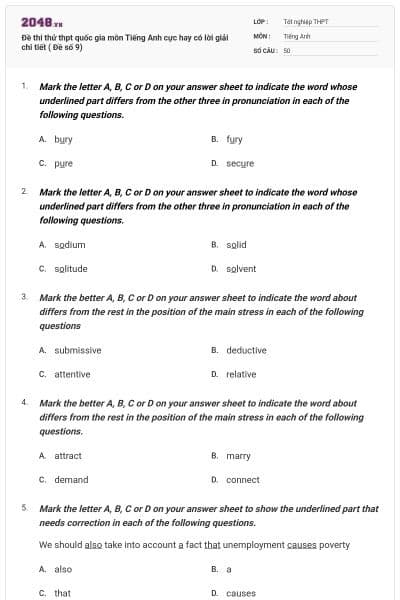
Mark the letter A, B, C or D on your answer sheet to indicate the word whose underlined part differs from the other three in pronunciation in each of the following questions.
bury
fury
pure
secure
Đáp án là A.
bury /ˈberi/
fury /ˈfjʊri/
pure /pjʊr/
secure /səˈkjʊr/
Câu A phát âm là /e/ còn lại phát âm là /jʊ/
Mark the letter A, B, C or D on your answer sheet to indicate the word whose underlined part differs from the other three in pronunciation in each of the following questions.
sodium
solid
solitude
solvent
Đáp án là A.
sodium /ˈsəʊdiəm/
solid /ˈsɒlɪd/
solitude /ˈsɒlɪtjuːd/
solvent /ˈsɒlvənt/
Câu A phát âm là /əʊ/ còn lại phát âm là /ɒ/
Mark the better A, B, C or D on your answer sheet to indicate the word about differs from the rest in the position of the main stress in each of the following questions
submissive
deductive
attentive
relative
Đáp án là D.
submissive /səbˈmɪsɪv/
deductive /dɪˈdʌktɪv/
attentive /əˈtentɪv/
relative /ˈrelətɪv/
Câu D trọng âm 1 còn lại trọng âm 2
Mark the better A, B, C or D on your answer sheet to indicate the word about differs from the rest in the position of the main stress in each of the following questions.
attract
marry
demand
connect
Đáp án là B.
attract /əˈtrækt/
marry /ˈmæri/
demand /dɪˈmɑːnd/
connect /kəˈnekt/
Câu B trọng âm 1 còn lại trọng âm 2
Mark the letter A, B, C or D on your answer sheet to show the underlined part that needs correction in each of the following questions.
We should also take into account a fact that unemployment causes poverty
also
a
that
causes
Đáp án là B.
a => the
Vì sau danh từ fact có mệnh đề bổ trợ nghĩ nên phải dùng mạo từ “the”
Câu này dịch như sau: Chúng ta cũng nên quan tâm đến chi tiết rằng sự thất nghiệp gây nên nghèo đói.
Mark the letter A, B, C or D on your answer sheet to show the underlined part that needs correction in each of the following questions.
Whoever said this he must have been a liar because it is something that even a child knows to be true
he must
something
that
be true
Đáp án là A.
he must => must
mệnh đề danh ngữ: wh-word/ if / whether + S+ V = đóng vai trò của ngữ => Động từ theo sau luôn ở dạng số ít
must là động từ chính của chủ ngữ whoever said this => chủ ngữ “he” thừa
Câu này dịch như sau: Bất cứ ai nói điều này chắc chắn là người nói dối bởi vì thậm chí một đứa trẻ cũng biết đâu là sự thật.
Mark the letter A, B, C or D on your answer sheet to show the underlined part that needs correction in each of the following questions.
Your brother spoke in a more interesting way, even though he mentioned less details
in a more
way
even
less
Đáp án là D.
less => fewer
Vì less là so sánh hơn của little [ little + danh từ không đếm được ]
Few + danh từ số nhiều [ details] => so sánh hơn là fewer
Câu này dịch như sau: Anh của bạn nói theo phong cách thú vị hơn , mặc dù anh ấy đề cập ít chi tiết hơn
Mark the letter A, B, C or D on your answer sheet to indicate the correct answer to each of the following questions.
New tax cut is designed to make life easier for _________
all of poor
most the poor
the poor people
the poor
Đáp án là D.
Cấu trúc: the + adj => danh từ tập hợp chỉ người số nhiều
Câu này dịch như sau: Việc cắt giảm thuế mới được đưa ra để làm cho cuộc sống dễ dàng hơn đối với những người nghèo.
Mark the letter A, B, C or D on your answer sheet to indicate the correct answer to each of the following questions.
I’m sure you'll have no _________the exam.
difficulty passing
difficulties to pass
difficulty to pass
difficulties of passing
Đáp án là A.
Cụm từ: have (no) difficuluty/ problme/ trouble (in) + Ving [ có vấn đề/ khó khăn]
Câu này dịch như sau: Tôi chắc chắn rằng bạn không có vấn đề trong việc vượt qua kỳ thi
Mark the letter A, B, C or D on your answer sheet to indicate the correct answer to each of the following questions.
The safe _________of nuclear waste is a major international problem
disposal
abandon
display
sale
Đáp án là A.
Abandon: từ bỏ/ bỏ rơi
Display: trưng bày
Sale: sự buôn bán
Cụm từ: waste disposal = the disposal of waste [ sự chôn/ xử lý chất thải]
Câu này dịch như sau: Việc xử lý an toàn chất thải hạt nhân là vấn đề lớn toàn cầu
Mark the letter A, B, C or D on your answer sheet to indicate the correct answer to each of the following questions.
I’m afraid we can only afford to pay you a _________sum for your services
nominal
titular
complete
calculated
Đáp án là A.
nominal = small: nhỏ bé
titular : giữ chức do có tước vị
complete : hoàn toàn
calculated: được tính toán kỹ lưỡng
Câu này dịch như sau: Tôi e rằng chúng tôi chỉ có thể trả bạn một số tiền nhỏ cho dịch vụ của bạn.
Mark the letter A, B, C or D on your answer sheet to indicate the correct answer to each of the following questions.
If you don’t decrease the speed soon, you may not be able to stop_________
shortly
at times
on time
in time
Đáp án là D.
Shortly = soon: sớm
At times: thỉnh thoảng [ = sometimes]
On time: đúng giờ
In time: kịp lúc
Câu này dịch như sau: Nếu bạn không giảm tốc độ sớm, bạn không thể dừng kịp lúc.
Mark the letter A, B, C or D on your answer sheet to indicate the correct answer to each of the following questions.
He hasn’t tried it himself . He would like to , _________
although
though
even though
despite
Đáp án là B.
though = although = even though + S+ V: mặc dù
Chỉ có though đứng ở cuối câu, trước đó là dấu phẩy.
Câu này dịch như sau: Anh ấy vẫn chưa thật sự cố gắng. Mặc dù anh ấy rất m
Mark the letter A, B, C or D on your answer sheet to indicate the correct answer to each of the following questions.
She said that she _________to have a baby.
was going
is going
has gone
will go
Đáp án là A.
She said that => Câu tường thuật => phải lùi thì về quá khứ => loại những đáp án ở hiện tại và tương lai.
Mark the letter A, B, C or D on your answer sheet to indicate the correct answer to each of the following questions.
Safety experts are trying to establish the _________of yesterday’s train crash
creation
reason
grounds
cause
Đáp án là D.
Creation: sự tạo ra
Reason:lý do
Grounds: mặt đất
Cause: nguyên nhân/ nguồn cơ
Câu này dịch như sau: các chuyên gia an toàn đang cố gắng tìm ra nguyên nhân của vụ va chạm tàu hỏa hôm qua.
Mark the letter A, B, C or D on your answer sheet to indicate the correct answer to each of the following questions.
At the moment we’re holding on to our shares but _________in value, we would probably sell them
if they were rise
for them to rise
unless they rose
were they to rise
Đáp án là D.
Cấu trúc đảo ngữ câu điều kiện loại 2: Were + S + to Vo = Were + S + O = If + S + Ved, S + would / could + Vo
Câu này dịch như sau: Hiện tại chúng tôi đang nắm giữ cổ phần nhưng nếu nó tăng giá, chúng tôi sẽ bán chúng
Mark the letter A, B, C or D on your answer sheet to indicate the correct answer to each of the following questions.
No one should be exempt _________prosecution if they have committed a crime
of
about
against
from
Đáp án là D.
Cụm từ: be exempt form [ miễn truy tố]
Câu này dịch như sau: Không ai được miễn truy tố nếu họ bị buộc là có tội
Mark the letter A, B, C or D on your answer sheet to indicate the correct answer to each of the following questions.
The ………..of food during that long winter left many families in despair
scarcity
availability
variety
abundance
Đáp án là A.
Scarcity: sự khan hiếm
Availability: sự có sẵn
Variety: sự đa dạng
Abundance: sự phong phú
Câu này dịch như sau: Sự khan hiếm thực phẩm trong suốt mùa đông dài đã làm cho nhiều gia đình khổ sở.
Mark the letter A, B, C or D on your answer sheet to indicate the correct answer to each of the following questions.
Peter: “Did you enjoy roller coaster ride?” Kate: “No! It was_________experience of life.”
The most terrifying
far more terrifying
the most terrified
A most terrified
Đáp án là A.
Câu này dịch như sau: Peter: “ Bạn có thích tàu lượn siêu tốc không?”
Kate:” Không! Đó là trải nghiệm kinh khủng nhất trong cuộc đời tôi.”
Dựa vào nghĩa của câu phải dùng so sánh nhất => loại B
loại D vì so sánh nhất phải dùng mạo từ “the”
terrifying [ tính từ chủ động ] dùng để miêu tả tính chất/ bản chất của người/ vật.
terrifird [ tính từ bị động ] dùng để diễn tả cảm xúc của con người do tác động bên ngoài mà có.
Mark the letter A, B, C or D on your answer sheet to indicate the most suitable respond to complete each of the following exchanges.
Teacher: “It’s so far away. How do you get to school?” Boy: “_________”
I have no idea.
In my neighbour’s van.
Nothing special.
About 7 kilometers, I think
Đáp án là B.
Giáo viên: “ Nhà em xa thế. Em đến trường bằng cách nào?”
A. Em không biết.
B. Bằng xe tải của hàng xóm ạ.
C. Không có gì đặc biệt.
D. Em nghĩ khoảng 7 km.
Mark the letter A, B, C or D on your answer sheet to indicate the most suitable respond to complete each of the following exchanges.
Host: “I’m terribly sorry for this inconvenience.” Guest: “_________”
It’s mine. I came late
It’s not your fault
I’ll do better next time
Fine, thanks
Đáp án: B
Giải thích:
Dịch:
Người dẫn chương trình: “Tôi vô cùng xin lỗi vì sự bất tiện này.”
Khách mời: “__________”
A. Đó là lỗi của tôi. Tôi đến muộn.
B. Không phải lỗi của bạn.
C. Tôi sẽ làm tốt hơn vào lần tới.
D. Tốt, cảm ơn.
Dựa vào nghĩa câu, chọn B.
Mark the letter A, B, C or D on your answer sheet to indicate the word (s) OPPOSITE in meaning to the underlined word (s) in the following Question .
As all of us cannot be available today , let’s put off the discussion till later.
absent for the event
scheduled for the event
arranged for the event
appointed for the event
Đáp án là A.
Available: có thời gian/ sẵn sàng
A. vắng mặt ở sự kiện
B. đã lên kế hoạch cho sự kiện
C. đã sắp xếp sự kiện
D. đã chỉ định sự kiện
=> available >< absent for the event
Câu này dịch như sau: Vì tất cả chúng ta đều không rảnh hôm nay, hãy hoãn cuộc thảo luận sau đó nhé.
Mark the letter A, B, C or D on your answer sheet to indicate the word (s) OPPOSITE in meaning to the underlined word (s) in the following Question .
When the rent increased from 200to200to400 a month, they protested against such a tremendous increase
slight
difficult
huge
numerous
Đáp án là A.
tremendous : nhiều/ khổng lồ
slight: nhẹ/chút/ ít
difficult: khó
huge = numerous: nhiều
=> tremendous >< slight
Câu này dịch như sau: Khi tiền thuê nhà tăng từ 200$ lên 400$, họ phản đối sự tăng giá nhiều như vậy.
Mark the letter A, B, C or D on your answer sheet to indicate the word or phrase that is CLOSEST in meaning to the underlined part in each of the following questions.
If you build a structure next to this river, you must be sure it is safe against floods.
hut
sentence
pattern
building
Đáp án là D.
structure: công trình/ kiến trúc
hut: lều
sentence: câu
pattern: nền tảng/ khuôn mẫu
building: tòa nhà
Câu này dịch như sau: Nếu bạn xây một công trình bên cạnh dòng sông này, bạn phải chắc chắn rằng nó an toàn khi lũ lụt.
=> structure = structure
Mark the letter A, B, C or D on your answer sheet to indicate the word or phrase that is CLOSEST in meaning to the underlined part in each of the following questions.
Within a week on display at the exhibition, the painting was hailed as a masterpiece
an expensive work of art
a down-to-earth work of art
an excellent work of art
a large work of art
Đáp án là C.
masterpiece: kiệt tác
A. một tác phẩm nghệ thuật đắt tiền
B. một tác phẩm nghệ thuật thực tế
C. một tác phẩm nghệ thuật xuất sắc
D. một tác phẩm nghệ thuật rộng lớn
=> masterpiece = an excellent work of art
Mark the letter A, B, C or D on your answer sheet to indicate the sentence that is closest in meaning to each of the following questions.
He didn’t hurry so he missed the plane.
If he hurried he wouldn’t miss the plane.
If he had hurried he might catch the plane.
If he had hurried he could have caught the plane.
He didn’t miss the plane because he hurried.
Đáp án là C.
Anh đã không vội vã vì vậy anh ấy đã lỡ chuyến bay.
Câu A là câu điều kiện loại 2 => loại vì If 2 chỉ dùng cho tình huống ở hiện tại
Câu B hỗn hợp loại 3 và 2 => loại vì ngữ cảnh đề bài hoàn toàn ở quá khứ.
Câu C câu điều kiện loại 3. Nếu anh ấy vội vã, anh ấy có thể bắt kịp chuyến bay.
=> Đúng
Câu D. Anh ấy đã không bỏ lỡ chuyến bay vì anh ấy vội vã. => ngược hoàn toàn với ngữ cảnh đầu bài. => loại
Mark the letter A, B, C or D on your answer sheet to indicate the sentence that is closest in meaning to each of the following questions.
They are building a new school in the village.
A new school has been built in the village.
The building of a new school in the village has just finished.
A new school is built in the village
A new school is being built in the village.
Đáp án là D.
Họ đang xây dựng một ngôi trường mới ở trong làng.
Cấu trúc bị động thì hiện tại tiếp diễn: S + am/is/ are being + Ved
Câu D. Một ngôi trường mới đang được xây trong làng.
Mark the letter A, B, C or D on your answer sheet to indicate the sentence that is closest in meaning to each of the following questions.
This conference wouldn’t have been possible without your organization
If you didn’t organize, this conference wouldn’t have been possible
If it had been for your organization, this conference wouldn’t have been possible
Your organization made it possible for this conference to take place
It’s possible that your organization made this conference impossible
Đáp án là C.
Buổi hội thảo này sẽ không thể diễn ra nếu không có sự sắp xếp của bạn.
Without = but for + cụm danh từ = If it hadn’t been for + danh từ, S + would/ could have Ved
=> loại B
Câu A loại vì không viết câu điều kiện loại 3 sang loại 2 được.
Câu C. Sự sắp xếp của bạn đã làm cho buổi hội thảo này có thẻ diễn ra.
=> tình huống ở quá khứ
Câu D. Có thể là sự sắp xếp của bạn đã làm cho buổi hội thảo này không thể xảy ra. => sai nghĩa => loại
Mark the letter A, B, C or D on your answer sheet to indicate that best combine this pair of sentences in the following questions.
It was an interesting novel. I stayed up all night to finish it
I stayed up all night to finish the novel so it was interesting
Unless it was an interesting novel, I would not stay up all night to finish it
Though it was an interesting novel, I stayed up all night to finish it
So interesting was the novel that I stayed up all night to finish it
Đáp án là D.
Quyến tiểu thuyết rất hay. Tôi đã thức cả đêm để đọc xong nó.
A. Tôi đã thức cả đêm để đọc xong quyển tiểu thuyết vì vậy nó rất thú vị.
B. Nếu quyển tiểu thuyết này không thú vị, tôi sẽ không thức cả đêm để đọc xong nó.
=>loại vì câu sai ngữ pháp. Unless = if...not... câu điều kiện loại 2 phải dùng were cho tất cả các chủ ngữ
C. Mặc dù quyến tiểu thuyết rất hay nhưng tôi đã thức cả đêm để đọc xong nó.
D. Quyến tiểu thuyết quá thú vị đến nỗi mà tôi đã thức cả đêm để đọc xonh nó.
Cấu trúc: So + adj + be + S + that + S + V
Mark the letter A, B, C or D on your answer sheet to indicate that best combine this pair of sentences in the following questions.
I understand why you detest her. I’ve finally met her.
I understand why you don’t like her due to I’ve lastly met her.
Now that I have finally met her, I understand why you hate her.
I met her and I know your feeling.
Since I finally met her, I understand why you like her.
Đáp án là B.
Tôi hiểu tại sao bạn ghét cô ấy. Tôi cuối cùng đã gặp cô ấy.
Câu A loại vì sai ngữ pháp, due to + Ving/ cụm danh từ
Câu B. Now that = because
Bởi vì cuối cùng tôi đã gặp cô ấy, tôi hiểu vì sao bạn ghét cô ấy.
Câu C. Tôi đã gặp cô ấy và tôi biết cảm giác của bạn.
Câu D. Kể từ lần cuối cùng tôi gặp cô ấy, tôi hiểu vì sao bạn thích cô ấy.
Read the following passage, and mark the letter (A, B, C or D) on your answer sheet to indicate the correct answer for each of the blanks.
THE TOURIST TRAP
Tourism is the fastest-growing industry in the world. As well as bringing prosperity to an area, however, it can also destroy the qualities which (31)________visitors in the first place. If it is not carefully controlled, tourism can also create problems for local people, as is shown by various examples from around the world. When Phuket in Thailand first became a popular tourist (32)________, people there were unable to cope with the increase in rubbish that 2 million visitors a year produce and a huge incinerator had to be built in the countryside to deal with it. New hotels at Goa in India caused a huge increase in water consumption, (33)________many local people to walk considerable distances to get clean water. And Egypt’s desert landscapes are being destroyed by the litter (34)________by tourists. Moving sands are difficult to clean, and the white desert to the west of the Nile Valley may be permanently affected. It’s encouraging, therefore, to read about the efforts of certain tour companies who are organising environmental holidays in some of the worst hit areas. Regular tours now go to places (35)________the Himalayas and Atlas mountains in North Africa with the aim of combining a bit of sightseeing with the chance to help clear up some of the mess left by previous visitors.
Điền vào ô số 31
convinced
persuaded
attracted
appealed
Đáp án là C.
Convinced: thuyết phục
Persuaded: thuyết phục
Attracted: thu hút
Appealed to sb: lôi cuốn/ hấp dẫn
Tourism is the fastest-growing industry in the world. As well as bringing prosperity to an area, however, it can also destroy the qualities which (31)………visitors in the first place. If it is not carefully controlled, tourism can also create problems for local people, as is shown by various examples from around the world.
[Ngành du lịch là ng công nghiệp phát triển nhanh nhất thế giới. Nó mang lại sự thịnh vượng cho một vùng, tuy nhiên, nó cũng phá hủy những chất lượng cái mà thu hút du khách lần đầu tiên. Nếu nó không được quản lý chặt chẽ, ngành du lịch cũng có thể gây ra những vấn đề cho người dân địa phương, như đang thể hiện bằng nhiều ví dụ trên thế giới.]
Read the following passage, and mark the letter (A, B, C or D) on your answer sheet to indicate the correct answer for each of the blanks.
THE TOURIST TRAP
Tourism is the fastest-growing industry in the world. As well as bringing prosperity to an area, however, it can also destroy the qualities which (31)________visitors in the first place. If it is not carefully controlled, tourism can also create problems for local people, as is shown by various examples from around the world. When Phuket in Thailand first became a popular tourist (32)________, people there were unable to cope with the increase in rubbish that 2 million visitors a year produce and a huge incinerator had to be built in the countryside to deal with it. New hotels at Goa in India caused a huge increase in water consumption, (33)________many local people to walk considerable distances to get clean water. And Egypt’s desert landscapes are being destroyed by the litter (34)________by tourists. Moving sands are difficult to clean, and the white desert to the west of the Nile Valley may be permanently affected. It’s encouraging, therefore, to read about the efforts of certain tour companies who are organising environmental holidays in some of the worst hit areas. Regular tours now go to places (35)________the Himalayas and Atlas mountains in North Africa with the aim of combining a bit of sightseeing with the chance to help clear up some of the mess left by previous visitors.
Điền vào ô số 32
position
destination
terminus
departure
Đáp án là B.
Position: vị trí
Destination: điểm đến
Terminus: ga cuối/ ga chót
Departure: điểm khởi hành
Cụm danh từ: tourist destination [ điểm du lịch thu hút du khách]
When Phuket in Thailand first became a popular tourist (32)……….., people there were unable to cope with the increase in rubbish that 2 million visitors a year produce and a huge incinerator had to be built in the countryside to deal with it.
[ Khi Phuket ở Thái Lan lần đầu trở thành một điểm du lịch nổi tiếng, mọi người ở đây không thể xử lý sự tăng lượng rác mà 2 triệu du khách 1 năm sản xuất ra và lò hỏa táng khổng lồ phải được xây ở nông thôn để giải quyết vấn đề này.]
Read the following passage, and mark the letter (A, B, C or D) on your answer sheet to indicate the correct answer for each of the blanks.
THE TOURIST TRAP
Tourism is the fastest-growing industry in the world. As well as bringing prosperity to an area, however, it can also destroy the qualities which (31)________visitors in the first place. If it is not carefully controlled, tourism can also create problems for local people, as is shown by various examples from around the world. When Phuket in Thailand first became a popular tourist (32)________, people there were unable to cope with the increase in rubbish that 2 million visitors a year produce and a huge incinerator had to be built in the countryside to deal with it. New hotels at Goa in India caused a huge increase in water consumption, (33)________many local people to walk considerable distances to get clean water. And Egypt’s desert landscapes are being destroyed by the litter (34)________by tourists. Moving sands are difficult to clean, and the white desert to the west of the Nile Valley may be permanently affected. It’s encouraging, therefore, to read about the efforts of certain tour companies who are organising environmental holidays in some of the worst hit areas. Regular tours now go to places (35)________the Himalayas and Atlas mountains in North Africa with the aim of combining a bit of sightseeing with the chance to help clear up some of the mess left by previous visitors.
Điền vào ô số 33
encouraging
making
forcing
urging
Đáp án là C.
Encouraging: khuyến khích
Making: tạo ra/ làm ra
Forcing: ép buộc
Urging: thúc giục
Force + sb + to Vo: bắt buộc ai phải làm gì
New hotels at Goa in India caused a huge increase in water consumption, (33)………many local people to walk considerable distances to get clean water.
[ Các khách sạn mới ở Ấn Độ đã gây ra sự tăng lượng nước tiêu thụ đáng kể, buộc nhiều người dân địa phương phải đi bộ những đoạn đường rất xa để có nước sạch.]
Read the following passage, and mark the letter (A, B, C or D) on your answer sheet to indicate the correct answer for each of the blanks.
THE TOURIST TRAP
Tourism is the fastest-growing industry in the world. As well as bringing prosperity to an area, however, it can also destroy the qualities which (31)________visitors in the first place. If it is not carefully controlled, tourism can also create problems for local people, as is shown by various examples from around the world. When Phuket in Thailand first became a popular tourist (32)________, people there were unable to cope with the increase in rubbish that 2 million visitors a year produce and a huge incinerator had to be built in the countryside to deal with it. New hotels at Goa in India caused a huge increase in water consumption, (33)________many local people to walk considerable distances to get clean water. And Egypt’s desert landscapes are being destroyed by the litter (34)________by tourists. Moving sands are difficult to clean, and the white desert to the west of the Nile Valley may be permanently affected. It’s encouraging, therefore, to read about the efforts of certain tour companies who are organising environmental holidays in some of the worst hit areas. Regular tours now go to places (35)________the Himalayas and Atlas mountains in North Africa with the aim of combining a bit of sightseeing with the chance to help clear up some of the mess left by previous visitors.
Điền vào ô số 34
dropped
sunk
lowered
fallen
Đáp án là A.
Dropped: rơi/ thả xuống
Sunk: chìm
Lowered: hạ thấp xuống
Fallen: giảm/ rơi
And Egypt’s desert landscapes are being destroyed by the litter (34) ………..by tourists. Moving sands are difficult to clean, and the white desert to the west of the Nile Valley may be permanently affected.
[ Những cảnh sa mạc ở Ai Cập đang bị phá hủy bởi rác thải được thải ra/ vứt xuống bởi những du khách. việc dời cát rất khó để làm sạch, và sa mạc trắng ở phía tây của thung lũng Nile có thể bị ảnh hưởng vĩnh viễn.]
Read the following passage, and mark the letter (A, B, C or D) on your answer sheet to indicate the correct answer for each of the blanks.
THE TOURIST TRAP
Tourism is the fastest-growing industry in the world. As well as bringing prosperity to an area, however, it can also destroy the qualities which (31)________visitors in the first place. If it is not carefully controlled, tourism can also create problems for local people, as is shown by various examples from around the world. When Phuket in Thailand first became a popular tourist (32)________, people there were unable to cope with the increase in rubbish that 2 million visitors a year produce and a huge incinerator had to be built in the countryside to deal with it. New hotels at Goa in India caused a huge increase in water consumption, (33)________many local people to walk considerable distances to get clean water. And Egypt’s desert landscapes are being destroyed by the litter (34)________by tourists. Moving sands are difficult to clean, and the white desert to the west of the Nile Valley may be permanently affected. It’s encouraging, therefore, to read about the efforts of certain tour companies who are organising environmental holidays in some of the worst hit areas. Regular tours now go to places (35)________the Himalayas and Atlas mountains in North Africa with the aim of combining a bit of sightseeing with the chance to help clear up some of the mess left by previous visitors.
Điền vào ô số 35
as well as
as for
such as
so as to
Đáp án là C.
as well as: cũng như
as for: theo như
such as: chẳng hạn như
so as to: để mà
It’s encouraging, therefore, to read about the efforts of certain tour companies who are organising environmental holidays in some of the worst hit areas. Regular tours now go to places (35) ………….the Himalayas and Atlas mountains in North Africa with the aim of combining a bit of sightseeing with the chance to help clear up some of the mess left by previous visitors.
[ Vì vậy, rất đáng khích lệ để đọc về những nỗ lực của những công ty nhât định người mà đang tổ chức các kỳ nghỉ môi trường ở một số khu vực bị thiệt hại nặng nề nhất. Các chuyến đi thường xuyên đến những nơi như là dáy núi Himalaya hay Atlas ở Bắc Phi nhằm mục đích kết hợp ngắm cảnh với cơ hội giúp làm sạch những tàn dư do các du khách trước đó để lại.]
Read the following passage and mark the letter (A, B, C or D) on your answer sheet to indicate the correct answer to each for the questions. Children learn to construct language from those around them. Until about the age of three, children tend to learn to develop their language by modeling the speech of their parents, but from that time on, peers have a growing influence as models for language development in children. It is easy to observe that, when adults and older children interact with younger children, they tend to modify their language to improve children communication with younger children, and this modified language is called caretaker speech.
Caretaker speech is used often quite unconsciously; few people actually study how to modify language when speaking to young children but, instead, without thinking, find ways to reduce the complexity of language in order to communicate effectively with young children. A caretaker will unconsciously speak in one way with adults and in a very different way with young children. Caretaker speech tends to be slower speech with short, simple words and sentences which are said in a higher-pitched voice with exaggerated inflections and many repetitions of essential information. It is not limited to what is commonly called baby talk, which generally refers to the use of simplified, repeated syllable expressions, such as ma-ma, boo-boo, bye-bye, wa-wa, but also includes the simplified sentence structures repeated in sing-song inflections. Examples of these are expressions such as “ say bye-bye” or “where’s da-da?”
Caretaker speech serves the very important function of allowing young children to acquire language more easily. The higher-pitched voice and the exaggerated inflections tend to focus the small child on what the caretaker is saying, the simplified words and sentences make it easier for the small child to begin to comprehended, and the repetitions reinforce the child’s developing understanding. Then, as a child’s speech develops, caretakers tend to adjust their language in the response to the improved language skills, again quite unconsciously. Parents and older children regularly adjust their speed to a level that is slightly above that of a younger child; without studied recognition of what they are doing, these caretakers will speak in one way to a one-year-ago and in a progressively more complex way as the child reaches the age of two or three.
An important point to note is that the function covered by caretaker speech, that of assisting a child to acquire language in small and simple steps, is an unconsciously used but extremely important part of the process of language acquisition and as such is quite universal. It is not merely a device used by English-speaking parents. Studying cultures where children do not acquire language through caretaker speech is difficult because such cultures are not difficult to find. The question of why caretaker speech is universal is not clear understood; instead proponents on either side of the nature vs. nature debate argue over whether caretaker speech is a natural function or a learned one. Those who believe that caretaker speech is a natural and inherent function in humans believe that it is human nature for children to acquire language and for those around them to encourage their language acquisition naturally; the presence of a child is itself a natural stimulus that increases the rate of caretaker speech develops through nurturing rather than nature argue that a person who is attempting to communicate with a child will learn by trying out different ways of communicating to determine which is the most effective from the reactions to the communication attempts; apparent might, for example, learn to use speech with exaggerated inflections with a small child because the exaggerated inflections do a better job of attracting the child’s attention than do more subtle inflections. Whether caretaker speech results from nature or nurture, it does play an important and universal role in child language acquisition.
According to paragraph 1, children over the age of three
Learn little language from those around them
Are no longer influenced by the language of their parents
Are influenced more and more by those closer to their own age
First begin to respond to caretaker speech
Đáp án là C.
Theo đoạn văn 1, trẻ con hơn 3 tuổi thì
A. học một chút ngôn ngữ về những thứ xung quanh chúng.
B. không còn bị ảnh hưởng bởi ngôn ngữ của bố mẹ chúng.
C. bị ảnh hưởng ngày càng nhiều hơn bởi những người gần với độ tuổi của chúng.
D. lần đầu bắt đầu phản hồi lại ngôn ngữ đã được biến đổi để phù hợp với trẻ.
Dẫn chứng: Until about the age of three, children tend to learn to develop their language by modeling the speed of their parents, but from that time on, peers have a growing influence as models for language development in children.
Read the following passage and mark the letter (A, B, C or D) on your answer sheet to indicate the correct answer to each for the questions. Children learn to construct language from those around them. Until about the age of three, children tend to learn to develop their language by modeling the speech of their parents, but from that time on, peers have a growing influence as models for language development in children. It is easy to observe that, when adults and older children interact with younger children, they tend to modify their language to improve children communication with younger children, and this modified language is called caretaker speech.
Caretaker speech is used often quite unconsciously; few people actually study how to modify language when speaking to young children but, instead, without thinking, find ways to reduce the complexity of language in order to communicate effectively with young children. A caretaker will unconsciously speak in one way with adults and in a very different way with young children. Caretaker speech tends to be slower speech with short, simple words and sentences which are said in a higher-pitched voice with exaggerated inflections and many repetitions of essential information. It is not limited to what is commonly called baby talk, which generally refers to the use of simplified, repeated syllable expressions, such as ma-ma, boo-boo, bye-bye, wa-wa, but also includes the simplified sentence structures repeated in sing-song inflections. Examples of these are expressions such as “ say bye-bye” or “where’s da-da?”
Caretaker speech serves the very important function of allowing young children to acquire language more easily. The higher-pitched voice and the exaggerated inflections tend to focus the small child on what the caretaker is saying, the simplified words and sentences make it easier for the small child to begin to comprehended, and the repetitions reinforce the child’s developing understanding. Then, as a child’s speech develops, caretakers tend to adjust their language in the response to the improved language skills, again quite unconsciously. Parents and older children regularly adjust their speed to a level that is slightly above that of a younger child; without studied recognition of what they are doing, these caretakers will speak in one way to a one-year-ago and in a progressively more complex way as the child reaches the age of two or three.
An important point to note is that the function covered by caretaker speech, that of assisting a child to acquire language in small and simple steps, is an unconsciously used but extremely important part of the process of language acquisition and as such is quite universal. It is not merely a device used by English-speaking parents. Studying cultures where children do not acquire language through caretaker speech is difficult because such cultures are not difficult to find. The question of why caretaker speech is universal is not clear understood; instead proponents on either side of the nature vs. nature debate argue over whether caretaker speech is a natural function or a learned one. Those who believe that caretaker speech is a natural and inherent function in humans believe that it is human nature for children to acquire language and for those around them to encourage their language acquisition naturally; the presence of a child is itself a natural stimulus that increases the rate of caretaker speech develops through nurturing rather than nature argue that a person who is attempting to communicate with a child will learn by trying out different ways of communicating to determine which is the most effective from the reactions to the communication attempts; apparent might, for example, learn to use speech with exaggerated inflections with a small child because the exaggerated inflections do a better job of attracting the child’s attention than do more subtle inflections. Whether caretaker speech results from nature or nurture, it does play an important and universal role in child language acquisition.
The word “modeling” in paragraph 1 could best replaced by
demonstrating
mimicking
building
designing
Đáp án là B.
Từ “modeling” ở đoạn 1 có thể được thay thế tốt nhất bởi
Demonstrating: minh họa
Mimicking: bắt chước
Building: xây dựng
Designing: thiết kế
Dẫn chứng: Until about the age of three, children tend to learn to develop their language by modeling the speech of their parents,
[ Khoảng 3 tuổi trẻ con có xu hướng học phát triển ngôn ngữ bằng cách bắt chước những gì bố mẹ chúng nói.]
=> modeling = mimicking
Read the following passage and mark the letter (A, B, C or D) on your answer sheet to indicate the correct answer to each for the questions. Children learn to construct language from those around them. Until about the age of three, children tend to learn to develop their language by modeling the speech of their parents, but from that time on, peers have a growing influence as models for language development in children. It is easy to observe that, when adults and older children interact with younger children, they tend to modify their language to improve children communication with younger children, and this modified language is called caretaker speech.
Caretaker speech is used often quite unconsciously; few people actually study how to modify language when speaking to young children but, instead, without thinking, find ways to reduce the complexity of language in order to communicate effectively with young children. A caretaker will unconsciously speak in one way with adults and in a very different way with young children. Caretaker speech tends to be slower speech with short, simple words and sentences which are said in a higher-pitched voice with exaggerated inflections and many repetitions of essential information. It is not limited to what is commonly called baby talk, which generally refers to the use of simplified, repeated syllable expressions, such as ma-ma, boo-boo, bye-bye, wa-wa, but also includes the simplified sentence structures repeated in sing-song inflections. Examples of these are expressions such as “ say bye-bye” or “where’s da-da?”
Caretaker speech serves the very important function of allowing young children to acquire language more easily. The higher-pitched voice and the exaggerated inflections tend to focus the small child on what the caretaker is saying, the simplified words and sentences make it easier for the small child to begin to comprehended, and the repetitions reinforce the child’s developing understanding. Then, as a child’s speech develops, caretakers tend to adjust their language in the response to the improved language skills, again quite unconsciously. Parents and older children regularly adjust their speed to a level that is slightly above that of a younger child; without studied recognition of what they are doing, these caretakers will speak in one way to a one-year-ago and in a progressively more complex way as the child reaches the age of two or three.
An important point to note is that the function covered by caretaker speech, that of assisting a child to acquire language in small and simple steps, is an unconsciously used but extremely important part of the process of language acquisition and as such is quite universal. It is not merely a device used by English-speaking parents. Studying cultures where children do not acquire language through caretaker speech is difficult because such cultures are not difficult to find. The question of why caretaker speech is universal is not clear understood; instead proponents on either side of the nature vs. nature debate argue over whether caretaker speech is a natural function or a learned one. Those who believe that caretaker speech is a natural and inherent function in humans believe that it is human nature for children to acquire language and for those around them to encourage their language acquisition naturally; the presence of a child is itself a natural stimulus that increases the rate of caretaker speech develops through nurturing rather than nature argue that a person who is attempting to communicate with a child will learn by trying out different ways of communicating to determine which is the most effective from the reactions to the communication attempts; apparent might, for example, learn to use speech with exaggerated inflections with a small child because the exaggerated inflections do a better job of attracting the child’s attention than do more subtle inflections. Whether caretaker speech results from nature or nurture, it does play an important and universal role in child language acquisition.
It can be inferred from part.2 that people generally seem
To be able to adapt their language to the level of a child’s language without thinking consciously about it
Quite aware of the use of caretaker speech
To have difficulty using caretaker speech
To use caretaker speech conscious by reducing the complexity of their language
Đáp án là A.
Có thể suy ra từ đoạn 2 rằng con người nhìn chung có vẻ như
A. Có thể nuôi dưỡng ngôn ngữ của họ đến mức ngôn ngữ của một đứa trẻ mà không cần suy nghĩ có ý thức về nó.
B. Khá ý thức về việc sử dụng ngôn ngữ đã được biển đổi để trẻ con hiểu
C. Có khó khăn trong việc sử dụng ngôn ngữ đã được biển đổi để trẻ con hiểu.
D. Để sử dụng ngôn ngữ đã được biển đổi để trẻ con hiểu có ý thức bằng cách giảm đi sự phức tạp trong ngôn ngữ của họ.
Dẫn chứng: Caretaker speech is used often quite unconsciously; few people actually study how to modify language when speaking to young children but, instead, without thinking, find ways to reduce the complexity of language in order to communicate effectively with young children.
Read the following passage and mark the letter (A, B, C or D) on your answer sheet to indicate the correct answer to each for the questions. Children learn to construct language from those around them. Until about the age of three, children tend to learn to develop their language by modeling the speech of their parents, but from that time on, peers have a growing influence as models for language development in children. It is easy to observe that, when adults and older children interact with younger children, they tend to modify their language to improve children communication with younger children, and this modified language is called caretaker speech.
Caretaker speech is used often quite unconsciously; few people actually study how to modify language when speaking to young children but, instead, without thinking, find ways to reduce the complexity of language in order to communicate effectively with young children. A caretaker will unconsciously speak in one way with adults and in a very different way with young children. Caretaker speech tends to be slower speech with short, simple words and sentences which are said in a higher-pitched voice with exaggerated inflections and many repetitions of essential information. It is not limited to what is commonly called baby talk, which generally refers to the use of simplified, repeated syllable expressions, such as ma-ma, boo-boo, bye-bye, wa-wa, but also includes the simplified sentence structures repeated in sing-song inflections. Examples of these are expressions such as “ say bye-bye” or “where’s da-da?”
Caretaker speech serves the very important function of allowing young children to acquire language more easily. The higher-pitched voice and the exaggerated inflections tend to focus the small child on what the caretaker is saying, the simplified words and sentences make it easier for the small child to begin to comprehended, and the repetitions reinforce the child’s developing understanding. Then, as a child’s speech develops, caretakers tend to adjust their language in the response to the improved language skills, again quite unconsciously. Parents and older children regularly adjust their speed to a level that is slightly above that of a younger child; without studied recognition of what they are doing, these caretakers will speak in one way to a one-year-ago and in a progressively more complex way as the child reaches the age of two or three.
An important point to note is that the function covered by caretaker speech, that of assisting a child to acquire language in small and simple steps, is an unconsciously used but extremely important part of the process of language acquisition and as such is quite universal. It is not merely a device used by English-speaking parents. Studying cultures where children do not acquire language through caretaker speech is difficult because such cultures are not difficult to find. The question of why caretaker speech is universal is not clear understood; instead proponents on either side of the nature vs. nature debate argue over whether caretaker speech is a natural function or a learned one. Those who believe that caretaker speech is a natural and inherent function in humans believe that it is human nature for children to acquire language and for those around them to encourage their language acquisition naturally; the presence of a child is itself a natural stimulus that increases the rate of caretaker speech develops through nurturing rather than nature argue that a person who is attempting to communicate with a child will learn by trying out different ways of communicating to determine which is the most effective from the reactions to the communication attempts; apparent might, for example, learn to use speech with exaggerated inflections with a small child because the exaggerated inflections do a better job of attracting the child’s attention than do more subtle inflections. Whether caretaker speech results from nature or nurture, it does play an important and universal role in child language acquisition.
All of the following are mentioned in par.3 as characteristics of caretaker speech EXCEPT
Overemphasized inflections
The use of rhyming sounds
The tendency to repeat oneself
The use of easier words and structures
Đáp án là B.
Tất cả những ý sau được đề cập ở đoạn 3 như là đặc điểm của ngôn ngữ người chăm sóc NGOẠI TRỪ
A. Quá nhấn mạnh sự uốn cong
B. Việc sử dụng âm thanh có vần điệu
C. Xu hướng tự lặp đi lặp lại
D. Việc sử dụng những từ và cấu trúc dễ hơn.
Dẫn chứng: The higher-pitched voice and the exaggerated inflections tend to focus the small child on what the caretaker is saying, => loại A
the simplified words and sentences make it easier for the small child to begin to comprehended,=> loại D
and the repetitions reinforce the child’s developing understanding. => loại C
Read the following passage and mark the letter (A, B, C or D) on your answer sheet to indicate the correct answer to each for the questions. Children learn to construct language from those around them. Until about the age of three, children tend to learn to develop their language by modeling the speech of their parents, but from that time on, peers have a growing influence as models for language development in children. It is easy to observe that, when adults and older children interact with younger children, they tend to modify their language to improve children communication with younger children, and this modified language is called caretaker speech.
Caretaker speech is used often quite unconsciously; few people actually study how to modify language when speaking to young children but, instead, without thinking, find ways to reduce the complexity of language in order to communicate effectively with young children. A caretaker will unconsciously speak in one way with adults and in a very different way with young children. Caretaker speech tends to be slower speech with short, simple words and sentences which are said in a higher-pitched voice with exaggerated inflections and many repetitions of essential information. It is not limited to what is commonly called baby talk, which generally refers to the use of simplified, repeated syllable expressions, such as ma-ma, boo-boo, bye-bye, wa-wa, but also includes the simplified sentence structures repeated in sing-song inflections. Examples of these are expressions such as “ say bye-bye” or “where’s da-da?”
Caretaker speech serves the very important function of allowing young children to acquire language more easily. The higher-pitched voice and the exaggerated inflections tend to focus the small child on what the caretaker is saying, the simplified words and sentences make it easier for the small child to begin to comprehended, and the repetitions reinforce the child’s developing understanding. Then, as a child’s speech develops, caretakers tend to adjust their language in the response to the improved language skills, again quite unconsciously. Parents and older children regularly adjust their speed to a level that is slightly above that of a younger child; without studied recognition of what they are doing, these caretakers will speak in one way to a one-year-ago and in a progressively more complex way as the child reaches the age of two or three.
An important point to note is that the function covered by caretaker speech, that of assisting a child to acquire language in small and simple steps, is an unconsciously used but extremely important part of the process of language acquisition and as such is quite universal. It is not merely a device used by English-speaking parents. Studying cultures where children do not acquire language through caretaker speech is difficult because such cultures are not difficult to find. The question of why caretaker speech is universal is not clear understood; instead proponents on either side of the nature vs. nature debate argue over whether caretaker speech is a natural function or a learned one. Those who believe that caretaker speech is a natural and inherent function in humans believe that it is human nature for children to acquire language and for those around them to encourage their language acquisition naturally; the presence of a child is itself a natural stimulus that increases the rate of caretaker speech develops through nurturing rather than nature argue that a person who is attempting to communicate with a child will learn by trying out different ways of communicating to determine which is the most effective from the reactions to the communication attempts; apparent might, for example, learn to use speech with exaggerated inflections with a small child because the exaggerated inflections do a better job of attracting the child’s attention than do more subtle inflections. Whether caretaker speech results from nature or nurture, it does play an important and universal role in child language acquisition.
It is indicated in paragraph 3 that parents tend to
Speak in basically the same way to a one-year-old and a three-year-old
Use language that is far above the language level of a child
Speak in a progressively less complex way as a child matures
Modify their speech according to the language development of a child
Đáp án là D.
Nó được chỉ ra ở đoạn 3 rằng bố mẹ có xu hướng
A. Nói về cơ bản cùng cách thức với trẻ 1 tuổi và 3 tuổi
B. Việc sử dụng ngôn ngữ vượt xa trình độ ngôn ngữ của trẻ con.
C. Nói theo cách ít phức tạp hơn như với trẻ trưởng thành.
D. Xác định giọng nói theo sự phát triển ngôn ngữ của trẻ con.
Dẫn chứng: Parents and older children regularly adjust their speed to a level that is slightly above that of a younger child;
Read the following passage and mark the letter (A, B, C or D) on your answer sheet to indicate the correct answer to each for the questions. Children learn to construct language from those around them. Until about the age of three, children tend to learn to develop their language by modeling the speech of their parents, but from that time on, peers have a growing influence as models for language development in children. It is easy to observe that, when adults and older children interact with younger children, they tend to modify their language to improve children communication with younger children, and this modified language is called caretaker speech.
Caretaker speech is used often quite unconsciously; few people actually study how to modify language when speaking to young children but, instead, without thinking, find ways to reduce the complexity of language in order to communicate effectively with young children. A caretaker will unconsciously speak in one way with adults and in a very different way with young children. Caretaker speech tends to be slower speech with short, simple words and sentences which are said in a higher-pitched voice with exaggerated inflections and many repetitions of essential information. It is not limited to what is commonly called baby talk, which generally refers to the use of simplified, repeated syllable expressions, such as ma-ma, boo-boo, bye-bye, wa-wa, but also includes the simplified sentence structures repeated in sing-song inflections. Examples of these are expressions such as “ say bye-bye” or “where’s da-da?”
Caretaker speech serves the very important function of allowing young children to acquire language more easily. The higher-pitched voice and the exaggerated inflections tend to focus the small child on what the caretaker is saying, the simplified words and sentences make it easier for the small child to begin to comprehended, and the repetitions reinforce the child’s developing understanding. Then, as a child’s speech develops, caretakers tend to adjust their language in the response to the improved language skills, again quite unconsciously. Parents and older children regularly adjust their speed to a level that is slightly above that of a younger child; without studied recognition of what they are doing, these caretakers will speak in one way to a one-year-ago and in a progressively more complex way as the child reaches the age of two or three.
An important point to note is that the function covered by caretaker speech, that of assisting a child to acquire language in small and simple steps, is an unconsciously used but extremely important part of the process of language acquisition and as such is quite universal. It is not merely a device used by English-speaking parents. Studying cultures where children do not acquire language through caretaker speech is difficult because such cultures are not difficult to find. The question of why caretaker speech is universal is not clear understood; instead proponents on either side of the nature vs. nature debate argue over whether caretaker speech is a natural function or a learned one. Those who believe that caretaker speech is a natural and inherent function in humans believe that it is human nature for children to acquire language and for those around them to encourage their language acquisition naturally; the presence of a child is itself a natural stimulus that increases the rate of caretaker speech develops through nurturing rather than nature argue that a person who is attempting to communicate with a child will learn by trying out different ways of communicating to determine which is the most effective from the reactions to the communication attempts; apparent might, for example, learn to use speech with exaggerated inflections with a small child because the exaggerated inflections do a better job of attracting the child’s attention than do more subtle inflections. Whether caretaker speech results from nature or nurture, it does play an important and universal role in child language acquisition.
The word “reaches” in paragraph 3 could best replaced by
holds on to
takes charge of
arrives at
extends out to
Đáp án là C.
Từ “reaches” ở đoạn 3 có thể đư thay thế bởi
A. giữ cho/ giữ lấy
B. chịu trách nhiệm về
C. đạt đến
D. trải rộng ra đến
Dẫn chứng: without studied recognition of what they are doing, these caretakers will speak in one way to a one-year-ago and in a progressively more complex way as the child reaches the age of two or three.
=>reaches = arrives at
Read the following passage and mark the letter (A, B, C or D) on your answer sheet to indicate the correct answer to each for the questions. Children learn to construct language from those around them. Until about the age of three, children tend to learn to develop their language by modeling the speech of their parents, but from that time on, peers have a growing influence as models for language development in children. It is easy to observe that, when adults and older children interact with younger children, they tend to modify their language to improve children communication with younger children, and this modified language is called caretaker speech.
Caretaker speech is used often quite unconsciously; few people actually study how to modify language when speaking to young children but, instead, without thinking, find ways to reduce the complexity of language in order to communicate effectively with young children. A caretaker will unconsciously speak in one way with adults and in a very different way with young children. Caretaker speech tends to be slower speech with short, simple words and sentences which are said in a higher-pitched voice with exaggerated inflections and many repetitions of essential information. It is not limited to what is commonly called baby talk, which generally refers to the use of simplified, repeated syllable expressions, such as ma-ma, boo-boo, bye-bye, wa-wa, but also includes the simplified sentence structures repeated in sing-song inflections. Examples of these are expressions such as “ say bye-bye” or “where’s da-da?”
Caretaker speech serves the very important function of allowing young children to acquire language more easily. The higher-pitched voice and the exaggerated inflections tend to focus the small child on what the caretaker is saying, the simplified words and sentences make it easier for the small child to begin to comprehended, and the repetitions reinforce the child’s developing understanding. Then, as a child’s speech develops, caretakers tend to adjust their language in the response to the improved language skills, again quite unconsciously. Parents and older children regularly adjust their speed to a level that is slightly above that of a younger child; without studied recognition of what they are doing, these caretakers will speak in one way to a one-year-ago and in a progressively more complex way as the child reaches the age of two or three.
An important point to note is that the function covered by caretaker speech, that of assisting a child to acquire language in small and simple steps, is an unconsciously used but extremely important part of the process of language acquisition and as such is quite universal. It is not merely a device used by English-speaking parents. Studying cultures where children do not acquire language through caretaker speech is difficult because such cultures are not difficult to find. The question of why caretaker speech is universal is not clear understood; instead proponents on either side of the nature vs. nature debate argue over whether caretaker speech is a natural function or a learned one. Those who believe that caretaker speech is a natural and inherent function in humans believe that it is human nature for children to acquire language and for those around them to encourage their language acquisition naturally; the presence of a child is itself a natural stimulus that increases the rate of caretaker speech develops through nurturing rather than nature argue that a person who is attempting to communicate with a child will learn by trying out different ways of communicating to determine which is the most effective from the reactions to the communication attempts; apparent might, for example, learn to use speech with exaggerated inflections with a small child because the exaggerated inflections do a better job of attracting the child’s attention than do more subtle inflections. Whether caretaker speech results from nature or nurture, it does play an important and universal role in child language acquisition.
The word “that” in par.4 refers to
an important point
the function
caretaker speech
a child
Đáp án là B.
Từ “that” ở đoạn 4 ám chỉ đến
A. một điểm quan trọng
B. chức năng
C. ngôn ngữ đã được biển đổi để trẻ con hiểu
D. một đứa trẻ
Dẫn chứng: An important point to note is that the function covered by caretaker speech, that of assisting a child to acquire language in small and simple steps
Read the following passage and mark the letter (A, B, C or D) on your answer sheet to indicate the correct answer to each for the questions.
Although noise, commonly defined as unwanted sound, is a widely recognized form of pollution, it is very difficult to measure because the discomfort experienced by different individuals is highly subjective and, therefore, variable. Exposure to lower levels of noise may be slightly irritating, whereas exposure to higher levels may actually cause hearing loss. Particularly in congested urban areas, the noise produced as a by product of our advancing technology causes physical and psychological harm, and detracts from the quality of life for those who are exposed to it.
Unlike the eyes, which can be covered by the eyelids against strong light, the ear has no lid, and is, therefore, always open and vulnerable; noise penetrates without protection.
Noise causes effects that the hearer cannot control and to which the body never becomes accustomed. Loud noises instinctively signal danger to any organism with a hearing mechanism, including human beings. In response, heartbeat and respiration accelerate, blood vessels constrict, the skin pales, and muscles tense. In fact, there is a general increase in functioning brought about by the flow of adrenaline released in response to fear, and some of these responses persist even longer than the noise, occasionally as long as thirty minutes after the sound has ceased.
Because noise is unavoidable in a complex, industrial society, we are constantly responding in the same way that we would respond to danger. Recently, researchers have concluded that noise and our response may be much more than an annoyance. It may be a serious threat to physical and psychological health and well-being, causing damage not only to the ear and brain but also to the heart and stomach. We have long known that hearing loss is America’s number one nonfatal health problem, but now we are learning that some of us with heart disease and ulcers may be victims of noise as well. Fetuses exposed to noise tend to be overactive, they cry easily, and they are more sensitive to gastrointestinal problems after birth. In addition, the psychic effect of noise is very important. Nervousness, irritability, tension, and anxiety increase, affecting the quality of rest during sleep, and the efficiency of activities during waking hours, as well as the way that we interact with each other.
Which of the following is the author’s main point?
Noise may pose a serious threat to our physical and psychological health.
Loud noises signal danger.
Hearing loss is America’s number one nonfatal health problem
The ear is not like the eye.
Đáp án là A.
Ý nào sau đây là ý chính của tác giả?
A. Tiếng ồn có thể gây ra sự đe dọa nghiêm trọng đến tình trạng thể chất và tinh thần của chúng ta.
B. Tiếng ồn lớn tín hiệu nguy hiểm
C. Mất thính giác là vấn đề sức khỏe không gây chết người số 1 ở Mỹ.
D. Tai không giồng như mắt.
Dẫn chứng: Exposure to lower levels of noise may be slightly irritating, whereas exposure to higher levels may actually cause hearing loss
Read the following passage and mark the letter (A, B, C or D) on your answer sheet to indicate the correct answer to each for the questions.
Although noise, commonly defined as unwanted sound, is a widely recognized form of pollution, it is very difficult to measure because the discomfort experienced by different individuals is highly subjective and, therefore, variable. Exposure to lower levels of noise may be slightly irritating, whereas exposure to higher levels may actually cause hearing loss. Particularly in congested urban areas, the noise produced as a by product of our advancing technology causes physical and psychological harm, and detracts from the quality of life for those who are exposed to it.
Unlike the eyes, which can be covered by the eyelids against strong light, the ear has no lid, and is, therefore, always open and vulnerable; noise penetrates without protection.
Noise causes effects that the hearer cannot control and to which the body never becomes accustomed. Loud noises instinctively signal danger to any organism with a hearing mechanism, including human beings. In response, heartbeat and respiration accelerate, blood vessels constrict, the skin pales, and muscles tense. In fact, there is a general increase in functioning brought about by the flow of adrenaline released in response to fear, and some of these responses persist even longer than the noise, occasionally as long as thirty minutes after the sound has ceased.
Because noise is unavoidable in a complex, industrial society, we are constantly responding in the same way that we would respond to danger. Recently, researchers have concluded that noise and our response may be much more than an annoyance. It may be a serious threat to physical and psychological health and well-being, causing damage not only to the ear and brain but also to the heart and stomach. We have long known that hearing loss is America’s number one nonfatal health problem, but now we are learning that some of us with heart disease and ulcers may be victims of noise as well. Fetuses exposed to noise tend to be overactive, they cry easily, and they are more sensitive to gastrointestinal problems after birth. In addition, the psychic effect of noise is very important. Nervousness, irritability, tension, and anxiety increase, affecting the quality of rest during sleep, and the efficiency of activities during waking hours, as well as the way that we interact with each other.
According to the passage, what is noise?
Unwanted sound
A by-product of technology
Physical and psychological harm
Congestion
Đáp án là A.
Theo bài đọc, tiếng ồn là gì?
A. âm thanh không muốn nghe
B. sản phẩm công nghệ
C. sự gây hại về thể chất và tinh thần
D. sự tắc nghẽn giao thông
Dẫn chứng: Although noise, commonly defined as unwanted sound
Read the following passage and mark the letter (A, B, C or D) on your answer sheet to indicate the correct answer to each for the questions.
Although noise, commonly defined as unwanted sound, is a widely recognized form of pollution, it is very difficult to measure because the discomfort experienced by different individuals is highly subjective and, therefore, variable. Exposure to lower levels of noise may be slightly irritating, whereas exposure to higher levels may actually cause hearing loss. Particularly in congested urban areas, the noise produced as a by product of our advancing technology causes physical and psychological harm, and detracts from the quality of life for those who are exposed to it.
Unlike the eyes, which can be covered by the eyelids against strong light, the ear has no lid, and is, therefore, always open and vulnerable; noise penetrates without protection.
Noise causes effects that the hearer cannot control and to which the body never becomes accustomed. Loud noises instinctively signal danger to any organism with a hearing mechanism, including human beings. In response, heartbeat and respiration accelerate, blood vessels constrict, the skin pales, and muscles tense. In fact, there is a general increase in functioning brought about by the flow of adrenaline released in response to fear, and some of these responses persist even longer than the noise, occasionally as long as thirty minutes after the sound has ceased.
Because noise is unavoidable in a complex, industrial society, we are constantly responding in the same way that we would respond to danger. Recently, researchers have concluded that noise and our response may be much more than an annoyance. It may be a serious threat to physical and psychological health and well-being, causing damage not only to the ear and brain but also to the heart and stomach. We have long known that hearing loss is America’s number one nonfatal health problem, but now we are learning that some of us with heart disease and ulcers may be victims of noise as well. Fetuses exposed to noise tend to be overactive, they cry easily, and they are more sensitive to gastrointestinal problems after birth. In addition, the psychic effect of noise is very important. Nervousness, irritability, tension, and anxiety increase, affecting the quality of rest during sleep, and the efficiency of activities during waking hours, as well as the way that we interact with each other.
Why is noise difficult to measure?
It causes hearing loss.
All people do not respond to it in the same way.
It is unwanted
People become accustomed to it
Đáp án là B.
Tại sao âm thanh khó đo lường?
Nó gây mất thính giác
B. Tất cả mọi người không phản hồi giống nhau trong cùng một cách.
C. Nó không được mong muốn.
D. Người ta trở nên quen dần với nó.
Dẫn chứng: it is very difficult to measure because the discomfort experienced by different individuals is highly subjective and, therefore, variable
Read the following passage and mark the letter (A, B, C or D) on your answer sheet to indicate the correct answer to each for the questions.
Although noise, commonly defined as unwanted sound, is a widely recognized form of pollution, it is very difficult to measure because the discomfort experienced by different individuals is highly subjective and, therefore, variable. Exposure to lower levels of noise may be slightly irritating, whereas exposure to higher levels may actually cause hearing loss. Particularly in congested urban areas, the noise produced as a by product of our advancing technology causes physical and psychological harm, and detracts from the quality of life for those who are exposed to it.
Unlike the eyes, which can be covered by the eyelids against strong light, the ear has no lid, and is, therefore, always open and vulnerable; noise penetrates without protection.
Noise causes effects that the hearer cannot control and to which the body never becomes accustomed. Loud noises instinctively signal danger to any organism with a hearing mechanism, including human beings. In response, heartbeat and respiration accelerate, blood vessels constrict, the skin pales, and muscles tense. In fact, there is a general increase in functioning brought about by the flow of adrenaline released in response to fear, and some of these responses persist even longer than the noise, occasionally as long as thirty minutes after the sound has ceased.
Because noise is unavoidable in a complex, industrial society, we are constantly responding in the same way that we would respond to danger. Recently, researchers have concluded that noise and our response may be much more than an annoyance. It may be a serious threat to physical and psychological health and well-being, causing damage not only to the ear and brain but also to the heart and stomach. We have long known that hearing loss is America’s number one nonfatal health problem, but now we are learning that some of us with heart disease and ulcers may be victims of noise as well. Fetuses exposed to noise tend to be overactive, they cry easily, and they are more sensitive to gastrointestinal problems after birth. In addition, the psychic effect of noise is very important. Nervousness, irritability, tension, and anxiety increase, affecting the quality of rest during sleep, and the efficiency of activities during waking hours, as well as the way that we interact with each other.
The word "congested" in paragraph 1 could best be replaced by
hazardous
polluted
crowded
rushed
Đáp án là C.
Từ “ congested” ở đoạn 1 có thẻ được thay thế tốt nhất bởi
Hazardous: nguy hiểm
Polluted: bị ô nhiễm
Crowded: đông đúc
Rushed: vội vàng
Dẫn chứng: . Particularly in congested urban areas,
=> congested = crowded
Read the following passage and mark the letter (A, B, C or D) on your answer sheet to indicate the correct answer to each for the questions.
Although noise, commonly defined as unwanted sound, is a widely recognized form of pollution, it is very difficult to measure because the discomfort experienced by different individuals is highly subjective and, therefore, variable. Exposure to lower levels of noise may be slightly irritating, whereas exposure to higher levels may actually cause hearing loss. Particularly in congested urban areas, the noise produced as a by product of our advancing technology causes physical and psychological harm, and detracts from the quality of life for those who are exposed to it.
Unlike the eyes, which can be covered by the eyelids against strong light, the ear has no lid, and is, therefore, always open and vulnerable; noise penetrates without protection.
Noise causes effects that the hearer cannot control and to which the body never becomes accustomed. Loud noises instinctively signal danger to any organism with a hearing mechanism, including human beings. In response, heartbeat and respiration accelerate, blood vessels constrict, the skin pales, and muscles tense. In fact, there is a general increase in functioning brought about by the flow of adrenaline released in response to fear, and some of these responses persist even longer than the noise, occasionally as long as thirty minutes after the sound has ceased.
Because noise is unavoidable in a complex, industrial society, we are constantly responding in the same way that we would respond to danger. Recently, researchers have concluded that noise and our response may be much more than an annoyance. It may be a serious threat to physical and psychological health and well-being, causing damage not only to the ear and brain but also to the heart and stomach. We have long known that hearing loss is America’s number one nonfatal health problem, but now we are learning that some of us with heart disease and ulcers may be victims of noise as well. Fetuses exposed to noise tend to be overactive, they cry easily, and they are more sensitive to gastrointestinal problems after birth. In addition, the psychic effect of noise is very important. Nervousness, irritability, tension, and anxiety increase, affecting the quality of rest during sleep, and the efficiency of activities during waking hours, as well as the way that we interact with each other.
It can be inferred from the passage that the eye
responds to fear
enjoys greater protection than the ear
increases functions
is damaged by noise
Đáp án là B.
Có thể suy ra từ bài đọc rằng mắt
A. phản hồi lại sự sợ hãi
B. được bảo vệ nhiều hơn tai
C. làm tăng chức năng
D. bị phá hủy bởi tiếng ồn
Dẫn chứng: Unlike the eyes, which can be covered by the eyelids against strong light, the ear has no lid, and is, therefore, always open and vulnerable; noise penetrates without protection
Read the following passage and mark the letter (A, B, C or D) on your answer sheet to indicate the correct answer to each for the questions.
Although noise, commonly defined as unwanted sound, is a widely recognized form of pollution, it is very difficult to measure because the discomfort experienced by different individuals is highly subjective and, therefore, variable. Exposure to lower levels of noise may be slightly irritating, whereas exposure to higher levels may actually cause hearing loss. Particularly in congested urban areas, the noise produced as a by product of our advancing technology causes physical and psychological harm, and detracts from the quality of life for those who are exposed to it.
Unlike the eyes, which can be covered by the eyelids against strong light, the ear has no lid, and is, therefore, always open and vulnerable; noise penetrates without protection.
Noise causes effects that the hearer cannot control and to which the body never becomes accustomed. Loud noises instinctively signal danger to any organism with a hearing mechanism, including human beings. In response, heartbeat and respiration accelerate, blood vessels constrict, the skin pales, and muscles tense. In fact, there is a general increase in functioning brought about by the flow of adrenaline released in response to fear, and some of these responses persist even longer than the noise, occasionally as long as thirty minutes after the sound has ceased.
Because noise is unavoidable in a complex, industrial society, we are constantly responding in the same way that we would respond to danger. Recently, researchers have concluded that noise and our response may be much more than an annoyance. It may be a serious threat to physical and psychological health and well-being, causing damage not only to the ear and brain but also to the heart and stomach. We have long known that hearing loss is America’s number one nonfatal health problem, but now we are learning that some of us with heart disease and ulcers may be victims of noise as well. Fetuses exposed to noise tend to be overactive, they cry easily, and they are more sensitive to gastrointestinal problems after birth. In addition, the psychic effect of noise is very important. Nervousness, irritability, tension, and anxiety increase, affecting the quality of rest during sleep, and the efficiency of activities during waking hours, as well as the way that we interact with each other.
According to the passage, people respond to loud noises in the same way that they respond to
annoyance
disease
damage
danger
Đáp án là D.
Theo bài đọc, con người phản hồi lại tiếng ồn lớn cùng một cách mà họ phản hồi lại
Annoyance: sự tức giận
Disease: bệnh tật
Damage: sự hư hỏng/ thiệt hại
Danger: mối nguy hiểm
Dẫn chứng: Because noise is unavoidable in a complex, industrial society, we are constantly responding in the same way that we would respond to danger
Read the following passage and mark the letter (A, B, C or D) on your answer sheet to indicate the correct answer to each for the questions.
Although noise, commonly defined as unwanted sound, is a widely recognized form of pollution, it is very difficult to measure because the discomfort experienced by different individuals is highly subjective and, therefore, variable. Exposure to lower levels of noise may be slightly irritating, whereas exposure to higher levels may actually cause hearing loss. Particularly in congested urban areas, the noise produced as a by product of our advancing technology causes physical and psychological harm, and detracts from the quality of life for those who are exposed to it.
Unlike the eyes, which can be covered by the eyelids against strong light, the ear has no lid, and is, therefore, always open and vulnerable; noise penetrates without protection.
Noise causes effects that the hearer cannot control and to which the body never becomes accustomed. Loud noises instinctively signal danger to any organism with a hearing mechanism, including human beings. In response, heartbeat and respiration accelerate, blood vessels constrict, the skin pales, and muscles tense. In fact, there is a general increase in functioning brought about by the flow of adrenaline released in response to fear, and some of these responses persist even longer than the noise, occasionally as long as thirty minutes after the sound has ceased.
Because noise is unavoidable in a complex, industrial society, we are constantly responding in the same way that we would respond to danger. Recently, researchers have concluded that noise and our response may be much more than an annoyance. It may be a serious threat to physical and psychological health and well-being, causing damage not only to the ear and brain but also to the heart and stomach. We have long known that hearing loss is America’s number one nonfatal health problem, but now we are learning that some of us with heart disease and ulcers may be victims of noise as well. Fetuses exposed to noise tend to be overactive, they cry easily, and they are more sensitive to gastrointestinal problems after birth. In addition, the psychic effect of noise is very important. Nervousness, irritability, tension, and anxiety increase, affecting the quality of rest during sleep, and the efficiency of activities during waking hours, as well as the way that we interact with each other.
The word "it" in the first paragraph refers to
the noise
the quality of life
advancing technology
a by-product
Đáp án là A.
Từ “it” ở đoạn 1 ám chỉ đến
A. tiếng ồn
B. chất lượng cuộc sống
C. công nghệ cải tiến
D. sản phẩm lỗi
Dẫn chứng: Particularly in congested urban areas, the noise produced as a by product of our advancing technology causes physical and psychological harm, and detracts from the quality of life for those who are exposed to it
Read the following passage and mark the letter (A, B, C or D) on your answer sheet to indicate the correct answer to each for the questions.
Although noise, commonly defined as unwanted sound, is a widely recognized form of pollution, it is very difficult to measure because the discomfort experienced by different individuals is highly subjective and, therefore, variable. Exposure to lower levels of noise may be slightly irritating, whereas exposure to higher levels may actually cause hearing loss. Particularly in congested urban areas, the noise produced as a by product of our advancing technology causes physical and psychological harm, and detracts from the quality of life for those who are exposed to it.
Unlike the eyes, which can be covered by the eyelids against strong light, the ear has no lid, and is, therefore, always open and vulnerable; noise penetrates without protection.
Noise causes effects that the hearer cannot control and to which the body never becomes accustomed. Loud noises instinctively signal danger to any organism with a hearing mechanism, including human beings. In response, heartbeat and respiration accelerate, blood vessels constrict, the skin pales, and muscles tense. In fact, there is a general increase in functioning brought about by the flow of adrenaline released in response to fear, and some of these responses persist even longer than the noise, occasionally as long as thirty minutes after the sound has ceased.
Because noise is unavoidable in a complex, industrial society, we are constantly responding in the same way that we would respond to danger. Recently, researchers have concluded that noise and our response may be much more than an annoyance. It may be a serious threat to physical and psychological health and well-being, causing damage not only to the ear and brain but also to the heart and stomach. We have long known that hearing loss is America’s number one nonfatal health problem, but now we are learning that some of us with heart disease and ulcers may be victims of noise as well. Fetuses exposed to noise tend to be overactive, they cry easily, and they are more sensitive to gastrointestinal problems after birth. In addition, the psychic effect of noise is very important. Nervousness, irritability, tension, and anxiety increase, affecting the quality of rest during sleep, and the efficiency of activities during waking hours, as well as the way that we interact with each other.
With which of the following statements would the author most probably agree?
Noise is not a serious problem today
Noise is America’s number one problem
Noise is an unavoidable problem in an industrial society
Noise is a complex problem
Đáp án là C.
Với câu nào sau đây tác giả sẽ có thể đồng ý nhất?
A. tiếng ồn không phải là vấn đề nghiêm trọng ngày nay.
B. tiếng ồn là vấn đề số 1 ở Mỹ
C. tiếng ồn là vấn đề không thể tránh khỏi trong xã hội công nghiệp
D. tiếng ồn là một vấn đề phức tạp
Dẫn chứng: Because noise is unavoidable in a complex, industrial society, we are constantly responding in the same way that we would respond to danger.