Đề thi thử thpt quốc gia môn Tiếng Anh cực hay có lời giải chi tiết ( Đề số 3)
50 câu hỏi
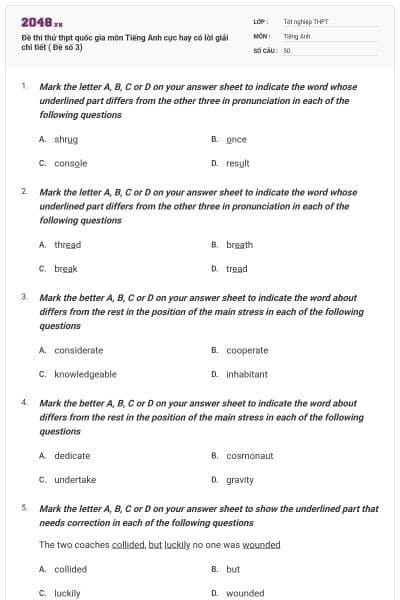
Mark the letter A, B, C or D on your answer sheet to indicate the word whose underlined part differs from the other three in pronunciation in each of the following questions
shrug
once
console
result
Đáp án là C.
shrug /ʃrʌɡ/
once /wʌns/
console /kənˈsəʊl/
result /rɪˈzʌlt/
=>Câu C phát âm là /əʊ/ còn lại phát âm là /ʌ/
Mark the letter A, B, C or D on your answer sheet to indicate the word whose underlined part differs from the other three in pronunciation in each of the following questions
thread
breath
break
tread
Đáp án là C.
thread /θred/
breath /breθ/
break /breɪk/
tread /tred/
=>Câu C phát âm là /eɪ/ còn lại phát âm là /e/
Mark the better A, B, C or D on your answer sheet to indicate the word about differs from the rest in the position of the main stress in each of the following questions
considerate
cooperate
knowledgeable
inhabitant
Đáp án là C.
considerate /kənˈsɪdərət/
cooperate /kəʊˈɒpəreɪt/
knowledgeable /ˈnɒlɪdʒəbl/
inhabitant /ɪnˈhæbɪtənt/
=>Câu C trọng âm 1 còn lại trọng âm 2
Mark the better A, B, C or D on your answer sheet to indicate the word about differs from the rest in the position of the main stress in each of the following questions
dedicate
cosmonaut
undertake
gravity
Đáp án là C.
dedicate /ˈdedɪkeɪt/
cosmonaut /ˈkɒzmənɔːt/
undertake /ˌʌndəˈteɪk/
gravity /ˈɡrævəti/
=>Câu C trọng âm 3 còn lại trọng âm 1
Mark the letter A, B, C or D on your answer sheet to show the underlined part that needs correction in each of the following questions
The two coaches collided, but luckily no one was wounded
collided
but
luckily
wounded
Đáp án là D.
Câu này dịch như sau: Hai chiếc xe khách đam sầm vào nhau nhưng may mắn không ai bị thương cả.
Wounded [ bị thương do vũ khí như dao, kiếm,...] => injured [ bị thương do tai nạn]
Mark the letter A, B, C or D on your answer sheet to show the underlined part that needs correction in each of the following questions
By itself, technology can be either good nor bad, depends on how people use it
By
can be
nor
depends
Đáp án là C.
Nor => or
Either...or...[ hoặc ...hoặc...]
Neither...nor...[ không....cũng không...]
Câu này dịch như sau: Công nghệ chính bản thân nó hoặc tốt hoặc xấu, tùy thuộc vào cách con người sử dụng nó như thế nào
Mark the letter A, B, C or D on your answer sheet to show the underlined part that needs correction in each of the following questions
Having watered the flowers in the rooms, she went on watering those in the kitchen
Having watered
in the
watering
those
Đáp án là C.
Câu này dịch như sau: Sau khi tưới hoa trong các phòng, cô ấy tiếp tục tưới cây trong nhà bếp.
Go on + Ving: tiếp tục làm một công việc đã làm
Go on + to Vo: tiếp tục làm 1 công việc khác
tưới hoa trong phòng ≠ tưới cây trong nhà bếp
watering => to water
Mark the letter A, B, C or D on your answer sheet to indicate the correct answer to each of the following questions
We don’t want my father to know about the trip. Please, don’t give us________
off
in
on
away
Đáp án là D.
Give off = to produce something such as a smell, heat, light, etc: tỏa ra mùi
Give in: nhượng bộ/ chịu thua
Give on => không có cụm động từ này
Give sb away: để lộ/ tiết lộ
Câu này dịch như sau: Chúng tôi không muốn bố biết về chuyến đi. Làm ơn, đừng để lộ.
Mark the letter A, B, C or D on your answer sheet to indicate the correct answer to each of the following questions
You should at least ________an effort to find the boy’s address if you don’t want to lose your last hope
make
work
put
do
Đáp án: A
Giải thích:
make an effort: nỗ lực làm gì
Dịch: Ít nhất bạn nên nỗ lực hết sức để tìm ra địa chỉ của chàng trai đó nếu bạn không muốn đánh mất cơ hội cuối cùng.
Mark the letter A, B, C or D on your answer sheet to indicate the correct answer to each of the following questions
If only I ________my temper at the party last night!
wouldn’t have lost
wouldn’t lose
hadn’t lost
didn’t lose
Đáp án là C.
Cấu trúc: If only = wish: ước gì/ giá mà
Ước ở hiện tại: Only if S+ quá khứ đơn
Ước ở quá khứ: Only if S+ quá khứ hoàn thành
Câu này dịch như sau: Giá mà tôi đã không nổi giận ở bữa tiệc tối qua.
Mark the letter A, B, C or D on your answer sheet to indicate the correct answer to each of the following questions
One of ________days I’m going to give him a piece of my mind
our
those
these
the
Đáp án là C.
Câu này dịch như sau: Một trong những ngày này, tôi dự định nói với anh ấy về những điều tôi không hài lòng.
Give sb a piece of sb‟s mind: bày tỏ với ai sự không hài lòng.
One of these days: dùng cho tương lai
One of those days: một trong những ngày trước
Mark the letter A, B, C or D on your answer sheet to indicate the correct answer to each of the following questions
“Why did you ride your bike today?” “It’s more ________than driving my car”
economical
economic
economy
economically
Đáp án là A.
S+ be+ tính từ => loại economy ( danh từ) và economically ( trạng từ)
Economic (adj): thuộc về kinh tế
Economical (adj): tiết kiệm
Câu này dịch như sau: “ Tại sao hôm nay bạn đi xe đạp vậy?” “ Nó tiết kiệm hơn đi ô tô.”
Mark the letter A, B, C or D on your answer sheet to indicate the correct answer to each of the following questions
- “ I understand you have been reading all the boys’ letters. Since when? “ - “ Since they________to me about their weekend plans.
laid
have laid
have lied
lied
Đáp án là D.
Lay(v) – laid – laid + O: đặt/ để
Lie (v) – lied – lied to sb: nói dối ai đó
Lie – lay – laid: nằm
Câu này dịch như sau: Tôi biết bạn đã đọc tất cả những lá thư của mấy đứa nhóc. Từ khi nào vây?” “ Kể từ khi chúng nói dối tôi về kế hoạch cuối tuần của chúng.”
Mark the letter A, B, C or D on your answer sheet to indicate the correct answer to each of the following questions
What about ________for us? It might be quite interesting, I suppose
to have some of them working
making some of them work
having some of them work
to make some of them work
Đáp án là C.
How about + Ving => loại A và D
Cấu trúc: S + have sb Vo: nhờ ai đó làm gì
Câu này dịch như sau: Về việc nhờ họ làm việc cho chúng ta thì sao? Tôi nghĩ, nó có vẻ khá thú vị đó
Mark the letter A, B, C or D on your answer sheet to indicate the correct answer to each of the following questions
Scientists say that mass ________can cause fast environmental pollution
production
productive
productively
product
Đáp án là A.
Production(n): sự sản xuất
Productive(adj): năng suất cao
Productively(adv): một cách có năng suất
Product(n): sản phẩm
Mass (adj) + danh từ => loại B và C
Câu này dịch như sau: Các nhà khoa học nói rằng việc sản xuất hàng loạt có thể gây ra ô nhiễm môi trường nhanh chóng.
Mark the letter A, B, C or D on your answer sheet to indicate the correct answer to each of the following questions
We are going to build a fence around the field with (a)n ________to breedingsheep and cattle
goal
view
reason
outlook
Đáp án là B.
Cụm từ with a view to + Vìn/ cụm danh từ: để mà/ với mục đích là để
Câu này dịch như sau: Chúng tôi dự định xây một hàng rào bao quanh cánh đồng để chăn nuôi cừu và gia súc
Mark the letter A, B, C or D on your answer sheet to indicate the correct answer to each of the following questions
The ASEAN countries are going to________a resolution to establish a free trade zone
take
pass
bring
order
Đáp án là B.
Cụm từ pass a resolution: thông qua nghị quyết
Câu này dịch như sau: Các nước Đông Nam Á dự kiến thông qua một nghị định để thành lập khu thương mại tự do
Mark the letter A, B, C or D on your answer sheet to indicate the correct answer to each of the following questions.
Mrs. Finkelstein demanded that the heater ________immediately. Her apartment was freezing.
be repaired
repaired
should be repair
would be repaired
Đáp án là A.
Cấu trúc: S1+ demand that + S2 + Vo/ should Vo
Câu này dịch như sau: Cô Finkerstein yêu cầu máy sưởi của cô ấy cần được sửa ngay lập tức. Căn hộ của cô ấy đang rất lạnh
Mark the letter A, B, C or D on your answer sheet to indicate the correct answer to each of the following questions
I can’t give you the answer on the ________; I’ll have to think about it for a few days
should have left
must have left
have left
ought to have left
Đáp án là B.
Must have Ved: chắc có lẽ đã...
Should/ ought to have Ved: đáng lẽ ra đã...
Câu này dịch như sau: Tôi không thể tìm đôi tất mới mà tôi đã mua. Chắc có lẽ tôi đã để quên nó ở cửa hàng
Mark the letter A, B, C or D on your answer sheet to indicate the most suitable respond to complete each of the following exchanges
Kelly: “I think that people are buying more than they actually need. What do you think?”Jack: ________, especially in this time of economic crises.”
I don’t think so.
I think the other way
I don’t, either
I think opposite
Đáp án là A.
Kelly: Tôi nghĩ rằng mọi người đang mua nhiều hơn những thứ họ thật sự cần. Bạn nghĩ sao?
Jack:..............., đặc biệt vào thời điểm khủng hoảng kinh tế như thế này.
A. Tôi không nghĩ vậy.
B. Tôi thì nghĩ khác.
C. Tôi cũng không.
D. Tôi nghĩ ngược lại.
Mark the letter A, B, C or D on your answer sheet to indicate the most suitable respond to complete each of the following exchanges
Jack: “I think the food in the restaurant is really delicious.” Janny: “________”
Neither do I
You can say that again
You’re welcome
That's why I am here
Đáp án là B.
Jack:” Mình nghĩ thức ăn trong nhà hàng thật sự ngon.”
A. Mình cũng không.
B. Bạn có thể nói lại điều đó.
C. Không có chi.
D. Đó là lý do tại sao tôi có mặt ở đây
Mark the letter A, B, C or D on your answer sheet to indicate the word (s) OPPOSITE in meaning to the underlined word (s) in the following question.
The sophisticated design of the vase made it a valuable piece or her collection
functional
simple
accurate
complex
Đáp án là B.
sophisticated (adj): phức tạp/ tinh vi
functional: chức năng
simple: đơn giản
accurate: chính xác
complex: phức tạp
Câu này dịch như sau: Thiết kế phức tạp/ tinh vi của chiếc bình này làm cho nó trở thành một phần đáng giá trong bộ sưu tập của cô ấy.
=> sophisticated >< simple
Mark the letter A, B, C or D on your answer sheet to indicate the word (s) OPPOSITE in meaning to the underlined word (s) in the following question.
Having spent all my money on tuition, I’m not affluent enough even to go to the cinema
arrogant
wealthy
afraid
poor
Đáp án là D.
Affluent (adj): giàu có/ phong phú
Arrogant: kiêu ngạo
Wealthy: giàu có
Afraid: e sợ
Poor: nghèo
Câu này dịch như sau: Sau khi đã dùng toàn bộ số tiền để đóng học phí, tôi giờ không đủ tiền thậm chí để đi xem phim.
=> Affluent >< Poor
Mark the letter A, B, C or D on your answer sheet to indicate the word or phrase that is CLOSEST in meaning to the underlined part in each of the following questions
Students are expected to be quiet and compliant in the classroom
recalcitrant
obedient
compatible
friendly
Đáp án là B.
compliant (adj): mềm mỏng/ hay nhường nhịn
recalcitrant: ngoan cố/ bướng bỉnh
obedient: ngoan ngoãn
compatible: tương hợp
friendly: thân thiện
Câu này dịch như sau: Các em học sinh được mong đợi trật tự và ngoan ngoãn trong lớp học.
=> compliant = obedient
Mark the letter A, B, C or D on your answer sheet to indicate the word or phrase that is CLOSEST in meaning to the underlined part in each of the following questions
After many years of unsuccessfully endeavoring to form his own orchestra, Glenn Miller finally achieved world fame in 1939 as a big band leader.
requesting
trying
offering
deciding
Đáp án là B.
endeavoring (v): nỗ lực
requesting: yêu cầu
trying: cố gắng
offering: đề xuất/ cung cấp/ dâng tặng
deciding: quyết định
Câu này dịch như sau: Sau nhiều năm nỗ lực không thành công trong việc thành lập dàn hợp xướng của riêng mình, Glenn Miller cuối cùng đã nổi tiếng khắp thế giới vào năm 1939 như một trưởng ban nhạc lớn.
=> endeavoring = trying
Mark the letter A, B, C or D on your answer sheet to indicate the sentence that is closest in meaning to each of the following questions
The newspaper reports that James was awarded the first prize
It is reported that James wins the first prize
It is reported that James to be awarded the first prize
James is reported to have been awarded the first prize
The first prize is reported to award to James
Đáp án là C.
Tờ báo nói rằng James đã được trao thưởng giải nhất.
People V1 that S + V2 + O
V2 xảy ra trước V1 => Câu bị động: S + be + to have been Ved/ V3
=>Chọn C [ James được nói rằng đã được trao tặng giải nhất.]
Mark the letter A, B, C or D on your answer sheet to indicate the sentence that is closest in meaning to each of the following questions
It is possible that we won’t have to take an entrance exam this year
Perhaps we don’t have to take an entrance exam this year
We mustn’t take an entrance exam this year
We mightn’t take an entrance exam this year
It is very likely that we will take an entrance exam this year
Đáp án là C.
Có thể chúng ta sẽ không phải thi đầu vào trong năm nay.
A. Có lẽ chúng ta không thi đầu vào trong năm nay. => sai vì phải dùng thì tương lai đơn.
B. Chúng ta không được thi đầu vào trong năm nay. => sai nghĩa.
C. Chúng ta có thể không thi đầu vào trong năm nay.
D. Rất có khả năng chúng ta sẽ thi đầu vào trong năm nay. => sai nghĩa
Mark the letter A, B, C or D on your answer sheet to indicate the sentence that is closest in meaning to each of the following questions
In spite of his tiredness, Joe managed to finish his work
Although he is tired, Joe managed to finish his work
Joe managed to finish his work but he was tired
Despite he was tired, Joe managed to finish his work
Tired as he seemed to be, Joe managed to finish his work
Đáp án là D.
Mặc dù mệt mỏi Joe vẫn hoàn thành được công việc.
Câu A sai vì hai mệnh đề không tương quan về thì.
B. Joe đã hoàn thành được công việc nhưng anh ấy mệt. => sai nghĩa
Câu C sai vì Despite + Ving / Cụm danh từ
D.Mặc dù có vẻ mệt mỏi, Joe vẫn hoàn thành công việc.
Cấu trúc: Tính từ + as/ though + S+ V = In spite of / Despite + Ving / cụm danh từ.
Mark the letter A, B, C or D on your answer sheet to indicate that best combine this pair of sentences in the following questions
We breathe much polluted air. We get weaker
Much polluted air is breathed as we get weaker
The more polluted air we breathe, the weaker we get
The weaker we get, the more polluted air we breathe
Polluted air is responsible for out bad health
Đáp án là B.
Chúng ta hít thở nhiều không khí bị ô nhiễm. Chún ta trở nên yếu hơn.
Cấu trúc so sánh kép: The + so sánh hơn + S + V, the + so sánh hơn + S + V
A. Nhiều không khí ô nhiễm được hít vào bởi vì chúng ta trở nên yếu hơn.
B. Càng nhiều không khí ô nhiễm mà chúng ta hít vào, chúng ta càng yếu hơn.
C. Chúng ta càng yếu, chúng ta càng hít nhiều không khí ô nhiễm.
D. Không khí bị ô nhiễm chịu trách nhiệm về sức khỏe yếu của chúng ta.
Mark the letter A, B, C or D on your answer sheet to indicate that best combine this pair of sentences in the following questions
We missed class several times. This was the cause of our poor grades
Having missed class several times, our poor grades were anticipated
Having missed class several times, our poor grades were anticipated
We received poor grades missing class several time
Receiving poor grades, we missed class several times
Đáp án là B.
Chúng tôi trễ học nhiều lần. Đó là lý do làm cho chúng tôi điểm kém.
A. Mặc dù chúng tôi trễ học nhiều lần, điểm kém của chúng tôi đã được đoán trước.
B. Bởi vì chúng tôi trễ học nhiều lần, chúng tôi nhận điểm kém.
C. Chúng tôi nhận điểm kém để trễn học nhiều lần.
D. Nếu chúng tôi nhận điểm kém, chúng tôi sẽ trễ học nhiều lần
Read the following passage, and mark the letter (A, B, C or D) on your answer sheet to indicate the correct answer for each of the blanks.
I live on the first floor of a house that has been (31) _______ into three flats. Five months ago, a couple moved into the flat above and since then my life has been a nightmare. They get up at 6 a.m and make a terrible noise. They listen to the radio at top (32) _______, talk loudly and stamp on the floor. In the evening they play the same record on their stereo over and over again. It’s beginning to (33) _______ me mad. I’ve tried turning my own stereo up to (34) _______ out the noise but I like peace and quiet and find loud music stressful. I tried to talking to them but it hasn’t done any good. I realize I should live and (35) _______ live , but I have begun to have quite irrational revenge fantasies about them – like switching off their electricity or deliberately making a lot of noise late at night when I know they are asleep. What on earth can I do?
Điền vào ô số 31
changed
converted
adapted
remade
Đáp án là B.
changed : thay đổi
converted: chuyển đổi [ từ dạng này sang dạng khác]
adapted:nhận nuôi/ thích nghi/ áp dụng
remade: tái tạo
I live on the first floor of a house that has been (31) _______ into three flats. Five months ago, a couple moved into the flat above and since then my life has been a nightmare.
[Tôi sống ở tầng 1 của một ngôi nhà đã được sửa thành 3 căn nhà. Cách đây 5 tháng, một cặp vợ chồng đã chuyển đến ở tầng trên và kể từ đó cuộc đời của tôi trở thành ác mộng.]
Read the following passage, and mark the letter (A, B, C or D) on your answer sheet to indicate the correct answer for each of the blanks.
I live on the first floor of a house that has been (31) _______ into three flats. Five months ago, a couple moved into the flat above and since then my life has been a nightmare. They get up at 6 a.m and make a terrible noise. They listen to the radio at top (32) _______, talk loudly and stamp on the floor. In the evening they play the same record on their stereo over and over again. It’s beginning to (33) _______ me mad. I’ve tried turning my own stereo up to (34) _______ out the noise but I like peace and quiet and find loud music stressful. I tried to talking to them but it hasn’t done any good. I realize I should live and (35) _______ live , but I have begun to have quite irrational revenge fantasies about them – like switching off their electricity or deliberately making a lot of noise late at night when I know they are asleep. What on earth can I do?
Điền vào ô số 32
power
volume
pitch
intensity
Đáp án là B.
Power: nặng lượng
Volume: âm lượng
Pitch: chai lọ/ độ nghiêng
Indensity: cường độ
They get up at 6 a.m and make a terrible noise. They listen to the radio at top (32) _______, talk loudly and stamp on the floor. In the evening they play the same record on their stereo over and over again.
[ Họ thức dậy lúc 6 giờ sáng và gây ra tiếng ông kinh khủng. họ nghe radio với âm lượng cao nhất, nói chuyện lớn tiếng và giẫm lên sán nhà. Buổi tối họ phát cùng một bài ghi âm trên máy lặp đi lặp lại.]
Read the following passage, and mark the letter (A, B, C or D) on your answer sheet to indicate the correct answer for each of the blanks.
I live on the first floor of a house that has been (31) _______ into three flats. Five months ago, a couple moved into the flat above and since then my life has been a nightmare. They get up at 6 a.m and make a terrible noise. They listen to the radio at top (32) _______, talk loudly and stamp on the floor. In the evening they play the same record on their stereo over and over again. It’s beginning to (33) _______ me mad. I’ve tried turning my own stereo up to (34) _______ out the noise but I like peace and quiet and find loud music stressful. I tried to talking to them but it hasn’t done any good. I realize I should live and (35) _______ live , but I have begun to have quite irrational revenge fantasies about them – like switching off their electricity or deliberately making a lot of noise late at night when I know they are asleep. What on earth can I do?
Điền vào ô số 33
drive
force
turn
put
Đáp án là A.
Cụm từ: Drive sb mad: khiến ai đó phát điên
It‟s beginning to (33) _______ me mad. [ Điều đó bắt đầu khiến tôi phát điên lên.]
Read the following passage, and mark the letter (A, B, C or D) on your answer sheet to indicate the correct answer for each of the blanks.
I live on the first floor of a house that has been (31) _______ into three flats. Five months ago, a couple moved into the flat above and since then my life has been a nightmare. They get up at 6 a.m and make a terrible noise. They listen to the radio at top (32) _______, talk loudly and stamp on the floor. In the evening they play the same record on their stereo over and over again. It’s beginning to (33) _______ me mad. I’ve tried turning my own stereo up to (34) _______ out the noise but I like peace and quiet and find loud music stressful. I tried to talking to them but it hasn’t done any good. I realize I should live and (35) _______ live , but I have begun to have quite irrational revenge fantasies about them – like switching off their electricity or deliberately making a lot of noise late at night when I know they are asleep. What on earth can I do?
Điền vào ô số 34
wipe
sound
deafen
drown
Đáp án là D.
Drown out: lấn át
I‟ve tried turning my own stereo up to (34) _______ out the noise but I like peace and quiet and find loud music stressful. I tried to talking to them but it hasn‟t done any good.
[ Tôi thử mở máy hát đĩa của mình để át đi tiếng ồn nhưng tôi thích sự yên tính và hòa bình và tôi cảm thấy nhạc to thật căng thắng. Tôi cố gắng nói chuyện với họ nhưng tình hình không khá lên chút nào.]
Read the following passage, and mark the letter (A, B, C or D) on your answer sheet to indicate the correct answer for each of the blanks.
I live on the first floor of a house that has been (31) _______ into three flats. Five months ago, a couple moved into the flat above and since then my life has been a nightmare. They get up at 6 a.m and make a terrible noise. They listen to the radio at top (32) _______, talk loudly and stamp on the floor. In the evening they play the same record on their stereo over and over again. It’s beginning to (33) _______ me mad. I’ve tried turning my own stereo up to (34) _______ out the noise but I like peace and quiet and find loud music stressful. I tried to talking to them but it hasn’t done any good. I realize I should live and (35) _______ live , but I have begun to have quite irrational revenge fantasies about them – like switching off their electricity or deliberately making a lot of noise late at night when I know they are asleep. What on earth can I do?
Điền vào ô số 35
let
make
have
be
Đáp án là A.
Cụm từ: live and let live: dĩ hòa vi quý
I realize I should live and (35) _______ live , but I have begun to have quite irrational revenge fantasies about them – like switching off their electricity or deliberately making a lot of noise late at night when I know they are asleep. What on earth can I do?
[ Tôi nhận ra rằng tôi nên dĩ hòa vi quý, nhưng tôi bắt đầu có những sở thích trả thù khá vô lý dành cho họ như ngắt điện của họ hay gây ra nhiều tiếng ồn khó chịu vào tối muộn khi tôi biết họ đang ngủ. Tôi có thể làm gì nữa đây?]
Read the following passage and mark the letter (A, B, C or D) on your answer sheet to indicate the correct answer to each for the questions.
Telecommuting-substituting the computer for the trip to the job-has been hailed as a solution to all kinds of problems related to office work. For workers, it promises freedom from the office, less time wasted in traffic, and help with child-care conflicts. For management, telecommuting helps keep high performers on board, minimizes tardiness and absenteeism by eliminating commutes, allows periods of solitude for high-concentration tasks, and provides scheduling flexibility. In some areas, such as Southern California and Seattle, Washington, local governments are encouraging companies to start telecommuting programs in order to reduce rush-hour congestion and improve air quality, but these benefits do not come easily. Making a telecommuting program work requires careful planning and an understanding of the differences between telecommuting realities and popular images.
Many workers are seduced by rosy illusions of life as a telecommuter. A computer programmer from New York City moves to the tranquil Adirondack Mountains and stays in contact with her office via computer. A manager comes into his Office three days a week and works at home the other two. An accountant stays home to care for child; she hooks up her telephone modem connections and does office work between calls to the doctor.
These are powerful images, but they are a limited reflection of reality. Telecommuting workers soon learn that it is almost impossible to concentrate on work and care for a young child at the same time. Before a certain age, young children cannot recognize, much less respect, the necessary boundaries between work and family. Additional child support is necessary if the parent is to get any work done.
Management, too, must separate the myth from the reality. Although the media has paid a great deal of attention to telecommuting, in most cases it is the employee’s situation, not the availability of technology, that precipitates a telecommuting arrangement.
That is partly why, despite the widespread press coverage, the number of companies with work-at-home programs or policy guidelines remains small
What is the main subject of the passage?
Business management policies
Commuting to work
Extending the workplace by means of telecommuting
Telecommuting for child-care purposes
Đáp án là C.
Chủ đề chính của bài đọc là gì?
A. Các chính sách quản trị kinh doanh.
B. Đi đi về về làm việc
C. Mở rộng nơi làm việc bằng các phương tiện viễn thông.
D. Viễn thông dành cho các mục đích chăm sóc trẻ em.
Read the following passage and mark the letter (A, B, C or D) on your answer sheet to indicate the correct answer to each for the questions.
Telecommuting-substituting the computer for the trip to the job-has been hailed as a solution to all kinds of problems related to office work. For workers, it promises freedom from the office, less time wasted in traffic, and help with child-care conflicts. For management, telecommuting helps keep high performers on board, minimizes tardiness and absenteeism by eliminating commutes, allows periods of solitude for high-concentration tasks, and provides scheduling flexibility. In some areas, such as Southern California and Seattle, Washington, local governments are encouraging companies to start telecommuting programs in order to reduce rush-hour congestion and improve air quality, but these benefits do not come easily. Making a telecommuting program work requires careful planning and an understanding of the differences between telecommuting realities and popular images.
Many workers are seduced by rosy illusions of life as a telecommuter. A computer programmer from New York City moves to the tranquil Adirondack Mountains and stays in contact with her office via computer. A manager comes into his Office three days a week and works at home the other two. An accountant stays home to care for child; she hooks up her telephone modem connections and does office work between calls to the doctor.
These are powerful images, but they are a limited reflection of reality. Telecommuting workers soon learn that it is almost impossible to concentrate on work and care for a young child at the same time. Before a certain age, young children cannot recognize, much less respect, the necessary boundaries between work and family. Additional child support is necessary if the parent is to get any work done.
Management, too, must separate the myth from the reality. Although the media has paid a great deal of attention to telecommuting, in most cases it is the employee’s situation, not the availability of technology, that precipitates a telecommuting arrangement.
That is partly why, despite the widespread press coverage, the number of companies with work-at-home programs or policy guidelines remains small
According to the passage, what is the most important tool for a telecommuter to work at home?
telephone
a camera
a smart phone
a computer
Đáp án là D.
Theo bài đọc, cái gì là công cụ quan trọng nhất cho một người làm việc ở nhà thông qua thiết bị viễn thông?
A. điện thoại
B. camera giám sát
C. điện thoại thông minh
D. máy tính
Dẫn chứng: Telecommuting-substituting the computer for the trip to the job-has been hailed as a solution to all kinds of problems related to office work
Read the following passage and mark the letter (A, B, C or D) on your answer sheet to indicate the correct answer to each for the questions.
Telecommuting-substituting the computer for the trip to the job-has been hailed as a solution to all kinds of problems related to office work. For workers, it promises freedom from the office, less time wasted in traffic, and help with child-care conflicts. For management, telecommuting helps keep high performers on board, minimizes tardiness and absenteeism by eliminating commutes, allows periods of solitude for high-concentration tasks, and provides scheduling flexibility. In some areas, such as Southern California and Seattle, Washington, local governments are encouraging companies to start telecommuting programs in order to reduce rush-hour congestion and improve air quality, but these benefits do not come easily. Making a telecommuting program work requires careful planning and an understanding of the differences between telecommuting realities and popular images.
Many workers are seduced by rosy illusions of life as a telecommuter. A computer programmer from New York City moves to the tranquil Adirondack Mountains and stays in contact with her office via computer. A manager comes into his Office three days a week and works at home the other two. An accountant stays home to care for child; she hooks up her telephone modem connections and does office work between calls to the doctor.
These are powerful images, but they are a limited reflection of reality. Telecommuting workers soon learn that it is almost impossible to concentrate on work and care for a young child at the same time. Before a certain age, young children cannot recognize, much less respect, the necessary boundaries between work and family. Additional child support is necessary if the parent is to get any work done.
Management, too, must separate the myth from the reality. Although the media has paid a great deal of attention to telecommuting, in most cases it is the employee’s situation, not the availability of technology, that precipitates a telecommuting arrangement.
That is partly why, despite the widespread press coverage, the number of companies with work-at-home programs or policy guidelines remains small
The word “hailed” in the first paragraph is closest in meaning to
welcomed
communicated
considered
arranged
Đáp án là A.
Từ “ hailed” ở đoạn 1 gần nghĩa nhất với....
Welcomed: chào đón
Communicated: giao tiếp
Considerated: cân nhắc, xem xét
Arranged: sắp xếp
Telecommuting-substituting the computer for the trip to the job-has been hailed as a solution to all kinds of problems related to office work.
[ Làm việc ở nhà thông qua các thiết bị viễn thông với máy tính thay thế cho việc đi lại đến nơi làm việc, đã được đón nhận như là một giải pháp đối với tất cả các loại vấn đề liên quan đến làm việc trong văn phòng.]
=>hailed = welcomed
Read the following passage and mark the letter (A, B, C or D) on your answer sheet to indicate the correct answer to each for the questions.
Telecommuting-substituting the computer for the trip to the job-has been hailed as a solution to all kinds of problems related to office work. For workers, it promises freedom from the office, less time wasted in traffic, and help with child-care conflicts. For management, telecommuting helps keep high performers on board, minimizes tardiness and absenteeism by eliminating commutes, allows periods of solitude for high-concentration tasks, and provides scheduling flexibility. In some areas, such as Southern California and Seattle, Washington, local governments are encouraging companies to start telecommuting programs in order to reduce rush-hour congestion and improve air quality, but these benefits do not come easily. Making a telecommuting program work requires careful planning and an understanding of the differences between telecommuting realities and popular images.
Many workers are seduced by rosy illusions of life as a telecommuter. A computer programmer from New York City moves to the tranquil Adirondack Mountains and stays in contact with her office via computer. A manager comes into his Office three days a week and works at home the other two. An accountant stays home to care for child; she hooks up her telephone modem connections and does office work between calls to the doctor.
These are powerful images, but they are a limited reflection of reality. Telecommuting workers soon learn that it is almost impossible to concentrate on work and care for a young child at the same time. Before a certain age, young children cannot recognize, much less respect, the necessary boundaries between work and family. Additional child support is necessary if the parent is to get any work done.
Management, too, must separate the myth from the reality. Although the media has paid a great deal of attention to telecommuting, in most cases it is the employee’s situation, not the availability of technology, that precipitates a telecommuting arrangement.
That is partly why, despite the widespread press coverage, the number of companies with work-at-home programs or policy guidelines remains small
Which of the following is NOT mentioned as a problem for office employees?
Being restricted to the office
Incurring expenses for lunches and clothing
Taking care of sick children
Driving in heavy traffic
Đáp án là B.
Câu nào sau đây không được đề cập như vấn đề của các nhân viên văn phòng?
A. Bị giới hạn trong văn phòng.
B. Gánh chịu chi phí cho bữa ăn trưa và ăn mặc.
C. Chăm sóc trẻ ốm.
D. Lái xe lúc giao thông ùn tắc.
Dẫn chứng: local governments are encouraging companies to start telecommuting programs in order to reduce rush-hour congestion => loại D
An accountant stays home to care for child; she hooks up her telephone modem connections and does office work between calls to the doctor. => loại C
Read the following passage and mark the letter (A, B, C or D) on your answer sheet to indicate the correct answer to each for the questions.
Telecommuting-substituting the computer for the trip to the job-has been hailed as a solution to all kinds of problems related to office work. For workers, it promises freedom from the office, less time wasted in traffic, and help with child-care conflicts. For management, telecommuting helps keep high performers on board, minimizes tardiness and absenteeism by eliminating commutes, allows periods of solitude for high-concentration tasks, and provides scheduling flexibility. In some areas, such as Southern California and Seattle, Washington, local governments are encouraging companies to start telecommuting programs in order to reduce rush-hour congestion and improve air quality, but these benefits do not come easily. Making a telecommuting program work requires careful planning and an understanding of the differences between telecommuting realities and popular images.
Many workers are seduced by rosy illusions of life as a telecommuter. A computer programmer from New York City moves to the tranquil Adirondack Mountains and stays in contact with her office via computer. A manager comes into his Office three days a week and works at home the other two. An accountant stays home to care for child; she hooks up her telephone modem connections and does office work between calls to the doctor.
These are powerful images, but they are a limited reflection of reality. Telecommuting workers soon learn that it is almost impossible to concentrate on work and care for a young child at the same time. Before a certain age, young children cannot recognize, much less respect, the necessary boundaries between work and family. Additional child support is necessary if the parent is to get any work done.
Management, too, must separate the myth from the reality. Although the media has paid a great deal of attention to telecommuting, in most cases it is the employee’s situation, not the availability of technology, that precipitates a telecommuting arrangement.
That is partly why, despite the widespread press coverage, the number of companies with work-at-home programs or policy guidelines remains small
Which of the following is NOT mentioned as a problem for employers that is potentially solved by telecommuting?
Employees’ lateness for work
Employees’ absence from work
Employees’ need for time to work intensively alone
Employees’ conflicts with second jobs
Đáp án là D.
Câu nào sau đây không được đề cập như là một vấn đề của nhân viên cái mà có thể được giải quyết bằng cách làm việc ở nhà thông qua các thiết bị viễn thông?
A. Trễ giờ làm của nhân viên
B. Nghỉ làm / vắng mặt/ nghỉ phép
C. Cần thời gian để làm việc chuyên sâu 1 mình
D. Mâu thuẫn của nhân viên với công việc thứ hai.
Dẫn chứng: telecommuting helps keep high performers on board, minimizes tardiness and absenteeism by eliminating commutes, allows periods of solitude for high-concentration tasks, and provides scheduling flexibility
Read the following passage and mark the letter (A, B, C or D) on your answer sheet to indicate the correct answer to each for the questions.
Telecommuting-substituting the computer for the trip to the job-has been hailed as a solution to all kinds of problems related to office work. For workers, it promises freedom from the office, less time wasted in traffic, and help with child-care conflicts. For management, telecommuting helps keep high performers on board, minimizes tardiness and absenteeism by eliminating commutes, allows periods of solitude for high-concentration tasks, and provides scheduling flexibility. In some areas, such as Southern California and Seattle, Washington, local governments are encouraging companies to start telecommuting programs in order to reduce rush-hour congestion and improve air quality, but these benefits do not come easily. Making a telecommuting program work requires careful planning and an understanding of the differences between telecommuting realities and popular images.
Many workers are seduced by rosy illusions of life as a telecommuter. A computer programmer from New York City moves to the tranquil Adirondack Mountains and stays in contact with her office via computer. A manager comes into his Office three days a week and works at home the other two. An accountant stays home to care for child; she hooks up her telephone modem connections and does office work between calls to the doctor.
These are powerful images, but they are a limited reflection of reality. Telecommuting workers soon learn that it is almost impossible to concentrate on work and care for a young child at the same time. Before a certain age, young children cannot recognize, much less respect, the necessary boundaries between work and family. Additional child support is necessary if the parent is to get any work done.
Management, too, must separate the myth from the reality. Although the media has paid a great deal of attention to telecommuting, in most cases it is the employee’s situation, not the availability of technology, that precipitates a telecommuting arrangement.
That is partly why, despite the widespread press coverage, the number of companies with work-at-home programs or policy guidelines remains small
Which of the following does the author mention as a possible disadvantage of telecommuting?
Small children cannot understand the boundaries of work and play
Computer technology is not advanced enough to accommodate the needs of every situation
Electrical malfunctions can destroy a project
The worker often does not have all the needed resources at home
Đáp án là A.
Câu nào sau đây tác giả đề cập như là 1 bất lợi của làm việc tại nhà thồn qua viễn thông?
A. Trẻ nhỏ không hiểu ranh giới giữa chơi và làm việc.
B. Công nghệ máy tính không được cải tiến để đáp ứng nhu cầu cho mọi tình huống.
C. Những trục trặc về điện tử có thể làm hỏng 1 dự án.
D. Công nhân thường không có tất cả những nguồn cần thiết khi ở nhà.
Dẫn chứng: Before a certain age, young children cannot recognize, much less respect, the necessary boundaries between work and family
Read the following passage and mark the letter (A, B, C or D) on your answer sheet to indicate the correct answer to each for the questions.
Telecommuting-substituting the computer for the trip to the job-has been hailed as a solution to all kinds of problems related to office work. For workers, it promises freedom from the office, less time wasted in traffic, and help with child-care conflicts. For management, telecommuting helps keep high performers on board, minimizes tardiness and absenteeism by eliminating commutes, allows periods of solitude for high-concentration tasks, and provides scheduling flexibility. In some areas, such as Southern California and Seattle, Washington, local governments are encouraging companies to start telecommuting programs in order to reduce rush-hour congestion and improve air quality, but these benefits do not come easily. Making a telecommuting program work requires careful planning and an understanding of the differences between telecommuting realities and popular images.
Many workers are seduced by rosy illusions of life as a telecommuter. A computer programmer from New York City moves to the tranquil Adirondack Mountains and stays in contact with her office via computer. A manager comes into his Office three days a week and works at home the other two. An accountant stays home to care for child; she hooks up her telephone modem connections and does office work between calls to the doctor.
These are powerful images, but they are a limited reflection of reality. Telecommuting workers soon learn that it is almost impossible to concentrate on work and care for a young child at the same time. Before a certain age, young children cannot recognize, much less respect, the necessary boundaries between work and family. Additional child support is necessary if the parent is to get any work done.
Management, too, must separate the myth from the reality. Although the media has paid a great deal of attention to telecommuting, in most cases it is the employee’s situation, not the availability of technology, that precipitates a telecommuting arrangement.
That is partly why, despite the widespread press coverage, the number of companies with work-at-home programs or policy guidelines remains small
Which of the following is an example of telecommuting as described in the passage?
A scientist in a laboratory developing plans for a space station
A technical writer sending via computer documents created at home
A computer technician repairing an office computer network
A teacher directing computer-assisted learning in a private school
Đáp án là B.
Câu nào sau đây là ví dụ của làm việc tịa nhà thông qua máy tính được miêu tả trong bài đọc?
A. Một nhà khoa học làm việc trong phòng thí nghiệm phát triển các kế hoạch cho trạm không gian.
B. Một người viết sách về kỹ thuật gửi những tài liệu thông qua máy tính ở nhà.
C. Một thợ sửa chữa máy tính sửa một mạng lưới máy tính văn phòng.
D. Một giáo viên hướng dẫn cách học với sự hỗ trợ của máy tính ở một trường tư.
Read the following passage and mark the letter (A, B, C or D) on your answer sheet to indicate the correct answer to each for the questions.
Millions of people tune into the weather forecast each evening on televisions. Most of them imagine that the presenter does little more than arrive at the studio a few minutes before the broadcast, read the weather, and then go home.
In fact, this imagine is far from the truth. The two-minute bulletin which we all rely on when we need to know tomorrow’s weather is the result of a hard day’s work by the presenter, who is actually a highly-qualified meteorologist.
Every morning after arriving at the TV studios, the first task of the days is to collect the latest data from the national Meteorological Office. This office provides up-to-the-minute information about weather conditions throughout the day, both in Britain and around the world. The information is very detailed and includes predictions, satellite and radar pictures, as well as more technical data. After gathering all the relevant material from this office, the forecaster has to translate the scientific terminology and maps into images and word which viewers can easily understand.
The final broadcast is then carefully planned. It is prepared in the same way as other programmes. The presenter decides what to say and in what order to say it. Next, a “story board” is drawn up which lay out the script word for word. What make a weather forecast more complicated than other programmes are the maps and electronic images which are required. The computer has to be programmed so that the pictures appear in the correct order during the bulletin.
The time allocated for each broadcast can also alter. This is because the weather report is screened after the news, which can vary in length. The weather forecaster doesn’t always know how much time is available, which means that he/ she has to be thoroughly prepared so that the material can be adapted to the time available.
Another related complication is that the weather forecast has to be a live broadcast; it cannot be pre- recorded. Live shows are very nerve- racking for the presenter because almost anything can go wrong. Perhaps the most worrying aspect for every weather forecaster is getting the following day’s predictions wrong. Unfortunately for them this is not an unusual occurrence; the weather is not always possible to predict accurately.
The weather is a national obsession in Britain, Perhaps because it is so changeable. It’s the national talking point, and most people watch at least one daily bulletin. It can be mortifying for a weather man or woman who has predicted rain for the morning to wake up to brilliant sunshine. These days, a weather forecaster’s job is even more complicated because they are replied upon to predict other environmental conditions. For example, in the summer the weather forecast has to include the pollen count for hay fever sufferers. Some also include reports on ultraviolet radiation intensity to help people avoid sunburn.
The job of the weather forecaster is certainly far more complicated than just pointing at a map and describing weather conditions. It’s a job for professionals who can cope with stressful and demanding conditions
What perception do most people have a weather forecasters?
They have many qualifications
They do a hard day’s work at the studio
They always tell the truth
They work very short hours
Đáp án là D.
Nhận thức của hầu hết mọi người về một phát thanh viên dự báo thời tiết là gì?
A. Họ có nhiều bằng cấp khác nhau.
B. họ làm việc vất vả cả ngày ở phòng quay.
C. Họ luôn nói sự thật.
D. Họ làm việc rất ít giờ.
Dẫn chứng: Most of them imagine that the presenter does little more than arrive at the studio a few minutes before the broadcast, read the weather, and then go home.
Read the following passage and mark the letter (A, B, C or D) on your answer sheet to indicate the correct answer to each for the questions.
Millions of people tune into the weather forecast each evening on televisions. Most of them imagine that the presenter does little more than arrive at the studio a few minutes before the broadcast, read the weather, and then go home.
In fact, this imagine is far from the truth. The two-minute bulletin which we all rely on when we need to know tomorrow’s weather is the result of a hard day’s work by the presenter, who is actually a highly-qualified meteorologist.
Every morning after arriving at the TV studios, the first task of the days is to collect the latest data from the national Meteorological Office. This office provides up-to-the-minute information about weather conditions throughout the day, both in Britain and around the world. The information is very detailed and includes predictions, satellite and radar pictures, as well as more technical data. After gathering all the relevant material from this office, the forecaster has to translate the scientific terminology and maps into images and word which viewers can easily understand.
The final broadcast is then carefully planned. It is prepared in the same way as other programmes. The presenter decides what to say and in what order to say it. Next, a “story board” is drawn up which lay out the script word for word. What make a weather forecast more complicated than other programmes are the maps and electronic images which are required. The computer has to be programmed so that the pictures appear in the correct order during the bulletin.
The time allocated for each broadcast can also alter. This is because the weather report is screened after the news, which can vary in length. The weather forecaster doesn’t always know how much time is available, which means that he/ she has to be thoroughly prepared so that the material can be adapted to the time available.
Another related complication is that the weather forecast has to be a live broadcast; it cannot be pre- recorded. Live shows are very nerve- racking for the presenter because almost anything can go wrong. Perhaps the most worrying aspect for every weather forecaster is getting the following day’s predictions wrong. Unfortunately for them this is not an unusual occurrence; the weather is not always possible to predict accurately.
The weather is a national obsession in Britain, Perhaps because it is so changeable. It’s the national talking point, and most people watch at least one daily bulletin. It can be mortifying for a weather man or woman who has predicted rain for the morning to wake up to brilliant sunshine. These days, a weather forecaster’s job is even more complicated because they are replied upon to predict other environmental conditions. For example, in the summer the weather forecast has to include the pollen count for hay fever sufferers. Some also include reports on ultraviolet radiation intensity to help people avoid sunburn.
The job of the weather forecaster is certainly far more complicated than just pointing at a map and describing weather conditions. It’s a job for professionals who can cope with stressful and demanding conditions
Meteorologists get their forecasting information from
The TV studio
The country’ s main weather centre
Satellite and radar information
Their office
Đáp án là B.
Các nhà thiên văn học nhận được thông tin dự báo từ...
A. Phòng quay đài truyền hình
B. Trung tâm dự báo khí tượng trung ương
C. vệ tinh và rada thông tin
D. văn phòng của họ
Dẫn chứng: Every morning after arriving at the TV studios, the first task of the days is to collect the latest data from the national Meteorological Office.
Read the following passage and mark the letter (A, B, C or D) on your answer sheet to indicate the correct answer to each for the questions. Millions of people tune into the weather forecast each evening on televisions. Most of them imagine that the presenter does little more than arrive at the studio a few minutes before the broadcast, read the weather, and then go home. In fact, this imagine is far from the truth. The two-minute bulletin which we all rely on when we need to know tomorrow’s weather is the result of a hard day’s work by the presenter, who is actually a highly-qualified meteorologist. Every morning after arriving at the TV studios, the first task of the days is to collect the latest data from the national Meteorological Office. This office provides up-to-the-minute information about weather conditions throughout the day, both in Britain and around the world. The information is very detailed and includes predictions, satellite and radar pictures, as well as more technical data. After gathering all the relevant material from this office, the forecaster has to translate the scientific terminology and maps into images and word which viewers can easily understand. The final broadcast is then carefully planned. It is prepared in the same way as other programmes. The presenter decides what to say and in what order to say it. Next, a “story board” is drawn up which lay out the script word for word. What make a weather forecast more complicated than other programmes are the maps and electronic images which are required. The computer has to be programmed so that the pictures appear in the correct order during the bulletin. The time allocated for each broadcast can also alter. This is because the weather report is screened after the news, which can vary in length. The weather forecaster doesn’t always know how much time is available, which means that he/ she has to be thoroughly prepared so that the material can be adapted to the time available. Another related complication is that the weather forecast has to be a live broadcast; it cannot be pre- recorded. Live shows are very nerve- racking for the presenter because almost anything can go wrong. Perhaps the most worrying aspect for every weather forecaster is getting the following day’s predictions wrong. Unfortunately for them this is not an unusual occurrence; the weather is not always possible to predict accurately. The weather is a national obsession in Britain, Perhaps because it is so changeable. It’s the national talking point, and most people watch at least one daily bulletin. It can be mortifying for a weather man or woman who has predicted rain for the morning to wake up to brilliant sunshine. These days, a weather forecaster’s job is even more complicated because they are replied upon to predict other environmental conditions. For example, in the summer the weather forecast has to include the pollen count for hay fever sufferers. Some also include reports on ultraviolet radiation intensity to help people avoid sunburn. The job of the weather forecaster is certainly far more complicated than just pointing at a map and describing weather conditions. It’s a job for professionals who can cope with stressful and demanding conditions.
The phrase up- to- the- minute in paragraph 3 is closest in meaning to
Very brief
Very short
( the) most recent
Fashionable
Đáp án là C.
Cụm từ “up- to – the – minute” ở đoạn 3 gần nghĩa nhất với...
A. rất ngắn gọn/ cô động
B. rất ngắn
C. gần đây nhất/ mới nhất
D. hợp xu hướng thời trang
=>up- to – the – minute = the most recent
Read the following passage and mark the letter (A, B, C or D) on your answer sheet to indicate the correct answer to each for the questions. Millions of people tune into the weather forecast each evening on televisions. Most of them imagine that the presenter does little more than arrive at the studio a few minutes before the broadcast, read the weather, and then go home. In fact, this imagine is far from the truth. The two-minute bulletin which we all rely on when we need to know tomorrow’s weather is the result of a hard day’s work by the presenter, who is actually a highly-qualified meteorologist. Every morning after arriving at the TV studios, the first task of the days is to collect the latest data from the national Meteorological Office. This office provides up-to-the-minute information about weather conditions throughout the day, both in Britain and around the world. The information is very detailed and includes predictions, satellite and radar pictures, as well as more technical data. After gathering all the relevant material from this office, the forecaster has to translate the scientific terminology and maps into images and word which viewers can easily understand. The final broadcast is then carefully planned. It is prepared in the same way as other programmes. The presenter decides what to say and in what order to say it. Next, a “story board” is drawn up which lay out the script word for word. What make a weather forecast more complicated than other programmes are the maps and electronic images which are required. The computer has to be programmed so that the pictures appear in the correct order during the bulletin. The time allocated for each broadcast can also alter. This is because the weather report is screened after the news, which can vary in length. The weather forecaster doesn’t always know how much time is available, which means that he/ she has to be thoroughly prepared so that the material can be adapted to the time available. Another related complication is that the weather forecast has to be a live broadcast; it cannot be pre- recorded. Live shows are very nerve- racking for the presenter because almost anything can go wrong. Perhaps the most worrying aspect for every weather forecaster is getting the following day’s predictions wrong. Unfortunately for them this is not an unusual occurrence; the weather is not always possible to predict accurately. The weather is a national obsession in Britain, Perhaps because it is so changeable. It’s the national talking point, and most people watch at least one daily bulletin. It can be mortifying for a weather man or woman who has predicted rain for the morning to wake up to brilliant sunshine. These days, a weather forecaster’s job is even more complicated because they are replied upon to predict other environmental conditions. For example, in the summer the weather forecast has to include the pollen count for hay fever sufferers. Some also include reports on ultraviolet radiation intensity to help people avoid sunburn. The job of the weather forecaster is certainly far more complicated than just pointing at a map and describing weather conditions. It’s a job for professionals who can cope with stressful and demanding conditions.
The computer has to be carefully programmed
So that the visual are sequenced correctly
So that the script is visible to the presenter
Because the script has to be written on a story board
Because electric maps are used
Đáp án là A.
Máy tính phải được lập trình cẩn thận ...
A. để mà thiết bị trực quan được vận hành đúng
B. để mà đoạn trích dẫn có thể dễ nhìn thấy với người thuyết trình
C. bởi vì đoạn trích phải được viết trên bảng tin.
D. bởi vì bản đồ điện tử được sử dụng.
Dẫn chứng: The computer has to be programmed so that the pictures appear in the correct order during the bulletin
Read the following passage and mark the letter (A, B, C or D) on your answer sheet to indicate the correct answer to each for the questions. Millions of people tune into the weather forecast each evening on televisions. Most of them imagine that the presenter does little more than arrive at the studio a few minutes before the broadcast, read the weather, and then go home. In fact, this imagine is far from the truth. The two-minute bulletin which we all rely on when we need to know tomorrow’s weather is the result of a hard day’s work by the presenter, who is actually a highly-qualified meteorologist. Every morning after arriving at the TV studios, the first task of the days is to collect the latest data from the national Meteorological Office. This office provides up-to-the-minute information about weather conditions throughout the day, both in Britain and around the world. The information is very detailed and includes predictions, satellite and radar pictures, as well as more technical data. After gathering all the relevant material from this office, the forecaster has to translate the scientific terminology and maps into images and word which viewers can easily understand. The final broadcast is then carefully planned. It is prepared in the same way as other programmes. The presenter decides what to say and in what order to say it. Next, a “story board” is drawn up which lay out the script word for word. What make a weather forecast more complicated than other programmes are the maps and electronic images which are required. The computer has to be programmed so that the pictures appear in the correct order during the bulletin. The time allocated for each broadcast can also alter. This is because the weather report is screened after the news, which can vary in length. The weather forecaster doesn’t always know how much time is available, which means that he/ she has to be thoroughly prepared so that the material can be adapted to the time available. Another related complication is that the weather forecast has to be a live broadcast; it cannot be pre- recorded. Live shows are very nerve- racking for the presenter because almost anything can go wrong. Perhaps the most worrying aspect for every weather forecaster is getting the following day’s predictions wrong. Unfortunately for them this is not an unusual occurrence; the weather is not always possible to predict accurately. The weather is a national obsession in Britain, Perhaps because it is so changeable. It’s the national talking point, and most people watch at least one daily bulletin. It can be mortifying for a weather man or woman who has predicted rain for the morning to wake up to brilliant sunshine. These days, a weather forecaster’s job is even more complicated because they are replied upon to predict other environmental conditions. For example, in the summer the weather forecast has to include the pollen count for hay fever sufferers. Some also include reports on ultraviolet radiation intensity to help people avoid sunburn. The job of the weather forecaster is certainly far more complicated than just pointing at a map and describing weather conditions. It’s a job for professionals who can cope with stressful and demanding conditions.
Weather forecasters have to know the material well because
The length of the report may have to change
The forecast may be incorporated into the news broadcast
The content of the report may have to change
The broadcast is pre-recorded
Đáp án là A.
Các phát thanh viên dự báo thời tiết phải biết về tài liệu rất rõ bởi vì...
A. Độ dài của bài viết có thể thay đổi.
B. Bài dự báo có thể được kết hợp thành 1 tin tức dự báo.
C. nội dung của bài viết có thể phải thay đổi.
D. bài dự báo được ghi âm lại.
Dẫn chứng: The time allocated for each broadcast can also alter
Read the following passage and mark the letter (A, B, C or D) on your answer sheet to indicate the correct answer to each for the questions. Millions of people tune into the weather forecast each evening on televisions. Most of them imagine that the presenter does little more than arrive at the studio a few minutes before the broadcast, read the weather, and then go home. In fact, this imagine is far from the truth. The two-minute bulletin which we all rely on when we need to know tomorrow’s weather is the result of a hard day’s work by the presenter, who is actually a highly-qualified meteorologist. Every morning after arriving at the TV studios, the first task of the days is to collect the latest data from the national Meteorological Office. This office provides up-to-the-minute information about weather conditions throughout the day, both in Britain and around the world. The information is very detailed and includes predictions, satellite and radar pictures, as well as more technical data. After gathering all the relevant material from this office, the forecaster has to translate the scientific terminology and maps into images and word which viewers can easily understand. The final broadcast is then carefully planned. It is prepared in the same way as other programmes. The presenter decides what to say and in what order to say it. Next, a “story board” is drawn up which lay out the script word for word. What make a weather forecast more complicated than other programmes are the maps and electronic images which are required. The computer has to be programmed so that the pictures appear in the correct order during the bulletin. The time allocated for each broadcast can also alter. This is because the weather report is screened after the news, which can vary in length. The weather forecaster doesn’t always know how much time is available, which means that he/ she has to be thoroughly prepared so that the material can be adapted to the time available. Another related complication is that the weather forecast has to be a live broadcast; it cannot be pre- recorded. Live shows are very nerve- racking for the presenter because almost anything can go wrong. Perhaps the most worrying aspect for every weather forecaster is getting the following day’s predictions wrong. Unfortunately for them this is not an unusual occurrence; the weather is not always possible to predict accurately. The weather is a national obsession in Britain, Perhaps because it is so changeable. It’s the national talking point, and most people watch at least one daily bulletin. It can be mortifying for a weather man or woman who has predicted rain for the morning to wake up to brilliant sunshine. These days, a weather forecaster’s job is even more complicated because they are replied upon to predict other environmental conditions. For example, in the summer the weather forecast has to include the pollen count for hay fever sufferers. Some also include reports on ultraviolet radiation intensity to help people avoid sunburn. The job of the weather forecaster is certainly far more complicated than just pointing at a map and describing weather conditions. It’s a job for professionals who can cope with stressful and demanding conditions.
What does this in paragraph 6 refer to?
The weather forecaster’s worry
Reading the weather ‘live’
Giving a forecast that doesn’t come true
An accurate prediction
Đáp án là C.
Từ “this” trong đoạn 6 ám chỉ đến cái gì?
A. Nỗi lo lắng của phát thanh viên dự báo thời tiết.
B. Việc đọc bản tin trực tiếp
C. Việc đưa ra bài dự báo không đúng
D. Sự tiên đoán chính xác.
Perhaps the most worrying aspect for every weather forecaster is getting the following day‟s predictions wrong. Unfortunately for them this is not an unusual occurrence; the weather is not always possible to predict accurately
Read the following passage and mark the letter (A, B, C or D) on your answer sheet to indicate the correct answer to each for the questions. Millions of people tune into the weather forecast each evening on televisions. Most of them imagine that the presenter does little more than arrive at the studio a few minutes before the broadcast, read the weather, and then go home. In fact, this imagine is far from the truth. The two-minute bulletin which we all rely on when we need to know tomorrow’s weather is the result of a hard day’s work by the presenter, who is actually a highly-qualified meteorologist. Every morning after arriving at the TV studios, the first task of the days is to collect the latest data from the national Meteorological Office. This office provides up-to-the-minute information about weather conditions throughout the day, both in Britain and around the world. The information is very detailed and includes predictions, satellite and radar pictures, as well as more technical data. After gathering all the relevant material from this office, the forecaster has to translate the scientific terminology and maps into images and word which viewers can easily understand. The final broadcast is then carefully planned. It is prepared in the same way as other programmes. The presenter decides what to say and in what order to say it. Next, a “story board” is drawn up which lay out the script word for word. What make a weather forecast more complicated than other programmes are the maps and electronic images which are required. The computer has to be programmed so that the pictures appear in the correct order during the bulletin. The time allocated for each broadcast can also alter. This is because the weather report is screened after the news, which can vary in length. The weather forecaster doesn’t always know how much time is available, which means that he/ she has to be thoroughly prepared so that the material can be adapted to the time available. Another related complication is that the weather forecast has to be a live broadcast; it cannot be pre- recorded. Live shows are very nerve- racking for the presenter because almost anything can go wrong. Perhaps the most worrying aspect for every weather forecaster is getting the following day’s predictions wrong. Unfortunately for them this is not an unusual occurrence; the weather is not always possible to predict accurately. The weather is a national obsession in Britain, Perhaps because it is so changeable. It’s the national talking point, and most people watch at least one daily bulletin. It can be mortifying for a weather man or woman who has predicted rain for the morning to wake up to brilliant sunshine. These days, a weather forecaster’s job is even more complicated because they are replied upon to predict other environmental conditions. For example, in the summer the weather forecast has to include the pollen count for hay fever sufferers. Some also include reports on ultraviolet radiation intensity to help people avoid sunburn. The job of the weather forecaster is certainly far more complicated than just pointing at a map and describing weather conditions. It’s a job for professionals who can cope with stressful and demanding conditions.
The word mortifying in the last paragraph is closest in meaning to
embarrassing
enjoyable
deceitful
frightening
Đáp án là A.
Từ “ mortifying” ở đoạn cuối gần nghĩa nhất với...
Mortifying (adj): lúng túng
embarrassing : lúng túng
enjoyable: được yêu thích
deceitful: giả dối
frightening: đáng sợ
=>Mortifying = embarrassing
Read the following passage and mark the letter (A, B, C or D) on your answer sheet to indicate the correct answer to each for the questions. Millions of people tune into the weather forecast each evening on televisions. Most of them imagine that the presenter does little more than arrive at the studio a few minutes before the broadcast, read the weather, and then go home. In fact, this imagine is far from the truth. The two-minute bulletin which we all rely on when we need to know tomorrow’s weather is the result of a hard day’s work by the presenter, who is actually a highly-qualified meteorologist. Every morning after arriving at the TV studios, the first task of the days is to collect the latest data from the national Meteorological Office. This office provides up-to-the-minute information about weather conditions throughout the day, both in Britain and around the world. The information is very detailed and includes predictions, satellite and radar pictures, as well as more technical data. After gathering all the relevant material from this office, the forecaster has to translate the scientific terminology and maps into images and word which viewers can easily understand. The final broadcast is then carefully planned. It is prepared in the same way as other programmes. The presenter decides what to say and in what order to say it. Next, a “story board” is drawn up which lay out the script word for word. What make a weather forecast more complicated than other programmes are the maps and electronic images which are required. The computer has to be programmed so that the pictures appear in the correct order during the bulletin. The time allocated for each broadcast can also alter. This is because the weather report is screened after the news, which can vary in length. The weather forecaster doesn’t always know how much time is available, which means that he/ she has to be thoroughly prepared so that the material can be adapted to the time available. Another related complication is that the weather forecast has to be a live broadcast; it cannot be pre- recorded. Live shows are very nerve- racking for the presenter because almost anything can go wrong. Perhaps the most worrying aspect for every weather forecaster is getting the following day’s predictions wrong. Unfortunately for them this is not an unusual occurrence; the weather is not always possible to predict accurately. The weather is a national obsession in Britain, Perhaps because it is so changeable. It’s the national talking point, and most people watch at least one daily bulletin. It can be mortifying for a weather man or woman who has predicted rain for the morning to wake up to brilliant sunshine. These days, a weather forecaster’s job is even more complicated because they are replied upon to predict other environmental conditions. For example, in the summer the weather forecast has to include the pollen count for hay fever sufferers. Some also include reports on ultraviolet radiation intensity to help people avoid sunburn. The job of the weather forecaster is certainly far more complicated than just pointing at a map and describing weather conditions. It’s a job for professionals who can cope with stressful and demanding conditions.
Nowadays, weather forecasters have to
do experiments to determine the pollen count
simply point at maps and describe weather conditions
cope with professionals
be able to cope under pressure
Đáp án là D.
Ngày nay các phát thanh viên dự báo thời tiết phải....
A. tiến hành thí nghiệm để xác định lượng phấn hoa
B. đơn giản chỉ vào bản đồ và mô tả điều kiện thời tiết
C. làm việc với các chuyên gia
D. có khả năng chịu được áp lực
Dẫn chứng: It‟s a job for professionals who can cope with stressful and demanding conditions