Đề thi thử thpt quốc gia môn Tiếng Anh cực hay có lời giải chi tiết ( Đề số 2)
50 câu hỏi
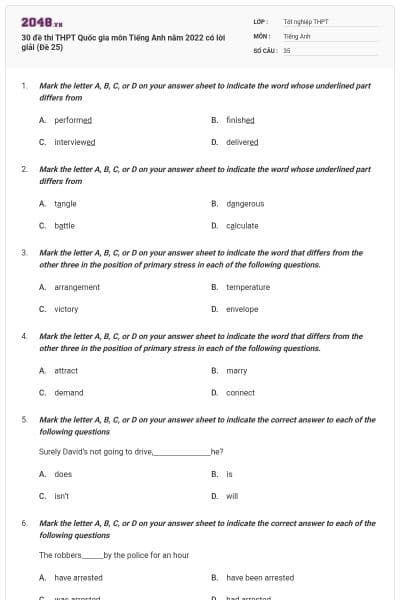
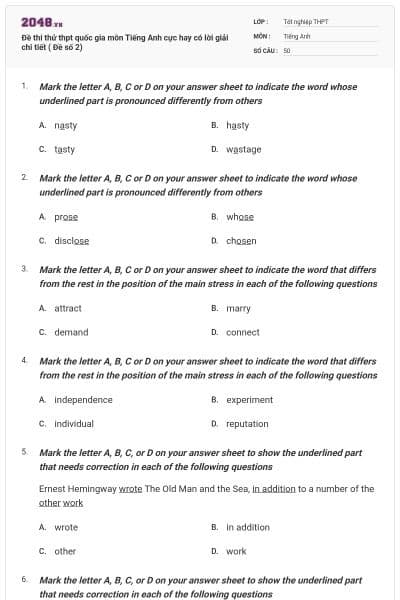
Mark the letter A, B, C or D on your answer sheet to indicate the word whose underlined part is pronounced differently from others
nasty
hasty
tasty
wastage
Đáp án là A.
nasty/ˈnɑːsti/
hasty /ˈheɪsti/
tasty /ˈteɪsti/
wastage /ˈweɪstɪdʒ/
Câu A phát âm là /ɑ/ còn lại phát âm là /eɪ/
Mark the letter A, B, C or D on your answer sheet to indicate the word whose underlined part is pronounced differently from others
prose
whose
disclose
chosen
Đáp án là B.
prose /prəʊz/
whose /huːz/
disclose /dɪsˈkləʊz/
chosen /ˈtʃəʊzn/
Câu B phát âm là /u:/ còn lại phát âm là /əʊ/
Mark the letter A, B, C or D on your answer sheet to indicate the word that differs from the rest in the position of the main stress in each of the following questions
attract
marry
demand
connect
Đáp án là B.
attract /əˈtrækt/
marry /ˈmæri/
demand /dɪˈmɑːnd/
connect /kəˈnekt/
=>Câu B trọng âm 1 còn lại trọng âm 2
Mark the letter A, B, C or D on your answer sheet to indicate the word that differs from the rest in the position of the main stress in each of the following questions
independence
experiment
individual
reputation
Đáp án là B.
independence /ˌɪndɪˈpendəns/
experiment /ɪkˈsperɪmənt/
individual /ˌɪndɪˈvɪdʒuəl/
reputation /ˌrepjuˈteɪʃn/
=>Câu B trọng âm 2 còn lại trọng âm 3
Mark the letter A, B, C, or D on your answer sheet to show the underlined part that needs correction in each of the following questions
Ernest Hemingway wrote The Old Man and the Sea, in addition to a number of the other work
wrote
in addition
other
work
Đáp án là D.
work [ công việc] => works [ tác phẩm]
work ≠ works
Other + danh từ số nhiều
Câu này dịch như sau: Ernest Hemingway đã viết Ông già và biển cả, cùng với một số tác phẩm khác
Mark the letter A, B, C, or D on your answer sheet to show the underlined part that needs correction in each of the following questions
Don’t get angry with me for your failure. You are yourself to blame by it and it is nobody else’s fault
get angry
yourself
by
else's fault
Đáp án là C.
By => on
Blame sb for sth: đổ lỗi cho ai về việc gì
Blame sth on sb
Câu này dịch như sau: Đừng tức giận với mình vì thất bại của bạn. Chính bạn nên bị đổ lỗi vì nó không phải lỗi của ai khác.
Mark the letter A, B, C, or D on your answer sheet to show the underlined part that needs correction in each of the following questions
In my country we have to do nine core subjects and then we can choose several other
to do
core
and then
other
Đáp án là D.
Other => others
Other + danh từ số nhiều = others
Câu này dịch như sau: Ở đất nước mình, mình phải học 9 môn học chính và sau đó có thể chọn một số môn khác
Mark the letter A, B, C or D on your answer sheet to indicate the correct answer to each of the following questions
We ________be going to France this summer, but we’re not sure yet
can
must
would
might
Đáp án là D.
Might/ can/ could + Vo : possibility [ dùng để chỉ khả năng] có thể xảy ra, tuy nhiên với “can” khả năng xảy ra cao hơn might, trong đề bài tình huống còn chưa chắc chắn nên dùng “might”.
Câu này dịch như sau: Chúng tôi có thể đi Pháp vào mùa hè này nhưng chúng tôi vẫn chưa chắc chắn
Mark the letter A, B, C or D on your answer sheet to indicate the correct answer to each of the following questions
He packed ________his job and went traveling in Nepal
off
away
out
in
Đáp án là D.
Pack off = send sb sth: gửi cho ai [ cái gi]
Pack away = being fold up small: gập nhỏ lại
Pack out = attract sb: thu hút ai đó
Pack in = stop doing sth: dừng làm việc gì đó
Câu này dịch như sau: Anh ấy nghỉ làm việc và đi du lịch ở Nepal
Mark the letter A, B, C or D on your answer sheet to indicate the correct answer to each of the following questions
The jury________her compliments on her excellent knowledge of the subject
paid
gave
made
said
Đáp án: A
Giải thích:
Pay compliment /ˈkɒmplɪmənt/ (n) on sth = compliment/ˈkɒmplɪment/ (v) on sth: khen ngợi ai về việc gì
Dịch: Ban giám khảo khen ngợi cô ấy kiến thức tuyệt vời về chủ đề này.
Mark the letter A, B, C or D on your answer sheet to indicate the correct answer to each of the following questions
Be careful! Don’t ________your drink on the table
spill
spread
flood
flow
Đáp án là A.
Spill: đánh đổ ( chất lỏng)
Spread: trải, phát tán
Flood: lũ lụt
Flow: chảy
Câu này dịch như sau: Cẩn thận! Đừng đánh đổ nước uống trên bàn
Mark the letter A, B, C or D on your answer sheet to indicate the correct answer to each of the following questions
“The baby is crying! Will you ________while 1 prepare his milk?”
look him up
look after him
care about him
make him up
Đáp án là B.
Look sb up: đến thăm/ liên lạc với ai đó sau khoảng thời gian dài không gặp
Look after: chăm sóc
Care about: quan tâm
Make sb up: trang điểm
Câu này dịch như sau: “ Đứa bé đang khóc! Bạn có thể chăm sóc đứa bé trong khi mình pha sữa cho nó được không?”
Mark the letter A, B, C or D on your answer sheet to indicate the correct answer to each of the following questions
The driver________control of the vehicle and crashed into a bus
lost
missed
failed
dropped
Đáp án là A.
Lose: mất/ thất lạc
Miss: nhớ/ bỏ lỡ
Fail: thất bại
Drop: rơi
Cụm từ: Lose control of sth: mất kiểm soát ( cái gì)
Crash into sth: đâm sầm vào
Câu này dịch như sau: Người tài xế mất kiểm soát phương tiện giao thông và đâm sầm vào một chiếc xe buýt
Mark the letter A, B, C or D on your answer sheet to indicate the correct answer to each of the following questions. On the way the bus stopped to pick up a ________
customer
rider
pedestrian
passenger
Chọn đáp án D.
Customer: khách hàng
Rider: người đi xe máy/ xe đạp
Pedestrian: người đi bộ
Passenger: hành khách
Câu này dịch như sau: Trên đường xe buýt dừng lại để đón một hành khách.
Mark the letter A, B, C or D on your answer sheet to indicate the correct answer to each of the following questions. I am ________tired to think about that problem at the moment.
simply
nearly
far too
much more
Chọn đáp án C.
Simply(adv): một cách đơn giản
Nearly(adv): gần như
Far too: quá
Much more: hơn nhiều
Cấu trúc: S+ be + too + adj + to Vo: quá...để làm gì.
Câu này dịch như sau: Tôi quá mệt mỏi để nghĩ về vấn đề đó vào lúc này.
Mark the letter A, B, C or D on your answer sheet to indicate the correct answer to each of the following questions. : ________anything else, please ring the bell for the attendant.
Should you require
You should require
If you are requiring
Were you to require
Chọn đáp án A.
Cấu trúc đảo ngữ câu điều kiện loại 1: Should S+ Vo = If + S + thì hiện tại tại đơn
Câu này dịch như sau: Nếu bạn có yêu cầu thêm gì nữa, hãy rung chuông để gọi người phục vụ.
Mark the letter A, B, C or D on your answer sheet to indicate the correct answer to each of the following questions. Monica is ________for her ambition and determination by all of her teachers.
praised
approved
congratulated
cheered
Chọn đáp án A.
Praise sb for sth: ca ngợi, tán thưởng
Approve of sth: đồng ý, chấp nhận
Congratulate sb on sth: khen ngợi
Cheer sb up: làm phấn chấn/ cổ vũ
Câu này dịch như sau: Monica được ca ngợi bởi hoài bão và quyết tâm của cô ấy bởi
Mark the letter A, B, C or D on your answer sheet to indicate the correct answer to each of the following questions. They froze in ________when they saw the lion.
shock
horror
panic
fright
Chọn đáp án B.
Cụm từ: freeze in horror: sợ cứng người
Câu này dịch như sau: Họ sợ cứng người khi nhìn thấy con sư tử.
Mark the letter A, B, C or D on your answer sheet to indicate the correct answer to each of the following questions
I can’t find those new socks I bought. I ________them in the store
should have left
must have left
have left
ought to have left
Đáp án là B.
Must have Ved: chắc có lẽ đã...
Should/ ought to have Ved: đáng lẽ ra đã...
Câu này dịch như sau: Tôi không thể tìm đôi tất mới mà tôi đã mua. Chắc có lẽ tôi đã để quên nó ở cửa hàng
Mark the letter A, B, C or D on your answer sheet to indicate the most suitable respond to complete each of the following exchanges
Kelly: “I think that people are buying more than they actually need. What do you think?”Jack: ________, especially in this time of economic crises.”
I don’t think so
I think the other way
I don’t, either
I think opposite
Đáp án là A.
Kelly: Tôi nghĩ rằng mọi người đang mua nhiều hơn những thứ họ thật sự cần. Bạn nghĩ sao?
Jack:..............., đặc biệt vào thời điểm khủng hoảng kinh tế như thế này.
A. Tôi không nghĩ vậy.
B. Tôi thì nghĩ khác.
C. Tôi cũng không.
D. Tôi nghĩ ngược lại
Mark the letter A, B, C or D on your answer sheet to indicate the most suitable respond to complete each of the following exchanges
Peter: "Is it important? " Tom: ________
not on your life
It's a matter of life and death
No worry, that's nothing
It's ridiculous
Đáp án là B.
Peter: Cái này có quan trọng không?
Tom:.......................
A. Không phải chuyện của bạn.
B. Đó là vấn đề sống còn/ rất quan trọng.
C. Đừng lo, không có gì đâu.
D. Thật buồn cười
Mark the letter A, B, C or D on your answer sheet to indicate the word (s) OPPOSITE in meaning to the underlined word (s) in the following question
The principal objectives of ASEAN, outlined in the Bangkok Declaration (1976), were to accelerate economic growth and promote peace and stability.
maintain
predict
speed up
slow down
Đáp án là D.
Accelerate: đẩy mạnh, tăng trưởng
Maintain: duy trì
Predict: dự đoán
Speed up: thúc đẩy
Slow down: làm chậm lại/ giảm bớt
Câu này dịch như sau: Những mục tiêu cơ bản của Hiệp hội các nước Đông Nam Á, được trình bày trong bản tuyên bố Băng-Cốc (1976), là nhắm thúc đẩy tăng trưởng kinh tế và tăng cường hòa bình ổn định.
=>accelerate >< slow down
Mark the letter A, B, C or D on your answer sheet to indicate the word (s) OPPOSITE in meaning to the underlined word (s) in the following question
They are going to demolish the old theater to make way for the new apartment complex
pull down
throw away
rebuild
decorate
Đáp án là C.
Demolish: phá hủy
Pull down: phá hủy
Throw away: vứt bỏ
Rebuild: xây dựng lại
Decorate: trang trí
Câu này dịch như sau: Họ dự định phả bỏ nhà hát cũ để nhường chỗ cho khu phức hợp chung cư mới.
=>demolish >< rebuild
Mark the letter A,B,C, or D on your answer sheet to indicate the word or phrase that is CLOSEST in meaning to the underlined part in each of the following questions
The difference between British and American English are comparatively small
extremely
relatively
surprisingly
straightly
Đáp án là B.
Comparatively: gần như/ tương đối
Extremely: cực kỳ
Relatively: gần như
Surprisingly: một cách đáng kinh ngạc
Straightly: một cách thẳng thắn
Câu này dịch như sau: Sự khác nhau giữa tiếng Anh Anh và Anh Mỹ khá là nhỏ.
=> Comparatively = Relatively
Mark the letter A,B,C, or D on your answer sheet to indicate the word or phrase that is CLOSEST in meaning to the underlined part in each of the following questions
The Present is taking deliberate steps to balance the federal budget
thoroughly planned
intentional
purposeful
accidental
Đáp án là A.
Deliberate (adj): cẩn thận/ thận trọng
Thoroughly planned: được lên kế hoạch cẩn thận
Intentional: cố ý
Purposeful: có mục đích
Accidential: tình cờ
Câu này dịch như sau: Ngài chủ tịch/ tổng thống đang tiến hành những bước cẩn trọng để cân bằng ngân sách nhà nước.
=>Deliberate = Thoroughly planned
Mark the letter A, B, C or D on your answer sheet to indicate the sentence that is closest in meaning to each of the following questions
Tom would sooner do without a car than pay all that money for one
Tom thinks the price is right, but he can’t afford it
Tom thinks the price is too high, but he must have the car
Tom is soon going to buy a car
Tom would never buy a car costs so much
Đáp án là D.
Would sooner + Vo + than Vo = would rather + Vo than Vo: thà [làm việc này] còn hơn [làm việc kia]
Câu này dịch như sau: Tom thà làm việc không có ô tô còn hơn lấy tất cả tiền để mua ô tô.
A. Tom nghĩ rằng giá cả hợp lý nhưng anh ấy không đủ tiền mua.
B. Tom nghĩ rằng giá quá cao nhưng anh ấy phải có 1 chiếc.
C. Tom dự định mua ô tô.
D. Tom sẽ không bao giờ mua một chiếc ô tô quá nhiều tiền
Mark the letter A, B, C or D on your answer sheet to indicate the sentence that is closest in meaning to each of the following questions
It’s no use trying to persuade Tom to change his mind
There’s no point to try to persuade Tom to change his mind
It’s worth trying to persuade Tom to change his mind
It’s useful trying to persuade Tom change his mind
It’s a waste of time trying to persuade Tom to change his mind
Đáp án là D.
Câu này dịch như sau: Thật vô ích khi cố gắng thuyết phục Tom thay đổi suy nghĩ.
A. Sai ngữ pháp: There’s no point + Ving: vô ích/ vô dụng [ khi làm việc gi]
B. Rất đáng để cố gắng thuyết phục Tom thay đổi suy nghĩ. => sai nghĩa => loại
C. Rất có ích khi cố gắng thuyết phục Tom thay đổi suy nghĩ. => sai nghĩa => loại
D. Thật lãng phí thời gian khi cố gắng thuyết phục Tom thay đổi suy nghĩ.
It’s worth + Ving = It’s useful + Ving: rất đáng/ rất có ích để làm gì
It’s a waste of time + Ving = It’s no use + Ving: thật vô ích để làm việc gì
Mark the letter A, B, C or D on your answer sheet to indicate the sentence that is closest in meaning to each of the following questions
His story was so funny that it made us all laugh
His story was too funny to laugh
His story couldn’t make us laugh
His story was very funny and we couldn’t help laughing
We all laughed at him for his story
Đáp án là C.
Câu này dịch như sau: Câu chuyện của anh ấy quá buồn cười đến nỗi mà nó làm tất cả chúng tôi đều cười.
A. Câu chuyện của anh ấy quá buồn cười để làm chúng tôi cười.
B. Câu chuyện của anh ấy không thể làm chúng tôi cười.
C. Câu chuyện của anh ấy quá buồn cười và chúng tôi không thể nhịn cười được.
Can’t help + Ving: không thể nhịn được.
D. Tất cả chúng tôi đều cười anh ấy vì câu chuyện của anh ấy
Mark the letter A, B, C or D on your answer sheet to indicate that best combine this pair of sentences in the following questions
Mike has expertise in gardening. Mike is an accomplished carpenter
Beside gardening, Mike is an accomplished carpenter as well
Despite his expertise in gardening, Mike is an accomplished carpenter.
Due to his expertise in gardening, Mike is an accomplished carpenter
Besides his expertise in gardening, Mike is also an accomplished carpenter
Đáp án là D.
Câu này dịch như sau: Mike thành thạo công việc làm vườn. Mike là một thợ mộc tài giỏi.
A. Bên cạnh làm vườn Mike còn là một thợ mộc tài giỏi nữa. => câu chưa đủ nghĩa => loại
B. Mặc dù thành thạo về làm vườn nhưng Mike là một thợ mộc tài giỏi. => sai nghĩa => loại
C. Bởi vì thành thạo về làm vườn, Mike là một thợ mộc tài giỏi. => sai nghĩa => loại
D. Bên cạnh thông thạo việc làm vườn, Mike còn là một thợ mộc tài giỏi
Mark the letter A, B, C or D on your answer sheet to indicate that best combine this pair of sentences in the following questions
My friends are good at drawing. I am good at drawing
My friends are good at drawing, and I do, too
Both my friends and I am good at drawing
My friends are good at drawing and so I am
Neither my friend nor I am good at drawing
Đáp án là C.
Câu này dịch như sau: Bạn tôi giỏi về môn vẽ. Tôi giỏi về môn vẽ.
Câu A sai ngữ pháp vì phía trước dùng động từ “be” phía sau cũng phải dùng be.
Câu B sai ngữ pháp vì both my friends and I phải dùng động từ “are”
C.Bạn tôi giỏi về môn vẽ và tôi cũng vậy.
D.Bạn tôi không giỏi về môn vẽ và tôi cũng vậy. => sai nghĩa => loại
Cấu trúc: S+ V, so + trợ động từ + S hoặc S + trợ động từ , too
Read the following passage, and mark the letter (A, B, C or D) on your answer sheet to indicate the correct answer for each of the blanks.
THE BENEFITS OF JOINING A SPORTS CLUB
Everyone, old or young, should think about joining a sports club. There are many benefits of being a (31)________of a club. First of all, you have the opportunity not just to play your favorite sport on a regular basis, but also to improve. Most clubs have training sessions or even professionals who (32)________lessons. Secondly, it’s a chance to meet people who enjoying doing the same things as you so you will probably get (33)________with them and end up with a good network of friends. Also these clubs usually have an excellent social life as they arrange parties and special occasions at the club where you can meet to talk and eat together and generally have a good time. Many people (34)________up sports in their early teens but it is good idea to continue as doing sport is a way of relieving stress and giving you more energy as well as being a good break from your studies. Best of all, a lot of clubs can arrange to get tickets for top sporting events that are hard to (35)________This means you can often get front row seats for matches and competitions in your favorite sport, or you may even be able to see your favorite team. Well worth joining!
Điền vào ô số 31
fellow
member
representative
associate
Đáp án là B.
Fellow(n): đồng chí
Member(n): thành viên
Representative(n): đại biểu
Associate(n): đồng minh
Everyone, old or young, should think about joining a sports club. There are many benefits of being a (31)………of a club.
[Mọi người dù trẻ hay già nên nghĩ đến việc tham gia một câu lạc bộ thể thao. Có nhiều lợi ích trở thành thành viên của một câu lạc bộ.]
Read the following passage, and mark the letter (A, B, C or D) on your answer sheet to indicate the correct answer for each of the blanks.
THE BENEFITS OF JOINING A SPORTS CLUB
Everyone, old or young, should think about joining a sports club. There are many benefits of being a (31)________of a club. First of all, you have the opportunity not just to play your favorite sport on a regular basis, but also to improve. Most clubs have training sessions or even professionals who (32)________lessons. Secondly, it’s a chance to meet people who enjoying doing the same things as you so you will probably get (33)________with them and end up with a good network of friends. Also these clubs usually have an excellent social life as they arrange parties and special occasions at the club where you can meet to talk and eat together and generally have a good time. Many people (34)________up sports in their early teens but it is good idea to continue as doing sport is a way of relieving stress and giving you more energy as well as being a good break from your studies. Best of all, a lot of clubs can arrange to get tickets for top sporting events that are hard to (35)________This means you can often get front row seats for matches and competitions in your favorite sport, or you may even be able to see your favorite team. Well worth joining!
Điền vào ô số 32
offer
present
hand
propose
Đáp án là A.
Offer: cung cấp/ dâng tặng
Present: trình bày
Hand:trao cho
Propose: đề xuất
First of all, you have the opportunity not just to play your favorite sport on a regular basis, but also to improve. Most clubs have training sessions or even professionals who (32)………lessons.
[ Trước hết, bạn có cơ hội không chỉ chơi môn thê thao yêu thích của bạn thường xuyên mà còn để cải thiện tốt hơn. Hầu hết các câu lạc bộ đều có các buổi tập luyện hay thậm chí các chuyên gia cung cấp/ hướng dẫn những bài tập luyện.]
Read the following passage, and mark the letter (A, B, C or D) on your answer sheet to indicate the correct answer for each of the blanks.
THE BENEFITS OF JOINING A SPORTS CLUB
Everyone, old or young, should think about joining a sports club. There are many benefits of being a (31)________of a club. First of all, you have the opportunity not just to play your favorite sport on a regular basis, but also to improve. Most clubs have training sessions or even professionals who (32)________lessons. Secondly, it’s a chance to meet people who enjoying doing the same things as you so you will probably get (33)________with them and end up with a good network of friends. Also these clubs usually have an excellent social life as they arrange parties and special occasions at the club where you can meet to talk and eat together and generally have a good time. Many people (34)________up sports in their early teens but it is good idea to continue as doing sport is a way of relieving stress and giving you more energy as well as being a good break from your studies. Best of all, a lot of clubs can arrange to get tickets for top sporting events that are hard to (35)________This means you can often get front row seats for matches and competitions in your favorite sport, or you may even be able to see your favorite team. Well worth joining!
Điền vào ô số 33
up
on
over
about
Đáp án là B.
Get up: thức dậy
Get on: bước lên [ tàu, xe]
Get on with sb: hòa đồng/ hòa hợp [ với ai]
Get over = overcome: khắc phục/ vượt qua
Get about = get around: di chuyển từ nơi này đến nơi khác
Secondly, it’s a chance to meet people who enjoying doing the same things as you so you will probably get (33)………..with them and end up with a good network of friends. Also these clubs usually have an excellent social life as they arrange parties and special occasions at the club where you can meet to talk and eat together and generally have a good time.
[ Thứ hai, đó là cơ hội để gặp gỡ mọi người người mà thích làm những việc giống bạn sẽ dễ hòa đồng với họ và bắt đầu có những người bạn tốt. Tương tự những câu lạc bộ thường có đời sống xã hội tốt vì họ sắp xếp những bữa tiệc và những dịp quan trọng tại câu lạc bộ nơi bạn có thể trò chuyện và ăn uống cùng nhau và nói chung là rất vui.]
Read the following passage, and mark the letter (A, B, C or D) on your answer sheet to indicate the correct answer for each of the blanks.
THE BENEFITS OF JOINING A SPORTS CLUB
Everyone, old or young, should think about joining a sports club. There are many benefits of being a (31)________of a club. First of all, you have the opportunity not just to play your favorite sport on a regular basis, but also to improve. Most clubs have training sessions or even professionals who (32)________lessons. Secondly, it’s a chance to meet people who enjoying doing the same things as you so you will probably get (33)________with them and end up with a good network of friends. Also these clubs usually have an excellent social life as they arrange parties and special occasions at the club where you can meet to talk and eat together and generally have a good time. Many people (34)________up sports in their early teens but it is good idea to continue as doing sport is a way of relieving stress and giving you more energy as well as being a good break from your studies. Best of all, a lot of clubs can arrange to get tickets for top sporting events that are hard to (35)________This means you can often get front row seats for matches and competitions in your favorite sport, or you may even be able to see your favorite team. Well worth joining!
Điền vào ô số 34
set
get
give
put
Đáp án là C.
Set up: thành lập/ hình thành
Get up: thức dậy
Give up: từ bỏ
Put up: đề xuất/ trình bày
Many people (34)……..up sports in their early teens but it is good idea to continue as doing sport is a way of relieving stress and giving you more energy as well as being a good break from your studies.
[ Nhiều người từ bỏ chơi thể thao từ rất sớm nhưng đó là ý kiến tốt khi tiếp tục chơi thể thao như một cách để giải tỏa căng thẳng và cho bạn thêm năng lượng cũng như nghỉ ngơi sau giờ học.]
Read the following passage, and mark the letter (A, B, C or D) on your answer sheet to indicate the correct answer for each of the blanks.
THE BENEFITS OF JOINING A SPORTS CLUB
Everyone, old or young, should think about joining a sports club. There are many benefits of being a (31)________of a club. First of all, you have the opportunity not just to play your favorite sport on a regular basis, but also to improve. Most clubs have training sessions or even professionals who (32)________lessons. Secondly, it’s a chance to meet people who enjoying doing the same things as you so you will probably get (33)________with them and end up with a good network of friends. Also these clubs usually have an excellent social life as they arrange parties and special occasions at the club where you can meet to talk and eat together and generally have a good time. Many people (34)________up sports in their early teens but it is good idea to continue as doing sport is a way of relieving stress and giving you more energy as well as being a good break from your studies. Best of all, a lot of clubs can arrange to get tickets for top sporting events that are hard to (35)________This means you can often get front row seats for matches and competitions in your favorite sport, or you may even be able to see your favorite team. Well worth joining!
Điền vào ô số 35
order
book
engage
register
Đáp án là B.
Order: đặ hàng
Book: đặt chỗ trước [ ở khách sạn hay nhà hàng]
Engage: đính hôn/ tham gia
Register: đăng ký
Best of all, a lot of clubs can arrange to get tickets for top sporting events that are hard to (35)………..This means you can often get front row seats for matches and competitions in your favorite sport, or you may even be able to see your favorite team. Well worth joining!
[ Quan trọng nhất là, nhiều câu lạc bộ có thể sắp xếp vé cho những sự kiện thể thao hàng đầu cái mà khó đặt vé trước. Điều này có nghĩa là bạn có thể thường xuyên ngồi ở hàng ghế đầu xem những trận đấu và tranh tài những môn thể thao mà bạn yêu thích, hoặc bạn thậm chí có thể xem đội bóng yêu thích. Rất đáng để tham gia đó!]
Read the following passage, and mark the letter A, B, C, or D on your answer sheet to indicate the correct answer to each of the questions.
The ruined temples of Angkor are perhaps one of the most impressive Seven Wonders of the World. Located in modern day Cambodia near Lake Tonle Sap, the largest freshwater lake in Asia, Angkor was the seat of power for the Khmer Empire for the ninth to the fifteenth century. The ruins of Angkor are documented as some of the most impressive ones in the world, rivaling the pyramids of Giza in Egypt. Why this mighty civilization died out is a question that archeologists are now only beginning to ponder. The answer, it turns out, may be linked with the availability of fresh water.
One possible explanation for the downfall of the Khmer Empire has to do with the inhabitant’s irrigation system. The temples and palaces of Angkor were constructed around a series of artificial reservoirs and canals which were annually flooded to capacity by the Mekong River. Once filled, they were used to irrigate the surrounding paddies and farmland during the course of the year. Farmers were completely dependent on the water for water crucial rice crop. Without consistent irrigation, the farmers would have been unable to maintain functional crop production.
Scientists speculate that toward the end of the Khmer Empire the hydraulic system of the reservoirs and canals broke down. The construction of hundreds of sandstone temples and palaces required an enormous amount of physical labor. In addition, as the capital of Khmer Empire, Angkor contained upwards of one hundred thousand people who resided in and around Angkor. In order to feed so many people, the local farmers were driven to grow food more quickly and more efficiently. After centuries of continual use, the irrigation system was pushed beyond its capacity. Soil erosion, nutrient depletion, and loss of water led to decrease in the food supply. With the less food available, the people of Angkor slowly began to migrate to other parts of Cambodia, thus leaving the marvelous city of Angkor to be swallowed by the jungle. Therefore, it is speculated that the Khmer Empire may have fallen victim to its own decrepit infrastructure.
The passage preceding most likely discusses ________.
architecture of ancient Asian civilization
religious practices of the people of Angkor
the form of government practiced by the Khmer Empire
the other six wonders of the world
Đáp án là D.
Bài đọc phía trước có thể thảo luận về.............
A. kiến trúc của nền văn minh cổ đại châu Á.
B. những phong tục tôn giáo của người Ăngkor
C. việc hình thành chính phủ được thực hiện bởi triều đại Khơ-me.
D. 6 kỳ quan khác của thế giới.
Dẫn chứng: The ruined temples of Angkor are perhaps one of the most impressive Seven Wonders of the World
Read the following passage, and mark the letter A, B, C, or D on your answer sheet to indicate the correct answer to each of the questions.
The ruined temples of Angkor are perhaps one of the most impressive Seven Wonders of the World. Located in modern day Cambodia near Lake Tonle Sap, the largest freshwater lake in Asia, Angkor was the seat of power for the Khmer Empire for the ninth to the fifteenth century. The ruins of Angkor are documented as some of the most impressive ones in the world, rivaling the pyramids of Giza in Egypt. Why this mighty civilization died out is a question that archeologists are now only beginning to ponder. The answer, it turns out, may be linked with the availability of fresh water.
One possible explanation for the downfall of the Khmer Empire has to do with the inhabitant’s irrigation system. The temples and palaces of Angkor were constructed around a series of artificial reservoirs and canals which were annually flooded to capacity by the Mekong River. Once filled, they were used to irrigate the surrounding paddies and farmland during the course of the year. Farmers were completely dependent on the water for water crucial rice crop. Without consistent irrigation, the farmers would have been unable to maintain functional crop production.
Scientists speculate that toward the end of the Khmer Empire the hydraulic system of the reservoirs and canals broke down. The construction of hundreds of sandstone temples and palaces required an enormous amount of physical labor. In addition, as the capital of Khmer Empire, Angkor contained upwards of one hundred thousand people who resided in and around Angkor. In order to feed so many people, the local farmers were driven to grow food more quickly and more efficiently. After centuries of continual use, the irrigation system was pushed beyond its capacity. Soil erosion, nutrient depletion, and loss of water led to decrease in the food supply. With the less food available, the people of Angkor slowly began to migrate to other parts of Cambodia, thus leaving the marvelous city of Angkor to be swallowed by the jungle. Therefore, it is speculated that the Khmer Empire may have fallen victim to its own decrepit infrastructure.
According to the passage, Lake Tonle Sap in Cambodia ________.
was unable to supply fish for the people of Angkor
is one of the Seven Wonders of the World
is an enormous body of fresh water in Asia
became polluted due to a population explosion
Đáp án là C.
Theo bài đọc, hồ Tôn Lê Sáp ở Cam-pu-chia......................
A. Không thể cung ứng cá cho người Angkor
B. Là một trong 7 kỳ quan thế giới
C. Là một phần lớn của nước sạch ở châu Á.
D. Trở nên ô nhiễm do bùng nổ dân số.
Dẫn chứng: Located in modern day Cambodia near Lake Tonle Sap, the largest freshwater lake in Asia, Angkor was the seat of power for the Khmer Empire for the ninth to the fifteenth century.
Read the following passage, and mark the letter A, B, C, or D on your answer sheet to indicate the correct answer to each of the questions.
The ruined temples of Angkor are perhaps one of the most impressive Seven Wonders of the World. Located in modern day Cambodia near Lake Tonle Sap, the largest freshwater lake in Asia, Angkor was the seat of power for the Khmer Empire for the ninth to the fifteenth century. The ruins of Angkor are documented as some of the most impressive ones in the world, rivaling the pyramids of Giza in Egypt. Why this mighty civilization died out is a question that archeologists are now only beginning to ponder. The answer, it turns out, may be linked with the availability of fresh water.
One possible explanation for the downfall of the Khmer Empire has to do with the inhabitant’s irrigation system. The temples and palaces of Angkor were constructed around a series of artificial reservoirs and canals which were annually flooded to capacity by the Mekong River. Once filled, they were used to irrigate the surrounding paddies and farmland during the course of the year. Farmers were completely dependent on the water for water crucial rice crop. Without consistent irrigation, the farmers would have been unable to maintain functional crop production.
Scientists speculate that toward the end of the Khmer Empire the hydraulic system of the reservoirs and canals broke down. The construction of hundreds of sandstone temples and palaces required an enormous amount of physical labor. In addition, as the capital of Khmer Empire, Angkor contained upwards of one hundred thousand people who resided in and around Angkor. In order to feed so many people, the local farmers were driven to grow food more quickly and more efficiently. After centuries of continual use, the irrigation system was pushed beyond its capacity. Soil erosion, nutrient depletion, and loss of water led to decrease in the food supply. With the less food available, the people of Angkor slowly began to migrate to other parts of Cambodia, thus leaving the marvelous city of Angkor to be swallowed by the jungle. Therefore, it is speculated that the Khmer Empire may have fallen victim to its own decrepit infrastructure.
The word “seat” in paragraph 1 is closest in meaning to ________.
battle
summit
location
chief
Đáp án là C.
Từ “seat” ở đoạn văn 1 gần nghĩa nhất với...................
Battle: trận chiến
Summit: đỉnh núi
Location: vị trí địa lý
Chief: chính/ chủ yếu
Dẫn chứng: Located in modern day Cambodia near Lake Tonle Sap, the largest freshwater lake in Asia, Angkor was the seat of power for the Khmer Empire for the ninth to the fifteenth century. [ Được đặt ở thời Cam-pu-chia hiện đại gần hồ Tôn Lê Sáp, vùng nước sạch lớn nhất châu Á, Angkor là vị trí sức mạnh của triều đại Khơ-me khoảng thế kỷ 9 đến 15.]
Read the following passage, and mark the letter A, B, C, or D on your answer sheet to indicate the correct answer to each of the questions.
The ruined temples of Angkor are perhaps one of the most impressive Seven Wonders of the World. Located in modern day Cambodia near Lake Tonle Sap, the largest freshwater lake in Asia, Angkor was the seat of power for the Khmer Empire for the ninth to the fifteenth century. The ruins of Angkor are documented as some of the most impressive ones in the world, rivaling the pyramids of Giza in Egypt. Why this mighty civilization died out is a question that archeologists are now only beginning to ponder. The answer, it turns out, may be linked with the availability of fresh water.
One possible explanation for the downfall of the Khmer Empire has to do with the inhabitant’s irrigation system. The temples and palaces of Angkor were constructed around a series of artificial reservoirs and canals which were annually flooded to capacity by the Mekong River. Once filled, they were used to irrigate the surrounding paddies and farmland during the course of the year. Farmers were completely dependent on the water for water crucial rice crop. Without consistent irrigation, the farmers would have been unable to maintain functional crop production.
Scientists speculate that toward the end of the Khmer Empire the hydraulic system of the reservoirs and canals broke down. The construction of hundreds of sandstone temples and palaces required an enormous amount of physical labor. In addition, as the capital of Khmer Empire, Angkor contained upwards of one hundred thousand people who resided in and around Angkor. In order to feed so many people, the local farmers were driven to grow food more quickly and more efficiently. After centuries of continual use, the irrigation system was pushed beyond its capacity. Soil erosion, nutrient depletion, and loss of water led to decrease in the food supply. With the less food available, the people of Angkor slowly began to migrate to other parts of Cambodia, thus leaving the marvelous city of Angkor to be swallowed by the jungle. Therefore, it is speculated that the Khmer Empire may have fallen victim to its own decrepit infrastructure.
The hydraulic system of reservoirs ________.
supplied irrigation from the Indian Ocean
helped transport the sandstone for constructing temples
were destroyed by nearby warrior’s tribes
became non–functional due to overuse
Đáp án là D.
Hệ thống thủy lực của các bể chứa............
A. cung cấp cho việc tưới tiêu từ Ấn Độ Dương.
B. đã giúp vận chuyển những tảng đá cát để xây dựng đền.
C. bị phá hủy bởi các bộ tộc của quân nhân gần đó.
D. trở nên vô dụng do sử dụng quá mức.
Dẫn chứng: After centuries of continual use, the irrigation system was pushed beyond its capacity.
Read the following passage, and mark the letter A, B, C, or D on your answer sheet to indicate the correct answer to each of the questions.
The ruined temples of Angkor are perhaps one of the most impressive Seven Wonders of the World. Located in modern day Cambodia near Lake Tonle Sap, the largest freshwater lake in Asia, Angkor was the seat of power for the Khmer Empire for the ninth to the fifteenth century. The ruins of Angkor are documented as some of the most impressive ones in the world, rivaling the pyramids of Giza in Egypt. Why this mighty civilization died out is a question that archeologists are now only beginning to ponder. The answer, it turns out, may be linked with the availability of fresh water.
One possible explanation for the downfall of the Khmer Empire has to do with the inhabitant’s irrigation system. The temples and palaces of Angkor were constructed around a series of artificial reservoirs and canals which were annually flooded to capacity by the Mekong River. Once filled, they were used to irrigate the surrounding paddies and farmland during the course of the year. Farmers were completely dependent on the water for water crucial rice crop. Without consistent irrigation, the farmers would have been unable to maintain functional crop production.
Scientists speculate that toward the end of the Khmer Empire the hydraulic system of the reservoirs and canals broke down. The construction of hundreds of sandstone temples and palaces required an enormous amount of physical labor. In addition, as the capital of Khmer Empire, Angkor contained upwards of one hundred thousand people who resided in and around Angkor. In order to feed so many people, the local farmers were driven to grow food more quickly and more efficiently. After centuries of continual use, the irrigation system was pushed beyond its capacity. Soil erosion, nutrient depletion, and loss of water led to decrease in the food supply. With the less food available, the people of Angkor slowly began to migrate to other parts of Cambodia, thus leaving the marvelous city of Angkor to be swallowed by the jungle. Therefore, it is speculated that the Khmer Empire may have fallen victim to its own decrepit infrastructure.
The word “artificial” in paragraph 2 is closest in meaning to ________.
man–made
numerous
natural
insincere
Đáp án là A.
Từ “artificial” để đoạn văn 2 gần nghĩa nhất với..............
Man-made: nhân tạo
Numerous: nhiều
Natural: tự nhiên/ thuộc về thiên nhiên
Insincere: không chân thành
=>artificial = man-made: nhân tạo
Read the following passage, and mark the letter A, B, C, or D on your answer sheet to indicate the correct answer to each of the questions.
The ruined temples of Angkor are perhaps one of the most impressive Seven Wonders of the World. Located in modern day Cambodia near Lake Tonle Sap, the largest freshwater lake in Asia, Angkor was the seat of power for the Khmer Empire for the ninth to the fifteenth century. The ruins of Angkor are documented as some of the most impressive ones in the world, rivaling the pyramids of Giza in Egypt. Why this mighty civilization died out is a question that archeologists are now only beginning to ponder. The answer, it turns out, may be linked with the availability of fresh water.
One possible explanation for the downfall of the Khmer Empire has to do with the inhabitant’s irrigation system. The temples and palaces of Angkor were constructed around a series of artificial reservoirs and canals which were annually flooded to capacity by the Mekong River. Once filled, they were used to irrigate the surrounding paddies and farmland during the course of the year. Farmers were completely dependent on the water for water crucial rice crop. Without consistent irrigation, the farmers would have been unable to maintain functional crop production.
Scientists speculate that toward the end of the Khmer Empire the hydraulic system of the reservoirs and canals broke down. The construction of hundreds of sandstone temples and palaces required an enormous amount of physical labor. In addition, as the capital of Khmer Empire, Angkor contained upwards of one hundred thousand people who resided in and around Angkor. In order to feed so many people, the local farmers were driven to grow food more quickly and more efficiently. After centuries of continual use, the irrigation system was pushed beyond its capacity. Soil erosion, nutrient depletion, and loss of water led to decrease in the food supply. With the less food available, the people of Angkor slowly began to migrate to other parts of Cambodia, thus leaving the marvelous city of Angkor to be swallowed by the jungle. Therefore, it is speculated that the Khmer Empire may have fallen victim to its own decrepit infrastructure.
The word “they” in paragraph 2 refers to ____.
reservoirs and canals
temples and palaces
rice paddles
farmland
Đáp án là A.
Từ “they” ở đoạn 2 ám chỉ đến.............
A. những bể chứa nước và kênh đào
B. những ngôi đền và dinh thự
C. những cánh đồng
D. nông trại
Dẫn chứng: The temples and palaces of Angkor were constructed around a series of artificial reservoirs and canals which were annually flooded to capacity by the Mekong River. Once filled, they were used to irrigate the surrounding paddies and farmland during the course of the year.
Read the following passage, and mark the letter A, B, C, or D on your answer sheet to indicate the correct answer to each of the questions.
The ruined temples of Angkor are perhaps one of the most impressive Seven Wonders of the World. Located in modern day Cambodia near Lake Tonle Sap, the largest freshwater lake in Asia, Angkor was the seat of power for the Khmer Empire for the ninth to the fifteenth century. The ruins of Angkor are documented as some of the most impressive ones in the world, rivaling the pyramids of Giza in Egypt. Why this mighty civilization died out is a question that archeologists are now only beginning to ponder. The answer, it turns out, may be linked with the availability of fresh water.
One possible explanation for the downfall of the Khmer Empire has to do with the inhabitant’s irrigation system. The temples and palaces of Angkor were constructed around a series of artificial reservoirs and canals which were annually flooded to capacity by the Mekong River. Once filled, they were used to irrigate the surrounding paddies and farmland during the course of the year. Farmers were completely dependent on the water for water crucial rice crop. Without consistent irrigation, the farmers would have been unable to maintain functional crop production.
Scientists speculate that toward the end of the Khmer Empire the hydraulic system of the reservoirs and canals broke down. The construction of hundreds of sandstone temples and palaces required an enormous amount of physical labor. In addition, as the capital of Khmer Empire, Angkor contained upwards of one hundred thousand people who resided in and around Angkor. In order to feed so many people, the local farmers were driven to grow food more quickly and more efficiently. After centuries of continual use, the irrigation system was pushed beyond its capacity. Soil erosion, nutrient depletion, and loss of water led to decrease in the food supply. With the less food available, the people of Angkor slowly began to migrate to other parts of Cambodia, thus leaving the marvelous city of Angkor to be swallowed by the jungle. Therefore, it is speculated that the Khmer Empire may have fallen victim to its own decrepit infrastructure.
All of the following are mentioned as events that can affect food supply EXCEPT ________.
reduction of nutrients
contamination of soil
loss of water supply
erosion of soil
Đáp án là B.
Tất cả những ý sau được đề cập như những sự kiện có thể ảnh hưởng đến lương thực ngoại trừ...........
A. cắt giảm chất dinh dưỡng
B. sự ô nhiễm đất
C. mất nguồn cung cấp nước
D. sự xói mòn đất
Dẫn chứng: Soil erosion, nutrient depletion, and loss of water led to decrease in the food supply.
Read the following passage, and mark the letter A, B, C, or D on your answer sheet to indicate the correct answer to each of the questions. The quest for sustainable sources of energy study the energy has led humans to study the energy potential of the sun and the wind, as well as the immense power created by dammed rivers. The oceans, too, represent an impressive source of potential energy. For example, it has been estimated that the oceans could provide nearly 3,000 times the energy generated by hydroelectric dams such as the Hoover Dam. Yet, this source remains quite difficult to exploit. But this challenge has not prevented scientists from trying. Within the last few decades, several technologies that can transform the ocean’s immense forces into usable electricity have been invented and introduced. Some focus on capturing the power of the changing tides, while others rely on thermal energy created by oceans in certain tropical regions. However, the most common and easiest-to-develop technologies are those designed to harness the power inherent in the ocean’s waves. There are several methods by which ocean-wave energy can be collected. All of them work because the movement of the water that the waves induce creates storable energy by directly or indirectly driving a power generator. In one such technology, the changing water levels in the ocean that are produced by waves lift a long floating tube comprised of many sections connected by hinges. As the sections move up and down with the water, they pump a special fluid through the tube that can be used to drive a generator. Another technique works on a similar principle, only the floating object rocks back and forth with the motion of the water instead of up and down. A third method of collecting wave energy relies on the rising water from the waves to compress air in a partially submerged chamber. As the waves rush into the chamber, they push the air out through a narrow tunnel. Located inside this tunnel is a turbine connected to a power generator. The movement of the air turns the turbine, which feeds energy into the generator. The drawback to each of these concepts is that the they make it necessary to have many pieces of machinery linked together. This presents a problem because the larger the device, the more vulnerable it is to damage from hazardous ocean environments, and the more likely it is to interfere with otherwise unspoiled coastal scenery. Also, these methods demand the construction of site-specific machines that take into consideration average local wave heights and sea conditions. Such a requirement can be quite cost-prohibitive, because engineers must create unique power generation mechanism for each site. In other words, the ability to get power from waves differ from region to region. Japan, Norway, and the UK have attempted to generate energy by capturing the power of ocean waves. In northern Scotland, the first power plan to use wave power, OSPREY ( Ocean Swell Powered Renewable Energy ), began operating in 1995. It followed the principle of the third method described above : waves entering a partially submerged chamber pushed air into turbines to generate electricity. The electricity was then transmitted to power collectors in the shore via underwater cables. Unfortunately, the OSPREY plant was destroyed in a large storm, highlighting an unavoidable difficulty associated with this kind of power generation. The potential benefits of wave-based energy are hard to ignore. Once the proper machinery is produced and installed, the energy is free. Maintenance cost are small, and the equipment does not pose any threats of environmental pollution. And best of all, the amounts of energy produced are enormous. However, these theoretical advantages have yet to be fully realized. In many cases, a lack of government funding has inhibited the technologies from advancing. For example, despite the relative abundance of proposed wave-power devices, many have not been adequately tested, and most have been evaluated only in artificial pools where they are not subjected to the harsh marine conditions that exist in actual oceans. Protecting the equipment from the sea’s destructive forces, as well as the fundamental task of determining feasible locations for collecting energy source are substantial and will require more time to overcome.
The phrase this source in the passage refers to
sun
wind
dammed rivers
oceans
Đáp án là D.
Cụm từ “ this source” trong bài đọc ám chỉ đến.........................
Sun: mặt trời
Wind: gió
Rivers: sông
Oceans: đại dương
Dẫn chứng: The oceans, too, represent an impressive source of potential energy. For example, it has been estimated that the oceans could provide nearly 3,000 times the energy generated by hydroelectric dams such as the Hoover Dam. Yet, this source remains quite difficult to exploit
Read the following passage, and mark the letter A, B, C, or D on your answer sheet to indicate the correct answer to each of the questions. The quest for sustainable sources of energy study the energy has led humans to study the energy potential of the sun and the wind, as well as the immense power created by dammed rivers. The oceans, too, represent an impressive source of potential energy. For example, it has been estimated that the oceans could provide nearly 3,000 times the energy generated by hydroelectric dams such as the Hoover Dam. Yet, this source remains quite difficult to exploit. But this challenge has not prevented scientists from trying. Within the last few decades, several technologies that can transform the ocean’s immense forces into usable electricity have been invented and introduced. Some focus on capturing the power of the changing tides, while others rely on thermal energy created by oceans in certain tropical regions. However, the most common and easiest-to-develop technologies are those designed to harness the power inherent in the ocean’s waves. There are several methods by which ocean-wave energy can be collected. All of them work because the movement of the water that the waves induce creates storable energy by directly or indirectly driving a power generator. In one such technology, the changing water levels in the ocean that are produced by waves lift a long floating tube comprised of many sections connected by hinges. As the sections move up and down with the water, they pump a special fluid through the tube that can be used to drive a generator. Another technique works on a similar principle, only the floating object rocks back and forth with the motion of the water instead of up and down. A third method of collecting wave energy relies on the rising water from the waves to compress air in a partially submerged chamber. As the waves rush into the chamber, they push the air out through a narrow tunnel. Located inside this tunnel is a turbine connected to a power generator. The movement of the air turns the turbine, which feeds energy into the generator. The drawback to each of these concepts is that the they make it necessary to have many pieces of machinery linked together. This presents a problem because the larger the device, the more vulnerable it is to damage from hazardous ocean environments, and the more likely it is to interfere with otherwise unspoiled coastal scenery. Also, these methods demand the construction of site-specific machines that take into consideration average local wave heights and sea conditions. Such a requirement can be quite cost-prohibitive, because engineers must create unique power generation mechanism for each site. In other words, the ability to get power from waves differ from region to region. Japan, Norway, and the UK have attempted to generate energy by capturing the power of ocean waves. In northern Scotland, the first power plan to use wave power, OSPREY ( Ocean Swell Powered Renewable Energy ), began operating in 1995. It followed the principle of the third method described above : waves entering a partially submerged chamber pushed air into turbines to generate electricity. The electricity was then transmitted to power collectors in the shore via underwater cables. Unfortunately, the OSPREY plant was destroyed in a large storm, highlighting an unavoidable difficulty associated with this kind of power generation. The potential benefits of wave-based energy are hard to ignore. Once the proper machinery is produced and installed, the energy is free. Maintenance cost are small, and the equipment does not pose any threats of environmental pollution. And best of all, the amounts of energy produced are enormous. However, these theoretical advantages have yet to be fully realized. In many cases, a lack of government funding has inhibited the technologies from advancing. For example, despite the relative abundance of proposed wave-power devices, many have not been adequately tested, and most have been evaluated only in artificial pools where they are not subjected to the harsh marine conditions that exist in actual oceans. Protecting the equipment from the sea’s destructive forces, as well as the fundamental task of determining feasible locations for collecting energy source are substantial and will require more time to overcome.
The word exploit in the passage is closest meaning to
utilize
declare
contain
determine
Đáp án là A.
Từ “ exploit” trong bài đọc gần nghĩa nhất với........................
Utilize: sử dụng
Declare: tuyên bố
Contain: chứa
Determine: xác nhận
=>exploit [ khai thác] = Utilize
Read the following passage, and mark the letter A, B, C, or D on your answer sheet to indicate the correct answer to each of the questions. The quest for sustainable sources of energy study the energy has led humans to study the energy potential of the sun and the wind, as well as the immense power created by dammed rivers. The oceans, too, represent an impressive source of potential energy. For example, it has been estimated that the oceans could provide nearly 3,000 times the energy generated by hydroelectric dams such as the Hoover Dam. Yet, this source remains quite difficult to exploit. But this challenge has not prevented scientists from trying. Within the last few decades, several technologies that can transform the ocean’s immense forces into usable electricity have been invented and introduced. Some focus on capturing the power of the changing tides, while others rely on thermal energy created by oceans in certain tropical regions. However, the most common and easiest-to-develop technologies are those designed to harness the power inherent in the ocean’s waves. There are several methods by which ocean-wave energy can be collected. All of them work because the movement of the water that the waves induce creates storable energy by directly or indirectly driving a power generator. In one such technology, the changing water levels in the ocean that are produced by waves lift a long floating tube comprised of many sections connected by hinges. As the sections move up and down with the water, they pump a special fluid through the tube that can be used to drive a generator. Another technique works on a similar principle, only the floating object rocks back and forth with the motion of the water instead of up and down. A third method of collecting wave energy relies on the rising water from the waves to compress air in a partially submerged chamber. As the waves rush into the chamber, they push the air out through a narrow tunnel. Located inside this tunnel is a turbine connected to a power generator. The movement of the air turns the turbine, which feeds energy into the generator. The drawback to each of these concepts is that the they make it necessary to have many pieces of machinery linked together. This presents a problem because the larger the device, the more vulnerable it is to damage from hazardous ocean environments, and the more likely it is to interfere with otherwise unspoiled coastal scenery. Also, these methods demand the construction of site-specific machines that take into consideration average local wave heights and sea conditions. Such a requirement can be quite cost-prohibitive, because engineers must create unique power generation mechanism for each site. In other words, the ability to get power from waves differ from region to region. Japan, Norway, and the UK have attempted to generate energy by capturing the power of ocean waves. In northern Scotland, the first power plan to use wave power, OSPREY ( Ocean Swell Powered Renewable Energy ), began operating in 1995. It followed the principle of the third method described above : waves entering a partially submerged chamber pushed air into turbines to generate electricity. The electricity was then transmitted to power collectors in the shore via underwater cables. Unfortunately, the OSPREY plant was destroyed in a large storm, highlighting an unavoidable difficulty associated with this kind of power generation. The potential benefits of wave-based energy are hard to ignore. Once the proper machinery is produced and installed, the energy is free. Maintenance cost are small, and the equipment does not pose any threats of environmental pollution. And best of all, the amounts of energy produced are enormous. However, these theoretical advantages have yet to be fully realized. In many cases, a lack of government funding has inhibited the technologies from advancing. For example, despite the relative abundance of proposed wave-power devices, many have not been adequately tested, and most have been evaluated only in artificial pools where they are not subjected to the harsh marine conditions that exist in actual oceans. Protecting the equipment from the sea’s destructive forces, as well as the fundamental task of determining feasible locations for collecting energy source are substantial and will require more time to overcome.
Why does the author mention the Hoover Dam in paragraph one ?
To give a current example of ocean–based energy technology
To explain that dams are effective producers of sustainable energy
To draw a comparison between two sources of renewable energy
To show that alternative energy sources have not been successful
Đáp án là C.
Tại sao tác giả đề cập đến Đập nước Hoover ở đoạn 1?
A. Để đưa ra ví dụ gần đây về công nghệ năng lượng dựa trên đại dương.
B. Để giải thích rằng những đập nước là nguồn sản xuất năng năng lượng bền bỉ và hiệu quả.
C. Để phác họa sự so sánh giữa hai nguồn năng lượng có thể tái tạo.
D. Đề cho thấy rằng những nguồn năng lượng thay thế không thành công.
Dẫn chứng: For example, it has been estimated that the oceans could provide nearly 3,000 times the energy generated by hydroelectric dams such as the Hoover Dam.
Read the following passage, and mark the letter A, B, C, or D on your answer sheet to indicate the correct answer to each of the questions. The quest for sustainable sources of energy study the energy has led humans to study the energy potential of the sun and the wind, as well as the immense power created by dammed rivers. The oceans, too, represent an impressive source of potential energy. For example, it has been estimated that the oceans could provide nearly 3,000 times the energy generated by hydroelectric dams such as the Hoover Dam. Yet, this source remains quite difficult to exploit. But this challenge has not prevented scientists from trying. Within the last few decades, several technologies that can transform the ocean’s immense forces into usable electricity have been invented and introduced. Some focus on capturing the power of the changing tides, while others rely on thermal energy created by oceans in certain tropical regions. However, the most common and easiest-to-develop technologies are those designed to harness the power inherent in the ocean’s waves. There are several methods by which ocean-wave energy can be collected. All of them work because the movement of the water that the waves induce creates storable energy by directly or indirectly driving a power generator. In one such technology, the changing water levels in the ocean that are produced by waves lift a long floating tube comprised of many sections connected by hinges. As the sections move up and down with the water, they pump a special fluid through the tube that can be used to drive a generator. Another technique works on a similar principle, only the floating object rocks back and forth with the motion of the water instead of up and down. A third method of collecting wave energy relies on the rising water from the waves to compress air in a partially submerged chamber. As the waves rush into the chamber, they push the air out through a narrow tunnel. Located inside this tunnel is a turbine connected to a power generator. The movement of the air turns the turbine, which feeds energy into the generator. The drawback to each of these concepts is that the they make it necessary to have many pieces of machinery linked together. This presents a problem because the larger the device, the more vulnerable it is to damage from hazardous ocean environments, and the more likely it is to interfere with otherwise unspoiled coastal scenery. Also, these methods demand the construction of site-specific machines that take into consideration average local wave heights and sea conditions. Such a requirement can be quite cost-prohibitive, because engineers must create unique power generation mechanism for each site. In other words, the ability to get power from waves differ from region to region. Japan, Norway, and the UK have attempted to generate energy by capturing the power of ocean waves. In northern Scotland, the first power plan to use wave power, OSPREY ( Ocean Swell Powered Renewable Energy ), began operating in 1995. It followed the principle of the third method described above : waves entering a partially submerged chamber pushed air into turbines to generate electricity. The electricity was then transmitted to power collectors in the shore via underwater cables. Unfortunately, the OSPREY plant was destroyed in a large storm, highlighting an unavoidable difficulty associated with this kind of power generation. The potential benefits of wave-based energy are hard to ignore. Once the proper machinery is produced and installed, the energy is free. Maintenance cost are small, and the equipment does not pose any threats of environmental pollution. And best of all, the amounts of energy produced are enormous. However, these theoretical advantages have yet to be fully realized. In many cases, a lack of government funding has inhibited the technologies from advancing. For example, despite the relative abundance of proposed wave-power devices, many have not been adequately tested, and most have been evaluated only in artificial pools where they are not subjected to the harsh marine conditions that exist in actual oceans. Protecting the equipment from the sea’s destructive forces, as well as the fundamental task of determining feasible locations for collecting energy source are substantial and will require more time to overcome.
According to paragraph 3, which of the following is true about wave–power technologies?
Many of them use submerged objects to obtain the waves’ energy
Compressed air must be present for them to work properly
They undertake three steps in order to collect wave power
They rely on the water’s motion to create electricity
Đáp án là D.
Theo đoạn 3, câu nào sau đây đúng về công nghệ năng lượng sóng?
A. Nhiều trong số chúng dùng vật thể ngập nước để lấy được năng lượng sóng.
B. Không khí bị nén phải tồn tại cho chúng hoạt động hiệu quả.
C. Chúng thực hiện 3 bước để thu thập năng lượng sóng.
D. Chúng dựa vào sự chuyển động của nước để tạo ra điện.
Dẫn chứng: All of them work because the movement of the water that the waves induce creates storable energy by directly or indirectly driving a power generator.
Read the following passage, and mark the letter A, B, C, or D on your answer sheet to indicate the correct answer to each of the questions. The quest for sustainable sources of energy study the energy has led humans to study the energy potential of the sun and the wind, as well as the immense power created by dammed rivers. The oceans, too, represent an impressive source of potential energy. For example, it has been estimated that the oceans could provide nearly 3,000 times the energy generated by hydroelectric dams such as the Hoover Dam. Yet, this source remains quite difficult to exploit. But this challenge has not prevented scientists from trying. Within the last few decades, several technologies that can transform the ocean’s immense forces into usable electricity have been invented and introduced. Some focus on capturing the power of the changing tides, while others rely on thermal energy created by oceans in certain tropical regions. However, the most common and easiest-to-develop technologies are those designed to harness the power inherent in the ocean’s waves. There are several methods by which ocean-wave energy can be collected. All of them work because the movement of the water that the waves induce creates storable energy by directly or indirectly driving a power generator. In one such technology, the changing water levels in the ocean that are produced by waves lift a long floating tube comprised of many sections connected by hinges. As the sections move up and down with the water, they pump a special fluid through the tube that can be used to drive a generator. Another technique works on a similar principle, only the floating object rocks back and forth with the motion of the water instead of up and down. A third method of collecting wave energy relies on the rising water from the waves to compress air in a partially submerged chamber. As the waves rush into the chamber, they push the air out through a narrow tunnel. Located inside this tunnel is a turbine connected to a power generator. The movement of the air turns the turbine, which feeds energy into the generator. The drawback to each of these concepts is that the they make it necessary to have many pieces of machinery linked together. This presents a problem because the larger the device, the more vulnerable it is to damage from hazardous ocean environments, and the more likely it is to interfere with otherwise unspoiled coastal scenery. Also, these methods demand the construction of site-specific machines that take into consideration average local wave heights and sea conditions. Such a requirement can be quite cost-prohibitive, because engineers must create unique power generation mechanism for each site. In other words, the ability to get power from waves differ from region to region. Japan, Norway, and the UK have attempted to generate energy by capturing the power of ocean waves. In northern Scotland, the first power plan to use wave power, OSPREY ( Ocean Swell Powered Renewable Energy ), began operating in 1995. It followed the principle of the third method described above : waves entering a partially submerged chamber pushed air into turbines to generate electricity. The electricity was then transmitted to power collectors in the shore via underwater cables. Unfortunately, the OSPREY plant was destroyed in a large storm, highlighting an unavoidable difficulty associated with this kind of power generation. The potential benefits of wave-based energy are hard to ignore. Once the proper machinery is produced and installed, the energy is free. Maintenance cost are small, and the equipment does not pose any threats of environmental pollution. And best of all, the amounts of energy produced are enormous. However, these theoretical advantages have yet to be fully realized. In many cases, a lack of government funding has inhibited the technologies from advancing. For example, despite the relative abundance of proposed wave-power devices, many have not been adequately tested, and most have been evaluated only in artificial pools where they are not subjected to the harsh marine conditions that exist in actual oceans. Protecting the equipment from the sea’s destructive forces, as well as the fundamental task of determining feasible locations for collecting energy source are substantial and will require more time to overcome.
According to paragraph 5, what part did the cables play in OSPREY’s design?
They attached the partially submerged chamber to the sea floor
They generated the electricity which was then collected in turbines
They conducted the electricity from the generator to the shore
They provided stability during powerful ocean storms.
Đáp án là C.
Theo đoạn 5, những dây cáp đóng vai trò là bộ phận nào trong thiết kế của OSPREY’s?
A. Chúng đính kèm với buồng chìm một phần với đáy đại dương.
B. Chúng phát ra điện cái mà được thu thập lại trong tua bin.
C. Chúng dẫn điện từ máy phát điện đến bờ biển.
D. Chúng cung cấp sự ổn định trong suốt những cơn bão đại dương lớn.
Dẫn chứng: The electricity was then transmitted to power collectors in the shore via underwater cables.
Read the following passage, and mark the letter A, B, C, or D on your answer sheet to indicate the correct answer to each of the questions. The quest for sustainable sources of energy study the energy has led humans to study the energy potential of the sun and the wind, as well as the immense power created by dammed rivers. The oceans, too, represent an impressive source of potential energy. For example, it has been estimated that the oceans could provide nearly 3,000 times the energy generated by hydroelectric dams such as the Hoover Dam. Yet, this source remains quite difficult to exploit. But this challenge has not prevented scientists from trying. Within the last few decades, several technologies that can transform the ocean’s immense forces into usable electricity have been invented and introduced. Some focus on capturing the power of the changing tides, while others rely on thermal energy created by oceans in certain tropical regions. However, the most common and easiest-to-develop technologies are those designed to harness the power inherent in the ocean’s waves. There are several methods by which ocean-wave energy can be collected. All of them work because the movement of the water that the waves induce creates storable energy by directly or indirectly driving a power generator. In one such technology, the changing water levels in the ocean that are produced by waves lift a long floating tube comprised of many sections connected by hinges. As the sections move up and down with the water, they pump a special fluid through the tube that can be used to drive a generator. Another technique works on a similar principle, only the floating object rocks back and forth with the motion of the water instead of up and down. A third method of collecting wave energy relies on the rising water from the waves to compress air in a partially submerged chamber. As the waves rush into the chamber, they push the air out through a narrow tunnel. Located inside this tunnel is a turbine connected to a power generator. The movement of the air turns the turbine, which feeds energy into the generator. The drawback to each of these concepts is that the they make it necessary to have many pieces of machinery linked together. This presents a problem because the larger the device, the more vulnerable it is to damage from hazardous ocean environments, and the more likely it is to interfere with otherwise unspoiled coastal scenery. Also, these methods demand the construction of site-specific machines that take into consideration average local wave heights and sea conditions. Such a requirement can be quite cost-prohibitive, because engineers must create unique power generation mechanism for each site. In other words, the ability to get power from waves differ from region to region. Japan, Norway, and the UK have attempted to generate energy by capturing the power of ocean waves. In northern Scotland, the first power plan to use wave power, OSPREY ( Ocean Swell Powered Renewable Energy ), began operating in 1995. It followed the principle of the third method described above : waves entering a partially submerged chamber pushed air into turbines to generate electricity. The electricity was then transmitted to power collectors in the shore via underwater cables. Unfortunately, the OSPREY plant was destroyed in a large storm, highlighting an unavoidable difficulty associated with this kind of power generation. The potential benefits of wave-based energy are hard to ignore. Once the proper machinery is produced and installed, the energy is free. Maintenance cost are small, and the equipment does not pose any threats of environmental pollution. And best of all, the amounts of energy produced are enormous. However, these theoretical advantages have yet to be fully realized. In many cases, a lack of government funding has inhibited the technologies from advancing. For example, despite the relative abundance of proposed wave-power devices, many have not been adequately tested, and most have been evaluated only in artificial pools where they are not subjected to the harsh marine conditions that exist in actual oceans. Protecting the equipment from the sea’s destructive forces, as well as the fundamental task of determining feasible locations for collecting energy source are substantial and will require more time to overcome.
The word inhibited in the passage is closest in meaning to
delivered
prevented
protected
approved
Đáp án là B.
Từ “ inhibited” trong bài đọc gần nghĩa nhất với
Inhibite: cản trở
Deliver: chuyển giao [ hàng hóa]
Prevent: ngăn chặn
Protect: bảo vệ
Approve: đồng ý
=>inhibite = prevent
Read the following passage, and mark the letter A, B, C, or D on your answer sheet to indicate the correct answer to each of the questions. The quest for sustainable sources of energy study the energy has led humans to study the energy potential of the sun and the wind, as well as the immense power created by dammed rivers. The oceans, too, represent an impressive source of potential energy. For example, it has been estimated that the oceans could provide nearly 3,000 times the energy generated by hydroelectric dams such as the Hoover Dam. Yet, this source remains quite difficult to exploit. But this challenge has not prevented scientists from trying. Within the last few decades, several technologies that can transform the ocean’s immense forces into usable electricity have been invented and introduced. Some focus on capturing the power of the changing tides, while others rely on thermal energy created by oceans in certain tropical regions. However, the most common and easiest-to-develop technologies are those designed to harness the power inherent in the ocean’s waves. There are several methods by which ocean-wave energy can be collected. All of them work because the movement of the water that the waves induce creates storable energy by directly or indirectly driving a power generator. In one such technology, the changing water levels in the ocean that are produced by waves lift a long floating tube comprised of many sections connected by hinges. As the sections move up and down with the water, they pump a special fluid through the tube that can be used to drive a generator. Another technique works on a similar principle, only the floating object rocks back and forth with the motion of the water instead of up and down. A third method of collecting wave energy relies on the rising water from the waves to compress air in a partially submerged chamber. As the waves rush into the chamber, they push the air out through a narrow tunnel. Located inside this tunnel is a turbine connected to a power generator. The movement of the air turns the turbine, which feeds energy into the generator. The drawback to each of these concepts is that the they make it necessary to have many pieces of machinery linked together. This presents a problem because the larger the device, the more vulnerable it is to damage from hazardous ocean environments, and the more likely it is to interfere with otherwise unspoiled coastal scenery. Also, these methods demand the construction of site-specific machines that take into consideration average local wave heights and sea conditions. Such a requirement can be quite cost-prohibitive, because engineers must create unique power generation mechanism for each site. In other words, the ability to get power from waves differ from region to region. Japan, Norway, and the UK have attempted to generate energy by capturing the power of ocean waves. In northern Scotland, the first power plan to use wave power, OSPREY ( Ocean Swell Powered Renewable Energy ), began operating in 1995. It followed the principle of the third method described above : waves entering a partially submerged chamber pushed air into turbines to generate electricity. The electricity was then transmitted to power collectors in the shore via underwater cables. Unfortunately, the OSPREY plant was destroyed in a large storm, highlighting an unavoidable difficulty associated with this kind of power generation. The potential benefits of wave-based energy are hard to ignore. Once the proper machinery is produced and installed, the energy is free. Maintenance cost are small, and the equipment does not pose any threats of environmental pollution. And best of all, the amounts of energy produced are enormous. However, these theoretical advantages have yet to be fully realized. In many cases, a lack of government funding has inhibited the technologies from advancing. For example, despite the relative abundance of proposed wave-power devices, many have not been adequately tested, and most have been evaluated only in artificial pools where they are not subjected to the harsh marine conditions that exist in actual oceans. Protecting the equipment from the sea’s destructive forces, as well as the fundamental task of determining feasible locations for collecting energy source are substantial and will require more time to overcome.
What can be inferred from paragraph 7 about governments?
They do not believe wave–energy devices can withstand ocean forces
Their interests often conflict with those of the energy industries
They demand much scientific research before they provide funding
Their support is often essential to the success of new endeavors
Đáp án là D.
Có thể suy ra gì từ đoạn 7 về chính phủ?
A. Họ không tin những thiết bị năng lượng sóng có thể chịu được sức mạnh của đại dương.
B. Sự quan tâm của họ thường mâu thuẫn với sự quan tâm của các ngành công nghiệp năng lượng.
C. Họ yêu cầu nhiều nghiên cứu khoa học trước khi cung cấp nguồn vốn.
D. Sự ủng hộ của họ thưởng rất quan trọng đối với sự thành công của những nỗ lực mới.
Dẫn chứng: In many cases, a lack of government funding has inhibited the technologies from advancing.
Read the following passage, and mark the letter A, B, C, or D on your answer sheet to indicate the correct answer to each of the questions. The quest for sustainable sources of energy study the energy has led humans to study the energy potential of the sun and the wind, as well as the immense power created by dammed rivers. The oceans, too, represent an impressive source of potential energy. For example, it has been estimated that the oceans could provide nearly 3,000 times the energy generated by hydroelectric dams such as the Hoover Dam. Yet, this source remains quite difficult to exploit. But this challenge has not prevented scientists from trying. Within the last few decades, several technologies that can transform the ocean’s immense forces into usable electricity have been invented and introduced. Some focus on capturing the power of the changing tides, while others rely on thermal energy created by oceans in certain tropical regions. However, the most common and easiest-to-develop technologies are those designed to harness the power inherent in the ocean’s waves. There are several methods by which ocean-wave energy can be collected. All of them work because the movement of the water that the waves induce creates storable energy by directly or indirectly driving a power generator. In one such technology, the changing water levels in the ocean that are produced by waves lift a long floating tube comprised of many sections connected by hinges. As the sections move up and down with the water, they pump a special fluid through the tube that can be used to drive a generator. Another technique works on a similar principle, only the floating object rocks back and forth with the motion of the water instead of up and down. A third method of collecting wave energy relies on the rising water from the waves to compress air in a partially submerged chamber. As the waves rush into the chamber, they push the air out through a narrow tunnel. Located inside this tunnel is a turbine connected to a power generator. The movement of the air turns the turbine, which feeds energy into the generator. The drawback to each of these concepts is that the they make it necessary to have many pieces of machinery linked together. This presents a problem because the larger the device, the more vulnerable it is to damage from hazardous ocean environments, and the more likely it is to interfere with otherwise unspoiled coastal scenery. Also, these methods demand the construction of site-specific machines that take into consideration average local wave heights and sea conditions. Such a requirement can be quite cost-prohibitive, because engineers must create unique power generation mechanism for each site. In other words, the ability to get power from waves differ from region to region. Japan, Norway, and the UK have attempted to generate energy by capturing the power of ocean waves. In northern Scotland, the first power plan to use wave power, OSPREY ( Ocean Swell Powered Renewable Energy ), began operating in 1995. It followed the principle of the third method described above : waves entering a partially submerged chamber pushed air into turbines to generate electricity. The electricity was then transmitted to power collectors in the shore via underwater cables. Unfortunately, the OSPREY plant was destroyed in a large storm, highlighting an unavoidable difficulty associated with this kind of power generation. The potential benefits of wave-based energy are hard to ignore. Once the proper machinery is produced and installed, the energy is free. Maintenance cost are small, and the equipment does not pose any threats of environmental pollution. And best of all, the amounts of energy produced are enormous. However, these theoretical advantages have yet to be fully realized. In many cases, a lack of government funding has inhibited the technologies from advancing. For example, despite the relative abundance of proposed wave-power devices, many have not been adequately tested, and most have been evaluated only in artificial pools where they are not subjected to the harsh marine conditions that exist in actual oceans. Protecting the equipment from the sea’s destructive forces, as well as the fundamental task of determining feasible locations for collecting energy source are substantial and will require more time to overcome.
All of these are problems associated with the collection of wave energy EXCEPT ?
the difficulty of finding feasible locations
the destructive power of the ocean
the size of the equipment involved
the constant changing of the tides
Đáp án là D.
Tất cả những vấn đề sau đây liên quan đến việc thu gom năng lượng sóng ngoại trừ?
A. Sự khó khăn của việc tìm ra vị trí khả thi.
B. Năng lượng hủy diệt của đại dương
C. Kích thước của thiết bị có liên quan
D. sự thay đổi liên tục của thủy triều
Dẫn chứng: Protecting the equipment from the sea’s destructive forces, as well as the fundamental task of determining feasible locations for collecting energy source are substantial and will require more time to overcome.[ câu A+ B]
This presents a problem because the larger the device, the more vulnerable it is to damage from hazardous ocean environments, and the more likely it is to interfere with otherwise unspoiled coastal scenery.[ câu C]