Đề thi thử thpt quốc gia môn Tiếng Anh cực hay có lời giải chi tiết ( Đề số 19)
50 câu hỏi
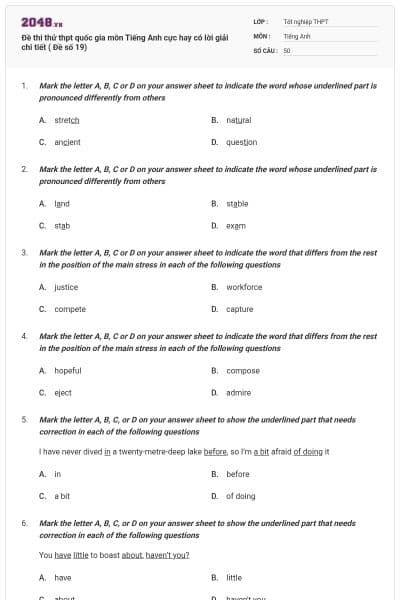
Mark the letter A, B, C or D on your answer sheet to indicate the word whose underlined part is pronounced differently from others
stretch
natural
ancient
question
Đáp án là C
stretch /stretʃ/
natural /ˈnætʃrəl/
ancient /ˈeɪnʃənt/
question /ˈkwestʃən/
Từ được gạch chân trong câu C phát âm là /ʃ/ còn lại phát âm là /tʃ/
Mark the letter A, B, C or D on your answer sheet to indicate the word whose underlined part is pronounced differently from others
land
stable
stab
exam
Đáp án là B
land /lænd/
stable /ˈsteɪbl/
stab /stæb/
exam /ɪɡˈzæm/
Từ được gạch chân trong câu B phát âm là /eɪ/ còn lại phát âm là /æ/
Mark the letter A, B, C or D on your answer sheet to indicate the word that differs from the rest in the position of the main stress in each of the following questions
justice
workforce
compete
capture
Đáp án là C
justice /ˈdʒʌstɪs/
workforce /ˈwɜːkfɔːs/
compete /kəmˈpiːt/
capture /ˈkæptʃər/
Câu C trọng âm 2 còn lại trọng âm 1
Mark the letter A, B, C or D on your answer sheet to indicate the word that differs from the rest in the position of the main stress in each of the following questions
hopeful
compose
eject
admire
Đáp án là A
hopeful /ˈhəʊpfl/
compose /kəmˈpəʊz/
eject /iˈdʒekt/
admire /ədˈmaɪər/
Câu A trọng âm 1 còn lại trọng âm 2
Mark the letter A, B, C, or D on your answer sheet to show the underlined part that needs correction in each of the following questions
I have never dived in a twenty-metre-deep lake before, so I’m a bit afraid of doing it
in
before
a bit
of doing
Đáp án là D
Phương pháp: Cách sử dụng afraid to và afraid of (ving) trong tiếng Anh
Cấu trúc I am afraid to do something = Tôi ngại (sợ) làm điều gì đó. Tôi không muốn làm điều đó bởi vì điều đó nguy hiểm hoặc kết quả có thể không tốt.
Chúng ta sử dụng afraid to do với những việc chúng ta có chủ tâm.
Ví dụ:
- A lot of people are afraid to go out at night.
(= they don't want to go out because it is dangerous — so they don't go out)
trúc I am afraid of something happening = Có khả năng một việc gì xấu sẽ xảy ra (ví dụ tai nạn).
Chúng ta không sử dụng afraid of + Ving cho những việc mà chúng ta có chủ tâm.
Ví dụ:
- The path was icy, so we walked very carefully. We were afraid of falling.
(= it was possible we would fall “ KHÔNG nói 'we were afraid to fall')
Tóm lại, bạn ngại phải làm điều gì đó (afraid to do) vì bạn sợ xảy ra một điều gì đó (afraid of something happening) như là một hậu quả tất yếu.
Ví dụ:
- I was afraid to go near the dog because I was afraid of being bitten.
Tôi sợ đi gần con chó vì tôi sợ bị cắn.
Of doing => to do
Tạm dịch: Tôi chưa bao giờ lăn ở hố sâu 20 mét, vì vậy tôi hơi sợ phải làm việc đó
Mark the letter A, B, C, or D on your answer sheet to show the underlined part that needs correction in each of the following questions
You have little to boast about, haven’t you?
have
little
about
haven't you
Đáp án là D
Kiến thức: Câu hỏi đuôi.
Mệnh đề thể phủ định ( vì có little) , trợ động từ + S?
Mệnh đề phủ định ở thì hiện tại đơn nên sửa như sau:
Haven‘t you => do you
Tạm dịch: Bạn có rất ít điều để khoe khoang về nó, đúng không
Mark the letter A, B, C, or D on your answer sheet to show the underlined part that needs correction in each of the following questions
Not surprisingly, poverty is a problem worth of concern in every country
surprisingly
poverty
worth
every country
Đáp án là C
Kiến thức: Cụm từ “ be worthy of sth” ( đáng để làm )
Worth => worthy
Tạm dịch: Không ngạc nhiên gì, nghèo đói là vấn đề đáng bận tâm ở mỗi quốc gia
Mark the letter A, B, C or D on your answer sheet to indicate the correct answer to each of the following questions
This story has been passed down by ________of mouth
word
phrase
memory
speaking
Đáp án là A
Cụm từ: Pass down by word of mouth ( truyền miệng)
Tạm dịch: Câu chuyện này được truyền miệng
Mark the letter A, B, C or D on your answer sheet to indicate the correct answer to each of the following questions
This is ________less satisfactory than the previous offer
fairly
far
absolutely
distant
Đáp án là B
Kiến thức: Trạng từ bổ nghĩa cho so sánh hơn “ far + more/ less + long adjective” than
Tạm dịch: Lời đề nghị này không thỏa đáng hơn lời đề nghị trước đó
Mark the letter A, B, C or D on your answer sheet to indicate the correct answer to each of the following questions
It ‘s ________knowledge that the Chancellor has not been entirely discreet in his private life
universal
general
common
full
Đáp án là C
Cụm từ: It‘s common knowledge that + S + V ( mọi người đều biết rằng)
Tạm dịch: Mọi người đều biết rằng Chancellor không hoàn toàn kín miệng về đời tư
Mark the letter A, B, C or D on your answer sheet to indicate the correct answer to each of the following questions
The professor wasn’t ________with the current political affairs in his country after his long stay abroad
present
familiar
knowledgeable
actual
Đáp án là B
Cụm từ: be familiar with ( quen với)
Tạm dịch: Giáo sư này không quen với các vấn đề chính trị hiện nay ở đất nước mình sau một thời gian dài ở nước ngoài
Mark the letter A, B, C or D on your answer sheet to indicate the correct answer to each of the following questions
You will not be successful in business if you don’t ________risks
put
get
try
take
Đáp án là D
Cụm từ: take risk/ take a risk ( làm liều)
Tạm dịch: Bạn sẽ không thành công trong kinh doanh nếu bạn không liều lĩnh
Mark the letter A, B, C or D on your answer sheet to indicate the correct answer to each of the following questions
I personally don’t believe you can ________of his support
count
depend
rely
be sure
Đáp án là D
Kiến thức: từ vựng
count on: tin tưởng/ chắc chắn
depend on: dựa vào
rely on: tin cậy vào
be sure of : chắc chắn về
Tạm dịch: Cá nhân tôi không tin rằng bạn có thể chắc chắn về sự ủng hộ của anh ấy
Mark the letter A, B, C or D on your answer sheet to indicate the correct answer to each of the following questions
You must know how to ________between what is good for you and what is not
differ
vary
solve
distinguish
Đáp án là D
Kiến thức: Từ vựng
Differ: làm khác đi
Vary: thay đổi
Solve: giải quyết
Distinguish: phân biệt
Tạm dịch: Bạn phải biết phân biệt cái gì tốt và cái gì không tốt cho bạn
Mark the letter A, B, C or D on your answer sheet to indicate the correct answer to each of the following questions
Paul asked Maria to ________him to the dentist’s because he didn’t want to go by himself
unify
join
interfere
accompany
Đáp án là D
Kiến thức: Từ vựng
Unify:
Join: tham gia vào
Interfere: can thiệp
Accompany: đồng hành cùng
Tạm dịch: Paul nhờ Maria cùng đồng hành với anh ấy đến phòng khám nha khoa bởi vì anh ấy không muốn đi một mình
Mark the letter A, B, C or D on your answer sheet to indicate the correct answer to each of the following questions
People are becoming ________aware of healthy eating, exercise, and relaxation, and want to incorporate them into their daily lives
hardly ever
rather than
more and more
much as
Đáp án là C
Kiến thức: từ vựng
Hardly ever: chưa bao giờ
Rather than: thay vì
More and more: ngày càng nhiều hơn
Much as: nhiều như
Tạm dịch: Con người ngày càng trở nên ý thức nhiều hơn về ăn uống lành mạnh, tập thể dục, thư giãn và kết hợp chúng trong đời sống hằng ngày
Mark the letter A, B, C or D on your answer sheet to indicate the correct answer to each of the following questions
As a small boy he was used to ________in the house for an hour or two
being left alone
eaving alone
leave alone
be left alone
Đáp án là A
Cấu trúc “ be used to + Ving”: quen với việc
Tạm dịch: Khi còn bé anh ấy đã quen với việc bị bỏ ở nhà một mình khoảng 1 đến 2 giờ.
Câu mang nghĩa bị động nên dùng: was used to + being + Ved
Mark the letter A, B, C or D on your answer sheet to indicate the correct answer to each of the following questions
One of the areas of multimedia that is growing quickly ________is sound
yet is easily overlooked
is easily overlooked
it is easily overlooked
that is easily overlooked
Đáp án là A
Kiến thức: Mệnh đề quan hệ và liên từ
Tạm dịch: Một trong những lĩnh vực của đa phương tiện cái mà đang phát triển nhanh chóng nhưng dễ dàng bị bỏ qua là âm thanh.
Mệnh đề chính của câu:
Chủ ngữ: One of the areas of multimedia
Động từ: is
Tân ngữ: sound
=>that is growing quickly yet is easily overlooked : là mệnh đề quan hệ
Hai động từ trong mệnh đề phải được liên kết với nhau bằng từ nối “yet”
Mark the letter A, B, C or D on your answer sheet to indicate the correct answer to each of the following questions
She’s so depressed. All these problem are really ________.
getting her down
getting round her
talking her on
toning her down
Đáp án là A
Kiến thức: Cụm động từ
Get sb down: làm ai đó thất vọng
Get round sb: thuyết phục
Take sb on: tuyển dụng
Tone sth down: làm cho bớt khắc nhiệt/ giảm độ sáng của màu sắc
Tạm dịch: Cô ấy rất chán nản. Tất cả những vấn đề này thật sự làm cô ấy thất vọng
Mark the letter A, B, C, or D on your answer sheet to indicate the most suitable response to complete each of the following exchanges
A: Shouldn't we pay before we leave? B: “________________”
No, I don't like to pray
I'm not sure
No, they'll bill us later
Yes, we should have paid
Đáp án là C
A: “ Chúng ta có nên trả tiền trước khi rời đi không?”
B: “.....................................”
A. Không. mình không thích cầu nguyện.
B. Mình không chắc.
C. Không, họ sẽ gửi hóa đơn cho chúng ta sau.
D. Có, đáng lé ra bạn đã nên trả
Mark the letter A, B, C, or D on your answer sheet to indicate the most suitable response to complete each of the following exchanges
Bill: "I like your bike, Helen." Helen: “________________”
Just kidding
I wish I could afford it
Thanks, but it isn't new
I don't wear it very often
Đáp án là C
Bill: “ Mình thích xe đạp của bạn, Helen à.”
Helen: “................................”
A. Mình đùa tí thôi mà.
B. Mình ước gì mình có thể mua nó.
C. Cảm ơn, nhưng nó không mới.
D. Mình không mặc nó thường xuyên lắm
Mark the letter A,B,C, or D on your answer sheet to indicate the word or phrase that is CLOSEST in meaning to the underlined part in each of the following questions
When she fell ill, her daughter took over the business
took a chance
took control of
took a loss
lost control of
Đáp án là B
Take over: tiếp quản/ kiểm soát
Take a chance: tận dụng cơ hội
Take control of: kiểm soát/ điều khiển
Lose control of: mất kiểm soát
=>take over = take control of
Tạm dịch: Khi bà ấy ốm, con gái bà đã tiếp quản việc làm ăn/ doanh nghiệp của bà ấy
Mark the letter A,B,C, or D on your answer sheet to indicate the word or phrase that is CLOSEST in meaning to the underlined part in each of the following questions
Biogas can be utilized for electricity production, cooking, space heating, water heating and process heating
sparing
generation
increase
reformation
Đáp án là B
Production: sự sản xuất
Sparing: dành ra
Generation: sự vận hành/ phát ra
Increase: tăng
Reformation: sự tái hình thành
=>production = generation
Tạm dịch: Khí sinh học có thể được sử dụng để sản xuất điện, nấu ăn, sưởi ấm, đun nước và quy trình sấy khô
Mark the letter A, B, C or D on your answer sheet to indicate the word (s) OPPOSITE in meaning to the underlined word (s) in the following question
In the first two decades of its existence, the cinema developed rapidly
shortly
sluggishly
leisurely
weakly
Đáp án là B
Rapidly: nhanh chóng
Shortly: ngay lập tức
Sluggishly: chậm chạp
Leisuerly: vui vẻ/ thoải mái
Weakly: yếu kém
=>rapidly >< sluggishly
Tạm dịch: Trong hai thập kỷ đầu tồn tại của mình, ngành điện ảnh phát triển nhanh chóng
Mark the letter A, B, C or D on your answer sheet to indicate the word (s) OPPOSITE in meaning to the underlined word (s) in the following question
attentions
unawareness
unconcern
carelessness
Đáp án là A
Distractions: sự sao nhãng
Attentions: sự chú ý
Unawaremess: sự không ý thức
Inconcern: không quan tâm
Carelessness: sự bất cẩn
=>distractions >< attentions
=>Chọn A
Tạm dịch: Tôi cảm thấy thật khó khi làm việc tại nhà vì có quá nhiều điều gây sao nhãng
Mark the letter A, B, C, or D on your answer sheet to indicate the sentence that is closest in meaning to each of the following sentences
It’s your duty to finish your homework before you go to school
You were supposed to finish your homework before you go to school
Your homework is supposed to be finished before going to school
That your homework is finished before you go to school is your duty
Your duty finishing your homework before you go to school is necessary
Đáp án là C
Kiến thức:
It‘s sb‘s duty to Vo = Sb be supposed to Vo
Tạm dịch: Nhiệm vụ của em là hoàn thành bài tập về nhà trước khi đến trường.
A. loại vì sai thì. Đề bài dùng thì hiện tại đơn. Đáp án A lại dùng thì quá khứ đơn.
B. Câu B loại vì sai ngữ pháp. Chỉ được rút gọn hai mệnh đề về dạng Ving/ Ved khi hai mệnh đề cùng chủ ngữ. Trong đáp án B hai mệnh đề có hai chủ ngữ khác nhau : “your homework” và “you” nên không được rút gọn.
C. Mệnh đề danh ngữ: That S+V => đóng vai trò chủ ngữ + S
Tạm dịch: Việc bài tập về nhà được hoàn thành trước khi đến lớp là nhiệm vụ của em.
D. loại vì sai ngữ pháp phải sửa finishing thành “ to finish
Mark the letter A, B, C, or D on your answer sheet to indicate the sentence that is closest in meaning to each of the following sentences
The Prime Minister is unlikely to call an early general election
The likelihood is that the Prime Minister will call an early general election
The likelihood is great that the Prime Minister will call an early general election
It’s likely that the Prime Minister will call an early general election
There is little likelihood of the Prime Minister calling an early general election
Đáp án là D
Tạm dịch: Thủ tường không có vẻ như kêu gọi cuộc tổng tuyển cử sớm.
A. Có khả năng rằng thủ tướng sẽ kêu gọi cuộc tổng tuyển cử sớm. => sai nghĩa
B. Có khả năng lớn rằng thủ tướng sẽ kêu gọi cuộc tổng tuyển cử sớm. => sai nghĩa
C. Có vẻ như rằng thủ tướng sẽ kêu gọi cuộc tổng tuyển cử sớm. => sai nghĩa
D. Có rất ít khả năng thủ tướng kêu gọi cuộc tổng tuyển cử sớm
Mark the letter A, B, C, or D on your answer sheet to indicate the sentence that is closest in meaning to each of the following sentences
What the politician was saying fell on deaf ears last night
The politician fell deaf when he was speaking last night
What the politician was saying deafened the listeners last night
No one took notice of what the politician was saying last night
No one listened to what the politician was saying last night because they had deaf ears
Đáp án là C
Cụm từ: fall on deaf ears = be ignored ( bị ngó lơ/ bị phớt lờ)
Tạm dịch: Điều mà nhà chính trị gia nói tối qua bị phớt lờ.
A. Chính trị gia bị điếc khi đang phát biểu tối qua. => sai nghĩa
B. Điều nhà mà chính trị nói tối qua đã làm những người nghe điếc tai. => sai nghĩa
C. Không ai chú ý điều chính trị gia nói tối qua.
D. Không ai nghe điều mà chính trị gia phát biểu tối qua bởi vì họ bị điếc. => sai nghĩa
Mark the letter A, B, C, or D on your answer sheet to indicate the sentence that best combines each pair of sentences in the following questions
Joan broke her right leg in the accident last week. Her parents worried a lot
If Joan didn’t broke her leg last week, her parents wouldn’t worry a lot
If Joan doesn’t broke her leg last week, her parents will not worry a lot
Joan’s parents worried because of her broken leg
The fact that Joan broke her leg made her parents worry
Đáp án là D
Tạm dịch: Joan đã gãy chân phải trong vụ tại nạn tuần trước. Bố mẹ anh ấy rất lo lắng.
A. Câu A loại vì đề bài ngữ cảnh ở quá khứ phải viết lại bằng câu điều kiện loại 3: If S + had Ved/ V3, S + would/ could have + Ved/ V3
B. Câu B là điều kiện loại 1 => loại vì sai tương tự câu A
C. Bố mẹ Joan đã lo lắng vì chân bị gãy của anh ấy. => chưa rõ nghĩa.
D. Sự việc Joan bị gãy chân đã làm bố mẹ anh ấy lo lắng
Mark the letter A, B, C, or D on your answer sheet to indicate the sentence that best combines each pair of sentences in the following questions
The box was too heavy. John could not move it.
The box was too heavy that John could not move it
The box was such heavy that John could not move it
The box was so heavy that John could not move it
The box was heavy that John could not move it
Đáp án là C
Cấu trúc: quá...đến nối mà...
S + be + too + adj ( for + O ) + to Vo: quá...để...
S + be + so + adj that S + V: quá...đến nỗi mà
Tạm dịch: Cái hộp quá nặng. John không thể di chuyển nó.
A. sai vì “too” không dùng với “that”
B. sai vì “ such + a/an + adj + noun”
C. Cái hộp quá nặng đến nõi mà John không thể di chuyển nó.
D. sai vì thiếu “so” trước tính từ “ heavy”
Read the following passage, and mark the letter (A, B, C or D) on your answer sheet to indicate the correct answer for each of the blanks.
Many people love boats. Going out on the water on a warm summer day is a lot of (31) _______. (32) _______ , different people like different kinds of boats. Two of the most popular kinds of boat are sailboats and speedboats. Sailboats use the (33) _______to give them power. They only have small engines. In contrast, speedboats have large engines and go very fast. Furthermore, speedboats are usually not as (34) _______ as sailboats. Speedboats are small so that they can go fast. Sailboats, on the other hand, are big so that they are more comfortable. ( 35) _______, sailboats can travel into the ocean, but this would be very dangerous in a speedboat. You can only use speedboats on rivers or lakes
Điền vào ô số 31
funny
fun
funs
funnies
Đáp án là B
Cụm từ: be a lot of fun = rất vui
=>Chọn B
Many people love boats. Going out on the water on a warm summer day is a lot of (31) _______.
[ Nhiều người thích thuyền. Đi ra ngoài trên nước vào một ngày màu hè nóng bức rất vui.]
Read the following passage, and mark the letter (A, B, C or D) on your answer sheet to indicate the correct answer for each of the blanks.
Many people love boats. Going out on the water on a warm summer day is a lot of (31) _______. (32) _______ , different people like different kinds of boats. Two of the most popular kinds of boat are sailboats and speedboats. Sailboats use the (33) _______to give them power. They only have small engines. In contrast, speedboats have large engines and go very fast. Furthermore, speedboats are usually not as (34) _______ as sailboats. Speedboats are small so that they can go fast. Sailboats, on the other hand, are big so that they are more comfortable. ( 35) _______, sailboats can travel into the ocean, but this would be very dangerous in a speedboat. You can only use speedboats on rivers or lakes
Điền vào ô số 32
However
Although
Because
Unless
Đáp án là A
However: tuy nhiên ( sau however là dấu phẩy)
Although: mặc dù
Because: bởi vì
Unless: nếu...không
(32) _______ , different people like different kinds of boats. Two of the most popular kinds of boat are sailboats and speedboats.
[ Tuy nhiên, những người khác nhau thích các loại thuyền khác nhau. Hai trong số các loại thuyền phổ biến nhất là thuyền buồm và thuyền máy]
Read the following passage, and mark the letter (A, B, C or D) on your answer sheet to indicate the correct answer for each of the blanks.
Many people love boats. Going out on the water on a warm summer day is a lot of (31) _______. (32) _______ , different people like different kinds of boats. Two of the most popular kinds of boat are sailboats and speedboats. Sailboats use the (33) _______to give them power. They only have small engines. In contrast, speedboats have large engines and go very fast. Furthermore, speedboats are usually not as (34) _______ as sailboats. Speedboats are small so that they can go fast. Sailboats, on the other hand, are big so that they are more comfortable. ( 35) _______, sailboats can travel into the ocean, but this would be very dangerous in a speedboat. You can only use speedboats on rivers or lakes
Điền vào ô số 33
water
speed
weather
wind
Đáp án là D
Water: nước
Speed: tốc độ
Weather: thời tiết
Wind: gió
Sailboats use the (33) _______to give them power. They only have small engines. In contrast, speedboats have large engines and go very fast.
[ Thuyền buồm sử dụng gió để tạo ra năng lượng. Chúng chỉ có những động cơ nhỏ. Ngược lại, thuyền máy có những động cơ lớn và đi rất nhanh.]
Read the following passage, and mark the letter (A, B, C or D) on your answer sheet to indicate the correct answer for each of the blanks.
Many people love boats. Going out on the water on a warm summer day is a lot of (31) _______. (32) _______ , different people like different kinds of boats. Two of the most popular kinds of boat are sailboats and speedboats. Sailboats use the (33) _______to give them power. They only have small engines. In contrast, speedboats have large engines and go very fast. Furthermore, speedboats are usually not as (34) _______ as sailboats. Speedboats are small so that they can go fast. Sailboats, on the other hand, are big so that they are more comfortable. ( 35) _______, sailboats can travel into the ocean, but this would be very dangerous in a speedboat. You can only use speedboats on rivers or lakes
Điền vào ô số 34
small
fast
warm
big
Đáp án là D
Small: nhỏ
Fast: nhanh
Warm: ấm/ nóng
Big: to
Furthermore, speedboats are usually not as (34) _______ as sailboats. Speedboats are small so that they can go fast. Sailboats, on the other hand, are big so that they are more comfortable.
[ Hơn thế nữa, thuyền máy thường không to như thuyền buồm. Thuyền máy nhỏ để đi nhanh. Thuyền buồm, ngược lại to để mà người ta thoải mái hơn.
Read the following passage, and mark the letter (A, B, C or D) on your answer sheet to indicate the correct answer for each of the blanks.
Many people love boats. Going out on the water on a warm summer day is a lot of (31) _______. (32) _______ , different people like different kinds of boats. Two of the most popular kinds of boat are sailboats and speedboats. Sailboats use the (33) _______to give them power. They only have small engines. In contrast, speedboats have large engines and go very fast. Furthermore, speedboats are usually not as (34) _______ as sailboats. Speedboats are small so that they can go fast. Sailboats, on the other hand, are big so that they are more comfortable. ( 35) _______, sailboats can travel into the ocean, but this would be very dangerous in a speedboat. You can only use speedboats on rivers or lakes
Điền vào ô số 35
Unfortunately
At first
In addition
Except for
Đáp án là C
Unfortunately: không may
At first: lúc đầu
In addition: thêm vào đó
Except for: ngoại trừ
( 35) _______, sailboats can travel into the ocean, but this would be very dangerous in a speedboat. You can only use speedboats on rivers or lakes.
[Thêm vào đó, thuyền buồm có thể đi ra đại dương, nhưng điều này lại rất nguy hiểm với thuyền máy. Bạn chỉ có thể sử dụng thuyền máy trên các dòng sông hoặc hồ.]
Read the following passage and circle A, B, C or D to indicate the correct answer to each of the question from 36 to 42
George Washington Carver showed that plant life was more than just food for animals and humans. Carver’s first step was to analyze plant parts to find out what they were made of. He then combined these simpler isolated substances with other substances to create new products.
The branch of chemistry that studies and finds ways to use raw materials from farm products to make industrial products is called chemurgy. Carver was one of the first and greatest chemurgists of all time. Today the science of chemurgy is better known as the science of synthetics. Each day people depend on and use synthetic materials made from raw materials. All his life Carver battled against the disposal of waste materials and warned of the growing need to develop substitutes for the natural substances being used up by humans.
Carver never cared about getting credit for the new products he created. He never tried to patent his discoveries or get wealthy from them. He turned down many offers to leave Tuskegee Institute to become a rich scientist in private industry. Thomas Edison, inventor of the electric light, offered him a laboratory in Detroit to carry out food research. When the United States government made him a collaborator in the Mycology and Plant Disease Survey of the Department of Agriculture, he accepted the position with the understanding that he wouldn’t have to leave Tuskegee. As an authority on plant diseases – especially of the fungus variety – Carver sent hundreds of specimens to the United States Department of Agriculture. At the peak of his career, Carver’s fame and influence were known on every continent.
With what topic is the passage mainly concerned?
The work and career of George Washington Carver
The research conducted at Tuskegee Institute
The progress of the science of synthetics
The use of plants as a source of nutrition
Đáp án là A
Bài đọc chủ yếu nói về nội dung gì?
A. Công việc và sự nghiệp của George Washington Carver.
B. Nghiên cứu được tiến hành ở viện Tuskegee
C. Tiến bộ của khoa học tổng hợp
D. Việc sử dụng thực vật như là nguồn dinh dưỡng.
Read the following passage and circle A, B, C or D to indicate the correct answer to each of the question from 36 to 42
George Washington Carver showed that plant life was more than just food for animals and humans. Carver’s first step was to analyze plant parts to find out what they were made of. He then combined these simpler isolated substances with other substances to create new products.
The branch of chemistry that studies and finds ways to use raw materials from farm products to make industrial products is called chemurgy. Carver was one of the first and greatest chemurgists of all time. Today the science of chemurgy is better known as the science of synthetics. Each day people depend on and use synthetic materials made from raw materials. All his life Carver battled against the disposal of waste materials and warned of the growing need to develop substitutes for the natural substances being used up by humans.
Carver never cared about getting credit for the new products he created. He never tried to patent his discoveries or get wealthy from them. He turned down many offers to leave Tuskegee Institute to become a rich scientist in private industry. Thomas Edison, inventor of the electric light, offered him a laboratory in Detroit to carry out food research. When the United States government made him a collaborator in the Mycology and Plant Disease Survey of the Department of Agriculture, he accepted the position with the understanding that he wouldn’t have to leave Tuskegee. As an authority on plant diseases – especially of the fungus variety – Carver sent hundreds of specimens to the United States Department of Agriculture. At the peak of his career, Carver’s fame and influence were known on every continent.
The word “step” in paragraph 1 could best be replaced with
footprint
action
scale
stair
Đáp án là B
Từ “ step” ( bước) ở đoạn 1 có thể được thay thế tốt nhất bởi
A. dấu chân
B. hành động
C. cái cân
D. cầu thang
Dẫn chứng: Carver‘s first step was to analyze plant parts to find out what they were made of.
[ Bước tiến/ hành động đầu tiên của Carver là phân tích các bộ phận của thực vật để tìm ra chúng được làm từ cái gì ]
Read the following passage and circle A, B, C or D to indicate the correct answer to each of the question from 36 to 42
George Washington Carver showed that plant life was more than just food for animals and humans. Carver’s first step was to analyze plant parts to find out what they were made of. He then combined these simpler isolated substances with other substances to create new products.
The branch of chemistry that studies and finds ways to use raw materials from farm products to make industrial products is called chemurgy. Carver was one of the first and greatest chemurgists of all time. Today the science of chemurgy is better known as the science of synthetics. Each day people depend on and use synthetic materials made from raw materials. All his life Carver battled against the disposal of waste materials and warned of the growing need to develop substitutes for the natural substances being used up by humans.
Carver never cared about getting credit for the new products he created. He never tried to patent his discoveries or get wealthy from them. He turned down many offers to leave Tuskegee Institute to become a rich scientist in private industry. Thomas Edison, inventor of the electric light, offered him a laboratory in Detroit to carry out food research. When the United States government made him a collaborator in the Mycology and Plant Disease Survey of the Department of Agriculture, he accepted the position with the understanding that he wouldn’t have to leave Tuskegee. As an authority on plant diseases – especially of the fungus variety – Carver sent hundreds of specimens to the United States Department of Agriculture. At the peak of his career, Carver’s fame and influence were known on every continent.
According to the passage, chemurgical can be defined as the
combination of chemistry and metallurgy
research on chemistry of the soil
study of the relationship between sunlight and energy
development of industrial products from farm products
Đáp án là D
Theo bài đọc, hóa hữu cơ có thể định nghĩa như là
A. sự kết hợp của hóa học và luyện kim
B. nghiên cứu về hóa học của đất
C. nghiên cứu mối quan hệ giữa ánh sáng mặt trời và năng lượng.
D. sự phát triển của các sản phẩm công nghiệp từ cá sản phẩm nông nghiệp.
Dẫn chứng:The branch of chemistry that studies and finds ways to use raw materials from farm products to make industrial products is called chemurgy
Read the following passage and circle A, B, C or D to indicate the correct answer to each of the question from 36 to 42
George Washington Carver showed that plant life was more than just food for animals and humans. Carver’s first step was to analyze plant parts to find out what they were made of. He then combined these simpler isolated substances with other substances to create new products.
The branch of chemistry that studies and finds ways to use raw materials from farm products to make industrial products is called chemurgy. Carver was one of the first and greatest chemurgists of all time. Today the science of chemurgy is better known as the science of synthetics. Each day people depend on and use synthetic materials made from raw materials. All his life Carver battled against the disposal of waste materials and warned of the growing need to develop substitutes for the natural substances being used up by humans.
Carver never cared about getting credit for the new products he created. He never tried to patent his discoveries or get wealthy from them. He turned down many offers to leave Tuskegee Institute to become a rich scientist in private industry. Thomas Edison, inventor of the electric light, offered him a laboratory in Detroit to carry out food research. When the United States government made him a collaborator in the Mycology and Plant Disease Survey of the Department of Agriculture, he accepted the position with the understanding that he wouldn’t have to leave Tuskegee. As an authority on plant diseases – especially of the fungus variety – Carver sent hundreds of specimens to the United States Department of Agriculture. At the peak of his career, Carver’s fame and influence were known on every continent.
The phrase “getting credit” in paragraph 3 can be best replaced with
taking responsibility
earning money
winning praise
advertising
Đáp án là C
Cụm từ “ getting credit” ở đoạn 3 có thể được thay thế tốt nhất bởi
A. chịu trách nhiệm
B. kiếm tiền
C. giành được sự khen ngợi/ ca tụng/ đề cao)
D. quảng cáo
Dẫn chứng: Carver never cared about getting credit for the new products he createD. [ Carver chưa bao giờ quan tâm đến việc nổi tiếng về những sản phẩm mới mà ông tạo ra]
Read the following passage and circle A, B, C or D to indicate the correct answer to each of the question from 36 to 42
George Washington Carver showed that plant life was more than just food for animals and humans. Carver’s first step was to analyze plant parts to find out what they were made of. He then combined these simpler isolated substances with other substances to create new products.
The branch of chemistry that studies and finds ways to use raw materials from farm products to make industrial products is called chemurgy. Carver was one of the first and greatest chemurgists of all time. Today the science of chemurgy is better known as the science of synthetics. Each day people depend on and use synthetic materials made from raw materials. All his life Carver battled against the disposal of waste materials and warned of the growing need to develop substitutes for the natural substances being used up by humans.
Carver never cared about getting credit for the new products he created. He never tried to patent his discoveries or get wealthy from them. He turned down many offers to leave Tuskegee Institute to become a rich scientist in private industry. Thomas Edison, inventor of the electric light, offered him a laboratory in Detroit to carry out food research. When the United States government made him a collaborator in the Mycology and Plant Disease Survey of the Department of Agriculture, he accepted the position with the understanding that he wouldn’t have to leave Tuskegee. As an authority on plant diseases – especially of the fungus variety – Carver sent hundreds of specimens to the United States Department of Agriculture. At the peak of his career, Carver’s fame and influence were known on every continent.
Why does the author mention Thomas Edison’s offer to Carver
To illustrate one of Carver’s many opportunities
To portray the wealth of one of Carver’s competitors
To contrast Edison’s contribution with that of Carver
To describe Carver’s dependence on industrial support
Đáp án là A
Tại sao tác giả đề cập đến lời đề nghị của Thomas Edition với Carver.
A. Để minh họa một trong những cơ hội của Carver.
B. Để phát thảo sự giàu có của các đối thủ cạnh tranh của Carvers.
C. Để tương phản đóng góp của Edison với đóng góp của Carver.
D. Để miêu tả sự phụ thuộc của Carver vào sự hỗ trợ của công nghiệp.
Dẫn chứng: He turned down many offers to leave Tuskegee Institute to become a rich scientist in private industry. Thomas Edison, inventor of the electric light, offered him a laboratory in Detroit to carry out food research
Read the following passage and circle A, B, C or D to indicate the correct answer to each of the question from 36 to 42
George Washington Carver showed that plant life was more than just food for animals and humans. Carver’s first step was to analyze plant parts to find out what they were made of. He then combined these simpler isolated substances with other substances to create new products.
The branch of chemistry that studies and finds ways to use raw materials from farm products to make industrial products is called chemurgy. Carver was one of the first and greatest chemurgists of all time. Today the science of chemurgy is better known as the science of synthetics. Each day people depend on and use synthetic materials made from raw materials. All his life Carver battled against the disposal of waste materials and warned of the growing need to develop substitutes for the natural substances being used up by humans.
Carver never cared about getting credit for the new products he created. He never tried to patent his discoveries or get wealthy from them. He turned down many offers to leave Tuskegee Institute to become a rich scientist in private industry. Thomas Edison, inventor of the electric light, offered him a laboratory in Detroit to carry out food research. When the United States government made him a collaborator in the Mycology and Plant Disease Survey of the Department of Agriculture, he accepted the position with the understanding that he wouldn’t have to leave Tuskegee. As an authority on plant diseases – especially of the fungus variety – Carver sent hundreds of specimens to the United States Department of Agriculture. At the peak of his career, Carver’s fame and influence were known on every continent.
Which of the following is NOT discussed in the passage as work done by Carver?
Research on electricity
Analysis of plant parts
Invention of new products
Research on plant diseases
Đáp án là A
Việc nào sau đây không được thảo luận trong bài đọc như công việc mà Carver đã làm?
A.Nghiên cứu về điện
B. Phân tích về các bộ phận của cây
C. Phát minh ra các sản phẩm mới
D. Nghiên cứu về các căn bệnh của cây
Dẫn chứng:
Carver‘s first step was to analyze plant parts to find out what they were made of. =>loại B
Carver was one of the first and greatest chemurgists of all time. =>loại C
As an authority on plant diseases – especially of the fungus variety – Carver sent hundreds of specimens to the United States Department of Agriculture
Read the following passage and circle A, B, C or D to indicate the correct answer to each of the question from 36 to 42
George Washington Carver showed that plant life was more than just food for animals and humans. Carver’s first step was to analyze plant parts to find out what they were made of. He then combined these simpler isolated substances with other substances to create new products.
The branch of chemistry that studies and finds ways to use raw materials from farm products to make industrial products is called chemurgy. Carver was one of the first and greatest chemurgists of all time. Today the science of chemurgy is better known as the science of synthetics. Each day people depend on and use synthetic materials made from raw materials. All his life Carver battled against the disposal of waste materials and warned of the growing need to develop substitutes for the natural substances being used up by humans.
Carver never cared about getting credit for the new products he created. He never tried to patent his discoveries or get wealthy from them. He turned down many offers to leave Tuskegee Institute to become a rich scientist in private industry. Thomas Edison, inventor of the electric light, offered him a laboratory in Detroit to carry out food research. When the United States government made him a collaborator in the Mycology and Plant Disease Survey of the Department of Agriculture, he accepted the position with the understanding that he wouldn’t have to leave Tuskegee. As an authority on plant diseases – especially of the fungus variety – Carver sent hundreds of specimens to the United States Department of Agriculture. At the peak of his career, Carver’s fame and influence were known on every continent.
One of Carver’s main concerns is most similar to which of the following present-day causes?
Preventive medicine
Recycling of used materials
Preservation of old buildings
Prevention of cruelty of animals
Đáp án là B
Một trong những sự quan tâm của Carver gần giống nhất với cái nào sau đây của cá nguyên nhân nào gần đây?
A. thuốc phòng bệnh
B. việc tái chế các vật liệu cũ
C. sự bảo tồn các ngôi nhà cũ
D. sự ngăn cản sự tàn ác của động vật.
Dẫn chứng: All his life Carver battled against the disposal of waste materials and warned of the growing need to develop substitutes for the natural substances being used up by humans
Read the following passage, and mark the letter A, B, C, or D on your answer sheet to indicate the correct answer to each of the questions.
Atomic were once thought to be fundamental pieces of matter, but they are in turn made of smaller subatomic particles. There are three major subatomic particles neutrons, protons, and electronic. Protons and neutrons can be broken into even smaller units, but these smaller units do not occur naturally in nature and are thought to only be produced in manmade particle accelerators and perhaps in extreme stellar events like supernovas. The structure of an atom can best be described as a small solar system, with the neutrons at the center and the electrons circling them in various orbits, just as the planets circle the sun .In reality, the structure of an atom is far more complex, because the laws of physics are fundamentally different at the atomic level than of the level of the observable word. The true nature of atomic structure can only be expressed accurately through complex mathematical formulas .This explanation, however, is of little use to most average people.
Protons and neutrons have nearly equal mass and size, but protons carry a positive electrical charge, while neutrons carry no charge at all. Protons and neutrons are bound together by the strong nuclear force, one of the four basic forces in the universe. Protons and neutrons give atoms some of their most basic properties. Elements are defined by two numbers; their atomic number , which is equal to the number of protons they have, and their atomic weight , which is equal to total number of their neutrons and protons. In most lighter atoms , the number of neutrons and protons is equal , and the element is stable. In heavier atoms, however, there are more neutrons than protons , and the element is unstable, eventually losing neutrons through radioactive decay until a neutral state is reached.
Electrons are negatively charged particles. They are bound to their atoms through electromagnetic attraction. Opposite electrical charges attract one another, so the positive charge of the proton helps keep the negatively charged electron in orbit around the nucleus of the atom. Electrons are different from neutrons in that they cannot be broken down into smaller particles. They are also far smaller and lighter than neutrons and protons. An electron is about one thousandth of the diameter of a proton and an even smaller fraction of its mass. Electrons circle the protons and neutrons at the center of the atom in orbit. These orbits are often called electron shells. The closer the orbit is to the center of the atom, the lower its energy is. There are seven electron shells, and each higher level can hold more electron than the previous shell. Electrons naturally seek to occupy the lowest shell possible .So if there is space in a lower shell, an electron will drop down to occupy that space. At temperatures higher than a few hundred degrees, electrons will gain energy and move to a higher shell, but only momentarily. When the electrons drop back down to their natural shell, they emit light .This is why fires and other very hot objects seem to glow.
Electrons are also primarily responsible for many of the chemical properties of atoms. Since electrons seek to occupy the lowest electron shell possible, they will move from one atom to another if there is a space available in a lower electron shell. For example, if there is an atom with an open space in its third shell, and it comes into contact with an atom with electrons in its fourth shell, the first atom will take one of these electrons to complete its third shell. When this happens, the two atoms will be chemically bonded to form a molecule. Furthermore, atoms sometimes lose electrons in collisions with other atoms. When it happens, the radio of protons and electrons in the atom changes, and therefore, the overall electrical charge of the atom changes as well. These atoms are called isotopes, and they have significantly different chemical properties from their parent atoms.
In paragraph 1, why does the author compare the structure of an atom to a solar system?
To provide an explanation of atomic structure that will be easily understood
To show that the complex mathematical formulas used to explain atomic structure are inaccurate
To show the influence of atomic structure on the world at the observable level
To contrast the size of atoms with the size of objects at the observable level
Đáp án là A
Ở đoạn 1, tại sao tác giả so sánh cấu trúc của một nguyên tử với hệ mặt trời?
A. Để cung cấp lời giải thích của cấu trúc nguyên tử sẽ được hiểu một cách dễ dàng.
B. Để cho thấy rằng những công thức toán học phức tạp được sử dụng để giải thích cấu trúc nguyên tử là không đúng.
C. Để cho thấy sự ảnh hưởng của cấu trúc phân tử lên thế giới ở mức độ có thể quan sát được.
D. Để tương phản kích thước của nguyên tử với các vật thể ở mức độ có thể quan sát đượC
Read the following passage, and mark the letter A, B, C, or D on your answer sheet to indicate the correct answer to each of the questions.
Atomic were once thought to be fundamental pieces of matter, but they are in turn made of smaller subatomic particles. There are three major subatomic particles neutrons, protons, and electronic. Protons and neutrons can be broken into even smaller units, but these smaller units do not occur naturally in nature and are thought to only be produced in manmade particle accelerators and perhaps in extreme stellar events like supernovas. The structure of an atom can best be described as a small solar system, with the neutrons at the center and the electrons circling them in various orbits, just as the planets circle the sun .In reality, the structure of an atom is far more complex, because the laws of physics are fundamentally different at the atomic level than of the level of the observable word. The true nature of atomic structure can only be expressed accurately through complex mathematical formulas .This explanation, however, is of little use to most average people.
Protons and neutrons have nearly equal mass and size, but protons carry a positive electrical charge, while neutrons carry no charge at all. Protons and neutrons are bound together by the strong nuclear force, one of the four basic forces in the universe. Protons and neutrons give atoms some of their most basic properties. Elements are defined by two numbers; their atomic number , which is equal to the number of protons they have, and their atomic weight , which is equal to total number of their neutrons and protons. In most lighter atoms , the number of neutrons and protons is equal , and the element is stable. In heavier atoms, however, there are more neutrons than protons , and the element is unstable, eventually losing neutrons through radioactive decay until a neutral state is reached.
Electrons are negatively charged particles. They are bound to their atoms through electromagnetic attraction. Opposite electrical charges attract one another, so the positive charge of the proton helps keep the negatively charged electron in orbit around the nucleus of the atom. Electrons are different from neutrons in that they cannot be broken down into smaller particles. They are also far smaller and lighter than neutrons and protons. An electron is about one thousandth of the diameter of a proton and an even smaller fraction of its mass. Electrons circle the protons and neutrons at the center of the atom in orbit. These orbits are often called electron shells. The closer the orbit is to the center of the atom, the lower its energy is. There are seven electron shells, and each higher level can hold more electron than the previous shell. Electrons naturally seek to occupy the lowest shell possible .So if there is space in a lower shell, an electron will drop down to occupy that space. At temperatures higher than a few hundred degrees, electrons will gain energy and move to a higher shell, but only momentarily. When the electrons drop back down to their natural shell, they emit light .This is why fires and other very hot objects seem to glow.
Electrons are also primarily responsible for many of the chemical properties of atoms. Since electrons seek to occupy the lowest electron shell possible, they will move from one atom to another if there is a space available in a lower electron shell. For example, if there is an atom with an open space in its third shell, and it comes into contact with an atom with electrons in its fourth shell, the first atom will take one of these electrons to complete its third shell. When this happens, the two atoms will be chemically bonded to form a molecule. Furthermore, atoms sometimes lose electrons in collisions with other atoms. When it happens, the radio of protons and electrons in the atom changes, and therefore, the overall electrical charge of the atom changes as well. These atoms are called isotopes, and they have significantly different chemical properties from their parent atoms.
According to paragraph 2, an atom’s atomic number is determined by
The sum of its protons and electrons
The different in the mass of its neutrons and protons
The strength of the bond between its protons and neutrons
The total number of protons it has
Đáp án là D
Theo đoạn 2, số nguyên tử của một nguyên tử được xác định bởi
A. Tổng các hạt proton và electron
B. Số lượng notron và proton khác nhau.
C. Sức mạnh kết hợp giữa các hạt proton và notron.
D. Tổng số proton mà nó có.
Dẫn chứng: Elements are defined by two numbers; their atomic number , which is equal to the number of protons they have
Read the following passage, and mark the letter A, B, C, or D on your answer sheet to indicate the correct answer to each of the questions.
Atomic were once thought to be fundamental pieces of matter, but they are in turn made of smaller subatomic particles. There are three major subatomic particles neutrons, protons, and electronic. Protons and neutrons can be broken into even smaller units, but these smaller units do not occur naturally in nature and are thought to only be produced in manmade particle accelerators and perhaps in extreme stellar events like supernovas. The structure of an atom can best be described as a small solar system, with the neutrons at the center and the electrons circling them in various orbits, just as the planets circle the sun .In reality, the structure of an atom is far more complex, because the laws of physics are fundamentally different at the atomic level than of the level of the observable word. The true nature of atomic structure can only be expressed accurately through complex mathematical formulas .This explanation, however, is of little use to most average people.
Protons and neutrons have nearly equal mass and size, but protons carry a positive electrical charge, while neutrons carry no charge at all. Protons and neutrons are bound together by the strong nuclear force, one of the four basic forces in the universe. Protons and neutrons give atoms some of their most basic properties. Elements are defined by two numbers; their atomic number , which is equal to the number of protons they have, and their atomic weight , which is equal to total number of their neutrons and protons. In most lighter atoms , the number of neutrons and protons is equal , and the element is stable. In heavier atoms, however, there are more neutrons than protons , and the element is unstable, eventually losing neutrons through radioactive decay until a neutral state is reached.
Electrons are negatively charged particles. They are bound to their atoms through electromagnetic attraction. Opposite electrical charges attract one another, so the positive charge of the proton helps keep the negatively charged electron in orbit around the nucleus of the atom. Electrons are different from neutrons in that they cannot be broken down into smaller particles. They are also far smaller and lighter than neutrons and protons. An electron is about one thousandth of the diameter of a proton and an even smaller fraction of its mass. Electrons circle the protons and neutrons at the center of the atom in orbit. These orbits are often called electron shells. The closer the orbit is to the center of the atom, the lower its energy is. There are seven electron shells, and each higher level can hold more electron than the previous shell. Electrons naturally seek to occupy the lowest shell possible .So if there is space in a lower shell, an electron will drop down to occupy that space. At temperatures higher than a few hundred degrees, electrons will gain energy and move to a higher shell, but only momentarily. When the electrons drop back down to their natural shell, they emit light .This is why fires and other very hot objects seem to glow.
Electrons are also primarily responsible for many of the chemical properties of atoms. Since electrons seek to occupy the lowest electron shell possible, they will move from one atom to another if there is a space available in a lower electron shell. For example, if there is an atom with an open space in its third shell, and it comes into contact with an atom with electrons in its fourth shell, the first atom will take one of these electrons to complete its third shell. When this happens, the two atoms will be chemically bonded to form a molecule. Furthermore, atoms sometimes lose electrons in collisions with other atoms. When it happens, the radio of protons and electrons in the atom changes, and therefore, the overall electrical charge of the atom changes as well. These atoms are called isotopes, and they have significantly different chemical properties from their parent atoms.
The word stable in paragraph 2 is closet in meaning to
Neutral
Unchanging
Heavy
Equal
Đáp án là B
Từ “stable” ( ổn định) ở đoạn 2 gần nghĩa nhất với
A. trung bình
B. không thay đổi
C. nặng
D. bình đẳng
Dẫn chứng: In most lighter atoms , the number of neutrons and protons is equal , and the element is stable. [ Trong các phân tử nhẹ hơn, số notron và proton bằng nhau, và thành phần ổn định.]
Read the following passage, and mark the letter A, B, C, or D on your answer sheet to indicate the correct answer to each of the questions.
Atomic were once thought to be fundamental pieces of matter, but they are in turn made of smaller subatomic particles. There are three major subatomic particles neutrons, protons, and electronic. Protons and neutrons can be broken into even smaller units, but these smaller units do not occur naturally in nature and are thought to only be produced in manmade particle accelerators and perhaps in extreme stellar events like supernovas. The structure of an atom can best be described as a small solar system, with the neutrons at the center and the electrons circling them in various orbits, just as the planets circle the sun .In reality, the structure of an atom is far more complex, because the laws of physics are fundamentally different at the atomic level than of the level of the observable word. The true nature of atomic structure can only be expressed accurately through complex mathematical formulas .This explanation, however, is of little use to most average people.
Protons and neutrons have nearly equal mass and size, but protons carry a positive electrical charge, while neutrons carry no charge at all. Protons and neutrons are bound together by the strong nuclear force, one of the four basic forces in the universe. Protons and neutrons give atoms some of their most basic properties. Elements are defined by two numbers; their atomic number , which is equal to the number of protons they have, and their atomic weight , which is equal to total number of their neutrons and protons. In most lighter atoms , the number of neutrons and protons is equal , and the element is stable. In heavier atoms, however, there are more neutrons than protons , and the element is unstable, eventually losing neutrons through radioactive decay until a neutral state is reached.
Electrons are negatively charged particles. They are bound to their atoms through electromagnetic attraction. Opposite electrical charges attract one another, so the positive charge of the proton helps keep the negatively charged electron in orbit around the nucleus of the atom. Electrons are different from neutrons in that they cannot be broken down into smaller particles. They are also far smaller and lighter than neutrons and protons. An electron is about one thousandth of the diameter of a proton and an even smaller fraction of its mass. Electrons circle the protons and neutrons at the center of the atom in orbit. These orbits are often called electron shells. The closer the orbit is to the center of the atom, the lower its energy is. There are seven electron shells, and each higher level can hold more electron than the previous shell. Electrons naturally seek to occupy the lowest shell possible .So if there is space in a lower shell, an electron will drop down to occupy that space. At temperatures higher than a few hundred degrees, electrons will gain energy and move to a higher shell, but only momentarily. When the electrons drop back down to their natural shell, they emit light .This is why fires and other very hot objects seem to glow.
Electrons are also primarily responsible for many of the chemical properties of atoms. Since electrons seek to occupy the lowest electron shell possible, they will move from one atom to another if there is a space available in a lower electron shell. For example, if there is an atom with an open space in its third shell, and it comes into contact with an atom with electrons in its fourth shell, the first atom will take one of these electrons to complete its third shell. When this happens, the two atoms will be chemically bonded to form a molecule. Furthermore, atoms sometimes lose electrons in collisions with other atoms. When it happens, the radio of protons and electrons in the atom changes, and therefore, the overall electrical charge of the atom changes as well. These atoms are called isotopes, and they have significantly different chemical properties from their parent atoms.
According to the information in paragraph 2, what will happen if an atom has more neutrons than protons?
It will not have enough of a positive electrical charge to keep its electrons in orbit
Its nucleus will explode in a supernova
It will slowly give off neutrons until the atom becomes stable
Its extra neutrons will be converted into light energy
Đáp án là C
Theo thông tin ở đoạn 2, điều gì sẽ xảy ra nếu 1 nguyên tử có nhiều notron hơn proton?
A. Nó sẽ không có đủ điện cực dương để giữ các electron theo đúng quỹ đạo.
B. Hạt nhân của nó sẽ nổ ở dạng một siêu tân binh.
C. Nó sẽ mất dần notron cho đến khi nguyên tử trở nên cân bằng.
D. Những notron thừa sẽ bị chuyển đổi thành năng lượng ánh sáng.
Dẫn chứng: In heavier atoms, however, there are more neutrons than protons , and the element is unstable, eventually losing neutrons through radioactive decay until a neutral state is reacheD
Read the following passage, and mark the letter A, B, C, or D on your answer sheet to indicate the correct answer to each of the questions.
Atomic were once thought to be fundamental pieces of matter, but they are in turn made of smaller subatomic particles. There are three major subatomic particles neutrons, protons, and electronic. Protons and neutrons can be broken into even smaller units, but these smaller units do not occur naturally in nature and are thought to only be produced in manmade particle accelerators and perhaps in extreme stellar events like supernovas. The structure of an atom can best be described as a small solar system, with the neutrons at the center and the electrons circling them in various orbits, just as the planets circle the sun .In reality, the structure of an atom is far more complex, because the laws of physics are fundamentally different at the atomic level than of the level of the observable word. The true nature of atomic structure can only be expressed accurately through complex mathematical formulas .This explanation, however, is of little use to most average people.
Protons and neutrons have nearly equal mass and size, but protons carry a positive electrical charge, while neutrons carry no charge at all. Protons and neutrons are bound together by the strong nuclear force, one of the four basic forces in the universe. Protons and neutrons give atoms some of their most basic properties. Elements are defined by two numbers; their atomic number , which is equal to the number of protons they have, and their atomic weight , which is equal to total number of their neutrons and protons. In most lighter atoms , the number of neutrons and protons is equal , and the element is stable. In heavier atoms, however, there are more neutrons than protons , and the element is unstable, eventually losing neutrons through radioactive decay until a neutral state is reached.
Electrons are negatively charged particles. They are bound to their atoms through electromagnetic attraction. Opposite electrical charges attract one another, so the positive charge of the proton helps keep the negatively charged electron in orbit around the nucleus of the atom. Electrons are different from neutrons in that they cannot be broken down into smaller particles. They are also far smaller and lighter than neutrons and protons. An electron is about one thousandth of the diameter of a proton and an even smaller fraction of its mass. Electrons circle the protons and neutrons at the center of the atom in orbit. These orbits are often called electron shells. The closer the orbit is to the center of the atom, the lower its energy is. There are seven electron shells, and each higher level can hold more electron than the previous shell. Electrons naturally seek to occupy the lowest shell possible .So if there is space in a lower shell, an electron will drop down to occupy that space. At temperatures higher than a few hundred degrees, electrons will gain energy and move to a higher shell, but only momentarily. When the electrons drop back down to their natural shell, they emit light .This is why fires and other very hot objects seem to glow.
Electrons are also primarily responsible for many of the chemical properties of atoms. Since electrons seek to occupy the lowest electron shell possible, they will move from one atom to another if there is a space available in a lower electron shell. For example, if there is an atom with an open space in its third shell, and it comes into contact with an atom with electrons in its fourth shell, the first atom will take one of these electrons to complete its third shell. When this happens, the two atoms will be chemically bonded to form a molecule. Furthermore, atoms sometimes lose electrons in collisions with other atoms. When it happens, the radio of protons and electrons in the atom changes, and therefore, the overall electrical charge of the atom changes as well. These atoms are called isotopes, and they have significantly different chemical properties from their parent atoms.
The phrase one another in paragraph 3 refers to
Particles
Electrical charges
Electrons
Atoms
Đáp án là B
Cụm từ “ one another” ở đoạn 3 ám chỉ đến
A. Các phân tử
B. Các điện cực
C. Các electron
D. Các nguyên tử
Dẫn chứng: Opposite electrical charges attract one another [ Những điện cực ngược nhau sẽ hút lẫn nhau]
Read the following passage, and mark the letter A, B, C, or D on your answer sheet to indicate the correct answer to each of the questions.
Atomic were once thought to be fundamental pieces of matter, but they are in turn made of smaller subatomic particles. There are three major subatomic particles neutrons, protons, and electronic. Protons and neutrons can be broken into even smaller units, but these smaller units do not occur naturally in nature and are thought to only be produced in manmade particle accelerators and perhaps in extreme stellar events like supernovas. The structure of an atom can best be described as a small solar system, with the neutrons at the center and the electrons circling them in various orbits, just as the planets circle the sun .In reality, the structure of an atom is far more complex, because the laws of physics are fundamentally different at the atomic level than of the level of the observable word. The true nature of atomic structure can only be expressed accurately through complex mathematical formulas .This explanation, however, is of little use to most average people.
Protons and neutrons have nearly equal mass and size, but protons carry a positive electrical charge, while neutrons carry no charge at all. Protons and neutrons are bound together by the strong nuclear force, one of the four basic forces in the universe. Protons and neutrons give atoms some of their most basic properties. Elements are defined by two numbers; their atomic number , which is equal to the number of protons they have, and their atomic weight , which is equal to total number of their neutrons and protons. In most lighter atoms , the number of neutrons and protons is equal , and the element is stable. In heavier atoms, however, there are more neutrons than protons , and the element is unstable, eventually losing neutrons through radioactive decay until a neutral state is reached.
Electrons are negatively charged particles. They are bound to their atoms through electromagnetic attraction. Opposite electrical charges attract one another, so the positive charge of the proton helps keep the negatively charged electron in orbit around the nucleus of the atom. Electrons are different from neutrons in that they cannot be broken down into smaller particles. They are also far smaller and lighter than neutrons and protons. An electron is about one thousandth of the diameter of a proton and an even smaller fraction of its mass. Electrons circle the protons and neutrons at the center of the atom in orbit. These orbits are often called electron shells. The closer the orbit is to the center of the atom, the lower its energy is. There are seven electron shells, and each higher level can hold more electron than the previous shell. Electrons naturally seek to occupy the lowest shell possible .So if there is space in a lower shell, an electron will drop down to occupy that space. At temperatures higher than a few hundred degrees, electrons will gain energy and move to a higher shell, but only momentarily. When the electrons drop back down to their natural shell, they emit light .This is why fires and other very hot objects seem to glow.
Electrons are also primarily responsible for many of the chemical properties of atoms. Since electrons seek to occupy the lowest electron shell possible, they will move from one atom to another if there is a space available in a lower electron shell. For example, if there is an atom with an open space in its third shell, and it comes into contact with an atom with electrons in its fourth shell, the first atom will take one of these electrons to complete its third shell. When this happens, the two atoms will be chemically bonded to form a molecule. Furthermore, atoms sometimes lose electrons in collisions with other atoms. When it happens, the radio of protons and electrons in the atom changes, and therefore, the overall electrical charge of the atom changes as well. These atoms are called isotopes, and they have significantly different chemical properties from their parent atoms.
According to paragraph 3, when does an atom produce light?
When it has more electrons than its electron shells can hold
When an electron drops back to its original electron shell
When an electron is transferred from one atom to another
When energy is added to the outermost electron shell
Đáp án là B
Theo đoạn 3, khi nào một nguyên tử sản sinh ra ánh sáng?
A. Khi nó có nhiều electron hơn vỏ electron nó có thể giữ
B. Khi một electron rơi trở lại vỏ electron ban đầu của nó.
C. Khi một electron được chuyển từ một nguyên tử này đến nguyên tử khác.
D. Khi năng lượng được thêm vào vỏ electron ngoài cùng
Dẫn chứng: When the electrons drop back down to their natural shell, they emit light
Read the following passage, and mark the letter A, B, C, or D on your answer sheet to indicate the correct answer to each of the questions.
Atomic were once thought to be fundamental pieces of matter, but they are in turn made of smaller subatomic particles. There are three major subatomic particles neutrons, protons, and electronic. Protons and neutrons can be broken into even smaller units, but these smaller units do not occur naturally in nature and are thought to only be produced in manmade particle accelerators and perhaps in extreme stellar events like supernovas. The structure of an atom can best be described as a small solar system, with the neutrons at the center and the electrons circling them in various orbits, just as the planets circle the sun .In reality, the structure of an atom is far more complex, because the laws of physics are fundamentally different at the atomic level than of the level of the observable word. The true nature of atomic structure can only be expressed accurately through complex mathematical formulas .This explanation, however, is of little use to most average people.
Protons and neutrons have nearly equal mass and size, but protons carry a positive electrical charge, while neutrons carry no charge at all. Protons and neutrons are bound together by the strong nuclear force, one of the four basic forces in the universe. Protons and neutrons give atoms some of their most basic properties. Elements are defined by two numbers; their atomic number , which is equal to the number of protons they have, and their atomic weight , which is equal to total number of their neutrons and protons. In most lighter atoms , the number of neutrons and protons is equal , and the element is stable. In heavier atoms, however, there are more neutrons than protons , and the element is unstable, eventually losing neutrons through radioactive decay until a neutral state is reached.
Electrons are negatively charged particles. They are bound to their atoms through electromagnetic attraction. Opposite electrical charges attract one another, so the positive charge of the proton helps keep the negatively charged electron in orbit around the nucleus of the atom. Electrons are different from neutrons in that they cannot be broken down into smaller particles. They are also far smaller and lighter than neutrons and protons. An electron is about one thousandth of the diameter of a proton and an even smaller fraction of its mass. Electrons circle the protons and neutrons at the center of the atom in orbit. These orbits are often called electron shells. The closer the orbit is to the center of the atom, the lower its energy is. There are seven electron shells, and each higher level can hold more electron than the previous shell. Electrons naturally seek to occupy the lowest shell possible .So if there is space in a lower shell, an electron will drop down to occupy that space. At temperatures higher than a few hundred degrees, electrons will gain energy and move to a higher shell, but only momentarily. When the electrons drop back down to their natural shell, they emit light .This is why fires and other very hot objects seem to glow.
Electrons are also primarily responsible for many of the chemical properties of atoms. Since electrons seek to occupy the lowest electron shell possible, they will move from one atom to another if there is a space available in a lower electron shell. For example, if there is an atom with an open space in its third shell, and it comes into contact with an atom with electrons in its fourth shell, the first atom will take one of these electrons to complete its third shell. When this happens, the two atoms will be chemically bonded to form a molecule. Furthermore, atoms sometimes lose electrons in collisions with other atoms. When it happens, the radio of protons and electrons in the atom changes, and therefore, the overall electrical charge of the atom changes as well. These atoms are called isotopes, and they have significantly different chemical properties from their parent atoms.
According to the passage, all of the following are true of electrons EXCEPT
Their energy levels are fixed and unchanging
They are kept in orbit by electromagnetic attraction
They are elementary particles and cannot be broken down
They are considerably smaller than neutrons or protons
Đáp án là A
Theo bài đọc, tất cả những ý nào sau đây đúng về electron NGOẠI TRỪ
A. Mức năng lượng của chúng là cố định và không đổi.
B. Chúng được giữ trong quỹ đạo bởi những lực hấp dẫn mang điện cực.
C. Chúng là những phân tử cơ bản và không thể bị phá vỡ
D. Chúng nhỏ hơn rất nhiều so với các notron và proton.
Dẫn chứng:
They are bound to their atoms through electromagnetic attraction. =>loại B
Electrons are different from neutrons in that they cannot be broken down into smaller particles. => loại C và D
Read the following passage, and mark the letter A, B, C, or D on your answer sheet to indicate the correct answer to each of the questions.
Atomic were once thought to be fundamental pieces of matter, but they are in turn made of smaller subatomic particles. There are three major subatomic particles neutrons, protons, and electronic. Protons and neutrons can be broken into even smaller units, but these smaller units do not occur naturally in nature and are thought to only be produced in manmade particle accelerators and perhaps in extreme stellar events like supernovas. The structure of an atom can best be described as a small solar system, with the neutrons at the center and the electrons circling them in various orbits, just as the planets circle the sun .In reality, the structure of an atom is far more complex, because the laws of physics are fundamentally different at the atomic level than of the level of the observable word. The true nature of atomic structure can only be expressed accurately through complex mathematical formulas .This explanation, however, is of little use to most average people.
Protons and neutrons have nearly equal mass and size, but protons carry a positive electrical charge, while neutrons carry no charge at all. Protons and neutrons are bound together by the strong nuclear force, one of the four basic forces in the universe. Protons and neutrons give atoms some of their most basic properties. Elements are defined by two numbers; their atomic number , which is equal to the number of protons they have, and their atomic weight , which is equal to total number of their neutrons and protons. In most lighter atoms , the number of neutrons and protons is equal , and the element is stable. In heavier atoms, however, there are more neutrons than protons , and the element is unstable, eventually losing neutrons through radioactive decay until a neutral state is reached.
Electrons are negatively charged particles. They are bound to their atoms through electromagnetic attraction. Opposite electrical charges attract one another, so the positive charge of the proton helps keep the negatively charged electron in orbit around the nucleus of the atom. Electrons are different from neutrons in that they cannot be broken down into smaller particles. They are also far smaller and lighter than neutrons and protons. An electron is about one thousandth of the diameter of a proton and an even smaller fraction of its mass. Electrons circle the protons and neutrons at the center of the atom in orbit. These orbits are often called electron shells. The closer the orbit is to the center of the atom, the lower its energy is. There are seven electron shells, and each higher level can hold more electron than the previous shell. Electrons naturally seek to occupy the lowest shell possible .So if there is space in a lower shell, an electron will drop down to occupy that space. At temperatures higher than a few hundred degrees, electrons will gain energy and move to a higher shell, but only momentarily. When the electrons drop back down to their natural shell, they emit light .This is why fires and other very hot objects seem to glow.
Electrons are also primarily responsible for many of the chemical properties of atoms. Since electrons seek to occupy the lowest electron shell possible, they will move from one atom to another if there is a space available in a lower electron shell. For example, if there is an atom with an open space in its third shell, and it comes into contact with an atom with electrons in its fourth shell, the first atom will take one of these electrons to complete its third shell. When this happens, the two atoms will be chemically bonded to form a molecule. Furthermore, atoms sometimes lose electrons in collisions with other atoms. When it happens, the radio of protons and electrons in the atom changes, and therefore, the overall electrical charge of the atom changes as well. These atoms are called isotopes, and they have significantly different chemical properties from their parent atoms.
According to paragraph 4, which property of electrons is responsible for chemical bonding?
Their ability to break free of their atom during a collision
Their electromagnetic attraction to protons
The fact that they cannot be broken into smaller particles
Their tendency to occupy the lowest possible electron shell
Đáp án là D
Theo đoạn 4, tính chất nào của electron chịu trách nhiệm cho liên kết hóa học?
A. Khả năng phá vỡ tự do của nguyên tử trong suốt đợt va chạm.
B. Lực hấp dẫn điện từ của chúng với các proton.
C. Chi tiết rằng chúng không thể phá vỡ thành các phân tử nhỏ hơn.
D. Xu hướng của nó chiếm đến vỏ electron thấp nhất có thể.
Dẫn chứng: Since electrons seek to occupy the lowest electron shell possible, they will move from one atom to another if there is a space available in a lower electron shell.