Đề thi thử thpt quốc gia môn Tiếng Anh cực hay có lời giải chi tiết ( Đề số 18)
50 câu hỏi
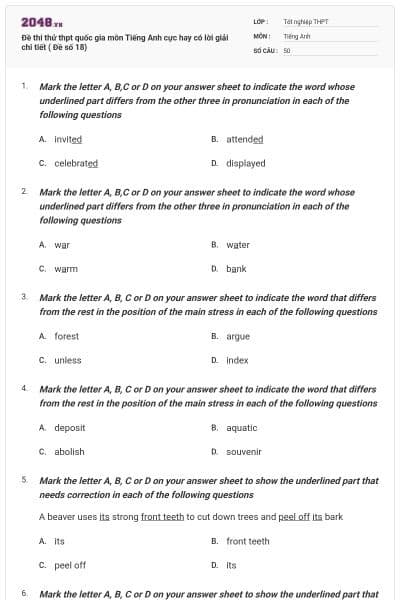
Mark the letter A, B,C or D on your answer sheet to indicate the word whose underlined part differs from the other three in pronunciation in each of the following questions
invited
attended
celebrated
displayed
Đáp án là D
invited /ɪnˈvaɪtɪd/
attended /əˈtendɪd /
celebrated /ˈselɪbreɪtɪd/
displayed /dɪˈspleɪd/
Câu D phát âm là /d/ còn lại phát âm là /id
Mark the letter A, B,C or D on your answer sheet to indicate the word whose underlined part differs from the other three in pronunciation in each of the following questions
war
water
warm
bank
Đáp án là D
war /wɔːr/
water /ˈwɔːtər/
warm /wɔːm/
bank /bæŋk/
Câu D phát âm là /æ/ còn lại phát âm là /ɔː
Mark the letter A, B, C or D on your answer sheet to indicate the word that differs from the rest in the position of the main stress in each of the following questions
forest
argue
unless
index
Đáp án là C
forest /ˈfɒrɪst/
argue /ˈɑːɡjuː/
unless /ənˈles/
index /ˈɪndeks/
Câu C trọng âm 2 còn lại trọng âm 1
Mark the letter A, B, C or D on your answer sheet to indicate the word that differs from the rest in the position of the main stress in each of the following questions
deposit
aquatic
abolish
souvenir
Đáp án là D
deposit /dɪˈpɒzɪt/
aquatic /əˈkwætɪk/
abolish /əˈbɒlɪʃ/
souvenir /ˌsuːvəˈnɪr/
Câu D trọng âm 3 còn lại trọng âm 2
Mark the letter A, B, C or D on your answer sheet to show the underlined part that needs correction in each of the following questions
A beaver uses its strong front teeth to cut down trees and peel off its bark
its
front teeth
peel off
its
Đáp án là D
its => their vì thay thế cho danh từ “trees” trước đó.
Câu này dịch như sau: Một con hải ly sử dụng răng trước chắc khỏe của nó để hạ những cái cây và bóc vỏ rễ cây
Mark the letter A, B, C or D on your answer sheet to show the underlined part that needs correction in each of the following questions
The clerks who are happy to wait for their customers will get promoted soon.
clerks
wait for
customers
get promoted
Đáp án là B
wait for ( chờ đợi) => wait on ( phục vụ)
Câu này dịch như sau: Những nhân viên người mà sẵn lòng phục vụ khách hàng sẽ sớm được thăng chứC.
Mark the letter A, B, C or D on your answer sheet to show the underlined part that needs correction in each of the following questions
Although lacking in calcium and vitamin A, grains have most carbohydrates than any other food
Although
in
grains
most
Đáp án là D
most => more vì trong câu có “than” nên phải dùng so sánh hơn
Câu này dịch như sau: Mặc dù thiếu can-xi và vitamin A nhưng các hạt ngũ cốc có nhiều cacbonhidrat hơn bất cứ th phẩm nào
Mark the letter A, B, C or D on your answer sheet to indicate the correct answer to each of the following question
These shoes won’t __________your trousers
suit
fit
match
consistent
Đáp án là C
Suit(v): phù hợp (người với vật)
Fit (v): vừa vặn
Match(v): kết hợp phù hợp (vật với vật)
Consistent (adj): thích hợp => loại vì won’t ( = will not) + Vo
Câu này dịch như sau: Những chiếc giày này không phù hợp với chiếc áo phông này đâu
Mark the letter A, B, C or D on your answer sheet to indicate the correct answer to each of the following question
I can’t wear this coat to work because there are two buttons __________
missing
loosing
falling
tearing
Đáp án là A
Missing: bỏ lỡ/ thất lạc
Loosing: mất
Falling: rơi
Tearing: xé
Câu này dịch như sau: Tôi không thể mặc chiếc áo khoác này đi làm bởi vì có hai cái cúc áo thất lạc đâu rồ
Mark the letter A, B, C or D on your answer sheet to indicate the correct answer to each of the following question
The movie is__________Shakespeare’s Hamlet in a number of ways.
like to
alike with
similar to
same as
Đáp án là C
Like: giống
Alike: giống nhau
Be the same as: giống như
Be similar to: tương tự như
Câu này dịch như sau: Bộ phim này giống với Hamlet của Shakespear ở một số khía cạnh
Mark the letter A, B, C or D on your answer sheet to indicate the correct answer to each of the following question
I__________all members by tomorrow night.
will contact
will have contacted with
will contact with
will have contacted
Đáp án là D
Kiến thức: Thì tương lai hoàn thành
Dấu hiệu nhận biết: by + trạng từ tương lai
Cấu trúc: S + will have Ved/ V3
Câu này dịch như sau: Tôi sẽ liên hệ xong với tất cả các thành viên trước tối
Mark the letter A, B, C or D on your answer sheet to indicate the correct answer to each of the following question
The Internet has enabled people to __________with each other more quickly
interact
interlink
intervene
interconnect
Đáp án là A
Interact with: tương tác với
Intervene with: can thiệp vào
Interlink = interconnect: liên kết toàn cầu
Câu này dịch như sau: Mạng Internet đã giúp con người có thể tương tác với nhau nhanh chóng hơn
Mark the letter A, B, C or D on your answer sheet to indicate the correct answer to each of the following question
Houses in big cities are expensive because land is in__________supply
brief
slight
little
short
Đáp án là D
Cụm từ: be in short supply [ nguồn cung ít ỏi]
Câu này dịch như sau: Những ngôi nhà ở các thành phố lớn rất đắt tiền bởi vì nguồn cung cấp đất ít ỏi.
Mark the letter A, B, C or D on your answer sheet to indicate the correct answer to each of the following question
Solar heat penetrates more deeply into water than__________
it is penetration into the soil
it does into soil
does it into soil
that it does into soil
Đáp án là B
So sánh hơn hai mệnh đề song song cùng thì
Câu này dịch như sau: Sức nóng của mặt trời thẩm thấu vào nước sâu hơn là vào trong đất
Mark the letter A, B, C or D on your answer sheet to indicate the correct answer to each of the following question
She’s got 100 percent on the exam and the other students were below 70 percent. She’s__________above the rest.
head and neck
shoulders and arms
head and shoulders
neck and ears
Đáp án là C
Thành ngữ: head and shoulders [ nổi bật]
Câu này dịch như sau: Cô ấy đạt điểm tuyệt đối trong kỳ thi và cc sinh viên khác chỉ đạt dưới 70%. Cô ấy nổi so với số còn lại
Mark the letter A, B, C or D on your answer sheet to indicate the correct answer to each of the following question
__________orangutans live alone
Near all
Almost all
The all
The most
Đáp án là B
Near là tính từ không đứng trước “all” phải dùng “ nearly”
Không dùng mạo từ “the” trước “all”
The most chỉ dùng trong so sánh nhất, không hợp về nghĩa trong ngữ cảnh này.
Câu này dịch như sau: Hầu hết tất cả loài tinh tinh sống một mình
Mark the letter A, B, C or D on your answer sheet to indicate the correct answer to each of the following question
The forecast has revealed that the world’s reserves of fossil fuel will have__________by 2015
used over
used off
run out
run out of
Đáp án là C
Use over = reuse: tái sử dụng
Run out: cạn kiệt
Run out of + noun: cạn kiệt
Use off => không tồn tại từ này
Câu này dịch như sau:Cascc dự báo đã cho thấy rằng các nguồn dự trữ nhiên liệu hóa thạch sẽ cạn kiệt trước năm 2015
Mark the letter A, B, C or D on your answer sheet to indicate the correct answer to each of the following question
The poor child was in __________because his bike had been stolen
floods of crying
floods of tears
mood of weeping
mood of tears
Đáp án là B
Thành ngữ: be in flood of tears [ khóc sướt mướt]
Câu này dịch như sau: Đứa trẻ đáng thương khóc sướt mướt bởi vì chiếc xe đạp đã bị đánh cắp.
Mark the letter A, B, C or D on your answer sheet to indicate the correct answer to each of the following question
As soon as she __________home, she took off her shoes and __________her slippers
had arrived/ put in
arrived/ put over
arrived/ put on
had arrived/ put over
Đáp án là C
Kiến thức: thì trong tiếng Anh
Diễn tả các hành động xảy ra liên tiếp trong quá khứ => dùng thì quá khứ đơn
Câu này dịch như sau: Ngay khi cô ấy về đến nhà, cô ấy cởi giày ra và mang dép tông vào
Mark the letter A, B, C, or D on your answer sheet to indicate the most suitable response to complete each of the following exchanges
Mr Black: “ I’d like to try on these shoes, please.” Salesgirl: “__________”
That’s right, sir
Why not?
Me too
By all means, sir
Đáp án là D
Ông Black: “ Tôi muốn thử những chiếc quần áo kia, làm ơn.”
Người bán hàng: “...........................”
A. Đúng rồi thưa ông.
B. Tại sao không?
C. Tôi cũng vậy.
D. Chắc chắn rồi, thưa ông
Mark the letter A, B, C, or D on your answer sheet to indicate the most suitable response to complete each of the following exchanges
Susan: “I had a really good weekend at my uncle’s.” Peter: “__________”
Oh, that’s very nice of you
Congratulations
It’s pleasure
Oh, I’m glad to hear that
Đáp án là D
Susan: “ Mình đã có một cuối tuần thật tuyệt ở nhà bác mình”
Peter: “...........................”
A. Ồ, bạn thật tốt.
B. Chúc mừng bạn nhé!
C. Đó là niềm vinh hạnh của mình.
D. Ồ, mình rất vui khi nghe điều đó
Choose the word which has CLOSEST meaning to the underlined word
Drivers who break traffic rules will be photographed
destroy
hit
violate
assault
Đáp án là C
Break: phá vỡ/ vị phạm
Hit: đánh đập/ va chạm
Violate: vi phạm
Assault:tấn công
=>break = violate
Câu này dịch như sau: Các tài xế vi phạm luật giao thông sẽ bị ghi hình lại.
Choose the word which has CLOSEST meaning to the underlined word
The students came up with some novelideas for fund-raising
unique
bookish
educational
radical
Đáp án là A
Novel (a) = unique: đốc đáo
Bookish: ham đọc sách
Educational: thuộc về giáo dục
Radical: gốc/ căn bản
Câu này dịch như sau: Các học sinh nảy ra nhiều ý tưởng độc đáo cho chương trình gây quỹ
Choose the word which has OPPOSITE meaning to the underlined word
A tangerine, which is flatter than an orange, peels and separates more readily
daintly
tastefully
easily
difficultly
Đáp án là D
Readily: dễ dàng
Tastefully: ngon
Easily: dễ dàng
Difficultly: khó khăn
=>Readily >< Difficultly
Câu này dịch như sau: Một quả quýt, cái mà dẹt hơn quả cam, bóc vỏ và tác dễ dàng hơn.
Choose the word which has OPPOSITE meaning to the underlined word
Catherine made a negligible effort to extend the freedoms of most Russians
marginal
ignorant
significant
accidental
Đáp án là C
Negligible (a): không đáng kể
Marginal: thuộc bên lề/ viền/ mép
Significant: to lớn/ đáng kể
Accidental: tình cờ
Câu này dịch như sau: Catherine nỗ lực không đáng kể để mở rộng sự tự do của hầu hết người NgA.
Mark the letter A, B, C or D on your answer sheet to indicate the sentence that is closest in meaning to each of the following questions
You are obliged to stop when the lights turn red
You must stop when the lights turn red
You have to stop when the lights turn red
You should stop when the lights turn red
You are allowed to stop when the lights turn red
Đáp án là A
Be obliged to Vo = must Vo: bắt buộc/ phải
Bạn bị bắt buộc dừng lại khi đèn chuyển sang màu đỏ.
A. Bạn phải dừng lại khi đèn chuyển sang màu đỏ.
B. Bạn cần dừng lại khi đèn đỏ.
C. Bạn nên dừng lại khi đèn đỏ.
D. Bạn được phép dừng lại khi đèn đỏ
Mark the letter A, B, C or D on your answer sheet to indicate the sentence that is closest in meaning to each of the following questions
If he had known the road was icy, he wouldn’t have been driving very fast
He was driving very fast because he didn’t know the road was icy
He has been driving very fast because he doesn’t know the road was icy
If only he knew the road was icy, he wouldn’t be driving very fast
He had been driving very fast because he didn’t know the road was icy
Đáp án là A
Nếu anh ấy biết con đường đóng băng, anh ấy sẽ không lái xe nhanh như vậy.
=>Câu điều kiện loại 3 => ngữ cảnh phải ở quá khứ
A. Anh ấy lái xe rất nhanh bởi vì anh ấy không biết con đường bị đóng băng.
B. Loại vì ngữ cảnh ở hiện tại.
C. Giá mà anh ấy biết con đường bị đóng băng, anh ấy sẽ không lái xe nhanh như vậy. => ước cho hiện tại => loại
D. loại vì hai mệnh đề không cùng thì
Mark the letter A, B, C or D on your answer sheet to indicate the sentence that is closest in meaning to each of the following questions
In the end, I felt I had been right to leave the club
I had no regrets about leaving the club in the end
I regretted to leave the club in the end
It’s a pity that I had left the club in the end
I don’t regret to leave the club in the end
Đáp án là A
Cuối cùng, tôi cảm thấy rằng tôi đã đúng khi rời khỏi câu lạc bộ.
A.Tôi không hối tiếc về việc cuối cùng đã rời khỏi câu lạc bộ.
B. Tôi hối tiếc cuối cùng đã rời khỏi câu lạc bộ.
C. Thật tiếc là cuối cùng tôi đã rời khỏi câu lạc bộ.
D. Tôi không hối tiếc để mà cuối cùng đã rời khỏi câu lạc bộ. => hối tiếc về việc sắp làm nhưng chưa làm => loại
Mark the letter A, B, C or D on your answer sheet to indicate the sentence that is closest in meaning to each of the following questions
She doesn’t have a car. She doesn’t go out in the evening
If she had a car, she would go out in the evening
If she had a car, she will go out in the evening
If she has a car, she would go out in the evening
If she had had a car, she would go out in the evening
Đáp án là A
Cô ấy không có ô tô. Cô ấy không ra ngoài buổi tối.
=>Ngữ cảnh ở hiện tại => dùng câu điều kiện loại 2
If S + Ved/ V2, S + would/ could Vo
A. Nếu cô ấy có ô tô, cô ấy sẽ ra ngoài buổi tối.
B. câu điều kiện hỗn hợp loại 2 và 1 => loại
C. câu điều kiện hỗn hợp loại 1 và 2 => loại
D. câu điều kiện hỗn hợp loại 3 và 2 => loạ
Mark the letter A, B, C or D on your answer sheet to indicate the sentence that is closest in meaning to each of the following questions
What was the name of the man? You met and talked to him this morning
What was the name of the man who you met and talked to him this morning?
What was the name of the man you met and talked to this morning?
What was the name of the man you met and talked to whom this morning?
What was the name of the man whose you met and talked to this morning?
Đáp án là B
Tên của người đàn ông đó là gì? Bạn đã gặp và nói chuyện với ông ấy sáng nay.
Kiến thức: Mệnh đề quan hệ dùng đại từ quan hệ “ who/whom/that” thay thế cho danh từ “ the man” trước đó.
A. loại vì đã dùng “who” thì không dùng đại từ “him”
B.Tên của người đàn ông mà bạn đã gặp và trò chuyện sáng nay là gì?
C. loại vì “ to whom” phải đặt ngay sau “ the man”
D. loại vì “ whose+ danh từ”
Read the following passage, and mark the letter (A, B, C or D) on your answer sheet to indicate the correct answer for each of the blanks.
The future of the African elephant depends on man. No (31)_________ can human beings and wild animals live in harmony throughout vast area of the continent as was possible in days gone by, for man’s needs have increased as well as his numbers. There are regions, such as the Congo forests and the equatorial Sudan, (32)_________ the old relationship may remain for a few more years or even generations, but in general it has gone. Conservation, if it is to be effective, should be a positive, constructive policy, and it is wishful thinking to imagine otherwise, (33)_________ in the case of the elephant. And this is not yet true of the whole of Africa, it soon will be, for the increase in the human population is almost universal. Where human beings and wild animals find themselves in competition with each other, the animals will (34)_________ Even if there appears to be enough room for both, man will not tolerate long a situation in which elephants and other (35)_________ make even occasional raids on his fields of food or economic crops. For many years this has been a major cause of conflicting interests and one of the reasons why so many elephants have been shot to control their numbers
Điền vào ô số 31.
more
condition
circumstance
longer
Đáp án là D
No longer + trợ động từ + S+ V: không còn nữa
The future of the African elephant depends on man. No (31)…………… can human beings and wild animals live in harmony throughout vast area of the continent as was possible in days gone by, for man’s needs have increased as well as his numbers.
[ Tương lai của voi châu Phi phụ thuộc vào con người. Con người và động vật hoang dã không còn chung sống trong hòa bình nữa trên khắp các khu vực rộng lớn của các lục địa như trước đây, bởi vì và nhu cầu và dân số của con người tăng lên.]
Read the following passage, and mark the letter (A, B, C or D) on your answer sheet to indicate the correct answer for each of the blanks.
The future of the African elephant depends on man. No (31)_________ can human beings and wild animals live in harmony throughout vast area of the continent as was possible in days gone by, for man’s needs have increased as well as his numbers. There are regions, such as the Congo forests and the equatorial Sudan, (32)_________ the old relationship may remain for a few more years or even generations, but in general it has gone. Conservation, if it is to be effective, should be a positive, constructive policy, and it is wishful thinking to imagine otherwise, (33)_________ in the case of the elephant. And this is not yet true of the whole of Africa, it soon will be, for the increase in the human population is almost universal. Where human beings and wild animals find themselves in competition with each other, the animals will (34)_________ Even if there appears to be enough room for both, man will not tolerate long a situation in which elephants and other (35)_________ make even occasional raids on his fields of food or economic crops. For many years this has been a major cause of conflicting interests and one of the reasons why so many elephants have been shot to control their numbers
Điền vào ô số 32
where
when
how
why
Đáp án là A
Kiến thức: Đại từ quan hệ
Where: nơi mà
When: khi mà
How: bằng cách
Why: tại sao
There are regions, such as the Congo forests and the equatorial Sudan, (32)……… the old relationship may remain for a few more years or even generations, but in general it has gone.
[ Có những khu vực chẳng hạn như rừng Congo và vành đai xích đạo Sudan, nơi mà những mối quan hệ cũ vẫn còn thêm một vài năm nữa hoặc thậm chí các thế hệ, nhưng nhìn chung đã qua hết rồi.
Read the following passage, and mark the letter (A, B, C or D) on your answer sheet to indicate the correct answer for each of the blanks.
The future of the African elephant depends on man. No (31)_________ can human beings and wild animals live in harmony throughout vast area of the continent as was possible in days gone by, for man’s needs have increased as well as his numbers. There are regions, such as the Congo forests and the equatorial Sudan, (32)_________ the old relationship may remain for a few more years or even generations, but in general it has gone. Conservation, if it is to be effective, should be a positive, constructive policy, and it is wishful thinking to imagine otherwise, (33)_________ in the case of the elephant. And this is not yet true of the whole of Africa, it soon will be, for the increase in the human population is almost universal. Where human beings and wild animals find themselves in competition with each other, the animals will (34)_________ Even if there appears to be enough room for both, man will not tolerate long a situation in which elephants and other (35)_________ make even occasional raids on his fields of food or economic crops. For many years this has been a major cause of conflicting interests and one of the reasons why so many elephants have been shot to control their numbers
Điền vào ô số 33
certainly
particularly
only
entirely
Đáp án là B
Certainly: chắc chắn là
Particularly: đặc biệt là/ cụ thể là
Only: chỉ/ duy nhất
Entirely: toàn bộ
Conservation, if it is to be effective, should be a positive, constructive policy, and it is wishful thinking to imagine otherwise, (33)………. in the case of the elephant. And this is not yet true of the whole of Africa, it soon will be, for the increase in the human population is almost universal.
[ Sự bảo tồn, nếu nó hiệu quả, nên là một chính sách tích cực và mang tính chất bảo tồn, và ngược lại nó là suy nghĩ đầy ảo tưởng chỉ để tưởng tượng, đặc biệt trong trường hợp của con voi. Và điều này vẫn chưa đúng đối với toàn bộ châu Phi, nó sớm sẽ ảnh hưởng, vì sự tăng dân số con người trên hầu hết vũ trụ.]
Read the following passage, and mark the letter (A, B, C or D) on your answer sheet to indicate the correct answer for each of the blanks.
The future of the African elephant depends on man. No (31)_________ can human beings and wild animals live in harmony throughout vast area of the continent as was possible in days gone by, for man’s needs have increased as well as his numbers. There are regions, such as the Congo forests and the equatorial Sudan, (32)_________ the old relationship may remain for a few more years or even generations, but in general it has gone. Conservation, if it is to be effective, should be a positive, constructive policy, and it is wishful thinking to imagine otherwise, (33)_________ in the case of the elephant. And this is not yet true of the whole of Africa, it soon will be, for the increase in the human population is almost universal. Where human beings and wild animals find themselves in competition with each other, the animals will (34)_________ Even if there appears to be enough room for both, man will not tolerate long a situation in which elephants and other (35)_________ make even occasional raids on his fields of food or economic crops. For many years this has been a major cause of conflicting interests and one of the reasons why so many elephants have been shot to control their numbers
Điền vào ô số 34
win
lose
disappear
fight
Đáp án là B
Win: thắng
Lose: thua
Disappear: biến mất
Fight: đấu tranh
Where human beings and wild animals find themselves in competition with each other, the animals will (34)……
[ Nơi mà nhân loại và động vật đấu tranh với nhau, động vật sẽ thuA.]
Read the following passage, and mark the letter (A, B, C or D) on your answer sheet to indicate the correct answer for each of the blanks.
The future of the African elephant depends on man. No (31)_________ can human beings and wild animals live in harmony throughout vast area of the continent as was possible in days gone by, for man’s needs have increased as well as his numbers. There are regions, such as the Congo forests and the equatorial Sudan, (32)_________ the old relationship may remain for a few more years or even generations, but in general it has gone. Conservation, if it is to be effective, should be a positive, constructive policy, and it is wishful thinking to imagine otherwise, (33)_________ in the case of the elephant. And this is not yet true of the whole of Africa, it soon will be, for the increase in the human population is almost universal. Where human beings and wild animals find themselves in competition with each other, the animals will (34)_________ Even if there appears to be enough room for both, man will not tolerate long a situation in which elephants and other (35)_________ make even occasional raids on his fields of food or economic crops. For many years this has been a major cause of conflicting interests and one of the reasons why so many elephants have been shot to control their numbers
Điền vào ô số 35
people
plants
descendants
creatures
Đáp án là D
People: con người
Plants: thực vật
Descendants: hậu duệ
Creatures: sinh vật
Even if there appears to be enough room for both, man will not tolerate long a situation in which elephants and other (35)……….. make even occasional raids on his fields of food or economic crops. For many years this has been a major cause of conflicting interests and one of the reasons why so many elephants have been shot to control their numbers.
[ Thậm chí nếu có vẻ như đủ không gian cho cả con người và voi, con người sẽ không hòa hợp lâu trong tình trạng này trong đó voi và những sinh vật khác thường xuyên giẫm đạp lên cánh đồng trồng thực phẩm và thương phẩm. Nhiều năm nay đây là nguyên nhân chủ yếu gây ra mâu thuẫn và một trong những lý do tại sao nhiều loài voi giảm mạnh về số lượng.]
Read the following passage, and mark the letter (A, B, C or D) on your answer sheet to indicate the correct answer to each question.
Fifty-five delegates representing all thirteen states except Rhode Island attended the Constitutional Convention in Philadelphia from May to September 1787. The delegates had been instructed by the Continental Congress to revise the old Articles of Confederation, but most believed that a stronger central government was needed. There were differences, however, about what structure the government should take and how much influence large states should have.
Virginia was by far the most populous state, with twice as many as people as New York, four times as many as New Jersey, and ten times as many as Delaware. The leader of the Virginia delegation, James Madison, had already drawn up a plan for government, which became known as the Large State Plan. Its essence was that congressional representation would be based on population. It provided for two or more national executives. The smaller states feared that under this plan, a few large states would lord over the rest. New Jersey countered with the Small State Plan. It provided for equal representation for all states in a national legislature and for a single national executive. Angry debate, heightened by a stifling heat wave, led to deadlock.
A cooling of tempers seemed to come with lower temperatures. The delegates hammered out an agreement known as the Great Compromise- actually a bundle of shrewd compromises. They decided that Congress would consist of two houses. The larger states were granted representation based on population in the lower house, the House of Representatives. The smaller states were given equal representation in the upper house, the Senate, in which each state would have two senators regardless of population. It was also agreed that there would be a single executive, the president. This critical compromise broke the logjam, and from then on, success seemed within reach.
What is the main topic of the passage?
James Madison’s plan to create a stable structure for the government of the United States
A disagreement at the Constitutional Convention and a subsequent compromise
The differences in population and relative power between the original states
The most important points of the Small State Plan
Đáp án là B
Chủ đề chính của bài đọc là gì?
A. Kế hoạch của James Madison’s tạo ra kết cấu bền vững cho chính phủ Mỹ.
B. Sự không thỏa hiệp tại hội nghị lập pháp và sự thương lượng sau đó.
C. Những sự khác biệt về dân số và quyền lực có liên quan giữa các bang.
D. Những điểm quan trọng nhất của kế hoạch tiểu bang.
Read the following passage, and mark the letter (A, B, C or D) on your answer sheet to indicate the correct answer to each question.
Fifty-five delegates representing all thirteen states except Rhode Island attended the Constitutional Convention in Philadelphia from May to September 1787. The delegates had been instructed by the Continental Congress to revise the old Articles of Confederation, but most believed that a stronger central government was needed. There were differences, however, about what structure the government should take and how much influence large states should have.
Virginia was by far the most populous state, with twice as many as people as New York, four times as many as New Jersey, and ten times as many as Delaware. The leader of the Virginia delegation, James Madison, had already drawn up a plan for government, which became known as the Large State Plan. Its essence was that congressional representation would be based on population. It provided for two or more national executives. The smaller states feared that under this plan, a few large states would lord over the rest. New Jersey countered with the Small State Plan. It provided for equal representation for all states in a national legislature and for a single national executive. Angry debate, heightened by a stifling heat wave, led to deadlock.
A cooling of tempers seemed to come with lower temperatures. The delegates hammered out an agreement known as the Great Compromise- actually a bundle of shrewd compromises. They decided that Congress would consist of two houses. The larger states were granted representation based on population in the lower house, the House of Representatives. The smaller states were given equal representation in the upper house, the Senate, in which each state would have two senators regardless of population. It was also agreed that there would be a single executive, the president. This critical compromise broke the logjam, and from then on, success seemed within reach.
According to the passage, how many states were represented at the Constitutional Convention?
12
13
14
15
Đáp án là A
Theo bài đọc, có bao nhiêu bạn có mặt tại Hội nghi lập pháp?
Dẫn chứng: Fifty-five delegates representing all thirteen states except Rhode Island attended the Constitutional Convention in Philadelphia from May to September 1787.
Read the following passage, and mark the letter (A, B, C or D) on your answer sheet to indicate the correct answer to each question.
Fifty-five delegates representing all thirteen states except Rhode Island attended the Constitutional Convention in Philadelphia from May to September 1787. The delegates had been instructed by the Continental Congress to revise the old Articles of Confederation, but most believed that a stronger central government was needed. There were differences, however, about what structure the government should take and how much influence large states should have.
Virginia was by far the most populous state, with twice as many as people as New York, four times as many as New Jersey, and ten times as many as Delaware. The leader of the Virginia delegation, James Madison, had already drawn up a plan for government, which became known as the Large State Plan. Its essence was that congressional representation would be based on population. It provided for two or more national executives. The smaller states feared that under this plan, a few large states would lord over the rest. New Jersey countered with the Small State Plan. It provided for equal representation for all states in a national legislature and for a single national executive. Angry debate, heightened by a stifling heat wave, led to deadlock.
A cooling of tempers seemed to come with lower temperatures. The delegates hammered out an agreement known as the Great Compromise- actually a bundle of shrewd compromises. They decided that Congress would consist of two houses. The larger states were granted representation based on population in the lower house, the House of Representatives. The smaller states were given equal representation in the upper house, the Senate, in which each state would have two senators regardless of population. It was also agreed that there would be a single executive, the president. This critical compromise broke the logjam, and from then on, success seemed within reach.
It can be inferred from the passage that the Articles of Confederation
were supported by a majority of the delegates at the Convention
were revised and presented as the Large State Plan
allowed small states to dominate large ones
provided for only a weak central government
Đáp án là D
Có thể suy ra từ bài đọc rằng các điều khoản của Liên minh
A. được đa số các đoàn đại biểu tại hội nghị ủng hộ.
B. được xem xét và trình bày như kế hoạch bang rộng lớn.
C. cho phép các bang nhỏ thống trị các bang lớn.
D. cung cấp khoảng 1 tuần cho trung ương.
Dẫn chứng: The delegates had been instructed by the Continental Congress to revise the old Articles of Confederation, but most believed that a stronger central government was needed
Read the following passage, and mark the letter (A, B, C or D) on your answer sheet to indicate the correct answer to each question.
Fifty-five delegates representing all thirteen states except Rhode Island attended the Constitutional Convention in Philadelphia from May to September 1787. The delegates had been instructed by the Continental Congress to revise the old Articles of Confederation, but most believed that a stronger central government was needed. There were differences, however, about what structure the government should take and how much influence large states should have.
Virginia was by far the most populous state, with twice as many as people as New York, four times as many as New Jersey, and ten times as many as Delaware. The leader of the Virginia delegation, James Madison, had already drawn up a plan for government, which became known as the Large State Plan. Its essence was that congressional representation would be based on population. It provided for two or more national executives. The smaller states feared that under this plan, a few large states would lord over the rest. New Jersey countered with the Small State Plan. It provided for equal representation for all states in a national legislature and for a single national executive. Angry debate, heightened by a stifling heat wave, led to deadlock.
A cooling of tempers seemed to come with lower temperatures. The delegates hammered out an agreement known as the Great Compromise- actually a bundle of shrewd compromises. They decided that Congress would consist of two houses. The larger states were granted representation based on population in the lower house, the House of Representatives. The smaller states were given equal representation in the upper house, the Senate, in which each state would have two senators regardless of population. It was also agreed that there would be a single executive, the president. This critical compromise broke the logjam, and from then on, success seemed within reach.
According to the passage, in 1787 which of the following states had FEWEST people?
Virginia
Delaware
New York
New Jersey
Đáp án là B
Theo bài đọc, năm 1787 bang nào có ít người nhất
A.Virginia
B. Dealaware
C. New York
D. New Jersey
Dẫn chứng: Virginia was by far the most populous state, with twice as many as people as New York, four times as many as New Jersey, and ten times as many as Delaware
Read the following passage, and mark the letter (A, B, C or D) on your answer sheet to indicate the correct answer to each question.
Fifty-five delegates representing all thirteen states except Rhode Island attended the Constitutional Convention in Philadelphia from May to September 1787. The delegates had been instructed by the Continental Congress to revise the old Articles of Confederation, but most believed that a stronger central government was needed. There were differences, however, about what structure the government should take and how much influence large states should have.
Virginia was by far the most populous state, with twice as many as people as New York, four times as many as New Jersey, and ten times as many as Delaware. The leader of the Virginia delegation, James Madison, had already drawn up a plan for government, which became known as the Large State Plan. Its essence was that congressional representation would be based on population. It provided for two or more national executives. The smaller states feared that under this plan, a few large states would lord over the rest. New Jersey countered with the Small State Plan. It provided for equal representation for all states in a national legislature and for a single national executive. Angry debate, heightened by a stifling heat wave, led to deadlock.
A cooling of tempers seemed to come with lower temperatures. The delegates hammered out an agreement known as the Great Compromise- actually a bundle of shrewd compromises. They decided that Congress would consist of two houses. The larger states were granted representation based on population in the lower house, the House of Representatives. The smaller states were given equal representation in the upper house, the Senate, in which each state would have two senators regardless of population. It was also agreed that there would be a single executive, the president. This critical compromise broke the logjam, and from then on, success seemed within reach.
The phrase “this plan” refers to
the Small State Plan
a plan suggested by the national legislature
the Large State Plan
a compromise plan
Đáp án là C
Cụm từ “ kế hoạch này” ám chỉ đến
A. Kế hoạc bang nhỏ
B. Một kế hoạch được đề xuất bởi cơ quan lập pháp quốc gia
C. Kế hoạch bang rộng lớn
D.Kế hoạch thương thuyết
Dẫn chứng:The leader of the Virginia delegation, James Madison, had already drawn up a plan for government, which became known as the Large State Plan. Its essence was that congressional representation would be based on population. It provided for two or more national executives. The smaller states feared that under this plan, a few large states would lord over the rest
Read the following passage, and mark the letter (A, B, C or D) on your answer sheet to indicate the correct answer to each question.
Fifty-five delegates representing all thirteen states except Rhode Island attended the Constitutional Convention in Philadelphia from May to September 1787. The delegates had been instructed by the Continental Congress to revise the old Articles of Confederation, but most believed that a stronger central government was needed. There were differences, however, about what structure the government should take and how much influence large states should have.
Virginia was by far the most populous state, with twice as many as people as New York, four times as many as New Jersey, and ten times as many as Delaware. The leader of the Virginia delegation, James Madison, had already drawn up a plan for government, which became known as the Large State Plan. Its essence was that congressional representation would be based on population. It provided for two or more national executives. The smaller states feared that under this plan, a few large states would lord over the rest. New Jersey countered with the Small State Plan. It provided for equal representation for all states in a national legislature and for a single national executive. Angry debate, heightened by a stifling heat wave, led to deadlock.
A cooling of tempers seemed to come with lower temperatures. The delegates hammered out an agreement known as the Great Compromise- actually a bundle of shrewd compromises. They decided that Congress would consist of two houses. The larger states were granted representation based on population in the lower house, the House of Representatives. The smaller states were given equal representation in the upper house, the Senate, in which each state would have two senators regardless of population. It was also agreed that there would be a single executive, the president. This critical compromise broke the logjam, and from then on, success seemed within reach.
The word “shrewd” is closest in meaning to
practical
unfair
important
clever
Đáp án là D
Từ “ shrewd” (thông minh, sáng suốt) gần nghĩa nhất với
Practical: thực tế
Unfair: không công bằng
Important: quan trọng
Clever: thông minh
Dẫn chứng: The delegates hammered out an agreement known as the Great Compromise- actually a bundle of shrewd compromises
Read the following passage, and mark the letter (A, B, C or D) on your answer sheet to indicate the correct answer to each question.
Fifty-five delegates representing all thirteen states except Rhode Island attended the Constitutional Convention in Philadelphia from May to September 1787. The delegates had been instructed by the Continental Congress to revise the old Articles of Confederation, but most believed that a stronger central government was needed. There were differences, however, about what structure the government should take and how much influence large states should have.
Virginia was by far the most populous state, with twice as many as people as New York, four times as many as New Jersey, and ten times as many as Delaware. The leader of the Virginia delegation, James Madison, had already drawn up a plan for government, which became known as the Large State Plan. Its essence was that congressional representation would be based on population. It provided for two or more national executives. The smaller states feared that under this plan, a few large states would lord over the rest. New Jersey countered with the Small State Plan. It provided for equal representation for all states in a national legislature and for a single national executive. Angry debate, heightened by a stifling heat wave, led to deadlock.
A cooling of tempers seemed to come with lower temperatures. The delegates hammered out an agreement known as the Great Compromise- actually a bundle of shrewd compromises. They decided that Congress would consist of two houses. The larger states were granted representation based on population in the lower house, the House of Representatives. The smaller states were given equal representation in the upper house, the Senate, in which each state would have two senators regardless of population. It was also agreed that there would be a single executive, the president. This critical compromise broke the logjam, and from then on, success seemed within reach.
Which of the following is NOT given in the passage as one of the provisions of the Great Compromise?
There would be only one national executive
The President would be elected by popular vote
Each state would have two senators
Congress would be divided into two bodies
Đáp án là B
Ý nào không được đề cập trong bài đọc như là một trong những điều khoản của Thương thuyết lớn?
A.Sẽ chỉ có một lãnh đạo cấp cao quốc gia
B. Tổng thống sẽ được bầu chọn bằng bầu cử phổ thông.
C. Mỗi bang sẽ có hai thượng nghị sĩ
D. Quốc hội sẽ được chia thành hai phần.
Dẫn chứng: They decided that Congress would consist of two houses. The larger states were granted representation based on population in the lower house, the House of Representatives. The smaller states were given equal representation in the upper house, the Senate, in which each state would have two senators regardless of population. It was also agreed that there would be a single executive, the president
Read the following passage, and mark the letter (A, B, C or D) on your answer sheet to indicate the correct answer to each question.
The biologist's role in society as well as his moral and ethical responsibility in the discovery and development of new ideas has led to a reassessment of his social and scientific value systems. A scientist can no longer ignore the consequences of his discoveries; he is as concerned with the possible misuses of his findings as he is with the basic research in which he is involved. This emerging social and political role of the biologist and all other scientists requires a weighing of values that cannot be done with the accuracy or the objectivity of a laboratory balance. As a member of society, it is necessary for a biologist now to redefine his social obligations and his functions, particularly in the realm of making judgments about such ethical problems as man's control of his environment or his manipulation of genes to direct further evolutionary development.
As a result of recent discoveries concerning hereditary mechanisms, genetic engineering, by which human traits are made to order, may soon be a reality. As desirable as itmay seem to be, such an accomplishment would entail many value judgments. Who would decide, for example, which traits should be selected for change? In cases of genetic deficiencies and disease, the desirability of the change is obvious, but the possibilities for social misuse are so numerous that they may far outweigh the benefits.
Probably the greatest biological problem of the future, as it is of the present, will be to find ways to curb environmental pollution without interfering with man's constant effort to improve the quality of his life. Many scientists believe that underlying the spectra of pollution is the problem of surplus human population. A rise in population necessitates an increase in the operations of modern industry, the waste products of which increase the pollution of air, water, and soil. The question of how many people the resources of the Earth can support is one of critical importance.
Although the solutions to these and many other problems are yet to be found, they do indicate the need for biologists to work with social scientists and other members of society in order to determine the requirements necessary for maintaining a healthy and productive planet. For although many of man's present and future problems may seem to be essentially social, political, or economic in nature, they have biological ramifications that could affect the very existence of life itself.
According to the passage, a modern scientist should be more concerned about__________.
the consequences of his discoveries
his basic research
his manipulation of genes
the development of new ideas
Đáp án là A
Theo bài đọc, một nhà khoa học hiện đại nên quan tâm nhiều hơn đến
A. những hậu quả của những khám phá của ông ấy.
B. nghiên cứu cơ bản
C. sự vận dụng của gen
D. sự phát triển những ý tưởng mới
Dẫn chứng: A scientist can no longer ignore the consequences of his discoveries
Read the following passage, and mark the letter (A, B, C or D) on your answer sheet to indicate the correct answer to each question.
The biologist's role in society as well as his moral and ethical responsibility in the discovery and development of new ideas has led to a reassessment of his social and scientific value systems. A scientist can no longer ignore the consequences of his discoveries; he is as concerned with the possible misuses of his findings as he is with the basic research in which he is involved. This emerging social and political role of the biologist and all other scientists requires a weighing of values that cannot be done with the accuracy or the objectivity of a laboratory balance. As a member of society, it is necessary for a biologist now to redefine his social obligations and his functions, particularly in the realm of making judgments about such ethical problems as man's control of his environment or his manipulation of genes to direct further evolutionary development.
As a result of recent discoveries concerning hereditary mechanisms, genetic engineering, by which human traits are made to order, may soon be a reality. As desirable as itmay seem to be, such an accomplishment would entail many value judgments. Who would decide, for example, which traits should be selected for change? In cases of genetic deficiencies and disease, the desirability of the change is obvious, but the possibilities for social misuse are so numerous that they may far outweigh the benefits.
Probably the greatest biological problem of the future, as it is of the present, will be to find ways to curb environmental pollution without interfering with man's constant effort to improve the quality of his life. Many scientists believe that underlying the spectra of pollution is the problem of surplus human population. A rise in population necessitates an increase in the operations of modern industry, the waste products of which increase the pollution of air, water, and soil. The question of how many people the resources of the Earth can support is one of critical importance.
Although the solutions to these and many other problems are yet to be found, they do indicate the need for biologists to work with social scientists and other members of society in order to determine the requirements necessary for maintaining a healthy and productive planet. For although many of man's present and future problems may seem to be essentially social, political, or economic in nature, they have biological ramifications that could affect the very existence of life itself.
The pronoun "it" in paragraph 2 refers to__________.
genetic engineering
an accomplishment
hereditary mechanism
a reality
Đáp án là A
Từ “it” ở đoạn 2 ám chỉ đến
A. việc cấy gen
B. một thành tựu
C. cơ chế di truyền
D. tính chân thật/ sự thật
Dẫn chứng: As a result of recent discoveries concerning hereditary mechanisms, genetic engineering, by which human traits are made to order, may soon be a reality. As desirable as it_may seem to be, such an accomplishment would entail many value judgments
Read the following passage, and mark the letter (A, B, C or D) on your answer sheet to indicate the correct answer to each question.
The biologist's role in society as well as his moral and ethical responsibility in the discovery and development of new ideas has led to a reassessment of his social and scientific value systems. A scientist can no longer ignore the consequences of his discoveries; he is as concerned with the possible misuses of his findings as he is with the basic research in which he is involved. This emerging social and political role of the biologist and all other scientists requires a weighing of values that cannot be done with the accuracy or the objectivity of a laboratory balance. As a member of society, it is necessary for a biologist now to redefine his social obligations and his functions, particularly in the realm of making judgments about such ethical problems as man's control of his environment or his manipulation of genes to direct further evolutionary development.
As a result of recent discoveries concerning hereditary mechanisms, genetic engineering, by which human traits are made to order, may soon be a reality. As desirable as itmay seem to be, such an accomplishment would entail many value judgments. Who would decide, for example, which traits should be selected for change? In cases of genetic deficiencies and disease, the desirability of the change is obvious, but the possibilities for social misuse are so numerous that they may far outweigh the benefits.
Probably the greatest biological problem of the future, as it is of the present, will be to find ways to curb environmental pollution without interfering with man's constant effort to improve the quality of his life. Many scientists believe that underlying the spectra of pollution is the problem of surplus human population. A rise in population necessitates an increase in the operations of modern industry, the waste products of which increase the pollution of air, water, and soil. The question of how many people the resources of the Earth can support is one of critical importance.
Although the solutions to these and many other problems are yet to be found, they do indicate the need for biologists to work with social scientists and other members of society in order to determine the requirements necessary for maintaining a healthy and productive planet. For although many of man's present and future problems may seem to be essentially social, political, or economic in nature, they have biological ramifications that could affect the very existence of life itself.
It is implied in the passage that genetic engineering__________.
will change all human traits
is no longer desirable
is the most desirable for life
may do us more harm than good
Đáp án là D
Bài đọc ngụ ý rằng công nghệ gen
A. sẽ thay đổi toàn bộ tính cách của con người
B. không còn đáng khao khát nước
C. được khao khát nhất trong cuộc đời
D. có nhiều cái hại hơn là cái lợi
Dẫn chứng: In cases of genetic deficiencies and disease, the desirability of the change is obvious, but the possibilities for social misuse are so numerous that they may far outweigh the benefits
Read the following passage, and mark the letter (A, B, C or D) on your answer sheet to indicate the correct answer to each question.
The biologist's role in society as well as his moral and ethical responsibility in the discovery and development of new ideas has led to a reassessment of his social and scientific value systems. A scientist can no longer ignore the consequences of his discoveries; he is as concerned with the possible misuses of his findings as he is with the basic research in which he is involved. This emerging social and political role of the biologist and all other scientists requires a weighing of values that cannot be done with the accuracy or the objectivity of a laboratory balance. As a member of society, it is necessary for a biologist now to redefine his social obligations and his functions, particularly in the realm of making judgments about such ethical problems as man's control of his environment or his manipulation of genes to direct further evolutionary development.
As a result of recent discoveries concerning hereditary mechanisms, genetic engineering, by which human traits are made to order, may soon be a reality. As desirable as itmay seem to be, such an accomplishment would entail many value judgments. Who would decide, for example, which traits should be selected for change? In cases of genetic deficiencies and disease, the desirability of the change is obvious, but the possibilities for social misuse are so numerous that they may far outweigh the benefits.
Probably the greatest biological problem of the future, as it is of the present, will be to find ways to curb environmental pollution without interfering with man's constant effort to improve the quality of his life. Many scientists believe that underlying the spectra of pollution is the problem of surplus human population. A rise in population necessitates an increase in the operations of modern industry, the waste products of which increase the pollution of air, water, and soil. The question of how many people the resources of the Earth can support is one of critical importance.
Although the solutions to these and many other problems are yet to be found, they do indicate the need for biologists to work with social scientists and other members of society in order to determine the requirements necessary for maintaining a healthy and productive planet. For although many of man's present and future problems may seem to be essentially social, political, or economic in nature, they have biological ramifications that could affect the very existence of life itself.
The pronoun "they" in paragraph 2 refers to__________.
possibilities for genetic deficiencies
cases of genetic deficiencies
discoveries concerning hereditary mechanisms
effects of genetic engineering misuse
Đáp án là D
Đại từ “they” ở đoạn 2 ám chỉ đến
A. những khả năng thiếu sót gen.
B. các trường hợp lỗi gen
C. những khám phá liên quan đến cơ chế di truyền
D. những ảnh hưởng của lạm dụng công nghệ gen
Dẫn chứng: In cases of genetic deficiencies and disease, the desirability of the change is obvious, but the possibilities for social misuse are so numerous that they may far outweigh the benefits
Read the following passage, and mark the letter (A, B, C or D) on your answer sheet to indicate the correct answer to each question.
The biologist's role in society as well as his moral and ethical responsibility in the discovery and development of new ideas has led to a reassessment of his social and scientific value systems. A scientist can no longer ignore the consequences of his discoveries; he is as concerned with the possible misuses of his findings as he is with the basic research in which he is involved. This emerging social and political role of the biologist and all other scientists requires a weighing of values that cannot be done with the accuracy or the objectivity of a laboratory balance. As a member of society, it is necessary for a biologist now to redefine his social obligations and his functions, particularly in the realm of making judgments about such ethical problems as man's control of his environment or his manipulation of genes to direct further evolutionary development.
As a result of recent discoveries concerning hereditary mechanisms, genetic engineering, by which human traits are made to order, may soon be a reality. As desirable as itmay seem to be, such an accomplishment would entail many value judgments. Who would decide, for example, which traits should be selected for change? In cases of genetic deficiencies and disease, the desirability of the change is obvious, but the possibilities for social misuse are so numerous that they may far outweigh the benefits.
Probably the greatest biological problem of the future, as it is of the present, will be to find ways to curb environmental pollution without interfering with man's constant effort to improve the quality of his life. Many scientists believe that underlying the spectra of pollution is the problem of surplus human population. A rise in population necessitates an increase in the operations of modern industry, the waste products of which increase the pollution of air, water, and soil. The question of how many people the resources of the Earth can support is one of critical importance.
Although the solutions to these and many other problems are yet to be found, they do indicate the need for biologists to work with social scientists and other members of society in order to determine the requirements necessary for maintaining a healthy and productive planet. For although many of man's present and future problems may seem to be essentially social, political, or economic in nature, they have biological ramifications that could affect the very existence of life itself.
The word "which" in paragraph 3 refers to __________.
the waste products dumped into our environment
serious environmental pollution
activities of surplus human population
activities of an overpopulated society's industry
Đáp án là D
Từ “ which” ở đoạn 3 ám chỉ đến
A. những sản phẩm bỏ đi được đưa vào môi trường
B. sự ô nhiễm môi trường nghiêm trọng
C. các hoạt động của sự quá tải dân số.
D. các hoạt động của nên công nghiệp trong xã hội dân số quá tải.
Dẫn chứng: A rise in population necessitates an increase in the operations of modern industry, the waste products of which increase the pollution of air, water, and soil
Read the following passage, and mark the letter (A, B, C or D) on your answer sheet to indicate the correct answer to each question.
The biologist's role in society as well as his moral and ethical responsibility in the discovery and development of new ideas has led to a reassessment of his social and scientific value systems. A scientist can no longer ignore the consequences of his discoveries; he is as concerned with the possible misuses of his findings as he is with the basic research in which he is involved. This emerging social and political role of the biologist and all other scientists requires a weighing of values that cannot be done with the accuracy or the objectivity of a laboratory balance. As a member of society, it is necessary for a biologist now to redefine his social obligations and his functions, particularly in the realm of making judgments about such ethical problems as man's control of his environment or his manipulation of genes to direct further evolutionary development.
As a result of recent discoveries concerning hereditary mechanisms, genetic engineering, by which human traits are made to order, may soon be a reality. As desirable as itmay seem to be, such an accomplishment would entail many value judgments. Who would decide, for example, which traits should be selected for change? In cases of genetic deficiencies and disease, the desirability of the change is obvious, but the possibilities for social misuse are so numerous that they may far outweigh the benefits.
Probably the greatest biological problem of the future, as it is of the present, will be to find ways to curb environmental pollution without interfering with man's constant effort to improve the quality of his life. Many scientists believe that underlying the spectra of pollution is the problem of surplus human population. A rise in population necessitates an increase in the operations of modern industry, the waste products of which increase the pollution of air, water, and soil. The question of how many people the resources of the Earth can support is one of critical importance.
Although the solutions to these and many other problems are yet to be found, they do indicate the need for biologists to work with social scientists and other members of society in order to determine the requirements necessary for maintaining a healthy and productive planet. For although many of man's present and future problems may seem to be essentially social, political, or economic in nature, they have biological ramifications that could affect the very existence of life itself.
According to the passage, to save our planet, biologists should work
with other social scientists
accurately and objectively
on social and political purposes
harder and harder
Đáp án là A
Theo bài đọc, để cứu lấy hành tinh của chúng ta, các nhà sinh học nên làm việc
A.với các nhà khoa học xã hội khác
B. chính xác và khách quan
C. vì mục đích chính trị và xã hội
D. ngày càng chăm chỉ hơn
Dẫn chứng: Although the solutions to these and many other problems are yet to be found, they do indicate the need for biologists to work with social scientists and other members of society in order to determine the requirements necessary for maintaining a healthy and productive planet
Read the following passage, and mark the letter (A, B, C or D) on your answer sheet to indicate the correct answer to each question.
The biologist's role in society as well as his moral and ethical responsibility in the discovery and development of new ideas has led to a reassessment of his social and scientific value systems. A scientist can no longer ignore the consequences of his discoveries; he is as concerned with the possible misuses of his findings as he is with the basic research in which he is involved. This emerging social and political role of the biologist and all other scientists requires a weighing of values that cannot be done with the accuracy or the objectivity of a laboratory balance. As a member of society, it is necessary for a biologist now to redefine his social obligations and his functions, particularly in the realm of making judgments about such ethical problems as man's control of his environment or his manipulation of genes to direct further evolutionary development.
As a result of recent discoveries concerning hereditary mechanisms, genetic engineering, by which human traits are made to order, may soon be a reality. As desirable as itmay seem to be, such an accomplishment would entail many value judgments. Who would decide, for example, which traits should be selected for change? In cases of genetic deficiencies and disease, the desirability of the change is obvious, but the possibilities for social misuse are so numerous that they may far outweigh the benefits.
Probably the greatest biological problem of the future, as it is of the present, will be to find ways to curb environmental pollution without interfering with man's constant effort to improve the quality of his life. Many scientists believe that underlying the spectra of pollution is the problem of surplus human population. A rise in population necessitates an increase in the operations of modern industry, the waste products of which increase the pollution of air, water, and soil. The question of how many people the resources of the Earth can support is one of critical importance.
Although the solutions to these and many other problems are yet to be found, they do indicate the need for biologists to work with social scientists and other members of society in order to determine the requirements necessary for maintaining a healthy and productive planet. For although many of man's present and future problems may seem to be essentially social, political, or economic in nature, they have biological ramifications that could affect the very existence of life itself.
Which of the following is closest in meaning to the word "ramifications" in paragraph 4?
effective techniques
latest developments
harmful consequences
useful experiments
Đáp án là C
Ý nào sau đây gần nghĩa nhất với từ “ ramifications” ( những hậu quả xấu) ở đoạn 4?
A.những kỹ thuật có hiệu quả
B. sự phát triển mới nhất
C. những hậu quả có hại
D. những thí nghiệm hữu ích
Dẫn chứng: For although many of man's present and future problems may seem to be essentially social, political, or economic in nature, they have biological ramifications that could affect the very existence of life itself
Read the following passage, and mark the letter (A, B, C or D) on your answer sheet to indicate the correct answer to each question.
The biologist's role in society as well as his moral and ethical responsibility in the discovery and development of new ideas has led to a reassessment of his social and scientific value systems. A scientist can no longer ignore the consequences of his discoveries; he is as concerned with the possible misuses of his findings as he is with the basic research in which he is involved. This emerging social and political role of the biologist and all other scientists requires a weighing of values that cannot be done with the accuracy or the objectivity of a laboratory balance. As a member of society, it is necessary for a biologist now to redefine his social obligations and his functions, particularly in the realm of making judgments about such ethical problems as man's control of his environment or his manipulation of genes to direct further evolutionary development.
As a result of recent discoveries concerning hereditary mechanisms, genetic engineering, by which human traits are made to order, may soon be a reality. As desirable as itmay seem to be, such an accomplishment would entail many value judgments. Who would decide, for example, which traits should be selected for change? In cases of genetic deficiencies and disease, the desirability of the change is obvious, but the possibilities for social misuse are so numerous that they may far outweigh the benefits.
Probably the greatest biological problem of the future, as it is of the present, will be to find ways to curb environmental pollution without interfering with man's constant effort to improve the quality of his life. Many scientists believe that underlying the spectra of pollution is the problem of surplus human population. A rise in population necessitates an increase in the operations of modern industry, the waste products of which increase the pollution of air, water, and soil. The question of how many people the resources of the Earth can support is one of critical importance.
Although the solutions to these and many other problems are yet to be found, they do indicate the need for biologists to work with social scientists and other members of society in order to determine the requirements necessary for maintaining a healthy and productive planet. For although many of man's present and future problems may seem to be essentially social, political, or economic in nature, they have biological ramifications that could affect the very existence of life itself.
What is the author's purpose in this passage?
To urge biologists to solve the problem of surplus human population
To conduct a survey of the biologist's role in society
To advise biologists to carry out extensive research into genetic engineering
To emphasize the biologist's role in solving the world's problems
Đáp án là D
Mục đích của tác giả trong bài đọc này là?
A.Để thúc giục các nhà sinh học giải quyết vấn đề quá tải dân số.
B. Để tiến hành khảo sát về vài trò của một nhà sinh học trong xã hội.
C. Để khuyên các nhà sinh học tiến hành nghiên cứu mở rộng vào công nghệ gen.
D. Để nhấn mạnh vai trò của nhà sinh học trong việc giải quyết vấn đề thế giới.