Đề thi thử thpt quốc gia môn Tiếng Anh cực hay có lời giải chi tiết ( Đề số 14)
50 câu hỏi
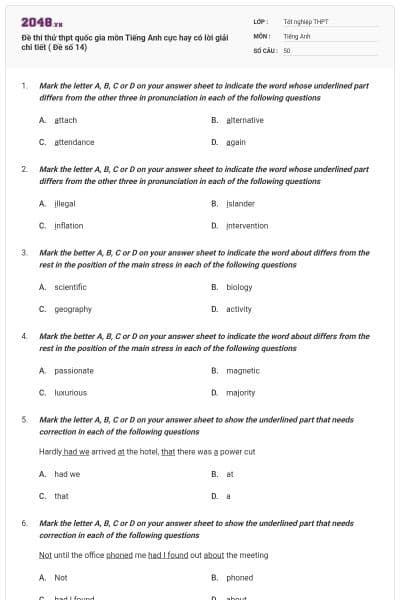
Mark the letter A, B, C or D on your answer sheet to indicate the word whose underlined part differs from the other three in pronunciation in each of the following questions
attach
alternative
attendance
again
Đáp án là B
attach /əˈtætʃ/
alternative /ɔːlˈtɜːnətɪv/
attendance /əˈtendəns/
again /əˈɡen/
Câu B phát âm là /ɔː/ còn lại phát âm là /ə/
Mark the letter A, B, C or D on your answer sheet to indicate the word whose underlined part differs from the other three in pronunciation in each of the following questions
illegal
islander
inflation
intervention
Đáp án là B
illegal /ɪˈliːɡl/
islander /ˈaɪləndər/
inflation /ɪnˈfleɪʃn/
intervention /ˌɪntəˈvenʃn/
Câu B phát âm là /aɪ/ còn lại phát âm là /ɪ/
Mark the better A, B, C or D on your answer sheet to indicate the word about differs from the rest in the position of the main stress in each of the following questions
scientific
biology
geography
activity
Đáp án là A
scientific /ˌsaɪənˈtɪfɪk/
biology /baɪˈɒlədʒi/
geography /dʒiˈɒɡrəfi/
activity /ækˈtɪvəti/
Câu A trọng âm 3 còn lại trọng âm 2
Mark the better A, B, C or D on your answer sheet to indicate the word about differs from the rest in the position of the main stress in each of the following questions
passionate
magnetic
luxurious
majority
Đáp án là A
passionate /ˈpæʃənət/
magnetic /mæɡˈnetɪk/
luxurious /lʌɡˈʒʊəriəs/
majority /məˈdʒɒrəti/
Câu A trọng âm 1 còn lại trọng âm 2
Mark the letter A, B, C or D on your answer sheet to show the underlined part that needs correction in each of the following questions
Hardly had we arrived at the hotel, that there was a power cut
had we
at
that
a
Đáp án là C
Cấu trúc: Hardly had + S + Ved/ V3 when/ before S + Ved/ V2 [ ngay khi...thì...]
Câu này dịch như sau: Ngay khi chúng tôi vừa đến khách sạn thì mất điện.
That => when/ before
Mark the letter A, B, C or D on your answer sheet to show the underlined part that needs correction in each of the following questions
Not until the office phoned me had I found out about the meeting
Not
phoned
had I found
about
Đáp án là C
Cấu trúc: Not until S + V did S + Vo [ mãi cho đến khi...thì...]
Câu này dịch như sau: Mãi cho đến khi văn phòng họi điện thoại đến thì tôi mới biết thông tin về cuộc họp.
Had I found => did I find
Mark the letter A, B, C or D on your answer sheet to show the underlined part that needs correction in each of the following questions
I tried to convince him several times but I failed because he was unwilling to consider what I have said
him
failed
to consider
have said
Đáp án là D
Kiến thức: Thì của động từ
Tình huống ngữ cảnh xảy ra ở quá khứ nên tất cả động từ phải đưa về quá khứ. Việc tôi đã nói xảy ra trước khi tôi thất bại => cái tôi đã nói phải dùng thì quá khứ hoàn thành.
Câu này dịch như sau: Tôi đã cố gắng thuyết phục anh ấy nhiều lần nhưng tôi đã thất bại bởi vì anh ấy không sẵn sàng cân nhắc những gì tôi đã nói.
have said => had said
From the four words or phrases (A, B, C or D) choose the one that best completes the sentence
The new director of the company seems to be an intelligent and ______ man
well-educated
well-educate
well-educational
well- education
Đáp án là A
Kiến thức: Cách thành lập tính từ ghép
Adv – Ved/ V3 => compound adj
Câu này dịch như sau: Giám đốc mới của công ty có vẻ như là một người đàn ông thông minh và có học thức
From the four words or phrases (A, B, C or D) choose the one that best completes the sentence
My brother has been getting so ______ with me recently - I've no idea what's the matter with him
nervous
irritable
envious
unkind
Đáp án là B
Kiến thức: Tính từ + giới từ & từ vựng
Nervous(a): lo lắng
Irritable with: bực mình
Envious of: ghen tị
Unkind to: không tốt
Câu này dịch như sau: Anh tôi dạo này trở nên bực mình với tôi – Tôi không biết chuyện gì xảy ra với anh ấy
From the four words or phrases (A, B, C or D) choose the one that best completes the sentence
If you have a ______ to make about the food, I am willing to listen
dislike
complaint
trouble
discontent
Đáp án là B
Kiến thức: Cụm động từ
Make a complaint about sth: phàn nàn về cái gì
Dislike: không thích
Complaint: phàn nàn
Trouble: lo lắng
Discontent: không hài lòng
Câu này dịch như sau: Nếu bạn muốn phàn nàn về thức ăn, tôi sẵn sàng lắng nghe
From the four words or phrases (A, B, C or D) choose the one that best completes the sentence
They say that a friend in ______ is a friend indeed
need
lack
wish
miss
Đáp án là A
Need: cần
Lack: thiếu hụt
Wish: ước
Miss: bỏ lỡ/ nhớ
Kiến thức: Thành ngữ
A fiend in need is a friend indeed: Một người bạn luôn bên cạnh bạn lúc hoạn nạn khó khăn mới là một người bạn thật sự.
Câu này dịch như sau: Mọi người nói rằng một người bạn luôn bên cạnh bạn lúc hoạn nạn khó khăn mới là một người bạn thật sự
From the four words or phrases (A, B, C or D) choose the one that best completes the sentence
Michael was ______ with anger when he saw his car had been scratched
filled
fixed
loaded
stored
Đáp án là A
Fill: làm đầy
Fix: sửa chữa
Load: chở hàng hóa
Store: lưu trữ
Kiến thức: Cụm động từ
Be filled with: tràn ngập/ đầy
Câu này dịch như sau: Michael đầy tức giận khi nhìn thấy chiếc ô tô bị trầy xướt
From the four words or phrases (A, B, C or D) choose the one that best completes the sentence
Never before ______ in an earnest attempt to resolve their differences
have the leaders of those two countries met
the leaders of these two countries have met
have the leaders the two countries meet
met the leaders of the two countries
Đáp án là A
Kiến thức: Cấu trúc đảo ngữ
Never before + trợ động từ + S + động từ chính + S + V
=>loại B và C
Thì hiện tại đơn nên dùng đảo ngữ là have + S + Ved/ V3 => loại A
Câu này dịch như sau: Chưa bao giờ lãnh đảo hai nước nỗ lực thật sự để giải quyết sự khác biệt giữa hai nước
From the four words or phrases (A, B, C or D) choose the one that best completes the sentence
I’m sure you’ll find someone to ______ friends with at the summer camp
create
set
join
make
Đáp án là D
Create: sáng tạo
Set: hình thành
Join: tham gia
Make: làm/ tạo ra
Kiến thức: Cụm động từ make friend with [ kết bạn với ai đó]
Câu này dịch như sau: Mình chắc là bạn sẽ tìm được ai đó để kết bạn trong buổi trại hè này
From the four words or phrases (A, B, C or D) choose the one that best completes the sentence
Looking after a pet can take ______ quite a lot of time
on
over
in
up
Đáp án là D
Kiến thức: Động từ + giới từ
Take up: chiếm
Take on: thuê
Take in: hiểu
Take over: kiểm soát
Câu này dịch như sau: Chăm sóc thú cưng có thể mất/ chiếm khá nhiều thời gian.
From the four words or phrases (A, B, C or D) choose the one that best completes the sentence
One of the men was lying on the ground after ______ down by a piece of rock
knocking
being knocked
knocking him
was knocked
Đáp án là B
Kiến thức: Giới từ + Ving và bị động của Ving là being Ved
Cụm từ: be knocked by [ bị vấp ngã bởi cái gì đó]
Câu này dịch như sau: Một trong những người đàn ông đang nằm trên mặt đất sau khi bị vấp ngã bởi một hòn đá
From the four words or phrases (A, B, C or D) choose the one that best completes the sentence
Solar energy is considered as one kind of ______ fuel
various
alternative
replacing
changing
Đáp án là B
Various: đa dạng
Alternative: thay thế
Replacing: thay thế
Changing: thay đổi
Cụm danh từ: alternative fuels [ nhiên liệu thay thế]
Câu này dịch như sau: Năng lượng mặt trời được xem như là một loại nguồn nhiên liệu thay thế.
From the four words or phrases (A, B, C or D) choose the one that best completes the sentence
I had no problems on the test, except for question 36, which I found really______
rough
upset
tough
strict
Đáp án là C
Kiến thức: Từ vựng
Rough: gồ ghê
Upset: buồn
Tough: khó, dai
Strict: nghiêm khắc
Câu này dịch như sau: Tôi không có vấn đề gì với bài kiểm tra, ngoại trừ câu 36, cái mà tôi cảm thấy thật sự khó
From the four words or phrases (A, B, C or D) choose the one that best completes the sentence.
______ entering the hall, he found everyone waiting for him.
With
In
At
On
Đáp án là D
Kiến thức: Rút gọn 2 mệnh đề cùng chủ ngữ mang nghĩa chủ động
When S + V = On + Ving
Câu này dịch như sau: Khi bước vào hội trường, anh ấy phát hiện ra rằng mọi người đang đợi anh ấy
Mark the letter A, B, C or D on your answer sheet to indicate the most suitable respond to complete each of the following exchanges
Lan: "That millions of people attended General Vo Nguyen Giap's funeral made a special impression on almost every foreigner."Nga: “__________”
My pleasure
Me neither
I'm afraid I can't
I'll say
Đáp án là D
Lan: “ Cái việc mà hàng triệu người tham dự đám tang của Đại tướng Võ Nguyên Giáp đã tạo nên ấn tượng đặc biệt đối với hầu hết mọi người nước ngoài.”
A.Niềm vinh dự của tôi.
B. Mình cũng không.
C. Mình e rằng mình không thể.
D. Mình hoàn toàn đồng ý với bạn
Mark the letter A, B, C or D on your answer sheet to indicate the most suitable respond to complete each of the following exchanges
"Would you like to have noodles, spaghetti, or something different!" “________”
I'm afraid not
Yes, please
Never mind
Anything will do
Đáp án là D
“ Bạn muốn dùng mì, mì ống hay cái gì đó khác không?”
A. Mình e rằng không.
B. Vâng, làm ơn.
C. Đừng ngại mà.
D. Bất cứ cái nào cũng được
Mark the letter A, B, C or D on your answer sheet to indicate the word (s) OPPOSITE in meaning to the underlined word (s) in the following question
The coach takes every opportunity to censure his players, yet he ignores every opportunity to praise them
criticise
praise
approve of
choose
Đáp án là B
Censure: chỉ trích/ khiển trách
Criticise: phê bình
Praise: đáng giá cao/ ca ngợi
approve of: đồng ý
choose: lựa chọn
=>Censure >< Praise
Câu này dịch như sau: Người huấn luyện viên tận dụng mọi cơ hội để khiển trách các cầu thủ, nhưng lại phớt lờ những cơ hội để khen ngợi họ
Mark the letter A, B, C or D on your answer sheet to indicate the word (s) OPPOSITE in meaning to the underlined word (s) in the following question
Thousands are going starving because of the failure of this year’s harvest
hungry
rich
poor
full
Đáp án là D
starving : nghèo đói
hungry: đói
rich: giàu
poor: nghèo
full: no
=>starving >< full
Câu này dịch như sau: Hàng ngàn người sắp chết đói bởi vì năm nay mất mùa
Mark the letter A, B, C or D on your answer sheet to indicate the word or phrase that is CLOSEST in meaning to the underlined part in each of the following questions
Workers tried to extinguished the flames. Their efforts proved futile, as piles of fabric ignitedall over the eighth floor
became wet
caught fire
exploded
spread
Đáp án là B
ignited: bắt lửa/ cháy
became wet: trở nên ướt
caught fire: bắt lửa
exploded: nổ
spread: lan rộng
=>ignited = caught fire
Câu này dịch như sau: Công nhân cố gắng dập tắt ngọn lửa. Nỗ lực của họ đã thất bại, vì các đống vải bắt lửa khắp tầng 8
Mark the letter A, B, C or D on your answer sheet to indicate the word or phrase that is CLOSEST in meaning to the underlined part in each of the following questions
In my experience, freshmentoday are different from those I knew two years ago
new counselors
first-year students
new students
young professors
Đáp án là B
freshmen: sinh viên năm nhất
A. cố vấn mới
B. sinh viên năm nhất
C. tân sinh viên/ học sinh
D. giáo sư/ chuyên gia trẻ
=>freshmen = first-year students
Câu này dịch như sau: Theo kinh nghiệm của mình, sinh viên năm nhất ngày nay khác so với sinh viên năm nhất mà tớ biết cách đây hai năm
Mark the letter A, B, C or D on your answer sheet to indicate the sentence that is closest in meaning to each of the following questions
He would never agree to sell his business, even if he received a very tempting offer
He wanted to sell his business although the offer was tempting
He would never agree to sell his business unless the offer was tempting
However tempting the offer, he would never agree to sell his business
Although he’d never agree to sell his business, the offer was very tempting
Đáp án là C
Anh ấy sẽ không bao giờ bán doanh nghiệp của mình, thậm chí nếu anh ấy có nhận lời đề nghị hấp dẫn.
A.Anh ấy muốn bán doanh nghiệp mặc dù lời đề nghị hấp dẫn. => sai nghĩa
B. Anh ấy sẽ không đồng ý bán doanh nghiệp nếu lời đề nghị không hấp dẫn.=>sai nghĩa
C. Cho dù lời đề nghị có hấp dẫn thế nào đi nữa, anh ấy sẽ không bao giờ bán doanh nghiệp.
Cấu trúc: However + adj [ cho dù thế nào đi nữa] + S + be = Although S + be + adj
D. Mặc dù anh ấy sẽ không bao giờ bán doanh nghiệp của mình, nhưng lời đề nghị rất hấp dẫn
Mark the letter A, B, C or D on your answer sheet to indicate the sentence that is closest in meaning to each of the following questions
I was shocked that John stole the car.
John’s stolen car was very shocking
John was shocked that he could not take the car
My car was stolen, and John was shocked
That John stole the car shocked me
Đáp án là D
Tôi bị bất ngờ rằng John đã ăn trộm xe hơi.
A. Chiếc xe hơi đã bị ăn trộm của John rất bất ngờ.
B. John bị bất ngờ rằng anh ấy không thể lấy chiếc xe hơi.
C. Xe hơi của tôi bị ăn trộm, và John bị bất ngờ.
D. Việc John ăn trộm xe hơi làm tôi bị bất ngời
Cấu trúc: That + S + V1 [ => đóng vai trò chủ ngữ số ít] + V2 + O
Mark the letter A, B, C or D on your answer sheet to indicate the sentence that is closest in meaning to each of the following questions
Scarcely had he got out of the house when it started raining
He was getting out of the house when it started raining
He had no sooner got out of the house when it started raining
He got out of the house after it started raining
It started raining right after he got out of the house
Đáp án là D
Ngay khi anh ấy bước ra khỏi nhà thì trời bắt đầu mưa.
Cấu trúc: Scarcely/ Hardly had + S + Ved/ V3 when/ before + S + Ved/ V2 [ ngay khi...thì...]
A. Anh ấy đang ra khỏi nhà khi trời mưa. => sai nghĩa
B. sai ngữ pháp vì No sooner...than...
C. Anh ấy ra khỏi nhà sau khi trời mưa. => sai nghĩa
D. Trời bắt đầu mưa ngay sau khi anh ấy ra khỏi nhà
Mark the letter A, B, C, or D on your answer sheet to indicate the sentence that best combines each pair of sentences in the following questions
Jim is my best friend. I borrowed his car yesterday
Jim, whose car I borrowed yesterday, is my best friend
Jim, whose car I borrowed yesterday is my best friend
Jim, who is my best friend, borrowed my car yesterday
Jim, whose car I lent yesterday, is my best friend
Đáp án là A
Jim là người bạn tốt nhất của tôi. Tôi đã mượn xe hơi của anh ấy hôm qua.
Kiến thức: Mệnh đề quan hệ
- Sau tên riêng phải có dấu phẩy
- Mệnh đề quan hệ xác định phải được đặt giữa hai dấu phẩy
- Dùng whose + danh từ [ cái gì đó của ai] để thay thế cho danh từ mang nghĩa sở hữu
A. Jim, mà chiếc xe của người đó tôi đã mượn hôm qua, là bạn tốt nhất của tôi.
B. sai ngữ pháp vì thiếu dấu phẩy sau “ yesterday”
C. Jim, người bạn tốt nhất của tôi đã mượn xe hơi của tôi hôm qua. => sai nghĩa
D. Jim, mà xe hơi của người đó tôi cho mượn hôm qua, là bạn tốt nhất của tôi. => sai nghĩa
Mark the letter A, B, C, or D on your answer sheet to indicate the sentence that best combines each pair of sentences in the following questions
Joe does a lot of exercise. He’s still very fat
Despite the fact that doing a lot of exercise, Joe’s still very fat
Joe does a lot of exercise, so he’s very fat
Even though Joe does a lot of exercise, he’s very fat
Joe’s very fat, but he does a lot of exercise
Đáp án là C
Joe tập thể dục nhiều. Anh ấy vẫn rất béo.
A. Sai ngữ pháp vì Despite the fact that + S + V
B. Joe tập thể dục nhiều, vì vậy anh ấy rất béo. => sai nghĩa
C. Mặc dù Joe tập thể dục nhiều, anh ấy vẫn rất béo.
D. Joe rất béo, nhưng anh ấy tập thể dục nhiều. => sai nghĩa
Read the passages and the questions or unfinished sentences. Then choose the answer (A, B, C or D) that you think fits best.
Around the age of sixteen, you must make one of the biggest decisions of your life. “Do I stay on at school and hopefully go on to university (31) _______? Do I leave and start work or begin a training course. The decision is yours, but it may be (32) _______ remembering two things: there is more unemployment among those who haven’t been to university, and people who have the right skills will have a big advantage in the competition for jobs. If you decide to go (33) _______ into a job, there are many opportunities for training. Getting qualifications will help you to get on more quickly in many careers, and evening classes allow you to learn (34) _______ you earn. Starting work and taking a break to study when you are older is another possibility. In this way, you can save up money for your student days, as well as (35) _______ practical work experience
Điền vào ô số 31
former
past
later
after
Đáp án là C
Former: trước đó
Past: trong quá khứ
Later: sau đó
After S + V: sau đó
Around the age of sixteen, you must make one of the biggest decisions of your life. “Do I stay on at school and hopefully go on to university (31) ____? Do I leave and start work or begin a training course.
Khoảng 16 tuổi, bạn phải thực hiện một trong những quyết định lớn nhất của cuộc đời bạn. “ Tôi sẽ học tiếp và hi vọng lên đại học sau đó hay không? Hay tôi ra trường và bắt đầu đi làm hay bắt đầu khóa đào tạo?”
Read the passages and the questions or unfinished sentences. Then choose the answer (A, B, C or D) that you think fits best.
Around the age of sixteen, you must make one of the biggest decisions of your life. “Do I stay on at school and hopefully go on to university (31) _______? Do I leave and start work or begin a training course. The decision is yours, but it may be (32) _______ remembering two things: there is more unemployment among those who haven’t been to university, and people who have the right skills will have a big advantage in the competition for jobs. If you decide to go (33) _______ into a job, there are many opportunities for training. Getting qualifications will help you to get on more quickly in many careers, and evening classes allow you to learn (34) _______ you earn. Starting work and taking a break to study when you are older is another possibility. In this way, you can save up money for your student days, as well as (35) _______ practical work experience
Điền vào ô số 32
necessary
important
useful
worth
Đáp án là D
Necessary + to Vo: cần thiết
Important + to Vo: quan trọng
Useful + to Vo: có ích
Worth + Ving: đáng giá
The decision is yours, but it may be (32) ____ remembering two things: there is more unemployment among those who haven’t been to university, and people who have the right skills will have a big advantage in the competition for jobs.
[ Quyết định là của bạn, nhưng nó có thể đáng giá để ghi nhớ hai điều: không có nhiều người thất nghiệp khi họ không học dại học, và người có kỹ năng tốt sẽ có lợi thế lớn hơn trong cạnh tranh việc làm.]
Read the passages and the questions or unfinished sentences. Then choose the answer (A, B, C or D) that you think fits best.
Around the age of sixteen, you must make one of the biggest decisions of your life. “Do I stay on at school and hopefully go on to university (31) _______? Do I leave and start work or begin a training course. The decision is yours, but it may be (32) _______ remembering two things: there is more unemployment among those who haven’t been to university, and people who have the right skills will have a big advantage in the competition for jobs. If you decide to go (33) _______ into a job, there are many opportunities for training. Getting qualifications will help you to get on more quickly in many careers, and evening classes allow you to learn (34) _______ you earn. Starting work and taking a break to study when you are older is another possibility. In this way, you can save up money for your student days, as well as (35) _______ practical work experience
Điền vào ô số 33
instant
just
straight
direct
Đáp án là C
Instant: lập tức
Just: vừa mới
Straight: thẳng
Direct: trực tiếp
Cụm từ: go straight into [ tiến thẳng vào]
If you decide to go (33) ____ into a job, there are many opportunities for training.
[ Nếu bạn quyết định tiến thẳng vào một công việc, có nhiều có hội đào tạo.]
Read the passages and the questions or unfinished sentences. Then choose the answer (A, B, C or D) that you think fits best.
Around the age of sixteen, you must make one of the biggest decisions of your life. “Do I stay on at school and hopefully go on to university (31) _______? Do I leave and start work or begin a training course. The decision is yours, but it may be (32) _______ remembering two things: there is more unemployment among those who haven’t been to university, and people who have the right skills will have a big advantage in the competition for jobs. If you decide to go (33) _______ into a job, there are many opportunities for training. Getting qualifications will help you to get on more quickly in many careers, and evening classes allow you to learn (34) _______ you earn. Starting work and taking a break to study when you are older is another possibility. In this way, you can save up money for your student days, as well as (35) _______ practical work experience
Điền vào ô số 34
while
what
where
which
Đáp án là A
While: trong khi
What: cái mà
Where: nơi mà
Which : cái mà
Getting qualifications will help you to get on more quickly in many careers, and evening classes allow you to learn (34) ____ you earn.
[ Có bằng cấp sẽ giúp bạn làm quen nhanh hơn nhiều sự nghiệp, và những lớp học buổi tối cho phép bạn học trong khi bạn đang đi làm.]
Read the passages and the questions or unfinished sentences. Then choose the answer (A, B, C or D) that you think fits best.
Around the age of sixteen, you must make one of the biggest decisions of your life. “Do I stay on at school and hopefully go on to university (31) _______? Do I leave and start work or begin a training course. The decision is yours, but it may be (32) _______ remembering two things: there is more unemployment among those who haven’t been to university, and people who have the right skills will have a big advantage in the competition for jobs. If you decide to go (33) _______ into a job, there are many opportunities for training. Getting qualifications will help you to get on more quickly in many careers, and evening classes allow you to learn (34) _______ you earn. Starting work and taking a break to study when you are older is another possibility. In this way, you can save up money for your student days, as well as (35) _______ practical work experience
Điền vào ô số 35
doing
getting
making
taking
Đáp án là B
Doing: làm
Getting: nhận/ trở nên
Making: tạo ra
Taking: nhận lấy/ mang đi
Cụm từ: get experience [ có kinh nghiệm]
Starting work and taking a break to study when you are older is another possibility. In this way, you can save up money for your student days, as well as (35) ____ practical work experience.
[ Bắt đầu làm việc và nghà ngơi để học khi bạn có tuổi là một cơ hội khác. Bằng cách này, bạn có tiết kiệm tiết cho những ngày đi học, cũng như có thêm kinh nghiệm làm việc thực tiễn.]
Read the following passage and mark the letter (A, B, C or D) on your answer sheet to indicate the correct answer to each for the questions.
The official residence of the president of the United States is the White House, located at 1600 Pennsylvania Avenue, in Washington, D.C. The Commissioners of the District of Columbia held a meeting in 1792 and decided to hold a contest for the best design for the Presidential House. James Hoban, an architect born in Ireland, was the winner. His bid for the construction of the mansion asked for $200,000, but the final cost of the building came to twice that amount. The work on the project began during the same year, and the grounds of approximately one and a half miles west of the Capitol Hill were chosen by Major Pierre-Charles L’Enfant, who was in charge of city planning. However, the construction continued for several more years, and George Washington had stepped down as president before the building was habitable. When John Adams, the second president of the United States and his wife Abigail moved in 1800, only six rooms had been completed.
The grey sandstone walls of the house were painted white during construction, and the color of the paint gave the building its name. The building was burned on August 24, 1814, and James Hoban reconstructed the house for President James Monroe and his family, who moved there in 1817. The north portico was added to the building in 1829, water pipes were installed in 1833, gas lighting in 1848, and electricity in 1891. In 1948, inspectors announced that the building was so dilapidated that it was beyond repair and suggested that it was cheaper to construct a new one than repair the existing dwelling. However, the national sentiment was to keep the original form intact, and Congress appropriated $5million dollars for repairs. In 1961, Jacqueline Kennedy launched a pro.4 gram to redecorate the rooms and appointed a Fine Arts Committee to make choices of furnishing and colors.
The house of the president accords its residents a great deal of space. The living quarters contain 107 rooms, 40 corridors, and 19 baths. The White House contains a doctor’s suite, a dentist’s office, a large solarium, a broadcasting room, and a two-floor basement for storage and service rooms. The office in which the president works is not located in the White House, but in a separate building called the West Wing. The White House stands on 16 acres of park like land and overlooks a broad lawn, flower gardens, and wood groves.
The word “contest” is closest in meaning to
hearing
concourse
competition
computation
Đáp án là C
Từ “contest” [ cuộc thi] gần nghĩa nhất với
A. thính giác
B. sự tụ tập
C. cuộc thi/ tranh tài
D. sự tính toán/ ước tính
Dẫn chứng:The Commissioners of the District of Columbia held a meeting in 1792 and decided to hold a contest for the best design for the Presidential House
Read the following passage and mark the letter (A, B, C or D) on your answer sheet to indicate the correct answer to each for the questions.
The official residence of the president of the United States is the White House, located at 1600 Pennsylvania Avenue, in Washington, D.C. The Commissioners of the District of Columbia held a meeting in 1792 and decided to hold a contest for the best design for the Presidential House. James Hoban, an architect born in Ireland, was the winner. His bid for the construction of the mansion asked for $200,000, but the final cost of the building came to twice that amount. The work on the project began during the same year, and the grounds of approximately one and a half miles west of the Capitol Hill were chosen by Major Pierre-Charles L’Enfant, who was in charge of city planning. However, the construction continued for several more years, and George Washington had stepped down as president before the building was habitable. When John Adams, the second president of the United States and his wife Abigail moved in 1800, only six rooms had been completed.
The grey sandstone walls of the house were painted white during construction, and the color of the paint gave the building its name. The building was burned on August 24, 1814, and James Hoban reconstructed the house for President James Monroe and his family, who moved there in 1817. The north portico was added to the building in 1829, water pipes were installed in 1833, gas lighting in 1848, and electricity in 1891. In 1948, inspectors announced that the building was so dilapidated that it was beyond repair and suggested that it was cheaper to construct a new one than repair the existing dwelling. However, the national sentiment was to keep the original form intact, and Congress appropriated $5million dollars for repairs. In 1961, Jacqueline Kennedy launched a pro.4 gram to redecorate the rooms and appointed a Fine Arts Committee to make choices of furnishing and colors.
The house of the president accords its residents a great deal of space. The living quarters contain 107 rooms, 40 corridors, and 19 baths. The White House contains a doctor’s suite, a dentist’s office, a large solarium, a broadcasting room, and a two-floor basement for storage and service rooms. The office in which the president works is not located in the White House, but in a separate building called the West Wing. The White House stands on 16 acres of park like land and overlooks a broad lawn, flower gardens, and wood groves.
What does the passage imply about the cost of the White House construction?
It was proposed at the meeting of the commissioners
It did not adhere to the original estimate
It was not included in the architectural design
It was considered excessive for the presidential home
Đáp án là B
Bài đọc ám chỉ gì về chi phí của việc xây dựng Nhà Trắng?
A. Nó được đề xuất tại cuộc họp của các ủy viên.
B. Nó không tuân theo ước tính ban đầu.
C. Nó không bao gồm trong thiết kế kiến trúc.
D. Nó được xem là vượt quá mức cho nhà của tổng thống.
Dẫn chứng: His bid for the construction of the mansion asked for $200,000, but the final cost of the building came to twice that amount
Read the following passage and mark the letter (A, B, C or D) on your answer sheet to indicate the correct answer to each for the questions.
The official residence of the president of the United States is the White House, located at 1600 Pennsylvania Avenue, in Washington, D.C. The Commissioners of the District of Columbia held a meeting in 1792 and decided to hold a contest for the best design for the Presidential House. James Hoban, an architect born in Ireland, was the winner. His bid for the construction of the mansion asked for $200,000, but the final cost of the building came to twice that amount. The work on the project began during the same year, and the grounds of approximately one and a half miles west of the Capitol Hill were chosen by Major Pierre-Charles L’Enfant, who was in charge of city planning. However, the construction continued for several more years, and George Washington had stepped down as president before the building was habitable. When John Adams, the second president of the United States and his wife Abigail moved in 1800, only six rooms had been completed.
The grey sandstone walls of the house were painted white during construction, and the color of the paint gave the building its name. The building was burned on August 24, 1814, and James Hoban reconstructed the house for President James Monroe and his family, who moved there in 1817. The north portico was added to the building in 1829, water pipes were installed in 1833, gas lighting in 1848, and electricity in 1891. In 1948, inspectors announced that the building was so dilapidated that it was beyond repair and suggested that it was cheaper to construct a new one than repair the existing dwelling. However, the national sentiment was to keep the original form intact, and Congress appropriated $5million dollars for repairs. In 1961, Jacqueline Kennedy launched a pro.4 gram to redecorate the rooms and appointed a Fine Arts Committee to make choices of furnishing and colors.
The house of the president accords its residents a great deal of space. The living quarters contain 107 rooms, 40 corridors, and 19 baths. The White House contains a doctor’s suite, a dentist’s office, a large solarium, a broadcasting room, and a two-floor basement for storage and service rooms. The office in which the president works is not located in the White House, but in a separate building called the West Wing. The White House stands on 16 acres of park like land and overlooks a broad lawn, flower gardens, and wood groves.
The word “grounds” is closest in meaning to
high ground
several lots
site
hills
Đáp án là C
Từ “ grounds” [ đất] gần nghĩa nhất với
A. vùng đất cao
B. một só lô đất
C. địa điểm
D. đồi
Dẫn chứng: The work on the project began during the same year, and the grounds of approximately one and a half miles west of the Capitol Hill were chosen by Major Pierre-Charles L’Enfant, who was in charge of city planning
Read the following passage and mark the letter (A, B, C or D) on your answer sheet to indicate the correct answer to each for the questions.
The official residence of the president of the United States is the White House, located at 1600 Pennsylvania Avenue, in Washington, D.C. The Commissioners of the District of Columbia held a meeting in 1792 and decided to hold a contest for the best design for the Presidential House. James Hoban, an architect born in Ireland, was the winner. His bid for the construction of the mansion asked for $200,000, but the final cost of the building came to twice that amount. The work on the project began during the same year, and the grounds of approximately one and a half miles west of the Capitol Hill were chosen by Major Pierre-Charles L’Enfant, who was in charge of city planning. However, the construction continued for several more years, and George Washington had stepped down as president before the building was habitable. When John Adams, the second president of the United States and his wife Abigail moved in 1800, only six rooms had been completed.
The grey sandstone walls of the house were painted white during construction, and the color of the paint gave the building its name. The building was burned on August 24, 1814, and James Hoban reconstructed the house for President James Monroe and his family, who moved there in 1817. The north portico was added to the building in 1829, water pipes were installed in 1833, gas lighting in 1848, and electricity in 1891. In 1948, inspectors announced that the building was so dilapidated that it was beyond repair and suggested that it was cheaper to construct a new one than repair the existing dwelling. However, the national sentiment was to keep the original form intact, and Congress appropriated $5million dollars for repairs. In 1961, Jacqueline Kennedy launched a pro.4 gram to redecorate the rooms and appointed a Fine Arts Committee to make choices of furnishing and colors.
The house of the president accords its residents a great deal of space. The living quarters contain 107 rooms, 40 corridors, and 19 baths. The White House contains a doctor’s suite, a dentist’s office, a large solarium, a broadcasting room, and a two-floor basement for storage and service rooms. The office in which the president works is not located in the White House, but in a separate building called the West Wing. The White House stands on 16 acres of park like land and overlooks a broad lawn, flower gardens, and wood groves.
It can be inferred from the passage that
George Washington often used the White House steps
George Washington contributed to the White House design
George Washington never lived in the White House
The White House was excluded from the city planning
Đáp án là C
Có thể suy ra từ bài đọc rằng
A. George Washington thường sử dụng các bậc thang của Nhà Trắng.
B. George Washington đóng góp vào thiết kế Nhà Trắng.
C. George Washington chưa bao giờ sống trong Nhà Trắng.
D. Nhà Trắng không được bao gồm trong kế hoạch của thành phố.
Dẫn chứng: However, the construction continued for several more years, and George Washington had stepped down as president before the building was habitable
Read the following passage and mark the letter (A, B, C or D) on your answer sheet to indicate the correct answer to each for the questions.
The official residence of the president of the United States is the White House, located at 1600 Pennsylvania Avenue, in Washington, D.C. The Commissioners of the District of Columbia held a meeting in 1792 and decided to hold a contest for the best design for the Presidential House. James Hoban, an architect born in Ireland, was the winner. His bid for the construction of the mansion asked for $200,000, but the final cost of the building came to twice that amount. The work on the project began during the same year, and the grounds of approximately one and a half miles west of the Capitol Hill were chosen by Major Pierre-Charles L’Enfant, who was in charge of city planning. However, the construction continued for several more years, and George Washington had stepped down as president before the building was habitable. When John Adams, the second president of the United States and his wife Abigail moved in 1800, only six rooms had been completed.
The grey sandstone walls of the house were painted white during construction, and the color of the paint gave the building its name. The building was burned on August 24, 1814, and James Hoban reconstructed the house for President James Monroe and his family, who moved there in 1817. The north portico was added to the building in 1829, water pipes were installed in 1833, gas lighting in 1848, and electricity in 1891. In 1948, inspectors announced that the building was so dilapidated that it was beyond repair and suggested that it was cheaper to construct a new one than repair the existing dwelling. However, the national sentiment was to keep the original form intact, and Congress appropriated $5million dollars for repairs. In 1961, Jacqueline Kennedy launched a pro.4 gram to redecorate the rooms and appointed a Fine Arts Committee to make choices of furnishing and colors.
The house of the president accords its residents a great deal of space. The living quarters contain 107 rooms, 40 corridors, and 19 baths. The White House contains a doctor’s suite, a dentist’s office, a large solarium, a broadcasting room, and a two-floor basement for storage and service rooms. The office in which the president works is not located in the White House, but in a separate building called the West Wing. The White House stands on 16 acres of park like land and overlooks a broad lawn, flower gardens, and wood groves.
The author of the passage implies that the construction of the main White House building continued
up to 1800
after 1800
until 1814
until 1792
Đáp án là B
Tác giả của bài đọc ngụ ý rằng việc xây dựng công trình chính của Nhà Trắng tiếp tục
A. đến năm 1800
B. sau năm 1800
C. cho đến năm 1814
D. cho đến năm 1792
Dẫn chứng: When John Adams, the second president of the United States and his wife Abigail moved in 1800, only six rooms had been completed.
The grey sandstone walls of the house were painted white during construction, and the color of the paint gave the building its name. The building was burned on August 24, 1814, and James Hoban reconstructed the house for President James Monroe and his family, who moved there in 1817. The north portico was added to the building in 1829, water pipes were installed in 1833, gas lighting in 1848, and electricity in 1891
Read the following passage and mark the letter (A, B, C or D) on your answer sheet to indicate the correct answer to each for the questions.
The official residence of the president of the United States is the White House, located at 1600 Pennsylvania Avenue, in Washington, D.C. The Commissioners of the District of Columbia held a meeting in 1792 and decided to hold a contest for the best design for the Presidential House. James Hoban, an architect born in Ireland, was the winner. His bid for the construction of the mansion asked for $200,000, but the final cost of the building came to twice that amount. The work on the project began during the same year, and the grounds of approximately one and a half miles west of the Capitol Hill were chosen by Major Pierre-Charles L’Enfant, who was in charge of city planning. However, the construction continued for several more years, and George Washington had stepped down as president before the building was habitable. When John Adams, the second president of the United States and his wife Abigail moved in 1800, only six rooms had been completed.
The grey sandstone walls of the house were painted white during construction, and the color of the paint gave the building its name. The building was burned on August 24, 1814, and James Hoban reconstructed the house for President James Monroe and his family, who moved there in 1817. The north portico was added to the building in 1829, water pipes were installed in 1833, gas lighting in 1848, and electricity in 1891. In 1948, inspectors announced that the building was so dilapidated that it was beyond repair and suggested that it was cheaper to construct a new one than repair the existing dwelling. However, the national sentiment was to keep the original form intact, and Congress appropriated $5million dollars for repairs. In 1961, Jacqueline Kennedy launched a pro.4 gram to redecorate the rooms and appointed a Fine Arts Committee to make choices of furnishing and colors.
The house of the president accords its residents a great deal of space. The living quarters contain 107 rooms, 40 corridors, and 19 baths. The White House contains a doctor’s suite, a dentist’s office, a large solarium, a broadcasting room, and a two-floor basement for storage and service rooms. The office in which the president works is not located in the White House, but in a separate building called the West Wing. The White House stands on 16 acres of park like land and overlooks a broad lawn, flower gardens, and wood groves.
What can be inferred about the White House from the information in the second paragraph?
Few changes occurred in the structure in the first half of the 20th century
The building was modernized extensively during one decade
Running water was installed in the second half of the 19th century
Each president added new features to the building’s conveniences
Đáp án là A
Có thể suy ra gì về Nhà Trắng từ thông tin ở đoạn 2?
A. Một vài sự thay đổi trong cấu trúc ở nửa đầu thế kỷ 20.
B. Tòa nhà đã được hiện đại hóa trên diện rộng trong suốt một thập kỷ.
C. Nước chảy được lắp vào nửa cuối thế kỷ 19.
D. Mỗi tổng thống thêm vào một số đặc trưng mới cho những tiện nghi của tòa nhà.
Dẫn chứng: . However, the national sentiment was to keep the original form intact, and Congress appropriated $5million dollars for repairs. In 1961, Jacqueline Kennedy launched a pro.4 gram to redecorate the rooms and appointed a Fine Arts Committee to make choices of furnishing and colors
Read the following passage and mark the letter (A, B, C or D) on your answer sheet to indicate the correct answer to each for the questions.
The official residence of the president of the United States is the White House, located at 1600 Pennsylvania Avenue, in Washington, D.C. The Commissioners of the District of Columbia held a meeting in 1792 and decided to hold a contest for the best design for the Presidential House. James Hoban, an architect born in Ireland, was the winner. His bid for the construction of the mansion asked for $200,000, but the final cost of the building came to twice that amount. The work on the project began during the same year, and the grounds of approximately one and a half miles west of the Capitol Hill were chosen by Major Pierre-Charles L’Enfant, who was in charge of city planning. However, the construction continued for several more years, and George Washington had stepped down as president before the building was habitable. When John Adams, the second president of the United States and his wife Abigail moved in 1800, only six rooms had been completed.
The grey sandstone walls of the house were painted white during construction, and the color of the paint gave the building its name. The building was burned on August 24, 1814, and James Hoban reconstructed the house for President James Monroe and his family, who moved there in 1817. The north portico was added to the building in 1829, water pipes were installed in 1833, gas lighting in 1848, and electricity in 1891. In 1948, inspectors announced that the building was so dilapidated that it was beyond repair and suggested that it was cheaper to construct a new one than repair the existing dwelling. However, the national sentiment was to keep the original form intact, and Congress appropriated $5million dollars for repairs. In 1961, Jacqueline Kennedy launched a pro.4 gram to redecorate the rooms and appointed a Fine Arts Committee to make choices of furnishing and colors.
The house of the president accords its residents a great deal of space. The living quarters contain 107 rooms, 40 corridors, and 19 baths. The White House contains a doctor’s suite, a dentist’s office, a large solarium, a broadcasting room, and a two-floor basement for storage and service rooms. The office in which the president works is not located in the White House, but in a separate building called the West Wing. The White House stands on 16 acres of park like land and overlooks a broad lawn, flower gardens, and wood groves.
The passage mentions all of the following White House premises EXCEPT
hallways
kitchen
medical offices
storage rooms
Đáp án là B
Bài đọc đề cập tất cả những cái nào sau đây trong cơ sở vật chất của Nhà Trắng NGOẠI TRỪ
A. hành lang
B. nhà bếp
C. văn phòng y tế
D. phòng lưu trữ
Dẫn chứng: The living quarters contain 107 rooms, 40 corridors, and 19 baths. The White House contains a doctor’s suite, a dentist’s office, a large solarium, a broadcasting room, and a two-floor basement for storage and service rooms
Read the following passage and mark the letter (A, B, C or D) on your answer sheet to indicate the correct answer to each for the questions.
In the course of history, human inventions have dramatically increased the average amount of energy available for use per person. Primitive people in cold regions burned wood and animal dung to heat their caves, cook food, and drive off animals by fire. The first step toward the developing of more efficient fuels was taken when people discovered that they could use vegetable oils and animal fats in lieu of gathered or cut wood. Charcoal gave off a more intensive heat than wood and was more easily obtainable than organic fats. The Greeks first began to use coal for metal smelting in the 4th century, but it did not come into extensive use until the Industrial Revolution.
In the 1700s, at the beginning of the Industrial Revolution, most energy used in the United States and other nations undergoing industrialization was obtained from perpetual and renewable sources, such as wood, water streams, domesticated animal labor, and wind. These were predominantly locally available supplies. By mid-1800s, 91 percent of all commercial energy consumed in the United States and European countries was obtained from wood. However, at the beginning of the 20th century, coal became a major energy source and replaced wood in industrializing countries. Although in most regions and climate zones wood was more readily accessible than coal, the latter represents a more concentrated source of energy. In 1910, natural gas and oil firmly replaced coal as the main source of fuel because they are lighter and, therefore, cheaper to transport. They burned more cleanly than coal and polluted less. Unlike coal, oil could be refined to manufacture liquid fuels for vehicles, a very important consideration in the early 1900s, when the automobile arrived on the scene.
By 1984, nonrenewable fossil fuels, such as oil, coal, and natural gas, provided over 82 percent of the commercial and industrial energy used in the world. Small amounts of energy were derived from nuclear fission, and the remaining 16 percent came from burning direct perpetual and renewable fuels, such as biomass. Between 1700 and 1986, a large number of countries shifted from the use of energy from local sources to a centralized generation of hydropower and solar energy converted to electricity. The energy derived from nonrenewable fossil fuels has been increasingly produced in one location and transported to another, as is the case with most automobile fuels. In countries with private, rather than public transportation, the age of nonrenewable fuels has created a dependency on a finite resource that will have to be replaced
What is the main topic of the passage?
Applications of various fuels
Natural resources and fossil fuels
A history of energy use
A historical overview of energy rates
Đáp án là C
Chủ đề chính của bài đọc là gì?
A. Các ứng dụng của các loại nhiên liệu khác nhau.
B. Các nguồn tài nguyên thiên nhiên
C. Lịch sử của việc sử dụng nhiên liệu
D. Tổng quan về mặt lịch sử của tỉ lệ nhiên liệu
Dẫn chứng: In the course of history, human inventions have dramatically increased the average amount of energy available for use per person
Read the following passage and mark the letter (A, B, C or D) on your answer sheet to indicate the correct answer to each for the questions.
In the course of history, human inventions have dramatically increased the average amount of energy available for use per person. Primitive people in cold regions burned wood and animal dung to heat their caves, cook food, and drive off animals by fire. The first step toward the developing of more efficient fuels was taken when people discovered that they could use vegetable oils and animal fats in lieu of gathered or cut wood. Charcoal gave off a more intensive heat than wood and was more easily obtainable than organic fats. The Greeks first began to use coal for metal smelting in the 4th century, but it did not come into extensive use until the Industrial Revolution.
In the 1700s, at the beginning of the Industrial Revolution, most energy used in the United States and other nations undergoing industrialization was obtained from perpetual and renewable sources, such as wood, water streams, domesticated animal labor, and wind. These were predominantly locally available supplies. By mid-1800s, 91 percent of all commercial energy consumed in the United States and European countries was obtained from wood. However, at the beginning of the 20th century, coal became a major energy source and replaced wood in industrializing countries. Although in most regions and climate zones wood was more readily accessible than coal, the latter represents a more concentrated source of energy. In 1910, natural gas and oil firmly replaced coal as the main source of fuel because they are lighter and, therefore, cheaper to transport. They burned more cleanly than coal and polluted less. Unlike coal, oil could be refined to manufacture liquid fuels for vehicles, a very important consideration in the early 1900s, when the automobile arrived on the scene.
By 1984, nonrenewable fossil fuels, such as oil, coal, and natural gas, provided over 82 percent of the commercial and industrial energy used in the world. Small amounts of energy were derived from nuclear fission, and the remaining 16 percent came from burning direct perpetual and renewable fuels, such as biomass. Between 1700 and 1986, a large number of countries shifted from the use of energy from local sources to a centralized generation of hydropower and solar energy converted to electricity. The energy derived from nonrenewable fossil fuels has been increasingly produced in one location and transported to another, as is the case with most automobile fuels. In countries with private, rather than public transportation, the age of nonrenewable fuels has created a dependency on a finite resource that will have to be replaced
The phrase “per person” is closest in meaning to
per capita
per year
per family
per day
Đáp án là A
Cụm từ “ per person” gần nghĩa nhất với
A. trên đầu người
B. trên năm
C. trên hộ gia đình
D. trên ngày
Dẫn chứng: In the course of history, human inventions have dramatically increased the average amount of energy available for use per person
Read the following passage and mark the letter (A, B, C or D) on your answer sheet to indicate the correct answer to each for the questions.
In the course of history, human inventions have dramatically increased the average amount of energy available for use per person. Primitive people in cold regions burned wood and animal dung to heat their caves, cook food, and drive off animals by fire. The first step toward the developing of more efficient fuels was taken when people discovered that they could use vegetable oils and animal fats in lieu of gathered or cut wood. Charcoal gave off a more intensive heat than wood and was more easily obtainable than organic fats. The Greeks first began to use coal for metal smelting in the 4th century, but it did not come into extensive use until the Industrial Revolution.
In the 1700s, at the beginning of the Industrial Revolution, most energy used in the United States and other nations undergoing industrialization was obtained from perpetual and renewable sources, such as wood, water streams, domesticated animal labor, and wind. These were predominantly locally available supplies. By mid-1800s, 91 percent of all commercial energy consumed in the United States and European countries was obtained from wood. However, at the beginning of the 20th century, coal became a major energy source and replaced wood in industrializing countries. Although in most regions and climate zones wood was more readily accessible than coal, the latter represents a more concentrated source of energy. In 1910, natural gas and oil firmly replaced coal as the main source of fuel because they are lighter and, therefore, cheaper to transport. They burned more cleanly than coal and polluted less. Unlike coal, oil could be refined to manufacture liquid fuels for vehicles, a very important consideration in the early 1900s, when the automobile arrived on the scene.
By 1984, nonrenewable fossil fuels, such as oil, coal, and natural gas, provided over 82 percent of the commercial and industrial energy used in the world. Small amounts of energy were derived from nuclear fission, and the remaining 16 percent came from burning direct perpetual and renewable fuels, such as biomass. Between 1700 and 1986, a large number of countries shifted from the use of energy from local sources to a centralized generation of hydropower and solar energy converted to electricity. The energy derived from nonrenewable fossil fuels has been increasingly produced in one location and transported to another, as is the case with most automobile fuels. In countries with private, rather than public transportation, the age of nonrenewable fuels has created a dependency on a finite resource that will have to be replaced
The phrase “in lieu” is closest in meaning to
in spite
in place
in every way
in charge
Đáp án là B
Cụm từ “ in lieu” [ thay thế] gần nghĩa nhất với
A. mặc dù B. thay thế C. theo mọi cách D. chịu trách nhiệm
Dẫn chứng: The first step toward the developing of more efficient fuels was taken when people discovered that they could use vegetable oils and animal fats in lieu of gathered or cut wood
Read the following passage and mark the letter (A, B, C or D) on your answer sheet to indicate the correct answer to each for the questions.
In the course of history, human inventions have dramatically increased the average amount of energy available for use per person. Primitive people in cold regions burned wood and animal dung to heat their caves, cook food, and drive off animals by fire. The first step toward the developing of more efficient fuels was taken when people discovered that they could use vegetable oils and animal fats in lieu of gathered or cut wood. Charcoal gave off a more intensive heat than wood and was more easily obtainable than organic fats. The Greeks first began to use coal for metal smelting in the 4th century, but it did not come into extensive use until the Industrial Revolution.
In the 1700s, at the beginning of the Industrial Revolution, most energy used in the United States and other nations undergoing industrialization was obtained from perpetual and renewable sources, such as wood, water streams, domesticated animal labor, and wind. These were predominantly locally available supplies. By mid-1800s, 91 percent of all commercial energy consumed in the United States and European countries was obtained from wood. However, at the beginning of the 20th century, coal became a major energy source and replaced wood in industrializing countries. Although in most regions and climate zones wood was more readily accessible than coal, the latter represents a more concentrated source of energy. In 1910, natural gas and oil firmly replaced coal as the main source of fuel because they are lighter and, therefore, cheaper to transport. They burned more cleanly than coal and polluted less. Unlike coal, oil could be refined to manufacture liquid fuels for vehicles, a very important consideration in the early 1900s, when the automobile arrived on the scene.
By 1984, nonrenewable fossil fuels, such as oil, coal, and natural gas, provided over 82 percent of the commercial and industrial energy used in the world. Small amounts of energy were derived from nuclear fission, and the remaining 16 percent came from burning direct perpetual and renewable fuels, such as biomass. Between 1700 and 1986, a large number of countries shifted from the use of energy from local sources to a centralized generation of hydropower and solar energy converted to electricity. The energy derived from nonrenewable fossil fuels has been increasingly produced in one location and transported to another, as is the case with most automobile fuels. In countries with private, rather than public transportation, the age of nonrenewable fuels has created a dependency on a finite resource that will have to be replaced
The author of the passage implies that in the 1700s, sources of energy were
used for commercial purposes
used in various combinations
not derived from mineral deposits
not always easy to locate
Đáp án là C
Tác giả của bài đọc ám chỉ rằng trong những năm 1700, các nguồn năng lượng thì
A. được sử dụng vì mục đích thương mại
B. được sử dụng ở nhiều dạng kết hợp
C. không bắt nguồn từ trầm tích khoáng sản
D. không phải lúc nào cũng dễ định vị
Dẫn chứng: In the 1700s, at the beginning of the Industrial Revolution, most energy used in the United States and other nations undergoing industrialization was obtained from perpetual and renewable sources, such as wood, water streams, domesticated animal labor, and wind
Read the following passage and mark the letter (A, B, C or D) on your answer sheet to indicate the correct answer to each for the questions.
In the course of history, human inventions have dramatically increased the average amount of energy available for use per person. Primitive people in cold regions burned wood and animal dung to heat their caves, cook food, and drive off animals by fire. The first step toward the developing of more efficient fuels was taken when people discovered that they could use vegetable oils and animal fats in lieu of gathered or cut wood. Charcoal gave off a more intensive heat than wood and was more easily obtainable than organic fats. The Greeks first began to use coal for metal smelting in the 4th century, but it did not come into extensive use until the Industrial Revolution.
In the 1700s, at the beginning of the Industrial Revolution, most energy used in the United States and other nations undergoing industrialization was obtained from perpetual and renewable sources, such as wood, water streams, domesticated animal labor, and wind. These were predominantly locally available supplies. By mid-1800s, 91 percent of all commercial energy consumed in the United States and European countries was obtained from wood. However, at the beginning of the 20th century, coal became a major energy source and replaced wood in industrializing countries. Although in most regions and climate zones wood was more readily accessible than coal, the latter represents a more concentrated source of energy. In 1910, natural gas and oil firmly replaced coal as the main source of fuel because they are lighter and, therefore, cheaper to transport. They burned more cleanly than coal and polluted less. Unlike coal, oil could be refined to manufacture liquid fuels for vehicles, a very important consideration in the early 1900s, when the automobile arrived on the scene.
By 1984, nonrenewable fossil fuels, such as oil, coal, and natural gas, provided over 82 percent of the commercial and industrial energy used in the world. Small amounts of energy were derived from nuclear fission, and the remaining 16 percent came from burning direct perpetual and renewable fuels, such as biomass. Between 1700 and 1986, a large number of countries shifted from the use of energy from local sources to a centralized generation of hydropower and solar energy converted to electricity. The energy derived from nonrenewable fossil fuels has been increasingly produced in one location and transported to another, as is the case with most automobile fuels. In countries with private, rather than public transportation, the age of nonrenewable fuels has created a dependency on a finite resource that will have to be replaced
The phrase “the latter” refers to
wood
coal
most regions
climate zones
Đáp án là B
Từ “latter” [ cái còn lại/ cái sau] ám chỉ đến
A. gỗ B. than đá C. hầu hết các khu vực D. các vùng khí hậu
Dẫn chứng: Although in most regions and climate zones wood was more readily accessible than coal, the latter represents a more concentrated source of energy
Read the following passage and mark the letter (A, B, C or D) on your answer sheet to indicate the correct answer to each for the questions.
In the course of history, human inventions have dramatically increased the average amount of energy available for use per person. Primitive people in cold regions burned wood and animal dung to heat their caves, cook food, and drive off animals by fire. The first step toward the developing of more efficient fuels was taken when people discovered that they could use vegetable oils and animal fats in lieu of gathered or cut wood. Charcoal gave off a more intensive heat than wood and was more easily obtainable than organic fats. The Greeks first began to use coal for metal smelting in the 4th century, but it did not come into extensive use until the Industrial Revolution.
In the 1700s, at the beginning of the Industrial Revolution, most energy used in the United States and other nations undergoing industrialization was obtained from perpetual and renewable sources, such as wood, water streams, domesticated animal labor, and wind. These were predominantly locally available supplies. By mid-1800s, 91 percent of all commercial energy consumed in the United States and European countries was obtained from wood. However, at the beginning of the 20th century, coal became a major energy source and replaced wood in industrializing countries. Although in most regions and climate zones wood was more readily accessible than coal, the latter represents a more concentrated source of energy. In 1910, natural gas and oil firmly replaced coal as the main source of fuel because they are lighter and, therefore, cheaper to transport. They burned more cleanly than coal and polluted less. Unlike coal, oil could be refined to manufacture liquid fuels for vehicles, a very important consideration in the early 1900s, when the automobile arrived on the scene.
By 1984, nonrenewable fossil fuels, such as oil, coal, and natural gas, provided over 82 percent of the commercial and industrial energy used in the world. Small amounts of energy were derived from nuclear fission, and the remaining 16 percent came from burning direct perpetual and renewable fuels, such as biomass. Between 1700 and 1986, a large number of countries shifted from the use of energy from local sources to a centralized generation of hydropower and solar energy converted to electricity. The energy derived from nonrenewable fossil fuels has been increasingly produced in one location and transported to another, as is the case with most automobile fuels. In countries with private, rather than public transportation, the age of nonrenewable fuels has created a dependency on a finite resource that will have to be replaced
The word “They” refers to
coal and wood
main sources of fuel
natural gas and oil
industrializing countries
Đáp án là C
Từ “They” ám chỉ đến
A. than đá và gỗ
B. các nguồn nhiên liệu chính
C. khí tự nhiên và dầu
D. các nước công nghiệp hóa
Dẫn chứng: In 1910, natural gas and oil firmly replaced coal as the main source of fuel because they are lighter and, therefore, cheaper to transport. They burned more cleanly than coal and polluted less
Read the following passage and mark the letter (A, B, C or D) on your answer sheet to indicate the correct answer to each for the questions.
In the course of history, human inventions have dramatically increased the average amount of energy available for use per person. Primitive people in cold regions burned wood and animal dung to heat their caves, cook food, and drive off animals by fire. The first step toward the developing of more efficient fuels was taken when people discovered that they could use vegetable oils and animal fats in lieu of gathered or cut wood. Charcoal gave off a more intensive heat than wood and was more easily obtainable than organic fats. The Greeks first began to use coal for metal smelting in the 4th century, but it did not come into extensive use until the Industrial Revolution.
In the 1700s, at the beginning of the Industrial Revolution, most energy used in the United States and other nations undergoing industrialization was obtained from perpetual and renewable sources, such as wood, water streams, domesticated animal labor, and wind. These were predominantly locally available supplies. By mid-1800s, 91 percent of all commercial energy consumed in the United States and European countries was obtained from wood. However, at the beginning of the 20th century, coal became a major energy source and replaced wood in industrializing countries. Although in most regions and climate zones wood was more readily accessible than coal, the latter represents a more concentrated source of energy. In 1910, natural gas and oil firmly replaced coal as the main source of fuel because they are lighter and, therefore, cheaper to transport. They burned more cleanly than coal and polluted less. Unlike coal, oil could be refined to manufacture liquid fuels for vehicles, a very important consideration in the early 1900s, when the automobile arrived on the scene.
By 1984, nonrenewable fossil fuels, such as oil, coal, and natural gas, provided over 82 percent of the commercial and industrial energy used in the world. Small amounts of energy were derived from nuclear fission, and the remaining 16 percent came from burning direct perpetual and renewable fuels, such as biomass. Between 1700 and 1986, a large number of countries shifted from the use of energy from local sources to a centralized generation of hydropower and solar energy converted to electricity. The energy derived from nonrenewable fossil fuels has been increasingly produced in one location and transported to another, as is the case with most automobile fuels. In countries with private, rather than public transportation, the age of nonrenewable fuels has created a dependency on a finite resource that will have to be replaced
According to the passage, what was the greatest advantage of oil as fuel?
It was a concentrated source of energy
It was lighter and cheaper than coal
It replaced wood and coal and reduced pollution
It could be converted to automobile fuel
Đáp án là D
Theo bài đọc, lợi ích quan trọng nhất của dầu như là nhiên liệu là gì?
A. Nó là một nguồn năng lượng tập trung.
B. Nó nhẹ hơn và rẻ hơn than đá.
C. Nó thay thế gỗ và than đá và giảm ô nhiễm.
D. Nó có thể được chuyển đổi thành nhiên liệu xe hơi.
Dẫn chứng: Unlike coal, oil could be refined to manufacture liquid fuels for vehicles, a very important consideration in the early 1900s, when the automobile arrived on the sc
Read the following passage and mark the letter (A, B, C or D) on your answer sheet to indicate the correct answer to each for the questions.
In the course of history, human inventions have dramatically increased the average amount of energy available for use per person. Primitive people in cold regions burned wood and animal dung to heat their caves, cook food, and drive off animals by fire. The first step toward the developing of more efficient fuels was taken when people discovered that they could use vegetable oils and animal fats in lieu of gathered or cut wood. Charcoal gave off a more intensive heat than wood and was more easily obtainable than organic fats. The Greeks first began to use coal for metal smelting in the 4th century, but it did not come into extensive use until the Industrial Revolution.
In the 1700s, at the beginning of the Industrial Revolution, most energy used in the United States and other nations undergoing industrialization was obtained from perpetual and renewable sources, such as wood, water streams, domesticated animal labor, and wind. These were predominantly locally available supplies. By mid-1800s, 91 percent of all commercial energy consumed in the United States and European countries was obtained from wood. However, at the beginning of the 20th century, coal became a major energy source and replaced wood in industrializing countries. Although in most regions and climate zones wood was more readily accessible than coal, the latter represents a more concentrated source of energy. In 1910, natural gas and oil firmly replaced coal as the main source of fuel because they are lighter and, therefore, cheaper to transport. They burned more cleanly than coal and polluted less. Unlike coal, oil could be refined to manufacture liquid fuels for vehicles, a very important consideration in the early 1900s, when the automobile arrived on the scene.
By 1984, nonrenewable fossil fuels, such as oil, coal, and natural gas, provided over 82 percent of the commercial and industrial energy used in the world. Small amounts of energy were derived from nuclear fission, and the remaining 16 percent came from burning direct perpetual and renewable fuels, such as biomass. Between 1700 and 1986, a large number of countries shifted from the use of energy from local sources to a centralized generation of hydropower and solar energy converted to electricity. The energy derived from nonrenewable fossil fuels has been increasingly produced in one location and transported to another, as is the case with most automobile fuels. In countries with private, rather than public transportation, the age of nonrenewable fuels has created a dependency on a finite resource that will have to be replaced
According to the passage, the sources of fossil fuels will have to be replaced because
they need to be transported
they are not efficient
their use is centralized
their supply is limited
Đáp án là D
Theo bài đọc, các nguồn nhiên liệu hóa thạch sẽ phải được thay thế bởi vì
A. chúng cần được vận chuyển
B. chúng không hiệu quả
C. việc sử dụng của chúng được tập trung hóa
D. sự cung cấp của nó giới hạn
Dẫn chứng: In countries with private, rather than public transportation, the age of nonrenewable fuels has created a dependency on a finite resource that will have to be replaced.