Đề thi thử thpt quốc gia 2020 môn tiếng anh (đề 5)
50 câu hỏi
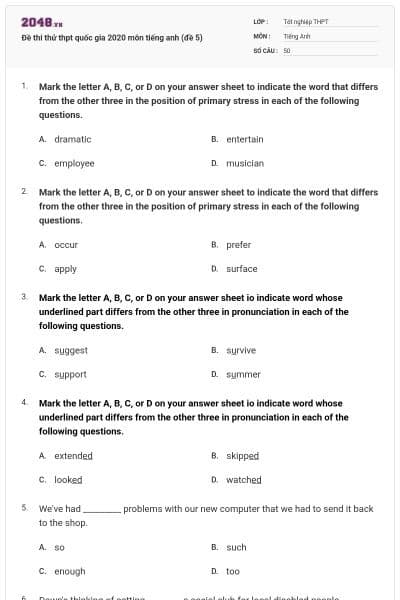
Mark the letter A, B, C, or D on your answer sheet to indicate the word that differs from the other three in the position of primary stress in each of the following questions.
dramatic
entertain
employee
musician
B
Kiến thức: trọng âm
Giải thích:
A. dramatic /drəˈmætɪk/ B. entertain /ˌentəˈteɪn/
C. employee /ɪmˈplɔɪiː/ D. musician /mjuˈzɪʃn/
Từ “entertain” có trọng âm rơi vào âm tiết thứ ba, các từ còn lại có trọng âm rơi vào âm tiết thứ hai.
Mark the letter A, B, C, or D on your answer sheet to indicate the word that differs from the other three in the position of primary stress in each of the following questions.
occur
prefer
apply
surface
D
Kiến thức: trọng âm
Giải thích:
A. occur /əˈkɜː(r)/ B. prefer /prɪˈfɜː(r)/
C. apply /əˈplaɪ/ D. surface /ˈsɜːfɪs/
Từ “surface” có trọng âm rơi vào âm tiết thứ nhất, các từ còn lại có trọng âm rơi vào âm tiết thứ hai.
Mark the letter A, B, C, or D on your answer sheet io indicate word whose underlined part differs from the other three in pronunciation in each of the following questions.
suggest
survive
support
summer
D
Kiến thức: cách phát âm “u”
Giải thích:
A. suggest /səˈdʒest/ B. survive /səˈvaɪv/
C. support /səˈpɔːt/ D. summer /ˈsʌmə(r)/
Âm “u” trong từ “summer” phát âm là /ʌ/, trong các từ còn lại phát âm là /ə/
Mark the letter A, B, C, or D on your answer sheet io indicate word whose underlined part differs from the other three in pronunciation in each of the following questions.
extended
skipped
looked
watched
A
Kiến thức: cách phát âm đuôi “ed”
Giải thích:
Cách phát âm đuôi “ed”:
+ Đuôi “ed” được phát âm là /id/ khi động từ có phát âm kết thúc là /t/ hay /d/
+ Đuôi “ed” được phát âm là /t/ khi động từ có phát âm kết thúc là /s/,/f/,/p/,/ʃ/,/tʃ/,/k/
+ Đuôi “ed” được phát âm là /d/ với các trường hợp còn lại
A. extended /ɪkˈstendɪd/ B. skipped /skɪpt/
C. looked /lʊkt/ D. watched /wɒtʃt/
Âm “ed” trong từ “extended” phát âm là /id/, trong các từ còn lại phát âm là /t/
We've had _________ problems with our new computer that we had to send it back to the shop.
so
such
enough
too
B
Kiến thức: Cấu trúc “such…that…”
Giải thích:
Such + N + that = So + adj + that: quá đến nỗi mà
Tạm dịch: Chúng tôi đã có vấn đề với cái máy tính mới đễn nỗi chúng tôi đã phải gửi lại nó cho cửa hàng.
Dawn's thinking of setting ________ a social club for local disabled people.
out
in
up
off
C
Kiến thức: phrasal verbs
Giải thích:
A. set in: bắt đầu và có vẻ sẽ tiếp diễn
B. set out: bắt đầu một công việc,… với mục tiêu cụ thể
C. set up: thiết lập, thành lập
D. set off: lên đường; phát ra, gây ra
Tạm dịch: Dawn đang nghĩ đến việc thành lập một câu lạc bộ xã hội cho những người khuyết tật ở địa phương.
Mr. Putin won a fourth term as Russia's president, picking up more than three-quarters of the vote with _________ of more than 67 percent.
an outcome
a turnup
a turnout
an output
C
Kiến thức: từ vựng
Giải thích:
A. an outcome: kết quả B. a turnup: gấu quần
D. a turnout: số người bỏ phiếu D. an output: sản phẩm
Tạm dịch: Ngài Putin đã thắng cử tổng thống nhiệm kì thứ tư của Nga, dành được ¾ số phiếu bầu với số người bỏ phiếu là hơn 67%.
His work ________ new ground in the treatment of cancer. It is now giving many cancer victims hope of complete recovery.
broke
found
dug
uncovered
A
Kiến thức: cụm từ đi với “ground”
Giải thích:
to break new ground: khám phá ra, làm ra điều chưa từng được làm trước đó
Tạm dịch: Công trình của ông ấy đã tạo ra một khám phá mới trong điều trị ung thư. Hiện nay, nhiều nạn nhân ung thư có hy vọng hồi phục hoàn toàn.
We like ________ policies.
American recent economic
recent American economic
recent economic American
economic recent American
B
Kiến thức: quy tắc trật tự tính từ
Giải thích:
Quy tắc trật tự tính từ trong tiếng Anh:
• Opinion – tính từ chỉ quan điểm, sự đánh giá. (beautiful, wonderful, terrible…)
• Size – tính từ chỉ kích cỡ. (big, small, long, short, tall…
• Age – tính từ chỉ độ tuổi. (old, young, old, new…)
• Shape – tính từ chỉ hình dạng (circular, square, round, rectangle…)
• Color – tính từ chỉ màu sắc. (orange, yellow, light blue…)
• Origin – tính từ chỉ nguồn gốc, xuất xứ. (Japanese, American, Vietnamese…
• Material – tính từ chỉ chất liệu. (stone, plastic, leather, steel, silk…)
• Purpose – tính từ chỉ mục đích, tác dụng.
Tạm dịch: Chúng tôi thích những chính sách kinh tế Mĩ gần đây?
She worked here for a while then _________ afternoon she just quit and left.
an
one
the
Ø
B
Kiến thức: mạo từ
Giải thích:
Trước các buổi trong ngày phải có mạo từ “the” đằng trước.
Tạm dịch: Cô ấy làm việc ở đó một lúc và sau đó vào buổi chiều cô ấy từ bỏ và rời đi.
DNA tests ________ accepted in court eases.
are known
were used
have been
will have
C
Kiến thức: câu bị động
Giải thích:
Cấu trúc câu bị động ở thì hiện tại hoàn thành: have/ has been + P2
Tạm dịch: Kiểm tra DNA đã được chấp nhận ở các trường hợp trên phiên toà.
The disavantaged should be cared for by _______.
the wealth
wealth
the wealthy
wealthier
C
Kiến thức: Cấu trúc “the + adj”
Giải thích:
“the + adj” dùng để diễn tả một nhóm người, một tập hợp chung có cùng tính chất nào đó.
Tạm dịch: Người khuyết tật cần được quan tâm bởi người giàu.
Why not ________ the meeting until Thursday morning?
postpone
postponing
you postpone
do you postpone
A
Kiến thức: Cấu trúc “why not…?”
Giải thích:
Why not + V = Let’s V: hãy làm…, tại sao không…
Tạm dịch: Tại sao không trì hoãn cuộc họp tới sáng thứ 5?
You're 18! You ________ to be able to look after yourself by now.
are advisable
expect
suppose
will have
D
Kiến thức: cấu trúc bị động ý kiến
Giải thích:
Cấu trúc bị động ý kiến: S + be + said/ thought/ supposed + to V
Tạm dịch: Bạn 18 tuổi rồi! Bạn được cho rằng đủ khả năng để tự chăm sóc bản thân từ bây giờ.
I was very sad when the vet said he'd have to ________ Gertie, our lapdog.
put down
feel up to
pull through
wear off
A
Kiến thức: phrasal verbs
Giải thích:
A. put down: bỏ đi B. fell up to: rơi vào
C. pull through: vượt qua khó khăn D. wear off: mệt mỏi
Tạm dịch: Tôi đã rất buồn khi bác sĩ thú y nói rằng anh ấy sẽ phải từ bỏ Gertie, con chó cưng của chúng tôi.
It is said that a drizzle on the Phap Van - Cau Gie Expressway caused poor______ and slippery road surface, leading to the vehicles, traveling at high speed, unable to respond safely.
vision
view
visibility
visionary
C
Kiến thức: vị trí danh từ
Giải thích:
A. vision (n): sự nhìn B. view (n): quan điểm
C. visibility (n): tính chất có thể trông thấy được D. visionary (adj): hão huyền
Sau tính từ “poor” cần một danh từ hợp nghĩa.
Tạm dịch: Người ta nói rằng mưa phùn trên đường cao tốc Pháp Vân - Cầu Giẽ gây ra sự nhìn thấy kém và bề mặt đường trơn, dẫn đến các phương tiện đi lại với tốc độ cao, không thể đáp ứng một cách an toàn.
Mark the letter A, B, C, or D on your answer sheet to indicate the word(s) CLOSEST in meaning to the underlined word(s) in each of the following questions.
When posed with a complicated mathematical equation, some students seek the assistance of a teacher.
spaced
informed
solved
presented
D
Kiến thức: từ đồng nghĩa
Giải thích:
pose (v): đặt câu hỏi
A. space (v): đặt cách nhau B. inform (v): thông báo
C. solve (v): giải quyết D. present (v): đặt câu hỏi
=> pose = present
Tạm dịch: Khi được đặt ra với một phương trình toán học phức tạp, một số học sinh tìm kiếm sự trợ giúp của một giáo viên.
Mark the letter A, B, C, or D on your answer sheet to indicate the word(s) CLOSEST in meaning to the underlined word(s) in each of the following questions.
At the advent of his speech, he told a joke but the audience failed to laugh.
end
commencement
creation
climax
B
Kiến thức: từ đồng nghĩa
Giải thích:
advent (n): phần đầu
A. end (n): phần cuối B. commencement (n): phần đầu
C. creation (n): sự tạo thành D. climax (n): phần cao trào
=> advent = commencement
Tạm dịch: Ở phần đầu của bài diễn thuyết, anh ý kể một trò đùa nhưng mọi người đã không cười.
Mark the letter A, B, C, or D on your answer sheet to indicate the word(s) OPPOSITE in meaning to the underlined word(s) in each of the following questions.
He revealed his intentions of leaving the company to the manager during the office dinner party.
disclosed
concealed
misled
influenced
B
Kiến thức: từ trái nghĩa
Giải thích:
reveal (v): tiết lộ
A. disclosed (v): tiết lộ B. concealed (V): che đậy
C. misled (v): làm cho mê muội D. influenced (v): ảnh hưởng
=> revealed >< concealed
Tạm dịch: Anh ấy đã tiết lộ ý định để lại công ty cho giám đốc tại bữa tiệc tối của văn phòng.
Mark the letter A, B, C, or D on your answer sheet to indicate the word(s) OPPOSITE in meaning to the underlined word(s) in each of the following questions.
Most of the guests at the dinner party chose to dress elegantly, but one man wore jeans and a T-shirt; he was later identified as a high school teacher.
unsophisticatedly
decently
gaudily
gracefully
A
Kiến thức: từ trái nghĩa
Giải thích:
elegantly (adv): một cách trang trọng, lịch lãm
A. unsophisticatedly (adv): không thanh lịch B. decently (adv): thanh lịch
C. gaudily (adv): xa hoa D. gracefully (adv): thanh lịch
=> elegantly >< unsophisticatedly
Tạm dịch: Hầu hết mọi người tới bữa tiệc tối chọn ăn mặc một cách thanh lịch, nhưng một người đàn ông mặc quần bò và áo phông, lúc sau anh ý được biết tới là một giáo viên cấp 3.
Sue is phoning Mr. Black but his secretary tells her that he is on vacation.
Ann: May I leave a message for Mr. Black, please?
Secretary: ___________.
I'm afraid he is not here.
He is taking a message now.
Yes, I'll make sure he gets it.
No, you can't tell him.
C
Kiến thức: câu giao tiếp
Giải thích:
Ann: Tôi có thể để lại lời nhắn cho ông Black không?
Thư kí: ______.
A. Tôi e ông ấy không có ở đây B. Ông ấy đang nhận một lời nhắn
C. Có, tôi sẽ đảm bảo ông ấy nhận được nó D. Không, cô không thể nói cho ông ấy
Peter and Mary are friends. They have just finished lunch in a restaurant.
Mary: The food is great. I'll get the bill.
Peter: _________.
Yes, speak to you soon.
No, this is on me.
It's nothing.
Don't mention it.
B
Kiến thức: câu giao tiếp
Giải thích:
Mary: Thức ăn ở đây thật tuyệt. Tôi sẽ đi thanh toán.
Peter: _______.
A. Ừ, nói chuyện với bạn sau B. Không, cái này để tôi
C. Không có gì đâu D. Đừng đề cập tới nó
Read the following passage and mark the letter A, B, C, or D on your answer sheet to indicate the correct word or phrase that best fits each of the numbered blanks from 23 to 27.
WILLIAM THE HERO!
Brave William Baldock, who is six years old, is a hero after helping his mother when she fell downstairs. William quickly rang for an ambulance when he discovered his mother had broken her leg. In spite of being frightened, he (23) ________ the emergency services what had happened and answered all the questions they asked him. He also telephoned his father at work, and then his grandmother, to explain what he had (24) _________. While waiting for these people to come, William looked after his 18-month-old sister. When ambulance man Steve Lyn went to the house, he was amazed: 'It's great that a young boy of six knew the right number to dial, and was able to give us the correct information. (25) ________ of William's quick thinking, we were able to (26) ________ there immediately." Mrs. Baldock left hospital yesterday, very (27) ________ to both William and the ambulance service.
Điền vào ô 23
called
talked
spoke
told
D
Kiến thức: từ vựng
Giải thích:
Đáp án B và C thiếu giới từ “to”. Đằng sau chỗ trống là “what happened” nên ta chọn D để phù hợp về nghĩa.
In spite of being frightened, he (23) ________ the emergency services what had happened and answered all the questions they asked him.
Tạm dịch: Thay vì hoảng sợ, cậu ấy đã nói cho dịch vụ cấp cứu những gì đã xảy ra và trả lời tất cả những câu hỏi của họ.
Read the following passage and mark the letter A, B, C, or D on your answer sheet to indicate the correct word or phrase that best fits each of the numbered blanks from 23 to 27.
WILLIAM THE HERO!
Brave William Baldock, who is six years old, is a hero after helping his mother when she fell downstairs. William quickly rang for an ambulance when he discovered his mother had broken her leg. In spite of being frightened, he (23) ________ the emergency services what had happened and answered all the questions they asked him. He also telephoned his father at work, and then his grandmother, to explain what he had (24) _________. While waiting for these people to come, William looked after his 18-month-old sister. When ambulance man Steve Lyn went to the house, he was amazed: 'It's great that a young boy of six knew the right number to dial, and was able to give us the correct information. (25) ________ of William's quick thinking, we were able to (26) ________ there immediately." Mrs. Baldock left hospital yesterday, very (27) ________ to both William and the ambulance service.
Điền vào ô 24
done
made
acted
worked
A
Kiến thức: từ vựng
Giải thích:
“what he had done”: những gì cậu ấy đã làm
He also telephoned his father at work, and then his grandmother, to explain what he had (24) _________.
Tạm dịch: Cậu ấy cũng đã gọi cho người bố đang đi làm và sau đó là bà của mình để giải thích những gì cậu ấy đã làm.
Read the following passage and mark the letter A, B, C, or D on your answer sheet to indicate the correct word or phrase that best fits each of the numbered blanks from 23 to 27.
WILLIAM THE HERO!
Brave William Baldock, who is six years old, is a hero after helping his mother when she fell downstairs. William quickly rang for an ambulance when he discovered his mother had broken her leg. In spite of being frightened, he (23) ________ the emergency services what had happened and answered all the questions they asked him. He also telephoned his father at work, and then his grandmother, to explain what he had (24) _________. While waiting for these people to come, William looked after his 18-month-old sister. When ambulance man Steve Lyn went to the house, he was amazed: 'It's great that a young boy of six knew the right number to dial, and was able to give us the correct information. (25) ________ of William's quick thinking, we were able to (26) ________ there immediately." Mrs. Baldock left hospital yesterday, very (27) ________ to both William and the ambulance service.
Điền vào ô 25
Since
Because
In spite
Instead
B
Kiến thức: liên từ
Giải thích:
Since + mệnh đề: bởi vì Because of + N: bởi vì
In spite of + N: bất kể Instead of + N/Ving: thay vì
(25) ________ of William's quick thinking
Tạm dịch: Bởi vì sự suy nghĩ nhanh của William
Read the following passage and mark the letter A, B, C, or D on your answer sheet to indicate the correct word or phrase that best fits each of the numbered blanks from 23 to 27.
WILLIAM THE HERO!
Brave William Baldock, who is six years old, is a hero after helping his mother when she fell downstairs. William quickly rang for an ambulance when he discovered his mother had broken her leg. In spite of being frightened, he (23) ________ the emergency services what had happened and answered all the questions they asked him. He also telephoned his father at work, and then his grandmother, to explain what he had (24) _________. While waiting for these people to come, William looked after his 18-month-old sister. When ambulance man Steve Lyn went to the house, he was amazed: 'It's great that a young boy of six knew the right number to dial, and was able to give us the correct information. (25) ________ of William's quick thinking, we were able to (26) ________ there immediately." Mrs. Baldock left hospital yesterday, very (27) ________ to both William and the ambulance service.
Điền vào ô 26
manage
find
get
reach
C
Kiến thức: từ vựng
Giải thích:
to get there: đến đó
we were able to (26) ________ there immediately.
Tạm dịch: chúng tôi đã có thể đến đó ngay lập tức
Read the following passage and mark the letter A, B, C, or D on your answer sheet to indicate the correct word or phrase that best fits each of the numbered blanks from 23 to 27.
WILLIAM THE HERO!
Brave William Baldock, who is six years old, is a hero after helping his mother when she fell downstairs. William quickly rang for an ambulance when he discovered his mother had broken her leg. In spite of being frightened, he (23) ________ the emergency services what had happened and answered all the questions they asked him. He also telephoned his father at work, and then his grandmother, to explain what he had (24) _________. While waiting for these people to come, William looked after his 18-month-old sister. When ambulance man Steve Lyn went to the house, he was amazed: 'It's great that a young boy of six knew the right number to dial, and was able to give us the correct information. (25) ________ of William's quick thinking, we were able to (26) ________ there immediately." Mrs. Baldock left hospital yesterday, very (27) ________ to both William and the ambulance service.
Điền vào ô 27
agreeable
happy
grateful
approving
C
Kiến thức: từ vựng
Giải thích:
A. agreeable (adj): có thể đồng ý B. happy (adj): hạnh phúc
C. grateful (adj): biết ơn D. approving (adj): đồng tình
Mrs. Baldock left hospital yesterday, very (27) ________ to both William and the ambulance service.
Tạm dịch: Bà Baldock đã ra viện hôm qua và rất biết ơn William và dịch vụ cấp cứu.
Dịch bài đọc:
William Baldock dũng cảm, người chỉ mới 6 tuổi, là một anh hùng sau khi giúp mẹ cậu ấy khi bà bị ngã cầu thang. William đã nhanh chóng gọi cấp cứu khi mẹ bị gãy chân. Thay vì hoảng sợ, cậu ấy đã nói cho dịch vụ cấp cứu những gì đã xảy ra và trả lời tất cả những câu hỏi của họ. Cậu ấy cũng đã gọi cho người bố đang đi làm và sau đó là bà của mình để giải thích những gì cậu ấy đã làm. Khi đợi những người này tới, cậu ý chăm sóc người em 18 tháng tuổi của mình.
Khi xe người đàn ông cứu thương Steve Lyn đến nhà, ông đã rất ngạc nhiên: "Thật tuyệt khi một cậu bé sáu tuổi biết đúng số người quay số, và có thể cung cấp cho chúng tôi thông tin chính xác. Bởi vì sự suy nghĩ nhanh của William, chúng tôi đã có thể đến đó ngay lập tức.
Bà Baldock đã ra viện hôm qua và rất biết ơn William và dịch vụ cấp cứu.
Read the following passage and mark the letter A, B, C, or D on your answer sheet to indicate the correct answer to each of the questions from 28 to 34.
A large number of inventions require years of arduous research and development before they are perfected. For instance, Thomas Edison had to make more than 1,000 attempts to invent the incandescent light bulb before he finally succeeded. History is replete with numerous other examples of people trying, yet failing to make inventions before they eventually succeeded. Yet some inventions have come about not through hard work but simply by accident. In most cases, when someone unintentionally invented something, the inventor was attempting to create something else. For example, in the 1930s, chemist Roy Plunkett was attempting to make a new substance that could be used to refrigerate items. He mixed some chemicals together. Then, he put them into a pressurized container and cooled the mixture. By the time his experiment was complete, he had a new invention. It was not a new substance that could be used for refrigeration though. Instead, he had invented Teflon, which is today most commonly used to make nonstick pots and pans. Similarly, decades earlier, John Pemberton was a pharmacist in Atlanta, Georgia. He was attempting to create a tonic that people could use whenever they had headaches. While he was not successful in that endeavor, he managed to invent Coca - Cola, the world - famous carbonated soft drink.
Scientists have also made crucial discoveries by accident when they were conducting experiments. In 1928, Alexander Fleming discovered penicillin, an antibiotic, in this manner. He discovered some mold growing in a dish with some bacteria. He noticed that the bacteria seemed to be avoiding the mold. When he investigated further, he determined some of the many useful properties of penicillin, which has saved millions of lives over the past few decades. Likewise, in 1946, scientist Percy Spencer was conducting an experiment with microwaves. He had a candy bar in his pocket, and he noticed that it suddenly melted. He investigated and learned the reason why that had happened. Soon afterward, he built a device that could utilize microwaves to heat food: the microwave oven.
Which title best summarizes the main idea of the passage?
History's Most Important Inventions
Accidental Inventions and Discoveries
How to Become a Great Inventor
You Don't Always Get What You Want
B
Kiến thức: đọc hiểu
Giải thích:
Tiêu đề nào tóm tắt ý chính của đoạn văn?
A. Các phát minh quan trọng nhất của lịch sử
B. Phát minh và khám phá tai nạn
C. Làm thế nào để trở thành một nhà phát minh vĩ đại
D. Bạn không luôn luôn có được những gì bạn muốn
Read the following passage and mark the letter A, B, C, or D on your answer sheet to indicate the correct answer to each of the questions from 28 to 34.
A large number of inventions require years of arduous research and development before they are perfected. For instance, Thomas Edison had to make more than 1,000 attempts to invent the incandescent light bulb before he finally succeeded. History is replete with numerous other examples of people trying, yet failing to make inventions before they eventually succeeded. Yet some inventions have come about not through hard work but simply by accident. In most cases, when someone unintentionally invented something, the inventor was attempting to create something else. For example, in the 1930s, chemist Roy Plunkett was attempting to make a new substance that could be used to refrigerate items. He mixed some chemicals together. Then, he put them into a pressurized container and cooled the mixture. By the time his experiment was complete, he had a new invention. It was not a new substance that could be used for refrigeration though. Instead, he had invented Teflon, which is today most commonly used to make nonstick pots and pans. Similarly, decades earlier, John Pemberton was a pharmacist in Atlanta, Georgia. He was attempting to create a tonic that people could use whenever they had headaches. While he was not successful in that endeavor, he managed to invent Coca - Cola, the world - famous carbonated soft drink.
Scientists have also made crucial discoveries by accident when they were conducting experiments. In 1928, Alexander Fleming discovered penicillin, an antibiotic, in this manner. He discovered some mold growing in a dish with some bacteria. He noticed that the bacteria seemed to be avoiding the mold. When he investigated further, he determined some of the many useful properties of penicillin, which has saved millions of lives over the past few decades. Likewise, in 1946, scientist Percy Spencer was conducting an experiment with microwaves. He had a candy bar in his pocket, and he noticed that it suddenly melted. He investigated and learned the reason why that had happened. Soon afterward, he built a device that could utilize microwaves to heat food: the microwave oven.
In paragraph 1, the word arduous is closest in meaning to _______.
detailed
tough
specific
constant
B
Kiến thức: đọc hiểu
Giải thích:
Từ “arduous” gần nghĩa nhất với?
A. chi tiết B. khó C. cụ thể D. kiên trì
Read the following passage and mark the letter A, B, C, or D on your answer sheet to indicate the correct answer to each of the questions from 28 to 34.
A large number of inventions require years of arduous research and development before they are perfected. For instance, Thomas Edison had to make more than 1,000 attempts to invent the incandescent light bulb before he finally succeeded. History is replete with numerous other examples of people trying, yet failing to make inventions before they eventually succeeded. Yet some inventions have come about not through hard work but simply by accident. In most cases, when someone unintentionally invented something, the inventor was attempting to create something else. For example, in the 1930s, chemist Roy Plunkett was attempting to make a new substance that could be used to refrigerate items. He mixed some chemicals together. Then, he put them into a pressurized container and cooled the mixture. By the time his experiment was complete, he had a new invention. It was not a new substance that could be used for refrigeration though. Instead, he had invented Teflon, which is today most commonly used to make nonstick pots and pans. Similarly, decades earlier, John Pemberton was a pharmacist in Atlanta, Georgia. He was attempting to create a tonic that people could use whenever they had headaches. While he was not successful in that endeavor, he managed to invent Coca - Cola, the world - famous carbonated soft drink.
Scientists have also made crucial discoveries by accident when they were conducting experiments. In 1928, Alexander Fleming discovered penicillin, an antibiotic, in this manner. He discovered some mold growing in a dish with some bacteria. He noticed that the bacteria seemed to be avoiding the mold. When he investigated further, he determined some of the many useful properties of penicillin, which has saved millions of lives over the past few decades. Likewise, in 1946, scientist Percy Spencer was conducting an experiment with microwaves. He had a candy bar in his pocket, and he noticed that it suddenly melted. He investigated and learned the reason why that had happened. Soon afterward, he built a device that could utilize microwaves to heat food: the microwave oven.
In paragraph 2, the word endeavor is closest in meaning to _______.
research
dream
request
attempt
D
Kiến thức: đọc hiểu
Giải thích:
Ở đoạn 2, từ “endeavor” gần nghĩa nhất với?
A. nghiên cứu B. giấc mơ C. yêu cầu D. cố gắng
Read the following passage and mark the letter A, B, C, or D on your answer sheet to indicate the correct answer to each of the questions from 28 to 34.
A large number of inventions require years of arduous research and development before they are perfected. For instance, Thomas Edison had to make more than 1,000 attempts to invent the incandescent light bulb before he finally succeeded. History is replete with numerous other examples of people trying, yet failing to make inventions before they eventually succeeded. Yet some inventions have come about not through hard work but simply by accident. In most cases, when someone unintentionally invented something, the inventor was attempting to create something else. For example, in the 1930s, chemist Roy Plunkett was attempting to make a new substance that could be used to refrigerate items. He mixed some chemicals together. Then, he put them into a pressurized container and cooled the mixture. By the time his experiment was complete, he had a new invention. It was not a new substance that could be used for refrigeration though. Instead, he had invented Teflon, which is today most commonly used to make nonstick pots and pans. Similarly, decades earlier, John Pemberton was a pharmacist in Atlanta, Georgia. He was attempting to create a tonic that people could use whenever they had headaches. While he was not successful in that endeavor, he managed to invent Coca - Cola, the world - famous carbonated soft drink.
Scientists have also made crucial discoveries by accident when they were conducting experiments. In 1928, Alexander Fleming discovered penicillin, an antibiotic, in this manner. He discovered some mold growing in a dish with some bacteria. He noticed that the bacteria seemed to be avoiding the mold. When he investigated further, he determined some of the many useful properties of penicillin, which has saved millions of lives over the past few decades. Likewise, in 1946, scientist Percy Spencer was conducting an experiment with microwaves. He had a candy bar in his pocket, and he noticed that it suddenly melted. He investigated and learned the reason why that had happened. Soon afterward, he built a device that could utilize microwaves to heat food: the microwave oven.
What does the author say about Teflon?
People first used it as a refrigeration device.
It was created many years before Coca-Cola.
The man who made it was a pharmacist.
It is used for kitchenware nowadays.
D
Kiến thức: đọc hiểu
Giải thích:
Tác giả nói gì về Teflon?
A. Người đầu tiên sử dụng nó như là một thiết bị làm lạnh.
B. Nó được tạo ra nhiều năm trước khi Coca-Cola được tạo ra.
C. Người đàn ông đã làm ra nó là một dược sĩ.
D. Nó được sử dụng cho đồ dùng nhà bếp ngày nay.
Dẫn chứng: Instead, he had invented Teflon, which is today most commonly used to make nonstick pots and pans.
Read the following passage and mark the letter A, B, C, or D on your answer sheet to indicate the correct answer to each of the questions from 28 to 34.
A large number of inventions require years of arduous research and development before they are perfected. For instance, Thomas Edison had to make more than 1,000 attempts to invent the incandescent light bulb before he finally succeeded. History is replete with numerous other examples of people trying, yet failing to make inventions before they eventually succeeded. Yet some inventions have come about not through hard work but simply by accident. In most cases, when someone unintentionally invented something, the inventor was attempting to create something else. For example, in the 1930s, chemist Roy Plunkett was attempting to make a new substance that could be used to refrigerate items. He mixed some chemicals together. Then, he put them into a pressurized container and cooled the mixture. By the time his experiment was complete, he had a new invention. It was not a new substance that could be used for refrigeration though. Instead, he had invented Teflon, which is today most commonly used to make nonstick pots and pans. Similarly, decades earlier, John Pemberton was a pharmacist in Atlanta, Georgia. He was attempting to create a tonic that people could use whenever they had headaches. While he was not successful in that endeavor, he managed to invent Coca - Cola, the world - famous carbonated soft drink.
Scientists have also made crucial discoveries by accident when they were conducting experiments. In 1928, Alexander Fleming discovered penicillin, an antibiotic, in this manner. He discovered some mold growing in a dish with some bacteria. He noticed that the bacteria seemed to be avoiding the mold. When he investigated further, he determined some of the many useful properties of penicillin, which has saved millions of lives over the past few decades. Likewise, in 1946, scientist Percy Spencer was conducting an experiment with microwaves. He had a candy bar in his pocket, and he noticed that it suddenly melted. He investigated and learned the reason why that had happened. Soon afterward, he built a device that could utilize microwaves to heat food: the microwave oven.
Who was John Pemberton?
The person who made Teflon
The creator of Coca-Cola
The man who discovered penicillin
The inventor of the microwave
B
Kiến thức: đọc hiểu
Giải thích:
John Pemberton là ai?
A. Người làm Teflon B. Người tạo ra Coca-Cola
C. Người phát hiện ra penicillin D. Người phát minh lò vi sóng
Dẫn chứng: While he was not successful in that endeavor, he managed to invent Coca - Cola, the world - famous carbonated soft drink.
Read the following passage and mark the letter A, B, C, or D on your answer sheet to indicate the correct answer to each of the questions from 28 to 34.
A large number of inventions require years of arduous research and development before they are perfected. For instance, Thomas Edison had to make more than 1,000 attempts to invent the incandescent light bulb before he finally succeeded. History is replete with numerous other examples of people trying, yet failing to make inventions before they eventually succeeded. Yet some inventions have come about not through hard work but simply by accident. In most cases, when someone unintentionally invented something, the inventor was attempting to create something else. For example, in the 1930s, chemist Roy Plunkett was attempting to make a new substance that could be used to refrigerate items. He mixed some chemicals together. Then, he put them into a pressurized container and cooled the mixture. By the time his experiment was complete, he had a new invention. It was not a new substance that could be used for refrigeration though. Instead, he had invented Teflon, which is today most commonly used to make nonstick pots and pans. Similarly, decades earlier, John Pemberton was a pharmacist in Atlanta, Georgia. He was attempting to create a tonic that people could use whenever they had headaches. While he was not successful in that endeavor, he managed to invent Coca - Cola, the world - famous carbonated soft drink.
Scientists have also made crucial discoveries by accident when they were conducting experiments. In 1928, Alexander Fleming discovered penicillin, an antibiotic, in this manner. He discovered some mold growing in a dish with some bacteria. He noticed that the bacteria seemed to be avoiding the mold. When he investigated further, he determined some of the many useful properties of penicillin, which has saved millions of lives over the past few decades. Likewise, in 1946, scientist Percy Spencer was conducting an experiment with microwaves. He had a candy bar in his pocket, and he noticed that it suddenly melted. He investigated and learned the reason why that had happened. Soon afterward, he built a device that could utilize microwaves to heat food: the microwave oven.
The author uses Alexander Fleming as an example of ________.
one of the most famous inventors in history
a person who made an accidental scientific discovery
someone who became a millionaire from his invention
a man who dedicated his life to medical science
B
Kiến thức: đọc hiểu
Giải thích:
Tác giả sử dụng Alexander Fleming làm ví dụ của ________.
A. một trong những nhà phát minh nổi tiếng nhất trong lịch sử
B. một người đã thực hiện một khám phá khoa học tình cờ
C. một người trở thành triệu phú từ phát minh của mình
D. một người đàn ông đã cống hiến cuộc đời mình cho khoa học y khoa
Dẫn chứng: Scientists have also made crucial discoveries by accident when they were conducting experiments.
Read the following passage and mark the letter A, B, C, or D on your answer sheet to indicate the correct answer to each of the questions from 28 to 34.
A large number of inventions require years of arduous research and development before they are perfected. For instance, Thomas Edison had to make more than 1,000 attempts to invent the incandescent light bulb before he finally succeeded. History is replete with numerous other examples of people trying, yet failing to make inventions before they eventually succeeded. Yet some inventions have come about not through hard work but simply by accident. In most cases, when someone unintentionally invented something, the inventor was attempting to create something else. For example, in the 1930s, chemist Roy Plunkett was attempting to make a new substance that could be used to refrigerate items. He mixed some chemicals together. Then, he put them into a pressurized container and cooled the mixture. By the time his experiment was complete, he had a new invention. It was not a new substance that could be used for refrigeration though. Instead, he had invented Teflon, which is today most commonly used to make nonstick pots and pans. Similarly, decades earlier, John Pemberton was a pharmacist in Atlanta, Georgia. He was attempting to create a tonic that people could use whenever they had headaches. While he was not successful in that endeavor, he managed to invent Coca - Cola, the world - famous carbonated soft drink.
Scientists have also made crucial discoveries by accident when they were conducting experiments. In 1928, Alexander Fleming discovered penicillin, an antibiotic, in this manner. He discovered some mold growing in a dish with some bacteria. He noticed that the bacteria seemed to be avoiding the mold. When he investigated further, he determined some of the many useful properties of penicillin, which has saved millions of lives over the past few decades. Likewise, in 1946, scientist Percy Spencer was conducting an experiment with microwaves. He had a candy bar in his pocket, and he noticed that it suddenly melted. He investigated and learned the reason why that had happened. Soon afterward, he built a device that could utilize microwaves to heat food: the microwave oven.
What does the author imply about penicillin?
Doctors seldom use it nowadays.
Some people are not affected by it.
It is an invaluable medical supply.
Mold combines with bacteria to make it.
C
Kiến thức: đọc hiểu
Giải thích:
Tác giả có ý gì về penicillin?
A. Các bác sĩ hiếm khi sử dụng nó ngày nay. B. Một số người không bị ảnh hưởng bởi nó.
C. Là một nguồn cung cấp y tế vô giá. D. Khuôn kết hợp với vi khuẩn để tạo ra.
Dẫn chứng: When he investigated further, he determined some of the many useful properties of penicillin, which has saved millions of lives over the past few decades.
Dịch bài đọc:
Một số lượng lớn các sáng chế đòi hỏi nhiều năm nghiên cứu và phát triển gian nan trước khi chúng được hoàn thiện. Thí dụ, Thomas Edison đã phải cố gắng hơn 1.000 lần để sáng chế ra bóng đèn sáng trước khi cuối cùng cũng thành công. Lịch sử có rất nhiều ví dụ khác của những người cố gắng, nhưng không thể làm sáng chế trước khi họ cuối cùng đã thành công. Tuy nhiên, một số sáng chế đã đến không phải thông qua công việc khó khăn, nhưng do tình cờ.
Trong hầu hết các trường hợp, khi người nào đó vô ý phát minh ra điều gì đó, nhà phát minh đã cố gắng tạo ra một thứ khác. Ví dụ, trong những năm 1930, nhà chế tạo thuốc Roy Plunkett đã cố gắng tạo ra một chất mới có thể sử dụng để làm lạnh các vật dụng. Ông pha trộn một số hóa chất với nhau. Sau đó, ông đưa chúng vào một thùng chứa áp lực và làm mát hỗn hợp. Đến thời điểm thử nghiệm của ông đã hoàn thành, ông đã có một phát minh mới. Nó không phải là một chất mới mặc dù có thể được sử dụng cho tủ lạnh. Thay vào đó, ông đã phát minh Teflon, ngày nay được sử dụng phổ biến nhất để chế tạo các chậu và chảo không dính. Tương tự, nhiều thập kỷ trước đó, John Pemberton là một dược sĩ ở Atlanta, Georgia. Ông đã cố gắng tạo ra một loại thuốc mà mọi người có thể sử dụng bất cứ khi nào họ bị nhức đầu. Trong khi ông không thành công trong nỗ lực đó, ông đã thành công trong việc sáng tạo ra Coca-Cola, nước uống có ga nổi tiếng thế giới.
Các nhà khoa học cũng đã có những khám phá quan trọng một cách tình cờ khi họ tiến hành các thí nghiệm. Năm 1928, Alexander Fleming phát hiện ra penicillin, một chất kháng sinh, theo cách này. Ông phát hiện ra một số nấm mốc phát triển trong một món ăn với một số vi khuẩn. Ông nhận thấy rằng vi khuẩn dường như tránh nấm mốc. Khi ông điều tra thêm, ông đã xác định một số tính chất hữu ích của penicillin, điều này đã cứu sống hàng triệu người trong vài thập kỷ qua. Tương tự như vậy, vào năm 1946, nhà khoa học Percy Spencer đã tiến hành thí nghiệm với lò vi sóng. Anh ta có một thanh kẹo trong túi, và anh nhận thấy nó tan chảy. Ông điều tra và học được lý do tại sao điều đó đã xảy ra. Ngay sau đó, ông đã chế tạo một thiết bị có thể sử dụng lò vi sóng để nướng thức ăn: lò vi sóng.
Read the following passage and mark the letter A, B, C, or D on your answer sheet to indicate the correct answer to each of the questions from 35 to 42.
How is the news different from entertainment? Most people would answer that news is real but entertainment is fiction. However, if we think more carefully about the news, it becomes clear that the news is not always real. The news does not show us all the events of the day, but stories from a small number of chosen events. The creation of news stories is subject to specific constraints, much like the creation of works of fiction. There are many constraints, but three of the most important ones are: commercialism, story formulas, and sources. Newspapers, radio, and TV stations are businesses, all of which are rivals for audiences and advertising revenue. The amount of time that the average TV station spends on news broadcasts has grown steadily over the last fifty years - largely because news is relatively cheap to produce, yet sells plenty of advertising. Some news broadcasts are themselves becoming advertisements. For example, during one week in 1996 when the American CBS network was airing a movie about the sinking of the Titanic, CBS news ran nine stories about that event (which had happened 84 years before). The ABC network is owned by Disney Studios, and frequently runs news stories about Mickey Mouse. Furthermore, the profit motive drives news organizations to pay more attention to stories likely to generate a large audience, and to shy away from stories that may be important but dull. This pressure to be entertaining has produced shorter, simpler stories: more focus on celebrities than people of substance, more focus on gossip than on news, and more focus on dramatic events than on nuanced issues.
As busy people under relentless pressure to produce, journalists cannot spend days agonizing over the best way to present stories. Instead, they depend upon certain story formulas, which they can reuse again and again. One example is known as the inverted pyramid. In this formula, the journalist puts the most important information at the beginning of the story, than adds the next most important, and so on. The inverted pyramid originates from the age of the telegraph, the idea being that if the line went dead halfway through the story, the journalist would know that the most crucial information had at least been relayed. Modern journalists still value the formula for a similar reason. Their editors will cut stories if they are too long. Another formula involves reducing a complicated story into a simple conflict. The best example is "horse race" election coverage. Thorough explication of the issues and the candidates' views is forbiddingly complex. Journalists therefore concentrate more on who is winning in the opinion polls, and whether the underdog can catch up in the numbers than on politicians' campaign goals.
Sources are another constraint on what journalists cover and how they cover it. The dominant sources for news are public information officers in businesses and government offices. The majority of such officers try to establish themselves as experts who are qualified to feed information to journalists. How do journalists know who is an expert? In general, they don't. They use sources not on the basis of actual expertise, but on the
appearance of expertise and the willingness to share it. All the major news organizations use some of the same sources (many of them anonymous), so the same types of stories always receive attention. Over time, the journalists may even become close friends with their sources, and they stop searching for alternative points of view. The result tends to be narrow, homogenized coverage of the same kind.
It can be inferred from paragraph 1 that the author of the passage thinks _______.
that watching or reading the news is extremely boring
that most news stories are false
that most people don't realize how different news is from reality
that most people don't pay enough attention to the news
C
Kiến thức: đọc hiểu
Giải thích:
Có thể suy luận từ đoạn 1 rằng tác giả của đoạn văn nghĩ _______.
A. xem hoặc đọc tin tức là rất nhàm chán
B. rằng hầu hết các câu chuyện tin tức là sai
C. hầu hết mọi người không nhận ra những tin tức khác nhau từ thực tế như thế nào
D. rằng hầu hết mọi người không chú ý đến tin tức
Dẫn chứng: How is the news different from entertainment? Most people would answer that news is real but entertainment is fiction. However, if we think more carefully about the news, it becomes clear that the news is not always real.
Read the following passage and mark the letter A, B, C, or D on your answer sheet to indicate the correct answer to each of the questions from 35 to 42.
How is the news different from entertainment? Most people would answer that news is real but entertainment is fiction. However, if we think more carefully about the news, it becomes clear that the news is not always real. The news does not show us all the events of the day, but stories from a small number of chosen events. The creation of news stories is subject to specific constraints, much like the creation of works of fiction. There are many constraints, but three of the most important ones are: commercialism, story formulas, and sources. Newspapers, radio, and TV stations are businesses, all of which are rivals for audiences and advertising revenue. The amount of time that the average TV station spends on news broadcasts has grown steadily over the last fifty years - largely because news is relatively cheap to produce, yet sells plenty of advertising. Some news broadcasts are themselves becoming advertisements. For example, during one week in 1996 when the American CBS network was airing a movie about the sinking of the Titanic, CBS news ran nine stories about that event (which had happened 84 years before). The ABC network is owned by Disney Studios, and frequently runs news stories about Mickey Mouse. Furthermore, the profit motive drives news organizations to pay more attention to stories likely to generate a large audience, and to shy away from stories that may be important but dull. This pressure to be entertaining has produced shorter, simpler stories: more focus on celebrities than people of substance, more focus on gossip than on news, and more focus on dramatic events than on nuanced issues.
As busy people under relentless pressure to produce, journalists cannot spend days agonizing over the best way to present stories. Instead, they depend upon certain story formulas, which they can reuse again and again. One example is known as the inverted pyramid. In this formula, the journalist puts the most important information at the beginning of the story, than adds the next most important, and so on. The inverted pyramid originates from the age of the telegraph, the idea being that if the line went dead halfway through the story, the journalist would know that the most crucial information had at least been relayed. Modern journalists still value the formula for a similar reason. Their editors will cut stories if they are too long. Another formula involves reducing a complicated story into a simple conflict. The best example is "horse race" election coverage. Thorough explication of the issues and the candidates' views is forbiddingly complex. Journalists therefore concentrate more on who is winning in the opinion polls, and whether the underdog can catch up in the numbers than on politicians' campaign goals.
Sources are another constraint on what journalists cover and how they cover it. The dominant sources for news are public information officers in businesses and government offices. The majority of such officers try to establish themselves as experts who are qualified to feed information to journalists. How do journalists know who is an expert? In general, they don't. They use sources not on the basis of actual expertise, but on the
appearance of expertise and the willingness to share it. All the major news organizations use some of the same sources (many of them anonymous), so the same types of stories always receive attention. Over time, the journalists may even become close friends with their sources, and they stop searching for alternative points of view. The result tends to be narrow, homogenized coverage of the same kind.
According to paragraph 2, which of the following is true?
One effect of commercialism is news stories with more complex content.
The ABC network owns Disney Studios.
Some news broadcasts are shown without advertisements.
More time is devoted to news on TV now than 50 years ago.
D
Kiến thức: đọc hiểu
Giải thích:
Theo đoạn 2, điều nào sau đây là đúng?
A. Một ảnh hưởng của chủ nghĩa thương mại là những câu chuyện tin tức có nội dung phức tạp hơn.
B. Mạng ABC sở hữu Disney Studios.
C. Một số chương trình phát sóng tin tức được chiếu mà không có quảng cáo.
D. Nhiều thời gian dành cho tin tức trên truyền hình hơn 50 năm trước đây.
Dẫn chứng: The amount of time that the average TV station spends on news broadcasts has grown steadily over the last fifty years - largely because news is relatively cheap to produce, yet sells plenty of advertising.
Read the following passage and mark the letter A, B, C, or D on your answer sheet to indicate the correct answer to each of the questions from 35 to 42.
How is the news different from entertainment? Most people would answer that news is real but entertainment is fiction. However, if we think more carefully about the news, it becomes clear that the news is not always real. The news does not show us all the events of the day, but stories from a small number of chosen events. The creation of news stories is subject to specific constraints, much like the creation of works of fiction. There are many constraints, but three of the most important ones are: commercialism, story formulas, and sources. Newspapers, radio, and TV stations are businesses, all of which are rivals for audiences and advertising revenue. The amount of time that the average TV station spends on news broadcasts has grown steadily over the last fifty years - largely because news is relatively cheap to produce, yet sells plenty of advertising. Some news broadcasts are themselves becoming advertisements. For example, during one week in 1996 when the American CBS network was airing a movie about the sinking of the Titanic, CBS news ran nine stories about that event (which had happened 84 years before). The ABC network is owned by Disney Studios, and frequently runs news stories about Mickey Mouse. Furthermore, the profit motive drives news organizations to pay more attention to stories likely to generate a large audience, and to shy away from stories that may be important but dull. This pressure to be entertaining has produced shorter, simpler stories: more focus on celebrities than people of substance, more focus on gossip than on news, and more focus on dramatic events than on nuanced issues.
As busy people under relentless pressure to produce, journalists cannot spend days agonizing over the best way to present stories. Instead, they depend upon certain story formulas, which they can reuse again and again. One example is known as the inverted pyramid. In this formula, the journalist puts the most important information at the beginning of the story, than adds the next most important, and so on. The inverted pyramid originates from the age of the telegraph, the idea being that if the line went dead halfway through the story, the journalist would know that the most crucial information had at least been relayed. Modern journalists still value the formula for a similar reason. Their editors will cut stories if they are too long. Another formula involves reducing a complicated story into a simple conflict. The best example is "horse race" election coverage. Thorough explication of the issues and the candidates' views is forbiddingly complex. Journalists therefore concentrate more on who is winning in the opinion polls, and whether the underdog can catch up in the numbers than on politicians' campaign goals.
Sources are another constraint on what journalists cover and how they cover it. The dominant sources for news are public information officers in businesses and government offices. The majority of such officers try to establish themselves as experts who are qualified to feed information to journalists. How do journalists know who is an expert? In general, they don't. They use sources not on the basis of actual expertise, but on the
appearance of expertise and the willingness to share it. All the major news organizations use some of the same sources (many of them anonymous), so the same types of stories always receive attention. Over time, the journalists may even become close friends with their sources, and they stop searching for alternative points of view. The result tends to be narrow, homogenized coverage of the same kind.
Why does the author mention Mickey Mouse in paragraph 2?
To indicate that ABC shows entertaining news stories
To give an example of news stories that are also advertisements
To contrast ABC's style with that of CBS
To give an example of news content that is not serious
B
Kiến thức: đọc hiểu
Giải thích:
Tại sao tác giả đề cập đến Mickey Mouse trong đoạn 2?
A. Để chỉ ra rằng ABC hiển thị các câu chuyện tin tức giải trí
B. Để đưa ra một ví dụ về các câu chuyện tin tức cũng là quảng cáo
C. So sánh phong cách ABC với phong cách của CBS
D. Để đưa ra một ví dụ về nội dung tin tức không nghiêm trọng
Dẫn chứng: Some news broadcasts are themselves becoming advertisements. For example, during one week in 1996 when the American CBS network was airing a movie about the sinking of the Titanic, CBS news ran nine stories about that event (which had happened 84 years before). The ABC network is owned by Disney Studios, and frequently runs news stories about Mickey Mouse.
Read the following passage and mark the letter A, B, C, or D on your answer sheet to indicate the correct answer to each of the questions from 35 to 42.
How is the news different from entertainment? Most people would answer that news is real but entertainment is fiction. However, if we think more carefully about the news, it becomes clear that the news is not always real. The news does not show us all the events of the day, but stories from a small number of chosen events. The creation of news stories is subject to specific constraints, much like the creation of works of fiction. There are many constraints, but three of the most important ones are: commercialism, story formulas, and sources. Newspapers, radio, and TV stations are businesses, all of which are rivals for audiences and advertising revenue. The amount of time that the average TV station spends on news broadcasts has grown steadily over the last fifty years - largely because news is relatively cheap to produce, yet sells plenty of advertising. Some news broadcasts are themselves becoming advertisements. For example, during one week in 1996 when the American CBS network was airing a movie about the sinking of the Titanic, CBS news ran nine stories about that event (which had happened 84 years before). The ABC network is owned by Disney Studios, and frequently runs news stories about Mickey Mouse. Furthermore, the profit motive drives news organizations to pay more attention to stories likely to generate a large audience, and to shy away from stories that may be important but dull. This pressure to be entertaining has produced shorter, simpler stories: more focus on celebrities than people of substance, more focus on gossip than on news, and more focus on dramatic events than on nuanced issues.
As busy people under relentless pressure to produce, journalists cannot spend days agonizing over the best way to present stories. Instead, they depend upon certain story formulas, which they can reuse again and again. One example is known as the inverted pyramid. In this formula, the journalist puts the most important information at the beginning of the story, than adds the next most important, and so on. The inverted pyramid originates from the age of the telegraph, the idea being that if the line went dead halfway through the story, the journalist would know that the most crucial information had at least been relayed. Modern journalists still value the formula for a similar reason. Their editors will cut stories if they are too long. Another formula involves reducing a complicated story into a simple conflict. The best example is "horse race" election coverage. Thorough explication of the issues and the candidates' views is forbiddingly complex. Journalists therefore concentrate more on who is winning in the opinion polls, and whether the underdog can catch up in the numbers than on politicians' campaign goals.
Sources are another constraint on what journalists cover and how they cover it. The dominant sources for news are public information officers in businesses and government offices. The majority of such officers try to establish themselves as experts who are qualified to feed information to journalists. How do journalists know who is an expert? In general, they don't. They use sources not on the basis of actual expertise, but on the
appearance of expertise and the willingness to share it. All the major news organizations use some of the same sources (many of them anonymous), so the same types of stories always receive attention. Over time, the journalists may even become close friends with their sources, and they stop searching for alternative points of view. The result tends to be narrow, homogenized coverage of the same kind.
According to paragraph 3, an advantage of the inverted pyramid formula for journalists is that _________.
if a story is cut by the editor, only the less crucial information will be lost
it makes a story more likely to be cut by the editor
it makes a story more likely to attract the attention of the audience
it makes a story simpler and easier to understand
A
Kiến thức: đọc hiểu
Giải thích:
Theo đoạn 3, lợi thế của công thức kim tự tháp ngược cho các nhà báo là _________.
A. nếu một câu chuyện được cắt bởi biên tập viên, chỉ có những thông tin ít quan trọng hơn sẽ bị mất
B. nó làm cho một câu chuyện có nhiều khả năng bị cắt bởi biên tập viên
C. làm cho một câu chuyện dễ thu hút sự chú ý của khán giả
D. nó làm cho một câu chuyện đơn giản hơn và dễ hiểu hơn
Dẫn chứng: Instead, they depend upon certain story formulas, which they can reuse again and again. One example is known as the inverted pyramid. In this formula, the journalist puts the most important information at the beginning of the story, than adds the next most important, and so on.
Read the following passage and mark the letter A, B, C, or D on your answer sheet to indicate the correct answer to each of the questions from 35 to 42.
How is the news different from entertainment? Most people would answer that news is real but entertainment is fiction. However, if we think more carefully about the news, it becomes clear that the news is not always real. The news does not show us all the events of the day, but stories from a small number of chosen events. The creation of news stories is subject to specific constraints, much like the creation of works of fiction. There are many constraints, but three of the most important ones are: commercialism, story formulas, and sources. Newspapers, radio, and TV stations are businesses, all of which are rivals for audiences and advertising revenue. The amount of time that the average TV station spends on news broadcasts has grown steadily over the last fifty years - largely because news is relatively cheap to produce, yet sells plenty of advertising. Some news broadcasts are themselves becoming advertisements. For example, during one week in 1996 when the American CBS network was airing a movie about the sinking of the Titanic, CBS news ran nine stories about that event (which had happened 84 years before). The ABC network is owned by Disney Studios, and frequently runs news stories about Mickey Mouse. Furthermore, the profit motive drives news organizations to pay more attention to stories likely to generate a large audience, and to shy away from stories that may be important but dull. This pressure to be entertaining has produced shorter, simpler stories: more focus on celebrities than people of substance, more focus on gossip than on news, and more focus on dramatic events than on nuanced issues.
As busy people under relentless pressure to produce, journalists cannot spend days agonizing over the best way to present stories. Instead, they depend upon certain story formulas, which they can reuse again and again. One example is known as the inverted pyramid. In this formula, the journalist puts the most important information at the beginning of the story, than adds the next most important, and so on. The inverted pyramid originates from the age of the telegraph, the idea being that if the line went dead halfway through the story, the journalist would know that the most crucial information had at least been relayed. Modern journalists still value the formula for a similar reason. Their editors will cut stories if they are too long. Another formula involves reducing a complicated story into a simple conflict. The best example is "horse race" election coverage. Thorough explication of the issues and the candidates' views is forbiddingly complex. Journalists therefore concentrate more on who is winning in the opinion polls, and whether the underdog can catch up in the numbers than on politicians' campaign goals.
Sources are another constraint on what journalists cover and how they cover it. The dominant sources for news are public information officers in businesses and government offices. The majority of such officers try to establish themselves as experts who are qualified to feed information to journalists. How do journalists know who is an expert? In general, they don't. They use sources not on the basis of actual expertise, but on the
appearance of expertise and the willingness to share it. All the major news organizations use some of the same sources (many of them anonymous), so the same types of stories always receive attention. Over time, the journalists may even become close friends with their sources, and they stop searching for alternative points of view. The result tends to be narrow, homogenized coverage of the same kind.
The word relayed in paragraph 3 is closest in meaning to ________.
chosen
Known
gathered
sent
D
Kiến thức: đọc hiểu
Giải thích:
Từ “relayed” ở đoạn 3 gần nghĩa nhất với?
A. chọn B. biết C. tập hợp D. gửi
Read the following passage and mark the letter A, B, C, or D on your answer sheet to indicate the correct answer to each of the questions from 35 to 42.
How is the news different from entertainment? Most people would answer that news is real but entertainment is fiction. However, if we think more carefully about the news, it becomes clear that the news is not always real. The news does not show us all the events of the day, but stories from a small number of chosen events. The creation of news stories is subject to specific constraints, much like the creation of works of fiction. There are many constraints, but three of the most important ones are: commercialism, story formulas, and sources. Newspapers, radio, and TV stations are businesses, all of which are rivals for audiences and advertising revenue. The amount of time that the average TV station spends on news broadcasts has grown steadily over the last fifty years - largely because news is relatively cheap to produce, yet sells plenty of advertising. Some news broadcasts are themselves becoming advertisements. For example, during one week in 1996 when the American CBS network was airing a movie about the sinking of the Titanic, CBS news ran nine stories about that event (which had happened 84 years before). The ABC network is owned by Disney Studios, and frequently runs news stories about Mickey Mouse. Furthermore, the profit motive drives news organizations to pay more attention to stories likely to generate a large audience, and to shy away from stories that may be important but dull. This pressure to be entertaining has produced shorter, simpler stories: more focus on celebrities than people of substance, more focus on gossip than on news, and more focus on dramatic events than on nuanced issues.
As busy people under relentless pressure to produce, journalists cannot spend days agonizing over the best way to present stories. Instead, they depend upon certain story formulas, which they can reuse again and again. One example is known as the inverted pyramid. In this formula, the journalist puts the most important information at the beginning of the story, than adds the next most important, and so on. The inverted pyramid originates from the age of the telegraph, the idea being that if the line went dead halfway through the story, the journalist would know that the most crucial information had at least been relayed. Modern journalists still value the formula for a similar reason. Their editors will cut stories if they are too long. Another formula involves reducing a complicated story into a simple conflict. The best example is "horse race" election coverage. Thorough explication of the issues and the candidates' views is forbiddingly complex. Journalists therefore concentrate more on who is winning in the opinion polls, and whether the underdog can catch up in the numbers than on politicians' campaign goals.
Sources are another constraint on what journalists cover and how they cover it. The dominant sources for news are public information officers in businesses and government offices. The majority of such officers try to establish themselves as experts who are qualified to feed information to journalists. How do journalists know who is an expert? In general, they don't. They use sources not on the basis of actual expertise, but on the
appearance of expertise and the willingness to share it. All the major news organizations use some of the same sources (many of them anonymous), so the same types of stories always receive attention. Over time, the journalists may even become close friends with their sources, and they stop searching for alternative points of view. The result tends to be narrow, homogenized coverage of the same kind.
According to the passage, which of the following tends to lead to homogenized coverage?
Journalists' use of experts as sources
Journalists' becoming friends with their sources
Journalists' search for alternative points of view
Journalists' using government officials as sources
B
Kiến thức: đọc hiểu
Giải thích:
Theo đoạn văn, điều nào sau đây có xu hướng dẫn đến sự bao phủ đồng nhất?
A. Các nhà báo sử dụng các chuyên gia làm nguồn
B. Các nhà báo trở thành bạn với nguồn của chúng
C. Các nhà báo tìm kiếm các quan điểm thay thế
D. Các nhà báo sử dụng các quan chức chính phủ làm nguồn
Dẫn chứng: Over time, the journalists may even become close friends with their sources, and they stop searching for alternative points of view. The result tends to be narrow, homogenized coverage of the same kind.
Read the following passage and mark the letter A, B, C, or D on your answer sheet to indicate the correct answer to each of the questions from 35 to 42.
How is the news different from entertainment? Most people would answer that news is real but entertainment is fiction. However, if we think more carefully about the news, it becomes clear that the news is not always real. The news does not show us all the events of the day, but stories from a small number of chosen events. The creation of news stories is subject to specific constraints, much like the creation of works of fiction. There are many constraints, but three of the most important ones are: commercialism, story formulas, and sources. Newspapers, radio, and TV stations are businesses, all of which are rivals for audiences and advertising revenue. The amount of time that the average TV station spends on news broadcasts has grown steadily over the last fifty years - largely because news is relatively cheap to produce, yet sells plenty of advertising. Some news broadcasts are themselves becoming advertisements. For example, during one week in 1996 when the American CBS network was airing a movie about the sinking of the Titanic, CBS news ran nine stories about that event (which had happened 84 years before). The ABC network is owned by Disney Studios, and frequently runs news stories about Mickey Mouse. Furthermore, the profit motive drives news organizations to pay more attention to stories likely to generate a large audience, and to shy away from stories that may be important but dull. This pressure to be entertaining has produced shorter, simpler stories: more focus on celebrities than people of substance, more focus on gossip than on news, and more focus on dramatic events than on nuanced issues.
As busy people under relentless pressure to produce, journalists cannot spend days agonizing over the best way to present stories. Instead, they depend upon certain story formulas, which they can reuse again and again. One example is known as the inverted pyramid. In this formula, the journalist puts the most important information at the beginning of the story, than adds the next most important, and so on. The inverted pyramid originates from the age of the telegraph, the idea being that if the line went dead halfway through the story, the journalist would know that the most crucial information had at least been relayed. Modern journalists still value the formula for a similar reason. Their editors will cut stories if they are too long. Another formula involves reducing a complicated story into a simple conflict. The best example is "horse race" election coverage. Thorough explication of the issues and the candidates' views is forbiddingly complex. Journalists therefore concentrate more on who is winning in the opinion polls, and whether the underdog can catch up in the numbers than on politicians' campaign goals.
Sources are another constraint on what journalists cover and how they cover it. The dominant sources for news are public information officers in businesses and government offices. The majority of such officers try to establish themselves as experts who are qualified to feed information to journalists. How do journalists know who is an expert? In general, they don't. They use sources not on the basis of actual expertise, but on the
appearance of expertise and the willingness to share it. All the major news organizations use some of the same sources (many of them anonymous), so the same types of stories always receive attention. Over time, the journalists may even become close friends with their sources, and they stop searching for alternative points of view. The result tends to be narrow, homogenized coverage of the same kind.
ThThe word them in paragraph 4 refers to _________.e word them in paragraph 4 refers to _________.
journalists
organizations
experts
sources
D
Kiến thức: đọc hiểu
Giải thích:
Từ “them” trong đoạn 4 đề cập tới?
A. các nhà báo B. các tổ chức C. các chuyên gia D. các nguồn
Dẫn chứng: All the major news organizations use some of the same sources (many of them anonymous), so the same types of stories always receive attention.
Read the following passage and mark the letter A, B, C, or D on your answer sheet to indicate the correct answer to each of the questions from 35 to 42.
How is the news different from entertainment? Most people would answer that news is real but entertainment is fiction. However, if we think more carefully about the news, it becomes clear that the news is not always real. The news does not show us all the events of the day, but stories from a small number of chosen events. The creation of news stories is subject to specific constraints, much like the creation of works of fiction. There are many constraints, but three of the most important ones are: commercialism, story formulas, and sources. Newspapers, radio, and TV stations are businesses, all of which are rivals for audiences and advertising revenue. The amount of time that the average TV station spends on news broadcasts has grown steadily over the last fifty years - largely because news is relatively cheap to produce, yet sells plenty of advertising. Some news broadcasts are themselves becoming advertisements. For example, during one week in 1996 when the American CBS network was airing a movie about the sinking of the Titanic, CBS news ran nine stories about that event (which had happened 84 years before). The ABC network is owned by Disney Studios, and frequently runs news stories about Mickey Mouse. Furthermore, the profit motive drives news organizations to pay more attention to stories likely to generate a large audience, and to shy away from stories that may be important but dull. This pressure to be entertaining has produced shorter, simpler stories: more focus on celebrities than people of substance, more focus on gossip than on news, and more focus on dramatic events than on nuanced issues.
As busy people under relentless pressure to produce, journalists cannot spend days agonizing over the best way to present stories. Instead, they depend upon certain story formulas, which they can reuse again and again. One example is known as the inverted pyramid. In this formula, the journalist puts the most important information at the beginning of the story, than adds the next most important, and so on. The inverted pyramid originates from the age of the telegraph, the idea being that if the line went dead halfway through the story, the journalist would know that the most crucial information had at least been relayed. Modern journalists still value the formula for a similar reason. Their editors will cut stories if they are too long. Another formula involves reducing a complicated story into a simple conflict. The best example is "horse race" election coverage. Thorough explication of the issues and the candidates' views is forbiddingly complex. Journalists therefore concentrate more on who is winning in the opinion polls, and whether the underdog can catch up in the numbers than on politicians' campaign goals.
Sources are another constraint on what journalists cover and how they cover it. The dominant sources for news are public information officers in businesses and government offices. The majority of such officers try to establish themselves as experts who are qualified to feed information to journalists. How do journalists know who is an expert? In general, they don't. They use sources not on the basis of actual expertise, but on the
appearance of expertise and the willingness to share it. All the major news organizations use some of the same sources (many of them anonymous), so the same types of stories always receive attention. Over time, the journalists may even become close friends with their sources, and they stop searching for alternative points of view. The result tends to be narrow, homogenized coverage of the same kind.
Which of the following best expresses the essential information in the highlighted sentences "Thorough explication of the issues .... than on politicians' campaign goals. " in the passage?
Journalists focus on poll numbers instead of campaign issues because it is easier.
Journalists are more interested in issues and candidates' views, but viewers are more interested in who is winning.
During an election campaign, journalists mainly concentrate on "horse race" coverage.
Candidates' views and how they are explained by journalists can have a big effect on poll numbers.
A
Kiến thức: đọc hiểu
Giải thích:
Câu nào sau đây thể hiện tốt nhất thông tin cần thiết trong các câu được đánh dấu "Giải quyết triệt để các vấn đề .... hơn là về các mục tiêu chiến dịch của các chính trị gia" trong đoạn văn?
A. Các nhà báo tập trung vào các số liệu thăm dò thay vì các vấn đề chiến dịch bởi vì nó dễ dàng hơn.
B. Các nhà báo quan tâm nhiều hơn đến các vấn đề và quan điểm của ứng cử viên, nhưng người xem quan tâm nhiều hơn đến ai là người chiến thắng.
C. Trong chiến dịch bầu cử, các nhà báo tập trung chủ yếu vào phạm vi "đua ngựa".
D. Quan điểm của ứng cử viên và cách giải thích của nhà báo có thể có ảnh hưởng lớn đến số liệu thăm dò.
Dịch bài đọc:
Tin tức khác với giải trí như thế nào? Hầu hết mọi người sẽ trả lời rằng tin tức là có thật nhưng giải trí là hư cấu. Tuy nhiên, nếu chúng ta suy nghĩ cẩn thận hơn về tin tức, rõ ràng là tin tức không phải lúc nào cũng thực. Tin tức không cho chúng ta biết tất cả các sự kiện trong ngày, nhưng những câu chuyện từ một số sự kiện đã chọn. Việc tạo ra các câu chuyện tin tức có những hạn chế cụ thể, giống như việc tạo ra các tác phẩm hư cấu. Có nhiều khó khăn, nhưng ba trong số những điều quan trọng nhất là: thương mại, công thức câu chuyện, và các nguồn.
Báo chí, đài phát thanh và đài truyền hình là các doanh nghiệp, tất cả đều là đối thủ cho khán giả và doanh thu quảng cáo. Lượng thời gian mà đài truyền hình trung bình dành cho việc phát sóng tin tức đã tăng đều trong năm mươi năm qua - phần lớn bởi vì tin tức là tương đối rẻ để sản xuất, nhưng lại bán nhiều quảng cáo. Một số chương trình phát sóng tin tức đã trở thành quảng cáo. Chẳng hạn, trong một tuần vào năm 1996 khi mạng CBS của Mỹ phát sóng một bộ phim về vụ chìm tàu Titanic, tin tức của CBS đã đưa ra 9 câu chuyện về sự kiện đó (đã xảy ra 84 năm trước). Mạng ABC thuộc sở hữu của Disney Studios, và thường xuyên chạy các tin tức về Mickey Mouse. Hơn nữa, động cơ lợi nhuận làm cho các tổ chức tin tức chú ý nhiều hơn tới những câu chuyện có khả năng tạo ra một lượng khán giả lớn và tránh xa những câu chuyện có thể quan trọng nhưng ngớ ngẩn. Áp lực này mang tính giải trí đã tạo ra những câu chuyện ngắn gọn hơn: tập trung vào người nổi tiếng hơn người khác, tập trung nhiều hơn vào tin đồn hơn là tin tức, và tập trung nhiều hơn vào các sự kiện kịch tính hơn là về những vấn đề đa dạng.
Khi những người bận rộn dưới áp lực không ngừng để sản xuất, các nhà báo không thể trải qua hàng ngày khổ sở qua cách tốt nhất để trình bày những câu chuyện. Thay vào đó, họ phụ thuộc vào các công thức câu chuyện nhất định mà chúng có thể sử dụng lại. Một ví dụ được gọi là kim tự tháp đảo ngược. Trong công thức này, nhà báo đưa ra những thông tin quan trọng nhất ở phần đầu của câu chuyện, hơn là thêm vào phần quan trọng tiếp theo, vân vân. Kim tự tháp đảo ngược bắt nguồn từ thời đại của điện tín, ý tưởng là nếu đường dây đi chết nửa chừng qua câu chuyện, phóng viên sẽ biết rằng thông tin quan trọng nhất ít nhất đã được chuyển tiếp. Các nhà báo hiện đại vẫn đánh giá công thức vì một lý do tương tự. Các biên tập viên của họ sẽ cắt các câu chuyện nếu quá dài. Công thức khác liên quan đến việc giảm một câu chuyện phức tạp thành một cuộc xung đột đơn giản. Ví dụ tốt nhất là bảo hiểm bầu cử "đua ngựa". Sự giải thích triệt để các vấn đề và quan điểm của ứng cử viên là rất phức tạp. Các nhà báo vì thế tập trung nhiều hơn vào ai là người giành chiến thắng trong các cuộc thăm dò ý kiến, và liệu người lười biếng có thể theo kịp các con số hơn là về các mục tiêu chiến dịch của các chính trị gia. Các nguồn là một sự hạn chế đối với các nhà báo và cách thức họ che giấu nó. Các nguồn tin nổi bật là các nhân viên thông tin công cộng trong các doanh nghiệp và văn phòng chính phủ. Phần lớn các nhân viên này cố gắng tự khẳng định mình là những chuyên gia đủ điều kiện để cung cấp thông tin cho các nhà báo. Làm sao các nhà báo biết ai là chuyên gia? Nói chung, họ không. Họ sử dụng các nguồn không dựa trên kiến thức chuyên môn thực tế, nhưng về sự xuất hiện của chuyên môn và sự sẵn lòng chia sẻ nó. Tất cả các tổ chức tin tức lớn sử dụng một số nguồn giống nhau (nhiều người vô danh), vì vậy cùng một loại câu chuyện luôn được chú ý. Theo thời gian, các nhà báo thậm chí có thể trở thành bạn thân với nguồn của họ, và họ ngừng tìm kiếm các điểm thay thế xem. Kết quả có xu hướng thu hẹp, đồng nhất hóa phạm vi bao quát của cùng một loại.
Her weigh has increased remarkably since she began receiving treatment.
Her
weigh
remarkably
receiving
B
Kiến thức: sửa lỗi sai
Giải thích:
Ta phải sử dụng danh từ cho vị trí này vì nó làm chủ ngữ trong câu.
B. weigh => weight
Tạm dịch: Cân nặng của cô ấy tăng một cách đáng kể từ khi cô ấy bắt đầu tiếp nhận trị liệu.
Upon reaching the destination, a number of personnel is expected to change their reservations and proceed to Hawaii.
reaching
is
to change
proceed to
B
Kiến thức: sửa lỗi sai
Giải thích:
Cấu trúc: A number of + Ns + V(số nhiều)
B. is => are
Tạm dịch: Trước khi đến nơi, một số nhân viên dự kiến thay đổi đặt chỗ của họ và tiến tới Hawaii.
The University of Kentucky has held this prestigious title until 1989, when it was granted to the University of Georgia.
has held
it
was granted
to
A
Kiến thức: sửa lỗi sai
Giải thích:
Câu có mốc thời gian rõ ràng và hành động đã kết thúc => sử dụng thì quá đơn
A. has held => held
Tạm dịch: Đại học Kentucky đã giữ danh hiệu có uy tín này cho đến năm 1989, khi được cấp cho Đại học Georgia.
Mark the letter A, B, C, or D on your answer sheet to indicate the sentence that is closest in meaning to each of the following questions.
There is no point in your phoning Jane - she's away.
It would be a waste of time phoning Jane - she's away.
You waste your time if you insist on phoning Jane - she's away.
Don't spend your valuable time phoning Jane -- she's out.
Jane is very difficult to phone - she's always away.
A
Kiến thức: câu đồng nghĩa
Giải thích:
There is no point in doing sth = It would be a waste of time doing sth: không có cách nào làm cái gì
Tạm dịch: Không có cách nào để gọi cho Jane cả - cô ấy đi rồi.
He smokes too much; perhaps that's why he can't get rid of his cough.
If he didn't smoke so much, he may get rid of his cough.
If he smoked less, he might be able to get rid of his cough.
If he smoked so much, he couldn't get rid of his cough.
If he does not smoke, he may not have his cough.
B
Kiến thức: câu đồng nghĩa
Giải thích:
Đáp án A sai cấu trúc câu điều kiện loại 2 ( If + mệnh đề quá khứ, S + would + V)
Đáp án C và D sai nghĩa so với câu gốc
=> chọn B
Tạm dịch: Anh ấy hút thuốc nhiều, đó là lí do tại sao anh ấy không ngừng ho.
"Why don't you take extra classes in English if you want to become a tourist guide?" said my friend.
My friend advised me to take extra classes in English only if I wanted to become a tourist guide.
My friend suggested I take extra classes in English if I wanted to become a tourist guide.
In my friend's opinion, I will never become a tourist guide if I don't take extra classes in English.
In my friend's opinion, taking extra classes in English is necessary if I wanted to become a tourist guide.
B
Kiến thức: câu đồng nghĩa
Giải thích:
Câu trực tiếp: “Why don’t you…?” => Câu gián tiếp: S + suggested …
Tạm dịch: “Tại sao bạn không tham gia lớp học thêm tiếng Anh nếu muốn trở thành hướng dẫn viên du lịch?” Bạn tôi nói.
Mark the letter A, B, C, or D on your answer sheet to indicate the sentence that is best made up from the prompts.
Darwin/ who/ be/ famous/ English/ scientist/ develop/theory/ evolution/ .
Darwin who is a famous English scientist developed a theory of evolution.
Darwin who was the famous English scientist develops the theory for evolution.
Darwin, who is a famous English scientist, has developed a theory on evolution.
Darwin, who was a famous English scientist, developed the theory of evolution.
D
Kiến thức: hoàn chỉnh câu từ những từ cho sẵn
Giải thích:
“Darwin” => danh từ chỉ người xác định => phải sử dụng mệnh đề quan hệ không xác định có dấu phẩy sau chủ ngữ => loại A và B
Đáp án C dùng thì không phù hợp nên loại
Tạm dịch: Darwin, một nhà khoa học nổi tiếng người Anh, đã phát triển thuyết tiến hoá.
Mark the letter A, B, C, or D on your answer sheet to indicate the sentence that is best made up from the prompts.
They/ not answer/phone/ this morning, so/ must/ out/.
They hasn't answered the phone this morning so they must have been out.
They didn't answer the phone this morning so they must be out.
They didn't answer the phone this morning so they must have gone out.
They hasn't answered the phone this morning so they must go out.
C
Kiến thức: hoàn chỉnh câu từ những từ cho sẵn
Giải thích:
Loại đáp án A và D vì dùng sai thì. Loại đáp án B do không đồng nhất về thì giữa 2 vế => chọn C
Tạm dịch: Họ không trả lời điện thoại lúc sáng nay vậy nên họ chắc hẳn đã ra ngoài.