Đề thi thử thpt quốc gia 2020 môn tiếng anh (đề 4)
50 câu hỏi
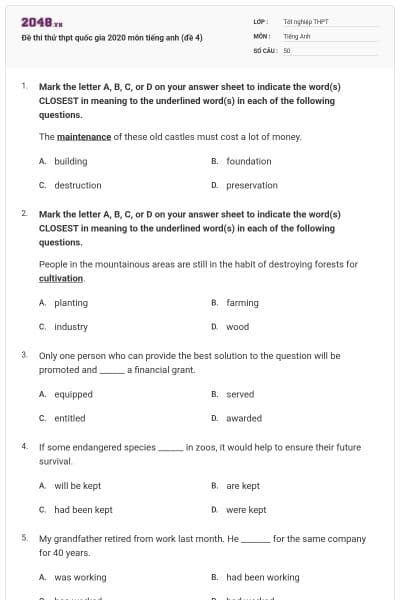
Mark the letter A, B, C, or D on your answer sheet to indicate the word(s) CLOSEST in meaning to the underlined word(s) in each of the following questions.
The maintenance of these old castles must cost a lot of money.
building
foundation
destruction
preservation
Chọn D
Kiến thức: Từ vựng, từ đồng nghĩa
Giải thích:
maintenance (n): sự giữ, sự duy trì
building (n): sự xây dựng, toà nhà foundation (n): sự thành lập, sự sáng lập
destruction (n): sự phá hoại, sự phá huỷ preservation (n): sự giữ, sự bảo tồn
=> maintenance = preservation
Tạm dịch: Việc duy trì những lâu đài cổ này phải tốn rất nhiều tiền.
Mark the letter A, B, C, or D on your answer sheet to indicate the word(s) CLOSEST in meaning to the underlined word(s) in each of the following questions.
People in the mountainous areas are still in the habit of destroying forests for cultivation.
planting
farming
industry
wood
Chọn B
Kiến thức: Từ vựng, từ đồng nghĩa
Giải thích:
cultivation (n): sự canh tác, sự trồng trọt
planting (n): sự trồng cây farming (n): nông nghiệp, canh tác
industry (n): công nghiệp wood (n): gỗ
=> cultivation = farming
Tạm dịch: Người dân vùng núi vẫn có thói quen phá rừng để trồng trọt.
Only one person who can provide the best solution to the question will be promoted and ______ a financial grant.
equipped
served
entitled
awarded
D
Kiến thức: Từ vựng
Giải thích:
equip (v): (+with) trang bị serve (v): phục vụ, đối xử
entitle (v): đặt tựa đề, đặt tên cho award (v): trao tặng, trao
Tạm dịch: Chỉ có một người có thể đưa ra giải pháp tốt nhất cho câu hỏi này sẽ được thăng chức và nhận một khoản trợ cấp tài chính
If some endangered species ______ in zoos, it would help to ensure their future survival.
will be kept
are kept
had been kept
were kept
D
Kiến thức: Câu điều kiện
Giải thích:
Ta dùng câu điều kiện loại 2 để diễn tả một hành động không có thật ở hiện tại.
Cấu trúc câu điều kiện loại 2: If + mệnh đề quá khứ đơn, S + would/could… + V +…
Tạm dịch: Nếu một số loài nguy cấp được giữ trong vườn thú, nó sẽ giúp đảm bảo sự sống còn của chúng trong tương lai
My grandfather retired from work last month. He _______ for the same company for 40 years.
was working
had been working
has worked
had worked
B
Kiến thức: Thì trong tiếng anh
Giải thích:
Ta dùng thì quá khứ hoàn thành để diễn tả một hành động bắt đầu và kéo dài (nhấn mạnh tính liên tục của hành động) đến trước một thời điểm/một hành động khác trong quá khứ.
Tạm dịch: Ông tôi đã nghỉ hưu vào tháng trước. Ông đã làm việc cho cùng một công ty trong 40 năm.
This building _______ finished by the end of last year but there have been so many strikes that it isn’t finished yet.
will have been
should have been
was to have been
may not have been
B
Kiến thức: Modal verb
Giải thích:
should + have PP: nên đã phải làm gì (nhưng thực tế là đã không làm)
Tạm dịch: Tòa nhà này đáng lẽ đã nên hoàn tất vào cuối năm ngoái nhưng có rất nhiều cuộc đình công khiến nó vẫn chưa hoàn thành.
Susan rarely stays up late, _______?
is she
isn’t she
does she
doesn’t she
C
Kiến thức: Câu hỏi đuôi
Giải thích:
Trong vế câu chính nếu có các trạng từ mang tính phủ định như “rarely” thì câu hỏi đuôi ở dạng khẳng định.
Vế chính dùng động từ, nên câu hỏi đuôi ta dùng trợ động từ.
Tạm dịch: Susan hiếm khi thức khuya, đúng không?
Hearing about people who mistreat animals makes me go hot under the ______.
chin
collar
sleeves
vest
B
Kiến thức: Idiom, từ vựng
Giải thích:
Ta có thành ngữ: “to be hot under the collar”: điên tiết, cáu tiết
Tạm dịch: Nghe về những người đối xử không tốt với động vật khiến tôi điên tiết.
Florida, ______ the Sunshine state, attracts many tourists every year.
is known as
that is known as
which known as
known as
D
Kiến thức: Quá khứ phân từ
Giải thích:
Ta dùng quá khứ phân từ tạo mệnh đề rút gọn cho dạng bị động (dạng chủ động ta dùng hiện tại phân từ). Trong câu này, “known as” được hiểu là “which is known as”
Tạm dịch: Florida, được biết đến với cái tên Sunshine, thu hút nhiều du khách mỗi năm.
You look really tired. You could ______ a week’s holiday, I think.
do with
make for
pass for
make with
A
Kiến thức: Phrasal verb
Giải thích:
do with (v): (chỉ một sự cần thiết, một sự mong muốn, thường dùng với can/could)
make for (v): giúp vào, góp vào
pass for (v): được coi là
make with (v): đưa ra, cung cấp nhanh chóng
Tạm dịch: Bạn trông thực sự mệt mỏi. Tôi nghĩ bạn có thể cần một kỳ nghỉ khoảng một tuần đấy.
For Arabic speakers, more than two consonants together can be difficult to _______, so they often insert a short vowel between them.
announce
denounce
pronounce
renounce
C
Kiến thức: Từ vựng
Giải thích:
announce (v): báo, giới thiệu denounce (v): tố cáo, lên án
pronounce (v): phát âm renounce (v): từ bỏ; bỏ
Tạm dịch: Đối với những người nói tiếng Ả Rập, nhiều hơn hai phụ âm với nhau có thể khó phát âm, vì vậy họ thường chèn một nguyên âm ngắn giữa chúng.
Flat-roofed buildings are not very ______ in areas where there is a great deal of rain or snowFlat-roofed buildings are not very ______ in areas where there is a great deal of rain or snow
severe
serious
suitable
sensitive
C
Kiến thức: Từ vựng
Giải thích:
severe (a): nghiêm khắc; khắc nghiệt serious (a): nghiêm trọng, nghiêm túc
suitable (a): hợp, phù hợp sensitive (a): nhạy cảm, dễ bị tổn thương
Tạm dịch: Các mái nhà lợp bằng phẳng không phù hợp ở những khu vực có nhiều mưa hoặc tuyết.
The local press has been pouring ______ on the mayor for dissolving the council.
scorn
blame
disapproval
hatred
A
Kiến thức: Từ vựng, cụm từ
Giải thích:
scorn (n): sự khinh bỉ, sự khinh miệt blame (n, v): sự đổ lỗi, đổ lỗi
disapproval (n): sự không tán thành hatred (n): lòng căm ghét
Cụm từ cố định "pour scorn on somebody": dè bỉu/chê bai ai đó
Tạm dịch: Truyền thông địa phương dè bỉu ngài thị trưởng vì giải tán hội đồng thành phố.
As a small boy, he was used to ______ alone in the house for an hour or two.
being left
leaving
be left
leave
A
Kiến thức: Cấu trúc với “be used to”
Giải thích:
“be used to” + V-ing: quen với việc làm gì
Về nghĩa của câu thì ta dùng ở dạng bị động sẽ phù hợp hơn.
Tạm dịch: Là một cậu bé nhỏ tuổi, cậu đã quen bị bỏ lại một mình ở nhà trong một hoặc hai giờ đồng hồ.
Read the following passage and mark the letter A, B, C, or D on your answer sheet to indicate the correct word or phrase that best fits each of the numbered blanks
Child workers, some as young as 10, have been found working in a textile factory in conditions described as close to slavery to produce clothes that appear destined for one of the major high street retailers. The discovery of these children working in appalling conditions in the Shahpur Jat area of Delhi has renewed concerns about the (15)______ by some large retail chains of their garment production to India, recognised (16)______ the United Nations as one of the world’s hotspots for child labour. According to one (17)______, over 20 per cent of India's economy is dependent on children, (18)______ comes to a total of 55 million youngsters under 14 working. Consumers in the West should not only be demanding answers from retailers about how their (19)______ are produced but also should be looking into their consciences at how they spend their money and whether cheap prices in the West are worth the suffering caused to so many children.
Điền vào ô 15
outsourcing
outsources
outsourced
outsource
A
Kiến thức: Từ loại, đọc hiểu
Giải thích:
outsourcing (n): quá trình sắp xếp cho ai đó bên ngoài công ty để làm việc hoặc cung cấp hàng hoá cho công ty đó
outsource (v): sắp xếp cho ai đó bên ngoài công ty để làm việc hoặc cung cấp hàng hoá cho công ty đó
outsourced (quá khứ/quá khứ phân từ)
Vị trí này ta cần một danh từ, vì phía trước có mạo từ “the”
Read the following passage and mark the letter A, B, C, or D on your answer sheet to indicate the correct word or phrase that best fits each of the numbered blanks
Child workers, some as young as 10, have been found working in a textile factory in conditions described as close to slavery to produce clothes that appear destined for one of the major high street retailers. The discovery of these children working in appalling conditions in the Shahpur Jat area of Delhi has renewed concerns about the (15)______ by some large retail chains of their garment production to India, recognised (16)______ the United Nations as one of the world’s hotspots for child labour. According to one (17)______, over 20 per cent of India's economy is dependent on children, (18)______ comes to a total of 55 million youngsters under 14 working. Consumers in the West should not only be demanding answers from retailers about how their (19)______ are produced but also should be looking into their consciences at how they spend their money and whether cheap prices in the West are worth the suffering caused to so many children.
Điền vào ô 16
for
with
of
by
D
Kiến thức: Giới từ, đọc hiểu
Giải thích:
for (prep): cho, vì with (prep): với
of (prep): của by (prep): bởi, trước
Read the following passage and mark the letter A, B, C, or D on your answer sheet to indicate the correct word or phrase that best fits each of the numbered blanks
Child workers, some as young as 10, have been found working in a textile factory in conditions described as close to slavery to produce clothes that appear destined for one of the major high street retailers. The discovery of these children working in appalling conditions in the Shahpur Jat area of Delhi has renewed concerns about the (15)______ by some large retail chains of their garment production to India, recognised (16)______ the United Nations as one of the world’s hotspots for child labour. According to one (17)______, over 20 per cent of India's economy is dependent on children, (18)______ comes to a total of 55 million youngsters under 14 working. Consumers in the West should not only be demanding answers from retailers about how their (19)______ are produced but also should be looking into their consciences at how they spend their money and whether cheap prices in the West are worth the suffering caused to so many children.
Điền vào ô 17
evaluation
investigation
calculation
estimate
D
Kiến thức: Từ vựng, đọc hiểu
Giải thích:
evaluation (n): sự đánh giá investigation (n): sự điều tra
calculation (n): sự tính toán; sự cân nhắc estimate (n): sự ước lượng, sự ước tính
Read the following passage and mark the letter A, B, C, or D on your answer sheet to indicate the correct word or phrase that best fits each of the numbered blanks
Child workers, some as young as 10, have been found working in a textile factory in conditions described as close to slavery to produce clothes that appear destined for one of the major high street retailers. The discovery of these children working in appalling conditions in the Shahpur Jat area of Delhi has renewed concerns about the (15)______ by some large retail chains of their garment production to India, recognised (16)______ the United Nations as one of the world’s hotspots for child labour. According to one (17)______, over 20 per cent of India's economy is dependent on children, (18)______ comes to a total of 55 million youngsters under 14 working. Consumers in the West should not only be demanding answers from retailers about how their (19)______ are produced but also should be looking into their consciences at how they spend their money and whether cheap prices in the West are worth the suffering caused to so many children.
Điền vào ô 18
who
which
what
that
B
Kiến thức: Mệnh đề quan hệ, đọc hiểu
Giải thích:
Ta dùng mệnh đề quan hệ “which” ở đây để thay thế cho toàn bộ vế câu ở trước dấu phảy.
Read the following passage and mark the letter A, B, C, or D on your answer sheet to indicate the correct word or phrase that best fits each of the numbered blanks
Child workers, some as young as 10, have been found working in a textile factory in conditions described as close to slavery to produce clothes that appear destined for one of the major high street retailers. The discovery of these children working in appalling conditions in the Shahpur Jat area of Delhi has renewed concerns about the (15)______ by some large retail chains of their garment production to India, recognised (16)______ the United Nations as one of the world’s hotspots for child labour. According to one (17)______, over 20 per cent of India's economy is dependent on children, (18)______ comes to a total of 55 million youngsters under 14 working. Consumers in the West should not only be demanding answers from retailers about how their (19)______ are produced but also should be looking into their consciences at how they spend their money and whether cheap prices in the West are worth the suffering caused to so many children.
Điền vào ô 19
goods
stuff
garment
ware
A
Kiến thức: Từ vựng, đọc hiểu
Giải thích:
goods (n): hàng hóa stuff (n): chất, chất liệu, cái, thứ…
garment (n): áo, quần ware (n): hàng, mặt hàng, đồ gốm sứ
Dịch bài đọc:
Các công nhân là trẻ em, khoảng 10 tuổi, được tìm thấy đang làm việc trong một nhà máy dệt may trong điều kiện được mô tả là gần với chế độ nô lệ để sản xuất quần áo dành cho một trong những nhà bán lẻ đường phố lớn.
Sự phát hiện của những đứa trẻ làm việc trong điều kiện khủng khiếp tại khu vực Shahpur Jat của Delhi đã làm mới mối quan ngại về việc sắp xếp người làm thêm bên ngoài của một số chuỗi bán lẻ lớn sản xuất hàng may mặc cho Ấn Độ, được LHQ công nhận là một trong những điểm nóng của thế giới đối với lao động trẻ em. Theo một ước tính, hơn 20% nền kinh tế Ấn Độ phụ thuộc vào trẻ em, trong đó có tới 55 triệu trẻ dưới 14 tuổi làm việc. Người tiêu dùng ở phương Tây không chỉ đòi hỏi những câu trả lời của các nhà bán lẻ về sản phẩm được sản xuất ra mà còn nên xem xét lương tâm về việc họ chi tiền và liệu giá rẻ ở phương Tây có đáng gây đau khổ cho nhiều trẻ em hay không.
Mark the letter A, B, C, or D on your answer sheet to indicate the sentence that best combines each pair of sentences in the following question
Mike graduated with a good degree. However, he joined the ranks of the unemployed.
If Mike graduated with a good degree, he would join the ranks of the unemployed.
That Mike graduated with a good degree helped him join the ranks of the unemployed.
Mike joined the ranks of the unemployed because he graduated with a good degree
Although Mike graduated with a good degree, he joined the ranks of the unemployed.
D
Kiến thức: Viết lại câu
Giải thích:
Tạm dịch: Mike tốt nghiệp với bằng giỏi. Tuy nhiên, anh gia nhập hàng ngũ những người thất nghiệp.
A. Nếu Mike tốt nghiệp với một bằng giỏi, anh sẽ gia nhập hàng ngũ của người thất nghiệp.
B. Việc Mike tốt nghiệp với một bằng đã giúp anh gia nhập hàng ngũ của người thất nghiệp.
C. Mike tham gia vào hàng ngũ những người thất nghiệp bởi vì anh tốt nghiệp với một bằng giỏi.
D. Mặc dù Mike tốt nghiệp với một bằng giỏi, anh đã gia nhập hàng ngũ những người thất nghiệp.
Mark the letter A, B, C, or D on your answer sheet to indicate the sentence that best combines each pair of sentences in the following questions.
Nam defeated the former champion in three sets. He finally won the inter-school table tennis championship.
Although Nam defeated the former champion in three sets, he did not win the title of inter- school table tennis championship.
Being defeated the former champion in three sets, Nam lost the chance to play the final games of inter-school table tennis championship.
Having defeated the former champion in three sets, Nam did not hold the title of champion.
Having defeated the former champion in three sets, Nam won the inter-school table tennis championship.
D
Kiến thức: Viết lại câu
Giải thích:
Tạm dịch: Nam đánh bại cựu vô địch trong ba xéc (ba ván). Cuối cùng anh đã giành chức vô địch bóng bàn liên trường.
A. Mặc dù Nam đánh bại cựu vô địch trong ba xéc, anh không giành được danh hiệu vô địch bóng bàn liên trường.
B. Bị đánh bại cựu vô địch trong ba xéc, Nam mất cơ hội để chơi các trận chung kết của giải vô địch bóng bàn liên trường.
C. Sau khi đánh bại cựu vô địch trong ba xéc, Nam không giữ danh hiệu vô địch.
D. Sau khi đánh bại cựu vô địch trong ba xéc, Nam đã giành giải vô địch bóng bàn liên trường
Mark the letter A, B, C, or D on your answer sheet to indicate the sentence that is closest in meaning to each of the following questions.
He was driving very fast because he didn’t know the road was icy.
If he knew the road was icy, he wouldn’t drive so fast.
He hadn’t been driving very fast if he would have known the road was icy.
If he had known the road was icy, he wouldn’t have been driving so fast.
He wasn’t driving very fast if he would know the road was icy.
C
Kiến thức: Viết lại câu, câu điều kiện
Giải thích:
Tạm dịch: Anh ấy đã lái xe rất nhanh bởi vì anh ấy không biết đường đã đóng băng. (Hành động lái xe là trong quá khứ)
A. Nếu anh ấy biết đường đã đóng băng, anh ấy sẽ không lái xe quá nhanh. (Hiện tại anh ấy lái xe quá nhanh)
B. Sai cấu trúc câu điều kiện loại 3
C. Nếu anh ấy biết con đường đã đóng băng, anh ấy hẳn đã không lái xe quá nhanh.
D. Sai cấu trúc câu điều kiện loại 2
Mark the letter A, B, C, or D on your answer sheet to indicate the sentence that is closest in meaning to each of the following questions.
It is difficult to start looking for a job at my age.
It is difficult for me to get employed at my age.
I’m young, so it is difficult to start looking for a job.
Getting employed at such ages is also difficult.
I don’t think I can start looking for a job now.
A
Kiến thức: Viết lại câu
Giải thích:
Tạm dịch: Rất khó để bắt đầu tìm việc ở độ tuổi của tôi.
A. Tôi khó có thể được làm việc ở tuổi của tôi.
B. Tôi còn trẻ, do đó rất khó để bắt đầu tìm kiếm việc làm.
C. Được làm việc ở những độ tuổi như vậy cũng rất khó.
D. Tôi không nghĩ mình có thể bắt đầu tìm việc ngay bây giờ.
Mark the letter A, B, C, or D on your answer sheet to indicate the sentence that is closest in meaning to each of the following questions.
I spent more time on the last question than I did on the first four.
The last question was the most difficult for me.
I answered only the first four questions.
I found the last question easier than the other questions.
I failed to get to the last question.
A
Kiến thức: Viết lại câu
Giải thích:
Tạm dịch: Tôi đã dành thời gian cho câu hỏi cuối cùng nhiều hơn so với bốn câu đầu tiên.
A. Câu hỏi cuối cùng là khó nhất đối với tôi.
B. Tôi chỉ trả lời bốn câu hỏi đầu tiên.
C. Câu hỏi cuối cùng dễ hơn những câu hỏi khác.
D. Tôi không thể làm đến câu hỏi cuối cùng.
Read the following passage and mark the letter A, B, C, or D on your answer sheet to indicate the correct answer to each of the questions
Unlike these fish, which are actually extinct, the coelacanth is a type of fish that was believed to be extinct. However, an unexpected twentieth- century rediscovery of living coelacanths has brought about a reassessment of the status of the prehistoric sea creature that was believed to have long since disappeared from the Earth. From fossil remains of the coelacanth, paleontologists have determined that the coelacanth was in existence around 350 million years ago, during the Paleozoic Era, more than 100 million years before the first dinosaurs arrived on the Earth. The most recent fossilized coelacanths date from around 70 million years ago, near the end of the age of dinosaurs. Because no fossilized remnants of coelacanth was believed to have died out around the same time as the dinosaurs.
The prehistoric coelacanth studied by paleontologists had distinctive characteristics that differentiated it from other fish. It was named for its hollow spine and was known to have been a powerful carnivore because of its many sharp teeth and a special joint in the skull that allowed the ferocious teeth to move in coordination with the lower jaw. It also had a pair of fins with unusual bony and muscular development that allowed the coelacanth to dart around the ocean floor. These fins also enable the coelacanth to search out prey trying to hide on the ocean bottom.
In 1938, a living specimen of the coelacanth was discovered in the catch of a fishing boat off the coast of South Africa, and since then numerous other examples of the coelacanth have been found in the waters of the Indian Ocean. This modern version of the coelacanth is not exactly the same as its prehistoric cousin. Today's coelacanth is larger than its prehistoric relative, measuring up to six feet in length and weighing up to 150 pounds. However, the modern version of the coelacanth still possesses the characteristic hollow spine and distinctive fins with their unusual bony and muscular structure.
It can be inferred from the passage that the first dinosaurs most likely appeared on Earth around
450 million years ago
350 million years ago
150 million years ago
250 million years ago
D
Kiến thức: Đọc hiểu
Giải thích:
Có thể suy luận từ đoạn văn rằng những con khủng long đầu tiên có thể xuất hiện trên trái đất khoảng
A. 450 triệu năm trước B. 350 triệu năm trước
C. 150 triệu năm trước D. 250 triệu năm trước
Thông tin: From fossil remains of the coelacanth, paleontologists have determined that the coelacanth was in existence around 350 million years ago, during the Paleozoic Era, more than 100 million years before the first dinosaurs arrived on the Earth.
Read the following passage and mark the letter A, B, C, or D on your answer sheet to indicate the correct answer to each of the questions
Unlike these fish, which are actually extinct, the coelacanth is a type of fish that was believed to be extinct. However, an unexpected twentieth- century rediscovery of living coelacanths has brought about a reassessment of the status of the prehistoric sea creature that was believed to have long since disappeared from the Earth. From fossil remains of the coelacanth, paleontologists have determined that the coelacanth was in existence around 350 million years ago, during the Paleozoic Era, more than 100 million years before the first dinosaurs arrived on the Earth. The most recent fossilized coelacanths date from around 70 million years ago, near the end of the age of dinosaurs. Because no fossilized remnants of coelacanth was believed to have died out around the same time as the dinosaurs.
The prehistoric coelacanth studied by paleontologists had distinctive characteristics that differentiated it from other fish. It was named for its hollow spine and was known to have been a powerful carnivore because of its many sharp teeth and a special joint in the skull that allowed the ferocious teeth to move in coordination with the lower jaw. It also had a pair of fins with unusual bony and muscular development that allowed the coelacanth to dart around the ocean floor. These fins also enable the coelacanth to search out prey trying to hide on the ocean bottom.
In 1938, a living specimen of the coelacanth was discovered in the catch of a fishing boat off the coast of South Africa, and since then numerous other examples of the coelacanth have been found in the waters of the Indian Ocean. This modern version of the coelacanth is not exactly the same as its prehistoric cousin. Today's coelacanth is larger than its prehistoric relative, measuring up to six feet in length and weighing up to 150 pounds. However, the modern version of the coelacanth still possesses the characteristic hollow spine and distinctive fins with their unusual bony and muscular structure.
It can be inferred from the passage that the word “coelacanth” comes from the Greek
sharp teeth
extinct fish
hollow spine
bony fingers
C
Kiến thức: Đọc hiểu
Giải thích:
Có thể suy luận từ đoạn văn rằng từ "coelacanth" xuất phát từ tiếng Hy Lạp
A. răng sắc bén B. cá đã tuyệt chủng
C. cột sống rỗng D. ngón tay xương xẩu
Thông tin: The prehistoric coelacanth studied by paleontologists had distinctive characteristics that differentiated it from other fish. It was named for its hollow spine
Read the following passage and mark the letter A, B, C, or D on your answer sheet to indicate the correct answer to each of the questions
Unlike these fish, which are actually extinct, the coelacanth is a type of fish that was believed to be extinct. However, an unexpected twentieth- century rediscovery of living coelacanths has brought about a reassessment of the status of the prehistoric sea creature that was believed to have long since disappeared from the Earth. From fossil remains of the coelacanth, paleontologists have determined that the coelacanth was in existence around 350 million years ago, during the Paleozoic Era, more than 100 million years before the first dinosaurs arrived on the Earth. The most recent fossilized coelacanths date from around 70 million years ago, near the end of the age of dinosaurs. Because no fossilized remnants of coelacanth was believed to have died out around the same time as the dinosaurs.
The prehistoric coelacanth studied by paleontologists had distinctive characteristics that differentiated it from other fish. It was named for its hollow spine and was known to have been a powerful carnivore because of its many sharp teeth and a special joint in the skull that allowed the ferocious teeth to move in coordination with the lower jaw. It also had a pair of fins with unusual bony and muscular development that allowed the coelacanth to dart around the ocean floor. These fins also enable the coelacanth to search out prey trying to hide on the ocean bottom.
In 1938, a living specimen of the coelacanth was discovered in the catch of a fishing boat off the coast of South Africa, and since then numerous other examples of the coelacanth have been found in the waters of the Indian Ocean. This modern version of the coelacanth is not exactly the same as its prehistoric cousin. Today's coelacanth is larger than its prehistoric relative, measuring up to six feet in length and weighing up to 150 pounds. However, the modern version of the coelacanth still possesses the characteristic hollow spine and distinctive fins with their unusual bony and muscular structure.
What is NOT true about the prehistoric coelacanth, according to the passage ?
It was smaller than the modern coelacanth.
It had a hollow pine and distinctive fins.
It weighed less than 150 pounds.
It measured as much as six feet in length.
D
Kiến thức: Đọc hiểu
Giải thích:
Điều gì là không đúng sự thật về cá vây tay tiền sử, theo đoạn văn?
A. Nó nhỏ hơn so với cá vây tay hiện đại. B. Nó có cột sống rỗng và vây khác thường.
C. Nó nặng chưa đầy 150 pound. D. Nó dài khoảng 6 feet.
Thông tin:
- Today's coelacanth is larger than its prehistoric relative, measuring up to six feet in length and weighing up to 150 pounds.
- However, the modern version of the coelacanth still possesses the characteristic hollow spine and distinctive fins with their unusual bony and muscular structure.
Read the following passage and mark the letter A, B, C, or D on your answer sheet to indicate the correct answer to each of the questions
Unlike these fish, which are actually extinct, the coelacanth is a type of fish that was believed to be extinct. However, an unexpected twentieth- century rediscovery of living coelacanths has brought about a reassessment of the status of the prehistoric sea creature that was believed to have long since disappeared from the Earth. From fossil remains of the coelacanth, paleontologists have determined that the coelacanth was in existence around 350 million years ago, during the Paleozoic Era, more than 100 million years before the first dinosaurs arrived on the Earth. The most recent fossilized coelacanths date from around 70 million years ago, near the end of the age of dinosaurs. Because no fossilized remnants of coelacanth was believed to have died out around the same time as the dinosaurs.
The prehistoric coelacanth studied by paleontologists had distinctive characteristics that differentiated it from other fish. It was named for its hollow spine and was known to have been a powerful carnivore because of its many sharp teeth and a special joint in the skull that allowed the ferocious teeth to move in coordination with the lower jaw. It also had a pair of fins with unusual bony and muscular development that allowed the coelacanth to dart around the ocean floor. These fins also enable the coelacanth to search out prey trying to hide on the ocean bottom.
In 1938, a living specimen of the coelacanth was discovered in the catch of a fishing boat off the coast of South Africa, and since then numerous other examples of the coelacanth have been found in the waters of the Indian Ocean. This modern version of the coelacanth is not exactly the same as its prehistoric cousin. Today's coelacanth is larger than its prehistoric relative, measuring up to six feet in length and weighing up to 150 pounds. However, the modern version of the coelacanth still possesses the characteristic hollow spine and distinctive fins with their unusual bony and muscular structure.
The pronoun “It” in the third paragraph refers to
coordination
coelacanth
joint
jaw
B
Kiến thức: Đọc hiểu
Giải thích:
Đại từ "Nó" ở đoạn thứ ba đề cập đến
A. phối hợp B. cá vây tay
C. khớp D. hàm
“It” đề cập đến cá vây tay: The prehistoric coelacanth studied by paleontologists had distinctive characteristics that differentiated it from other fish. […] It also had a pair of fins with unusual bony and muscular development that allowed the coelacanth to dart around the ocean floor.
Cá vây tay tiền sử được các nhà cổ sinh vật học nghiên cứu có đặc điểm phân biệt với các loài cá khác. […] Nó cũng có một đôi vây với sự phát triển xương và cơ bắp bất thường cho phép cá vây tay lặn xuống đáy đại dương.
Read the following passage and mark the letter A, B, C, or D on your answer sheet to indicate the correct answer to each of the questions
Unlike these fish, which are actually extinct, the coelacanth is a type of fish that was believed to be extinct. However, an unexpected twentieth- century rediscovery of living coelacanths has brought about a reassessment of the status of the prehistoric sea creature that was believed to have long since disappeared from the Earth. From fossil remains of the coelacanth, paleontologists have determined that the coelacanth was in existence around 350 million years ago, during the Paleozoic Era, more than 100 million years before the first dinosaurs arrived on the Earth. The most recent fossilized coelacanths date from around 70 million years ago, near the end of the age of dinosaurs. Because no fossilized remnants of coelacanth was believed to have died out around the same time as the dinosaurs.
The prehistoric coelacanth studied by paleontologists had distinctive characteristics that differentiated it from other fish. It was named for its hollow spine and was known to have been a powerful carnivore because of its many sharp teeth and a special joint in the skull that allowed the ferocious teeth to move in coordination with the lower jaw. It also had a pair of fins with unusual bony and muscular development that allowed the coelacanth to dart around the ocean floor. These fins also enable the coelacanth to search out prey trying to hide on the ocean bottom.
In 1938, a living specimen of the coelacanth was discovered in the catch of a fishing boat off the coast of South Africa, and since then numerous other examples of the coelacanth have been found in the waters of the Indian Ocean. This modern version of the coelacanth is not exactly the same as its prehistoric cousin. Today's coelacanth is larger than its prehistoric relative, measuring up to six feet in length and weighing up to 150 pounds. However, the modern version of the coelacanth still possesses the characteristic hollow spine and distinctive fins with their unusual bony and muscular structure.
What is stated in the passage about the prehistoric coelacanth?
It had few teeth.
It was a rather feeble fish.
It lived on plants.
It moved its teeth in an unusual way.
D
Kiến thức: Đọc hiểu
Giải thích:
Điều gì được nêu trong đoạn văn về cá vây tay thời tiền sử?
A. Có ít răng. B. Là một loài cá khá yếu.
C. Nó sống trên cây. D. Nó chuyển động răng của nó theo một cách khác thường.
Thông tin: It was named for its hollow spine and was known to have been a powerful carnivore because of its many sharp teeth and a special joint in the skull that allowed the ferocious teeth to move in coordination with the lower jaw.
Read the following passage and mark the letter A, B, C, or D on your answer sheet to indicate the correct answer to each of the questions
Unlike these fish, which are actually extinct, the coelacanth is a type of fish that was believed to be extinct. However, an unexpected twentieth- century rediscovery of living coelacanths has brought about a reassessment of the status of the prehistoric sea creature that was believed to have long since disappeared from the Earth. From fossil remains of the coelacanth, paleontologists have determined that the coelacanth was in existence around 350 million years ago, during the Paleozoic Era, more than 100 million years before the first dinosaurs arrived on the Earth. The most recent fossilized coelacanths date from around 70 million years ago, near the end of the age of dinosaurs. Because no fossilized remnants of coelacanth was believed to have died out around the same time as the dinosaurs.
The prehistoric coelacanth studied by paleontologists had distinctive characteristics that differentiated it from other fish. It was named for its hollow spine and was known to have been a powerful carnivore because of its many sharp teeth and a special joint in the skull that allowed the ferocious teeth to move in coordination with the lower jaw. It also had a pair of fins with unusual bony and muscular development that allowed the coelacanth to dart around the ocean floor. These fins also enable the coelacanth to search out prey trying to hide on the ocean bottom.
In 1938, a living specimen of the coelacanth was discovered in the catch of a fishing boat off the coast of South Africa, and since then numerous other examples of the coelacanth have been found in the waters of the Indian Ocean. This modern version of the coelacanth is not exactly the same as its prehistoric cousin. Today's coelacanth is larger than its prehistoric relative, measuring up to six feet in length and weighing up to 150 pounds. However, the modern version of the coelacanth still possesses the characteristic hollow spine and distinctive fins with their unusual bony and muscular structure.
This passage is about a fish
that is extinct
that once was extinct
that is becoming extinct
that is not extinct
D
Kiến thức: Đọc hiểu
Giải thích:
Đoạn này nói về một con cá
A. hiện đã tuyệt chủng B. đã từng bị tuyệt chủng
C. đang trở nên bị tuyệt chủng D. không bị tuyệt chủng
Thông tin: Unlike these fish, which are actually extinct, the coelacanth is a type of fish that was believed to be extinct. However, an unexpected twentieth- century rediscovery of living coelacanths has brought about a reassessment of the status of the prehistoric sea creature that was believed to have long since disappeared from the Earth.
Read the following passage and mark the letter A, B, C, or D on your answer sheet to indicate the correct answer to each of the questions
Unlike these fish, which are actually extinct, the coelacanth is a type of fish that was believed to be extinct. However, an unexpected twentieth- century rediscovery of living coelacanths has brought about a reassessment of the status of the prehistoric sea creature that was believed to have long since disappeared from the Earth. From fossil remains of the coelacanth, paleontologists have determined that the coelacanth was in existence around 350 million years ago, during the Paleozoic Era, more than 100 million years before the first dinosaurs arrived on the Earth. The most recent fossilized coelacanths date from around 70 million years ago, near the end of the age of dinosaurs. Because no fossilized remnants of coelacanth was believed to have died out around the same time as the dinosaurs.
The prehistoric coelacanth studied by paleontologists had distinctive characteristics that differentiated it from other fish. It was named for its hollow spine and was known to have been a powerful carnivore because of its many sharp teeth and a special joint in the skull that allowed the ferocious teeth to move in coordination with the lower jaw. It also had a pair of fins with unusual bony and muscular development that allowed the coelacanth to dart around the ocean floor. These fins also enable the coelacanth to search out prey trying to hide on the ocean bottom.
In 1938, a living specimen of the coelacanth was discovered in the catch of a fishing boat off the coast of South Africa, and since then numerous other examples of the coelacanth have been found in the waters of the Indian Ocean. This modern version of the coelacanth is not exactly the same as its prehistoric cousin. Today's coelacanth is larger than its prehistoric relative, measuring up to six feet in length and weighing up to 150 pounds. However, the modern version of the coelacanth still possesses the characteristic hollow spine and distinctive fins with their unusual bony and muscular structure.
According to the passage, why are scientists sure that the prehistoric coelacanth was a flesh-eater?
Because of its hollow spine
Because of its unusual bony and muscular development
Because of the shape and movement of the teeth
Because of the size of the skull
C
Kiến thức: Đọc hiểu
Giải thích:
Theo đoạn văn, tại sao các nhà khoa học chắc chắn rằng cá vây tay tiền sử là một loài ăn thịt?
A. Do cột sống rỗng của nó
B. Do sự phát triển xương và cơ bất thường của nó
C. Do hình dạng và chuyển động của răng
D. Do kích thước của hộp sọ
Thông tin: It was named for its hollow spine and was known to have been a powerful carnivore because of its many sharp teeth and a special joint in the skull that allowed the ferocious teeth to move in coordination with the lower jaw.
Read the following passage and mark the letter A, B, C, or D on your answer sheet to indicate the correct answer to each of the questions
Unlike these fish, which are actually extinct, the coelacanth is a type of fish that was believed to be extinct. However, an unexpected twentieth- century rediscovery of living coelacanths has brought about a reassessment of the status of the prehistoric sea creature that was believed to have long since disappeared from the Earth. From fossil remains of the coelacanth, paleontologists have determined that the coelacanth was in existence around 350 million years ago, during the Paleozoic Era, more than 100 million years before the first dinosaurs arrived on the Earth. The most recent fossilized coelacanths date from around 70 million years ago, near the end of the age of dinosaurs. Because no fossilized remnants of coelacanth was believed to have died out around the same time as the dinosaurs.
The prehistoric coelacanth studied by paleontologists had distinctive characteristics that differentiated it from other fish. It was named for its hollow spine and was known to have been a powerful carnivore because of its many sharp teeth and a special joint in the skull that allowed the ferocious teeth to move in coordination with the lower jaw. It also had a pair of fins with unusual bony and muscular development that allowed the coelacanth to dart around the ocean floor. These fins also enable the coelacanth to search out prey trying to hide on the ocean bottom.
In 1938, a living specimen of the coelacanth was discovered in the catch of a fishing boat off the coast of South Africa, and since then numerous other examples of the coelacanth have been found in the waters of the Indian Ocean. This modern version of the coelacanth is not exactly the same as its prehistoric cousin. Today's coelacanth is larger than its prehistoric relative, measuring up to six feet in length and weighing up to 150 pounds. However, the modern version of the coelacanth still possesses the characteristic hollow spine and distinctive fins with their unusual bony and muscular structure.
The topic of the preceding paragraph is most likely
the discovery of the coelacanth
a reassessment of the status of a number of kinds of fish
a particular prehistoric sea creature
various extinct fish
D
Kiến thức: Đọc hiểu
Giải thích:
Chủ đề của đoạn trước rất có thể là
A. sự khám phá cá vây tay B. đánh giá lại tình trạng của một số loại cá
C. một sinh vật biển thời tiền sử đặc biệt D. các loài cá tuyệt chủng khác nhau
Bởi ở đầu bài viết này có nhắc đến “these fish, which are actually extinct” nên đoạn trước có thể nói về các loài cá đã tuyệt chủng
Dịch bài đọc:
Không giống như những loài cá này thực sự đã tuyệt chủng, cá vây tay là một loại cá được cho là đã tuyệt chủng. Tuy nhiên, một khám phá lạ lùng trong thế kỷ hai mươi về cá vây tay sống đã mang đến một đánh giá về trạng thái của sinh vật biển tiền sử được cho là từ lâu đã biến mất khỏi Trái Đất.
Từ các hóa thạch còn lại của cá vây tay, các nhà cổ sinh vật học đã xác định rằng cá vây tay đã tồn tại khoảng 350 triệu năm trước, trong kỷ nguyên Paleozoi, hơn 100 triệu năm trước khi những con khủng long đầu tiên xuất hiện trên trái đất. Các loài cá vây tay hoá thạch gần đây nhất được cho là từ khoảng 70 triệu năm trước, gần cuối thời kỳ khủng long. Bởi vì không có hóa thạch còn sót lại của cá vây tay được cho là đã chết trong khoảng thời gian giống như khủng long.
Cá vây tay tiền sử được các nhà cổ sinh vật học nghiên cứu có đặc điểm phân biệt với các loài cá khác. Nó được đặt tên bởi cột sống rỗng của nó và được biết đến là một động vật ăn thịt mạnh bởi nhiều răng sắc và một khớp đặc biệt trong hộp sọ cho phép răng khoẻ mạnh chuyển động cùng với hàm dưới. Nó cũng có một đôi vây với sự phát triển xương và cơ bắp bất thường cho phép cá vây tay lặn xuống đáy đại dương. Những vây này cũng cho phép cá vây tay tìm ra con mồi cố gắng trốn trên đáy đại dương.
Năm 1938, một mẫu vật sống của cá vây tay đã được tìm thấy trong một chiếc thuyền đánh bắt ngoài khơi Nam Phi, và kể từ đó nhiều ví dụ khác của cá vây tay đã được tìm thấy ở vùng biển Ấn Độ Dương. Phiên bản hiện đại của cá vây tay không hoàn toàn giống với thời tiền sử của nó. Cá vây tay ngày nay lớn hơn so với tiền sử của nó, có chiều dài lên đến 6 feet và nặng đến 150 pound. Tuy nhiên, phiên bản hiện đại của cá vây tay vẫn có cột sống rỗng đặc trưng và các vây đặc biệt với cấu trúc xương và cơ bất thường của chúng.
Mark the letter A, B, C, or D on your answer sheet to indicate the word whose underlined part differs from the other three in pronunciation in each of the following questions.
buttons
books
begs
cans
B
Kiến thức: Phát âm “-s”
Giải thích:
Có ba quy tắc phát âm đuôi s/es
Quy tắc 1: Phát âm là /s/ khi tận cùng từ bằng -p, -k, -t, -f.
Quy tắc 2: Phát âm là /iz/ khi tận cùng từ bằng -s,-ss,-ch,-sh,-x,-z,-o,-ge,-ce.
Quy tắc 3: Phát âm là /z/ đối với những từ còn lại.
Phần gạch chân câu B được phát âm là /s/ còn lại là /z/
Mark the letter A, B, C, or D on your answer sheet to indicate the word whose underlined part differs from the other three in pronunciation in each of the following questions.
family
famine
famous
fabricate
C
Kiến thức: Phát âm “-a”
Giải thích:
family /'fæməli/ famine /'fæmin/
famous /'feiməs/ fabricate /'fæbrikeit/
Phần gạch chân câu C được phát âm là /ei/ còn lại là /æ/
In early days, hydrochloric acid was done by heating a mixture of sodium chloride with iron sulfate.
In early days
done
heating
with
B
Kiến thức: Từ vựng, sửa lỗi sai
Giải thích:
done => made
Câu này sai vì dùng từ không đúng nghĩa.
do (v): làm; và make (v): tạo ra
Tạm dịch: Trong những ngày đầu tiên, axit clohiđric được tạo ra bằng cách nung nóng một hỗn hợp natri clorua với sắt sulfat.
Never in the history of humanity has there been more people living on this relatively small planet.
humanity
has
living
relatively
B
Kiến thức: Cấu trúc với “there be”
Giải thích:
has => have
Phía sau là danh từ số nhiều (people) nên ta không thể dùng “has” mà phải dùng “have”
Tạm dịch: Chưa bao giờ trong lịch sử nhân loại có nhiều người hơn thế này sống trên hành tinh tương đối nhỏ này.
The number of wild horses on Assateague is increasing, resulted in overgrazed marsh and dune grasses.
number
is
resulted
grasses
C
Kiến thức: Hiện tại phân từ, quá khứ phân từ
Giải thích:
resulted => resulting
Ta dùng hiện tại phân từ tạo một mệnh đề quan hệ rút gọn đối với dạng chủ động (còn dạng bị động ta dùng quá khứ phân từ)
Trong câu này “resulting” được hiểu là “which results”
Tạm dịch: Số lượng ngựa hoang ở Assateague đang gia tăng nhanh chóng, dẫn đến những bãi cỏ đầm lầy và cỏ dốc trở nên quá tải.
Mark the letter A, B, C, or D on your answer sheet to indicate the word that differs from the other three in the position of the primary stress in each of the following questions.
instruction
intelligent
comprehend
inflation
C
Kiến thức: Trọng âm của từ có 3 âm tiết trở lên
Giải thích:
instruction /in'strʌk∫n/ intelligent /in'telidʒənt/
comprehend /,kɒmpri'hend/ inflation /in'flei∫n/
Câu C trọng âm rơi vào âm tiết thứ 3, còn lại là thứ 2
Mark the letter A, B, C, or D on your answer sheet to indicate the word that differs from the other three in the position of the primary stress in each of the following questions.
reveal
offer
provide
collapse
B
Kiến thức: Trọng âm của từ có 2 âm tiết
Giải thích:
reveal /ri'vi:l/ offer /'ɒfə[r]/
provide /prə'vaid/ collapse /kə'læps/
câu B trọng âm rơi vào âm tiết thứ nhất, còn lại là thứ 2
Mark the letter A, B, C, or D on your answer sheet to indicate the word(s) OPPOSITE in meaning to the underlined word(s) in each of the following questions
If one fails to achieve a goal, his or her efforts are fruitless.
profitable
futile
purposeful
useless
A
Kiến thức: Từ vựng, từ trái nghĩa
Giải thích:
fruitless (a): không có kết quả, thất bại profitable (a): có lợi; bổ ích
futile (a): vô ích, vô nghĩa purposeful (a): [có] quyết tâm
useless (a): vô ích, vô dụng
=> fruitless >< profitable
Tạm dịch: Nếu một người không đạt được mục tiêu, thì nỗ lực của họ là không có kết quả.
Mark the letter A, B, C, or D on your answer sheet to indicate the word(s) OPPOSITE in meaning to the underlined word(s) in each of the following questions.
Hazardous waste is waste that has substantial or potential threats to public health or the environment.
vivid
risky
dangerous
secure
D
Kiến thức: Từ vựng, từ trái nghĩa
Giải thích:
hazardous (a): nguy hiểm vivid (a): tươi sáng, sống động
risky (a): đầy rủi ro nguy hiểm dangerous (a): nguy hiểm
secure (a): bảo đảm, an toàn
=> hazardous >< secure
Tạm dịch: Chất thải nguy hại là chất thải có những mối đe dọa đáng kể hoặc tiềm ẩn đối với sức khoẻ cộng đồng hoặc môi trường.
Janet: “How did you get here?” - Susan: “_____.”
I came here last night.
The train was so crowded.
Is it far from here?
I came here by train.
D
Kiến thức: Văn hoá giao tiếp
Giải thích:
Tạm dịch: - Janet: "Bạn đã đến đây bằng cách nào?" - Susan: "_____."
A. Tôi đến đây đêm qua. B. Con tàu rất đông.
C. Từ đây cách nó xa không? D. Tôi đến đây bằng tàu hỏa.
- Janet: “Do you feel like going to the cinema this evening?” - Susan: “_____.”
I don't agree. I’m afraid.
I feel very bored.
That would be great.
You’re welcome.
C
Kiến thức: Văn hoá giao tiếp
Giải thích:
Tạm dịch: - Janet: "Bạn có muốn đi xem phim vào tối nay không?" - Susan: "_____."
A. Tôi không đồng ý. Tôi sợ. B. Tôi cảm thấy rất chán.
C. Điều đó hẳn sẽ rất tuyệt vời. D. Không có gì. (đáp lại lời cám ơn)
Read the following passage and mark the letter A, B, C, or D on your answer sheet to indicate the correct answer to each of the questions
For a century before the Erie Canal was built, there was much discussion among the general population of the Northeast as to the need for connecting the waterways of the Great Lakes with the Atlantic Ocean. A project of such monumental proportions was not going to be undertaken and completed without a supreme amount of effort.
The man who was instrumental in accomplishing the feat that was the Erie Canal was Dewitt Clinton. As early as 1812, he was in the nation's capital petitioning the federal government for financial assistance on the project, emphasizing what a boon to the economy of the country the canal would be; his efforts with the federal government, however, were not successful.
In 1816, Clinton asked the New York State Legislature for the funding for the canal, and this time he did succeed. A canal commission was instituted, and Clinton himself was made head of it. One year later, Clinton was elected governor of the state, and soon after, construction of the canal was started.
The canal took eight years to complete, and Clinton was on the first barge to travel the length of the canal, the Seneca Chief, which departed from Buffalo on October 26, 1825, and arrived in New York City on November
4. Because of the success of the Erie Canal, numerous other canals were built in other parts of the country.
The pronoun “it” in the 3rd paragraph refers to which of the following?
The canal
The New York State Legislation
The state governor
The commission
44. D
Kiến thức: Đọc hiểu
Giải thích:
Đại từ "it" trong đoạn thứ ba đề cập đến?
A. Kênh đào B. Luật pháp tiểu bang New York
C. Thống đốc bang D. Uỷ ban
Từ “it” đề cập đến “commission” ở vế trước: A canal commission was instituted, and Clinton himself was made head of it.
Một ủy ban kênh đào đã được thành lập, và chính Clinton đã được làm chủ.
Read the following passage and mark the letter A, B, C, or D on your answer sheet to indicate the correct answer to each of the questions
For a century before the Erie Canal was built, there was much discussion among the general population of the Northeast as to the need for connecting the waterways of the Great Lakes with the Atlantic Ocean. A project of such monumental proportions was not going to be undertaken and completed without a supreme amount of effort.
The man who was instrumental in accomplishing the feat that was the Erie Canal was Dewitt Clinton. As early as 1812, he was in the nation's capital petitioning the federal government for financial assistance on the project, emphasizing what a boon to the economy of the country the canal would be; his efforts with the federal government, however, were not successful.
In 1816, Clinton asked the New York State Legislature for the funding for the canal, and this time he did succeed. A canal commission was instituted, and Clinton himself was made head of it. One year later, Clinton was elected governor of the state, and soon after, construction of the canal was started.
The canal took eight years to complete, and Clinton was on the first barge to travel the length of the canal, the Seneca Chief, which departed from Buffalo on October 26, 1825, and arrived in New York City on November
4. Because of the success of the Erie Canal, numerous other canals were built in other parts of the country.
When did Clinton ask the U.S. government for funds for the canal?
In 1812
In 1825
In 1816
One hundred years before the canal was built.
C
Kiến thức: Đọc hiểu
Giải thích:
Khi nào Clinton yêu cầu chính phủ Hoa Kỳ về kinh phí cho kênh đào?
A. Năm 1812 B. Năm 1825
C. Năm 1816 D. Một trăm năm trước khi con kênh được xây dựng.
Thông tin: In 1816, Clinton asked the New York State Legislature for the funding for the canal, and this time he did succeed.
Read the following passage and mark the letter A, B, C, or D on your answer sheet to indicate the correct answer to each of the questions
For a century before the Erie Canal was built, there was much discussion among the general population of the Northeast as to the need for connecting the waterways of the Great Lakes with the Atlantic Ocean. A project of such monumental proportions was not going to be undertaken and completed without a supreme amount of effort.
The man who was instrumental in accomplishing the feat that was the Erie Canal was Dewitt Clinton. As early as 1812, he was in the nation's capital petitioning the federal government for financial assistance on the project, emphasizing what a boon to the economy of the country the canal would be; his efforts with the federal government, however, were not successful.
In 1816, Clinton asked the New York State Legislature for the funding for the canal, and this time he did succeed. A canal commission was instituted, and Clinton himself was made head of it. One year later, Clinton was elected governor of the state, and soon after, construction of the canal was started.
The canal took eight years to complete, and Clinton was on the first barge to travel the length of the canal, the Seneca Chief, which departed from Buffalo on October 26, 1825, and arrived in New York City on November
4. Because of the success of the Erie Canal, numerous other canals were built in other parts of the country.
The Seneca Chief was
the nickname of Buffalo
the name of the canal
Clinton's nickname
the name of a boat
D
Kiến thức: Đọc hiểu
Giải thích:
The Seneca Chief là
A. biệt danh của Buffalo B. tên của kênh
C. biệt danh của Clinton D. tên của một chiếc thuyền
Thông tin: The canal took eight years to complete, and Clinton was on the first barge to travel the length of the canal, the Seneca Chief, which departed from Buffalo on October 26, 1825, and arrived in New York City on November 4.
Kênh đào này mất 8 năm để hoàn thành, và Clinton đã ở trên chiếc sà lan đầu tiên đi dọc theo chiều dài của con kênh, the Seneca Chief, khởi hành từ Buffalo vào ngày 26 tháng 10 năm 1825 và đến thành phố New York vào ngày 4 tháng 11.
Read the following passage and mark the letter A, B, C, or D on your answer sheet to indicate the correct answer to each of the questions
For a century before the Erie Canal was built, there was much discussion among the general population of the Northeast as to the need for connecting the waterways of the Great Lakes with the Atlantic Ocean. A project of such monumental proportions was not going to be undertaken and completed without a supreme amount of effort.
The man who was instrumental in accomplishing the feat that was the Erie Canal was Dewitt Clinton. As early as 1812, he was in the nation's capital petitioning the federal government for financial assistance on the project, emphasizing what a boon to the economy of the country the canal would be; his efforts with the federal government, however, were not successful.
In 1816, Clinton asked the New York State Legislature for the funding for the canal, and this time he did succeed. A canal commission was instituted, and Clinton himself was made head of it. One year later, Clinton was elected governor of the state, and soon after, construction of the canal was started.
The canal took eight years to complete, and Clinton was on the first barge to travel the length of the canal, the Seneca Chief, which departed from Buffalo on October 26, 1825, and arrived in New York City on November
4. Because of the success of the Erie Canal, numerous other canals were built in other parts of the country.
The information in the passage
is in chronological order
is organized spatially
gives a cause followed by an effect
lists opposing viewpoints of a problem
A
Kiến thức: Đọc hiểu
Giải thích:
Thông tin trong đoạn văn
A. theo thứ tự thời gian
B. được tổ chức về không gian
C. đưa ra một nguyên nhân sau đó là ảnh hưởng
D. liệt kê các quan điểm trái ngược nhau của một
vấn đề
Read the following passage and mark the letter A, B, C, or D on your answer sheet to indicate the correct answer to each of the questions
For a century before the Erie Canal was built, there was much discussion among the general population of the Northeast as to the need for connecting the waterways of the Great Lakes with the Atlantic Ocean. A project of such monumental proportions was not going to be undertaken and completed without a supreme amount of effort.
The man who was instrumental in accomplishing the feat that was the Erie Canal was Dewitt Clinton. As early as 1812, he was in the nation's capital petitioning the federal government for financial assistance on the project, emphasizing what a boon to the economy of the country the canal would be; his efforts with the federal government, however, were not successful.
In 1816, Clinton asked the New York State Legislature for the funding for the canal, and this time he did succeed. A canal commission was instituted, and Clinton himself was made head of it. One year later, Clinton was elected governor of the state, and soon after, construction of the canal was started.
The canal took eight years to complete, and Clinton was on the first barge to travel the length of the canal, the Seneca Chief, which departed from Buffalo on October 26, 1825, and arrived in New York City on November
4. Because of the success of the Erie Canal, numerous other canals were built in other parts of the country.
The word “boon” in the 2nd paragraph is closest in meaning to
Disadvantage
Benefit
Cost
Detriment
B
Kiến thức: Đọc hiểu
Giải thích:
Từ "boon" trong đoạn 2 có ý nghĩa gần nhất với
A. nhược điểm B. lợi ích
C. chi phí D. thiệt hại
“boon” = benefit: lợi ích
he was in the nation's capital petitioning the federal government for financial assistance on the project, emphasizing what a boon to the economy of the country the canal would be
ông đã có mặt ở thủ đô của quốc gia yêu cầu chính phủ liên bang hỗ trợ tài chính cho dự án, nhấn mạnh đến lợi ích của nền kinh tế nước này mà kênh đào có thể đem đến
Read the following passage and mark the letter A, B, C, or D on your answer sheet to indicate the correct answer to each of the questions
For a century before the Erie Canal was built, there was much discussion among the general population of the Northeast as to the need for connecting the waterways of the Great Lakes with the Atlantic Ocean. A project of such monumental proportions was not going to be undertaken and completed without a supreme amount of effort.
The man who was instrumental in accomplishing the feat that was the Erie Canal was Dewitt Clinton. As early as 1812, he was in the nation's capital petitioning the federal government for financial assistance on the project, emphasizing what a boon to the economy of the country the canal would be; his efforts with the federal government, however, were not successful.
In 1816, Clinton asked the New York State Legislature for the funding for the canal, and this time he did succeed. A canal commission was instituted, and Clinton himself was made head of it. One year later, Clinton was elected governor of the state, and soon after, construction of the canal was started.
The canal took eight years to complete, and Clinton was on the first barge to travel the length of the canal, the Seneca Chief, which departed from Buffalo on October 26, 1825, and arrived in New York City on November
4. Because of the success of the Erie Canal, numerous other canals were built in other parts of the country.
Read the following passage and mark the letter A, B, C, or D on your answer sheet to indicate the correct answer to each of the questions
For a century before the Erie Canal was built, there was much discussion among the general population of the Northeast as to the need for connecting the waterways of the Great Lakes with the Atlantic Ocean. A project of such monumental proportions was not going to be undertaken and completed without a supreme amount of effort.
The man who was instrumental in accomplishing the feat that was the Erie Canal was Dewitt Clinton. As early as 1812, he was in the nation's capital petitioning the federal government for financial assistance on the project, emphasizing what a boon to the economy of the country the canal would be; his efforts with the federal government, however, were not successful.
In 1816, Clinton asked the New York State Legislature for the funding for the canal, and this time he did succeed. A canal commission was instituted, and Clinton himself was made head of it. One year later, Clinton was elected governor of the state, and soon after, construction of the canal was started.
The canal took eight years to complete, and Clinton was on the first barge to travel the length of the canal, the Seneca Chief, which departed from Buffalo on October 26, 1825, and arrived in New York City on November
4. Because of the success of the Erie Canal, numerous other canals were built in other parts of the country.
The paragraph following the passage most probably discusses
the effect of the Erie Canal on the Buffalo area
Clinton's career as governor of New York
the century before the building of the Erie Canal
canals in different U.S locations
D
Kiến thức: Đọc hiểu
Giải thích:
Đoạn sau đoạn văn này có thể thảo luận về
A. ảnh hưởng của kênh Erie trên khu vực Buffalo
B. sự nghiệp của Clinton với tư cách thống đốc bang New York
C. thế kỷ trước khi xây dựng kênh đào Erie
D. các con kênh ở các vị trí khác nhau ở Hoa Kỳ
Thông tin: Vì cuối bài này có câu: “Because of the success of the Erie Canal, numerous other canals were built in other parts of the country.”
Read the following passage and mark the letter A, B, C, or D on your answer sheet to indicate the correct answer to each of the questions
For a century before the Erie Canal was built, there was much discussion among the general population of the Northeast as to the need for connecting the waterways of the Great Lakes with the Atlantic Ocean. A project of such monumental proportions was not going to be undertaken and completed without a supreme amount of effort.
The man who was instrumental in accomplishing the feat that was the Erie Canal was Dewitt Clinton. As early as 1812, he was in the nation's capital petitioning the federal government for financial assistance on the project, emphasizing what a boon to the economy of the country the canal would be; his efforts with the federal government, however, were not successful.
In 1816, Clinton asked the New York State Legislature for the funding for the canal, and this time he did succeed. A canal commission was instituted, and Clinton himself was made head of it. One year later, Clinton was elected governor of the state, and soon after, construction of the canal was started.
The canal took eight years to complete, and Clinton was on the first barge to travel the length of the canal, the Seneca Chief, which departed from Buffalo on October 26, 1825, and arrived in New York City on November
4. Because of the success of the Erie Canal, numerous other canals were built in other parts of the country.
Where in the passage does the author mention a committee that worked to develop the canal?
The first paragraph
The second paragraph
The fourth paragraph
The third paragraph
D
Kiến thức: Đọc hiểu
Giải thích:
Trong đoạn văn nào tác giả đề cập đến một uỷ ban đã làm việc để phát triển kênh đào?
A. Đoạn thứ nhất B. Đoạn thứ hai
C. Đoạn thứ tư D. Đoạn thứ ba
Thông tin: Trong đoạn thứ 3 có viết: “A canal commission was instituted, and Clinton himself was made head of it. One year later, Clinton was elected governor of the state, and soon after, construction of the canal was started.”
Dịch bài đọc:
Trong một thế kỷ trước khi kênh đào Erie được xây dựng, đã có nhiều cuộc thảo luận giữa các dân cư nói chung của vùng Đông Bắc về nhu cầu kết nối các tuyến đường thủy của Great Lakes với Đại Tây Dương. Một dự án đồ sộ như vậy sẽ không được thực hiện và hoàn thành mà không có một nỗ lực tối đa. Người đóng vai trò quan trọng trong việc thực hiện thành công kênh đào Erie là Dewitt Clinton. Ngay từ năm 1812, ông đã có mặt ở thủ đô của quốc gia yêu cầu chính phủ liên bang hỗ trợ tài chính cho dự án, nhấn mạnh đến lợi ích của nền kinh tế nước này mà kênh đào có thể đem đến; tuy nhiên, những nỗ lực của ông với chính phủ liên bang, đã không thành công.
Năm 1816, Clinton yêu cầu Cơ quan Lập pháp Bang New York tài trợ cho kênh đào, và lần này ông đã thành công. Một ủy ban kênh đào đã được thành lập, và chính Clinton đã được làm chủ. Một năm sau, Clinton được bầu làm thống đốc của bang, và ngay sau đó, việc xây dựng kênh đào đã được bắt đầu.
Kênh đào này mất 8 năm để hoàn thành, và Clinton đã ở trên chiếc sà lan đầu tiên đi dọc theo chiều dài của con kênh, the Seneca Chief, khởi hành từ Buffalo vào ngày 26 tháng 10 năm 1825 và đến thành phố New York vào ngày 4 tháng 11. Vì thành công của kênh đào Erie, nhiều kênh khác được xây dựng ở các vùng khác của đất nước.