Đề thi thử thpt quốc gia 2020 môn tiếng anh (đề 3)
50 câu hỏi
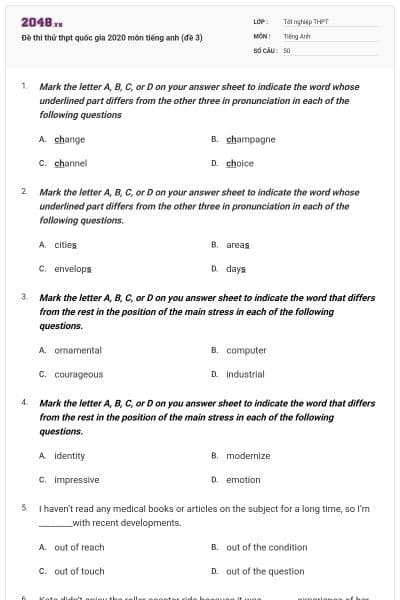
Mark the letter A, B, C, or D on your answer sheet to indicate the word whose underlined part differs from the other three in pronunciation in each of the following questions
change
champagne
channel
choice
Đáp án B
Kiến thức: Phát âm “-ch”
Giải thích:
change /t∫eindʒ/ champagne /∫æm'pein/
channel /'t∫ænl/ choice /t∫ɔis/
Phần gạch chân câu B được phát âm là /∫/ còn lại là /t∫/
Mark the letter A, B, C, or D on your answer sheet to indicate the word whose underlined part differs from the other three in pronunciation in each of the following questions.
cities
areas
envelops
days
Đáp án C
Kiến thức: Phát âm “-s”
Giải thích:
Có ba quy tắc phát âm đuôi s/es
Quy tắc 1: Phát âm là /s/ khi tận cùng từ bằng -p, -k, -t, -f.
Quy tắc 2: Phát âm là /iz/ khi tận cùng từ bằng -s,-ss,-ch,-sh,-x,-z,-o,-ge,-ce.
Quy tắc 3: Phát âm là /z/ đối với những từ còn lại.
Phần gạch chân câu C được phát âm là /s/ còn lại là z
Mark the letter A, B, C, or D on you answer sheet to indicate the word that differs from the rest in the position of the main stress in each of the following questions.
ornamental
computer
courageous
industrial
Đáp án A
Kiến thức: Trọng âm của từ có 3 âm tiết trở lên
Giải thích:
ornamental /,ɔ:nə'mentl/ computer /kəm'pju:tə[r]/
courageous /kə'reidʒəs/ industrial /in'dʌstriəl/
Câu A trọng âm rơi vào âm tiết thứ 3, còn lại là thứ 2
Mark the letter A, B, C, or D on you answer sheet to indicate the word that differs from the rest in the position of the main stress in each of the following questions.
identity
modernize
impressive
emotion
Đáp án B
Kiến thức: Trọng âm của từ có 3 âm tiết trở lên
Giải thích:
identity /ai'dentəti/ modernize /'mɔdə:naiz/
impressive /im'presiv/ emotion /i'məʊ∫n/
Câu B trọng âm rơi vào âm tiết thứ nhất, còn lại là thứ 2
I haven’t read any medical books or articles on the subject for a long time, so I’m ________with recent developments.
out of reach
out of the condition
out of touch
out of the question
Đáp án C
Kiến thức: Cụm từ, từ vựng
Giải thích:
out of reach: ngoài tầm với
out of the condition: không vừa (về cơ thể)
out of touch: mất liên lạc với, không có tin tức về
out of the question: không thể được, điều không thể
Tạm dịch: Tôi đã không đọc bất kỳ sách y khoa hoặc bài viết về chủ đề này trong một thời gian dài, vì vậy tôi không có tin tức về những phát triển gần đây.
Kate didn’t enjoy the roller coaster ride because it was________ experience of her life.
the most terrifying
the most terrified
a most terrified
far more terrifying
Đáp án A
Kiến thức: Tính từ, so sánh nhất
Giải thích:
Tính từ đuôi “ed” là tính từ nhấn mạnh đến tính cảm xúc của con người; tính từ đuôi "ing" là tính từ chỉ bản chất => đáp án B, C loại
Trong câu không có đối tượng so sánh hơn => đáp án D loại
Dạng so sánh nhất với tính từ dài: the most + tính từ dài
Tạm dịch: Kate không thích đi tàu lượn vì nó là trải nghiệm khủng khiếp nhất trong cuộc đời cô.
I assume that you are acquainted ________this subject since you are responsible ________writing the accompanying materials.
to/for
with/for
to/to
with/with
Đáp án B
Kiến thức: Phrasal verb
Giải thích:
To be acquainted with: làm quen với, biết
To be responsible for: chịu trách nhiệm cho
Tạm dịch: Tôi cho rằng bạn đã làm quen với chủ đề này vì bạn chịu trách nhiệm soạn thảo tài liệu kèm theo.
Everyone in both cars________injured in the accident last night, ________?
was/weren’t they
were/ weren’t they
was/ wasn’t he
were/ were they
Đáp án A
Kiến thức: Phù hợp chủ ngữ và động từ, câu hỏi đuôi
Giải thích:
Động từ sau “Everyone” được chia như với danh từ số ít => B, D loại
Trong câu hỏi đuôi, nếu phía trước là “Everyone” thì câu hỏi đuôi ta dùng đại từ “they” => đáp án C loại
Tạm dịch: Mọi người trong cả hai chiếc xe đều bị thương trong vụ tai nạn đêm qua, đúng không?
When the Titanic started sinking, the passengers were________.
horrifying
apprehensive
panic-stricken
weather-beaten
Đáp án C
Kiến thức: Từ vựng
Giải thích:
horrifying (a): làm khiếp sợ, kinh khủng
apprehensive (a): sợ hãi, lo lắng
panic-stricken (a): hoảng sợ, hoảng loạn
weather-beaten (a): sạm nắng (da)
Tạm dịch: Khi Titanic bắt đầu chìm, hành khách hoảng loạn.
Jack has a collection of ________.
old valuable Japanese postage stamps
old Japanese valuable postage stamps
valuable Japanese old postage stamps
valuable old Japanese postage stamps
Đáp án D
Kiến thức: Vị trí của tính từ trước danh từ
Giải thích:
Vị trí của tính từ trước danh từ: Value (Giá trị) – valuable + Age (tuổi tác) – old + Origin (xuất xứ) – Japanese + N
Tạm dịch: Jack có một bộ sưu tập tem bưu chính Nhật Bản cổ có giá trị.
By appearing on the soap powder commercials, she became a ________ name.
housekeeper
housewife
household
house
Đáp án C
Kiến thức: Từ vựng
Giải thích:
housekeeper (n): quản gia housewife (n): bà nội trợ
household (n) gia đình; hộ house (n): ngôi nhà
ta có cụm “a household name (word)”: tên quen thuộc; tên cửa miệng
Tạm dịch: Bằng cách xuất hiện trên quảng cáo bột xà phòng, cô trở thành một cái tên quen thuộc.
Jenny: “Was Linda asleep when you came home?”
Jack: “No. She ________TV.”
watched
had watched
was watching
has been watching
Đáp án C
Kiến thức: Thì trong tiếng anh
Giải thích:
Ta dùng thì quá khứ tiếp diễn để diễn tả một hành động đang xảy ra tại một thời điểm trong quá khứ.
Tạm dịch:
Jenny: "Có phải Linda đang ngủ khi bạn về nhà không?"
Jack: "Không. Cô ấy đang xem TV. "
This class,_____is a prerequisite for microbiology, is so difficult that I would rather drop it.
that
when
where
which
Đáp án D
Kiến thức: Mệnh đề quan hệ
Giải thích:
Ta dùng mệnh đề quan hệ “which” để thay thế cho một vật. Mệnh đề quan hệ “that” cũng có thể dùng thay thế cho vật, tuy nhiên sau dấu phảy ta không dùng “that”
Tạm dịch: Lớp này, là điều kiện tiên quyết cho lớp vi sinh học, rất khó đến mức tôi muốn bỏ nó
During the campaign when Lincoln was first a(n)________ for the Presidency, the slaves on the far-off plantations, miles from any railroad or large city or daily newspaper, knew what the issues involved were.
competitor
contestant
applicant
candidate
Đáp án D
Kiến thức: Từ vựng
Giải thích:
competitor (n): người cạnh tranh, đối thủ
contestant (n): người tranh tài, người thi
applicant (n): người nộp đơn xin, người xin việc
candidate (n): ứng cử viên, thí sinh
Tạm dịch: Trong chiến dịch tranh cử khi Lincoln là ứng cử viên đầu tiên cho chức vụ Tổng thống, các nô lệ trên các đồn điền xa xôi, cách xa hàng dặm từ bất kỳ đường sắt hay thành phố lớn hoặc tờ báo hàng ngày nào, đều biết những vấn đề liên quan.
Peter: “What________ your flight?”
Mary: “There was a big snowstorm in Birmingham that delayed a lot of flights.”
held up
postponed up
delayed up
hung up
Đáp án A
Kiến thức: Phrasal verb
Giải thích:
hold up (v): cản trở; trì hoãn
postpone, delay bản thân mang nghĩa “trì hoãn” không có giới từ “up”
hang up (v): cúp máy
Tạm dịch:
Peter: "Cái gì đã làm cản trở chuyến bay của bạn?"
Mary: "Có một cơn bão tuyết lớn ở Birmingham đã trì hoãn rất nhiều chuyến bay."
________ his poor English, he managed to communicate his problem very clearly.
Because
Even though
Because of
In spite of
Đáp án D
Kiến thức: Mệnh đề chỉ sự nhượng bộ
Giải thích:
Because + mệnh đề: bởi vì, do
Even though + mệnh đề: dù cho, mặc dù
Because of + danh từ/cụm danh từ: bởi vì, do
In spite of + danh từ/cụm danh từ: dù cho, mặc dù
Tạm dịch: Mặc dù tiếng Anh kém, anh đã giải quyết rất nhiều vấn đề của mình một cách rõ ràng.
Jane is talking to Billy about the meeting.
Jane: “Is everybody happy with the decision?”
Billy: “__________________”
That sounds like fun.
Yes, it is certainly.
No, have you?
Not really.
Đáp án D
Kiến thức: Văn hoá giao tiếp
Giải thích:
Tạm dịch: Jane đang nói chuyện với Billy về cuộc họp.
Jane: "Mọi người đều vui vẻ với quyết định này chứ?"
Billy: "__________________"
A. Nghe có vẻ thú vị. B. Có, nó chắc chắn là vậy.
C. Không, bạn có không? D. Không thực sự
Lucy is asking for permission to play the guitar at Pete’s home.
Lucy: “Is it all right if I play the guitar in here while you’re studying?”
Pete: “_________________”
Oh, I wish you wouldn’t.
Well, I’d rather not.
Well, actually, I’d prefer it if you didn’t.
Well, if only you didn’t.
Đáp án C
Kiến thức: Văn hoá giao tiếp
Giải thích:
Tạm dịch: Lucy đang xin phép chơi guitar tại nhà của Pete.
Lucy: "Có ổn không nếu tôi chơi guitar ở đây trong khi bạn đang học?"
Pete: "_________________"
A. Ôi, tôi ước bạn sẽ không.
B. Ừm, tôi không muốn.
C. Ừm, thực ra tôi thấy tốt hơn nếu bạn không chơi.
D. Ừm, tôi ước bạn không chơi.
Mark the letter A, B, C, or D on your answer sheet to indicate the word(s) OPPOSITE in meaning to the underlined word(s) in each of the following questions.
Nutritionists believe that vitamins circumvent diseases.
defeat
nourish
help
treat
Đáp án B
Kiến thức: Từ vựng, từ trái nghĩa
Giải thích:
circumvent (v): né tránh
defeat (v): đánh bại nourish (v) nuôi dưỡng, ấp ủ
help (v): giúp đỡ treat (v): đối xử
=> circumvent >< nourish
Tạm dịch: Các nhà dinh dưỡng học tin rằng vitamin giúp tránh bệnh tật.
Mark the letter A, B, C, or D on your answer sheet to indicate the word(s) OPPOSITE in meaning to the underlined word(s) in each of the following questions.
Adverse weather conditions made it difficult to play the game.
favorable
bad
comfortable
severe
Đáp án A
Kiến thức: Từ vựng, từ trái nghĩa
Giải thích:
adverse (a): không thuận, có hại
favorable (a): thuận lợi, có lợi bad (a): xấu, tồi tệ
comfortable (a): thoải mái severe (a): khắc nghiệt, dữ dội
=> adverse >< favorable
Tạm dịch: Các điều kiện thời tiết bất lợi khiến trận đấu trở nên khó khăn.
Mark the letter A, B, C, or D on your answer sheet to indicate the sentence that is closest in meaning to each of the following questions
"I have never been to Russia. I think I shall go there next year.” said Bill.
Bill said that he had never been to Russia and he thought he would go there the next year.
Bill said that he would have never been to Russia and he thinks he would go there the next year.
Bill said that he had never been to Russia and he thinks he will go there the next year.
Bill said that he has never been to Russia and he thinks he would go there the next year.
Đáp án A
Kiến thức: Reported speech, viết lại câu
Giải thích:
Khi chuyển từ câu trực tiếp sang gián tiếp, thì hiện tại hoàn thành => quá khứ hoàn thành; thì hiện tại đơn => quá khứ đơn; và những từ will/shall => would
Tạm dịch: Bill nói rằng anh chưa bao giờ đến Nga và anh nghĩ anh sẽ đến đó năm sau.
Mark the letter A, B, C, or D on your answer sheet to indicate the sentence that is closest in meaning to each of the following questions.
People believed that Jane retired because of her poor health.
Jane is believed to have retired because of her poor health.
Jane was believed to have retired because of her poor health.
It is believed that Jane retired because of her poor health.
Jane retired because of her poor health was believed.
Đáp án B
Kiến thức: Bị động kép, viết lại câu
Giải thích:
Động từ mệnh đề chính là quá khứ (believed), nên động từ đầu tiên cũng phải ở quá khứ => A, C loại
Câu D loại vì không đúng về ngữ pháp.
Tạm dịch:
Mọi người tin rằng Jane đã nghỉ hưu vì sức khoẻ của cô.
=> Jane được cho là đã nghỉ hưu vì sức khoẻ của cô.
Mark the letter A, B, C, or D on your answer sheet to indicate the sentence that is closest in meaning to each of the following questions.
Charles would have won the essay contest if he had typed his paper.
Charles won the essay contest in spite of not typing his paper.
Charles did not win the essay contest because he did not type his paper.
Typing his paper made Charles win the essay contest.
Charles did not win the essay contest even though he typed his paper.
Đáp án B
Kiến thức: Viết lại câu
Giải thích:
Tạm dịch: Charles hẳn đã thắng cuộc thi viết tiểu luận nếu cậu ấy đã đánh máy.
A. Charles đã thắng cuộc thi tiểu luận mặc dù không đánh máy.
B. Charles không thắng cuộc thi viết luận vì không đánh máy.
C. Đánh máy giúp Charles giành chiến thắng trong cuộc thi tiểu luận.
D. Charles không thắng cuộc thi viết tiểu luận mặc dù cậu ấy đã đánh máy.
Read the following passage and mark the letter A, B, C, or D on your answer sheet to indicate the correct answer to each of the questions from 24 to 30.
Duncan Phyfe made some of the most beautiful furniture found in America. His family name was originally Fife, and he was born in Scotland in 1768. In 1784, the Fife family immigrated to Albany, New York where Duncan’s father opened a cabinetmaking shop. Duncan followed his father’s footsteps and was apprenticed to a cabinetmaker. After completing his training, Duncan moved to New York City.
Duncan Fife was first mentioned in the 1792 NYC Directory as a furniture “joiner” in business at 2 Broad Street. Two years later, he moved, expanded his business, and changed his name to Phyfe. He was a quiet-living, God-fearing young man who felt his new name would probably appeal to potential customers who were definitely anti-British in this post-Revolutionary War period.
Duncan Phyfe’s name distinguished him from his contemporaries. Although the new spelling helped him better compete with French emigrant craftsmen, his new name had more to do with hanging it on a sign over his door stoop.
The artisans and merchants who came to America discovered a unique kind of freedom. They were no longer restricted by class and guild traditions of Europe. For the first time in history, a man learned that by working hard, he could build his business based on his own name and reputation and quality of work.
Phyfe’s workshop apparently took off immediately. At the peak of his success, Phyfe employed 100 craftsmen. Some economic historians point to Phyfe as having employed division of labor and an assembly line. What his workshop produced shows Phyfe’s absolute dedication to quality in workmanship. Each piece of furniture was made of the best available materials. He was reported to have paid $1,000 for a single Santo Domingo mahogany log.
Phyfe did not create new designs. Rather, he borrowed from a broad range of the period’s classical styles, Empire, Sheraton, Regency, and French Classical among them. Nevertheless, Phyfe’s high quality craftsmanship established him as America’s patriotic interpreter of European design in the late eighteenth and early nineteenth centuries.
Although the number of pieces produced by Duncan Phyfe’s workshop is enormous, comparatively few marked or labeled pieces have been found extant. In antiques shops and auctions, collectors have paid $11,000 for a card table, $24,200 for a tea table, and $93,500 for a sewing table.
What is the main idea of the passage?
The business of cabinetmaking.
The significance of Duncan Phyfe’s name.
Duncan Phyfe’s life and career
Duncan Phyfe’s cabinetmaking designs.
Đáp án C
Kiến thức: Đọc hiểu
Giải thích:
Ý tưởng chính của đoạn văn là gì?
A. Kinh doanh đồ nội thất. B. Ý nghĩa của tên Duncan Phyfe.
C. Cuộc sống và sự nghiệp của Duncan Phyfe. D. Thiết kế nội thất của Duncan Phyfe.
Read the following passage and mark the letter A, B, C, or D on your answer sheet to indicate the correct answer to each of the questions from 24 to 30.
Duncan Phyfe made some of the most beautiful furniture found in America. His family name was originally Fife, and he was born in Scotland in 1768. In 1784, the Fife family immigrated to Albany, New York where Duncan’s father opened a cabinetmaking shop. Duncan followed his father’s footsteps and was apprenticed to a cabinetmaker. After completing his training, Duncan moved to New York City.
Duncan Fife was first mentioned in the 1792 NYC Directory as a furniture “joiner” in business at 2 Broad Street. Two years later, he moved, expanded his business, and changed his name to Phyfe. He was a quiet-living, God-fearing young man who felt his new name would probably appeal to potential customers who were definitely anti-British in this post-Revolutionary War period.
Duncan Phyfe’s name distinguished him from his contemporaries. Although the new spelling helped him better compete with French emigrant craftsmen, his new name had more to do with hanging it on a sign over his door stoop.
The artisans and merchants who came to America discovered a unique kind of freedom. They were no longer restricted by class and guild traditions of Europe. For the first time in history, a man learned that by working hard, he could build his business based on his own name and reputation and quality of work.
Phyfe’s workshop apparently took off immediately. At the peak of his success, Phyfe employed 100 craftsmen. Some economic historians point to Phyfe as having employed division of labor and an assembly line. What his workshop produced shows Phyfe’s absolute dedication to quality in workmanship. Each piece of furniture was made of the best available materials. He was reported to have paid $1,000 for a single Santo Domingo mahogany log.
Phyfe did not create new designs. Rather, he borrowed from a broad range of the period’s classical styles, Empire, Sheraton, Regency, and French Classical among them. Nevertheless, Phyfe’s high quality craftsmanship established him as America’s patriotic interpreter of European design in the late eighteenth and early nineteenth centuries.
Although the number of pieces produced by Duncan Phyfe’s workshop is enormous, comparatively few marked or labeled pieces have been found extant. In antiques shops and auctions, collectors have paid $11,000 for a card table, $24,200 for a tea table, and $93,500 for a sewing table.
According to the passage, which of the following does the author imply?
Duncan Fife and his father had the same first name.
Duncan Fife worked for his father in Scotland.
Duncan Fife and his father were in the same business.
Duncan Phyfe made over 100 different kinds of tables.
Đáp án C
Kiến thức: Đọc hiểu
Giải thích:
Theo đoạn văn, tác giả gợi ý điều nào sau đây?
A. Duncan Fife và cha của ông có cùng tên.
B. Duncan Fife làm việc cho cha ông ở Scotland.
C. Duncan Fife và cha của ông có cùng kinh doanh.
D. Duncan Phyfe đã làm trên 100 loại bảng khác nhau.
Thông tin: In 1784, the Fife family immigrated to Albany, New York where Duncan’s father opened a cabinetmaking shop. Duncan followed his father’s footsteps and was apprenticed to a cabinetmaker.
Read the following passage and mark the letter A, B, C, or D on your answer sheet to indicate the correct answer to each of the questions from 43 to 50.
After the United States purchased Louisiana from France and made it their newest territory in 1803, President Thomas Jefferson called for an expedition to investigate the land the United States had bought for $15 million. Jefferson’s secretary, Meriwether Lewis, a woodsman and a hunter from childhood, persuaded the president to let him lead this expedition. Lewis recruited Army officer William Clark to be his co-commander. The Lewis and Clark expedition led the two young explorers to discover a new natural wealth of variety and abundance about which they would return to tell the world.
When Lewis and Clark departed from St. Louis in 1804, they had twenty-nine in their party, including a few Frenchmen and several men from Kentucky who were well-known frontiersmen. Along the way, they picked up an interpreter named Toussant Charbonneau and his Native American wife, Sacajawea, the Shoshoni “Bird Woman” who aided them as guide and peacemaker and later became an American legend.
The expedition followed the Missouri River to its source, made a long portage overland though the Rocky Mountains, and descended the Columbia River to the Pacific Ocean. On the journey, they encountered peaceful Otos, whom they befriended, and hostile Teton Sioux, who demanded tribute from all traders. They also met Shoshoni, who welcomed their little sister Sacajawea, who had been abducted as a child by the Mandans. They discovered a paradise full of giant buffalo herds and elk and antelope so innocent of human contact that they tamely approached the men. The explorers also found a hell blighted by mosquitoes and winters harsher than anyone could reasonably hope to survive. They became desperately lost, then found their way again. Lewis and Clark kept detailed journals of the expedition, cataloging a dazzling array of new plants and animals, and even unearthing the bones of a forty-five-foot dinosaur.
Read the following passage and mark the letter A, B, C, or D on your answer sheet to indicate the correct answer to each of the questions from 24 to 30.
Duncan Phyfe made some of the most beautiful furniture found in America. His family name was originally Fife, and he was born in Scotland in 1768. In 1784, the Fife family immigrated to Albany, New York where Duncan’s father opened a cabinetmaking shop. Duncan followed his father’s footsteps and was apprenticed to a cabinetmaker. After completing his training, Duncan moved to New York City.
Duncan Fife was first mentioned in the 1792 NYC Directory as a furniture “joiner” in business at 2 Broad Street. Two years later, he moved, expanded his business, and changed his name to Phyfe. He was a quiet-living, God-fearing young man who felt his new name would probably appeal to potential customers who were definitely anti-British in this post-Revolutionary War period.
Duncan Phyfe’s name distinguished him from his contemporaries. Although the new spelling helped him better compete with French emigrant craftsmen, his new name had more to do with hanging it on a sign over his door stoop.
The artisans and merchants who came to America discovered a unique kind of freedom. They were no longer restricted by class and guild traditions of Europe. For the first time in history, a man learned that by working hard, he could build his business based on his own name and reputation and quality of work.
Phyfe’s workshop apparently took off immediately. At the peak of his success, Phyfe employed 100 craftsmen. Some economic historians point to Phyfe as having employed division of labor and an assembly line. What his workshop produced shows Phyfe’s absolute dedication to quality in workmanship. Each piece of furniture was made of the best available materials. He was reported to have paid $1,000 for a single Santo Domingo mahogany log.
Phyfe did not create new designs. Rather, he borrowed from a broad range of the period’s classical styles, Empire, Sheraton, Regency, and French Classical among them. Nevertheless, Phyfe’s high quality craftsmanship established him as America’s patriotic interpreter of European design in the late eighteenth and early nineteenth centuries.
Although the number of pieces produced by Duncan Phyfe’s workshop is enormous, comparatively few marked or labeled pieces have been found extant. In antiques shops and auctions, collectors have paid $11,000 for a card table, $24,200 for a tea table, and $93,500 for a sewing table.
Which choice does the word “it” in paragraph 3 refer to?
His spelling
His chair
His French
His name
Đáp án D
Kiến thức: Đọc hiểu
Giải thích:
Từ "nó" trong đoạn 3 đề cập đến?
A. lối viết tên của ông B. ghế của ông
C. tiếng Pháp của ông D. tên của ông
“it” đề cập đến tên của ông trong vế trước: Although the new spelling helped him better compete with French emigrant craftsmen, his new name had more to do with hanging it on a sign over his door stoop.
Read the following passage and mark the letter A, B, C, or D on your answer sheet to indicate the correct answer to each of the questions from 24 to 30.
Duncan Phyfe made some of the most beautiful furniture found in America. His family name was originally Fife, and he was born in Scotland in 1768. In 1784, the Fife family immigrated to Albany, New York where Duncan’s father opened a cabinetmaking shop. Duncan followed his father’s footsteps and was apprenticed to a cabinetmaker. After completing his training, Duncan moved to New York City.
Duncan Fife was first mentioned in the 1792 NYC Directory as a furniture “joiner” in business at 2 Broad Street. Two years later, he moved, expanded his business, and changed his name to Phyfe. He was a quiet-living, God-fearing young man who felt his new name would probably appeal to potential customers who were definitely anti-British in this post-Revolutionary War period.
Duncan Phyfe’s name distinguished him from his contemporaries. Although the new spelling helped him better compete with French emigrant craftsmen, his new name had more to do with hanging it on a sign over his door stoop.
The artisans and merchants who came to America discovered a unique kind of freedom. They were no longer restricted by class and guild traditions of Europe. For the first time in history, a man learned that by working hard, he could build his business based on his own name and reputation and quality of work.
Phyfe’s workshop apparently took off immediately. At the peak of his success, Phyfe employed 100 craftsmen. Some economic historians point to Phyfe as having employed division of labor and an assembly line. What his workshop produced shows Phyfe’s absolute dedication to quality in workmanship. Each piece of furniture was made of the best available materials. He was reported to have paid $1,000 for a single Santo Domingo mahogany log.
Phyfe did not create new designs. Rather, he borrowed from a broad range of the period’s classical styles, Empire, Sheraton, Regency, and French Classical among them. Nevertheless, Phyfe’s high quality craftsmanship established him as America’s patriotic interpreter of European design in the late eighteenth and early nineteenth centuries.
Although the number of pieces produced by Duncan Phyfe’s workshop is enormous, comparatively few marked or labeled pieces have been found extant. In antiques shops and auctions, collectors have paid $11,000 for a card table, $24,200 for a tea table, and $93,500 for a sewing table.
Which choice is closest in meaning to the word “guild” in paragraph 4?
Verdict of a jury
Organization of craftsmen
Political party of emigrants
Immigrants’ club
Đáp án B
Kiến thức: Đọc hiểu
Giải thích:
Lựa chọn nào có ý nghĩa gần nhất với từ "guild" trong đoạn 4?
A. Bản án của bồi thẩm đoàn
B. Tổ chức thợ thủ công
C. Đảng chính trị của người nhập cư
D. Câu lạc bộ người nhập cư
“guild”: phường hội, là một tổ chức của các thợ thủ công
Read the following passage and mark the letter A, B, C, or D on your answer sheet to indicate the correct answer to each of the questions from 24 to 30.
Duncan Phyfe made some of the most beautiful furniture found in America. His family name was originally Fife, and he was born in Scotland in 1768. In 1784, the Fife family immigrated to Albany, New York where Duncan’s father opened a cabinetmaking shop. Duncan followed his father’s footsteps and was apprenticed to a cabinetmaker. After completing his training, Duncan moved to New York City.
Duncan Fife was first mentioned in the 1792 NYC Directory as a furniture “joiner” in business at 2 Broad Street. Two years later, he moved, expanded his business, and changed his name to Phyfe. He was a quiet-living, God-fearing young man who felt his new name would probably appeal to potential customers who were definitely anti-British in this post-Revolutionary War period.
Duncan Phyfe’s name distinguished him from his contemporaries. Although the new spelling helped him better compete with French emigrant craftsmen, his new name had more to do with hanging it on a sign over his door stoop.
The artisans and merchants who came to America discovered a unique kind of freedom. They were no longer restricted by class and guild traditions of Europe. For the first time in history, a man learned that by working hard, he could build his business based on his own name and reputation and quality of work.
Phyfe’s workshop apparently took off immediately. At the peak of his success, Phyfe employed 100 craftsmen. Some economic historians point to Phyfe as having employed division of labor and an assembly line. What his workshop produced shows Phyfe’s absolute dedication to quality in workmanship. Each piece of furniture was made of the best available materials. He was reported to have paid $1,000 for a single Santo Domingo mahogany log.
Phyfe did not create new designs. Rather, he borrowed from a broad range of the period’s classical styles, Empire, Sheraton, Regency, and French Classical among them. Nevertheless, Phyfe’s high quality craftsmanship established him as America’s patriotic interpreter of European design in the late eighteenth and early nineteenth centuries.
Although the number of pieces produced by Duncan Phyfe’s workshop is enormous, comparatively few marked or labeled pieces have been found extant. In antiques shops and auctions, collectors have paid $11,000 for a card table, $24,200 for a tea table, and $93,500 for a sewing table.
In his business, Duncan Phyfe used all of the following EXCEPT________.
division of labor
an assembly line
continental designs
the least expensive materials
Đáp án D
Kiến thức: Đọc hiểu
Giải thích:
Trong kinh doanh, Duncan Phyfe đã sử dụng tất cả TRỪ
A. phân công lao động B. một dây chuyền lắp ráp
C. thiết kế lục địa D. các vật liệu ít đắt tiền nhất
Thông tin:
- Some economic historians point to Phyfe as having employed division of labor and an assembly line.
- Rather, he borrowed from a broad range of the period’s classical styles, Empire, Sheraton, Regency, and French Classical among them.
- Each piece of furniture was made of the best available materials. He was reported to have paid $1,000 for a single Santo Domingo mahogany log.
Như vậy đáp án D là không chính xác
Read the following passage and mark the letter A, B, C, or D on your answer sheet to indicate the correct answer to each of the questions from 24 to 30.
Duncan Phyfe made some of the most beautiful furniture found in America. His family name was originally Fife, and he was born in Scotland in 1768. In 1784, the Fife family immigrated to Albany, New York where Duncan’s father opened a cabinetmaking shop. Duncan followed his father’s footsteps and was apprenticed to a cabinetmaker. After completing his training, Duncan moved to New York City.
Duncan Fife was first mentioned in the 1792 NYC Directory as a furniture “joiner” in business at 2 Broad Street. Two years later, he moved, expanded his business, and changed his name to Phyfe. He was a quiet-living, God-fearing young man who felt his new name would probably appeal to potential customers who were definitely anti-British in this post-Revolutionary War period.
Duncan Phyfe’s name distinguished him from his contemporaries. Although the new spelling helped him better compete with French emigrant craftsmen, his new name had more to do with hanging it on a sign over his door stoop.
The artisans and merchants who came to America discovered a unique kind of freedom. They were no longer restricted by class and guild traditions of Europe. For the first time in history, a man learned that by working hard, he could build his business based on his own name and reputation and quality of work.
Phyfe’s workshop apparently took off immediately. At the peak of his success, Phyfe employed 100 craftsmen. Some economic historians point to Phyfe as having employed division of labor and an assembly line. What his workshop produced shows Phyfe’s absolute dedication to quality in workmanship. Each piece of furniture was made of the best available materials. He was reported to have paid $1,000 for a single Santo Domingo mahogany log.
Phyfe did not create new designs. Rather, he borrowed from a broad range of the period’s classical styles, Empire, Sheraton, Regency, and French Classical among them. Nevertheless, Phyfe’s high quality craftsmanship established him as America’s patriotic interpreter of European design in the late eighteenth and early nineteenth centuries.
Although the number of pieces produced by Duncan Phyfe’s workshop is enormous, comparatively few marked or labeled pieces have been found extant. In antiques shops and auctions, collectors have paid $11,000 for a card table, $24,200 for a tea table, and $93,500 for a sewing table.
Based on the information in the passage, what can be inferred about Duncan Phyfe’s death?
He died in the eighteenth century.
He died in Albany.
He died in the nineteenth century.
He died in Scotland.
Đáp án C
Kiến thức: Đọc hiểu
Giải thích:
Dựa vào thông tin trong đoạn văn, có thể suy ra được gì về cái chết của Duncan Phyfe?
A. Ông qua đời vào thế kỷ XVIII. B. Ông qua đời tại Albany.
C. Ông qua đời vào thế kỷ XIX. D. Ông qua đời tại Scotland.
Thông tin: Phyfe’s high quality craftsmanship established him as America’s patriotic interpreter of European design in the late eighteenth and early nineteenth centuries.
Read the following passage and mark the letter A, B, C, or D on your answer sheet to indicate the correct answer to each of the questions from 24 to 30.
Duncan Phyfe made some of the most beautiful furniture found in America. His family name was originally Fife, and he was born in Scotland in 1768. In 1784, the Fife family immigrated to Albany, New York where Duncan’s father opened a cabinetmaking shop. Duncan followed his father’s footsteps and was apprenticed to a cabinetmaker. After completing his training, Duncan moved to New York City.
Duncan Fife was first mentioned in the 1792 NYC Directory as a furniture “joiner” in business at 2 Broad Street. Two years later, he moved, expanded his business, and changed his name to Phyfe. He was a quiet-living, God-fearing young man who felt his new name would probably appeal to potential customers who were definitely anti-British in this post-Revolutionary War period.
Duncan Phyfe’s name distinguished him from his contemporaries. Although the new spelling helped him better compete with French emigrant craftsmen, his new name had more to do with hanging it on a sign over his door stoop.
The artisans and merchants who came to America discovered a unique kind of freedom. They were no longer restricted by class and guild traditions of Europe. For the first time in history, a man learned that by working hard, he could build his business based on his own name and reputation and quality of work.
Phyfe’s workshop apparently took off immediately. At the peak of his success, Phyfe employed 100 craftsmen. Some economic historians point to Phyfe as having employed division of labor and an assembly line. What his workshop produced shows Phyfe’s absolute dedication to quality in workmanship. Each piece of furniture was made of the best available materials. He was reported to have paid $1,000 for a single Santo Domingo mahogany log.
Phyfe did not create new designs. Rather, he borrowed from a broad range of the period’s classical styles, Empire, Sheraton, Regency, and French Classical among them. Nevertheless, Phyfe’s high quality craftsmanship established him as America’s patriotic interpreter of European design in the late eighteenth and early nineteenth centuries.
Although the number of pieces produced by Duncan Phyfe’s workshop is enormous, comparatively few marked or labeled pieces have been found extant. In antiques shops and auctions, collectors have paid $11,000 for a card table, $24,200 for a tea table, and $93,500 for a sewing table.
The author implies that________.
furniture from Duncan Phyfe’s workshop no longer exists.
furniture from Duncan Phyfe’s workshop costs a lot of money today.
furniture from Duncan Phyfe’s workshop was ignored by New Yorkers.
furniture from Duncan Phyfe’s workshop was made by his father.
Đáp án B
Kiến thức: Đọc hiểu
Giải thích:
Tác giả ám chỉ rằng ________
A. đồ nội thất từ xưởng của Duncan Phyfe không còn tồn tại.
B. đồ nội thất từ xưởng của Duncan Phyfe tốn rất nhiều tiền ngày nay.
C. đồ nội thất từ xưởng của Duncan Phyfe bị người New York phớt lờ.
D. đồ nội thất từ xưởng của Duncan Phyfe được thực hiện bởi cha ông.
Thông tin: In antiques shops and auctions, collectors have paid $11,000 for a card table, $24,200 for a tea table, and $93,500 for a sewing table.
Dịch bài đọc:
Duncan Phyfe đã tạo ra một số đồ nội thất đẹp nhất ở Mỹ. Họ của ông vốn là Fife, và ông sinh ra ở Scotland vào năm 1768. Năm 1784, gia đình Fife di cư đến Albany, New York, nơi cha của Duncan mở một cửa hiệu làm đồ nội thất. Duncan theo bước chân của cha mình và đã học nghề làm đồ nội thất. Sau khi hoàn thành khóa học, Duncan đã chuyển đến New York.
Duncan Fife lần đầu tiên được đề cập đến trong cuốn NYC Directory năm 1792 với tư cách là một "thợ lắp" nội thất làm việc tại số 2 Broad Street. Hai năm sau, ông chuyển đi, mở rộng kinh doanh, đổi tên thành Phyfe. Ông là một thanh niên tĩnh lặng, theo đạo giáo, cảm thấy tên mới của mình có lẽ sẽ thu hút những khách hàng tiềm năng, những người chắc chắn chống lại Anh trong giai đoạn hậu Chiến tranh Cách mạng.
Tên của Duncan Phyfe đã phân biệt ông với những người cùng thời. Mặc dù lối viết tên mới đã giúp ông cạnh tranh tốt hơn với các thợ thủ công người Pháp, tên mới của ông có liên quan đến việc phải treo nó trên một cái dấu trên cánh cửa.
Các nghệ nhân và các thương gia đến Mỹ đã khám phá ra một loại tự do độc nhất. Họ không còn bị hạn chế bởi các truyền thống của các tầng lớp và phường hội của Châu Âu. Lần đầu tiên trong lịch sử, một người đã học được rằng bằng cách làm việc chăm chỉ, anh ta có thể xây dựng kinh doanh dựa trên tên tuổi, danh tiếng và chất lượng công việc.
Xưởng của Phyfe dường như nổi tiếng ngay lập tức. Vào thời đỉnh cao thành công của mình, Phyfe đã thuê 100 thợ thủ công. Một số nhà sử học về kinh tế đã chỉ ra rằng Phyfe đã sử dụng phân công lao động và dây chuyền lắp ráp. Những gì xưởng của ông sản xuất cho thấy sự cống hiến tuyệt đối của Phyfe đến chất lượng trong tay nghề. Mỗi đồ nội thất được làm bằng các vật liệu sẵn có tốt nhất. Ông đã cho là đã phải trả 1.000 đô la cho một khúc gỗ gụ mộc mạc Santo Domingo.
Phyfe không tạo ra kiểu dáng mới. Thay vào đó, ông vay mượn từ một loạt các phong cách cổ điển của thời kỳ, Empire, Sheraton, Regency, và cổ điển Pháp trong số đó. Tuy nhiên, thủ công chất lượng cao của Phyfe đã giúp ông trở thành người phiên dịch yêu nước của Mỹ về thiết kế châu Âu vào cuối thế kỷ mười tám và đầu thế kỷ XIX.
Mặc dù số lượng các tác phẩm do xưởng của Duncan Phyfe sản xuất rất lớn, nhưng có ít dấu hiệu hoặc nhãn mác đã được tìm thấy còn tồn tại. Trong các cửa hàng bán đồ cổ và đấu giá, người thu mua đã trả 11.000 đô la cho một cái bàn chải len, 24.200 đô la cho một chiếc bàn trà, và 93.500 đô la cho một chiếc bàn may.
Read the following passage and mark the letter A, B, C or D on your answer sheet to indicate the correct word or phrase that best fits each of the numbered blanks from 31 to 35.
A rainbow is an optical display of color that usually appears in the sky when a beam of sunlight refracts through millions of raindrops. Each (31)________ color from the spectrum is then sent to your eyes. For this to happen, the angle between the ray of light, the raindrop and the human eye must be between 40 and 42 degrees.
After studying rainbows in (32)________, Sir Isaac Newton was able to explain how they are formed. However, he was color blind, so he had to rely on the eyes of his assistant, who could easily (33)________all the seven colors: red, orange, yellow, green, blue, indigo and violet. His assistant could also clearly tell the difference between indigo and violet.
There are two types of rainbows. Primary rainbows are the most common and have the most distinctive colors, with red appearing on the outside of the arc and violet on the inside. Secondary rainbows are unusual because the light is reflected twice within the raindrop before it (34)________ a rainbow, so the colors are in reverse order and not as bright as primary rainbows.
There is a popular myth that if you reach the end of a rainbow, you will find a pot of gold waiting for you. In fact, it is impossible to do this, because a rainbow has no end - as you go towards the point where the rainbow seems to touch the ground, it moves away from you as quickly as you (35)________.
Điền vào ô 31
single
divided
detached
separate
Đáp án D
Kiến thức: Từ vựng, đọc hiểu
Giải thích:
single (a): đơn, chỉ một divided (a): phân chia, số bị chia
detached (a): đứng tách riêng ra (ngôi nhà…) separate (a): tách rời, riêng; khác biệt
Read the following passage and mark the letter A, B, C or D on your answer sheet to indicate the correct word or phrase that best fits each of the numbered blanks from 31 to 35.
A rainbow is an optical display of color that usually appears in the sky when a beam of sunlight refracts through millions of raindrops. Each (31)________ color from the spectrum is then sent to your eyes. For this to happen, the angle between the ray of light, the raindrop and the human eye must be between 40 and 42 degrees.
After studying rainbows in (32)________, Sir Isaac Newton was able to explain how they are formed. However, he was color blind, so he had to rely on the eyes of his assistant, who could easily (33)________all the seven colors: red, orange, yellow, green, blue, indigo and violet. His assistant could also clearly tell the difference between indigo and violet.
There are two types of rainbows. Primary rainbows are the most common and have the most distinctive colors, with red appearing on the outside of the arc and violet on the inside. Secondary rainbows are unusual because the light is reflected twice within the raindrop before it (34)________ a rainbow, so the colors are in reverse order and not as bright as primary rainbows.
There is a popular myth that if you reach the end of a rainbow, you will find a pot of gold waiting for you. In fact, it is impossible to do this, because a rainbow has no end - as you go towards the point where the rainbow seems to touch the ground, it moves away from you as quickly as you (35)________.
Điền vào ô 32
depth
width
breadth
length
Đáp án A
Kiến thức: Từ vựng, đọc hiểu
Giải thích:
depth (n): chiều sâu, độ sâu width (n): bề rộng, chiều rộng
breadth (n): bề ngang, bề rộng length (n): chiều dài, bề dài
Read the following passage and mark the letter A, B, C or D on your answer sheet to indicate the correct word or phrase that best fits each of the numbered blanks from 31 to 35.
A rainbow is an optical display of color that usually appears in the sky when a beam of sunlight refracts through millions of raindrops. Each (31)________ color from the spectrum is then sent to your eyes. For this to happen, the angle between the ray of light, the raindrop and the human eye must be between 40 and 42 degrees.
After studying rainbows in (32)________, Sir Isaac Newton was able to explain how they are formed. However, he was color blind, so he had to rely on the eyes of his assistant, who could easily (33)________all the seven colors: red, orange, yellow, green, blue, indigo and violet. His assistant could also clearly tell the difference between indigo and violet.
There are two types of rainbows. Primary rainbows are the most common and have the most distinctive colors, with red appearing on the outside of the arc and violet on the inside. Secondary rainbows are unusual because the light is reflected twice within the raindrop before it (34)________ a rainbow, so the colors are in reverse order and not as bright as primary rainbows.
There is a popular myth that if you reach the end of a rainbow, you will find a pot of gold waiting for you. In fact, it is impossible to do this, because a rainbow has no end - as you go towards the point where the rainbow seems to touch the ground, it moves away from you as quickly as you (35)________.
Điền vào ô 33
realize
discover
understand
recognize
Đáp án D
Kiến thức: Từ vựng, đọc hiểu
Giải thích:
realize (v): nhận thức rõ, thấy rõ discover (v): phát hiện, tìm ra
understand (v): hiểu recognize (v): nhận ra, thừa nhận, công nhận
Read the following passage and mark the letter A, B, C or D on your answer sheet to indicate the correct word or phrase that best fits each of the numbered blanks from 31 to 35.
A rainbow is an optical display of color that usually appears in the sky when a beam of sunlight refracts through millions of raindrops. Each (31)________ color from the spectrum is then sent to your eyes. For this to happen, the angle between the ray of light, the raindrop and the human eye must be between 40 and 42 degrees.
After studying rainbows in (32)________, Sir Isaac Newton was able to explain how they are formed. However, he was color blind, so he had to rely on the eyes of his assistant, who could easily (33)________all the seven colors: red, orange, yellow, green, blue, indigo and violet. His assistant could also clearly tell the difference between indigo and violet.
There are two types of rainbows. Primary rainbows are the most common and have the most distinctive colors, with red appearing on the outside of the arc and violet on the inside. Secondary rainbows are unusual because the light is reflected twice within the raindrop before it (34)________ a rainbow, so the colors are in reverse order and not as bright as primary rainbows.
There is a popular myth that if you reach the end of a rainbow, you will find a pot of gold waiting for you. In fact, it is impossible to do this, because a rainbow has no end - as you go towards the point where the rainbow seems to touch the ground, it moves away from you as quickly as you (35)________.
Điền vào ô 34
forms
grows
develops
shapes
Đáp án A
Kiến thức: Từ vựng, đọc hiểu
Giải thích:
form (v): hình thành, tạo thành grow (v): lớn lên, phát triển
develop (v): phát triển shape (n): hình dáng
Read the following passage and mark the letter A, B, C or D on your answer sheet to indicate the correct word or phrase that best fits each of the numbered blanks from 31 to 35.
A rainbow is an optical display of color that usually appears in the sky when a beam of sunlight refracts through millions of raindrops. Each (31)________ color from the spectrum is then sent to your eyes. For this to happen, the angle between the ray of light, the raindrop and the human eye must be between 40 and 42 degrees.
After studying rainbows in (32)________, Sir Isaac Newton was able to explain how they are formed. However, he was color blind, so he had to rely on the eyes of his assistant, who could easily (33)________all the seven colors: red, orange, yellow, green, blue, indigo and violet. His assistant could also clearly tell the difference between indigo and violet.
There are two types of rainbows. Primary rainbows are the most common and have the most distinctive colors, with red appearing on the outside of the arc and violet on the inside. Secondary rainbows are unusual because the light is reflected twice within the raindrop before it (34)________ a rainbow, so the colors are in reverse order and not as bright as primary rainbows.
There is a popular myth that if you reach the end of a rainbow, you will find a pot of gold waiting for you. In fact, it is impossible to do this, because a rainbow has no end - as you go towards the point where the rainbow seems to touch the ground, it moves away from you as quickly as you (35)________.
Điền vào ô 35
progress
arrive
get
approach
Đáp án D
Kiến thức: Từ vựng, đọc hiểu
Giải thích:
progress (v): tiến tới, tiến hành (công việc) arrive (v): đến
get (v): có được, lấy được approach (v): tiếp cận, đến gần
Dịch bài đọc:
Cầu vồng là một hiển thị quang học về màu sắc thường xuất hiện trên bầu trời khi một chùm ánh sáng mặt trời lọt qua hàng triệu giọt mưa. Mỗi màu riêng biệt từ quang phổ sẽ được gửi đến mắt bạn. Để điều này xảy ra, góc giữa tia sáng, giọt mưa và mắt người phải nằm trong khoảng từ 40 đến 42 độ.
Sau khi nghiên cứu sâu về cầu vồng, Sir Isaac Newton đã có thể giải thích cách chúng được hình thành. Tuy nhiên, ông bị mù màu vì vậy ông phải dựa vào mắt trợ lý của mình, người có thể dễ dàng nhận ra tất cả bảy màu: đỏ, cam, vàng, xanh, xanh, chàm và tím. Trợ lý của ông cũng có thể nói rõ sự khác biệt giữa chàm và tím.
Có hai loại cầu vồng. Cầu vồng chính là phổ biến nhất và có màu sắc đặc biệt nhất, với màu đỏ xuất hiện ở bên ngoài và màu tím bên trong. Cầu vồng thứ bất thường bởi vì ánh sáng được phản xạ hai lần trong giọt mưa trước khi nó tạo thành một cầu vồng, vì vậy màu sắc theo thứ tự ngược lại và không sáng như cầu vồng chính.
Có một huyền thoại phổ biến rằng nếu bạn đến cuối một cầu vồng, bạn sẽ tìm thấy một nồi chứa vàng đang chờ bạn. Trên thực tế, không thể làm điều này, bởi vì một cầu vồng không có kết thúc - khi bạn đi đến chỗ mà cầu vồng dường như chạm đất, nó sẽ di chuyển ra xa nhanh như bạn đến gần.
Mark the letter A, B, C, or D on your answer sheet to indicate the word(s) CLOSEST in meaning to the underlined word(s) in each of the following questions.
Laws on military service since 1960 still hold good.
remains for good
is still in good condition
stands in life
remains in effect
Đáp án D
Kiến thức: Từ vựng, từ đồng nghĩa
Giải thích:
hold good (v): còn hiệu lực
remain for good: vẫn còn tốt
is still in good condition: vẫn trong tình trạng tốt
stands in life: trong cuộc sống
remains in effect: vẫn có hiệu lực
=> hold good = remain in effect
Tạm dịch: Luật về nghĩa vụ quân sự từ năm 1960 vẫn còn hiệu lực
Mark the letter A, B, C, or D on your answer sheet to indicate the word(s) CLOSEST in meaning to the underlined word(s) in each of the following questions
The expression “out of the frying pan and into the fire” means to go from one dilemma to a worse one.
situation
predicament
solution
embarrassment
Đáp án B
Kiến thức: Từ vựng, từ đồng nghĩa
Giải thích:
dilemma (n): thế lưỡng nan, thế khó xử
situation (n) : tình thế, tình hình predicament (n) : tình trạng khó xử
solution (n) : giải pháp embarrassment (n): sự lúng túng
=> dilemma = predicament
Tạm dịch: Cụm từ "out of the frying pan and into the fire" có nghĩa là đi từ tình thế tiến thoái lưỡng nan này sang một tình huống tiến thoái lưỡng nan khác còn tệ hơn.
Mark the letter A, B, C, or D on your answer sheet to indicate the sentence that best combines each pair of sentences in the following questions.
The government knows the extent of the problem. The government needs to take action soon.
The government knows the extent of the problem whereas it needs to take action soon.
The government knows the extent of the problem so that it needs to take action soon.
Knowing the extent of the problem, the government needs to take action soon.
The government knows the extent of the problem, or else it needs to take action soon.
Đáp án C
Kiến thức: Viết lại câu
Giải thích:
Tạm dịch: Chính phủ biết mức độ của vấn đề. Chính phủ cần sớm hành động.
A. Chính phủ biết mức độ của vấn đề trong khi nó cần phải hành động sớm.
B. Chính phủ biết mức độ của vấn đề để nó cần phải hành động sớm.
C. Hiểu được mức độ của vấn đề, chính phủ cần hành động sớm.
D. Chính phủ biết mức độ của vấn đề, nếu không nó cần phải hành động sớm.
Mark the letter A, B, C, or D on your answer sheet to indicate the sentence that best combines each pair of sentences in the following questions.
The substance is very toxic. Protective clothing must be worn at all times.
Since the substance is very toxic, so protective clothing must be worn at all times.
So toxic is the substance that protective clothing must be worn at all times.
The substance is such toxic that protective clothing must be worn at all times.
The substance is too toxic to wear protective clothing at all times.
Đáp án B
Kiến thức: Viết lại câu
Giải thích:
Tạm dịch: Chất này rất độc. Quần áo bảo hộ phải được mặc bất cứ lúc nào.
A. Vì chất này rất độc, nên quần áo bảo hộ phải được mặc bất cứ lúc nào. (Sau since/because/as, ta không dùng “so”)
B. Chất này độc hại đến mức quần áo bảo hộ phải được mặc bất cứ lúc nào.
C. Sai cấu trúc với such: such + (a/an) adj + N
D. Chất này quá độc để mặc quần áo bảo hộ mọi lúc. (=Chất này quá độc để có thể mặc quần áo bảo hộ mọi lúc)
Once you have finished an article and identified its main ideas, it may not be necessary to reread it again
Once
identified
be necessary
again
Đáp án D
Kiến thức: Từ vựng, sửa lại câu
Giải thích:
Bỏ “again”
Phía trước đã có từ “reread” (đọc lại) vì thế không cần từ “again” nữa
Tạm dịch: Một khi bạn đã hoàn thành một bài báo và xác định các ý tưởng chính của nó, có thể không cần phải đọc lại nó.
An ambitious person is committed to improve his or her status at work.
is
improve
status
at
Đáp án C
Kiến thức: Từ loại, sửa lại câu
Giải thích:
vast geography => vast geographical
ta cần dùng tính từ, vì phía sau có danh từ “division”, ta cần tính từ để bổ nghĩa cho danh từ này
Tạm dịch: Nói chung, châu Âu và châu Á được coi là những lục địa khác biệt, nhưng chúng đơn giản là các đơn vị địa lý rộng lớn của khối đất rộng lớn hơn được gọi là Eurasia.
Generally, Europe and Asia are regarded as being distinct continents, but they are simply vast geography divisions of the larger land mass known as Eurasia.
Generally
are regarded
vast geography
known as
Đáp án C
Kiến thức: Từ loại, sửa lại câu
Giải thích:
vast geography => vast geographical
ta cần dùng tính từ, vì phía sau có danh từ “division”, ta cần tính từ để bổ nghĩa cho danh từ này
Tạm dịch: Nói chung, châu Âu và châu Á được coi là những lục địa khác biệt, nhưng chúng đơn giản là các đơn vị địa lý rộng lớn của khối đất rộng lớn hơn được gọi là Eurasia.
Read the following passage and mark the letter A, B, C, or D on your answer sheet to indicate the correct answer to each of the questions from 43 to 50.
After the United States purchased Louisiana from France and made it their newest territory in 1803, President Thomas Jefferson called for an expedition to investigate the land the United States had bought for $15 million. Jefferson’s secretary, Meriwether Lewis, a woodsman and a hunter from childhood, persuaded the president to let him lead this expedition. Lewis recruited Army officer William Clark to be his co-commander. The Lewis and Clark expedition led the two young explorers to discover a new natural wealth of variety and abundance about which they would return to tell the world.
When Lewis and Clark departed from St. Louis in 1804, they had twenty-nine in their party, including a few Frenchmen and several men from Kentucky who were well-known frontiersmen. Along the way, they picked up an interpreter named Toussant Charbonneau and his Native American wife, Sacajawea, the Shoshoni “Bird Woman” who aided them as guide and peacemaker and later became an American legend.
The expedition followed the Missouri River to its source, made a long portage overland though the Rocky Mountains, and descended the Columbia River to the Pacific Ocean. On the journey, they encountered peaceful Otos, whom they befriended, and hostile Teton Sioux, who demanded tribute from all traders. They also met Shoshoni, who welcomed their little sister Sacajawea, who had been abducted as a child by the Mandans. They discovered a paradise full of giant buffalo herds and elk and antelope so innocent of human contact that they tamely approached the men. The explorers also found a hell blighted by mosquitoes and winters harsher than anyone could reasonably hope to survive. They became desperately lost, then found their way again. Lewis and Clark kept detailed journals of the expedition, cataloging a dazzling array of new plants and animals, and even unearthing the bones of a forty-five-foot dinosaur.
When the party returned to St. Louis in 1806 after travelling almost 8,000 miles, they were eagerly greeted and grandly entertained. Their glowing descriptions of this vast new West provided a boon to the westward migration now becoming a permanent part of American life. The journals written by Lewis and Clark are still widely read today.
The purpose of the Lewis and Clark expedition was________.
to establish trade with the Otos and Teton Sioux
to explore territory purchased by the United States
to purchase land from France
to find the source of the Missouri River
Đáp án B
Kiến thức: Đọc hiểu
Giải thích:
Mục đích của cuộc thám hiểm Lewis và Clark là ________.
A. để thiết lập thương mại với Otos và Teton Sioux
B. để khám phá lãnh thổ mà Hoa Kỳ mua
C. để mua đất từ Pháp
D. để tìm ra nguồn gốc của sông Missouri
Thông tin: After the United States purchased Louisiana from France and made it their newest territory in 1803, President Thomas Jefferson called for an expedition to investigate the land the United States had bought for $15 million.
Read the following passage and mark the letter A, B, C, or D on your answer sheet to indicate the correct answer to each of the questions from 43 to 50.
After the United States purchased Louisiana from France and made it their newest territory in 1803, President Thomas Jefferson called for an expedition to investigate the land the United States had bought for $15 million. Jefferson’s secretary, Meriwether Lewis, a woodsman and a hunter from childhood, persuaded the president to let him lead this expedition. Lewis recruited Army officer William Clark to be his co-commander. The Lewis and Clark expedition led the two young explorers to discover a new natural wealth of variety and abundance about which they would return to tell the world.
When Lewis and Clark departed from St. Louis in 1804, they had twenty-nine in their party, including a few Frenchmen and several men from Kentucky who were well-known frontiersmen. Along the way, they picked up an interpreter named Toussant Charbonneau and his Native American wife, Sacajawea, the Shoshoni “Bird Woman” who aided them as guide and peacemaker and later became an American legend.
The expedition followed the Missouri River to its source, made a long portage overland though the Rocky Mountains, and descended the Columbia River to the Pacific Ocean. On the journey, they encountered peaceful Otos, whom they befriended, and hostile Teton Sioux, who demanded tribute from all traders. They also met Shoshoni, who welcomed their little sister Sacajawea, who had been abducted as a child by the Mandans. They discovered a paradise full of giant buffalo herds and elk and antelope so innocent of human contact that they tamely approached the men. The explorers also found a hell blighted by mosquitoes and winters harsher than anyone could reasonably hope to survive. They became desperately lost, then found their way again. Lewis and Clark kept detailed journals of the expedition, cataloging a dazzling array of new plants and animals, and even unearthing the bones of a forty-five-foot dinosaur.
When the party returned to St. Louis in 1806 after travelling almost 8,000 miles, they were eagerly greeted and grandly entertained. Their glowing descriptions of this vast new West provided a boon to the westward migration now becoming a permanent part of American life. The journals written by Lewis and Clark are still widely read today.
Where in the passage does the author mention hardship faced by the expedition?
Lines 4-6
Lines 8-10
Lines 12-13
Lines 16-17
Đáp án D
Kiến thức: Đọc hiểu
Giải thích:
Ở đâu trong đoạn văn này tác giả đề cập đến sự khó khăn mà cuộc thám hiểm phải đối mặt?
A. Các dòng 4-6 B. Các dòng 8-10
C. Các dòng 12-13 D. Các dòng 16-17
Thông tin: Dòng 16-17: The explorers also found a hell blighted by mosquitoes and winters harsher than anyone could reasonably hope to survive. They became desperately lost, then found their way again.
Read the following passage and mark the letter A, B, C, or D on your answer sheet to indicate the correct answer to each of the questions from 43 to 50.
After the United States purchased Louisiana from France and made it their newest territory in 1803, President Thomas Jefferson called for an expedition to investigate the land the United States had bought for $15 million. Jefferson’s secretary, Meriwether Lewis, a woodsman and a hunter from childhood, persuaded the president to let him lead this expedition. Lewis recruited Army officer William Clark to be his co-commander. The Lewis and Clark expedition led the two young explorers to discover a new natural wealth of variety and abundance about which they would return to tell the world.
When Lewis and Clark departed from St. Louis in 1804, they had twenty-nine in their party, including a few Frenchmen and several men from Kentucky who were well-known frontiersmen. Along the way, they picked up an interpreter named Toussant Charbonneau and his Native American wife, Sacajawea, the Shoshoni “Bird Woman” who aided them as guide and peacemaker and later became an American legend.
The expedition followed the Missouri River to its source, made a long portage overland though the Rocky Mountains, and descended the Columbia River to the Pacific Ocean. On the journey, they encountered peaceful Otos, whom they befriended, and hostile Teton Sioux, who demanded tribute from all traders. They also met Shoshoni, who welcomed their little sister Sacajawea, who had been abducted as a child by the Mandans. They discovered a paradise full of giant buffalo herds and elk and antelope so innocent of human contact that they tamely approached the men. The explorers also found a hell blighted by mosquitoes and winters harsher than anyone could reasonably hope to survive. They became desperately lost, then found their way again. Lewis and Clark kept detailed journals of the expedition, cataloging a dazzling array of new plants and animals, and even unearthing the bones of a forty-five-foot dinosaur.
When the party returned to St. Louis in 1806 after travelling almost 8,000 miles, they were eagerly greeted and grandly entertained. Their glowing descriptions of this vast new West provided a boon to the westward migration now becoming a permanent part of American life. The journals written by Lewis and Clark are still widely read today.
It can be inferred that Sacajawea ________.
married a Shoshoni interpreter
abducted a child
demanded tribute from the traders
is a well-known American heroine
Đáp án D
Kiến thức: Đọc hiểu
Giải thích:
Có thể suy luận rằng Sacajawea ________.
A. kết hôn với một thông dịch viên Shoshoni B. bắt cóc một đứa trẻ
C. đòi cống phẩm từ các thương nhân D. là một nữ anh hùng nổi tiếng người Mỹ
Thông tin: his Native American wife, Sacajawea, the Shoshoni “Bird Woman” who aided them as guide and peacemaker and later became an American legend.
Read the following passage and mark the letter A, B, C, or D on your answer sheet to indicate the correct answer to each of the questions from 43 to 50.
After the United States purchased Louisiana from France and made it their newest territory in 1803, President Thomas Jefferson called for an expedition to investigate the land the United States had bought for $15 million. Jefferson’s secretary, Meriwether Lewis, a woodsman and a hunter from childhood, persuaded the president to let him lead this expedition. Lewis recruited Army officer William Clark to be his co-commander. The Lewis and Clark expedition led the two young explorers to discover a new natural wealth of variety and abundance about which they would return to tell the world.
When Lewis and Clark departed from St. Louis in 1804, they had twenty-nine in their party, including a few Frenchmen and several men from Kentucky who were well-known frontiersmen. Along the way, they picked up an interpreter named Toussant Charbonneau and his Native American wife, Sacajawea, the Shoshoni “Bird Woman” who aided them as guide and peacemaker and later became an American legend.
The expedition followed the Missouri River to its source, made a long portage overland though the Rocky Mountains, and descended the Columbia River to the Pacific Ocean. On the journey, they encountered peaceful Otos, whom they befriended, and hostile Teton Sioux, who demanded tribute from all traders. They also met Shoshoni, who welcomed their little sister Sacajawea, who had been abducted as a child by the Mandans. They discovered a paradise full of giant buffalo herds and elk and antelope so innocent of human contact that they tamely approached the men. The explorers also found a hell blighted by mosquitoes and winters harsher than anyone could reasonably hope to survive. They became desperately lost, then found their way again. Lewis and Clark kept detailed journals of the expedition, cataloging a dazzling array of new plants and animals, and even unearthing the bones of a forty-five-foot dinosaur.
When the party returned to St. Louis in 1806 after travelling almost 8,000 miles, they were eagerly greeted and grandly entertained. Their glowing descriptions of this vast new West provided a boon to the westward migration now becoming a permanent part of American life. The journals written by Lewis and Clark are still widely read today.
The word “they” in paragraph 3 refers to________.
elk and antelope
buffalo herds
the members of the expedition
Shoshoni and Mandans
Đáp án A
Kiến thức: Đọc hiểu
Giải thích:
Từ "they" trong đoạn 3 đề cập đến ________.
A. hươu và linh dương B. đàn trâu
C. các thành viên của đoàn thám hiểm D. Shoshoni và Mandans
“they” đề cập đến hươu và linh dương: They discovered a paradise full of giant buffalo herds and elk and antelope so innocent of human contact that they tamely approached the men.
Read the following passage and mark the letter A, B, C, or D on your answer sheet to indicate the correct answer to each of the questions from 43 to 50.
After the United States purchased Louisiana from France and made it their newest territory in 1803, President Thomas Jefferson called for an expedition to investigate the land the United States had bought for $15 million. Jefferson’s secretary, Meriwether Lewis, a woodsman and a hunter from childhood, persuaded the president to let him lead this expedition. Lewis recruited Army officer William Clark to be his co-commander. The Lewis and Clark expedition led the two young explorers to discover a new natural wealth of variety and abundance about which they would return to tell the world.
When Lewis and Clark departed from St. Louis in 1804, they had twenty-nine in their party, including a few Frenchmen and several men from Kentucky who were well-known frontiersmen. Along the way, they picked up an interpreter named Toussant Charbonneau and his Native American wife, Sacajawea, the Shoshoni “Bird Woman” who aided them as guide and peacemaker and later became an American legend.
The expedition followed the Missouri River to its source, made a long portage overland though the Rocky Mountains, and descended the Columbia River to the Pacific Ocean. On the journey, they encountered peaceful Otos, whom they befriended, and hostile Teton Sioux, who demanded tribute from all traders. They also met Shoshoni, who welcomed their little sister Sacajawea, who had been abducted as a child by the Mandans. They discovered a paradise full of giant buffalo herds and elk and antelope so innocent of human contact that they tamely approached the men. The explorers also found a hell blighted by mosquitoes and winters harsher than anyone could reasonably hope to survive. They became desperately lost, then found their way again. Lewis and Clark kept detailed journals of the expedition, cataloging a dazzling array of new plants and animals, and even unearthing the bones of a forty-five-foot dinosaur.
When the party returned to St. Louis in 1806 after travelling almost 8,000 miles, they were eagerly greeted and grandly entertained. Their glowing descriptions of this vast new West provided a boon to the westward migration now becoming a permanent part of American life. The journals written by Lewis and Clark are still widely read today.
The word “blighted” in paragraph 3 is closest in meaning to _______.
increased
ruined
swollen
driven
Đáp án B
Kiến thức: Đọc hiểu
Giải thích:
Từ "blighted" trong đoạn 3 có ý nghĩa gần nhất với _______.
A. tăng lên B. bị hủy hoại C. sưng lên D. điều khiển
"blighted" = ruined: bị huỷ hoại
The explorers also found a hell blighted by mosquitoes and winters harsher than anyone could reasonably hope to survive.
Các nhà thám hiểm cũng tìm thấy một địa ngục bị tàn phá bởi muỗi và mùa đông nghiêm trọng hơn việc bất kỳ ai có thể tưởng tượng để tồn tại được.
Read the following passage and mark the letter A, B, C, or D on your answer sheet to indicate the correct answer to each of the questions from 43 to 50.
After the United States purchased Louisiana from France and made it their newest territory in 1803, President Thomas Jefferson called for an expedition to investigate the land the United States had bought for $15 million. Jefferson’s secretary, Meriwether Lewis, a woodsman and a hunter from childhood, persuaded the president to let him lead this expedition. Lewis recruited Army officer William Clark to be his co-commander. The Lewis and Clark expedition led the two young explorers to discover a new natural wealth of variety and abundance about which they would return to tell the world.
When Lewis and Clark departed from St. Louis in 1804, they had twenty-nine in their party, including a few Frenchmen and several men from Kentucky who were well-known frontiersmen. Along the way, they picked up an interpreter named Toussant Charbonneau and his Native American wife, Sacajawea, the Shoshoni “Bird Woman” who aided them as guide and peacemaker and later became an American legend.
The expedition followed the Missouri River to its source, made a long portage overland though the Rocky Mountains, and descended the Columbia River to the Pacific Ocean. On the journey, they encountered peaceful Otos, whom they befriended, and hostile Teton Sioux, who demanded tribute from all traders. They also met Shoshoni, who welcomed their little sister Sacajawea, who had been abducted as a child by the Mandans. They discovered a paradise full of giant buffalo herds and elk and antelope so innocent of human contact that they tamely approached the men. The explorers also found a hell blighted by mosquitoes and winters harsher than anyone could reasonably hope to survive. They became desperately lost, then found their way again. Lewis and Clark kept detailed journals of the expedition, cataloging a dazzling array of new plants and animals, and even unearthing the bones of a forty-five-foot dinosaur.
When the party returned to St. Louis in 1806 after travelling almost 8,000 miles, they were eagerly greeted and grandly entertained. Their glowing descriptions of this vast new West provided a boon to the westward migration now becoming a permanent part of American life. The journals written by Lewis and Clark are still widely read today.
Lewis and Clark encountered all of the following EXCEPT_______.
mountains
buffaloes
dinosaur herds
friendly people
Đáp án C
Kiến thức: Đọc hiểu
Giải thích:
Lewis và Clark gặp tất cả TRỪ
A. núi B. trâu C. đàn khủng long D. những người thân thiện
Thông tin:
- The expedition followed the Missouri River to its source, made a long portage overland though the Rocky Mountains
- They discovered a paradise full of giant buffalo herds
- they encountered peaceful Otos, whom they befriended, and hostile Teton Sioux, who demanded tribute from all traders. They also met Shoshoni, who welcomed their little sister Sacajawea, who had been abducted as a child by the Mandans.
Chỉ có đáp án C là không có.
Read the following passage and mark the letter A, B, C, or D on your answer sheet to indicate the correct answer to each of the questions from 43 to 50.
After the United States purchased Louisiana from France and made it their newest territory in 1803, President Thomas Jefferson called for an expedition to investigate the land the United States had bought for $15 million. Jefferson’s secretary, Meriwether Lewis, a woodsman and a hunter from childhood, persuaded the president to let him lead this expedition. Lewis recruited Army officer William Clark to be his co-commander. The Lewis and Clark expedition led the two young explorers to discover a new natural wealth of variety and abundance about which they would return to tell the world.
When Lewis and Clark departed from St. Louis in 1804, they had twenty-nine in their party, including a few Frenchmen and several men from Kentucky who were well-known frontiersmen. Along the way, they picked up an interpreter named Toussant Charbonneau and his Native American wife, Sacajawea, the Shoshoni “Bird Woman” who aided them as guide and peacemaker and later became an American legend.
The expedition followed the Missouri River to its source, made a long portage overland though the Rocky Mountains, and descended the Columbia River to the Pacific Ocean. On the journey, they encountered peaceful Otos, whom they befriended, and hostile Teton Sioux, who demanded tribute from all traders. They also met Shoshoni, who welcomed their little sister Sacajawea, who had been abducted as a child by the Mandans. They discovered a paradise full of giant buffalo herds and elk and antelope so innocent of human contact that they tamely approached the men. The explorers also found a hell blighted by mosquitoes and winters harsher than anyone could reasonably hope to survive. They became desperately lost, then found their way again. Lewis and Clark kept detailed journals of the expedition, cataloging a dazzling array of new plants and animals, and even unearthing the bones of a forty-five-foot dinosaur.
When the party returned to St. Louis in 1806 after travelling almost 8,000 miles, they were eagerly greeted and grandly entertained. Their glowing descriptions of this vast new West provided a boon to the westward migration now becoming a permanent part of American life. The journals written by Lewis and Clark are still widely read today.
The word “boon” in paragraph 5 is closest in meaning to _______.
power
hurdle
benefit
conclusion
Đáp án C
Kiến thức: Đọc hiểu
Giải thích:
Từ "boon" trong đoạn 5 có ý nghĩa gần nhất với _______.
A. sức mạnh B. trở ngại C. lợi ích D. kết luận
"boon" = benefit: lợi ích
Their glowing descriptions of this vast new West provided a boon to the westward migration now becoming a permanent part of American life.
Những mô tả của họ về phương Tây rộng lớn này đã mang lại lợi ích cho việc di cư về phía tây giờ đây trở thành một phần lâu dài của cuộc sống Hoa Kỳ.
Read the following passage and mark the letter A, B, C, or D on your answer sheet to indicate the correct answer to each of the questions from 43 to 50.
After the United States purchased Louisiana from France and made it their newest territory in 1803, President Thomas Jefferson called for an expedition to investigate the land the United States had bought for $15 million. Jefferson’s secretary, Meriwether Lewis, a woodsman and a hunter from childhood, persuaded the president to let him lead this expedition. Lewis recruited Army officer William Clark to be his co-commander. The Lewis and Clark expedition led the two young explorers to discover a new natural wealth of variety and abundance about which they would return to tell the world.
When Lewis and Clark departed from St. Louis in 1804, they had twenty-nine in their party, including a few Frenchmen and several men from Kentucky who were well-known frontiersmen. Along the way, they picked up an interpreter named Toussant Charbonneau and his Native American wife, Sacajawea, the Shoshoni “Bird Woman” who aided them as guide and peacemaker and later became an American legend.
The expedition followed the Missouri River to its source, made a long portage overland though the Rocky Mountains, and descended the Columbia River to the Pacific Ocean. On the journey, they encountered peaceful Otos, whom they befriended, and hostile Teton Sioux, who demanded tribute from all traders. They also met Shoshoni, who welcomed their little sister Sacajawea, who had been abducted as a child by the Mandans. They discovered a paradise full of giant buffalo herds and elk and antelope so innocent of human contact that they tamely approached the men. The explorers also found a hell blighted by mosquitoes and winters harsher than anyone could reasonably hope to survive. They became desperately lost, then found their way again. Lewis and Clark kept detailed journals of the expedition, cataloging a dazzling array of new plants and animals, and even unearthing the bones of a forty-five-foot dinosaur.
When the party returned to St. Louis in 1806 after travelling almost 8,000 miles, they were eagerly greeted and grandly entertained. Their glowing descriptions of this vast new West provided a boon to the westward migration now becoming a permanent part of American life. The journals written by Lewis and Clark are still widely read today.
It can be inferred from the passage that the Lewis and Clark expedition________.
experienced more hardships than successes
encouraged Americans to move to the West
probably cost the United States more than $15 million
caused the deaths of some of the explorers
Đáp án B
Kiến thức: Đọc hiểu
Giải thích:
Có thể suy luận từ đoạn văn rằng cuộc thám hiểm Lewis và Clark
A. gặp nhiều khó khăn hơn thành công
B. khuyến khích người Mỹ di chuyển sang phương Tây
C. có thể tiêu tốn của Mỹ hơn 15 triệu đô
D. gây ra cái chết của một số nhà thám hiểm
Thông tin: Their glowing descriptions of this vast new West provided a boon to the westward migration now becoming a permanent part of American life.
Dịch bài đọc:
Sau khi Hoa Kỳ mua Louisiana từ Pháp và biến nó thành lãnh thổ mới nhất vào năm 1803, Tổng thống Thomas Jefferson đã yêu cầu một cuộc thám hiểm để điều tra mảnh đất mà Hoa Kỳ đã mua với giá 15 triệu USD. Thư ký của Jefferson, Meriwether Lewis, một tiều phu và thợ săn, đã thuyết phục Tổng thống để ông dẫn dắt chuyến thám hiểm này. Lewis đã tuyển mộ sĩ quan quân đội William Clark làm đồng chỉ huy của ông. Chuyến thám hiểm của Lewis và Clark đã dẫn dắt hai nhà thám hiểm trẻ tuổi khám phá ra sự đa dạng tự nhiên và phong phú về điều mà họ sẽ quay trở lại để nói với thế giới.
Khi Lewis và Clark rời khỏi St. Louis vào năm 1804, họ đã có hai mươi chín người trong đội của họ, bao gồm một vài người Pháp và một số người đến từ bang Kentucky, những người khai phá nổi tiếng. Trên đường đi, họ đã thu một thông dịch viên tên là Toussant Charbonneau và người vợ người Mỹ bản xứ của anh, Sacajawea, "Người phụ nữ chim" Shoshoni, người đã giúp họ như người hướng dẫn và hòa bình, và sau đó trở thành một huyền thoại của Mỹ.
Cuộc thám hiểm theo sông Missouri đến nguồn của nó, đã thực hiện một chuyến đi dài qua dãy núi Rocky, và xuống sông Columbia đến Thái Bình Dương. Trong cuộc hành trình, họ gặp được Otos yêu hoà bình, người mà họ kết bạn, và thù địch Teton Sioux, người yêu cầu cống vật của tất cả các thương nhân. Họ cũng gặp Shoshoni, người đã chào đón em gái của họ là Sacajawea, người đã bị những người Mandans bắt cóc khi còn nhỏ. Họ khám phá ra một thiên đường đầy những đàn trâu khổng lồ và hươu cao quý và linh dương chưa hề tiếp xúc với con người đến mức chúng tình cờ tiếp cận những người đàn ông. Các nhà thám hiểm cũng tìm thấy một địa ngục bị tàn phá bởi muỗi và mùa đông nghiêm trọng hơn việc bất kỳ ai có thể tưởng tượng để tồn tại được. Họ đã lạc đường một cách tuyệt vọng, rồi lại tìm thấy đường. Lewis và Clark lưu giữ các ghi chép chi tiết của cuộc thám hiểm, liệt kê một loạt các loài thực vật và động vật mới mẻ, và thậm chí là khai quật xương của một con khủng long bốn mươi lăm foot.
Khi cả nhóm trở về St. Louis vào năm 1806 sau khi di chuyển gần 8.000 dặm, họ đã được háo hức chào đón và được tiếp đãi đàng hoàng. Những mô tả của họ về phương Tây rộng lớn này đã mang lại lợi ích cho việc di cư về phía tây giờ đây trở thành một phần lâu dài của cuộc sống Hoa Kỳ. Các ghi chép được viết bởi Lewis và Clark vẫn còn được đọc rộng rãi ngày nay.