Đề thi thử thpt quốc gia 2020 môn tiếng anh (đề 10)
50 câu hỏi
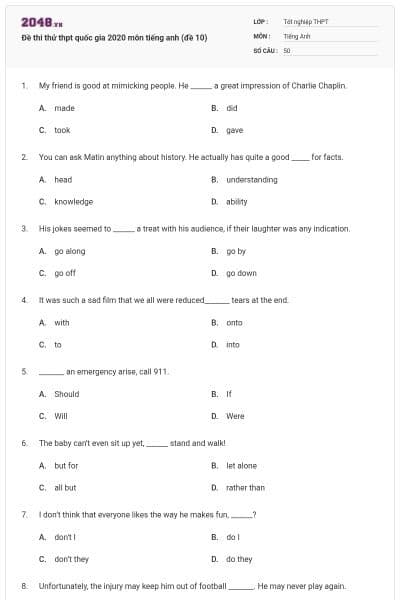
My friend is good at mimicking people. He ______ a great impression of Charlie Chaplin.
made
did
took
gave
Đáp án B
Kiến thức: Cụm từ, từ vựng
Giải thích:
Ta có cụm “do an impression of sb”: bắt chước ai, nhại điệu bộ của ai
Tạm dịch: Bạn tôi rất giỏi bắt chước mọi người. Cậu ấy bắt chước rất giống Charlie Chaplin.
Đáp án:B
You can ask Matin anything about history. He actually has quite a good _____ for facts.
head
understanding
knowledge
ability
Đáp án A
Kiến thức: Cụm từ, từ vựng
Giải thích:
Ta có cụm “have a (good) head for sth”: có khả năng làm điều gì đó thật tốt
Tạm dịch: Bạn có thể hỏi Matin mọi thứ về lịch sử. Cậu ấy thật sự có khả năng ghi nhớ tốt các sự kiện.
Đáp án:A
His jokes seemed to ______ a treat with his audience, if their laughter was any indication.
go along
go by
go off
go down
Đáp án D
Kiến thức: Phrasal verb
Giải thích:
go along (v): tiến triển, phát triển
go by (v): trôi qua, qua đi, phán đoán, làm theo
go off (v): rời sân khấu, đi vào
go down (with sb) (v): được ai đón nhận (ra sao đó)
Tạm dịch: Nếu tiếng cười của họ là dấu hiệu, thì những câu chuyện cười của anh dường như được khán giả đón nhận.
Đáp án:D
It was such a sad film that we all were reduced_______ tears at the end.
with
onto
to
into
Đáp án C
Kiến thức: Cụm từ, từ vựng
Giải thích:
Ta có cụm “reduce sb to tears” = make sb cry: làm ai khóc
Tạm dịch: Nó thật là một bộ phim buồn đến mức vào phút cuối tất cả chúng tôi đều khóc. Đáp án:C
_______ an emergency arise, call 911.
Should
If
Will
Were
Đáp án A
Kiến thức: Câu điều kiện
Giải thích:
Mệnh đề chính chia động từ là “call” vì thế ở vế giả định không thể dùng Were hay Will => đáp án C, D loại Chủ ngữ trong vế giả định là số ít, tuy nhiên động từ lại ở dạng nguyên thể (arise), vì thế chỉ có khả năng ta dùng Should, sau Should dùng động từ nguyên thể.
Tạm dịch: Nếu có tình huống khẩn cấp xảy ra, gọi 911.
Đáp án:A
The baby can't even sit up yet, ______ stand and walk!
but for
let alone
all but
rather than
Đáp án B
Kiến thức: Cụm từ, từ vựng
Giải thích:
but for: nhờ có, nếu không có all but: gần như, hầu như, suýt
let alone: chứ đừng nói đến, huống chi là rather than: thà..còn hơn, thích hơn
Tạm dịch: Đứa bé còn chưa thể ngồi được nữa là, huống chi là đứng và đi!
Đáp án:B
I don’t think that everyone likes the way he makes fun, ______?
don't I
do I
don’t they
do they
Đáp án D
Kiến thức: Câu hỏi đuôi
Giải thích:
Nếu trong câu có I + think/suppose/feel…. (that) + mệnh đề phụ, thì câu hỏi đuôi được chia theo mệnh đề đó
Trong câu có “everyone” thì câu hỏi đuôi ta dùng đại từ “they” Mệnh đề chính có “not” (I don’t think) vì thế cũng tính như mệnh đề phụ, do đó khi viết câu hỏi đuôi theo mệnh đề phụ ta dùng trợ động từ “do” chứ không dùng “don’t”
Tạm dịch: Tôi không nghĩ mọi người thích cách anh ta nói đùa, phải vậy không?
Đáp án: D
Unfortunately, the injury may keep him out of football _______. He may never play again.
for good
now and then
once in a while
every so often
Đáp án A
Kiến thức: Cụm từ, từ vựng
Giải thích:
for good = permanently: mãi mãi
now and then = sometimes: thỉnh thoảng
once in a while = occasionally: thỉnh thoảng
every so often = occasionally; sometimes: thỉnh thoảng
Tạm dịch: Thật không may, chấn thương có thể khiến anh ấy tách khỏi bóng đá mãi mãi. Anh ấy có thể không bao giờ chơi được nữa.
Đáp án:A
The two cars for sale were in poor condition, so I didn't buy ______.
neither of them
either of them
each of them
none of them
Đáp án B
Kiến thức: Từ vựng
Giải thích:
neither of: không phải trong số chúng => loại, ta không phủ định 2 lần. Đúng sẽ phải là “I bought neither of them”
either of: một trong hai, hoặc cái này hoặc cái kia each of: mỗi cái => loại vì không hợp về nghĩa
Phía trước đã có phủ định nên ta không thể dùng “none” nữa => D loại
Tạm dịch: Hai chiếc xe đang giảm giá đều chất lượng kém, vì thế tôi không mua cái nào hết. Đáp án:B
I used to ______ reading comics, but now I've grown out of it.
take a fancy to
keep an eye on
get a kick out of
kick up a fuss about
Đáp án C
Kiến thức: Cụm từ, từ vựng
Giải thích:
take a fancy to (v): bắt đầu thích cái gì
keep an eye on (v): để ý, quan tâm, chăm sóc đến cái gì
get a kick out of (v): thích cái gì, cảm thấy cái gì thú vị (= to like, be interested in…)
kick up a fuss about (v): giận dữ, phàn nàn về cái gì
Tạm dịch: Tôi đã từng thích đọc truyện tranh, nhưng bây giờ tôi không thích nữa.
Đáp án:C
The evidence suggests that single fathers ______ more likely to work than single mothers.
should be
must be
be
are
Đáp án D
Kiến thức: Cấu trúc với “suggest”
Giải thích:
Khi “suggest” với nghĩa yêu cầu, đề nghị, thì mệnh đề sau “suggest (that)…” động từ được chia là “should + V nguyên thể” hoặc động từ ở dạng nguyên thể (hay “be” với động từ to be)
Tuy nhiên, khi “suggest” mang nghĩa “đưa một ý nghĩ vào đầu người khác, khiến người khác tin điều gì đó là đúng”, đặc biệt là có kết hợp với từ “evidence” thì mệnh đề sau “suggest (that)…” động từ được chia như ở câu bình thường.
Do đó, câu này đáp án đúng là D, to be được chia là “are” với danh từ số nhiều. Tạm dịch: Bằng chứng cho thấy rằng người cha đơn thân có nhiều khả năng làm việc hơn so với người mẹ đơn thân.
Đáp án:D
Little Deon: “This herb smells horrible, mommy!”
Mommy: “______, it will do you a power of good.”
Come what may
By the by
What is more
Be that as it may
Đáp án D
Kiến thức: Cụm từ, từ vựng
Giải thích:
Come what may: dù khó khăn đến mấy/dù có rắc rối gì đi nữa
By the by = By the way: tiện thể, nhân tiện
What is more: thêm nữa là (thêm một điều gì đó có tính quan trọng hơn)
Be that as it may: cho dù như thế
Tạm dịch:
Little Deon: "Loại thảo mộc này có mùi thật khủng khiếp, mẹ ơi!"
Mẹ: "Dù thế, nó sẽ làm cho con vô cùng khoẻ mạnh."
Đáp án:D
It’s not fair to put all the blame on him. He’s not the only one at fault.
He doesn't deserve to be blamed for everything as there were others involved.
He deserved to be punished, but the others don’t.
It wouldn't be right to punish those who, like him, were not involved.
Only the one who were involved should be punished
Đáp án A
Kiến thức: Viết lại câu
Giải thích:
Tạm dịch: Không công bằng khi đặt tất cả trách nhiệm cho anh ta. Anh ta không phải là người duy nhất có lỗi.
A. Anh ta không đáng bị đổ lỗi cho tất cả mọi thứ vì có những người khác có liên quan.
B. Anh ta xứng đáng bị trừng phạt, nhưng những người khác thì không.
C. Không đúng khi trừng phạt những người không có liên quan, như anh ta,.
D. Chỉ có người có liên quan mới phải bị trừng phạt.
Đáp án:A
You will have to tell him about it in the end. The longer you put off doing so, the harder it’s going to be.
You can never keep things secret for long, so the best is to tell him about it soon.
Surely it’s better to let him know about it now than wait until he finds out for himself.
He will have to be notified about it, and the sooner the better.
You can’t keep him in the dark about it forever, and telling him will get harder the longer you wait.
Đáp án C
Kiến thức: Viết lại câu
Giải thích:
Tạm dịch: Bạn cuối cùng sẽ phải nói với anh ta về điều đó. Bạn càng trì hoãn lâu, thì nó sẽ càng khó khăn hơn.
A. Bạn không bao giờ có thể giữ bí mật lâu được, do đó, tốt nhất là nói với anh ta về điều đó sớm chút.
B. Chắc chắn tốt hơn khi bây giờ cho anh ta biết về điều đó hơn là đợi cho đến khi anh ta tự phát hiện.
C. Anh ta sẽ phải được thông báo về điều đó, và càng sớm càng tốt.
D. Bạn không giấu anh ta về điều đó mãi mãi, và việc nói với anh ta sẽ càng khó khăn hơn khi bạn chờ đợi càng lâu.
Đáp án:C
Mark the letter A, B, C, or D on your answer sheet to indicate the word that differs from the other three in the position of primary stress in each of the following questions.
technique
gazelle
canal
compass
Đáp án D
Kiến thức: Trọng âm của từ có 2 âm tiết
Giải thích:
technique /tekˈniːk/ canal /kəˈnæl/
gazelle /ɡəˈzel/ compass /ˈkʌmpəs/
Câu D trọng âm rơi vào âm tiết thứ nhất, còn lại là thứ 2
Đáp án:D
Mark the letter A, B, C, or D on your answer sheet to indicate the word that differs from the other three in the position of primary stress in each of the following questions
informative
preservative
mandatory
compulsory
Đáp án C
Kiến thức: Trọng âm của từ có 3 âm tiết trở lên
Giải thích:
informative /ɪnˈfɔːmətɪv/ mandatory /ˈmændətəri/ hoặc /mænˈdeɪtəri/
preservative /prɪˈzɜːvətɪv/ compulsory /kəmˈpʌlsəri/
Câu C trọng âm rơi vào âm tiết thứ nhất, còn lại là thứ 2 (câu C cũng có thể trọng âm ở âm tiết thứ 2, nhưng để khác với các đáp án còn lại, trong câu này, câu C trọng âm rơi vào thứ nhất)
Đáp án:C
Mark the letter A, B, C, or D on your answer sheet to indicate the word whose underlined part differs from the other three in pronunciation in each of the following questions
smooth
sunbath
youth
cloth
Đáp án A
Kiến thức: Phát âm “-th”
Giải thích:
smooth /smuːð/ youth /juːθ/
/ˈsʌnbɑːθ/ cloth /klɒθ/
Phần gạch chân câu A được phát âm là /ð/ còn lại là /θ/
Đáp án:A
Mark the letter A, B, C, or D on your answer sheet to indicate the word whose underlined part differs from the other three in pronunciation in each of the following questions
rough
touchy
southern
coup
Đáp án D
Kiến thức: Phát âm “-ou”
Giải thích:
rough /rʌf/ southern /ˈsʌðən/
touchy /ˈtʌtʃi/ coup /kuː/
Phần gạch chân câu D được phát âm là /uː/ còn lại là /ʌ/
Đáp án:D
We had about ten people helping us carry our belongings to a van parking outside when there was a sudden crash which made us turn round to find the big mirror lying in pieces on the ground.
ten people helping
van parking
which made us turn round
lying in pieces
Đáp án A
Kiến thức: Cấu trúc “have sb do sth”
Giải thích:
ten people helping => ten people help
Cấu trúc “have sb do sth”: có ai đó làm việc gì (ngoài ra ta còn có cấu trúc “have sth done (by sb): có cái gì đó được làm (bởi ai đó))
Tạm dịch: Chúng tôi có khoảng mười người giúp chúng tôi mang đồ đạc đến một chiếc xe van đậu bên ngoài thì có một vụ tai nạn đột ngột làm chúng tôi quay lại thấy mảnh gương lớn nằm trên đất.
Đáp án:A
You should take out insurance for your house from any possible damage. Earthquakes sometimes occur here.
take out
for
from
occur
Đáp án B
Kiến thức: Cụm từ, sửa lại câu
Giải thích:
for => on
ta có cụm “take out insurance on” = buy an insurance policy for: mua bảo hiểm cho cái gì Tạm dịch: Bạn nên mua bảo hiểm cho căn nhà của bạn khỏi mọi thiệt hại có thể xảy ra. Động đất đôi khi xảy ra ở đây.
Đáp án:B
In a famous experiment conducted at University of Chicago in 1983, rats kept from sleeping died after two and a half weeks.
conducted
University of Chicago
rats kept
half weeks
Đáp án B
Kiến thức: Mạo từ, sửa lại câu
Giải thích:
University of Chicago => The University of Chicago
"The" cũng đứng trước những tên gọi, danh từ riêng gồm Danh từ + of + danh từ
Tạm dịch: Trong một cuộc thí nghiệm nổi tiếng được tiến hành tại Đại học Chicago vào năm 1983, những con chuột thức trắng không ngủ đã chết sau hai tuần rưỡi.
Đáp án:B
Read the following passage and mark the letter A, B, C, or D on your answer sheet to indicate the correct word or phrase that best fits each of the numbered blanks from 22 to 26.
The invention of the mobile phone has undoubtedly revolutionized the way people communicate and influenced every aspect of our lives. The issue is whether this technological innovation has done more harm than good.
In order to (22)______ the question, we must first turn to the type of consumer. Presumably, most parents buy mobile phones for their teenagers to track their whereabouts and ensure their safety. We can also assume that most teenagers want mobile phones to avoid missing out (23)______ social contact. In this context, the advantages are clear. However, we cannot deny the fact that text messages have been used by bullies to intimidate fellow students. There is also (24)______ evidence that texting has affected literacy skills.
The ubiquitous use of the mobile phone has, (25)______ question, affected adult consumers, too. What employee, on the way home from work, would be reluctant to answer a call from their boss? Apparently, only 18% of us, according to a recent survey, are willing to switch off our mobile phones once we’ve left the office.
Admittedly, mobile phones can be intrusive but there are obvious benefits to possessing one. Personally speaking, they are invaluable when it comes to making social or business arrangements at short (26)______. According to a recent survey, they also provide their owners with a sense of security in emergency situations.
In conclusion, mobile phones do have their drawbacks, but these are outweighed by the benefits. I would argue that it is not the tool that chooses its purpose, but the user.
Điền vào ô 22
answer
address
remedy
put right
Đáp án A
Kiến thức: Từ vựng, đọc hiểu
Giải thích:
answer (v): trả lời, hồi đáp address (v): gửi, đề địa chỉ, nhằm vào
remedy (v): chữa, cứu chữa put right (v): sửa đổi, sữa chữa (cho đúng)
Đáp án: A
Read the following passage and mark the letter A, B, C, or D on your answer sheet to indicate the correct word or phrase that best fits each of the numbered blanks from 22 to 26.
The invention of the mobile phone has undoubtedly revolutionized the way people communicate and influenced every aspect of our lives. The issue is whether this technological innovation has done more harm than good.
In order to (22)______ the question, we must first turn to the type of consumer. Presumably, most parents buy mobile phones for their teenagers to track their whereabouts and ensure their safety. We can also assume that most teenagers want mobile phones to avoid missing out (23)______ social contact. In this context, the advantages are clear. However, we cannot deny the fact that text messages have been used by bullies to intimidate fellow students. There is also (24)______ evidence that texting has affected literacy skills.
The ubiquitous use of the mobile phone has, (25)______ question, affected adult consumers, too. What employee, on the way home from work, would be reluctant to answer a call from their boss? Apparently, only 18% of us, according to a recent survey, are willing to switch off our mobile phones once we’ve left the office.
Admittedly, mobile phones can be intrusive but there are obvious benefits to possessing one. Personally speaking, they are invaluable when it comes to making social or business arrangements at short (26)______. According to a recent survey, they also provide their owners with a sense of security in emergency situations.
In conclusion, mobile phones do have their drawbacks, but these are outweighed by the benefits. I would argue that it is not the tool that chooses its purpose, but the user.
Điền vào ô 23
in
to
of
on
Đáp án D
Kiến thức: Cụm từ, đọc hiểu
Giải thích: Ta có cụm “miss out on sth”: không được hưởng lợi từ một cái gì bằng việc không tham gia vào nó
Đáp án:D
Read the following passage and mark the letter A, B, C, or D on your answer sheet to indicate the correct word or phrase that best fits each of the numbered blanks from 22 to 26.
The invention of the mobile phone has undoubtedly revolutionized the way people communicate and influenced every aspect of our lives. The issue is whether this technological innovation has done more harm than good.
In order to (22)______ the question, we must first turn to the type of consumer. Presumably, most parents buy mobile phones for their teenagers to track their whereabouts and ensure their safety. We can also assume that most teenagers want mobile phones to avoid missing out (23)______ social contact. In this context, the advantages are clear. However, we cannot deny the fact that text messages have been used by bullies to intimidate fellow students. There is also (24)______ evidence that texting has affected literacy skills.
The ubiquitous use of the mobile phone has, (25)______ question, affected adult consumers, too. What employee, on the way home from work, would be reluctant to answer a call from their boss? Apparently, only 18% of us, according to a recent survey, are willing to switch off our mobile phones once we’ve left the office.
Admittedly, mobile phones can be intrusive but there are obvious benefits to possessing one. Personally speaking, they are invaluable when it comes to making social or business arrangements at short (26)______. According to a recent survey, they also provide their owners with a sense of security in emergency situations.
In conclusion, mobile phones do have their drawbacks, but these are outweighed by the benefits. I would argue that it is not the tool that chooses its purpose, but the user.
Điền vào ô 24
indisputable
arguable
doubtless
unhesitating
Đáp án B
Kiến thức: Từ vựng, đọc hiểu
Giải thích:
indisputable (a): không thể tranh cãi, hẳn là
arguable (a): còn phải bàn cãi, còn nghi vấn, đáng ngờ
doubtless (adv): không còn nghi ngờ gì nữa, (một cách) chắc chắn
unhesitating (a): không do dự; quả quyết
Đáp án:B
Read the following passage and mark the letter A, B, C, or D on your answer sheet to indicate the correct word or phrase that best fits each of the numbered blanks from 22 to 26.
The invention of the mobile phone has undoubtedly revolutionized the way people communicate and influenced every aspect of our lives. The issue is whether this technological innovation has done more harm than good.
In order to (22)______ the question, we must first turn to the type of consumer. Presumably, most parents buy mobile phones for their teenagers to track their whereabouts and ensure their safety. We can also assume that most teenagers want mobile phones to avoid missing out (23)______ social contact. In this context, the advantages are clear. However, we cannot deny the fact that text messages have been used by bullies to intimidate fellow students. There is also (24)______ evidence that texting has affected literacy skills.
The ubiquitous use of the mobile phone has, (25)______ question, affected adult consumers, too. What employee, on the way home from work, would be reluctant to answer a call from their boss? Apparently, only 18% of us, according to a recent survey, are willing to switch off our mobile phones once we’ve left the office.
Admittedly, mobile phones can be intrusive but there are obvious benefits to possessing one. Personally speaking, they are invaluable when it comes to making social or business arrangements at short (26)______. According to a recent survey, they also provide their owners with a sense of security in emergency situations.
In conclusion, mobile phones do have their drawbacks, but these are outweighed by the benefits. I would argue that it is not the tool that chooses its purpose, but the user.
Điền vào ô 25
out of
without
beyond
outside
Đáp án A
Kiến thức: Cụm từ, đọc hiểu
Giải thích:
Ta có cụm “out of the question”: không thể, không cho phép
Đáp án:A
Read the following passage and mark the letter A, B, C, or D on your answer sheet to indicate the correct word or phrase that best fits each of the numbered blanks from 22 to 26.
The invention of the mobile phone has undoubtedly revolutionized the way people communicate and influenced every aspect of our lives. The issue is whether this technological innovation has done more harm than good.
In order to (22)______ the question, we must first turn to the type of consumer. Presumably, most parents buy mobile phones for their teenagers to track their whereabouts and ensure their safety. We can also assume that most teenagers want mobile phones to avoid missing out (23)______ social contact. In this context, the advantages are clear. However, we cannot deny the fact that text messages have been used by bullies to intimidate fellow students. There is also (24)______ evidence that texting has affected literacy skills.
The ubiquitous use of the mobile phone has, (25)______ question, affected adult consumers, too. What employee, on the way home from work, would be reluctant to answer a call from their boss? Apparently, only 18% of us, according to a recent survey, are willing to switch off our mobile phones once we’ve left the office.
Admittedly, mobile phones can be intrusive but there are obvious benefits to possessing one. Personally speaking, they are invaluable when it comes to making social or business arrangements at short (26)______. According to a recent survey, they also provide their owners with a sense of security in emergency situations.
In conclusion, mobile phones do have their drawbacks, but these are outweighed by the benefits. I would argue that it is not the tool that chooses its purpose, but the user.
Điền vào ô 26
time
notice
term
warning
Đáp án B
Kiến thức: Cụm từ, đọc hiểu
Giải thích:
Ta có cụm “at short notice”: không lâu trước đó; không có cảnh báo hoặc thời gian chuẩn bị Đáp án:B
Dịch bài đọc:
Việc phát minh ra điện thoại di động chắc chắn đã cách mạng hóa cách mọi người giao tiếp và ảnh hưởng đến mọi khía cạnh của cuộc sống của chúng ta. Vấn đề là liệu sự đổi mới công nghệ này có hại nhiều hơn lợi hay không.
Để trả lời câu hỏi này, trước tiên chúng ta phải chuyển đến loại hình người tiêu dùng. Có lẽ, hầu hết cha mẹ mua điện thoại di động cho con trong tuổi thiếu niên của họ để theo dõi nơi ở của chúng và đảm bảo sự an toàn của chúng. Chúng ta cũng có thể cho rằng hầu hết thanh thiếu niên muốn điện thoại di động để tránh bị mất liên lạc xã hội. Trong bối cảnh này, lợi thế là rõ ràng. Tuy nhiên, chúng ta không thể phủ nhận thực tế là các tin nhắn văn bản dã bị sử dụng bởi những kẻ bắt nạt để hăm dọa các học sinh. Cũng có những bằng chứng nghi ngờ rằng việc nhắn tin đã ảnh hưởng đến kỹ năng đọc viết.
Việc sử dụng phổ biến của điện thoại di động cũng ảnh hưởng đến người tiêu dùng trưởng thành. Nhân viên nào, trên đường về nhà từ nơi làm việc, sẽ miễn cưỡng trả lời cuộc gọi từ ông chủ của họ? Rõ ràng, theo một cuộc khảo sát gần đây, chỉ có 18% trong số chúng ta sẵn sàng tắt điện thoại di động khi rời khỏi văn phòng. Phải thừa nhận, điện thoại di động có thể xâm nhập quá nhiều nhưng có những lợi ích rõ ràng khi sở hữu một chiếc điện thoại di động. Cá nhân mà nói, chúng là vô giá khi nói đến việc sắp xếp cuộc hẹn xã giao hoặc kinh doanh trong thời gian ngắn không có thông báo trước đó. Theo một cuộc khảo sát gần đây, chúng cũng mang lại cho chủ nhân một cảm giác an toàn trong các tình huống khẩn cấp.
Tóm lại, điện thoại di động có những nhược điểm của chúng, nhưng những lợi ích lại vượt trội hơn. Tôi lập luận rằng không phải là công cụ chọn mục đích, mà là người sử dụng.
- John: “Oh, I forgot my girlfriend's birthday last week.” - Anne: “______.”
Not on your life
So I guess you are in the doghouse again.
Sure, knock on wood.
You really should get a life.
Đáp án B
Kiến thức: Cụm từ, Văn hoá giao tiếp
Giải thích:
Tạm dịch: - John: "Ôi, tôi quên sinh nhật bạn gái vào tuần trước." - Anne: "______."
A. Không cần đâu. (Not on your life: dùng để từ chối một điều gì đó)
B. Vậy tôi đoán bạn lại bị giận rồi. (be in the doghouse: nếu bạn đang “in the doghouse”, tức là ai đó đang khó chịu với bạn vì điều bạn đã làm)
C. Chắc chắn rồi, Bề trên phù hộ. (knock on wood: dùng để diễn tả cách bạn đã may mắn trong quá khứ, tránh mang lại xui xẻo)
D. Bạn thực sự nên làm gì thú vị đi. (get a life: sử dụng để nói với ai đó ngưng nhàm chán và làm điều gì đó thú vị hơn)
Đáp án: B
- Porter: “I didn’t do too well on my final exams.” - Mary: “______.”
That's a shame!
Don’t mention it!
What a drag!
That will be the day!
Đáp án A
Kiến thức: Cụm từ, Văn hoá giao tiếp
Giải thích:
Tạm dịch: - Porter: "Tôi đã không làm tốt bài kiểm tra cuối kì." - Mary: "______."
A. Thật đáng tiếc!
B. Đừng nhắc đến nó!
C. Thật buồn chán!
D. Không thể nào! (That will be the day: tỏ ý không tin là điều gì người ta mong xảy ra sẽ thực sự xảy ra.)
Đáp án:A
Mark the letter A, B, C, or D on your answer sheet to indicate the word(s) CLOSEST in meaning to the underlined word(s) in each of the following questions.
The appeal was rejected by the committee, despite the fact that it had been signed by over 5,000 people.
application
petition
permit
form
Đáp án B
Kiến thức: Từ vựng, từ đồng nghĩa
Giải thích:
appeal (n): đơn phúc thẩm, đơn xin (một yêu cầu chính thức cho một tòa án về một quyết định được thay đổi)
application (n): (luật) việc có hiệu lực một nguyên tắc
petition (n): (luật) đơn thỉnh cầu ((một văn kiện) chính thức yêu cầu một tòa án thực hiện một hành động cụ thể)
permit (n): giấy phép
form (n): mẫu đơn
=> appeal = petition
Tạm dịch: Đơn phúc thẩm đã bị Ủy ban bác bỏ, mặc dù thực tế là nó đã được ký bởi hơn 5.000 người.
Đáp án:B
Mark the letter A, B, C, or D on your answer sheet to indicate the word(s) CLOSEST in meaning to the underlined word(s) in each of the following questions.
The children were full of beans today, looking forward to their field trip.
eating a lot
hyperactive
melancholy
lively and in high spirits
Đáp án D
Kiến thức: Từ vựng, từ đồng nghĩa
Giải thích:
full of beans: hăng hái, sôi nổi, đầy năng lượng
eating a lot: ăn rất nhiều
hyperactive: quá mức hiếu động (trẻ em)
melancholy: u sầu, đau buồn
lively and in high spirits: năng nổ và đầy năng lượng
=> full of beans = lively and in high spirits
Tạm dịch: Hôm nay lũ trẻ rất hăng hái, vô cùng mong đợi chuyến đi thực địa.
Đáp án:D
Mark the letter A, B, C, or D on your answer sheet to indicate the word(s) OPPOSITE in meaning to the underlined word(s) in each of the following questions.
The device is very sophisticated and should only be operated by someone who The device is very sophisticated and should only be operated by someone who is
crude
advanced
makeshift
archaic
Đáp án A
Kiến thức: Từ vựng, từ trái nghĩa
Giải thích:
sophisticated (a): tinh xảo, tinh vi
crude (a): đơn giản, thô kệch makeshift (n): cái thay thế tạm thời advanced (a): cao cấp archaic (a): cổ, cổ xưa
=> sophisticated >< crude
Tạm dịch: Thiết bị này rất tinh vi và chỉ được vận hành bởi một người quen thuộc với nó. Đáp án:A
Mark the letter A, B, C, or D on your answer sheet to indicate the word(s) OPPOSITE in meaning to the underlined word(s) in each of the following questions.
Relations between the two countries have improved considerably in the last few years.
abolis
demolish
diminish
deteriorated
Đáp án D
Kiến thức: Từ vựng, từ trái nghĩa
Giải thích:
improve (v): nâng cao, cải thiện
abolish (v): thủ tiêu, bãi bỏ diminish (v): làm giảm, làm yếu đi
demolish (v): phá hủy, đánh đổ deteriorate (v): trở nên tệ hơn
=> improve >< deteriorate
Tạm dịch: Quan hệ giữa hai nước đã được cải thiện đáng kể trong vài năm gần đây.
Đáp án:D
Mark the letter A, B, C, or D on your answer sheet to indicate the sentence that is closest in meaning to each of the following questions
However much effort he put into it, he will never make a go of the business.
He’s a failure as an a businessman even though he’s extremely hardworking.
No matter how hard he tries, he won’t ever turn that business into a going concern.
The success of the business will depend upon the amount of hard work he puts into it.
Unless he is willing to make more of an effort, the business is never likely to be a success.
Đáp án B
Kiến thức: Viết lại câu Giải thích:
Tạm dịch: Dù anh ấy bỏ bao nhiêu nỗ lực vào nó đi chăng nữa, anh sẽ không bao giờ thành công trong kinh doanh.
A. Anh ấy là một doanh nhân thất bại mặc dù anh ấy rất chăm chỉ.
B. Dù anh ấy cố gắng thế nào, anh sẽ không bao giờ biến việc kinh doanh đó thành một hoạt động liên tục.
C. Sự thành công của kinh doanh sẽ phụ thuộc vào lượng công việc vất vả mà anh ấy bỏ vào đó.
D. Trừ khi anh ấy sẵn sàng nỗ lực hơn, công việc kinh doanh không bao giờ có thể thành công.
Đáp án:B
Mark the letter A, B, C, or D on your answer sheet to indicate the sentence that is closest in meaning to each of the following questions
The last time I saw Peter was when I ran into him at the station on my way to Glasgow.
I haven't seen Peter since a chance meeting with him at the station when I was setting off for Glasgow
The last time I went to Glasgow, I happened to meet Peter at the station.
When I last saw Peter at the station when I was on my way to Glasgow, I ran after him
I finally saw Peter at the station when I was on my way to Glasgow.
Đáp án A
Kiến thức: Viết lại câu
Giải thích:
Tạm dịch: Lần cuối cùng tôi gặp Peter là khi tôi tình cờ gặp anh ta tại nhà ga trên đường tới Glasgow.
A. Tôi đã không gặp Peter kể từ cuộc gặp mặt tình cờ với anh ta tại nhà ga khi tôi lên đường đi Glasgow
B. Lần cuối cùng tôi đến Glasgow, tôi đã gặp Peter ở nhà ga.
C. Khi tôi gặp Peter lần cuối ở nhà ga khi tôi đang trên đường đến Glasgow, tôi tình cờ gặp anh ấy.
D. Cuối cùng tôi gặp Peter ở nhà ga khi tôi đang trên đường đến Glasgow.
Đáp án:A
Mark the letter A, B, C, or D on your answer sheet to indicate the sentence that is closest in meaning to each of the following questions
We got caught in a traffic jam so we were among the last to arrive at the cinema.
The traffic jam prevented us from getting to the cinema.
The traffic was so heavy that everybody arrived at the cinema late.
There was such a congestion on the road that nobody arrived at the cinema on time.
Most people get to the cinema before us as we were held up by the traffic jam.
Đáp án D
Kiến thức: Viết lại câu
Giải thích:
Tạm dịch: Chúng tôi bị tắc đường vì thế chúng tôi là một trong những người cuối cùng đến rạp chiếu phim.
A. Tắc nghẽn giao thông ngăn cản chúng tôi đi đến rạp chiếu phim.
B. Giao thông quá đông đúc khiến mọi người đến rạp chiếu phim muộn.
C. Có một sự tắc nghẽn trên đường đến mức không ai đến rạp chiếu phim đúng giờ.
D. Hầu hết mọi người đến rạp chiếu phim trước chúng tôi vì chúng tôi bị tắc đường.
Đáp án:D
Read the following passage and mark the letter A B, C, or D on your answer sheet to indicate the correct answer to each of the questions
All foods contain water - cabbage and other leaf vegetables contain as much as 93% water, potatoes and other root vegetables 80%, lean meat 75% and fish anything from 80% to 60% depending on how fatty it is. If this water is removed, the activity of the bacteria which cause food to go bad is checked.
Fruit is sun-dried in Asia Minor, Greece, Spain and ot her Mediterranean countries, and also in California, South Africa and Australia. The methods used vary, but in general the fruit is spread out on trays in drying yards in the hot sun. In order to prevent darkening, pears, peaches and apricots are exposed to the fumes of burning sulphur before drying. Plums for making prunes, and certain varieties of grapes for making raisins and currants, are dipped in an alkaline solution in order to crack the skins of the fruit slightly and remove their wax coating, so increasing the rate of drying.
Nowadays most foods are dried mechanically; the conventional method of such dehydration is to put food in chambers through which hot air is blown at temperatures of about 110°C at entry to about 45°C at exit. This is the usual method for drying such things as vegetables, minced meat, and fish.
Liquids such as milk, coffee, tea, soups and eggs may be dried by pouring them over a heated horizontal steel cylinder or by spraying them into a chamber through which a current of hot air passes. In the first case, the dried material is scraped off the roller as a thin film which is then broken up into small, though still relatively coarse flakes. In the second process it falls to the bottom of the chamber as a fine powder. Where recognizable pieces of meat and vegetables are required, as in soup, the ingredients are dried separately and then mixed.
Dried foods take up less room and weigh less than the same food packed in cans or frozen, and they do not need to be stored in special conditions. For these reasons they are invaluable to climbers, explorers and soldiers in battle, who have little storage space. They are also popular with housewives because it takes so little time to cook them.
What is the main idea of the passage?
Advantages of dried foods.
Water: the main component of food
Mechanization of drying foods.
Different methods of drying foods.
Đáp án D
Kiến thức: Đọc hiểu
Giải thích:
Ý chính của đoạn văn là gì?
A: Những ích lợi của thực phẩm khô C: Sự cơ khí hóa trong việc làm khô thực phẩm B: Nước: thành phần chính của thực phẩm D: Các phương pháp làm khô thực phẩm.
Trong bài có nhắc đến các phương pháp làm khô thực phẩm như "sun-dried", "expose to sulphur fumes", "put in chambers", ....
Đáp án:D
Read the following passage and mark the letter A B, C, or D on your answer sheet to indicate the correct answer to each of the questions
All foods contain water - cabbage and other leaf vegetables contain as much as 93% water, potatoes and other root vegetables 80%, lean meat 75% and fish anything from 80% to 60% depending on how fatty it is. If this water is removed, the activity of the bacteria which cause food to go bad is checked.
Fruit is sun-dried in Asia Minor, Greece, Spain and ot her Mediterranean countries, and also in California, South Africa and Australia. The methods used vary, but in general the fruit is spread out on trays in drying yards in the hot sun. In order to prevent darkening, pears, peaches and apricots are exposed to the fumes of burning sulphur before drying. Plums for making prunes, and certain varieties of grapes for making raisins and currants, are dipped in an alkaline solution in order to crack the skins of the fruit slightly and remove their wax coating, so increasing the rate of drying.
Nowadays most foods are dried mechanically; the conventional method of such dehydration is to put food in chambers through which hot air is blown at temperatures of about 110°C at entry to about 45°C at exit. This is the usual method for drying such things as vegetables, minced meat, and fish.
Liquids such as milk, coffee, tea, soups and eggs may be dried by pouring them over a heated horizontal steel cylinder or by spraying them into a chamber through which a current of hot air passes. In the first case, the dried material is scraped off the roller as a thin film which is then broken up into small, though still relatively coarse flakes. In the second process it falls to the bottom of the chamber as a fine powder. Where recognizable pieces of meat and vegetables are required, as in soup, the ingredients are dried separately and then mixed.
Dried foods take up less room and weigh less than the same food packed in cans or frozen, and they do not need to be stored in special conditions. For these reasons they are invaluable to climbers, explorers and soldiers in battle, who have little storage space. They are also popular with housewives because it takes so little time to cook them.
The word “checked” in the second paragraph is closest in meaning to ______.
reduced considerably
put a tick
examined carefully
motivated to develop
Đáp án A
Kiến thức: Đọc hiểu
Giải thích:
Chữ "checked" ở đoạn thứ hai có nghĩa gần nhất với ______.
A: được giảm đáng kể C: được kiểm tra kỹ lưỡng
B: được đánh dấu tick. D: được kích thích phát triển
If this water is removed, the activity of the bacteria which cause food to go bad is checked. Nếu nước bị loại bỏ thì hoạt động của vi khuẩn gây hư hại thực phẩm sẽ được giảm thiểu đáng kể.
Đáp án:A
Read the following passage and mark the letter A B, C, or D on your answer sheet to indicate the correct answer to each of the questions
All foods contain water - cabbage and other leaf vegetables contain as much as 93% water, potatoes and other root vegetables 80%, lean meat 75% and fish anything from 80% to 60% depending on how fatty it is. If this water is removed, the activity of the bacteria which cause food to go bad is checked.
Fruit is sun-dried in Asia Minor, Greece, Spain and ot her Mediterranean countries, and also in California, South Africa and Australia. The methods used vary, but in general the fruit is spread out on trays in drying yards in the hot sun. In order to prevent darkening, pears, peaches and apricots are exposed to the fumes of burning sulphur before drying. Plums for making prunes, and certain varieties of grapes for making raisins and currants, are dipped in an alkaline solution in order to crack the skins of the fruit slightly and remove their wax coating, so increasing the rate of drying.
Nowadays most foods are dried mechanically; the conventional method of such dehydration is to put food in chambers through which hot air is blown at temperatures of about 110°C at entry to about 45°C at exit. This is the usual method for drying such things as vegetables, minced meat, and fish.
Liquids such as milk, coffee, tea, soups and eggs may be dried by pouring them over a heated horizontal steel cylinder or by spraying them into a chamber through which a current of hot air passes. In the first case, the dried material is scraped off the roller as a thin film which is then broken up into small, though still relatively coarse flakes. In the second process it falls to the bottom of the chamber as a fine powder. Where recognizable pieces of meat and vegetables are required, as in soup, the ingredients are dried separately and then mixed.
Dried foods take up less room and weigh less than the same food packed in cans or frozen, and they do not need to be stored in special conditions. For these reasons they are invaluable to climbers, explorers and soldiers in battle, who have little storage space. They are also popular with housewives because it takes so little time to cook them.
In the process of drying certain kinds of fruits, sulphur fumes help ______
remove their wax coating
kill off bacteria
maintain their color
crack their skin
Đáp án C
Kiến thức: Đọc hiểu
Giải thích:
Trong quá trình sấy một số loại trái cây nhất định, khói lưu huỳnh sẽ giúp ______.
A. loại bỏ lớp phủ sáp của chúng C. duy trì màu sắc của chúng
B. diệt vi khuẩn D. làm nứt vỏ của chúng
Thông tin: In order to prevent darkening, pears, peaches and apricots are exposed to the fumes of burning sulphur before drying.
Ta có cụm từ "prevent darkening" (không để bị thâm đen) = "maintain their color" (giữ nguyên màu sắc)
Đáp án:C
Read the following passage and mark the letter A B, C, or D on your answer sheet to indicate the correct answer to each of the questions
All foods contain water - cabbage and other leaf vegetables contain as much as 93% water, potatoes and other root vegetables 80%, lean meat 75% and fish anything from 80% to 60% depending on how fatty it is. If this water is removed, the activity of the bacteria which cause food to go bad is checked.
Fruit is sun-dried in Asia Minor, Greece, Spain and ot her Mediterranean countries, and also in California, South Africa and Australia. The methods used vary, but in general the fruit is spread out on trays in drying yards in the hot sun. In order to prevent darkening, pears, peaches and apricots are exposed to the fumes of burning sulphur before drying. Plums for making prunes, and certain varieties of grapes for making raisins and currants, are dipped in an alkaline solution in order to crack the skins of the fruit slightly and remove their wax coating, so increasing the rate of drying.
Nowadays most foods are dried mechanically; the conventional method of such dehydration is to put food in chambers through which hot air is blown at temperatures of about 110°C at entry to about 45°C at exit. This is the usual method for drying such things as vegetables, minced meat, and fish.
Liquids such as milk, coffee, tea, soups and eggs may be dried by pouring them over a heated horizontal steel cylinder or by spraying them into a chamber through which a current of hot air passes. In the first case, the dried material is scraped off the roller as a thin film which is then broken up into small, though still relatively coarse flakes. In the second process it falls to the bottom of the chamber as a fine powder. Where recognizable pieces of meat and vegetables are required, as in soup, the ingredients are dried separately and then mixed.
Dried foods take up less room and weigh less than the same food packed in cans or frozen, and they do not need to be stored in special conditions. For these reasons they are invaluable to climbers, explorers and soldiers in battle, who have little storage space. They are also popular with housewives because it takes so little time to cook them.
Nowadays the common method for drying vegetables and minced meat is ______.
spreading them out on trays in drying yards
putting them in chambers and blowing hot air through
dipping them in an alkaline solution
pouring them over a heated horizontal steel cylinder
Đáp án B
Kiến thức: Đọc hiểu
Giải thích:
Ngày nay, phương pháp phổ biến để sấy rau và thịt băm là ______.
A. phun chúng trên khay trong sân phơi
B. đưa chúng vào buồng và thổi không khí nóng qua
C. nhúng chúng trong dung dịch kiềm
D. đổ chúng qua một xy lanh thép ngang nóng
Thông tin: Nowadays most foods are dried mechanically; the conventional method of such dehydration is to put food in chambers through which hot air is blown at temperatures of about 110°C at entry to about 45°C at exit.
Đáp án:B
Read the following passage and mark the letter A B, C, or D on your answer sheet to indicate the correct answer to each of the questions
All foods contain water - cabbage and other leaf vegetables contain as much as 93% water, potatoes and other root vegetables 80%, lean meat 75% and fish anything from 80% to 60% depending on how fatty it is. If this water is removed, the activity of the bacteria which cause food to go bad is checked.
Fruit is sun-dried in Asia Minor, Greece, Spain and ot her Mediterranean countries, and also in California, South Africa and Australia. The methods used vary, but in general the fruit is spread out on trays in drying yards in the hot sun. In order to prevent darkening, pears, peaches and apricots are exposed to the fumes of burning sulphur before drying. Plums for making prunes, and certain varieties of grapes for making raisins and currants, are dipped in an alkaline solution in order to crack the skins of the fruit slightly and remove their wax coating, so increasing the rate of drying.
Nowadays most foods are dried mechanically; the conventional method of such dehydration is to put food in chambers through which hot air is blown at temperatures of about 110°C at entry to about 45°C at exit. This is the usual method for drying such things as vegetables, minced meat, and fish.
Liquids such as milk, coffee, tea, soups and eggs may be dried by pouring them over a heated horizontal steel cylinder or by spraying them into a chamber through which a current of hot air passes. In the first case, the dried material is scraped off the roller as a thin film which is then broken up into small, though still relatively coarse flakes. In the second process it falls to the bottom of the chamber as a fine powder. Where recognizable pieces of meat and vegetables are required, as in soup, the ingredients are dried separately and then mixed.
Dried foods take up less room and weigh less than the same food packed in cans or frozen, and they do not need to be stored in special conditions. For these reasons they are invaluable to climbers, explorers and soldiers in battle, who have little storage space. They are also popular with housewives because it takes so little time to cook them.
What does the word “which” in the fourth paragraph refer to?
Vegetables
Foods
Things
Chambers
Đáp án D
Kiến thức: Đọc hiểu
Giải thích:
Từ "which" trong đoạn 4 nói đến cái gì?
A. Rau C. Những thứ
B. Thực phẩm D. Buồng sấy
Đại từ quan hệ "which" dùng để thay thế cho danh từ đứng trước nó là "chambers": Nowadays most foods are dried mechanically; the conventional method of such dehydration is to put food in chambers through which hot air is blown at temperatures of about 110°C at entry to about 45°C at exit.
Đáp án:D
Read the following passage and mark the letter A B, C, or D on your answer sheet to indicate the correct answer to each of the questions
All foods contain water - cabbage and other leaf vegetables contain as much as 93% water, potatoes and other root vegetables 80%, lean meat 75% and fish anything from 80% to 60% depending on how fatty it is. If this water is removed, the activity of the bacteria which cause food to go bad is checked.
Fruit is sun-dried in Asia Minor, Greece, Spain and ot her Mediterranean countries, and also in California, South Africa and Australia. The methods used vary, but in general the fruit is spread out on trays in drying yards in the hot sun. In order to prevent darkening, pears, peaches and apricots are exposed to the fumes of burning sulphur before drying. Plums for making prunes, and certain varieties of grapes for making raisins and currants, are dipped in an alkaline solution in order to crack the skins of the fruit slightly and remove their wax coating, so increasing the rate of drying.
Nowadays most foods are dried mechanically; the conventional method of such dehydration is to put food in chambers through which hot air is blown at temperatures of about 110°C at entry to about 45°C at exit. This is the usual method for drying such things as vegetables, minced meat, and fish.
Liquids such as milk, coffee, tea, soups and eggs may be dried by pouring them over a heated horizontal steel cylinder or by spraying them into a chamber through which a current of hot air passes. In the first case, the dried material is scraped off the roller as a thin film which is then broken up into small, though still relatively coarse flakes. In the second process it falls to the bottom of the chamber as a fine powder. Where recognizable pieces of meat and vegetables are required, as in soup, the ingredients are dried separately and then mixed.
Dried foods take up less room and weigh less than the same food packed in cans or frozen, and they do not need to be stored in special conditions. For these reasons they are invaluable to climbers, explorers and soldiers in battle, who have little storage space. They are also popular with housewives because it takes so little time to cook them.
The final product of the process of drying liquids that uses the first method will be ______.
small flakes
fine powder
dried soup
recognizable pieces
Đáp án A
Kiến thức: Đọc hiểu
Giải thích:
Sản phẩm cuối cùng của quá trình sấy chất lỏng sử dụng phương pháp đầu tiên sẽ là ______. A. các mảnh nhỏ C. súp khô
B. bột mịn D. các mảnh dễ nhận biết
Thông tin: In the first case, the dried material is scraped off the roller as a thin film which is then broken up into small, though still relatively coarse flakes.
Đáp án:A
Read the following passage and mark the letter A B, C, or D on your answer sheet to indicate the correct answer to each of the questions
All foods contain water - cabbage and other leaf vegetables contain as much as 93% water, potatoes and other root vegetables 80%, lean meat 75% and fish anything from 80% to 60% depending on how fatty it is. If this water is removed, the activity of the bacteria which cause food to go bad is checked.
Fruit is sun-dried in Asia Minor, Greece, Spain and ot her Mediterranean countries, and also in California, South Africa and Australia. The methods used vary, but in general the fruit is spread out on trays in drying yards in the hot sun. In order to prevent darkening, pears, peaches and apricots are exposed to the fumes of burning sulphur before drying. Plums for making prunes, and certain varieties of grapes for making raisins and currants, are dipped in an alkaline solution in order to crack the skins of the fruit slightly and remove their wax coating, so increasing the rate of drying.
Nowadays most foods are dried mechanically; the conventional method of such dehydration is to put food in chambers through which hot air is blown at temperatures of about 110°C at entry to about 45°C at exit. This is the usual method for drying such things as vegetables, minced meat, and fish.
Liquids such as milk, coffee, tea, soups and eggs may be dried by pouring them over a heated horizontal steel cylinder or by spraying them into a chamber through which a current of hot air passes. In the first case, the dried material is scraped off the roller as a thin film which is then broken up into small, though still relatively coarse flakes. In the second process it falls to the bottom of the chamber as a fine powder. Where recognizable pieces of meat and vegetables are required, as in soup, the ingredients are dried separately and then mixed.
Dried foods take up less room and weigh less than the same food packed in cans or frozen, and they do not need to be stored in special conditions. For these reasons they are invaluable to climbers, explorers and soldiers in battle, who have little storage space. They are also popular with housewives because it takes so little time to cook them.
According to the passage, dried foods are most useful for ______.
explorers who are underweight
soldiers who are not in battle
people who are on the move
housewives who have little storage space
Đáp án C
Kiến thức: Đọc hiểu
Giải thích:
Theo đoạn văn, thực phẩm khô hữu ích nhất cho ______.
A. những nhà thám hiểm thiếu cân B. những người lính không tham chiến
C. những người bận rộn D. các bà nội trợ có ít không gian để trữ đồ
Thông tin: Dried foods take up less room and weigh less than the same food packed in cans or frozen, and they do not need to be stored in special conditions. For these reasons they are invaluable to climbers, explorers and soldiers in battle, who have little storage space. They are also popular with housewives because it takes so little time to cook them.
Ta có cụm "to be on the move" hoặc "to be on the go" nghĩa là vô cùng bận rộn. Do đó đáp án C là hợp lí nhất. ("People who are on the move" bao gồm"climbers", "soldiers in battle" and "housewives".)
Đáp án:C
Read the following passage and mark the letter A B, C, or D on your answer sheet to indicate the correct answer to each of the questions
All foods contain water - cabbage and other leaf vegetables contain as much as 93% water, potatoes and other root vegetables 80%, lean meat 75% and fish anything from 80% to 60% depending on how fatty it is. If this water is removed, the activity of the bacteria which cause food to go bad is checked.
Fruit is sun-dried in Asia Minor, Greece, Spain and ot her Mediterranean countries, and also in California, South Africa and Australia. The methods used vary, but in general the fruit is spread out on trays in drying yards in the hot sun. In order to prevent darkening, pears, peaches and apricots are exposed to the fumes of burning sulphur before drying. Plums for making prunes, and certain varieties of grapes for making raisins and currants, are dipped in an alkaline solution in order to crack the skins of the fruit slightly and remove their wax coating, so increasing the rate of drying.
Nowadays most foods are dried mechanically; the conventional method of such dehydration is to put food in chambers through which hot air is blown at temperatures of about 110°C at entry to about 45°C at exit. This is the usual method for drying such things as vegetables, minced meat, and fish.
Liquids such as milk, coffee, tea, soups and eggs may be dried by pouring them over a heated horizontal steel cylinder or by spraying them into a chamber through which a current of hot air passes. In the first case, the dried material is scraped off the roller as a thin film which is then broken up into small, though still relatively coarse flakes. In the second process it falls to the bottom of the chamber as a fine powder. Where recognizable pieces of meat and vegetables are required, as in soup, the ingredients are dried separately and then mixed.
Dried foods take up less room and weigh less than the same food packed in cans or frozen, and they do not need to be stored in special conditions. For these reasons they are invaluable to climbers, explorers and soldiers in battle, who have little storage space. They are also popular with housewives because it takes so little time to cook them.
This passage is mainly ______.
argumentative
analytical
informative
fictional
Đáp án C
Kiến thức: Đọc hiểu
Giải thích:
Đoạn văn này chủ yếu là ______.
A: tranh luận C: cung cấp thông tin
B: phân tích D: hư cấu, viễn tưởng
Đáp án:C
Dịch bài đọc:
Tất cả các loại thực phẩm đều chứa nước - bắp cải và các loại rau ăn lá khác có chứa 93% nước, khoai tây và rau củ ăn rễ khác chứa 80%, thịt nạc 75% và cá từ 80% đến 60% tuỳ theo chất béo. Nếu nước bị loại bỏ thì hoạt động của vi khuẩn gây hư hại thực phẩm sẽ được giảm thiểu đáng kể.
Trái cây được sấy khô ở Châu Á, Hy Lạp, Tây Ban Nha và các nước Địa Trung Hải, cũng như ở California, Nam Phi và Úc. Phương thức được sử dụng khác nhau, nhưng nhìn chung, trái cây được trải ra trên khay trong sân phơi nắng. Để ngăn bị thâm đen, lê, đào và mơ sẽ tiếp xúc với khói của lưu huỳnh đốt cháy trước khi sấy khô. Mận để làm mận khô và một số loại nho để làm nho khô và quả lý chua, được nhúng vào dung dịch kiềm để nứt vỏ và loại bỏ lớp phủ sáp, do đó làm tăng tốc độ sấy.
Ngày nay hầu hết các thực phẩm đều được làm khô bằng máy móc; phương pháp loại bỏ nước thông thường là đưa thức ăn vào trong buồng thông qua đó không khí nóng được thổi ở nhiệt độ khoảng 110 ° C ở lối vào tới khoảng 45 ° C ở lối ra. Đây là phương pháp thông thường để làm khô những thứ như rau, thịt băm, và cá.
Các chất lỏng như sữa, cà phê, chè, súp và trứng có thể được làm khô bằng cách đổ chúng lên trên một xi lanh thép ngang nóng hoặc bằng cách phun chúng vào trong buồng mà qua đó một luồng không khí nóng đi qua. Trong trường hợp đầu tiên, vật liệu khô được loại bỏ khỏi con lăn như một màng mỏng sau đó được chia thành các mảnh nhỏ, mặc dù vẫn còn thô. Trong quá trình thứ hai nó rơi xuống đáy của buồng như một miếng bột. Nơi có thể nhận thịt và rau là cần thiết, như trong súp, các thành phần được sấy khô riêng biệt và sau đó trộn lẫn.
Thực phẩm khô chiếm ít chỗ hơn và nhẹ hơn so với cùng một thực phẩm đóng gói trong lon hoặc đông lạnh, và chúng không cần phải được bảo quản trong điều kiện đặc biệt. Vì những lý do này, chúng rất có giá rị đối với các nhà leo núi, thám hiểm và binh lính trong trận chiến, những người có ít chỗ trữ đồ. Chúng cũng phổ biến với các bà nội trợ bởi vì cần rất ít thời gian để nấu chúng.
Read the following passage and mark the letter A B, C, or D on your answer sheet to indicate the correct answer to each of the questions
Very few people, groups, or governments oppose globalization in its entirety. Instead, critics of globalization believe aspects of the way globalization operates should be changed. The debate over globalization is about what the best rules are for governing the global economy so that its advantages can grow while its problems can be solved.
On one side of this debate are those who stress the benefits of removing barriers to international trade and investment, allowing capital to be allocated more efficiently and giving consumers greater freedom of choice. With free-market globalization, investment funds can move unimpeded from the rich countries to the developing countries. Consumers can benefit from cheaper products because reduced taxes make goods produced at low cost from faraway places cheaper to buy. Producers of goods gain by selling to a wider market. More competition keeps sellers on their toes and allows ideas and new technology to spread and benefit others.
On the other side of the debate are critics who see neo-liberal policies as producing greater poverty, inequality, social conflict, cultural destruction, and environmental damage. They say that the most developed nations – the United States, Germany, and Japan – succeeded not because of free trade but because of protectionism and subsidies. They argue that the more recently successful economies of South Korea, Taiwan, and China all had strong state-led development strategies that did not follow neo-liberalism. These critics think that government encouragement of “infant industries” – that is, industries that are just beginning to develop – enables a country to become internationally competitive.
Furthermore, those who criticize the Washington Consensus suggest that the inflow and outflow of money from speculative investors must be limited to prevent bubbles. These bubbles are characterized by the rapid inflow of foreign funds that bid up domestic stock markets and property values. When the economy cannot sustain such expectation, the bubbles burst as investors panic and pull their money out of the country.
Protests by what is called the anti-globalization movement are seldom directed against globalization itself but rather against abuses that harm the rights of workers and the environment. The question raised by nongovernmental organizations and protesters at WTO and IMF gatherings is whether globalization will result in a rise of living standards or a race to the bottom as competition takes the form of lowering living standards and undermining environmental regulations.
One of the key problems of the 21st century will be determining to what extent markets should be regulated to promote fair competition, honest dealing, and fair distribution of public goods on a global scale.
Supporters of free-market globalization point out that
investment will be allocated only to rich countries
taxes that are paid on goods will be increased
there will be less competition among producers
consumers can benefit from cheaper products
Đáp án D
Kiến thức: Đọc hiểu
Giải thích:
Những người ủng hộ toàn cầu hoá thị trường tự do chỉ ra rằng
A. đầu tư sẽ chỉ được phân bổ cho các nước giàu
B. các loại thuế được thanh toán trên hàng hoá sẽ được tăng lên
C. sẽ có sự cạnh tranh giữa các nhà sản xuất
D. người tiêu dùng có thể hưởng lợi từ các sản phẩm rẻ hơn
Thông tin: On one side of this debate are those who stress the benefits of removing barriers to international trade and investment, allowing capital to be allocated more efficiently and giving consumers greater freedom of choice. […]Consumers can benefit from cheaper products because reduced taxes make goods produced at low cost from faraway places cheaper to buy.
Đáp án:D
Read the following passage and mark the letter A B, C, or D on your answer sheet to indicate the correct answer to each of the questions
Very few people, groups, or governments oppose globalization in its entirety. Instead, critics of globalization believe aspects of the way globalization operates should be changed. The debate over globalization is about what the best rules are for governing the global economy so that its advantages can grow while its problems can be solved.
On one side of this debate are those who stress the benefits of removing barriers to international trade and investment, allowing capital to be allocated more efficiently and giving consumers greater freedom of choice. With free-market globalization, investment funds can move unimpeded from the rich countries to the developing countries. Consumers can benefit from cheaper products because reduced taxes make goods produced at low cost from faraway places cheaper to buy. Producers of goods gain by selling to a wider market. More competition keeps sellers on their toes and allows ideas and new technology to spread and benefit others.
On the other side of the debate are critics who see neo-liberal policies as producing greater poverty, inequality, social conflict, cultural destruction, and environmental damage. They say that the most developed nations – the United States, Germany, and Japan – succeeded not because of free trade but because of protectionism and subsidies. They argue that the more recently successful economies of South Korea, Taiwan, and China all had strong state-led development strategies that did not follow neo-liberalism. These critics think that government encouragement of “infant industries” – that is, industries that are just beginning to develop – enables a country to become internationally competitive.
Furthermore, those who criticize the Washington Consensus suggest that the inflow and outflow of money from speculative investors must be limited to prevent bubbles. These bubbles are characterized by the rapid inflow of foreign funds that bid up domestic stock markets and property values. When the economy cannot sustain such expectation, the bubbles burst as investors panic and pull their money out of the country.
Protests by what is called the anti-globalization movement are seldom directed against globalization itself but rather against abuses that harm the rights of workers and the environment. The question raised by nongovernmental organizations and protesters at WTO and IMF gatherings is whether globalization will result in a rise of living standards or a race to the bottom as competition takes the form of lowering living standards and undermining environmental regulations.
One of the key problems of the 21st century will be determining to what extent markets should be regulated to promote fair competition, honest dealing, and fair distribution of public goods on a global scale.
The word “allocated” in the passage mostly means
distributed
solved
removed
offered
Đáp án A
Kiến thức: Đọc hiểu
Giải thích:
Từ “allocated” trong đoạn văn chủ yếu nghĩa là
A. phân phối C. loại bỏ
B. được giải quyết D. được cung cấp
“allocated” = distributed: phân bổ, phân phối
Đáp án:A
Read the following passage and mark the letter A B, C, or D on your answer sheet to indicate the correct answer to each of the questions
Very few people, groups, or governments oppose globalization in its entirety. Instead, critics of globalization believe aspects of the way globalization operates should be changed. The debate over globalization is about what the best rules are for governing the global economy so that its advantages can grow while its problems can be solved.
On one side of this debate are those who stress the benefits of removing barriers to international trade and investment, allowing capital to be allocated more efficiently and giving consumers greater freedom of choice. With free-market globalization, investment funds can move unimpeded from the rich countries to the developing countries. Consumers can benefit from cheaper products because reduced taxes make goods produced at low cost from faraway places cheaper to buy. Producers of goods gain by selling to a wider market. More competition keeps sellers on their toes and allows ideas and new technology to spread and benefit others.
On the other side of the debate are critics who see neo-liberal policies as producing greater poverty, inequality, social conflict, cultural destruction, and environmental damage. They say that the most developed nations – the United States, Germany, and Japan – succeeded not because of free trade but because of protectionism and subsidies. They argue that the more recently successful economies of South Korea, Taiwan, and China all had strong state-led development strategies that did not follow neo-liberalism. These critics think that government encouragement of “infant industries” – that is, industries that are just beginning to develop – enables a country to become internationally competitive.
Furthermore, those who criticize the Washington Consensus suggest that the inflow and outflow of money from speculative investors must be limited to prevent bubbles. These bubbles are characterized by the rapid inflow of foreign funds that bid up domestic stock markets and property values. When the economy cannot sustain such expectation, the bubbles burst as investors panic and pull their money out of the country.
Protests by what is called the anti-globalization movement are seldom directed against globalization itself but rather against abuses that harm the rights of workers and the environment. The question raised by nongovernmental organizations and protesters at WTO and IMF gatherings is whether globalization will result in a rise of living standards or a race to the bottom as competition takes the form of lowering living standards and undermining environmental regulations.
One of the key problems of the 21st century will be determining to what extent markets should be regulated to promote fair competition, honest dealing, and fair distribution of public goods on a global scale.
The phrase “keeps sellers on their toes” in the passage mostly means
prevents sellers from selling new products
forces sellers to go bare-footed
makes sellers responsive to any changes
allows sellers to stand on their own feet
Đáp án C
Kiến thức: Đọc hiểu
Giải thích:
Cụm từ “keeps sellers on their toes” trong đoạn văn có nghĩa là
A. ngăn cản người bán bán sản phẩm mới
B. buộc người bán phải đi chân trần
C. làm cho người bán đáp ứng nhanh nhạy với mọi thay đổi
D. cho phép người bán đứng vững trên đôi chân của mình
“keeps sellers on their toes”: làm cho người bán đáp ứng nhanh nhạy với mọi thay đổi
More competition keeps sellers on their toes and allows ideas and new technology to spread and benefit others.
Nhiều cạnh tranh hơn khiến người bán phản ứng nhanh nhạy với những thay đổi và cho phép những ý tưởng và công nghệ mới lan rộng và mang lại lợi ích.
Đáp án: C
Read the following passage and mark the letter A B, C, or D on your answer sheet to indicate the correct answer to each of the questions
Very few people, groups, or governments oppose globalization in its entirety. Instead, critics of globalization believe aspects of the way globalization operates should be changed. The debate over globalization is about what the best rules are for governing the global economy so that its advantages can grow while its problems can be solved.
On one side of this debate are those who stress the benefits of removing barriers to international trade and investment, allowing capital to be allocated more efficiently and giving consumers greater freedom of choice. With free-market globalization, investment funds can move unimpeded from the rich countries to the developing countries. Consumers can benefit from cheaper products because reduced taxes make goods produced at low cost from faraway places cheaper to buy. Producers of goods gain by selling to a wider market. More competition keeps sellers on their toes and allows ideas and new technology to spread and benefit others.
On the other side of the debate are critics who see neo-liberal policies as producing greater poverty, inequality, social conflict, cultural destruction, and environmental damage. They say that the most developed nations – the United States, Germany, and Japan – succeeded not because of free trade but because of protectionism and subsidies. They argue that the more recently successful economies of South Korea, Taiwan, and China all had strong state-led development strategies that did not follow neo-liberalism. These critics think that government encouragement of “infant industries” – that is, industries that are just beginning to develop – enables a country to become internationally competitive.
Furthermore, those who criticize the Washington Consensus suggest that the inflow and outflow of money from speculative investors must be limited to prevent bubbles. These bubbles are characterized by the rapid inflow of foreign funds that bid up domestic stock markets and property values. When the economy cannot sustain such expectation, the bubbles burst as investors panic and pull their money out of the country.
Protests by what is called the anti-globalization movement are seldom directed against globalization itself but rather against abuses that harm the rights of workers and the environment. The question raised by nongovernmental organizations and protesters at WTO and IMF gatherings is whether globalization will result in a rise of living standards or a race to the bottom as competition takes the form of lowering living standards and undermining environmental regulations.
One of the key problems of the 21st century will be determining to what extent markets should be regulated to promote fair competition, honest dealing, and fair distribution of public goods on a global scale.
According to critics of globalization, several developed countries have become rich because of
their help to developing countries
their neo-liberal policies
their protectionism and subsidies
their prevention of bubbles
Đáp án C
Kiến thức: Đọc hiểu
Giải thích:
Theo các nhà phê bình về toàn cầu hoá, một số nước phát triển đã trở nên giàu có vì
A. sự giúp đỡ của họ đối với các nước đang phát triển
B. các chính sách tự do của họ
C. bảo hộ và trợ cấp của họ
D. ngăn ngừa bong bóng tiền tệ
Thông tin: On the other side of the debate are critics who see neo-liberal policies as producing greater poverty, inequality, social conflict, cultural destruction, and environmental damage. They say that the most developed nations – the United States, Germany, and Japan – succeeded not because of free trade but because of protectionism and subsidies.
Đáp án:C
Read the following passage and mark the letter A B, C, or D on your answer sheet to indicate the correct answer to each of the questions
Very few people, groups, or governments oppose globalization in its entirety. Instead, critics of globalization believe aspects of the way globalization operates should be changed. The debate over globalization is about what the best rules are for governing the global economy so that its advantages can grow while its problems can be solved.
On one side of this debate are those who stress the benefits of removing barriers to international trade and investment, allowing capital to be allocated more efficiently and giving consumers greater freedom of choice. With free-market globalization, investment funds can move unimpeded from the rich countries to the developing countries. Consumers can benefit from cheaper products because reduced taxes make goods produced at low cost from faraway places cheaper to buy. Producers of goods gain by selling to a wider market. More competition keeps sellers on their toes and allows ideas and new technology to spread and benefit others.
On the other side of the debate are critics who see neo-liberal policies as producing greater poverty, inequality, social conflict, cultural destruction, and environmental damage. They say that the most developed nations – the United States, Germany, and Japan – succeeded not because of free trade but because of protectionism and subsidies. They argue that the more recently successful economies of South Korea, Taiwan, and China all had strong state-led development strategies that did not follow neo-liberalism. These critics think that government encouragement of “infant industries” – that is, industries that are just beginning to develop – enables a country to become internationally competitive.
Furthermore, those who criticize the Washington Consensus suggest that the inflow and outflow of money from speculative investors must be limited to prevent bubbles. These bubbles are characterized by the rapid inflow of foreign funds that bid up domestic stock markets and property values. When the economy cannot sustain such expectation, the bubbles burst as investors panic and pull their money out of the country.
Protests by what is called the anti-globalization movement are seldom directed against globalization itself but rather against abuses that harm the rights of workers and the environment. The question raised by nongovernmental organizations and protesters at WTO and IMF gatherings is whether globalization will result in a rise of living standards or a race to the bottom as competition takes the form of lowering living standards and undermining environmental regulations.
One of the key problems of the 21st century will be determining to what extent markets should be regulated to promote fair competition, honest dealing, and fair distribution of public goods on a global scale.
The word “undermining” in the passage mostly means
making less effective
obeying
observing
making more effective
Đáp án A
Kiến thức: Đọc hiểu
Giải thích:
Chữ “undermining” trong đoạn văn có nghĩa là
A. làm kém hiệu quả hơn C. quan sát
B. vâng lời D. làm cho hiệu quả hơn
“undermining” = making less effective: làm kém hiệu quả hơn
…whether globalization will result in a rise of living standards or a race to the bottom as competition takes the form of lowering living standards and undermining environmental regulations.
… liệu sự toàn cầu hóa có làm tăng mức sống hoặc cuộc chạy đua đến mức đáy như một sự cạnh tranh có hạ thấp mức sống và làm các quy định về môi trường kém hiệu quả hay không. Đáp án:A
Read the following passage and mark the letter A B, C, or D on your answer sheet to indicate the correct answer to each of the questions
Very few people, groups, or governments oppose globalization in its entirety. Instead, critics of globalization believe aspects of the way globalization operates should be changed. The debate over globalization is about what the best rules are for governing the global economy so that its advantages can grow while its problems can be solved.
On one side of this debate are those who stress the benefits of removing barriers to international trade and investment, allowing capital to be allocated more efficiently and giving consumers greater freedom of choice. With free-market globalization, investment funds can move unimpeded from the rich countries to the developing countries. Consumers can benefit from cheaper products because reduced taxes make goods produced at low cost from faraway places cheaper to buy. Producers of goods gain by selling to a wider market. More competition keeps sellers on their toes and allows ideas and new technology to spread and benefit others.
On the other side of the debate are critics who see neo-liberal policies as producing greater poverty, inequality, social conflict, cultural destruction, and environmental damage. They say that the most developed nations – the United States, Germany, and Japan – succeeded not because of free trade but because of protectionism and subsidies. They argue that the more recently successful economies of South Korea, Taiwan, and China all had strong state-led development strategies that did not follow neo-liberalism. These critics think that government encouragement of “infant industries” – that is, industries that are just beginning to develop – enables a country to become internationally competitive.
Furthermore, those who criticize the Washington Consensus suggest that the inflow and outflow of money from speculative investors must be limited to prevent bubbles. These bubbles are characterized by the rapid inflow of foreign funds that bid up domestic stock markets and property values. When the economy cannot sustain such expectation, the bubbles burst as investors panic and pull their money out of the country.
Protests by what is called the anti-globalization movement are seldom directed against globalization itself but rather against abuses that harm the rights of workers and the environment. The question raised by nongovernmental organizations and protesters at WTO and IMF gatherings is whether globalization will result in a rise of living standards or a race to the bottom as competition takes the form of lowering living standards and undermining environmental regulations.
One of the key problems of the 21st century will be determining to what extent markets should be regulated to promote fair competition, honest dealing, and fair distribution of public goods on a global scale.
Which of the following is NOT mentioned in the passage?
Critics believe the way globalization operates should be changed.
The anti-globalization movement was set up to end globalization.
Hardly anyone disapproves of globalization in its entirety.
Some Asian countries had strong state-led economic strategies.
Đáp án B
Kiến thức: Đọc hiểu
Giải thích: Điều nào KHÔNG được đề cập trong đoạn văn?
A. Các nhà phê bình tin rằng cách hoạt động của toàn cầu hóa cần được thay đổi.
B. Phong trào chống toàn cầu hóa được thành lập để chấm dứt toàn cầu hoá.
C. Hầu như không ai phủ nhận hoàn toàn toàn cầu hóa.
D. Một số nước châu Á có chiến lược kinh tế mạnh mẽ do nhà nước lãnh đạo.
Thông tin:
- Instead, critics of globalization believe aspects of the way globalization operates should be changed.
- Very few people, groups, or governments oppose globalization in its entirety.
- They argue that the more recently successful economies of South Korea, Taiwan, and China all had strong state-led development strategies that did not follow neo-liberalism.
Chỉ có đáp án B không được đề cập đến.
Đáp án:B
Read the following passage and mark the letter A B, C, or D on your answer sheet to indicate the correct answer to each of the questions
Very few people, groups, or governments oppose globalization in its entirety. Instead, critics of globalization believe aspects of the way globalization operates should be changed. The debate over globalization is about what the best rules are for governing the global economy so that its advantages can grow while its problems can be solved.
On one side of this debate are those who stress the benefits of removing barriers to international trade and investment, allowing capital to be allocated more efficiently and giving consumers greater freedom of choice. With free-market globalization, investment funds can move unimpeded from the rich countries to the developing countries. Consumers can benefit from cheaper products because reduced taxes make goods produced at low cost from faraway places cheaper to buy. Producers of goods gain by selling to a wider market. More competition keeps sellers on their toes and allows ideas and new technology to spread and benefit others.
On the other side of the debate are critics who see neo-liberal policies as producing greater poverty, inequality, social conflict, cultural destruction, and environmental damage. They say that the most developed nations – the United States, Germany, and Japan – succeeded not because of free trade but because of protectionism and subsidies. They argue that the more recently successful economies of South Korea, Taiwan, and China all had strong state-led development strategies that did not follow neo-liberalism. These critics think that government encouragement of “infant industries” – that is, industries that are just beginning to develop – enables a country to become internationally competitive.
Furthermore, those who criticize the Washington Consensus suggest that the inflow and outflow of money from speculative investors must be limited to prevent bubbles. These bubbles are characterized by the rapid inflow of foreign funds that bid up domestic stock markets and property values. When the economy cannot sustain such expectation, the bubbles burst as investors panic and pull their money out of the country.
Protests by what is called the anti-globalization movement are seldom directed against globalization itself but rather against abuses that harm the rights of workers and the environment. The question raised by nongovernmental organizations and protesters at WTO and IMF gatherings is whether globalization will result in a rise of living standards or a race to the bottom as competition takes the form of lowering living standards and undermining environmental regulations.
One of the key problems of the 21st century will be determining to what extent markets should be regulated to promote fair competition, honest dealing, and fair distribution of public goods on a global scale.
The debate over globalization is about how
to spread ideas and strategies for globalization
to govern the global economy for
to use neo-liberal policies for the benefit of the rich countries
to terminate globalization in its entirety
Đáp án B
Kiến thức: Đọc hiểu
Giải thích:
Cuộc tranh luận về toàn cầu hóa là về cách
A. để truyền bá ý tưởng và chiến lược cho toàn cầu hóa
B. quản trị nền kinh tế toàn cầu vì lợi ích của cộng đồng
C. sử dụng các chính sách tự do vì lợi ích của các nước giàu
D. chấm dứt toàn cầu hóa hoàn toàn
Thông tin: The debate over globalization is about what the best rules are for governing the global economy so that its advantages can grow while its problems can be solved.
Đáp án:B
Dịch bài đọc:
Rất ít người, nhóm hay các chính phủ phản đối hoàn toàn toàn cầu hóa. Thay vào đó, các nhà phê bình về toàn cầu hóa tin rằng các khía cạnh của cách hoạt động toàn cầu hóa nên được thay đổi. Cuộc tranh luận về toàn cầu hóa là về những quy tắc tốt nhất để điều hành nền kinh tế toàn cầu để những lợi ích của nó có thể phát triển trong khi những vấn đề của nó có thể được giải quyết.
Một mặt của cuộc tranh luận này là những người nhấn mạnh lợi ích của việc xoá bỏ các rào cản đối với thương mại và đầu tư quốc tế, cho phép phân bổ vốn một cách hiệu quả hơn và tạo cho người tiêu dùng quyền tự do lựa chọn hơn. Với toàn cầu hoá thị trường tự do, các quỹ đầu tư có thể di chuyển không bị cản trở từ các nước giàu sang các nước đang phát triển. Người tiêu dùng có thể hưởng lợi từ các sản phẩm rẻ hơn vì thuế giảm khiến hàng hoá được sản xuất với chi phí thấp từ những nơi xa xôi rẻ hơn để mua. Các nhà sản xuất hàng hoá kiếm tiền bằng cách bán cho một thị trường rộng lớn hơn. Nhiều cạnh tranh hơn khiến người bán phản ứng nhanh nhạy với những thay đổi và cho phép những ý tưởng và công nghệ mới lan rộng và mang lại lợi ích.
Ở phía bên kia của cuộc tranh luận là những người chỉ trích các chính sách tự do như là tạo ra nhiều đói nghèo, bất bình đ ng, xung đột xã hội, phá huỷ văn hoá và thiệt hại về môi trường. Họ nói rằng các nước phát triển nhất là Hoa Kỳ, Đức và Nhật Bản thành công không phải vì tự do thương mại mà là do chủ nghĩa bảo hộ và trợ cấp. Họ lập luận rằng các nền kinh tế thành công gần đây như Hàn Quốc, Đài Loan và Trung Quốc đều có những chiến lược phát triển mạnh mẽ do nhà nước lãnh đạo không theo chính sách tự do. Những nhà phê bình cho rằng chính phủ khuyến khích các "ngành công nghiệp sơ sinh" - tức là các ngành công nghiệp đang bắt đầu phát triển - cho phép một quốc gia trở nên cạnh tranh về mặt quốc tế.
Hơn nữa, những người chỉ trích Washington Consensus cho thấy dòng tiền vào và ra của tiền từ các nhà đầu tư phải được hạn chế để ngăn ngừa bong bóng tiền tệ. Những bong bóng này được đặc trưng bởi dòng vốn chảy vào của các quỹ nước ngoài tràn ngập thị trường chứng khoán trong nước và giá trị tài sản. Khi nền kinh tế không thể duy trì kỳ vọng như vậy, các bong bóng bùng nổ khi các nhà đầu tư hoảng sợ và kéo tiền ra khỏi đất nước.
Các cuộc biểu tình bằng cái được gọi là phong trào chống toàn cầu hóa ít khi chỉ đạo chống lại chính sách toàn cầu hóa mà là chống lại các hành vi lạm dụng gây hại cho quyền của người lao động và môi trường. Câu hỏi của các tổ chức phi chính phủ và những người biểu tình tại các cuộc họp của WTO và IMF là liệu sự toàn cầu hóa có làm tăng mức sống hoặc cuộc chạy đua đến mức đáy như một sự cạnh tranh có hạ thấp mức sống và làm các quy định về môi trường kém hiệu quả hay không. Một trong những vấn đề chính của thế kỷ 21 là xác định mức độ cạnh tranh của các thị trường phải được quy định để thúc đẩy cạnh tranh công bằng, buôn bán trung thực và phân phối công bằng các hàng hoá công trên phạm vi toàn cầu.