Đề thi thử thpt quốc gia 2019 môn tiếng anh (Đề số 6)
50 câu hỏi
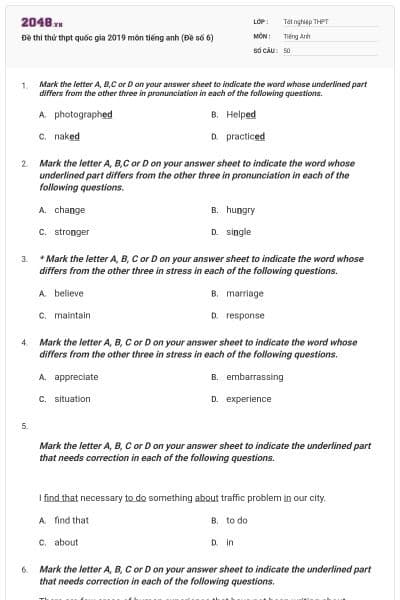
Mark the letter A, B,C or D on your answer sheet to indicate the word whose underlined part differs from the other three in pronunciation in each of the following questions.
photographed
Helped
naked
practiced
Đáp án C
Giải thích: Cách phát âm đuôi “-ed”:
+/id/: trước -ed là các âm /t/ hoặc /d/.
+/t/: trước -ed là các âm vô thanh /k/, /p/, /f/, /s/, /ʃ/, /tʃ/, /ɵ/.
+/d/: trước -ed là phụ âm còn lại và các nguyên âm.
Tuy nhiên có một số trường hợp bất qui tắc sau:
naked/’neikid/
ragged/'ræɡɪd/
vretched/'retʃd/
crooked/ krʊkɪd/
rugged/'rʌɡɪd/
learned/'lɜ:nɪd/
dogged / 'dɒɡid/
Theo qui tắc trên thì các đáp án A, B, D, đuôi “-ed" đều được đọc là /t/. Riêng đáp án C là trường hợp bất quy tắc, đọc là: /id/
A. photographed /ˈfəʊtəɡrɑ:ft/
B. helped /helpt/
C. naked /’neikid/
D. practiced /'præktrs
Mark the letter A, B,C or D on your answer sheet to indicate the word whose underlined part differs from the other three in pronunciation in each of the following questions.
change
hungry
stronger
single
Đáp án A
Giải thích:
A. change /tʃeindʒ/
B. hungry / ‘hʌŋgri/
C. stronger /strɒŋəg(r)/
D. single / ‘siŋgl/
Đáp án B, C, D đọc là /g/; đáp án A đọc là /dʒ/
* Mark the letter A, B, C or D on your answer sheet to indicate the word whose differs from the other three in stress in each of the following questions.
believe
marriage
maintain
response
Đáp án B
Theo qui tắc trọng âm: đa số danh từ và tính từ 2 âm tiết trọng âm rơi vào âm tiết thứ nhất. Đa số các động từ 2 âm tiết thì trọng âm rơi vào âm tiết thứ 2.
A. believe (v) /bi’li:v/
B. marriage (n)/‘mæridʒ/
C. maintain (v)/ mein’tein/
D. response (v)/ri’spɒns/
Đáp án A, C, D là các động từ, trọng âm rơi vào âm tiết số 2. Đáp án B là danh từ trọng âm rơi vào âm tiết số 1.
Mark the letter A, B, C or D on your answer sheet to indicate the word whose differs from the other three in stress in each of the following questions.
appreciate
embarrassing
situation
experience
Đáp án C
Giải thích:
A. appreciate / ə’pri:ʃeit/
B. embaưassing /im’bærəsiŋ/
C. situation /sitʃu’eiʃn/
D. experience /ik‘spiəriəns/
Theo quy tắc trọng âm:
+ từ 3 âm tiết tận cùng là các đuôi: -ate, -ise, -ize, -y, - ent, -ence,-ism, -izm: trọng âm rơi vào âm tiết cách nó 1 âm tiết. Như vậy, đáp án A, D, trọng âm rơi vào âm tiết thứ 2.
+ Từ tận cùng là: -ion, -ible, -ian, -ity, -ic, -ics, -logy,-ive, -ial, -ious...: trọng âm rơi vào âm tiết ngay trước nó.
Như vậy đáp án C trọng âm rơi vào âm tiết thứ 3.
Mark the letter A, B, C or D on your answer sheet to indicate the underlined part that needs correction in each of the following questions.
I find that necessary to do something about traffic problem in our city.
find that
to do
about
in
Đáp án A
Ta có cấu trúc: Sb find it adj to V
Đáp án: A (find that à find it)
Dịch: Tôi thấy cần phải làm gì đó để giải quyết vấn đề giao thông trong thành phố.
Mark the letter A, B, C or D on your answer sheet to indicate the underlined part that needs correction in each of the following questions.
There are few areas of human experience that have not been writing about.
there are
of human
have not been
writing
Đáp án D
Giải thích: “that” trong câu là ĐTQH thay thể cho cụm danh từ chỉ vật “few areas of human experience” nghĩa là: rất ít lĩnh vực trải nghiệm của con người. Xét về nghĩa thì theo sau nó cần phải là động từ bị động mới phù hợp.
Đáp án: D (writing à written)
Dịch: Còn rất ít lĩnh các lĩnh vực trải nghiệm của con người mà chưa được viết ra.
Mark the letter A, B, C or D on your answer sheet to indicate the underlined part that needs correction in each of the following questions.
In the past, polite men had stood up when women entered the room.
the
polite
had stood up
entered
Đáp án C
Giải thích: Câu này có dấu hiệu nhận biết “in the past” - thì quá khứ đơn. Tình huống này diễn tả 2 hành động xảy ra nối tiếp nhau trong quá khứ chứ không phải 1 hành động xảy ra và kết thúc trước hành động khác trong quá khứ. Vậy nên cả 2 hành động phải chia ở quá khứ đơn.
Đáp án: C (had stood up à stood)
Dịch: Trước đây, những người đàn ông lịch sự thường đứng dậy khi phụ nữ bước vào phòng, (ngay khi thấy có người phụ nữ bước vào phòng đàn ông sẽ đứng dậy.)

Học thông minh hơn mỗi ngày
Xem toàn bộ 50 câu hỏi và nhiều hơn nữa với tài khoản miễn phí
Mark the letter A, B, C or D on your answer sheet to indicate the correct answer to each of the following questions.
Peter is working in an office. He’s a white- .................. worker.
collar
sleeve
shirt
button
Đáp án A
Giải thích: ta có cụm thành ngữ: white-collar (adj): công chức, lao động bằng trí óc # blue -collar: lao động tay chân
Dịch: Peter đang làm việc trong văn phòng. Anh ấy là một công chức.
Mark the letter A, B, C or D on your answer sheet to indicate the correct answer to each of the following questions.
Just keep .................. on the baby while I cook the supper, will you?
a look
a glance
an eye
a care
Đáp án C
Giải thích: ta có cụm từ: keep an eye on sb/st: để mắt đến/ trông coi ai/cái gì
Mark the letter A, B, C or D on your answer sheet to indicate the correct answer to each of the following questions.
He clearly had no .................. of doing any work, although it was only a week till the exam.
desire
ambition
willingness
intention
Đáp án D
Giải thích:
A. desire (n) khát khao
B. ambition (n) tham vọng, hoài bão
C. willingness (n) sự sẵn sàng
D. intention (n) ý định
Ta có cụm từ:
have an intention of + Ving: có ý định làm gì;
have no intention of + Ving: không có ý định làm gì
Dịch: Anh ấy rõ ràng không có ý định làm bất cứ việc gì, mặc dù chỉ còn 1 tuần nữa là đến kì thi.
Mark the letter A, B, C or D on your answer sheet to indicate the correct answer to each of the following questions.
Not a word .................. since the exam started.
she wrote
she had written
has she written
she has written
Đáp án C
Giải thích: cấu trúc câu đảo ngữ bắt đầu bằng NOT:
Not + N + trợ động từ + S + V
Dịch: Dù chỉ một từ cô ta vẫn chưa viết được kể từ khi kì thi bắt đầu.
Mark the letter A, B, C or D on your answer sheet to indicate the correct answer to each of the following questions.
She showed her .................. by asking lots of trivial questions.
experience
experienced
inexperienced
inexperience
Đáp án D
Giải thích: sau tính từ sở hữu: my/ your/ his/ her/ our/ their/ its + N à loại đáp án B, C là các tính từ. Xét về nghĩa đáp án D phù hợp hơn.
A. experience (n); kinh nghiệm
B. experienced (adj) có kinh nghiệm
C. inexperienced (adj) thiếu kinh nghiệm
D. inexperience (n) sự thiếu kinh nghiệm
Dịch: Cô ta thể hiện sự thiếu kinh nghiệm bằng việc hỏi những câu hỏi không quan trọng
Mark the letter A, B, C or D on your answer sheet to indicate the correct answer to each of the following questions.
An only child often creates an .................. friend to play with.
imagery
imaginable
imaginary
imaginative
Đáp án C
C. imaginary /i'mædʒinəri/(a): tưởng tượng, không có thực, ảo
Xét các đáp án khác
A. imagery /'imiddʒəri/(n): hình ảnh, hình tượng
B. imaginable /i'mædʒinəbl/(a): có thể tưởng tượng được, có thể hình dung được
D. imaginative /i'mædʒinətiv/(a): sáng tạo, giàu trí tưởng tượng
Căn cứ vào mạo từ “an” và danh từ “friend” nên vị trí trống cần một tính từ.
Dịch: Những đứa con một thường tạo ra một người bạn tưởng tượng để chơi cùng
Mark the letter A, B, C or D on your answer sheet to indicate the correct answer to each of the following questions.
He has a very outgoing .................. and makes friends very easily.
person
personality
personal
personage
Đáp án B
Giải thích: Chỗ trống cần điền phải là danh từ vì trước nó là tính từ “outgoing”.
Như vậy loại đáp án C là tính từ đi. Xét về nghĩa thì đáp án B phù hợp.
A. person (n) người
B. personality (n) tính cách
C. personal (adj) riêng tư
D. personage (n) người có vai vế, nhân vật
Dịch: Anh ấy có tính cách cởi mở và kết bạn rất dễ dàng.
Mark the letter A, B, C or D on your answer sheet to indicate the correct answer to each of the following questions.
Your .................. to life decides whether you are happy or not.
thinking
opinion
attitude
dream
Đáp án C
Giải thích: opinion (n): ý kiến; attitude (n); thái độ
Dịch: Thái độ của bạn với cuộc sống quyết định bạn có hạnh phúc hay không.
Mark the letter A, B, C or D on your answer sheet to indicate the correct answer to each of the following questions.
People are advised to .................. smoking because of its harm to their health.
cut down
cut off
cut in
cut down on
Đáp án D
- cut down (v): chặt, đốn (cây,...)
- cut off (v): cắt đứt
- cut in (v): nói xen vào, chèn ngang
- cut down on (v); to reduce the size, amount or number of something: cắt giảm, giảm
Dịch nghĩa: Mọi người được khuyên giảm hút thuốc bởi vì tác hại của nó đối với sức khỏe.
Mark the letter A, B, C or D on your answer sheet to indicate the correct answer to each of the following questions.
They decided to divorce and Mary is .................. to get the right to raise the child.
equal
determined
obliged
active
Đáp án B
Giải thích:
Be determined to do st: quyết tâm làm gì
Dịch:
Họ quyết định ly dị và Mary quyết tâm giành quyền nuôi con
Mark the letter A, B, C or D on your answer sheet to indicate the correct answer to each of the following questions.
Some researchers have just .................. a survey of young people’s points of view on contractual marriage.
sent
directed
managed
conducted
Đáp án D
Giải thích: cụm từ conduct a survey: tổ chức 1 cuộc khảo sát
B. direct (v) chỉ dẫn
C. manage (v) quản lí
Dịch: Một số nhà nghiên cứu vừa tiến hành 1 cuộc khảo sát về quan điểm của thanh niên với vấn đề hôn nhân sắp đặt.
Mark the letter A, B, C or D on your answer sheet to indicate the correct answer to each of the following questions.
It is not easy to .................. our beauty when we get older and older.
maintain
develop
gain
collect
Đáp án A
Giải thích:
A. maintain (v) duy trì
B. develop (v) phát triển
C. gain (v) đạt được
D. collect (v) sưu tập
Dịch: Việc duy trì vẻ đẹp không hề dễ khi chúng ta ngày càng già đi.
Mark the letter A, B, C, or D on your answer sheet to indicate the most suitable response to complete each of the following exchanges.
- Harry: "I'm going on holiday tomorrow."
- An: “....................................................................... ”
Sorry to hear that
Congratulations!
Watch out
Have a nice time
Đáp án D
Giải thích: Harry nói: “Ngày mai tôi sẽ đi nghỉ.” An trả lời: “_____”
A. Sorry to hear that: rất tiếc khi phải nghe điều đó
B. Congratulations!: xin chúc mừng
C. Watch out: cẩn thận, coi chừng
D. Have a nice time: chúc bạn có thời gian vui vẻ
Mark the letter A, B, C, or D on your answer sheet to indicate the most suitable response to complete each of the following exchanges.
- Hoa: "Write to me when you get home."
- Phong: “.......................................................................”
I must
I should
I will
I can
Đáp án C
Giải thích: Hoa nói: “Hãy viết cho tôi khi bạn về đến nhà nhé.”
Phong trả lời: “Nhất định rồi.”
Đây là lời hứa của Phong nên dùng “wiil”
* Mark the letter A, B, C, or D on your answer sheet to indicate the sentence that is CLOSET in meaning to the underlined word(s) in each of the following questions.
Professor Berg was very interested in the diversity of cultures all over the world.
variety
changes
conservation
number
Đáp án A
Giải thích: diversity = variety: sự đa dạng; change: sự thay đổi; conservation: sự bảo tồn
Dịch: Giáo sư Berg rất quan tâm đến sự đa dạng văn hóa khắp thế giới.
* Mark the letter A, B, C, or D on your answer sheet to indicate the sentence that is CLOSET in meaning to the underlined word(s) in each of the following questions.
I don't like that man. There is a sneaky look on his face.
humorous
dishonest
guilty
furious
Đáp án B
Giải thích: sneaky = dishonest: lén lút
A. humorous (adj): hài hước
B. dishonest (adj) không thành thật
C. guilty (adj) có tội
D. furious (adj) giận dữ
Dịch: Tôi không thích người đàn ông đó. Có cái gì đó rất không thành thật trên khuôn mặt ông ta.
Mark the letter A, B, C, or D on your answer sheet to indicate the sentence that is OPPOSITE in meaning to the underlined word(s) in each of the following questions.
She decided to remain celibate and devote her life to helping the homeless and orphans.
married
divorced
separated
single
Đáp án A
Giải thích: celibate (adj) (sống) độc thân = single >< married
A. married (adj): đã kết hôn
B. divorced (adj) đã li hôn
C. separated (adj) đã chia tay
D. single (adj) độc thân
Dịch: Cô ta quyết định sống độc thân và dành cả đời mình giúp đỡ những người vô gia cư và trẻ mồ côi.
Mark the letter A, B, C, or D on your answer sheet to indicate the sentence that is OPPOSITE in meaning to the underlined word(s) in each of the following questions.
Maria will take charee of the advertising for the play.
spend time
spend
account for
be irresponsible for
Đáp án D
Giải thích: take charge of: chịu trách nhiệm về >< be irresponsible for: vô trách nhiệm với cái gì; account for: giải thích cho, chiếm (tỉ lệ)
Dịch: Maria sẽ chịu trách nhiệm về việc quảng cáo cho vở kịch.
Mark the letter A, B, C, or D on your answer sheet to indicate the sentence that is closest in meaning to each of the following questions.
“If I were you, I'd tell him the truth, ” she said to me.
She said to me that if I were you, I’d tell him the truth.
She suggested to tell him the truth if she were me.
She will tell him the truth if she is me.
She advised me to tell him the truth.
Đáp án D
Giải thích: Cô ấy nói với tôi: Nếu tôi là bạn, tôi sẽ nói cho anh ta sự thật.
Cấu trúc: If I vvere you: nếu tôi là bạn mang nghĩa khuyên bảo
Đáp án: D. Dịch: Cô ta khuyên tôi nói cho anh ta sự thật.
Mark the letter A, B, C, or D on your answer sheet to indicate the sentence that is closest in meaning to each of the following questions.
David seems really ill at case in front of all those people.
David feels uncomfortable in front of all those people.
David is easy to be ill because of all those people.
David is ill because he stands in front of all those people.
David fells comfortable in front of all those people.
Đáp án A
Giải thích: David dường như không thoái mái trước những người này.
Cụm từ ill at case = uncomfortable: không thoái mái, ngại ngùng
A. David cảm thấy không thoải mái trước những người này.
B. David dễ bị ốm vì những người này.
C. David bị ốm vì anh ta đứng trước những người này.
D. David cảm thấy thoải mải trước những người này.
Mark the letter A, B, C, or D on your answer sheet to indicate the sentence that is closest in meaning to each of the following questions.
Those students should be punished for what they have done.
Those students should have done what they were punished for.
What those students have done will give them some punishment.
Those students can't get away with what they have done.
The things those students have done are kinds of punishment.
Đáp án C
Giải thích: Những học sinh này nên bị phạt vì những gì chúng đã làm
A. Những học sinh này đáng lẽ nên làm vì điều mà chúng bị phạt.
B. Cái mà những học sinh này đã làm sẽ cho chúng vài hình phạt
C. Những học sinh này không thể trốn thoát khỏi việc chúng đã làm.
D. Những điều mà những học sinh này đã làm là những loại hình phạt.
Mark the letter A, B, C, or D on your answer sheet to indicate the sentence that best combines each pair of sentences in the following questions.
I have to support my family. I want to find a job.
I want to find a job in order support my family.
I have to support my family from seeking a job.
I want to find a job so that I can support my family.
I want to find a job because my family supports me.
Đáp án C
Giải thích: Tỏi phải chu cấp cho gia đình. Tôi muốn tìm một công việc.
Câu này cần được viết lại bằng việc sử dụng cụm từ chỉ mục đích: in order to V/ so as to V hay mệnh đề chỉ mục đích: S + V so that/ in order that + S + can + V
A. Tôi muốn tìm việc để chu cấp cho gia đình, (câu này loại vì sai cấu trúc của in order)
B. Tôi phải chu cấp cho gia đình từ việc đi tìm việc làm.
C. Tôi muốn tìm một công việc để mà tôi có thể chu cấp cho gia đình.
D. Tôi muốn tìm việc vì gia đình chu cấp cho tôi.
Mark the letter A, B, C, or D on your answer sheet to indicate the sentence that best combines each pair of sentences in the following questions.
The workers finished their work. They left for home.
Before the workers finished their work, they left for home.
Having finished their work, the workers left for home.
By the time the workers finished their work, they had left for home.
The workers left home since they finished their work.
Đáp án B
Giải thích: Những công nhân làm xong việc của mình. Họ đi về nhà
A. Trước khi những công nhân làm xong việc, họ đi về nhà.
B. Làm xong việc, những công nhân đi về nhà.
C. Vào lúc những công nhân làm xong việc, họ đã đi về nhà rồi.
D. Những công nhân bỏ nhà đi vì họ đã làm xong công việc.
Trong trường hợp này chọn đáp án B vừa phù hợp nghĩa, vừa đúng về ngữ pháp. Sử dụng cụm từ “Having finished” là một phân từ hoàn thành, diễn tả 1 hành động xảy ra và hoàn thành trước một hành động khác ở quá khứ. (mệnh đề đầy đủ là: After the workers had finished their work)
* Read the following passage and mark the letter A, B, C, or D on your answer sheet to indicate the correct word or phrase that bestfits each of the numbered blanks from 31 to 35.
The relationship between students and teachers is less formal in the USA than in many other countries. American students do not stand up (1) .................. their teachers enter the room. Students are encouraged to ask questions during class, to stop in the teacher’s office for extra help, and to phone if they are absent. Most teachers (2) .................. students to enter class late or leave early if necessary. (3) .................. the lack of formality, students are still expected to be polite to their teachers and fellow classmates.
When students want to ask questions, they usually (4) .................. a hand and wait to be called on. When a test is being given, talking to a classmate is not only rude but also risky. Most American teachers consider that students who are talking to each other (5) .................. a test are cheating.
Điền vào ô 1
when
that
where
whether
Đáp án A
Giải thích: cần chọn một liên từ chỉ thời gian
* Read the following passage and mark the letter A, B, C, or D on your answer sheet to indicate the correct word or phrase that bestfits each of the numbered blanks from 31 to 35.
The relationship between students and teachers is less formal in the USA than in many other countries. American students do not stand up (1) .................. their teachers enter the room. Students are encouraged to ask questions during class, to stop in the teacher’s office for extra help, and to phone if they are absent. Most teachers (2) .................. students to enter class late or leave early if necessary. (3) .................. the lack of formality, students are still expected to be polite to their teachers and fellow classmates.
When students want to ask questions, they usually (4) .................. a hand and wait to be called on. When a test is being given, talking to a classmate is not only rude but also risky. Most American teachers consider that students who are talking to each other (5) .................. a test are cheating.
Điền vào ô 2
let
allow
make
encourage
Đáp án B
Giải thích: cấu trúc của các từ như sau:
- let Sb V = allow s to V: cho phép ai làm gì
make Sb V: khiến, bắt ai làm gì; allow Sb to V: khuyến khích ai làm gì à loại đáp án A, C. Xét về nghĩa của câu thì đáp án B phù hợp.
* Read the following passage and mark the letter A, B, C, or D on your answer sheet to indicate the correct word or phrase that bestfits each of the numbered blanks from 31 to 35.
The relationship between students and teachers is less formal in the USA than in many other countries. American students do not stand up (1) .................. their teachers enter the room. Students are encouraged to ask questions during class, to stop in the teacher’s office for extra help, and to phone if they are absent. Most teachers (2) .................. students to enter class late or leave early if necessary. (3) .................. the lack of formality, students are still expected to be polite to their teachers and fellow classmates.
When students want to ask questions, they usually (4) .................. a hand and wait to be called on. When a test is being given, talking to a classmate is not only rude but also risky. Most American teachers consider that students who are talking to each other (5) .................. a test are cheating.
Điền vào ô 3
Though
In spite
Despite
Because of
Đáp án C
Giải thích: Though/ Although + S + V= Despite/ In spite of + N/ Ving
Because + S + V = Because of + N/ Ving
* Read the following passage and mark the letter A, B, C, or D on your answer sheet to indicate the correct word or phrase that bestfits each of the numbered blanks from 31 to 35.
The relationship between students and teachers is less formal in the USA than in many other countries. American students do not stand up (1) .................. their teachers enter the room. Students are encouraged to ask questions during class, to stop in the teacher’s office for extra help, and to phone if they are absent. Most teachers (2) .................. students to enter class late or leave early if necessary. (3) .................. the lack of formality, students are still expected to be polite to their teachers and fellow classmates.
When students want to ask questions, they usually (4) .................. a hand and wait to be called on. When a test is being given, talking to a classmate is not only rude but also risky. Most American teachers consider that students who are talking to each other (5) .................. a test are cheating.
Điền vào ô 4
rise
arise
raise
put
Đáp án C
Giải thích: rise (v): mọc, tăng; arise (v) phát sinh. Cả 2 động từ này đều là Intransitive verb (nội động từ) nên không có tân ngữ theo sau à loại.
Ta có cụm từ: raise a hand: giơ tay
* Read the following passage and mark the letter A, B, C, or D on your answer sheet to indicate the correct word or phrase that bestfits each of the numbered blanks from 31 to 35.
The relationship between students and teachers is less formal in the USA than in many other countries. American students do not stand up (1) .................. their teachers enter the room. Students are encouraged to ask questions during class, to stop in the teacher’s office for extra help, and to phone if they are absent. Most teachers (2) .................. students to enter class late or leave early if necessary. (3) .................. the lack of formality, students are still expected to be polite to their teachers and fellow classmates.
When students want to ask questions, they usually (4) .................. a hand and wait to be called on. When a test is being given, talking to a classmate is not only rude but also risky. Most American teachers consider that students who are talking to each other (5) .................. a test are cheating.
Điền vào ô 5
in
when
while
during
Đáp án D
Giải thích: sau “during” cần 1 danh từ: trong suốt, trong khi
Dịch nghĩa đoạn văn:
Mối quan hệ giữa thầy và trò ở Mĩ ít câu nệ về hình thức hơn so với những quốc gia khác. Học sinh Mĩ không cần đứng dậy khi thầy cô bước vào lớp. Học sinh được khuyến khích đưa ra các câu hỏi trong giờ học, được vào phòng của thầy cô yêu cầu sự giúp đỡ thêm, và được gọi điện nếu nghỉ học. Hầu hết các giáo viên đều cho phép học sinh của mình vào lớp muộn hoặc ra khỏi lớp sớm hơn nếu cần thiết. Mặc dù không câu nệ về hình thức, học sinh vẫn được mong đợi phải lễ phép với giáo viên và lịch sự với bạn bè.
Khi học sinh muốn hỏi, họ thường giơ 1 tay lên và chờ được gọi. Khi làm bài kiểm tra, nói chuyện trong lớp không chỉ bất lịch sự mà còn rất mạo hiểm. Vì hầu hết giáo viên Mĩ coi việc nói chuyện trong các giờ kiểm tra là gian lận.
* Read the following passage and mark the letter A, B, C, or D on your answer sheet to indicate the correct answer to each of the questions from 36 to 42.
The increase in international business and in foreign investment has created a need for executives with knowledge of foreign languages and skills in cross-culture communication. Americans, however, have not been well trained in either area and, consequently, have not enjoyed the same level of success in negotiation in an international arena as have their foreign counterpart.
Negotiating is the process of communicating back and forth for the purpose of reaching an agreement. It involves persuasion and compromise, but in order to participate in either one, the negotiators must understand the ways in which people are persuaded and how compromise is reached within the culture of the negotiation.
In many international business negotiations abroad, Americans are perceived as wealthy and impersonal. It often appears to the foreign negotiator that the American represents a large multimillion-dollar corporation that can afford to pay the price without bargaining further. The American negotiator’s role becomes that of an impersonal purveyor of information and cash, an image that succeeds only in undermining the negotiation.
In studies of American negotiators abroad, several traits have been indentified that may serve to confirm this stereotypical perception, while subverting the negotiator's position. Two traits in particular that cause cross-culture misunderstanding are directness and impatience on the part of American negotiator. Furthermore, American negotiators often insist on realizing short-term goals. Foreign negotiators, on the other hand, may value the relationship established between negotiators and may be willing to invest time in it for long-term benefits. In order to solidify the relationship, they may opt for indirect interactions without regard for the time involved in getting to know the other negotiator.
Clearly, perceptions and differences in values affect the outcomes of negotiations and the success of negotiators. For Americans to play a more effective role in international business negotiations, they must put forth more effort to improve cross-cultural understanding.
What is the author’s main point?
Negotiation is the process of reaching an agreement.
Foreign languages are important for international business.
Foreign perceptions of American negotiators are based on stereotypes.
American negotiators need to learn more about other cultures.
Đáp án D
Giải thích: Đâu là điểm chính của tác giả?
A. Sự đàm phán là quá trình đạt được sự đồng thuận.
B. Ngoại ngữ rất quan trọng với kinh doanh quốc tế.
C. Nhận thức về nước ngoài của những nhà đàm phán Mĩ mang tính rập khuôn.
D. Những nhà đàm phán Mĩ cần học nhiều hơn về văn hóa.
Americans, however, have not been well trained in either area and, consequently, have not enjoyed the same level of success in negotiation in an intemational arena as have their foreign counterpart.
For Americans to play a more effective role in intemational business negotiations, they must put forth more effort to improve cross-cultural understanding.
* Read the following passage and mark the letter A, B, C, or D on your answer sheet to indicate the correct answer to each of the questions from 36 to 42.
The increase in international business and in foreign investment has created a need for executives with knowledge of foreign languages and skills in cross-culture communication. Americans, however, have not been well trained in either area and, consequently, have not enjoyed the same level of success in negotiation in an international arena as have their foreign counterpart.
Negotiating is the process of communicating back and forth for the purpose of reaching an agreement. It involves persuasion and compromise, but in order to participate in either one, the negotiators must understand the ways in which people are persuaded and how compromise is reached within the culture of the negotiation.
In many international business negotiations abroad, Americans are perceived as wealthy and impersonal. It often appears to the foreign negotiator that the American represents a large multimillion-dollar corporation that can afford to pay the price without bargaining further. The American negotiator’s role becomes that of an impersonal purveyor of information and cash, an image that succeeds only in undermining the negotiation.
In studies of American negotiators abroad, several traits have been indentified that may serve to confirm this stereotypical perception, while subverting the negotiator's position. Two traits in particular that cause cross-culture misunderstanding are directness and impatience on the part of American negotiator. Furthermore, American negotiators often insist on realizing short-term goals. Foreign negotiators, on the other hand, may value the relationship established between negotiators and may be willing to invest time in it for long-term benefits. In order to solidify the relationship, they may opt for indirect interactions without regard for the time involved in getting to know the other negotiator.
Clearly, perceptions and differences in values affect the outcomes of negotiations and the success of negotiators. For Americans to play a more effective role in international business negotiations, they must put forth more effort to improve cross-cultural understanding.
According to the author, what is the purpose of negotiation?
To undermine the other negotiator’s position.
To communicate back and forth.
To reach an agreement.
To understand the culture of the negotiators.
Đáp án C
Giải thích: Theo như tác giả, đâu là mục đích chính của sự đàm phán?
A. Để làm giảm vị thế của người đàm phán khác.
B. Để giao tiếp qua lại.
C. Để đạt được một thỏa thuận.
D. Để hiểu về văn hóa của những người đàm phán.
Negotiating is the pmcess of communicating back and forth for the purpose of reaching an agreement.
* Read the following passage and mark the letter A, B, C, or D on your answer sheet to indicate the correct answer to each of the questions from 36 to 42.
The increase in international business and in foreign investment has created a need for executives with knowledge of foreign languages and skills in cross-culture communication. Americans, however, have not been well trained in either area and, consequently, have not enjoyed the same level of success in negotiation in an international arena as have their foreign counterpart.
Negotiating is the process of communicating back and forth for the purpose of reaching an agreement. It involves persuasion and compromise, but in order to participate in either one, the negotiators must understand the ways in which people are persuaded and how compromise is reached within the culture of the negotiation.
In many international business negotiations abroad, Americans are perceived as wealthy and impersonal. It often appears to the foreign negotiator that the American represents a large multimillion-dollar corporation that can afford to pay the price without bargaining further. The American negotiator’s role becomes that of an impersonal purveyor of information and cash, an image that succeeds only in undermining the negotiation.
In studies of American negotiators abroad, several traits have been indentified that may serve to confirm this stereotypical perception, while subverting the negotiator's position. Two traits in particular that cause cross-culture misunderstanding are directness and impatience on the part of American negotiator. Furthermore, American negotiators often insist on realizing short-term goals. Foreign negotiators, on the other hand, may value the relationship established between negotiators and may be willing to invest time in it for long-term benefits. In order to solidify the relationship, they may opt for indirect interactions without regard for the time involved in getting to know the other negotiator.
Clearly, perceptions and differences in values affect the outcomes of negotiations and the success of negotiators. For Americans to play a more effective role in international business negotiations, they must put forth more effort to improve cross-cultural understanding.
The word undermining in paragraph 3 is closest in meaning to ....................
making known
making clear
making brief
making weak
Đáp án D
Giải thích: Từ “undermine” ở đoạn 3 gần nghĩa nhất với
A. making known: làm cho được biết đến
B. making clear: làm cho rõ ràng
C. making brief: tóm tắt
D. making weak: làm cho yếu đi
* Read the following passage and mark the letter A, B, C, or D on your answer sheet to indicate the correct answer to each of the questions from 36 to 42.
The increase in international business and in foreign investment has created a need for executives with knowledge of foreign languages and skills in cross-culture communication. Americans, however, have not been well trained in either area and, consequently, have not enjoyed the same level of success in negotiation in an international arena as have their foreign counterpart.
Negotiating is the process of communicating back and forth for the purpose of reaching an agreement. It involves persuasion and compromise, but in order to participate in either one, the negotiators must understand the ways in which people are persuaded and how compromise is reached within the culture of the negotiation.
In many international business negotiations abroad, Americans are perceived as wealthy and impersonal. It often appears to the foreign negotiator that the American represents a large multimillion-dollar corporation that can afford to pay the price without bargaining further. The American negotiator’s role becomes that of an impersonal purveyor of information and cash, an image that succeeds only in undermining the negotiation.
In studies of American negotiators abroad, several traits have been indentified that may serve to confirm this stereotypical perception, while subverting the negotiator's position. Two traits in particular that cause cross-culture misunderstanding are directness and impatience on the part of American negotiator. Furthermore, American negotiators often insist on realizing short-term goals. Foreign negotiators, on the other hand, may value the relationship established between negotiators and may be willing to invest time in it for long-term benefits. In order to solidify the relationship, they may opt for indirect interactions without regard for the time involved in getting to know the other negotiator.
Clearly, perceptions and differences in values affect the outcomes of negotiations and the success of negotiators. For Americans to play a more effective role in international business negotiations, they must put forth more effort to improve cross-cultural understanding.
Which of the following is mentioned as a criterion necessary for negotiation?
compromise
participation
communication
investment
Đáp án A
Giải thích: Đáp án nào sau đây được đề cập đến như 1 tiêu chuẩn cần thiết cho việc đàm phán?
A. sự thỏa hiệp
B. sự tham gia
C. sự giao tiếp
D. sự đầu tư
Negotiating is the process of communicating back and forth for the purpose of reaching an agreement. It involves persuasion and compromise.
* Read the following passage and mark the letter A, B, C, or D on your answer sheet to indicate the correct answer to each of the questions from 36 to 42.
The increase in international business and in foreign investment has created a need for executives with knowledge of foreign languages and skills in cross-culture communication. Americans, however, have not been well trained in either area and, consequently, have not enjoyed the same level of success in negotiation in an international arena as have their foreign counterpart.
Negotiating is the process of communicating back and forth for the purpose of reaching an agreement. It involves persuasion and compromise, but in order to participate in either one, the negotiators must understand the ways in which people are persuaded and how compromise is reached within the culture of the negotiation.
In many international business negotiations abroad, Americans are perceived as wealthy and impersonal. It often appears to the foreign negotiator that the American represents a large multimillion-dollar corporation that can afford to pay the price without bargaining further. The American negotiator’s role becomes that of an impersonal purveyor of information and cash, an image that succeeds only in undermining the negotiation.
In studies of American negotiators abroad, several traits have been indentified that may serve to confirm this stereotypical perception, while subverting the negotiator's position. Two traits in particular that cause cross-culture misunderstanding are directness and impatience on the part of American negotiator. Furthermore, American negotiators often insist on realizing short-term goals. Foreign negotiators, on the other hand, may value the relationship established between negotiators and may be willing to invest time in it for long-term benefits. In order to solidify the relationship, they may opt for indirect interactions without regard for the time involved in getting to know the other negotiator.
Clearly, perceptions and differences in values affect the outcomes of negotiations and the success of negotiators. For Americans to play a more effective role in international business negotiations, they must put forth more effort to improve cross-cultural understanding.
It can be referred from paragraph 1 that ..................
training is not available for Americans who must interact in international negotiations.
foreign businesspersons negotiate less effectively than Americans because of their training.
because their training is not as good, Americans are less successful as negotiators than their international counterparts
foreign businesspersons do not like to negotiate with Americans, who are not well trained.
Đáp án C
A. việc đào tạo không sẵn có với người Mĩ, người mà phải tương tác trong những cuộc đàm phán quốc tế,
B. những doanh nhân nước ngoài đàm phán kém hiệu quả hơn người Mĩ vì sự đào tạo của họ.
C. vì không được đào tạo tốt bằng, người Mĩ là những người đàm ít thành công hơn những bạn bè quốc tế của mình.
D. những doanh nhân nước ngoài không thích đàm phán với người Mĩ,
những người không được đào tạo.
Negotiating is the process of communicating back and forth for the purpose of reaching an agreement. It involves persuasion and compromise.
Americans, however, have not been well trained in either area and, consequently, have not enioyed the same level of success in negotiation in an intemational arena as have their foreign counterpart
* Read the following passage and mark the letter A, B, C, or D on your answer sheet to indicate the correct answer to each of the questions from 36 to 42.
The increase in international business and in foreign investment has created a need for executives with knowledge of foreign languages and skills in cross-culture communication. Americans, however, have not been well trained in either area and, consequently, have not enjoyed the same level of success in negotiation in an international arena as have their foreign counterpart.
Negotiating is the process of communicating back and forth for the purpose of reaching an agreement. It involves persuasion and compromise, but in order to participate in either one, the negotiators must understand the ways in which people are persuaded and how compromise is reached within the culture of the negotiation.
In many international business negotiations abroad, Americans are perceived as wealthy and impersonal. It often appears to the foreign negotiator that the American represents a large multimillion-dollar corporation that can afford to pay the price without bargaining further. The American negotiator’s role becomes that of an impersonal purveyor of information and cash, an image that succeeds only in undermining the negotiation.
In studies of American negotiators abroad, several traits have been indentified that may serve to confirm this stereotypical perception, while subverting the negotiator's position. Two traits in particular that cause cross-culture misunderstanding are directness and impatience on the part of American negotiator. Furthermore, American negotiators often insist on realizing short-term goals. Foreign negotiators, on the other hand, may value the relationship established between negotiators and may be willing to invest time in it for long-term benefits. In order to solidify the relationship, they may opt for indirect interactions without regard for the time involved in getting to know the other negotiator.
Clearly, perceptions and differences in values affect the outcomes of negotiations and the success of negotiators. For Americans to play a more effective role in international business negotiations, they must put forth more effort to improve cross-cultural understanding.
According to the passage, how can American businesspersons improve their negotiation skills?
By living in a foreign culture
By getting to know the negotiators
By compromising more often
By explaining the goals more clearly
Đáp án B
Giải thích: Theo đoạn văn, những doanh nhân người Mĩ có thể cải thiện kĩ năng đàm phán của họ như thế nào?
A. bằng việc sống trong nền văn hóa nước ngoài
B. bằng việc làm quen với các nhà đàm phán
C. bằng việc thỏa hiệp thường xuyên hơn
D. bằng việc giải thích mục đích rõ ràng hơn
Furthermore, American negotiators often insist on realizing short-term goals. Foreign negotiators, on the other hand, may value the relationship established between negotiators and may be willing to invest time in it for long-term benefits. In order to solidfiy the relationship, they may opt for indirect interactions without
regard for the time involved in getting to know the other negotiator.
* Read the following passage and mark the letter A, B, C, or D on your answer sheet to indicate the correct answer to each of the questions from 36 to 42.
The increase in international business and in foreign investment has created a need for executives with knowledge of foreign languages and skills in cross-culture communication. Americans, however, have not been well trained in either area and, consequently, have not enjoyed the same level of success in negotiation in an international arena as have their foreign counterpart.
Negotiating is the process of communicating back and forth for the purpose of reaching an agreement. It involves persuasion and compromise, but in order to participate in either one, the negotiators must understand the ways in which people are persuaded and how compromise is reached within the culture of the negotiation.
In many international business negotiations abroad, Americans are perceived as wealthy and impersonal. It often appears to the foreign negotiator that the American represents a large multimillion-dollar corporation that can afford to pay the price without bargaining further. The American negotiator’s role becomes that of an impersonal purveyor of information and cash, an image that succeeds only in undermining the negotiation.
In studies of American negotiators abroad, several traits have been indentified that may serve to confirm this stereotypical perception, while subverting the negotiator's position. Two traits in particular that cause cross-culture misunderstanding are directness and impatience on the part of American negotiator. Furthermore, American negotiators often insist on realizing short-term goals. Foreign negotiators, on the other hand, may value the relationship established between negotiators and may be willing to invest time in it for long-term benefits. In order to solidify the relationship, they may opt for indirect interactions without regard for the time involved in getting to know the other negotiator.
Clearly, perceptions and differences in values affect the outcomes of negotiations and the success of negotiators. For Americans to play a more effective role in international business negotiations, they must put forth more effort to improve cross-cultural understanding.
The American negotiator is described as all of the following EXCEPT ....................
perceived by foreign negotiators as wealthy
willing to invest time in relationships
known for direct interaction
interested in short-term goals
Đáp án B
Dịch đoạn văn: Sự gia tăng trong kinh doanh quốc tế và đầu tư nước ngoài đã tạo ra một nhu cầu cần thiết với các nhà quản lí đó là kiến thức về ngoại ngữ và những kĩ năng giao tiếp liên văn hóa. Tuy nhiên, những người Mĩ lại không được đào tạo tốt ở cả hai lĩnh vực này, kết quả là, họ không đạt được mức độ thành công tương ứng trong việc đàm phán trên các đấu trường quốc tế như các bạn bè nước khác.
Đàm phán là một quá trình giao liếp qua lại nhằm mục đích đạt được sự thỏa hiệp. Nó bao gồm sự thuyết phục và sự thỏa hiệp, nhưng để đạt được điều này, người đàm phán cần phải hiểu cách mà người kia được thuyết phục và cách đạt được sự thỏa hiệp cùng với văn hóa đàm phán.
Trong nhiều cuộc đàm phán kinh doanh quốc tế ở nước ngoài, người Mĩ được đánh giá là giàu có và khách quan. Dường như người đàm phán nước ngoài thường thấy rằng người Mĩ thường đại diện cho một công ty lớn trị giá nhiều triệu đô la có thể đủ khả năng trả giá mà không cần mặc cả thêm. Vai trò của người đàm phán Mỹ trở thành vai trò của một nhà cung ứng khách quan về thông tin và tiền mặt, một hình ảnh mà chỉ thành công trong việc phá hoại việc đàm phán.
Trong những nghiên cứu về những người đàm phán Mĩ ở nước ngoài, một số đặc điểm đã được xác định mà góp phần chứng thực cho những nhận thức khuôn mẫu này, trong khi phá vỡ vị trí của người đàm phán. Hai đặc điểm riêng mà gây ra sự hiểu lầm liên văn hóa đó là sự thẳng thắn và thiếu kiên nhẫn ở phía người đàm phán người Mĩ. Hơn nữa những nhà đàm phán Mĩ thường chỉ nhận ra những mục đích trước mắt. Những nhà đàm phán nước ngoài, trái lại, lại hiểu được giá trị của mối quan hệ được thiết lập giữa những nhà đàm phán và thường sẵn sàng đầu tư thời gian cho nó vì những lợi ích lâu dài. Để làm bền vững mối quan hệ, họ có thể chọn lựa những sự tương tác gián tiếp mà không tính đến thời gian làm quen với người đàm phán kia.
Rõ ràng, sự nhận thức và sự khác biệt về những giá trị ảnh hưởng tới kết quả cuộc đàm phán và sự thành công của những nhà đàm phán. Với người Mĩ để đóng vai trò hiệu quả hơn trong những cuộc đàm phán kinh doanh quốc tế, họ phải thể hiện sự nỗ lực hơn nữa để cải thiện sự hiểu biết liên văn hóa.
Read the following passage and mark the letter A, B, C, or D on your answer sheet to indicate the correct answer to each of the questions from 43 to 50.
In most discussions of cultural diversity, attention has focused on visible, explicit aspects of culture, such as language, dress, food, religion, music, and social rituals. Although they are important, these visible expressions of culture, which are taught deliberately and learned consciously, are only the tip of the iceberg of culture. Much of culture is taught and learned implicitly, or outside awareness. Thus, neither cultural insiders nor cultural outsiders are aware that certain “invisible” aspects of their culture exist.
Invisible elements of culture are important to us. For example, how long we can be late before being impolite, what topics we should avoid in a conversation, how we show interest or attention through listening behavior, what we consider beautiful or ugly- these are all aspects of culture that we learn and use without being aware of it. When we meet other people whose invisible cultural assumptions differ from those we have learned implicitly, we usually do not recognize their behavior as cultural in origin.
Differences in invisible culture can cause problems in cross-cultural relations. Conflicts may arise when we are unable to recognize others’ behavioral differences as cultural rather than personal. We tend to misinterpret other people’s behavior, blame them, or judge their intentions or competence without realizing that we are experiencing cultural rather than individual differences.
Formal organizations and institutions, such as schools, hospitals, workplaces, governments, and the legal system are collection sites for invisible cultural differences. If the differences were more visible, we might have less misunderstanding. For example, if we met a man in a courthouse who was wearing exotic clothes, speaking a language other than ours, and carrying food that looked strange, we would not assume that we understood his thoughts and feelings or that he understood ours. Yet when such a man is dressed similarly to us, speaks our language, and does not differ from us in other obvious ways, we may fail to recognize the invisible cultural differences between us. As a result, mutual misunderstanding may arise.
What is the main purpose of the passage?
To describe cultural diversity.
To point out that much of culture is learned consciously.
To explain why cross-cultural conflict occurs.
To explain the importance of invisible aspects of culture.
Đáp án D
Giải thích: Đâu là mục đích chính của đoạn văn?
A. Để miêu tả sự đa dạng văn hóa
B. Để chỉ ra rằng nhiều lĩnh vực văn hóa được học một cách có ý thức
C. Để giải thích tại sao những xung đột liên văn hóa xảy ra
D. Để giải thích tầm quan trọng của những mặt không nhìn thấy của văn hóa.
Read the following passage and mark the letter A, B, C, or D on your answer sheet to indicate the correct answer to each of the questions from 43 to 50.
In most discussions of cultural diversity, attention has focused on visible, explicit aspects of culture, such as language, dress, food, religion, music, and social rituals. Although they are important, these visible expressions of culture, which are taught deliberately and learned consciously, are only the tip of the iceberg of culture. Much of culture is taught and learned implicitly, or outside awareness. Thus, neither cultural insiders nor cultural outsiders are aware that certain “invisible” aspects of their culture exist.
Invisible elements of culture are important to us. For example, how long we can be late before being impolite, what topics we should avoid in a conversation, how we show interest or attention through listening behavior, what we consider beautiful or ugly- these are all aspects of culture that we learn and use without being aware of it. When we meet other people whose invisible cultural assumptions differ from those we have learned implicitly, we usually do not recognize their behavior as cultural in origin.
Differences in invisible culture can cause problems in cross-cultural relations. Conflicts may arise when we are unable to recognize others’ behavioral differences as cultural rather than personal. We tend to misinterpret other people’s behavior, blame them, or judge their intentions or competence without realizing that we are experiencing cultural rather than individual differences.
Formal organizations and institutions, such as schools, hospitals, workplaces, governments, and the legal system are collection sites for invisible cultural differences. If the differences were more visible, we might have less misunderstanding. For example, if we met a man in a courthouse who was wearing exotic clothes, speaking a language other than ours, and carrying food that looked strange, we would not assume that we understood his thoughts and feelings or that he understood ours. Yet when such a man is dressed similarly to us, speaks our language, and does not differ from us in other obvious ways, we may fail to recognize the invisible cultural differences between us. As a result, mutual misunderstanding may arise.
The word “rituals” in paragraph 1 is closest in meaning to ..................
cultures
formalities
assumptions
aspects
Đáp án B
Giải thích: Từ "rituals" (nghỉ lễ) đoạn 1 gần nghĩa nhất với từ ________
A. văn hóa
B. nghỉ lễ
C. cách thể hiện
D. các lĩnh vực
Read the following passage and mark the letter A, B, C, or D on your answer sheet to indicate the correct answer to each of the questions from 43 to 50.
In most discussions of cultural diversity, attention has focused on visible, explicit aspects of culture, such as language, dress, food, religion, music, and social rituals. Although they are important, these visible expressions of culture, which are taught deliberately and learned consciously, are only the tip of the iceberg of culture. Much of culture is taught and learned implicitly, or outside awareness. Thus, neither cultural insiders nor cultural outsiders are aware that certain “invisible” aspects of their culture exist.
Invisible elements of culture are important to us. For example, how long we can be late before being impolite, what topics we should avoid in a conversation, how we show interest or attention through listening behavior, what we consider beautiful or ugly- these are all aspects of culture that we learn and use without being aware of it. When we meet other people whose invisible cultural assumptions differ from those we have learned implicitly, we usually do not recognize their behavior as cultural in origin.
Differences in invisible culture can cause problems in cross-cultural relations. Conflicts may arise when we are unable to recognize others’ behavioral differences as cultural rather than personal. We tend to misinterpret other people’s behavior, blame them, or judge their intentions or competence without realizing that we are experiencing cultural rather than individual differences.
Formal organizations and institutions, such as schools, hospitals, workplaces, governments, and the legal system are collection sites for invisible cultural differences. If the differences were more visible, we might have less misunderstanding. For example, if we met a man in a courthouse who was wearing exotic clothes, speaking a language other than ours, and carrying food that looked strange, we would not assume that we understood his thoughts and feelings or that he understood ours. Yet when such a man is dressed similarly to us, speaks our language, and does not differ from us in other obvious ways, we may fail to recognize the invisible cultural differences between us. As a result, mutual misunderstanding may arise.
The phrase “the tip of the iceberg” in paragraph 1 means that ..................
visible aspects of culture are learned in formal institutions
most aspects of culture cannot be seen
other cultures seem cold to us
we usually focus on the highest forms of culture
Đáp án B
Giải thích: Cụm từ "the tip of the iceberg" (phần nhìn thấy) trong đoạn 1 gần nghĩa với _______________
A. những khía cạnh được nhìn thấy của văn hóa mà được học ở những cơ quan chính thống
B. hầu hết các khía cạnh của văn hóa mà không được nhìn thấy
C. những nền văn hoá khác dường như lạnh lùng với chúng ta
D. chúng ta thường tập trung ở những hình thức cao nhất của văn hóa
these visible expressions of culture, which are tauaht deliberately and leamed consciously, are only the tip of the iceberg of culture.
Read the following passage and mark the letter A, B, C, or D on your answer sheet to indicate the correct answer to each of the questions from 43 to 50.
In most discussions of cultural diversity, attention has focused on visible, explicit aspects of culture, such as language, dress, food, religion, music, and social rituals. Although they are important, these visible expressions of culture, which are taught deliberately and learned consciously, are only the tip of the iceberg of culture. Much of culture is taught and learned implicitly, or outside awareness. Thus, neither cultural insiders nor cultural outsiders are aware that certain “invisible” aspects of their culture exist.
Invisible elements of culture are important to us. For example, how long we can be late before being impolite, what topics we should avoid in a conversation, how we show interest or attention through listening behavior, what we consider beautiful or ugly- these are all aspects of culture that we learn and use without being aware of it. When we meet other people whose invisible cultural assumptions differ from those we have learned implicitly, we usually do not recognize their behavior as cultural in origin.
Differences in invisible culture can cause problems in cross-cultural relations. Conflicts may arise when we are unable to recognize others’ behavioral differences as cultural rather than personal. We tend to misinterpret other people’s behavior, blame them, or judge their intentions or competence without realizing that we are experiencing cultural rather than individual differences.
Formal organizations and institutions, such as schools, hospitals, workplaces, governments, and the legal system are collection sites for invisible cultural differences. If the differences were more visible, we might have less misunderstanding. For example, if we met a man in a courthouse who was wearing exotic clothes, speaking a language other than ours, and carrying food that looked strange, we would not assume that we understood his thoughts and feelings or that he understood ours. Yet when such a man is dressed similarly to us, speaks our language, and does not differ from us in other obvious ways, we may fail to recognize the invisible cultural differences between us. As a result, mutual misunderstanding may arise.
Which of the following was NOT mentioned as an example of invisible culture?
What topics to avoid in conversation.
How late is considered impolite.
What food to eat in a courthouse
How people express interest in what others are saying
Đáp án C
hóa không được nhìn thấy?
A. những chủ đề nào mà tránh trong cuộc trò chuyện
B. muộn như thế nào được coi là bất lịch sự
C. chúng ta ăn gì ở tòa án
D. mọi người thể hiện sự quan tâm đến cái người khác đang nói như thế nào
Invisible elements of culture are important to us. For example, how long we can be late before being impolite, what topics we should avoid in a conversation, how we show interest or attention through listening behavior, what we consider beautiful or ugly
Read the following passage and mark the letter A, B, C, or D on your answer sheet to indicate the correct answer to each of the questions from 43 to 50.
In most discussions of cultural diversity, attention has focused on visible, explicit aspects of culture, such as language, dress, food, religion, music, and social rituals. Although they are important, these visible expressions of culture, which are taught deliberately and learned consciously, are only the tip of the iceberg of culture. Much of culture is taught and learned implicitly, or outside awareness. Thus, neither cultural insiders nor cultural outsiders are aware that certain “invisible” aspects of their culture exist.
Invisible elements of culture are important to us. For example, how long we can be late before being impolite, what topics we should avoid in a conversation, how we show interest or attention through listening behavior, what we consider beautiful or ugly- these are all aspects of culture that we learn and use without being aware of it. When we meet other people whose invisible cultural assumptions differ from those we have learned implicitly, we usually do not recognize their behavior as cultural in origin.
Differences in invisible culture can cause problems in cross-cultural relations. Conflicts may arise when we are unable to recognize others’ behavioral differences as cultural rather than personal. We tend to misinterpret other people’s behavior, blame them, or judge their intentions or competence without realizing that we are experiencing cultural rather than individual differences.
Formal organizations and institutions, such as schools, hospitals, workplaces, governments, and the legal system are collection sites for invisible cultural differences. If the differences were more visible, we might have less misunderstanding. For example, if we met a man in a courthouse who was wearing exotic clothes, speaking a language other than ours, and carrying food that looked strange, we would not assume that we understood his thoughts and feelings or that he understood ours. Yet when such a man is dressed similarly to us, speaks our language, and does not differ from us in other obvious ways, we may fail to recognize the invisible cultural differences between us. As a result, mutual misunderstanding may arise.
The word “those” in paragraph 2 refers to ..................
people who speak a different language
people from a different culture
topics that should be avoided in conversation
invisible cultural assumptions
Đáp án D
Giải thích: Từ “those” đoạn 2 chỉ về________
A. những người nói một ngôn ngữ khác
B. những người từ nền văn hóa khác
C. những chủ đề nên được tránh trong các cuộc trò chuyện
D. những cách thể hiện văn hóa không nhìn thấy
When we meet other people whose invisible cultural assumptions differ from those we have leamed implicitly, we usually do not recognize their behavior as
cultural in origin.
Read the following passage and mark the letter A, B, C, or D on your answer sheet to indicate the correct answer to each of the questions from 43 to 50.
In most discussions of cultural diversity, attention has focused on visible, explicit aspects of culture, such as language, dress, food, religion, music, and social rituals. Although they are important, these visible expressions of culture, which are taught deliberately and learned consciously, are only the tip of the iceberg of culture. Much of culture is taught and learned implicitly, or outside awareness. Thus, neither cultural insiders nor cultural outsiders are aware that certain “invisible” aspects of their culture exist.
Invisible elements of culture are important to us. For example, how long we can be late before being impolite, what topics we should avoid in a conversation, how we show interest or attention through listening behavior, what we consider beautiful or ugly- these are all aspects of culture that we learn and use without being aware of it. When we meet other people whose invisible cultural assumptions differ from those we have learned implicitly, we usually do not recognize their behavior as cultural in origin.
Differences in invisible culture can cause problems in cross-cultural relations. Conflicts may arise when we are unable to recognize others’ behavioral differences as cultural rather than personal. We tend to misinterpret other people’s behavior, blame them, or judge their intentions or competence without realizing that we are experiencing cultural rather than individual differences.
Formal organizations and institutions, such as schools, hospitals, workplaces, governments, and the legal system are collection sites for invisible cultural differences. If the differences were more visible, we might have less misunderstanding. For example, if we met a man in a courthouse who was wearing exotic clothes, speaking a language other than ours, and carrying food that looked strange, we would not assume that we understood his thoughts and feelings or that he understood ours. Yet when such a man is dressed similarly to us, speaks our language, and does not differ from us in other obvious ways, we may fail to recognize the invisible cultural differences between us. As a result, mutual misunderstanding may arise.
It can be inferred from paragraph 3 that conflict results when ..................
people think cultural differences are personal
people compete with those from other cultures
one culture is more invisible than another culture.
some people recognize more cultural differences than others.
Đáp án A
Giải thích: Có thể suy ra từ đoạn 3 ràng xung đột xảy ra khi______
A. mọi người nghĩ khác biệt về văn hóa là khác biệt mang tính cá nhân
B. mọi người cạnh tranh với những người đến từ nền văn hóa khác
C. một nền văn hóa thì không thể nhìn thấy được hơn một nền văn hoá khác
D. một số người nhận ra nhiều sự khác biệt văn hóa hơn những người khác
Conflicts may arise when we are unable to recognize others’ behavioral differences as cultural rather than personal.
The author implies that institutions such as schools and workplaces ..................
are aware of cultural differences
teach their employees about cultural differences
share a common culture.
reinforce invisible cultural differences
Đáp án D
Giải thích: Tác giả ngụ ý rằng những cơ quan như trường học và nơi làm
việc_______
A. có nhận thức về sự khác biệt văn hóa
B. dạy nhân viên của họ về sự khác biệt văn hóa
C. chia sẻ một nền văn hóa phổ biến
D. làm tăng những khác biệt văn hóa không thể nhìn thấy
Formal organizations and institutions, such as schools, hospitals, workplaces, govemments, and the legal system are collection sites for invisible cultural differences.
Read the following passage and mark the letter A, B, C, or D on your answer sheet to indicate the correct answer to each of the questions from 43 to 50.
In most discussions of cultural diversity, attention has focused on visible, explicit aspects of culture, such as language, dress, food, religion, music, and social rituals. Although they are important, these visible expressions of culture, which are taught deliberately and learned consciously, are only the tip of the iceberg of culture. Much of culture is taught and learned implicitly, or outside awareness. Thus, neither cultural insiders nor cultural outsiders are aware that certain “invisible” aspects of their culture exist.
Invisible elements of culture are important to us. For example, how long we can be late before being impolite, what topics we should avoid in a conversation, how we show interest or attention through listening behavior, what we consider beautiful or ugly- these are all aspects of culture that we learn and use without being aware of it. When we meet other people whose invisible cultural assumptions differ from those we have learned implicitly, we usually do not recognize their behavior as cultural in origin.
Differences in invisible culture can cause problems in cross-cultural relations. Conflicts may arise when we are unable to recognize others’ behavioral differences as cultural rather than personal. We tend to misinterpret other people’s behavior, blame them, or judge their intentions or competence without realizing that we are experiencing cultural rather than individual differences.
Formal organizations and institutions, such as schools, hospitals, workplaces, governments, and the legal system are collection sites for invisible cultural differences. If the differences were more visible, we might have less misunderstanding. For example, if we met a man in a courthouse who was wearing exotic clothes, speaking a language other than ours, and carrying food that looked strange, we would not assume that we understood his thoughts and feelings or that he understood ours. Yet when such a man is dressed similarly to us, speaks our language, and does not differ from us in other obvious ways, we may fail to recognize the invisible cultural differences between us. As a result, mutual misunderstanding may arise.
Which of the following would most likely result in misunderstanding?
Unusual food being cooked by foreign visitors.
Strange behaviour from someone speaking a foreign language.
Strange behaviour from someone speaking our language.
Learning about our own culture in school.
Đáp án C
Giải thích: Điều nào sau đây hầu như dẫn đến sự hiểu lầm?
A. thức ăn được nấu theo cách không bình thường bởi du khách nước ngoài
B. cách cư xử kì lạ từ ai đó nói tiếng nước ngoài
C. hành vi kì lạ từ ai đó nói ngôn ngữ của chúng ta
D. học về văn hóa của chúng ta ở trường
Yet when such a man is dressed similarly to us, speaks our language. and does not differ from us in other obvious ways. we may fail to recognize the invisible cultural differences between us. As a result, mutual misunderstanding may arise.
Dịch đoạn văn: Trong hầu hết những cuộc thảo luận về sự đa dạng văn hóa, sự chú ý chỉ tập trung vào những khía cạnh rõ ràng, nhìn thấy được như ngôn ngữ, trang phục, thức ăn, tôn giáo, âm nhạc và những nghi lễ mang tính xã hội.
Mặc dù chúng rất quan trọng, những sự thể hiện văn hóa có thể nhận thấy này, được dạy một cách có chọn lọc và được học một cách có ý thức, cũng chỉ là bề nổi của văn hóa. Còn rất nhiều thứ về văn hóa được dạy và học một cách âm thầm, hoặc không hề nhận thức được. Vì vậy, cả những người nghiên cứu hay không nghiên cứu về văn hóa cũng không thể nhận thức được rằng những mặt không thể nhìn thấy nhất định của nền văn hóa của họ có tồn tại.
Những thành phần không nhìn thấy của văn hóa rất quan trọng với chúng ta. Ví dụ, chúng ta có thể đến muộn bao lâu trước khi bị coi là bất lịch sự, chủ đề nào chúng ta nên tránh trong các cuộc trò chuyện, chúng ta nên thể hiện sự quan tâm hoặc chú ý như thế nào qua cách lắng nghe, chúng ta coi cái gì là đẹp, là xấu - đây là tất cả những khía cạnh của văn hóa mà chúng ta học và sử dụng mà không nhận thức được nó. Khi chúng ta gặp những người khác mà cách thể hiện văn hóa không nhìn thấy của họ khác với cái chúng ta học một cách âm thầm, chúng ta thường không nhận ra cách cư xử của họ như văn hóa truyền thống.
Sự khác biệt về văn hóa không được nhìn thấy có thể gây ra những vấn đề trong các mối quan hệ liên văn hóa. Những xung đột có thể phát sinh khi chúng ta không thể nhận ra sự khác biệt về hành vi của người khác là mang tính văn hóa chứ không phải mang tính cá nhân. Chúng ta có xu hướng hiểu sai hành vi của người khác, buộc tội họ, hoặc phán xét ý định, khả năng của họ mà không nhận ra rằng chúng ta đang trải nghiệm sự khác biệt về văn hóa chứ không phải sự khác biệt của cá nhân.
Những tổ chức và cơ quan chính thống, như trường học, bệnh viện, nơi làm việc, chính phủ, và hệ thống hợp pháp chính là những nơi tập hợp của sự khác biệt văn hóa không nhìn thấy. Nếu những sự khác biệt này dễ nhận thấy hơn, chúng ta đã có thể có ít sự hiểu lầm hơn. Ví dụ, nếu chúng ta gặp một người đàn ông ở tòa án mà đang mặc bộ quần áo kì lạ, nói một ngôn ngữ không giống chúng ta, mang theo thức ăn trông kì lạ, chúng ta cũng không thề cam đoan là chúng ta hiểu được suy nghĩ và tình cảm của anh ta hay anh ta hiểu về chúng ta.
Thế nhưng khi một người đàn ông như vậy mặc quần áo giống chúng
Bạn có thích hoạt động này không?
Ý kiến của bạn sẽ giúp chúng tôi đề xuất nội dung phù hợp hơn.
Gợi ý cho bạn
![[Năm 2022] Đề thi thử môn Vật lí THPT Quốc gia có lời giải - Đề số 21](/_next/image?url=https%3A%2F%2Fvideo.vietjack.com%2Fupload%2Fimages%2Fvj-image%2Fimage-3izficdefgfoel0s9j8s-1786772791.jpg&w=3840&q=75)

![[Năm 2022] Đề thi thử môn Vật lí THPT Quốc gia có lời giải - Đề số 20](/_next/image?url=https%3A%2F%2Fvideo.vietjack.com%2Fupload%2Fimages%2Fvj-image%2Fimage-emy0gtcksawvorajezvv-1786772460.jpg&w=3840&q=75)

Tài liệu phổ biến Tốt nghiệp THPT
Tài liệu phổ biến Tiếng Anh