Đề thi THPT Quốc gia môn Tiếng anh năm 2022 chọn lọc, có lời giải (Đề số 5)
50 câu hỏi
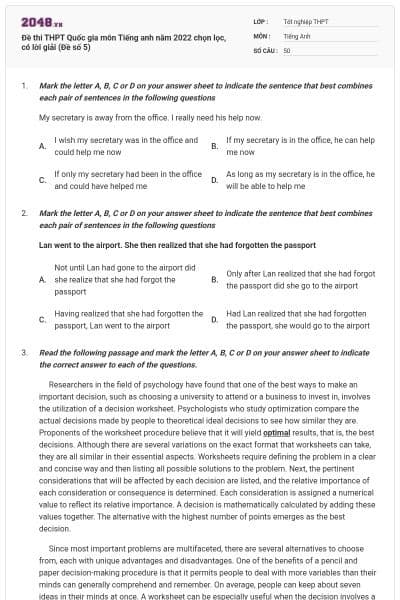
Mark the letter A, B, C or D on your answer sheet to indicate the sentence that best combines each pair of sentences in the following questions
My secretary is away from the office. I really need his help now.
I wish my secretary was in the office and could help me now
If my secretary is in the office, he can help me now
If only my secretary had been in the office and could have helped me
As long as my secretary is in the office, he will be able to help me
Kiến thức: Câu ước
Giải thích:
Cấu trúc câu ước trái với thực tế ở hiện tại: S + wish + S + V-quá khứ đơn
Câu điều kiện có thật ở hiện tại (loại 1): If + S + V-hiện tại đơn, S + can/may/will + V-nguyên thể
If only + S + V-quá khứ hoàn thành: giá mà … (ước trái với quá khứ)
As long as + S + V: miễn là …
Tạm dịch: Thư ký của tôi đi vắng không ở văn phòng. Tôi thực sự cần sự giúp đỡ của anh ấy lúc này.
- Tôi ước gì thư ký của tôi đang ở văn phòng và có thể giúp tôi ngay bây giờ.
- Dùng sai câu điều kiện (phải dùng loại 2)
- Dùng sai câu ước (phải dùng loại trái với hiện tại)
- Miễn là thư ký của tôi ở văn phòng, anh ấy sẽ có thể giúp tôi. => sai nghĩa
Chọn A
Mark the letter A, B, C or D on your answer sheet to indicate the sentence that best combines each pair of sentences in the following questions
Lan went to the airport. She then realized that she had forgotten the passport
Not until Lan had gone to the airport did she realize that she had forgot the passport
Only after Lan realized that she had forgot the passport did she go to the airport
Having realized that she had forgotten the passport, Lan went to the airport
Had Lan realized that she had forgotten the passport, she would go to the airport
Kiến thức: Đảo ngữ
Giải thích:
Not until + S + V + trợ động từ + S + V: mãi cho đến khi … thì…
Only after + S + V + trợ động từ + S + V: chỉ sau khi … thì …
Having P2, S + V-quá khứ đơn: Sau khi đã … thì …
Had + S + P2, S + would V-nguyên thể: Nếu … thì … (đảo ngữ câu điều kiện mix 3-2)
Tạm dịch: Lan đến sân bay. Sau đó cô nhận ra rằng mình đã quên hộ chiếu.
- Mãi cho đến khi Lan đã đến sân bay thì cô ấy mới nhận ra rằng mình đã quên hộ chiếu.
- Chỉ sau khi Lan nhận ra rằng cô ấy đã quên hộ chiếu thì cô ấy mới đến sân bay. => sai nghĩa
- Sau khi nhận ra mình quên hộ chiếu, Lan đã đến sân bay. => sai nghĩa
- Nếu Lan nhận ra rằng cô ấy đã quên hộ chiếu, cô ấy sẽ đến sân bay. => sai nghĩa
Chọn A
Read the following passage and mark the letter A, B, C or D on your answer sheet to indicate the correct answer to each of the questions.
Researchers in the field of psychology have found that one of the best ways to make an important decision, such as choosing a university to attend or a business to invest in, involves the utilization of a decision worksheet. Psychologists who study optimization compare the actual decisions made by people to theoretical ideal decisions to see how similar they are. Proponents of the worksheet procedure believe that it will yield optimal results, that is, the best decisions. Although there are several variations on the exact format that worksheets can take, they are all similar in their essential aspects. Worksheets require defining the problem in a clear and concise way and then listing all possible solutions to the problem. Next, the pertinent considerations that will be affected by each decision are listed, and the relative importance of each consideration or consequence is determined. Each consideration is assigned a numerical value to reflect its relative importance. A decision is mathematically calculated by adding these values together. The alternative with the highest number of points emerges as the best decision.
Since most important problems are multifaceted, there are several alternatives to choose from, each with unique advantages and disadvantages. One of the benefits of a pencil and paper decision-making procedure is that it permits people to deal with more variables than their minds can generally comprehend and remember. On average, people can keep about seven ideas in their minds at once. A worksheet can be especially useful when the decision involves a large number of variables with complex relationships. A realistic example for many college students is the question “What will I do after graduation?” A graduate might seek a position that offers specialized training, pursue an advanced degree, or travel abroad for a year.
A decision-making worksheet begins with a succinct statement of the problem that will also help to narrow it. It is important to be clear about the distinction between long-range and immediate goals because long-range goals often involve a different decision than short-range ones. Focusing on long-range goals, a graduating student might revise the question above to “What will I do after graduation that will lead to a successful career?”
What does the passage mainly discuss?
A tool to assist in making complex decisions
Research on how people make decisions
A comparison of actual decisions and ideal decisions
Differences between long-range and short-range decision making
Kiến thức: Đọc hiểu
Giải thích:
Bài đọc chủ yếu thảo luận nội dung gì?
- Một công cụ hỗ trợ đưa ra các quyết định phức tạp
- Nghiên cứu về cách mọi người đưa ra quyết định
- Sự so sánh giữa các quyết định thực tế và các quyết định lý tưởng
- Sự khác biệt giữa ra quyết định tầm xa và tầm ngắn
Thông tin: Từ khóa “a decision worksheet”, “worksheet” được nhắc đến nhiều lần trong bài, và là đối tượng bài đọc thảo luận chính – đây (worksheet) cũng chính là công cụ hỗ trợ đưa ra quyết định.
Chọn A
Read the following passage and mark the letter A, B, C or D on your answer sheet to indicate the correct answer to each of the questions.
Researchers in the field of psychology have found that one of the best ways to make an important decision, such as choosing a university to attend or a business to invest in, involves the utilization of a decision worksheet. Psychologists who study optimization compare the actual decisions made by people to theoretical ideal decisions to see how similar they are. Proponents of the worksheet procedure believe that it will yield optimal results, that is, the best decisions. Although there are several variations on the exact format that worksheets can take, they are all similar in their essential aspects. Worksheets require defining the problem in a clear and concise way and then listing all possible solutions to the problem. Next, the pertinent considerations that will be affected by each decision are listed, and the relative importance of each consideration or consequence is determined. Each consideration is assigned a numerical value to reflect its relative importance. A decision is mathematically calculated by adding these values together. The alternative with the highest number of points emerges as the best decision.
Since most important problems are multifaceted, there are several alternatives to choose from, each with unique advantages and disadvantages. One of the benefits of a pencil and paper decision-making procedure is that it permits people to deal with more variables than their minds can generally comprehend and remember. On average, people can keep about seven ideas in their minds at once. A worksheet can be especially useful when the decision involves a large number of variables with complex relationships. A realistic example for many college students is the question “What will I do after graduation?” A graduate might seek a position that offers specialized training, pursue an advanced degree, or travel abroad for a year.
A decision-making worksheet begins with a succinct statement of the problem that will also help to narrow it. It is important to be clear about the distinction between long-range and immediate goals because long-range goals often involve a different decision than short-range ones. Focusing on long-range goals, a graduating student might revise the question above to “What will I do after graduation that will lead to a successful career?”
Of the following steps, which occurs before the others in making a decision worksheet?
Deciding which consequences are most important
Calculating a numerical summary of each solution
Listing the consequences of each solution
Writing down all possible solutions
Kiến thức: Đọc hiểu
Giải thích:
Trong số các bước sau, bước nào xảy ra trước các bước khác trong việc lập bảng quyết định?
- Quyết định hệ quả nào là quan trọng nhất B. Tính tổng số của mỗi giải pháp
- Liệt kê các hệ quả của từng giải pháp D. Viết ra tất cả các giải pháp khả thi
Thông tin: Worksheets require defining the problem in a clear and concise way and then listing all possible solutions to the problem. Next,…
Tạm dịch: Bảng yêu cầu xác định vấn đề một cách rõ ràng và ngắn gọn, sau đó liệt kê tất cả các giải pháp khả thi cho vấn đề. Tiếp theo,…
Chọn D
Read the following passage and mark the letter A, B, C or D on your answer sheet to indicate the correct answer to each of the questions.
Researchers in the field of psychology have found that one of the best ways to make an important decision, such as choosing a university to attend or a business to invest in, involves the utilization of a decision worksheet. Psychologists who study optimization compare the actual decisions made by people to theoretical ideal decisions to see how similar they are. Proponents of the worksheet procedure believe that it will yield optimal results, that is, the best decisions. Although there are several variations on the exact format that worksheets can take, they are all similar in their essential aspects. Worksheets require defining the problem in a clear and concise way and then listing all possible solutions to the problem. Next, the pertinent considerations that will be affected by each decision are listed, and the relative importance of each consideration or consequence is determined. Each consideration is assigned a numerical value to reflect its relative importance. A decision is mathematically calculated by adding these values together. The alternative with the highest number of points emerges as the best decision.
Since most important problems are multifaceted, there are several alternatives to choose from, each with unique advantages and disadvantages. One of the benefits of a pencil and paper decision-making procedure is that it permits people to deal with more variables than their minds can generally comprehend and remember. On average, people can keep about seven ideas in their minds at once. A worksheet can be especially useful when the decision involves a large number of variables with complex relationships. A realistic example for many college students is the question “What will I do after graduation?” A graduate might seek a position that offers specialized training, pursue an advanced degree, or travel abroad for a year.
A decision-making worksheet begins with a succinct statement of the problem that will also help to narrow it. It is important to be clear about the distinction between long-range and immediate goals because long-range goals often involve a different decision than short-range ones. Focusing on long-range goals, a graduating student might revise the question above to “What will I do after graduation that will lead to a successful career?”
The author develops the discussion in paragraph 1 by means of __________.
describing a process
providing historical background
explaining a theory
classifying types of worksheets
Kiến thức: Đọc hiểu
Giải thích:
Tác giả phát triển cuộc thảo luận trong đoạn 1 bằng việc __________.
- mô tả một quá trình B. cung cấp nền tảng lịch sử
- giải thích một lý thuyết D. phân loại các loại bảng quyết định
Thông tin: 4 câu cuối đoạn 1 cho thấy một quá trình (then, Next…) => là nội dung mà tác giả phát triển cuộc thảo luận.
Chọn A
Read the following passage and mark the letter A, B, C or D on your answer sheet to indicate the correct answer to each of the questions.
Researchers in the field of psychology have found that one of the best ways to make an important decision, such as choosing a university to attend or a business to invest in, involves the utilization of a decision worksheet. Psychologists who study optimization compare the actual decisions made by people to theoretical ideal decisions to see how similar they are. Proponents of the worksheet procedure believe that it will yield optimal results, that is, the best decisions. Although there are several variations on the exact format that worksheets can take, they are all similar in their essential aspects. Worksheets require defining the problem in a clear and concise way and then listing all possible solutions to the problem. Next, the pertinent considerations that will be affected by each decision are listed, and the relative importance of each consideration or consequence is determined. Each consideration is assigned a numerical value to reflect its relative importance. A decision is mathematically calculated by adding these values together. The alternative with the highest number of points emerges as the best decision.
Since most important problems are multifaceted, there are several alternatives to choose from, each with unique advantages and disadvantages. One of the benefits of a pencil and paper decision-making procedure is that it permits people to deal with more variables than their minds can generally comprehend and remember. On average, people can keep about seven ideas in their minds at once. A worksheet can be especially useful when the decision involves a large number of variables with complex relationships. A realistic example for many college students is the question “What will I do after graduation?” A graduate might seek a position that offers specialized training, pursue an advanced degree, or travel abroad for a year.
A decision-making worksheet begins with a succinct statement of the problem that will also help to narrow it. It is important to be clear about the distinction between long-range and immediate goals because long-range goals often involve a different decision than short-range ones. Focusing on long-range goals, a graduating student might revise the question above to “What will I do after graduation that will lead to a successful career?”
The word "optimal" in paragraph 1 is closest in meaning to __________
satisfactory
suitable
perfect
creative
Kiến thức: Đọc hiểu
Giải thích:
Từ “optimal” trong đoạn 1 có nghĩa gần nhất với _______.
- satisfactory (adj): thỏa đáng (đáp ứng nhu cầu hoặc mong đợi, dù không hoàn hảo)
- suitable (adj): phù hợp
- perfect (adj): hoàn hảo
- creative (adj): sáng tạo
=> optimal (adj): tối ưu (tốt nhất có thể; tạo ra kết quả tốt nhất có thể) = perfect
Thông tin: Proponents of the worksheet procedure believe that it will yield optimal results, that is, the best decisions.
Tạm dịch: Những người ủng hộ quy trình bảng quyết định tin rằng nó sẽ mang lại kết quả tối ưu, tức là những quyết định tốt nhất.
Chọn C
Read the following passage and mark the letter A, B, C or D on your answer sheet to indicate the correct answer to each of the questions.
Researchers in the field of psychology have found that one of the best ways to make an important decision, such as choosing a university to attend or a business to invest in, involves the utilization of a decision worksheet. Psychologists who study optimization compare the actual decisions made by people to theoretical ideal decisions to see how similar they are. Proponents of the worksheet procedure believe that it will yield optimal results, that is, the best decisions. Although there are several variations on the exact format that worksheets can take, they are all similar in their essential aspects. Worksheets require defining the problem in a clear and concise way and then listing all possible solutions to the problem. Next, the pertinent considerations that will be affected by each decision are listed, and the relative importance of each consideration or consequence is determined. Each consideration is assigned a numerical value to reflect its relative importance. A decision is mathematically calculated by adding these values together. The alternative with the highest number of points emerges as the best decision.
Since most important problems are multifaceted, there are several alternatives to choose from, each with unique advantages and disadvantages. One of the benefits of a pencil and paper decision-making procedure is that it permits people to deal with more variables than their minds can generally comprehend and remember. On average, people can keep about seven ideas in their minds at once. A worksheet can be especially useful when the decision involves a large number of variables with complex relationships. A realistic example for many college students is the question “What will I do after graduation?” A graduate might seek a position that offers specialized training, pursue an advanced degree, or travel abroad for a year.
A decision-making worksheet begins with a succinct statement of the problem that will also help to narrow it. It is important to be clear about the distinction between long-range and immediate goals because long-range goals often involve a different decision than short-range ones. Focusing on long-range goals, a graduating student might revise the question above to “What will I do after graduation that will lead to a successful career?”
It can be inferred from the paragraph 2 that __________.
pencil and paper allow people to relax their minds when they make a decision
there is only one suitable solution to each problem
college students can use a worksheet to seek a job after graduation
human mental capacity has limitations
Kiến thức: Đọc hiểu
Giải thích:
Có thể suy ra từ đoạn 2 rằng __________.
- bút chì và giấy cho phép mọi người thư giãn đầu óc khi họ đưa ra quyết định
- chỉ có một giải pháp thích hợp cho mỗi vấn đề
- sinh viên đại học có thể sử dụng bảng quyết định để tìm việc làm sau khi tốt nghiệp
- bộ nhớ tinh thần của con người có giới hạn
Thông tin: One of the benefits of a pencil and paper decision-making procedure is that it permits people to deal with more variables than their minds can generally comprehend and remember. On average, people can keep about seven ideas in their minds at once.
Tạm dịch: Một trong những lợi ích của quy trình ra quyết định bằng bút chì và giấy là nó cho phép mọi người đối phó với nhiều biến số hơn trí óc của họ nói chung có thể hiểu và ghi nhớ. Trung bình, mọi người có thể lưu giữ khoảng bảy ý tưởng trong đầu họ cùng một lúc.
Chọn D
Read the following passage and mark the letter A, B, C or D on your answer sheet to indicate the correct answer to each of the questions.
Researchers in the field of psychology have found that one of the best ways to make an important decision, such as choosing a university to attend or a business to invest in, involves the utilization of a decision worksheet. Psychologists who study optimization compare the actual decisions made by people to theoretical ideal decisions to see how similar they are. Proponents of the worksheet procedure believe that it will yield optimal results, that is, the best decisions. Although there are several variations on the exact format that worksheets can take, they are all similar in their essential aspects. Worksheets require defining the problem in a clear and concise way and then listing all possible solutions to the problem. Next, the pertinent considerations that will be affected by each decision are listed, and the relative importance of each consideration or consequence is determined. Each consideration is assigned a numerical value to reflect its relative importance. A decision is mathematically calculated by adding these values together. The alternative with the highest number of points emerges as the best decision.
Since most important problems are multifaceted, there are several alternatives to choose from, each with unique advantages and disadvantages. One of the benefits of a pencil and paper decision-making procedure is that it permits people to deal with more variables than their minds can generally comprehend and remember. On average, people can keep about seven ideas in their minds at once. A worksheet can be especially useful when the decision involves a large number of variables with complex relationships. A realistic example for many college students is the question “What will I do after graduation?” A graduate might seek a position that offers specialized training, pursue an advanced degree, or travel abroad for a year.
A decision-making worksheet begins with a succinct statement of the problem that will also help to narrow it. It is important to be clear about the distinction between long-range and immediate goals because long-range goals often involve a different decision than short-range ones. Focusing on long-range goals, a graduating student might revise the question above to “What will I do after graduation that will lead to a successful career?”
The word "it" in paragraph 3 refers to__________.
problem
decision
worksheet
distinction
Kiến thức: Đọc hiểu
Giải thích:
Từ “it” trong đoạn 3 đề cập đến _______.
- problem (n): vấn đề B. decision (n): quyết định
- worksheet (n): bảng (quyết định) D. distinction (n): sư phân biệt
Thông tin: A decision-making worksheet begins with a succinct statement of the problem that will also help to narrow it.
Tạm dịch: Một bảng ra quyết định bắt đầu bằng một tuyên bố ngắn gọn về vấn đề cũng sẽ giúp thu hẹp vấn đề.
Chọn A
Read the following passage and mark the letter A, B, C or D on your answer sheet to indicate the correct answer to each of the questions.
Researchers in the field of psychology have found that one of the best ways to make an important decision, such as choosing a university to attend or a business to invest in, involves the utilization of a decision worksheet. Psychologists who study optimization compare the actual decisions made by people to theoretical ideal decisions to see how similar they are. Proponents of the worksheet procedure believe that it will yield optimal results, that is, the best decisions. Although there are several variations on the exact format that worksheets can take, they are all similar in their essential aspects. Worksheets require defining the problem in a clear and concise way and then listing all possible solutions to the problem. Next, the pertinent considerations that will be affected by each decision are listed, and the relative importance of each consideration or consequence is determined. Each consideration is assigned a numerical value to reflect its relative importance. A decision is mathematically calculated by adding these values together. The alternative with the highest number of points emerges as the best decision.
Since most important problems are multifaceted, there are several alternatives to choose from, each with unique advantages and disadvantages. One of the benefits of a pencil and paper decision-making procedure is that it permits people to deal with more variables than their minds can generally comprehend and remember. On average, people can keep about seven ideas in their minds at once. A worksheet can be especially useful when the decision involves a large number of variables with complex relationships. A realistic example for many college students is the question “What will I do after graduation?” A graduate might seek a position that offers specialized training, pursue an advanced degree, or travel abroad for a year.
A decision-making worksheet begins with a succinct statement of the problem that will also help to narrow it. It is important to be clear about the distinction between long-range and immediate goals because long-range goals often involve a different decision than short-range ones. Focusing on long-range goals, a graduating student might revise the question above to “What will I do after graduation that will lead to a successful career?”
The word “revise” in paragraph 3 is closest in meaning to__________.
predict
ask
change
explain
Kiến thức: Đọc hiểu
Giải thích:
Từ “revise” trong đoạn 3 có nghĩa gần nhất với _________.
- predict (v): dự đoán B. ask (v): hỏi, yêu cầu
- change (v): thay đổi D. explain (v): giải thích
=> revise (v): xem lại, sửa lại = change
Thông tin: Focusing on long-range goals, a graduating student might revise the question above to “What will I do after graduation that will lead to a successful career?”
Tạm dịch: Tập trung vào các mục tiêu dài hạn, một sinh viên sắp tốt nghiệp có thể sửa lại câu hỏi ở trên thành "Tôi sẽ làm gì sau khi tốt nghiệp mà có được sự nghiệp thành công?"
Chọn C
Mark the letter A, B, C or D on your answer sheet to indicate the correct answer in each of the following questions
_______ her poor conditions, she won a scholarship to study abroad.
Even though
Despite
Due to
Because
Kiến thức: Liên từ, giới từ
Giải thích:
- Even though + S + V: mặc dù B. Despite + N / V-ing: mặc cho, bất chấp
- Due to + N / V-ing: vì, bởi vì D. Because + S + V: bởi vì
Sau chỗ trống là cụm danh từ “her poor conditions” (hoàn cảnh nghèo khó) => loại A, D.
Tạm dịch: Mặc cho hoàn cảnh khó khăn, cô đã giành được học bổng đi du học.
Chọn B
Mark the letter A, B, C or D on your answer sheet to indicate the correct answer in each of the following questions
The more you think about the good things, _______ you become.
the most relaxed
the more relaxed
more relaxed
most relaxed
Kiến thức: So sánh kép
Giải thích:
Cấu trúc so sánh kép: The more + adj-dài + S + V, the more + adj-dài + S + V.
relaxed => the more relaxed
Tạm dịch: Bạn càng nghĩ nhiều về những điều tốt đẹp thì bạn càng trở nên thoải mái hơn.
Chọn B
Mark the letter A, B, C or D on your answer sheet to indicate the correct answer in each of the following questions
The bank will insist you produce a driving _______ or passport as a form of ID.
certificate
degree
licence
diploma
Kiến thức: Từ vựng
Giải thích:
- certificate (n): chứng nhận (vượt qua kì thi, dành giải cuộc thi, hoàn thành khóa học kéo dài 1 vài tháng)
- degree (n): bằng cấp (trao cho người hoàn thành khóa học kéo dài 3-4 năm)
- licence (n): giấy phép (lái xe)
- diploma (n): chứng chỉ (trao cho người hoàn thành khóa học kéo dài 1-2 năm)
Tạm dịch: Ngân hàng sẽ yêu cầu bạn xuất trình giấy phép lái xe hoặc hộ chiếu như một dạng ID.
Chọn C
Mark the letter A, B, C or D on your answer sheet to indicate the correct answer in each of the following questions
: I've never enjoyed going to the ballet or the opera; they're not really my _______.
piece of cake
piece of cake
a glass of milk
cup of tea
Kiến thức: Thành ngữ
Giải thích:
be one’s cup of tea: là sở thích của ai đó
a piece of cake: rất dễ dàng, đơn giản
Tạm dịch: Tôi chưa bao giờ thích đi xem múa ba lê hay opera; chúng không thực sự là điều tôi thích.
Chọn D
Mark the letter A, B, C or D on your answer sheet to indicate the correct answer in each of the following questions
The jobs give you lots of chances to travel abroad; it's certainly a very _______ offer
attraction
attracted
attractive
attractively
Kiến thức: Từ loại
Giải thích:
Trước danh từ “offer” (lời đề nghị) cần điền một tính từ.
Đuôi –tion thường là danh từ, -tive là tính từ, -ly là trạng từ, -ed là tính từ chỉ cảm xúc hoặc động từ có quy tắc chia quá khứ.
- attraction (n): sức hút, sự hấp dẫn B. attracted (v-ed)
- attractive (adj): hấp dẫn D. attractively (adv): một cách hấp dẫn
Tạm dịch: Các công việc mang đến cho bạn nhiều cơ hội đi du lịch nước ngoài; đó chắc chắn là một đề nghị rất hấp dẫn.
Chọn C
Mark the letter A, B, C or D on your answer sheet to indicate the correct answer in each of the following questions
_______ at the party, we had finished the second dish
Before they arrive
As soon as they arrive
By the time they arrived
After they had arrived
Kiến thức: Sự phối hợp thì, mệnh đề chỉ thời gian
Giải thích:
By the time + S + V-quá khứ đơn, S + V-quá khứ hoàn thành: Vào lúc … thì đã …
Before + S + V-quá khứ đơn, S + V-quá khứ hoàn thành: trước khi … thì đã
After + S + V-quá khứ hoàn thành, S + V-quá khứ đơn: Sau khi đã … thì …
As soon as: ngay khi
Loại A, B, D vì không hòa hợp thì với động từ ở mệnh đề còn lại.
Tạm dịch: Vào lúc họ đến bữa tiệc, chúng tôi đã ăn xong món thứ hai.
Chọn C
Mark the letter A, B, C or D on your answer sheet to indicate the correct answer in each of the following questions
When she arrives, she _______ us about the change in the schedule.
will tell
tells
will be telling
was telling
Kiến thức: Sự phối hợp thì
Giải thích:
Động từ trong mệnh đề chỉ thời gian (When…) chia hiện tại đơn => động từ trong mệnh đề chính chia thì tương lai đơn.
When + S + V-hiện tại đơn, S + will + V-nguyên thể: Khi … sẽ …
Tạm dịch: Khi cô ấy đến, cô ấy sẽ cho chúng tôi biết về sự thay đổi trong lịch trình.
Chọn A
Mark the letter A, B, C or D on your answer sheet to indicate the correct answer in each of the following questions
The kitchen _______, so we need to go out for dinner
paints
is being painted
painted
is painting
Kiến thức: Câu bị động
Giải thích:
Sau chỗ trống không có tân ngữ => câu bị động.
Hoặc: chủ ngữ “kitchen” (phòng bếp) không thể tự thực hiện hành động “paint” (sơn) => câu bị động.
Cấu trúc câu bị động thì hiện tại tiếp diễn: S + am/is/are + being + P2.
Tạm dịch: Nhà bếp đang được sơn, vì vậy chúng tôi cần ra ngoài ăn tối.
Chọn B.
Mark the letter A, B, C or D on your answer sheet to indicate the correct answer in each of the following questions
They were all surprised _______ her amazing performance yesterday.
from
in
on
at
Kiến thức: Giới từ
Giải thích: be surprised at/by sth: thấy ngạc nhiên về …
Tạm dịch: Tất cả đều ngạc nhiên về màn trình diễn tuyệt vời của cô ấy ngày hôm qua.
Chọn D
Mark the letter A, B, C or D on your answer sheet to indicate the correct answer in each of the following questions
The party has started for 20 minutes, but very few people _______.
went over
turned up
came after
saw through
Kiến thức: Cụm động từ
Giải thích:
go over: kiểm tra kĩ lưỡng
turn up: xuất hiện, đến
come after: theo sau, theo sát ai
see through: nhận ra sự thật
Tạm dịch: Bữa tiệc đã bắt đầu được 20 phút, nhưng rất ít người đến.
Chọn B
Mark the letter A, B, C or D on your answer sheet to indicate the correct answer in each of the following questions
_______ the instructions carefully, she started to operate the machine.
To read
Having read
Reading
Being read
Kiến thức: Mệnh đề phân từ / Rút gọn mệnh đề cùng chủ ngữ
Giải thích:
- 2 mệnh đề có cùng chủ ngữ “she” => có thể rút gọn mệnh đề phụ về dạng:
V-ing: nếu mệnh đề được rút gọn mang nghĩa chủ động
Having P2: nếu mệnh đề được rút gọn mang nghĩa chủ động, và hành động này xảy ra trước hành động còn lại
P2 (quá khứ phân từ): nếu mệnh đề được rút gọn mang nghĩa bị động
- to + V-nguyên thể: để … => chỉ mục đích
Chủ ngữ “she” có thể tự thực hiện hành động “read” (đọc) => mệnh đề rút gọn mang nghĩa chủ động.
Câu đầy đủ: After she had read the instructions carefully, she started to operate the machine.
Câu rút gọn: Having read the instructions carefully, she started to operate the machine.
Tạm dịch: Sau khi đọc kỹ hướng dẫn, cô bắt đầu vận hành máy.
Chọn B
Mark the letter A, B, C or D on your answer sheet to indicate the correct answer in each of the following questions
My father bought a _______ clock at the weekly fair last weekend.
wonderful old German
old wonderful German
German old wonderful
old German wonderful
Kiến thức: Trật tự tính từ
Giải thích:
Khi có nhiều tính từ cùng đứng trước 1 danh từ, sắp xếp chúng theo thứ tự: OSASCOMP + N. Trong đó:
O – opinion: quan điểm
S – size: kích thước
A – age: độ tuổi (mới, cũ, trẻ, già,…)
S – shape: hình dạng
C – color: màu sắc
O – origin: nguồn gốc
M – material: chất liệu
P – purpose: mục đích
N – noun: danh từ
wonderful (adj): đẹp tuyệt vời => chỉ quan điểm
old (adj): cũ, cổ => chỉ độ tuổi
German (adj): thuộc Đức => chỉ xuất xứ
Tạm dịch: Bố tôi đã mua một chiếc đồng hồ cổ tuyệt đẹp của Đức tại hội chợ hàng tuần vào cuối tuần trước.
Chọn A
Mark the letter A, B, C or D on your answer sheet to indicate the correct answer in each of the following questions
He put on a large hat and glasses as a disguise and hoped no one would _______ him
recognize
see
realize
watch
Kiến thức: Từ vựng
Giải thích:
- recognize (v): nhận ra (biết ai đó là ai hoặc điều gì đó là gì khi bạn nhìn thấy hoặc nghe thấy họ)
- see (v): nhìn thấy
- realize (v): nhận ra, có nhận thức (hiểu hoặc nhận thức về một thực tế hoặc tình huống cụ thể)
- watch (v): xem
Tạm dịch: Anh ta đội một chiếc mũ lớn và đeo kính để ngụy trang và hy vọng không ai nhận ra mình.
Chọn A
Mark the letter A, B, C or D on your answer sheet to indicate the correct answer in each of the following questions
Destruction of natural habitats accounts for the reason why many species are in _______ of extinction
risk
threat
danger
harm
Kiến thức: Sự kết hợp từ, cụm từ
Giải thích: be in danger of extinction: có nguy cơ tuyệt chủng
Tạm dịch: Việc phá hủy môi trường sống tự nhiên là nguyên nhân khiến nhiều loài có nguy cơ tuyệt chủng.
Chọn C
Mark the letter A, B, C or D on your answer sheet to indicate the correct answer in each of the following questions
Your sister informed them of her health situation, _______?
didn't she
did she
did they
didn't they
Kiến thức: Câu hỏi đuôi
Giải thích:
Vế trước câu hỏi đuôi dạng khẳng định, thì quá khứ đơn => câu hỏi đuôi dạng phủ định: didn’t
Vế trước có chủ ngữ là “Your sister” => chủ ngữ câu hỏi đuôi: she
Tạm dịch: Chị gái cậu đã thông báo cho họ về tình hình sức khỏe của chị ấy rồi, phải không?
Chọn A
Read the following passage and mark the letter A, B, C or D on your answer sheet to indicate the correct answer to each of the questions.
The generation gap that was so in evidence during the 60s has resurfaced, but a 2009 study showed that it was not the disruptive force. The Pew Research Center study found that 79% of Americans see major differences between younger and older adults in the way they look at the world. In 1969, a Gallup Poll found that a smaller percentage, 74%, perceived major differences.
Today, however, although more Americans see generational differences, most do not see them as divisive. That is partly because of the areas of difference. The top areas of disagreement between young and old people, according to the Pew Research Study, are the use of technology and taste in music. Grandparents are likely to have observed these differences in their grandchildren who are tweens, teens, and young adults.
If large differences between the generations exist, why don't they spawn conflict? The answer is twofold. First, the two largest areas of difference - technology and music - are less emotionally charged than political issues. The older generation is likely to be proud of the younger generation's prowess in technology rather than to view it as a problem. As for the musical differences, each generation wants its own style of music, and the older generation generally can relate to that desire. Second, in the other areas of difference, the younger generation tends to regard the older generation as superior to their own generation – clearly a difference from the 1960s with its rallying cry of "Don't trust anyone over thirty!". According to the Pew study, all generations regard older Americans as superior in moral values, work ethics and respect for others.
Which of the following could be the main idea of the passage?
Different points of view are the main problem between generations in America
Generation gap doesn't cause a big problem in American families
The areas of difference in generation gap have changed over the years
The generation gap in the past was different from that in the modern time
Kiến thức: Đọc hiểu
Giải thích:
Ý nào sau đây có thể là ý chính của bài đọc?
- Các quan điểm khác nhau là vấn đề chính giữa các thế hệ ở Mỹ.
- Khoảng cách thế hệ không gây ra vấn đề lớn trong các gia đình Mỹ.
- Các khu vực chênh lệch khoảng cách thế hệ thay đổi qua các năm.
- Khoảng cách thế hệ trong quá khứ khác với thời hiện đại.
Thông tin:
- A sai, vì bài chỉ nêu đến hai sự khác biệt lớn nhất giữa các thế hệ là “technology” and “music", không nhắc đến yếu tố “different point of views” (các quan điểm khác nhau).
- C sai (chỉ có duy nhất 1 câu trong đoạn 2 là nhắc đến “khu vực”: That is partly because of the areas of difference.)
- D sai vì bài đọc chỉ đơn thuần đưa ra những con số được thống kê, nghiên cứu trong quá khứ nhằm nhấn mạnh mức độ khác biệt là lớn cho đến bây giờ nhưng đó hoàn toàn không là điều gây ra vấn đề
Chọn B
Read the following passage and mark the letter A, B, C or D on your answer sheet to indicate the correct answer to each of the questions.
The generation gap that was so in evidence during the 60s has resurfaced, but a 2009 study showed that it was not the disruptive force. The Pew Research Center study found that 79% of Americans see major differences between younger and older adults in the way they look at the world. In 1969, a Gallup Poll found that a smaller percentage, 74%, perceived major differences.
Today, however, although more Americans see generational differences, most do not see them as divisive. That is partly because of the areas of difference. The top areas of disagreement between young and old people, according to the Pew Research Study, are the use of technology and taste in music. Grandparents are likely to have observed these differences in their grandchildren who are tweens, teens, and young adults.
If large differences between the generations exist, why don't they spawn conflict? The answer is twofold. First, the two largest areas of difference - technology and music - are less emotionally charged than political issues. The older generation is likely to be proud of the younger generation's prowess in technology rather than to view it as a problem. As for the musical differences, each generation wants its own style of music, and the older generation generally can relate to that desire. Second, in the other areas of difference, the younger generation tends to regard the older generation as superior to their own generation – clearly a difference from the 1960s with its rallying cry of "Don't trust anyone over thirty!". According to the Pew study, all generations regard older Americans as superior in moral values, work ethics and respect for others
The word "them” in the second paragraph refers to _______.
adults
Americans
differences
areas
Kiến thức: Đọc hiểu
Giải thích:
Từ “them” trong đoạn 2 đề cập đến ________.
- adults: người lớn B. Americans: người Mỹ
- differences: sự khác biệt D. areas: khu vực
Thông tin: Today, however, although more Americans see generational differences, most do not see them as divisive.
Tạm dịch: Tuy nhiên, ngày nay, mặc dù nhiều người Mỹ nhìn thấy sự khác biệt thế hệ hơn, nhưng hầu hết không coi những sự khác biệt này là điều gây chia rẽ.
Chọn C
Read the following passage and mark the letter A, B, C or D on your answer sheet to indicate the correct answer to each of the questions.
The generation gap that was so in evidence during the 60s has resurfaced, but a 2009 study showed that it was not the disruptive force. The Pew Research Center study found that 79% of Americans see major differences between younger and older adults in the way they look at the world. In 1969, a Gallup Poll found that a smaller percentage, 74%, perceived major differences.
Today, however, although more Americans see generational differences, most do not see them as divisive. That is partly because of the areas of difference. The top areas of disagreement between young and old people, according to the Pew Research Study, are the use of technology and taste in music. Grandparents are likely to have observed these differences in their grandchildren who are tweens, teens, and young adults.
If large differences between the generations exist, why don't they spawn conflict? The answer is twofold. First, the two largest areas of difference - technology and music - are less emotionally charged than political issues. The older generation is likely to be proud of the younger generation's prowess in technology rather than to view it as a problem. As for the musical differences, each generation wants its own style of music, and the older generation generally can relate to that desire. Second, in the other areas of difference, the younger generation tends to regard the older generation as superior to their own generation – clearly a difference from the 1960s with its rallying cry of "Don't trust anyone over thirty!". According to the Pew study, all generations regard older Americans as superior in moral values, work ethics and respect for others.
The word “prowess” in the third paragraph is closest in meaning to _______.
skill
enrichment
creation
awareness
Kiến thức: Đọc hiểu
Giải thích:
Từ “prowess” trong đoạn 3 có nghĩa gần nhất với ___________.
- skill (n): kĩ năng B. enrichment (n): sự phong phú
- creation (n): sự sáng tạo D. awareness (n): sự nhận thức
=> prowess (n): sức mạnh (great skill at doing something) = skill
Thông tin: The older generation is likely to be proud of the younger generation's prowess in technology rather than to view it as a problem.
Tạm dịch: Thế hệ cũ có thể tự hào về sức mạnh công nghệ của thế hệ trẻ hơn là coi đó là một vấn đề.
Chọn A
Read the following passage and mark the letter A, B, C or D on your answer sheet to indicate the correct answer to each of the questions.
The generation gap that was so in evidence during the 60s has resurfaced, but a 2009 study showed that it was not the disruptive force. The Pew Research Center study found that 79% of Americans see major differences between younger and older adults in the way they look at the world. In 1969, a Gallup Poll found that a smaller percentage, 74%, perceived major differences.
Today, however, although more Americans see generational differences, most do not see them as divisive. That is partly because of the areas of difference. The top areas of disagreement between young and old people, according to the Pew Research Study, are the use of technology and taste in music. Grandparents are likely to have observed these differences in their grandchildren who are tweens, teens, and young adults.
If large differences between the generations exist, why don't they spawn conflict? The answer is twofold. First, the two largest areas of difference - technology and music - are less emotionally charged than political issues. The older generation is likely to be proud of the younger generation's prowess in technology rather than to view it as a problem. As for the musical differences, each generation wants its own style of music, and the older generation generally can relate to that desire. Second, in the other areas of difference, the younger generation tends to regard the older generation as superior to their own generation – clearly a difference from the 1960s with its rallying cry of "Don't trust anyone over thirty!". According to the Pew study, all generations regard older Americans as superior in moral values, work ethics and respect for others.
According to paragraph 3, what are the two reasons why large differences between generations don't cause disagreement?
The generosity of the elder generation and the attitude of the younger generation
The different styles of music and the knowledge of the elder generation
The pride of the elder generation and the obedience of the younger one
The major areas of difference between generations and the respect for the elder generation
Kiến thức: Đọc hiểu
Giải thích:
Theo đoạn 3, hai lý do tại sao sự khác biệt lớn giữa các thế hệ không gây ra bất đồng là gì?
- Sự hào phóng của thế hệ cũ (lớn tuổi) và thái độ của thế hệ trẻ
- Các phong cách âm nhạc khác nhau và kiến thức của thế hệ cũ
- Niềm tự hào của thế hệ cũ và sự vâng lời của thế hệ trẻ
- Những lĩnh vực khác biệt chính giữa các thế hệ và sự tôn trọng đối với thế hệ cũ
Thông tin:
- First, the two largest areas of difference - technology and music - are less emotionally charged than political issues.
- Second, in the other areas of difference, the younger generation tends to regard the older generation as superior to their own generation - clearly a difference from the 1960s with its rallying cry of "Don't trust anyone over thirty!".
Tạm dịch:
- Thứ nhất, hai lĩnh vực khác biệt lớn nhất - công nghệ và âm nhạc - ít mang tính cảm xúc hơn các vấn đề chính trị.
- Thứ hai, trong các lĩnh vực khác biệt khác, thế hệ trẻ có xu hướng tôn trọng thế hệ lớn tuổi hơn thế hệ của họ - rõ ràng là một sự khác biệt so với những năm 1960 với lời kêu gọi tập hợp "Đừng tin bất cứ ai trên ba mươi tuổi!".
Chọn D
Read the following passage and mark the letter A, B, C or D on your answer sheet to indicate the correct answer to each of the questions.
The generation gap that was so in evidence during the 60s has resurfaced, but a 2009 study showed that it was not the disruptive force. The Pew Research Center study found that 79% of Americans see major differences between younger and older adults in the way they look at the world. In 1969, a Gallup Poll found that a smaller percentage, 74%, perceived major differences.
Today, however, although more Americans see generational differences, most do not see them as divisive. That is partly because of the areas of difference. The top areas of disagreement between young and old people, according to the Pew Research Study, are the use of technology and taste in music. Grandparents are likely to have observed these differences in their grandchildren who are tweens, teens, and young adults.
If large differences between the generations exist, why don't they spawn conflict? The answer is twofold. First, the two largest areas of difference - technology and music - are less emotionally charged than political issues. The older generation is likely to be proud of the younger generation's prowess in technology rather than to view it as a problem. As for the musical differences, each generation wants its own style of music, and the older generation generally can relate to that desire. Second, in the other areas of difference, the younger generation tends to regard the older generation as superior to their own generation – clearly a difference from the 1960s with its rallying cry of "Don't trust anyone over thirty!". According to the Pew study, all generations regard older Americans as superior in moral values, work ethics and respect for others.
According to the passage, which is NOT true?
Grandparents feel uncomfortable with their grandchildren because of their better technology skills
The majority of Americans agree that there are major differences in generations' viewpoints
The elderly in America are admired in moral values, work ethics and respect for others
Technology is one of the two biggest areas creating the gap between the old and the young
Kiến thức: Đọc hiểu
Giải thích:
Theo bài đọc, điều nào KHÔNG đúng?
- Ông bà cảm thấy không thoải mái với cháu của họ vì kỹ năng công nghệ của cháu tốt hơn.
- Đa số người Mỹ đồng ý rằng có sự khác biệt lớn trong quan điểm của các thế hệ.
- Người cao tuổi ở Mỹ được ngưỡng mộ ở các giá trị đạo đức, đạo đức làm việc và tôn trọng người khác.
- Công nghệ là một trong hai lĩnh vực lớn nhất tạo ra khoảng cách giữa người già và người trẻ.
Thông tin:
- According to the Pew study, all generations regard older Americans as superior in moral values, work ethics and respect for others.
- First, the two largest areas of difference - technology and music - are less emotionally charged than political issues.
- The older generation is likely to be proud of the younger generation's prowess in technology rather than to view it as a problem.
Tạm dịch:
- Theo nghiên cứu của Pew, tất cả các thế hệ đều coi người Mỹ lớn tuổi là những người vượt trội về giá trị đạo đức, đạo đức làm việc và tôn trọng người khác. => C đúng
- Thứ nhất, hai lĩnh vực khác biệt lớn nhất - công nghệ và âm nhạc - ít mang tính cảm xúc hơn các vấn đề chính trị. => D đúng
- Thế hệ cũ có thể tự hào về sức mạnh công nghệ của thế hệ trẻ hơn là coi đó là một vấn đề. => A sai
Chọn A
Mark the letter A, B, C or D on your answer sheet to indicate the word(s) CLOSEST in meaning to the underlined word(s) in each of the following questions
Bill Gates is famous for his generosity. He has donated a large part of his possessions to charities
hospitality
kindness
greediness
responsibility
Kiến thức: Từ vựng
Giải thích:
- hospitality (n): sự hiếu khách (thân thiện và hào phóng)
- kindness (n): sự tử tế
- greediness (n): sự tham lam
- responsibility (n): trách nhiệm
=> generosity (n): sự hào phóng, rộng lượng = hospitality
Tạm dịch: Bill Gates nổi tiếng là người hào phóng. Anh đã quyên góp một phần lớn tài sản của mình cho các tổ chức từ thiện.
Chọn A
Mark the letter A, B, C or D on your answer sheet to indicate the word(s) CLOSEST in meaning to the underlined word(s) in each of the following questions
: At present, I have to work and study at the same time, so I often have to burn the midnight oil
go to bed late
get up late
go to bed early
work until late at night
Kiến thức: Thành ngữ
Giải thích:
burn the midnight oil (idiom): làm việc đến khuya
- đi ngủ muộn B. dậy muộn
- đi ngủ sớm D. làm việc đến khuya
=> burn the midnight oil = work until late at night
Tạm dịch: Hiện tại, tôi vừa đi làm vừa đi học nên tôi thường xuyên phải thức khuya làm việc.
Chọn D
Mark the letter A, B, C or D on your answer sheet to indicate the word(s) OPPOSITE in meaning to the underlined word(s) in each of the following questions
He's really out of shape, so he'd better start exercising every day.
out of work
extremely joyful
out of order
physically fit
Kiến thức: Cụm từ
Giải thích:
out of shape: vóc dáng không còn đẹp, tình trạng thể chất không tốt
- out of work: thất nghiệp, mất việc B. extremely joyful: cực kì vui mừng
- out of order: hỏng, không hoạt động tốt D. physically fit: thể chất tốt, khỏe
=> out of shape >< physically fit
Tạm dịch: Anh ấy thực sự mất dáng rồi, vì vậy tốt hơn hết anh ấy nên bắt đầu tập thể dục mỗi ngày.
Chọn D
Mark the letter A, B, C or D on your answer sheet to indicate the word(s) OPPOSITE in meaning to the underlined word(s) in each of the following questions
The critical issue is whether genuine artificial intelligence can ever be truly realized
unpretentious
authentic
fake
true
Đáp án: C
Giải thích:
Kiến thức: Từ vựng – Từ trái nghĩa
genuine (adj): thật, không nhân tạo
A. unpretentious (adj): khiêm tốn
B. authentic (adj): thật, chính hãng
C. fake (adj): giả
D. true (adj): đúng, chính xác
→ genuine >< fake
Dịch: Vấn đề quan trọng là liệu trí thông minh nhân tạo thực sự có thể thực sự trở thành hiện thực hay không.
Mark the letter A, B, C or D on your answer sheet to indicate the sentence that is closest in meaning to each of the following questions
The last time she met her grandmother was three years ago
About three years ago, she used to meet her grandmother
She has met her grandmother for three years
She has not met her grandmother for three years
She has often met her grandmother for the last three years
Kiến thức: Thì hiện tại hoàn thành
Giải thích:
Cách dùng: thì hiện tại hoàn thành diễn tả sự việc xảy ra bắt đầu từ quá khứ, vẫn còn liên hệ hoặc để lại kết quả ở hiện tại mà không đề cập đến thời điểm hành động xảy ra.
Thường dùng với: for + khoảng thời gian / since + mốc thời gian.
Cấu trúc đống nghĩa:
The last time + S + V-quá khứ đơn + was + khoảng thời gian + ago: Lần cuối ai làm gì là ….
= S + haven’t / hasn’t + P2 + for + khoảng thời gian: Ai đó đã không làm gì được bao lâu rồi
Tạm dịch: Lần cuối cùng cô gặp bà của mình là ba năm trước.
- Khoảng ba năm trước, cô ấy đã từng gặp bà của mình. => sai nghĩa
- Cô ấy đã gặp bà của cô ấy trong ba năm. => sai nghĩa
- Cô ấy đã không gặp bà của cô ấy được ba năm rồi.
- Cô ấy đã thường xuyên gặp bà của mình trong ba năm qua. => sai nghĩa
Chọn C
Mark the letter A, B, C or D on your answer sheet to indicate the sentence that is closest in meaning to each of the following questions
It's optional for students to learn French in this school
Students needn't learn French in this school
Students mustn't learn French in this school
Students might learn French in this school
Students must learn French in this school
Kiến thức: Động từ khuyết thiếu
Giải thích:
be optional to V: không bắt buộc phải làm gì
needn’t V: không cần làm gì
mustn’t V: không được phép làm gì
might V: có thể làm gì (không chắc chắn)
must V: phải làm gì
Tạm dịch: Không bắt buộc học sinh phải học tiếng Pháp trong trường này.
- Học sinh không cần học tiếng Pháp trong trường này.
- Học sinh không được học tiếng Pháp trong trường này. => sai nghĩa
- Học sinh có thể học tiếng Pháp trong trường này. => sai nghĩa
- Học sinh phải học tiếng Pháp trong trường này. => sai nghĩa
Chọn A
Mark the letter A, B, C or D on your answer sheet to indicate the sentence that is closest in meaning to each of the following questions
: "You'd better stay at home during this time," he said to Lam
He thanked Lam for staying at home during that time
He ordered Lam to stay at home during that time
He warned Lam against staying at home during that time
He advised Lam to stay at home during that time
Đáp án: D
Giải thích:
had better V-nguyên thể: nên làm gì = advise sb to V: khuyên ai làm gì
thank sb for V-ing: cảm ơn ai vì …
order sb to V: yêu cầu, ra lệnh cho ai làm gì
warn sb against V-ing: cảnh báo ai không làm gì
Dịch: “Cậu nên ở nhà trong thời gian này,” anh nói với Lâm.
A. Anh ấy cảm ơn Lâm vì đã ở nhà trong thời gian đó. → sai nghĩa
B. Anh ta ra lệnh cho Lâm ở nhà trong thời gian đó. → sai nghĩa
C. Anh ấy đã cảnh báo Lâm không nên ở nhà trong thời gian đó. → sai nghĩa
D. Anh ấy khuyên Lâm nên ở nhà trong thời gian đó.
Chọn D.
Read the following passage and mark the letter A, B, C or D to indicate the correct word that best fits each of the numbered blanks.
Culture beliefs differ as to whether directness or indirectness is considered positive. In the mainstream American culture, the ideal (37) _______ of communication includes being direct rather than indirect (“ideal" here means that the culture values this style, although not everyone speaks directly). There are several expressions in English (38) _______ emphasize the importance of being direct: “Get to the point! Don't beat around the bush! Let's get down to business!". These sayings all indicate the importance of dealing directly with issues rather than avoiding them. One way to determine whether a culture favours a direct or indirect style in communication is to find out how the people in that culture express disagreement or how they say “No”. In Japan, there are at least fifteen ways of saying "No", without actually saying the word. (39) _______, in some countries, there are different ways to express disagreement. For example, it would be considered rude to say directly “I disagree with you!” or “You're wrong!".
(40) _______ Americans believe that honesty is the best policy, and their communication style reflects this. Honesty and directness in communication are strongly related. It is not a(n) (41) _______ then, to find out that cultural groups misjudge each other based on different beliefs about directness and honesty in communication
phrase
form
shape
word
Kiến thức: Từ vựng
Giải thích:
- phrase (n): cụm (từ) B. form (n): dạng, hình thức
- shape (n): hình dạng, khuôn D. word (n): từ
=> form of communication: hình thức giao tiếp
In the mainstream American culture, the ideal (37) form of communication includes being direct rather than indirect…
Tạm dịch: Trong văn hóa chính thống của Mỹ, hình thức giao tiếp lý tưởng bao gồm trực tiếp thay vì gián tiếp…
Chọn B
Read the following passage and mark the letter A, B, C or D to indicate the correct word that best fits each of the numbered blanks.
Culture beliefs differ as to whether directness or indirectness is considered positive. In the mainstream American culture, the ideal (37) _______ of communication includes being direct rather than indirect (“ideal" here means that the culture values this style, although not everyone speaks directly). There are several expressions in English (38) _______ emphasize the importance of being direct: “Get to the point! Don't beat around the bush! Let's get down to business!". These sayings all indicate the importance of dealing directly with issues rather than avoiding them. One way to determine whether a culture favours a direct or indirect style in communication is to find out how the people in that culture express disagreement or how they say “No”. In Japan, there are at least fifteen ways of saying "No", without actually saying the word. (39) _______, in some countries, there are different ways to express disagreement. For example, it would be considered rude to say directly “I disagree with you!” or “You're wrong!".
(40) _______ Americans believe that honesty is the best policy, and their communication style reflects this. Honesty and directness in communication are strongly related. It is not a(n) (41) _______ then, to find out that cultural groups misjudge each other based on different beliefs about directness and honesty in communication.
when
what
who
which
Kiến thức: Đại từ quan hệ
Giải thích:
- when S + V: khi mà… B. what S + V: cái mà
- who + S + V/ V: người mà D. which S + V / V: cái mà
Cần điền đại từ quan hệ thay thế cho danh từ chỉ vật “expressions”, đóng vai trò chủ ngữ => “which”.
There are several expressions in English (38) which emphasize the importance of being direct:…
Tạm dịch: Có một số cụm từ tiếng Anh mà nhấn mạnh tầm quan trọng của việc trực tiếp:…
Chọn D
Read the following passage and mark the letter A, B, C or D to indicate the correct word that best fits each of the numbered blanks. Culture beliefs differ as to whether directness or indirectness is considered positive. In the mainstream American culture, the ideal (37) _______ of communication includes being direct rather than indirect (“ideal" here means that the culture values this style, although not everyone speaks directly). There are several expressions in English (38) _______ emphasize the importance of being direct: “Get to the point! Don't beat around the bush! Let's get down to business!". These sayings all indicate the importance of dealing directly with issues rather than avoiding them. One way to determine whether a culture favours a direct or indirect style in communication is to find out how the people in that culture express disagreement or how they say “No”. In Japan, there are at least fifteen ways of saying "No", without actually saying the word. (39) _______, in some countries, there are different ways to express disagreement. For example, it would be considered rude to say directly “I disagree with you!” or “You're wrong!". (40) _______ Americans believe that honesty is the best policy, and their communication style reflects this. Honesty and directness in communication are strongly related. It is not a(n) (41) _______ then, to find out that cultural groups misjudge each other based on different beliefs about directness and honesty in communication.
Frankly
Differently
Similarly
Honestly
Kiến thức: Từ vựng
Giải thích:
- Frankly (adv): một cách thằng thắn B. Differently (adv): một cách khác biệt
- Similarly (adv): một cách tương tự D. Honestly (adv): một cách thành thật
In Japan, there are at least fifteen ways of saying "No", without actually saying the word. (39) Similarly, in some countries, there are different ways to express disagreement.
Tạm dịch: Ở Nhật Bản, có ít nhất mười lăm cách nói "Không" mà không thực sự nói ra từ đó. Tương tự như vậy, ở một số quốc gia, có nhiều cách khác nhau để thể hiện sự bất đồng.
Chọn C
Read the following passage and mark the letter A, B, C or D to indicate the correct word that best fits each of the numbered blanks. Culture beliefs differ as to whether directness or indirectness is considered positive. In the mainstream American culture, the ideal (37) _______ of communication includes being direct rather than indirect (“ideal" here means that the culture values this style, although not everyone speaks directly). There are several expressions in English (38) _______ emphasize the importance of being direct: “Get to the point! Don't beat around the bush! Let's get down to business!". These sayings all indicate the importance of dealing directly with issues rather than avoiding them. One way to determine whether a culture favours a direct or indirect style in communication is to find out how the people in that culture express disagreement or how they say “No”. In Japan, there are at least fifteen ways of saying "No", without actually saying the word. (39) _______, in some countries, there are different ways to express disagreement. For example, it would be considered rude to say directly “I disagree with you!” or “You're wrong!". (40) _______ Americans believe that honesty is the best policy, and their communication style reflects this. Honesty and directness in communication are strongly related. It is not a(n) (41) _______ then, to find out that cultural groups misjudge each other based on different beliefs about directness and honesty in communication.
A lot
Each
Many
Every
Kiến thức: Lượng từ
Giải thích:
- A lot + of + N số nhiều: nhiều # a lot (adv) B. Each + N số ít đếm được: mỗi
- Many + N số nhiều: nhiều D. Every + N số ít, đếm được: mọi
Sau chỗ trống là danh từ số nhiều “Americans” (người Mỹ).
(40) Many Americans believe that honesty is the best policy, and their communication style reflects this.
Tạm dịch: Nhiều người Mỹ tin rằng trung thực là chính sách tốt nhất, và phong cách giao tiếp của họ phản ánh điều này.
Chọn C
Read the following passage and mark the letter A, B, C or D to indicate the correct word that best fits each of the numbered blanks. Culture beliefs differ as to whether directness or indirectness is considered positive. In the mainstream American culture, the ideal (37) _______ of communication includes being direct rather than indirect (“ideal" here means that the culture values this style, although not everyone speaks directly). There are several expressions in English (38) _______ emphasize the importance of being direct: “Get to the point! Don't beat around the bush! Let's get down to business!". These sayings all indicate the importance of dealing directly with issues rather than avoiding them. One way to determine whether a culture favours a direct or indirect style in communication is to find out how the people in that culture express disagreement or how they say “No”. In Japan, there are at least fifteen ways of saying "No", without actually saying the word. (39) _______, in some countries, there are different ways to express disagreement. For example, it would be considered rude to say directly “I disagree with you!” or “You're wrong!". (40) _______ Americans believe that honesty is the best policy, and their communication style reflects this. Honesty and directness in communication are strongly related. It is not a(n) (41) _______ then, to find out that cultural groups misjudge each other based on different beliefs about directness and honesty in communication.
anger
surprise
disappointment
interest
Kiến thức: Từ vựng
Giải thích:
- anger (n): sự tức giận B. surprise (n): sự ngạc nhiên
- disappointment (n): sự thất vọng D. interest (n): sự thích thú, hứng thú
Honesty and directness in communication are strongly related. It is not a(n) (41) surprise then, to find out that cultural groups misjudge each other based on different beliefs about directness and honesty in communication.
Tạm dịch: Sự trung thực và thẳng thắn trong giao tiếp có liên quan chặt chẽ với nhau. Không có gì ngạc nhiên khi phát hiện ra rằng các nhóm văn hóa đánh giá sai về nhau dựa trên những niềm tin khác nhau về sự thẳng thắn và trung thực trong giao tiếp.
Chọn B
Mark the letter A, B, C or D on your answer sheet to indicate the word whose underlined part differs from the other three in pronunciation in each of the following questions
town
brown
how
slow
Kiến thức: Phát âm “ow”
Giải thích:
- town /taʊn/ B. brown /braʊn/ C. how /haʊ/ D. slow /sləʊ/
Phần gạch chân phương án D được phát âm là /əʊ/, còn lại là /aʊ/.
Chọn D
Mark the letter A, B, C or D on your answer sheet to indicate the word whose underlined part differs from the other three in pronunciation in each of the following questions
demanded
employed
consumed
maintained
Kiến thức: Phát âm đuôi -ed
Giải thích:
- demanded /dɪˈmɑːndɪd/ B. employed /ɪm.ˈplɔɪ.d/
- consumed /kənˈsjuːmd/ D. maintained /meɪnˈteɪnd/
Cách phát âm đuôi –ed dựa vào chữ cái tận cùng:
Những động từ có chữ cái kết thúc tận cùng là:
TH 1: t, d => đuôi –ed được phát âm là /ɪd/
TH 2: p, pe; k, ke; ff, ph, gh; ss, ce, se, x; ch; sh => đuôi –ed được phát âm là /t/.
TH 3: còn lại => đuôi –ed được phát âm là /d/.
Phần gạch chân phương án A được phát âm là /ɪd/, còn lại là /d/.
Chọn A
Mark the letter A, B, C or D on your answer sheet to indicate the underlined part that needs correction in each of the following questions
Robots can replace humans at work because it can complete tasks very fast.
at work
because
it
fast
Kiến thức: Đại từ chủ ngữ
Giải thích:
it: nó => thay cho danh từ chỉ vật, số ít, danh từ không đếm được
they: họ, chúng => thay cho danh từ số nhiều
Sau liên từ “because” cần điền chủ ngữ thay cho danh từ số nhiều “robots”.
Sửa: it => they
Tạm dịch: Robot có thể thay thế con người trong công việc vì chúng có thể hoàn thành nhiệm vụ rất nhanh.
Chọn C
Mark the letter A, B, C or D on your answer sheet to indicate the underlined part that needs correction in each of the following questions
The country has been in a very poor economical state since the outbreak of coronavirus happened
has been
in
economical
happened
Đáp án: C
Giải thích:
Kiến thức: Từ vựng
economical (adj): tiết kiệm
economic (adj): thuộc về kinh tế
=> economic state: tình trạng kinh tế
Sửa: economical → economic
Dịch: Đất nước này đã ở trong tình trạng kinh tế rất nghèo nàn kể từ khi sự bùng phát của dịch coronavirus xảy ra.
Mark the letter A, B, C or D on your answer sheet to indicate the underlined part that needs correction in each of the following questions
They have been working here since they are very young
working
here
are
very young
Kiến thức: Thì quá khứ đơn
Giải thích:
Động từ trong mệnh đề “since” chia quá khứ đơn.
Phối hợp thì: S + V-hiện tại hoàn thành tiếp diễn + since + S + V-quá khứ đơn
Sửa: are => were
Tạm dịch: Họ đã làm việc ở đây từ khi còn rất trẻ.
Chọn C.
Mark the letter A, B, C or D on your answer sheet to indicate the option that best completes each of the following exchanges
Sue and Mira are talking about the use of mobile phones in class.
- Sue: "Students should not be allowed to use mobile phones in class."
- Mira: “_____________. This will distract them from studying."
No way! It's useful
Not really
I quite agree
I'm of the opposite
Kiến thức: Ngôn ngữ giao tiếp
Giải thích:
Sue và Mira đang nói về việc sử dụng điện thoại di động trong lớp.
- Sue: "Học sinh không được phép sử dụng điện thoại di động trong lớp."
- Mira: “_____________. Điều này sẽ khiến chúng mất tập trung vào việc học.
- Không được! Nó hữu ích B. Không hẳn
- Tôi khá đồng ý D. Tôi có quan điểm ngược lại
Phản hồi C phù hợp với ngữ cảnh nhất.
Chọn C
Mark the letter A, B, C or D on your answer sheet to indicate the option that best completes each of the following exchanges
Claudia is being interviewed by the manager of the company she's applied for.
- Manager: “____________”
- Claudia: "I work hard and I enjoy working with other people."
Would you describe yourself as ambitious?
What are some of your main strengths?
Why have you applied for this position?
Can you do jobs on your own?
Kiến thức: Ngôn ngữ giao tiếp
Giải thích:
Claudia đang được phỏng vấn bởi giám đốc của công ty mà cô ấy ứng tuyển.
- Giám đốc: "____________"
- Claudia: "Tôi làm việc chăm chỉ và tôi thích làm việc với những người khác."
- Bạn có tự mô tả mình là người đầy tham vọng không?
- Một số điểm mạnh chính của bạn là gì?
- Tại sao bạn lại ứng tuyển vào vị trí này?
- Bạn có thể tự mình làm những công việc không?
Phản hồi B phù hợp với ngữ cảnh nhất.
Chọn B
Mark the letter A, B, C or D on your answer sheet to indicate the word that differs from the other three in the position of the primary stress in each of the following questions
appear
obtain
employ
settle
Kiến thức: Trọng âm từ có 2 âm tiết
Giải thích:
- appear /əˈpɪə(r)/ B. obtain /əbˈteɪn/ C. employ /ɪmˈplɔɪ/ D. settle /ˈsetl/
Trọng âm phương án D rơi vào âm tiết 1, còn lại là âm tiết 2.
Chọn D
Mark the letter A, B, C or D on your answer sheet to indicate the word that differs from the other three in the position of the primary stress in each of the following questions
difference
comedy
character
importance
Kiến thức: Trọng âm từ có 3 âm tiết
Giải thích:
- difference /ˈdɪfrəns/ B. comedy /ˈkɒmədi/
- character /ˈkærəktə(r)/ D. importance /ɪmˈpɔːtns/
Trọng âm phương án D rơi vào âm tiết 2, còn lại là âm tiết 1.
Chọn D