Đề thi THPT Quốc gia môn Tiếng anh năm 2022 chọn lọc, có lời giải (Đề số 3)
50 câu hỏi
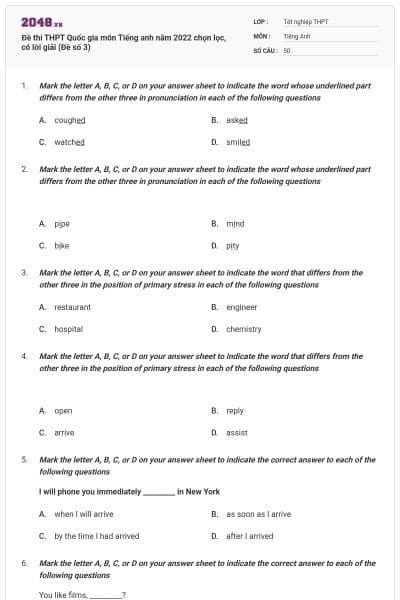
Mark the letter A, B, C, or D on your answer sheet to indicate the word whose underlined part differs from the other three in pronunciation in each of the following questions
coughed
asked
watched
smiled
Kiến thức: Phát âm đuôi “-ed”
Giải thích:
- coughed /kɒft/ B. asked /ɑːskt/
- watched /wɒtʃt/ D. smiled /smaɪld/
Quy tắc: Cách phát âm đuôi “-ed”:
- /t/: khi động từ có phát âm kết thúc là /s/, /f/, /p/, /ʃ/, /tʃ/, /k/ và /s/.
- /id/: khi động từ có phát âm kết thúc là /t/ hay /d/
- /d/: với những trường hợp còn lại
Phần gạch chân đáp án D được phát âm là /d/, còn lại là /t/.
Chọn D
Mark the letter A, B, C, or D on your answer sheet to indicate the word whose underlined part differs from the other three in pronunciation in each of the following questions
pipe
mind
bike
pity
Kiến thức: Phát âm nguyên âm “-i”
Giải thích:
- pipe /paɪp/ B. mind /maɪnd/
- bike /baɪk/ D. pity /ˈpɪti/
Phần gạch chân đáp án D được phát âm là /ɪ/, còn lại là /aɪ/.
Chọn D
Mark the letter A, B, C, or D on your answer sheet to indicate the word that differs from the other three in the position of primary stress in each of the following questions
restaurant
engineer
hospital
chemistry
Kiến thức: Trọng âm từ có 3 âm tiết
Giải thích:
- restaurant /ˈrestrɒnt/ B. engineer /endʒɪˈnɪə(r)/
- hospital /ˈhɒspɪtl/ D. chemistry /ˈkemɪstri/
Trọng âm phương án B rơi vào âm tiết 3, còn lại là âm 1.
Chọn B
Mark the letter A, B, C, or D on your answer sheet to indicate the word that differs from the other three in the position of primary stress in each of the following questions
open
reply
arrive
assist
Kiến thức: Trọng âm từ có 2 âm tiết
Giải thích:
- open /ˈəʊpən/ B. reply /rɪˈplaɪ/
- arrive /əˈraɪv/ D. assist /əˈsɪst/
Quy tắc:
- Động từ thường có trọng âm rơi vào âm tiết thứ hai.
- Danh từ, tính từ thường có trọng âm rơi vào âm thứ nhất.
Trọng âm phương án A rơi vào âm tiết 1, còn lại là âm 2.
Chọn A
Mark the letter A, B, C, or D on your answer sheet to indicate the correct answer to each of the following questions
I will phone you immediately _________ in New York
when I will arrive
as soon as I arrive
by the time I had arrived
after I arrived
Kiến thức: Mệnh đề trạng ngữ chỉ thời gian
Giải thích:
Không dùng thì tương lai trong mệnh đề trạng ngữ chỉ thời gian => loại A
Do động từ ở mệnh đề chính thì tương lai nên động từ ở mệnh đề trạng ngữ chỉ thời gian thì hiện tại đơn => loại C, D
Tạm dịch: Tôi sẽ gọi cho bạn ngay khi tôi vừa đến New York.
Chọn B
Mark the letter A, B, C, or D on your answer sheet to indicate the correct answer to each of the following questions
You like films, _________?
will you
do you
won't you
don't you
Kiến thức: Câu hỏi đuôi
Giải thích:
Động từ ở mệnh đề chính chia thì hiện tại đơn “like”, dạng khẳng định
=> động từ ở câu hỏi đuôi dạng phủ định: don’t
Chủ ngữ ở mệnh đề chính: you => chủ ngữ ở câu hỏi đuôi: you
Tạm dịch: Bạn thích phim, phải không?
Chọn D
Mark the letter A, B, C, or D on your answer sheet to indicate the correct answer to each of the following questions
He _________ a striking resemblance to one of my friends.
bears
owns
holds
shows
Kiến thức: Từ vựng, sự kết hợp từ
Giải thích:
- bears (v): mang, cầm, vác B. owns (v): sở hữu
- holds (v): nắm giữ D. shows (v): cho thấy
=> bear a resemblance to: giống với
Tạm dịch: Anh ấy có nét giống với một trong những người bạn của tôi.
Chọn A
Mark the letter A, B, C, or D on your answer sheet to indicate the correct answer to each of the following questions
When he phoned, we _________ with our friends at home
had sung
are singing
sand
were singing
Kiến thức: Thì quá khứ tiếp diễn, phối hợp thì
Giải thích:
Thì quá khứ tiếp diễn dùng để diễn tả một hành động đang xảy ra tại một thời điểm trong quá khứ (chia quá khứ tiếp diễn), nếu có hành động khác xen vào thì hành động đó chia ở thì quá khứ đơn.
Công thức phối hợp 2 thì: When S + V-quá khứ đơn, S + was/were Ving.
=> loại A, B, C
Tạm dịch: Khi anh ấy gọi điện, chúng tôi đang hát với bạn bè ở nhà.
Chọn D
Mark the letter A, B, C, or D on your answer sheet to indicate the correct answer to each of the following questions
Brian lost so much money as he didn't know how to _________ his business
run
make
do
put
Kiến thức: Từ vựng, cụm từ
Giải thích:
- run (v): điều hành => run business: điều hành việc kinh doanh
- make (v): chế tạo, sản xuất
- do (v): làm, hành động => do business: buôn bán
- put (v): đặt, để
Tạm dịch: Brian đã mất quá nhiều tiền vì anh ấy không biết cách điều hành công việc kinh doanh của mình.
Chọn A
Mark the letter A, B, C, or D on your answer sheet to indicate the correct answer to each of the following questions
_________ the content, we are now looking for supporting information
To plan
Having been planned
Having planned
To be planned
Kiến thức: Rút gọn mệnh đề đồng ngữ
Giải thích:
2 mệnh đề có cùng chủ ngữ (we - chúng tôi), có thể rút gọn một mệnh đề về dạng:
- Ving: khi mệnh đề dạng chủ động và hai hành động xảy ra liên tiếp
- Ved: khi mệnh đề dạng bị động
- Having Ved/V3: khi mệnh đề dạng chủ động, hành động được rút gọn xảy ra trước và là nguyên nhân dẫn đến hành động còn lại => Dạng bị động: Having been Ved/V3.
Câu đầy đủ: We have planned the content. We are now looking for supporting information
Câu rút gọn: Having planned the content, we are now looking for supporting information.
Tạm dịch: Sau khi lên kế hoạch về nội dung, chúng tôi đang tìm kiếm thông tin hỗ trợ.
Chọn C
Mark the letter A, B, C, or D on your answer sheet to indicate the correct answer to each of the following questions
He lost the race because he _________ petrol on the last lap
ran out of
got out of
put out of
made out of
Đáp án: A
Giải thích:
Kiến thức: Cụm động từ
A. ran out of: hết, cạn kiệt
B. got out of: né tránh (trách nhiệm)
C. put something out: vứt đi
D. made out of: làm từ
Dựa vào nghĩa, chọn A.
Dịch: Anh ấy thua cuộc đua vì hết xăng ở vòng đua cuối cùng.
Mark the letter A, B, C, or D on your answer sheet to indicate the correct answer to each of the following questions
A number of _________ buyers have expressed their interests in the company
potential
potentiality
potentially
potention
Kiến thức: Từ loại
Giải thích:
- potential (adj): tiềm năng B. potentiality (n): tiềm năng
- potentially (adv): có tiềm năng D. potention => từ không có nghĩa
Dấu hiệu: trước danh từ “buyers” (người mua) cần một tính từ
Tạm dịch: Một số người mua tiềm năng đã bày tỏ sự quan tâm của họ đối với công ty.
Chọn A
Mark the letter A, B, C, or D on your answer sheet to indicate the correct answer to each of the following questions
People in this area _________ with clothes and food by the government every year
are providing
provided
provide
are provided
Kiến thức: Câu bị động
Giải thích:
Dấu hiệu: “by the government” (bởi chính phủ) => động từ ở dạng bị động
Câu bị động thì hiện tại đơn: S + am/is/are Ved/V3 + (by O).
Tạm dịch: Người dân khu vực này được chính phủ cung cấp quần áo và thực phẩm hàng năm.
Chọn D
Mark the letter A, B, C, or D on your answer sheet to indicate the correct answer to each of the following questions
The later you get up, _________ you will be
the tired
the more tired
the most tired
the tireder
Kiến thức: So sánh
Giải thích:
Công thức so sánh kép: The more adj/adj-er S1 + V1, the more adj/adj-er S2 + V2: càng … càng
tired => more tired
Tạm dịch: Càng dậy muộn, bạn sẽ càng mệt mỏi.
Chọn B
Mark the letter A, B, C, or D on your answer sheet to indicate the correct answer to each of the following questions
Many young people are now interested _________ Korean music.
on
by
at
in
Kiến thức: Giới từ
Giải thích: be interested + in sth: thích thú cái gì
Tạm dịch: Hiện nay rất nhiều bạn trẻ quan tâm đến âm nhạc Hàn Quốc.
Chọn D
Mark the letter A, B, C, or D on your answer sheet to indicate the correct answer to each of the following questions
I've got a promotion at work, but all John did was make a joke about it. He has a real chip on his _________. I think he is just jealous.
head
shoulder
nose
mount
Kiến thức: Thành ngữ
Giải thích:
- head (n): đầu B. shoulder (n): vai
- nose (n): mũi D. mount (n): núi
=> have a chip on your shoulder: luôn tức giận, thích gây sự
Tạm dịch: Tôi có một sự thăng tiến trong công việc, nhưng tất cả những gì John làm là đùa cợt về điều đó.
Anh ta lúc nào cũng tức giận về điều đó. Tôi nghĩ anh ta đang ghen tị với tôi.
Chọn B
Mark the letter A, B, C, or D on your answer sheet to indicate the correct answer to each of the following questions
We bought a _________ cat at the flea market last week
nice British white
British nice white
nice white British
white British nice
Kiến thức: Trật tự tính từ
Giải thích:
Trật tự tính từ: Opinion (Ý kiến) – Size (Kích cỡ) – Age (Tuổi tác) – Shape (Hình dáng) – Color (Màu sắc) – Origin (Nguồn gốc) – Material (Chất liệu) – Purpose (Mục đích)
nice (adj): tốt (ý kiến)
white (adj): màu trắng
British (adj): thuộc nước Anh
Tạm dịch: Tuần trước, chúng tôi đã mua một con mèo Anh màu trắng rất đẹp ở chợ si.
Chọn C
Mark the letter A, B, C, or D on your answer sheet to indicate the correct answer to each of the following questions
Numerous _________ have prevented us from going to the lakeside again this year
disadvantages
impairments
obstacles
adversities
Kiến thức: Từ vựng
Giải thích:
- disadvantages (n): điểm bất lợi, điều hạn chế, tiêu cực
- impairments (n): khiếm khuyết
- obstacles (n): trở ngại, vật cản
- adversities (n): nghịch cảnh, vận rủi
Tạm dịch: Nhiều điều không may đã khiến chúng tôi không thể đến bờ hồ một lần nữa vào năm nay.
Chọn D
Mark the letter A, B, C, or D on your answer sheet to indicate the correct answer to each of the following questions
He was late for school this morning _________ he had missed the bus
in spite of
although
despite
because
Kiến thức: Liên từ
Giải thích:
- in spite of + N/Ving: mặc dù B. although S + V: mặc dù
- despite + N/Ving: mặc dù D. because S + V: bởi vì
Dấu hiệu: “he had missed the bus” là cụm chủ vị => loại A, C.
Tạm dịch: Sáng nay cậu bé đi học muộn vì lỡ xe buýt.
Chọn D
Mark the letter A, B, C, or D on your answer sheet to indicate the word(s) CLOSEST in meaning to the underlined word(s) in each of the following questions
Sewage from this company has definitely contaminated the vast area of the river, the habitat of numerous aquatic species
polluted
corrupted
defiled
purified
Đáp án: A
Kiến thức: Từ vựng
Giải thích:
contaminate – contaminated: làm bẩn, gây ô nhiễm
A. pollute – polluted: gây ô nhiễm
B. corrupt – corrupted: làm hư hỏng
C. defile – defiled: làm ô uế (một nơi linh thiêng)
D. purify – purified: làm cho sạch
=> contaminated = polluted: gây ô nhiễm
Dịch: Nước thải từ công ty này chắc chắn đã làm ô nhiễm một vùng rộng lớn của con sông, nơi sinh sống của nhiều loài thủy sinh.
Mark the letter A, B, C, or D on your answer sheet to indicate the word(s) CLOSEST in meaning to the underlined word(s) in each of the following questions
Female kangaroos carry their young in pouches that are external to their bodies
woman
man
male
Đáp án: A
Giải thích:
Kiến thức: Từ vựng – Từ đồng nghĩa
female (n, adj): giống cái, thuộc về con cái
Xét các đáp án:
A. Woman (n): giống cái, phụ nữ
B. Man (n): giống đực, đàn ông
C. Male (n): giới tính nam
D. Gender (n): giới tính
→ Female = Woman
Dịch: Chuột túi cái mang con của chúng trong những chiếc túi bên ngoài cơ thể.
Kiến thức: Từ vựng
Giải thích:
female (adj): thuộc giống cái, thuộc phái nữ
- woman (n): con gái, phụ nữ B. man (n): đàn ông
- male (adj): thuộc giống đực, thuộc phái nam D. gender (n): giới tính
=> female (adj): thuộc giống cái, thuộc phái nữ = woman (n): con gái, phụ nữ
Tạm dịch: Chuột túi cái mang con non của chúng trong các túi bên ngoài cơ thể mình.
Chọn A
Mark the letter A, B, C, or D on your answer sheet to indicate the word(s) OPPOSITE in meaning to the underlined word(s) in each of the following questions
Mr. Brown is a very generous old man. He has given most of his wealth to a charity organization
honest
hospitable
mean
kind
Kiến thức: Từ vựng
Giải thích:
generous (adj): hào phóng, rộng lượng
- honest (adj): trung thực B. hospitable (adj): hiếu khách
- mean (adj): ích kỷ, nhỏ nhen D. kind (adj): tử tế
=> generous (adj): hào phóng, rộng lượng >< mean (adj): ích kỷ, nhỏ nhen
Tạm dịch: Ông Brown là một người rất hào phóng. Ông đã dành phần lớn tài sản của mình cho một tổ chức từ thiện.
Chọn C
Mark the letter A, B, C, or D on your answer sheet to indicate the word(s) OPPOSITE in meaning to the underlined word(s) in each of the following questions
Both universities speak highly of the programme of student exchange and hope to cooperate more in the future.
resolve a conflict over
voice opinions on
find favor with
express disapproval of
Kiến thức: Cụm từ
Giải thích:
speak highly of: đề cao điều gì
- resolve a conflict over: giải quyết xung đột về B. voice opinions on: nêu ý kiến về
- find favor with: tìm kiếm sự ủng hộ với D. express disapproval of: bày tỏ sự phản đối
=> speak highly of: đề cao điều gì >< express disapproval of: bày tỏ sự phản đối
Tạm dịch: Cả hai trường đại học đều đề cao chương trình trao đổi sinh viên và hy vọng sẽ hợp tác nhiều hơn trong tương lai.
Chọn D
Mark the letter A, B, C, or D on your answer sheet to indicate the most suitable response to complete each of the following exchanges
Nick and Peter are talking about sports.
- Nick: "What sports do you like?"- Peter: "_____________”
Yes, it's my favorite sport
Well, I love volleyball
I think it's boring
No, I don't
Kiến thức: Ngôn ngữ giao tiếp
Giải thích:
Nick và Peter đang nói về thể thao.
- Nick: “Cậu thích môn thể thao nào?” - Peter: “_____________”
- Ừ, đó là môn thể thao yêu thích của tớ B. Chà, tớ yêu bóng chuyền
- Tớ nghĩ nó nhàm chán D. Không, tớ không yêu thích môn nào cả
Các phản hổi A, C, D không phù hợp ngữ cảnh.
Chọn B
Mark the letter A, B, C, or D on your answer sheet to indicate the most suitable response to complete each of the following exchanges
Maria and Alex are talking about the environment.
- Maria: "Our environment is getting more and more polluted. Do you think so?"
- Alex: “________________. It's really worrying.
I don't think so
I don't agree
I can't agree more
I'll think about that
Kiến thức: Ngôn ngữ giao tiếp
Giải thích:
Maria và Alex đang nói về môi trường.
- Maria: “Môi trường của chúng ta ngày càng ô nhiễm. Bạn có nghĩ vậy không?”
- Alex: “________________. Nó thực sự đáng lo ngại”.
- Tôi không nghĩ vậy B. Tôi không đồng ý
- Tôi hoàn toàn đồng ý với bạn D. Tôi sẽ suy nghĩ về điều đó
Các phản hổi A, B, D không phù hợp ngữ cảnh.
Chọn C
Read the following passage and mark the letter A, B, C, or D on your answer sheet to indicate the correct word or phrase that best fits each of the numbered blanks from 26 to 30.
Culture refers to the customs, practices, languages, values, and world views that define social groups such as those based on nationality, ethnicity, region, or common interests. Cultural identity is important for people's (26) _________ of self and how they relate to others. A strong cultural identity can contribute to people's overall well-being.
Cultural identity based on ethnicity is not necessarily exclusive. People may identify themselves as New Zealanders in some circumstances and as part of a particular culture (e.g. Māori, Chinese or Scottish) in (27) _________ circumstances. They may also identify with more than one culture.
Cultural identity is an important contributor to people's well-being. Identifying with a particular culture helps people feel they belong and gives them a sense of security. An established cultural identity has also been linked with positive outcomes in areas such as health and education. It provides access to social networks, (28) _________ provide support and shared values and aspirations.
(29) _________, strong cultural identity expressed in the wrong way can contribute to barriers between groups. Members of smaller cultural groups can feel (30) _________ from society if others obstruct, or are intolerant of their cultural practices
sense
opinion
thinking
feeling
Kiến thức: Từ vựng, cụm từ
Giải thích:
- sense (n): ý thức B. opinion (n): ý kiến
- thinking (n): suy nghĩ D. feeling (n): cảm giác
=> sense of self: ý thức về bản thân
Cultural identity is important for people's (26) sense of self and how they relate to others.
Tạm dịch: Bản sắc văn hóa quan trọng đối với ý thức của con người về bản thân và cách họ gắn kết với những người khác.
Chọn A
Read the following passage and mark the letter A, B, C, or D on your answer sheet to indicate the correct word or phrase that best fits each of the numbered blanks from 26 to 30. Culture refers to the customs, practices, languages, values, and world views that define social groups such as those based on nationality, ethnicity, region, or common interests. Cultural identity is important for people's (26) _________ of self and how they relate to others. A strong cultural identity can contribute to people's overall well-being. Cultural identity based on ethnicity is not necessarily exclusive. People may identify themselves as New Zealanders in some circumstances and as part of a particular culture (e.g. Māori, Chinese or Scottish) in (27) _________ circumstances. They may also identify with more than one culture. Cultural identity is an important contributor to people's well-being. Identifying with a particular culture helps people feel they belong and gives them a sense of security. An established cultural identity has also been linked with positive outcomes in areas such as health and education. It provides access to social networks, (28) _________ provide support and shared values and aspirations. (29) _________, strong cultural identity expressed in the wrong way can contribute to barriers between groups. Members of smaller cultural groups can feel (30) _________ from society if others obstruct, or are intolerant of their cultural practices
the other
another
other
others
Kiến thức: Từ vựng, tính từ/lượng từ
Giải thích:
- the other: cái còn lại B. another + N: cái khác
- other + N(số nhiều): những cái khác D. others = other + N(số nhiều): những cái khác
Dấu hiệu: do danh từ “circumstances” (những hoàn cảnh) là danh từ số nhiều => loại A, B, D
People may identify themselves as New Zealanders in some circumstances and as part of a particular culture (e.g. Māori, Chinese or Scottish) in (27) other circumstances.
Tạm dịch: Mọi người có thể tự nhận mình là người New Zealand trong một số trường hợp và là một phần của nền văn hóa cụ thể (ví dụ: người Maori, người Hoa hoặc người Scotland) trong các trường hợp khác.
Chọn C
Read the following passage and mark the letter A, B, C, or D on your answer sheet to indicate the correct word or phrase that best fits each of the numbered blanks from 26 to 30. Culture refers to the customs, practices, languages, values, and world views that define social groups such as those based on nationality, ethnicity, region, or common interests. Cultural identity is important for people's (26) _________ of self and how they relate to others. A strong cultural identity can contribute to people's overall well-being. Cultural identity based on ethnicity is not necessarily exclusive. People may identify themselves as New Zealanders in some circumstances and as part of a particular culture (e.g. Māori, Chinese or Scottish) in (27) _________ circumstances. They may also identify with more than one culture. Cultural identity is an important contributor to people's well-being. Identifying with a particular culture helps people feel they belong and gives them a sense of security. An established cultural identity has also been linked with positive outcomes in areas such as health and education. It provides access to social networks, (28) _________ provide support and shared values and aspirations. (29) _________, strong cultural identity expressed in the wrong way can contribute to barriers between groups. Members of smaller cultural groups can feel (30) _________ from society if others obstruct, or are intolerant of their cultural practices
where
which
who
that
Kiến thức: Đại từ quan hệ
Giải thích:
Trong mệnh đề quan hệ:
- where: ở đâu
- which: thay thế cho danh từ chỉ vật
- who: thay thế cho danh từ chỉ người đóng vai trò làm chủ ngữ, tân ngữ
- that: that thế cho danh từ chỉ người và vật (không đứng đằng sau dấu “,”)
Dấu hiệu: danh từ “social networks” (mạng xã hội) là danh từ chỉ vật và đứng sau nó là dấu “,”
=> loại A, C, D
It provides access to social networks, (28) which provide support and shared values and aspirations.
Tạm dịch: Nó cung cấp quyền tham gia vào các mạng xã hội, cung cấp hỗ trợ và chia sẻ các giá trị và nguyện vọng.
Chọn B
Read the following passage and mark the letter A, B, C, or D on your answer sheet to indicate the correct word or phrase that best fits each of the numbered blanks from 26 to 30. Culture refers to the customs, practices, languages, values, and world views that define social groups such as those based on nationality, ethnicity, region, or common interests. Cultural identity is important for people's (26) _________ of self and how they relate to others. A strong cultural identity can contribute to people's overall well-being. Cultural identity based on ethnicity is not necessarily exclusive. People may identify themselves as New Zealanders in some circumstances and as part of a particular culture (e.g. Māori, Chinese or Scottish) in (27) _________ circumstances. They may also identify with more than one culture. Cultural identity is an important contributor to people's well-being. Identifying with a particular culture helps people feel they belong and gives them a sense of security. An established cultural identity has also been linked with positive outcomes in areas such as health and education. It provides access to social networks, (28) _________ provide support and shared values and aspirations. (29) _________, strong cultural identity expressed in the wrong way can contribute to barriers between groups. Members of smaller cultural groups can feel (30) _________ from society if others obstruct, or are intolerant of their cultural practices
But
Therefore
However
And
Kiến thức: Liên từ
Giải thích:
- But S + V: nhưng B. Therefore, S + V: vì thế, vì vậy
- However, S + V: tuy nhiên D. And: và
(29) However, strong cultural identity expressed in the wrong way can contribute to barriers between groups.
Tạm dịch: Tuy nhiên, bản sắc văn hóa mạnh mẽ được thể hiện sai cách có thể góp phần tạo ra rào cản giữa các nhóm văn hóa.
Chọn C
Read the following passage and mark the letter A, B, C, or D on your answer sheet to indicate the correct word or phrase that best fits each of the numbered blanks from 26 to 30. Culture refers to the customs, practices, languages, values, and world views that define social groups such as those based on nationality, ethnicity, region, or common interests. Cultural identity is important for people's (26) _________ of self and how they relate to others. A strong cultural identity can contribute to people's overall well-being. Cultural identity based on ethnicity is not necessarily exclusive. People may identify themselves as New Zealanders in some circumstances and as part of a particular culture (e.g. Māori, Chinese or Scottish) in (27) _________ circumstances. They may also identify with more than one culture. Cultural identity is an important contributor to people's well-being. Identifying with a particular culture helps people feel they belong and gives them a sense of security. An established cultural identity has also been linked with positive outcomes in areas such as health and education. It provides access to social networks, (28) _________ provide support and shared values and aspirations. (29) _________, strong cultural identity expressed in the wrong way can contribute to barriers between groups. Members of smaller cultural groups can feel (30) _________ from society if others obstruct, or are intolerant of their cultural practices
debarred
eliminated
excluded
exhausted
Kiến thức: Từ vựng
Giải thích:
- debarred: ngăn cản, ngăn cấm B. eliminated: loại bỏ
- excluded: bị loại trừ D. exhausted: kiệt sức
=> exclude sth from sth: loại cái gì khỏi điều gì
Members of smaller cultural groups can feel (30) excluded from society if others obstruct, or are intolerant of their cultural practices.
Tạm dịch: Các thành viên của các nhóm văn hóa nhỏ hơn có thể cảm thấy bị loại trừ khỏi xã hội nếu những người khác cản trở hoặc không khoan dung với các giá trị trong văn hóa của họ.
Chọn C
Read the following passage and mark the letter A, B, C, or D on your answer sheet to indicate the correct answer to each of the questions from 31 to 35.
One way of training for your future occupation in Germany is by pursuing a dual vocational training programme. Such programmes offer plenty of opportunities for on-the-job training and work experience. Programmes usually last between two and three and a half years and comprise theoretical as well as practical elements. You will spend one or two days a week, or several weeks at once, at a vocational school where you will acquire the theoretical knowledge that you will need in your future occupation. The rest of the time will be spent at a company. There you get to apply your newly acquired knowledge in practice, for example by learning to operate machinery. You will get to know what your company does, learn how it operates and find out if you can see yourself working there after completing your training.
This combination of theory and practice gives you a real head start into your job: by the time you have completed your training, you will not only have the required technical knowledge, but you will also have hands-on experience in your job. There are around 350 officially recognised training programmes in Germany, so chances are good that one of them will suit your interests and talents. You can find out which one that might be by visiting one of the jobs and vocational training fairs which are organised in many German cities at different times in the year.
Employment prospects for students who have completed a dual vocational training programme are very good. This is one of the reasons why this kind of training is very popular with young Germans: around two thirds of all students leaving school go on to start a vocational training programme
Which of the following is probably the best title of the passage?
Employment Opportunities and Prospects in Germany
Dual Vocational Training System in Germany
Higher Education System in Germany
Combination of Theory and Practice in Studying in Germany
Kiến thức: Đọc hiểu
Giải thích:
Tiêu đề của bài đọc có thể là gì?
- Cơ hội và triển vọng việc làm ở Đức
- Hệ thống đào tạo nghề kép ở Đức
- Hệ thống giáo dục đại học ở Đức
- Sự kết hợp giữa lý thuyết và thực hành khi học tập tại Đức
Thông tin: One way of training for your future occupation in Germany is by pursuing a dual vocational training programme.
Tạm dịch: Một cách đào tạo cho nghề nghiệp tương lai của bạn ở Đức là theo học chương trình đào tạo nghề kép.
Chọn B
Read the following passage and mark the letter A, B, C, or D on your answer sheet to indicate the correct answer to each of the questions from 31 to 35.
One way of training for your future occupation in Germany is by pursuing a dual vocational training programme. Such programmes offer plenty of opportunities for on-the-job training and work experience. Programmes usually last between two and three and a half years and comprise theoretical as well as practical elements. You will spend one or two days a week, or several weeks at once, at a vocational school where you will acquire the theoretical knowledge that you will need in your future occupation. The rest of the time will be spent at a company. There you get to apply your newly acquired knowledge in practice, for example by learning to operate machinery. You will get to know what your company does, learn how it operates and find out if you can see yourself working there after completing your training.
This combination of theory and practice gives you a real head start into your job: by the time you have completed your training, you will not only have the required technical knowledge, but you will also have hands-on experience in your job. There are around 350 officially recognised training programmes in Germany, so chances are good that one of them will suit your interests and talents. You can find out which one that might be by visiting one of the jobs and vocational training fairs which are organised in many German cities at different times in the year.
Employment prospects for students who have completed a dual vocational training programme are very good. This is one of the reasons why this kind of training is very popular with young Germans: around two thirds of all students leaving school go on to start a vocational training programme
The word "it" in the first paragraph refers to ________.
machinery
knowledge
company
organisation
Kiến thức: Đọc hiểu
Giải thích:
Từ "it" trong đoạn đầu tiên đề cập đến ________.
- máy móc B. kiến thức C. công ty D. tổ chức
Thông tin: You will get to know what your company does, learn how it operates and find out if you can see yourself working there after completing your training.
Tạm dịch: Bạn sẽ biết công ty của bạn làm gì, tìm hiểu cách nó hoạt động và tìm hiểu xem tìm hiểu xem liệu bạn có thể thấy mình đang làm việc ở đó sau khi hoàn thành khóa đào tạo hay không.
Chọn C
Read the following passage and mark the letter A, B, C, or D on your answer sheet to indicate the correct answer to each of the questions from 31 to 35.
One way of training for your future occupation in Germany is by pursuing a dual vocational training programme. Such programmes offer plenty of opportunities for on-the-job training and work experience. Programmes usually last between two and three and a half years and comprise theoretical as well as practical elements. You will spend one or two days a week, or several weeks at once, at a vocational school where you will acquire the theoretical knowledge that you will need in your future occupation. The rest of the time will be spent at a company. There you get to apply your newly acquired knowledge in practice, for example by learning to operate machinery. You will get to know what your company does, learn how it operates and find out if you can see yourself working there after completing your training.
This combination of theory and practice gives you a real head start into your job: by the time you have completed your training, you will not only have the required technical knowledge, but you will also have hands-on experience in your job. There are around 350 officially recognised training programmes in Germany, so chances are good that one of them will suit your interests and talents. You can find out which one that might be by visiting one of the jobs and vocational training fairs which are organised in many German cities at different times in the year.
Employment prospects for students who have completed a dual vocational training programme are very good. This is one of the reasons why this kind of training is very popular with young Germans: around two thirds of all students leaving school go on to start a vocational training programme
How many German school leavers choose this vocational training programme?
around one out of five
about 70%
well over 75%
less than a third
Kiến thức: Đọc hiểu
Giải thích:
Có bao nhiêu học sinh tốt nghiệp ở Đức chọn chương trình đào tạo nghề này?
- khoảng 1/5 B. khoảng 70% C. trên 75% D. ít hơn 1/3
Thông tin: This is one of the reasons why this kind of training is very popular with young Germans: around two-thirds of all students leaving school go on to start a vocational training programme.
Tạm dịch: Đây là một trong những lý do tại sao hình thức đào tạo này rất phổ biến với giới trẻ Đức: khoảng 2/3 tổng số sinh viên rời trường học để bắt đầu một chương trình đào tạo nghề. (2/3 ~ 66%)
Chọn B
Read the following passage and mark the letter A, B, C, or D on your answer sheet to indicate the correct answer to each of the questions from 31 to 35.
One way of training for your future occupation in Germany is by pursuing a dual vocational training programme. Such programmes offer plenty of opportunities for on-the-job training and work experience. Programmes usually last between two and three and a half years and comprise theoretical as well as practical elements. You will spend one or two days a week, or several weeks at once, at a vocational school where you will acquire the theoretical knowledge that you will need in your future occupation. The rest of the time will be spent at a company. There you get to apply your newly acquired knowledge in practice, for example by learning to operate machinery. You will get to know what your company does, learn how it operates and find out if you can see yourself working there after completing your training.
This combination of theory and practice gives you a real head start into your job: by the time you have completed your training, you will not only have the required technical knowledge, but you will also have hands-on experience in your job. There are around 350 officially recognised training programmes in Germany, so chances are good that one of them will suit your interests and talents. You can find out which one that might be by visiting one of the jobs and vocational training fairs which are organised in many German cities at different times in the year.
Employment prospects for students who have completed a dual vocational training programme are very good. This is one of the reasons why this kind of training is very popular with young Germans: around two thirds of all students leaving school go on to start a vocational training programme
According to the passage, which of the following is NOT true about vocational training programmes in Germany?
They last two and three and a half years
They offer opportunities for on-the-job training.
They provide work experience
They are organised in one city in Germany.
Kiến thức: Đọc hiểu
Giải thích:
Theo đoạn văn, điều nào sau đây KHÔNG đúng về chương trình đào tạo nghề ở Đức?
- Chúng kéo dài hai năm đến ba năm rưỡi.
- Chúng cung cấp các cơ hội để được đào tạo tại chỗ.
- Chúng cung cấp kinh nghiệm làm việc.
- Chúng được tổ chức tại một thành phố ở Đức.
Thông tin: One way of training for your future occupation in Germany is by pursuing a dual vocational training programme.
Tạm dịch: Một cách đào tạo cho nghề nghiệp tương lai của bạn ở Đức là theo học chương trình đào tạo nghề kép. => chúng được tổ chức ở tất cả các thành phố ở Đức (không nói giới hạn ở nơi nào của Đức)
Chọn D
Read the following passage and mark the letter A, B, C, or D on your answer sheet to indicate the correct answer to each of the questions from 31 to 35.
One way of training for your future occupation in Germany is by pursuing a dual vocational training programme. Such programmes offer plenty of opportunities for on-the-job training and work experience. Programmes usually last between two and three and a half years and comprise theoretical as well as practical elements. You will spend one or two days a week, or several weeks at once, at a vocational school where you will acquire the theoretical knowledge that you will need in your future occupation. The rest of the time will be spent at a company. There you get to apply your newly acquired knowledge in practice, for example by learning to operate machinery. You will get to know what your company does, learn how it operates and find out if you can see yourself working there after completing your training.
This combination of theory and practice gives you a real head start into your job: by the time you have completed your training, you will not only have the required technical knowledge, but you will also have hands-on experience in your job. There are around 350 officially recognised training programmes in Germany, so chances are good that one of them will suit your interests and talents. You can find out which one that might be by visiting one of the jobs and vocational training fairs which are organised in many German cities at different times in the year.
Employment prospects for students who have completed a dual vocational training programme are very good. This is one of the reasons why this kind of training is very popular with young Germans: around two thirds of all students leaving school go on to start a vocational training programme
The word "hands-on" in the second paragraph is closest in meaning to ________.
theoretical
integral
practical
technical
Kiến thức: Đọc hiểu
Giải thích:
The word "hands-on" (thực hành, có thực tế) in the second paragraph is closest in meaning to ________.
- theoretical (adj): thuộc lý thuyết B. integral (adj): toàn bộ, không thể thiếu
- practical (adj): thực hành, thực tế D. technical (adj): thuộc kỹ thuật
Thông tin: This combination of theory and practice gives you a real head start into your job: by the time you have completed your training, you will not only have the required technical knowledge, but you will also have hands-on experience in your job.
Tạm dịch: Sự kết hợp giữa lý thuyết và thực hành này mang lại cho bạn một khởi đầu thực sự trong công việc của mình: khi bạn hoàn thành khóa đào tạo, bạn sẽ không chỉ có kiến thức kỹ thuật cần thiết mà còn có kinh nghiệm thực tế trong công việc của mình.
Chọn C
Read the following passage and mark the letter A, B, C, or D on your answer sheet to indicate the correct answer to each of the questions from 36 to 42.
Do you feel like your teenager is spending most of the day glued to a phone screen? You're not too far off. A new survey from the Pew Research Center reveals the surprising ways that technology intersects with teen friendships - and the results show that 57 percent of teens have made at least one new friend online. Even more surprisingly, only 20 percent of those digital friends ever meet in person. While teens do connect with their friends face-to-face outside of school, they spend 55 percent of their day texting with friends, and only 25 percent of teens are spending actual time with their friends on a daily basis. These new forms of communication are key in maintaining friendships day-to-day - 27 percent of teens instant message their friends every day, 23 percent connect through social media every day, and 7 percent even video chat daily. Text messaging remains the main form of communication - almost half of the survey respondents say it's their chosen method of communication with their closest friend.
While girls are more likely to text with their close friends, boys are meeting new friends and maintaining friendships) in the gaming world - 89 percent play with friends they know, and 54 percent play with online only friends. Whether they're close with their teammates or not, online gamers say that playing makes them feel "more connected" to friends they know or gamers they've never met.
When making new friends, social media has also become a major part of the teenage identity - 62 percent of teens are quick to share their social media usernames when connecting with a new friend. Despite the negative consequences, 21 percent of teenage users feel worse about their lives because of posts they see on social media - teens also have found support and connection through various platforms. In fact, 68 percent of teens received support during a challenging time in their lives via social media platforms
Just as technology has become a gateway for new friendships, or a channel to stay connected with current friends, it can also make a friendship breakup more public. The study reveals that girls are more likely to block or unfriend former allies, and 68 percent of all teenage users report experiencing "drama among their friends on social media."
What is the main idea of the passage?
The difference of making new friends between girls and boys.
Social media affects friendship positively and negatively
Teenagers are making and keeping friends in a surprising way
Social friendship is longer and more open than a real-life one
Kiến thức: Đọc hiểu
Giải thích:
Ý chính của đoạn văn là gì?
- Sự khác biệt của việc kết bạn mới giữa con gái và con trai.
- Phương tiện truyền thông xã hội ảnh hưởng đến tình bạn một cách tích cực và tiêu cực.
- Giới trẻ đang kết bạn và giữ tình bạn theo một cách rất đáng ngạc nhiên.
- Tình bạn ngoài xã hội lâu dài và cởi mở hơn tình bạn ngoài đời.
Thông tin: A new survey from the Pew Research Center reveals the surprising ways that technology intersects with teen friendships – and the results show that 57 percent of teens have made at least one new friend online. Even more surprisingly, only 20 percent of those digital friends ever meet in person.
Tạm dịch: Một cuộc khảo sát mới từ Trung tâm Nghiên cứu Pew cho thấy những cách đáng ngạc nhiên mà công nghệ giao thoa với tình bạn của thanh thiếu niên - và kết quả cho thấy 57% thanh thiếu niên đã có ít nhất một người bạn mới trực tuyến. Đáng ngạc nhiên hơn nữa, chỉ 20% trong số những người bạn trực tuyến đó từng gặp ngoài đời.
Chọn C
Read the following passage and mark the letter A, B, C, or D on your answer sheet to indicate the correct answer to each of the questions from 36 to 42.
Do you feel like your teenager is spending most of the day glued to a phone screen? You're not too far off. A new survey from the Pew Research Center reveals the surprising ways that technology intersects with teen friendships - and the results show that 57 percent of teens have made at least one new friend online. Even more surprisingly, only 20 percent of those digital friends ever meet in person. While teens do connect with their friends face-to-face outside of school, they spend 55 percent of their day texting with friends, and only 25 percent of teens are spending actual time with their friends on a daily basis. These new forms of communication are key in maintaining friendships day-to-day - 27 percent of teens instant message their friends every day, 23 percent connect through social media every day, and 7 percent even video chat daily. Text messaging remains the main form of communication - almost half of the survey respondents say it's their chosen method of communication with their closest friend.
While girls are more likely to text with their close friends, boys are meeting new friends and maintaining friendships) in the gaming world - 89 percent play with friends they know, and 54 percent play with online only friends. Whether they're close with their teammates or not, online gamers say that playing makes them feel "more connected" to friends they know or gamers they've never met.
When making new friends, social media has also become a major part of the teenage identity - 62 percent of teens are quick to share their social media usernames when connecting with a new friend. Despite the negative consequences, 21 percent of teenage users feel worse about their lives because of posts they see on social media - teens also have found support and connection through various platforms. In fact, 68 percent of teens received support during a challenging time in their lives via social media platforms
Just as technology has become a gateway for new friendships, or a channel to stay connected with current friends, it can also make a friendship breakup more public. The study reveals that girls are more likely to block or unfriend former allies, and 68 percent of all teenage users report experiencing "drama among their friends on social media."
The word "intersect" in the first paragraph is closest in meaning to _________.
interrupt
generate
maintain
involve
Kiến thức: Đọc hiểu
Giải thích:
Từ "intersect" trong đoạn đầu tiên gần nghĩa nhất với _________.
- interrupt (v): làm gián đoạn B. generate (v): tạo ra
- maintain (v): duy trì D. involve (v): liên quan
=> intersect (v): cắt nhau, đi qua nhau, giao nhau = interrupt (v): làm gián đoạn
Thông tin: A new survey from the Pew Research Center reveals the surprising ways that technology intersects with teen friendships – and the results show that 57 percent of teens have made at least one new friend online.
Tạm dịch: Một cuộc khảo sát mới từ Trung tâm Nghiên cứu Pew cho thấy những cách đáng ngạc nhiên mà công nghệ giao thoa với tình bạn của thanh thiếu niên - và kết quả cho thấy 57% thanh thiếu niên đã có ít nhất một người bạn mới trực tuyến.
Chọn A
Read the following passage and mark the letter A, B, C, or D on your answer sheet to indicate the correct answer to each of the questions from 36 to 42.
Do you feel like your teenager is spending most of the day glued to a phone screen? You're not too far off. A new survey from the Pew Research Center reveals the surprising ways that technology intersects with teen friendships - and the results show that 57 percent of teens have made at least one new friend online. Even more surprisingly, only 20 percent of those digital friends ever meet in person. While teens do connect with their friends face-to-face outside of school, they spend 55 percent of their day texting with friends, and only 25 percent of teens are spending actual time with their friends on a daily basis. These new forms of communication are key in maintaining friendships day-to-day - 27 percent of teens instant message their friends every day, 23 percent connect through social media every day, and 7 percent even video chat daily. Text messaging remains the main form of communication - almost half of the survey respondents say it's their chosen method of communication with their closest friend.
While girls are more likely to text with their close friends, boys are meeting new friends and maintaining friendships) in the gaming world - 89 percent play with friends they know, and 54 percent play with online only friends. Whether they're close with their teammates or not, online gamers say that playing makes them feel "more connected" to friends they know or gamers they've never met.
When making new friends, social media has also become a major part of the teenage identity - 62 percent of teens are quick to share their social media usernames when connecting with a new friend. Despite the negative consequences, 21 percent of teenage users feel worse about their lives because of posts they see on social media - teens also have found support and connection through various platforms. In fact, 68 percent of teens received support during a challenging time in their lives via social media platforms
Just as technology has become a gateway for new friendships, or a channel to stay connected with current friends, it can also make a friendship breakup more public. The study reveals that girls are more likely to block or unfriend former allies, and 68 percent of all teenage users report experiencing "drama among their friends on social media."
According to the passage, what is the proportion of teenagers experiencing daily online communication?
27 percent
57 percent
7 percent
23 percent
Kiến thức: Đọc hiểu
Giải thích:
Theo đoạn văn, tỷ lệ thanh thiếu niên trò chuyện trực tuyến mỗi ngày là bao nhiêu?
- 27 phần trăm B. 57 phần trăm
- 7 phần trăm D. 23 phần trăm
Thông tin: These new forms of communication are key in maintaining friendships day-to-day - 27 percent of teens instant message their friends every day, 23 percent connect through social media every day, and 7 percent even video chat daily.
Tạm dịch: Các hình thức giao tiếp mới này là chìa khóa để duy trì tình bạn hàng ngày - 27% thanh thiếu niên nhắn tin nhanh cho bạn bè mỗi ngày, 23% kết nối qua mạng xã hội mỗi ngày và 7% thậm chí trò chuyện video hàng ngày.
=> Tổng: 27 + 23 + 7 = 57%
Chọn B
Read the following passage and mark the letter A, B, C, or D on your answer sheet to indicate the correct answer to each of the questions from 36 to 42.
Do you feel like your teenager is spending most of the day glued to a phone screen? You're not too far off. A new survey from the Pew Research Center reveals the surprising ways that technology intersects with teen friendships - and the results show that 57 percent of teens have made at least one new friend online. Even more surprisingly, only 20 percent of those digital friends ever meet in person. While teens do connect with their friends face-to-face outside of school, they spend 55 percent of their day texting with friends, and only 25 percent of teens are spending actual time with their friends on a daily basis. These new forms of communication are key in maintaining friendships day-to-day - 27 percent of teens instant message their friends every day, 23 percent connect through social media every day, and 7 percent even video chat daily. Text messaging remains the main form of communication - almost half of the survey respondents say it's their chosen method of communication with their closest friend.
While girls are more likely to text with their close friends, boys are meeting new friends and maintaining friendships) in the gaming world - 89 percent play with friends they know, and 54 percent play with online only friends. Whether they're close with their teammates or not, online gamers say that playing makes them feel "more connected" to friends they know or gamers they've never met.
When making new friends, social media has also become a major part of the teenage identity - 62 percent of teens are quick to share their social media usernames when connecting with a new friend. Despite the negative consequences, 21 percent of teenage users feel worse about their lives because of posts they see on social media - teens also have found support and connection through various platforms. In fact, 68 percent of teens received support during a challenging time in their lives via social media platforms
Just as technology has become a gateway for new friendships, or a channel to stay connected with current friends, it can also make a friendship breakup more public. The study reveals that girls are more likely to block or unfriend former allies, and 68 percent of all teenage users report experiencing "drama among their friends on social media."
Which of the following is NOT true, according to paragraph 1?
Most teenagers use video chat and text messages to maintain a relationship with friends
New forms of communication make a huge contribution in keeping friendships
Teens only encounter in real life a part of their online friends they have made
According to the survey, more than half of teens have ever made new friends online
Kiến thức: Đọc hiểu
Giải thích:
Điều nào sau đây KHÔNG đúng, theo đoạn 1?
- Hầu hết thanh thiếu niên sử dụng trò chuyện video và tin nhắn văn bản để duy trì mối quan hệ với bạn bè.
- Các hình thức giao tiếp mới góp phần rất lớn trong việc duy trì tình bạn.
- Chỉ có một phần thanh thiếu niên gặp những người bạn trực tuyến mà họ đã kết bạn.
- Theo khảo sát, hơn một nửa thanh thiếu niên đã từng kết bạn mới trên mạng.
Thông tin: These new forms of communication are key in maintaining friendships day-to-day - 27 percent of teens instant message their friends every day, 23 percent connect through social media every day, and 7 percent even video chat daily.
Tạm dịch: Các hình thức giao tiếp mới này là chìa khóa để duy trì tình bạn hàng ngày - 27% thanh thiếu niên nhắn tin nhanh cho bạn bè mỗi ngày, 23% kết nối qua mạng xã hội mỗi ngày và 7% thậm chí trò chuyện video hàng ngày. => chỉ có 7% gọi video
Chọn A
Read the following passage and mark the letter A, B, C, or D on your answer sheet to indicate the correct answer to each of the questions from 36 to 42.
Do you feel like your teenager is spending most of the day glued to a phone screen? You're not too far off. A new survey from the Pew Research Center reveals the surprising ways that technology intersects with teen friendships - and the results show that 57 percent of teens have made at least one new friend online. Even more surprisingly, only 20 percent of those digital friends ever meet in person. While teens do connect with their friends face-to-face outside of school, they spend 55 percent of their day texting with friends, and only 25 percent of teens are spending actual time with their friends on a daily basis. These new forms of communication are key in maintaining friendships day-to-day - 27 percent of teens instant message their friends every day, 23 percent connect through social media every day, and 7 percent even video chat daily. Text messaging remains the main form of communication - almost half of the survey respondents say it's their chosen method of communication with their closest friend.
While girls are more likely to text with their close friends, boys are meeting new friends and maintaining friendships) in the gaming world - 89 percent play with friends they know, and 54 percent play with online only friends. Whether they're close with their teammates or not, online gamers say that playing makes them feel "more connected" to friends they know or gamers they've never met.
When making new friends, social media has also become a major part of the teenage identity - 62 percent of teens are quick to share their social media usernames when connecting with a new friend. Despite the negative consequences, 21 percent of teenage users feel worse about their lives because of posts they see on social media - teens also have found support and connection through various platforms. In fact, 68 percent of teens received support during a challenging time in their lives via social media platforms
Just as technology has become a gateway for new friendships, or a channel to stay connected with current friends, it can also make a friendship breakup more public. The study reveals that girls are more likely to block or unfriend former allies, and 68 percent of all teenage users report experiencing "drama among their friends on social media."
The word "they" in paragraph 3 refers to _________.
friends
teenage users
their teammates
online-only friends
Kiến thức: Đọc hiểu
Giải thích:
Từ "they" trong đoạn 3 đề cập đến _________.
- bạn bè B. người dùng tuổi teen
- bạn cùng nhóm của họ D. bạn bè chỉ trực tuyến
Thông tin: Despite the negative consequences, 21 percent of teenage users feel worse about their lives because of posts they see on social media - teens also have found support and connection through various platforms.
Tạm dịch: Bất chấp những hậu quả tiêu cực, 21% người dùng tuổi teen cảm thấy tồi tệ hơn về cuộc sống của họ vì những bài đăng mà họ nhìn thấy trên mạng xã hội - thanh thiếu niên cũng tìm thấy sự hỗ trợ và kết nối thông qua nhiều nền tảng khác nhau.
Chọn B
Read the following passage and mark the letter A, B, C, or D on your answer sheet to indicate the correct answer to each of the questions from 36 to 42.
Do you feel like your teenager is spending most of the day glued to a phone screen? You're not too far off. A new survey from the Pew Research Center reveals the surprising ways that technology intersects with teen friendships - and the results show that 57 percent of teens have made at least one new friend online. Even more surprisingly, only 20 percent of those digital friends ever meet in person. While teens do connect with their friends face-to-face outside of school, they spend 55 percent of their day texting with friends, and only 25 percent of teens are spending actual time with their friends on a daily basis. These new forms of communication are key in maintaining friendships day-to-day - 27 percent of teens instant message their friends every day, 23 percent connect through social media every day, and 7 percent even video chat daily. Text messaging remains the main form of communication - almost half of the survey respondents say it's their chosen method of communication with their closest friend.
While girls are more likely to text with their close friends, boys are meeting new friends and maintaining friendships) in the gaming world - 89 percent play with friends they know, and 54 percent play with online only friends. Whether they're close with their teammates or not, online gamers say that playing makes them feel "more connected" to friends they know or gamers they've never met.
When making new friends, social media has also become a major part of the teenage identity - 62 percent of teens are quick to share their social media usernames when connecting with a new friend. Despite the negative consequences, 21 percent of teenage users feel worse about their lives because of posts they see on social media - teens also have found support and connection through various platforms. In fact, 68 percent of teens received support during a challenging time in their lives via social media platforms
Just as technology has become a gateway for new friendships, or a channel to stay connected with current friends, it can also make a friendship breakup more public. The study reveals that girls are more likely to block or unfriend former allies, and 68 percent of all teenage users report experiencing "drama among their friends on social media."
The word "breakup" in paragraph 4 is closest in meaning to _________.
termination
popularity
division
commencement
Kiến thức: Đọc hiểu
Giải thích:
Từ "breakup" (kết thúc) trong đoạn 4 gần nghĩa nhất với _________.
- termination (n): sự chấm dứt B. popularity (n): sự phổ biến
- division (n): sự phân chia D. commencement (n): sự bắt đầu
Thông tin: Just as technology has become a gateway for new friendships, or a channel to stay connected with current friends, it can also make a friendship breakup more public.
Tạm dịch: Cũng giống như công nghệ đã trở thành một cánh cổng cho tình bạn mới hoặc một kênh để duy trì kết nối với những người bạn hiện tại, nó cũng có thể làm cho việc kết thúc tình bạn trở nên công khai hơn.
Chọn A
Read the following passage and mark the letter A, B, C, or D on your answer sheet to indicate the correct answer to each of the questions from 36 to 42.
Do you feel like your teenager is spending most of the day glued to a phone screen? You're not too far off. A new survey from the Pew Research Center reveals the surprising ways that technology intersects with teen friendships - and the results show that 57 percent of teens have made at least one new friend online. Even more surprisingly, only 20 percent of those digital friends ever meet in person. While teens do connect with their friends face-to-face outside of school, they spend 55 percent of their day texting with friends, and only 25 percent of teens are spending actual time with their friends on a daily basis. These new forms of communication are key in maintaining friendships day-to-day - 27 percent of teens instant message their friends every day, 23 percent connect through social media every day, and 7 percent even video chat daily. Text messaging remains the main form of communication - almost half of the survey respondents say it's their chosen method of communication with their closest friend.
While girls are more likely to text with their close friends, boys are meeting new friends and maintaining friendships) in the gaming world - 89 percent play with friends they know, and 54 percent play with online only friends. Whether they're close with their teammates or not, online gamers say that playing makes them feel "more connected" to friends they know or gamers they've never met.
When making new friends, social media has also become a major part of the teenage identity - 62 percent of teens are quick to share their social media usernames when connecting with a new friend. Despite the negative consequences, 21 percent of teenage users feel worse about their lives because of posts they see on social media - teens also have found support and connection through various platforms. In fact, 68 percent of teens received support during a challenging time in their lives via social media platforms
Just as technology has become a gateway for new friendships, or a channel to stay connected with current friends, it can also make a friendship breakup more public. The study reveals that girls are more likely to block or unfriend former allies, and 68 percent of all teenage users report experiencing "drama among their friends on social media."
What can be inferred from the passage?
A larger number of teens are reluctant to give others their online usernames
Most teenage users agree that social media has negative consequences in their lives
More than two-thirds of teens is helped online when facing challenges in their lives
It is less likely that boys are going to make new relationships faster than girls
Kiến thức: Đọc hiểu
Giải thích:
Điều gì có thể được suy ra từ đoạn văn?
- Một số lượng lớn hơn thanh thiếu niên miễn cưỡng cung cấp cho người khác tên người dùng trực tuyến của họ.
- Hầu hết người dùng tuổi teen đồng ý rằng mạng xã hội có những hậu quả tiêu cực trong cuộc sống của họ.
- Hơn 2/3 thanh thiếu niên được giúp đỡ trực tuyến khi gặp thử thách trong cuộc sống.
- Con trai ít có khả năng tạo ra mối quan hệ mới hơn con gái.
Thông tin: In fact, 68 percent of teens received support during a challenging time in their lives via social media platforms.
Tạm dịch: Trên thực tế, 68% thanh thiếu niên nhận được sự hỗ trợ trong thời gian thử thách trong cuộc sống của họ thông qua các nền tảng truyền thông xã hội.
2/3 của 100% ~ 67% => hơn 2/3 ~ 68%
Chọn C
Mark the letter A, B, C, or D on your answer sheet to indicate the underlined part that needs correction in each of the following questions
It started to rain while we play on the swing at the park at 3 yesterday afternoon
play
to rain
afternoon
at
Kiến thức: Thì quá khứ tiếp diễn
Giải thích:
Dấu hiệu: at 3 yesterday afternoon (vào lúc 3 giờ chiều hôm qua) => thời điểm cụ thể trong quá khứ
Cách dùng: Thì quá khứ tiếp diễn dùng để diễn tả một hành động đang xảy ra tại một thời điểm cụ thể, xác định trong quá khứ.
Công thức: S + was/were Ving.
Sửa: play => were playing
Tạm dịch: Trời bắt đầu đổ mưa khi chúng tôi đang chơi xích đu ở công viên lúc 3 giờ chiều hôm qua.
Chọn A
Mark the letter A, B, C, or D on your answer sheet to indicate the underlined part that needs correction in each of the following questions
Human beings are changing the environment in all respects through the action in his habits
through
environment
are
his
Kiến thức: Từ vựng
Giải thích:
his: của anh ấy their: của họ
Dấu hiệu: do “human beings” (con người) là danh từ số nhiều => dùng tính từ sở hữu “their”. Sửa: his => their
Tạm dịch: Con người đang thay đổi môi trường ở mọi mặt thông qua hành động trong thói quen của họ.
Chọn D
Mark the letter A, B, C, or D on your answer sheet to indicate the underlined part that needs correction in each of the following questions
They have carried out exhausting research into the effects of smartphones on schoolchildren's health and their academic results
into
exhausting
health
academic results
Kiến thức: Từ vựng
Giải thích:
exhausting (adj): làm kiệt sức exhaustive (adj): mọi khía cạnh, toàn diện
Sửa: exhausting => exhaustive
Tạm dịch: Họ đã tiến hành nghiên cứu toàn diện về ảnh hưởng của điện thoại thông minh lên thái độ và kết quả học tập của trẻ em.
Chọn B
Mark the letter A, B, C, or D on your answer sheet to indicate the sentence that is closest in meaning to each of the following questions
It's about time she got more practical experiences for her job.
She should have got more practical experiences for her job.
Getting more practical experiences for her job is necessary
She ought to get more practical experiences for her job
It is possible to get more practical experiences for her job
Kiến thức: Động từ khuyết thiếu
Giải thích:
Cấu trúc: It’s about time: đã qua thời điểm mà lẽ ra điều gì đó đã xảy ra
should have Ved/V3: đáng lẽ nên làm nhưng đã không làm
ought to V: nên làm gì
it is possible to V: có thể làm gì
Tạm dịch: Đã đến lúc cô ấy có thêm nhiều kinh nghiệm thực tế cho công việc của mình.
= A. Cô ấy đáng lẽ nên có nhiều kinh nghiệm thực tế hơn cho công việc của mình.
- Có thêm kinh nghiệm thực tế cho công việc của cô ấy là cần thiết.
=> sai về thì hiện tại còn câu gốc ở quá khứ
- Cô ấy nên có thêm kinh nghiệm thực tế cho công việc của mình.
=> sai về thì hiện tại còn câu gốc ở quá khứ
- Việc có thêm kinh nghiệm thực tế cho công việc của cô ấy là điều có thể. => sai về nghĩa
Chọn A
Mark the letter A, B, C, or D on your answer sheet to indicate the sentence that is closest in meaning to each of the following questions.
It is 3 months since the last time we came to the national park.
We last came to the national park for 3 months ago
It is 3 months when we first came to the national park
We haven't come to the national park for 3 months
I haven't come to any national parks for 3 months
Kiến thức: Thì hiện tại hoàn thành
Giải thích:
Thì hiện tại hoàn thành dùng để diễn tả một hành động đã xảy ra trong quá khứ nhưng kết quả còn ảnh hưởng đến hiện tại.
Công thức: S + have/has Ved/V3.
Cách viết lại câu với thì hiện tại hoàn thành:
It is + khoảng thời gian + since the last time + S + Ved.: Đã bao lâu kể từ lần cuối ai làm gì
= S + haven’t/hasn’t Ved/V3 + for khoảng thời gian.: Ai đó đã không làm gì được bao lâu rồi
Tạm dịch: Đã 3 tháng kể từ lần cuối cùng chúng tôi đến vườn quốc gia.
= C. Chúng tôi đã không đến vườn quốc gia được 3 tháng rồi.
- Sai ở “3 months ago”
- Lần đầu tiên chúng tôi đến vườn quốc gia là 3 tháng. => sai về nghĩa
- Tôi đã không đến bất kỳ công viên quốc gia nào trong 3 tháng. => sai về nghĩa
Chọn C
Mark the letter A, B, C, or D on your answer sheet to indicate the sentence that is closest in meaning to each of the following questions
The lifeguard told the children "Don't swim farther than 5 meters".
The lifeguard reminded the children to swim farther than 5 meters
The lifeguard warned the children not to swim farther than 5 meters
The lifeguard stopped the children from swimming farther than 5 meters
The lifeguard allowed the children not to swim farther than 5 meters
Kiến thức: Câu tường thuật đặc biệt
Giải thích:
Một số cấu trúc tường thuật đặc biệt:
- reminded sb to V: nhắc nhở ai làm gì - warned sb to V: nhắc nhở ai làm gì
- stopped sb from Ving: ngăn chặn ai làm gì - allowed sb to V: cho phép ai làm gì
Tạm dịch: Nhân viên cứu hộ nói với bọn trẻ "Đừng bơi xa quá 5 mét".
= B. Nhân viên cứu hộ cảnh báo bọn trẻ không được bơi xa quá 5 mét.
- Nhân viên cứu hộ nhắc bọn trẻ bơi xa hơn 5 mét. => sai về nghĩa
- Nhân viên cứu hộ đã ngăn bọn trẻ bơi xa hơn 5 mét. => sai về nghĩa
- Nhân viên cứu hộ cho phép bọn trẻ không được bơi xa quá 5 mét. => sai về nghĩa
Chọn B
Mark the letter A, B, C, or D on your answer sheet to indicate the sentence that best combines each pair of sentences in the following questions
They've decided to install an online classroom application to keep track of all lessons at school. It's the only way
Only by installing an online classroom application do they keep track of all lessons at school
By installing an online classroom application do they only keep track of all lessons at school
The way they can keep track of all lessons at school is by installing an online classroom application
The only way to install an online classroom application is keeping track of all lessons at school
Đáp án: A
Kiến thức: Đảo ngữ
Giải thích: Only by + N/Ving + V(trợ) + S + V(chính): chỉ bằng cách
Dịch: Họ đã quyết định cài đặt một ứng dụng lớp học trực tuyến để theo dõi tất cả các bài học ở trường. Đó là cách duy nhất.
= A. Chỉ bằng cách cài đặt một ứng dụng lớp học trực tuyến, họ mới có thể theo dõi tất cả các bài học ở trường.
B. Bằng cách cài đặt một ứng dụng lớp học trực tuyến, họ chỉ theo dõi tất cả các bài học ở trường. => sai về nghĩa
C. sai ở “by installing”
D. Cách duy nhất để cài đặt ứng dụng lớp học trực tuyến là theo dõi tất cả các bài học ở trường. => sai về nghĩa
Mark the letter A, B, C, or D on your answer sheet to indicate the sentence that best combines each pair of sentences in the following questions
She didn't revise her lesson yesterday. That's why she can't finish the test today
As long as she had revised her lesson, she could finish the test today
Without revising her lesson yesterday, she could finish the test today
If she had revised her lesson yesterday, she could finish the test today
She wished she had revised her lesson yesterday,so she can'tfinish the test today
Đáp án: C
Giải thích:
Dấu hiệu: động từ trong câu 1 chia quá khứ, câu 2 chia hiện tại và có “today” chỉ kết quả ở hiện tại => dùng câu điều kiện hỗn hợp.
Câu điều kiện trộn/hỗn hợp 3-2 dùng để diễn tả một giả thiết trái ngược với thực tế đã xảy ra trong quá khứ dẫn đến kết quả trái với hiện tại.
Công thức: If S + had Ved/V3, S + would/could + V (now/today…).
as long as S + V: miễn là
without + N/Ving: không làm gì
Dịch: Cô ấy đã không ôn lại bài học của mình ngày hôm qua. Đó là lý do tại sao cô ấy không thể hoàn thành bài kiểm tra hôm nay.
= C. Nếu cô ấy đã ôn lại bài vào ngày hôm qua, thì cô ấy có thể hoàn thành bài kiểm tra hôm nay.
A. Miễn là cô ấy ôn lại bài của mình, cô ấy có thể hoàn thành bài kiểm tra hôm nay. => thiếu nghĩa từ “yesterday”
B. Nếu không ôn lại bài ngày hôm qua, cô ấy có thể hoàn thành bài kiểm tra hôm nay. => sai về nghĩa
D. Cô ấy ước gì cô ấy ôn lại bài của mình ngày hôm qua, vì vậy cô ấy không thể hoàn thành bài kiểm tra hôm nay. => sai về nghĩa
Chọn C.