Đề thi THPT Quốc gia môn Tiếng anh năm 2022 chọn lọc, có lời giải (Đề số 21)
50 câu hỏi
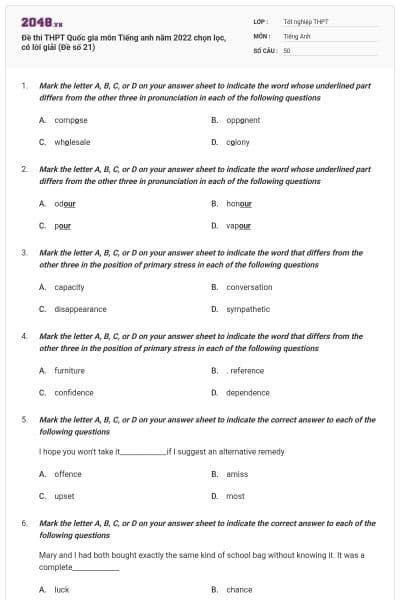
Mark the letter A, B, C, or D on your answer sheet to indicate the word whose underlined part differs from the other three in pronunciation in each of the following questions
compose
opponent
wholesale
colony
Đáp án D
Compose /kəmˈpəʊz/ (v): biên soạn, sáng tác
Opponent /əˈpəʊnənt/ (n): đối thủ
Wholesale /ˈhəʊlseɪl/ (n): sự bán buôn, bán sỉ
Colony /ˈkɒləni/ (n): thuộc địa
Mark the letter A, B, C, or D on your answer sheet to indicate the word whose underlined part differs from the other three in pronunciation in each of the following questions
odour
honour
pour
vapour
Đáp án C
Odour /ˈəʊdə(r)/ (n): mùi
Pour /pɔː(r)/ (v): đổ
Honour /ˈɒnə(r)/ (n): danh dự, vinh dự
Vapour /ˈveɪpə(r)/ (n): hơi, hơi nước
Mark the letter A, B, C, or D on your answer sheet to indicate the word that differs from the other three in the position of primary stress in each of the following questions
capacity
conversation
disappearance
sympathetic
Đáp án A
Capacity /kəˈpæsəti/ (n): sức chức; năng lực, khả năng
Conversation /ˌkɒnvəˈseɪʃn/ (n): cuộc đàm thoại
Disappearance /ˌdɪsəˈpɪərəns/ (n): sự biến mất
Sympathetic /ˌsɪmpəˈθetɪk/ (adj): thông cảm
Mark the letter A, B, C, or D on your answer sheet to indicate the word that differs from the other three in the position of primary stress in each of the following questions
furniture
. reference
confidence
dependence
Đáp án D
Furniture /ˈfɜːnɪtʃə(r)/ (n): đồ đạc
Confidence /ˈkɒnfɪdəns/ (n): sự tự tin
Reference /ˈrefrəns/ (n): tham khảo
Dependence /dɪˈpendəns/ (n): sự phụ thuộc
Mark the letter A, B, C, or D on your answer sheet to indicate the correct answer to each of the following questions
I hope you won't take it_____________if I suggest an alternative remedy
offence
amiss
upset
most
Đáp án B
- take sth amiss: cảm thấv bị xúc nham ívì cóihểdn hiển 1'âml
"Tôi hi vọng bạn sẽ không cảm thấy bị xúc phạm nếu tôi gợi ý một giải pháp thay thế."
Mark the letter A, B, C, or D on your answer sheet to indicate the correct answer to each of the following questions
Mary and I had both bought exactly the same kind of school bag without knowing it. It was a complete_____________
luck
chance
fortune
coincidence
Đáp án D
- coincidence (n): sự trùng hợp ngẫu nhiên (sự việc)
"Cả tôi và Mary đã mua một kiểu cặp sách giống nhau mà không biết về điều đó. Đó hoàn toàn là sự trùng hợp ngẫu nhiên."
Mark the letter A, B, C, or D on your answer sheet to indicate the correct answer to each of the following questions
There was nothing special about his clothes_____________from his flowerv tie
but
except
other
apart
Đáp án D
- apart from ~ except for: ngoại trừ, trừ ra
"Quần áo ông ấy không có gì đặc biệt ngoại trừ chiếc cà vạt hoa."
Mark the letter A, B, C, or D on your answer sheet to indicate the correct answer to each of the following questions
_____________you're late?
Why
What makes
How come
How
Đáp án C
- How come ~ How is it that: được dùng khi muốn hỏi tại sao (Why) hay bằng cách nào (How) mà điều gì đó đã
"Sao bạn đến trễ vậy?"
Mark the letter A, B, C, or D on your answer sheet to indicate the correct answer to each of the following questions
His illness made him_____________of concentration
incompetent
unable
incapable
powerless
Đáp án C
- incompetent (adj): không có năng lực
- unable to do sth: không có khả năng làm gì
- incapable of sth: không có khả năng
- powerless to do sth: hoàn toàn không có khả năng làm gì
"Căn bệnh của anh ấy đã khiến anh ấy không có khả năng tập trung
Mark the letter A, B, C, or D on your answer sheet to indicate the correct answer to each of the following questions
If you are_____________with your goods, contact us within a week of receipt, and we will refund your money in full
not completely satisfied
not completely satisfying
not completely satisfactory
not satisfied completely
Đáp án A
"Nếu bạn không hoàn toàn hài lòng với hàng hóa của mình, hãy liên hệ với chúng tôi trong vòng một tuần kể từ khi nhận hàng, và chúng tôi sẽ hoàn trả đầy đủ tiền cho bạn."
- satisfied with somebody/something: hài lòng với ai đó/ cái gì đó
E.g: She's never satisfied with what she's got.
Mark the letter A, B, C, or D on your answer sheet to indicate the correct answer to each of the following questions
Don’t worry about trying to catch last bus home, as we can easily_____________you up for the night
keep
put
take
set
Đáp án B
- keep somebody up: to prevent somebody from going to bed
- put somebody up: to let somebody stay at your home (cho ai ở trọ tại nhà bạn)
- take up: bắt giữ, tóm; ngắt lời; hiểu;...
- set somebody up: to provide somebody with the money that they need in order to do something, (cung cấp cho ai số tiền họ cần để làm việc gì đó)
"Đừng lo về việc cố gắng bắt chuyến xe buýt cuối cùng về nhà, vì chúng tôi có thể cho bạn ở lại qua đêm."
Mark the letter A, B, C, or D on your answer sheet to indicate the correct answer to each of the following questions
Don’t touch that wire or you’ll get an electric_____________
current
shock
charge
fire
Đáp án B
- electric shock: điện giật
"Đừng chạm vào dây đó hoặc bạn sẽ bị điện giật
Mark the letter A, B, C, or D on your answer sheet to indicate the correct answer to each of the following questions
The total cost to renovate the building was $20 million, _____________double the original estimate
mostly
most all
the most
almost
Đáp án D
- mostly (adv): chủ yếu
- the most: dùng trong cấp so sánh hơn nhất
- almost: (hầu hết, gần như) là một Adverb (trạng từ), nghĩa là nó sẽ bố nghĩa cho động từ, tính từ hoặc một trạng từ khác
"Tổng chi phí để nâng cấp tòa nhà là 20 triệu đô, gần như gấp đôi ước tính ban đầu."
Mark the letter A, B, C, or D on your answer sheet to indicate the correct answer to each of the following questions
I think the_____________thing would be to catch a bus home. I’m tired of walking
sensitive
sensational
sensible
senseless
Đáp án C
- sensitive /ˈsensətɪv/ (adj): nhạy cảm (dễ vui, buồn, giận...)
- sensational /senˈseɪʃənl/ (adj): gây xúc động mạnh, làm náo động, giật gân, tuyệt vời
- sensible /ˈsensəbl/ (adj): khôn ngoan, có lý, biết lẽ phải, hợp lý (thiên về lý trí)
- senseless (adj): bất tỉnh, vô nghĩa
"Tôi nghĩ điều hợp lý là bắt xe buýt về nhà. Tôi chán với việc đi bộ lắm rồi."
Mark the letter A, B, C, or D on your answer sheet to indicate the correct answer to each of the following questions
We have a party tonight and Mary is worried about_____________
what to wear
which wearing
these wearing
that she wearing
Đáp án A
Cấu trúc: từ để hỏi + to V
"Chúng tôi có một bữa tiệc tối nay và Mary đang lo lắng về việc mặc cái gì."
Mark the letter A, B, C, or D on your answer sheet to indicate the correct answer to each of the following questions
My grandfather is getting old and forgetful. _____________, he is experienced.
Be that as it may
Regardless
Inasmuch as it is
Consequently
Đáp án A
- Be that as it may = nevertheless: dù gì đi chăng nữa, tuy nhiên
E.g: I know that he has tried hard; be that as it may, his work is just not good enough.
- Inasmuch as: bởi vì; inasmuch as được dùng trong lối nói và viết trịnh trọng.
E.g: Inasmuch as I'll stay home all day tomorrow, you can stop by my house any time you want
- Regardless of sth: bất kế, bất chấp
- Consequently = As a consequence: vì vậy, vì thế
"Ông tôi đang trở nên già và hay quên. Tuy nhiên, ông có kinh nghiệm."
Mark the letter A, B, C, or D on your answer sheet to indicate the correct answer to each of the following questions
He behaved_____________nothing had happened
therefore
so
if
as though
Đáp án D
- therefore: vì thế, do đó, cho nên
- so: vì thế, vì vậy
- if: nếu
- as though: như thể là
"Anh ấy đã cư xử như chưa có chuyện gì xảy ra
Mark the letter A, B, C, or D on your answer sheet to indicate the correct answer to each of the following questions
After the flood, all the drains were overflowing_____________storm water
with
by
from
for
Đáp án A
- overflow with sth: cháy tràn ra với cái gì, tràn đầy
E.g: Plates overflowed with party food.
"Sau trận lũ, tất cả các cống đã tràn đầy nước lũ."
Mark the letter A, B, C, or D on your answer sheet to indicate the correct answer to each of the following questions
He suffered from depression_____________by overwork and ill-health.
brought on
coming about
taken up
pull through
Đáp án A
- bring sth on: gây ra
E.g: He has brought shame and disgrace on the whole family.
- come about: xảy ra, xảy đến
E.g: How could this come about? (Sao việc đó có thể xảy ra được?)
- take up: bắt đầu làm gì đó vì yêu thích, bắt đầu một sở thích,...
E.g: They've taken up golf.
- pull through: qua khỏi được (cơn ốm); thoát khỏi được; xoay sở được thoát (cảnh khó khăn); làm cho qua khỏi được (cơn ốm, cảnh khó khăn...)
E.g: The doctors think she will pull through. (Các bác sĩ nghĩ rằng cô ấy sẽ qua khỏi.)
He suffered from depression which was brought on by overwork and ill-health. _ He suffered from depression brought on by overwork and ill-health, (rút gọn mệnh đề quan hệ ở bị động)
"Ông ấy chịu sự trầm cảm gây ra bởi làm việc quá sức và bệnh tật."
Mark the letter A, B, C, or D on your answer sheet to indicate the word(s) CLOSEST in meaning to the underlined word(s) in each of the following questions
They decided to tie the knot after they had loved each other for 10 years.
get divorced
get married
break up
fall out
Đáp án B
- tie the knot ~ get married: kết hôn
- get divorced: ly hôn
- break up: chia tay
- fall out: cãi nhau
"Họ đã quyết định kết hôn sau thời gian yêu nhau 10 năm."
Mark the letter A, B, C, or D on your answer sheet to indicate the word(s) CLOSEST in meaning to the underlined word(s) in each of the following questions
These customers grumbled about the food. They didn't seem to be pleased.
talked
complained
thought
bargained
Đáp án B
- grumble (v) ~ complain (v): phàn nàn, càu nhàu
- talk (v): nói chuyện
-think (v): nghĩ
- bargain (v): mặc cả
"Những khách hàng này phàn nàn về thức ăn. Dường như họ không hài hòng."
Mark the letter A, B, C, or D on your answer sheet to indicate the word(s) OPPOSITE in meaning to the underlined word(s) in each of the following questions
Inadequate supply of oxygen to the blood can cause death within minutes.
Sufficient
Nonexistent
Rich
Useful
Đáp án A
- sufficient (adj): đủ
rich (adj): giàu
- nonexistent (adj): not existing; not real: không tồn tại
- useful (adj): có ích
- inadequate (adj): not enough: không đủ, thiếu
"Việc cung cấp không đủ khí oxi cho máu có thể gây ra cái chết trong vòng vài phút."
Do đó: inadequate # sufficient
Mark the letter A, B, C, or D on your answer sheet to indicate the word(s) OPPOSITE in meaning to the underlined word(s) in each of the following questions
There are several different kinds of faults in reading which are usually more exaggerated with foreign learners
overestimated
understated
overemphasized
undertaken
Đáp án B
- exaggerated /ɪɡˈzædʒəreɪtɪd/ (adj): cường điệu hóa, phóng đại
- overestimated /ˌəʊvərˈestɪmeɪtɪd/ (adj): đánh giá quá cao
- understated /ˌʌndəˈsteɪtɪd/ (adj): nói giảm đi, nói bớt
- overemphasized /ˌəʊvərˈemfəsaɪzd/ (adj): quá nhấn mạnh
Do đó: exaggerated # understated
"Có một vài lỗi khác nhau trong việc đọc mà thường xuyên phóng đại hơn với người nước ngoài."
Mark the letter A, B, C, or D on your answer sheet to indicate the option that best completes each of the following exchanges
David:" _____________". - John: "Thanks. I'm glad to hear that".
Where did you buy your bike?
Your bike is new, isn't it?
What a nice bike you have!
My bike is very expensive
Đáp án C
David: "Cậu có chiếc xe đạp đẹp quá!" - John: "Cám ơn cậu. Tớ rất vui khi cậu nói vậy."
A. Cậu đã mua xe đạp khi nào?
B. Xe đạp của cậu mới, phải không?
D. Xe đạp của tớ rất đắt.
Mark the letter A, B, C, or D on your answer sheet to indicate the option that best completes each of the following exchanges
Tim: "Do you need any help? - Jenifer:" _____________"
How can I help you?
No, thanks. I'm fine
Let me help you
I'm sorry
Đáp án B
Tim: "Cậu có cần giúp đỡ không?" - Jenifer: "Không, cám ơn cậu. Tớ ổn."
A. Tớ có thể giúp cậu như thế nào?
C. Để tớ giúp cậu.
D. Tớ xin lỗi
Read the following passage and mark the letter A, B, C, or D on your answer sheet to indicate the correct word or phrase that best fits each of the numbered blanks from 26 to 30.
Sailing tourism (26) _____________to any holiday where the main purpose of the trip is to sail or learn how to sail. Sailing tourism has two broad (27) _____________, which are defined by the type of boat used: a yacht (which is also used as overnight accommodation) or a dinghy (a smaller boat without berths - therefore overnight accommodation is (28) _____________land).
Yacht sailing holidays tend to be either bareboat charters, where the boat is hired - without crew - and can be sailed to any chosen destination, or flotilla, where all boats in the flotilla follow a pre-planned route. Dinghy sailing holidays are most (29) _____________to be combined (30) _____________a sailing course. As with most niche markets, there are scant data available regarding the sailing tourism sector. However, it is estimated that around 10 million sailing holidays are taken each year
denotes
means
indicates
refers
Đáp án D
- refer to: đề cập đến
Read the following passage and mark the letter A, B, C, or D on your answer sheet to indicate the correct word or phrase that best fits each of the numbered blanks from 26 to 30.
Sailing tourism (26) _____________to any holiday where the main purpose of the trip is to sail or learn how to sail. Sailing tourism has two broad (27) _____________, which are defined by the type of boat used: a yacht (which is also used as overnight accommodation) or a dinghy (a smaller boat without berths - therefore overnight accommodation is (28) _____________land).
Yacht sailing holidays tend to be either bareboat charters, where the boat is hired - without crew - and can be sailed to any chosen destination, or flotilla, where all boats in the flotilla follow a pre-planned route. Dinghy sailing holidays are most (29) _____________to be combined (30) _____________a sailing course. As with most niche markets, there are scant data available regarding the sailing tourism sector. However, it is estimated that around 10 million sailing holidays are taken each year
categories
ranks
levels
orders
Đáp án A
- broad categories (collocation)~ a class or type of things or people: loại, lớp, nhóm
Read the following passage and mark the letter A, B, C, or D on your answer sheet to indicate the correct word or phrase that best fits each of the numbered blanks from 26 to 30.
Sailing tourism (26) _____________to any holiday where the main purpose of the trip is to sail or learn how to sail. Sailing tourism has two broad (27) _____________, which are defined by the type of boat used: a yacht (which is also used as overnight accommodation) or a dinghy (a smaller boat without berths - therefore overnight accommodation is (28) _____________land).
Yacht sailing holidays tend to be either bareboat charters, where the boat is hired - without crew - and can be sailed to any chosen destination, or flotilla, where all boats in the flotilla follow a pre-planned route. Dinghy sailing holidays are most (29) _____________to be combined (30) _____________a sailing course. As with most niche markets, there are scant data available regarding the sailing tourism sector. However, it is estimated that around 10 million sailing holidays are taken each year
under
in
at
on
Đáp án D
- on land: trên đất liền
Read the following passage and mark the letter A, B, C, or D on your answer sheet to indicate the correct word or phrase that best fits each of the numbered blanks from 26 to 30.
Sailing tourism (26) _____________to any holiday where the main purpose of the trip is to sail or learn how to sail. Sailing tourism has two broad (27) _____________, which are defined by the type of boat used: a yacht (which is also used as overnight accommodation) or a dinghy (a smaller boat without berths - therefore overnight accommodation is (28) _____________land).
Yacht sailing holidays tend to be either bareboat charters, where the boat is hired - without crew - and can be sailed to any chosen destination, or flotilla, where all boats in the flotilla follow a pre-planned route. Dinghy sailing holidays are most (29) _____________to be combined (30) _____________a sailing course. As with most niche markets, there are scant data available regarding the sailing tourism sector. However, it is estimated that around 10 million sailing holidays are taken each year
unlike
unlikely
likely
like
Đáp án C
- likely ~ probably (adj): có khả năng, có thể
- unlikely (adj): không có khả năng, không thế
"Dinghy sailing holidays are most likely to be combined with a sailing course." (Kì nghỉ chèo xuồng nhỏ rất có thể được kết hợp với một khóa học chèo thuyền.)
Read the following passage and mark the letter A, B, C, or D on your answer sheet to indicate the correct word or phrase that best fits each of the numbered blanks from 26 to 30.
Sailing tourism (26) _____________to any holiday where the main purpose of the trip is to sail or learn how to sail. Sailing tourism has two broad (27) _____________, which are defined by the type of boat used: a yacht (which is also used as overnight accommodation) or a dinghy (a smaller boat without berths - therefore overnight accommodation is (28) _____________land).
Yacht sailing holidays tend to be either bareboat charters, where the boat is hired - without crew - and can be sailed to any chosen destination, or flotilla, where all boats in the flotilla follow a pre-planned route. Dinghy sailing holidays are most (29) _____________to be combined (30) _____________a sailing course. As with most niche markets, there are scant data available regarding the sailing tourism sector. However, it is estimated that around 10 million sailing holidays are taken each year.
with
from
to
by
Đáp án A
- combine with ~ join together: kết hợp với
Read the following passage and mark the letter A, B, C, or D on your answer sheet to indicate the correct answer to each of the questions from 31 to 35.
I did a business administration degree at Bristol University and then worked for a credit card company for eight years. During this time, I was assistant marketing manager. I gained a lot of useful experience doing this job, but in 1997,1 decided that I needed a change. I moved to Thomson Holidays where I have worked as a manager ever since. My main job is to think up new and interesting ideas for holidays.
When I'm working from my office in the UK, I arrive at 9 a.m. First I answer my emails, then plan the day. My role is to investigate new projects for Thomson Holidays in our Mediterranean resorts. I am responsible for coming up with ideas, developing them and evaluating their success.
We have lots of meetings in the office which involve the marketing department, holiday reps and people that we bring in from outside such as entertainment organizers. The aim is to develop an exciting idea into a realistic and workable project.
Once a month I spend a few days overseas checking possible resorts, meeting with reps to develop their roles and working out how events should be sold to the customer. I work with resort supervisors, use their local knowledge of bars and clubs for venues, talk through new ideas and find out how existing ones are working. I also meet holidaymakers.
I have to be very open-minded because ideas come from anywhere. I love my job because I get to travel and I am working on a project that everyone loves.
What is the writer's main purpose in writing the text?
To explain the best way to choose a holiday
To advise people on holiday resorts
To explain what her job involves
To show how stressful her job is
Đáp án C
Mục đích chính của tác giả khi viết bài viết là gì?
A. Để giải thích cách tốt nhất để lựa chọn một kì nghỉ.
B. Để tư vấn cho mọi người về các khu nghỉ mát.
C. Để giải thích những gì liên quan đến công việc của cô ây.
D. Để cho thấy công việc của cô ấy căng thẳng như thế nào.
Thông tin trong bài: "I did a business administration degree at Bristol University and then worked for a credit card company for eight years."
- "When I’m working from my office in the UK, I arrive at 9 a.m. First I answer my emails, then plan the day."
- "We have lots of meetings in the office which involve the marketing department."
Read the following passage and mark the letter A, B, C, or D on your answer sheet to indicate the correct answer to each of the questions from 31 to 35.
I did a business administration degree at Bristol University and then worked for a credit card company for eight years. During this time, I was assistant marketing manager. I gained a lot of useful experience doing this job, but in 1997,1 decided that I needed a change. I moved to Thomson Holidays where I have worked as a manager ever since. My main job is to think up new and interesting ideas for holidays.
When I'm working from my office in the UK, I arrive at 9 a.m. First I answer my emails, then plan the day. My role is to investigate new projects for Thomson Holidays in our Mediterranean resorts. I am responsible for coming up with ideas, developing them and evaluating their success.
We have lots of meetings in the office which involve the marketing department, holiday reps and people that we bring in from outside such as entertainment organizers. The aim is to develop an exciting idea into a realistic and workable project.
Once a month I spend a few days overseas checking possible resorts, meeting with reps to develop their roles and working out how events should be sold to the customer. I work with resort supervisors, use their local knowledge of bars and clubs for venues, talk through new ideas and find out how existing ones are working. I also meet holidaymakers.
I have to be very open-minded because ideas come from anywhere. I love my job because I get to travel and I am working on a project that everyone loves.
What do we learn about the writer in the first paragraph?
She learned a lot from her first job
She disliked her first job
She lost her first job
She worked in the administration department of Bristol University
Đáp án A
Qua đoạn đầu chúng ta biết được gì về tác giả?
A. Cô ây đã học được rất nhiều điều từ công việc đầu tiên của mình.
B. Cô ấy không thích công việc đầu tiên của mình.
C. Cô ấy bị mất công việc đầu tiên.
D. Cô ấy đã làm việc trong bộ phận quản trị của Đại học Bristol.
Thông tin trong bài: "During this time, I was assistant marketing manager. I gained a lot of useful experience doing this job, but in 1997,1 decided that I needed a change." (Trong suốt thời gian này, tôi là trợ lý giám đốc tiếp thị. Tôi đã có được rất nhiều kinh nghiệm hữu ích khi làm công việc này, nhưng vào năm 1997, tôi quyết định rẳng mình cần phải thay đổi.)
Read the following passage and mark the letter A, B, C, or D on your answer sheet to indicate the correct answer to each of the questions from 31 to 35.
I did a business administration degree at Bristol University and then worked for a credit card company for eight years. During this time, I was assistant marketing manager. I gained a lot of useful experience doing this job, but in 1997,1 decided that I needed a change. I moved to Thomson Holidays where I have worked as a manager ever since. My main job is to think up new and interesting ideas for holidays.
When I'm working from my office in the UK, I arrive at 9 a.m. First I answer my emails, then plan the day. My role is to investigate new projects for Thomson Holidays in our Mediterranean resorts. I am responsible for coming up with ideas, developing them and evaluating their success.
We have lots of meetings in the office which involve the marketing department, holiday reps and people that we bring in from outside such as entertainment organizers. The aim is to develop an exciting idea into a realistic and workable project.
Once a month I spend a few days overseas checking possible resorts, meeting with reps to develop their roles and working out how events should be sold to the customer. I work with resort supervisors, use their local knowledge of bars and clubs for venues, talk through new ideas and find out how existing ones are working. I also meet holidaymakers.
I have to be very open-minded because ideas come from anywhere. I love my job because I get to travel and I am working on a project that everyone loves.
The writer has to_____________.
send emails all day
find out if new ideas could actually work
entertain the holiday reps
spend all of her time having meetings in the office
Đáp án B
Người viết phải______________.
A. gửi email cả ngày
B. tìm hiểu xem những ý tưởng mới có thực sự hiệu quả hay không
C. tiếp đãi những người chăm sóc kì nghỉ của khách hàng
D. dành toàn bộ thời gian để họp ở cơ quan
Thông tin trong bài: "I work with resort supervisors, use their local knowledge of bars and clubs for venues, talk through new ideas and find out how existing ones are working." (Tôi làm việc với những người giám sất khu nghỉ dưỡng, sử dụng kiến thức địa phương của họ về các quán bar và câu lạc bộ cho các địa điểm, nói chuyện thông qua các ý tưởng mới và tìm hiểu xem những ý tưởng hiện có hiệu quả như thế nào.)
Read the following passage and mark the letter A, B, C, or D on your answer sheet to indicate the correct answer to each of the questions from 31 to 35.
I did a business administration degree at Bristol University and then worked for a credit card company for eight years. During this time, I was assistant marketing manager. I gained a lot of useful experience doing this job, but in 1997,1 decided that I needed a change. I moved to Thomson Holidays where I have worked as a manager ever since. My main job is to think up new and interesting ideas for holidays.
When I'm working from my office in the UK, I arrive at 9 a.m. First I answer my emails, then plan the day. My role is to investigate new projects for Thomson Holidays in our Mediterranean resorts. I am responsible for coming up with ideas, developing them and evaluating their success.
We have lots of meetings in the office which involve the marketing department, holiday reps and people that we bring in from outside such as entertainment organizers. The aim is to develop an exciting idea into a realistic and workable project.
Once a month I spend a few days overseas checking possible resorts, meeting with reps to develop their roles and working out how events should be sold to the customer. I work with resort supervisors, use their local knowledge of bars and clubs for venues, talk through new ideas and find out how existing ones are working. I also meet holidaymakers.
I have to be very open-minded because ideas come from anywhere. I love my job because I get to travel and I am working on a project that everyone loves.
What does she say about her job?
She never knows where or how a new idea might come to her
It makes her very popular with lots of people
She spends too much time in bars and clubs
She has a few problems with local people at the resorts
Đáp án A
Cô ấy nói gì về công việc của mình?
A. Cô ấy không bao giờ biết một ý tưởng mới có thể đến với mình ở đâu hoặc bằng cách nào.
B. Nó làm cho cô ấy rất nổi tiếng với rất nhiều người.
C. Cô ấy dành quá nhiều thời gian trong quán bar và câu lạc bộ.
D. Cô ấy có một vài vấn đề với người dân địa phương tại các khu nghỉ dưỡng.
Thông tin trong bài: “I have to be very open-minded because ideas come from anywhere."
(Tôi sẵn sàng tiếp thu những điều mới vì ý tưởng đến với mình từ bất cứ đâu.)
Read the following passage and mark the letter A, B, C, or D on your answer sheet to indicate the correct answer to each of the questions from 31 to 35.
I did a business administration degree at Bristol University and then worked for a credit card company for eight years. During this time, I was assistant marketing manager. I gained a lot of useful experience doing this job, but in 1997,1 decided that I needed a change. I moved to Thomson Holidays where I have worked as a manager ever since. My main job is to think up new and interesting ideas for holidays.
When I'm working from my office in the UK, I arrive at 9 a.m. First I answer my emails, then plan the day. My role is to investigate new projects for Thomson Holidays in our Mediterranean resorts. I am responsible for coming up with ideas, developing them and evaluating their success.
We have lots of meetings in the office which involve the marketing department, holiday reps and people that we bring in from outside such as entertainment organizers. The aim is to develop an exciting idea into a realistic and workable project.
Once a month I spend a few days overseas checking possible resorts, meeting with reps to develop their roles and working out how events should be sold to the customer. I work with resort supervisors, use their local knowledge of bars and clubs for venues, talk through new ideas and find out how existing ones are working. I also meet holidaymakers.
I have to be very open-minded because ideas come from anywhere. I love my job because I get to travel and I am working on a project that everyone loves.
Which of the following is the best description of the writer?
A working woman
The travel agent who is trying to get a promotion
A woman who spends a lot of time on holiday and has an easy life
A woman who makes a lot of money by going to clubs and bars
Đáp án A
Cách miêu tả nào sau đây về tác giả là hợp lý nhất?
A. Một phụ nữ công việc.
B. Một người đại lý du lịch đang cố gắng để được thăng tiến.
C. Một người phụ nữ dành nhiều thời gian đi nghỉ và có một cuộc sống dễ dàng.
D. Một phụ nữ kiếm được nhiều tiền bằng cách đến các câu lạc bộ và quán bar.
Read the following passage and mark the letter A, B, C, or D on your answer sheet to indicate the correct answer to each of the questions from 36 to 42.
Newspaper publishers in the United States have long been enthusiastic users and distributors of weather maps. Although some newspapers that had carried the United States Weather Bureau's national weather map in 1912 dropped it once the novelty had passed, many continued to print the daily weather chart provided by their local forecasting office. In the 1930's, when interest in aviation and progress in air-mass analysis made weather patterns more newsworthy, additional newspapers started or resumed the daily weather map. In 1935, The Associated Press (AP) news service inaugurated its WirePhoto network and offered subscribing newspapers morning and afternoon weather maps redrafted by the AP's Washington, B.C., office from charts provided by the government agency. Another news service, United Press International (UPI), developed a competing photowire network and also provided timely weather maps for both morning and afternoon newspapers. After the United States government launched a series of weather satellites in 1966, both the AP and UPI offered cloud-cover photos obtained from the Weather Bureau.
In the late 1970’s and early 1980's, the weather map became an essential ingredient in the redesign of the American newspaper. News publishers, threatened by increased competition from television for readers' attention, sought to package the news more conveniently and attractively. In 1982, many publishers felt threatened by the new USA Today, a national daily newspaper that used a page-wide full-color weather map as its key design element. That the weather map in USA today did not include information about weather fronts and pressures attests to the largely symbolic role it played. Nonetheless, competing local and metropolitan newspapers responded in a variety of ways. Most substituted full-color temperature maps for the standard weather maps, while others dropped the comparatively drab satellite photos or added regional forecast maps with pictorial symbols to indicate rainy, snowy, cloudy, or clear conditions. A few newspapers, notably The New York Times, adopted a highly informative yet less visually prominent weather map that was specially designed to explain an important recent or imminent weather event. Ironically, a newspaper's richest, most instructive weather maps often are comparatively small and inconspicuous
What does the passage mainly discuss?
The differences between government and newspaper weather forecasting in the United States
The history of publishing weather maps in United States newspapers
A comparison of regional and national weather reporting in the United States
Information that forms the basis for weather forecasting in the United States
Đáp án B
Bài đọc chủ yếu thảo luận về điều gì?
A. Sự khác nhau giữa dự báo thời tiết của chính phủ và báo chí ở nước Mỹ
B. Lịch sử của việc xuất bản bản đồ thời tiết trong ngành báo chí Mỹ
C. Một sự so sánh giữa bản tin thời tiết của quốc gia và vùng miền ở nước Mỹ
D. Thông tin hình hành nền tảng cho dự báo thời tiết ở nước Mỹ
Thông tin trong bài: "Although some newspapers that had carried the United States Weather Bureau's national weather map in 1912 dropped it once the novelty had passed, many continued to print the daily weather chart provided by their local forecasting office." (Mặc dù một vài tờ báo mà in bản đồ thời tiết quốc gia của cục thời tiết Mỹ vào năm 1912 đã bỏ nó một khi nó không còn gì mới lạ thì nhiều hãng vẫn tiếp tục in bản đồ thời tiết do cơ quan dự báo thời tiết địa phương của họ cung cấp.)
- "In 1982, many publishers felt threatened by the new USA Today, a national daily newspaper that used a page-wide full-color weather map as its key design element." (Vào năm 1982, nhiều nhà xuất bản đã cảm thấy mối đe dọa từ USA Today - tờ báo hàng ngày của quốc gia mà sử dụng một loại bản đồ thời tiết rộng 1 trang giấy với đầy đủ các màu như là yếu tố chính trong thiết kế của họ.)
Read the following passage and mark the letter A, B, C, or D on your answer sheet to indicate the correct answer to each of the questions from 36 to 42.
Newspaper publishers in the United States have long been enthusiastic users and distributors of weather maps. Although some newspapers that had carried the United States Weather Bureau's national weather map in 1912 dropped it once the novelty had passed, many continued to print the daily weather chart provided by their local forecasting office. In the 1930's, when interest in aviation and progress in air-mass analysis made weather patterns more newsworthy, additional newspapers started or resumed the daily weather map. In 1935, The Associated Press (AP) news service inaugurated its WirePhoto network and offered subscribing newspapers morning and afternoon weather maps redrafted by the AP's Washington, B.C., office from charts provided by the government agency. Another news service, United Press International (UPI), developed a competing photowire network and also provided timely weather maps for both morning and afternoon newspapers. After the United States government launched a series of weather satellites in 1966, both the AP and UPI offered cloud-cover photos obtained from the Weather Bureau.
In the late 1970’s and early 1980's, the weather map became an essential ingredient in the redesign of the American newspaper. News publishers, threatened by increased competition from television for readers' attention, sought to package the news more conveniently and attractively. In 1982, many publishers felt threatened by the new USA Today, a national daily newspaper that used a page-wide full-color weather map as its key design element. That the weather map in USA today did not include information about weather fronts and pressures attests to the largely symbolic role it played. Nonetheless, competing local and metropolitan newspapers responded in a variety of ways. Most substituted full-color temperature maps for the standard weather maps, while others dropped the comparatively drab satellite photos or added regional forecast maps with pictorial symbols to indicate rainy, snowy, cloudy, or clear conditions. A few newspapers, notably The New York Times, adopted a highly informative yet less visually prominent weather map that was specially designed to explain an important recent or imminent weather event. Ironically, a newspaper's richest, most instructive weather maps often are comparatively small and inconspicuous
The word "resumed" in the passage is closest in meaning to_____________
began again
held back
thought over
referred to
Đáp án A
Từ "resumed" trong bài đọc gần nghĩa nhất với từ_______________.
A. bắt đầu lại
B. giữ lại, ngăn lại
C. nghĩ kĩ, cân nhắc cẩn thận
D. đề cập đến, nhắc đến
"In the 1930's, when interest in aviation and progress in air-mass analysis made weather patterns more newsworthy, additional newspapers started or resumed the daily weather map." (Vào những năm 1930, khi mối quan tâm đến lĩnh vực hàng không và tiến bộ trong việc phân tích khối không khí đã khiến các kiểu thời tiết đáng đăng báo hơn, có thêm một số tờ báo đã bắt đầu hoặc bắt đầu lại việc in bản đồ thời tiết hàng ngày.)
Do đó: resumed ~ began again
Read the following passage and mark the letter A, B, C, or D on your answer sheet to indicate the correct answer to each of the questions from 36 to 42.
Newspaper publishers in the United States have long been enthusiastic users and distributors of weather maps. Although some newspapers that had carried the United States Weather Bureau's national weather map in 1912 dropped it once the novelty had passed, many continued to print the daily weather chart provided by their local forecasting office. In the 1930's, when interest in aviation and progress in air-mass analysis made weather patterns more newsworthy, additional newspapers started or resumed the daily weather map. In 1935, The Associated Press (AP) news service inaugurated its WirePhoto network and offered subscribing newspapers morning and afternoon weather maps redrafted by the AP's Washington, B.C., office from charts provided by the government agency. Another news service, United Press International (UPI), developed a competing photowire network and also provided timely weather maps for both morning and afternoon newspapers. After the United States government launched a series of weather satellites in 1966, both the AP and UPI offered cloud-cover photos obtained from the Weather Bureau.
In the late 1970’s and early 1980's, the weather map became an essential ingredient in the redesign of the American newspaper. News publishers, threatened by increased competition from television for readers' attention, sought to package the news more conveniently and attractively. In 1982, many publishers felt threatened by the new USA Today, a national daily newspaper that used a page-wide full-color weather map as its key design element. That the weather map in USA today did not include information about weather fronts and pressures attests to the largely symbolic role it played. Nonetheless, competing local and metropolitan newspapers responded in a variety of ways. Most substituted full-color temperature maps for the standard weather maps, while others dropped the comparatively drab satellite photos or added regional forecast maps with pictorial symbols to indicate rainy, snowy, cloudy, or clear conditions. A few newspapers, notably The New York Times, adopted a highly informative yet less visually prominent weather map that was specially designed to explain an important recent or imminent weather event. Ironically, a newspaper's richest, most instructive weather maps often are comparatively small and inconspicuous
According to the passage, one important reason why newspapers printed daily weather maps during the first half of the twentieth century was _____________.
the progress in printing technology
a growing interest in air transportation
a change in atmospheric conditions
the improvement of weather forecasting techniques
Đáp án B
Theo bài đọc, một lý do quan trọng cho việc báo chí in bản đồ thời tiết hàng ngày suốt nửa đầu thế kỉ 20 là________________.
A. sự tiến bộ trong công nghệ in
B. mối quan tâm lớn đến vận tải hàng không
C. sự thay đổi về điều kiện không khí
D. sự cải thiện về các kĩ thuật dự báo thời tiết
Thông tin trong bài: "In the 1930's, when interest in aviation and progress in air-mass analysis made weather patterns more newsworthy, additional newspapers started or resumed the daily weather map." (Vào những năm 1930, khi mối quan tâm đến lĩnh vực hàng không và tiến bộ trong việc phân tích khối không khí đã khiến các kiểu thời tiết đáng đăng báo hơn, có thêm một số tờ báo đã bắt đầu hoặc bắt đầu lại việc in bản đồ thời tiết hàng ngày.)
Read the following passage and mark the letter A, B, C, or D on your answer sheet to indicate the correct answer to each of the questions from 36 to 42.
Newspaper publishers in the United States have long been enthusiastic users and distributors of weather maps. Although some newspapers that had carried the United States Weather Bureau's national weather map in 1912 dropped it once the novelty had passed, many continued to print the daily weather chart provided by their local forecasting office. In the 1930's, when interest in aviation and progress in air-mass analysis made weather patterns more newsworthy, additional newspapers started or resumed the daily weather map. In 1935, The Associated Press (AP) news service inaugurated its WirePhoto network and offered subscribing newspapers morning and afternoon weather maps redrafted by the AP's Washington, B.C., office from charts provided by the government agency. Another news service, United Press International (UPI), developed a competing photowire network and also provided timely weather maps for both morning and afternoon newspapers. After the United States government launched a series of weather satellites in 1966, both the AP and UPI offered cloud-cover photos obtained from the Weather Bureau.
In the late 1970’s and early 1980's, the weather map became an essential ingredient in the redesign of the American newspaper. News publishers, threatened by increased competition from television for readers' attention, sought to package the news more conveniently and attractively. In 1982, many publishers felt threatened by the new USA Today, a national daily newspaper that used a page-wide full-color weather map as its key design element. That the weather map in USA today did not include information about weather fronts and pressures attests to the largely symbolic role it played. Nonetheless, competing local and metropolitan newspapers responded in a variety of ways. Most substituted full-color temperature maps for the standard weather maps, while others dropped the comparatively drab satellite photos or added regional forecast maps with pictorial symbols to indicate rainy, snowy, cloudy, or clear conditions. A few newspapers, notably The New York Times, adopted a highly informative yet less visually prominent weather map that was specially designed to explain an important recent or imminent weather event. Ironically, a newspaper's richest, most instructive weather maps often are comparatively small and inconspicuous
The phrase "attests to" in the passage is closest in meaning to_____________.
makes up for
combines with
interferes with
gives evidence of
Đáp án D
Cụm từ "attests to" trong bài đọc gần nghĩa nhất với___________
A. đền bù cho
B. kết hợp với
C. can thiệp, quấy rầy
D. làm chứng, chứng tỏ
"That the weather map in USA today did not include information about weather fronts and pressures attests to the largely symbolic role it played.” (Việc bản đồ thời tiết của tờ USA today không bao gồm thông tin về các phương diện thời tiết và áp suất đã chứng tỏ vai trò mang tính tượng trưng to lớn mà tờ báo này giữ.)
Do đó: attests to ~ gives evidence of
Read the following passage and mark the letter A, B, C, or D on your answer sheet to indicate the correct answer to each of the questions from 36 to 42.
Newspaper publishers in the United States have long been enthusiastic users and distributors of weather maps. Although some newspapers that had carried the United States Weather Bureau's national weather map in 1912 dropped it once the novelty had passed, many continued to print the daily weather chart provided by their local forecasting office. In the 1930's, when interest in aviation and progress in air-mass analysis made weather patterns more newsworthy, additional newspapers started or resumed the daily weather map. In 1935, The Associated Press (AP) news service inaugurated its WirePhoto network and offered subscribing newspapers morning and afternoon weather maps redrafted by the AP's Washington, B.C., office from charts provided by the government agency. Another news service, United Press International (UPI), developed a competing photowire network and also provided timely weather maps for both morning and afternoon newspapers. After the United States government launched a series of weather satellites in 1966, both the AP and UPI offered cloud-cover photos obtained from the Weather Bureau.
In the late 1970’s and early 1980's, the weather map became an essential ingredient in the redesign of the American newspaper. News publishers, threatened by increased competition from television for readers' attention, sought to package the news more conveniently and attractively. In 1982, many publishers felt threatened by the new USA Today, a national daily newspaper that used a page-wide full-color weather map as its key design element. That the weather map in USA today did not include information about weather fronts and pressures attests to the largely symbolic role it played. Nonetheless, competing local and metropolitan newspapers responded in a variety of ways. Most substituted full-color temperature maps for the standard weather maps, while others dropped the comparatively drab satellite photos or added regional forecast maps with pictorial symbols to indicate rainy, snowy, cloudy, or clear conditions. A few newspapers, notably The New York Times, adopted a highly informative yet less visually prominent weather map that was specially designed to explain an important recent or imminent weather event. Ironically, a newspaper's richest, most instructive weather maps often are comparatively small and inconspicuous
The word "others” in the passage refers to_____________
newspapers
ways
temperature maps
weather maps
Đáp án A
Từ "others" trong bài đọc đề cập đến_______________.
A. tờ báo
B. cách thức
C. bản đồ nhiệt độ
D. bản đồ thời tiết
"Nonetheless, competing local and metropolitan newspapers responded in a variety of ways. Most substituted full-color temperature maps for the standard weather maps, while others dropped the comparatively drab satellite photos or added regional forecast maps with pictorial symbols to indicate rainy, snowy, cloudy, or clear conditions" (Tuy nhiên, báo địa phương và đô thị cạnh tranh đã phản ứng lại theo nhiều cách khác nhau. Hầu hết đều thay thế các bản đồ thời tiết bình thường bằng bản đồ nhiệt độ đầy đủ màu sắc trong khi các báo khác bỏ những bức ảnh chụp từ vệ tinh tương đối buồn tẻ hoặc in thêm bản đồ dự báo khu vực với các biểu tượng hình ảnh để chỉ ra là mưa, tuyết, mây hay quang đãng)
Do đó: others = newspapers
Read the following passage and mark the letter A, B, C, or D on your answer sheet to indicate the correct answer to each of the questions from 36 to 42.
Newspaper publishers in the United States have long been enthusiastic users and distributors of weather maps. Although some newspapers that had carried the United States Weather Bureau's national weather map in 1912 dropped it once the novelty had passed, many continued to print the daily weather chart provided by their local forecasting office. In the 1930's, when interest in aviation and progress in air-mass analysis made weather patterns more newsworthy, additional newspapers started or resumed the daily weather map. In 1935, The Associated Press (AP) news service inaugurated its WirePhoto network and offered subscribing newspapers morning and afternoon weather maps redrafted by the AP's Washington, B.C., office from charts provided by the government agency. Another news service, United Press International (UPI), developed a competing photowire network and also provided timely weather maps for both morning and afternoon newspapers. After the United States government launched a series of weather satellites in 1966, both the AP and UPI offered cloud-cover photos obtained from the Weather Bureau.
In the late 1970’s and early 1980's, the weather map became an essential ingredient in the redesign of the American newspaper. News publishers, threatened by increased competition from television for readers' attention, sought to package the news more conveniently and attractively. In 1982, many publishers felt threatened by the new USA Today, a national daily newspaper that used a page-wide full-color weather map as its key design element. That the weather map in USA today did not include information about weather fronts and pressures attests to the largely symbolic role it played. Nonetheless, competing local and metropolitan newspapers responded in a variety of ways. Most substituted full-color temperature maps for the standard weather maps, while others dropped the comparatively drab satellite photos or added regional forecast maps with pictorial symbols to indicate rainy, snowy, cloudy, or clear conditions. A few newspapers, notably The New York Times, adopted a highly informative yet less visually prominent weather map that was specially designed to explain an important recent or imminent weather event. Ironically, a newspaper's richest, most instructive weather maps often are comparatively small and inconspicuous
In contrast to the weather maps of USA Today, weather maps in The New York Times tended to be_____________.
printed in foil color
included for symbolic reasons
easily understood by the readers
filled with detailed information
Đáp án D
Trái với bản đồ thời tiết của tờ USA Today thì bản đồ thời tiết ở tờ New York Times có khuynh hướng_______________.
A. in bằng màu lá
B. được bao gồm vì lý do tượng trưng
C. dễ hiểu bởi độc giả
D. đầy đủ thông tin chi tiết
Thông tin trong bài: "A few newspapers, notably The New York Times, adopted a highly informative yet less visually prominent weather map that was specially designed to explain an important recent or imminent weather event." (Một vài tờ báo, nổi bật là tờ New York Times, đã đưa ra bản đồ thời tiết mang tính thông tin cao nhưng kém bắt mắt hơn, được thiết kế đặc biệt đế giải thích một sự kiện thời tiết quan trọng gần đằy hoặc sắp xảy ra.)
Read the following passage and mark the letter A, B, C, or D on your answer sheet to indicate the correct answer to each of the questions from 36 to 42.
Newspaper publishers in the United States have long been enthusiastic users and distributors of weather maps. Although some newspapers that had carried the United States Weather Bureau's national weather map in 1912 dropped it once the novelty had passed, many continued to print the daily weather chart provided by their local forecasting office. In the 1930's, when interest in aviation and progress in air-mass analysis made weather patterns more newsworthy, additional newspapers started or resumed the daily weather map. In 1935, The Associated Press (AP) news service inaugurated its WirePhoto network and offered subscribing newspapers morning and afternoon weather maps redrafted by the AP's Washington, B.C., office from charts provided by the government agency. Another news service, United Press International (UPI), developed a competing photowire network and also provided timely weather maps for both morning and afternoon newspapers. After the United States government launched a series of weather satellites in 1966, both the AP and UPI offered cloud-cover photos obtained from the Weather Bureau.
In the late 1970’s and early 1980's, the weather map became an essential ingredient in the redesign of the American newspaper. News publishers, threatened by increased competition from television for readers' attention, sought to package the news more conveniently and attractively. In 1982, many publishers felt threatened by the new USA Today, a national daily newspaper that used a page-wide full-color weather map as its key design element. That the weather map in USA today did not include information about weather fronts and pressures attests to the largely symbolic role it played. Nonetheless, competing local and metropolitan newspapers responded in a variety of ways. Most substituted full-color temperature maps for the standard weather maps, while others dropped the comparatively drab satellite photos or added regional forecast maps with pictorial symbols to indicate rainy, snowy, cloudy, or clear conditions. A few newspapers, notably The New York Times, adopted a highly informative yet less visually prominent weather map that was specially designed to explain an important recent or imminent weather event. Ironically, a newspaper's richest, most instructive weather maps often are comparatively small and inconspicuous
The author uses the term "Ironically” in the passage to indicate that a weather map's appearance_____________.
is not important to newspaper publishers
does not always indicate how much information it provides
reflects how informative a newspaper can be
often can improve newspaper sales
Đáp án B
Tác giả sử dụng thuật ngữ "Ironically" trong bài đọc để chỉ ra rằng sự xuất hiện của bản đồ thời tiết______________.
A. không quan trọng đối với các nhà xuất bản báo
B. không luôn luôn chỉ ra bao nhiêu thông tin mà tờ báo đó cung cấp
C. phản ánh việc tờ báo có thể cung cấp nhiều thông tin như thế nào
D. thường có thể cải thiện việc bán báo
"A few newspapers, notably The New York Times, adopted a highly informative yet less visually prominent weather map that was specially designed to explain an important recent or imminent weather event. Ironically, a newspaper's richest, most instructive weather maps often are comparatively small and inconspicuous. (Một vài tờ báo, nổi bật là tờ New York Times, đã đưa ra bản đồ thời tiết mang tính thông tin cao nhưng kém bắt mắt hơn, được thiết kế đặc biệt để giải thích một sự kiện thời tiết quan trọng gần đây hoặc sắp xảy ra. Trớ trêu thay, bản đồ thời tiết cung cấp nhiều thông tin nhất của các tờ báo thường tương đối nhỏ và không đáng chú ý.)
Mark the letter A, B, C, or D on your answer sheet to indicate the underlined part that needs correction in each of the following questions
You (A) are (B) quite so thin that you (C) can slip (D) between the bars.
are
quite so
can slip
between
Đáp án B (quite so so)
Cấu trúc: S + be + so + adj + that clause (quá... đến nỗi mà)
Mark the letter A, B, C, or D on your answer sheet to indicate the underlined part that needs correction in each of the following questions.
(A) Hardly he had arrived (B) at the airport when he (C) realized that he (D) had forgotten his wallet
Hardly
at
realized
had
Đáp án A (Hardly he had Hardly had he)
Cấu trúc: Hardly + had + S + pp... + when + S + V-past...
Mark the letter A, B, C, or D on your answer sheet to indicate the underlined part that needs correction in each of the following questions
(A) To everyone's (B) surprise, it wasn't in Ha Noi (C) which he (D) made his fortune, although that's where he was born
To
surprise
which
made
Đáp án C (which that)
Cấu trúc nhấn mạnh: It + be +... + that...
"Với sự ngạc nhiên của mọi người, Hà Nội không phải nơi ông trở nên giàu có, mặc dù đó là nơi ông sinh ra."
Mark the letter A, B, C, or D on your answer sheet to indicate the sentence that is closest in meaning to each of the following questions
I can't go with you now
I wish I can go with you now
I wish I could go with you now
I wish I had gone with you now
I wish I has gone with you now
Đáp án B
"Bây giờ tôi không thể đi với bạn." _Tôi ước bây giờ tôi có thế đi với bạn.
Cấu trúc: S + wish + S + V-past... (ao ước hiện tại)
Mark the letter A, B, C, or D on your answer sheet to indicate the sentence that is closest in meaning to each of the following questions
"Would you like to attend the party with me, Mary?", said John.
John asked Mary if you would like to attend the party with me
John said to Mary that he would like to attend the party with her
John told Mary to attend the party
John invited Mary to attend the party with him
Đáp án D
"Bạn có muốn tham dự bữa tiệc với tớ không, Mary?" John nói _ John đã mời Mary tham dự bữa tiệc với anh ấy.
Cấu trúc: invite sb to do sth (mời ai làm gì)
- A, B, C sai nghĩa
Mark the letter A, B, C, or D on your answer sheet to indicate the sentence that is closest in meaning to each of the following questions
This is the most interesting film I have ever seen
I have ever seen a more interesting film than this before
I have never seen a more interesting film than this before
This is the first time I have ever seen an interesting film
I have seen this interesting film before
Đáp án: B
Giải thích:
Dịch: Đây là bộ phim thú vị nhất mà tôi từng xem.
A. Tôi từng xem một bộ phim thú vị hơn thế này trước đây.
B. Tôi chưa từng xem một bộ phim thú vị hơn thế này trước đây.
C. Đây là lần đầu tiên tôi xem một bộ phim thú vị.
D. Tôi đã từng xem bộ phim thú vị này trước đây.
Đáp án B phù hợp nhất về nghĩa, các đáp án còn lại không phù hợp.
Mark the letter A, B, C, or D on your answer sheet to indicate the sentence that best combines each pair of sentences in the following questions
She didn't take her father's advice. That's why she is out of work.
If she had taken her father's advice, she would not have been out of work
If she took her father's advice, she would not be out of work
If she had taken her father’s advice, she would not be out of work
If she takes her father's advice, she will not be out of work
Đáp án C
"Cô ấy đã không nghe theo lời khuyên của bố. Vì thế bây giờ cô ấy thất nghiệp." Nếu cô ấy đã nghe lời bố mình thì bây giờ cô ấy không thất nghiệp.
- Cô ấy đã không nghe theo lời khuyên của bố (sự việc quá khứ _ dùng câu điều kiện loại 3)
- Vì thế bây giờ cô ấy thất nghiệp (sự việc hiện tại _ dùng câu điều kiện loại 2)
_ câu điều kiện hỗn hợp của loại 3 và loại 2 (giả thiết trái với thực tế trong quá khứ, kết quả trái với thực tế hiện tại)
Cấu trúc: If + S + had (not) + PP, S + would (not) + V (bare-inf)
Mark the letter A, B, C, or D on your answer sheet to indicate the sentence that best combines each pair of sentences in the following questions
We chose to find a place for the night. We found the bad weather very inconvenient
Bad weather was approaching, so we started to look for a place to stay
The bad weather prevented us from driving any further
Seeing that the bad weather had set in, we decided to find somewhere to spend the night
Because the climate was so severe, we were worried about what we'd do at night
Đáp án C
"Chúng tôi đã quyết định tìm một địa điểm để qua đêm. Chúng tôi đã cảm thấy thời tiết xấu không thuận lợi."
- chose to find = decided to find
A. Thời tiết xấu đang đến gần, vì vậy chúng tôi đã bắt đầu tìm một địa điểm ở lại.
B. Thời tiết xấu đã ngăn cản chúng tôi lái xe đi xa hơn.
C. Bởi vì thời tiết xấu đã đến nên chúng tôi đã quyết định tìm một nơi nào đó để qua đêm.
D. Bởi vì khí hậu quá khắc nghiệt nên chúng tôi lo lắng về việc làm gì vào ban đêm.