Đề thi THPT Quốc gia môn Tiếng anh năm 2022 chọn lọc, có lời giải (Đề số 18)
50 câu hỏi
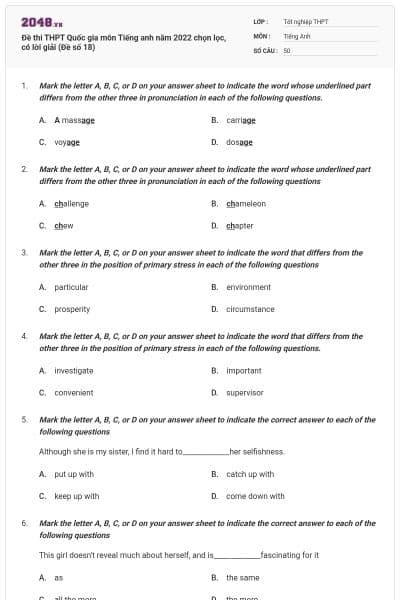
Mark the letter A, B, C, or D on your answer sheet to indicate the word whose underlined part differs from the other three in pronunciation in each of the following questions.
A massage
carriage
voyage
dosage
Đáp án A
Massage /ˈmæsɑːʒ/ (n): xoa bóp
Carriage /ˈkærɪdʒ/ (n): xe ngựa
Voyage /ˈvɔɪɪdʒ/ (n): cuộc du lịch xa bằng đường biển
Dosage /ˈdəʊsɪdʒ/ (n): liều lượng
Mark the letter A, B, C, or D on your answer sheet to indicate the word whose underlined part differs from the other three in pronunciation in each of the following questions
challenge
chameleon
chew
chapter
Đáp án B
Challenge /ˈtʃælɪndʒ/ (v,n): thách thức
Chew /tʃuː/ (v-ing): nhai
Chameleon /kəˈmiːliən/ (n): tắc kè hoa
Chapter /ˈtʃæptə(r)/ (n): chương
Mark the letter A, B, C, or D on your answer sheet to indicate the word that differs from the other three in the position of primary stress in each of the following questions
particular
environment
prosperity
circumstance
Đáp án D
Particular /pəˈtɪkjələ(r)/ (adj): đặc biệt, riêng biệt
Environment /ɪnˈvaɪrənmənt/ (n): môi trường
Prosperity /prɒˈsperəti/ (n): sự thịnh vượng
Circumstance /ˈsɜːkəmstəns/ (n): hoàn cảnh
Mark the letter A, B, C, or D on your answer sheet to indicate the word that differs from the other three in the position of primary stress in each of the following questions.
investigate
important
convenient
supervisor
Đáp án D
Investigate /ɪnˈvestɪɡeɪt/ (v): điều tra
Important /ɪmˈpɔːtnt/ (adj): quan trọng
Convenient /kənˈviːniənt/ (adj): thuận tiện
Supervisor /ˈsuːpəvaɪzə(r)/ (n): người giám sát
Mark the letter A, B, C, or D on your answer sheet to indicate the correct answer to each of the following questions
Although she is my sister, I find it hard to_____________her selfishness.
put up with
catch up with
keep up with
come down with
Đáp án A
- put up with: chịu đựng
E.g: I cannot put up with him any more
- catch up with (sb): đuổi kịp (ai)
E.g: Go on ahead. I'll catch up with you
keep up with: theo kịp, bắt kịp
Eg: Technology changes so fast it's hard to keep up with it.
come down with: mắc bệnh, ốm (nhẹ)
E.g: I came down with flu last week.
"Mặc dù cô ấy là chị tôi nhưng tôi cảm thấy khó để chịu đựng được tính ích kỉ của chị.”
Mark the letter A, B, C, or D on your answer sheet to indicate the correct answer to each of the following questions
This girl doesn't reveal much about herself, and is_____________fascinating for it
as
the same
all the more
the more
Đáp án C
Cấu trúc: - as: như (dùng trong so sánh bằng)
- the same + N: cùng, giống... (dùng trong so sánh bằng)
- the more + adj/ adv: càng... (dùng trong so sánh kép)
- all the more + adj ~ even more... (than before) càng/ thậm chí còn... hơn (so với trước)
"Cô gái này không tiết lộ nhiều về bản thân mình và điều này càng làm cho cô ấy trở nên quyến rũ hơn."
Mark the letter A, B, C, or D on your answer sheet to indicate the correct answer to each of the following questions
I didn't_____________to see my aunt when I was in Paris
take
make
get
meet
Đáp án C
Cấu trúc: - take to doing sth ~ begin/ start to do sth as a habit: bắt đầu làm gì như một thói quen
- get to do sth ~have the opportunity to do sth: có cơ hội làm gì đó
"Tôi đã không có cơ hội gặp dì tôi khi tôi ở Paris.”
Mark the letter A, B, C, or D on your answer sheet to indicate the correct answer to each of the following questions
Mr. Huy received a warning for speeding. He_____________so fast
shouldn't have driven
would have driven
should have
might have driven
Đáp án A
- shouldn't have PP: lẽ ra đã không nên làm gì (thực tế đã làm)
- should + V: nên làm gì
- would have PP: đã... rồi (dùng trong câu điều kiện loại 3)/ đã muốn làm gì trong quá khứ (nhưng đã không làm)
- might have PP: có thể/ có lẽ đã làm gì (khả năng trong quá khứ)
"Ông Huy nhận được lời cảnh cáo về việc bắn tốc độ. Lẽ ra ông ấy đã không nên lái xe quá nhanh."
Mark the letter A, B, C, or D on your answer sheet to indicate the correct answer to each of the following questions
Tom never stays in one place for long. He always gets_____________feet and sets off on his travels again
chilly
itchy
dusty
shaky
Đáp án B
- chilly (adj): giá lạnh - itchy (adj): ngứa ngáy
- dusty (adj): đầy bụi - shaky (adj): run
+ get/ have itchy feet (ngứa ngáy chân tay): want to travel or move to a different place; to want to do something different: muốn đi đây đi đó
"Tom chưa bao giờ ở lại một nơi quá lâu. Anh ấy luôn muốn xách ba lô lên và đi du lịch."
Mark the letter A, B, C, or D on your answer sheet to indicate the correct answer to each of the following questions
He_____________his uncle for his father's death
accused
caused
confessed
blamed
Đáp án D
Cấu trúc: blame sb for sth: đổ lỗi cho ai về điều gì
"Anh ấy đổ lỗi cho bác anh ấy về cái chết của bố mình."
Mark the letter A, B, C, or D on your answer sheet to indicate the correct answer to each of the following questions
Our new classmate, John is a bit of a rough_____________but I think I'm going to like him once I get used to him.
stone
rock
diamond
pearl
Đáp án C
- stone (n): đá
- rock (n): đá
- diamond (n): kim cương
- pearl (n): ngọc trai
+ a rough diamond: kim cương chưa mài, một người căn bản tốt nhưng có thể cư xử thô lỗ, cục mịch
"Bạn học cùng lớp mới của chúng tôi, John, hơi thô lỗ chút nhưng tôi nghĩ tôi sẽ thích anh ấy một khi tôi quen anh ấy."
Mark the letter A, B, C, or D on your answer sheet to indicate the correct answer to each of the following questions
This watch is only made of plastic so it's quite_____________.
valuable
worthless
priceless
invaluable
Đáp án B
- valuable (adj): đáng giá - worthless (adj): không có giá trị
- priceless (adj): vô giá
- invaluable (adj): vô giá, rất quý giá
"Chiếc đồng hồ này chỉ làm bằng nhựa nên nó không có giá trị gì lâm
Mark the letter A, B, C, or D on your answer sheet to indicate the correct answer to each of the following questions
David does not have_____________Peter does
money more than
as many money as
more money as
as much money as
Đáp án D
Cấu trúc so sánh bằng với danh từ: S + V + as + many/ much/ little/ few + N + as + N/ pronoun
"Money" là danh từ không đếm được _ dùng much
"David không có nhiều tiền bằng Peter."
Mark the letter A, B, C, or D on your answer sheet to indicate the correct answer to each of the following questions
After a long working day, she felt_____________.
broken down
worn out
knocked out
turned down
Đáp án B
- break down (ph.v): suy sụp
E.g: She broke down when she heard the bad news.
- knock sb out ~ wear sb out: làm cho ai đó cảm thấy rất mệt
E.g: The kids have knocked me out.
- turn down (ph. v): từ chối
E.g: He turned down my invitation.
- worn out (adj): kiệt sức
+ be/ feel/ get worn out: cảm thấy kiệt sức
“Sau một ngày làm việc dài thì cô ấy cảm thấy kiệt sức."
Mark the letter A, B, C, or D on your answer sheet to indicate the correct answer to each of the following questions
Tim was disappointed because he_____________for the train for two hours.
was waiting
waited
has been waiting
had been waiting
Đáp án D
Động từ "wait" trong câu này được chia ở thì quá khứ hoàn thành tiếp diễn đế diễn tả hành động là nguyên nhân của một điều gì đó trong quá khứ.
Cấu trúc: S + had + been + V-ing... (thì quá khứ hoàn thành tiếp diễn)
"Tim đã rất thất vọng vì cậu ấy đã chờ tàu 2 tiếng đồng hồ rồi."
Mark the letter A, B, C, or D on your answer sheet to indicate the correct answer to each of the following questions
There were many politicians at the meeting, several of _____________ were very young.
that
whom
who
which
Đáp án B
- that: không dùng sau giới từ
- who: không dùng sau giới từ
- "whom" và "which": có thể được dùng sau giới từ
- Chúng ta có thể dùng "all, most, none, neither, any, either, some, (a) few, both, half, each, one, two, several, many, much"+ of which/whom
E.g: I have two brothers, both of whom are doctors.
"Có nhiều chính trị gia ở cuộc họp, một vài trong số họ thì trẻ."
Mark the letter A, B, C, or D on your answer sheet to indicate the correct answer to each of the following questions
The judge_____________murderer to a lifetime imprisonment.
prosecuted
sentenced
convicted
accused
Đáp án B
- prosecute (v): khởi tố, kiện
+ prosecute sb for sth: khởi tố ai về điều gì
- sentence (v): kết án, tuyên án
+ sentence sb to sth: kết án/ tuyên án ai...
- convict (v): kết tội, tuyên bố có tội
+ convict sb of sth: tuyên bố ai có tội...
- accuse (v): kết tội, buộc tội
+ accuse sb of sth: buộc tội ai...
"Quan tòa tuyên án kẻ giết người tù chung thân
Mark the letter A, B, C, or D on your answer sheet to indicate the correct answer to each of the following questions
He lost his job because he was_____________. He made so many mistakes.
rash
incautious
inefficient
impulsive
Đáp án C
- rash (adj): liều, liều lĩnh
- incautious (adj): thiếu thận trọng, thiếu suy nghĩ
- inefficient (adj): không có khả năng, thiếu năng lực, không hiệu quả
- impulsive (adj): bốc đồng
"Anh ấy mất việc vì thiếu năng lực. Anh ấy phạm quá nhiều sai lầm."
Mark the letter A, B, C, or D on your answer sheet to indicate the correct answer to each of the following questions
. _____________me to your mother when you are in New York.
Tell
Remind
Remember
Greet
Đáp án C
- tell (v): bảo, kể
+ tell sb sth/ tell sb about sth: kể ai điều gì/ kể ai về điều gì
remind sb to do sth: nhắc nhở ai làm gì
- remember (v): nhớ
+ remember + to V/ V-ing: nhớ làm gì/ đã làm gì
+ remember me to sb: be used to ask somebody to give your good wishes to somebody else: gửi lời chào, gửi lời hỏi thăm
E.g: Remember me to your parents. (Nhớ gửi lời hỏi thăm của tôi đến bố mẹ bạn nhé.)
- greet (v): chào
+ greet sb: chào ai
"Nhớ gửi lời hỏi thăm của tôi tới mẹ bạn khi bạn ở New York nhé."
Mark the letter A, B, C, or D on your answer sheet to indicate the word(s) CLOSEST in meaning to the underlined word(s) in each of the following questions
The sales clerk was totally bewildered by the customer's behavior.
disgusted
puzzled
angry
upset
Đáp án B
- disgusted (adj): ghê tởm, chán ghét - puzzled (adj): bối rối, lúng túng, khó xử
- angry (adj): tức giận - upset (adj): buồn bã, thất vọng
- bewildered (adj): bối rối, lúng túng
Do đó: bewildered ~ puzzled
"Nhân viên bán hàng hoàn toàn bối rối với cách cư xử của khách hàng."
Mark the letter A, B, C, or D on your answer sheet to indicate the word(s) CLOSEST in meaning to the underlined word(s) in each of the following questions
Thousands of people flocked to the beach this weekend.
came without knowing what they will see
came in large numbers
came out of boredom
came by plane
Đáp án B
- flock (v) ~ come in large numbers: lũ lượt kéo đến
"Hàng nghìn người lũ lượt kéo đến bãi biển vào cuối tuần này
Mark the letter A, B, C, or D on your answer sheet to indicate the word(s) OPPOSITE in meaning to the underlined word(s) In each of the following questions
I think you will be home and dry in the interview because you have many years of teaching experience and good academic qualifications.
be successful
be unsuccessful
be satisfied
be unsatisfied
Đáp án B
- be successful: thành công - be unsuccessful: không thành công
- be satisfied: hài lòng, thỏa mãn - be unsatisfied: không hài lòng, thỏa mãn
- be home and dry/ be home free: thành công, xuôi chèo mát mái
Do đó: be home and dry # be unsuccessful
"Tôi nghĩ bạn sẽ thành công trong cuộc phỏng vấn vì bạn có nhiều năm kinh nghiệm dạy học và bằng cấp tốt."
Mark the letter A, B, C, or D on your answer sheet to indicate the word(s) OPPOSITE in meaning to the underlined word(s) In each of the following questions
It’s very difficult to tell her to give in because she is so big - headed.
wise
generous
modest
arrogant
Đáp án C
- wise (adj): khôn ngoan - generous (adj): hào phóng, rộng lượng
- modest (adj): khiêm tốn - arrogant (adj): kiêu căng, ngạo mạn
- big-headed (adj): quá kiêu căng, ngạo mạn
Do đó: big-headed # modest
"Rất khó đế bảo cô ấy chịu thua vì cô ấy quá kiêu căng."
Mark the letter A, B, C, or D on your answer sheet to indicate the option that best completes each of the following exchanges
Ken and Laura are saying goodbye to each other after going to LOTTE Center. And they are going to have a date with each other later.
Laura: "Well, it's getting late. Maybe we could get together sometime." - Ken:" _____________"
Nice to see back you.
Take it easy
Sounds good. I'll give you a call
Yes, I've enjoyed it
Đáp án C
Laura: Ồ, trời đang dần tối rồi. Có lẽ chúng ta nên gặp mặt dịp khác.
A. Rất vui được gặp lại cậu. B. Hãy thư giãn đi.
C. Nghe có vẻ ổn đây. Tớ sẽ gọi cho cậu.
D. ừ, tớ thích nó
Mark the letter A, B, C, or D on your answer sheet to indicate the option that best completes each of the following exchanges
Hung: "How about listening to pop music?" - Hoa:" _____________"
Good idea
I'm afraid I do
No, it's interesting, isn't it?
Sorry, I don't like to work
Đáp án A
A. Ý tưởng hay. B. Tớ e rằng tớ làm.
C. Không, nó thú vị có phải không?
D. Xin lỗi, tớ không thích làm việc.
Read the following passage and mark the letter A, B, C, or D on your answer sheet to indicate the correct word or phrase that best fits each of the numbered blanks from 26 to 30.
Horses and donkeys were (26) _____________comparatively late compared with other animals, probably around 4000 BC in Western Asia. By that time, people in many parts of the world were no longer (27) _____________on hunting and gathering their food, but had become nomadic stockbreeders or settled farmers, raising livestock such as cattle, sheep and goats and, in the static communities, growing and harvesting food plants.
They still hunted wild game, but could now do so with the (28) _____________of domestic dogs, the close animal companions who also helped them to protect and control their flocks and herds. Their needs for meat, milk, skins and wool were being met, and it may not have been immediately obvious to them that the horse had anything more to offer than the occasional (29) _____________of the chase and a different type of meat. The horse did have something more to offer. It had the potential to bring about nothing less than a revolution (30) _____________power and transport, a dramatic development that transformed the ability of humans to wage war.
trained
domesticated
educated
accustomed
Đáp án B
- train (v): đào tạo
- domesticate (v) ~ make a wild animal used to living with or working for humans: thuần hóa (động vật)
- educate (v): giáo dục
- accustom (v): làm cho quen
"Horses and donkeys were domesticated comparatively late compared with other animals, probably around 4000 BC in Western Asia." (Ngựa và lừa được thuần hóa tương đối muộn so với các loài động vật khác, có lẽ vào khoảng 4000 năm trước Công nguyên ở Tây Á.)
Read the following passage and mark the letter A, B, C, or D on your answer sheet to indicate the correct word or phrase that best fits each of the numbered blanks from 26 to 30.
Horses and donkeys were (26) _____________comparatively late compared with other animals, probably around 4000 BC in Western Asia. By that time, people in many parts of the world were no longer (27) _____________on hunting and gathering their food, but had become nomadic stockbreeders or settled farmers, raising livestock such as cattle, sheep and goats and, in the static communities, growing and harvesting food plants.
They still hunted wild game, but could now do so with the (28) _____________of domestic dogs, the close animal companions who also helped them to protect and control their flocks and herds. Their needs for meat, milk, skins and wool were being met, and it may not have been immediately obvious to them that the horse had anything more to offer than the occasional (29) _____________of the chase and a different type of meat. The horse did have something more to offer. It had the potential to bring about nothing less than a revolution (30) _____________power and transport, a dramatic development that transformed the ability of humans to wage war.
reliant
liable
subject
sustained
Đáp án A
- reliant (adj): dựa dẫm
- subject + to (adj): phải chịu, lệ thuộc
- reliant + on: phụ thuộc vào
- sustained (adj): chống đỡ, chịu đựng
- liable + for (adj): chịu trách nhiệm pháp lý, có bổn phận
Read the following passage and mark the letter A, B, C, or D on your answer sheet to indicate the correct word or phrase that best fits each of the numbered blanks from 26 to 30.
Horses and donkeys were (26) _____________comparatively late compared with other animals, probably around 4000 BC in Western Asia. By that time, people in many parts of the world were no longer (27) _____________on hunting and gathering their food, but had become nomadic stockbreeders or settled farmers, raising livestock such as cattle, sheep and goats and, in the static communities, growing and harvesting food plants.
They still hunted wild game, but could now do so with the (28) _____________of domestic dogs, the close animal companions who also helped them to protect and control their flocks and herds. Their needs for meat, milk, skins and wool were being met, and it may not have been immediately obvious to them that the horse had anything more to offer than the occasional (29) _____________of the chase and a different type of meat. The horse did have something more to offer. It had the potential to bring about nothing less than a revolution (30) _____________power and transport, a dramatic development that transformed the ability of humans to wage war.
aim
assistance
compliments
intention
Đáp án B
- with the assistance of~ help, support: giúp đỡ, hỗ trợ
"They still hunted wild game, but could now do so with the assistance of domestic dogs, the close animal companions." (Họ vẫn săn thú rừng, nhưng giờ có thể làm như vậy với sự hỗ trợ của chó nhà, những người bạn động vật thân thiết.)
Read the following passage and mark the letter A, B, C, or D on your answer sheet to indicate the correct word or phrase that best fits each of the numbered blanks from 26 to 30.
Horses and donkeys were (26) _____________comparatively late compared with other animals, probably around 4000 BC in Western Asia. By that time, people in many parts of the world were no longer (27) _____________on hunting and gathering their food, but had become nomadic stockbreeders or settled farmers, raising livestock such as cattle, sheep and goats and, in the static communities, growing and harvesting food plants.
They still hunted wild game, but could now do so with the (28) _____________of domestic dogs, the close animal companions who also helped them to protect and control their flocks and herds. Their needs for meat, milk, skins and wool were being met, and it may not have been immediately obvious to them that the horse had anything more to offer than the occasional (29) _____________of the chase and a different type of meat. The horse did have something more to offer. It had the potential to bring about nothing less than a revolution (30) _____________power and transport, a dramatic development that transformed the ability of humans to wage war.
inspiration
kick
thrill
emotion
Đáp án C
- the thrill of: sự thích thú, sự hào hứng
Read the following passage and mark the letter A, B, C, or D on your answer sheet to indicate the correct word or phrase that best fits each of the numbered blanks from 26 to 30.
Horses and donkeys were (26) _____________comparatively late compared with other animals, probably around 4000 BC in Western Asia. By that time, people in many parts of the world were no longer (27) _____________on hunting and gathering their food, but had become nomadic stockbreeders or settled farmers, raising livestock such as cattle, sheep and goats and, in the static communities, growing and harvesting food plants.
They still hunted wild game, but could now do so with the (28) _____________of domestic dogs, the close animal companions who also helped them to protect and control their flocks and herds. Their needs for meat, milk, skins and wool were being met, and it may not have been immediately obvious to them that the horse had anything more to offer than the occasional (29) _____________of the chase and a different type of meat. The horse did have something more to offer. It had the potential to bring about nothing less than a revolution (30) _____________power and transport, a dramatic development that transformed the ability of humans to wage war.
in
at
for
on
Đáp án A
- a revolution + in sth: cuộc cách mạng về
Read the following passage and mark the letter A, B, C, or D on your answer sheet to Indicate the correct answer to each of the questions from 31 to 35.
Psychologists tell us that there are four basic stages that human beings pass through when they enter and live in a new culture. This process, which helps us to deal with culture shock, is the way our brain and our personality reacts to the strange new things we encounter when we move from one culture to another. If our culture involves bowing when we greet someone, we may feel very uncomfortable in a culture that does not involve bowing. If the language we use when talking to someone in our own culture is influenced by levels of formality based on the other person's age and status, it may be difficult for us to feel comfortable communicating with people in the new culture. Culture begins with the "honeymoon stage". This is the period of time when we first arrive in which everything about the new culture is strange and exciting
We may be suffering from "jet lag" but we are thrilled to be in the new environment, seeing new sights, hearing new sounds and language, eating new kinds of food. This honeymoon stage can last for quite a long time because we feel we are involved in some kind of great adventure. Unfortunately, the second stage of culture shock can be more difficult. After we have settled down into our new life, working or studying, buying groceries, doing laundry, or living with a home-stay family, we can become very tired and begin to miss our homeland and our family, girlfriend/ boyfriend, pets. All the little problems that everybody in life has seem to be much bigger and more disturbing when you face them in a foreign culture. This period of cultural adjustment can be very difficult and lead to the new arrival rejecting or pulling away from the new culture. This "rejection stage" can be quite dangerous because the visitor may develop unhealthy habits (smoking and drinking too much, being too concerned over food or contact with people from the new culture). This can, unfortunately lead to the person getting sick or developing skin infections or rashes which then makes the person feel even more scared and confused and helpless. This stage is considered a crisis in the process of cultural adjustment and many people choose to go back to their homeland or spend all their time with people from their own culture speaking their native language.
The third stage of culture shock is called the "adjustment stage". This is when you begin to realize that things are not so bad in the host culture. Your sense of humour usually becomes stronger and you realize that you are becoming stronger by learning to take care of yourself in the new place. Things are still difficult, but you are now a survivor! The fourth stage can be called "at ease at last". Now you feel quite comfortable in your new surroundings. You can cope with most problems that occur. You may still have problems with the language, but you know you are strong enough to deal with them. If you meet someone from your country who has just arrived, you can be the expert on life in the new culture and help them to deal with their culture shock
When does culture shock happen?
When you reach your teens
When you move to a big city
When you meet foreign people for the first time
When you go to live in a foreign culture
Đáp án D
Thông tin trong bài: "Psychologists tell us that there are four basic stages that human beings pass through when they enter and live in a new culture"
Read the following passage and mark the letter A, B, C, or D on your answer sheet to Indicate the correct answer to each of the questions from 31 to 35.
Psychologists tell us that there are four basic stages that human beings pass through when they enter and live in a new culture. This process, which helps us to deal with culture shock, is the way our brain and our personality reacts to the strange new things we encounter when we move from one culture to another. If our culture involves bowing when we greet someone, we may feel very uncomfortable in a culture that does not involve bowing. If the language we use when talking to someone in our own culture is influenced by levels of formality based on the other person's age and status, it may be difficult for us to feel comfortable communicating with people in the new culture. Culture begins with the "honeymoon stage". This is the period of time when we first arrive in which everything about the new culture is strange and exciting
We may be suffering from "jet lag" but we are thrilled to be in the new environment, seeing new sights, hearing new sounds and language, eating new kinds of food. This honeymoon stage can last for quite a long time because we feel we are involved in some kind of great adventure. Unfortunately, the second stage of culture shock can be more difficult. After we have settled down into our new life, working or studying, buying groceries, doing laundry, or living with a home-stay family, we can become very tired and begin to miss our homeland and our family, girlfriend/ boyfriend, pets. All the little problems that everybody in life has seem to be much bigger and more disturbing when you face them in a foreign culture. This period of cultural adjustment can be very difficult and lead to the new arrival rejecting or pulling away from the new culture. This "rejection stage" can be quite dangerous because the visitor may develop unhealthy habits (smoking and drinking too much, being too concerned over food or contact with people from the new culture). This can, unfortunately lead to the person getting sick or developing skin infections or rashes which then makes the person feel even more scared and confused and helpless. This stage is considered a crisis in the process of cultural adjustment and many people choose to go back to their homeland or spend all their time with people from their own culture speaking their native language.
The third stage of culture shock is called the "adjustment stage". This is when you begin to realize that things are not so bad in the host culture. Your sense of humour usually becomes stronger and you realize that you are becoming stronger by learning to take care of yourself in the new place. Things are still difficult, but you are now a survivor! The fourth stage can be called "at ease at last". Now you feel quite comfortable in your new surroundings. You can cope with most problems that occur. You may still have problems with the language, but you know you are strong enough to deal with them. If you meet someone from your country who has just arrived, you can be the expert on life in the new culture and help them to deal with their culture shock.
How do you feel during the first stage of culture shock?
Lonely and depressed
Bored and homesick
Happy and excited
Angry and frustrated
Đáp án C
Thông tin trong bài: "Culture begins with the "honeymoon stage". This is the period of time when we first arrive in which everything about the new culture is strange and exciting"
Read the following passage and mark the letter A, B, C, or D on your answer sheet to Indicate the correct answer to each of the questions from 31 to 35.
Psychologists tell us that there are four basic stages that human beings pass through when they enter and live in a new culture. This process, which helps us to deal with culture shock, is the way our brain and our personality reacts to the strange new things we encounter when we move from one culture to another. If our culture involves bowing when we greet someone, we may feel very uncomfortable in a culture that does not involve bowing. If the language we use when talking to someone in our own culture is influenced by levels of formality based on the other person's age and status, it may be difficult for us to feel comfortable communicating with people in the new culture. Culture begins with the "honeymoon stage". This is the period of time when we first arrive in which everything about the new culture is strange and exciting
We may be suffering from "jet lag" but we are thrilled to be in the new environment, seeing new sights, hearing new sounds and language, eating new kinds of food. This honeymoon stage can last for quite a long time because we feel we are involved in some kind of great adventure. Unfortunately, the second stage of culture shock can be more difficult. After we have settled down into our new life, working or studying, buying groceries, doing laundry, or living with a home-stay family, we can become very tired and begin to miss our homeland and our family, girlfriend/ boyfriend, pets. All the little problems that everybody in life has seem to be much bigger and more disturbing when you face them in a foreign culture. This period of cultural adjustment can be very difficult and lead to the new arrival rejecting or pulling away from the new culture. This "rejection stage" can be quite dangerous because the visitor may develop unhealthy habits (smoking and drinking too much, being too concerned over food or contact with people from the new culture). This can, unfortunately lead to the person getting sick or developing skin infections or rashes which then makes the person feel even more scared and confused and helpless. This stage is considered a crisis in the process of cultural adjustment and many people choose to go back to their homeland or spend all their time with people from their own culture speaking their native language.
The third stage of culture shock is called the "adjustment stage". This is when you begin to realize that things are not so bad in the host culture. Your sense of humour usually becomes stronger and you realize that you are becoming stronger by learning to take care of yourself in the new place. Things are still difficult, but you are now a survivor! The fourth stage can be called "at ease at last". Now you feel quite comfortable in your new surroundings. You can cope with most problems that occur. You may still have problems with the language, but you know you are strong enough to deal with them. If you meet someone from your country who has just arrived, you can be the expert on life in the new culture and help them to deal with their culture shock
How do you feel during the second stage?
Homesick and afraid
Interested and amused
Stressed, but positive
You have no particular feelings
Đáp án A
Thông tin trong bài: "we can become very tired and begin to miss our homeland and our family, girlfriend/boyfriend, pets... This can, unfortunately lead to the person getting sick or developing skin infections or rashes which then makes the person feel even more scared and confused and helpless"
Read the following passage and mark the letter A, B, C, or D on your answer sheet to Indicate the correct answer to each of the questions from 31 to 35.
Psychologists tell us that there are four basic stages that human beings pass through when they enter and live in a new culture. This process, which helps us to deal with culture shock, is the way our brain and our personality reacts to the strange new things we encounter when we move from one culture to another. If our culture involves bowing when we greet someone, we may feel very uncomfortable in a culture that does not involve bowing. If the language we use when talking to someone in our own culture is influenced by levels of formality based on the other person's age and status, it may be difficult for us to feel comfortable communicating with people in the new culture. Culture begins with the "honeymoon stage". This is the period of time when we first arrive in which everything about the new culture is strange and exciting
We may be suffering from "jet lag" but we are thrilled to be in the new environment, seeing new sights, hearing new sounds and language, eating new kinds of food. This honeymoon stage can last for quite a long time because we feel we are involved in some kind of great adventure. Unfortunately, the second stage of culture shock can be more difficult. After we have settled down into our new life, working or studying, buying groceries, doing laundry, or living with a home-stay family, we can become very tired and begin to miss our homeland and our family, girlfriend/ boyfriend, pets. All the little problems that everybody in life has seem to be much bigger and more disturbing when you face them in a foreign culture. This period of cultural adjustment can be very difficult and lead to the new arrival rejecting or pulling away from the new culture. This "rejection stage" can be quite dangerous because the visitor may develop unhealthy habits (smoking and drinking too much, being too concerned over food or contact with people from the new culture). This can, unfortunately lead to the person getting sick or developing skin infections or rashes which then makes the person feel even more scared and confused and helpless. This stage is considered a crisis in the process of cultural adjustment and many people choose to go back to their homeland or spend all their time with people from their own culture speaking their native language.
The third stage of culture shock is called the "adjustment stage". This is when you begin to realize that things are not so bad in the host culture. Your sense of humour usually becomes stronger and you realize that you are becoming stronger by learning to take care of yourself in the new place. Things are still difficult, but you are now a survivor! The fourth stage can be called "at ease at last". Now you feel quite comfortable in your new surroundings. You can cope with most problems that occur. You may still have problems with the language, but you know you are strong enough to deal with them. If you meet someone from your country who has just arrived, you can be the expert on life in the new culture and help them to deal with their culture shock
How could the third stage be described?
Adjustment
Rejection
Enthusiasm
Anger
Đáp án A
Thông tin trong bài: "The third stage of culture shock is called the "adjustment stage"."
Read the following passage and mark the letter A, B, C, or D on your answer sheet to Indicate the correct answer to each of the questions from 31 to 35.
Psychologists tell us that there are four basic stages that human beings pass through when they enter and live in a new culture. This process, which helps us to deal with culture shock, is the way our brain and our personality reacts to the strange new things we encounter when we move from one culture to another. If our culture involves bowing when we greet someone, we may feel very uncomfortable in a culture that does not involve bowing. If the language we use when talking to someone in our own culture is influenced by levels of formality based on the other person's age and status, it may be difficult for us to feel comfortable communicating with people in the new culture. Culture begins with the "honeymoon stage". This is the period of time when we first arrive in which everything about the new culture is strange and exciting
We may be suffering from "jet lag" but we are thrilled to be in the new environment, seeing new sights, hearing new sounds and language, eating new kinds of food. This honeymoon stage can last for quite a long time because we feel we are involved in some kind of great adventure. Unfortunately, the second stage of culture shock can be more difficult. After we have settled down into our new life, working or studying, buying groceries, doing laundry, or living with a home-stay family, we can become very tired and begin to miss our homeland and our family, girlfriend/ boyfriend, pets. All the little problems that everybody in life has seem to be much bigger and more disturbing when you face them in a foreign culture. This period of cultural adjustment can be very difficult and lead to the new arrival rejecting or pulling away from the new culture. This "rejection stage" can be quite dangerous because the visitor may develop unhealthy habits (smoking and drinking too much, being too concerned over food or contact with people from the new culture). This can, unfortunately lead to the person getting sick or developing skin infections or rashes which then makes the person feel even more scared and confused and helpless. This stage is considered a crisis in the process of cultural adjustment and many people choose to go back to their homeland or spend all their time with people from their own culture speaking their native language.
The third stage of culture shock is called the "adjustment stage". This is when you begin to realize that things are not so bad in the host culture. Your sense of humour usually becomes stronger and you realize that you are becoming stronger by learning to take care of yourself in the new place. Things are still difficult, but you are now a survivor! The fourth stage can be called "at ease at last". Now you feel quite comfortable in your new surroundings. You can cope with most problems that occur. You may still have problems with the language, but you know you are strong enough to deal with them. If you meet someone from your country who has just arrived, you can be the expert on life in the new culture and help them to deal with their culture shock
How do you feel during the fourth stage of culture shock?
Tense, but positive
Relaxed
Negative and stressed
Afraid
Đáp án B
Thông tin trong bài: "The fourth stage can be called "at ease at last". Now you feel quite comfortable in your new surroundings"
Read the following passage and mark the letter A, B, C, or D on your answer sheet to indicate the correct answer to each of the questions from 36 to 42.
Earthquakes are the most lethal of all natural disasters. What causes them? Geologists explain them in terms of a theory known as plate tectonics. Continents are floating apart from each other; this is referred to as the continental drift. About sixty miles below the surface of the sea, there is a semi-molten bed of rock over which plates, or slabs, carry continents and sea floors at a rate of several inches a year. As the plates separate from each other, a new sea floor is formed by the molten matter that was formerly beneath. Volcanic islands and large mountain ranges are created by this type of movement. The collision of plates causes geological instability such as that in California called the San Andreas Fault, located between the Pacific and North American plates. The plates there are constantly pushing and pulling adjacent plates, thereby creating constant tremors and a potential for earthquakes in the area
Geologists would like to be able to predict earthquakes accurately. Using laser beams, seismographs, gravity-measuring devices, and radio telescopes, they are presently studying the San Andreas Fault to determine the rate of strain and the amount of ground slippage. Calculations indicate that sometime in the future, California will be struck by a major earthquake. In spite of the geologists' theory of plate tectonics, there are still gaps in man's understanding and knowledge of the causes of earthquakes. Powerful earthquakes have occurred in places where plate boundaries are hundreds of miles away. In the 1800s New Madrid, Missouri, and Charleston, South Carolina, were shaken by earthquakes that no one had foreseen.
Certain areas of the world are quake prone. Italy, Yugoslavia, and Algeria have experienced many quakes. In November 1980, Naples was struck by an especially devastating quake. China and Japan have also been hit by horrendous quakes. In 1923, Tokyo and Yokohama were reduced to rubble by gigantic tremors that were followed by fires, tornadoes, and finally a thirty-four-foot tsunami, or tidal wave, which was caused by the earth's drop into the waters of Tokyo Bay.
What effects have geologists' predictions of earthquakes had? The Chinese in Haicheng in 1974 were warned that an earthquake might occur within the next year or two. With the help of amateur seismologists' observations of animal behavior and the rise and fall of water in wells and measurements of quantities of radioactive gas in water, professional geologists were able, in January 1975, to predict an earthquake within the next six months. On February 4, Haicheng was destroyed, but because its residents had been evacuated, very few people were killed. In California, where earthquake is an ever-present menace, building codes now require quakeproof structures, and Civil Defense units have intensified their training in how to deal with disaster should it strike or, perhaps more accurately, when it strikes
Continental drift is the concept that_____________.
continents are drawing nearer to each other
continents are separating
continents are 60 miles apart from each other
new continents are developing beneath the sea
Đáp án B
Trôi dạt lục địa là khái niệm mà____________.
A. các lục địa đang kéo gần nhau hơn B. các lục địa đang tách ra
C. các lục địa xa nhau 60 dặm D. các lục địa mới đang phát triển dưới biển
Thông tin trong bài: "Continents are floating apart from each other; this is referred to as the continental drift." (Các lục địa trôi dạt ra xa nhau; đây được gọi là sự trôi dạt lục địa.)
Read the following passage and mark the letter A, B, C, or D on your answer sheet to indicate the correct answer to each of the questions from 36 to 42.
Earthquakes are the most lethal of all natural disasters. What causes them? Geologists explain them in terms of a theory known as plate tectonics. Continents are floating apart from each other; this is referred to as the continental drift. About sixty miles below the surface of the sea, there is a semi-molten bed of rock over which plates, or slabs, carry continents and sea floors at a rate of several inches a year. As the plates separate from each other, a new sea floor is formed by the molten matter that was formerly beneath. Volcanic islands and large mountain ranges are created by this type of movement. The collision of plates causes geological instability such as that in California called the San Andreas Fault, located between the Pacific and North American plates. The plates there are constantly pushing and pulling adjacent plates, thereby creating constant tremors and a potential for earthquakes in the area
Geologists would like to be able to predict earthquakes accurately. Using laser beams, seismographs, gravity-measuring devices, and radio telescopes, they are presently studying the San Andreas Fault to determine the rate of strain and the amount of ground slippage. Calculations indicate that sometime in the future, California will be struck by a major earthquake. In spite of the geologists' theory of plate tectonics, there are still gaps in man's understanding and knowledge of the causes of earthquakes. Powerful earthquakes have occurred in places where plate boundaries are hundreds of miles away. In the 1800s New Madrid, Missouri, and Charleston, South Carolina, were shaken by earthquakes that no one had foreseen.
Certain areas of the world are quake prone. Italy, Yugoslavia, and Algeria have experienced many quakes. In November 1980, Naples was struck by an especially devastating quake. China and Japan have also been hit by horrendous quakes. In 1923, Tokyo and Yokohama were reduced to rubble by gigantic tremors that were followed by fires, tornadoes, and finally a thirty-four-foot tsunami, or tidal wave, which was caused by the earth's drop into the waters of Tokyo Bay.
What effects have geologists' predictions of earthquakes had? The Chinese in Haicheng in 1974 were warned that an earthquake might occur within the next year or two. With the help of amateur seismologists' observations of animal behavior and the rise and fall of water in wells and measurements of quantities of radioactive gas in water, professional geologists were able, in January 1975, to predict an earthquake within the next six months. On February 4, Haicheng was destroyed, but because its residents had been evacuated, very few people were killed. In California, where earthquake is an ever-present menace, building codes now require quakeproof structures, and Civil Defense units have intensified their training in how to deal with disaster should it strike or, perhaps more accurately, when it strikes
Geologists are using modern technology to_____________.
help predict earthquakes
enhance their reputations
measure the accuracy of earthquakes
control ground slippage
Đáp án A
Các nhà địa chất đang sử dụng công nghệ hiện đại để_____________.
A. giúp dự đoán động đất B. nâng cao danh tiếng của họ
C. đo độ chính xác của động đất D. kiểm soát trượt đất
Thông tin trong bài: "Geologists would like to be able to predict earthquakes accurately. Using laser beams, seismographs, gravity-measuring devices, and radio telescopes, they are presently studying the San Andreas Fault to determine the rate of strain and the amount of ground slippage." (Các nhà địa chất muốn có thể dự đoán chính xác các trận động đất. Sử dụng chùm tia laze, máy ghi địa chấn, thiết bị đo trọng lực và kính viễn vọng vô tuyến, họ hiện đang nghiên cứu vết đứt gãy San Andreas để xác định tốc độ biến dạng và lượng trượt mặt đất.)
Read the following passage and mark the letter A, B, C, or D on your answer sheet to indicate the correct answer to each of the questions from 36 to 42.
Earthquakes are the most lethal of all natural disasters. What causes them? Geologists explain them in terms of a theory known as plate tectonics. Continents are floating apart from each other; this is referred to as the continental drift. About sixty miles below the surface of the sea, there is a semi-molten bed of rock over which plates, or slabs, carry continents and sea floors at a rate of several inches a year. As the plates separate from each other, a new sea floor is formed by the molten matter that was formerly beneath. Volcanic islands and large mountain ranges are created by this type of movement. The collision of plates causes geological instability such as that in California called the San Andreas Fault, located between the Pacific and North American plates. The plates there are constantly pushing and pulling adjacent plates, thereby creating constant tremors and a potential for earthquakes in the area
Geologists would like to be able to predict earthquakes accurately. Using laser beams, seismographs, gravity-measuring devices, and radio telescopes, they are presently studying the San Andreas Fault to determine the rate of strain and the amount of ground slippage. Calculations indicate that sometime in the future, California will be struck by a major earthquake. In spite of the geologists' theory of plate tectonics, there are still gaps in man's understanding and knowledge of the causes of earthquakes. Powerful earthquakes have occurred in places where plate boundaries are hundreds of miles away. In the 1800s New Madrid, Missouri, and Charleston, South Carolina, were shaken by earthquakes that no one had foreseen.
Certain areas of the world are quake prone. Italy, Yugoslavia, and Algeria have experienced many quakes. In November 1980, Naples was struck by an especially devastating quake. China and Japan have also been hit by horrendous quakes. In 1923, Tokyo and Yokohama were reduced to rubble by gigantic tremors that were followed by fires, tornadoes, and finally a thirty-four-foot tsunami, or tidal wave, which was caused by the earth's drop into the waters of Tokyo Bay.
What effects have geologists' predictions of earthquakes had? The Chinese in Haicheng in 1974 were warned that an earthquake might occur within the next year or two. With the help of amateur seismologists' observations of animal behavior and the rise and fall of water in wells and measurements of quantities of radioactive gas in water, professional geologists were able, in January 1975, to predict an earthquake within the next six months. On February 4, Haicheng was destroyed, but because its residents had been evacuated, very few people were killed. In California, where earthquake is an ever-present menace, building codes now require quakeproof structures, and Civil Defense units have intensified their training in how to deal with disaster should it strike or, perhaps more accurately, when it strikes
The Chinese predicted an earthquake by_____________.
employing amateur seismologists
observing professional geologists
watching animals, wells, and radioactive gas
evacuating the population
Đáp án C
Người Trung Quốc dự đoán động đất bằng cách_________.
A. thuê các nhà địa chấn học nghiệp dư B. quan sát các nhà địa chất chuyên nghiệp
C. quan sát động vật, giếng và khí phóng xạ D. sơ tán dân
Thông tin trong bài: "The Chinese in Haicheng in 1974 were warned that an earthquake might occur within the next year or two. With the help of amateur seismologists' observations of animal behavior and the rise and fall of water in wells and measurements of quantities of radioactive gas in water..." (Người Trung Quốc ở Haicheng vào năm 1974 đã được cảnh báo rằng một trận động đất có thể xảy ra trong vòng một hoặc hai năm tới. Với sự giúp đỡ từ việc quan sát của các nhà địa chấn học nghiệp dư về hành vi của động vật và sự lên xuống của nước trong giếng và các phép đo lượng khí phóng xạ trong nước)
Read the following passage and mark the letter A, B, C, or D on your answer sheet to indicate the correct answer to each of the questions from 36 to 42.
Earthquakes are the most lethal of all natural disasters. What causes them? Geologists explain them in terms of a theory known as plate tectonics. Continents are floating apart from each other; this is referred to as the continental drift. About sixty miles below the surface of the sea, there is a semi-molten bed of rock over which plates, or slabs, carry continents and sea floors at a rate of several inches a year. As the plates separate from each other, a new sea floor is formed by the molten matter that was formerly beneath. Volcanic islands and large mountain ranges are created by this type of movement. The collision of plates causes geological instability such as that in California called the San Andreas Fault, located between the Pacific and North American plates. The plates there are constantly pushing and pulling adjacent plates, thereby creating constant tremors and a potential for earthquakes in the area
Geologists would like to be able to predict earthquakes accurately. Using laser beams, seismographs, gravity-measuring devices, and radio telescopes, they are presently studying the San Andreas Fault to determine the rate of strain and the amount of ground slippage. Calculations indicate that sometime in the future, California will be struck by a major earthquake. In spite of the geologists' theory of plate tectonics, there are still gaps in man's understanding and knowledge of the causes of earthquakes. Powerful earthquakes have occurred in places where plate boundaries are hundreds of miles away. In the 1800s New Madrid, Missouri, and Charleston, South Carolina, were shaken by earthquakes that no one had foreseen.
Certain areas of the world are quake prone. Italy, Yugoslavia, and Algeria have experienced many quakes. In November 1980, Naples was struck by an especially devastating quake. China and Japan have also been hit by horrendous quakes. In 1923, Tokyo and Yokohama were reduced to rubble by gigantic tremors that were followed by fires, tornadoes, and finally a thirty-four-foot tsunami, or tidal wave, which was caused by the earth's drop into the waters of Tokyo Bay.
What effects have geologists' predictions of earthquakes had? The Chinese in Haicheng in 1974 were warned that an earthquake might occur within the next year or two. With the help of amateur seismologists' observations of animal behavior and the rise and fall of water in wells and measurements of quantities of radioactive gas in water, professional geologists were able, in January 1975, to predict an earthquake within the next six months. On February 4, Haicheng was destroyed, but because its residents had been evacuated, very few people were killed. In California, where earthquake is an ever-present menace, building codes now require quakeproof structures, and Civil Defense units have intensified their training in how to deal with disaster should it strike or, perhaps more accurately, when it strikes
Californians are preparing for an earthquake by_____________.
saving their property
building stronger houses and practicing techniques to handle emergencies
ignoring the San Andreas Fault
moving to another state
Đáp án B
Người dân California đang chuẩn bị cho một trận động đất bằng cách____________.
A. tiết kiệm tài sản của mình
B. xây dựng những ngôi nhà vững chắc hơn và thực hành các kỹ thuật để xử lý các trường hợp khẩn cấp
C. bỏ qua đứt gãy San Andreas
D. chuyển sang trạng thái khac
Thông tin trong bài: “In California, where earthquake is an ever-present menace, building codes now require quakeproof structures, and Civil Defense units have intensified their training in how to deal with disaster should it strike or, perhaps more accurately, when it strikes." (Ở California, nơi động đất là mối đe dọa luôn hiện hữu, các quy tắc xây dựng hiện nay yêu cầu cấu trúc chôhg động đất và các đơn vị Phòng Vệ Dân Sự đã tăng cường huấn luyện cách đối phó với thảm họa nếu nó xảy ra hoặc có lẽ chính xấc hơn là khi nó xảy ra.)
Read the following passage and mark the letter A, B, C, or D on your answer sheet to indicate the correct answer to each of the questions from 36 to 42.
Earthquakes are the most lethal of all natural disasters. What causes them? Geologists explain them in terms of a theory known as plate tectonics. Continents are floating apart from each other; this is referred to as the continental drift. About sixty miles below the surface of the sea, there is a semi-molten bed of rock over which plates, or slabs, carry continents and sea floors at a rate of several inches a year. As the plates separate from each other, a new sea floor is formed by the molten matter that was formerly beneath. Volcanic islands and large mountain ranges are created by this type of movement. The collision of plates causes geological instability such as that in California called the San Andreas Fault, located between the Pacific and North American plates. The plates there are constantly pushing and pulling adjacent plates, thereby creating constant tremors and a potential for earthquakes in the area
Geologists would like to be able to predict earthquakes accurately. Using laser beams, seismographs, gravity-measuring devices, and radio telescopes, they are presently studying the San Andreas Fault to determine the rate of strain and the amount of ground slippage. Calculations indicate that sometime in the future, California will be struck by a major earthquake. In spite of the geologists' theory of plate tectonics, there are still gaps in man's understanding and knowledge of the causes of earthquakes. Powerful earthquakes have occurred in places where plate boundaries are hundreds of miles away. In the 1800s New Madrid, Missouri, and Charleston, South Carolina, were shaken by earthquakes that no one had foreseen.
Certain areas of the world are quake prone. Italy, Yugoslavia, and Algeria have experienced many quakes. In November 1980, Naples was struck by an especially devastating quake. China and Japan have also been hit by horrendous quakes. In 1923, Tokyo and Yokohama were reduced to rubble by gigantic tremors that were followed by fires, tornadoes, and finally a thirty-four-foot tsunami, or tidal wave, which was caused by the earth's drop into the waters of Tokyo Bay.
What effects have geologists' predictions of earthquakes had? The Chinese in Haicheng in 1974 were warned that an earthquake might occur within the next year or two. With the help of amateur seismologists' observations of animal behavior and the rise and fall of water in wells and measurements of quantities of radioactive gas in water, professional geologists were able, in January 1975, to predict an earthquake within the next six months. On February 4, Haicheng was destroyed, but because its residents had been evacuated, very few people were killed. In California, where earthquake is an ever-present menace, building codes now require quakeproof structures, and Civil Defense units have intensified their training in how to deal with disaster should it strike or, perhaps more accurately, when it strikes
No one had foreseen earthquakes in Missouri because_____________.
the area is not quake prone
geologists do not understand the area
there are gaps in the area
the theory of plate tectonics is incorrect
Đáp án A
Không ai có thể lường trước được những trận động đất ở Missouri vì_____________.
A. khu vực đó không dễ xảy ra động đất B. các nhà địa chất không hiểu về khu vực đó
C. có các khoảng trống trong khu vực đó D. thuyết kiến tạo mảng không đúng
Thông tin trong bài: “In spite of the geologists' theory of plate tectonics, there are still gaps in man’s understanding and knowledge of the causes of earthquakes. Powerful earthquakes have occurred in places where plate boundaries are hundreds of miles away. In the 1800s New Madrid, Missouri, and Charleston, South Carolina, were shaken by earthquakes that no one had foreseen." (Mặc dù có lý thuyết của các nhà địa chất học về kiến tạo mảng nhưng vẫn còn những khoảng trống trong hiểu biết và kiến thức của con người về nguyên nhân gây ra động đất. Trận động đất mạnh đã xảy ra ở những nơi mà ranh giới mảng xa hàng trăm dặm. Vào những năm 1800, New Madrid, Missouri và Charleston, Nam Carolina đã bị rung chuyển bởi những trận động đất mà không ai có thể dự đoán trước được.)
Read the following passage and mark the letter A, B, C, or D on your answer sheet to indicate the correct answer to each of the questions from 36 to 42.
Earthquakes are the most lethal of all natural disasters. What causes them? Geologists explain them in terms of a theory known as plate tectonics. Continents are floating apart from each other; this is referred to as the continental drift. About sixty miles below the surface of the sea, there is a semi-molten bed of rock over which plates, or slabs, carry continents and sea floors at a rate of several inches a year. As the plates separate from each other, a new sea floor is formed by the molten matter that was formerly beneath. Volcanic islands and large mountain ranges are created by this type of movement. The collision of plates causes geological instability such as that in California called the San Andreas Fault, located between the Pacific and North American plates. The plates there are constantly pushing and pulling adjacent plates, thereby creating constant tremors and a potential for earthquakes in the area
Geologists would like to be able to predict earthquakes accurately. Using laser beams, seismographs, gravity-measuring devices, and radio telescopes, they are presently studying the San Andreas Fault to determine the rate of strain and the amount of ground slippage. Calculations indicate that sometime in the future, California will be struck by a major earthquake. In spite of the geologists' theory of plate tectonics, there are still gaps in man's understanding and knowledge of the causes of earthquakes. Powerful earthquakes have occurred in places where plate boundaries are hundreds of miles away. In the 1800s New Madrid, Missouri, and Charleston, South Carolina, were shaken by earthquakes that no one had foreseen.
Certain areas of the world are quake prone. Italy, Yugoslavia, and Algeria have experienced many quakes. In November 1980, Naples was struck by an especially devastating quake. China and Japan have also been hit by horrendous quakes. In 1923, Tokyo and Yokohama were reduced to rubble by gigantic tremors that were followed by fires, tornadoes, and finally a thirty-four-foot tsunami, or tidal wave, which was caused by the earth's drop into the waters of Tokyo Bay.
What effects have geologists' predictions of earthquakes had? The Chinese in Haicheng in 1974 were warned that an earthquake might occur within the next year or two. With the help of amateur seismologists' observations of animal behavior and the rise and fall of water in wells and measurements of quantities of radioactive gas in water, professional geologists were able, in January 1975, to predict an earthquake within the next six months. On February 4, Haicheng was destroyed, but because its residents had been evacuated, very few people were killed. In California, where earthquake is an ever-present menace, building codes now require quakeproof structures, and Civil Defense units have intensified their training in how to deal with disaster should it strike or, perhaps more accurately, when it strikes.
Geologists have been able to predict an earthquake_____________.
with unerring accuracy
within months
by measuring tremors
by knowing about continental drift
Đáp án B
Các nhà địa chất đã có thể dự đoán một trận động đất____________
A. với độ chính xác cao B. trong vòng mấy tháng
C. bằng cách đo sự chấn động D. bằng cách hiểu biết về trôi dạt lục địa
Thông tin trong bài: "The Chinese in Haicheng in 1974 were warned that an earthquake might occur within the next year or two. With the help of amateur seismologists' observations of animal behavior and the rise and fall of water in wells and measurements of quantities of radioactive gas in water, professional geologists were able, in January 1975, to predict an earthquake within the next six months." (Người Trung Quốc ở Haicheng vào năm 1974 đã được cảnh báo rằng một trận động đất có thế xảy ra trong vòng một hoặc hai năm tới. Với sự giúp đỡ từ việc quan sát của các nhà địa chấn học nghiệp dư về hành vi của động vật và sự lên xuống của nước trong giếng và các phép đo lượng khí phóng xạ trong nước thì vào tháng 1 năm 1975 các nhà địa chất chuyên nghiệp đã có thể dự đoán một trận động đất trong vòng sáu tháng tới.)
Read the following passage and mark the letter A, B, C, or D on your answer sheet to indicate the correct answer to each of the questions from 36 to 42.
Earthquakes are the most lethal of all natural disasters. What causes them? Geologists explain them in terms of a theory known as plate tectonics. Continents are floating apart from each other; this is referred to as the continental drift. About sixty miles below the surface of the sea, there is a semi-molten bed of rock over which plates, or slabs, carry continents and sea floors at a rate of several inches a year. As the plates separate from each other, a new sea floor is formed by the molten matter that was formerly beneath. Volcanic islands and large mountain ranges are created by this type of movement. The collision of plates causes geological instability such as that in California called the San Andreas Fault, located between the Pacific and North American plates. The plates there are constantly pushing and pulling adjacent plates, thereby creating constant tremors and a potential for earthquakes in the area
Geologists would like to be able to predict earthquakes accurately. Using laser beams, seismographs, gravity-measuring devices, and radio telescopes, they are presently studying the San Andreas Fault to determine the rate of strain and the amount of ground slippage. Calculations indicate that sometime in the future, California will be struck by a major earthquake. In spite of the geologists' theory of plate tectonics, there are still gaps in man's understanding and knowledge of the causes of earthquakes. Powerful earthquakes have occurred in places where plate boundaries are hundreds of miles away. In the 1800s New Madrid, Missouri, and Charleston, South Carolina, were shaken by earthquakes that no one had foreseen.
Certain areas of the world are quake prone. Italy, Yugoslavia, and Algeria have experienced many quakes. In November 1980, Naples was struck by an especially devastating quake. China and Japan have also been hit by horrendous quakes. In 1923, Tokyo and Yokohama were reduced to rubble by gigantic tremors that were followed by fires, tornadoes, and finally a thirty-four-foot tsunami, or tidal wave, which was caused by the earth's drop into the waters of Tokyo Bay.
What effects have geologists' predictions of earthquakes had? The Chinese in Haicheng in 1974 were warned that an earthquake might occur within the next year or two. With the help of amateur seismologists' observations of animal behavior and the rise and fall of water in wells and measurements of quantities of radioactive gas in water, professional geologists were able, in January 1975, to predict an earthquake within the next six months. On February 4, Haicheng was destroyed, but because its residents had been evacuated, very few people were killed. In California, where earthquake is an ever-present menace, building codes now require quakeproof structures, and Civil Defense units have intensified their training in how to deal with disaster should it strike or, perhaps more accurately, when it strikes.
Volcanic islands are formed by_____________.
the separation of plates and the consequent uncovering of the molten sea floor beneath them
the constant pushing and pulling of adjacent plates
constant tremors
huge mountain ranges
Đáp án A
Đảo núi lửa được hình thành bởi_____________.
Thông tin trong bài: "As the plates separate from each other, a new sea floor is formed by the
molten matter that was formerly beneath. Volcanic islands and large mountain ranges are created by this type of movement." (Khi các mảng tách ra khỏi nhau, một đáy biển mới được hình thành do chất nóng chảy trước đây nẳm bên dưới. Các đảo núi lửa và các dãy núi lớn được tạo ra bởi kiểu chuyến động này.)
Mark the letter A, B, C, or D on your answer sheet to indicate the underlined part that needs correction in each of the following questions
Tim works (A) as a doctor and he (B) earns (C) twice (D) as much than his brother
as a doctor
earns
twice
as much than
Đáp án D
Cấu trúc: S + V + multiple numbers (half/ twice/ three times/...) + as + much/many/adj/adv + (N) + as + N/pronoun (so sánh bội số)
E.g: The yellow skirt costs twice as much as the red one. (Cái váy màu vàng có giá gấp đôi cái váy màu đỏ.)
Do đó: as much than _ as much as
"Tim là một bác sĩ và cậu ấy kiếm được gấp đôi anh trai cậu ấy."
Mark the letter A, B, C, or D on your answer sheet to indicate the underlined part that needs correction in each of the following questions
You ( A) shouldn't criticize (B) him in front of his friends (C) It was (D) insensitive of you
shouldn't criticize
him in front
It
insensitive
Đáp án A (shouldn't criticize _ shouldn’t have criticized)
- should (not) V (bare-inf): nên/ không nên làm gì
- should (not) have PP: lẽ ra đã nên/ không nên làm gì (sự việc đã xảy ra)
"Bạn lẽ ra đã không nên chỉ trích cậu ấy trước mặt bạn bè cậu ấy. Bạn đã thiếu nhạy bén."
Mark the letter A, B, C, or D on your answer sheet to indicate the underlined part that needs correction in each of the following questions
(A) Alike other forms of energy, natural gas (B) may be used to (C) heat homes, cook food, and even (D) run automobiles
Alike
may be used
heat homes
run
Đáp án A
- alike (adj, adv): giống, giống nhau, như nhau
E.g: My brother and I are alike.
They treated all the children alike.
- like (prep): giống như, như
E.g: Like many children, I like watching cartoons.
"Giống như nhiều dạng năng lượng khác, khí tự nhiên có thể được dùng để sưởi ấm nhà cửa, nấu ăn và thậm chí điều khiển ô tô."
Mark the letter A, B, C, or D on your answer sheet to indicate the sentence that is closest in meaning to each of the following questions
Due to the fact that the demand for tea was very high in the 19th century, its price was astronomical
It was not until the 19th century that the demand for tea started to increase
The demand for tea was so high in the 19th century that its price was enormous.
In the 19th century the price for tea didn't increase despite the demand
In the 19th century, even though the demand for tea was enormous its price remained cheap
Đáp án B
Vì thực tế là nhu cầu uống trà rất lớn vào thế kỉ thứ 19 nên giá của nó cũng rất cao.
A. Mãi cho đến thế kỉ thứ 19 thì nhu cầu uống trà mới bắt đầu tăng.
B. Nhu cầu uống trà quá lớn vào thế kỉ 19 nên giá của nó cũng rất cao.
C. Vào thế kỉ 19 giá của trà không tăng dù có nhu cầu.
D. Vào thế kỉ 19, mặc dù nhu cầu uống trà lớn nhưng giá của nó vẫn rẻ.
Cấu trúc: S + be + so + adj + that + S + V... (quá... đến nỗi mà...)
Mark the letter A, B, C, or D on your answer sheet to indicate the sentence that is closest in meaning to each of the following questions
Tom no longer smokes a lot.
Tom now smokes a lot
Tom used to smoke a lot
Tom didn't use to smoke a lot
Tom rarely smoked a lot
Đáp án B
Câu ban đầu: Tom không còn hút thuốc nhiều nữa.
A. Tom bây giờ hút thuốc nhiều. B. Tom đã từng hút thuốc nhiều.
C. Tom đã không từng hút thuốc nhiều.
D. Tom đã hiếm khi hút thuốc nhiều.
- used to + V (bare-inf): đã từng, đã thường làm gì (thói quen trong quá khứ, không còn ở hiện Q tại nữa)
E.g: I used to get up late.
Mark the letter A, B, C, or D on your answer sheet to indicate the sentence that is closest in meaning to each of the following questions
No one has sent me that letter
I haven't been sent that letter
I wasn’t sent that letter
That letter hasn't been sent me
That letter has sent to me by no one
Đáp án A
Câu ban đầu: Không ai gửi cho tôi bức thư đó.
Đại từ "no one" mang ý nghĩa phủ định nên khi chuyển sang bị động ta phải dùng thể phủ định. Thì của động từ được sử dụng trong câu này là thì hiện tại hoàn thành.
Cấu trúc: Chủ động: S + have/ has+ PP + O
Bị động: S (O) + have/ has + been + PP + by O(S)
Vì chủ ngữ là "I" nên ta dùng "have"; "no one" được lược bỏ và dùng thể phủ định trong câu bị động.
Lưu ý: send sb sth ~ send sth to sb (gửi cho ai cái gì/ gửi cái gì cho ai)
"Tôi không được gửi bức thư đó."
Mark the letter A, B, C, or D on your answer sheet to indicate the sentence that best combines each pair of sentences in the following questions
Mr. Hung is a professor. His car was stolen yesterday
His car was stolen yesterday, Mr Hung is a professor
Mr. Hung, who his car was stolen yesterday, is a professor
Mr. Hung, who is a professor, his car was stolen yesterday
Mr. Hung, whose car was stolen yesterday, is a professor
Đáp án D
"Thầy Hùng là một giáo sư. Hôm qua xe thầy ấy đã bị lấy trộm."
- who: thay thế cho danh từ chỉ người, làm chức năng chủ ngữ
- whom: thay thế cho danh từ chỉ người, làm chức năng tân ngữ
- whose: thay thế cho tính từ sở hữu trước danh từ (whose + N)
Mark the letter A, B, C, or D on your answer sheet to indicate the sentence that best combines each pair of sentences in the following questions.
Mary was not here yesterday. Perhaps she was ill
Mary needn't be here yesterday because she was ill
Because of her illness, Mary shouldn’t have been here yesterday
Mary might have been ill yesterday, so she was not here
Mary must have been ill yesterday, so she was not here
Đáp án C
- shouldn't have PP: lẽ ra đã không nên làm gì
- might + have PP: có lẽ, có thể đã làm gì
- must + have PP: chắc hẳn đã làm gì (suy đoán có căn cứ ở quá khứ)
"Mary đã không ở đây vào hôm qua. Có lẽ cô ấy bị ốm."
A. Mary không cần ở đây vào hôm qua vì cô ấy đã bị ốm.
B. Bởi vì bị ốm nên cô ấy lẽ ra không nên ở đây vào hôm qua.
C. Có lẽ hôm qua Mary bị ốm nên cô ấy không ở đây.
D. Chắc hẳn hôm qua Mary bị ốm nên cô ấy không ở đây.