Đề thi THPT Quốc gia môn Tiếng anh năm 2022 chọn lọc, có lời giải (Đề số 15)
50 câu hỏi
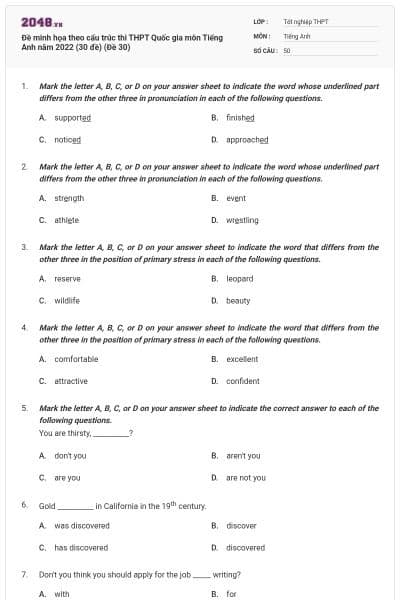
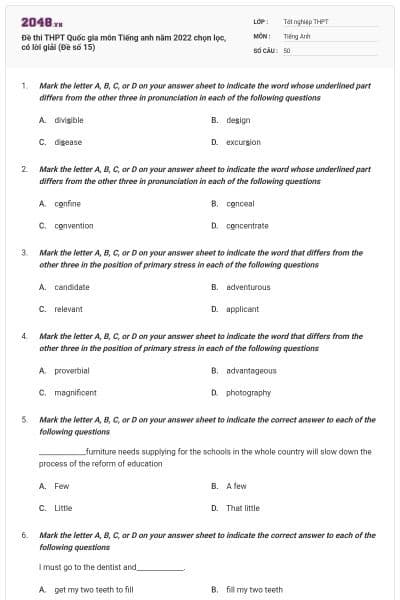
Mark the letter A, B, C, or D on your answer sheet to indicate the word whose underlined part differs from the other three in pronunciation in each of the following questions
divisible
design
disease
excursion
Đáp án D
- Divisible /dɪˈvɪzəbl/ (adj): có thể chia được
- Design /dɪˈzaɪn/ (n,v): thiết kế
- Disease /dɪˈziːz/ (n): bệnh, bệnh tật
- Excursion /ɪkˈskɜːʃn/ (n): cuộc đi tham quan, cuộc đi chơi
Mark the letter A, B, C, or D on your answer sheet to indicate the word whose underlined part differs from the other three in pronunciation in each of the following questions
confine
conceal
convention
concentrate
Đáp án D
- Confine /kənˈfaɪn/ (v): hạn chế, giới hạn; giam giữ, giam cầm, nhốt/giữ lại
- Conceal /kənˈsiːl/ (v): giấu giếm, giấu, che đậy
- Convention /kənˈvenʃn/ (n): công ước, hiệp định, hội nghị, quy ước
- Concentrate /ˈkɒnsntreɪt/ (v): tập trung
Mark the letter A, B, C, or D on your answer sheet to indicate the word that differs from the other three in the position of primary stress in each of the following questions
candidate
adventurous
relevant
applicant
Đáp án B
- Candidate /ˈkændɪdət/ (n): ứng viên, thí sinh
- Adventurous /ədˈventʃərəs/ (adj): thích phiêu lưu, mạo hiểm
- Relevant /ˈreləvənt/ (adj): thích hợp, thích đáng; có liên quan
- Applicant /ˈæplɪkənt/ (n): người xin việc, người nộp hồ sơ
Mark the letter A, B, C, or D on your answer sheet to indicate the word that differs from the other three in the position of primary stress in each of the following questions
proverbial
advantageous
magnificent
photography
Đáp án B
- Proverbial /prəˈvɜːbiəl/ (adj): (thuộc) tục ngữ
- Advantageous /ˌædvənˈteɪdʒəs/ (adj): thuận lợi
- Magnificent /mæɡˈnɪfɪsnt/ (adj): lộng lẫy, nguy nga
- Photography /fəˈtɒɡrəfi/ (n): thuật nhiếp ảnh
Mark the letter A, B, C, or D on your answer sheet to indicate the correct answer to each of the following questions
_____________furniture needs supplying for the schools in the whole country will slow down the process of the reform of education
Few
A few
Little
That little
Đáp án D
- Few: dùng với danh từ số nhiều đếm được, mang nghĩa "ít, rất ít" (hầu như không có)
- A few: dùng với danh từ số nhiều đếm được, mang nghĩa "một ít, một vài" (ít nhưng còn đủ)
- Little: dùng với danh từ không đếm được, mang nghĩa "ít, rất ít" (hầu như không có)
Mệnh đề danh ngữ (danh từ):
- Là mệnh đề phụ có chức năng như 1 danh từ, mở đầu bằng các từ để hỏi (where, what, how, why, when, who, whose,..), that, if/ whether.
- Chức năng trong câu tương tự như chức năng của một danh từ (Chủ ngữ, tân ngữ của động từ, tân ngữ của giới từ, bổ ngữ bổ nghĩa cho chủ ngữ, bô’ ngữ bổ nghĩa cho tính từ.)
"Việc có ít thiết bị cần được cung cấp cho các trường học trong cả nước làm chậm quá trình cải cách giáo dục”.
Mark the letter A, B, C, or D on your answer sheet to indicate the correct answer to each of the following questions
I must go to the dentist and_____________.
get my two teeth to fill
fill my two teeth
my two teeth be filled
get my two teeth filled
Đáp án D
- Chủ động: get somebody to do something _ Bị động: get something done (by somebody): nhờ/thuê ai đó làm gì
"Tôi phải đến nha sĩ và nhờ ông ấy hàn hai cái răng của mình
Mark the letter A, B, C, or D on your answer sheet to indicate the correct answer to each of the following questions
He_____________the accusation. He felt innocent
accepted
admitted
denied
reported
Đáp án C
- deny the accusation: phủ nhận lời buộc tội
"Anh ấy đã phủ nhận lời buộc tội. Anh ấy cảm thấy vô tội."
Mark the letter A, B, C, or D on your answer sheet to indicate the correct answer to each of the following questions
I regret to tell you that a rise in salary is_____________just now.
out of work
out of control
out of date
out of the guestion
Đáp án D
- out of work: thất nghiệp
- out of control: ngoài tầm kiểm soát
- out of date: hết hạn, lỗi thời
- out of the question: không thể, không được phép, không đáng bàn
"Tôi lấy làm tiếc phải nói với bạn rằng việc tăng lương bây giờ là không thể được."
Mark the letter A, B, C, or D on your answer sheet to indicate the correct answer to each of the following questions
A useful way to_____________your vocabulary is to read as much as possible,
amass
increase
collect
gather
Đáp án B
- amass /əˈmæs/ (v): tích lũy, chất đống
- increase /ɪnˈkriːs/ (v): tăng; làm tăng
- collect /kəˈlekt/ (v): góp, sưu tập, thu thập
- gather /ˈɡæðə(r)/ (v): tập hợp, tụ họp lại; thu thập
"Một cách hữu ích để làm tăng vốn từ vựng của bạn là đọc càng nhiều càng tốt."
Mark the letter A, B, C, or D on your answer sheet to indicate the correct answer to each of the following questions
If you don't give up smoking, you'll_____________the risk of damaging your health
bear
suffer
make
run
Đáp án D
- run the risk of doing sth: làm gì mặc dù điều không tốt đẹp sẽ xảy ra
"Nếu bạn không bỏ hút thuốc, bạn sẽ có nguy cơ gây hại cho sức khỏe của mình."
Mark the letter A, B, C, or D on your answer sheet to indicate the correct answer to each of the following questions
The number of vehicles on the roads_____________increasing, so we need to build more roads
is
were
was
are
Đáp án A
- The number of (số lượng những...): đi với danh từ đếm được số nhiều, động từ theo sau chia ở dạng số ít.
"Số lượng các phương tiện trên đường đang gia tăng, vì thế chúng ta cần xây nhiều con đường hơn."
Mark the letter A, B, C, or D on your answer sheet to indicate the correct answer to each of the following questions
We live in a very_____________populated area of Thailand
sparsely
scarcely
hardly
barely
Đáp án A
- sparsely populated: dân cư thưa thớt # densely populated: dân cư đông đúc
"Chúng tôi sống ở một vùng dân cư thưa thớt của Thái Lan."
Mark the letter A, B, C, or D on your answer sheet to indicate the correct answer to each of the following questions
The fire caused_____________damage that that building had to be destroyed.
so much
too much
such much
very much
Đáp án A
Cấu trúc: so + much + N-uncountable + that clause (quá nhiều... đến nỗi mà...)
"Trận hỏa hoạn đã gây ra quá nhiều thiệt hại đến nỗi mà tòa nhà phải bị phá hủy."
Mark the letter A, B, C, or D on your answer sheet to indicate the correct answer to each of the following questions
I can't tell my daughter what to do; it's water off_____________with her
a duck's head
a dripping tap
an umbrella
a duck's back
Đáp án D
- like water off a duck's back: như nước đổ đầu vịt
"Tôi không thể bảo con gái mình làm gì, giống như nước đổ đầu vịt
Mark the letter A, B, C, or D on your answer sheet to indicate the correct answer to each of the following questions
We decide to go to the beach_____________we should be disturbed by the noise of the city
in order that
so that
for
lest
Đáp án D
- lest: để... khỏi, để... không
"Chúng tôi quyết định đi bãi biển để tránh bị làm phiền bởi sự ồn ào của thành phố"
Mark the letter A, B, C, or D on your answer sheet to indicate the correct answer to each of the following questions
The organization underwent_____________reforms
far-reaching
far-gone
far-off
far-flung
Đáp án A
"Tổ chức đã trải qua những cuộc cải cách lớn."
- far-reaching (adj): có ảnh hưởng sâu rộng, tác động lớn
E.g: I think that this decision will have far-reaching consequences. (Tôi nghĩ rằng quyết định này sẽ dẫn đến nhiều hậu quả lớn.)
- far-gone (adj): ốm rất nặng, say mềm
E.g: Last night, my husband was so far-gone that he couldn't walk. (Tối qua chồng tôi say đến nỗi mà không thể đi được.)
- far-off (adj): xa xôi, xa xưa
E.g: They want to live in a far-off country. (Họ sống ở một vùng quê xa xôi.)
- far-flung (adj): xa, trải rộng bao la
E.g: She wants to travel to the most far-flung regions of the world. (Cô ấy muốn đi du lịch đến những vừng xa nhất trên thế giới.)
Mark the letter A, B, C, or D on your answer sheet to indicate the correct answer to each of the following questions
When the first child was born, they_____________for three years.
have been married
had been married
will been married
will have been married
Đáp án B
"Lúc đứa con đầu tiên của họ được sinh ra thì họ đã kết hôn được 3 năm rồi."
Cấu trúc thì quá khứ hoàn thành: S + had + PP +...
Thì quá khứ hoàn thành diễn tả hành động xảy ra và hoàn tất trước một hành động khác trong quá khứ
Mark the letter A, B, C, or D on your answer sheet to indicate the correct answer to each of the following questions
The teacher likes her essay because it's very_____________.
imagination
imaginable
imaginative
imaginary
Đáp án C .
"Giáo viên thích bài văn của cô ấy vì nó rất sáng tạo."
- imagination /ɪˌmædʒɪˈneɪʃn/ (n): sự tưởng tượng, trí tưởng tượng
Eg: My daughter has a very vivid imagination. (Con gái tôi có một trí tưởng tượng rất phong phú.)
- imaginable /ɪˈmædʒɪnəbl/ ~ possible to think of/ imagine (adj): có thể tưởng tượng, hình dung được
E.g: What they went through is hardly imaginable. (Những gì họ đã trải qua thì khó mà hình dung được.)
- imaginative /ɪˈmædʒɪnətɪv/ ~ inventive, creative (adj): sáng tạo, giàu óc tưởng tượng, có nhiều ý tưởng mới mẻ
E.g: You should be more imaginative if you want to win this contest. (Bạn nên sáng tạo hơn nếu bạn muốn thắng cuộc thi này.)
- imaginary (adj): tưởng tượng, ảo, không có thật
E.g: The story is completely imaginary. (Câu chuyện hoàn toàn không có thật.)
Mark the letter A, B, C, or D on your answer sheet to indicate the correct answer to each of the following questions
The Beauty Contest is_____________start at 8:00 a.m our time next Monday.
due to
bound to
about to
on the point of
Đáp án B
"Cuộc thi hoa hậu chắc chắn sẽ bắt đầu lúc 8 giờ 30 sáng thứ 2 tuần sau theo giờ của chúng ta."
- be due to V: mong đợi xảy ra (nói về 1 sự kiện/ sự việc mong đợi xảy ra tại thời điểm cụ thể nào đó trong tương lai (có kèm thời gian))
- due to + V-ing/ N ~ because of: bởi vì
E.g: The match was cancelled due to the heavy snow.
- be bound to + V ~ certain or extremely likely to happen: chắc chắn xảy ra
E.g: It's bound to be rainy again tomorrow.
- be about to + V ~ to be going to do something very soon: sắp sửa làm gì đó
E.g: They are about to leave here.
- be on the point of + V-ing ~ to be going to do something very soon: sắp sửa làm gì đó
E.g: When they were on the point of giving up hope, a man arrived and helped them.
Mark the letter A, B, C, or D on your answer sheet to indicate the word(s) CLOSEST in meaning to the underlined word(s) in each of the following questions.
The kidnapper gave himself up to the police
confided himself
surrendered
accommodated himself
went up
Đáp án B
- give yourself up to sb ~ surrender to sb: đầu hàng ai
- confide yourself: giãi bày tâm sự
- accommodate yourself: làm cho mình thích nghi
- go up: tăng lên
"Kẻ bắt cóc đã đầu hàng cảnh sát."
Mark the letter A, B, C, or D on your answer sheet to indicate the word(s) CLOSEST in meaning to the underlined word(s) in each of the following questions.
I'll back up your ideas if they don't believe you
support
rebel
admire
protect
Đáp án A
- back up ~ support: ủng hộ
- admire (v): ngưỡng mộ
- rebel (v): chống đối
- protect (v): bảo vệ
Tôi sẽ ủng hộ ý kiến của bạn nếu họ không tin bạn."
Mark the letter A, B, C, or D on your answer sheet to indicate the word(s) OPPOSITE in meaning to the underlined word(s) in each of the following questions
They conducted a campaign to promote people's awareness of environmental problems
encourage
publicize
hinder
strengthen
Đáp án C
- encourage (v): khuyến khích, động viên
- hinder (v): cản trở, gây trở ngại
- publicize (v): quảng cáo, đưa ra công khai
- strengthen (v): tăng cường
- promote (v) ~ encourage: đẩy mạnh, khuyến khích
"Họ đã thực hiện một chiến lược để tăng cường ý thức của mọi người về các vấn đề môi trường."
Mark the letter A, B, C, or D on your answer sheet to indicate the word(s) OPPOSITE in meaning to the underlined word(s) in each of the following questions
Sally has just won a full scholarship to one of the most prestigious universities in the world; she must be on cloud nine now
extremely panicked
obviously delighted
incredibly optimistic
desperately sad
Đáp án D
- on could nine ~ extremely happy: cực kì sung sướng/ hạnh phúc, lên đến chín tầng mây
A. extremely panicked: cực kì hoảng sợ
C. incredibly optimistic: cực kì lạc quan
B. obviously delighted: rất vui sướng
D. desperately sad: cực kì buồn, rất buồn
Do đó: on cloud nine # desperately sad
"Sally vừa mới nhận được học bổng toàn phần đến một trong những trường đại học danh tiếng nhất trên thế giới, bây giờ chắc là cô ấy rất vui sướng."
Mark the letter A, B, C, or D on vonr answer sheet to indicate the option, that best completes each of the following exchanges.
Mai: "Would you mind lending me your bike?" - Lan:" _____________."
Yes. Here it is
Yes, let's
Great
No, not at all
Đáp án D
Mai: "Cậu có phiền cho tớ mượn xe đạp của cậu không?" - Lan: "Không, không phiền tý nào."
- "No, not at all": để đưa ra sự đồng ý với cấu trúc "would you mind"
- Yes, let's: để đưa ra sự đồng ý với lời đề nghị, rủ rê
Mark the letter A, B, C, or D on vonr answer sheet to indicate the option, that best completes each of the following exchanges
Kelly: "It's was very kind of you to give me a lift home". - Mark:" _____________."
As a matter of fact, you're pretty nice
Oh, don't do that. I was coming past your house any way
I'm not pleased
Oh, don't mention it. I was coming past your house any way
Đáp án D
Kelly: "Bạn thật tốt khi cho mình đi nhờ xe về nhà." _ lời cảm ơn
A. Thực sự thì bạn khá tốt.
B. Ồ, đừng làm điều đó. Mình đi ngang qua nhà bạn.
C. Mình không hài lòng.
D. Ồ, không có gì đâu. Mình tiện đường đi ngang qua nhà bạn luôn.
- give sb a lift: cho ai đi nhờ xe
- as a matter of fact ~ actually: thực tế thì, thực sự
Read the following passage and mark the letter A, B, C, or D on your answer sheet to indicate the correct word or phrase that best fits each of the numbered blanks from 26 to 30.
The (26)_____________American watches television for more than four hours a day. A recent study found that children 6 months to 6 years old spend on average 2 hours a day watching television, using a computer or playing a video game. That is three times as long as they spend reading or being read to. Television makes children violent and aggressive. (27) _____________to the National Institute of Mental Health, there is a consensus developing among members of the research community that violence on television does (28) _____________to aggressive behaviour by children and teenagers who watch the programs.
Television discourages face-to-face interaction among children or families. Sitting (29) _____________ in front of the television leads to weight gain, increasing the chances of diabetes in children and heart disease in adults. Television programs model undesirable behaviour such as drug and alcohol use or (30) _____________relationships. Research indicates that students may be less able to engage in formal descriptions of events or objects than their peers in the past
standard
average
balanced
moderate
Đáp án B
- Standard (adj): tiêu chuẩn - average (adj): trung bình
- balanced (adj): cân bằng - moderate (adj): vừa phải, điều độ
"The average American watches television for more than four hours a day." (Người Mỹ trung bình xem truyền hình khoảng hơn 4 tiếng mỗi ngày.)
Read the following passage and mark the letter A, B, C, or D on your answer sheet to indicate the correct word or phrase that best fits each of the numbered blanks from 26 to 30.
The (26)_____________American watches television for more than four hours a day. A recent study found that children 6 months to 6 years old spend on average 2 hours a day watching television, using a computer or playing a video game. That is three times as long as they spend reading or being read to. Television makes children violent and aggressive. (27) _____________to the National Institute of Mental Health, there is a consensus developing among members of the research community that violence on television does (28) _____________to aggressive behaviour by children and teenagers who watch the programs.
Television discourages face-to-face interaction among children or families. Sitting (29) _____________ in front of the television leads to weight gain, increasing the chances of diabetes in children and heart disease in adults. Television programs model undesirable behaviour such as drug and alcohol use or (30) _____________relationships. Research indicates that students may be less able to engage in formal descriptions of events or objects than their peers in the past
According
Due
Close
Used
Đáp án A
- according to: theo
"Television makes children violent and aggressive. According to the National Institute of Mental Health..." (Truyền hình làm cho bọn trẻ bạo lực và hung hăng. Theo viện sức khỏe tâm thần quốc gia...)
Read the following passage and mark the letter A, B, C, or D on your answer sheet to indicate the correct word or phrase that best fits each of the numbered blanks from 26 to 30.
The (26)_____________American watches television for more than four hours a day. A recent study found that children 6 months to 6 years old spend on average 2 hours a day watching television, using a computer or playing a video game. That is three times as long as they spend reading or being read to. Television makes children violent and aggressive. (27) _____________to the National Institute of Mental Health, there is a consensus developing among members of the research community that violence on television does (28) _____________to aggressive behaviour by children and teenagers who watch the programs.
Television discourages face-to-face interaction among children or families. Sitting (29) _____________ in front of the television leads to weight gain, increasing the chances of diabetes in children and heart disease in adults. Television programs model undesirable behaviour such as drug and alcohol use or (30) _____________relationships. Research indicates that students may be less able to engage in formal descriptions of events or objects than their peers in the past.
guide
take
cause
lead
Đáp án D
- lead to: dẫn đến
"there is a consensus developing among members of the research community that violence on television does lead to aggressive behavior by children and teenagers who watch the programs (Có sự đồng thuận giữa các thành viên của cộng đồng nghiên cứu rằng bạo lực trên truyền hình dẫn đến hành vi hung hăng của trẻ em và thanh thiếu niên xem các chương trình)
Read the following passage and mark the letter A, B, C, or D on your answer sheet to indicate the correct word or phrase that best fits each of the numbered blanks from 26 to 30.
The (26)_____________American watches television for more than four hours a day. A recent study found that children 6 months to 6 years old spend on average 2 hours a day watching television, using a computer or playing a video game. That is three times as long as they spend reading or being read to. Television makes children violent and aggressive. (27) _____________to the National Institute of Mental Health, there is a consensus developing among members of the research community that violence on television does (28) _____________to aggressive behaviour by children and teenagers who watch the programs.
Television discourages face-to-face interaction among children or families. Sitting (29) _____________ in front of the television leads to weight gain, increasing the chances of diabetes in children and heart disease in adults. Television programs model undesirable behaviour such as drug and alcohol use or (30) _____________relationships. Research indicates that students may be less able to engage in formal descriptions of events or objects than their peers in the past.
emotionless
resigned
still
passively
Đáp án D
- passively (adv): bị động, thụ động
“Sitting passively in front of the television leads to weight gain, increasing the chances of diabetes in children and heart disease in adults". (Ngồi thụ động trước tivi dẫn đến tăng cân, tăng nguy cơ mắc bệnh tiểu đường ở trẻ em và bệnh tim ở người lớn)
Read the following passage and mark the letter A, B, C, or D on your answer sheet to indicate the correct word or phrase that best fits each of the numbered blanks from 26 to 30.
The (26)_____________American watches television for more than four hours a day. A recent study found that children 6 months to 6 years old spend on average 2 hours a day watching television, using a computer or playing a video game. That is three times as long as they spend reading or being read to. Television makes children violent and aggressive. (27) _____________to the National Institute of Mental Health, there is a consensus developing among members of the research community that violence on television does (28) _____________to aggressive behaviour by children and teenagers who watch the programs.
Television discourages face-to-face interaction among children or families. Sitting (29) _____________ in front of the television leads to weight gain, increasing the chances of diabetes in children and heart disease in adults. Television programs model undesirable behaviour such as drug and alcohol use or (30) _____________relationships. Research indicates that students may be less able to engage in formal descriptions of events or objects than their peers in the past
poorly
unhealthily
unhealthy
sickly
Đáp án C
- unhealthy relationships: các mối quan hệ không lành mạnh
Read the following passage and mark the letter A, B, C, or D on your answer sheet to indicate the correct answer to each of the questions from 31 to 35.
Jacques-Yves Cousteau was an explorer, ecologist, filmmaker, inventor and conservationist. He was a man, who spent nearly his whole life underwater exploring the hidden depths of the ocean and who did more to educate the world about the mysteries of the deep sea than any other scientist before or since. He was born in June, 1910 in the village of Saint-André-de- Cubzac, in south western France. Jacques was a sickly boy and spent much of his time in bed, reading books and dreaming about a life at sea. In 1920, Jacques' family moved to New York and he was encouraged to start swimming to build up his strength. This was the beginning of his fascination with water and the more he learnt through his own experiences, the more passionate he became about "looking through nature's keyhole". Nevertheless, his career in underwater exploration came about by accident. After entering France's naval academy and travelling around the world, he was involved in an almost fatal car accident that left him seriously injured with two broken arms. He began swimming in the Mediterranean Sea to strengthen his arm muscles as part of his recovery process and rediscovered his love of the ocean. Cousteau developed a pair of underwater breathing apparatus to allow him to stay underwater for long periods of time. His experiments led to the development of the first Aqua¬Lung which was a great commercial success. During World War II, he worked for the French Resistance and experimented with underwater photographic equipment. He helped to get rid of German mines and was awarded the Legion D'Honneur and the Croix de Guerre medals for his bravery. In 1942, he filmed his first underwater film Sixty Feet Down. It was 18 minutes long and was entered in the Cannes Film Festival
What is the writer trying to do in the passage?a
Teach readers how to make films
Explain how Jacques-Yves Cousteau has made a lot of money
Introduce readers to the filmmaker Jacques-Yves Cousteau
Describe particular films directed by Jacques Cousteau
Đáp án C
Tác giả cố gắng làm điều gì trong bài đọc?
A. Dạy người đọc việc sản xuất phim như thế nào
B. Giải thích việc Jacques-Yves Cousteau đã kiếm được nhiều tiền như thế nào
C. Giới thiệu cho người đọc về nhà sản xuất phim Jacques-Yves Cousteau
D. Miêu tả các bộ phim cụ thể do Jacques Cousteau làm đạo diễn
Cả bài đọc, tác giả nói về Jacques-Yves Cousteau - một nhà sản xuất phim
Read the following passage and mark the letter A, B, C, or D on your answer sheet to indicate the correct answer to each of the questions from 31 to 35.
Jacques-Yves Cousteau was an explorer, ecologist, filmmaker, inventor and conservationist. He was a man, who spent nearly his whole life underwater exploring the hidden depths of the ocean and who did more to educate the world about the mysteries of the deep sea than any other scientist before or since. He was born in June, 1910 in the village of Saint-André-de- Cubzac, in south western France. Jacques was a sickly boy and spent much of his time in bed, reading books and dreaming about a life at sea. In 1920, Jacques' family moved to New York and he was encouraged to start swimming to build up his strength. This was the beginning of his fascination with water and the more he learnt through his own experiences, the more passionate he became about "looking through nature's keyhole". Nevertheless, his career in underwater exploration came about by accident. After entering France's naval academy and travelling around the world, he was involved in an almost fatal car accident that left him seriously injured with two broken arms. He began swimming in the Mediterranean Sea to strengthen his arm muscles as part of his recovery process and rediscovered his love of the ocean. Cousteau developed a pair of underwater breathing apparatus to allow him to stay underwater for long periods of time. His experiments led to the development of the first Aqua¬Lung which was a great commercial success. During World War II, he worked for the French Resistance and experimented with underwater photographic equipment. He helped to get rid of German mines and was awarded the Legion D'Honneur and the Croix de Guerre medals for his bravery. In 1942, he filmed his first underwater film Sixty Feet Down. It was 18 minutes long and was entered in the Cannes Film Festival.
Being a child, Cousteau had_____________.
strong will
bright mind
heart attacks
delicate health
Đáp án D
Khi còn nhỏ, Cousteau có _____________
A. ý chí mạnh mẽ B. tâm sáng
C. bệnh đau tim D. sức khỏe mỏng manh/ kém
Thông tin trong bài: "Jacques was a sickly boy and spent much of his time in bed, reading books and dreaming about a life at sea." (Jacgues là một cậu bé ốm yếu và dành nhiều thời gian nằm trên giường, đọc sách và mơ về một cuộc sống trên biển.)
Read the following passage and mark the letter A, B, C, or D on your answer sheet to indicate the correct answer to each of the questions from 31 to 35.
Jacques-Yves Cousteau was an explorer, ecologist, filmmaker, inventor and conservationist. He was a man, who spent nearly his whole life underwater exploring the hidden depths of the ocean and who did more to educate the world about the mysteries of the deep sea than any other scientist before or since. He was born in June, 1910 in the village of Saint-André-de- Cubzac, in south western France. Jacques was a sickly boy and spent much of his time in bed, reading books and dreaming about a life at sea. In 1920, Jacques' family moved to New York and he was encouraged to start swimming to build up his strength. This was the beginning of his fascination with water and the more he learnt through his own experiences, the more passionate he became about "looking through nature's keyhole". Nevertheless, his career in underwater exploration came about by accident. After entering France's naval academy and travelling around the world, he was involved in an almost fatal car accident that left him seriously injured with two broken arms. He began swimming in the Mediterranean Sea to strengthen his arm muscles as part of his recovery process and rediscovered his love of the ocean. Cousteau developed a pair of underwater breathing apparatus to allow him to stay underwater for long periods of time. His experiments led to the development of the first Aqua¬Lung which was a great commercial success. During World War II, he worked for the French Resistance and experimented with underwater photographic equipment. He helped to get rid of German mines and was awarded the Legion D'Honneur and the Croix de Guerre medals for his bravery. In 1942, he filmed his first underwater film Sixty Feet Down. It was 18 minutes long and was entered in the Cannes Film Festival.
In a car accident he_____________.
burnt both of his arm
broke his extremities
injured his leg
hurt his eyes
Đáp án B
Trong vụ tai nạn ô tô, ông ấy _______________.
A. bị bỏng cả hai cánh tay B. bị gãy chi
C. bị thương ở một chân D. bị đau ở mắt
Thông tin trong bài: "After entering France’s naval academy and travelling around the world, he was involved in an almost fatal car accident that left him seriously injured with two broken arms." (Sau khi vào học viện hải quằn của Pháp và đi du lịch khắp thế giới, ông ấy dính vào một vụ tai nạn ô tô suýt chết khiến ông ấy bị thương nặng với hai cánh tay bị gãy.)
Read the following passage and mark the letter A, B, C, or D on your answer sheet to indicate the correct answer to each of the questions from 31 to 35.
Jacques-Yves Cousteau was an explorer, ecologist, filmmaker, inventor and conservationist. He was a man, who spent nearly his whole life underwater exploring the hidden depths of the ocean and who did more to educate the world about the mysteries of the deep sea than any other scientist before or since. He was born in June, 1910 in the village of Saint-André-de- Cubzac, in south western France. Jacques was a sickly boy and spent much of his time in bed, reading books and dreaming about a life at sea. In 1920, Jacques' family moved to New York and he was encouraged to start swimming to build up his strength. This was the beginning of his fascination with water and the more he learnt through his own experiences, the more passionate he became about "looking through nature's keyhole". Nevertheless, his career in underwater exploration came about by accident. After entering France's naval academy and travelling around the world, he was involved in an almost fatal car accident that left him seriously injured with two broken arms. He began swimming in the Mediterranean Sea to strengthen his arm muscles as part of his recovery process and rediscovered his love of the ocean. Cousteau developed a pair of underwater breathing apparatus to allow him to stay underwater for long periods of time. His experiments led to the development of the first Aqua¬Lung which was a great commercial success. During World War II, he worked for the French Resistance and experimented with underwater photographic equipment. He helped to get rid of German mines and was awarded the Legion D'Honneur and the Croix de Guerre medals for his bravery. In 1942, he filmed his first underwater film Sixty Feet Down. It was 18 minutes long and was entered in the Cannes Film Festival.
Cousteau developed underwater breathing equipment, _____________.
to extend his underwater investigations
to gain fame
to achieve commercial success
having no certain goals
Đáp án A
Cousteau đã phát triển thiết bị thở dưới nước _____________.
A. để mở rộng các cuộc điều tra dưới nước của mình
B. để có được sự nổi tiếng
C. để đạt được thành công thương mại
D. không có mục tiêu nhất định
Thông tin trong bài: "Cousteau developed a pair of underwater breathing apparatus to allow him to stay underwater for long periods of time. His experiments led to the development of the first Aqua-Lung which was a great commercial success." (Cousteau đã phát triển một cặp thiết bị thở dưới nước để cho phép ông ấy ở dưới nước trong thời gian dài. Các thí nghiệm của ông ấy đã đưa đến sự phát triển về đồ lặn đầu tiên, một thành công lớn về mặt thương mại.)
Read the following passage and mark the letter A, B, C, or D on your answer sheet to indicate the correct answer to each of the questions from 31 to 35.
Jacques-Yves Cousteau was an explorer, ecologist, filmmaker, inventor and conservationist. He was a man, who spent nearly his whole life underwater exploring the hidden depths of the ocean and who did more to educate the world about the mysteries of the deep sea than any other scientist before or since. He was born in June, 1910 in the village of Saint-André-de- Cubzac, in south western France. Jacques was a sickly boy and spent much of his time in bed, reading books and dreaming about a life at sea. In 1920, Jacques' family moved to New York and he was encouraged to start swimming to build up his strength. This was the beginning of his fascination with water and the more he learnt through his own experiences, the more passionate he became about "looking through nature's keyhole". Nevertheless, his career in underwater exploration came about by accident. After entering France's naval academy and travelling around the world, he was involved in an almost fatal car accident that left him seriously injured with two broken arms. He began swimming in the Mediterranean Sea to strengthen his arm muscles as part of his recovery process and rediscovered his love of the ocean. Cousteau developed a pair of underwater breathing apparatus to allow him to stay underwater for long periods of time. His experiments led to the development of the first Aqua¬Lung which was a great commercial success. During World War II, he worked for the French Resistance and experimented with underwater photographic equipment. He helped to get rid of German mines and was awarded the Legion D'Honneur and the Croix de Guerre medals for his bravery. In 1942, he filmed his first underwater film Sixty Feet Down. It was 18 minutes long and was entered in the Cannes Film Festival.
During World War II Cousteau collaborated with_____________.
Polish resistance movement
German antifascists
American troops
underground resistance fighters in France
Đáp án D
Thông tin trong bài: "During World War II, he worked for the French Resistance and experimented with underwater photographic equipment." (Trong suốt Thế chiến thứ hai, ông ấy làm việc cho Kháng chiến Pháp và thử nghiệm thiết bị chụp ảnh dưới nước.)
Read the following passage and mark the letter A, B, C, or D on your answer sheet to indicate the correct answer to each of the questions from 36 to 42.
The geology of the Earth's surface is dominated by the particular properties of water. Present on Earth in solid, liquid, and gaseous states, water is exceptionally reactive. It dissolves, transports, and precipitates many chemical compounds and is constantly modifying the face of the Earth.
Evaporated from the oceans, water vapor forms clouds, some of which are transported by wind over the continents. Condensation from the clouds provides the essential agent of continental erosion: rain. Precipitated onto the ground, the water trickles down to form brooks, streams, and rivers, constituting what are called the hydrographic network. This immense polarized network channels the water toward a single receptacle: an ocean. Gravity dominates this entire step in the cycle because water tends to minimize its potential energy by running from high altitudes toward the reference point, that is, sea level.
The rate at which a molecule of water passes though the cycle is not random but is a measure of the relative size of the various reservoirs. If we define residence time as the average time for a water molecule to pass through one of the three reservoirs - atmosphere, continent, and ocean - we see that the times are very different. A water molecule stays, on average, eleven days in the atmosphere, one hundred years on a continent and forty thousand years in the ocean. This last figure shows the importance of the ocean as the principal reservoir of the hydrosphere but also the rapidity of water transport on the continents.
A vast chemical separation process takes places during the flow of water over the continents. Soluble ions such as calcium, sodium, potassium, and some magnesium are dissolved and transported. Insoluble ions such as aluminum, iron, and silicon stay where they are and form the thin, fertile skin of soil on which vegetation can grow. Sometimes soils are destroyed and transported mechanically during flooding. The erosion of the continents thus results from two closely linked and interdependent processes, chemical erosion and mechanical erosion. Their respective interactions and efficiency depend on different factors
The word "which” in paragraph 2 refers to_____________.
clouds
oceans
continents
compounds
Đáp án A
Thông tin trong bài: "Evaporated from the oceans, water vapor forms clouds, some of which are transported by wind over the continents." (Bốc hơi từ các đại dương, hơi nước tạo thành mây, một sô'được gió mang qua các lục địa.) _ which = clouds
Read the following passage and mark the letter A, B, C, or D on your answer sheet to indicate the correct answer to each of the questions from 36 to 42.
The geology of the Earth's surface is dominated by the particular properties of water. Present on Earth in solid, liquid, and gaseous states, water is exceptionally reactive. It dissolves, transports, and precipitates many chemical compounds and is constantly modifying the face of the Earth.
Evaporated from the oceans, water vapor forms clouds, some of which are transported by wind over the continents. Condensation from the clouds provides the essential agent of continental erosion: rain. Precipitated onto the ground, the water trickles down to form brooks, streams, and rivers, constituting what are called the hydrographic network. This immense polarized network channels the water toward a single receptacle: an ocean. Gravity dominates this entire step in the cycle because water tends to minimize its potential energy by running from high altitudes toward the reference point, that is, sea level.
The rate at which a molecule of water passes though the cycle is not random but is a measure of the relative size of the various reservoirs. If we define residence time as the average time for a water molecule to pass through one of the three reservoirs - atmosphere, continent, and ocean - we see that the times are very different. A water molecule stays, on average, eleven days in the atmosphere, one hundred years on a continent and forty thousand years in the ocean. This last figure shows the importance of the ocean as the principal reservoir of the hydrosphere but also the rapidity of water transport on the continents.
A vast chemical separation process takes places during the flow of water over the continents. Soluble ions such as calcium, sodium, potassium, and some magnesium are dissolved and transported. Insoluble ions such as aluminum, iron, and silicon stay where they are and form the thin, fertile skin of soil on which vegetation can grow. Sometimes soils are destroyed and transported mechanically during flooding. The erosion of the continents thus results from two closely linked and interdependent processes, chemical erosion and mechanical erosion. Their respective interactions and efficiency depend on different factors
According to the passage, clouds are primarily formed by water_____________.
precipitating onto the ground
changing from a solid to a liquid state
evaporating from the oceans
being carried by wind
Đáp án C
Theo bài đọc, mây chủ yếu được hình thành bằng cách nước_____________.
A. kết tủa trên mặt đất B. chuyển từ trạng thái rắn sang lỏng
C. bốc hơi từ đại dương D. bị gió cuốn theo
Thông tin trong bài: "Evaporated from the oceans, water vapor forms clouds, some of which are transported by wind over the continents." (Bốc hơi từ các đại dương, hơi nước tạo thành mây, một số được gió mang qua các lục địa.)
Read the following passage and mark the letter A, B, C, or D on your answer sheet to indicate the correct answer to each of the questions from 36 to 42.
The geology of the Earth's surface is dominated by the particular properties of water. Present on Earth in solid, liquid, and gaseous states, water is exceptionally reactive. It dissolves, transports, and precipitates many chemical compounds and is constantly modifying the face of the Earth.
Evaporated from the oceans, water vapor forms clouds, some of which are transported by wind over the continents. Condensation from the clouds provides the essential agent of continental erosion: rain. Precipitated onto the ground, the water trickles down to form brooks, streams, and rivers, constituting what are called the hydrographic network. This immense polarized network channels the water toward a single receptacle: an ocean. Gravity dominates this entire step in the cycle because water tends to minimize its potential energy by running from high altitudes toward the reference point, that is, sea level.
The rate at which a molecule of water passes though the cycle is not random but is a measure of the relative size of the various reservoirs. If we define residence time as the average time for a water molecule to pass through one of the three reservoirs - atmosphere, continent, and ocean - we see that the times are very different. A water molecule stays, on average, eleven days in the atmosphere, one hundred years on a continent and forty thousand years in the ocean. This last figure shows the importance of the ocean as the principal reservoir of the hydrosphere but also the rapidity of water transport on the continents.
A vast chemical separation process takes places during the flow of water over the continents. Soluble ions such as calcium, sodium, potassium, and some magnesium are dissolved and transported. Insoluble ions such as aluminum, iron, and silicon stay where they are and form the thin, fertile skin of soil on which vegetation can grow. Sometimes soils are destroyed and transported mechanically during flooding. The erosion of the continents thus results from two closely linked and interdependent processes, chemical erosion and mechanical erosion. Their respective interactions and efficiency depend on different factors.
The passage suggests that the purpose of the "hydrographic network" is to_____________
determine the size of molecules of water
prevent soil erosion caused by flooding
move water from the Earth's surface to the oceans
regulate the rate of water flow from streams and rivers
Đáp án C
Bài đọc gợi ý rằng mục đích của "mạng lưới thủy văn" là để____________.
A. xác định kích thước của phân tử nước
B. ngăn chặn xói mòn đất do lũ lụt
C. dẫn nước từ bề mặt Trái đất đến các đại dương
D. điều chỉnh tốc độ dòng nước từ sông suối
Thông tin trong bài: "This immense polarized network channels the water toward a single receptacle: an ocean." (Mạng lưới phân cực rộng lớn này dẫn nước về một nơi chứa duy nhất: đại dương.)
Read the following passage and mark the letter A, B, C, or D on your answer sheet to indicate the correct answer to each of the questions from 36 to 42.
The geology of the Earth's surface is dominated by the particular properties of water. Present on Earth in solid, liquid, and gaseous states, water is exceptionally reactive. It dissolves, transports, and precipitates many chemical compounds and is constantly modifying the face of the Earth.
Evaporated from the oceans, water vapor forms clouds, some of which are transported by wind over the continents. Condensation from the clouds provides the essential agent of continental erosion: rain. Precipitated onto the ground, the water trickles down to form brooks, streams, and rivers, constituting what are called the hydrographic network. This immense polarized network channels the water toward a single receptacle: an ocean. Gravity dominates this entire step in the cycle because water tends to minimize its potential energy by running from high altitudes toward the reference point, that is, sea level.
The rate at which a molecule of water passes though the cycle is not random but is a measure of the relative size of the various reservoirs. If we define residence time as the average time for a water molecule to pass through one of the three reservoirs - atmosphere, continent, and ocean - we see that the times are very different. A water molecule stays, on average, eleven days in the atmosphere, one hundred years on a continent and forty thousand years in the ocean. This last figure shows the importance of the ocean as the principal reservoir of the hydrosphere but also the rapidity of water transport on the continents.
A vast chemical separation process takes places during the flow of water over the continents. Soluble ions such as calcium, sodium, potassium, and some magnesium are dissolved and transported. Insoluble ions such as aluminum, iron, and silicon stay where they are and form the thin, fertile skin of soil on which vegetation can grow. Sometimes soils are destroyed and transported mechanically during flooding. The erosion of the continents thus results from two closely linked and interdependent processes, chemical erosion and mechanical erosion. Their respective interactions and efficiency depend on different factors.
What determines the rate at which a molecule of water moves through the cycle, as discussed in the third paragraph?
The potential energy contained in water
The effects of atmospheric pressure on chemical compounds
The amounts of rainfall that fall on the continents
The relative size of the water storage areas
Đáp án D
Điều gì xác định tốc độ một phân tử nước di chuyển trong chu kỳ, như đã thảo luận trong đoạn thứ ba?
A. Thế năng chứa trong nước
B. Ảnh hưởng của áp suất khí quyển đến các hợp chất hóa học
C. Lượng mưa rơi xuống các lục địa
D. Kích thước tương đối của các khu vực chứa nước
Thông tin trong bài: "The rate at which a molecule of water passes though the cycle is not random but is a measure of the relative size of the various reservoirs." (Tốc độ mà một phân tử nước di chuyển trong chu kỳ không phải là ngẫu nhiên mà là phạm vi kích thước tương đổi của các hồ chứa khác nhau.)
Read the following passage and mark the letter A, B, C, or D on your answer sheet to indicate the correct answer to each of the questions from 36 to 42.
The geology of the Earth's surface is dominated by the particular properties of water. Present on Earth in solid, liquid, and gaseous states, water is exceptionally reactive. It dissolves, transports, and precipitates many chemical compounds and is constantly modifying the face of the Earth.
Evaporated from the oceans, water vapor forms clouds, some of which are transported by wind over the continents. Condensation from the clouds provides the essential agent of continental erosion: rain. Precipitated onto the ground, the water trickles down to form brooks, streams, and rivers, constituting what are called the hydrographic network. This immense polarized network channels the water toward a single receptacle: an ocean. Gravity dominates this entire step in the cycle because water tends to minimize its potential energy by running from high altitudes toward the reference point, that is, sea level.
The rate at which a molecule of water passes though the cycle is not random but is a measure of the relative size of the various reservoirs. If we define residence time as the average time for a water molecule to pass through one of the three reservoirs - atmosphere, continent, and ocean - we see that the times are very different. A water molecule stays, on average, eleven days in the atmosphere, one hundred years on a continent and forty thousand years in the ocean. This last figure shows the importance of the ocean as the principal reservoir of the hydrosphere but also the rapidity of water transport on the continents.
A vast chemical separation process takes places during the flow of water over the continents. Soluble ions such as calcium, sodium, potassium, and some magnesium are dissolved and transported. Insoluble ions such as aluminum, iron, and silicon stay where they are and form the thin, fertile skin of soil on which vegetation can grow. Sometimes soils are destroyed and transported mechanically during flooding. The erosion of the continents thus results from two closely linked and interdependent processes, chemical erosion and mechanical erosion. Their respective interactions and efficiency depend on different factors
The word "rapidity'' in paragraph 3 is closest in meaning to_____________.
significance
method
swiftness
reliability
Đáp án C
- rapidity ~ swiftness: sự nhanh, sự mau lẹ - significance: sự quan trọng, ý nghĩa
- method: phương pháp - reliability: sự đáng tin cậy
Thông tin trong bài: "This last figure shows the importance of the ocean as the principal reservoir of the hydrosphere but also the rapidity of water transport on the continents." (Con số cuối cùng cho thấy tầm quan trọng của đại dương như là hồ chứa chính của thủy quyển cũng như tốc độ vận chuyển nước nhanh chóng trên các lục địa.)
Read the following passage and mark the letter A, B, C, or D on your answer sheet to indicate the correct answer to each of the questions from 36 to 42.
The geology of the Earth's surface is dominated by the particular properties of water. Present on Earth in solid, liquid, and gaseous states, water is exceptionally reactive. It dissolves, transports, and precipitates many chemical compounds and is constantly modifying the face of the Earth.
Evaporated from the oceans, water vapor forms clouds, some of which are transported by wind over the continents. Condensation from the clouds provides the essential agent of continental erosion: rain. Precipitated onto the ground, the water trickles down to form brooks, streams, and rivers, constituting what are called the hydrographic network. This immense polarized network channels the water toward a single receptacle: an ocean. Gravity dominates this entire step in the cycle because water tends to minimize its potential energy by running from high altitudes toward the reference point, that is, sea level.
The rate at which a molecule of water passes though the cycle is not random but is a measure of the relative size of the various reservoirs. If we define residence time as the average time for a water molecule to pass through one of the three reservoirs - atmosphere, continent, and ocean - we see that the times are very different. A water molecule stays, on average, eleven days in the atmosphere, one hundred years on a continent and forty thousand years in the ocean. This last figure shows the importance of the ocean as the principal reservoir of the hydrosphere but also the rapidity of water transport on the continents.
A vast chemical separation process takes places during the flow of water over the continents. Soluble ions such as calcium, sodium, potassium, and some magnesium are dissolved and transported. Insoluble ions such as aluminum, iron, and silicon stay where they are and form the thin, fertile skin of soil on which vegetation can grow. Sometimes soils are destroyed and transported mechanically during flooding. The erosion of the continents thus results from two closely linked and interdependent processes, chemical erosion and mechanical erosion. Their respective interactions and efficiency depend on different factors.
The word "they" in the last paragraph refers to_____________.
insoluble ions
soluble ions
soils
continents
Đáp án A
Thông tin trong bài: "Insoluble ions such as aluminum, iron, and silicon stay where they are and form the thin, fertile skin of soil on which vegetation can grow." (Các ion không hòa tan như nhôm, sắt và Silicon ở lại vị trí của chúng và tạo thành lớp đất mỏng và màu mỡ mà trên đó thực vật có thể phát triển) _ they = Insoluble ions
Read the following passage and mark the letter A, B, C, or D on your answer sheet to indicate the correct answer to each of the questions from 36 to 42.
The geology of the Earth's surface is dominated by the particular properties of water. Present on Earth in solid, liquid, and gaseous states, water is exceptionally reactive. It dissolves, transports, and precipitates many chemical compounds and is constantly modifying the face of the Earth.
Evaporated from the oceans, water vapor forms clouds, some of which are transported by wind over the continents. Condensation from the clouds provides the essential agent of continental erosion: rain. Precipitated onto the ground, the water trickles down to form brooks, streams, and rivers, constituting what are called the hydrographic network. This immense polarized network channels the water toward a single receptacle: an ocean. Gravity dominates this entire step in the cycle because water tends to minimize its potential energy by running from high altitudes toward the reference point, that is, sea level.
The rate at which a molecule of water passes though the cycle is not random but is a measure of the relative size of the various reservoirs. If we define residence time as the average time for a water molecule to pass through one of the three reservoirs - atmosphere, continent, and ocean - we see that the times are very different. A water molecule stays, on average, eleven days in the atmosphere, one hundred years on a continent and forty thousand years in the ocean. This last figure shows the importance of the ocean as the principal reservoir of the hydrosphere but also the rapidity of water transport on the continents.
A vast chemical separation process takes places during the flow of water over the continents. Soluble ions such as calcium, sodium, potassium, and some magnesium are dissolved and transported. Insoluble ions such as aluminum, iron, and silicon stay where they are and form the thin, fertile skin of soil on which vegetation can grow. Sometimes soils are destroyed and transported mechanically during flooding. The erosion of the continents thus results from two closely linked and interdependent processes, chemical erosion and mechanical erosion. Their respective interactions and efficiency depend on different factors.
All of the following are example of soluble ions EXCEPT_____________.
magnesium
iron
potassium
calcium
Đáp án B
Thông tin trong bài: "Soluble ions such as calcium, "sodium", potassium, and some magnesium are dissolved and transported." (Các ion hòa tan nhưcanxi, natri, kali, và một sốmagiê được hòa tan và vận chuyển.)
Mark the letter A, B, C, or D on your answer sheet to indicate the underlined part that needs correction in each of the following questions.
(A) Intelligence, education, (B) and experience all (C) helps shape (D) management style
Intelligence
and
helps
management
Đáp án C (helps _ help)
- N1, N2 and N3 + V (plural)
"Trí tuệ, học vấn và kinh nghiệm giúp hình thành phong cách quản lý."
Mark the letter A, B, C, or D on your answer sheet to indicate the underlined part that needs correction in each of the following questions
He was (A) too exhausted (B) that he (C) couldn't even stand on (D) his feet
too
that
couldn’t even
his feet
Đáp án A (too _ so)
Cấu trúc: - S + to be + too + adj + (for somebody) + to V: quá... đến nỗi mà không thể làm gì
- S + to be + so + adj + that + S + V: quá... đến nỗi mà
"Anh ấy quá kiệt sức đến nỗi mà anh ấy thậm chí không thể đứng trên đôi chân của mình."
Mark the letter A, B, C, or D on your answer sheet to indicate the underlined part that needs correction in each of the following questions
I didn't mean (A) offending him, but he (B) took my comments (C) amiss and now will not talk (D) to me
offending
took
amiss
to
Đáp án A (offending _ to offend)
- mean + to V: có ý định, muốn làm gì
Mark the letter A, B, C, or D on your answer sheet to indicate the sentence that is closest in meaning to each of the following questions
Our chances of success are very small.
There is possibility that we will achieve success
It's not very likely that we will succeed
We will certainly be very successful
We have no chances, so we are not successful
Đáp án B
Câu ban đầu: Cơ hội thành công của chúng ta rất nhỏ.
A. Có khả năng chúng ta sẽ thành công.
B. Không có mấy khả năng rằng chúng ta sẽ thành công.
C. Chúng ta chắc chắn sẽ rất thành công.
D. Chúng ta không có cơ hội nên chúng ta không thành công.
Mark the letter A, B, C, or D on your answer sheet to indicate the sentence that is closest in meaning to each of the following questions
I had no sooner got to know my neighbors than they moved away.
Soon after I got to know my new neighbors, I stopped having contact with them
If my new neighbors had stayed longer, I would have got to know them better
Once I had got used to my new neighbors, they moved somewhere else
Hardly had I become acquainted with my new neighbors when they went somewhere else to live
Đáp án D
Câu ban đầu: Ngay khi tôi quen những người hàng xóm thì họ chuyển đi nơi khác.
A. Ngay sau khi tôi quen những người hàng xóm mới thì tôi ngừng liên lạc với họ.
B. Nếu những người hàng xóm của tôi ở lại lâu hơn thì tôi đã quen họ hơn.
C. Một khi tôi quen với những hàng xóm mới thì họ chuyển đến nơi khác
D. Ngay khi tôi quen với những hàng xóm của mình thì họ đến nơi khác sống.
+ no sooner... than ~ hardly... when: ngay khi... thì
Mark the letter A, B, C, or D on your answer sheet to indicate the sentence that is closest in meaning to each of the following questions
He didn't eat anything but small pieces of bread and butter
He ate small pieces of bread and butter but didn't like them
He only ate some small pieces of bread and butter
He didn't eat anything, not even the bread and butter
He didn't touch the bread and butter, but he ate other things
Đáp án B
Câu ban đầu: Cậu ấy không ăn bất cứ thứ gì ngoài vài mấu bánh mỳ và bơ.
A. Cậu ấy đã ăn mấy mẩu bánh mỳ nhỏ và bơ nhưng không thích chúng.
B. Cậu ây chí ăn một vài mâu bánh mỳ và bơ.
C. Cậu ấy không ăn bất cứ thứ gì, ngay cả bánh mỳ và bơ.
D. Cậu ấy không động đến bánh mỳ và bơ, nhưng cậu ấy ăn những thứ khác.
Mark the letter A, B, C, or D on your answer sheet to indicate the sentence that best combines each pair of sentences in the following questions.
The storm was so great. Many families had to be evacuated to safer parts of the city
Although the storm was not great, many families had to be evacuated to safer parts of the city
So great was the storm that many families had to be evacuated to safer parts of the city
Many families had to be evacuated to safer parts of the city in spite of the great storm
It was so a great storm that many families had to be evacuated to safer parts of the city
Đáp án B
"Cơn bão quá mạnh. Nhiều gia đình phải được sơ tán đến những nơi an toàn trong thành phố."
A. Mặc dù cơn bão không mạnh nhưng nhiều gia đình phải được sơ tán đến những nơi an toàn trong thành phố. (sai nghĩa)
B. Cơn bão quá mạnh nên nhiều gia đình phải được sơ tán đến những nơi an toàn trong thành phố.
C. Nhiều gia đình phải được sơ tán đến những nơi an toàn trong thành phố mặc dù cơn bão mạnh, (sai nghĩa)
D. sai cấu trúc (so a great storm _ such a great storm/ so great a storm)
Cấu trúc: So + adj + be + S + that + S + V... (đảo ngữ với so)
Mark the letter A, B, C, or D on your answer sheet to indicate the sentence that best combines each pair of sentences in the following questions
She behaved in a very strange way. That surprised me a lot
Her behaviour was a very strange thing, that surprised me most
She behaved very strangely, which surprised me very much
What almost surprised me was the strange way she behaved
I was almost not surprised by her strange behaviour
Đáp án B
Which: đại từ quan hệ có thể thay thế cho cả mệnh đề phía trước với nghĩa "điều mà"
E.g: He came here yesterday, which made me surprised.
She behaved in a very strange way. That surprised me a lot. _ She behaved very strangely, which surprised me very much. (Cô ấy đã cư xử rất lạ, điều mà đã khiến tôi rất ngạc nhiên.)
A. sai ngữ pháp ("that" không được dùng trong mệnh đề quan hệ không xác định)
C. sai nghĩa (Điều gần như đã khiến tôi ngạc nhiên là cách cô ấy cư xử lạ.)
D. sai nghĩa (Tôi gần như không bị ngạc nhiên bởi cách cư xử lạ của cô ấy.)