Đề thi THPT Quốc gia môn Tiếng anh năm 2022 chọn lọc, có lời giải (Đề số 13)
50 câu hỏi
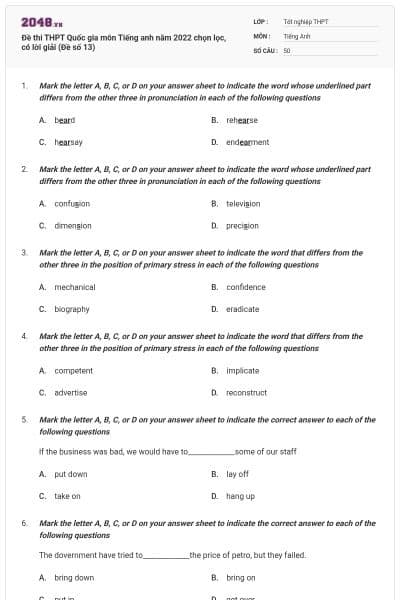
Mark the letter A, B, C, or D on your answer sheet to indicate the word whose underlined part differs from the other three in pronunciation in each of the following questions
beard
rehearse
hearsay
endearment
Đáp án B
- Beard /bɪəd/ (n): râu (người)
- Hearsay /ˈhɪəseɪ/ (n): tin đồn
- Rehearse /rɪˈhɜːs/ (v): diễn tập
- Endearment /ɪnˈdɪəmənt/ (n): lời âu yếm
Mark the letter A, B, C, or D on your answer sheet to indicate the word whose underlined part differs from the other three in pronunciation in each of the following questions
confusion
television
dimension
precision
Đáp án C
- Confusion (n) /kənˈfjuːʒn/: sự hoang mang, bối rối
- Television /ˈtelɪvɪʒn/ (n): ti-vi, vô tuyến truyền hình
- Dimension /daɪˈmenʃn/ (n): chiều, kích thước
- Precision /prɪˈsɪʒn/ (n): tính chính xác
Mark the letter A, B, C, or D on your answer sheet to indicate the word that differs from the other three in the position of primary stress in each of the following questions
mechanical
confidence
biography
eradicate
Đáp án B
- Mechanical /məˈkænɪkl/ (adj): (thuộc) cơ khí
- Biography /baɪˈɒɡrəfi/ (n): tiểu sử
- Confidence /ˈkɒnfɪdəns/ (n): sự tự tin
- Eradicate /ɪˈrædɪkeɪt/ (v): loại bỏ, trừ tiệt
Mark the letter A, B, C, or D on your answer sheet to indicate the word that differs from the other three in the position of primary stress in each of the following questions
competent
implicate
advertise
reconstruct
Đáp án D
- Competent /ˈkɒmpɪtənt/ (adj): có năng lực
- Advertise /'ædvətaiz/ (v): quảng cáo
- Implicate /ˈɪmplɪkeɪt/ (v): ngụ ý
- Reconstruct /ˌriːkənˈstrʌkt/ (v): xây dựng lại
Mark the letter A, B, C, or D on your answer sheet to indicate the correct answer to each of the following questions
If the business was bad, we would have to_____________some of our staff
put down
lay off
take on
hang up
Đáp án B
- lay off: cho nghỉ việc, sa thải
"Nếu việc kinh doanh tệ, chúng tôi phải sa thải một số nhân viên.”
Mark the letter A, B, C, or D on your answer sheet to indicate the correct answer to each of the following questions
The dovernment have tried to_____________the price of petro, but they failed.
bring down
bring on
put in
get over
Đáp án A
- bring down ~ reduce: giảm
"Chính phủ đã cố gắng giảm giá xăng, nhưng đã thất bại."
Mark the letter A, B, C, or D on your answer sheet to indicate the correct answer to each of the following questions
She came_____________a photo of her husband and a strange woman when she was cleaning the house
across
by
with
in
Đáp án A
- come across sth: tình cờ thấy cái gì
"Cô ấy đã tình cờ nhìn thấy một tấm ảnh của chồng cô ấy và một người phụ nữ lạ khi cô ấy đang dọn nhà."
Mark the letter A, B, C, or D on your answer sheet to indicate the correct answer to each of the following questions
Students can_____________a lot of information just by attending class and taking good notes of the lectures
absorb
provide
read
transmit
Đáp án: A
Giải thích:
Kiến thức: Từ vựng
Giải thích:
A. absorb (v): hấp thụ, tiếp thu
B. provide (v): cung cấp
C. read (v): đọc
D. transmit (v): truyền
Dựa vào nghĩa, chọn A.
Dịch: Các học sinh có thể tiếp thu rất nhiều thông tin chỉ qua việc lên lớp và ghi chép bài giảng tốt.
Mark the letter A, B, C, or D on your answer sheet to indicate the correct answer to each of the following questions
_____________flowers are usually made of plastic or silk
Unreal
False
Artificial
Untrue
Đáp án C
- unreal /ˌʌnˈrɪəl/ (adj): hư ảo, ảo tưởng, hão huyền
- false /fɔːls/ (adj): không thật, giả
- artificial /ˌɑːtɪˈfɪʃl/ (adj): nhân tạo; không tự nhiên, giả
+ artificial flowers: hoa giả
- untrue /ʌnˈtruː/ (adj): không đúng, sai, trái với sự thật
"Hoa giả thường được làm từ nhựa hoặc iụa."
Mark the letter A, B, C, or D on your answer sheet to indicate the correct answer to each of the following questions
Let's go swimming, _____________?
shall we
shall I
will you
don't you
Đáp án A
- Let’s trong lời rủ rê nên phần hỏi đuôi ta dùng "shall we"
"Chúng ta hãy đi bơi, được không?"
Mark the letter A, B, C, or D on your answer sheet to indicate the correct answer to each of the following questions
I'll give you another hour to_____________up your mind
give
go
make
take
Đáp án C
- make up one’s mind ~ decide: quyết định
"Tôi sẽ cho bạn thêm một tiếng nữa để quyết định."
Mark the letter A, B, C, or D on your answer sheet to indicate the correct answer to each of the following questions
The film was so_____________that many viewers cried.
moody
touching
touchy
moved
Đáp án B
- moody /ˈmuːdi/ (adj): tính khí thất thường, buồn rầu, ủ rũ
- touching /ˈtʌtʃɪŋ/ = moving (adj): making you feel emotional: cảm động
- touchy /ˈtʌtʃi/ - sensitive (adj): dễ động lòng, quá nhạy cảm (dùng cho người)
- moved (adj): cảm động, xúc động
"Bộ phim quá cảm động đến nỗi nhiều người xem đã khóc.”
Mark the letter A, B, C, or D on your answer sheet to indicate the correct answer to each of the following questions
. _____________the company, I'd like to thank you for your help.
According to
On behalf of
In addition to
Thanks to
Đáp án B
- according to: theo
- on behalf of: thay mặt cho
- in addition to: thêm vào
- thanks to: nhờ vào
"Thay mặt cho công ty, tôi muốn cảm ơn ông vì sự giúp đỡ
Mark the letter A, B, C, or D on your answer sheet to indicate the correct answer to each of the following questions
_____________at the party, we saw Jenifer standing alone
Arriving
We arrived
Arrived
We were arriving
Đáp án A
- Cấu trúc: V-ing.., a clause (S+V): rút gọn mệnh đề trạng ngữ (chủ động)
"Lúc đến bữa tiệc, chúng tôi đã nhìn thấy Jenifer đứng một mình
Mark the letter A, B, C, or D on your answer sheet to indicate the correct answer to each of the following questions
Her talent and experience_____________her to the respect of her colleagues.
permitted
qualified
deserved
entitled
Đáp án D
- be entitled to sth/ to do sth: được quyền làm điều gì, có quyền làm điều gì
"Tài năng và kinh nghiệm của mình đã cho cô ấy nhận được sự kính trọng của đồng nghiệp."
Mark the letter A, B, C, or D on your answer sheet to indicate the correct answer to each of the following questions
They were working overtime to cope with a sudden_____________in demand
surge
boost
impetus
thrust
Đáp án A
- surge (n): sự tăng lên đột ngột (surge in sth)
- boost: sự tăng lên
- impetus: sự thúc đấy, sự kích thí
- thrust: sự xô đẩy mạnh
"Họ làm việc thêm giờ đế giải quyết nhu cầu gia tăng đột ngột."
Mark the letter A, B, C, or D on your answer sheet to indicate the correct answer to each of the following questions
It can be difficult to teach young children because of their short attention_____________.
limit
span
duration
time
Đáp án B
- attention span: thời gian chú ý
"Có thể gặp khó khăn khi dạy trẻ nhỏ vì thời gian chú ý của chúng ngắn
Mark the letter A, B, C, or D on your answer sheet to indicate the correct answer to each of the following questions
He objected to_____________.
his mistakes being laughed at
laughing his mistakes at
his mistakes laughing at
his mistakes at laughing
Đáp án A
- object to + (O) + V-ing: phản đối, chống đối làm gì
"Anh ấy phản đối với việc bị cười nhạo vào những sai lầm của mình
Mark the letter A, B, C, or D on your answer sheet to indicate the correct answer to each of the following questions
_____________summer I spent in_____________USA was one of _____________best in my life
At/a/the
The/the/a
The/-/ the
The/the/the
Đáp án D
- The + danh từ + mệnh đề bổ trợ nghĩa cho danh từ
- The USA: Hoa Kỳ
- The + so sánh nhất (the best: tốt nhất)
"Mùa hè tôi trải qua ở Mỹ là một trong những mùa hè đẹp nhất trong cuộc đời tôi."
Mark the letter A, B, C, or D on your answer sheet to indicate the word(s) CLOSEST in meaning to the underlined word(s) in each of the following questions
She drives me to the edge because she never stops talking in class.
worries me
irritates me
pleases me
frightens me
Đáp án B
- drive sb to the edge ~ irritate sb: làm ai tức điên lên, làm ai bực mình
A. làm tôi lo lắng
C. làm tôi hài lòng
D. làm tôi sợ hãi
"Cô ấy làm tôi tức điên lên vì không bao giờ ngừng nói chuyện trong lớp."
Mark the letter A, B, C, or D on your answer sheet to indicate the word(s) CLOSEST in meaning to the underlined word(s) in each of the following questions.
Because the jury had reached a deadlock, the judge called for a retrial.
reduction
disagreement
impasse
verdict
Đáp án C
- deadlock ~ impasse (n): sự bế tắc - reduction (n): sự giảm
- disagreement (n): sự bất đồng - verdict (n): lời tuyên án
"Bởi vì bồi thẩm đoàn gặp bế tắc trong việc quyết định nên quan tòa yêu cầu xử lại."
Mark the letter A, B, C, or D on your answer sheet to indicate the word(s) OPPOSITE in meaning to the underlined word(s) in each of the following questions
Sarah's predominant features, what you first noticed about her, were her stunning black hair and big, dark eyes
inadequate
unnoticeable
universal
evident
Đáp án B
- predominant (adj): trội hơn hẳn, dễ nhận thấy # unnoticeable (adj): không thấy rõ, không
đáng chú ý
- inadequate (adj): không đầy đủ, không tương xứng
- universal (adj): chung, phổ thông
- evident (adj): rõ rệt
"Đặc điểm nổi bật dễ thấy của Sarah điều bạn nhìn thấy đầu tiên về cô ấy, là mái tóc đen tuyệt đẹp và đôi mắt to đen."
Mark the letter A, B, C, or D on your answer sheet to indicate the word(s) OPPOSITE in meaning to the underlined word(s) in each of the following questions
The shop assistant have to break off the conversation to serve a customer
interrupt
continue
hurry
begin
Đáp án B
- break off: tạm ngừng nói chuyện/ ngừng làm gì # continue: tiếp tục
- interrupt (v): ngắt quãng, gián đoạn
- hurry (v): vội vàng, nhanh lên
- begin (v): bắt đầu
"Người bán hàng phải ngừng cuộc nói chuyện để phục vụ khách hàng
Mark the letter A, B, C, or D on your answer sheet to indicate the option that best completes each of the following exchanges
Hoa and Nam are talking about their next exams.
Hoa: "Our final exams will start next Friday. Are you ready?" - Nam:" ____________"
I'm half ready
God save you
Thank you so much
Don't mention it!
Đáp án A
Hoa và Nam đang nói chuyện về kì thi sắp tới của mình.
- Hoa: "Kì thi cuối kì của chúng ta sẽ bắt đầu vào thứ Sáu tuần sau. Cậu sẵn sàng chưa?"
- Nam:"____________"
A. Tớ ôn được một nửa rồi. B. Chúa sẽ phù hộ cho cậu
C. Cám ơn cậu nhiều nhé. D. Không có gì (đáp lại lời cảm ơn)
Mark the letter A, B, C, or D on your answer sheet to indicate the option that best completes each of the following exchanges
Minh: "Can I bring a friend to your birthday party?" - Hoa:" ____________."
It's my pleasure to help you.
Let's do it then
The more the merrier
You're right
Đáp án C
- the more the merrier: càng đông càng vui
- Minh: "Tớ dẫn thêm bạn đến bữa tiệc sinh nhật cậu nhé?" - Hoa: "Càng đông càng vui cậu à."
A. Đó là niềm hân hạnh của tớ khi giúp cậu.
B. Chúng ta hãy làm điều đó sau.
D. Cậu đã đúng.
Read the following passage and mark the letter A, B, C, or D on your answer sheet to indicate the correct word or phrase that best fits each of the numbered blanks from 26 to 30.
An important part of building independence is allowing your teenagers to do things for themselves, (26) ____________their own decisions, and make mistakes. These are natural processes in life and people are wired to desire autonomy early in life. This need for early independence is designed to prepare individuals for adulthood. Allowing your children to become independent earlier in life can (27) ____________rebellion during the later stages of the teenage years. All teenagers have a need to express their individuality. Teenagers (28) ____________are not allowed to express their individuality are more likely to revolt.
(29) ____________, practicing self-reliance via independence will help eliminate public shyness and teach your kids to stand up for themselves when needed, including peer (30) ____________Early choice will also add confidence and prepare them for decision-making in adulthood.
take
do
get
make
Đáp án D
- make decisions (v): quyết định
"Một phần quan trọng của việc xây dựng tính độc lập là cho phép thanh thiếu niên tự mình làm mọi thứ, tự đưa ra quyết định và phạm sai lầm."
Read the following passage and mark the letter A, B, C, or D on your answer sheet to indicate the correct word or phrase that best fits each of the numbered blanks from 26 to 30.
An important part of building independence is allowing your teenagers to do things for themselves, (26) ____________their own decisions, and make mistakes. These are natural processes in life and people are wired to desire autonomy early in life. This need for early independence is designed to prepare individuals for adulthood. Allowing your children to become independent earlier in life can (27) ____________rebellion during the later stages of the teenage years. All teenagers have a need to express their individuality. Teenagers (28) ____________are not allowed to express their individuality are more likely to revolt.
(29) ____________, practicing self-reliance via independence will help eliminate public shyness and teach your kids to stand up for themselves when needed, including peer (30) ____________Early choice will also add confidence and prepare them for decision-making in adulthood.
minimize
increase
interfere
maximize
Đáp án A
- minimize (v): giảm đến mức tối thiếu - increase (v): tăng
- interfere (v): can thiệp - maximize (v): làm tăng đến tột độ, tăng tối đa
"Việc cho phép con bạn trở nên độc lập sớm trong cuộc sống có thể làm giảm tối thiểu sự nổi loạn sau đó của tuổi vị thành niên."
Read the following passage and mark the letter A, B, C, or D on your answer sheet to indicate the correct word or phrase that best fits each of the numbered blanks from 26 to 30.
An important part of building independence is allowing your teenagers to do things for themselves, (26) ____________their own decisions, and make mistakes. These are natural processes in life and people are wired to desire autonomy early in life. This need for early independence is designed to prepare individuals for adulthood. Allowing your children to become independent earlier in life can (27) ____________rebellion during the later stages of the teenage years. All teenagers have a need to express their individuality. Teenagers (28) ____________are not allowed to express their individuality are more likely to revolt.
(29) ____________, practicing self-reliance via independence will help eliminate public shyness and teach your kids to stand up for themselves when needed, including peer (30) ____________Early choice will also add confidence and prepare them for decision-making in adulthood.
whom
which
where
that
Đáp án D
Từ cần điền vào là đại từ quan hệ "who/ that" để thay thế cho chủ ngữ chỉ người
"Những thanh thiếu niên không được thể hiện cá tính của mình có nhiều khả năng nổi loạn hơn."
Read the following passage and mark the letter A, B, C, or D on your answer sheet to indicate the correct word or phrase that best fits each of the numbered blanks from 26 to 30.
An important part of building independence is allowing your teenagers to do things for themselves, (26) ____________their own decisions, and make mistakes. These are natural processes in life and people are wired to desire autonomy early in life. This need for early independence is designed to prepare individuals for adulthood. Allowing your children to become independent earlier in life can (27) ____________rebellion during the later stages of the teenage years. All teenagers have a need to express their individuality. Teenagers (28) ____________are not allowed to express their individuality are more likely to revolt.
(29) ____________, practicing self-reliance via independence will help eliminate public shyness and teach your kids to stand up for themselves when needed, including peer (30) ____________Early choice will also add confidence and prepare them for decision-making in adulthood
However
In addition
But
In contrast
Đáp án B
- However: Tuy nhiên - In addition: Thêm vào đó
- But: Nhưng - In contrast: Trái lại
"Thêm vào đó, rèn luyện tính tự lực thông qua sự độc lập sẽ giúp loại bỏ tính nhút nhát nơi công cộng và dạy con bạn tự vệ khi cần thiết..."
Read the following passage and mark the letter A, B, C, or D on your answer sheet to indicate the correct word or phrase that best fits each of the numbered blanks from 26 to 30.
An important part of building independence is allowing your teenagers to do things for themselves, (26) ____________their own decisions, and make mistakes. These are natural processes in life and people are wired to desire autonomy early in life. This need for early independence is designed to prepare individuals for adulthood. Allowing your children to become independent earlier in life can (27) ____________rebellion during the later stages of the teenage years. All teenagers have a need to express their individuality. Teenagers (28) ____________are not allowed to express their individuality are more likely to revolt.
(29) ____________, practicing self-reliance via independence will help eliminate public shyness and teach your kids to stand up for themselves when needed, including peer (30) ____________Early choice will also add confidence and prepare them for decision-making in adulthood
stress
help
pressure
advice
Đáp án C
- stress (n): căng thẳng
- help (n): sự giúp đỡ
- pressure (n): áp lực - advice (n): lời khuyên
+ peer pressure: áp lực của bạn bè
Read the following passage and mark the letter A, B, C, or D on your answer sheet to Indicate the correct answer to each of the questions from 31 to 35.
The term "virus" is derived from the Latin word for poison or slime. It was originally applied to the noxious stench emanating from swamps that was thought to cause a variety of diseases in the centuries before microbes were discovered and specifically linked to illness. But it was not until almost the end of the nineteenth century that a true virus was proven to be the cause of a disease.
The nature of viruses made them impossible to detect for many years even after bacteria had been discovered and studied. Not only are viruses too small to be seen with a light microscope, they also cannot be detected through their biological activity, except as it occurs in conjunction with other organisms. In fact, viruses show no traces of biological activity by themselves. Unlike bacteria, they are not living agents in the strictest sense. Viruses are very simple pieces of organic material composed only of nucleic acid, either DNA or RNA, enclosed in a coat of protein made up of simple structural units. (Some viruses also contain carbohydrates and lipids.) They are parasites, requiring human, animal, or plant cells to live. The virus replicates by attaching to a cell and injecting its nucleic acid.’ once inside the cell, the DNA or RNA that contains the virus' genetic information takes over the cell's biological machinery, and the cell begins to manufacture viral proteins rather than its own
Before microbes were discovered it was believed that some diseases were caused by____________.
germ-carrying insects
certain strains of bacteria
foul odors released from swamps
slimy creatures living near swamps
Đáp án C
Thông tin trong bài: 'The term "virus" is derived from the Latin word for poison or slime. It was originally applied to the noxious stench emanating from swamps that was thought to cause a variety of diseases in the centuries before microbes were discovered and specifically linked to illness." (Thuật ngữ "virus" có nguồn gốc từ tiếng Latin có nghĩa là chất độc hay chất nhờn. Ban đầu nó được áp dụng cho mùi hôi thối độc hại từ đầm lầy mà được cho là gây ra nhiều loại bệnh trong nhiều thế kỷ trước khi vi khuẩn được phát hiện và có liên quan cụ thể đến bệnh tật.)
Read the following passage and mark the letter A, B, C, or D on your answer sheet to Indicate the correct answer to each of the questions from 31 to 35.
The term "virus" is derived from the Latin word for poison or slime. It was originally applied to the noxious stench emanating from swamps that was thought to cause a variety of diseases in the centuries before microbes were discovered and specifically linked to illness. But it was not until almost the end of the nineteenth century that a true virus was proven to be the cause of a disease.
The nature of viruses made them impossible to detect for many years even after bacteria had been discovered and studied. Not only are viruses too small to be seen with a light microscope, they also cannot be detected through their biological activity, except as it occurs in conjunction with other organisms. In fact, viruses show no traces of biological activity by themselves. Unlike bacteria, they are not living agents in the strictest sense. Viruses are very simple pieces of organic material composed only of nucleic acid, either DNA or RNA, enclosed in a coat of protein made up of simple structural units. (Some viruses also contain carbohydrates and lipids.) They are parasites, requiring human, animal, or plant cells to live. The virus replicates by attaching to a cell and injecting its nucleic acid.’ once inside the cell, the DNA or RNA that contains the virus' genetic information takes over the cell's biological machinery, and the cell begins to manufacture viral proteins rather than its own.
The word "proven" in the passage is closest meaning to____________.
shown
feared
imagined
considered
Đáp án A (proven ~ shown: được chứng minh)
Thông tin trong bài: "But it was not until almost the end of the nineteenth century that a true virus was proven to be the cause of a disease." (Nhưng phải đến gần cuối thế kỷ 19, một loại virus thực sự mới được chứng minh là nguyên nhân gây bệnh.)
Read the following passage and mark the letter A, B, C, or D on your answer sheet to Indicate the correct answer to each of the questions from 31 to 35.
The term "virus" is derived from the Latin word for poison or slime. It was originally applied to the noxious stench emanating from swamps that was thought to cause a variety of diseases in the centuries before microbes were discovered and specifically linked to illness. But it was not until almost the end of the nineteenth century that a true virus was proven to be the cause of a disease.
The nature of viruses made them impossible to detect for many years even after bacteria had been discovered and studied. Not only are viruses too small to be seen with a light microscope, they also cannot be detected through their biological activity, except as it occurs in conjunction with other organisms. In fact, viruses show no traces of biological activity by themselves. Unlike bacteria, they are not living agents in the strictest sense. Viruses are very simple pieces of organic material composed only of nucleic acid, either DNA or RNA, enclosed in a coat of protein made up of simple structural units. (Some viruses also contain carbohydrates and lipids.) They are parasites, requiring human, animal, or plant cells to live. The virus replicates by attaching to a cell and injecting its nucleic acid.’ once inside the cell, the DNA or RNA that contains the virus' genetic information takes over the cell's biological machinery, and the cell begins to manufacture viral proteins rather than its own
The word "nature” in the passage is closest in meaning to____________.
self-sufficiency
shapes
characteristics
speed
Đáp án C (nature ~ characteristics: bản chất, những đặc điểm)
Thông tin trong bài: "The nature of viruses made them impossible to detect for many years even after bacteria had been discovered and studied." (Bản chất của virus khiến chúng không thể bị phát hiện trong nhiều năm ngay cả khi vi khuẩn đã được phát hiện và nghiên cứu.)
Read the following passage and mark the letter A, B, C, or D on your answer sheet to Indicate the correct answer to each of the questions from 31 to 35.
The term "virus" is derived from the Latin word for poison or slime. It was originally applied to the noxious stench emanating from swamps that was thought to cause a variety of diseases in the centuries before microbes were discovered and specifically linked to illness. But it was not until almost the end of the nineteenth century that a true virus was proven to be the cause of a disease.
The nature of viruses made them impossible to detect for many years even after bacteria had been discovered and studied. Not only are viruses too small to be seen with a light microscope, they also cannot be detected through their biological activity, except as it occurs in conjunction with other organisms. In fact, viruses show no traces of biological activity by themselves. Unlike bacteria, they are not living agents in the strictest sense. Viruses are very simple pieces of organic material composed only of nucleic acid, either DNA or RNA, enclosed in a coat of protein made up of simple structural units. (Some viruses also contain carbohydrates and lipids.) They are parasites, requiring human, animal, or plant cells to live. The virus replicates by attaching to a cell and injecting its nucleic acid.’ once inside the cell, the DNA or RNA that contains the virus' genetic information takes over the cell's biological machinery, and the cell begins to manufacture viral proteins rather than its own.
The author implies that bacteria were investigated earlier than viruses because____________.
bacteria are easier to detect
bacteria are harder to eradicate
viruses are extremely poisonous
viruses are found only in hot climates
Đáp án A
Thông tin trong bài: 'The nature of viruses made them impossible to detect for many years even after bacteria had been discovered and studied. Not only are viruses too small to be seen with a light microscope, they also cannot be detected through their biological activity, except as it occurs in conjunction with other organisms."
Read the following passage and mark the letter A, B, C, or D on your answer sheet to Indicate the correct answer to each of the questions from 31 to 35.
The term "virus" is derived from the Latin word for poison or slime. It was originally applied to the noxious stench emanating from swamps that was thought to cause a variety of diseases in the centuries before microbes were discovered and specifically linked to illness. But it was not until almost the end of the nineteenth century that a true virus was proven to be the cause of a disease.
The nature of viruses made them impossible to detect for many years even after bacteria had been discovered and studied. Not only are viruses too small to be seen with a light microscope, they also cannot be detected through their biological activity, except as it occurs in conjunction with other organisms. In fact, viruses show no traces of biological activity by themselves. Unlike bacteria, they are not living agents in the strictest sense. Viruses are very simple pieces of organic material composed only of nucleic acid, either DNA or RNA, enclosed in a coat of protein made up of simple structural units. (Some viruses also contain carbohydrates and lipids.) They are parasites, requiring human, animal, or plant cells to live. The virus replicates by attaching to a cell and injecting its nucleic acid.’ once inside the cell, the DNA or RNA that contains the virus' genetic information takes over the cell's biological machinery, and the cell begins to manufacture viral proteins rather than its own.
All of the following may be components of a virus EXCEPT____________.
RNA
plant cells
carbohydrates
a coat of protein
Đáp án B
Thông tin trong bài: "Viruses are very simple pieces of organic material composed only of nucleic acid, either DNA or RNA, enclosed in a coat of protein made up of simple structural units. Some viruses also contain carbohydrates and lipids..."
Read the following passage and mark the letter A, B, C, or D on your answer sheet to indicate the correct answer to each of the questions from 36 to 42
The Native Americans of northern California were very good at basketry, using the reeds, grasses, barks, and roots they found around them to fashion articles of all sorts and sizes - not only trays, containers, and cooking pots, but hats, boats, fish traps, baby carriers, and ceremonial objects.
Of all these experts, none excelled the Porno - a group who lived on or near the coast during the 1800's, and whose descendants continue to live in parts of the same region to this day. They made baskets three feet in diameter and others no bigger than a thimble. The Pomo people were masters of decoration. Some of their baskets were completely covered with shell pendants; others with feathers that made the baskets' surfaces as soft as the breasts of birds. Moreover, the Pomo people made use of more weaving techniques than did their neighbors. Most groups made all their basketwork by twining - the twisting of a flexible horizontal material, called a weft, around stiffer vertical strands of material, the warp, others depended primarily on coiling - a process in which a continuous coil of stiff material is held in the desired shape with tight wrapping of flexible strands. Only the Pomo people used both processes with equal ease and frequency. In addition, they made use of four distinct variations on the basic twining process, often employing more than one of them in a single article.
Although a wide variety of materials was available, the Pomo people used only a few. The warp was always made of willow, and the most commonly used weft was sedge root, a woody fiber that could easily be separated into strands no thicker than a thread. For color, the Pomo people used the bark of redbud for their twined work and dyed bulrush root for black in coiled work. Though other materials were sometimes used, these four were the staples in their finest basketry.
If the basketry materials used by the Pomo people were limited, the designs were amazingly varied. Every Pomo basketmaker knew how to produce from fifteen to twenty distinct patterns that could be combined in a number of different ways.
The word "fashion" in line 2 is closest in meaning to____________.
maintain
organize
trade
create
Đáp án D
- maintain (v): duy trì - organize (v): tổ chức
- trade (v): buôn bán - create (v): tạo ra
Thông tin trong bài: "The Native Americans of northern California were very good at basketry,
using the reeds, grasses, barks, and roots they found around them to fashion articles of all sorts and sizes - not only trays, containers, and cooking pots, but hats, boats, fish traps, baby carriers, and ceremonial objects.” (Người Mỹ bản địa ở bắc California rất giỏi trong việc đan rổ, sử dụng cày sậy, cỏ, vỏ cây và rễ cây họ tìm thấy xung quanh mình để tạo ra các mặt hàng với đủ loại và kích cồ - không chỉ khay, hộp đựng và nồi nấu ăn, mà còn cả mũ, thuyền, lưới cá, địu em bé và đồ dùng cho nghi lễ.)
_ fashion ~ create: tạo ra, tạo thành
Read the following passage and mark the letter A, B, C, or D on your answer sheet to indicate the correct answer to each of the questions from 36 to 42
The Native Americans of northern California were very good at basketry, using the reeds, grasses, barks, and roots they found around them to fashion articles of all sorts and sizes - not only trays, containers, and cooking pots, but hats, boats, fish traps, baby carriers, and ceremonial objects.
Of all these experts, none excelled the Porno - a group who lived on or near the coast during the 1800's, and whose descendants continue to live in parts of the same region to this day. They made baskets three feet in diameter and others no bigger than a thimble. The Pomo people were masters of decoration. Some of their baskets were completely covered with shell pendants; others with feathers that made the baskets' surfaces as soft as the breasts of birds. Moreover, the Pomo people made use of more weaving techniques than did their neighbors. Most groups made all their basketwork by twining - the twisting of a flexible horizontal material, called a weft, around stiffer vertical strands of material, the warp, others depended primarily on coiling - a process in which a continuous coil of stiff material is held in the desired shape with tight wrapping of flexible strands. Only the Pomo people used both processes with equal ease and frequency. In addition, they made use of four distinct variations on the basic twining process, often employing more than one of them in a single article.
Although a wide variety of materials was available, the Pomo people used only a few. The warp was always made of willow, and the most commonly used weft was sedge root, a woody fiber that could easily be separated into strands no thicker than a thread. For color, the Pomo people used the bark of redbud for their twined work and dyed bulrush root for black in coiled work. Though other materials were sometimes used, these four were the staples in their finest basketry.
If the basketry materials used by the Pomo people were limited, the designs were amazingly varied. Every Pomo basketmaker knew how to produce from fifteen to twenty distinct patterns that could be combined in a number of different ways.
The Pomo people used each of the following materials to decorate baskets EXCEPT____________.
shells
feathers
leaves
bark
Đáp án C
Người Pomo sử dụng các nguyên liệu sau để trang trí rổ NGOẠI TRỪ____________.
Thông tin trong bài: "The Native Americans of northern California were very good at basketry, using the reeds, grasses, barks, and roots they found around them to fashion articles of all sorts and sizes - not only trays, containers, and cooking pots, but hats, boats, fish traps, baby carriers, and ceremonial objects." (Người Mỹ bản địa ở bắc California rất giỏi trong việc đan rổ, sử dụng cây sậy, cỏ, vỏ cây và rễ cây họ tìm thấy xung quanh mình để tạo ra các mặt hàng với đủ loại và kích cỡ - không chỉ khay, hộp đựng và nồi nấu ăn, mà còn cả mũ, thuyền, lưới cá, địu em bé và đồ dùng cho nghi lễ.)
- 'The Pomo people were masters of decoration. Some of their baskets were completely covered with shell pendants; others with feathers that made the baskets’ surfaces as soft as the breasts of birds." (Người Pomo là bậc thầy về trang trí. Một sổ loại rổ của họ được bao phủ hoàn toàn bằng tòn ten vỏ sò; một số khác có lông vũ làm cho bề mặt của rổ mềm mại như ngực chim.)
Read the following passage and mark the letter A, B, C, or D on your answer sheet to indicate the correct answer to each of the questions from 36 to 42
The Native Americans of northern California were very good at basketry, using the reeds, grasses, barks, and roots they found around them to fashion articles of all sorts and sizes - not only trays, containers, and cooking pots, but hats, boats, fish traps, baby carriers, and ceremonial objects.
Of all these experts, none excelled the Porno - a group who lived on or near the coast during the 1800's, and whose descendants continue to live in parts of the same region to this day. They made baskets three feet in diameter and others no bigger than a thimble. The Pomo people were masters of decoration. Some of their baskets were completely covered with shell pendants; others with feathers that made the baskets' surfaces as soft as the breasts of birds. Moreover, the Pomo people made use of more weaving techniques than did their neighbors. Most groups made all their basketwork by twining - the twisting of a flexible horizontal material, called a weft, around stiffer vertical strands of material, the warp, others depended primarily on coiling - a process in which a continuous coil of stiff material is held in the desired shape with tight wrapping of flexible strands. Only the Pomo people used both processes with equal ease and frequency. In addition, they made use of four distinct variations on the basic twining process, often employing more than one of them in a single article.
Although a wide variety of materials was available, the Pomo people used only a few. The warp was always made of willow, and the most commonly used weft was sedge root, a woody fiber that could easily be separated into strands no thicker than a thread. For color, the Pomo people used the bark of redbud for their twined work and dyed bulrush root for black in coiled work. Though other materials were sometimes used, these four were the staples in their finest basketry.
If the basketry materials used by the Pomo people were limited, the designs were amazingly varied. Every Pomo basketmaker knew how to produce from fifteen to twenty distinct patterns that could be combined in a number of different ways.
What is the author's main point in the second paragraph?
The neighbors of the Pomo people tried to improve on the Pomo basket weaving techniques
The Pomo people were the most skilled basket weavers in their region
The Pomo people learned their basket weaving techniques from other Native Americans
The Pomo baskets have been handed down for generations
Đáp án B
Ý chính của đoạn thứ hai là gì?
A. Những người hàng xóm của người Pomo đã cố gắng cải tiến kỹ thuật đan rổ của người Pomo.
B. Người Pomo là những người đan rổ lành nghề nhất trong khu vực của mình.
C. Người Pomo học kỹ thuật đan rổ từ những thổ dân Mỹ bản địa khác.
D. Những chiếc rổ Pomo đã được truyền qua nhiều thế hệ.
Thông tín trong bài: "Of all these experts, none excelled the Porno - a group who lived on or near the coast during the 1800's, and whose descendants continue to live in parts of the same region to this day." (Trong số tất cả các chuyên gia này, không ai giỏi hơn người dân Pomo - một nhóm sống trên biển hoặc gần bờ biển trong những năm 1800 và con cháu của họ tiếp tục sống ở các vùng của cùng một khu vực cho đến ngày nay.)
Read the following passage and mark the letter A, B, C, or D on your answer sheet to indicate the correct answer to each of the questions from 36 to 42
The Native Americans of northern California were very good at basketry, using the reeds, grasses, barks, and roots they found around them to fashion articles of all sorts and sizes - not only trays, containers, and cooking pots, but hats, boats, fish traps, baby carriers, and ceremonial objects.
Of all these experts, none excelled the Porno - a group who lived on or near the coast during the 1800's, and whose descendants continue to live in parts of the same region to this day. They made baskets three feet in diameter and others no bigger than a thimble. The Pomo people were masters of decoration. Some of their baskets were completely covered with shell pendants; others with feathers that made the baskets' surfaces as soft as the breasts of birds. Moreover, the Pomo people made use of more weaving techniques than did their neighbors. Most groups made all their basketwork by twining - the twisting of a flexible horizontal material, called a weft, around stiffer vertical strands of material, the warp, others depended primarily on coiling - a process in which a continuous coil of stiff material is held in the desired shape with tight wrapping of flexible strands. Only the Pomo people used both processes with equal ease and frequency. In addition, they made use of four distinct variations on the basic twining process, often employing more than one of them in a single article.
Although a wide variety of materials was available, the Pomo people used only a few. The warp was always made of willow, and the most commonly used weft was sedge root, a woody fiber that could easily be separated into strands no thicker than a thread. For color, the Pomo people used the bark of redbud for their twined work and dyed bulrush root for black in coiled work. Though other materials were sometimes used, these four were the staples in their finest basketry.
If the basketry materials used by the Pomo people were limited, the designs were amazingly varied. Every Pomo basketmaker knew how to produce from fifteen to twenty distinct patterns that could be combined in a number of different ways.
According to the passage, a weft is a____________.
tool for separating sedge root
process used for coloring baskets
pliable material woven around the warp
pattern used to decorate baskets
Đáp án C
Theo bài đọc, một sợi ngang là một_____________
A. dụng cụ tách rễ cói
C. sợi dẻo đan xung quanh sợi dọc
B. quy trình dùng để tô màu cho rổ
D. mẫu dùng để trang trí rổ
Thông tin trong bài: "Most groups made all their basketwork by twining - the twisting of a flexible horizontal material, called a weft, around stiffer vertical strands of material, the warp." (Hầu hết các nhóm đã thực hiện tất cả các công việc đan rổ của mình bằng cách xoắn - việc xoắn của một chất liệu nằm ngang linh hoạt, được gọi là sợi ngang, quanh các sợi chất liệu dọc cứng hơn gọi là sợi dọc.)
Read the following passage and mark the letter A, B, C, or D on your answer sheet to indicate the correct answer to each of the questions from 36 to 42
The Native Americans of northern California were very good at basketry, using the reeds, grasses, barks, and roots they found around them to fashion articles of all sorts and sizes - not only trays, containers, and cooking pots, but hats, boats, fish traps, baby carriers, and ceremonial objects.
Of all these experts, none excelled the Porno - a group who lived on or near the coast during the 1800's, and whose descendants continue to live in parts of the same region to this day. They made baskets three feet in diameter and others no bigger than a thimble. The Pomo people were masters of decoration. Some of their baskets were completely covered with shell pendants; others with feathers that made the baskets' surfaces as soft as the breasts of birds. Moreover, the Pomo people made use of more weaving techniques than did their neighbors. Most groups made all their basketwork by twining - the twisting of a flexible horizontal material, called a weft, around stiffer vertical strands of material, the warp, others depended primarily on coiling - a process in which a continuous coil of stiff material is held in the desired shape with tight wrapping of flexible strands. Only the Pomo people used both processes with equal ease and frequency. In addition, they made use of four distinct variations on the basic twining process, often employing more than one of them in a single article.
Although a wide variety of materials was available, the Pomo people used only a few. The warp was always made of willow, and the most commonly used weft was sedge root, a woody fiber that could easily be separated into strands no thicker than a thread. For color, the Pomo people used the bark of redbud for their twined work and dyed bulrush root for black in coiled work. Though other materials were sometimes used, these four were the staples in their finest basketry.
If the basketry materials used by the Pomo people were limited, the designs were amazingly varied. Every Pomo basketmaker knew how to produce from fifteen to twenty distinct patterns that could be combined in a number of different ways.
According to the passage, what did the Pomo people use as the warp in their baskets?
bulrush
willow
sedge
redbud
Đáp án B
Thông tin trong bài: 'The warp was always made of willow, and the most commonly used weft was sedge root, a woody fiber that could easily be separated into strands no thicker than a thread." (Sợi dọc luôn được làm bằng liễu, và sợi ngang được sử dụng phổ biển nhất là rễ cói, một loại sợi thân gỗ có thể dễ dàng tách ra thành sợi không dày hơn sợi chỉ.)
Read the following passage and mark the letter A, B, C, or D on your answer sheet to indicate the correct answer to each of the questions from 36 to 42
The Native Americans of northern California were very good at basketry, using the reeds, grasses, barks, and roots they found around them to fashion articles of all sorts and sizes - not only trays, containers, and cooking pots, but hats, boats, fish traps, baby carriers, and ceremonial objects.
Of all these experts, none excelled the Porno - a group who lived on or near the coast during the 1800's, and whose descendants continue to live in parts of the same region to this day. They made baskets three feet in diameter and others no bigger than a thimble. The Pomo people were masters of decoration. Some of their baskets were completely covered with shell pendants; others with feathers that made the baskets' surfaces as soft as the breasts of birds. Moreover, the Pomo people made use of more weaving techniques than did their neighbors. Most groups made all their basketwork by twining - the twisting of a flexible horizontal material, called a weft, around stiffer vertical strands of material, the warp, others depended primarily on coiling - a process in which a continuous coil of stiff material is held in the desired shape with tight wrapping of flexible strands. Only the Pomo people used both processes with equal ease and frequency. In addition, they made use of four distinct variations on the basic twining process, often employing more than one of them in a single article.
Although a wide variety of materials was available, the Pomo people used only a few. The warp was always made of willow, and the most commonly used weft was sedge root, a woody fiber that could easily be separated into strands no thicker than a thread. For color, the Pomo people used the bark of redbud for their twined work and dyed bulrush root for black in coiled work. Though other materials were sometimes used, these four were the staples in their finest basketry.
If the basketry materials used by the Pomo people were limited, the designs were amazingly varied. Every Pomo basketmaker knew how to produce from fifteen to twenty distinct patterns that could be combined in a number of different ways.
The word "staples" in line 21 is closest in meaning to____________.
combinations
limitations
accessories
basic elements
Đáp án D
- combination: sự kết hợp - limitation (n): sự hạn chế
- accessory (n): phụ kiện, đồ phụ tùng - basic elements: yếu tố/ thành phần cơ bản
Thông tin trong bài: "Though other materials were sometimes used, these four were the staphs in their finest basketry." (Mặc dù đôi khi các nguyên liệu khác được sử dụng nhưng bổn nguyên liệu này là yếu tố chủ yếu giúp cho việc đan rổ đẹp nhất.)
Read the following passage and mark the letter A, B, C, or D on your answer sheet to indicate the correct answer to each of the questions from 36 to 42
The Native Americans of northern California were very good at basketry, using the reeds, grasses, barks, and roots they found around them to fashion articles of all sorts and sizes - not only trays, containers, and cooking pots, but hats, boats, fish traps, baby carriers, and ceremonial objects.
Of all these experts, none excelled the Porno - a group who lived on or near the coast during the 1800's, and whose descendants continue to live in parts of the same region to this day. They made baskets three feet in diameter and others no bigger than a thimble. The Pomo people were masters of decoration. Some of their baskets were completely covered with shell pendants; others with feathers that made the baskets' surfaces as soft as the breasts of birds. Moreover, the Pomo people made use of more weaving techniques than did their neighbors. Most groups made all their basketwork by twining - the twisting of a flexible horizontal material, called a weft, around stiffer vertical strands of material, the warp, others depended primarily on coiling - a process in which a continuous coil of stiff material is held in the desired shape with tight wrapping of flexible strands. Only the Pomo people used both processes with equal ease and frequency. In addition, they made use of four distinct variations on the basic twining process, often employing more than one of them in a single article.
Although a wide variety of materials was available, the Pomo people used only a few. The warp was always made of willow, and the most commonly used weft was sedge root, a woody fiber that could easily be separated into strands no thicker than a thread. For color, the Pomo people used the bark of redbud for their twined work and dyed bulrush root for black in coiled work. Though other materials were sometimes used, these four were the staples in their finest basketry.
If the basketry materials used by the Pomo people were limited, the designs were amazingly varied. Every Pomo basketmaker knew how to produce from fifteen to twenty distinct patterns that could be combined in a number of different ways.
Which of the following statements about Pomo baskets can be best inferred from the passage?
Baskets produced by other Native Americans were less varied in design than those of the Pomo people
Baskets produced by Pomo weavers were primarily for ceremonial purposes
There were a very limited number of basket-making materials available to the Pomo people
The basket-making production of the Pomo people has increased over the years
Đáp án A
Câu phát biểu nào sau đây về rổ Pomo có thể được suy ra đúng nhất từ bài đọc?
A. Rổ do những người Mỹ bản địa khác sản xuất có thiết kế ít đa dạng hơn so với rổ của người Pomo.
B. Những chiếc rổ do người Pomo đan chủ yếu dùng cho mục đích nghi lễ.
C. Có một số lượng rất hạn chế các nguyên liệu làm rổ sẵn có cho người Pomo.
D. Việc sản xuất rổ của người Pomo đã tăng lên qua các năm.
Thông tin trong bài: "If the basketry materials used by the Porno people were limited, the designs were amazingly varied. Every Porno basketmaker knew how to produce from fifteen to twenty distinct patterns that could be combined in a number of different ways." (Nếu những nguyên liệu đan rổ mà người Pomo sử dụng còn hạn chế thì các thiết kế lại đa dạng một cách đáng kinh ngạc. Mỗi thợ đan rổ của Pomo đều biết cách tạo ra từ 15 đến 20 mẫu thiết kế riêng biệt mà có thể được kết hợp theo nhiều cách khác nhau.)
Mark the letter A, B, C, or D on your answer sheet to indicate the underlined part that needs correction in each of the following questions
The (A) discovery of penicillin in 1928 (B) has not produced antibiotics (C) useful for the treatment of (D) infectious diseases until 1940
discovery
has not produced
useful
infectious
Đáp án B (has not produced _ did not produced)
- Sự việc này đã xảy ra vào một thời điểm xác định trong quá khứ _ động từ chia ở thì quá khứ đơn
"Việc phát hiện ra penicillin vào năm 1928 vẫn chưa tạo ra được kháng sinh hữu ích cho việc điều trị các bệnh truyền nhiễm mãi cho đến năm 1940."
Mark the letter A, B, C, or D on your answer sheet to indicate the underlined part that needs correction in each of the following questions
The Mississippi, the (A) longest river in the USA, begins (B) as small (C) clear stream in (D) northwestern Minnesota
longest
as small
clear
northwestern
Đáp án B (as small _ as a small)
Cấu trúc: a/ an + adj + N (singular)
"Mississippi, con sông dài nhất ở Mỹ, bắt đầu là một dòng suối nhỏ trong vắt ở Tây Bắc Minnesota."
Mark the letter A, B, C, or D on your answer sheet to indicate the underlined part that needs correction in each of the following questions
A) Before the invention of (B) the printing press, books (C) have been all printed (D) by hand
Before
the printing
have been
by hand
Đáp án C (have been _ had been)
- Thì quá khứ hoàn thành dùng đế diễn tả hành động đã xảy ra và hoàn tất trước một thời điếm, hoặc trước một hành động khác cũng đã kết thúc trong quá khứ.
"Trước khi phát minh ra máy in, sách được in toàn bộ bằng tay."
Mark the letter A, B, C, or D on your answer sheet to indicate the sentence that is closest in meaning to each of the following questions
It was so hot on the bus Lucy thought she was going to faint
The bus was so hot that Lucy felt fainted
Lucy thought she was on the point of fainting because it was so hot on the bus
Lucy nearly fainted because of the heating of the bus
As soon as the bus got hot, Lucy fainted
Đáp án B
"Trên xe buýt quá nóng đến mức mà Lucy nghĩ rằng mình sắp ngất."
A. Xe buýt quá nóng nên Lucy đã cảm thấy ngất.
B. Lucy nghĩ mình sắp ngất vì quá nóng trên xe buýt.
C. Lucy đã gần ngất vì sức nóng của xe buýt.
D. Ngay khi xe buýt sắp phát nóng thì Lucy đã ngất.
Cấu trúc: on the point of doing sth: sắp làm gì
Mark the letter A, B, C, or D on your answer sheet to indicate the sentence that is closest in meaning to each of the following questions
The boss completely deceived him
He was given a full conception by the boss
He was completely taken in by the boss
The boss had full conception of him
He was criticized by the boss
Đáp án B
"Sếp hoàn toàn lừa anh ấy."
- take in ~ deceive: lừa dối
A, C, D không hợp nghĩa
Mark the letter A, B, C, or D on your answer sheet to indicate the sentence that is closest in meaning to each of the following questions
It is regretful that they destroyed the oldest building
They wouldn't have destroyed the oldest building
They shouldn't have destroyed the oldest building
They couldn't have destroyed the oldest building
They can't have destroyed the oldest building
Đáp án B
"Điều hối tiếc là họ đã phát hủy tòa nhà cổ nhất." _ Họ đáng lẽ ra không nên phá hủy tòa nhà cổ nhất."
Cấu trúc: shouldn't have PP: lẽ ra đã không nên làm gì
Mark the letter A, B, C, or D on your answer sheet to indicate the sentence that best combines each pair of sentences in the following questions
He was able to finish his book. It was because his wife helped him.
If only he had been able to finish his book
Without his wife's help, he couldn't have finished his book
If it weren't for his wife's help, he couldn't have finished his book
But for his wife's help, he couldn't finish his book
Đáp án B
"Anh ấy đã có thể hoàn thành xong cuốn sách của mình. Đó là bởi vì vợ anh ấy đã giúp đỡ anh ấy."
A. Giá như anh ấy đã có thể hoàn thành xong cuốn sách của mình.
B. Nếu không có sự giúp đỡ của vợ thì anh ấy đã không thể hoàn thành xong cuốn sách của mình.
C. dùng sai câu điều kiện _ If it hadn't been for N,...
D. dùng sai câu điều kiện _ couldn't have finished
Cấu trúc: Without/ But for + N: nếu không có ...
Mark the letter A, B, C, or D on your answer sheet to indicate the sentence that best combines each pair of sentences in the following questions
"You got an A in English. Congratulations!" Peter said to his classmate.
Peter encouraged his classmate to get an A in English
Peter persuaded his classmate to get an A in English
Peter insisted on getting an A in English for his classmate
Peter congratulated his classmate on getting an A in English
Đáp án D
"Cậu đã nhận điểm A môn Tiếng Anh. Xin chúc mừng cậu nhé!" Peter đã nói với người bạn cùng lớp.
_ Peter đã chúc mừng người bạn cùng lớp đã nhận điểm A môn Tiếng Anh.
Cấu trúc: - encourage sb to do sth: khuyến khích ai làm gì
- persuade sb to do sth: thuyết phục ai làm gì
- insist on doing sth: khăng khăng làm gì
- congratulate sb on doing sth: chúc mừng ai làm gì