Đề luyện thi THPT quốc gia môn tiếng anh có lời giải (Đề số 11)
50 câu hỏi
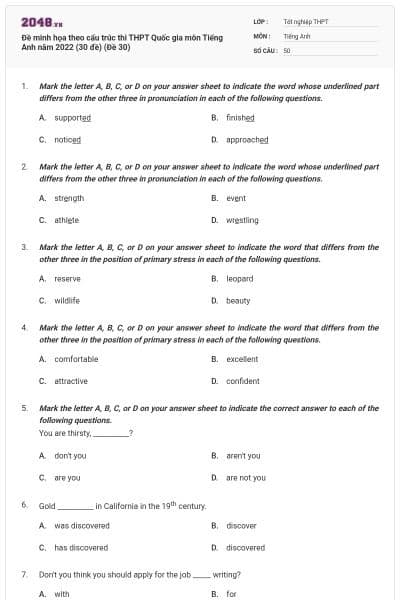
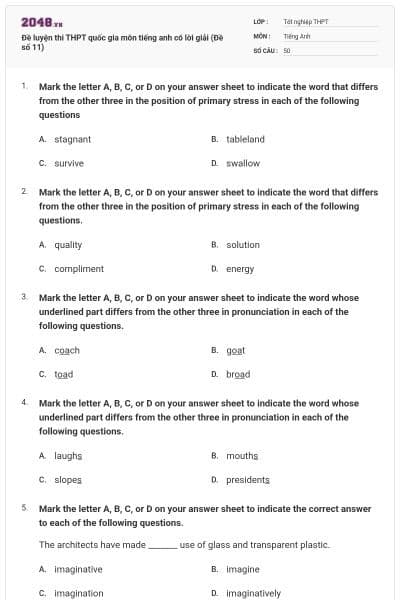
Mark the letter A, B, C, or D on your answer sheet to indicate the word that differs from the other three in the position of primary stress in each of the following questions
stagnant
tableland
survive
swallow
Đáp án C
Kiến thức: Trọng âm của từ có 2 và 3 âm tiết
Giải thích:
stagnant /'stægnənt/ tableland /'teibllænd/
survive /sə'vaiv/ swallow /'swɒləʊ/
Câu C trọng âm rơi vào âm tiết thứ 2 còn lại là thứ nhất
Mark the letter A, B, C, or D on your answer sheet to indicate the word that differs from the other three in the position of primary stress in each of the following questions.
quality
solution
compliment
energy
Đáp án B
Kiến thức: từ vựng, trọng âm
Giải thích:
A. quality /ˈkwɒləti/ B. solution /səˈluːʃn/
C. compliment /ˈkɒmplɪmənt/ D. energy /ˈenədʒi/
Câu B trọng âm rơi vào âm thứ 2, còn lại là thứ nhất
Mark the letter A, B, C, or D on your answer sheet to indicate the word whose underlined part differs from the other three in pronunciation in each of the following questions.
coach
goat
toad
broad
Đáp án D
Phần gạch chân ở đáp án D phát âm là /ɔː/, các đáp án khác phát âm là /əʊ/
A. coach /kəʊtʃ/: huấn luyện viên
B. goat /ɡəʊt/: con dê
C. toad /təʊd/: con cóc
D. broad /brɔːd/: rộng
Mark the letter A, B, C, or D on your answer sheet to indicate the word whose underlined part differs from the other three in pronunciation in each of the following questions.
laughs
mouths
slopes
presidents
Đáp án A
Cách phát âm đuôi “s/es”
- Phát âm là /s/ khi từ có tận cùng bằng các phụ âm vô thanh: /ð/, /p/, /k/, /f/, /t/, /θ/.
- Phát âm là /ɪz/ khi từ có tận cùng là các âm: /s/, /z/, /ʃ/, /tʃ/, /ʒ/, /dʒ/.
- Phát âm là /z/ khi các từ có tận cùng là nguyên âm và các phụ âm hữu thanh còn lại.
Trường hợp đặc biệt: mouth /maʊθ/ khi ở dạng số nhiều mouths được phát âm là /maʊðz/.
Mark the letter A, B, C, or D on your answer sheet to indicate the correct answer to each of the following questions.
The architects have made _______ use of glass and transparent plastic.
imaginative
imagine
imagination
imaginatively
Đáp án A
Kiến thức: từ vựng, từ loại
Giải thích:
imaginative (adj): sáng tạo imagine (v): tưởng tượng
imagination (n): trí tưởng tượng imaginatively (adv): sáng tạo
Ở đây từ cần điền là một tính từ.
Tạm dịch: Các kiến trúc sư đã sử dụng sáng tạo thủy tinh và nhựa trong suốt
Your brother hardly talks to anyone, _______?
does he
is he
doesn’t he
isn’t he
Đáp án A
Kiến thức: từ vựng, câu hỏi đuôi
Giải thích:
Cấu trúc câu hỏi đuôi với động từ thường: S + V(s/es)….., don’t/doesn’t + S?
Trong câu có các trạng từ phủ định và bán phủ định như: never, seldom, hardly, scarely, little… thì câu đó được
xem như là câu phủ định – phần hỏi đuôi sẽ ở dạng khẳng định.
Tạm dịch: Có phải anh của cậu rất ít nói chuyện với mọi người không?
Only after she had finished the course did she realize she _____ a wrong choice
had made
has made
had been making
was making
Đáp án A
Kiến thức: từ vựng, thì trong tiếng Anh
Giải thích:
Diễn tả một sự việc diễn ra trước một sự việc khác trong quá khứ => Dùng thì quá khứ hoàn thành: S + had + V.p.p
Tạm dịch: Chỉ sau khi cô ấy kết thúc khóa học thì cô ấy mới nhận ra rằng mình đã có một quyết định sai lầm
You looked exhausted. I think you’ve _______ more than you can handle.
turned on
taken up
turned up
taken on
Đáp án B
Kiến thức: từ vựng, cụm động từ
Giải thích:
turn on: bật take up: đảm nhiệm, gánh vác công việc
turn up: xuất hiện take on: thuê
Tạm dịch: Trông cậu thật mệt mỏi. Tớ nghĩ cậu đang gánh vác nhiều hơn những gì cậu có thể xử lý.
You need to make ______ about what course to take at university
a decision
a fortune
a guess
an impression
Đáp án A
Kiến thức: từ vựng
Giải thích:
make a decision: quyết định make a fortune: trở nên giàu có
make a guess: dự đoán make an impression: gây ấn tượng
Tạm dịch: Bạn cần phải quyết định tham gia khóa học nào ở trường đại học.
They _________ tired now because they _________ in the garden since 8 o’clock.
are / worked
were / were working
are / have been working
were / worked
Đáp án C
Thì hiện tại tiếp diễn diễn đạt một hành động đang xảy ra tại thời điểm nói. Trong câu xuất hiện dấu hiệu nhận biết thì hiện tại tiếp diễn now.
Thì hiện tại hoàn thành tiếp diễn dùng để diễn tả hành động bắt đầu ở quá khứ và còn đang tiếp tục ở hiện tại (nhấn mạnh tính liên tục).
Dịch nghĩa: Bây giờ họ rất mệt bởi vì họ đã làm việc trong vường từ lúc 8 giờ
We have bought some _________
German lovely old glasses
German old lovely glasses
lovely old German glasses
old lovely German glasses
Đáp án C
Trật tự của tính từ: Opinion – Size – Age – Shape – Color – Origin – Material – Purpose
lovely => Opinion
old => Age
German => Origin
Dịch nghĩa: Chúng tôi vừa mua vài cặp kính Đức cũ đáng yêu
I enjoy _________ busy. I don’t like it when there is nothing _________
being / to do
to be / doing
to be / to do
being / doing
Đáp án A
(to) enjoy doing something: thích làm gì
to V: để làm gì
Dịch nghĩa: Tôi rất thích bận rộn. Tôi không thích khi mà chẳng có gì để làm
He sent his children to the park so that he could have some _________
fresh and quiet
quiet and peace
peace and quiet
fresh and peace
Đáp án C
Thành ngữ peace and quiet: bình yên và tĩnh lặng
Dịch nghĩa: Ông ấy gửi những đứa trẻ đến công viên để có thể có một chút bình yên và tĩnh lặng.
He was the last man _________ the ship
who leave
to leave
leaving
left
Đáp án B
Rút gọn mệnh đề quan hệ bằng to V khi danh từ đứng trước có các từ bổ nghĩa như : only, last, số thứ tự như: first, second…
Dịch nghĩa: Anh ta là người đàn ông cuối cùng rời khỏi con tàu
The local were not very friendly towards us, in fact there was a distinctly _________ atmosphere.
hostile
offensive
rude
abrupt
Đáp án A
Câu hỏi từ vựng.
A. hostile (adj): thù địch, không thân thiện
B. offensive (adj): xúc phạm
C. rude (adj): thô lỗ
D. abrupt (adj): cọc cằn
Dịch nghĩa: Những người dân địa phương không thân thiện lắm với chúng tôi, trên thực tế còn có một bầu không khí thù địch rõ rệt
I _________ to see Chris on my way home
dropped back
dropped in
dropped out
dropped off
Đáp án B
(to) drop in: ghé qua
Các đáp án còn lại:
A. (to) drop back: rơi lại vào tình trạng nào đó
C. (to) drop out: biến mất
D. (to) drop off: lần lượt bỏ đi
Dịch nghĩa: Tôi sẽ ghé qua để gặp Chris trên đường về nhà
Mark the letter A, B, C, or D on your answer sheet to indicate the word(s) CLOSEST in meaning to the underlined word (s) in each of the following questions.
The way the care-taker treated those little children was deplorable. She must be punished for what she did
respectable
unacceptable
mischievous
satisfactory
Đáp án B
Kiến thức: từ vựng, từ đồng nghĩa
Giải thích: deplorable (adj): tồi tệ, không thể chấp nhận được
respectable (adj): đáng kính trọng unacceptable (adj): không thể chấp nhận được
mischievous (adj): tinh nghịch satisfactory (adj): thỏa mãn, đạt yêu cầu
=> unacceptable = deplorable
Tạm dịch: Cách mà người bảo mẫu đối xử với những đứa trẻ đó là không thể chấp nhận được. Cô ấy phải bị trừng phạt vì những gì cô ấy đã làm
Mark the letter A, B, C, or D on your answer sheet to indicate the word(s) CLOSEST in meaning to the underlined word (s) in each of the following questions
At times, I look at him and wonder what is going on his mind.
Never
Always
Hardly
Sometimes
Đáp án D
At times = Sometimes: đôi khi, thỉnh thoảng
Các đáp án còn lại:
A. Never: không bao giờ
B. Always: luôn luôn
C. Hardly: hầu như không
Dịch nghĩa: Đôi khi, tôi nhìn vào anh ta và tự hỏi rằng cái gì đang diễn ra trong đầu anh ta
Mark the letter A, B, C, or D on your answer sheet to indicate the word(s) OPPOSITE in meaning to the underlined word(s) in each of the following questions.
At first, no one believed she was a pilot, but her documents lent colour to her statements.
provided evidence for
got information from
borrowed color from
gave no proof of
Đáp án D
Kiến thức: từ vựng, từ trái nghĩa
Giải thích: lend colour to something: chứng minh
provide evidence for: cung cấp chứng cứ cho
give no proof of: không có bằng chứng
=> give no proof >< lend colour to something
Tạm dịch: Lúc đầu, không ai tin rằng cô ấy là phi công, nhưng các tài liệu của cô ấy đã chứng minh cho câu nói của cô
Mark the letter A, B, C, or D on your answer sheet to indicate the word(s) OPPOSITE in meaning to the underlined word(s) in each of the following questions.
The nominating committee always meet behind closed doors, lest its deliberations become known prematurely
privately
safely
publicly
dangerously
Đáp án: C
Giải thích:
behind closed doors: kín, không công khai >< publicly (adv): công khai
Các đáp án còn lại:
A. privately (adv): riêng tư
B. safely (adv): an toàn
D. dangerously (adv): nguy hiểm
Dịch: Ủy ban bổ nhiệm luôn gặp nhau một cách kín đáo, để buổi thảo luận của họ không được biết đến quá sớm.
Mark the letter A, B, C, or D on your answer sheet to indicate the sentence that best completes each of the following exchanges.
Mike an Joe are talking about transport in the future.
- Mike: “Do you think there will be pilotless planes?”
- Joe: “_____”
I’m afraid I can’t
What for? There are quite a few around
Why not? There have been cars without drivers
I’m glad you like it
Đáp án C
Kiến thức: từ vựng, hội thoại giao tiếp
Tạm dịch: Mike và Joe đang nói chuyện về giao thông trong tương lai.
- Mike: “Cậu có nghĩ rằng sẽ có máy bay không người lái không?” Joe: “______”
A. Mình e là mình không thể
B. Để làm gì? Có một vài cái xung quanh đây.
C. Tại sao không? Chúng ta đã có ô tô không người lái rồi mà.
D. Mình vui vì cậu thích chúng
Mark the letter A, B, C, or D on your answer sheet to indicate the sentence that best completes each of the following exchanges.
John is in Hanoi and wants to change some money. He asks the local passer-by the way to the bank. Choose the most suitable response to fill in the blank in the following exchange
- John: “Can you show me the way to the nearest bank, please?” - Passer-by: “_______.”
Not way, sorry
Just round the corner over there
Look it up in a dictionary!
There’s no traffic near here
Đáp án B
Dịch nghĩa: John đang ở Hà Nội và muốn đổi một chút tiền. Anh ta hỏi người dân địa phương đi qua đường đến ngân hàng. Chọn câu trả lời phù hợp nhất để điền vào chỗ trống trong cuộc trò chuyện sau.
- John: “Bạn có thể chỉ cho tôi đường đến ngân hàng gần nhất không?”
- Người qua đường: “Chỉ đâu đó ở góc kia thôi.”
Các đáp án còn lại
A. Không có đường, xin lỗi
C. Tìm nó trong từ điển ấy!
D. Không có phương tiện giao thông quanh đây
Read the following passage and mark the letter A, B, C, or D on your answer sheet to indicate the correct word or phrase that best fits each of the numbered blanks from 23 to 27.
I had never been to Denmark before, so when I set out to catch the ferry in early May, I little
suspected that by the end of the trip I'd have made such lasting friendships. Esjberg is a (23) ________ port for a cyclist's arrival, where tourist information can be obtained and money changed. A cycle track leads (24) ________ town and down to Ribe, where I spent my first night. The only appointment I had to keep was a meeting with a friend who was flying out in June. I wanted to use my time well, so I had planned a route which would include several small islands and various parts of the countryside.
In my (25) ________, a person travelling alone sometimes meets with unexpected hospitality, and this trip was no (26) ________. On only my second day, I got into conversation with a cheerful man who turned out to be the local baker. He insisted that I should join his family for lunch, and, while we were eating, he contacted his daughter in Odense. Within minutes, he had (27) ________ for me to visit her and her family. Then I was sent on my way with a fresh loaf of bread to keep me going and the feeling that this would turn out to be a wonderful holiday.
Điền ô số 23
capable
ready
favorable
convenient
Đáp án D
Câu hỏi từ vựng.
A. capable (adj): có khả năng
B. ready (adj): sắn sàng
C. favorable (adj): thuận lợi
D. convenient (adj): tiện lợi, thuận tiện
Dịch nghĩa: Esbjerg là một cảng thuận tiện cho người đi xe đạp, nơi có thể thu thập được thông tin du lịch và đổi được tiền
Read the following passage and mark the letter A, B, C, or D on your answer sheet to indicate the correct word or phrase that best fits each of the numbered blanks from 23 to 27.
I had never been to Denmark before, so when I set out to catch the ferry in early May, I little
suspected that by the end of the trip I'd have made such lasting friendships. Esjberg is a (23) ________ port for a cyclist's arrival, where tourist information can be obtained and money changed. A cycle track leads (24) ________ town and down to Ribe, where I spent my first night. The only appointment I had to keep was a meeting with a friend who was flying out in June. I wanted to use my time well, so I had planned a route which would include several small islands and various parts of the countryside.
In my (25) ________, a person travelling alone sometimes meets with unexpected hospitality, and this trip was no (26) ________. On only my second day, I got into conversation with a cheerful man who turned out to be the local baker. He insisted that I should join his family for lunch, and, while we were eating, he contacted his daughter in Odense. Within minutes, he had (27) ________ for me to visit her and her family. Then I was sent on my way with a fresh loaf of bread to keep me going and the feeling that this would turn out to be a wonderful holiday.
Điền ô số 24
in to
up ward
out of
upon
Đáp án C
Câu hỏi giới từ.
(to) lead out of town: dẫn ra ngoài thị trấn
Các đáp án còn lại:
A. in to: vào
B. up ward: lên cao
D. upon: trên
Dịch nghĩa: Một đường đi xe đạp dẫn ra khỏi thị trấn và xuống đến Ribe, nơi tôi đã trải qua đêm đầu tiên
Read the following passage and mark the letter A, B, C, or D on your answer sheet to indicate the correct word or phrase that best fits each of the numbered blanks from 23 to 27.
I had never been to Denmark before, so when I set out to catch the ferry in early May, I little
suspected that by the end of the trip I'd have made such lasting friendships. Esjberg is a (23) ________ port for a cyclist's arrival, where tourist information can be obtained and money changed. A cycle track leads (24) ________ town and down to Ribe, where I spent my first night. The only appointment I had to keep was a meeting with a friend who was flying out in June. I wanted to use my time well, so I had planned a route which would include several small islands and various parts of the countryside.
In my (25) ________, a person travelling alone sometimes meets with unexpected hospitality, and this trip was no (26) ________. On only my second day, I got into conversation with a cheerful man who turned out to be the local baker. He insisted that I should join his family for lunch, and, while we were eating, he contacted his daughter in Odense. Within minutes, he had (27) ________ for me to visit her and her family. Then I was sent on my way with a fresh loaf of bread to keep me going and the feeling that this would turn out to be a wonderful holiday.
Điền ô số 25
information
experience
knowledge
observation
Đáp án A
In one’s experience: theo kinh nghiệm của ai đó
Dịch nghĩa: Theo kinh nghiệm của tôi, một người đi du lịch một mình đôi khi gặp được sự hiếu khách bất ngờ
Read the following passage and mark the letter A, B, C, or D on your answer sheet to indicate the correct word or phrase that best fits each of the numbered blanks from 23 to 27.
I had never been to Denmark before, so when I set out to catch the ferry in early May, I little
suspected that by the end of the trip I'd have made such lasting friendships. Esjberg is a (23) ________ port for a cyclist's arrival, where tourist information can be obtained and money changed. A cycle track leads (24) ________ town and down to Ribe, where I spent my first night. The only appointment I had to keep was a meeting with a friend who was flying out in June. I wanted to use my time well, so I had planned a route which would include several small islands and various parts of the countryside.
In my (25) ________, a person travelling alone sometimes meets with unexpected hospitality, and this trip was no (26) ________. On only my second day, I got into conversation with a cheerful man who turned out to be the local baker. He insisted that I should join his family for lunch, and, while we were eating, he contacted his daughter in Odense. Within minutes, he had (27) ________ for me to visit her and her family. Then I was sent on my way with a fresh loaf of bread to keep me going and the feeling that this would turn out to be a wonderful holiday.
Điền ô số 26
exception
difference
change
contract
Đáp án A
Câu hỏi từ vựng.
A. exception (n) : ngoại lệ
B. difference (n): điểm khác nhau
C. change (n): sự thay đổi
D. contract (n): hợp đồng
Dịch nghĩa: Theo kinh nghiệm của tôi, một người đi du lịch một mình đôi khi gặp được sự hiếu khách bất ngờ và chuyến đi này cũng không ngoại lệ
Read the following passage and mark the letter A, B, C, or D on your answer sheet to indicate the correct word or phrase that best fits each of the numbered blanks from 23 to 27.
I had never been to Denmark before, so when I set out to catch the ferry in early May, I little
suspected that by the end of the trip I'd have made such lasting friendships. Esjberg is a (23) ________ port for a cyclist's arrival, where tourist information can be obtained and money changed. A cycle track leads (24) ________ town and down to Ribe, where I spent my first night. The only appointment I had to keep was a meeting with a friend who was flying out in June. I wanted to use my time well, so I had planned a route which would include several small islands and various parts of the countryside.
In my (25) ________, a person travelling alone sometimes meets with unexpected hospitality, and this trip was no (26) ________. On only my second day, I got into conversation with a cheerful man who turned out to be the local baker. He insisted that I should join his family for lunch, and, while we were eating, he contacted his daughter in Odense. Within minutes, he had (27) ________ for me to visit her and her family. Then I was sent on my way with a fresh loaf of bread to keep me going and the feeling that this would turn out to be a wonderful holiday.
Điền ô số 27
fixed
ordered
settled
arranged
Đáp án D
Câu hỏi từ vựng.
A. (to) fix : sửa chữa
B. (to) order: đặt hàng
C. (to) settle: ổn định
D. (to) arrange: sắp xếp
Dịch nghĩa: Trong vài phút, ông đã sắp xếp cho tôi thăm cô và gia đình của cô
Read the following passage and mark the letter A, B, C, or D on your answer sheet to ndicate the correct answer to each of the questions.
Millions of people are using cellphones today. In many places, it is actually considered unusual not to use one. In many countries, cellphones are very popular with young people. They find that the phones are more than a means of communication - having a mobile phone shows that they are cool and connected.The explosion in mobile phone use around the world has made some health professionals worried. Some doctors are concerned that in the future many people may suffer health problems from the use of mobile phones. In England, there has been a serious debate about this issue. Mobile phone companies are worried about the negative publicity of such ideas. They say that there is no proof that mobile phones are bad for your health.
On the other hand, medical studies have shown changes in the brain cells of some people who use mobile phones. Signs of change in the tissues of the brain and head can be detected with modern scanning equipment. In one case, a traveling salesman had to retire at young age because of serious memory loss. He couldn't remember even simple tasks. He would often forget the name of his own son. This man used to talk on his mobile phone for about six hours a day, every day of his working week, for a couple of years. His family doctor blamed his mobile phone use, but his employer's doctor didn't agree.
What is it that makes mobile phones potentially harmful? The answer is radiation. High-tech machines can detect very small amounts of radiation from mobile phones. Mobile phone companies agree that there is some radiation, but they say the amount is too small to worry about.
As the discussion about their safety continues, it appears that it's best to use mobile phones less often. Use your regular phone if you want to talk for a long time. Use your mobile phone only when you really need it. Mobile phones can be very useful and convenient, especially in emergencies. In the future, mobile phones may have a warning label that says they are bad for your health. So for now, it's wise not to use your mobile phone too often
The word “they” in paragraph 2 refers to _______.
doctors
ideas
professionals
companies
Đáp án D
Kiến thức: đọc hiểu
Tạm dịch: Từ “they” ở đoạn 2 chỉ _______.
A. doctors: các bác sỹ B. ideas: các ý tưởng
C. professionals: các giáo sư D. companies: các công ty
Thông tin: Mobile phone companies are worried about the negative publicity of such ideas. They say that there is no proof that mobile phones are bad for your health
Read the following passage and mark the letter A, B, C, or D on your answer sheet to ndicate the correct answer to each of the questions.
Millions of people are using cellphones today. In many places, it is actually considered unusual not to use one. In many countries, cellphones are very popular with young people. They find that the phones are more than a means of communication - having a mobile phone shows that they are cool and connected.The explosion in mobile phone use around the world has made some health professionals worried. Some doctors are concerned that in the future many people may suffer health problems from the use of mobile phones. In England, there has been a serious debate about this issue. Mobile phone companies are worried about the negative publicity of such ideas. They say that there is no proof that mobile phones are bad for your health.
On the other hand, medical studies have shown changes in the brain cells of some people who use mobile phones. Signs of change in the tissues of the brain and head can be detected with modern scanning equipment. In one case, a traveling salesman had to retire at young age because of serious memory loss. He couldn't remember even simple tasks. He would often forget the name of his own son. This man used to talk on his mobile phone for about six hours a day, every day of his working week, for a couple of years. His family doctor blamed his mobile phone use, but his employer's doctor didn't agree.
What is it that makes mobile phones potentially harmful? The answer is radiation. High-tech machines can detect very small amounts of radiation from mobile phones. Mobile phone companies agree that there is some radiation, but they say the amount is too small to worry about.
As the discussion about their safety continues, it appears that it's best to use mobile phones less often. Use your regular phone if you want to talk for a long time. Use your mobile phone only when you really need it. Mobile phones can be very useful and convenient, especially in emergencies. In the future, mobile phones may have a warning label that says they are bad for your health. So for now, it's wise not to use your mobile phone too often
The phrase “negative publicity” in paragraph 2 most likely means _______.
poor ideas about the effects of cellphones
information on the lethal effects of cellphones
the negative public use of cellphones
widespread opinion about bad effect of cellphones
Đáp án B
Kiến thức: đọc hiểu
Tạm dịch: Cụm “negative publicity” ở đoạn 2 có nghĩa là _______.
A. những ý tưởng nghèo nàn về ảnh hưởng của điện thoại di động
B. thông tin về tác động chết người của điện thoại di động
C. sự sử dụng tiêu cực của điện thoại di động
D. quan điểm phổ biến về ảnh hưởng xấu của điện thoại di động
Thông tin: Some doctors are concerned that in the future many people may suffer health problems from the use of mobile phones. In England, there has been a serious debate about this issue. Mobile phone companies are worried about the negative publicity of such ideas
Read the following passage and mark the letter A, B, C, or D on your answer sheet to ndicate the correct answer to each of the questions.
Millions of people are using cellphones today. In many places, it is actually considered unusual not to use one. In many countries, cellphones are very popular with young people. They find that the phones are more than a means of communication - having a mobile phone shows that they are cool and connected.The explosion in mobile phone use around the world has made some health professionals worried. Some doctors are concerned that in the future many people may suffer health problems from the use of mobile phones. In England, there has been a serious debate about this issue. Mobile phone companies are worried about the negative publicity of such ideas. They say that there is no proof that mobile phones are bad for your health.
On the other hand, medical studies have shown changes in the brain cells of some people who use mobile phones. Signs of change in the tissues of the brain and head can be detected with modern scanning equipment. In one case, a traveling salesman had to retire at young age because of serious memory loss. He couldn't remember even simple tasks. He would often forget the name of his own son. This man used to talk on his mobile phone for about six hours a day, every day of his working week, for a couple of years. His family doctor blamed his mobile phone use, but his employer's doctor didn't agree.
What is it that makes mobile phones potentially harmful? The answer is radiation. High-tech machines can detect very small amounts of radiation from mobile phones. Mobile phone companies agree that there is some radiation, but they say the amount is too small to worry about.
As the discussion about their safety continues, it appears that it's best to use mobile phones less often. Use your regular phone if you want to talk for a long time. Use your mobile phone only when you really need it. Mobile phones can be very useful and convenient, especially in emergencies. In the future, mobile phones may have a warning label that says they are bad for your health. So for now, it's wise not to use your mobile phone too often
According to the passage, cellphones are very popular with young people because_______.
they make them look more stylish
they are worrying
they are a means of communication
they are considered unusual
Đáp án A
Kiến thức: đọc hiểu
Tạm dịch: Theo đoạn văn, điện thoại di động rất phổ biến với những người trẻ tuổi vì _______.
A. chúng làm cho họ trông phong cách hơn B. họ đang lo lắng
C. chúng là một phương tiện giao tiếp D. chúng được coi là bất thường
Thông tin: In many places, it is actually considered unusual not to use one. In many countries, cellphones are very popular with young people. They find that the phones are more than a means of communication - having a mobile phone shows that they are cool and connected
Read the following passage and mark the letter A, B, C, or D on your answer sheet to ndicate the correct answer to each of the questions.
Millions of people are using cellphones today. In many places, it is actually considered unusual not to use one. In many countries, cellphones are very popular with young people. They find that the phones are more than a means of communication - having a mobile phone shows that they are cool and connected.The explosion in mobile phone use around the world has made some health professionals worried. Some doctors are concerned that in the future many people may suffer health problems from the use of mobile phones. In England, there has been a serious debate about this issue. Mobile phone companies are worried about the negative publicity of such ideas. They say that there is no proof that mobile phones are bad for your health.
On the other hand, medical studies have shown changes in the brain cells of some people who use mobile phones. Signs of change in the tissues of the brain and head can be detected with modern scanning equipment. In one case, a traveling salesman had to retire at young age because of serious memory loss. He couldn't remember even simple tasks. He would often forget the name of his own son. This man used to talk on his mobile phone for about six hours a day, every day of his working week, for a couple of years. His family doctor blamed his mobile phone use, but his employer's doctor didn't agree.
What is it that makes mobile phones potentially harmful? The answer is radiation. High-tech machines can detect very small amounts of radiation from mobile phones. Mobile phone companies agree that there is some radiation, but they say the amount is too small to worry about.
As the discussion about their safety continues, it appears that it's best to use mobile phones less often. Use your regular phone if you want to talk for a long time. Use your mobile phone only when you really need it. Mobile phones can be very useful and convenient, especially in emergencies. In the future, mobile phones may have a warning label that says they are bad for your health. So for now, it's wise not to use your mobile phone too often
What could be the most suitable title for the passage?
Technological Innovations and Their Price
The Way Mobile Phones Work
Mobile Phones: A Must of Our Time
The Reasons Why Mobile Phones Are Popular
Đáp án A
Kiến thức: đọc hiểu
Tạm dịch: Đâu có thể là tiêu đề phù hợp nhất cho đoạn văn?
A. Sự đổi mới công nghệ và cái giá của chúng
B. Cách điện thoại di động hoạt động
C. Điện thoại di động: Vật bất li thân của thời đại chúng ta
D. Những lý do tại sao điện thoại di động được ưa chuộng
Giải thích: Bài đọc đề cập đến sự tiện lợi hữu ích của điện thoại di động đồng thời cũng nêu lên những tác hại có thể gây cho con người
Read the following passage and mark the letter A, B, C, or D on your answer sheet to ndicate the correct answer to each of the questions.
Millions of people are using cellphones today. In many places, it is actually considered unusual not to use one. In many countries, cellphones are very popular with young people. They find that the phones are more than a means of communication - having a mobile phone shows that they are cool and connected.The explosion in mobile phone use around the world has made some health professionals worried. Some doctors are concerned that in the future many people may suffer health problems from the use of mobile phones. In England, there has been a serious debate about this issue. Mobile phone companies are worried about the negative publicity of such ideas. They say that there is no proof that mobile phones are bad for your health.
On the other hand, medical studies have shown changes in the brain cells of some people who use mobile phones. Signs of change in the tissues of the brain and head can be detected with modern scanning equipment. In one case, a traveling salesman had to retire at young age because of serious memory loss. He couldn't remember even simple tasks. He would often forget the name of his own son. This man used to talk on his mobile phone for about six hours a day, every day of his working week, for a couple of years. His family doctor blamed his mobile phone use, but his employer's doctor didn't agree.
What is it that makes mobile phones potentially harmful? The answer is radiation. High-tech machines can detect very small amounts of radiation from mobile phones. Mobile phone companies agree that there is some radiation, but they say the amount is too small to worry about.
As the discussion about their safety continues, it appears that it's best to use mobile phones less often. Use your regular phone if you want to talk for a long time. Use your mobile phone only when you really need it. Mobile phones can be very useful and convenient, especially in emergencies. In the future, mobile phones may have a warning label that says they are bad for your health. So for now, it's wise not to use your mobile phone too often
The word “potentially” in paragraph 4 is closet in meaning to _______.
possibly
privately
obviously
certainly
Đáp án A
Kiến thức: đọc hiểu, từ vựng
Tạm dịch: potentially (adv): có khả năng
possibly (adv): có khả năng privately (adv): riêng tư, cá nhân
obviously (adv): chắc chắn, hiển nhiên certainly (adv): chắc chắn
=> possibly = potentially
Read the following passage and mark the letter A, B, C, or D on your answer sheet to ndicate the correct answer to each of the questions.
Millions of people are using cellphones today. In many places, it is actually considered unusual not to use one. In many countries, cellphones are very popular with young people. They find that the phones are more than a means of communication - having a mobile phone shows that they are cool and connected.The explosion in mobile phone use around the world has made some health professionals worried. Some doctors are concerned that in the future many people may suffer health problems from the use of mobile phones. In England, there has been a serious debate about this issue. Mobile phone companies are worried about the negative publicity of such ideas. They say that there is no proof that mobile phones are bad for your health.
On the other hand, medical studies have shown changes in the brain cells of some people who use mobile phones. Signs of change in the tissues of the brain and head can be detected with modern scanning equipment. In one case, a traveling salesman had to retire at young age because of serious memory loss. He couldn't remember even simple tasks. He would often forget the name of his own son. This man used to talk on his mobile phone for about six hours a day, every day of his working week, for a couple of years. His family doctor blamed his mobile phone use, but his employer's doctor didn't agree.
What is it that makes mobile phones potentially harmful? The answer is radiation. High-tech machines can detect very small amounts of radiation from mobile phones. Mobile phone companies agree that there is some radiation, but they say the amount is too small to worry about.
As the discussion about their safety continues, it appears that it's best to use mobile phones less often. Use your regular phone if you want to talk for a long time. Use your mobile phone only when you really need it. Mobile phones can be very useful and convenient, especially in emergencies. In the future, mobile phones may have a warning label that says they are bad for your health. So for now, it's wise not to use your mobile phone too often
According to the passage, people should _______.
only use mobile phones in medical emergencies
never use mobile phones in all cases
only use mobile phone in urgent cases
keep off mobile phones regularly
Đáp án C
Kiến thức: đọc hiểu
Tạm dịch: Theo đoạn văn, mọi người nên _______.
A. chỉ sử dụng điện thoại di động trong trường hợp cấp cứu
B. không bao giờ sử dụng điện thoại di động trong mọi trường hợp
C. chỉ sử dụng điện thoại di động trong trường hợp khẩn cấp
D. giữ điện thoại di động thường xuyên
Thông tin: Mobile phones can be very useful and convenient, especially in emergencies.
Read the following passage and mark the letter A, B, C, or D on your answer sheet to ndicate the correct answer to each of the questions.
Millions of people are using cellphones today. In many places, it is actually considered unusual not to use one. In many countries, cellphones are very popular with young people. They find that the phones are more than a means of communication - having a mobile phone shows that they are cool and connected.The explosion in mobile phone use around the world has made some health professionals worried. Some doctors are concerned that in the future many people may suffer health problems from the use of mobile phones. In England, there has been a serious debate about this issue. Mobile phone companies are worried about the negative publicity of such ideas. They say that there is no proof that mobile phones are bad for your health.
On the other hand, medical studies have shown changes in the brain cells of some people who use mobile phones. Signs of change in the tissues of the brain and head can be detected with modern scanning equipment. In one case, a traveling salesman had to retire at young age because of serious memory loss. He couldn't remember even simple tasks. He would often forget the name of his own son. This man used to talk on his mobile phone for about six hours a day, every day of his working week, for a couple of years. His family doctor blamed his mobile phone use, but his employer's doctor didn't agree.
What is it that makes mobile phones potentially harmful? The answer is radiation. High-tech machines can detect very small amounts of radiation from mobile phones. Mobile phone companies agree that there is some radiation, but they say the amount is too small to worry about.
As the discussion about their safety continues, it appears that it's best to use mobile phones less often. Use your regular phone if you want to talk for a long time. Use your mobile phone only when you really need it. Mobile phones can be very useful and convenient, especially in emergencies. In the future, mobile phones may have a warning label that says they are bad for your health. So for now, it's wise not to use your mobile phone too often
According to paragraph 3, the salesman _______.
couldn’t remember his name
blamed his doctor
had a problem with memory
had to retire because of his age
Đáp án C
Kiến thức: đọc hiểu
Tạm dịch: Theo đoạn 3, nhân viên bán hàng _______.
A. không thể nhớ tên của mình B. đổ lỗi cho bác sĩ của mình
C. có vấn đề với trí nhớ D. đã phải nghỉ hưu vì tuổi tác của mình
Thông tin: In one case, a traveling salesman had to retire at young age because of serious memory loss
Read the following passage and mark the letter A, B, C, or D on your answer sheet to indicate the correct answer to each of the questions from 35 to 42.
In my experience, freshmen today are different from those I knew when I started as a counselor and professor 25 years ago. College has always been demanding both academically and socially. But students now are less mature and often not ready for the responsibility of being in college. It is really too easy to point the finger at parents who protect their children from life’s obstacle. Parents, who handle every difficulty and every other responsibility for their children writing admission essays to picking college courses, certainly may contribute to their children’s lack of coping strategies. But we can look even more broadly to the social trends of today.
How many people do you know who are on medication to prevent anxiety or depression? The number of students who arrive at college already medicated for unwanted emotions has increased dramatically in the past 10 years. We, as a society, don’t want to “feel” anything unpleasant and we certainly don’t want our children to “suffer”.
The resulting problem is that by not experiencing negative emotions, one does not learn the necessary skills to tolerate and negotiate adversity. As a psychologist, I am well aware of the fact that some individuals suffer from depression and anxiety and can benefit from treatment, but I question the growing number of medicated adolescents today.
Our world is more stressful in general because of the current economic and political realities, but I don’t believe that the college experience itself is more intense today than that of the past 10 years. What I do think is that many students are often not prepared to be young “adults” with all the responsibilities of life.
What does this mean for college faculty and staff? We are required to assist in the basic parenting of these students – the student who complains that the professor didn’t remind her of the due date for an assignment that was clearly listed on the syllabus and the student who cheats on an assignment in spite of careful instructions about plagiarism.
As college professors, we have to explain what it means to be an independent college student before we can even begin to teach. As parents and teachers we should expect young people to meet challenges. To encourage them in this direction, we have to step back and let them fail and pick themselves up and move forward. This approach needs to begin at an early age so that college can actually be a passage to independent adulthood
According to the writer, students today are different from those she knew in that they are ____________.
too ready for college
not as mature
not so academic
responsible for their work
Đáp án B
Theo nhà văn, sinh viên ngày nay khác với những người mà cô đã từng biết theo cách mà chúng ____________.
A. quá sẵn sàng cho đại học
B. không chín chắn
C. không quá có học thức
D. chịu trách nhiệm cho việc làm của chúng
Thông tin ở câu: "But students now are less mature and often not ready for the responsibility of being in college." (Nhưng bây giờ sinh viên ít chín chắn hơn và thường không sẵn sàng để có trách nhiệm cho việc học đại học.)
Read the following passage and mark the letter A, B, C, or D on your answer sheet to indicate the correct answer to each of the questions from 35 to 42.
In my experience, freshmen today are different from those I knew when I started as a counselor and professor 25 years ago. College has always been demanding both academically and socially. But students now are less mature and often not ready for the responsibility of being in college. It is really too easy to point the finger at parents who protect their children from life’s obstacle. Parents, who handle every difficulty and every other responsibility for their children writing admission essays to picking college courses, certainly may contribute to their children’s lack of coping strategies. But we can look even more broadly to the social trends of today.
How many people do you know who are on medication to prevent anxiety or depression? The number of students who arrive at college already medicated for unwanted emotions has increased dramatically in the past 10 years. We, as a society, don’t want to “feel” anything unpleasant and we certainly don’t want our children to “suffer”.
The resulting problem is that by not experiencing negative emotions, one does not learn the necessary skills to tolerate and negotiate adversity. As a psychologist, I am well aware of the fact that some individuals suffer from depression and anxiety and can benefit from treatment, but I question the growing number of medicated adolescents today.
Our world is more stressful in general because of the current economic and political realities, but I don’t believe that the college experience itself is more intense today than that of the past 10 years. What I do think is that many students are often not prepared to be young “adults” with all the responsibilities of life.
What does this mean for college faculty and staff? We are required to assist in the basic parenting of these students – the student who complains that the professor didn’t remind her of the due date for an assignment that was clearly listed on the syllabus and the student who cheats on an assignment in spite of careful instructions about plagiarism.
As college professors, we have to explain what it means to be an independent college student before we can even begin to teach. As parents and teachers we should expect young people to meet challenges. To encourage them in this direction, we have to step back and let them fail and pick themselves up and move forward. This approach needs to begin at an early age so that college can actually be a passage to independent adulthood
The word “handle” in paragraph 2 mostly means ____________.
deal with
gain benefits from
lend a hand to
point at
Đáp án A
Từ “handle” trong đoạn 2 gần nghĩa nhất với ____________.
A. (to) deal with: giải quyết
B. (to) gain benefits from: hưởng lợi từ
C. (to) lend a hand to: nhờ vả
D. (to) point at: chỉ vào
(to) handle: xử lí ≈ (to) deal with
Read the following passage and mark the letter A, B, C, or D on your answer sheet to indicate the correct answer to each of the questions from 35 to 42.
In my experience, freshmen today are different from those I knew when I started as a counselor and professor 25 years ago. College has always been demanding both academically and socially. But students now are less mature and often not ready for the responsibility of being in college. It is really too easy to point the finger at parents who protect their children from life’s obstacle. Parents, who handle every difficulty and every other responsibility for their children writing admission essays to picking college courses, certainly may contribute to their children’s lack of coping strategies. But we can look even more broadly to the social trends of today.
How many people do you know who are on medication to prevent anxiety or depression? The number of students who arrive at college already medicated for unwanted emotions has increased dramatically in the past 10 years. We, as a society, don’t want to “feel” anything unpleasant and we certainly don’t want our children to “suffer”.
The resulting problem is that by not experiencing negative emotions, one does not learn the necessary skills to tolerate and negotiate adversity. As a psychologist, I am well aware of the fact that some individuals suffer from depression and anxiety and can benefit from treatment, but I question the growing number of medicated adolescents today.
Our world is more stressful in general because of the current economic and political realities, but I don’t believe that the college experience itself is more intense today than that of the past 10 years. What I do think is that many students are often not prepared to be young “adults” with all the responsibilities of life.
What does this mean for college faculty and staff? We are required to assist in the basic parenting of these students – the student who complains that the professor didn’t remind her of the due date for an assignment that was clearly listed on the syllabus and the student who cheats on an assignment in spite of careful instructions about plagiarism.
As college professors, we have to explain what it means to be an independent college student before we can even begin to teach. As parents and teachers we should expect young people to meet challenges. To encourage them in this direction, we have to step back and let them fail and pick themselves up and move forward. This approach needs to begin at an early age so that college can actually be a passage to independent adulthood
According to the writer, students’ difficulties to cope with college life are partly due to ____________.
the absence of parents’ protection
the lack of parental support
the over-parenting from parents
the lack of financial support
Đáp án C
Theo như tác giả thì sinh viên gặp phải khó khăn trong việc giải quyết các vấn đề ở môi trường đại học phần lớn là do________
A. việc thiếu vắng sự bảo vệ từ cha mẹ
B. việc không được hỗ trợ từ cha mẹ
C. việc chăm sóc con cái quá kỹ lưỡng từ cha mẹ
D. việc không được hỗ trợ tài chính từ cha mẹ
Thông tin ở câu: “It is really too easy to point the finger at parents who protect their children from life’s obstacle. Parents, who handle every difficulty and every other responsibility for their children writing admission essays to picking college courses, certainly may contribute to their children’s lack of coping strategies.” (Quá dễ để chỉ trích các bậc cha mẹ, những người bao bọc con mình khỏi tất cả trở ngại của cuộc sống. Các bậc cha mẹ, những người xử lý mọi khó khăn và mọi trách nhiệm khác cho con của họ từ viết bài tiểu luận để nộp đến chọn các khóa học đại học, chắc chắn có thể đã góp phần làm cho trẻ thiếu các chiến lược đối phó với khó khăn.)
Read the following passage and mark the letter A, B, C, or D on your answer sheet to indicate the correct answer to each of the questions from 35 to 42.
In my experience, freshmen today are different from those I knew when I started as a counselor and professor 25 years ago. College has always been demanding both academically and socially. But students now are less mature and often not ready for the responsibility of being in college. It is really too easy to point the finger at parents who protect their children from life’s obstacle. Parents, who handle every difficulty and every other responsibility for their children writing admission essays to picking college courses, certainly may contribute to their children’s lack of coping strategies. But we can look even more broadly to the social trends of today.
How many people do you know who are on medication to prevent anxiety or depression? The number of students who arrive at college already medicated for unwanted emotions has increased dramatically in the past 10 years. We, as a society, don’t want to “feel” anything unpleasant and we certainly don’t want our children to “suffer”.
The resulting problem is that by not experiencing negative emotions, one does not learn the necessary skills to tolerate and negotiate adversity. As a psychologist, I am well aware of the fact that some individuals suffer from depression and anxiety and can benefit from treatment, but I question the growing number of medicated adolescents today.
Our world is more stressful in general because of the current economic and political realities, but I don’t believe that the college experience itself is more intense today than that of the past 10 years. What I do think is that many students are often not prepared to be young “adults” with all the responsibilities of life.
What does this mean for college faculty and staff? We are required to assist in the basic parenting of these students – the student who complains that the professor didn’t remind her of the due date for an assignment that was clearly listed on the syllabus and the student who cheats on an assignment in spite of careful instructions about plagiarism.
As college professors, we have to explain what it means to be an independent college student before we can even begin to teach. As parents and teachers we should expect young people to meet challenges. To encourage them in this direction, we have to step back and let them fail and pick themselves up and move forward. This approach needs to begin at an early age so that college can actually be a passage to independent adulthood
The phrase “on medication” in paragraph 3 is similar in meaning to ________.
studying medicine at college
doing medical research
receiving medical treatment
suffering anxiety from depression
Đáp án C
Cụm “on medication” ở đoạn 3 đồng nghĩa với ___________.
A. việc học y khoa ở trường đại học
B. tiến hành nghiên cứu y khoa
C. việc điều trị y khoa
D. việc trải qua chứng trầm cảm hoặc lo lắng
Read the following passage and mark the letter A, B, C, or D on your answer sheet to indicate the correct answer to each of the questions from 35 to 42.
In my experience, freshmen today are different from those I knew when I started as a counselor and professor 25 years ago. College has always been demanding both academically and socially. But students now are less mature and often not ready for the responsibility of being in college. It is really too easy to point the finger at parents who protect their children from life’s obstacle. Parents, who handle every difficulty and every other responsibility for their children writing admission essays to picking college courses, certainly may contribute to their children’s lack of coping strategies. But we can look even more broadly to the social trends of today.
How many people do you know who are on medication to prevent anxiety or depression? The number of students who arrive at college already medicated for unwanted emotions has increased dramatically in the past 10 years. We, as a society, don’t want to “feel” anything unpleasant and we certainly don’t want our children to “suffer”.
The resulting problem is that by not experiencing negative emotions, one does not learn the necessary skills to tolerate and negotiate adversity. As a psychologist, I am well aware of the fact that some individuals suffer from depression and anxiety and can benefit from treatment, but I question the growing number of medicated adolescents today.
Our world is more stressful in general because of the current economic and political realities, but I don’t believe that the college experience itself is more intense today than that of the past 10 years. What I do think is that many students are often not prepared to be young “adults” with all the responsibilities of life.
What does this mean for college faculty and staff? We are required to assist in the basic parenting of these students – the student who complains that the professor didn’t remind her of the due date for an assignment that was clearly listed on the syllabus and the student who cheats on an assignment in spite of careful instructions about plagiarism.
As college professors, we have to explain what it means to be an independent college student before we can even begin to teach. As parents and teachers we should expect young people to meet challenges. To encourage them in this direction, we have to step back and let them fail and pick themselves up and move forward. This approach needs to begin at an early age so that college can actually be a passage to independent adulthood
Which of the following is NOT TRUE according to the passage?
College faculty and staff are required to help in the parenting of problematic students
The college experience itself is more intense today than that of the past 10 years
Our world is more stressful because of the current economic and political situation
Our society certainly doesn’t want our children to experience unpleasant things
Đáp án B
Dựa theo đoạn văn thì phát biểu nào sao đây là không đúng?
A. Đội ngũ nhân viên và giảng viên ở trường đại học được yêu cầu hỗ trợ, chăm sóc như cha mẹ đối với những sinh viên cá biệt.
B. Việc học đại học ngày nay thì căng thẳng, áp lực hơn 10 năm về trước.
C. Thế giới của chúng ta ngày càng căng thẳng hơn vì tình hình chính trị và kinh tế hiện tại.
D. Xã hội của chúng ta không muốn để những đứa trẻ phải trải nghiệm nhiều khó khăn, thử thách.
Thông tin ở câu: “...but I don’t believe that the college experience itself is more intense today than that of the past 10 years.” (... nhưng tôi không tin rằng ngày nay trải nghiệm ở trường đại học căng thẳng hơn 10 năm trước.) => Đáp án B sai
Read the following passage and mark the letter A, B, C, or D on your answer sheet to indicate the correct answer to each of the questions from 35 to 42.
In my experience, freshmen today are different from those I knew when I started as a counselor and professor 25 years ago. College has always been demanding both academically and socially. But students now are less mature and often not ready for the responsibility of being in college. It is really too easy to point the finger at parents who protect their children from life’s obstacle. Parents, who handle every difficulty and every other responsibility for their children writing admission essays to picking college courses, certainly may contribute to their children’s lack of coping strategies. But we can look even more broadly to the social trends of today.
How many people do you know who are on medication to prevent anxiety or depression? The number of students who arrive at college already medicated for unwanted emotions has increased dramatically in the past 10 years. We, as a society, don’t want to “feel” anything unpleasant and we certainly don’t want our children to “suffer”.
The resulting problem is that by not experiencing negative emotions, one does not learn the necessary skills to tolerate and negotiate adversity. As a psychologist, I am well aware of the fact that some individuals suffer from depression and anxiety and can benefit from treatment, but I question the growing number of medicated adolescents today.
Our world is more stressful in general because of the current economic and political realities, but I don’t believe that the college experience itself is more intense today than that of the past 10 years. What I do think is that many students are often not prepared to be young “adults” with all the responsibilities of life.
What does this mean for college faculty and staff? We are required to assist in the basic parenting of these students – the student who complains that the professor didn’t remind her of the due date for an assignment that was clearly listed on the syllabus and the student who cheats on an assignment in spite of careful instructions about plagiarism.
As college professors, we have to explain what it means to be an independent college student before we can even begin to teach. As parents and teachers we should expect young people to meet challenges. To encourage them in this direction, we have to step back and let them fail and pick themselves up and move forward. This approach needs to begin at an early age so that college can actually be a passage to independent adulthood
Students who are not well – prepared to be young “adults” with all the responsibilities of life will need ______.
to be assigned more housework from adults
to be given more social responsibilities
to be encouraged to meet challenges
D daily coaching from their teachers
Đáp án C
Những sinh viên không được chuẩn bị đầy đủ để trưởng thành với việc đảm đương những trách nhiệm trong cuộc sống sẽ cần ___________.
A. được giao nhiều công việc nhà hơn
B. được giao nhiều công việc xã hội hơn
C. được khuyến khích đối mặt với các thử thách
D. sự hướng dẫn hằng ngày từ giáo viên
Thông tin ở câu: “As parents and teachers we should expect young people to meet challenges.” (Là cha mẹ và giáo viên, chúng ta nên mong đợi những người trẻ tuổi gặp phải những thách thức.)
Read the following passage and mark the letter A, B, C, or D on your answer sheet to indicate the correct answer to each of the questions from 35 to 42.
In my experience, freshmen today are different from those I knew when I started as a counselor and professor 25 years ago. College has always been demanding both academically and socially. But students now are less mature and often not ready for the responsibility of being in college. It is really too easy to point the finger at parents who protect their children from life’s obstacle. Parents, who handle every difficulty and every other responsibility for their children writing admission essays to picking college courses, certainly may contribute to their children’s lack of coping strategies. But we can look even more broadly to the social trends of today.
How many people do you know who are on medication to prevent anxiety or depression? The number of students who arrive at college already medicated for unwanted emotions has increased dramatically in the past 10 years. We, as a society, don’t want to “feel” anything unpleasant and we certainly don’t want our children to “suffer”.
The resulting problem is that by not experiencing negative emotions, one does not learn the necessary skills to tolerate and negotiate adversity. As a psychologist, I am well aware of the fact that some individuals suffer from depression and anxiety and can benefit from treatment, but I question the growing number of medicated adolescents today.
Our world is more stressful in general because of the current economic and political realities, but I don’t believe that the college experience itself is more intense today than that of the past 10 years. What I do think is that many students are often not prepared to be young “adults” with all the responsibilities of life.
What does this mean for college faculty and staff? We are required to assist in the basic parenting of these students – the student who complains that the professor didn’t remind her of the due date for an assignment that was clearly listed on the syllabus and the student who cheats on an assignment in spite of careful instructions about plagiarism.
As college professors, we have to explain what it means to be an independent college student before we can even begin to teach. As parents and teachers we should expect young people to meet challenges. To encourage them in this direction, we have to step back and let them fail and pick themselves up and move forward. This approach needs to begin at an early age so that college can actually be a passage to independent adulthood
Acording to the writer, failure in life and less support from parents will ______.
help students to learn to stand on their own feet
allow students to learn the first lesson in their lives
defeat students from the very beginning
discourage students and let them down forever
Đáp án A
Theo như tác giả, thất bại trong cuộc sống và việc hạn chế sự hỗ trợ từ cha mẹ sẽ _______.
A. giúp sinh viên học cách tự đứng trên đôi chân của mình
B. cho phép sinh viên học bài học đường đời đầu tiên
C. đánh bại sinh viên ngay từ giai đoạn đầu tiên
D. làm cho sinh viên nản chí mãi mãi
Thông tin ở câu: “This approach needs to begin at an early age so that college can actually be a passage to independent adulthood.” (Cách tiếp cận này cần phải bắt đầu từ khi còn rất nhỏ để môi trường đại học có thể thực sự là một sự chuyển tiếp sang tuổi trưởng thành độc lập.)
Read the following passage and mark the letter A, B, C, or D on your answer sheet to indicate the correct answer to each of the questions from 35 to 42.
In my experience, freshmen today are different from those I knew when I started as a counselor and professor 25 years ago. College has always been demanding both academically and socially. But students now are less mature and often not ready for the responsibility of being in college. It is really too easy to point the finger at parents who protect their children from life’s obstacle. Parents, who handle every difficulty and every other responsibility for their children writing admission essays to picking college courses, certainly may contribute to their children’s lack of coping strategies. But we can look even more broadly to the social trends of today.
How many people do you know who are on medication to prevent anxiety or depression? The number of students who arrive at college already medicated for unwanted emotions has increased dramatically in the past 10 years. We, as a society, don’t want to “feel” anything unpleasant and we certainly don’t want our children to “suffer”.
The resulting problem is that by not experiencing negative emotions, one does not learn the necessary skills to tolerate and negotiate adversity. As a psychologist, I am well aware of the fact that some individuals suffer from depression and anxiety and can benefit from treatment, but I question the growing number of medicated adolescents today.
Our world is more stressful in general because of the current economic and political realities, but I don’t believe that the college experience itself is more intense today than that of the past 10 years. What I do think is that many students are often not prepared to be young “adults” with all the responsibilities of life.
What does this mean for college faculty and staff? We are required to assist in the basic parenting of these students – the student who complains that the professor didn’t remind her of the due date for an assignment that was clearly listed on the syllabus and the student who cheats on an assignment in spite of careful instructions about plagiarism.
As college professors, we have to explain what it means to be an independent college student before we can even begin to teach. As parents and teachers we should expect young people to meet challenges. To encourage them in this direction, we have to step back and let them fail and pick themselves up and move forward. This approach needs to begin at an early age so that college can actually be a passage to independent adulthood
What is probably the writer’s attitude in the passage?
Praising
Indifferent
Humorous
Critical
Đáp án D
Thái độ của tác giả trong bài viết này như thế nào?
A. Khen ngợi, tán dương
B. Trung lập
C. Hài hước
D. Chỉ trích
Trong bài viết này, tác giả chỉ trích các bậc cha mẹ quá bảo bọc con mình, khiến chúng thiếu tinh thần độc lập và không thể tự giải quyết được những trở ngại trong cuộc sống
Mark the letter A, B, C, or D on your answer sheet to indicate the underlined part that needs correction in each of the following questions.
Tom’s jokes are inappropriate but we have to put up with it just because he’s the boss.
inappropriate
it
because
the
Đáp án B
Kiến thức: từ vựng
Giải thích:
“jokes” là danh từ ở dạng số nhiều nên phải dùng tân ngữ “them” để thay thế.
it => them
Tạm dịch: Những câu chuyện cười của Tom không phù hợp nhưng chúng ta phải chịu đựng chúng chỉ vì ông ấy là ông chủ
Mark the letter A, B, C, or D on your answer sheet to indicate the underlined part that needs correction in each of the following questions
We always have believed that honesty is the best policy in personal as well as professional matters
always have believed
best policy
personal
professional
Đáp án A
Sửa lại: always have believed => have always believed
Động từ chỉ tần suất phải đi sau trợ động từ.
Dịch nghĩa: Chúng tôi luôn tin rằng sự trung thực là giải pháp tốt nhất trong các vấn đề cá nhân cũng như chuyên môn
Mark the letter A, B, C, or D on your answer sheet to indicate the underlined part that needs correction in each of the following questions
Sometimes all it take is a few minutes to help you and your family members feel more in touch with each other
all it take
to help
feel
in touch with
Đáp án A
Sửa lại: all it take => all it takes
Động từ sau it chia ở dạng số ít.
Dịch nghĩa: Đôi khi, việc đó chỉ mất vài phút để giúp bạn và gia đình bạn trở nên gần gũi hơn
Mark the letter A, B, C, or D on your answer sheet to indicate the sentence that is closest in meaning to each of the following questions
The car was very expensive and he couldn’t afford it
The car was very expensive so that he couldn’t buy it.
The car was too expensive for him to buy
He was rich enough to buy the car
He was so poor but he bought the car
Đáp án B
Dịch nghĩa: Chiếc xe rất đắt và anh ta không thể mua được nó.
= B. Chiếc xe quá đắt cho anh ta mua.
Các đáp án còn lại :
too adj for somebody to do something : quá để ai làm gì
A. Chiếc xe rất đắt để anh ta không thể mua nó.
C. Anh ấy đủ giàu để mua chiếc xe đó.
D. Anh ấy rất nghèo nhưng anh ấy đã mua chiếc xe
Mark the letter A, B, C, or D on your answer sheet to indicate the sentence that is closest in meaning to each of the following questions
“Please send me to a warm climate” Tom said
Tom pleaded with the boss to send him to a warm climate
Tom begged the boss to send him to a warm climate
Tom would rather went to a warm climate
Tom asked his boss to go to a warm climate
Đáp án B
Dịch nghĩa: “Làm ơn đưa tôi đến nơi có khí hậu ấm áp.” Tom nói
= B. Tom cầu xin ông chủ đưa ông ấy đến nơi có khí hậu ấm áp.
(to) beg someone to do something: cầu xin ai làm gì = (to) plead someone for doing something
Đáp án A sai vì plead phải đi với for doing something.
Đáp án C sai vì would rather + V-inf
Đáp án D. Tom yêu cầu ông chủ đưa ông ấy đến nơi có khí hậu ấm áp. sai vì giọng điệu ở câu này là cầu xin chứ không phải yêu cầu
Mark the letter A, B, C, or D on your answer sheet to indicate the sentence that is closest in meaning to each of the following questions
He expected us to offer him the job
We were expected to be offered him the job
He expected to be offered the job
He is expected that we should offer him the job
He was offered the job without expectation
Đáp án B
Dịch nghĩa: Anh ta mong chúng tôi sẽ mời ông ta làm việc.
= B. Anh ta mong được mời làm việc.
Đáp án A sai vì offer ở đây phải chia ở dạng chủ động.
Đáp án C sai vì câu gốc ở thì quá khứ mà câu này ở thì hiện tại.
Đáp án D. Anh ấy được mời làm việc mà không có sự kì vọng nào. sai về nghĩa so với câu gốc
Mark the letter A, B, C, or D on your answer sheet to indicate the sentence that best combines each of sentences in the following questions
Julie had a training course in alternative medicine. She was able to help the man out of danger
Much as Julie had a training course in alternative medicine, she was able to help the man out of danger
Having trained in alternative medicine, Julie was able to help the man out of danger
But for a training course in alternative medicine, Julie could have helped the man out of danger
Despite training in alternative medicine, Julie was able to help the man out of danger
Đáp án B
Kiến thức: từ vựng
Tạm dịch: Julie đã có một khóa đào tạo về y học cổ truyền. Cô ấy có thể giúp người đàn ông thoát khỏi nguy hiểm.
A. Dù Julie đã có một khóa đào tạo về y học cổ truyền, cô đã có thể giúp người đàn ông ra nguy hiểm.
B. Đã được đào tạo về y học cổ truyền, Julie đã có thể giúp người đàn ông thoát khỏi nguy hiểm.
C. Nếu không có một khóa đào tạo về y học cổ truyền, Julie đã có thể giúp người đàn ông thoát khỏi nguy hiểm.
D. Mặc dù đã được đào tạo về y học cổ truyền, Julie đã có thể giúp người đàn ông thoát khỏi nguy hiểm.
Mark the letter A, B, C, or D on your answer sheet to indicate the sentence that best combines each of sentences in the following questions.
The plan may be ingenious. It will never work in practice
Ingenious as it may be, the plan will never work in practice
Ingenious as may the plan, it will never work in practice
The plan may be too ingenious to work in practice
The plan is as impractical as it is genius
Đáp án A
Dịch nghĩa: Kế hoạch có thể rất tài tình. Nó sẽ không bao giờ có tác dụng trong thực tiễn.
= A. Dù có tài tình đến thế nào đi nữa, kế hoạch sẽ không bao giờ có tác dụng trong thực tiễn.
Cấu trúc Adj + as/though + S + V, clause: dù.... đến thế nào => Đáp án B sai vì sai cấu trúc.
Các đáp án còn lại:
C. Kế hoạch có thể quá tài tình để có tác dụng trong thực tiễn.
D. Kế hoạch này không thực tế như nó là thiên tài