Đề luyện thi THPT quốc gia môn tiếng anh có lời giải (Đề số 03)
50 câu hỏi
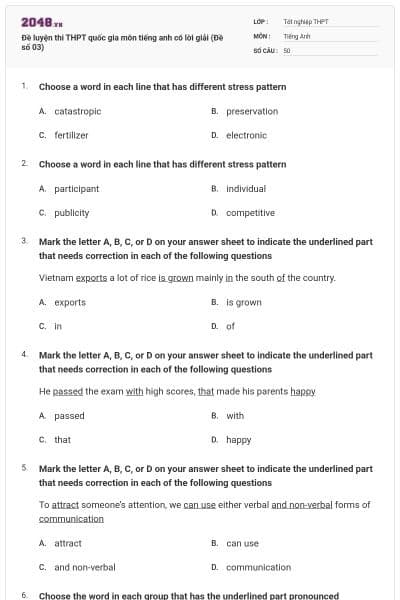
Choose a word in each line that has different stress pattern
catastropic
preservation
fertilizer
electronic
Đáp án C
catastrophic /,kætə'strɒfik/
preservation /prezə'vei∫n/
fertilizer /'fɜ:təlaizə[r]/
electronic /i,lek'trɒnik/
Câu C trọng âm rơi vào âm tiết thứ nhất, còn lại là thứ
Choose a word in each line that has different stress pattern
participant
individual
publicity
competitive
Đáp án B
participant /pɑ:'tisipənt/
individual /,indi'vidʒʊəl/
publicity /pʌb'lisəti/
competitive /kəm'petətiv/
Câu B trọng âm rơi vào âm tiết thứ 3, còn lại là thứ 2
Mark the letter A, B, C, or D on your answer sheet to indicate the underlined part that needs correction in each of the following questions
Vietnam exports a lot of rice is grown mainly in the south of the country.
exports
is grown
in
of
Đáp án B
is grown => which is grown
Ở đây ta cần phải có một mệnh đề quan hệ “which” để thay thế cho “rice”
=> đáp án B
Tạm dịch: Việt Nam xuất khẩu rất nhiều gạo chủ yếu được trồng ở miền Nam
Mark the letter A, B, C, or D on your answer sheet to indicate the underlined part that needs correction in each of the following questions
He passed the exam with high scores, that made his parents happy
passed
with
that
happy
Đáp án C
that => which
Mệnh đề quan hệ “that” không dùng sau dấu phảy, ở đây ta dùng “which” để thay thế cho cả mệnh đề phía trước
=> đáp án C
Tạm dịch: Cậu ấy đã vượt qua kỳ thi với điểm số cao, điều này khiến cha mẹ cậu ấy hạnh phúc
Mark the letter A, B, C, or D on your answer sheet to indicate the underlined part that needs correction in each of the following questions
To attract someone’s attention, we can use either verbal and non-verbal forms of communication
attract
can use
and non-verbal
communication
Đáp án C
and non-verbal => or non-verbal
Cấu trúc “either…or…”
=> đáp án C
Tạm dịch: Để thu hút sự chú ý của ai đó, chúng ta có thể sử dụng các hình thức giao tiếp bằng ngôn ngữ hoặc phi ngôn ngữ
Choose the word in each group that has the underlined part pronounced differrently from the rest
fossil
session
discuss
progress
Đáp án B
fossil /'fɒsl/
session /'se∫n/
discuss /di'skʌs/
progress /'prəʊgres/
Phần gạch chân câu B được phát âm là /∫/ còn lại là /s/
Choose the word in each group that has the underlined part pronounced differrently from the rest
talked
naked
liked
asked
Đáp án B
talked /tɔ:kt/
naked /'neikid/
liked /laikt/
asked /ɑ:skt/
Phần gạch chân câu B được phát âm là /id/ còn lại là /t/
Choose the best answer for each of the following sentences
___________, no one was absent from the farewell party last night
Heavily as it rained
As it rained heavily
Though it rains heavily
In spite of heavily rain
Đáp án A
Cấu trúc chỉ sự tương phản "tuy…. nhưng…": adj/adv + as+ S+ V, S + V.
Câu B không đúng về nghĩa (as = because: bởi vì)
Câu C không đúng thì
Câu D dùng sai dạng của từ (ở đây cần dùng tính từ “heavy” chứ không phải trạng từ “heavily”)
=> đáp án A
Tạm dịch: Dù trời mưa to, nhưng không có ai vắng mặt trong bữa tiệc chia tay đêm qua
He had changed so much since the last time we met that I ___________ him
could recognize
could hardly recognize
wouldn’t have recognized
don’t recognize
Đáp án B
could recognize: có thể nhận ra
could hardly recognize: khó có thể nhận ra
wouldn’t have recognized: sẽ không nhận ra
don’t recognize: không nhận ra (thì hiện tại)
=> đáp án B
Tạm dịch: Anh ấy đã thay đổi rất nhiều kể từ lần cuối cùng chúng tôi gặp nhau đến nỗi tôi khó có thể nhận ra anh ấy
Jane cooks well___________she hates washing up afterwards
however
therefore
so
but
Đáp án D
however: tuy nhiên (khi đứng giữa câu, phải được ngăn cách bởi 2 dấu phảy)
therefore: do đó, vì vậy (khi đứng giữa câu, phải được ngăn cách bởi 2 dấu phảy)
so: nên, do đó
but: nhưng
=> đáp án D
Tạm dịch: Jane nấu ăn ngon nhưng cô ấy ghét rửa bát sau đó
___________his brother, Petter is active and friendly
Alike
Unlike
Dislike
Liking
Đáp án B
Alike (tính từ): giống
Unlike (tính từ, giới từ): không giống
Dislike (động từ): ghét, không thích
Liking (danh động từ): thích
=> đáp án B
Tạm dịch: Không giống anh trai, Peter rất năng động và thân thiện
Tom’s eyes were red ___________he had been swimming in a chlorinated pool.
so
but
because
in case
Đáp án C
so: nên, do đó
but: nhưng
because: bởi vì
in case: trong trường hợp
=> đáp án C
Tạm dịch: Đôi mắt của Tom đỏ vì anh ấy đã bơi trong một hồ bơi có chứa clo
Lucy was late for school this morning because the alarm didn’t ___________as usual.
ring off
get off
go off
take off
Đáp án C
To go off: đổ chuông (đồng hồ)
=> đáp án C
Tạm dịch: Lucy đã đến trường muộn vì đồng hồ báo thức không đổ chuông như thường lệ.
A sudden idea ___________to the cyclist that he might try the new method.
occurred
happened
took place
took part
Đáp án A
To occur to..: nảy ra (ý kiến, ý tưởng gì)
=> đáp án A
Tạm dịch: Một ý tưởng đột xuất nảy ra với người đi xe đạp rằng anh ta có thể thử phương pháp mới.
She asked me ___________ I was looking at
when
if
what
why
Đáp án C
when: khi nào
if: nếu như, liệu
what: cái gì
why: tại sao
=> đáp án C
Tạm dịch: Cô ấy hỏi tôi đang nhìn cái gì
We need to import___________from abroad
a great deal of sports equipment
many sports equipments
a sports equipment
many pieces of sports equipment
Đáp án A
“equipment” là danh từ không đếm được, do đó đáp án B và C loại
“equipment” không dùng lượng từ là “piece”
=> đáp án A
Tạm dịch: Chúng ta cần phải nhập khẩu rất nhiều thiết bị thể thao từ nước ngoài
___________ these books to the library, as they will soon overdue.
Bring
Take
Fetch
Leave
Đáp án A
bring: mang
take: lấy, mang theo
fetch: tìm về, đem về
leave: rời khỏi
=> đáp án A
Tạm dịch: Mang những cuốn sách này đến thư viện, vì chúng sẽ sớm quá hạn
Larry was so___________in his novel that he forgot about his dinner cooking in the oven.
absorbed
attracted
drawn
obliged
Đáp án A
To be absorbed in sth: bị cuốn hút, thu hút vào cái gì
=> đáp án A
Tạm dịch: Larry đã bị cuốn hút bởi cuốn tiểu thuyết của mình đến nỗi quên mất bữa tối của mình trong lò
“Sorry for being late. I was ___________ in the traffic for more than an hour.”
carried on
held up
put off
taken after
Đáp án B
To be held up: bị kẹt, làm chậm.
=> đáp án B
Tạm dịch: Xin lỗi vì đến muộn. Tôi bị tắc đường hơn một tiếng đồng hồ
Mark the letter A, B, C, or D on your answer sheet to indicate the sentence that is CLOSEST in meaning to each of the following questions
I’m sure Luisa was very disappointed when she failed the exam
Luisa must be very disappointed when she failed the exam
Luisa must have been very disappointed when she failed the exam
Luisa may be very disappointed when she failed the exam
Luisa could have been very disappointed when she failed the exam
Đáp án B
Tôi chắc rằng Luisa đã rất thất vọng khi cô ấy trượt kỳ thi.
Ở đây ta dùng must have done sth: chắc hẳn đã làm gì (phỏng đoán chắc chắn về việc đã xảy ra trong quá khứ)
=> đáp án B. Luisa chắc hẳn đã rất thất vọng khi cô trượt kỳ thi
Mark the letter A, B, C, or D on your answer sheet to indicate the sentence that is CLOSEST in meaning to each of the following questions
“You had better see a doctor if the sore throat does not clear up.” she said to me.
She reminded me of seeing a doctor if the sore throat did not clear up
She ordered me to see a doctor if the sore throat did not clear up
She insisted that I see a doctor unless the sore throat did not clear up
She suggested that I see a doctor if the sore throat did not clear up
Đáp án D
Tạm dịch: “Bạn nên đi gặp bác sĩ nếu đau họng không hết.” Cô ấy nói với tôi.
A. Cô nhắc tôi nhớ đến gặp bác sĩ nếu đau họng không hết.
B. Cô ra lệnh cho tôi gặp bác sĩ nếu đau họng không hết.
C. Cô khẳng định rằng tôi nên gặp một bác sĩ trừ khi đau họng không hết.
D. Cô đề nghị tôi gặp bác sĩ nếu đau họng không hết
Mark the letter A, B, C, or D on your answer sheet to indicate the sentence that is CLOSEST in meaning to each of the following questions
Without her teacher’s advice, she would never have written such a good essay
Her teacher advised him and she didn't write a good essay
Her teacher didn't advise her and she didn't write a good essay
She wrote a good essay as her teacher gave her some advice
If her teacher didn't advise her, she wouldnt write such a good essay
Đáp án C
Tạm dịch: Nếu không có lời khuyên của giáo viên, cô ấy sẽ không bao giờ viết được một bài luận hay như vậy.
A. Giáo viên của cô khuyên anh ta và cô ấy đã không viết được một bài luận hay.
B. Giáo viên của cô đã không khuyên cô và cô đã không viết được một bài luận hay.
C. Cô đã viết được một bài luận hay vì giáo viên đã cho cô một số lời khuyên.
D. Nếu giáo viên của cô không khuyên cô, cô ấy sẽ không viết một bài luận hay. (dùng câu điều kiện loại 2 là không đúng)
Mark the letter A, B, C, or D on you answer sheet to indicate the sentence that best combines each pair of sentences in the following questions
She tried very hard to pass the driving test. She could hardly pass it.
Although she didn't try hard to pass the driving test, she could pass it
Despite being able to pass the driving test, she didn’t pass it
No matter how hard she tried, she could hardly pass the driving test
She tried very hard, so she passed the driving test satisfactorily
Đáp án C
Tạm dịch: Cô đã cố gắng rất nhiều để vượt qua bài kiểm tra lái xe. Cô ấy khó có thể vượt qua nó.
A. Mặc dù cô không cố gắng vượt qua kỳ thi lái xe, cô có thể vượt qua.
B. Mặc dù có thể vượt qua được bài kiểm tra lái xe, nhưng cô ấy đã không vượt qua.
C. Dù cô cố gắng như thế nào, cô ấy khó có thể vượt qua được bài kiểm tra lái xe.
D. Cô rất cố gắng, vì vậy cô đã vượt qua kiểm tra lái xe một cách thỏa đáng
Mark the letter A, B, C, or D on you answer sheet to indicate the sentence that best combines each pair of sentences in the following questions
Mary loved her stuffed animal when she was young. She couldn’t sleep without it.
When Mary was young, she loved her stuffed animal so much that she couldn’t sleep without it
When Mary was young, she loved her stuffed animal so as not to sleep without it
When Mary was young, she loved her stuffed animal though she couldn’t sleep without it.
As Mary couldn’t sleep without her stuffed animal when Mary was young, she loved it.
Đáp án A
Tạm dịch: Mary yêu thú nhồi bông của mình khi cô còn nhỏ. Cô không thể ngủ mà không có nó.
A. Khi Mary còn bé, cô yêu thú nhồi bông của cô đến nỗi cô không thể ngủ mà không có nó.
B. Khi Mary còn bé, cô yêu thú nhồi bông của cô để không ngủ mà không có nó.
C. Khi Mary còn bé, cô yêu thú nhồi bông của mình mặc dù cô không thể ngủ mà không có nó.
D. Vì Mary không thể ngủ mà không có thú nhồi bông của mình khi còn bé, cô yêu thích nó
Mark the letter A, B, C, or D on your answer sheet to indicate the most suitable response to complete each of the following exchanges.
- "Excuse me. Where’s the parking lot?" - “___________”
Why do you ask me? I don’t know
Do you get lost? I do too
You missed the turn. It’s back that way
You are going the wrong way. It’s not here
Đáp án D
“Xin lỗi, bãi đỗ xe ở đâu vậy?”
A. Tại sao bạn hỏi tôi? Tôi không biết.
B. Bạn bị lạc? Tôi cũng vậy.
C. Bạn đã bỏ lỡ lượt. Trở lại bằng đường đó.
D. Bạn đang đi sai đường. Nó không có ở đây
Mark the letter A, B, C, or D on your answer sheet to indicate the most suitable response to complete each of the following exchanges.
Mary is talking to a porter in the hotel lobby
- Porter: "Shall I help you with your suitcase?” - Mary: “___________”
Not a chance
That’s very kind of you
I can’t agree more
What a pity!
Đáp án B
Mary đang nói chuyện với một người khuân vác ở sảnh khách sạn.
- Porter: "Tôi có thể giúp khiêng chiếc vali của cô chứ?"
- Mary: “............”
A. Không có cơ hội đâu.
B. Bạn thật tốt bụng.
C. Tôi không thể đồng ý nhiều hơn.
D. Thật đáng tiếc!
Mark the letter A, B, C or D on your answer sheet to indicate the word(s) CLOSEST in meaning to the underlined word(s) in each of the following questions.
Students are expected to always adhere to school regulations
question
violate
disregard
follow
Đáp án D
adhere to: tuân theo, tuân thủ
question: hỏi, chất vấn
violate: vi phạm, trái với
disregard: không quan tâm đến, coi thường
follow: làm theo, nghe theo
=> adhere to = follow
=> đáp án D
Tạm dịch: Học sinh được yêu cầu phải tuân theo các quy định của nhà trường
Mark the letter A, B, C or D on your answer sheet to indicate the word(s) CLOSEST in meaning to the underlined word(s) in each of the following questions.
A number of programs have been initiated to provide food and shelter for the underprivileged in the remote areas of the country
rich citizens
active members
poor inhabitants
enthusiastic people
Đáp án C
the underprivileged: những người thiệt thòi về quyền lợi
rich citizens: những công dân giàu có
active members: những thành viên năng động
poor inhabitants: những cư dân nghèo
enthusiastic people: những người nhiệt tình
=> the underprivileged ~ poor inhabitants
=> đáp án C
Tạm dịch: Một số chương trình đã được khởi xướng để cung cấp thức ăn và chỗ ở cho những người thiệt thòi ở các vùng sâu vùng xa của đất nước
Mark the letter A, B, C, or D on your answer sheet to indicate the word(s) OPPOSITE in meaning to the underlined word(s) in each of the following questions.
Driver are advised to get enough petrol because filling stations are few and far between on the highway
easy to find
difficult to access
unlikely to happen
impossible to reach
Đáp án A
few and far between: ít và nằm rải rác, khi có khi không
easy to find: dễ tìm
difficult to access: khó tiếp cận
unlikely to happen: không có khả năng xảy ra
impossible to reach: không thể với tới
=> few and far between >< easy to find
=> đáp án A
Tạm dịch: Lái xe nên có đủ xăng vì trạm xăng rất ít trên đường cao tốc
Mark the letter A, B, C, or D on your answer sheet to indicate the word(s) OPPOSITE in meaning to the underlined word(s) in each of the following questions.
We managed to get to school in time despite the heavy rain
earlier than a particular moment
later than expected
early enough to do something
as long as expected
Đáp án B
in time: đúng giờ
earlier than a particular moment: sớm hơn một khoảnh khắc cụ thể
later than expected: chậm hơn dự kiến
early enough to do something : đủ sớm để làm điều gì đó
as long as expected: lâu như dự đoán
=> in time >< later than expected
=> đáp án B
Tạm dịch: Chúng tôi đã đến trường đúng giờ mặc dù có mưa lớn
Read the following passage and mark the letter A, B, C, or D on your answer sheet to indicate the correct answer for each of the questions.
Understanding India's Caste System
It has been said that life is what we make of it. In other words, if we work hard and focus on our goals, we can have great careers and enjoy high status is society. However, these opportunities don’t exist for everyone. In some places, the family you are born into will decide almost everything about your life. India’s caste system is an example of this.
The caste system is a major part of the Hindu religion that has existed for thousands of years. It is a way of organizing and grouping people based on the occupation of the family. Castes will determine whom people can socialize with and their place in society. Originally, a person’s caste was supposed to be determined by their personality, but over time it has been linked to their job and family.
There are four classes, also known as varnas, in India’s caste system. The highest one is Brahmin. People in this class have jobs in education and religion. These are seen as extremely important functions for the society as they deal with the knowledge. The second highest level is the Kshatriya, or ruling class. People from this group can be soldiers, landowners, or have jobs in politics. The class beneath this is the Vaishya. These people often work in the commercial sector as merchants. The fourth class level is the Shudra. Shudras typically work as unskilled labourers doing factory or farm work, or they may also be employed as artists.
There is another group, the Harijan, that is at the bottom and considered to be outside of the caste system. For many years, they were known as Untouchables, people from this caste held the most undesirable jobs in society, such as cleaning up garbage. Furthermore, they weren’t allowed to pray at public temples or drink water from the same wells as other classes. If someone from another caste came into contact with an Untouchable, they were considered dirty and would be expected to bathe vigorously to clean themselves.
Although the caste system still exists in India, the government is taking steps to improve the living conditions and decrease unemployment rates for the Shudras and Harijan. This includes providing better health care, offering literacy programmes, and making sure that people from higher social classes do not exploit them. It seems unlikely that the caste system will disappear any time soon, but the overall conditions for those at the bottom do seem to be improving
Which of the following is not true about India’s caste system?
The caste system has been used in India for a long time
The Kshatriya is the second highest class
Hard work helps people move up in the caste system
It is possible that a Shudra would work on a farm
Đáp án C
Điều nào sau đây không đúng về chế độ đẳng cấp của Ấn Độ?
A. Chế độ đẳng cấp đã được sử dụng ở Ấn Độ trong một thời gian dài.
B. Kshatriya là đẳng cấp cao thứ hai.
C. Công việc nặng nhọc giúp người ta tiến lên trong chế độ đẳng cấp.
D. Có thể một Shudra sẽ làm việc trên một trang trại.
=> đáp án C
Thông tin ở các đáp án còn lại đều chính xác và có thể được tìm thấy trong bài. Việc một người thuộc đắng cấp nào phụ thuộc vào gia đình và công việc của họ, không có thông tin cho thấy nếu làm việc chăm chỉ, họ sẽ được lên đẳng cấp cao hơn
Read the following passage and mark the letter A, B, C, or D on your answer sheet to indicate the correct answer for each of the questions.
Understanding India's Caste System
It has been said that life is what we make of it. In other words, if we work hard and focus on our goals, we can have great careers and enjoy high status is society. However, these opportunities don’t exist for everyone. In some places, the family you are born into will decide almost everything about your life. India’s caste system is an example of this.
The caste system is a major part of the Hindu religion that has existed for thousands of years. It is a way of organizing and grouping people based on the occupation of the family. Castes will determine whom people can socialize with and their place in society. Originally, a person’s caste was supposed to be determined by their personality, but over time it has been linked to their job and family.
There are four classes, also known as varnas, in India’s caste system. The highest one is Brahmin. People in this class have jobs in education and religion. These are seen as extremely important functions for the society as they deal with the knowledge. The second highest level is the Kshatriya, or ruling class. People from this group can be soldiers, landowners, or have jobs in politics. The class beneath this is the Vaishya. These people often work in the commercial sector as merchants. The fourth class level is the Shudra. Shudras typically work as unskilled labourers doing factory or farm work, or they may also be employed as artists.
There is another group, the Harijan, that is at the bottom and considered to be outside of the caste system. For many years, they were known as Untouchables, people from this caste held the most undesirable jobs in society, such as cleaning up garbage. Furthermore, they weren’t allowed to pray at public temples or drink water from the same wells as other classes. If someone from another caste came into contact with an Untouchable, they were considered dirty and would be expected to bathe vigorously to clean themselves.
Although the caste system still exists in India, the government is taking steps to improve the living conditions and decrease unemployment rates for the Shudras and Harijan. This includes providing better health care, offering literacy programmes, and making sure that people from higher social classes do not exploit them. It seems unlikely that the caste system will disappear any time soon, but the overall conditions for those at the bottom do seem to be improving
The word “this” in paragraph 1 refers to ________.
the fact that your origin will mostly decide your future
the pleasure of life in India
the India’s caste system existing for thousands of years
the major part of the Hindu religion
Đáp án A
Từ “this” trong đoạn 1 đề cập đến ________.
A. thực tế là gốc gác của bạn sẽ chủ yếu quyết định tương lai của bạn
B. niềm vui của cuộc sống ở Ấn Độ
C. chế độ đẳng cấp Ấn Độ tồn tại trong hàng ngàn năm
D. phần lớn tôn giáo Hindu
=> đáp án A
“this” ở đây đề cập đến vấn đề được đưa ra ở câu trước đó: “In some places, the family you are born into will decide almost everything about your life.” (Ở một số nơi, gia đình mà bạn được sinh ra sẽ quyết định hầu hết mọi thứ về cuộc sống của bạn), có thể hiểu đó là sự thật rằng gốc gác sẽ quyết định phần lớn tương lai của mỗi người
Read the following passage and mark the letter A, B, C, or D on your answer sheet to indicate the correct answer for each of the questions.
Understanding India's Caste System
It has been said that life is what we make of it. In other words, if we work hard and focus on our goals, we can have great careers and enjoy high status is society. However, these opportunities don’t exist for everyone. In some places, the family you are born into will decide almost everything about your life. India’s caste system is an example of this.
The caste system is a major part of the Hindu religion that has existed for thousands of years. It is a way of organizing and grouping people based on the occupation of the family. Castes will determine whom people can socialize with and their place in society. Originally, a person’s caste was supposed to be determined by their personality, but over time it has been linked to their job and family.
There are four classes, also known as varnas, in India’s caste system. The highest one is Brahmin. People in this class have jobs in education and religion. These are seen as extremely important functions for the society as they deal with the knowledge. The second highest level is the Kshatriya, or ruling class. People from this group can be soldiers, landowners, or have jobs in politics. The class beneath this is the Vaishya. These people often work in the commercial sector as merchants. The fourth class level is the Shudra. Shudras typically work as unskilled labourers doing factory or farm work, or they may also be employed as artists.
There is another group, the Harijan, that is at the bottom and considered to be outside of the caste system. For many years, they were known as Untouchables, people from this caste held the most undesirable jobs in society, such as cleaning up garbage. Furthermore, they weren’t allowed to pray at public temples or drink water from the same wells as other classes. If someone from another caste came into contact with an Untouchable, they were considered dirty and would be expected to bathe vigorously to clean themselves.
Although the caste system still exists in India, the government is taking steps to improve the living conditions and decrease unemployment rates for the Shudras and Harijan. This includes providing better health care, offering literacy programmes, and making sure that people from higher social classes do not exploit them. It seems unlikely that the caste system will disappear any time soon, but the overall conditions for those at the bottom do seem to be improving
What is the caste system mainly based on?
What a person believes on
When a person starts school
Who a person’s parents are
Where a person was born
Đáp án C
Chế độ đẳng cấp chủ yếu dựa vào?
A. Một người tin vào những gì B. Khi một người bắt đầu học
C. Cha mẹ của một người là ai D. Nơi một người được sinh ra
=> đáp án C
Điều này có thể được suy ra từ hai câu cuối cùng của đoạn đầu tiên: "In some places, the family you are born into will decide almost everything about your life. India‟s caste system is an example of this." (Ở một số nơi, gia đình mà bạn được sinh ra sẽ quyết định hầu hết mọi thứ về cuộc sống của bạn. Chế độ đẳng cấp ở Ấn Độ là một ví dụ). Có nghĩa là chế độ đẳng cấp phụ thuộc vào việc bố mẹ của một người là ai
Read the following passage and mark the letter A, B, C, or D on your answer sheet to indicate the correct answer for each of the questions.
Understanding India's Caste System
It has been said that life is what we make of it. In other words, if we work hard and focus on our goals, we can have great careers and enjoy high status is society. However, these opportunities don’t exist for everyone. In some places, the family you are born into will decide almost everything about your life. India’s caste system is an example of this.
The caste system is a major part of the Hindu religion that has existed for thousands of years. It is a way of organizing and grouping people based on the occupation of the family. Castes will determine whom people can socialize with and their place in society. Originally, a person’s caste was supposed to be determined by their personality, but over time it has been linked to their job and family.
There are four classes, also known as varnas, in India’s caste system. The highest one is Brahmin. People in this class have jobs in education and religion. These are seen as extremely important functions for the society as they deal with the knowledge. The second highest level is the Kshatriya, or ruling class. People from this group can be soldiers, landowners, or have jobs in politics. The class beneath this is the Vaishya. These people often work in the commercial sector as merchants. The fourth class level is the Shudra. Shudras typically work as unskilled labourers doing factory or farm work, or they may also be employed as artists.
There is another group, the Harijan, that is at the bottom and considered to be outside of the caste system. For many years, they were known as Untouchables, people from this caste held the most undesirable jobs in society, such as cleaning up garbage. Furthermore, they weren’t allowed to pray at public temples or drink water from the same wells as other classes. If someone from another caste came into contact with an Untouchable, they were considered dirty and would be expected to bathe vigorously to clean themselves.
Although the caste system still exists in India, the government is taking steps to improve the living conditions and decrease unemployment rates for the Shudras and Harijan. This includes providing better health care, offering literacy programmes, and making sure that people from higher social classes do not exploit them. It seems unlikely that the caste system will disappear any time soon, but the overall conditions for those at the bottom do seem to be improving
What kind of job would a Brahmin likely have?
A priest
A warrior
An inventor
A painter
Đáp án A
Loại công việc mà một Brahmin có khả năng có?
A. Một linh mục
B. Một chiến binh
C. Một nhà phát minh
D. Một họa sĩ
=> đáp án A
Có thể suy ra từ câu thứ ba của đoạn 3: “People in this class have jobs in education and religion.” (Những người thuộc giai cấp này thường làm việc trong lĩnh vực giáo dục và tôn giáo). Trong 4 đáp án được đưa ra, chỉ có “priest” (linh mục) thuộc một trong hai lĩnh vực này.
Read the following passage and mark the letter A, B, C, or D on your answer sheet to indicate the correct answer for each of the questions.
Understanding India's Caste System
It has been said that life is what we make of it. In other words, if we work hard and focus on our goals, we can have great careers and enjoy high status is society. However, these opportunities don’t exist for everyone. In some places, the family you are born into will decide almost everything about your life. India’s caste system is an example of this.
The caste system is a major part of the Hindu religion that has existed for thousands of years. It is a way of organizing and grouping people based on the occupation of the family. Castes will determine whom people can socialize with and their place in society. Originally, a person’s caste was supposed to be determined by their personality, but over time it has been linked to their job and family.
There are four classes, also known as varnas, in India’s caste system. The highest one is Brahmin. People in this class have jobs in education and religion. These are seen as extremely important functions for the society as they deal with the knowledge. The second highest level is the Kshatriya, or ruling class. People from this group can be soldiers, landowners, or have jobs in politics. The class beneath this is the Vaishya. These people often work in the commercial sector as merchants. The fourth class level is the Shudra. Shudras typically work as unskilled labourers doing factory or farm work, or they may also be employed as artists.
There is another group, the Harijan, that is at the bottom and considered to be outside of the caste system. For many years, they were known as Untouchables, people from this caste held the most undesirable jobs in society, such as cleaning up garbage. Furthermore, they weren’t allowed to pray at public temples or drink water from the same wells as other classes. If someone from another caste came into contact with an Untouchable, they were considered dirty and would be expected to bathe vigorously to clean themselves.
Although the caste system still exists in India, the government is taking steps to improve the living conditions and decrease unemployment rates for the Shudras and Harijan. This includes providing better health care, offering literacy programmes, and making sure that people from higher social classes do not exploit them. It seems unlikely that the caste system will disappear any time soon, but the overall conditions for those at the bottom do seem to be improving
What could replace the word “ruling” in paragraph 3?
defeating
guessing
delaying
governing
Đáp án D
Từ gì có thể thay thế từ “ruling” trong đoạn 3?
A. đánh bại
B. đoán
C. trì hoãn
D. cầm quyền
=> đáp án D
“ruling” có nghĩa là “thống trị”, “cầm quyền”, đồng nghĩa với “governing”.
Read the following passage and mark the letter A, B, C, or D on your answer sheet to indicate the correct answer for each of the questions.
Understanding India's Caste System
It has been said that life is what we make of it. In other words, if we work hard and focus on our goals, we can have great careers and enjoy high status is society. However, these opportunities don’t exist for everyone. In some places, the family you are born into will decide almost everything about your life. India’s caste system is an example of this.
The caste system is a major part of the Hindu religion that has existed for thousands of years. It is a way of organizing and grouping people based on the occupation of the family. Castes will determine whom people can socialize with and their place in society. Originally, a person’s caste was supposed to be determined by their personality, but over time it has been linked to their job and family.
There are four classes, also known as varnas, in India’s caste system. The highest one is Brahmin. People in this class have jobs in education and religion. These are seen as extremely important functions for the society as they deal with the knowledge. The second highest level is the Kshatriya, or ruling class. People from this group can be soldiers, landowners, or have jobs in politics. The class beneath this is the Vaishya. These people often work in the commercial sector as merchants. The fourth class level is the Shudra. Shudras typically work as unskilled labourers doing factory or farm work, or they may also be employed as artists.
There is another group, the Harijan, that is at the bottom and considered to be outside of the caste system. For many years, they were known as Untouchables, people from this caste held the most undesirable jobs in society, such as cleaning up garbage. Furthermore, they weren’t allowed to pray at public temples or drink water from the same wells as other classes. If someone from another caste came into contact with an Untouchable, they were considered dirty and would be expected to bathe vigorously to clean themselves.
Although the caste system still exists in India, the government is taking steps to improve the living conditions and decrease unemployment rates for the Shudras and Harijan. This includes providing better health care, offering literacy programmes, and making sure that people from higher social classes do not exploit them. It seems unlikely that the caste system will disappear any time soon, but the overall conditions for those at the bottom do seem to be improving
All of the following are true about the Harijan EXCEPT that ________.
they used to be known as Untouchables
they had to do undesirable jobs in society
any contact between someone from another caste with an Untouchable was considered unacceptable
anyone from another caste coming to contact with an Untouchable is not allowed to pray at temples
Đáp án D
Tất cả những điều sau đây là đúng về Harijan TRỪ________.
A. họ thường được gọi là tầng lớp tiện dân
B. họ phải làm những công việc không mong muốn trong xã hội
C. bất kỳ sự liên lạc nào giữa một người từ đẳng cấp khác với tầng lớp tiện dân được coi là không thể chấp nhận
D. bất cứ ai từ đẳng cấp khác tiếp xúc với một tầng lớp tiện dân không được phép cầu nguyện tại đền thờ
=> đáp án D
Thông tin ở các đáp án còn lại đều được đưa ra ở đoạn 4. Thông tin trong đáp án cuối cùng không được đề cập đến trong bài. Câu cuối của đoạn 4 chỉ cho biết bất cứ người nào từ một đẳng cấp khác tiếp xúc với một người thuộc tầng lớp tiện dân, họ sẽ bị coi là bẩn thỉu và phải tắm thật sạch để làm sạch mình, không có thông tin cho thấy người đó không được phép cầu nguyện ở các đền
Read the following passage and mark the letter A, B, C, or D on your answer sheet to indicate the correct answer for each of the questions.
Understanding India's Caste System
It has been said that life is what we make of it. In other words, if we work hard and focus on our goals, we can have great careers and enjoy high status is society. However, these opportunities don’t exist for everyone. In some places, the family you are born into will decide almost everything about your life. India’s caste system is an example of this.
The caste system is a major part of the Hindu religion that has existed for thousands of years. It is a way of organizing and grouping people based on the occupation of the family. Castes will determine whom people can socialize with and their place in society. Originally, a person’s caste was supposed to be determined by their personality, but over time it has been linked to their job and family.
There are four classes, also known as varnas, in India’s caste system. The highest one is Brahmin. People in this class have jobs in education and religion. These are seen as extremely important functions for the society as they deal with the knowledge. The second highest level is the Kshatriya, or ruling class. People from this group can be soldiers, landowners, or have jobs in politics. The class beneath this is the Vaishya. These people often work in the commercial sector as merchants. The fourth class level is the Shudra. Shudras typically work as unskilled labourers doing factory or farm work, or they may also be employed as artists.
There is another group, the Harijan, that is at the bottom and considered to be outside of the caste system. For many years, they were known as Untouchables, people from this caste held the most undesirable jobs in society, such as cleaning up garbage. Furthermore, they weren’t allowed to pray at public temples or drink water from the same wells as other classes. If someone from another caste came into contact with an Untouchable, they were considered dirty and would be expected to bathe vigorously to clean themselves.
Although the caste system still exists in India, the government is taking steps to improve the living conditions and decrease unemployment rates for the Shudras and Harijan. This includes providing better health care, offering literacy programmes, and making sure that people from higher social classes do not exploit them. It seems unlikely that the caste system will disappear any time soon, but the overall conditions for those at the bottom do seem to be improving
What does the passage suggest about the future of the caste system?
One day soon it won’t be used anymore in India
It is probably going to get worse before it gets better
The bottom groups will rise to rule over the top classes
It will likely continue to exist for a long time in India
Đáp án D
Đoạn văn đề xuất gì về tương lai của hệ thống giai cấp?
A. Một ngày nào đó nó sẽ không được sử dụng ở Ấn Độ nữa.
B. Nó có thể sẽ trở nên tồi tệ hơn trước khi nó tốt hơn.
C. Các nhóm dưới đáy sẽ đứng lên để cai trị các tầng lớp hàng đầu.
D. Nó có thể sẽ tiếp tục tồn tại trong một thời gian dài ở Ấn Độ.
=> đáp án D
Thông tin này được tìm thấy ở câu kết của bài viết: "It seems unlikely that the caste system will disappear any time soon, but the overall conditions for those at the bottom do seem to be improving." (Có vẻ như chế độ đẳng cấp sẽ không biến mất trong thời gian tới, nhưng những điều kiện chung dành cho những người ở dưới đáy dường như đang được cải thiện).
Read the following passage and mark the letter A, B, C, or D on your answer sheet to indicate the correct answer for each of the questions.
Throughout the world there are different ways for people to greet each other. In much of the world, a handshake is the (38) __________ form of welcoming and greeting someone. In many countries around the Mediterranean Sea a (39) ___________ kiss on the cheek is the appropriate way to welcome friends and family. It can be a very (40) __________ surprise if you expect to shake hands and get a kiss or a hug instead.
At times, it is difficult to tell what sort of greeting (41) ___________ is followed. People may bow, grab another’s arm or even slap the other person on the back. In some places people just smile, look at the other’s face and say nothing.
Most people in the world are tolerant of visitors and don’t mind what travellers do that seems wrong as long as the visitors are (42)__________. A big part of the delightfulness of world travel is experiencing different customs
Điền ô số 38
different
unique
common
same
Đáp án C
different: khác biệt
unique: độc đáo, có một không hai.
common: chung, phổ biến
same: giống
Read the following passage and mark the letter A, B, C, or D on your answer sheet to indicate the correct answer for each of the questions.
Throughout the world there are different ways for people to greet each other. In much of the world, a handshake is the (38) __________ form of welcoming and greeting someone. In many countries around the Mediterranean Sea a (39) ___________ kiss on the cheek is the appropriate way to welcome friends and family. It can be a very (40) __________ surprise if you expect to shake hands and get a kiss or a hug instead.
At times, it is difficult to tell what sort of greeting (41) ___________ is followed. People may bow, grab another’s arm or even slap the other person on the back. In some places people just smile, look at the other’s face and say nothing.
Most people in the world are tolerant of visitors and don’t mind what travellers do that seems wrong as long as the visitors are (42)__________. A big part of the delightfulness of world travel is experiencing different customs.
Điền ô số 39
light
superficial
fast
heavy
Đáp án A
“A light kiss”: cái hôn nhẹ
Read the following passage and mark the letter A, B, C, or D on your answer sheet to indicate the correct answer for each of the questions.
Throughout the world there are different ways for people to greet each other. In much of the world, a handshake is the (38) __________ form of welcoming and greeting someone. In many countries around the Mediterranean Sea a (39) ___________ kiss on the cheek is the appropriate way to welcome friends and family. It can be a very (40) __________ surprise if you expect to shake hands and get a kiss or a hug instead.
At times, it is difficult to tell what sort of greeting (41) ___________ is followed. People may bow, grab another’s arm or even slap the other person on the back. In some places people just smile, look at the other’s face and say nothing.
Most people in the world are tolerant of visitors and don’t mind what travellers do that seems wrong as long as the visitors are (42)__________. A big part of the delightfulness of world travel is experiencing different customs
Điền ô số 40
huge
large
big
great
Đáp án C
“A big surprise”: sự ngạc nhiên lớn
Read the following passage and mark the letter A, B, C, or D on your answer sheet to indicate the correct answer for each of the questions.
Throughout the world there are different ways for people to greet each other. In much of the world, a handshake is the (38) __________ form of welcoming and greeting someone. In many countries around the Mediterranean Sea a (39) ___________ kiss on the cheek is the appropriate way to welcome friends and family. It can be a very (40) __________ surprise if you expect to shake hands and get a kiss or a hug instead.
At times, it is difficult to tell what sort of greeting (41) ___________ is followed. People may bow, grab another’s arm or even slap the other person on the back. In some places people just smile, look at the other’s face and say nothing.
Most people in the world are tolerant of visitors and don’t mind what travellers do that seems wrong as long as the visitors are (42)__________. A big part of the delightfulness of world travel is experiencing different customs
Điền ô số 41
habit
routine
custom
tradition
Đáp án A
habit: thói quen
routine: thường lệ
custom: phong tục
tradition: truyền thống
Read the following passage and mark the letter A, B, C, or D on your answer sheet to indicate the correct answer for each of the questions.
Throughout the world there are different ways for people to greet each other. In much of the world, a handshake is the (38) __________ form of welcoming and greeting someone. In many countries around the Mediterranean Sea a (39) ___________ kiss on the cheek is the appropriate way to welcome friends and family. It can be a very (40) __________ surprise if you expect to shake hands and get a kiss or a hug instead.
At times, it is difficult to tell what sort of greeting (41) ___________ is followed. People may bow, grab another’s arm or even slap the other person on the back. In some places people just smile, look at the other’s face and say nothing.
Most people in the world are tolerant of visitors and don’t mind what travellers do that seems wrong as long as the visitors are (42)__________. A big part of the delightfulness of world travel is experiencing different customs
Điền ô số 42
sincere
truthful
faithful
hopeful
Đáp án A
sincere: chân thành
truthful: đúng sự thật
faithful: trung thành
hopeful: đầy hứa hẹn
Read the following passage and mark the letter A, B, C, or D on your answer sheet to indicate the correct answer for each of the questions
Humans have struggled against weeds since the beginnings of agriculture. Marring our gardens is one of the milder effects of weeds – any plants that thrive where they are unwanted. They clog waterways, destroy wildlife habitats, and impede farming. Their spread eliminates grazing areas and accounts for one-third of all crop loss. They compete for sunlight, nutrients, and water with useful plants.
The global need for weed control had been answered mainly by the chemical industry. Its herbicides are effective and sometimes necessary, but some pose serious problems, particularly if misused. Toxic compounds threaten animal and public health when they accumulate in food plants, groundwater, and drinking water. They also harm workers who apply them.
In recent years, the chemical industry has introduced several herbicides that are more ecologically sound. Yet new chemicals alone cannot solve the world’s weed problems. Hence, scientists are exploring the innate weed-killing powers of living organisms, primarily insects and microorganisms.
The biological agents now in use are environmentally benign and are harmless to humans. They can be chosen for their ability to attack selected targets and leave crops and other plants untouched. In contrast, some of the most effective chemicals kill virtually all the plants they come in contact with, sparing only those that are naturally resistant or have been genetically modified for resistance. Furthermore, a number of biological agents can be administered only once, after which no added applications are needed. Chemicals typically must be used several times per growing season.
With what topic does this passage primarily deal?
The dangers of toxic chemicals
A proposal to ban the use of all herbicides
The importance of the chemical industry
Advantages of biological agents over chemical ones
Đáp án D
Chủ đề nào đoạn văn này chủ yếu giải quyết?
A. Sự nguy hiểm của hóa chất độc hại.
B. Đề xuất cấm sử dụng tất cả các chất diệt cỏ.
C. Tầm quan trọng của ngành công nghiệp hoá chất.
D. Ưu điểm của tác nhân sinh học hơn những hóa chất
Read the following passage and mark the letter A, B, C, or D on your answer sheet to indicate the correct answer for each of the questions
Humans have struggled against weeds since the beginnings of agriculture. Marring our gardens is one of the milder effects of weeds – any plants that thrive where they are unwanted. They clog waterways, destroy wildlife habitats, and impede farming. Their spread eliminates grazing areas and accounts for one-third of all crop loss. They compete for sunlight, nutrients, and water with useful plants.
The global need for weed control had been answered mainly by the chemical industry. Its herbicides are effective and sometimes necessary, but some pose serious problems, particularly if misused. Toxic compounds threaten animal and public health when they accumulate in food plants, groundwater, and drinking water. They also harm workers who apply them.
In recent years, the chemical industry has introduced several herbicides that are more ecologically sound. Yet new chemicals alone cannot solve the world’s weed problems. Hence, scientists are exploring the innate weed-killing powers of living organisms, primarily insects and microorganisms.
The biological agents now in use are environmentally benign and are harmless to humans. They can be chosen for their ability to attack selected targets and leave crops and other plants untouched. In contrast, some of the most effective chemicals kill virtually all the plants they come in contact with, sparing only those that are naturally resistant or have been genetically modified for resistance. Furthermore, a number of biological agents can be administered only once, after which no added applications are needed. Chemicals typically must be used several times per growing season.
The word ‘marring’ in bold is closest in meaning to
planting
spoiling
dividing
replacing
Đáp án B
Từ ‘marring’ in đậm gần nghĩa nhất với
A. trồng
B. làm hỏng
C. phân chia
D. thay thế
Read the following passage and mark the letter A, B, C, or D on your answer sheet to indicate the correct answer for each of the questions
Humans have struggled against weeds since the beginnings of agriculture. Marring our gardens is one of the milder effects of weeds – any plants that thrive where they are unwanted. They clog waterways, destroy wildlife habitats, and impede farming. Their spread eliminates grazing areas and accounts for one-third of all crop loss. They compete for sunlight, nutrients, and water with useful plants.
The global need for weed control had been answered mainly by the chemical industry. Its herbicides are effective and sometimes necessary, but some pose serious problems, particularly if misused. Toxic compounds threaten animal and public health when they accumulate in food plants, groundwater, and drinking water. They also harm workers who apply them.
In recent years, the chemical industry has introduced several herbicides that are more ecologically sound. Yet new chemicals alone cannot solve the world’s weed problems. Hence, scientists are exploring the innate weed-killing powers of living organisms, primarily insects and microorganisms.
The biological agents now in use are environmentally benign and are harmless to humans. They can be chosen for their ability to attack selected targets and leave crops and other plants untouched. In contrast, some of the most effective chemicals kill virtually all the plants they come in contact with, sparing only those that are naturally resistant or have been genetically modified for resistance. Furthermore, a number of biological agents can be administered only once, after which no added applications are needed. Chemicals typically must be used several times per growing season.
The word ‘clog’ in bold is closest in meaning to
drain
grow along
obstruct
float on
Đáp án C
Từ ‘clog’ in đậm gần nghĩa nhất với
A. cống
B. phát triển dọc theo
C. cản trở
D. nổi trên
=> đáp án C
‘clog’ = obstruct: cản trở, làm tắc nghẽn
Read the following passage and mark the letter A, B, C, or D on your answer sheet to indicate the correct answer for each of the questions
Humans have struggled against weeds since the beginnings of agriculture. Marring our gardens is one of the milder effects of weeds – any plants that thrive where they are unwanted. They clog waterways, destroy wildlife habitats, and impede farming. Their spread eliminates grazing areas and accounts for one-third of all crop loss. They compete for sunlight, nutrients, and water with useful plants.
The global need for weed control had been answered mainly by the chemical industry. Its herbicides are effective and sometimes necessary, but some pose serious problems, particularly if misused. Toxic compounds threaten animal and public health when they accumulate in food plants, groundwater, and drinking water. They also harm workers who apply them.
In recent years, the chemical industry has introduced several herbicides that are more ecologically sound. Yet new chemicals alone cannot solve the world’s weed problems. Hence, scientists are exploring the innate weed-killing powers of living organisms, primarily insects and microorganisms.
The biological agents now in use are environmentally benign and are harmless to humans. They can be chosen for their ability to attack selected targets and leave crops and other plants untouched. In contrast, some of the most effective chemicals kill virtually all the plants they come in contact with, sparing only those that are naturally resistant or have been genetically modified for resistance. Furthermore, a number of biological agents can be administered only once, after which no added applications are needed. Chemicals typically must be used several times per growing season.
Which of the following terms does the author define in the first paragraph?
grazing area
weeds
nutrients
wildlife habitats
Đáp án B
Thuật ngữ nào sau đây được định nghĩa trong đoạn đầu tiên?
A. khu chăn thả B. cỏ dại
C. chất dinh dưỡng D. môi trường sống động vật hoang dã
=> đáp án B
Thông tin: weeds – any plants that thrive where they are unwanted. (cỏ dại - bất kỳ loài cây nào phát triển nơi chúng không cần thiết.)
Read the following passage and mark the letter A, B, C, or D on your answer sheet to indicate the correct answer for each of the questions
Humans have struggled against weeds since the beginnings of agriculture. Marring our gardens is one of the milder effects of weeds – any plants that thrive where they are unwanted. They clog waterways, destroy wildlife habitats, and impede farming. Their spread eliminates grazing areas and accounts for one-third of all crop loss. They compete for sunlight, nutrients, and water with useful plants.
The global need for weed control had been answered mainly by the chemical industry. Its herbicides are effective and sometimes necessary, but some pose serious problems, particularly if misused. Toxic compounds threaten animal and public health when they accumulate in food plants, groundwater, and drinking water. They also harm workers who apply them.
In recent years, the chemical industry has introduced several herbicides that are more ecologically sound. Yet new chemicals alone cannot solve the world’s weed problems. Hence, scientists are exploring the innate weed-killing powers of living organisms, primarily insects and microorganisms.
The biological agents now in use are environmentally benign and are harmless to humans. They can be chosen for their ability to attack selected targets and leave crops and other plants untouched. In contrast, some of the most effective chemicals kill virtually all the plants they come in contact with, sparing only those that are naturally resistant or have been genetically modified for resistance. Furthermore, a number of biological agents can be administered only once, after which no added applications are needed. Chemicals typically must be used several times per growing season.
Which of the following statements about the use of chemical agents as herbicides would the author most likely agree?
It has become more dangerous recently
It is occasionally required
It is safe but inefficient
It should be increased
Đáp án B
Câu nào trong những câu sau đây về việc sử dụng các tác nhân hóa học như chất diệt cỏ tác giả có thể đồng ý?
A. Gần đây đã trở nên nguy hiểm hơn.
B. Nó thỉnh thoảng cần thiết.
C. Nó an toàn nhưng không hiệu quả.
D. Nó nên được tăng lên.
=> đáp án B
Thông tin: The global need for weed control had been answered mainly by the chemical industry. Its herbicides are effective and sometimes necessary (Nhu cầu kiểm soát cỏ dại toàn cầu đã được hồi đáp chủ yếu bởi ngành công nghiệp hoá chất. Thuốc diệt cỏ có hiệu quả và đôi khi cần thiết)
Read the following passage and mark the letter A, B, C, or D on your answer sheet to indicate the correct answer for each of the questions
Humans have struggled against weeds since the beginnings of agriculture. Marring our gardens is one of the milder effects of weeds – any plants that thrive where they are unwanted. They clog waterways, destroy wildlife habitats, and impede farming. Their spread eliminates grazing areas and accounts for one-third of all crop loss. They compete for sunlight, nutrients, and water with useful plants.
The global need for weed control had been answered mainly by the chemical industry. Its herbicides are effective and sometimes necessary, but some pose serious problems, particularly if misused. Toxic compounds threaten animal and public health when they accumulate in food plants, groundwater, and drinking water. They also harm workers who apply them.
In recent years, the chemical industry has introduced several herbicides that are more ecologically sound. Yet new chemicals alone cannot solve the world’s weed problems. Hence, scientists are exploring the innate weed-killing powers of living organisms, primarily insects and microorganisms.
The biological agents now in use are environmentally benign and are harmless to humans. They can be chosen for their ability to attack selected targets and leave crops and other plants untouched. In contrast, some of the most effective chemicals kill virtually all the plants they come in contact with, sparing only those that are naturally resistant or have been genetically modified for resistance. Furthermore, a number of biological agents can be administered only once, after which no added applications are needed. Chemicals typically must be used several times per growing season.
The word ‘innate’ in bold is closest in meaning to
effective
natural
active
organic
Đáp án B
Từ ‘innate’ in đậm gần nghĩa nhất với
A. hiệu quả B. tự nhiên C. năng động D. hữu cơ
=> đáp án B
‘innate’ = natural: tự nhiên, bẩm sinh
Read the following passage and mark the letter A, B, C, or D on your answer sheet to indicate the correct answer for each of the questions
Humans have struggled against weeds since the beginnings of agriculture. Marring our gardens is one of the milder effects of weeds – any plants that thrive where they are unwanted. They clog waterways, destroy wildlife habitats, and impede farming. Their spread eliminates grazing areas and accounts for one-third of all crop loss. They compete for sunlight, nutrients, and water with useful plants.
The global need for weed control had been answered mainly by the chemical industry. Its herbicides are effective and sometimes necessary, but some pose serious problems, particularly if misused. Toxic compounds threaten animal and public health when they accumulate in food plants, groundwater, and drinking water. They also harm workers who apply them.
In recent years, the chemical industry has introduced several herbicides that are more ecologically sound. Yet new chemicals alone cannot solve the world’s weed problems. Hence, scientists are exploring the innate weed-killing powers of living organisms, primarily insects and microorganisms.
The biological agents now in use are environmentally benign and are harmless to humans. They can be chosen for their ability to attack selected targets and leave crops and other plants untouched. In contrast, some of the most effective chemicals kill virtually all the plants they come in contact with, sparing only those that are naturally resistant or have been genetically modified for resistance. Furthermore, a number of biological agents can be administered only once, after which no added applications are needed. Chemicals typically must be used several times per growing season.
The word ‘applications’ in bold could best be replaced by which of the following?
treatments
requests
special purposes
qualifications
Đáp án A
Từ ‘applications’ in đậm có thể được thay thế bằng từ nào sau đây?
A. phương pháp điều trị
B. yêu cầu
C. mục đích đặc biệt
D. trình độ
Read the following passage and mark the letter A, B, C, or D on your answer sheet to indicate the correct answer for each of the questions
Humans have struggled against weeds since the beginnings of agriculture. Marring our gardens is one of the milder effects of weeds – any plants that thrive where they are unwanted. They clog waterways, destroy wildlife habitats, and impede farming. Their spread eliminates grazing areas and accounts for one-third of all crop loss. They compete for sunlight, nutrients, and water with useful plants.
The global need for weed control had been answered mainly by the chemical industry. Its herbicides are effective and sometimes necessary, but some pose serious problems, particularly if misused. Toxic compounds threaten animal and public health when they accumulate in food plants, groundwater, and drinking water. They also harm workers who apply them.
In recent years, the chemical industry has introduced several herbicides that are more ecologically sound. Yet new chemicals alone cannot solve the world’s weed problems. Hence, scientists are exploring the innate weed-killing powers of living organisms, primarily insects and microorganisms.
The biological agents now in use are environmentally benign and are harmless to humans. They can be chosen for their ability to attack selected targets and leave crops and other plants untouched. In contrast, some of the most effective chemicals kill virtually all the plants they come in contact with, sparing only those that are naturally resistant or have been genetically modified for resistance. Furthermore, a number of biological agents can be administered only once, after which no added applications are needed. Chemicals typically must be used several times per growing season.
Which of the following best describes the organization of the passage?
Two possible causes of a phenomenon are compared
A problem is described and possible solutions are discussed
A general idea is introduced and several specific examples are given
A recommendation is analysed and rejected
Đáp án C
Câu nào sau đây mô tả đúng nhất việc tổ chức đoạn văn?
A. Hai nguyên nhân có thể xảy ra của một hiện tượng được so sánh.
B. Một vấn đề được mô tả và các giải pháp có thể năng được thảo luận.
C. Một ý tưởng chung được giới thiệu và một số ví dụ cụ thể được đưa ra.
D. Một khuyến nghị được phân tích và bác bỏ