Đề luyện thi THPT quốc gia môn tiếng anh có lời giải (Đề số 01)
50 câu hỏi
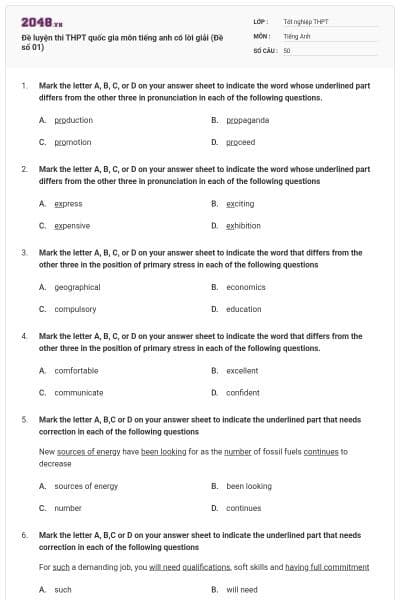
Mark the letter A, B, C, or D on your answer sheet to indicate the word whose underlined part differs from the other three in pronunciation in each of the following questions.
production
propaganda
promotion
proceed
Đáp án B
production /prəˈdʌkʃn/
propaganda /prɒpə'gændə/
promotion /prə'məʊt∫n/
proceed /prəˈsiːd/
Phần gạch chân của propaganda phát âm là /prɒ/ còn lại là /prə/
=> đáp án propaganda
Mark the letter A, B, C, or D on your answer sheet to indicate the word whose underlined part differs from the other three in pronunciation in each of the following questions
express
exciting
expensive
exhibition
Đáp án D
express /ɪkˈspres/
exciting /ɪkˈsaɪtɪŋ/
expensive /ɪkˈspensɪv/
exhibition /ˌeksɪˈbɪʃn/
Phần gạch chân exhibition phát âm là /eks/ còn lại là /ɪks/
=> đáp án exhibition
Mark the letter A, B, C, or D on your answer sheet to indicate the word that differs from the other three in the position of primary stress in each of the following questions
geographical
economics
compulsory
education
Đáp án C
geographical /dʒiə'græfikl/
economics /,i:kə'nɒmiks/
compulsory /kəm'pʌlsəri/
education /,edjʊ'kei∫n/
compulsory trọng âm rơi vào âm tiết thứ 2 còn lại là thứ 3
=> đáp án compulsory
Mark the letter A, B, C, or D on your answer sheet to indicate the word that differs from the other three in the position of primary stress in each of the following questions.
comfortable
excellent
communicate
confident
Đáp án C
comfortable /'kʌmftəbl/
excellent /'eksələnt/
communicate /kə'mju:nikeit/
confident /'kɒnfidənt/
communicate trọng âm rơi vào âm tiết thứ 2 còn lại là thứ nhất
=> đáp án communicate
Mark the letter A, B,C or D on your answer sheet to indicate the underlined part that needs correction in each of the following questions
New sources of energy have been looking for as the number of fossil fuels continues to decrease
sources of energy
been looking
number
continues
Đáp án B
been looking => been looked
Ở đây chủ ngữ là vật nên ta phải sử dụng dạng bị động.
=> đáp án B
Tạm dịch: Các nguồn năng lượng mới đã được tìm kiếm vì số lượng nhiên liệu hoá thạch tiếp tục giảm
Mark the letter A, B,C or D on your answer sheet to indicate the underlined part that needs correction in each of the following questions
For such a demanding job, you will need qualifications, soft skills and having full commitment
such
will need
qualifications
having full commitment
Đáp án D
having full commitment => full commitment
Ở đây ta chỉ cần danh từ để phù hợp về ngữ pháp, vì phía trước cũng sử dụng các danh từ. (Hoặc có thể sửa thành “have full commitment” khi đó động từ “have” và “need” cùng là động từ trong câu)
=> đáp án D
Tạm dịch: Đối với công việc đòi hỏi như vậy, bạn sẽ cần trình độ, kỹ năng mềm và tận tuỵ tuyệt đối
Mark the letter A, B,C or D on your answer sheet to indicate the underlined part that needs correction in each of the following questions
Antarctic blue whales can be 100 foot long and weigh more than any dinosaur that ever lived
can be
100 foot long
more than
any dinosaur
Đáp án B
100 foot long => 100 feet long
foot là dùng cho số ít, số nhiều chuyển thành feet. foot, feet ở đây là đơn vị đo chiều dài Anh bằng 0,3048 m.
=> đáp án B
Tạm dịch: Cá voi xanh Nam Cực có thể dài 100 feet và nặng hơn bất kỳ loài khủng long nào đã từng sống.
Mark the letter A, B, C, or D on your answer sheet to indicate the most suitable response to each of the following exchanges
“How do you like your steak done?” - “_______.”
I don’t like it
Very little
Well done
Very much
Đáp án C
“Ngài muốn bít tết chín như thế nào?”
Tôi không thích nó.
Rất ít.
Chín kỹ.
Rất nhiều.
=> đáp án Well done
Mark the letter A, B, C, or D on your answer sheet to indicate the most suitable response to each of the following exchanges
"Oops! I’m sorry for stepping on your foot" – “______.”
Never mind
You don't mind
You're welcome
That's fine
Đáp án A
“Ôi! Tôi xin lỗi đã giẫm lên chân bạn.”
Các đáp án:
Không sao.
Bạn không để tâm.
Không có gì (dùng để đáp lại lời cám ơn.)
Nó ổn.
=> đáp án Never mind
Mark the letter A, B, C, or D on your answer sheet to indicate the correct answer in each of the following question
Dr. Sales is a person______.
in that I don’t have much confidence
whom I don’t have much confidence in Him
in whom I don’t have much confidence
I don’t have much confidence
Đáp án C
Ở đây ta dùng mệnh đề quan hệ “whom” để thay thế cho danh từ chỉ người đóng vai trò là tân ngữ trong câu. Đáp án “whom I don’t have much confidence in him” loại vì thừa từ “him”
=> đáp án : in whom I don’t have much confidence
Tạm dịch: Bác sĩ Sales là người tôi không tin tưởng cho lắm
A quick look would reveal that France has twice______computers
more televisions than
many as televisions as
as many televisions as
as many as televisions
Đáp án C
Cấu trúc so sánh gấp số lần: once/twice/three times…. + as… as +…
=> đáp án: as many televisions as
Tạm dịch: Nhìn qua có thể thấy rằng Pháp có số lượng tivi gấp 2 lần máy tính
The instructor blew his whistle and______.
off the runners were running
off ran the runners
off were running the runners
the runners runs off
Đáp án B
Đây thuộc cấu trúc đảo ngữ với giới từ đầu mệnh đề hoặc câu. Khi giới từ đứng đầu câu thì khác so với các loại đảo ngữ khác đó là sẽ đảo nguyên cả động từ của chủ ngữ đó
Tuy nhiên, nếu chủ ngữ của câu thuộc 1 trong 7 đại từ sau: she, he, we, they, I, it, you thì chúng ta không đảo động từ lên mặc dù có giới từ đầu câu
=> đáp án : off ran the runners
Tạm dịch: Trọng tài thổi còi và các vận động viên chạy
People have used coal and oil to______electricity for a long time
bred
raise
cultivate
generate
Đáp án D
bred (quá khứ của breed): sinh ra, gây ra, mang lại
raise: nâng lên, đưa lên
cultivate: canh tác, trau dồi, tu dưỡng
generate: tạo ra, phát ra
=> đáp án : generate
Tạm dịch: Người ta đã sử dụng than và dầu để tạo ra điện trong một thời gian dài
In the early years of the 20th century, several rebellions______in the northern parts of the country.
turned out
rose up
broke out
came up
Đáp án C
turn out: diễn ra, hoá ra
rise up: tăng lên
break out: bùng ra, nổ ra
come up: nhú lên, mọc, nảy sinh
=> đáp án: broke out
Tạm dịch: Trong những năm đầu của thế kỷ 20, một số cuộc nổi dậy nổ ra ở các vùng phía bắc của đất nước
The festival has many attractions. It will include contemporary orchestra music and an opera. ____ , there will be poetry readings and theatrical presentations
Otherwise
Furthermore
Nevertheless
On the other hand
Đáp án B
Otherwise: mặt khác, nếu không
Furthermore: ngoài ra, thêm vào đó
Nevertheless: tuy nhiên, dù vậy
On the other hand: mặt khác
=> đáp án Furthermore
Tạm dịch: Lễ hội có nhiều điểm tham quan. Nó sẽ gồm có dàn nhạc đương đại và một vở opera. Hơn nữa, sẽ có những bài đọc thơ và những bài diễn thuyết sân khấu
When he started that company, he really went______. It might have been a disaster.
out on the limb
on and off
over the odds
once too often
Đáp án D
out on the limb: rơi vào thế kẹt
on and off: chốc chốc, chập chờn, thỉnh thoảng
over the odds : cần thiết, nhiều hơn mong đợi
once too often: hơn một lần được vô sự
=> đáp án once too often
Tạm dịch: Khi mới bắt đầu công ty đó, anh ta thực sự được vô sự hơn một lần. Nó đã có thể là một thảm hoạ rồi
We regret to tell you that the materials you ordered are______.
out of stock
out of practice
out of reach
out of work
Đáp án A
out of stock: hết hàng
out of practice: không thể thực thi
out of reach: ngoài tầm với
out of work: thất nghiệp
=> đáp án out of stock
My sister is a woman of______age
marriage
married
marrying
marriageable
Đáp án D
marriageable age: tuổi kết hôn, tuổi có thể kết hôn
=> đáp án marriageable
Tạm dịch: Chị tôi là người phụ nữ đến tuổi kết hôn
The fire______to have started in the furnace under the house
is believed
that is believed
they believed
that they believe
Đáp án A
Nếu dùng đáp án khác thì tất cả phía sau chỉ là bổ sung ý nghĩa cho chủ ngữ “the fire”, khi đó trong câu thiếu mất vị ngữ.
=> đáp án is believed
Tạm dịch: Ngọn lửa được cho là bắt đầu từ cái lò ở dưới nhà
This is the latest news from earthquake site. Two- thirds of the city______in a fire
has been destroyed
have been destroyed
were destroyed
was destroyed
Đáp án A
Ở đây ta dùng thì hiện tại hoàn thành, diễn tả 1 hành động xảy ra trong quá khứ và để lại kết quả ở hiện tại.
Với những chủ ngữ chỉ phân số, phần trăm -> ta dựa vào danh từ sau “of” để chia động từ.
=> đáp án has been destroyed
Tạm dịch: Đây là tin tức mới nhất từ nơi động đất. Hai phần ba thành phố đã bị phá hủy trong lửa
There are many______in our library
interesting American old history books
old American interesting history books
interesting old American history books
American interesting old history books
Đáp án C
Vị trí của tính từ khi đứng trước danh từ:
Opinion – nhận định (interesting: thú vị) + Age – tuổi tác (old: cũ) + Origin – xuất xứ (American: Mỹ) + N
=> đáp án : interesting old American history books
Tạm dịch: Có rất nhiều cuốn sách lịch sử nước Mỹ cũ rất thú vị trong thư viện của chúng tôi
Mark the letter A, B, C, or D on your answer sheet to indicate the word CLOSEST in meaning to the under lined word in each of the following questions
She was brought up in a well-off family. She can’t understand the problems we are facing
poor
broke
wealthy
kind
Đáp án C
well-off: giàu có
poor: nghèo
broke: cháy túi, hết tiền
wealthy: giàu có
kind: tốt bụng
=> well-off = wealthy
=> đáp án wealthy
Tạm dịch: Cô được nuôi lớn trong một gia đình khá giả. Cô ấy không thể hiểu được những vấn đề mà chúng ta đang phải đối mặt
Mark the letter A, B, C, or D on your answer sheet to indicate the word CLOSEST in meaning to the under lined word in each of the following questions
The most important thing is to keep yourself occupied
relaxed
comfortable
possessive
busy
Đáp án D
occupied: bận rộn
relaxed: không căng thẳng; ung dung
comfortable: thoải mái
possessive : chiếm hữu
busy: bận rộn
=> occupied = busy
=> đáp án busy
Tạm dịch: Điều quan trọng nhất là để giữ cho bản thân luôn bận rộn
Mark letter A, B, C, or D on your answer sheet to indicate the word or phrase that is OPPOSITE in meaning to the underlined word(s) in each of the following questions
There has been insufficient rainfall over the past two years, and fanners are having trouble
abundant
adequate
unsatisfactory
dominant
Đáp án A
insufficient: không đủ, thiếu
abundant: nhiều, thừa thãi
adequate: đủ, thỏa đáng, thích đáng
unsatisfactory: không làm thỏa mãn, không làm vừa ý
dominant: át, trội hơn
=> insufficient >< abundant
=> đáp án abundant
Tạm dịch: Trong vòng hai năm trở lại đây không đủ mưa, và các máy quạt thóc đều gặp rắc rối
Mark letter A, B, C, or D on your answer sheet to indicate the word or phrase that is OPPOSITE in meaning to the underlined word(s) in each of the following questions
We strongly believe that he's innocent of the crime. We do not think that he did it.
crimeless
skillful
clean
guilty
Đáp án D
innocent: vô tội
không có từ crimeless
skillful: lành nghề
clean: trong sạch
guilty: có tội
=> innocent >< guilty
=> đáp án guilty
Tạm dịch: Chúng tôi tin tưởng rằng anh ấy vô tội. Chúng tôi không nghĩ rằng anh ấy đã thực hiện điều đó
Mark the letter A, B, C, or D on your answer sheet to indicate the sentence that is CLOSEST in meaning to the sentence given in each of the following question
Only with careful environmental planning can we protect the world in which we live.
Careful environmental planning protects the world we live in
Planning the environment carefully, we can protect the world in which we live
Protecting the world we live in, we plan the environment carefully
We can protect the world we live in only with careful environmental planning
Đáp án D
Tạm dịch: Chỉ với việc hoạch định môi trường cẩn thận chúng ta mới có thể bảo vệ được thế giới mà chúng ta đang sống.
Các đáp án
Hoạch định môi trường cẩn thận bảo vệ thế giới chúng ta đang sống.
Hoạch định môi trường một cách cẩn thận, chúng ta có thể bảo vệ thế giới mà chúng ta đang sống.
Bảo vệ thế giới chúng ta đang sống, chúng ta hoạch định môi trường một cách cẩn thận.
Chúng ta chỉ có thể bảo vệ thế giới chúng ta đang sống duy nhất bằng việc hoạch định môi trường cẩn thận.
=> đáp án : We can protect the world we live in only with careful environmental planning
Mark the letter A, B, C, or D on your answer sheet to indicate the sentence that is CLOSEST in meaning to the sentence given in each of the following question
You should take regular exercises instead of sitting in front of the television all day
Taking regular exercises is better than sitting in front of the television all day
Sitting in front of the television all day helps you take regular exercises
Sitting in front of the television all day and taking exercises are advisable
Don’t take regular exercises, just sit in front of the television all day
Đáp án A
Tạm dịch: Bạn nên tập thể dục thường xuyên thay vì ngồi trước tivi hàng ngày.
Các đáp án:
Tập thể dục đều đặn tốt hơn ngồi trước tivi hàng ngày.
Ngồi trước tivi cả ngày giúp bạn tập thể dục thường xuyên.
Ngồi trước tivi hàng ngày và tập thể dục được khuyến khích.
Không tập thể dục thường xuyên, chỉ ngồi trước tivi suốt ngày.
=> đáp án : Taking regular exercises is better than sitting in front of the television all day.
Mark the letter A, B, C, or D on your answer sheet to indicate the sentence that is CLOSEST in meaning to the sentence given in each of the following question
It was not until after I got home that I realized I had not set the burglar alarm in the office
On the way home, I suddenly realized that I had forgotten to turn on the burglar alarm in the office
Fortunately, I realized that I hadn't set the burglar alarm just before I left for home; otherwise, I would have had to travel all the way back to the office
I didn’t turn the burglar alarm on before I left the office, but I only became aware of this after I'd arrived home
I wish I had realized before I arrived home that I hadn't turned on the burglar alarm in the office, then it would have been easier to go and set it
Đáp án C
Tạm dịch: Mãi đến sau khi tôi về đến nhà tôi mới nhận ra rằng tôi đã không đặt báo động chống trộm trong văn phòng.
Các đáp án:
Trên đường về nhà, tôi đột nhiên nhận ra rằng tôi đã quên bật báo động chống trộm trong văn phòng.
May mắn thay, tôi nhận ra rằng tôi chưa đặt báo động chống trộm trước khi tôi về nhà; nếu không, tôi đã phải quay trở lại văn phòng.
Tôi đã không bật báo động chống trộm trước khi rời văn phòng, nhưng tôi chỉ nhận ra điều này sau khi tôi về đến nhà.
Tôi ước gì tôi đã nhận ra trước khi tôi về đến nhà rằng tôi đã không bật báo động chống trộm trong văn phòng, sau đó nó sẽ dễ dàng hơn để thiết lập nó.
=> đáp án : I didn’t turn the burglar alarm on before I left the office, but I only became aware of this after I'd arrived home
Mark the letter A, B, C, or D on your answer sheet to indicate the sentence that best combines each pair of sentences in the following questions
He did not remember the meeting. He went out for a coffee with his friends then.
Not remember the meeting, he went out for a coffee with his friends
Not to remember the meeting, he went out for a coffee with his friends
Not remembered the meeting, he went out for a coffee with his friends
Not remembering the meeting, he went out for a coffee with his friends
Đáp án D
Khi động từ đứng đầu câu mà không có chủ ngữ, ta dùng dạng danh động từ.
=> đáp án Not remembering the meeting, he went out for a coffee with his friends.
Tạm dịch: Không nhớ cuộc họp, anh ta đã đi cà phê với bạn bè
Mark the letter A, B, C, or D on your answer sheet to indicate the sentence that best combines each pair of sentences in the following questions.
They left their home early. They didn’t want to miss the first train
They left their home early so as to not miss the first train
They left their home early for fear that they wouldn’t miss the first train
They left their home early so as not to miss the first train
They left their home early in order that not to miss the first train
Đáp án C
Cấu trúc so as not to do sth: để không làm việc gì
=> đáp án They left their home early so as not to miss the first train.
Tạm dịch: Họ rời nhà sớm để không bị lỡ chuyến tàu đầu tiên
Read the following passage and mark the letter A, B, C, or D on your answer sheet to choose the word or phrase that bestfits each ofthe numbered blanks from 31 to 35
Left-handers are the odd ones out. Sure, lefties (31) ______up about 10 percent of the population - but, frankly, it seems like society has forgotten about them. Just consider all of the right-handed gadgets, awkwardly designed desks, and cooking tools that fit comfortably only in your right hand. What (32) ______someone to become a lefthand? Scientists aren’t exactly sure, but research points to a complex (33) ______between genes and environment While no exact set of “leftie genes” have been discovered, people who dominantly use their left hands do have more left-handed family members. And researchers have found different brain wirings in righties vs. lefties. But no matter (34) ______it is that drives someone to use their antipodal paw, science has also uncovered a particular set of personality traits that left-handed people tend to have. So for all of you lefties, leftie-loving righties, and ambidextrous folks out there - it’s time to brush up on your left-handed knowledge and help (35) ______an end to leftie discrimination once and for all
Điền ô số 31
consist
account
hold
make
Đáp án D
To make up: tạo nên, làm nên
=> đáp án make
Read the following passage and mark the letter A, B, C, or D on your answer sheet to choose the word or phrase that bestfits each ofthe numbered blanks from 31 to 35
Left-handers are the odd ones out. Sure, lefties (31) ______up about 10 percent of the population - but, frankly, it seems like society has forgotten about them. Just consider all of the right-handed gadgets, awkwardly designed desks, and cooking tools that fit comfortably only in your right hand. What (32) ______someone to become a lefthand? Scientists aren’t exactly sure, but research points to a complex (33) ______between genes and environment While no exact set of “leftie genes” have been discovered, people who dominantly use their left hands do have more left-handed family members. And researchers have found different brain wirings in righties vs. lefties. But no matter (34) ______it is that drives someone to use their antipodal paw, science has also uncovered a particular set of personality traits that left-handed people tend to have. So for all of you lefties, leftie-loving righties, and ambidextrous folks out there - it’s time to brush up on your left-handed knowledge and help (35) ______an end to leftie discrimination once and for all
Điền ô số 32
causes
makes
gets
does
Đáp án A
Cấu trúc To cause sb to do sth: khiến ai làm việc gì
=> đáp án causes
Read the following passage and mark the letter A, B, C, or D on your answer sheet to choose the word or phrase that bestfits each ofthe numbered blanks from 31 to 35
Left-handers are the odd ones out. Sure, lefties (31) ______up about 10 percent of the population - but, frankly, it seems like society has forgotten about them. Just consider all of the right-handed gadgets, awkwardly designed desks, and cooking tools that fit comfortably only in your right hand. What (32) ______someone to become a lefthand? Scientists aren’t exactly sure, but research points to a complex (33) ______between genes and environment While no exact set of “leftie genes” have been discovered, people who dominantly use their left hands do have more left-handed family members. And researchers have found different brain wirings in righties vs. lefties. But no matter (34) ______it is that drives someone to use their antipodal paw, science has also uncovered a particular set of personality traits that left-handed people tend to have. So for all of you lefties, leftie-loving righties, and ambidextrous folks out there - it’s time to brush up on your left-handed knowledge and help (35) ______an end to leftie discrimination once and for all
Điền ô số 33
collaborate
collaboration
collaborating
collaborated
Đáp án B
Ở đây ta cần một danh từ vì phía trước có tính từ và mạo từ “a”
=> đáp án collaboration
Read the following passage and mark the letter A, B, C, or D on your answer sheet to choose the word or phrase that bestfits each ofthe numbered blanks from 31 to 35
Left-handers are the odd ones out. Sure, lefties (31) ______up about 10 percent of the population - but, frankly, it seems like society has forgotten about them. Just consider all of the right-handed gadgets, awkwardly designed desks, and cooking tools that fit comfortably only in your right hand. What (32) ______someone to become a lefthand? Scientists aren’t exactly sure, but research points to a complex (33) ______between genes and environment While no exact set of “leftie genes” have been discovered, people who dominantly use their left hands do have more left-handed family members. And researchers have found different brain wirings in righties vs. lefties. But no matter (34) ______it is that drives someone to use their antipodal paw, science has also uncovered a particular set of personality traits that left-handed people tend to have. So for all of you lefties, leftie-loving righties, and ambidextrous folks out there - it’s time to brush up on your left-handed knowledge and help (35) ______an end to leftie discrimination once and for all
Điền ô số 34
which
who
what
that
Đáp án C
Trong câu này: no matter what it is: không quan trọng nó là cái gì
=> đáp án what
Read the following passage and mark the letter A, B, C, or D on your answer sheet to choose the word or phrase that bestfits each ofthe numbered blanks from 31 to 35
Left-handers are the odd ones out. Sure, lefties (31) ______up about 10 percent of the population - but, frankly, it seems like society has forgotten about them. Just consider all of the right-handed gadgets, awkwardly designed desks, and cooking tools that fit comfortably only in your right hand. What (32) ______someone to become a lefthand? Scientists aren’t exactly sure, but research points to a complex (33) ______between genes and environment While no exact set of “leftie genes” have been discovered, people who dominantly use their left hands do have more left-handed family members. And researchers have found different brain wirings in righties vs. lefties. But no matter (34) ______it is that drives someone to use their antipodal paw, science has also uncovered a particular set of personality traits that left-handed people tend to have. So for all of you lefties, leftie-loving righties, and ambidextrous folks out there - it’s time to brush up on your left-handed knowledge and help (35) ______an end to leftie discrimination once and for all
Điền ô số 35
put
bring
make
take
Đáp án A
To put an end to: chấm dứt cái gì
=> đáp án put
Read the following passage and mark the letter A, B, C, or D on your answer sheet to indicate the correct answer to each of the questions from 36 to 42.
Successful students often do the followings while studying. First, they have an overview before reading. Next, they look for important information and pay greater attention to it (which often needs jumping forward or backward to process information). They also relate important points to one another. Also, they activate and use their prior knowledge. When they realize that their understanding is not good, they do not wait to change strategies. Last, they can monitor understanding and take action to correct or “fix up” mistakes in comprehension.
Conversely, students with low academic achievement often demonstrate ineffective study skills. They tend to assume a passive role, in learning and rely on others (e.g., teachers, parents) to monitor their studying, for example, low-achieving students often do not monitor their understanding of content; they may not be aware of the purpose of studying; and they show little evidence of looking back, or employing “fix-up” strategies to fix understanding problems. Students who struggle with learning new information seem to be unaware that they must extent effort beyond simply reading the content to understand and remember it. Children with learning disabilities do not plan and judge the quality of their studying. Their studying may be disorganized. Students with learning problems face challenges with personal organization as well. They often have difficulty keeping track of materials and assignments, following directions, and completing work on time. Unlike good studiers who employ a variety of study skills in a flexible yet purposeful manner, low-achieving students use a restricted range of study skills. They cannot explain why good study strategies are important for learning; and they tend to use the same, often ineffective study approach for all learning tasks, ignoring task content, structure or difficulty.
What is the topic of the passage?
Successful and low-academic achieving students
Successful learners and their learning strategies
Study skills for high school students
Effective and ineffective ways of learning
Đáp án D
Chủ đề của đoạn văn là gì?
Học sinh giỏi và học sinh kém
Những người học giỏi và các chiến lược học tập của họ
Kỹ năng học tập dành cho học sinh trung học
Cách học hiệu quả và không hiệu quả
=> đáp án : Effective and ineffective ways of learning
Read the following passage and mark the letter A, B, C, or D on your answer sheet to indicate the correct answer to each of the questions from 36 to 42.
Successful students often do the followings while studying. First, they have an overview before reading. Next, they look for important information and pay greater attention to it (which often needs jumping forward or backward to process information). They also relate important points to one another. Also, they activate and use their prior knowledge. When they realize that their understanding is not good, they do not wait to change strategies. Last, they can monitor understanding and take action to correct or “fix up” mistakes in comprehension.
Conversely, students with low academic achievement often demonstrate ineffective study skills. They tend to assume a passive role, in learning and rely on others (e.g., teachers, parents) to monitor their studying, for example, low-achieving students often do not monitor their understanding of content; they may not be aware of the purpose of studying; and they show little evidence of looking back, or employing “fix-up” strategies to fix understanding problems. Students who struggle with learning new information seem to be unaware that they must extent effort beyond simply reading the content to understand and remember it. Children with learning disabilities do not plan and judge the quality of their studying. Their studying may be disorganized. Students with learning problems face challenges with personal organization as well. They often have difficulty keeping track of materials and assignments, following directions, and completing work on time. Unlike good studiers who employ a variety of study skills in a flexible yet purposeful manner, low-achieving students use a restricted range of study skills. They cannot explain why good study strategies are important for learning; and they tend to use the same, often ineffective study approach for all learning tasks, ignoring task content, structure or difficulty.
The word “prior” in the first paragraph is closest meaning to ______?
important
earlier
forward
good
Đáp án B
Từ "prior" ở đoạn đầu tiên có ý nghĩa gần nhất với ______?
quan trọng trước đó chuyển tiếp tốt
=> prior = earlier: trước đó
Read the following passage and mark the letter A, B, C, or D on your answer sheet to indicate the correct answer to each of the questions from 36 to 42.
Successful students often do the followings while studying. First, they have an overview before reading. Next, they look for important information and pay greater attention to it (which often needs jumping forward or backward to process information). They also relate important points to one another. Also, they activate and use their prior knowledge. When they realize that their understanding is not good, they do not wait to change strategies. Last, they can monitor understanding and take action to correct or “fix up” mistakes in comprehension.
Conversely, students with low academic achievement often demonstrate ineffective study skills. They tend to assume a passive role, in learning and rely on others (e.g., teachers, parents) to monitor their studying, for example, low-achieving students often do not monitor their understanding of content; they may not be aware of the purpose of studying; and they show little evidence of looking back, or employing “fix-up” strategies to fix understanding problems. Students who struggle with learning new information seem to be unaware that they must extent effort beyond simply reading the content to understand and remember it. Children with learning disabilities do not plan and judge the quality of their studying. Their studying may be disorganized. Students with learning problems face challenges with personal organization as well. They often have difficulty keeping track of materials and assignments, following directions, and completing work on time. Unlike good studiers who employ a variety of study skills in a flexible yet purposeful manner, low-achieving students use a restricted range of study skills. They cannot explain why good study strategies are important for learning; and they tend to use the same, often ineffective study approach for all learning tasks, ignoring task content, structure or difficulty
According to the passage, what can be learnt about passive students?
They depend on other people to organize their learning
They are slow in their studying
They monitor their understanding
They know the purpose of studying
Đáp án A
Theo đoạn văn, điều gì có thể rút ra về những học sinh thụ động?
Họ phụ thuộc vào người khác để tổ chức học tập
Họ chậm trong việc học tập
Họ theo dõi hiểu biết của mình
Họ biết mục tiêu học tập
=> đáp án : They depend on other people to organize their learning
Thông tin: They tend to assume a passive role, in learning and rely on others (e.g., teachers, parents) to monitor their studying
Read the following passage and mark the letter A, B, C, or D on your answer sheet to indicate the correct answer to each of the questions from 36 to 42.
Successful students often do the followings while studying. First, they have an overview before reading. Next, they look for important information and pay greater attention to it (which often needs jumping forward or backward to process information). They also relate important points to one another. Also, they activate and use their prior knowledge. When they realize that their understanding is not good, they do not wait to change strategies. Last, they can monitor understanding and take action to correct or “fix up” mistakes in comprehension.
Conversely, students with low academic achievement often demonstrate ineffective study skills. They tend to assume a passive role, in learning and rely on others (e.g., teachers, parents) to monitor their studying, for example, low-achieving students often do not monitor their understanding of content; they may not be aware of the purpose of studying; and they show little evidence of looking back, or employing “fix-up” strategies to fix understanding problems. Students who struggle with learning new information seem to be unaware that they must extent effort beyond simply reading the content to understand and remember it. Children with learning disabilities do not plan and judge the quality of their studying. Their studying may be disorganized. Students with learning problems face challenges with personal organization as well. They often have difficulty keeping track of materials and assignments, following directions, and completing work on time. Unlike good studiers who employ a variety of study skills in a flexible yet purposeful manner, low-achieving students use a restricted range of study skills. They cannot explain why good study strategies are important for learning; and they tend to use the same, often ineffective study approach for all learning tasks, ignoring task content, structure or difficulty
Which of the followings is NOT an evidence of monitoring studying?
Being aware of the purpose of studying
Monitoring their understanding of content
Fixing up mistakes in understanding
Looking at their backs
Đáp án D
Điều sau đây KHÔNG phải là bằng chứng của việc theo dõi học tập?
Nhận thức được mục đích học tập
Theo dõi sự hiểu biết của họ về bài học
Xử lý sai lầm trong hiểu biết
Nhìn vào lưng của họ
=> đáp án : Looking at their backs
Read the following passage and mark the letter A, B, C, or D on your answer sheet to indicate the correct answer to each of the questions from 36 to 42.
Successful students often do the followings while studying. First, they have an overview before reading. Next, they look for important information and pay greater attention to it (which often needs jumping forward or backward to process information). They also relate important points to one another. Also, they activate and use their prior knowledge. When they realize that their understanding is not good, they do not wait to change strategies. Last, they can monitor understanding and take action to correct or “fix up” mistakes in comprehension.
Conversely, students with low academic achievement often demonstrate ineffective study skills. They tend to assume a passive role, in learning and rely on others (e.g., teachers, parents) to monitor their studying, for example, low-achieving students often do not monitor their understanding of content; they may not be aware of the purpose of studying; and they show little evidence of looking back, or employing “fix-up” strategies to fix understanding problems. Students who struggle with learning new information seem to be unaware that they must extent effort beyond simply reading the content to understand and remember it. Children with learning disabilities do not plan and judge the quality of their studying. Their studying may be disorganized. Students with learning problems face challenges with personal organization as well. They often have difficulty keeping track of materials and assignments, following directions, and completing work on time. Unlike good studiers who employ a variety of study skills in a flexible yet purposeful manner, low-achieving students use a restricted range of study skills. They cannot explain why good study strategies are important for learning; and they tend to use the same, often ineffective study approach for all learning tasks, ignoring task content, structure or difficulty.
According to the passage, to learn new information, low-achieving students do NOT______.
just understand it
relate it to what they have known
simply remember it
read it
Đáp án B
Theo đoạn văn, để tìm hiểu thông tin mới, học sinh kém KHÔNG______.
chỉ hiểu nó
liên hệ nó với những gì họ đã biết
chỉ đơn giản là nhớ nó
đọc nó
=> đáp án : relate it to what they have known
Thông tin: Students who struggle with learning new information seem to be unaware that they must extent effort beyond simply reading the content to understand and remember it.
Read the following passage and mark the letter A, B, C, or D on your answer sheet to indicate the correct answer to each of the questions from 36 to 42.
Successful students often do the followings while studying. First, they have an overview before reading. Next, they look for important information and pay greater attention to it (which often needs jumping forward or backward to process information). They also relate important points to one another. Also, they activate and use their prior knowledge. When they realize that their understanding is not good, they do not wait to change strategies. Last, they can monitor understanding and take action to correct or “fix up” mistakes in comprehension.
Conversely, students with low academic achievement often demonstrate ineffective study skills. They tend to assume a passive role, in learning and rely on others (e.g., teachers, parents) to monitor their studying, for example, low-achieving students often do not monitor their understanding of content; they may not be aware of the purpose of studying; and they show little evidence of looking back, or employing “fix-up” strategies to fix understanding problems. Students who struggle with learning new information seem to be unaware that they must extent effort beyond simply reading the content to understand and remember it. Children with learning disabilities do not plan and judge the quality of their studying. Their studying may be disorganized. Students with learning problems face challenges with personal organization as well. They often have difficulty keeping track of materials and assignments, following directions, and completing work on time. Unlike good studiers who employ a variety of study skills in a flexible yet purposeful manner, low-achieving students use a restricted range of study skills. They cannot explain why good study strategies are important for learning; and they tend to use the same, often ineffective study approach for all learning tasks, ignoring task content, structure or difficulty.
In compared with low-achieving students, successful students use______.
aimless study techniques
various study skills
restricted strategies
inflexible study ways
Đáp án B
So với các học sinh kém, học sinh giỏi sử dụng ____.
các phương pháp học tập vô nghĩa
các kỹ năng học tập khác nhau
các chiến lược hạn chế
cách học tập không linh hoạt
=> đáp án : various study skills
Read the following passage and mark the letter A, B, C, or D on your answer sheet to indicate the correct answer to each of the questions from 36 to 42.
Successful students often do the followings while studying. First, they have an overview before reading. Next, they look for important information and pay greater attention to it (which often needs jumping forward or backward to process information). They also relate important points to one another. Also, they activate and use their prior knowledge. When they realize that their understanding is not good, they do not wait to change strategies. Last, they can monitor understanding and take action to correct or “fix up” mistakes in comprehension.
Conversely, students with low academic achievement often demonstrate ineffective study skills. They tend to assume a passive role, in learning and rely on others (e.g., teachers, parents) to monitor their studying, for example, low-achieving students often do not monitor their understanding of content; they may not be aware of the purpose of studying; and they show little evidence of looking back, or employing “fix-up” strategies to fix understanding problems. Students who struggle with learning new information seem to be unaware that they must extent effort beyond simply reading the content to understand and remember it. Children with learning disabilities do not plan and judge the quality of their studying. Their studying may be disorganized. Students with learning problems face challenges with personal organization as well. They often have difficulty keeping track of materials and assignments, following directions, and completing work on time. Unlike good studiers who employ a variety of study skills in a flexible yet purposeful manner, low-achieving students use a restricted range of study skills. They cannot explain why good study strategies are important for learning; and they tend to use the same, often ineffective study approach for all learning tasks, ignoring task content, structure or difficulty.
The underlined pronoun “They” in the last sentence refers to______.
study strategies
study skills
low-achieving students
good studiers
Đáp án C
Đại từ được gạch dưới "They" trong câu cuối cùng đề cập đến ____.
các chiến lược học tập
kỹ năng học tập
học sinh kém
người học giỏi
=> đáp án : low-achieving students
“they” được thay cho “low-achieving students”
Read the following passage and mark the letter A, B, c, or D on your answer sheet to indicate the correct answer to each of the questions from 43 to 50
Pollution emitted in industrial areas represents a threat to human health and the surrounding natural resources. We have a tendency to believe that the production processes are the only source of environmental damage, and often forget about the possible long-term effects of harmful production practices. We may think that the closure of these huge industrial areas would improve the quality of the environment. Unfortunately, this ignores the threat of the remaining waste, which is abandoned and poorly stored. It represents an even bigger danger because it stands neglected as it degrades and leaks into the earth without any control at all.
Changes in the water chemistry due to surface water contamination can affect all levels of an ecosystem. It can affect the health of lower food chain organisms and, consequently, the availability of food up through the food chain. It can damage the health of wetlands and damage their ability to support healthy ecosystems, control flooding, and filter pollutants from storm water runoff. The health of animals and humans are affected when they drink or bathe in contaminated water. In addition water-based organisms, like fish and shellfish, can pile up and concentrate contaminants in their bodies. When other animals or humans eat these organisms, they receive a much higher dose of contaminant than they would have if they had been directly exposed to the original contamination.
Contaminated groundwater can badly affect animals, plants and humans if it is removed from the ground by manmade or natural processes. Depending on the study of rocks of the area, groundwater may rise to the surface through springs or seeps, flow sideways into nearby rivers, streams, or ponds, or sink deeper into the earth. In many parts of fhe world, groundwater is pumped out of the ground to be used for drinking, bathing, other household uses, agriculture, and industry.
Contaminants in the soil can harm plants when they take up the contamination through their roots. Eating, breathing in, or touching contaminated soil, as well as eating plants or animals that have piled up soil contaminants can badly affect the health of humans and animals.
Air pollution can cause breathing-related problems and other bad health effects as contaminants are absorbed from the lungs into other parts of the body. Certain air contaminants can also harm animals and humans when they contact the skin. Plants rely on breathing for their growth and can also be affected by exposure to contaminants moved in the air.
What is the topic of the passage?
Sources of environmental damage
The pollution from the city
Bad effects of industrial waste
The quality of the environment
Đáp án C
Chủ đề của đoạn văn là gì?
Các nguồn gây tổn hại môi trường
Sự ô nhiễm từ thành phố
Ảnh hưởng xấu của chất thải công nghiệp
Chất lượng môi trường
=> đáp án : Bad effects of industrial waste
Read the following passage and mark the letter A, B, c, or D on your answer sheet to indicate the correct answer to each of the questions from 43 to 50
Pollution emitted in industrial areas represents a threat to human health and the surrounding natural resources. We have a tendency to believe that the production processes are the only source of environmental damage, and often forget about the possible long-term effects of harmful production practices. We may think that the closure of these huge industrial areas would improve the quality of the environment. Unfortunately, this ignores the threat of the remaining waste, which is abandoned and poorly stored. It represents an even bigger danger because it stands neglected as it degrades and leaks into the earth without any control at all.
Changes in the water chemistry due to surface water contamination can affect all levels of an ecosystem. It can affect the health of lower food chain organisms and, consequently, the availability of food up through the food chain. It can damage the health of wetlands and damage their ability to support healthy ecosystems, control flooding, and filter pollutants from storm water runoff. The health of animals and humans are affected when they drink or bathe in contaminated water. In addition water-based organisms, like fish and shellfish, can pile up and concentrate contaminants in their bodies. When other animals or humans eat these organisms, they receive a much higher dose of contaminant than they would have if they had been directly exposed to the original contamination.
Contaminated groundwater can badly affect animals, plants and humans if it is removed from the ground by manmade or natural processes. Depending on the study of rocks of the area, groundwater may rise to the surface through springs or seeps, flow sideways into nearby rivers, streams, or ponds, or sink deeper into the earth. In many parts of fhe world, groundwater is pumped out of the ground to be used for drinking, bathing, other household uses, agriculture, and industry.
Contaminants in the soil can harm plants when they take up the contamination through their roots. Eating, breathing in, or touching contaminated soil, as well as eating plants or animals that have piled up soil contaminants can badly affect the health of humans and animals.
Air pollution can cause breathing-related problems and other bad health effects as contaminants are absorbed from the lungs into other parts of the body. Certain air contaminants can also harm animals and humans when they contact the skin. Plants rely on breathing for their growth and can also be affected by exposure to contaminants moved in the air
According to the passage, the industry is likely to be thought as______.
a danger to the environment
the only source of pollution
the utmost harmful activity
a threat to human health
Đáp án B
Theo đoạn văn, ngành công nghiệp có thể sẽ được nghĩ là ______.
một mối nguy hiểm cho môi trường
nguồn ô nhiễm duy nhất
hoạt động gây hại tối đa
một mối đe dọa đối với sức khoẻ con người
=> đáp án : the only source of pollution
Thông tin: We have a tendency to believe that the production processes are the only source of environmental damage
Read the following passage and mark the letter A, B, c, or D on your answer sheet to indicate the correct answer to each of the questions from 43 to 50
Pollution emitted in industrial areas represents a threat to human health and the surrounding natural resources. We have a tendency to believe that the production processes are the only source of environmental damage, and often forget about the possible long-term effects of harmful production practices. We may think that the closure of these huge industrial areas would improve the quality of the environment. Unfortunately, this ignores the threat of the remaining waste, which is abandoned and poorly stored. It represents an even bigger danger because it stands neglected as it degrades and leaks into the earth without any control at all.
Changes in the water chemistry due to surface water contamination can affect all levels of an ecosystem. It can affect the health of lower food chain organisms and, consequently, the availability of food up through the food chain. It can damage the health of wetlands and damage their ability to support healthy ecosystems, control flooding, and filter pollutants from storm water runoff. The health of animals and humans are affected when they drink or bathe in contaminated water. In addition water-based organisms, like fish and shellfish, can pile up and concentrate contaminants in their bodies. When other animals or humans eat these organisms, they receive a much higher dose of contaminant than they would have if they had been directly exposed to the original contamination.
Contaminated groundwater can badly affect animals, plants and humans if it is removed from the ground by manmade or natural processes. Depending on the study of rocks of the area, groundwater may rise to the surface through springs or seeps, flow sideways into nearby rivers, streams, or ponds, or sink deeper into the earth. In many parts of fhe world, groundwater is pumped out of the ground to be used for drinking, bathing, other household uses, agriculture, and industry.
Contaminants in the soil can harm plants when they take up the contamination through their roots. Eating, breathing in, or touching contaminated soil, as well as eating plants or animals that have piled up soil contaminants can badly affect the health of humans and animals.
Air pollution can cause breathing-related problems and other bad health effects as contaminants are absorbed from the lungs into other parts of the body. Certain air contaminants can also harm animals and humans when they contact the skin. Plants rely on breathing for their growth and can also be affected by exposure to contaminants moved in the air
The word “it” in the first paragraph refers to______.
the remaining waste
a danger
the environment
the threat of the remaining waste
Đáp án A
Từ "nó" trong đoạn đầu đề cập đến ____.
chất thải hiện có nguy hiểm môi trường sự đe dọa của chất thải hiện có
=> đáp án the remaining waste
Read the following passage and mark the letter A, B, c, or D on your answer sheet to indicate the correct answer to each of the questions from 43 to 50
Pollution emitted in industrial areas represents a threat to human health and the surrounding natural resources. We have a tendency to believe that the production processes are the only source of environmental damage, and often forget about the possible long-term effects of harmful production practices. We may think that the closure of these huge industrial areas would improve the quality of the environment. Unfortunately, this ignores the threat of the remaining waste, which is abandoned and poorly stored. It represents an even bigger danger because it stands neglected as it degrades and leaks into the earth without any control at all.
Changes in the water chemistry due to surface water contamination can affect all levels of an ecosystem. It can affect the health of lower food chain organisms and, consequently, the availability of food up through the food chain. It can damage the health of wetlands and damage their ability to support healthy ecosystems, control flooding, and filter pollutants from storm water runoff. The health of animals and humans are affected when they drink or bathe in contaminated water. In addition water-based organisms, like fish and shellfish, can pile up and concentrate contaminants in their bodies. When other animals or humans eat these organisms, they receive a much higher dose of contaminant than they would have if they had been directly exposed to the original contamination.
Contaminated groundwater can badly affect animals, plants and humans if it is removed from the ground by manmade or natural processes. Depending on the study of rocks of the area, groundwater may rise to the surface through springs or seeps, flow sideways into nearby rivers, streams, or ponds, or sink deeper into the earth. In many parts of fhe world, groundwater is pumped out of the ground to be used for drinking, bathing, other household uses, agriculture, and industry.
Contaminants in the soil can harm plants when they take up the contamination through their roots. Eating, breathing in, or touching contaminated soil, as well as eating plants or animals that have piled up soil contaminants can badly affect the health of humans and animals.
Air pollution can cause breathing-related problems and other bad health effects as contaminants are absorbed from the lungs into other parts of the body. Certain air contaminants can also harm animals and humans when they contact the skin. Plants rely on breathing for their growth and can also be affected by exposure to contaminants moved in the air.
Which of the followings affect an ecosystem as the whole?
Surface water contamination
Soil contamination
Groundwater contamination
Air contamination
Đáp án A
vấn đề nào sau đây ảnh hưởng đến toàn bộ hệ sinh thái?
Ô nhiễm nước bề mặt
Sự ô nhiễm đất
Ô nhiễm nước ngầm
Ô nhiễm không khí
=> đáp án Surface water contamination
Thông tin: Changes in the water chemistry due to surface water contamination can affect all levels of an ecosystem
Read the following passage and mark the letter A, B, c, or D on your answer sheet to indicate the correct answer to each of the questions from 43 to 50
Pollution emitted in industrial areas represents a threat to human health and the surrounding natural resources. We have a tendency to believe that the production processes are the only source of environmental damage, and often forget about the possible long-term effects of harmful production practices. We may think that the closure of these huge industrial areas would improve the quality of the environment. Unfortunately, this ignores the threat of the remaining waste, which is abandoned and poorly stored. It represents an even bigger danger because it stands neglected as it degrades and leaks into the earth without any control at all.
Changes in the water chemistry due to surface water contamination can affect all levels of an ecosystem. It can affect the health of lower food chain organisms and, consequently, the availability of food up through the food chain. It can damage the health of wetlands and damage their ability to support healthy ecosystems, control flooding, and filter pollutants from storm water runoff. The health of animals and humans are affected when they drink or bathe in contaminated water. In addition water-based organisms, like fish and shellfish, can pile up and concentrate contaminants in their bodies. When other animals or humans eat these organisms, they receive a much higher dose of contaminant than they would have if they had been directly exposed to the original contamination.
Contaminated groundwater can badly affect animals, plants and humans if it is removed from the ground by manmade or natural processes. Depending on the study of rocks of the area, groundwater may rise to the surface through springs or seeps, flow sideways into nearby rivers, streams, or ponds, or sink deeper into the earth. In many parts of fhe world, groundwater is pumped out of the ground to be used for drinking, bathing, other household uses, agriculture, and industry.
Contaminants in the soil can harm plants when they take up the contamination through their roots. Eating, breathing in, or touching contaminated soil, as well as eating plants or animals that have piled up soil contaminants can badly affect the health of humans and animals.
Air pollution can cause breathing-related problems and other bad health effects as contaminants are absorbed from the lungs into other parts of the body. Certain air contaminants can also harm animals and humans when they contact the skin. Plants rely on breathing for their growth and can also be affected by exposure to contaminants moved in the air
According to the passage, which of the followings supports healthy ecosystems?
Lower food chain organisms
Animals
Water-based organisms
Wetlands
Đáp án D
Theo đoạn văn, cái gì hỗ trợ hệ sinh thái lành mạnh?
Các sinh vật chuỗi dưới thức ăn
Động vật
Sinh vật sống dưới nước
Đất ngập nước
=> đáp án Wetlands
Thông tin: It can damage the health of wetlands and damage their ability to support healthy ecosystems, control flooding, and filter pollutants from storm water runoff
Read the following passage and mark the letter A, B, c, or D on your answer sheet to indicate the correct answer to each of the questions from 43 to 50
Pollution emitted in industrial areas represents a threat to human health and the surrounding natural resources. We have a tendency to believe that the production processes are the only source of environmental damage, and often forget about the possible long-term effects of harmful production practices. We may think that the closure of these huge industrial areas would improve the quality of the environment. Unfortunately, this ignores the threat of the remaining waste, which is abandoned and poorly stored. It represents an even bigger danger because it stands neglected as it degrades and leaks into the earth without any control at all.
Changes in the water chemistry due to surface water contamination can affect all levels of an ecosystem. It can affect the health of lower food chain organisms and, consequently, the availability of food up through the food chain. It can damage the health of wetlands and damage their ability to support healthy ecosystems, control flooding, and filter pollutants from storm water runoff. The health of animals and humans are affected when they drink or bathe in contaminated water. In addition water-based organisms, like fish and shellfish, can pile up and concentrate contaminants in their bodies. When other animals or humans eat these organisms, they receive a much higher dose of contaminant than they would have if they had been directly exposed to the original contamination.
Contaminated groundwater can badly affect animals, plants and humans if it is removed from the ground by manmade or natural processes. Depending on the study of rocks of the area, groundwater may rise to the surface through springs or seeps, flow sideways into nearby rivers, streams, or ponds, or sink deeper into the earth. In many parts of fhe world, groundwater is pumped out of the ground to be used for drinking, bathing, other household uses, agriculture, and industry.
Contaminants in the soil can harm plants when they take up the contamination through their roots. Eating, breathing in, or touching contaminated soil, as well as eating plants or animals that have piled up soil contaminants can badly affect the health of humans and animals.
Air pollution can cause breathing-related problems and other bad health effects as contaminants are absorbed from the lungs into other parts of the body. Certain air contaminants can also harm animals and humans when they contact the skin. Plants rely on breathing for their growth and can also be affected by exposure to contaminants moved in the air.
Which of the followings is NOT badly affected by contaminated groundwater?
Human
Plants
Rocks
Animals
Đáp án C
Cái gì không bị ảnh hưởng xấu bởi nước ngầm bị ô nhiễm?
con người
cây cối
hòn đá
động vật
=> đáp án Rocks
Read the following passage and mark the letter A, B, c, or D on your answer sheet to indicate the correct answer to each of the questions from 43 to 50
Pollution emitted in industrial areas represents a threat to human health and the surrounding natural resources. We have a tendency to believe that the production processes are the only source of environmental damage, and often forget about the possible long-term effects of harmful production practices. We may think that the closure of these huge industrial areas would improve the quality of the environment. Unfortunately, this ignores the threat of the remaining waste, which is abandoned and poorly stored. It represents an even bigger danger because it stands neglected as it degrades and leaks into the earth without any control at all.
Changes in the water chemistry due to surface water contamination can affect all levels of an ecosystem. It can affect the health of lower food chain organisms and, consequently, the availability of food up through the food chain. It can damage the health of wetlands and damage their ability to support healthy ecosystems, control flooding, and filter pollutants from storm water runoff. The health of animals and humans are affected when they drink or bathe in contaminated water. In addition water-based organisms, like fish and shellfish, can pile up and concentrate contaminants in their bodies. When other animals or humans eat these organisms, they receive a much higher dose of contaminant than they would have if they had been directly exposed to the original contamination.
Contaminated groundwater can badly affect animals, plants and humans if it is removed from the ground by manmade or natural processes. Depending on the study of rocks of the area, groundwater may rise to the surface through springs or seeps, flow sideways into nearby rivers, streams, or ponds, or sink deeper into the earth. In many parts of fhe world, groundwater is pumped out of the ground to be used for drinking, bathing, other household uses, agriculture, and industry.
Contaminants in the soil can harm plants when they take up the contamination through their roots. Eating, breathing in, or touching contaminated soil, as well as eating plants or animals that have piled up soil contaminants can badly affect the health of humans and animals.
Air pollution can cause breathing-related problems and other bad health effects as contaminants are absorbed from the lungs into other parts of the body. Certain air contaminants can also harm animals and humans when they contact the skin. Plants rely on breathing for their growth and can also be affected by exposure to contaminants moved in the air
Which of the followings is the flow of water from the ground to the surface?
Streams
Ponds
Rivers
Springs
Đáp án D
Cái nào là dòng chảy của nước từ mặt đất đến bề mặt?
dòng ao sông suối
=> đáp án Springs
Thông tin: Depending on the study of rocks of the area, groundwater may rise to the surface through springs or seeps, flow sideways into nearby rivers, streams, or ponds, or sink deeper into the earth
Read the following passage and mark the letter A, B, c, or D on your answer sheet to indicate the correct answer to each of the questions from 43 to 50
Pollution emitted in industrial areas represents a threat to human health and the surrounding natural resources. We have a tendency to believe that the production processes are the only source of environmental damage, and often forget about the possible long-term effects of harmful production practices. We may think that the closure of these huge industrial areas would improve the quality of the environment. Unfortunately, this ignores the threat of the remaining waste, which is abandoned and poorly stored. It represents an even bigger danger because it stands neglected as it degrades and leaks into the earth without any control at all.
Changes in the water chemistry due to surface water contamination can affect all levels of an ecosystem. It can affect the health of lower food chain organisms and, consequently, the availability of food up through the food chain. It can damage the health of wetlands and damage their ability to support healthy ecosystems, control flooding, and filter pollutants from storm water runoff. The health of animals and humans are affected when they drink or bathe in contaminated water. In addition water-based organisms, like fish and shellfish, can pile up and concentrate contaminants in their bodies. When other animals or humans eat these organisms, they receive a much higher dose of contaminant than they would have if they had been directly exposed to the original contamination.
Contaminated groundwater can badly affect animals, plants and humans if it is removed from the ground by manmade or natural processes. Depending on the study of rocks of the area, groundwater may rise to the surface through springs or seeps, flow sideways into nearby rivers, streams, or ponds, or sink deeper into the earth. In many parts of fhe world, groundwater is pumped out of the ground to be used for drinking, bathing, other household uses, agriculture, and industry.
Contaminants in the soil can harm plants when they take up the contamination through their roots. Eating, breathing in, or touching contaminated soil, as well as eating plants or animals that have piled up soil contaminants can badly affect the health of humans and animals.
Air pollution can cause breathing-related problems and other bad health effects as contaminants are absorbed from the lungs into other parts of the body. Certain air contaminants can also harm animals and humans when they contact the skin. Plants rely on breathing for their growth and can also be affected by exposure to contaminants moved in the air
Which of the followings has the closest meaning to the word “absorbed” in the last paragraph?
Consumed
Taken in
Swallowed
Piled up
Đáp án B
Câu nào sau đây có ý nghĩa gần nhất với từ "hấp thụ" ở đoạn cuối?
tiêu thụ hấp thu vào nuốt chất đống
=> đáp án Taken in